Articles | Volume 10, issue 12
https://doi.org/10.5194/wes-10-3027-2025
© Author(s) 2025. This work is distributed under
the Creative Commons Attribution 4.0 License.
https://doi.org/10.5194/wes-10-3027-2025
© Author(s) 2025. This work is distributed under
the Creative Commons Attribution 4.0 License.
Frequency-domain modeling of floating wind arrays with shared mooring lines
National Renewable Energy Laboratory, Golden, Colorado, United States
Lucas Carmo
National Renewable Energy Laboratory, Golden, Colorado, United States
Ericka Lozon
National Renewable Energy Laboratory, Golden, Colorado, United States
Related authors
Leah H. Sirkis, Ericka Lozon, and Matthew Hall
Wind Energ. Sci. Discuss., https://doi.org/10.5194/wes-2025-209, https://doi.org/10.5194/wes-2025-209, 2025
Preprint under review for WES
Short summary
Short summary
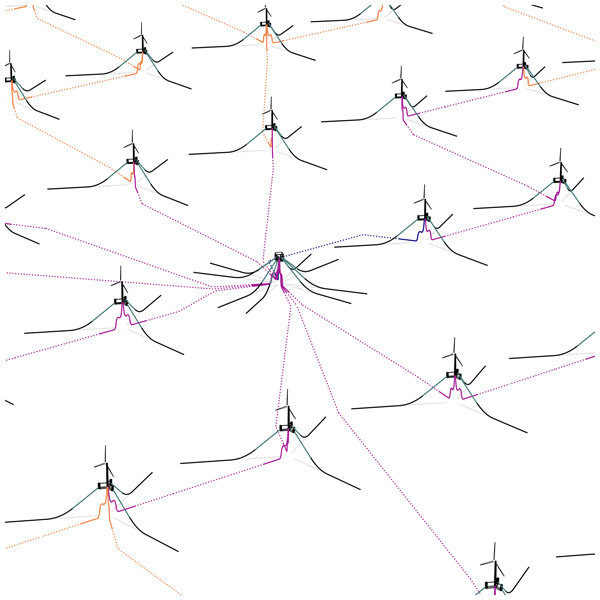
This paper presents GW-scale floating wind farm reference designs tailored to the site conditions of three regions. The array designs use a 15 MW semisubmersible floating turbine and include the array layout, mooring systems, dynamic power cables, array cable routing, and floating substations. The layout methodology includes spatial constraints for each subsystem. The resulting reference arrays provide open-source baseline designs to facilitate future floating wind research at the array scale.
Katarzyna Patryniak, Maurizio Collu, Jason Jonkman, Matthew Hall, Garrett Barter, Daniel Zalkind, and Andrea Coraddu
Wind Energ. Sci., 10, 2051–2077, https://doi.org/10.5194/wes-10-2051-2025, https://doi.org/10.5194/wes-10-2051-2025, 2025
Short summary
Short summary
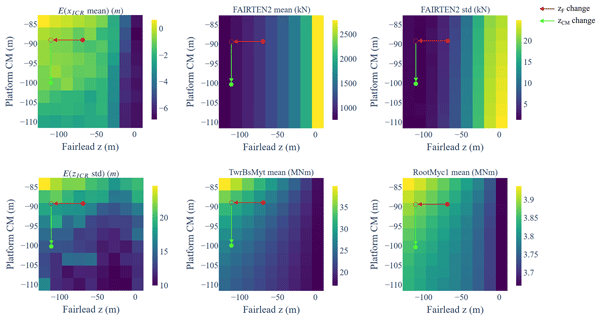
This paper studies the instantaneous centre of rotation (ICR) of floating offshore wind turbines (FOWTs). We present a method for computing the ICR and examine the correlations between the external loading, design features, ICR statistics, motions, and loads. We demonstrate how to apply the new insights to successfully modify the designs of the spar and semisubmersible FOWTs to reduce the loads in the moorings, the tower, and the blades, improving the ultimate strength and fatigue properties.
Mohammad Youssef Mahfouz, Ericka Lozon, Matthew Hall, and Po Wen Cheng
Wind Energ. Sci., 9, 1595–1615, https://doi.org/10.5194/wes-9-1595-2024, https://doi.org/10.5194/wes-9-1595-2024, 2024
Short summary
Short summary
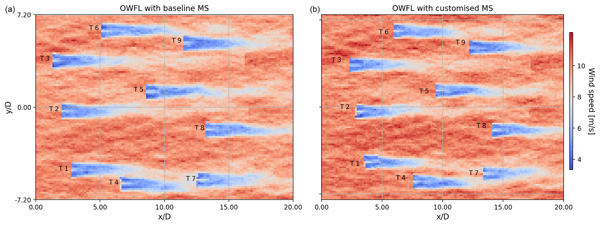
As climate change increasingly impacts our daily lives, a transition towards cleaner energy is needed. With all the growth in floating offshore wind and the planned floating wind farms (FWFs) in the next few years, we urgently need new techniques and methodologies to accommodate the differences between the fixed bottom and FWFs. This paper presents a novel methodology to decrease aerodynamic losses inside an FWF by passively relocating the downwind floating wind turbines out of the wakes.
Leah H. Sirkis, Ericka Lozon, and Matthew Hall
Wind Energ. Sci. Discuss., https://doi.org/10.5194/wes-2025-209, https://doi.org/10.5194/wes-2025-209, 2025
Preprint under review for WES
Short summary
Short summary
This paper presents GW-scale floating wind farm reference designs tailored to the site conditions of three regions. The array designs use a 15 MW semisubmersible floating turbine and include the array layout, mooring systems, dynamic power cables, array cable routing, and floating substations. The layout methodology includes spatial constraints for each subsystem. The resulting reference arrays provide open-source baseline designs to facilitate future floating wind research at the array scale.
Katarzyna Patryniak, Maurizio Collu, Jason Jonkman, Matthew Hall, Garrett Barter, Daniel Zalkind, and Andrea Coraddu
Wind Energ. Sci., 10, 2051–2077, https://doi.org/10.5194/wes-10-2051-2025, https://doi.org/10.5194/wes-10-2051-2025, 2025
Short summary
Short summary
This paper studies the instantaneous centre of rotation (ICR) of floating offshore wind turbines (FOWTs). We present a method for computing the ICR and examine the correlations between the external loading, design features, ICR statistics, motions, and loads. We demonstrate how to apply the new insights to successfully modify the designs of the spar and semisubmersible FOWTs to reduce the loads in the moorings, the tower, and the blades, improving the ultimate strength and fatigue properties.
Lucas Carmo, Jason Jonkman, and Regis Thedin
Wind Energ. Sci., 9, 1827–1847, https://doi.org/10.5194/wes-9-1827-2024, https://doi.org/10.5194/wes-9-1827-2024, 2024
Short summary
Short summary
As floating wind turbines progress to arrays with multiple units, it becomes important to understand how the wake of a floating turbine affects the performance of other units in the array. Due to the compliance of the floating substructure, the wake of a floating wind turbine may behave differently from that of a fixed turbine. In this work, we present an investigation of the mutual interaction between the motions of floating wind turbines and wakes.
Mohammad Youssef Mahfouz, Ericka Lozon, Matthew Hall, and Po Wen Cheng
Wind Energ. Sci., 9, 1595–1615, https://doi.org/10.5194/wes-9-1595-2024, https://doi.org/10.5194/wes-9-1595-2024, 2024
Short summary
Short summary
As climate change increasingly impacts our daily lives, a transition towards cleaner energy is needed. With all the growth in floating offshore wind and the planned floating wind farms (FWFs) in the next few years, we urgently need new techniques and methodologies to accommodate the differences between the fixed bottom and FWFs. This paper presents a novel methodology to decrease aerodynamic losses inside an FWF by passively relocating the downwind floating wind turbines out of the wakes.
Cited articles
Abdelmoteleb, S.-E. and Bachynski-Polić, E. E.: A frequency-domain optimization procedure for catenary and semi-taut mooring systems of floating wind turbines, Marine Structures, 101, 103768, https://doi.org/10.1016/j.marstruc.2024.103768, 2025. a
Allen, C., Viselli, A., Dagher, H., Goupee, A., Gaertner, E., Abbas, N., Hall, M., and Barter, G.: Definition of the UMaine VolturnUS-S reference platform developed for the IEA Wind 15-Megawatt offshore reference wind turbine, Tech. Rep. NREL/TP-5000-76773, National Renewable Energy Laboratory, https://doi.org/10.2172/1660012, 2020. a
Barltrop, N. (Ed.): Floating structures: a guide for design and analysis, Oilfield Publications Limited (OPL), Ledbury, England, ISBN: 978-1-87055-3353, 1998. a
Carmo, L. and Hall, M.: Slender-body approach for computing second-order wave loads in the frequency domain, Ocean Engineering, 322, https://doi.org/10.1016/j.oceaneng.2025.120558, 2025. a
Chen, P., Cheng, Z., Deng, S., Hu, Z., and Moan, T.: A frequency domain method for fully coupled modelling and dynamic analysis of floating wind turbines, Marine Structures, 99, 103715, https://doi.org/10.1016/j.marstruc.2024.103715, 2025. a
Connolly, P. and Hall, M.: Comparison of pilot-scale floating offshore wind farms with shared moorings, Ocean Engineering, 171, 172–180, https://doi.org/10.1016/j.oceaneng.2018.08.040, 2019. a
Ding, Q., Li, C., Yu, N., Hao, W., and Ji, J.: Numerical and experimental investigation into the dynamic response of a floating wind turbine spar array platform, Journal of Mechanical Science and Technology, 32, 1106–1116, https://doi.org/10.1007/s12206-018-0213-x, 2018. a
Faltinsen, O.: Sea loads on ships and offshore structures, Cambridge University press, ISBN: 9780521458702, 1993. a
Gaertner, E., Rinker, J., Sethuraman, L., Zahle, F., Anderson, B., Barter, G. E., Abbas, N. J., Meng, F., Bortolotti, P., Skrzypinski, W., Scott, G. N., Feil, R., Bredmose, H., Dykes, K., Shields, M., Allen, C., and Viselli, A.: IEA Wind TCP Task 37: Definition of the IEA 15-Megawatt offshore reference wind turbine, Tech. Rep. NREL/TP-5000-75698, National Renewable Energy Laboratory, https://doi.org/10.2172/1603478, 2020. a
Goldschmidt, M. and Muskulus, M.: Coupled mooring systems for floating wind farms, Energy Procedia, 80, 255–262, https://doi.org/10.1016/j.egypro.2015.11.429, 2015. a
Gözcü, O., Kontos, S., and Bredmose, H.: Dynamics of two floating wind turbines with shared anchor and mooring lines, Journal of Physics: Conference Series, 2265, 042026, https://doi.org/10.1088/1742-6596/2265/4/042026, 2022. a
Hall, M.: Generalized quasi-static mooring system modeling with analytic jacobians, Energies, 17, 3155, https://doi.org/10.3390/en17133155, 2024. a
Hall, M. and Connolly, P.: Coupled dynamics modelling of a floating wind farm with shared moorings, in: Proceedings of the ASME 2018 37th International Conference on Ocean, Offshore and Arctic Engineering, ASME, Madrid, Spain, https://doi.org/10.1115/OMAE2018-78489, 2018. a
Hall, M., Buckham, B., and Crawford, C.: Evolving offshore wind: Genetic algorithm-based optimization of floating wind turbine platforms, in: MTS/IEEE Oceans'13, Bergen, Norway, 2013, 1–10, https://doi.org/10.1109/OCEANS-Bergen.2013.6608173, 2013. a
Hall, M., Carmo, L., Housner, S., Zalkind, D., and Barter, G.: RAFT: v1.5, Zenodo [code], https://doi.org/10.5281/zenodo.17808357, 2025.
Hall, M., Lozon, E., Housner, S., and Sirnivas, S.: Design and analysis of a ten-turbine floating wind farm with shared mooring lines, Journal of Physics: Conference Series, 2362, 012016, https://doi.org/10.1088/1742-6596/2362/1/012016, 2022b. a, b
Hall, M., West, W., Housner, S., and Lozon, E.: Efficient modeling of floating wind arrays including current loads and seabed bathymetry, in: Proceedings of the ASME 2023 5th International Offshore Wind Technical Conference, 18–19 December 2023, Exeter, UK, https://doi.org/10.1115/IOWTC2023-119447, 2024. a
Hegseth, J. M., Bachynski, E. E., and Martins, J. R. R. A.: Integrated design optimization of spar floating wind turbines, Marine Structures, 72, https://doi.org/10.1016/j.marstruc.2020.102771, 2020. a
Jonkman, B., Platt, A., Mudafort, R., Branlard, E., Sprague, M., Ross, H., Slaughter, D., Jonkman, J., Hayman, G., cortadocodes3, Hall, M., Vijayakumar, G., Buhl, M., Russell9798, Bortolotti, P., Davies, R., reos-rcrozier, Ananthan, S., Michael, S., Rood, J., Damiani, R., Mendoza, N., sinolonghai, pschuenemann, Chetan, M., Sharma, A., Shaler, K., Housner, S., Wang, L., and psakievich: OpenFAST/openfast: v4.0.0, Zenodo [code], https://doi.org/10.5281/zenodo.14553563, 2024.
Lemmer, F., Yu, W., Luhmann, B., Schlipf, D., and Cheng, P. W.: Multibody modeling for concept-level floating offshore wind turbine design, Multibody System Dynamics, 49, 203–236, https://doi.org/10.1007/s11044-020-09729-x, 2020. a
Liang, G., Merz, K., and Jiang, Z.: Modeling of a shared mooring system for a dual-spar configuration, in: Proceedings of the ASME 2020 39th International Conference on Ocean, Offshore and Arctic Engineering, 3–7 August 2020, virtual conference, https://doi.org/10.1115/OMAE2020-18467, 2020. a
Lozon, E. and Hall, M.: Coupled loads analysis of a novel shared-mooring floating wind farm, Applied Energy, 332, 120513, https://doi.org/10.1016/j.apenergy.2022.120513, 2023. a
Lozon, E., Hall, M., and Mahfouz, M. Y.: Coupled modeling of wake steering and platform offsets for floating wind arrays, Journal of Physics: Conference Series, 2767, 062035, https://doi.org/10.1088/1742-6596/2767/6/062035, 2024. a
Lupton, R. C. and Langley, R. S.: Improved linearised models of wind turbine aerodynamics and control system dynamics using harmonic linearisation, Renew. Energy, 135, https://doi.org/10.1016/j.renene.2018.11.067, 2019. a
Morison, J., O'Brien, M., Johnson, J., and Schaaf, S.: The force exerted by surface waves on piles, Journal of Petroleum Technology, 2, 149–154, https://doi.org/10.2118/950149-G, 1950. a
Munir, H., Lee, C. F., and Ong, M. C.: Global analysis of floating offshore wind turbines with shared mooring system, IOP Conference Series: Materials Science and Engineering, 1201, 012024, https://doi.org/10.1088/1757-899x/1201/1/012024, 2021. a
Pegalajar-Jurado, A., Borg, M., and Bredmose, H.: An efficient frequency-domain model for quick load analysis of floating offshore wind turbines, Wind Energ. Sci., 3, 693–712, https://doi.org/10.5194/wes-3-693-2018, 2018. a
Wayman, E.: Coupled dynamics and economic analysis of floating wind turbine systems, Masters thesis, MIT, Massachusetts Institute of Technology, http://hdl.handle.net/1721.1/35650 (last access: 23 February 2016), 2006. a
Wilson, S., Hall, M., Housner, S., and Sirnivas, S.: Linearized modeling and optimization of shared mooring systems, Ocean Engineering, 241, 110009, https://doi.org/10.1016/j.oceaneng.2021.110009, 2021. a
Yang, C., Xiao, L., Chen, P., Cheng, Z., Liu, M., and Liu, L.: An analytical frequency-domain model of aerodynamic mass and damping of floating wind turbines, Wind Energy, 26, 1140–1164, https://doi.org/10.1002/we.2861, 2023. a
Short summary
This paper presents a frequency-domain dynamics modeling approach for multiple floating wind turbines that are connected by shared mooring lines. It models the wave excitation and response of each floating platform and computes the shared mooring line reactions based on the relative platform motions. A two-turbine scenario demonstrates the approach, and comparison with an established time-domain model verifies its accuracy. The results reveal a new shared mooring tension-dynamics phenomenon.
This paper presents a frequency-domain dynamics modeling approach for multiple floating wind...
Altmetrics
Final-revised paper
Preprint