Articles | Volume 11, issue 5
https://doi.org/10.5194/wes-11-1553-2026
© Author(s) 2026. This work is distributed under
the Creative Commons Attribution 4.0 License.
https://doi.org/10.5194/wes-11-1553-2026
© Author(s) 2026. This work is distributed under
the Creative Commons Attribution 4.0 License.
Reliability and O&M key performance indicators of onshore and offshore wind turbines based on field-data analysis

Julia Walgern
CORRESPONDING AUTHOR
Fraunhofer Institute for Wind Energy Systems IWES, 30159 Hannover, Germany
University of Strathclyde, 16 Richmond St, Glasgow G1 1XQ, United Kingdom
Nils Stratmann
Fraunhofer Institute for Wind Energy Systems IWES, 30159 Hannover, Germany
Leibniz University Hannover, Welfengarten 1, 30167 Hannover, Germany
Martin Horn
Fraunhofer Institute for Wind Energy Systems IWES, 30159 Hannover, Germany
Leibniz University Hannover, Welfengarten 1, 30167 Hannover, Germany
Nathalene W. Y. Then
Fraunhofer Institute for Wind Energy Systems IWES, 30159 Hannover, Germany
Leibniz University Hannover, Welfengarten 1, 30167 Hannover, Germany
Moritz Menzel
Fraunhofer Institute for Wind Energy Systems IWES, 30159 Hannover, Germany
Leibniz University Hannover, Welfengarten 1, 30167 Hannover, Germany
Fraser Anderson
Fraunhofer Institute for Wind Energy Systems IWES, 30159 Hannover, Germany
Fraunhofer UK Research Ltd., 99 George St., Glasgow G1 1RD, United Kingdom
Athanasios Kolios
University of Strathclyde, 16 Richmond St, Glasgow G1 1XQ, United Kingdom
Technical University of Denmark, Department of Wind & Energy Systems, Risø Campus, Frederiksborgvej 399, 4000 Roskilde, Denmark
Katharina Fischer
Fraunhofer Institute for Wind Energy Systems IWES, 30159 Hannover, Germany
Related authors
No articles found.
Timo Lichtenstein, Martin Hippenstiel, and Katharina Fischer
Wind Energ. Sci., 11, 1963–1970, https://doi.org/10.5194/wes-11-1963-2026, https://doi.org/10.5194/wes-11-1963-2026, 2026
Short summary
Short summary
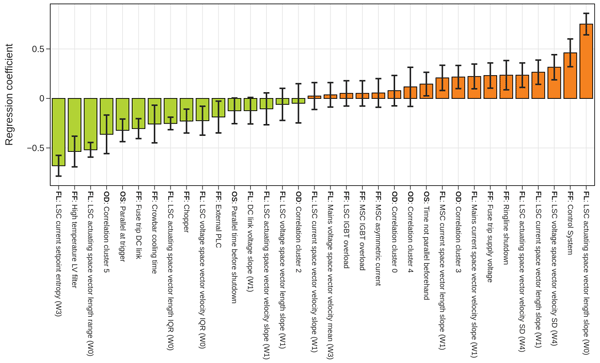
Power converter faults in wind turbines often lead to costly downtime and repeated maintenance. We present a practical, explainable, and fully data-driven approach that utilizes high-resolution converter control system records, 1 min operating data, and event logs to predict whether a fault leads to a long or short standstill. By combining engineered features with interpretable feature reduction, we achieve 89 % accuracy and an F1 score of 0.86, providing support for remote decision-making.
Bruno Rodrigues Faria, Nikolay Dimitrov, Nikhil Sudhakaran, Matthias Stammler, Athanasios Kolios, W. Dheelibun Remigius, Xiaodong Zhang, and Asger Bech Abrahamsen
Wind Energ. Sci., 11, 1583–1606, https://doi.org/10.5194/wes-11-1583-2026, https://doi.org/10.5194/wes-11-1583-2026, 2026
Short summary
Short summary
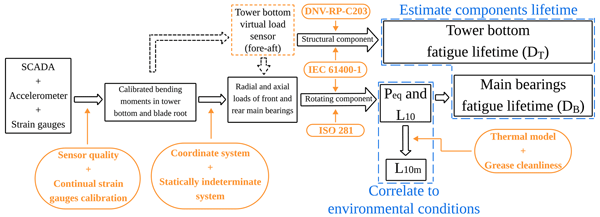
This study presents continuous lifetime assessments of wind turbine structural (tower) and rotating components (main bearings) over nearly a decade, combining controller data, calibrated load measurements, and a virtual load sensor at the tower bottom. The components' estimated lifetimes exceeded the design lifetime. Contrary to expectations, lower turbulence intensity at rated wind speed increased fatigue loads of the locating main bearing due to turbulence averaging.
Carlo L. Bottasso, Sandrine Aubrun, Nicolaos A. Cutululis, Julia Gottschall, Athanasios Kolios, Jakob Mann, and Paul Veers
Wind Energ. Sci., 11, 347–348, https://doi.org/10.5194/wes-11-347-2026, https://doi.org/10.5194/wes-11-347-2026, 2026
Short summary
Short summary
This editorial celebrates the 10th anniversary of Wind Energy Science, reflecting on a decade of rapid scientific progress and the journal’s role in advancing fundamental, interdisciplinary research. It highlights key developments in wind energy, the importance of open science and academia–industry collaboration, and emerging challenges such as data sharing and artificial intelligence. Above all, it honors the research community that has shaped the journal and looks ahead to the next decade.
Moritz Johann Gräfe, Azélice Ludot, Matt Shields, Athanasios Kolios, Rajasekhar Pulikollu, and Nikolay Dimitrov
Wind Energ. Sci. Discuss., https://doi.org/10.5194/wes-2026-31, https://doi.org/10.5194/wes-2026-31, 2026
Preprint under review for WES
Short summary
Short summary
This study examines the risk drivers of the economic success of wind energy projects and how interacting risks threaten that success. We combined expert opinions, survey results, and literature findings to identify key challenges in planning and operation. The results show that risks interact and can cause uneven financial losses, highlighting the need for integrated decision support tools.
Innes Murdo Black, Moritz Werther Häckell, and Athanasios Kolios
Wind Energ. Sci., 10, 2889–2901, https://doi.org/10.5194/wes-10-2889-2025, https://doi.org/10.5194/wes-10-2889-2025, 2025
Short summary
Short summary
Population-based structural health monitoring minimises costs by efficiently sharing information within a wind farm, reducing the need for many sensors and model updates.
Büsra Yildirim, Nikolay Dimitrov, Athanasios Kolios, and Asger Bech Abrahamsen
Wind Energ. Sci. Discuss., https://doi.org/10.5194/wes-2025-115, https://doi.org/10.5194/wes-2025-115, 2025
Revised manuscript not accepted
Short summary
Short summary
A surrogate-based design optimization framework has been implemented for a floating wind turbine. By integrating surrogate modeling and analytical design constraints, computationally efficient exploration of design spaces is ensured. This integration provides a connection between conceptual and detailed design. The proposed methodology achieved a reduction of 3.7 % in the Levelized Cost of Energy, considering ultimate, fatigue, and serviceability limit states.
Azélice Ludot, Thor Heine Snedker, Athanasios Kolios, and Ilmas Bayati
Wind Energ. Sci. Discuss., https://doi.org/10.5194/wes-2024-162, https://doi.org/10.5194/wes-2024-162, 2025
Preprint withdrawn
Short summary
Short summary
This paper presents a methodology to develop machine learning models designed to predict, in real-time, hourly fatigue damage accumulation in the mooring lines of floating wind turbines, from measurements of five environmental variables: wind speed, wind direction, wave height, wave period, and wind-wave misalignment. The proposed tool is intended for predictive maintenance applications, which has been identified as a key area for cost reduction in floating wind.
Mareike Leimeister, Maurizio Collu, and Athanasios Kolios
Wind Energ. Sci., 7, 259–281, https://doi.org/10.5194/wes-7-259-2022, https://doi.org/10.5194/wes-7-259-2022, 2022
Short summary
Short summary
Floating offshore wind technology has high potential but still faces challenges for gaining economic competitiveness to allow commercial market uptake. Hence, design optimization plays a key role; however, the final optimum floater obtained highly depends on the specified optimization problem. Thus, by considering alternative structural realization approaches, not very stringent limitations on the structure and dimensions are required. This way, more innovative floater designs can be captured.
Cited articles
Anderson, F., Dawid, R., McMillan, D., and Garcia Cava, D.: On the sensitivity of wind turbine failure rate estimates to failure definitions, J. Phys. Conf. Ser., 2626, https://doi.org/10.1088/1742-6596/2626/1/012025, 2023.
Anderson, F., Pelka, K., Walgern, J. L. T., and Fischer, K.: Trends and influencing factors in power-converter reliability of wind turbines: A deepened analysis, IEEE Trans. Power Electron., 1–12, https://doi.org/10.1109/TPEL.2025.3530163, 2025a.
Anderson, F., Walgern, J., and Fischer, K.: Early, Intrinsic and Deterioration Stage Wind Turbine Reliability Models: A Case Study for the Converter System, J. Phys. Conf. Ser., 3131, 012029, https://doi.org/10.1088/1742-6596/3131/1/012029, 2025b.
Artigao, E., Martin-Martinez, S., Ceña, A., Honrubia-Escribano, A., and Gomez-Lazaro, E.: Failure rate and downtime survey of wind turbines located in Spain, IET Renew. Power Gener., 15, 225–236, https://doi.org/10.1049/rpg2.12019, 2021.
Ayyildiz, E. and Erdogan, M.: A comprehensive approach to evaluate risk mitigation strategies in offshore wind farms using spherical fuzzy decision making analysis, Ocean Eng., 221, 118881, https://doi.org/10.1016/j.oceaneng.2024.118881, 2024.
Bain, L. J. and Engelhardt, M.: Statistical analysis of reliability and life testing models: theory and methods, Dekker, New York, ISBN 0824785061, 1991.
Black, I. M., Richmond, M., and Kolios, A.: Condition monitoring systems: a systematic literature review on machine-learning methods improving offshore-wind turbine operational management, Int. J. Sustain. Energy, 40, 923–946, https://doi.org/10.1080/14786451.2021.1890736, 2021.
BVG Associates: Guide to an offshore wind farm, BVG Associates, 2019.
Carroll, J., McDonald, A., and McMillan, D.: Reliability comparison of wind turbines with DFIG and PMG drive trains, IEEE Trans. Energy Convers., 30, 663–670, https://doi.org/10.1109/TEC.2014.2367243, 2015.
Carroll, J., McDonald, A., and McMillan, D.: Failure rate, repair time and unscheduled O&M cost analysis of offshore wind turbines, Wind Energy, 19, 1107–1119, https://doi.org/10.1002/we.1887, 2016.
Carroll, J., Koukoura, S., McDonald, A., Charalambous, A., Weiss, S., and McArthur, S.: Wind turbine gearbox failure and remaining useful life prediction using machine learning techniques, Wind Energy, 22, 360–375, https://doi.org/10.1002/we.2290, 2018.
Cevasco, D., Koukoura, S., and Kolios, A.: Reliability, availability, maintainability data review for the identification of trends in offshore wind energy applications, Renew. Sustain. Energy Rev., 135, 110181, https://doi.org/10.1016/j.rser.2020.110414, 2021.
Dahane, M., Sahnoun, M., Bettayeb, B., Baudry, D., and Boudhar, H.: Impact of spare parts remanufacturing on the operation and maintenance performance of offshore wind turbines: a multi-agent approach, J. Intell. Manuf., 28, 1531–1549, https://doi.org/10.1007/s10845-015-1154-1, 2015.
Dao, C., Kazemtabrizi, B., and Crabtree, C.: Wind turbine reliability data review and impacts on levelised cost of energy, Wind Energy, 22, 1848–1871, https://doi.org/10.1002/we.2404, 2019.
Donnelly, O., Carroll, J., and Howland, M.: Analysing the cost impact of failure rates for the next generation of offshore wind turbines, Wind Energy, 27, 695–710, https://doi.org/10.1002/we.2907, 2024.
Encalada-Dávilla, A., Tutiven, C., Puruncajas, B., and Vidal, Y.: Wind turbine multi-fault detection based on SCADA data via an autoencoder, Renew. Energ. Power Qual. J., 19, 4, https://doi.org/10.24084/repqj19.325, 2021.
Faulstich, S., Hahn, B., and Tavner, P. J.: Wind turbine downtime and its importance for offshore deployment, Wind Energy, 14, 327–337, https://doi.org/10.1002/we.421, 2011.
FGW e.V. – Fördergesellschaft Windenergie und andere Erneuerbare Energien: Technical guidelines for power generating units – State-Event-Cause code for power generating units (ZEUS), FGW e.V., Berlin, 2013.
Fischer, K., Pelka, K., Bartschat, A., Tegtmeier, B., Coronado, D., and Broer, C.: Reliability of power converters in wind turbines: exploratory analysis of failure and operating data from a worldwide turbine fleet, IEEE Trans. Power Electron., 34, 6332–6344, https://doi.org/10.1109/TPEL.2018.2875005, 2019a.
Fischer, K., Pelka, K., Puls, S., Poech, M.-H., Mertens, A., Bartschat, A., Tegtmeier, B., Broer, C., and Wenske, J.: Exploring the causes of power-converter failure in wind turbines based on comprehensive field-data and damage analysis, Energies, 12, 678, https://doi.org/10.3390/en12040593, 2019b.
Fischer, K., Pelka, K., and Walgern, J.: Trends and influencing factors in power-converter reliability of wind turbines, in: Proc. PCIM Europe 2023, Nürnberg, Germany, https://doi.org/10.30420/566091068, 2023.
Fraunhofer IEE: WInD-Pool – Windenergie-Informations-Daten-Pool, Fraunhofer IEE, 2018.
Gayo, J. B.: Final publishable summary of results of project ReliaWind, https://cordis.europa.eu/docs/results/212/212966/110513-reliawind-final-publishable-summary-to-ec.pdf (last access: 25 April 2026), 2011.
Hahn, B., Durstewitz, M., and Rohrig, K.: Reliability of wind turbines, Wind Energy, 10, 329–332, https://doi.org/10.1007/978-3-540-33866-6_62, 2007.
Hahn, B., Welte, T., Faulstich, S., Bangalore, P., Boussion, C., Harrison, K., Miguelanez-Martin, E., O'Connor, F., Pettersson, L., Soraghan, C., Stock-Williams, C., Sørensen, J., van Bussel, G., and Vatn, J.: Recommended practices for wind farm data collection and reliability assessment for O&M optimization, Energ. Proced., 137, 358–365, https://doi.org/10.1016/j.egypro.2017.10.360, 2017.
Hart, E., Clarke, B., Nicholas, G., Kazemi Amiri, A., Stirling, J., Carroll, J., Dwyer-Joyce, R., McDonald, A., and Long, H.: A review of wind turbine main bearings: design, operation, modelling, damage mechanisms and fault detection, Wind Energ. Sci., 5, 105–124, https://doi.org/10.5194/wes-5-105-2020, 2020.
Ioannou, A., Angus, A., and Brennan, F.: A lifecycle techno-economic model of offshore wind energy for different entry and exit instances, Appl. Energy, 406–424, https://doi.org/10.1016/j.apenergy.2018.03.143, 2018.
Jeong, S., Kim, E.-J., Shin, D. H., Park, J.-W., and Sim, S.-H.: Data fusion-based damage identification for a monopile offshore wind turbine structure using wireless smart sensors, Ocean Eng., 195, 106728, https://doi.org/10.1016/j.oceaneng.2019.106728, 2020.
Kavakli, M. and Gudmestad, O. T.: Analysis and assessment of onshore and offshore wind turbine failures, Int. J. Energy Prod. Manag., 8, 27–34, https://doi.org/10.18280/ijepm.080104, 2023.
Khan, P. W. and Byun, Y.-C.: A review of machine learning techniques for wind turbine fault detection, diagnosis, and prognosis, Int. J. Green Energy, 21, 771–786, https://doi.org/10.1080/15435075.2023.2217901, 2024.
Koukoura, S.: Wind turbine gearbox diagnostics using artificial intelligence, University of Strathclyde, Glasgow, 2019.
Kusiak, A. and Verma, A.: A data-driven approach for monitoring blade pitch faults in wind turbines, IEEE Trans. Sustain. Energy, 2, 87–96, https://doi.org/10.1109/TSTE.2010.2066585, 2011.
Le, B. and Andrews, J.: Modelling wind turbine degradation and maintenance, Wind Energy, 19, 571–591, https://doi.org/10.1002/we.1851, 2015.
Leahy, K., Gallagher, C., O'Donovan, P., and O'Sullivan, D. T. J.: Issues with data quality for wind turbine condition monitoring and reliability analyses, Energies, 12, 201, https://doi.org/10.3390/en12020201, 2019.
Leimeister, M. and Kolios, A.: A review of reliability-based methods for risk analysis and their application in the offshore wind industry, Renew. Sustain. Energy Rev., 91, 1065–1076, https://doi.org/10.1016/j.rser.2018.04.004, 2018.
Li, H. and Guedes Soares, C.: Assessment of failure rates and reliability of floating offshore wind turbines, Reliab. Eng. Syst. Saf., 228, 108777, https://doi.org/10.1016/j.ress.2022.108777, 2022.
Li, J., Bian, J., Chuang, Z., Jiang, Y., and Leng, S.: Impact of pitch actuator fault on 10-MW semi-submersible floating wind turbine, Ocean Eng., 254, 111375, https://doi.org/10.1016/j.oceaneng.2022.111375, 2022.
Lopez, J. C. and Kolios, A.: Risk-based maintenance strategy selection for wind turbine composite blades, Energy Rep., 8, 5541–5561, https://doi.org/10.1016/j.egyr.2022.04.027, 2022.
Lorenzo-Espejo, A., Escudero-Santana, A., Muñoz-Díaz, M.-L., and Robles-Velasco, A.: Machine learning-based analysis of a wind turbine manufacturing operation: a case study, Sustainability, 14, 7779, https://doi.org/10.3390/su14137779, 2022.
Martinez-Luengo, M., Shafiee, M., and Kolios, A.: Data management for structural integrity assessment of offshore wind turbine support structures: data cleansing and missing data imputation, Ocean Eng., 173, 867–883, https://doi.org/10.1016/j.oceaneng.2019.01.003, 2019.
Pfaffel, S., Faulstich, S., and Rohrig, K.: Performance and reliability of wind turbines: a review, Energies, 10, 1–27, https://doi.org/10.3390/en10111904, 2017.
Pulcini, G.: Modeling the failure data of a repairable equipment with bathtub type failure intensity, Reliab. Eng. Syst. Saf., 71, 209–218, https://doi.org/10.1016/S0951-8320(00)00101-0, 2001.
Reder, M. D., Gonzalez, E., and Melero, J. J.: Wind turbine failures – tackling current problems in failure data analysis, J. Phys. Conf. Ser., 753, 072027, https://doi.org/10.1088/1742-6596/753/7/072027, 2016.
Rigdon, S. and Basu, A.: Statistical methods for the reliability of repairable systems, John Wiley and Sons, New York, ISBN 978-0-471-34941-9, 2000.
Scheu, M. N., Kolios, A., Fischer, T., and Brennan, F.: Influence of statistical uncertainty of component reliability estimations on offshore wind farm availability, Reliab. Eng. Syst. Saf., 168, 28–39, https://doi.org/10.1016/j.ress.2017.05.021, 2017.
Scheu, M. N., Tremps, L., Smolka, U., Kolios, A., and Brennan, F.: A systematic failure mode effects and criticality analysis for offshore wind turbine systems towards integrated condition-based maintenance strategies, Ocean Eng., 176, 118–133, https://doi.org/10.1016/j.oceaneng.2019.02.048, 2019.
SPARTA: Portfolio review 2016: system performance, availability and reliability trend analysis, SPARTA Project, Northumberland, UK, 2017.
SPARTA: Portfolio review 2020/21: system performance, availability and reliability trend analysis, ORE Catapult, UK, 2022.
Spinato, F., Tavner, P., van Bussel, G., and Koutoulakos, E.: Reliability of wind turbine subassemblies, IET Renew. Power Gener., 3, 1–9, https://doi.org/10.1049/iet-rpg.2008.0060, 2009.
Stehly, T., Duffy, P., and Mulas Hernando, D.: Cost of wind energy review: 2024 edition, National Renewable Energy Laboratory, US, 2024.
Tavner, P., Xiang, J., and Spinato, F.: Reliability analysis for wind turbines, Wind Energy, 10, 1–18, https://doi.org/10.1002/we.204, 2007.
Tavner, P. J., Greenwood, D. M., Whittle, M. W. G., Gindele, R., Faulstich, S., and Hahn, B.: Study of weather and location effects on wind turbine failure rates, Wind Energy, 16, 175–187, https://doi.org/10.1002/we.538, 2012.
The Crown Estate: Jack-up vessel optimisation – improving offshore wind performance through better use of jack-up vessels in the operations and maintenance phase, The Crown Estate, London, UK, https://de.scribd.com/document/481722825/Jack-up-vessel-optimisation-in-offshore-wind-O-M-by-Generating-Better-for-The-Crown-Estate (last access: 25 April 2026), 2014.
Tremps, L., Yeter, B., and Kolios, A.: Review and analysis of the failure risk mitigation via monitoring for monopile offshore wind structures, Energy Rep., 11, 5407–5420, https://doi.org/10.1016/j.egyr.2024.05.026, 2024.
Turnbull, A., McKinnon, C., Carroll, J., and McDonald, A.: On the development of offshore wind turbine technology: an assessment of reliability rates and fault detection methods in a changing market, Energies, 15, 3180, https://doi.org/10.3390/en15093180, 2022.
VGB PowerTech: VGB-Standard RDS-PP Application Guideline Part 32: Wind Power Plants, VGB PowerTech, 2014.
Walgern, J., Fischer, K., Hentschel, P., and Kolios, A.: Reliability of electrical and hydraulic pitch systems in wind turbines based on field-data analysis, Energy Rep., 9, 3273–3281, https://doi.org/10.1016/j.egyr.2023.02.007, 2023.
Walgern, J., Anderson, F., and Fischer, K.: Field-data based wind turbine reliability modelling: Quantifying effects of design, technological development, operating age and environmental and load conditions, Wind Energy Science Conference WESC 2025, Nantes, France, https://doi.org/10.24406/publica-5515, 2025.
Walgern, J., Anderson, F., Kolios, A., and Fischer, K.: Field-data based wind turbine reliability modelling: Quantifying effects of operating age, design and technological development, Wind Energy, https://doi.org/10.1002/we.70108, accepted for publication, 2026.
Wang, J., Liang, D., Li, Z., Hong, Z., Song, X., and Deng, Y.: Data-driven reliability assessment of wind power system operation state, in: Proc. 3rd Power System and Green Energy Conf. (PSGEC), IEEE, Shanghai, China, 98–104, https://doi.org/10.1109/PSGEC58411.2023.10256008, 2023.
Zaher, A., McArthur, S. D. J., Infield, D. G., and Patel, Y.: Online wind turbine fault detection through automated SCADA data analysis, Wind Energy, 12, 574–593, https://doi.org/10.1002/we.319, 2009.
Short summary
This study analyses maintenance data from over 1000 onshore and offshore wind turbines, covering 4200 operating years, to assess failure rates, repair times, and maintenance needs. It compares failure rates per turbine and per megawatt, examines time-dependent failure behaviour, and evaluates maintenance interventions. Results show higher onshore failure rates and identify the pitch, control, and converter systems as most critical.
This study analyses maintenance data from over 1000 onshore and offshore wind turbines, covering...
Altmetrics
Final-revised paper
Preprint