
Articles | Volume 10, issue 12
https://doi.org/10.5194/wes-10-2889-2025
© Author(s) 2025. This work is distributed under the Creative Commons Attribution 4.0 License.
Research article
| 
08 Dec 2025
Research article |
| 08 Dec 2025
| 08 Dec 2025
Population-based structural health monitoring: homogeneous offshore wind model development
Related authors
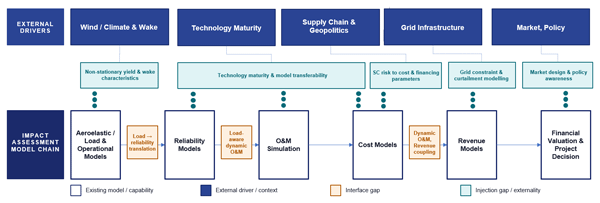
Wind Energ. Sci., 11, 3475–3507, 2026
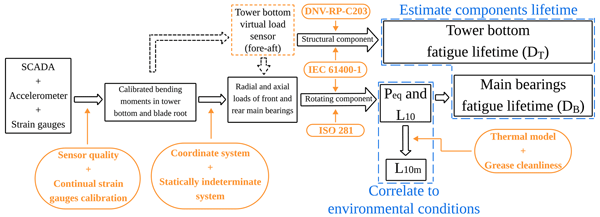
Wind Energ. Sci., 11, 1583–1606, 2026
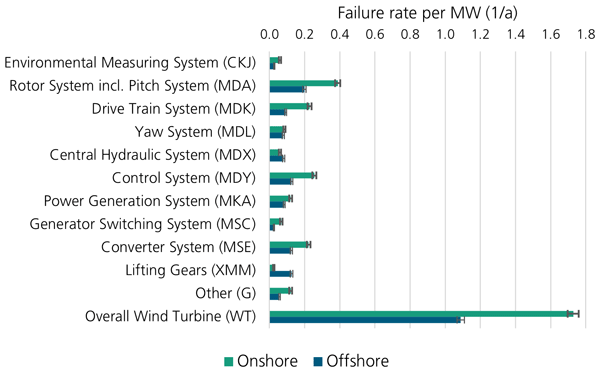
Wind Energ. Sci., 11, 1553–1568, 2026
Wind Energ. Sci. Discuss., 2025
Revised manuscript not accepted
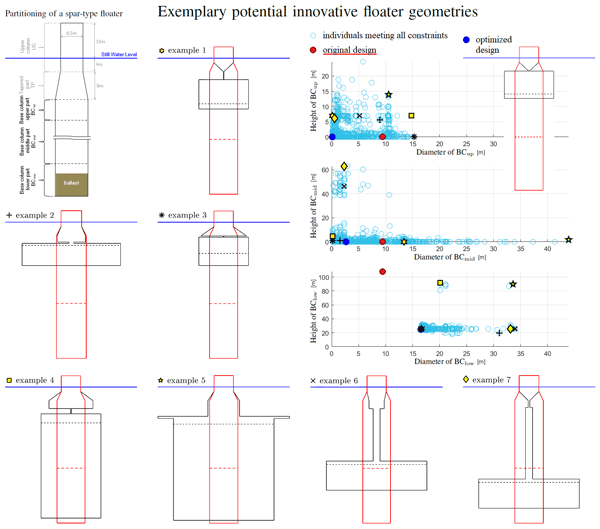
Cited articles
Anderlik, S., Stumptner, R., Freudenthaler, B., and Fritz, M.: A proposal for ontology-based integration of heterogeneous decision support systems for structural health monitoring, iiWAS, https://doi.org/10.1145/1967486.1967515, 2010. a
ASTM: Standard Practices for Cycle Counting in Fatigue Analysis, https://store.astm.org/e1049-85r17.html (last access: 10 October 2023), 2017. a
Black, I. M., Cevasco, D., and Kolios, A.: Deep Neural Network Hard Parameter Multi-Task Learning for Condition Monitoring of an Offshore Wind Turbine, Journal of Physics: Conference Series, 2265, 032091, https://doi.org/10.1088/1742-6596/2265/3/032091, 2022. a
Bull, L. A., Gardner, P. A., Gosliga, J., Rogers, T. J., Dervilis, N., Cross, E. J., Papatheou, E., Maguire, A. E., Campos, C., and Worden, K.: Foundations of population-based SHM, Part I: Homogeneous populations and forms, Mech. Syst. Signal Process., 148, 107141, https://doi.org/10.1016/j.ymssp.2020.107141, 2021. a
Chelba, C. and Acero, A.: Adaptation of Maximum Entropy Capitalizer: Little Data Can Help a Lo, in: Proceedings of the 2004 Conference on Empirical Methods in Natural Language Processing, Association for Computational Linguistics, Barcelona, Spain, 285–292, https://aclanthology.org/W04-3237 (last access: 10 October 2023), 2004. a, b


