
Articles | Volume 11, issue 4
https://doi.org/10.5194/wes-11-1343-2026
© Author(s) 2026. This work is distributed under
the Creative Commons Attribution 4.0 License.
the Creative Commons Attribution 4.0 License.
https://doi.org/10.5194/wes-11-1343-2026
© Author(s) 2026. This work is distributed under
the Creative Commons Attribution 4.0 License.
the Creative Commons Attribution 4.0 License.
Research article
| 
22 Apr 2026
Research article |
| 22 Apr 2026
| 22 Apr 2026
Low-level jets in the southern North Sea: implications for wind turbine performance using Doppler lidar observations
Pauline Haezebrouck
CORRESPONDING AUTHOR

Laboratoire de Physico-Chimie de l'Atmosphère (LPCA), Université du Littoral Côte d'Opale (ULCO), Dunkerque, France
Elsa Dieudonné
Laboratoire de Physico-Chimie de l'Atmosphère (LPCA), Université du Littoral Côte d'Opale (ULCO), Dunkerque, France
Anton Sokolov
Laboratoire de Physico-Chimie de l'Atmosphère (LPCA), Université du Littoral Côte d'Opale (ULCO), Dunkerque, France
Hervé Delbarre
Laboratoire de Physico-Chimie de l'Atmosphère (LPCA), Université du Littoral Côte d'Opale (ULCO), Dunkerque, France
Patrick Augustin
Laboratoire de Physico-Chimie de l'Atmosphère (LPCA), Université du Littoral Côte d'Opale (ULCO), Dunkerque, France
Marc Fourmentin
Laboratoire de Physico-Chimie de l'Atmosphère (LPCA), Université du Littoral Côte d'Opale (ULCO), Dunkerque, France
Related authors
Elsa Dieudonné, Pauline Haezebrouck, Perrine Maynard, Anton Sokolov, Hervé Delbarre, Patrick Augustin, and Marc Fourmentin
EGUsphere, https://doi.org/10.5194/egusphere-2025-5639, https://doi.org/10.5194/egusphere-2025-5639, 2026
Preprint archived
Short summary
Short summary
Doppler lidars are now commonly used by the wind energy industry and weather agencies to retrieve vertical profiles of the horizontal wind speed and direction. Commercial instruments rely on the Doppler Beam Swinging technique to reconstruct the wind profile from the raw observations. This study investigates another profiling technique that does not have a blind layer near the ground and is less sensitive to contamination from high-altitude clouds.
Elsa Dieudonné, Pauline Haezebrouck, Perrine Maynard, Anton Sokolov, Hervé Delbarre, Patrick Augustin, and Marc Fourmentin
EGUsphere, https://doi.org/10.5194/egusphere-2025-5639, https://doi.org/10.5194/egusphere-2025-5639, 2026
Preprint archived
Short summary
Short summary
Doppler lidars are now commonly used by the wind energy industry and weather agencies to retrieve vertical profiles of the horizontal wind speed and direction. Commercial instruments rely on the Doppler Beam Swinging technique to reconstruct the wind profile from the raw observations. This study investigates another profiling technique that does not have a blind layer near the ground and is less sensitive to contamination from high-altitude clouds.
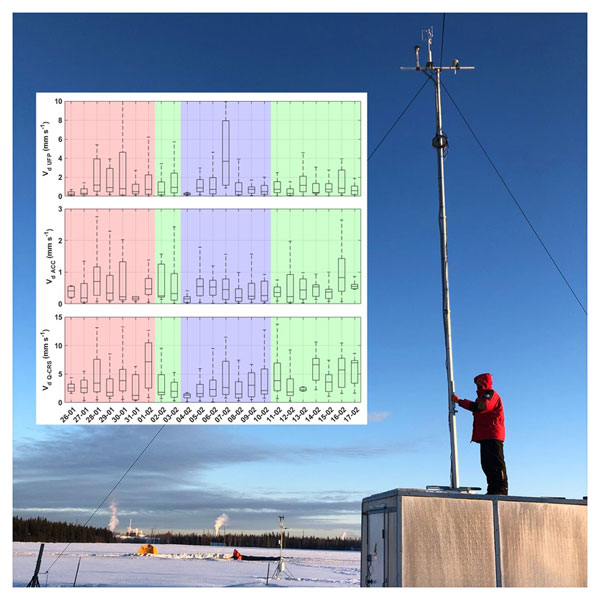
Antonio Donateo, Gianluca Pappaccogli, Federico Scoto, Maurizio Busetto, Francesca L. Lovisco, Natalie Brett, Douglas Keller, Brice Barret, Elsa Dieudonné, Roman Pohorsky, Andrea Baccarini, Slimane Bekki, Jean-Christophe Raut, Julia Schmale, Kathy S. Law, Steve R. Arnold, Javier G. Fochesatto, William R. Simpson, and Stefano Decesari
Atmos. Chem. Phys., 25, 18129–18156, https://doi.org/10.5194/acp-25-18129-2025, https://doi.org/10.5194/acp-25-18129-2025, 2025
Short summary
Short summary
A study in Fairbanks, Alaska, measured winter aerosol fluxes on snow. Both emission and deposition occurred, with larger particles settling faster. Weather influenced dispersion and deposition, while wind-driven turbulence enhanced deposition despite stable conditions. Results show aerosol accumulation in snow impacts pollution and snowmelt. Findings help improve aerosol models and pollution studies in cold cities.
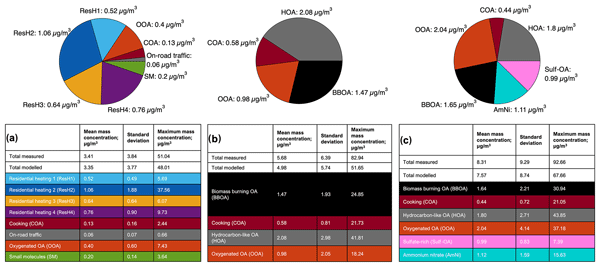
Amna Ijaz, Brice Temime-Roussel, Benjamin Chazeau, Sarah Albertin, Stephen R. Arnold, Brice Barret, Slimane Bekki, Natalie Brett, Meeta Cesler-Maloney, Elsa Dieudonne, Kayane K. Dingilian, Javier G. Fochesatto, Jingqiu Mao, Allison Moon, Joel Savarino, William Simpson, Rodney J. Weber, Kathy S. Law, and Barbara D'Anna
Atmos. Chem. Phys., 25, 11789–11811, https://doi.org/10.5194/acp-25-11789-2025, https://doi.org/10.5194/acp-25-11789-2025, 2025
Short summary
Short summary
Fairbanks is among the most polluted cities, with the highest particulate matter (PM) levels in the US during winters. Highly time-resolved measurements of the submicron PM found residential heating with wood and oil and hydrocarbon-like organics from traffic, as well as sulfur-containing aerosol, to be the key pollution sources. Remarkable differences existed between complementary instruments, warranting the deployment of multiple tools at sites, with wide-ranging influences.
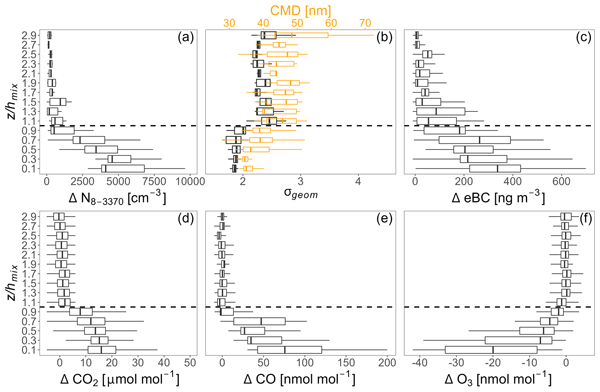
Roman Pohorsky, Andrea Baccarini, Natalie Brett, Brice Barret, Slimane Bekki, Gianluca Pappaccogli, Elsa Dieudonné, Brice Temime-Roussel, Barbara D'Anna, Meeta Cesler-Maloney, Antonio Donateo, Stefano Decesari, Kathy S. Law, William R. Simpson, Javier Fochesatto, Steve R. Arnold, and Julia Schmale
Atmos. Chem. Phys., 25, 3687–3715, https://doi.org/10.5194/acp-25-3687-2025, https://doi.org/10.5194/acp-25-3687-2025, 2025
Short summary
Short summary
This study presents an analysis of vertical measurements of pollution in an Alaskan city during winter. It investigates the relationship between the atmospheric structure and the layering of aerosols and trace gases. Results indicate an overall very shallow surface mixing layer. The height of this layer is strongly influenced by a local shallow wind. The study also provides information on the pollution chemical composition at different altitudes, including pollution signatures from power plants.
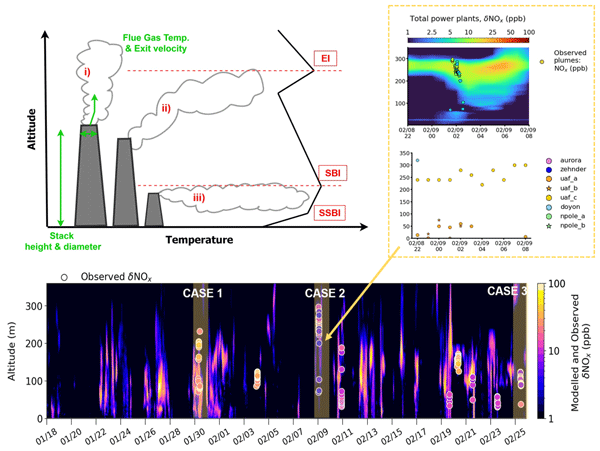
Natalie Brett, Kathy S. Law, Steve R. Arnold, Javier G. Fochesatto, Jean-Christophe Raut, Tatsuo Onishi, Robert Gilliam, Kathleen Fahey, Deanna Huff, George Pouliot, Brice Barret, Elsa Dieudonné, Roman Pohorsky, Julia Schmale, Andrea Baccarini, Slimane Bekki, Gianluca Pappaccogli, Federico Scoto, Stefano Decesari, Antonio Donateo, Meeta Cesler-Maloney, William Simpson, Patrice Medina, Barbara D'Anna, Brice Temime-Roussel, Joel Savarino, Sarah Albertin, Jingqiu Mao, Becky Alexander, Allison Moon, Peter F. DeCarlo, Vanessa Selimovic, Robert Yokelson, and Ellis S. Robinson
Atmos. Chem. Phys., 25, 1063–1104, https://doi.org/10.5194/acp-25-1063-2025, https://doi.org/10.5194/acp-25-1063-2025, 2025
Short summary
Short summary
Processes influencing dispersion of local anthropogenic pollution in Arctic wintertime are investigated with Lagrangian dispersion modelling. Simulated power plant plume rise that considers temperature inversion layers improves results compared to observations (interior Alaska). Modelled surface concentrations are improved by representation of vertical mixing and emission estimates. Large increases in diesel vehicle emissions at temperatures reaching −35°C are required to reproduce observed NOx.
Cited articles
Abkar, M. and Porté-Agel, F.: Influence of the Coriolis force on the structure and evolution of wind turbine wakes, Phys. Rev. Fluids, 1, 063701, https://doi.org/10.1103/physrevfluids.1.063701, 2016. a
Andreas, E. L., Claffy, K. J., and Makshtas, A. P.: Low-level atmospheric jets and inversions over the western Weddell Sea, Bound.-Lay. Meteorol., 97, 459–486, https://doi.org/10.1023/a:1002793831076, 2000. a, b
Antoniou, I., Pedersen, S. M., and Enevoldsen, P. B.: Wind shear and uncertainties in power curve measurement and wind resources, Wind Engergy, 33, 449–468, https://doi.org/10.1260/030952409790291208, 2009. a
Banta, R., Newsom, R., Lundquist, J., Pichugina, Y., Coulter, R., and Mahrt, L.: Nocturnal low-level jet characteristics over Kansas during CASES-99, Bound.-Lay. Meteorol., 105, 221–252, https://doi.org/10.1023/a:1019992330866, 2002. a, b
Barthelmie, R. J., Shepherd, T. J., Aird, J. A., and Pryor, S. C.: Power and wind shear implications of large wind turbine scenarios in the US Central Plains, Energies, 13, 4269, https://doi.org/10.3390/en13164269, 2020. a
Betz, A.: Das Maximum der theoretisch möglichen Ausnützung des Windes durch Windmotoren, Zeitschrift für das gesamte Turbinenwesen, 26, 307–309, 1920. a
Blackadar, A. K.: Boundary layer wind maxima and their significance for the growth of nocturnal inversions, B. Am. Meteorol. Soc., 38, 283–290, https://doi.org/10.1175/1520-0477-38.5.283, 1957. a, b
Bonin, T. A., Choukulkar, A., Brewer, W. A., Sandberg, S. P., Weickmann, A. M., Pichugina, Y. L., Banta, R. M., Oncley, S. P., and Wolfe, D. E.: Evaluation of turbulence measurement techniques from a single Doppler lidar, Atmos. Meas. Tech., 10, 3021–3039, https://doi.org/10.5194/amt-10-3021-2017, 2017. a
Bonner, W. D.: Climatology of the low level jet, Mon. Weather Rev., 96, 833–850, https://doi.org/10.1175/1520-0493(1968)096<0833:COTLLJ>2.0.CO;2, 1968. a
Capon, R. A.: Wind speed-up in the Dover Straits with the Met Office new dynamics model, Meteorol. Appl., 10, 229–237, https://doi.org/10.1017/s1350482703003037, 2003. a, b
Chao, S.-Y.: Coastal jets in the lower atmosphere, J. Phys. Oceanogr., 15, 361–371, https://doi.org/10.1175/1520-0485(1985)015<0361:cjitla>2.0.co;2, 1985. a
Chirosca, A.-M., Rusu, L., and Bleoju, A.: Study on wind farms in the North Sea area, Energy Rep., 8, 162–168, https://doi.org/10.1016/j.egyr.2022.10.244, 2022. a
Davis, P.: Development and mechanisms of the nocturnal jet, Meteorol. Appl., 7, 239–246, https://doi.org/10.1017/s1350482700001535, 2000. a
Dieudonné, E., Delbarre, H., Sokolov, A., Ebojie, F., Augustin, P., and Fourmentin, M.: Characteristics of the low-level jets observed over Dunkerque (North Sea French coast) using 4 years of wind lidar data, Q. J. Roy. Meteor. Soc., 149, 1745–1768, https://doi.org/10.1002/qj.4480, 2023. a, b, c, d, e, f, g, h, i, j, k, l, m, n, o, p, q, r
Dieudonné, E., Haezebrouck, P., Maynard, P., Sokolov, A., Delbarre, H., Augustin, P., and Fourmentin, M.: Horizontal wind profiling with Doppler lidars: long-term evaluation of the perpendicular vertical sweeps reconstruction method, EGU General Assembly 2025, Vienna, Austria, 27 April–2 May 2025, EGU25-3463, https://doi.org/10.5194/egusphere-egu25-3463, 2025. a, b
Doosttalab, A., Siguenza-Alvarado, D., Pulletikurthi, V., Jin, Y., Bocanegra Evans, H., Chamorro, L. P., and Castillo, L.: Interaction of low-level jets with wind turbines: on the basic mechanisms for enhanced performance, J. Renew. Sustain. Ener., 12, 053301, https://doi.org/10.1063/5.0017230, 2020. a
Eoliennes en mer en France: https://www.eoliennesenmer.fr/facades-maritimes-en-france/facade-manche-mer-du-nord/dunkerque (last access: 18 February 2026), 2025. a
Gadde, S. N. and Stevens, R. J.: Interaction between low-level jets and wind farms in a stable atmospheric boundary layer, Phys. Rev. Fluids, 6, 014603, https://doi.org/10.1103/physrevfluids.6.014603, 2021. a
Global Wind Energy Council: Global Wind Report 2024, Tech. rep., Global Wind Energy Council, https://www.gwec.net/reports/globalwindreport/2024 (last access: 8 April 2025), 2024. a
Golding, W. L.: Low-level wind shear and its impact on airlines, J. Aviat./Aerosp. Educ. Res., 14, 8, https://doi.org/10.15394/jaaer.2005.1530, 2005. a
Gutierrez, W., Araya, G., Basu, S., Ruiz-Columbie, A., and Castillo, L.: Toward understanding low level jet climatology over west Texas and its impact on wind energy, J. Phys. Conf. Ser., 524, 012008, https://doi.org/10.1088/1742-6596/524/1/012008, 2014. a
Gutierrez, W., Araya, G., Kiliyanpilakkil, P., Ruiz-Columbie, A., Tutkun, M., and Castillo, L.: Structural impact assessment of low level jets over wind turbines, J. Renew. Sustain. Ener., 8, 023308, https://doi.org/10.1063/1.4945359, 2016. a
Gutierrez, W., Ruiz-Columbie, A., Tutkun, M., and Castillo, L.: Impacts of the low-level jet's negative wind shear on the wind turbine, Wind Energ. Sci., 2, 533–545, https://doi.org/10.5194/wes-2-533-2017, 2017. a, b, c, d
Gutierrez, W., Ruiz-Columbie, A., Tutkun, M., and Castillo, L.: The structural response of a wind turbine under operating conditions with a low-level jet, Renew. Sust. Energ. Rev., 108, 380–391, https://doi.org/10.1016/j.rser.2019.03.058, 2019. a, b
Hersbach, H., Bell, B., Berrisford, P., Hirahara, S., Horányi, A., Muñoz-Sabater, J., Nicolas, J., Peubey, C., Radu, R., Schepers, D., Simmons, A., Soci, C., Abdalla, S., Abellan, X., Balsamo, G., Bechtold, P., Biavati, G., Bidlot, J., Bonavita, M., Chiara, G. D., Dahlgren, P., Dee, D., Diamantakis, M., Dragani, R., Flemming, J., Forbes, R., Fuentes, M., Geer, A., Haimberger, L., Healy, S., Hogan, R. J., Hólm, E., Janisková, M., Keeley, S., Laloyaux, P., Lopez, P., Lupu, C., Radnoti, G., Rosnay, P. D., Rozum, I., Vamborg, F., Villaume, S., and Thépaut, J.-N.: The ERA5 global reanalysis, Q. J. Roy. Meteor. Soc., 146, 1999–2049, https://doi.org/10.1002/qj.3803, 2020. a
Hersbach, H., Bell, B., Berrisford, P., Biavati, G., Horányi, A., Muñoz Sabater, J., Nicolas, J., Peubey, C., Radu, R., Rozum, I., Schepers, D., Simmons, A., Soci, C., Dee, D., and Thépaut, J.-N.: ERA5 hourly data on single levels from 1940 to present, Copernicus Climate Change Service (C3S) Climate Data Store (CDS) [data set], https://doi.org/10.24381/cds.adbb2d47, 2023. a
IGN: Géoportail, https://www.geoportail.gouv.fr/, last access: 7 July 2025. a
Jones, P., Harpham, C., and Briffa, K.: Lamb weather types derived from reanalysis products, Int. J. Climatol., 33, 1129–1139, https://doi.org/10.1002/joc.3498, 2013. a
Kalverla, P. C., Duncan Jr., J. B., Steeneveld, G.-J., and Holtslag, A. A.: Low-level jets over the North Sea based on ERA5 and observations: together they do better, Wind Energ. Sci., 4, 193–209, https://doi.org/10.5194/wes-4-193-2019, 2019. a, b, c, d
Kapoor, A., Ouakka, S., Arwade, S. R., Lundquist, J. K., Lackner, M. A., Myers, A. T., Worsnop, R. P., and Bryan, G. H.: Hurricane eyewall winds and structural response of wind turbines, Wind Energ. Sci., 5, 89–104, https://doi.org/10.5194/wes-5-89-2020, 2020. a
Klein, A., Ravetta, F., Thomas, J. L., Ancellet, G., Augustin, P., Wilson, R., Dieudonné, E., Fourmentin, M., Delbarre, H., and Pelon, J.: Influence of vertical mixing and nighttime transport on surface ozone variability in the morning in Paris and the surrounding region, Atmos. Environ., 197, 92–102, https://doi.org/10.1016/j.atmosenv.2018.10.009, 2019. a
Kottmeier, C., Palacio-Sese, P., Kalthoff, N., Corsmeier, U., and Fiedler, F.: Sea breezes and coastal jets in southeastern Spain, Int. J. Climatol., 20, 1791–1808, https://doi.org/10.1002/1097-0088(20001130)20:14<1791::aid-joc574>3.0.co;2-i, 2000. a
Maynard, P., Dieudonné, E., Sokolov, A., Delbarre, H., Augustin, P., Fourmentin, M., and Dmitriev, E.: Exploring the level of organization of turbulent coherent structures in the atmospheric surface layer through supervised classification of Doppler lidar observations, J. Geophys. Res.-Mach. Learn. Comput., 2, e2025JH000652, https://doi.org/10.1029/2025JH000652, 2025. a
Mehta, M., Zaaijer, M., and von Terzi, D.: Drivers for optimum sizing of wind turbines for offshore wind farms, Wind Energ. Sci., 9, 141–163, https://doi.org/10.5194/wes-9-141-2024, 2024. a
Miller, S., Keim, B., Talbot, R., and Mao, H.: Sea breeze: Structure, forecasting, and impacts, Rev. Geophys., 41, https://doi.org/10.1029/2003RG000124, 2003. a, b
Na, J. S., Koo, E., Jin, E. K., Linn, R., Ko, S. C., Muñoz-Esparza, D., and Lee, J. S.: Large-eddy simulations of wind-farm wake characteristics associated with a low-level jet, Wind Energy, 21, 163–173, https://doi.org/10.1002/we.2152, 2018. a
Nunalee, C. G. and Basu, S.: Mesoscale modeling of coastal low-level jets: implications for offshore wind resource estimation, Wind Energy, 17, 1199–1216, https://doi.org/10.1002/we.1628, 2014. a
Pichugina, Y. L., Brewer, W. A., Banta, R. M., Choukulkar, A., Clack, C. T. M., Marquis, M. C., McCarty, B. J., Weickmann, A. M., Sandberg, S. P., Marchbanks, R. D., and Hardesty, R. M.: Properties of the offshore low level jet and rotor layer wind shear as measured by scanning Doppler Lidar, Wind Energy, 20, 987–1002, https://doi.org/10.1002/we.2075, 2017. a
Rausch, T., Cañadillas, B., Hampel, O., Simsek, T., Tayfun, Y. B., Neumann, T., Siedersleben, S., and Lampert, A.: Wind lidar and radiosonde measurements of low-level jets in coastal areas of the German Bight, Atmosphere, 13, 839, https://doi.org/10.3390/atmos13050839, 2022. a, b, c, d, e, f, g, h, i, j, k
Robertson, A. N., Shaler, K., Sethuraman, L., and Jonkman, J.: Sensitivity analysis of the effect of wind characteristics and turbine properties on wind turbine loads, Wind Energ. Sci., 4, 479–513, https://doi.org/10.5194/wes-4-479-2019, 2019. a
SALOME project: Dynamic Monitoring of Offshore Wind Turbines Subject to Atmospheric Phenomena for Optimized Participation in Electricity Markets, https://www.salome-interreg.eu (last access: 24 July 2025), 2024. a
Sanchez Gomez, M. and Lundquist, J. K.: The effect of wind direction shear on turbine performance in a wind farm in central Iowa, Wind Energ. Sci., 5, 125–139, https://doi.org/10.5194/wes-5-125-2020, 2020. a
Sharples, J. J.: An overview of mountain meteorological effects relevant to fire behaviour and bushfire risk, Int. J. Wildland Fire, 18, 737–754, https://doi.org/10.1071/wf08041, 2009. a
Smedman, A.-S., Tjernström, M., and Högström, U.: Analysis of the turbulence structure of a marine low-level jet, Bound.-Lay. Meteorol., 66, 105–126, https://doi.org/10.1007/bf00705462, 1993. a
Soares, P. M., Cardoso, R. M., Semedo, Á., Chinita, M. J., and Ranjha, R.: Climatology of the Iberia coastal low-level wind jet: weather research forecasting model high-resolution results, Tellus A, 66, 22377, https://doi.org/10.3402/tellusa.v66.22377, 2014. a
Steele, C., Dorling, S., von Glasow, R., and Bacon, J.: Modelling sea-breeze climatologies and interactions on coasts in the southern North Sea: implications for offshore wind energy, Q. J. Roy. Meteor. Soc., 141, 1821–1835, https://doi.org/10.1002/qj.2484, 2015. a, b
Tumenbayar, U. and Ko, K.: Investigation of wind veer characteristics on complex terrain using ground-based lidar, Int. J. Renew. Energy D., 13, 10–18, https://doi.org/10.14710/ijred.2023.56352, 2023. a
Tuononen, M., O'Connor, E. J., Sinclair, V. A., and Vakkari, V.: Low-level jets over Utö, Finland, based on Doppler lidar observations, J. Appl. Meteorol. Clim., 56, 2577–2594, https://doi.org/10.1175/jamc-d-16-0411.1, 2017. a, b, c
Van de Wiel, B. J., Moene, A., Steeneveld, G., Baas, P., Bosveld, F., and Holtslag, A.: A conceptual view on inertial oscillations and nocturnal low-level jets, J. Atmos. Sci., 67, 2679–2689, https://doi.org/10.1175/2010jas3289.1, 2010. a
Wagner, R., Antoniou, I., Pedersen, S. M., Courtney, M. S., and Jørgensen, H. E.: The influence of the wind speed profile on wind turbine performance measurements, Wind Energy, 12, 348–362, https://doi.org/10.1002/we.297, 2009. a
Weide Luiz, E. and Fiedler, S.: Spatiotemporal observations of nocturnal low-level jets and impacts on wind power production, Wind Energ. Sci., 7, 1575–1591, https://doi.org/10.5194/wes-7-1575-2022, 2022. a, b, c, d
Wildmann, N., Hagen, M., and Gerz, T.: Enhanced resource assessment and atmospheric monitoring of the research wind farm WiValdi, J. Phys. Conf. Ser., 2265, 022029, https://doi.org/10.1088/1742-6596/2265/2/022029, 2022. a, b, c, d
Wu, Y. and Raman, S.: The summertime Great Plains low level jet and the effect of its origin on moisture transport, Bound.-Lay. Meteorol., 88, 445–466, https://doi.org/10.1023/a:1001518302649, 1998. a
Xiang, Y.: Analyse dynamique en champ proche de la contribution des sources de composés organiques volatils, en région urbaine sous influence industrielle, Ph. D. thesis, Université du Littoral Côte d'Opale, http://www.theses.fr/2011DUNK0408, 2011. a
Short summary
Low-level jets are wind maxima that frequently occur at wind turbine rotor heights. This work investigated their properties and their impact on wind turbines using 3 years of wind measurements in Dunkerque, a coastal city in the North Sea. Results showed that jets are frequent (15 % of the time), could decrease current turbines' production, and could expose them to unfavorable structural conditions, whereas future turbines will be less impacted and will see an increase in energy production.
Low-level jets are wind maxima that frequently occur at wind turbine rotor heights. This work...


Altmetrics
Final-revised paper
Preprint