
the Creative Commons Attribution 4.0 License.
the Creative Commons Attribution 4.0 License.
 | 30 Apr 2026
Preference and willingness-to-pay analysis for an eco-engineering technology for floating wind turbines
Pierre-Alexandre Mahieu
Alison Bates
Jenifer Meredith
Franck Schoefs
Floating offshore wind turbines (FOWTs) raise concerns among coastal communities due to their potential impacts on marine biodiversity and fisheries. This issue is particularly striking in France, where the government is accelerating offshore wind deployment to meet decarbonisation targets while maintaining a relatively large fisheries sector. This study investigates public preferences and willingness to pay (WTP) for an innovative eco-engineering solution aiming at enhancing marine biodiversity, supporting artisanal fisheries and minimising seabed disturbance. A discrete choice experiment (DCE) was conducted among 306 residents across five French coastal territories (i.e. departments) to quantify trade-offs among four attributes including structure material, biodiversity gain, fishery impact and additional cost on the electricity bill. Results from a conditional logit model reveal strong and consistent public support for eco-engineering features. Biodiversity enhancement, fishery revenue growth and the use of recycled steel for building eco-engineering structures were all positively valued by respondents, as reflected in their willingness to pay. The territorial variation was more limited than initially assumed, reflected in similar coefficients between departments, except for recycled steel, which showed variation between two departments. This paper provides new evidence on how targeted eco-engineering measures can improve social acceptability by combining preference modelling with ecological design considerations. The results show how important it is to include public preferences in the early design of floating offshore wind turbine (FOWT) projects to improve both environmental performance and public acceptance.
- Article
(1687 KB) - Full-text XML
- BibTeX
- EndNote


Over the past decade, the French Government has set an ambitious trajectory to cut its greenhouse gas emissions and move towards a low-carbon economy. The country has committed to reaching net-zero carbon emissions by 2050, a goal in line with the European Green Deal and its own Climate and Energy Framework (ADEME, 2024). To do so, France aims to produce 40 % of its electricity from renewable sources by 2030, with offshore wind power emerging as a cornerstone of its future energy mix (Ministère de la Transition Écologique, 2024). The French Government has set a new target for offshore wind deployment: 45 GW by 2050. This aim is an unprecedented leap given that only 1.5 GW had been commissioned by mid-2025. This suggests that over the next 25 years, about 96.7 % (43.5 GW) remains to be installed (Fig. 1 and Table A1).
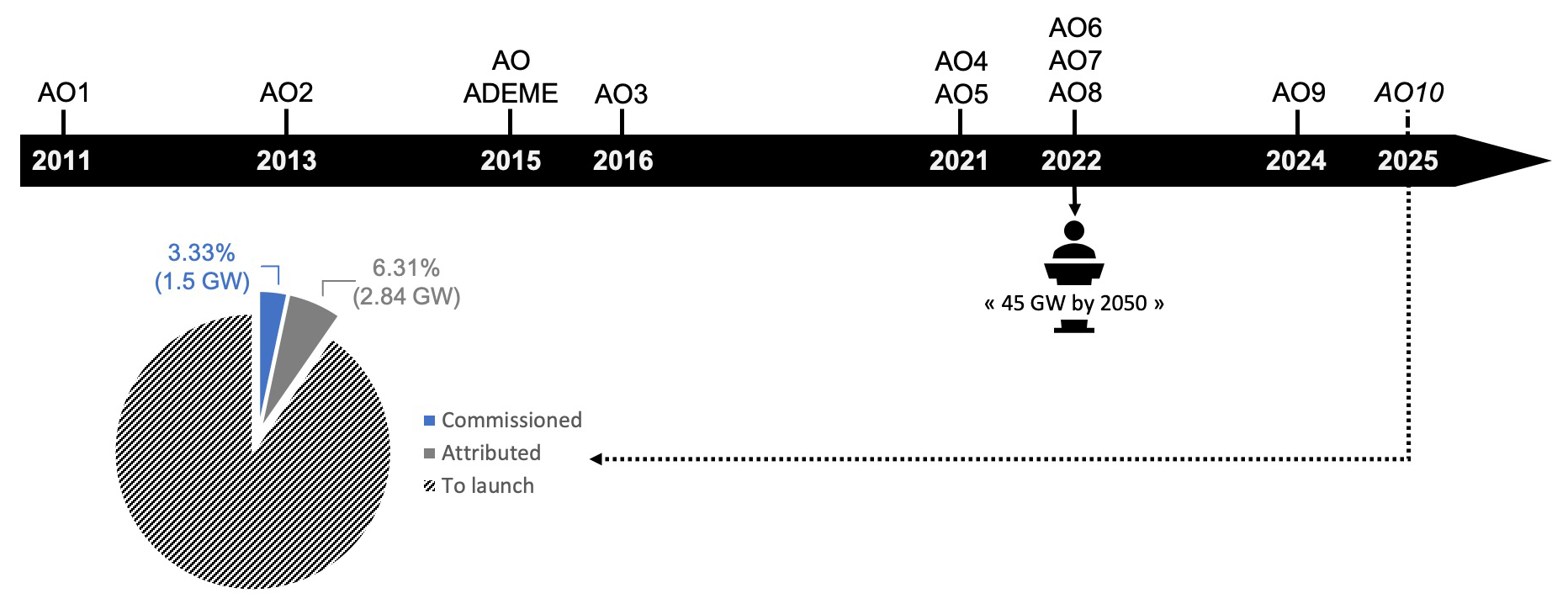
Figure 1Chronological order of call for tenders for offshore wind projects launched in France, and proportion of national goals achieved and remaining.
Floating offshore wind turbines (FOWTs) are emerging as a key technology and a promising solution for France to meet its ambitions on offshore wind energy, particularly in areas where deep waters (>60 m depth) preclude the use of bottom-fixed turbines. FOWTs allow one to build wind farms farther out to sea, which makes them less visible and gives them more space to produce renewable energy (Zountouridou et al., 2015). However, they also bring up specific environmental and social challenges, as well as the need for adaptation of harbour infrastructures (Crowle and Thies, 2022). The greater depth and distance of FOWTs does not always mitigate public worries. Instead, they might make people more preoccupied about the unknown effects on the environment, possible conflicts with fishing activities and the cumulative stress on marine ecosystems (Chaumette, 2017; Dubois et al., 2025a; Jiang, 2021).
This technological shift and acceleration are reflected in the growing scale and ambition of national offshore wind tenders. Over 10 GW of capacity had entered formal procedures by the end of 2024 (Fig. 1), and the upcoming “AO10” call for tenders will bring the total area of wind exploitation in French metropolitan waters to over 3000 km2. Among these “AO10” projects are several large-scale floating wind farms, each involving a capacity of between 1 and 2 GW (Table A1). These projects mark a clear shift towards industrial-scale deployment, both in terms of capacity and spatial footprint. This dynamic is happening at the same time as an explicit objective to use the newest technologies to generate as much energy as possible. While the bottom-fixed Saint-Nazaire wind farm (awarded in 2012) used 6 MW turbines, more recent projects such as “Bretagne Sud 1”, “Golfe de Fos 1” or “Narbonnaise Sud-Hérault 1” plan to deploy FOWTs of more than 20 MW per unit. However, there are still significant delays in implementation (Table A1): on average, it may take 10 years from the time a project is awarded until construction begins. For instance, construction of the wind farm projects awarded in the tenders “AO4”, “AO5” and “AO6”, awarded respectively in 2023, 2024 and 2024 (Table A1), is not expected to begin until 2031–2032, but the concept of the turbine used is fixed when the tendered company is selected (i.e. around 5 years before the park is commissioned).
In this context, spatial planning and public acceptance are emerging as major challenges for the successful growth of offshore wind energy (Joalland and Mahieu, 2023). Many studies have demonstrated that public opposition to offshore wind farms can be driven by a wide range of factors. These include visual concerns (Ladenburg, 2010), place attachment (Brownlee et al., 2015), perceived fairness and justice during the process (Bacchiocchi et al., 2022; Firestone et al., 2012), or even trust in institutions (Druckman, 2015; Handmaker et al., 2021). Impacts on marine biodiversity is also frequently cited as a major concern (Bush and Hoagland, 2016; Galparsoro et al., 2022). Thus, developers are increasingly required to implement early-stage environmental monitoring, such as the evaluation of acoustic pollution, analysis of benthic disturbances and assessment of interactions with marine mammals (Degraer et al., 2021; Maxwell et al., 2022). Furthermore, these studies and monitoring are part of the process of verifying the proper integrity of structures throughout the farm's service life (Coolen et al., 2018; Coughlan et al., 2025; Dubois et al., 2025b).
Eco-engineering is increasingly being investigated as a viable method to balance technological development and ecological integrity. This idea refers to the design and inclusion of infrastructure that integrates ecological functions and improves ecosystem services (Pardo et al., 2023). In the case of offshore wind power, the technique may be applied by integrating habitat-enhancing structures directly into wind farm elements such as moorings, scour protection or substations to promote biodiversity and ecosystem functioning (O'Shaughnessy et al., 2020). New frameworks like nature-inclusive design (NID) and marine nature-based solutions (NbSs) have made it even more crucial to integrate such approaches directly in the development process. This is especially relevant to respect the “avoid–reduce–compensate” hierarchy used in marine spatial planning (Hermans et al., 2020; Sutton-Grier et al., 2015). These strategies seek to mitigate ecological damage while simultaneously producing quantifiable co-benefits for marine ecosystems and local stakeholders. Eco-engineering involves the modification of structures through the use of artificial reefs, textured concrete modules or biologically active substrates, as well as the inherent design of structures to attract reef-associated species, stabilise sediments or create nursery habitats (Firth et al., 2014; Lengkeek et al., 2017). However, Bishop et al. (2017) indicated that the ecological efficiency of such measures is significantly influenced by spatial size, species-specific needs and physical compatibility.
Eco-engineering is being recognised as a social as well as technical innovation, raising important questions about governance, legitimacy and the role of local communities in defining what constitutes acceptable and meaningful ecological compensation (Dennis et al., 2018; O'Shaughnessy et al., 2020; Varenne et al., 2023), especially in the context of ocean sprawl or non-indigenous species facilitation (Gauff et al., 2023).
Studies indicate that such measures could improve social acceptance, in particular if they create induce a snowball effect in the society (Klain et al., 2020; Strain et al., 2019). Additionally, a recent qualitative study (Dubois et al., 2025a) compared coastal community perceptions of marine renewable energies in France (Pays de la Loire) and in the United States (Maine), and highlights the complexity of public attitudes towards eco-engineering applied to floating offshore wind farms. Persistent concerns were expressed about environmental impacts (biodiversity, seascapes), economic consequences (fisheries, tourism) and technical issues (costs, maintenance), but an overall support for the energy transition was still shown. These findings underline the importance of transparent, participatory and science-based governance in harmonising climate goals with the social expectations of coastal communities characterised by diverse identities and conflicting uses.
The present study investigates public preferences for an innovative eco-engineering solution specifically designed for integration into floating offshore wind farms. The solution takes the form of a multifunctional artificial structure intended to simultaneously (1) increase local biodiversity, (2) support artisanal fishing and (3) reduce the ecological footprint of FOWTs by limiting seabed dragging caused by mooring lines. As a hybrid between ecological compensation and technical optimisation, this innovation tries to embody a model of spatial and functional cohabitation that could help to mitigate stakeholder opposition and contribute to the long-term viability of floating wind deployment.
While existing studies have explored how environmental attributes influence public preferences for wind energy, few have examined the acceptability of integrated technological and ecological innovations into such technology. Moreover, no previous study has assessed such preferences in the specific context of France's floating offshore wind strategy. This study addresses that gap by implementing a discrete choice experiment (DCE) targeting a representative sample of 306 coastal residents across five French departments with various cultural, economic and industrial relationships to the sea. The DCE includes four key attributes: (1) the material used for building the structures, (2) the expected augmentation in marine biodiversity (specific richness), (3) the anticipated economic effects on the local fisheries and (4) the cost attribute to estimate willingness to pay (WTP). This approach allows one to quantify trade-offs in citizen preferences and explore variation in acceptability across regions and individual profiles.
More specifically, the primary objective of this study is to identify the preferences of citizens from five French departments regarding an integrated offshore eco-engineering solution and to test whether social acceptability varies across territories and individual attitudes. Thus, this territorial comparison is designed to test whether public preferences vary across coastal contexts. While the null hypothesis assumes no significant differences between departments, we expect that local factors (such as dependence on fisheries or exposure to existing offshore projects) may influence the acceptability of eco-engineering solutions. Identifying these variations can support more tailored and socially informed planning strategies. Another possible hypothesis to make is that offshore wind opponents will try to minimise environmental or social impacts by selecting projects that include mitigation measures.
The paper is organised as follows: Sect. 2 describes the tested concept of eco-engineering, the method used to analyse its societal acceptability and the territorial identities of the five selected departments. Section 3 presents the results of the willingness to pay for the application of the concept and the parameters influencing the choice of scenario. Section 4 discusses the results depending on the department studied and the effect of attitude towards offshore wind power on the application of an eco-engineering concept. Section 5 is dedicated to developers and industry stakeholders for future offshore wind power development, and Sect. 6 summarises the findings of the study. Thus, this study explicitly examines whether nature-inclusive design features influence both acceptance and willingness to pay for floating offshore wind projects.
2.1 The eco-engineering concept
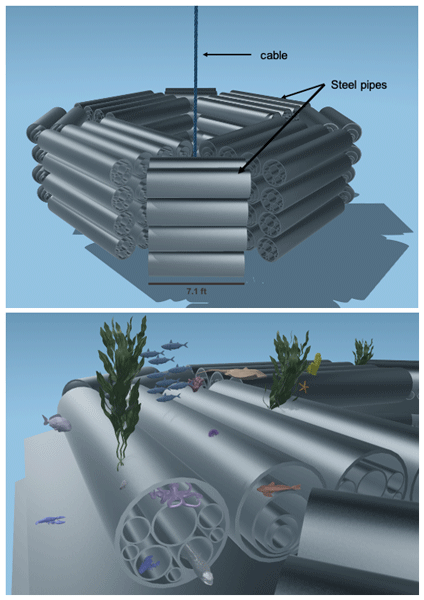
In our study, we focus on a concept designed specifically for application in floating offshore wind farms. After discussions in a previous study (Dubois et al., 2025a), we targeted the respondents' priorities and concerns to help in the design of this structure. In the end, the concept was a stack of steel pipes of various diameters (Fig. A2). Despite the paucity of information on this subject, some sources indicate an optimal volume for an artificial reef in Offshore Wind Farms (OWFs) of the order of 320 m3 (Glarou et al., 2020; Langhamer, 2012). Thus, the theoretical volume of this concept is 400 m3, with a steel volume of 43.5 m3. Together with the increase in biodiversity and biomass, the structure fits into the framework of eco-engineering (Hermans et al., 2020; Pardo et al., 2023; Pioch et al., 2018) by limiting the seabed dragging by the mooring lines. This could be achieved by passing the mooring line through the centre of the structure, thus shifting the line upwards so that it does not touch the seabed. For the chain, such an arrangement reduces wear and tear; and for the environment, it considerably reduces chain slippage on the floor as the float moves. This type of structure would be used above each floating wind turbine anchor on a wind farm. Overall, they would serve a triple purpose: (1) they would limit the footprint of a farm, (2) they would provide an opportunity for refuge and habitat creation, and (3) they would have an impact on society in terms of both societal acceptability and the economy (e.g. fishers).
2.2 Survey design
2.2.1 DCE method
This study uses the discrete choice experiment (DCE) method to identify individuals' preferences (Hoyos, 2010) and to estimate their willingness to pay (WTP) for different characteristics of a good or service (Hanley et al., 1998). This approach is based on the theory of random utility (McFadden, 1974) and relies on the analysis of choices made between several alternatives defined by combinations of attributes. DCE was chosen for its ability to quantify trade-offs between attributes and to incorporate a payment vehicle enabling direct monetary estimation. Its implementation in digital format also facilitates large-scale dissemination, and enables a large and geographically diverse sample. This method has several advantages: theoretical soundness, applicability to non-market goods and the ability to model preference heterogeneity. However, it has certain limitations, including a potential cognitive burden for respondents, questionable rationality assumptions and sensitivity to formulation or fatigue biases. Despite these constraints, DCE remains a benchmark method for preference analysis and the economic evaluation of goods and services.
The experimental design was generated using Ngene software following a D-efficient design approach. The design efficiency was optimised for a conditional logit model using prior parameter values derived from expected signs and magnitudes of the attributes. In particular, negative priors were specified for the price attribute, while positive priors were assumed for environmental and economic benefits, in line with standard expectations in environmental valuation studies. The final design consisted of 16 choice sets, each including two policy alternatives and a “status quo” option. To reduce the cognitive burden on respondents, the choice sets were divided into two blocks so that each respondent completed eight choice tasks. In the design generation process, an additional imbalance penalty was considered to avoid excessive level repetition across alternatives and to improve the statistical properties of the design. The final design ensured sufficient variation in attribute levels across choice tasks, allowing reliable estimation of the preference parameters (detailed below in Sect. 2.2.4 and 2.2.5 “Cost to households – electricity bill”, illustrated in Table A2). The detailed tasks with attributes and their respective values are presented in Table A3.
Prior to the choice tasks, attributes and their associated levels were introduced sequentially to respondents, with explanations provided for each attribute to ensure comprehension. The status quo option corresponded to a conventional floating offshore wind development without eco-engineering measures. The exact wording presented to respondents for the status quo explanation was (translated from French): “Option C means a conventional floating offshore wind development WITHOUT artificial reefs”. To encourage respondents to read the attribute descriptions, the “next” button appeared after only a short delay on the screen presenting the explanations. Finally, both the overall length of the questionnaire and the number of choice cards presented to each respondent were deliberately limited to reduce respondent fatigue. In addition, attribute descriptions were written in simple and non-technical language so that they could be easily understood by a general audience, thereby reducing the risk of attribute non-attendance.
2.2.2 Geographical sampling
An online national survey was performed through a market company in April 2024. Five French territories (i.e. departments) were sampled, depending on their proximity to the planned development of the floating offshore wind farm. These departments were the following: Aude, Bouches-du-Rhône, Hérault, Morbihan and Pyrénées-Orientales. Four of these departments border the coast of the French Mediterranean Sea (south of France), and one (Morbihan) is on the western coast of French Brittany and bordered by the Atlantic Ocean. The total number of respondents was 306, and sampling was carried out in such a way as to obtain proportions as representative as possible to the number of inhabitants in each department, with 20 respondents from Aude, 114 from Bouches-du-Rhône, 87 from Morbihan, 54 from Hérault and 31 from Pyrénées-Orientales. The sampling did not rely on formal quotas or post-stratification weights; however, recruitment through the survey company ensured a balanced distribution in terms of age and gender across departments. The resulting sample composition was verified to be consistent with INSEE departmental demographic data, providing reasonable confidence in the representativeness of the respondents.
We drew up the territorial identities of the sample departments (Table 1) in relation to the subject of study, taking into account demographic and blue economic statistics, including tourism (the touristic rate being the number of touristic beds divided by the number of residents in the department), fishing and industry, information on ecology (through protected areas) and fishing (share of maritime employment and tonnes of seafood landed). The percentages are expressed as a function of the department level.
Table 1Identities of the sampled territories (departments) subject to floating offshore wind development.

Aude: a discreet coastline between tourist appeal and economic fragility
Literature and data obtained for the Aude department generally point to limited maritime employment in this territory, with 3.1 % of employees working in the maritime sector (INSEE, 2017) and 1600 t yr−1 of seafood products landed (FranceAgriMer, 2024) for a population of 376 000 persons (INSEE, 2025a). However, commercial tourism is highly structuring the economy of the department, with a high rate of second homes (25.3 % of departmental homes) and a relatively high tourist function rate of 42.82 % (Agence de Développement Touristique, 2024). Finally, the maritime domain is still little preserved, with around 6 % of its surface area under any protection regime (Les sites Natura 2000 dans l'Aude, 2019).
Bouches-du-Rhône: a strategic industrial-port coastline and fewer tourists
The Bouches-du-Rhône department is one of the most urbanised and densely populated French coastal areas, with more than 2 million residents (INSEE, 2025b) but with limited tourism according to the touristic rate of 18 % and 4.8 % of secondary homes (Observatoire en ligne Provence Tourisme, 2025). The area is also characterised by a strong maritime presence but is rather focused on logistics and industry than fishing, with around 3833 t yr−1 (Ifremer, 2024b). It hosts the second-most important commercial harbour in France (Marseille-FOS). However, there are some real natural gems, such as the “Côte Bleue” Marine Park and the Calanques National Park, which are considered true marine sanctuaries thanks to zones that are protected and have no human impact (diving and fishing). This brings the surface area of protected marine areas (all statuses combined) to around 45 000 ha (Bottin et al., 2020) and almost 10 000 ha fully preserved from anthropic activities.
Hérault: a dense multifunctional coastline between tourism and the blue economy
Hérault is characterised by a dense population of more than 1.2 million residents (INSEE, 2025c) and a single harbour structuring the marine employment that is located at Sète, where the fishing landings are concentrated, accumulating around 7146 t yr−1 (Ifremer, 2024c). The proportion of maritime employment in the departmental activity is around 4.4 %. This department is highly attractive for tourism, especially the seaside tourism, and this activity represents a great part of the local economy, highlighted by the tourist function rate of 83 % and the proportion of secondary residences of 17.8 % (INSEE, 2022; Chiffres clés Tourisme et Loisirs Hérault édition 2024, 2025). Also, with 8500 ha of marine protected areas, this department is in the process of reconciling tourism with the protection of its natural heritage (Bottin et al., 2020).
Morbihan: a coastline balanced between maritime traditions and tourist appeal
The Atlantic Ocean borders the Morbihan department, giving it a history that is distinct from the Mediterranean departments. This Breton department has one of the highest maritime employment rates in France, with more than 7 % (Février and Le Guen, 2018) for a population above 760 000 residents (INSEE, 2025d). At the same time, the fishing industry in Morbihan is one of the main sectors in the local economy, with almost 22 000 t yr−1 of seafood products landed each year (Ifremer, 2024d). On top of this, the area is a major drawcard for tourists, thanks to its culture and landscapes, with a high tourist function rate of 85 % and 17.8 % of secondary residences. Another attraction for tourism is the balance between maritime exploitation and preservation in the Gulf of Morbihan, with some 70 000 ha of protected marine areas (DREAL Bretagne, 2023).
Pyrénées-Orientales: a hyper-touristic coastline with a modest maritime profile
Last but not least, the Pyrénées-Orientales department lies midway between mountain ranges and coastlines, making it an attractive location for tourism. The population is modest, with almost 490 000 residents. This demographic profile is reflected in the tourism offer, particularly in the tourist function rate of 132 % (Capacité d'accueil Pyrénées Orientales Tourisme, 2025) and a high rate of 27.7 % of second homes (INSEE, 2025e). Tourism is thus the mainstay of the local economy. Meanwhile, maritime activity is more limited, with a low proportion of maritime employment (3.7 %; INSEE, 2017) and more limited landings than other departments (1501 t yr−1; Ifremer, 2024e). The documentation found estimates around 11 000 ha for the surface of marine protected areas of any status (Bottin et al., 2020; De Paoli et al., 2023).
2.2.3 Organisation of the survey
The questionnaire started with socio-demographic questions: place of residence (zip code), education level, current employment status, and income after taxes and per month (France). The choice experiment followed these questions. Before the series of choices, an introduction was included with the following information:
-
Electricity mix in France and governmental goals,
-
Explanation of a FOWT and what the situation is in their country,
-
Explanation of the reasons for moving towards a FOWT development,
-
Goals about this technology development, comparison with nuclear power and number of households' electricity consumption,
-
Impacts of FOWT (environmental, economic),
-
Presentation of the eco-engineering concept with visualisations,
-
Explanation of how a DCE works and description of each attribute with their meanings,
-
Explanation of the status quo.
After the choice experiment, respondents were asked several follow-up questions about their (prior) attitude about offshore wind power (OWP) and their relation with the ocean (any relatives working with or depending on the ocean and/or fishing), having heard or seen an OWF before this survey. Finally, a new ecological paradigm test was performed through a Likert-scale questionnaire with 15 questions (Table A4; Anderson, 2012; Dunlap et al., 2000). These parameters were implemented into a correlation test after the econometric model. We were enable to estimate the average distance from the coast with the zip code of residency given by respondents.
2.2.4 The status quo scenario
The status quo scenario chosen reflects France's current trajectory in offshore wind power: rapid intensive development of wind farms, with no particular requirements beyond the regulatory framework imposed. It corresponds to floating wind farm projects that could be described as “classic”, with no specific eco-engineering measures, apart from the environmental monitoring required before and after commissioning and throughout the farm's service life until decommissioning. This scenario serves as a realistic reference point, consistent with national guidelines, and enables the measurement of preferences for alternatives that incorporate greater ecological ambitions.
2.2.5 The attributes and their levels
The attributes were chosen on the basis of a preliminary study in which respondents expressed their fears and priorities with regard to the development of offshore wind power, whether bottom-fixed or floating (Dubois et al., 2025a). Moreover, literature was considered to scale the levels of chosen attributes (Börger et al., 2015; Dalton et al., 2020; Iwata et al., 2023; Kermagoret et al., 2016; Kim et al., 2019; Klain et al., 2020). The definition of levels for each attribute is based on a synthesis of the scientific literature, empirical data from fisheries, energy reports, and adjustments based on the pre-testing of the questionnaire. The aim was to propose realistic, credible and comprehensible levels for respondents as well as ensuring sufficient variability to capture differentiated preferences.
Structure material
The material used for the structure (recycled or new steel) is a central environmental indicator. With an emission reduction potential of 1.5 t of CO2 per tonne of steel (World Steel Association, 2024), recycled steel has a 20 %–25 % lower carbon footprint than new steel (Fennell et al., 2022). France already produces around 40 % of its steel from recycled materials (Ministère de la Transition Écologique, 2024), making this attribute credible, measurable and culturally relevant. It also makes it possible to test citizens' sensitivity to aspects of circularity in energy infrastructures.
Impact on marine biodiversity
The biodiversity attribute was defined on the basis of extensive literature on the effects of both offshore wind farms and artificial reefs. Submerged structures (foundations, cables, floats) promote colonisation by fixed species such as mussels, anemones, algae or soft corals (Andersson and Öhman, 2010; Coolen et al., 2018; Degraer et al., 2021; Dubois et al., 2025a), inducing a local increase in biodiversity. Rates of increase in biodiversity ranging from 10 % to 200 % have been reported depending on the context (Brock and Norris, 1989; Fabi and Fiorentini, 1994), although the range generally adopted in previous DCE varies between 10 % and 60 % (e.g. Klain et al., 2020). To remain within a zone of ecological plausibility and to facilitate understanding for respondents, the following four levels were retained: +10 %, +20 %, +30 % and +40 % increase in marine biodiversity on average throughout the service life of the farm. This increase refers to the increase in species richness “S” (Anon, 2009). The experimental design was inspired by previous work carried out on artificial reefs where the addition of hard substrates has demonstrated strong potential for biological colonisation (Koeck et al., 2014; Komyakova et al., 2021). The structures studied were modelled with a volume of around 320 m3 (Glarou et al., 2020), the optimum size suggested in the literature to maximise ecological effects.
Impact on local fisheries revenue
The impact of floating wind turbines on fishing activities was assessed by examining changes in the income of local fishers, an indirect measure that was proved pertinent (Bates and Firestone, 2015; Firestone and Kempton, 2007). Based on studies of fishing yields around artificial reefs (CPUE – catch per unit effort), a link was established between an increase in biomass and biodiversity, combined with a potential increase in catches. A literature review (De Backer and Hostens, 2019; Ramos et al., 2006; Reubens et al., 2013) was used to translate CPUE gains into economic impacts. A 60 % catch-to-revenue conversion was adopted on the basis of existing data (Pan, 2021). This rate was then reduced to take into account operational constraints (closed areas, affected ports, etc.). The estimated impact was refined by cross-referencing wind farm development zones with data from the main fishing ports in the French Gulf of Lion (Ifremer, 2024a). To include differentiated but plausible scenarios, and following the pre-test highlighting the absence of an “extreme” case, the levels retained were +1 %, +5 %, +10 % and +15 % increase in fishing income in the zones concerned and on average throughout the service life of the wind farm.
Cost to households – electricity bill
The last attribute was the payment vehicle for the willingness to pay and represents the monthly extra cost on the electricity bill induced by the integration of eco-engineering structures in wind farms. This cost was estimated by modelling the price of steel structures from computer-aided design (320 m3 total volume, 43.5 m3 steel) and its installation offshore. This amount was then integrated into electricity production costs via an economic simulator (Energy101, 2025). Standard parameters were considered for floating wind farms: a capacity of 1050 MW, a capacity factor of 60 %, a lifespan of 20 years and an interest rate of 6 %. Three consumption profiles were simulated (1 person, 2 people and 4 people, respectively, in a studio, a small apartment or a house), with amounts ranging from EUR 0.40 to 7.76 per month depending on the profile. In addition to these estimates, feedback from the pre-test suggested the inclusion of a higher cost level to capture economic trade-offs. Thus, five levels have been retained: EUR 1, 2, 3, 5 and 10 per month, over a 20-year period and for a household. These values were in line with previous research (Kim et al., 2019; Krueger et al., 2011).
2.3 Econometric models
2.3.1 Conditional logit model and willingness-to-pay (WTP) estimation
The analysis conducted in this study relies on the random utility theory maximisation approach (McFadden, 1974). When a respondent chooses a scenario for a FOWT development, the respondent is supposed to choose the option that maximises the satisfaction that is derived from the attributes and their levels. The utility function is as follows:
where Unj represents the utility that individual n derives from alternative j, Xnj is the vector of observed attributes associated with that alternative, β is the vector of preference parameters to be estimated, and εnj is the stochastic error term capturing unobserved influences on choice behaviour.
In the present study, the attribute vector includes the material used for eco-engineering structures (recycled or new steel), the variation in marine biodiversity (%), the change in local fisheries income (%) and the additional monthly electricity bill (EUR per month). Conditional logit models were estimated separately for each department in order to examine potential territorial differences in preferences. All attributes were specified as alternative-varying.
After estimating the conditional logit model, Wald tests were performed to evaluate linear restrictions on the estimated coefficients (Greene, 2019; Woolridge, 2010; Train, 2009). They were applied to assess whether specific parameters were statistically equal across departments. The Wald test is computed from the estimated coefficients and their covariance matrix, and follows an asymptotic chi-square distribution under the null hypothesis that the tested parameters are equal to zero. It allows one to test whether groups of variables contribute significantly to the explanatory power of the model.
The marginal WTP, also called the implicit price, can be estimated for each of the non-cost attributes as follows, as explained by Hanley et al. (1998), where βc is the coefficient of any of the attributes and βy is the coefficient of the cost attribute (which corresponds to the marginal utility of income):
WTP estimates were therefore derived from the conditional logit specification with a linear cost coefficient. Confidence intervals were computed using the delta method based on the estimated variance-covariance matrix of the model parameters (Train, 2009). All models were estimated in R using the “Apollo” choice modelling package (Hess and Palma, 2019).
2.3.2 Zero-inflated negative binomial regression model to explain the choices
A zero-inflated negative binomial (ZINB) regression model was used to analyse the determinants of respondents' tendency to choose the status quo option. The dependent variable(“Number of status quo chosen”) represents the number of times each respondent selected the status quo across the eight choice scenarios performed by the respondent. Preliminary inspection of the distribution revealed a large proportion of zeros, indicating that many respondents never chose the status quo option. This overdispersion and excess of zeros (Cameron and Trivedi, 2013) makes traditional ordinary least squares (OLS) regression unsuitable, as it assumes normally distributed residuals and constant variance. Preliminary OLS models confirmed the lack of fit and heteroscedasticity.
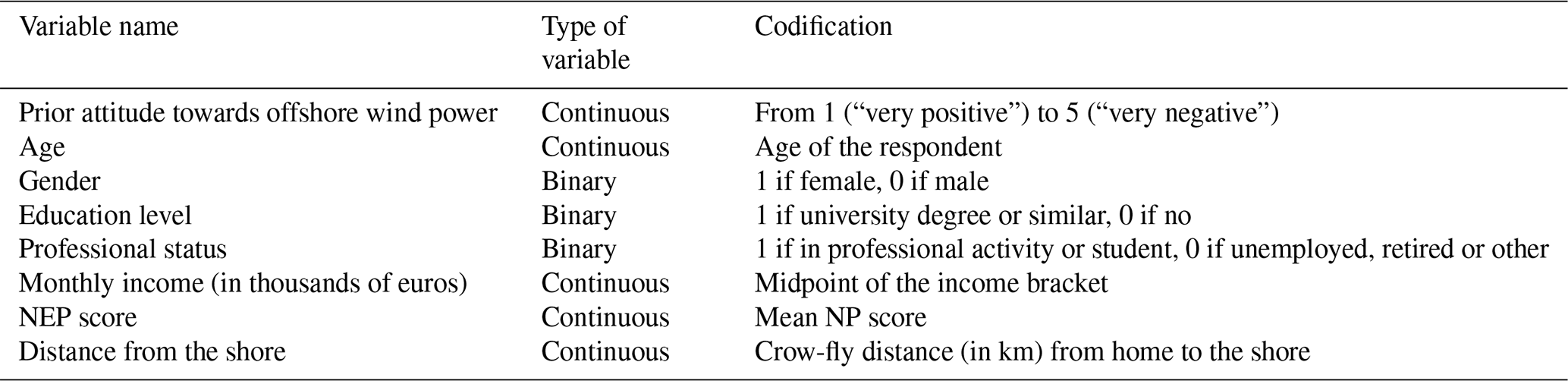
The ZINB model decomposes the data-generating process into two parts (Hilbe, 2011, 2014; Yau et al., 2003): (i) a count model, which predicts the number of status quo choices for respondents capable of choosing it, modelled using a negative binomial distribution; and (ii) a zero-inflation model, which predicts the probability that a respondent never selects the status quo, modelled with a logistic regression. The count part included the following covariates: prior attitude towards floating offshore wind power, stated gender, age, level of education, professional status, monthly revenue, prior exposure to offshore wind power projects (having already seen or heard about offshore wind turbines), environmental attitudes (through the NEP mean score), relationship to the ocean (having a relative working with the ocean), fishing activity (having a relative who is a commercial fisher) and, finally, the distance to the coast in kilometres. To ensure the interpretability of the ZINB coefficients and transparency for reproducibility, the variables included in the ZINB model (Table 2) were coded and scaled as in Table 2.
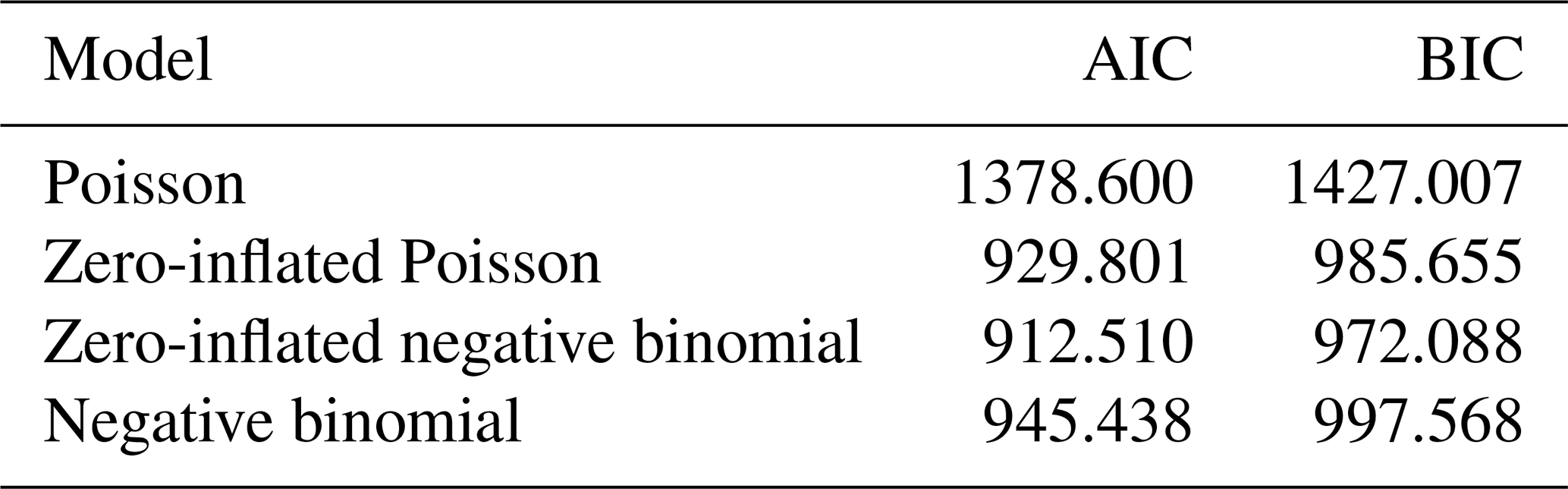
Model selection was informed by comparisons of Akaike Information Criterion (AIC) and Bayesian Information Criterion (BIC) across alternative specifications, including Poisson, negative binomial, zero-inflated Poisson (ZIP) and ZINB models. The ZINB model was selected as the most appropriate due to its superior fit (lowest AIC and BIC in Table 3) and ability to accommodate both overdispersion and excess zeros (Greene, 1994; Hall, 2000).
Table 3Akaike Information Criterion and Bayesian Information Criterion for optimal selection of model.
All analyses were conducted in R (version 4.3) using the “pscl” package (Jackman, 2024) for zero-inflated models. Standard errors and statistical significance were derived from the model summary output, and incidence rate ratios (IRRs) were calculated by exponentiating the coefficients from the count model to aid interpretation.
2.3.3 Mixed logit model
A panel mixed logit model was estimated as a robustness analysis following the conditional logit specification to account for repeated choice observations per respondent and to explore potential unobserved preference heterogeneity (Tables A5 and A6). In contrast to the conditional logit model that assumes homogeneous preferences across individuals, the mixed logit model allows preference parameters to vary randomly across respondents (Hensher et al., 2005; Train, 2009).
Under this specification, the utility that respondent n derives from alternative j in choice situation t can be expressed as
where Xnjt represents the vector of attributes associated with the alternative and βn is a vector of individual-specific preference parameters. The term εnjt represents the unobserved component of utility, and is assumed to be independently and identically distributed according to a type I extreme value (Gumbel) distribution. These parameters are assumed to follow statistical distributions across the population.
In the present study, the coefficients associated with the non-cost attributes (recycled steel, biodiversity increase and local fisheries revenue growth) as well as the alternative-specific constant for the status quo option were specified as normally distributed random parameters. The cost coefficient was specified as lognormally distributed to ensure that the marginal utility of cost remains negative for all individuals.
The resulting utility specification can be written as
Additional interaction terms were included to explore behavioural and territorial heterogeneity. In particular, respondents' prior attitudes towards offshore wind power interacted with the ASC to capture systematic differences in the propensity to select the status quo alternative (Lancsar and Louviere, 2008; McFadden, 1974). The attitude score (Likert scale from 1 = very positive to 5 = very negative) was mean centred. Interactions between the recycled steel attribute and the department of residence were also included to explore potential territorial differences in material preferences.
Parameters were estimated using simulated maximum likelihood with 2000 draws. The model was estimated using the Apollo package in R (Hess and Palma, 2019), which allows flexible specification of panel mixed logit models.
The mixed logit model was estimated in preference space. Consequently, the coefficients represent marginal utilities rather than direct willingness-to-pay estimates. This specification is therefore used primarily to assess the robustness of the conditional logit results and to analyse the extent of preference heterogeneity across individuals.
3.1 Descriptive statistics
The sample is characterised by a departmental profile contrast in comparison with the national average (Table 4). The Bouches-du-Rhône sample stands out with younger respondents, a high activity rate (75 %), a high proportion of high education (41 % at least bachelor's) and an average net income well above the national average (EUR 3100 vs EUR 2336). Conversely, the Aude sample has an older population, lower levels of education (30 %), a lower activity rate (50 %) and the lowest average income (EUR 2000). Morbihan and Hérault samples present intermediate profiles with average incomes but an older population (especially in Morbihan) and relatively low graduation rates. Lastly, Pyrénées-Orientales has a high income but a more masculine structure and moderate activity levels.
Table 4Socio-demographics data from the samples.
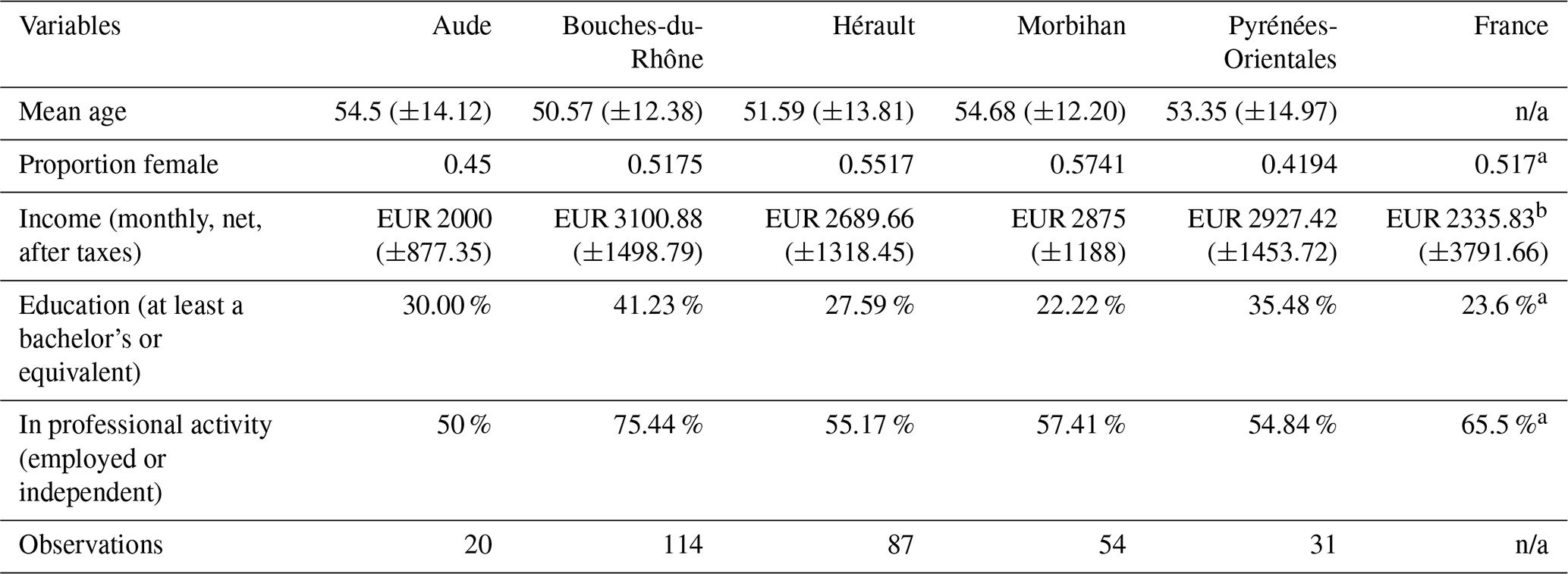
n/a: not applicable. a data from 2019; b data from 2017 (INSEE, 2020).
3.2 Conditional logit model: relative importance relative of attributes per territory (i.e. department)
The conditional logit model carried out on the data according to department shows significance for practically all the factors taken into account (Table 5). The “Recycled steel” factor is significant for the departments of Hérault and Pyrénées-Orientales at the 5 % level. The results thus indicate the sensitivity of respondents to the attributes and their levels. The payment attribute (electricity bill) is the only one to have negative coefficients, indicating a limitation on the increase in values for this attribute by respondents.
Table 5Coefficients from the conditional logit model.
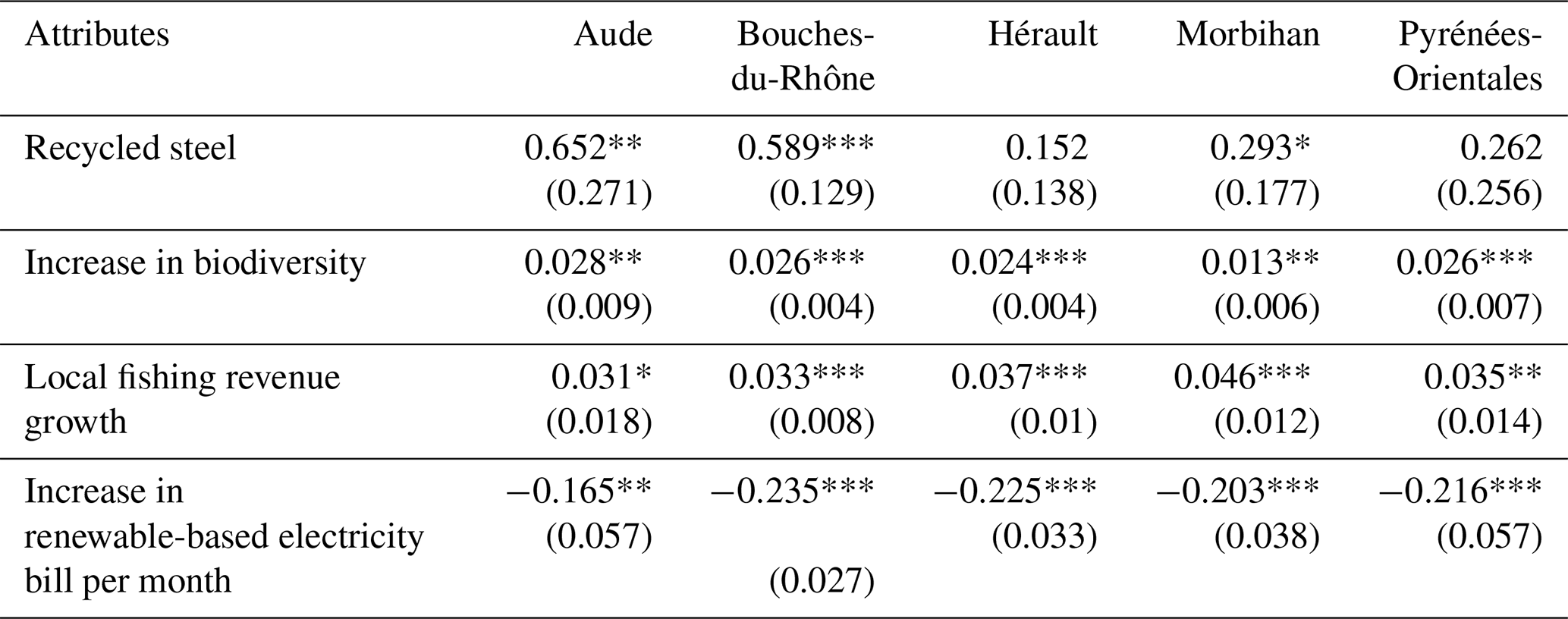
* for p value <0.05; ** for p value <0.01; *** for p value <0.001. Robust standards errors are in brackets.
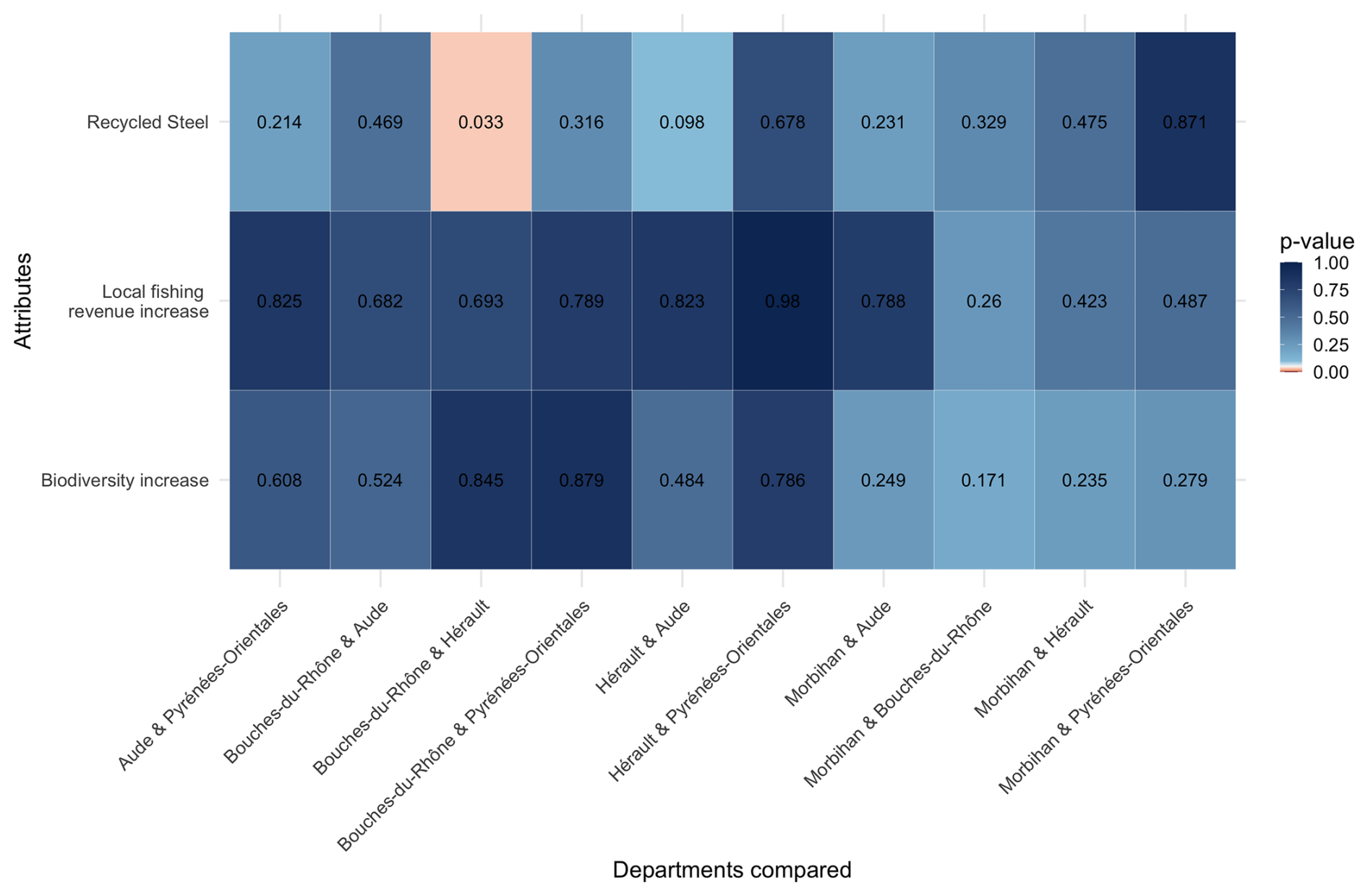
A Wald test was performed to analyse the presence or absence of differences in attributes between sampled departments (Fig. 2). The null hypothesis (H0) tested that the coefficients associated with a given attribute are equal across departments (H0: βi,dep1 =βi,dep2). Rejection of this hypothesis therefore indicates that respondents from different territories valued an attribute differently. Only the “Recycled steel” attribute between the Bouches-du-Rhône and Hérault departments was significantly different. Despite the absence of statistical evidence (p value >0.05), the attribute “Increased biodiversity” between the Morbihan and Bouches-du-Rhône departments is notable.
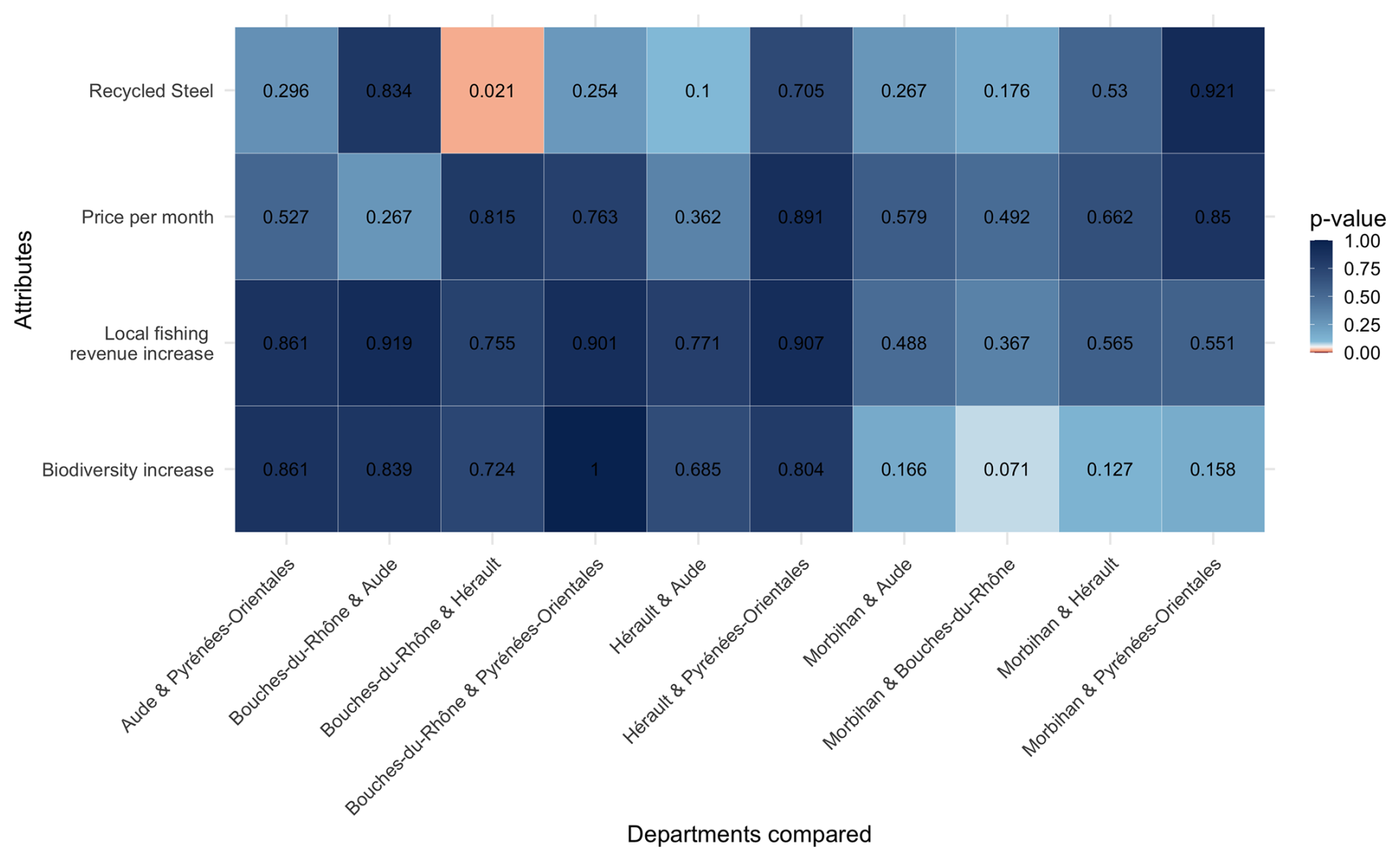
Figure 2Conditional logit model coefficient comparison (Wald test) between department in function of attribute.
3.3 Estimated willingness to pay (WTP)
The estimation of WTP revealed a large majority of significant coefficients (Table 6). The coefficient for the attribute “Recycled steel” is not significant for the departments of Hérault, Morbihan and Pyrénées-Orientales. The same case is found for the attribute “Growth in local fishing revenues” for the Aude department.
Table 6Baseline marginal WTP estimates from the conditional logit model with two scenarios as examples.
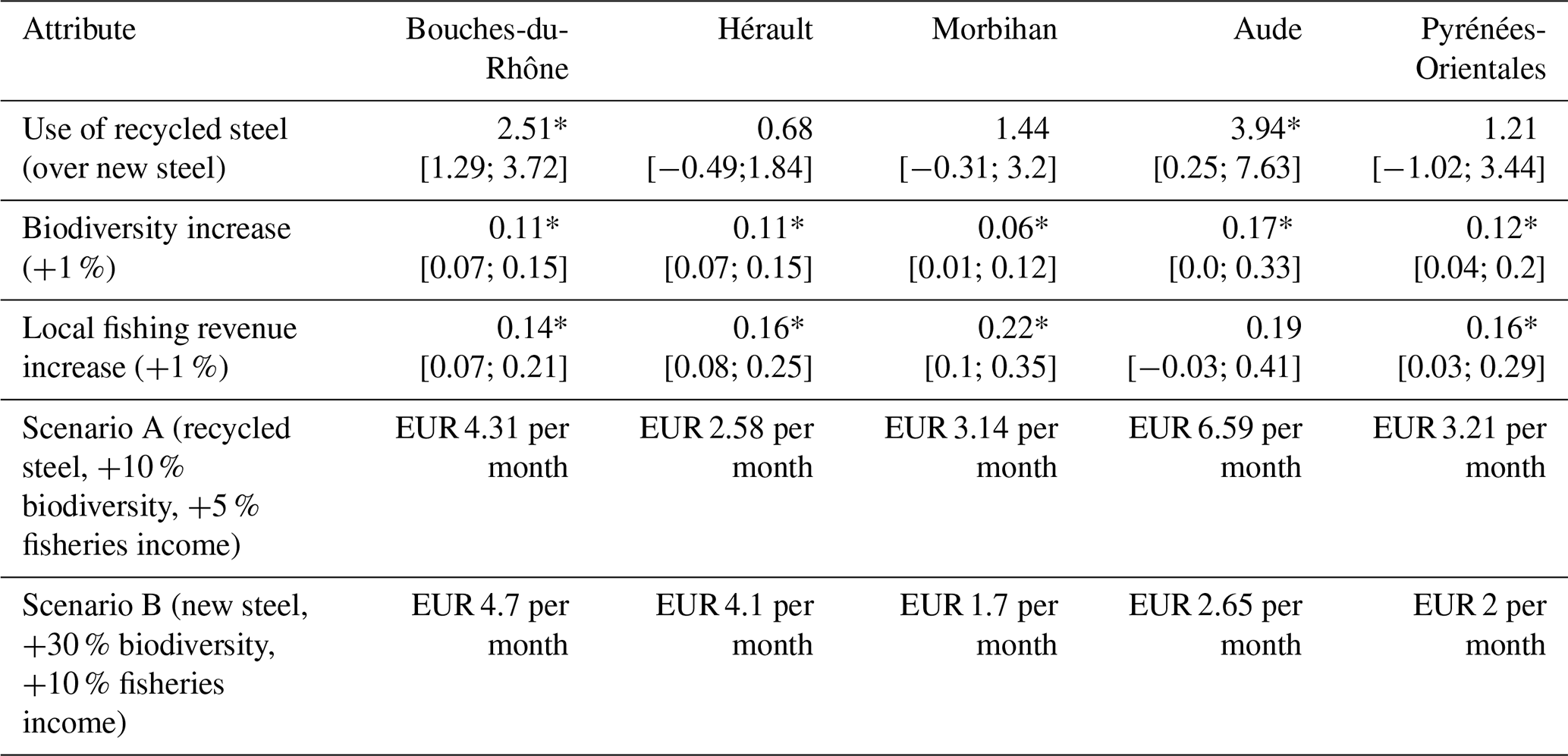
* for p value <0.05; values represent average household willingness to pay derived from marginal estimates of the conditional logit model. Biodiversity and fisheries impacts are expressed as percentage changes relative to current conditions. Confidence intervals (in brackets) were computed using the delta method based on the estimated variance-covariance matrix.
A Wald test was performed to analyse whether or not there was a significant difference between departments for an attribute (Fig. 3). The null hypothesis was that the estimated coefficients were equal across departments. This test revealed a single significant difference between the coefficients derived from the Conditional Logit Model for Recycled Steel between respondents from Bouches-du-Rhône and Hérault (p value <0.05). Similarly, the marginal WTPs were analysed with this Wald test, and the same result emerged: only the marginal WTP for recycled steel was significantly different between respondents from Bouches-du-Rhône and Hérault.
3.4 Attitude towards offshore wind power: a global point of view rather than territorial
A chi2 test was performed to assess whether the respondents' departments of origin had an effect on their attitudes towards offshore wind power (Fig. 4). The results of this analysis showed no significant difference between departments in attitudes (chi2 test, p value >0.05). In an attempt to discern a trend, an identical test was carried out, grouping “Very positive” with “Positive” and “Very negative” with “Negative”: the results of this test were also unsuccessful in detecting differences (chi2 test, p value >0.05).
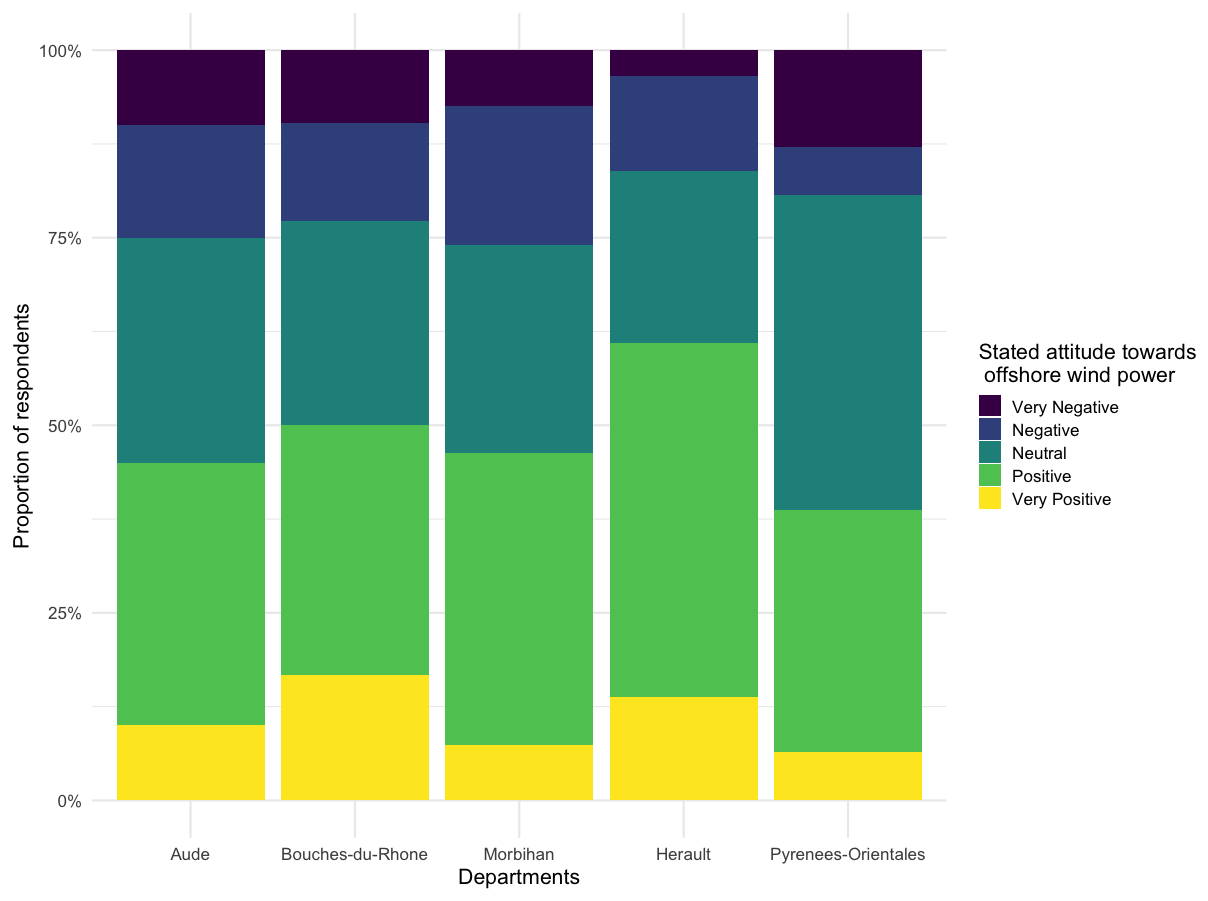
Figure 4Proportion of each attitude towards offshore wind power depending on the territories (i.e. department).
3.5 Link between stated attitude towards offshore wind power and frequency of chosen status quo: zero-inflated negative binomial regression model
To facilitate interpretation and visualisation, two categories of respondents were considered: those who chose the status quo more than four times out of eight (>50 %) and those who selected it four times or fewer (≤50 %). This threshold was chosen to capture a meaningful distinction between consistent and occasional selection of the status quo. A chi-square test of independence revealed a significant association between stated attitudes and the number of status quo choices (χ2=57.89, p<0.001). Respondents with very negative attitudes chose the status quo significantly more often than expected. Neutral and very positive respondents did not significantly deviate from expected frequencies (Table 7).
Table 7Number of status quo chosen in function of stated attitudes by respondents.
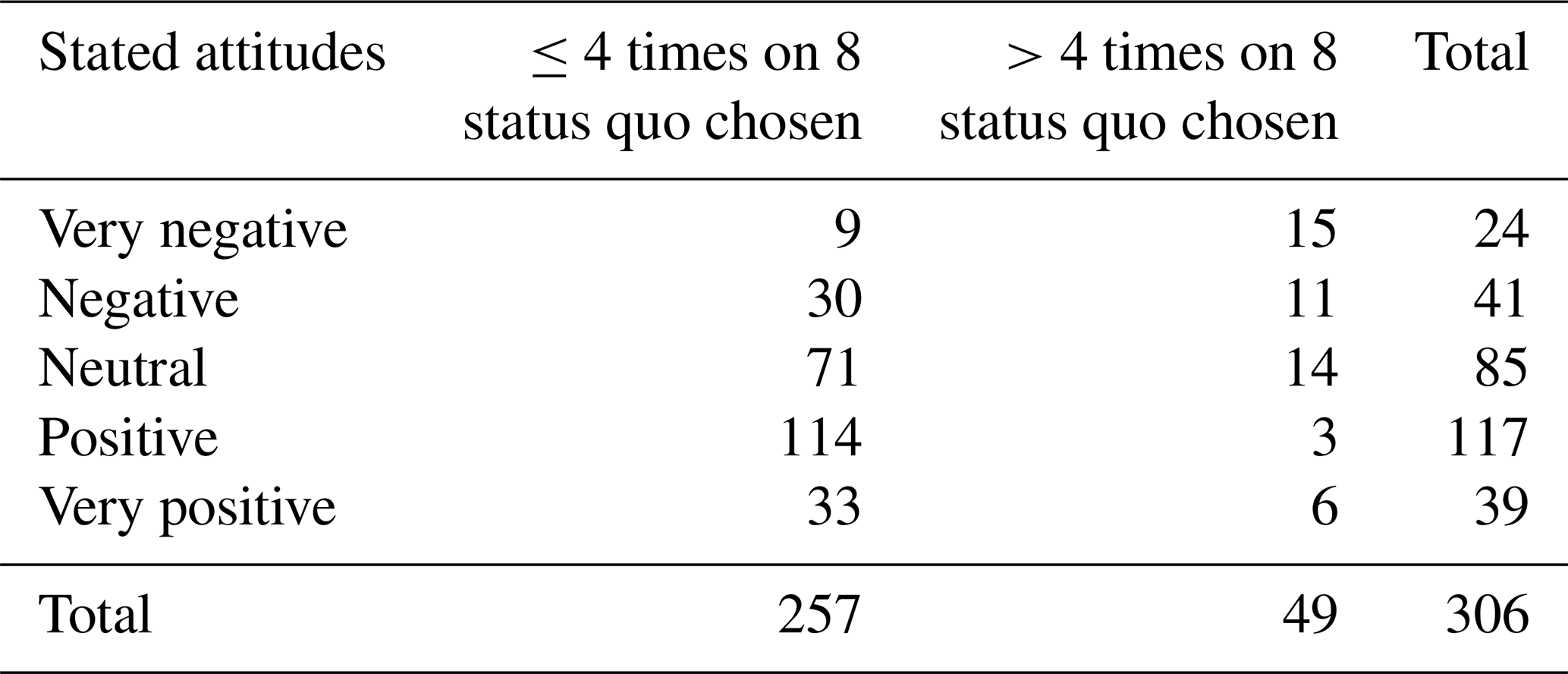
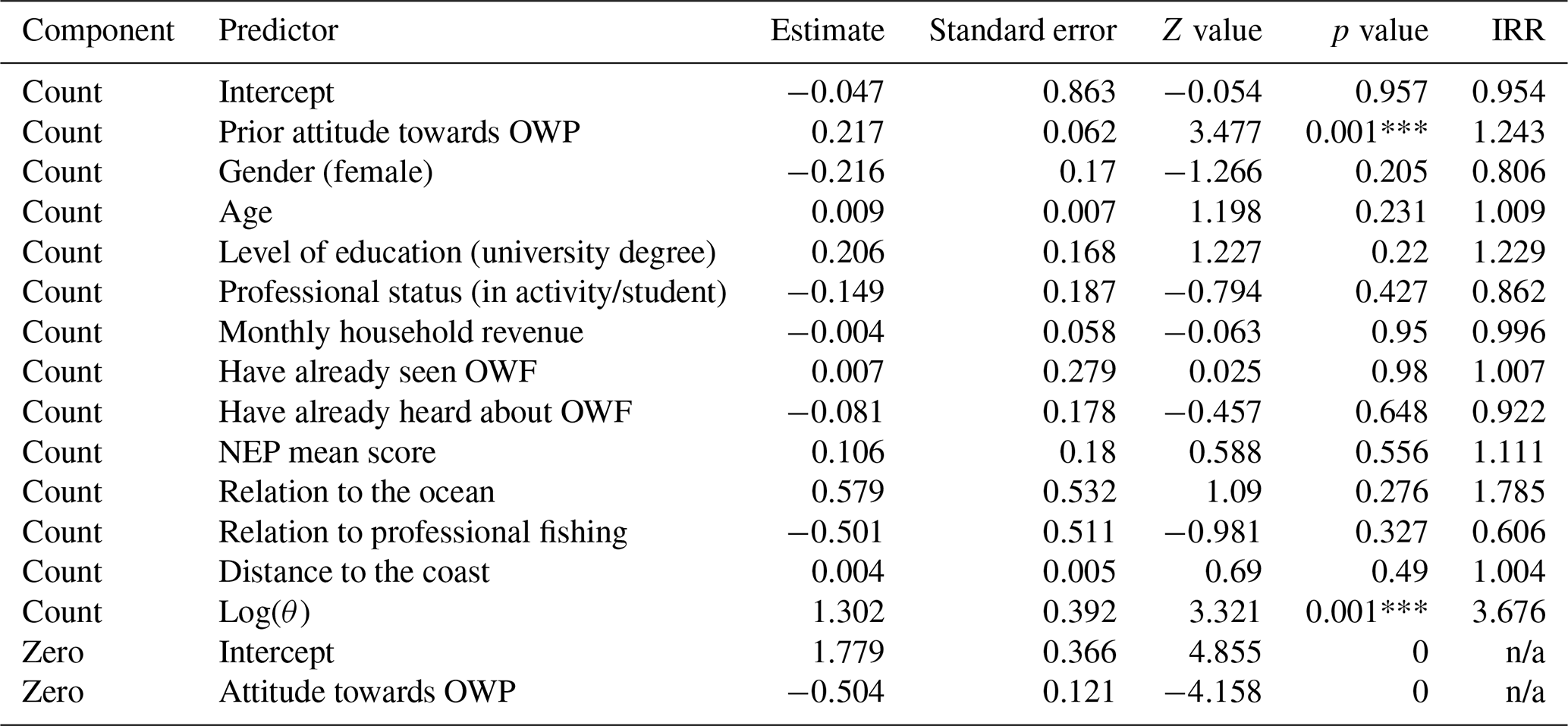
Table 8 presents the coefficients of the ZINB model and distinguishes them between the count component (number of status quo choices among respondents capable of selecting it) and the zero-inflation component (probability of always choosing zero). In the count model, the attitude towards offshore wind power was a significant predictor (β=0.217, p<0.001): it indicates that respondents with a more negative attitude towards offshore wind power were more likely to choose the status quo. The corresponding IRR of 1.243 (Table 8) suggests that for each unit increase in the scale of attitude towards offshore wind power (from very positive to very negative), the expected number of status quo choices increases by approximately 24 %. Other covariates in the count model, including declared gender, age, education, professional status, prior knowledge or exposure to OWF, NEP mean score, ocean and professional fishing relationship, and distance to the coast, were not statistically significant at the 0.05 level.
Table 8ZINB model: count and zero-inflation coefficients (IRR for count part).
n/a: not applicable
As the overdispersion parameter (θ) was significantly different from zero (log(θ)=1.302, p<0.001), it confirms the necessity of a negative binomial specification over another model. The ZINB model revealed that the attitude towards offshore wind power was also a significant predictor of the structural zeros (, p<0.001). This negative coefficient indicates that respondents with a more positive attitude towards offshore wind power are more likely to belong to the group of individuals who never choose the status quo over the two other options where the eco-engineering concept was applied. In other words, the tendency to avoid each time the status quo, and the frequency of status quo choices when selected, are strongly associated with respondents' prior attitudes towards offshore wind power.
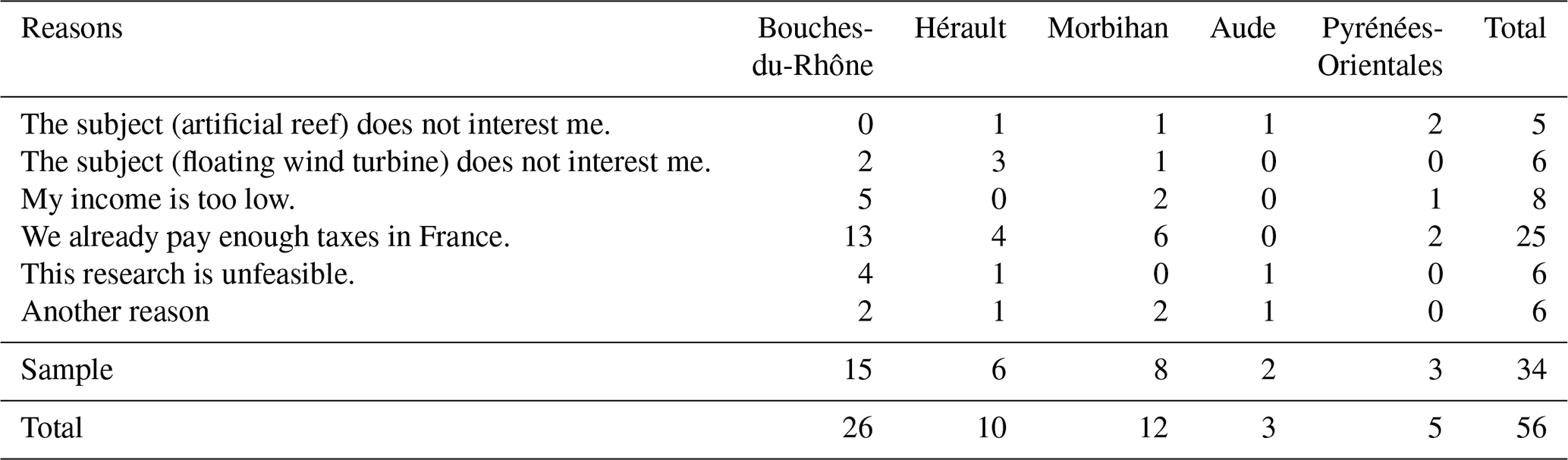
Those who chose only the status quo mainly cited the argument that they were already paying too much tax in France (Table 9) to support the inclusion of eco-engineering in their electricity bills. Some people also added other arguments to the list provided (13 people chose two arguments, three people chose three arguments and one person chose four arguments).
Table 9Reasons of respondents who were exclusive choosers of option C.
3.6 Complementary analysis with a mixed logit model
To account for repeated choice observations and to explore potential unobserved preference heterogeneity, a panel mixed logit model was estimated as a robustness check of the baseline conditional logit results (Table A5). Territorial differences were explored by introducing interaction terms between the recycled steel attribute and the department of residence because the number of observations was insufficient to estimate separate models for each department. This attribute was selected as it was the only one showing a difference across departments in the conditional logit specification (see Sect. 3.2).
Overall, the mixed logit specification confirms the direction and magnitude of the preference patterns identified in the conditional logit models that average preferences remain broadly similar across departments. The estimated mean coefficients confirm the main preference patterns identified in the conditional logit models. In particular, biodiversity enhancement, growth in local fisheries revenues and the use of recycled steel all exhibit positive average effects on utility, whereas the cost coefficient remains negative. These results indicate that respondents generally favour eco-engineering features associated with floating offshore wind projects while remaining sensitive to increases in electricity bills.
The interaction terms between recycled steel and departments remain relatively weak in the mixed logit specification. It implies a limited territorial variation in preference for this attribute. These findings are consistent with the conditional logit specification that indicated minor variation across departments.
Moreover, the interaction between respondents' prior attitudes towards offshore wind power and the status quo is positive and statistically significant (Table A5). It confirms the pattern found with the ZINB model that people holding stronger negative attitude towards offshore wind power are more likely to select the status quo option.
4.1 Do preferences vary depending on territories (i.e. departments)?
The results suggest a relatively homogeneous pattern of preferences across the departments sampled. Only one attribute (the use of recycled steel over new steel) demonstrated a statistically significant difference between territories in the conditional logit specification. Respondents from Bouches-du-Rhône reported a higher willingness to pay for the use of recycled steel (EUR 2.51 per household per month) than those from Hérault (EUR 0.68). On the contrary, preferences for biodiversity enhancement and growth in local fishing revenues appeared consistent across departments.
These results suggest that the territorial context plays a more limited role than initially expected in shaping preferences for eco-engineering characteristics. The overall pattern indicates a widely shared appreciation of the environmental and socio-economic benefits with the application of eco-engineering. However, differences in the perception of recycled materials may reflect local contextual factors such as exposure to industrial activities or discourse around circular economy practices. Nevertheless, the effect found for recycled steel remains moderate, as it was only found between two departments, and the mixed logit specification also supports this by showing no territorial variability for this attribute. This convergence of preferences contrasts with previous research that found significant contextual variance in the social acceptability of energy infrastructures (Lennon et al., 2019; Perlaviciute et al., 2018). Instead, the present results suggest that citizens may share relatively stable preferences regarding key project characteristics, and particularly for biodiversity enhancement and local economic benefits as artisanal fisheries.
From a policy perspective, the limited territorial variation observed in the results may represent an important opportunity for large-scale deployment strategies. If preferences for key eco-engineering attributes are consistent across coastal regions, developers and policymakers may be able to rely on relatively standardised design configurations rather than highly differentiated regional approaches. Such standardisation could facilitate economies of scale in the development of floating offshore wind projects incorporating eco-engineering features.
In this context, it becomes particularly relevant to consider combinations of attributes that could maximise public support. For example, a scenario combining the use of recycled steel with an increase of 10 % in the biodiversity (within the observed range from the literature; see Sect. 2.2.5 “Impact on marine biodiversity”) and a growth of 5 % in the revenues for local fisheries would lead to positive WTP in any department, with an average of EUR 3.9 per month (Scenario A, Table 6). This bundle design demonstrates how societal support can lead to efficient and responsible deployment strategies.
Interestingly, these results are consistent with previous studies showing that preferences for environmental and socio-economic attributes can be remarkably robust across countries, despite significant differences in institutional settings, tax regimes or energy cultures (Firestone and Kempton, 2007; Iwata et al., 2023; Klain et al., 2020). This suggests that certain attributes, in particular marine biodiversity enhancement and local economic impact, can benefit from broad cross-border support if correctly stated and culturally significant in the development territory. It also leaves room for a tailored approach to each region to take into account recent or specific contexts (Batel, 2020). Overall, this study reinforces the relevance of using eco-engineering that is both technically robust and symbolically credible (Pardo et al., 2023).
4.2 Does the attitude towards offshore wind power influence its acceptability?
The results indicate a clear link between respondents' attitudes towards offshore wind power and their propensity to select the status quo option. Individuals expressing the strongest negative attitudes towards offshore wind were significantly more likely to support the status quo alternative. In other words, those who were initially ardent opponents of offshore wind tended to reject configurations that had ecological and socio-economic improvements.
Interestingly, this finding contradicts our initial hypothesis, where we thought that opponents to offshore wind would try to reduce environmental or social impacts by choosing projects (options) with mitigation measures. Several explanations may account for this pattern. First, the status quo option may have been interpreted by some respondents as representing “no project at all”, even with the clear explanation before the choice experiment and the indication in the choice cards. Thus, the status quo was chosen as a symbolic choice for those rejecting offshore wind development. Second, the consistency of status quo selections (Table 7) may reflect a form of systematic opposition sometimes described in the literature as “technology fatigue” or ideology-driven rejection (Anon, 2013; Cohen et al., 2014; Devine-Wright, 2009). Lastly, follow-up questions revealed that many of these respondents mentioned financial concerns, particularly regarding the already existing French taxation. Some explicitly stated that they “already pay too much” and could not support additional fees, even for minimal additional fees to the electricity bill, suggesting that financial resistance may be tightly bound to broader political or economic dissatisfaction. Our results also echo prior findings (Klain et al., 2020) showing that choices often reinforce existing attitudes rather than changing them. But it is not entirely pessimistic, since respondents who declared an “only” negative attitude (or a moderate one) chose scenarios with eco-engineering integrated. Despite the resistance to wind power sometimes encountered, it paves the way for the broad development of this technology. In addition, qualitative comments collected during the survey suggest that financial factors may also play a role. Several respondents explicitly stated that they already felt heavily taxed and were reluctant to support additional electricity costs. This suggests that resistance to offshore wind projects may be rooted in broader political or economic dissatisfaction rather than a direct evaluation of the project attributes themselves.
These findings highlight the fact that the acceptability of offshore wind projects cannot be explained solely by the ecological or economic characteristics of the projects. Individuals' responses to proposed project configurations appear to be strongly influenced by their attitudes towards technology.
The results of this study provide several practical insights for policymakers, developers and other stakeholders involved in offshore renewable energy deployment. Public opposition is frequently motivated not only by technical misconceptions but also by symbolic, cultural or emotional dimensions as distrust of institutions and a perceived loss of democratic agency.
These findings suggest that simply upgrading project technical design may not always be enough to resolve public concerns. Communication efforts should therefore go beyond communicating ecological advantages or compensatory mechanisms, instead addressing underlying social representations and beliefs of fairness. At the same time, the findings show that many people with moderately negative opinions are willing to explore project alternatives that include significant ecological or socio-economic improvements. This shows that early participation and open communication with local populations can help to lessen resistance and encourage more positive talks about project design. More broadly, the relatively limited territorial differences observed in the study suggest that similar eco-engineering design principles could potentially be implemented across multiple coastal regions. This may facilitate the development of scalable solutions while still allowing for local adaptations where necessary.
Finally, tools such as discrete choice experiments, particularly when combined with qualitative or deliberative approaches, can provide valuable insights into public expectations and help to anticipate potential sources of opposition. Acceptability levers such as improving biodiversity, using recycled materials or addressing local economic repercussions should not be considered as “incidental” additions but rather as truly structural components of the project's legitimacy and viability. In a context where environmental legitimacy must be earned rather than presumed, aligning renewable infrastructure with social expectations and sustainable operation is not optional: it is an imperative.
The aim of this study was to assess how social preferences for floating wind projects associated with eco-engineering may vary across territories and according to respondents' stated attitudes towards offshore wind. The survey was designed to capture opinions and preferences of non-specialists towards an emerging technology. The results highlight a relative consistency in preferences across the French coastline. Environmental and socio-economic attributes of eco-engineering were positively valued by respondents. Only limited territorial variations were observed, indicating broadly shared preferences across coastal areas. In this context, the use of recycled steel further increases the value of willingness to pay and supports the idea of responsible energy exploitation in every aspect. These findings suggest that similar eco-engineering design principles could potentially be implemented across different territories, facilitating scalable deployment strategies for floating offshore wind projects.
The results also show a strong association between stated attitudes towards offshore wind power and the choices made in the experimental scenarios. Ardent opponents of offshore wind power were significantly more likely to favour the status quo option, even when ecological or socio-economic improvements were incorporated into the proposed alternatives. In contrast, those with simply “Negative” views were more likely to engage with scenarios of applied eco-engineering. This nuance is essential, as it highlights that although a segment of the population may be unreachable through technical or communicative adjustments, another large portion remains open to projects designed with attention to their values and concerns (i.e. the impact on marine and societal environments).
Some limitations of the study should be acknowledged. Uneven sample sizes across departments may have reduced the power of certain local comparisons. Moreover, the hypothetical nature of scenarios imply a degree of abstraction that may differ from behaviour in a real policy context. Attitudes were self reported and may also reflect some social desirability bias. Future research could further explore how emotional factors, risk perception or place-based identity interact with preference heterogeneity identified through mixed logit modelling approaches.
Table A1List of offshore wind farms on French maritime territory and their status.
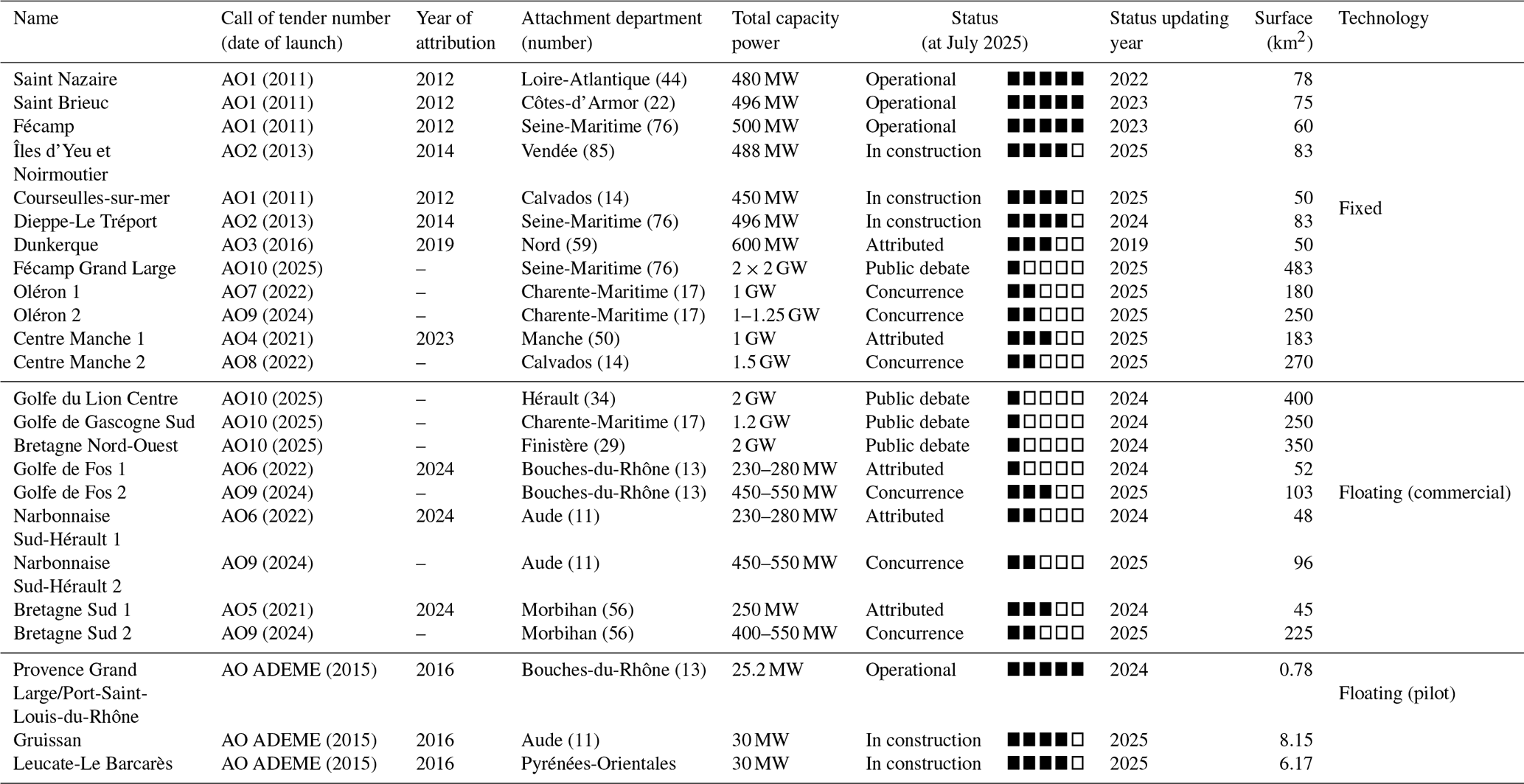
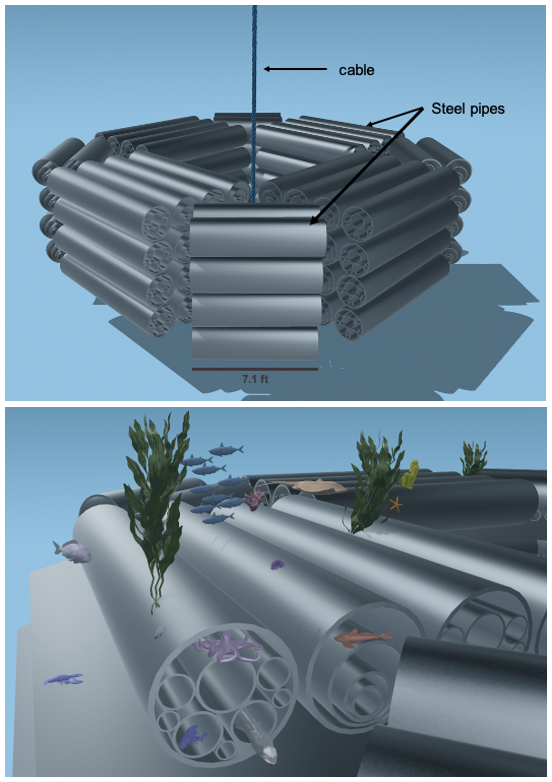
Figure A1Examples of visualisations of the concept shown to respondents during the discrete choice experiment survey (credit illustration: Antoine Dubois).
Table A2Example of choice cards shown to participants during the discrete choice experiment survey (translated from French).

Table A3Attributes and their values for each block and tasks.
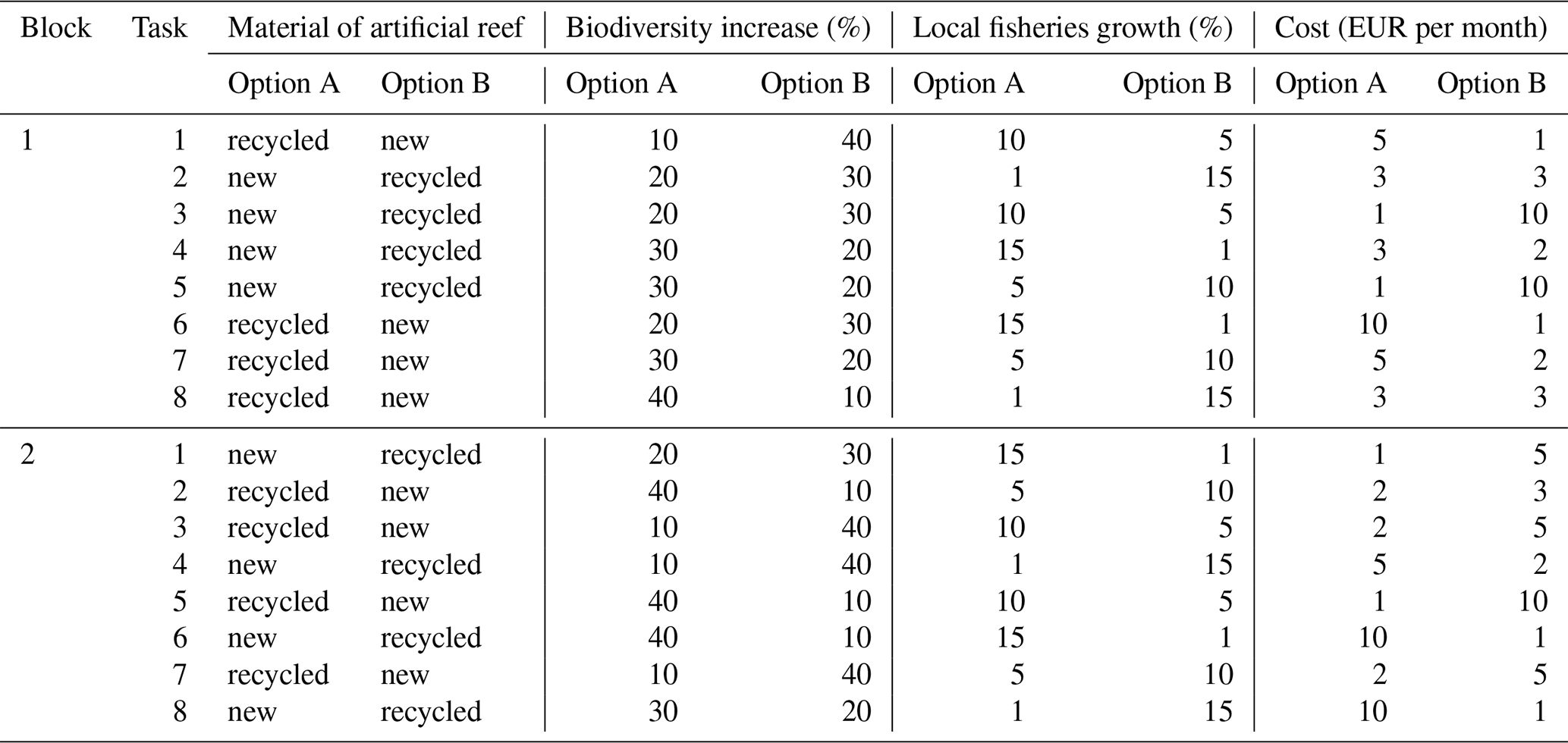
Each respondent was assigned to one of the two blocks and completed the eight tasks in a random order.
Table A4The 15 Likert-scale statements (strongly disagree, disagree, neutral, agree, strongly agree) of the new ecological paradigm questionnaire (Anderson, 2012).
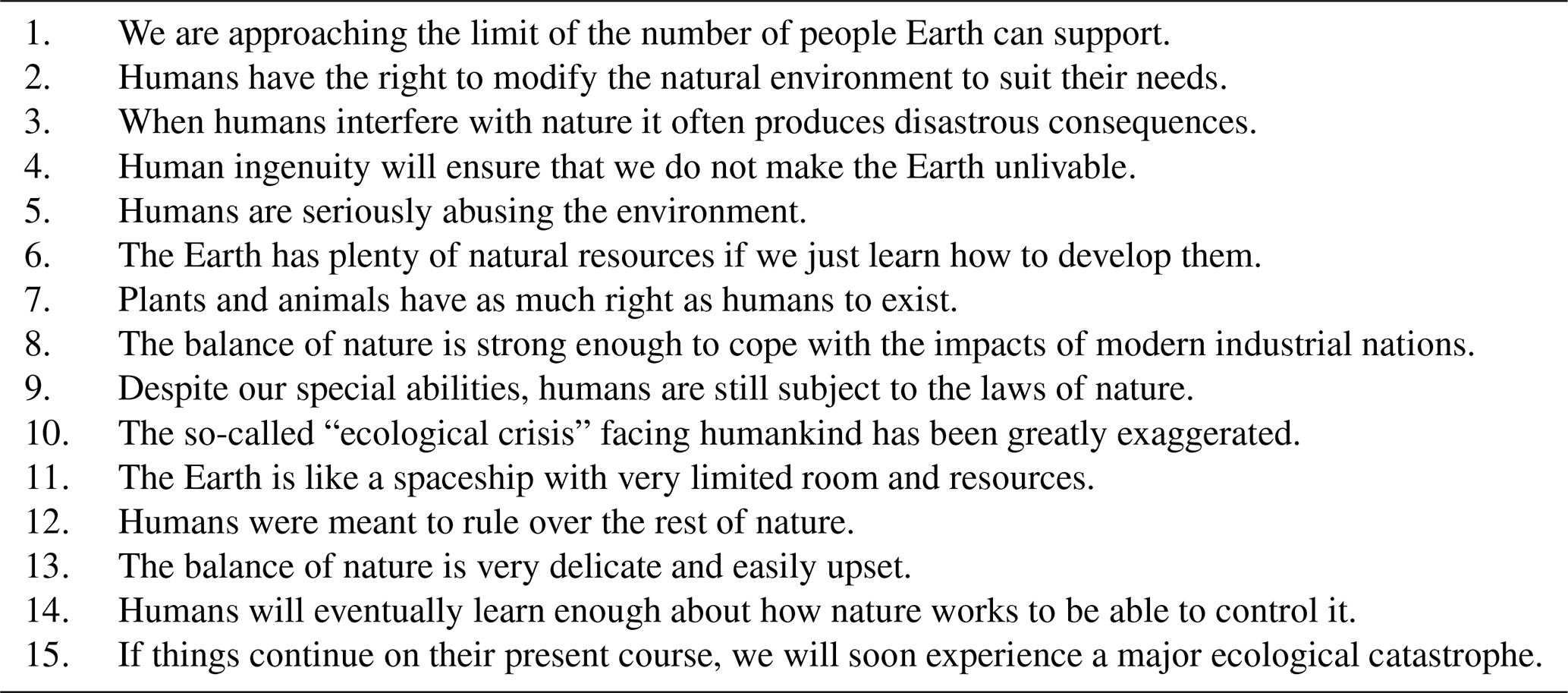
Table A5Mixed logit model accounting for repeated choices and preference heterogeneity.
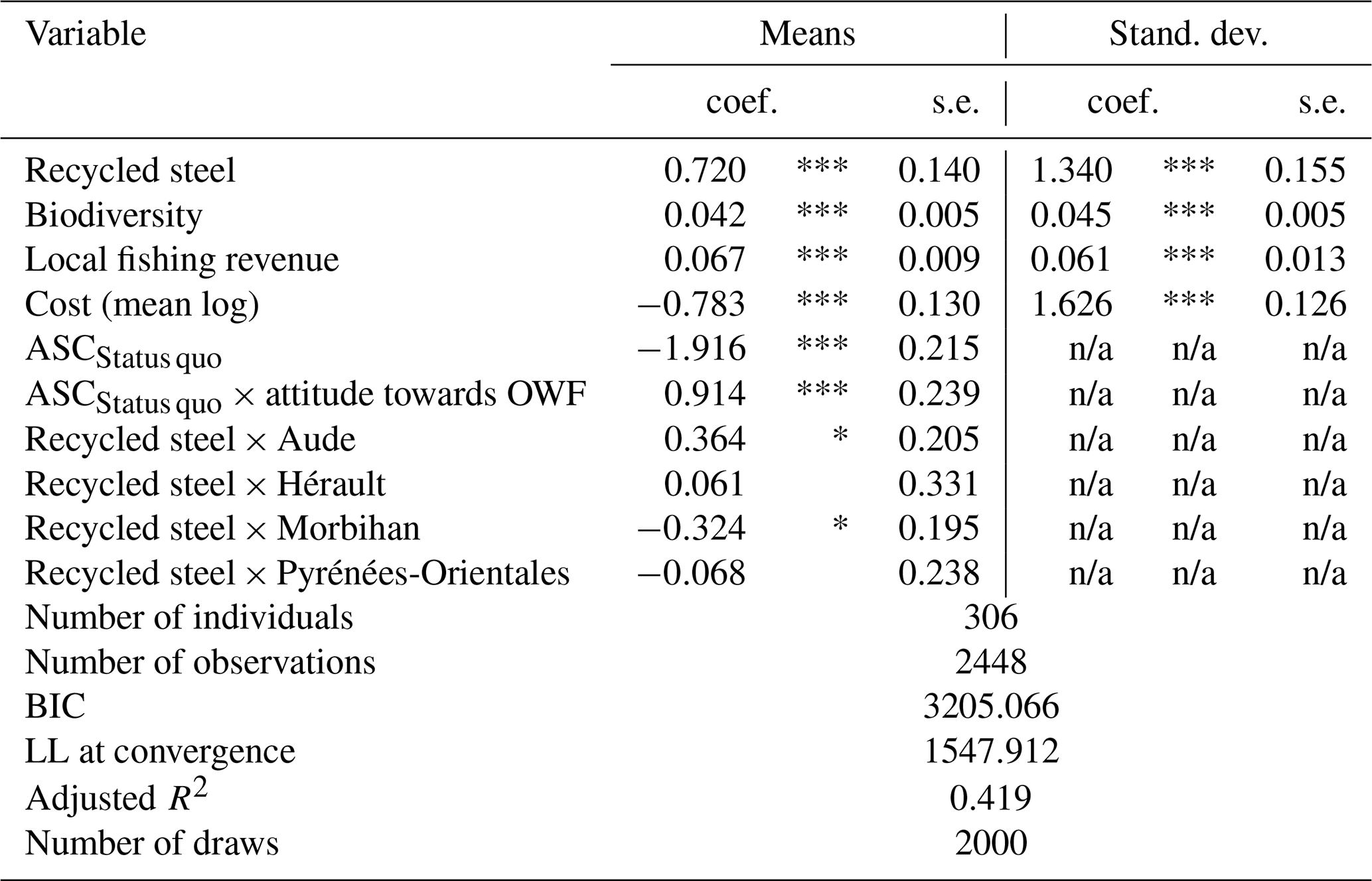
Notes: n/a: not applicable. s.e. robust; * p<0.1, ** p<0.05, *** p<0.01; department of reference: Bouches-du-Rhône; random parameters are assumed normally distributed except for the cost coefficient specified as lognormally distributed. The model includes interactions between respondents' attitudes towards offshore wind power and the status quo alternative, as well as territorial interactions with recycled steel preference. The specification accounts for repeated choice observations at the respondent level.
Table A6Willingness to pay derived from the mixed logit model.

Notes: n/a: not applicable. EUR per household per month; biodiversity and income = per percentage point; share β>0 = share of simulated preference draws implying a positive marginal utility. Confidence intervals for mixed logit WTP summaries were obtained using a parametric bootstrap: parameter vectors were drawn from the estimated (robust) variance-covariance matrix and individual-level WTP distributions derived from simulated preference parameters.
The code used in this study is available at https://doi.org/10.57745/MD9JFA (Dubois and Mahieu, 2026a).
The data set used in this study is available at https://doi.org/10.57745/M8AHEF (Dubois and Mahieu, 2026b).
AD, PAM, AB and FS conceptualised the study. AD, PAM, AB and JM developed the methodology. AD and PAM performed formal analysis, investigation and visualisation. AD, PAM and FS prepared the original draft. PAM, AB and FS provided supervision. All authors contributed to the draft review and editing.
The contact author has declared that none of the authors has any competing interests.
Publisher's note: Copernicus Publications remains neutral with regard to jurisdictional claims made in the text, published maps, institutional affiliations, or any other geographical representation in this paper. The authors bear the ultimate responsibility for providing appropriate place names. Views expressed in the text are those of the authors and do not necessarily reflect the views of the publisher.
This article is part of the special issue “Wind energy economics and markets with high shares of renewables”. It is not associated with a conference.
This work is part of the US–French collaborative project Improving the Environmental Integration of Floating Offshore Wind Turbines (I2FLOW) of the Sea and Littoral Research Institute (FR CNRS IUML), Nantes Université, Nantes, France, in partnership with the Ocean Resources and Renewable Energy (ORE) Lab, Department of Mechanical and Industrial Engineering, University of Massachusetts, Amherst, USA, and the Department of Environmental Studies at Colby College, Waterville, Maine, USA. It was funded by Region de la Loire under the WEAMEC community through the MOORREEF project and the European Community under the FEDER programme. During the preparation of this work, the authors partially used AI (Quillbot) in order to improve readability, language and grammar of the work. After using this tool/service, the authors reviewed and edited the content as needed and take full responsibility for the content of the published article. The authors would like to sincerely thank two anonymous reviewers for their thorough analyses.
This research has been supported by the WEst Atlantic Marine Energy Community (MOORREEF).
This paper was edited by Anastasia Ioannou and reviewed by three anonymous referees.
ADEME: Frontier Economics, GreenFlex: Mesures et instruments de politiques publiques pour l'atteinte de la neutralité carbone, 34 pp., https://librairie.ademe.fr/index.php?controller=attachment&id_attachment=3784&preview=1 (last access: 11 September 2025), 2024.
Agence de Développement Touristique: Bilan touristique départemental 2023, https://pro.audetourisme.com/uploads/2025/05/2024-bilan-touristique.pdf (last access: 27 April 2026), 2024.
Anderson, M.: New Ecological Paradigm (NEP) Scale, Berkshire Encyclopedia of Sustainability, 6, 260–262, 2012.
Andersson, M. H. and Öhman, M. C.: Fish and sessile assemblages associated with wind-turbine constructions in the Baltic Sea, Mar. Freshwater Res., 61, 642, https://doi.org/10.1071/MF09117, 2010.
Anon: Biodiversity: Concepts, Patterns, and Measurement, in: The Princeton Guide to Ecology, Princeton University Press, 257–263, https://doi.org/10.1515/9781400833023.257, 2009.
Anon: Wind Power: Basic Challenge Concerning Social Acceptance, in: Renewable Energy Systems, Springer New York, New York, NY, 1785–1821, https://doi.org/10.1007/978-1-4614-5820-3_88, 2013.
Bacchiocchi, E., Sant, I., and Bates, A.: Energy justice and the co-opting of indigenous narratives in U.S. offshore wind development, Renewable Energy Focus, 41, 133–142, https://doi.org/10.1016/j.ref.2022.02.008, 2022.
Batel, S.: Research on the social acceptance of renewable energy technologies: Past, present and future, Energy Research & Social Science, 68, 101544, https://doi.org/10.1016/j.erss.2020.101544, 2020.
Bates, A. and Firestone, J.: A comparative assessment of proposed offshore wind power demonstration projects in the United States, Energy Research & Social Science, 10, 192–205, https://doi.org/10.1016/j.erss.2015.07.007, 2015.
Bishop, M. J., Mayer-Pinto, M., Airoldi, L., Firth, L. B., Morris, R. L., Loke, L. H. L., Hawkins, S. J., Naylor, L. A., Coleman, R. A., Chee, S. Y., and Dafforn, K. A.: Effects of ocean sprawl on ecological connectivity: impacts and solutions, J. Exp. Mar. Biol. Ecol., 492, 7–30, https://doi.org/10.1016/j.jembe.2017.01.021, 2017.
Börger, T., Hooper, T. L., and Austen, M. C.: Valuation of ecological and amenity impacts of an offshore windfarm as a factor in marine planning, Environ. Sci. Policy, 54, 126–133, https://doi.org/10.1016/j.envsci.2015.05.018, 2015.
Bottin, L., Garcia, D., and Meinesz, A.: Côtes françaises de la Méditerranée: observatoire des réserves sous-marines et des aires marines protégées, Equipe CNRS UMR 7035 ECOSEAS, Université Côte d’Azur, http://www.medamp.org (last access: 27 April 2026), 2020.
Brock, R. E. and Norris, J. E.: An Analysis of the Efficacy of Four Artificial Reef Designs in Tropical Waters, B. Mar. Sci., 44, 934–941, 1989.
Brownlee, M. T. J., Hallo, J. C., Jodice, L. W., Moore, D. D., Powell, R. B., and Wright, B. A.: Place Attachment and Marine Recreationists' Attitudes toward Offshore Wind Energy Development, J. Leisure Res., 47, 263–284, https://doi.org/10.1080/00222216.2015.11950360, 2015.
Bush, D. and Hoagland, P.: Public opinion and the environmental, economic and aesthetic impacts of offshore wind, Ocean Coast. Manage., 120, 70–79, https://doi.org/10.1016/j.ocecoaman.2015.11.018, 2016.
Cameron, A. C. and Trivedi, P. K.: Regression Analysis of Count Data, 2nd edn., Cambridge University Press, https://doi.org/10.1017/CBO9781139013567, 2013.
Capacité d'accueil Pyrénées Orientales Tourisme: https://pro-tourismeadt66.com/capacite-daccueil, last access: 28 July 2025.
Chaumette, P.: Challenge économique et maîtrise des nouveaux risques maritimes: Quelle croissance bleue? GOMILEX, 480 pp., 2017, ISBN 978-84-15176-86-2, 2017.
Chiffres clés Tourisme et Loisirs Hérault édition 2024: https://www.calameo.com/read/00001754241e0fb5006ae, last access: 28 July 2025.
Cohen, J. J., Reichl, J., and Schmidthaler, M.: Re-focussing research efforts on the public acceptance of energy infrastructure: A critical review, Energy, 76, 4–9, https://doi.org/10.1016/j.energy.2013.12.056, 2014.
Coolen, J. W. P., Van Der Weide, B., Cuperus, J., Blomberg, M., Van Moorsel, G. W. N. M., Faasse, M. A., Bos, O. G., Degraer, S., and Lindeboom, H. J.: Benthic biodiversity on old platforms, young wind farms, and rocky reefs, ICES J. Marine Sci., 77, 1250–1265, https://doi.org/10.1093/icesjms/fsy092, 2018.
Crowle, A. and Thies, P.: Floating offshore wind turbines port requirements for construction, Proceedings of the Institution of Mechanical Engineers, Part M: Journal of Engineering for the Maritime Environment, 236, 1047–1056, https://doi.org/10.1177/14750902221078425, 2022.
Coughlan, K., Schoefs, F., Thiagarajan, K., and Arwade, S.: Multi-parameter analysis of marine growth effects on mooring lines for floating offshore wind, Ocean Eng., 340, https://doi.org/10.1016/j.oceaneng.2025.122390, 2025.
Dalton, T., Weir, M., Calianos, A., D'Aversa, N., and Livermore, J.: Recreational boaters' preferences for boating trips associated with offshore wind farms in US waters, Marine Policy, 122, 104216, https://doi.org/10.1016/j.marpol.2020.104216, 2020.
De Backer, A. and Hostens, K.: Effects of Belgian Offshore Windfarms on soft sediment epibenthos and fish: an updated time series, in: Marking a Decade of Monitoring, Research and Innovation, 13, edited by: Degraer, S., Brabant, R., Rumes, B., and Vigin, L., Royal Belgian Institute of Natural Sciences (RBINS) Operational Directorate Natural Environment, Marine Ecology and Management Section, 2019.
Degraer, S., Brabant, R., Rumes, B., and Vigin, L. (Eds.): Environmental Impacts of Offshore Wind Farms in the Belgian Part of the North Sea: Attraction, avoidance and habitat use at various spatial scales. Memoirs on the Marine Environment, Royal Belgian Institute of Natural Sciences, Operational Directorate Natural Environment, Marine Ecology and Management Section, 2021.
Dennis, H. D., Evans, A. J., Banner, A. J., and Moore, P. J.: Reefcrete: Reducing the environmental footprint of concretes for eco-engineering marine structures, Ecol. Eng., 120, 668–678, https://doi.org/10.1016/j.ecoleng.2017.05.031, 2018.
De Paoli, G., Rivière, C., Bastide, L., Zaitar, Y., and Tsakas, C.: Évaluation des coûts et bénéfices induits par des mesures de protection dans deux aires marines protégées françaises, Cahier no. 22, Plan Bleu, PNUE/PAM, ISBN 978-2-912081-58-2, 2023.
Devine-Wright, P.: Rethinking NIMBYism: The role of place attachment and place identity in explaining place-protective action, J. Community. Appl. Soc. Psychol., 19, 426–441, https://doi.org/10.1002/casp.1004, 2009.
DREAL Bretagne: Plan d'actions territorial terrestre en Bretagne 2022–2024, Ministère de la Transition Écologique, Rennes, 2023.
Druckman, J. N.: Communicating Policy-Relevant Science, APSC, 48, 58–69, https://doi.org/10.1017/S1049096515000438, 2015.
Dubois, A. and Mahieu, P.-A.: Sorted & Prepared data and R-code for “Preference and willingness-to-pay analysis for an eco-engineering technology for floating wind turbines”, Recherche Data Gouv [code and data set], https://doi.org/10.57745/MD9JFA, 2026a.
Dubois, A. and Mahieu, P.-A.: Raw data for “Preference and Willingness-to-pay analysis for an eco-engineering technology for floating wind turbines” article, Recherche Data Gouv [data set], https://doi.org/10.57745/M8AHEF, 2026b.
Dubois, A., Bates, A., Lin, A., Schoefs, F., and Mahieu, P.: Transatlantic Coastal Community Voices on Floating Offshore Wind Farms With Artificial Reefs, Wind Energy, 28, https://doi.org/10.1002/we.70021, 2025a.
Dubois, A., Schoefs, F., Cognie, B., Reynaud, M., Soulard, T., and Dumay, J.: Spatio-temporal evolution and engineering implications of biofouling communities on floating wind turbines mooring lines, Estuar. Coast. Shelf Sci., 320, 109302, https://doi.org/10.1016/j.ecss.2025.109302, 2025b.
Dunlap, R. E., Van Liere, K. D., Mertig, A. G., and Jones, R. E.: New Trends in Measuring Environmental Attitudes: Measuring Endorsement of the New Ecological Paradigm: A Revised NEP Scale, J. Soc. Issues, 56, 425–442, https://doi.org/10.1111/0022-4537.00176, 2000.
Energy101: https://www.energy101.com/calculators/, last access: 31 July 2025.
Fabi, G. and Fiorentini, L.: Comparison Between an Artificial Reef and a Control Site in the Adriatic Sea: Analysis of Four Years of Monitoring, B. Marine Sci., 55, 538–558, 1994.
Fennell, P., Driver, J., Bataille, C., and Davis, S. J.: Going net zero for cement and steel, Nature, 603, https://www.nature.com/articles/d41586-022-00758-4.pdf (last access: 27 April 2026), 2022.
Février, M. and Le Guen, S.: Économie maritime: 74500 emplois en Bretagne, INSEE, Rennes, https://www.insee.fr/fr/statistiques/3627571 (last access: 27 April 2026), 2018.
Firestone, J. and Kempton, W.: Public opinion about large offshore wind power: Underlying factors, Energy Policy, 35, 1584–1598, https://doi.org/10.1016/j.enpol.2006.04.010, 2007.
Firestone, J., Kempton, W., Lilley, M. B., and Samoteskul, K.: Public acceptance of offshore wind power: does perceived fairness of process matter?, J. Environ. Plann. Man., 55, 1387–1402, https://doi.org/10.1080/09640568.2012.688658, 2012.
Firth, L. B., Thompson, R. C., Bohn, K., Abbiati, M., Airoldi, L., Bouma, T. J., Bozzeda, F., Ceccherelli, V. U., Colangelo, M. A., Evans, A., Ferrario, F., Hanley, M. E., Hinz, H., Hoggart, S. P. G., Jackson, J. E., Moore, P., Morgan, E. H., Perkol-Finkel, S., Skov, M. W., Strain, E. M., Van Belzen, J., and Hawkins, S. J.: Between a rock and a hard place: Environmental and engineering considerations when designing coastal defence structures, Coast. Eng., 87, 122–135, https://doi.org/10.1016/j.coastaleng.2013.10.015, 2014.
FranceAgriMer: The fisheries and aquaculture sector in France – Data 2023, https://www.franceagrimer.fr/sites/default/files/2025-09/Document Key figures for fisheries and aquaculture sector in France - Data 2024.pdf (last access: 27 April 2026), 2024.
Galparsoro, I., Menchaca, I., Garmendia, J. M., Borja, Á., Maldonado, A. D., Iglesias, G., and Bald, J.: Reviewing the ecological impacts of offshore wind farms, npj Ocean Sustain, 1, 1, https://doi.org/10.1038/s44183-022-00003-5, 2022.
Gauff, R. P. M., Joubert, E., Curd, A., Carlier, A., Chavanon, F., Ravel, C., and Bouchoucha, M.: The elephant in the room: Introduced species also profit from refuge creation by artificial fish habitats, Mar. Environ. Res., 185, 105859, https://doi.org/10.1016/j.marenvres.2022.105859, 2023.
Glarou, M., Zrust, M., and Svendsen, J. C.: Using Artificial-Reef Knowledge to Enhance the Ecological Function of Offshore Wind Turbine Foundations: Implications for Fish Abundance and Diversity, JMSE, 8, 332, https://doi.org/10.3390/jmse8050332, 2020.
Greene, W. H.: Accounting for excess zeros and sample selection in Poisson and negative binomial regression models, NYU Working Paper No. EC-94-10, 1994.
Greene, W. H.: Econometric Analysis, 8th edn., Pearson Education, E-ISBN 978-1-292-23115-0, 2019.
Hall, D. B.: Zero-inflated Poisson and binomial regression with random effects: A case study, Biometrics, 56, 1030–1039, https://doi.org/10.1111/j.0006-341X.2000.01030.x, 2000.
Handmaker, O., Keeler, B. L., and Milz, D.: What type of value information is most valuable to stakeholders? Multi-sector perspectives on the utility and relevance of water valuation information, Environ. Sci. Policy, 115, 47–60, https://doi.org/10.1016/j.envsci.2020.10.006, 2021.
Hanley, N., Wright, R. E., and Adamowicz, V.: Using Choice Experiments to Value the Environment, Environmental and Resource Economics, 11, 413–428, https://doi.org/10.1023/A:1008287310583, 1998.
Hensher, D. A., Rose, J. M., and Greene, W. H.: Applied Choice Analysis: A Primer, Cambridge University Press, 2005, ISBN 0521844266, 2005.
Hermans, A., Bos, O. G., Prusina, I., and Klinge, M.: Nature-Inclusive Design: a catalogue for offshore wind infrastructure, Wageningen Marine Research, The Ministry of Agriculture, Nature and Food Quality, the Netherlands, https://tethys.pnnl.gov/sites/default/files/publications/Nature_inclusive_design_catalogue_offshore_wind.pdf (last access: 27 April 2026), 2020.
Hess, S. and Palma, D.: Apollo: a flexible, powerful and customisable freeware package for choice model estimation and application, J. Choice Model., 32, https://doi.org/10.1016/j.jocm.2019.100170, 2019.
Hilbe, J. M.: Negative Binomial Regression, 2nd edn., Cambridge University Press, https://doi.org/10.1017/CBO9780511973420, 2011.
Hilbe, J. M.: Modeling Count Data, Cambridge University Press, https://doi.org/10.1017/CBO9781139236065, 2014.
Hoyos, D.: The state of the art of environmental valuation with discrete choice experiments, Ecol. Econom., 69, 1595–1603, https://doi.org/10.1016/j.ecolecon.2010.04.011, 2010.
Ifremer: Système d'Informations Halieutiques, Façade Méditerranée. 2023. Activité des navires de pêche, https://archimer.ifremer.fr/doc/00912/102409/ (last access: 27 April 2026), 2024a.
Ifremer: Système d'Informations Halieutiques, Département Bouches-du-Rhône. 2023, Activité des navires de pêche. Ref. Navires dans les lieux d'immatriculation de Martigues et Marseille, https://archimer.ifremer.fr/doc/00912/102400/ (last access: 27 April 2026), 2024b.
Ifremer: Système d'Informations Halieutiques, Département Hérault. 2023. Activité des navires de pêche. Ref. Navires dans le lieu d'immatriculation de Sète, https://archimer.ifremer.fr/doc/00912/102403/ (last access: 27 April 2026), 2024c.
Ifremer: Système d'Informations Halieutiques, Département Morbihan. 2023, Activité des navires de pêche. Ref. Navires dans les lieux d'immatriculation de Lorient, Auray et Vannes, https://archimer.ifremer.fr/doc/00912/102393/ (last access: 27 April 2026), 2024d.
Ifremer: Système d'Informations Halieutiques, Département Pyrénées-Orientales. 2023. Activité des navires de pêche, https://archimer.ifremer.fr/doc/00912/102404/113672.pdf (last access: 27 April 2026), 2024e.
INSEE: 120 000 emplois directement liés à la mer en Provence-Alpes-Côtes d'Azur, https://www.insee.fr/fr/statistiques/2862316 (last access: 28 July 2025), 2017.
INSEE: France, portrait social, Édition 2020, https://www.insee.fr/fr/statistiques/4797574?sommaire=4928952 (last access: 31 July 2025), 2020.
INSEE: Flash Occitanie: En Occitanie, un emploi salarié sur quinze est lié à la présence des touristes, INSEE, https://www.insee.fr/fr/statistiques/6212965 (last access: 27 April 2026), 2022.
INSEE: Dossier complet – Département de l'Aude (11), https://www.insee.fr/fr/statistiques/2011101?geo=DEP-11 (last access: 28 July 2025), 2025a.
INSEE: Dossier complet – Département des Bouches-du-Rhône (13), https://www.insee.fr/fr/statistiques/2011101?geo=DEP-13 (last access: 28 July 2025), 2025b.
INSEE: Dossier complet – Département de l'Hérault (34), https://www.insee.fr/fr/statistiques/2011101?geo=DEP-34 (last access: 28 July 2025), 2025c.
INSEE: Dossier complet – Département du Morbihan (56), https://www.insee.fr/fr/statistiques/2011101?geo=DEP-56 (last access: 28 July 2025), 2025d.
INSEE: Dossier complet – Département des Pyrénées-Orientales (66), https://www.insee.fr/fr/statistiques/2011101?geo=DEP-66 (last access: 28 July 2025), 2025e.
Iwata, K., Kyoi, S., and Ushifusa, Y.: Public attitudes of offshore wind energy in Japan: An empirical study using choice experiments, Cleaner Energy Systems, 4, 100052, https://doi.org/10.1016/j.cles.2023.100052, 2023.
Jackman, S.: pscl: Classes and Methods for R developed in the Political Science Computational Laboratory, Sidney, Australia, University of Sydney, Sydney, Australia, R package version 1.5.9, https://www.rdocumentation.org/packages/pscl/versions/1.5.9 (last access: 27 April 2026), 2024.
Jiang, Z.: Installation of offshore wind turbines: A technical review, Renewable and Sustainable Energy Reviews, 139, 110576, https://doi.org/10.1016/j.rser.2020.110576, 2021.
Joalland, O. and Mahieu, P.-A.: Developing large-scale offshore wind power programs: A choice experiment analysis in France, Ecol. Econ., 204, 107683, https://doi.org/10.1016/j.ecolecon.2022.107683, 2023.
Kermagoret, C., Levrel, H., Carlier, A., and Dachary-Bernard, J.: Individual preferences regarding environmental offset and welfare compensation: a choice experiment application to an offshore wind farm project, Ecol. Econ., 129, 230–240, https://doi.org/10.1016/j.ecolecon.2016.05.017, 2016.
Kim, H.-J., Kim, J.-H., and Yoo, S.-H.: Social acceptance of offshore wind energy development in South Korea: Results from a choice experiment survey, Renewable and Sustainable Energy Reviews, 113, 109253, https://doi.org/10.1016/j.rser.2019.109253, 2019.
Klain, S., Satterfield, T., Chan, K. M. A., and Lindberg, K.: Octopus's garden under the blade: Boosting biodiversity increases willingness to pay for offshore wind in the United States, Energy Research & Social Science, 69, 101744, https://doi.org/10.1016/j.erss.2020.101744, 2020.
Koeck, B., Tessier, A., Brind'Amour, A., Pastor, J., Bijaoui, B., Dalias, N., Astruch, P., Saragoni, G., and Lenfant, P.: Functional differences between fish communities on artificial and natural reefs: a case study along the French Catalan coast, Aquat. Biol., 20, 219–234, https://doi.org/10.3354/ab00561, 2014.
Komyakova, V., Chamberlain, D., and Swearer, S. E.: A multi-species assessment of artificial reefs as ecological traps, Ecol. Eng., 171, 106394, https://doi.org/10.1016/j.ecoleng.2021.106394, 2021.
Krueger, A. D., Parsons, G. R., and Firestone, J.: Valuing the Visual Disamenity of Offshore Wind Power Projects at Varying Distances from the Shore: An Application on the Delaware Shoreline, Land Econ., 87, 268–283, https://doi.org/10.3368/le.87.2.268, 2011.
Ladenburg, J.: Attitudes towards offshore wind farms – The role of beach visits on attitude and demographic and attitude relations, Energy Policy, 38, 1297–1304, https://doi.org/10.1016/j.enpol.2009.11.005, 2010.
Lancsar, E. and Louviere, J.: Conducting Discrete Choice Experiments to Inform Healthcare Decision Making, Pharmacoeconomics 26, 661–677, https://doi.org/10.2165/00019053-200826080-00004, 2008.
Langhamer, O.: Artificial Reef Effect in relation to Offshore Renewable Energy Conversion: State of the Art, Sci. World J., 2012, 1–8, https://doi.org/10.1100/2012/386713, 2012.
Lengkeek, W., Didderen, K., Teunis, M., Driessen, F., Coolen, J. W. P., Bos, O. G., Vergouwen, S. A., Raaijmakers, T. C., de Vries, M. B., and van Koningsveld, M.: Eco-friendly design of scour protection: potential enhancement of ecological functioning in offshore wind farms, Ministry of Economic Affairs, Netherlands, Wageningen Marine Research, report 17-001, https://www.buwa.nl/fileadmin/buwa_upload/Bureau_Waardenburg_rapporten/17-001_Bureau_Waardenburg_report_EcoFriendly_design_scour_protection.pdf (last access: 27 April 2026), 2017.
Lennon, B., Dunphy, N. P., and Sanvicente, E.: Community acceptability and the energy transition: a citizens' perspective, Energ. Sustain. Soc., 9, https://doi.org/10.1186/s13705-019-0218-z, 2019.
Les sites Natura 2000 dans l'Aude: https://www.aude.gouv.fr/Actions-de-l-Etat/Environnement-eau-foret-chasse-risques-naturels-technologiques/Environnement-et-Developpement-durable/Natura-2000/Les-sites-dans-l-Aude/Les-sites-Natura-2000-dans-l-Aude (last access: 28 July 2025), 2019.
Maxwell, S. M., Kershaw, F., Locke, C. C., Conners, M. G., Dawson, C., Aylesworth, S., Loomis, R., and Johnson, A. F.: Potential impacts of floating wind turbine technology for marine species and habitats, J. Environ. Manage., 307, 114577, https://doi.org/10.1016/j.jenvman.2022.114577, 2022.
McFadden, D.: Conditional logit analysis of qualitative choice behavior, in: Frontiers in econometrics, Academic Press, New York, 105–142, ISBN 0-12-776150-0, 1974.
Ministère de la Transition Écologique: Éolien en mer, https://www.ecologie.gouv.fr/sites/default/files/documents/20241018_DP_Eolien en mer.pdf (last access: 27 April 2026), 2024.
Observatoire en ligne Provence Tourisme: https://app.powerbi.com/view?r=eyJrIjoiYjZlNGZjYWQtN2Jk NC00M2U3LTgwNzQtOWEyM2MzMDk5MWU1IiwidCI6Ijg 2ODE5YmE4LTFiYWItNDI2Zi1hNDI1LWI1NzNiN2JiZWM wYyJ9, last access: 28 July 2025.
O'Shaughnessy, K. A., Hawkins, S. J., Evans, A. J., Hanley, M. E., Lunt, P., Thompson, R. C., Francis, R. A., Hoggart, S. P. G., Moore, P. J., Iglesias, G., Simmonds, D., Ducker, J., and Firth, L. B.: Design catalogue for eco-engineering of coastal artificial structures: a multifunctional approach for stakeholders and end-users, Urban Ecosyst., 23, 431–443, https://doi.org/10.1007/s11252-019-00924-z, 2020.
Pan, M.: Maximum Economic Yield and Nonlinear Catchability, N. American J. Fish. Manag., 41, 1229–1245, https://doi.org/10.1002/nafm.10661, 2021.
Pardo, J. C. F., Aune, M., Harman, C., Walday, M., and Skjellum, S. F.: A synthesis review of nature positive approaches and coexistence in the offshore wind industry, ICES J. Marine Sci., 82, fsad191, https://doi.org/10.1093/icesjms/fsad191, 2023.
Perlaviciute, G., Schuitema, G., Devine-Wright, P., and Ram, B.: At the Heart of a Sustainable Energy Transition: The Public Acceptability of Energy Projects, IEEE Power Energy Mag., 16, 49–55, https://doi.org/10.1109/mpe.2017.2759918, 2018.
Pioch, S., Relini, G., Souche, J. C., Stive, M. J. F., De Monbrison, D., Nassif, S., Simard, F., Allemand, D., Saussol, P., Spieler, R., and Kilfoyle, K.: Enhancing eco-engineering of coastal infrastructure with eco-design: Moving from mitigation to integration, Ecol. Eng., 120, 574–584, https://doi.org/10.1016/j.ecoleng.2018.05.034, 2018.
Ramos, J., Santos, M. N., Whitmarsh, D., and Monteiro, C. C.: Patterns of use in an Artificial reef system: a case study in Portugal, B. Mar. Sci., 78, 203–211, 2006.
Reubens, J. T., Vandendriessche, S., Zenner, A. N., Degraer, S., and Vincx, M.: Offshore wind farms as productive sites or ecological traps for gadoid fishes? – Impact on growth, condition index and diet composition, Mar. Environ. Res., 90, 66–74, https://doi.org/10.1016/j.marenvres.2013.05.013, 2013.
Strain, E. M. A., Alexander, K. A., Kienker, S., Morris, R., Jarvis, R., Coleman, R., Bollard, B., Firth, L. B., Knights, A. M., Grabowski, J. H., Airoldi, L., Chan, B. K. K., Chee, S. Y., Cheng, Z., Coutinho, R., De Menezes, R. G., Ding, M., Dong, Y., Fraser, C. M. L., Gómez, A. G., Juanes, J. A., Mancuso, P., Messano, L. V. R., Naval-Xavier, L. P. D., Scyphers, S., Steinberg, P., Swearer, S., Valdor, P. F., Wong, J. X. Y., Yee, J., and Bishop, M. J.: Urban blue: A global analysis of the factors shaping people's perceptions of the marine environment and ecological engineering in harbours, Sci. Total Enviro., 658, 1293–1305, https://doi.org/10.1016/j.scitotenv.2018.12.285, 2019.
Sutton-Grier, A. E., Wowk, K., and Bamford, H.: Future of our coasts: The potential for natural and hybrid infrastructure to enhance the resilience of our coastal communities, economies and ecosystems, Environ. Sci. Policy, 51, 137–148, https://doi.org/10.1016/j.envsci.2015.04.006, 2015.
Train, K. E.: Discrete Choice Methods with Simulation, 2nd edn., Cambridge University Press, https://doi.org/10.1017/cbo9780511805271, 2009.
Varenne, A., Richardson, L. E., Radford, A. N., Rossi, F., Lecaillon, G., Gudefin, A., Bérenger, L., Abadie, E., Boissery, P., Lenfant, P., and Simpson, S. D.: Immersion Time Determines Performance of Artificial Habitats in Commercial Harbours by Changing Biodiversity of Colonising Invertebrate Assemblages, Diversity, 15, 505, https://doi.org/10.3390/d15040505, 2023.
World Steel Association: Climate change policy paper: https://worldsteel.org/wp-content/uploads/Climate-change-production-of-iron-and-steel-2021.pdf, last access: 27 August 2024.
Woolridge, J. M.: Econometric Analysis of cross section and panel data, 2nd edn., 1096 pp., MIT Press, ISBN 9780262232586, 2010.
Yau, K. K. W., Wang, K., and Lee, A. H.: Zero-Inflated Negative Binomial Mixed Regression Modeling of Over-Dispersed Count Data with Extra Zeros, Biom. J., 45, 437–452, https://doi.org/10.1002/bimj.200390024, 2003.
Zountouridou, E. I., Kiokes, G. C., Chakalis, S., Georgilakis, P. S., and Hatziargyriou, N. D.: Offshore floating wind parks in the deep waters of Mediterranean Sea, Renewable and Sustainable Energy Reviews, 51, 433–448, https://doi.org/10.1016/j.rser.2015.06.027, 2015.
- Abstract
- Introduction
- Material and method
- Results of willingness to pay for an eco-engineering concept
- Discussion
- Practical recommendations for policymakers, non-governmental organisations, developers and industry stakeholders
- Conclusions
- Appendix A
- Code availability
- Data availability
- Author contributions
- Competing interests
- Disclaimer
- Special issue statement
- Acknowledgements
- Financial support
- Review statement
- References
- Abstract
- Introduction
- Material and method
- Results of willingness to pay for an eco-engineering concept
- Discussion
- Practical recommendations for policymakers, non-governmental organisations, developers and industry stakeholders
- Conclusions
- Appendix A
- Code availability
- Data availability
- Author contributions
- Competing interests
- Disclaimer
- Special issue statement
- Acknowledgements
- Financial support
- Review statement
- References