
the Creative Commons Attribution 4.0 License.
the Creative Commons Attribution 4.0 License.
 | 18 Jun 2026
Condition monitoring of wind turbine drivetrains: state-of-the-art technologies, recent trends, and future outlook
Xavier Chesterman
Donatella Zappalá
Simon Watson
Mingxin Li
Edward Hart
James Carroll
Yolanda Vidal
Amir R. Nejad
Shawn Sheng
Matthias Stammler
Florian Wirsing
Ahmed Saleh
Nico Gregarek
Thao Baszenski
Thomas Decker
Martin Knops
Georg Jacobs
Benjamin Lehmann
Florian König
Ines Pereira
Pieter-Jan Daems
Cédric Peeters
Jan Helsen
As global wind capacity expands, reducing operations and maintenance costs is critical to lowering the levelized cost of energy. This paper explores the state of the art in condition monitoring and prognostic strategies for wind turbine drivetrains, which are among the most failure-prone and maintenance-intensive subsystems. Current diagnostic methodologies are evaluated, covering supervisory control and data acquisition (SCADA) data, high-frequency vibration and acoustic analysis, machine learning and digital twin frameworks. Finally, practical challenges are identified that limit wide-scale industrial adoption, in order to guide future research and industrial efforts.
- Article
(5764 KB) - Full-text XML
- BibTeX
- EndNote


This work was authored in part by the National Laboratory of the Rockies for the U.S. Department of Energy (DOE), operated under Contract No. DE-AC36-08GO28308. Funding provided by U.S. Department of Energy Critical Minerals and Energy Innovations Integrated Energy Systems Office. The U.S. Government retains and the publisher, by accepting the article for publication, acknowledges that the U.S. Government retains a nonexclusive, paid-up, irrevocable, worldwide license to publish or reproduce the published form of this work, or allow others to do so, for U.S. Government purposes.
According to WindEurope (2025), current wind energy production capacity in Europe is 280 GW. The same report indicates that the European Union (EU) will reach approximately 351 GW of wind capacity by 2030, with the total for all of Europe almost 450 GW, based on current build-out rates. The initiatives outlined in the European Green Deal and the REPowerEU Plan (European Commission, 2019, 2022) further call for the annual installation of 20–23 GW of new wind capacity from 2025 to 2030. Additionally, WindEurope (2025) forecasts that offshore wind capacity in Europe can reach 84 GW by 2030.
Long-term strategies are also being developed beyond 2030. WindEurope (2025) stressed that wind farms can be deployed at scale in a relatively short time span and will be a major contributor to meet the increasing energy demand. Member states in the EU have set objectives to achieve 440 GW of onshore and 150 GW of offshore wind capacity. These goals reflect Europe's intention to double or even triple its current wind capacity throughout the 2030s, with continued expansion envisioned to 2050 under net-zero pathways.
To meet these targets, reducing the levelized cost of energy (LCoE) for wind power is essential. The LCoE refers to the average cost of electricity generated by a wind turbine over its operational life. A key factor influencing LCoE is the operating expenditure, particularly operations and maintenance (O&M) costs, which represent a major share of the total life cycle cost of a wind farm, shown by Hammond and Cooperman (2022) and Feng et al. (2010). For onshore wind projects in 2023, O&M expenses, both fixed and variable, generally accounted for 10 % to 30 % of the total LCoE, according to the International Renewable Energy Agency (2024). While decreasing turbine prices have historically helped to reduce costs, their impact is now limited, making O&M cost reduction increasingly important. The International Renewable Energy Agency (2024) reports that in offshore wind farms (fixed bottom) in the G20 countries, O&M costs typically range from 16 % to 25 % of LCoE.
1.1 What is a drivetrain?
The drivetrain plays an important role in defining the overall dynamic response of the turbine, the efficiency of power conversion, and the structural integrity. It must accommodate a variety of variable operational conditions, including wind turbulence, directional shifts, start-stop sequences, and grid-induced disturbances. A well-designed drivetrain ensures not only energy efficiency but also long-term reliability and maintainability, which are particularly critical in large-scale and offshore wind applications (Struggl et al., 2015; Ritschel and Beyer, 2022).
There are two principal drivetrain configurations (Nejad et al., 2022): indirect-drive (geared) systems, in which a gearbox increases the rotor speed to match the requirements of the generator; and direct-drive (gearless) systems, where a large low-speed generator is directly coupled to the rotor.
The wind turbine drivetrain refers to the mechanical and electromechanical subsystem responsible for transmitting the kinetic energy captured by the rotor into electrical energy via the generator. The drivetrain begins with the rotor assembly, which includes the blades and hub. The blades are aerodynamic structures that extract kinetic energy from the wind and generate torque. This torque is transferred to the hub, which anchors the blades and directs the mechanical energy into the main shaft. In geared systems, a gearbox amplifies rotational speed, which is then transmitted to the generator. The generator, typically induction or a permanent magnet synchronous type, converts mechanical energy into electrical energy, with power electronics used for variable-speed operation and grid integration. A mechanical brake system is also mounted on the high-speed shaft. In general, an indirect-drive system comprises the following components: the hub (including the blades and the pitch system), the main bearing, a shaft and a gearbox, a generator, and various auxiliary subsystems (such as braking and electrical systems) that ensure stable operation and functional integrity of the turbine (Struggl et al., 2015).
1.2 Need from industry to monitor
In the overall O&M costs of wind turbines, the drivetrain is one of the most maintenance-intensive subsystems. Failures in wind turbine drivetrains and other major turbine components (e.g. blades, pitch systems, and converters) can significantly increase O&M costs and lead to substantial downtime costs. According to a report by the Electric Power Research Institute (EPRI, 2020), the O&M cost of the global onshore wind turbine industry is estimated to reach up to USD 15 billion annually. While the exact O&M expenditure of wind farms is not public information, the value is even higher for offshore turbines per megawatt. Ensuring the reliability of drivetrain components is therefore critical to the cost-effective and sustainable deployment of wind energy. Continuous condition monitoring helps to detect potential issues early, while accurate estimation of the remaining useful life (RUL) of these components allows for optimized maintenance scheduling. This article presents a detailed overview of current approaches to drivetrain condition monitoring and RUL prediction in wind turbines.
1.2.1 What is the cost of O&M in a wind farm?
The wind industry has experienced tremendous growth over the past few decades. Advancements from design and manufacturing to O&M have led to reduced capital and maintenance costs, which make wind power an indispensable source for a comprehensive solution to global energy needs. The global cumulative installed capacity, combining land-based and offshore applications, exceeded 1 trillion watts by the end of 2023 (GWEC, 2024). Despite the success measured by the scale of deployment, the industry is still challenged by premature component failures, which have become a bigger issue for newer turbine technologies. Furthermore, mature turbine technologies with longer operational experience have and will be subject to an increased number of component failures, like all ageing mechanical systems, leading to increased O&M costs. These turbines typically need overhauls or replacements of major mechanical components or blades throughout their service life, despite the fact that structural components such as the foundation and tower can normally last longer. Major component overhauls or replacements, although infrequent, are typically associated with long downtimes. When compounded by more frequent failures of minor components, they significantly increase O&M wind turbine costs and subsequently wind power LCoE. O&M costs typically increase as wind turbines age and are significantly higher for offshore wind power plants. For land-based wind plants, approximately half of the O&M costs derive from the turbines themselves. Comparatively, offshore O&M costs can be several times higher than those of land-based counterparts. This difference is largely attributed to higher failure rates in offshore turbines compared to onshore ones, a result of harsher environmental conditions, higher rotating speeds, and higher rated powers (Carroll et al., 2016). Moreover, the hard-to-access nature of offshore wind farms increases O&M costs substantially. Turbine O&M costs represent the primary area for potential cost reductions, which can be accomplished through improved strategies enabled by condition monitoring technologies.
1.2.2 Main failing components
Wind turbines are complex systems operating under highly dynamic environmental conditions. Offshore turbines, in particular, are exposed to more severe environments than onshore counterparts, due to higher wind speeds, salt-laden humidity, and extreme weather events, which collectively accelerate degradation and increase failure rates (Carroll et al., 2016). The emergence of floating offshore wind turbines introduces further complexity via platform-induced motions and additional dynamic loads, amplifying operational stresses on critical components (McMorland et al., 2022). Consequently, both fixed and floating offshore assets exhibit higher failure frequencies and face greater maintenance challenges. Hence, it is necessary to identify and monitor critical components to ensure system reliability and reduce life cycle costs. A detailed understanding of component-specific failure mechanisms is therefore essential for developing the advanced condition monitoring, diagnosis, prognosis, and predictive maintenance strategies required to ensure the economic viability of the sector.
Reliability studies indicate that a minor portion of wind turbine assemblies (38 %) is responsible for over half of all failure rates and 60 % of total downtime (Artigao et al., 2018b). While electrical and mechanical components may fail at similar frequencies, mechanical failures result in significantly longer outages, accounting for more than 75 % of total downtime (Artigao et al., 2018b). Specifically, electric systems, control systems, and blade/hub assemblies drive the highest failure rates, whereas gearboxes, generators, and hub/blade assemblies cause the most severe downtime (Artigao et al., 2018b).
The gearbox remains one of the most critical drivetrain elements; it experiences a high number of failures, and its breakdown typically results in the longest downtime and highest economic loss (Olabi et al., 2021). Similarly, generators consistently account for high failure rates and significant downtime across multiple reliability studies (Olabi et al., 2021; Carroll et al., 2016). In offshore systems, transformers and electrical components also represent a massive portion of critical failure modes requiring extensive condition-based maintenance (Olabi et al., 2021; Carroll et al., 2016; Scheu et al., 2019).
Rotor blades are the third major contributor to O&M costs after the generator and gearbox (Carroll et al., 2016). They are prone to leading-edge erosion, fatigue cracking, and delamination caused by sustained aerodynamic loading and environmental exposure (Wang et al., 2022b). These loads are managed by the pitch system, which consists of pitch bearings and drives. While the pitch system acts as a primary safety mechanism for controlling aerodynamic loads, it is highly susceptible to wear and fatigue, presenting the highest failure rates in offshore systems (Carroll et al., 2016). Although a pitch system failure can lead to devastating catastrophic events (Olabi et al., 2021), it generally has a lower overall impact on maintenance and downtime costs compared to the energy-producing systems mentioned above (Carroll et al., 2016).
Finally, the main bearing supports the rotor and transmits loads to the main shaft, making it vulnerable to various failure modes under highly non-steady loading. Historically, main bearing failure incidents may have been under-reported (Hart et al., 2020), as they are sometimes categorized under broader terms such as “drivetrain” or “other”. However, recent data suggest that main bearing failure rates can reach up to 30 % over a turbine's lifetime Hart et al. (2019). While these typically result in lower annual failure costs than generators or gearboxes, the main shaft and bearings remain highly critical assemblies because their specific downtime costs can equal those of the primary drivetrain components Hart et al. (2019).
1.2.3 Value of condition monitoring in cost scenarios
Once wind turbines are installed in the field, the main opportunity for cost reduction lies in the improvement of O&M practices. Condition-based maintenance, enabled by various condition monitoring technologies, is a practice that the wind industry has investigated for O&M strategy improvements. Typical condition monitoring technologies include several modules: data acquisition, signal processing, feature extraction, modelling and analysis for fault detection, diagnostics and prognostics, and O&M decision-making. Without investing in any dedicated instrumentation, modelling and analysis for the purpose of fault detection, diagnostics, or prognostics can be conducted using supervisory control and data acquisition (SCADA) system data. Based on dedicated instrumentation, there are various condition monitoring technologies, e.g. vibration analysis typically using data collected by accelerometers, oil debris monitoring using magnetic field or image-based sensing principles, oil condition tracking based on certain parameters (such as cleanliness, contamination, or oxidation levels), and electric signature analysis, among others. All of these monitoring solutions can be conducted continuously, which is recommended if budget is not a challenge, and periodically, which has the downside of possibly missing fault signatures embedded in the data that were not measured. A typical value from SCADA-based monitoring is the deviation from baseline or healthy states that can be detected by comparing incoming data against predicted values using the normal behaviour models, which are developed based on data collected under healthy states. For major component monitoring solutions, the main benefit is to convert a potential full replacement to an up-tower repair. Fault detection is good information that the industry can benefit from. However, most end users would like to understand how bad the situation is, e.g. fault severity, and how much longer they can keep the turbine running, e.g. RUL prediction, until maintenance actions must be taken. The request is along the line of prognostics, which has not been widely adopted by the industry but has been actively investigated in the research community. The gap between academic exercises and field adoption needs to be filled before the industry can benefit fully from prognostics. Reliable prognostics can enable the bundle of a few different maintenance activities into one crane rental or one vessel trip. In addition, if root cause analyses of frequent failure modes are conducted and confirmed, the feedback can be provided to component designers and manufacturers to help improve future product performance.
1.2.4 Standards, recommended practices, and guidelines
With the gradual adoption of condition monitoring in the wind industry, various standards, recommended practices, and guidelines have been developed. They will become increasingly important as the industry adopts more predictive maintenance practices. A few well-established standards include the following: (1) ISO 20816-21: 2025 provides information on the measurement and evaluation of the mechanical vibration of wind turbines and their components. It covers both geared and direct-drive types of drivetrain configuration. Recommended zones for evaluation of vibration under continuous load operation are provided, although caution needs to be taken for early fault detection by using the recommended zone boundaries. (2) ISO 17359 provides a general methodology for setting up condition monitoring programmes. (3) ISO 13379 provides data interpretation and diagnostics techniques applicable to wind turbines. (4) IEC 61400-25 provides uniform information exchange for monitoring and control of wind power plants. (5) IEC 61400-1 includes design requirements on condition monitoring systems in turbines. (6) IEC 61400-13 provides methods for measuring mechanical loads in turbines that are relevant for condition monitoring. For recommended practices, one notable effort is the O&M recommended practices published by the American Clean Power Association (formerly the American Wind Energy Association). It has a chapter on condition-based maintenance, which covers the general overview, vibration analysis, grease analysis on different components (e.g. main bearing, pitch bearing), temperature measurement, nacelle parameter monitoring, oil monitoring, etc. In terms of guidelines, two older efforts are GL-IV-4 and the Allianz Zentrum für Technik report 03.01.068 on requirements for certification of condition monitoring systems in wind turbines. Their contents were mostly incorporated into DNVGL-SE-0439, a service specification for the certification of wind turbine condition monitoring systems.
Current efforts on standards, recommended practices, and guidelines address the evolving needs of the industry, such as the ageing onshore fleet with increased failure rates and offshore wind turbines, which face harsher environmental conditions and greater accessibility challenges. There is also a need to define open data formats and improve interoperability among condition monitoring systems, which can be accomplished through international collaborations on standard harmonization and knowledge exchange among various standard organizations, such as ISO, IEC, and IEA. Future efforts are expected to account for impacts from artificial intelligence (AI) and machine learning (ML) on modelling and analysis in support of fault detection, diagnostics, and prognostics, especially as turbines increase in rating and become more complex, automated, or intelligent. Additionally, cybersecurity and data integrity in condition monitoring systems need to be better addressed because of the increased connectivity and digitalization of wind plants.
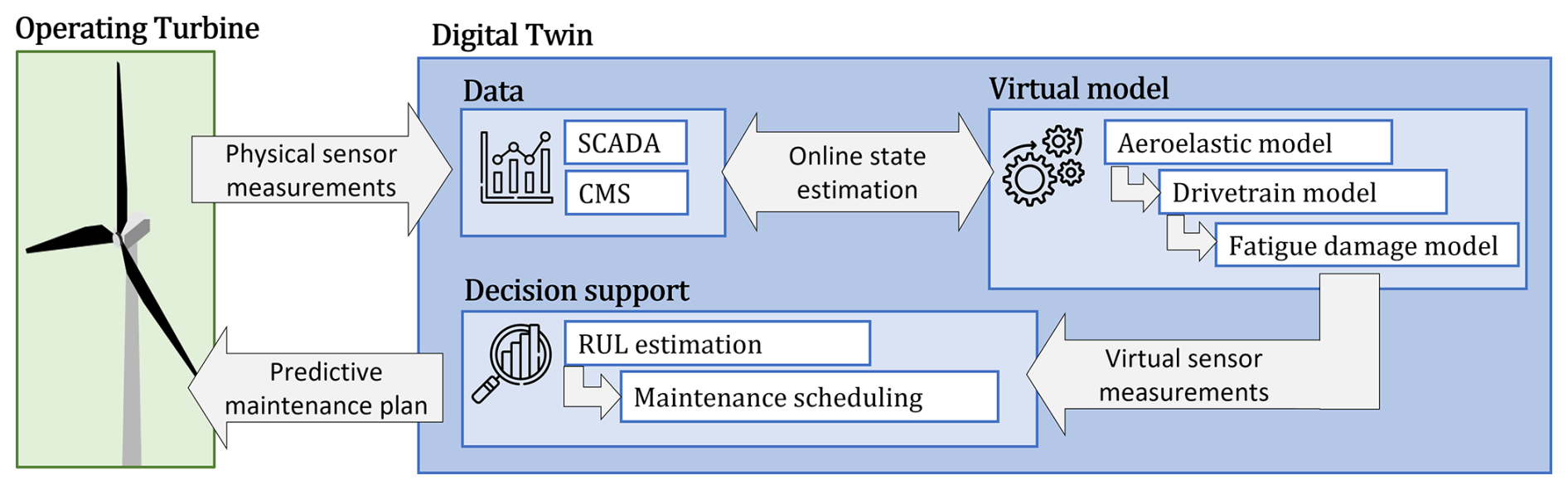
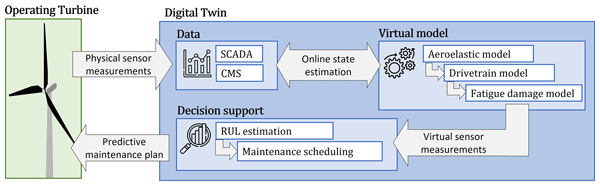
Figure 1Example of digital twin framework for continuous RUL estimation in wind turbine drivetrain components (Mehlan et al., 2023).
1.3 Digital twin in condition monitoring
A digital twin is a virtual counterpart of a physical system, defined by deep integration and automated data flows between the two (Kritzinger et al., 2018). In the context of condition monitoring and RUL, the concept rests on two pillars: (1) the use of continuous data and modelling to mirror a turbine's operational history and degradation, and (2) the ability to predict how future scenarios or decisions will impact component life (Errandonea et al., 2020). Figure 1 illustrates this framework for drivetrain components. While a system that provides decision support is often termed a digital shadow, a true digital twin acts as a direct controlling instance that can autonomously execute decisions for the physical system (Kritzinger et al., 2018; Errandonea et al., 2020).
In the digital twin framework, simulated data are essential for replicating real-world operating conditions and failure modes. These datasets are used to create synthetic representations of components like blades, bearings, and gearboxes, especially when actual fault data are scarce (Zhao et al., 2022). This allows the digital twin to model how critical components behave under different stress levels, including rare or extreme failures, which improves prediction accuracy and maintenance planning (De Kooning et al., 2021). The integration of simulated data into the digital twin framework not only aids in understanding component behaviour but also facilitates the development of predictive maintenance protocols that can significantly reduce downtime and maintenance costs (Pacheco-Blazquez et al., 2024). Different modelling strategies are briefly discussed below, i.e. data-driven models including supervised and unsupervised physics-based approaches, along with data processing like continuous data support, data pre-processing, data storage, and decision support. The choice of different modelling strategies (data-driven, physics-based, and hybrid) and how actually they improve the condition monitoring performance depends largely on the design information and data availability. For instance, Gebel et al. (2025) present a case where the operator has large measurement data but is left with limited design information. A similar problem is also raised by Wada et al. (2026) for operators in Japan in order to build a physics-based digital twin as they often have limited insight into the design of the drivetrain. Although AI and data-driven models offer new opportunities, physics-based simulations retain a crucial advantage: they do not rely on extensive historical training data, enabling them to accurately predict turbine behaviour under entirely unobserved conditions (Gebel et al., 2025).
-
Data-driven models – supervised vs unsupervised. Data-driven models are instrumental in digital twins for wind turbines. These models utilize historical and real-time data to forecast system health, and they can be categorized into supervised and unsupervised learning approaches. Supervised models depend on labelled data for training, which helps in identifying known faults, such as blade erosion or gearbox damage, once trained with historical datasets (Solman et al., 2022). Conversely, unsupervised models do not require predefined labels and are adept at detecting anomalies or unexpected behaviours in turbine operations. This characteristic is particularly advantageous for identifying emerging or previously unknown failure modes, thereby enhancing the overall reliability of wind turbine systems (Encalada-Dávila et al., 2021).
-
Physics-based models. Physics-based modelling is another approach to build models for digital twins where fundamental physics rules are utilized (Johansen and Nejad, 2019). For instance, equations of motion can be used to model the relation between input load and load effects in a wind turbine gearbox, which can be further processed through fatigue damage models in order to estimate damage and RUL (Mehlan et al., 2022). Despite the dependency of data-driven models on large datasets, the physics-based models do not necessarily require historical data. However, having all physical parameters to build a physics-based model is often a challenge, particularly for operators.
-
Continuous data support. The efficacy of a wind turbine's digital twin is heavily reliant on the continuous inflow of real-time data. Systems such as SCADA and condition monitoring systems (CMSs) provide ongoing data streams that enable the digital twin to maintain an accurate representation of the turbine's operational state (Schröder et al., 2018). This constant data flow is essential for real-time fault detection and early warning systems, allowing operators to respond swiftly to potential issues, such as abnormal rotor behaviour or temperature fluctuations in the drivetrain (Momber et al., 2022). Recent studies underscore the significance of continuous data streams in enhancing the accuracy of digital twins, particularly in areas like load monitoring and fatigue assessment, which are critical for ensuring the longevity and efficiency of wind turbines (Mehlan and Nejad, 2025).
-
Data pre-processing. Data pre-processing is a vital step in the digital twin pipeline for monitoring wind turbines. Raw data from turbine sensors often contain noise, missing values, or outliers that must be addressed to ensure effective utilization. For example, vibration data from turbine components require filtering to eliminate background noise (Peeters et al., 2025, 2016), while SCADA data must be normalized to maintain consistency across multiple turbines (Ibrahim et al., 2023). This pre-processing is crucial for the accuracy of the digital twin's predictive models, which depend on clean structured data to monitor the health of turbine components and anticipate failures (Wagg et al., 2020). Without rigorous data pre-processing, the reliability of the digital twin's predictions could be compromised, leading to inefficient maintenance strategies and increased operational risks (Wadhwani et al., 2022).
-
Data storage. The generation of large volumes of data by a digital twin requires efficient data storage solutions to manage both real-time and historical data effectively. High-frequency sensor data from the CMS and SCADA measurements are streamed into the digital twin, making robust data storage essential for real-time monitoring and long-term trend analysis (Liu et al., 2024b). Furthermore, the simulated data used for fault prediction and performance evaluation must also be securely stored. Advances in data storage technologies, such as distributed systems and cloud-based solutions, could enable the scalability required for large wind farms employing digital twins. Effective storage and retrieval systems facilitate the integration of real-time data with historical trends. As a result, the ability of digital twins to accurately predict the RUL of critical components, such as gearboxes and main bearings, is enhanced (Sivalingam et al., 2018).
-
Decision support. The loop between the real asset and the virtual models is closed when the digital twin is able to provide decision support and feedback to the asset (Purcell et al., 2024). The level and type of decision support depends on the digital twin functionality level, as described in the following section. RUL estimation is an example of digital twin decision support at a prognostic capability level.
1.3.1 Digital twin capability levels
DNV (DNV, 2020) has classified a digital twin in six functional element capability levels where the capability increases for each level. Level zero represents a stand-alone model with no data or decision exchange between the model and the asset. In this case, the physical asset may not yet exist. A finite element model during the design phase is an example of this stage. Level one is the “descriptive” level, for instance, a multi-body dynamic model which is updated by data from the real asset. Here, the digital twin can describe the asset behaviour and provide alarms, for example. The second level, “diagnostic”, is where the digital twin is able to identify the faults and be used as a diagnostic tool. If the digital twin is able to estimate the RUL, then level three, “predictive”, is achieved. Level four is “perspective”. In this phase, the digital twin is able to provide recommended actions based on predictions. Finally, level five is the “autonomous” level where the digital twin can take over control from the user and control the asset.
As highlighted by Ibrion et al. (2019), the main aim of employing a digital twin is to reduce the risk in operations; therefore, the digital twin itself should not pose or bring new risk. Specifically, these technologies target the reduction of risks associated with design errors, maintenance-related downtime, and structural fatigue over an asset's life cycle. As the digital twin functionality level increases, the associated risk may also increase. It is therefore essential to evaluate the risk and uncertainty throughout each level (Ibrion et al., 2019; Mehlan and Nejad, 2025).
1.3.2 Brief overview of data access challenges
It is well known that the wind industry R&D and technology innovations, including condition monitoring, are hindered by data sharing. There are a few concerns by data owners: (1) the disclosure of sensitive information may impact their business competitiveness; (2) data-sharing infrastructure introduced to facilitate the data sharing may pose new cybersecurity risks; (3) uncertainty regarding specific data-driven project objectives and required data streams; and (4) a lack of clarity concerning the value generated by their data-sharing efforts.
The contradictory fact is that the wind industry is data rich. There are thousands of turbines, each with hundreds of channels of measurements of various types at different resolutions. There are a few possible ways to mitigate the data-sharing challenge: (1) use normalization and anonymization; (2) specify task objectives, data needs, and value (e.g. standardization and FAIR data principle) returned to the data owner; (3) adopt a clear data protection mechanism, making it beneficial to members of a consortium (e.g. NLR gearbox reliability database (NREL, 2018), EPRI WinNER (EPRI, 2021), and ORE Catapult Sparta (Catapult, 2020)), while releasing educational information to the public (e.g. data organized by turbine ratings, technology types without disclosing turbine or component original equipment manufacturers); and (4) investigate novel data-sharing approaches that enable proprietary data sharing without disclosing sensitive information.
1.3.3 Ideal datasets for condition monitoring research
To support condition monitoring research and root cause analysis for a wind plant, an ideal dataset should include the following five categories of information:
-
Basic plant information, such as the site layout, resource measurements from met towers or turbine nacelles, the number of turbines, and specific turbine specifications;
-
Operational data for the turbines or balance of the plant, including SCADA time series and status codes recorded before and after a fault or failure event;
-
Historical records of faults or failures;
-
Dedicated condition monitoring system data, where available; and
-
Maintenance logs, including work orders and detailed inspection reports.
These data can be in different file formats: time series (SCADA, vibration, oil debris, and met tower), text or string (status codes), Excel table entries (e.g. oil sample analysis results), and pdf (e.g. inspection or oil sample analysis reports). In addition, with the advancement of modelling capabilities, there are abundant synthetic or simulated data, which can be beneficial to mitigate the unbalanced data challenge between faulty and healthy populations. In case a root cause investigation is conducted, the findings are also valuable, especially condition monitoring recommendations that might be used for control adjustments, reducing loads and extending component operational time or life. If more data from wind plants with the same or similar turbine models are available, it will be helpful to make the condition monitoring technologies transferable to different plants or more robust with reduced uncertainty. From a broad industry-wide condition monitoring research perspective, it will be extremely valuable to give the research community access to a large population of useable data based on multiple wind plants. Moreover, data owners can gain immediate access to the developed condition monitoring technologies and help to mature these technologies before they are adopted by the rest of the industry.
To address the data access and digitalization challenges, several international initiatives and research proposals have emerged, targeting the technical, cultural, and business barriers that currently hinder sector-wide collaboration. These efforts, such as those coordinated by the IEA Wind Task 43 (Bray et al., 2021), focus on streamlining the digitalization of wind energy through international research on data standards, sharing protocols, and advanced analytics to improve life cycle efficiency and reduce costs. By developing collaborative ontologies, data maturity roadmaps, and guidelines for best practices, these projects aim to foster a culture of “coopetition”. Ultimately, these initiatives seek to publish practical recommendations and success stories that demonstrate how priority use cases can be solved through improved data sharing and organizational transparency.
1.4 Data labelling and annotation: impact on model training
Model learning for distinguishing between healthy and faulty operational states of wind turbines faces several significant challenges when applied to experimental data. One major obstacle is the inherent imbalance in datasets, as fault occurrences are typically rare compared to normal operational data. This scarcity can result in models that are biased towards the majority class, reducing their effectiveness in accurately detecting faults.
Additionally, experimental wind turbine data are often noisy and subject to variability due to fluctuating environmental conditions, sensor inaccuracies, and operational inconsistencies, which complicate the extraction of reliable features. The high dimensionality of the data, with numerous sensors capturing a wide range of parameters, further exacerbates the difficulty of identifying relevant fault indicators. Furthermore, differences in turbine models and configurations introduce heterogeneity, hindering the development of generalized solutions. Addressing these challenges requires advanced techniques such as data augmentation, imbalance handling methods, robust feature selection, and transfer learning to enhance model resilience and accuracy.
1.5 Contributions and novel perspectives of this review
While the literature contains numerous reviews on specific condition monitoring technologies, this paper moves beyond a purely descriptive consolidation of these methods. The contribution of this review lies in its comprehensive approach to the condition monitoring pipeline, connecting raw data acquisition with practical O&M decision-making. Specifically, the contributions of this review are threefold:
-
Integration of emerging techniques. In addition to established methods, this review evaluates new diagnostic and prognostic approaches, such as video-based vibration analysis, deep learning for complex acoustic emission classification, and the transition towards advanced digital twin frameworks.
-
Focus on industrial adoption. The practical barriers hindering the transition of advanced algorithms from academic research to operational wind farms are analysed, particularly highlighting challenges related to data scarcity, dataset imbalance, and uncertainty quantification in complex environments.
-
A problem-driven perspective. By consolidating insights across SCADA, vibration, and acoustic domains, this work outlines how different data streams can be combined to solve core condition monitoring problems, offering a guide for future research and industrial deployment.
1.6 Organization of the manuscript
To guide the reader, the remainder of this paper is organized around the fundamental challenges of condition monitoring and asset management.
Section 2 establishes the context by analysing current failure trends and identifying the critical components that cause downtime in wind turbine drivetrains. Section 3 directly addresses the problem of fault detection and diagnosis, detailing strategies to identify and classify anomalies using SCADA, vibration, and acoustic emission data. Shifting to predictive capabilities, Sect. 4 covers the problem of prognosis, focusing on RUL estimation methods and their practical limitations. Section 5 applies these diagnostic and prognostic strategies to specific drivetrain components (main bearing, gearbox, generator, converter, and blades), discussing data and processing challenges for each. Finally, Sect. 6 addresses the end goal of condition monitoring: decision-making. It discusses how diagnostic and prognostic outputs translate into optimized O&M strategies and maintenance planning. The final section concludes the paper, with a summary and future outlook.
Understanding the reliability and historical performance of wind drivetrains is fundamental to developing effective monitoring strategies. By identifying which components fail most frequently and which contribute most significantly to downtime, operators can prioritize their condition monitoring efforts. This section analyses the current failure statistics for wind turbines and outlines the dominant failure modes affecting critical drivetrain components.
2.1 Key components causing downtime and their failure rates
Failure data from wind turbines are crucial for identifying critical components and improving wind farm performance. In recent years, the cumulative installed capacity of wind turbines, particularly in offshore wind energy, has been steadily increasing. However, due to intense industry competition, information on wind turbine operations and failures is strictly protected, with offshore wind failure data being particularly scarce. In this context, some prior studies have collected, analysed, and compared available data from onshore turbines along with the limited data accessible from offshore sources. For example, Carroll et al. (2016) released a dataset covering 350 offshore wind turbines across Europe, including statistics on failure rates, repair costs, and repair times. Cevasco et al. (2021) provided a comprehensive analysis of reliability, availability, and maintainability data for both onshore and offshore wind turbines. Dao et al. (2019) reviewed 18 sources of wind turbine reliability, availability, and maintainability data, providing a visual comparison of failure rates and downtime for critical components in onshore and offshore wind turbines, as illustrated in Figs. 2 and 3.
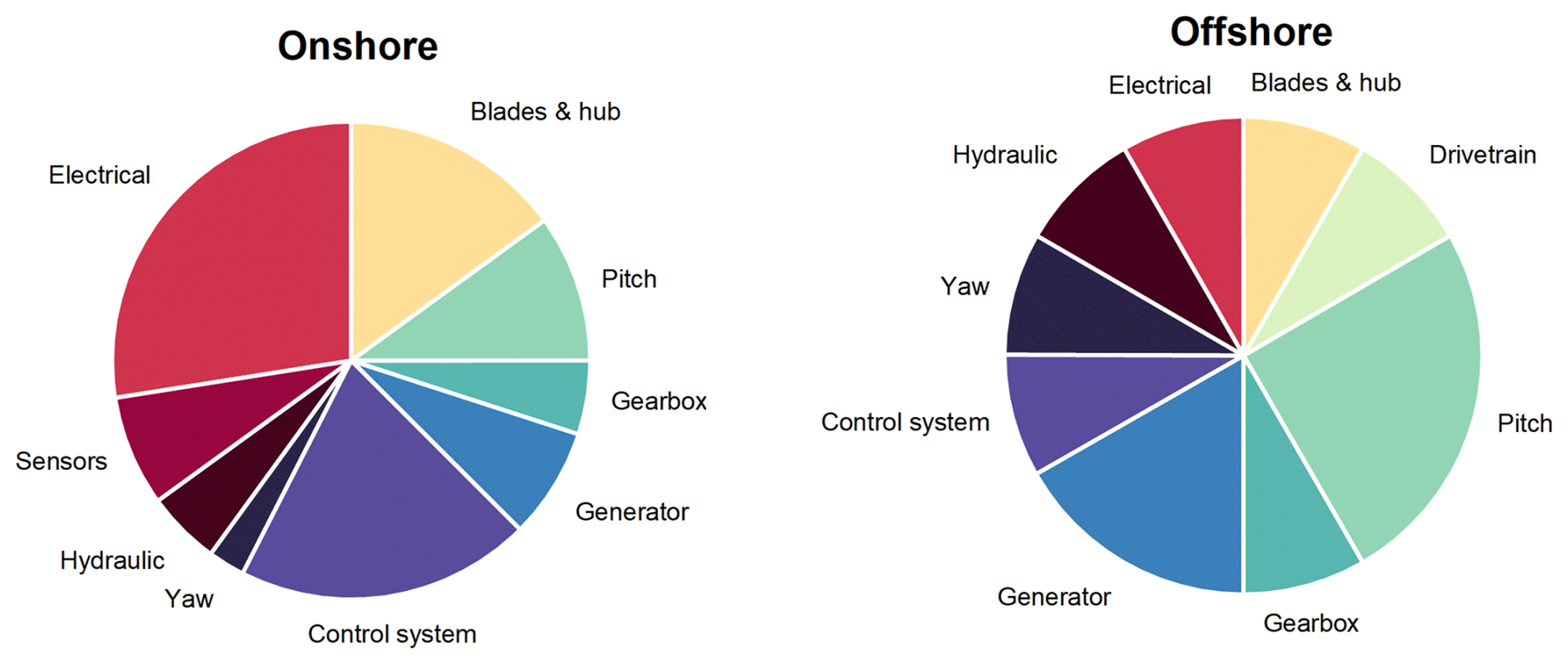
Figure 2Failure rate comparison of components in onshore and offshore wind turbines (reproduced from Dao et al., 2019).
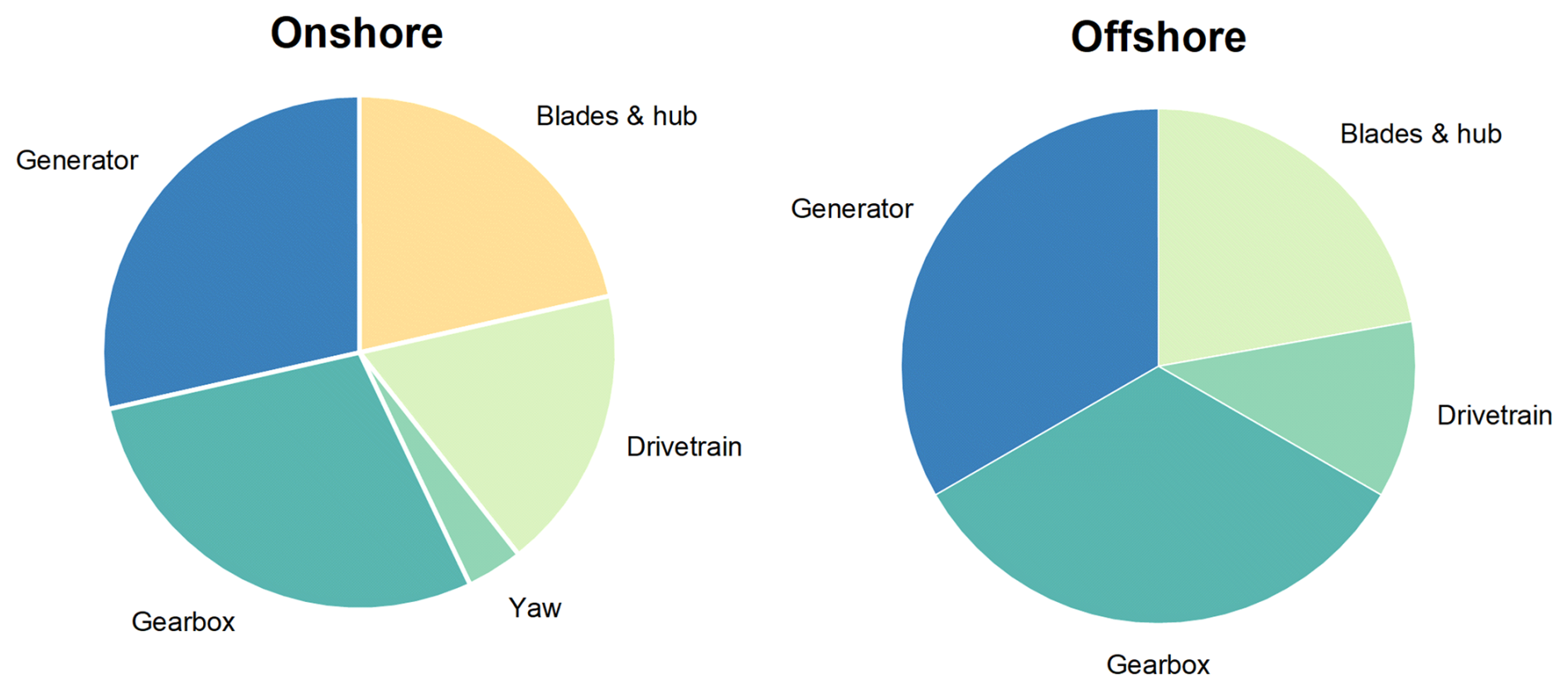
Figure 3Downtime comparison of components in onshore and offshore wind turbines (reproduced from Dao et al., 2019).
The figures show that the top three components with the highest failure rates in onshore wind turbines are electrical systems, control systems, and blades and hub. This may be due to frequent changes in onshore wind speed and direction, which require more frequent system adjustments, increasing the load and stress on these components. While onshore turbines most frequently experience failures in electrical and control systems, the situation offshore presents different challenges. For offshore wind turbines, the components with the highest failure rates are the pitch systems, followed by generators. The overall failure rates of offshore wind turbines are typically higher than onshore, and the differences in the high-failure components can be explained by the harsh marine conditions and higher wind speeds offshore. Generators also operate more frequently under high-load conditions, which increases the risks of wear and overheating.
Analysing downtime reveals that component rankings for offshore and onshore wind turbines are consistent, with gearboxes, generators, blades, and hubs accounting for the longest downtimes. This is largely due to the considerable size and weight of these components. When faults occur, these components typically require complex procedures such as disassembly, inspection, and even full replacement, often necessitating large-scale lifting equipment, which significantly prolongs the repair process. Furthermore, offshore wind turbines are located in deep and remote waters where harsh environmental conditions and limited accessibility for maintenance vessels present significant challenges. These factors increase the difficulty and duration of on-site repairs, thereby exacerbating overall downtime.
2.2 Main failure modes
The previous section identified the components with the highest failure rates and downtimes, including gearboxes, generators, blades and hub, electrical and control systems, and pitch systems. Many studies have investigated the failure modes of the critical components in both onshore and offshore wind turbines. For instance, Kang et al. (2019) employed fault tree analysis to visually depict failure paths in floating wind turbines and to identify root causes. Scheu et al. (2019) used failure modes, effects, and criticality analysis to prioritize components in offshore wind turbine systems, providing valuable insights for condition monitoring systems and subsequent maintenance planning. The common failure modes for components with the highest failure rates and downtimes are summarized as follows.
Within the drivetrain, main bearing reliability has become a significant challenge to the wind industry (Hart et al., 2023; EPRI, 2024). A variety of failure modes have been documented, including damage resulting from surface and subsurface initiation, stray currents, lubrication failures, overloading, and improper bearing assembly/fit (Hart et al., 2023; EPRI, 2024). The principal drivers of premature main bearing failures remain unclear.
The gearbox in wind turbines serves to amplify the rotational speed of the blades to a level that is efficient for electricity generation by the generator. Gearbox failures in wind turbines are commonly found in the gears and bearings. Typical failure modes include wear of gear teeth and the wear of rollers and raceways in the bearings (Bejger et al., 2021; Gong et al., 2017; Greco et al., 2013). Cracks or even fractures may occur under excessive impact loads or prolonged fatigue. Other failure modes include overheating due to inadequate oil cooling and blockages in the oil passages caused by contaminants or debris (Olabi et al., 2021; Scheu et al., 2019).
The generator converts the mechanical energy from the rotating blades into electrical energy. Generator failures may be attributed to either electrical or mechanical causes (Kang et al., 2019). Mechanical failure modes include rotor issues such as eccentricity, broken rotor bars, cracked end rings, bearing deformation, and air gap eccentricity (Olabi et al., 2021). Electrical faults are mainly caused by winding faults, including open or short circuits in the rotor or stator windings, inter-turn shorts, and abnormalities in electrical connections (Olabi et al., 2021). Overheating and magnetization issues, such as inadequate magnetization or demagnetization of magnets, also lead to generator failures, adversely affecting their efficiency and service life (Scheu et al., 2019; Li et al., 2020a).
The blades and hub capture the kinetic energy of wind and convert it into rotational motion to drive the generator through the gearbox. Common failure modes in blades include cracks, delamination, de-bonding on bonding lines, and damage to the top coat (Wang et al., 2022c). The hub, which connects the blades to the nacelle, may experience fatigue, wear, and imbalance (Zhang et al., 2016).
The failure modes of electrical and control systems can be categorized into electrical faults and mechanical failures. Electrical faults typically include issues such as open circuits, short circuits, and gate drive circuit faults (Kang et al., 2019). On the mechanical side, common faults include corrosion caused by salt mist and moisture, and damage to the terminals (Kang et al., 2017).
Pitch bearings are susceptible to wear and fatigue damage, typically affecting the raceways and rolling elements. Together with their drives, pitch bearings form the pitch system of a wind turbine. Blade pitching controls aerodynamic loads and serves as the primary safety mechanism of the turbine. Pitch drives can be either hydraulic or electrical, with both showing similar failure rates in operation (Walgern et al., 2023). Failure modes of pitch bearings include ring cracks, raceway, rolling elements, cage wear and fatigue, and bolt damage (Liu et al., 2020; Stammler et al., 2024).
Understanding these failure patterns is essential for guiding condition monitoring strategies. By prioritizing high-risk components like gearboxes and pitch systems, especially in offshore installations, operators can tailor diagnostic methods to improve reliability and reduce unexpected downtime.
Wind turbine drivetrain monitoring has seen significant advancements through diverse analytical approaches (Helsen, 2021). An elaborate discussion on the diagnostic strategies is provided in this section. It highlights approaches such as AI/ML-based monitoring using SCADA data, signal processing techniques applied to high-frequency vibration data, and acoustic emission methods. These techniques detect anomalies, diagnose faults at an early stage, and effectively inform maintenance strategies.
3.1 General aspects of AI/ML-based monitoring using SCADA data
Condition monitoring of wind turbines using SCADA data has been a productive research topic. The developments can be subdivided into several methodological groups. For thorough overviews, see, for example, Tautz-Weinert and Watson (2017), Stetco et al. (2019), Black et al. (2021), and Chatterjee and Dethlefs (2021). In Tautz-Weinert and Watson (2017), the methodologies are divided into six categories: normal behaviour model (NBM), trending, clustering, damage modelling, assessment of alarms, and expert systems. NBM is currently the most popular method proposed in the literature. For this reason, the main focus will be on this method, while the other methods will be discussed only briefly.
3.1.1 Overview of normal behaviour modelling methods
Condition monitoring based on the NBM methodology generally consists of two phases: (1) developing a model that can be used to predict normal or healthy behaviour of the machine (this model is called the NBM) and (2) analysing the prediction error, which is the difference between the observed and predicted data, for abnormal patterns and deviations. Normal behaviour models can be developed using various approaches, including statistical models, shallow ML, and deep learning. Table 1 gives an overview.
Campoverde et al. (2022)Kim et al. (2011)Garlick et al. (2009)Chesterman et al. (2021)Chesterman et al. (2022)Garlick et al. (2009)Yang et al. (2018)Li and Wu (2020)Dao et al. (2018)Sun et al. (2019)Dao (2023)Ali Qadri et al. (2020)Xu et al. (2022)Turnbull et al. (2021)Chesterman et al. (2022)Kusiak and Verma (2012)Beretta et al. (2021a)Beretta et al. (2021a)Shi et al. (2021)Udo and Yar (2021)(Maron et al., 2022)Chesterman et al. (2022)Kusiak and Verma (2012)Udo and Yar (2021)Trizoglou et al. (2021)Kusiak and Li (2011)McKinnon et al. (2020)Castellani et al. (2021)Chesterman et al. (2022)Dienst and Beseler (2016)Chesterman et al. (2023)Zaher et al. (2009)Kusiak and Li (2011)Kusiak and Verma (2012)Li et al. (2014)Bangalore and Tjernberg (2014)Bangalore and Tjernberg (2015)Sun et al. (2016)Meyer (2021)Turnbull et al. (2021)Black et al. (2022)Jamil et al. (2022)Mazidi et al. (2017)Verma et al. (2022)Zhao et al. (2018)Beretta et al. (2020)Renström et al. (2020)Chen et al. (2021)Miele et al. (2022)Liu et al. (2023)Lee et al. (2024b)Liu et al. (2020)Zgraggen et al. (2021)Bermúdez et al. (2022)Xiang et al. (2022)Trizoglou et al. (2021)Udo and Yar (2021)Bermúdez et al. (2022)Peng et al. (2021)Beretta et al. (2021a)Khan et al. (2023)Grataloup et al. (2024)Schlechtingen and Santos (2012)Schlechtingen et al. (2013)Schlechtingen and Santos (2014)Zhongshan et al. (2018)Marti-Puig et al. (2021)Table 1Overview of the different methodologies that have been used in the literature to model normal behaviour.
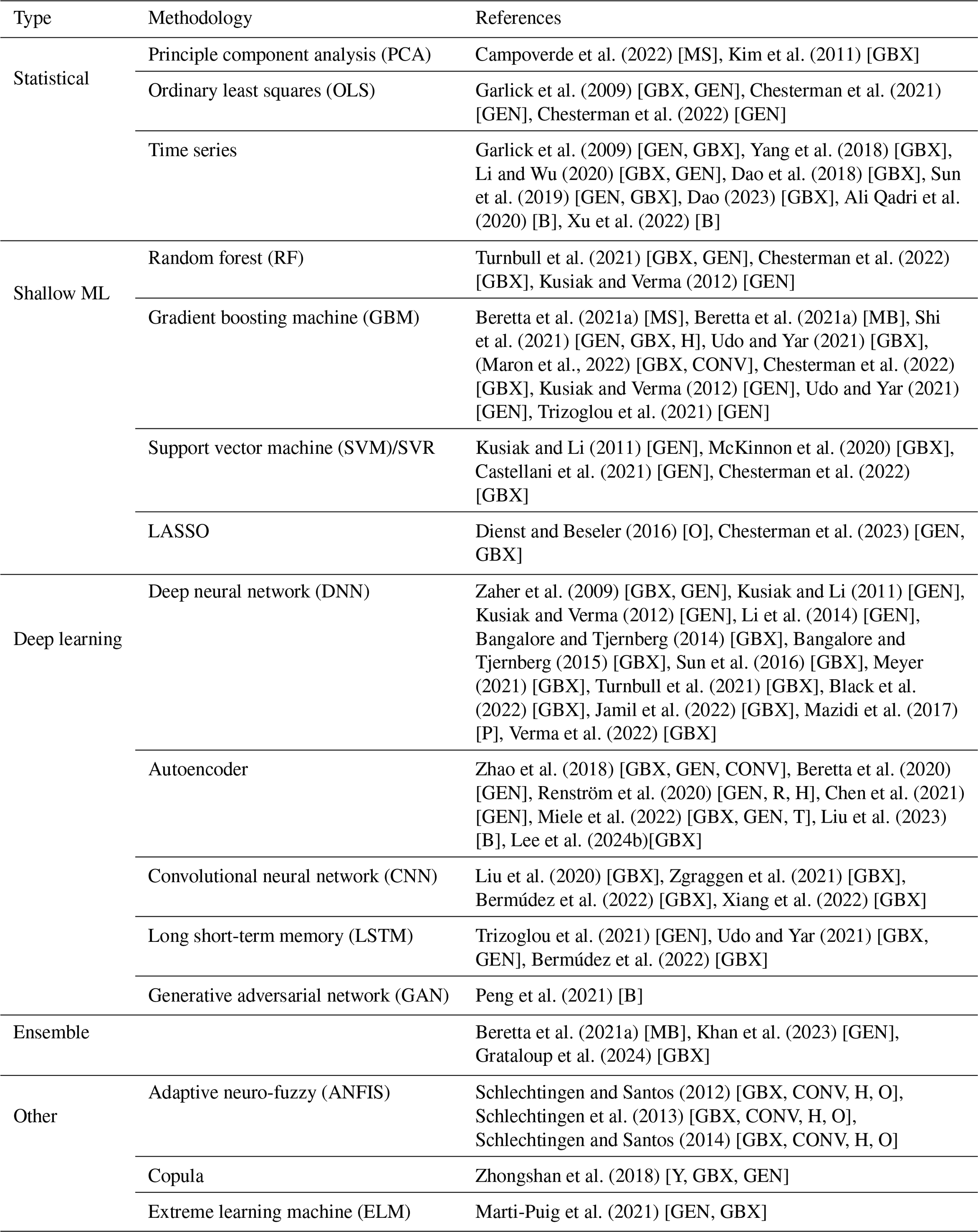
Abbreviations: GBX: gearbox, GEN: generator, B: blade, MS: main shaft, MB: main bearing, H: hydraulics, CONV: converter, R: rotor, T: transformer, P: pitch, O: other.
-
Statistical methods. This is a group of models based on traditional statistical techniques. These can be unsupervised or supervised. The advantage of statistical models is that they are in general computationally undemanding, data efficient, well studied, and well understood. The disadvantage, however, is that they are less suitable to model highly complex non-linear dynamics. Algorithms like principal component analysis, ordinary least squares, ARIMA, and, more recently, cointegration have been/are popular. However, statistical techniques are used less frequently in recent research than ML techniques.
-
Shallow ML methods. Models within this group are based on shallow ML techniques, e.g. decision trees, random forests, gradient boosting machines, and support vector machines (SVM). Shallow ML techniques are generally better suited for modelling non-linear relationships. However, this comes at the cost of being more computationally expensive and having higher data requirements. The shallow ML algorithms were the most popular until the deep learning breakthrough.
-
Deep learning methods. This category includes models based on deep learning algorithms, such as deep neural networks, convolutional neural networks (CNNs), and long short-term memory (LSTM) networks. The use of deep learning is the most recent addition to the NBM development toolbox. Deep learning algorithms are even better modellers of non-linearities and have generated good results in several domains. However, they are often more computationally demanding and data intensive than shallow ML. More recently, generative AI, e.g. generative adversarial networks, has been introduced. This technique was originally mainly used for the generation of new images. More recently, it has become clear that generative models are also useful for the generation of synthetic tabular data and anomaly detection.
-
Ensemble methods. This is a group of models that combines the output of multiple statistical, shallow ML, or deep learning algorithms. By combining the results of several algorithms, ensemble methods attempt to improve accuracy compared to the individual models. The ensemble methodology is generally composed of two layers. The first layer contains several algorithms that individually model the normal behaviour. The second layer is made up of an algorithm, called a meta-model, that combines the predictions of the models in the first layer. The meta-model can be a statistical, shallow ML, or deep ML model.
-
Other methods. Several other methods have also occasionally been used. Examples are the adaptive neuro-fuzzy inference system, copula-based modelling, and extreme learning machines.
3.1.2 Alternative unsupervised/physics-based methods
The previous section focused exclusively on the NBM methodology. However, other methodologies have also been used, although less frequently. For this reason, they are only briefly discussed in this section. This overview is based on the classification proposed by Tautz-Weinert and Watson (2017). The following methodologies (excluding NBM) are distinguished in Tautz-Weinert and Watson (2017): trending, clustering, damage modelling, and the assessment of alarms and expert systems.
Trending techniques involve tracking long-term time-series SCADA data to identify patterns, trends, and anomalies that can indicate potential faults or inefficiencies. The main challenge lies in interpreting trends due to varying operational conditions, as changes in SCADA parameters do not always indicate faults. Several works have demonstrated how these techniques can be used for anomaly and fault detection. For example, Feng et al. (2013) found that decreasing gearbox efficiency leads to a temperature rise approximately 6 months before failure, while Wilkinson et al. (2014) explored comparing temperature differences between turbines at the same site but found the approach unreliable due to environmental variations. Yang et al. (2013) introduced a binning method averaging wind speed, generator speed, and power output to track damage levels. While trending SCADA parameters can help to detect failures by comparing historical and current data, interpretation challenges and turbine-specific variability limit accuracy. Without addressing these issues, uncertainty and false alarms remain a risk in maintenance applications (Black et al., 2021).
Clustering techniques are unsupervised ML methods that are used to group data points into clusters based on their similarities or differences. They use distance metrics, such as Euclidean distance or cosine similarity, to measure the similarity between data points. Clustering algorithms applied to SCADA data have been proposed for the automated classification of normal and faulty observations by identifying patterns or distinct operational states representative of potential anomalies or faults. For example, Wilkinson et al. (2014) applied self-organizing maps to classify turbine operating conditions and detect anomalies in the gearbox. Rodriguez et al. (2023) proposed the k-means clustering algorithm to perform an exploratory analysis of SCADA data to identify patterns and anomalies that can indicate potential faults or abnormal behaviour which can then be further investigated by experts. More recently, Marti-Puig and Núñez-Vilaplana (2024) introduced a novel approach to dynamically cluster wind turbines based on real-time SCADA signal analysis, thereby accounting for temporal and operational variations. Unlike static approaches, this method proved to be more adaptive and accurate in identifying performance trends and anomalies. However, research showed no clear advantage of clustering over trending methods. Additionally, the requirement for faulty data in the methodology could pose a challenge in an industrial setting (Tautz-Weinert and Watson, 2017). In damage modelling, the observed signals are interpreted using physical models of the machine or component. This is different from the NBM approach where an empirical or data-driven method is used. However, the applicability of modelling-based methods depends on the availability of a physical model.
Expert systems have also been used for wind turbine condition monitoring research. These systems can be used together with NBM-based systems as a way to interpret the results (Tautz-Weinert and Watson, 2017). An expert system is composed of several parts, e.g. a knowledge base, a reasoning or inference engine, and some sort of user interface through which experts can interact with the AI. The knowledge base contains facts and rules, and the inference engine applies the rules to deduce new facts or to give an explanation or prediction. An advantage is that the rules are, in general, easily interpretable. Disadvantages are computational complexity and maintenance problems when the number of rules and facts become very large. Expert systems have been applied to wind turbine failure diagnosis cases, e.g. Zhi-Ling et al. (2012), Yang and Jiang (2015/05), and Garcia et al. (2006).
3.1.3 Supervised learning: overview of classifier-based modelling methods
In the categorization of ML, supervised learning utilizes labelled datasets for training, aiming to approximate a mapping that predicts output labels based on input data. Supervised learning is further classified depending on whether the output labels are numerical variables (regression problems) or categorical variables (classification problems). When applied to wind turbine diagnostics, the classifier-based methods leverage an input vector composed of features extracted from pre-processed data collected from the component. The input vector is labelled with the categories reflecting the status of wind turbine components. Fault detection can be regarded as a binary classification problem, where the system is categorized into one of two labels, i.e. “healthy” or “faulty”. Fault diagnosis involves a multi-class classification task where the input label is classified into multiple non-overlapping classes encompassing specific faults/failures of the component. The model is subsequently trained to classify component status into the predefined categories.
Commonly used classifier-based methods for wind turbine diagnostics are SVM (Tuerxun et al., 2021), k-nearest neighbour (kNN) (Tang et al., 2023), logistic regression (Bodla et al., 2016), artificial neural network (ANN) (Cho et al., 2021), naïve Bayes (Colone et al., 2019), decision tree (Joshuva and Sugumaran, 2017), extreme gradient boosting (XGBoost) (Tao et al., 2021), light gradient boosting machine (LightGBM) (Wang et al., 2022a), and random forests (Mansouri et al., 2022). Current research primarily focuses on improving conventional classifiers, developing ensemble methods that aggregate multiple learners, and utilizing deep learning to process high-dimensional data, enhancing data pre-processing and feature extraction techniques (Surucu et al., 2023; Stetco et al., 2019). Moreover, exploring the application of transfer learning and increasing model transparency, explainability, and interpretability are also critical endeavours (Zio, 2022; Lei et al., 2020). These efforts aim to improve the diagnostic performance of classifiers on real data from wind turbines.
The typical performance metrics of diagnostics include accuracy, recall, precision, and F1 score, which are derived from the observations, including the number of true positive (TP), false positive (FP), true negative (TN), and false negative (FN) observations. Accuracy is calculated as
The recall is calculated by
The precision is calculated by
The F1 score is calculated by
The performance superiority of different classifiers is generally assessed through these metrics. However, classifier performance can vary across datasets due to factors such as class distribution, feature correlation, and dataset size. To systematically compare the performance of different classifiers, de Lima Munguba et al. (2024) tested and compared 16 classifiers for detecting pitch system faults, utilizing a dataset containing SCADA data and alarm logs collected from 14 wind turbines across two wind farms in Brazil. The results indicated that most classifiers achieve an average accuracy of 80 % in distinguishing between healthy and faulty operating modes. Among them, the random forest, extra tree, XGBoost, LightGBM, CatBoost, gradient boosting (GBoost), and kNN demonstrated superior performance. In the paper (Allal et al., 2024), the authors tested 13 classifiers by using a SCADA dataset originating from a 3 MW direct-drive turbine in Ireland. The type of wind turbine faults cover generator heating faults, mains failure, feeding faults, air cooling faults, and excitation faults. The comparison results reveal that the best-performing classifier is the ensemble learner based on bagging, achieving the highest accuracy, precision, recall, and F1 score at approximately 79 %. This was followed by GBoost, with CatBoost, random forest, and XGBoost trailing behind. Building on these basic classifiers, researchers have continually innovated algorithms to improve performance. For instance, in the same paper (Allal et al., 2024), the authors proposed a two-tier fault detection and diagnosis framework. In binary classification, bagging achieved accuracy, precision, recall, and F1 scores exceeding 95 %, outperforming the voting classifier and CatBoost. For multi-class classification, the stacking ensemble learner demonstrated an overall precision of 86 %, with accuracy, recall, and F1 scores all surpassing 84 %, followed by random forest and CatBoost.
3.1.4 Farm-scale strategies: detection and transfer learning
Single-turbine models for condition monitoring provide tailored fault detection by aligning with each turbine's unique operational profile, capturing faults specific to individual units. However, these models are computationally demanding in large farms, as each turbine requires its own model and frequent recalibration to address evolving conditions. Additionally, without cross-turbine comparisons, single-turbine models can struggle with environmental variability, increasing false positive or false negative rates. These limitations highlight the potential benefits of a comparative, multi-turbine approach, where analysing performance deviations among turbines can enhance fault detection and provide a broader, context-aware perspective on turbine health.
Comparative analysis of wind turbines within a farm using SCADA data offers a considerable advantage for condition monitoring, as identifying performance deviations among turbines can help operators to detect anomalies early (Cambron et al., 2018). However, this approach also presents challenges due to the unique operational signatures of each turbine, influenced by factors such as manufacturing variances, site-specific conditions, and individual wear patterns (Malik and Bak, 2024). Differences in assembly processes can cause performance disparities even among turbines of the same model. Additionally, environmental influences, such as the wake effect, can result in variations in energy output and mechanical stress among turbines within the same farm. Exposure to differing levels of sunlight can also lead certain turbines to consistently operate at higher temperatures, a condition that reflects site specifics rather than equipment faults. Over time, wear and tear on components such as gearboxes, bearings, and blades further contribute to distinct performance profiles for each turbine. These differences can complicate the establishment of performance baselines and the application of uniform diagnostic models throughout the farm. The challenge lies in balancing the need for standardized approaches with the need to customize to reflect the unique conditions of each turbine.
The signal trending approach examines long-term changes in operational data, assuming failures have identifiable signatures in variables like temperature. Astolfi et al. (2014) introduced a method tracking the relationship between binned active power and key sensor readings (e.g. rotor and generator bearing temperatures) to visualize turbine health over time and support early fault detection. Cambron et al. (2018) advanced this with a control chart monitoring algorithm comparing turbine performance against the farm average to detect generator issues. In contrast, Li and Wu (2020) used median differences across turbines to create a condition vector, incorporating monitoring charts with strategies to handle autocorrelated data. However, these methods are often univariate, limiting their ability to capture interactions among variables within the complex, interconnected systems of wind turbines. Even more, automated online monitoring based on trending methods has been shown to fall short of achieving the required accuracy. This limitation is attributed to the case-specific nature of the problem, which necessitates offline visual interpretation of trends. The challenge is further exacerbated when monitoring extensive wind farms operating under varying conditions. Clustering algorithms have been proposed as one potential approach to mitigate the limitations of trending methods.
Clustering-based anomaly detection offers several advantages for wind turbine condition monitoring. By grouping turbines based on similarities in their performance data, clustering enables the identification of outliers that may indicate faults. This approach provides a powerful framework for analysing complex, high-dimensional data from wind farms. For example, distributing the wind turbines into peer clusters such that the wind turbines within each of the clusters have similar environmental conditions has been used in Lapira et al. (2014). This clustering enabled the identification of underperforming turbines within each peer group using a predictive performance model. By analysing the performance metrics of these underperforming turbines, a critical component was identified and the end-of-life of the component was subsequently predicted. Additionally, ensemble approaches that integrate clustering with advanced algorithms, such as isolation forests applied at the farm-wide level, have demonstrated significant potential in detecting anomalies with improved precision (Beretta et al., 2021b). The high dimensionality and variability of SCADA data can complicate the clustering process, making it difficult to ensure the meaningful separation of operational states. Additionally, the selection of appropriate clustering algorithms and the definition of similarity measures often require domain-specific knowledge, which may not generalize across different wind farms. Furthermore, clustering methods can be computationally intensive, particularly when applied to large-scale wind farms with extensive data streams. The dynamic nature of turbine operations and environmental conditions also pose challenges, as clusters may need frequent updates to remain accurate and relevant. To address these challenges, NBMs have been proposed in the literature as an effective alternative.
As mentioned in the previous section, NBMs are data-driven frameworks designed to predict the expected operational behaviour of wind turbines. When extended to include cross-turbine information, NBMs leverage data from multiple turbines to enhance condition monitoring by enabling comparative analysis across units with similar operating conditions. For example, Marti-Puig et al. (2022) use cross-turbine NBMs to detect failures by analysing the temporal evolution of signals from several SCADA systems belonging to geographically proximate turbines. By evaluating joint variations in these signals, the overall behaviour of the turbine assembly is assessed to identify deviations indicative of faults. Furthermore, Barnabei et al. (2024) introduce a framework that uses the meta-predictive power score to construct a fleet-wide similarity matrix, capturing operational similarities between turbines based on environmental data, operational metrics, and multivariate regression outcomes. By incorporating this similarity matrix into a community detection algorithm, the framework identifies groups of turbines with similar behaviour. This approach transforms NBMs from a single-turbine tool into a fleet-wide monitoring solution.
Finally, transfer learning between turbines has emerged as a promising approach. Transfer learning involves using knowledge gained from one domain (source) to improve learning in another domain (target). This technique enables the application of models trained on data from certain turbines to others within the same farm or across different farms. For instance, a study by Jamil et al. (2022) introduced a deep boosted transfer learning method for wind turbine gearbox fault detection. This approach prevents negative transfer by focusing on relevant information from the source machine, updating the weights of both source and target models to enhance fault detection accuracy. Similarly, Zgraggen et al. (2021) explored transfer learning approaches for wind turbine fault detection using deep learning. Their research demonstrated that models trained on data from multiple turbines could be fine-tuned with minimal data from a target turbine, achieving performance comparable to models trained solely on extensive target data.
3.1.5 Limitations and drawbacks of SCADA data for condition monitoring of wind turbines
While the use of SCADA data for condition monitoring offers notable economic and operational advantages, several inherent limitations and complexities must be considered. Wang et al. (2026) highlight the following key challenges:
-
Low sampling frequency. SCADA data are typically recorded at low sampling rates (e.g. 10 min averages of 1 Hz data). This limits the ability to capture transient and dynamic phenomena, which are often critical for early fault detection.
-
Lack of standardization. The absence of a unified taxonomy for signal and parameter naming across SCADA systems complicates data integration and comparative analysis, hampering the development of generalized monitoring frameworks.
-
Data quality issues. Communication errors, sensor malfunctions, and environmental interference frequently result in noisy, incorrect, or missing data points. These anomalies introduce significant challenges for robust and reliable analysis.
-
Spatio-temporal correlations. The interdependencies between different SCADA signals necessitate the use of sophisticated models capable of capturing and interpreting these complex relationships.
-
Dynamic environmental conditions. Wind turbines operate under continuously changing environmental conditions, leading to highly dynamic SCADA data. Models must therefore adapt to and account for these evolving operational contexts.
-
Data heterogeneity. SCADA datasets often exhibit heterogeneity in time resolution, variable patterns, statistical properties, and signal scales or units. This variability complicates the application of uniform analytical approaches.
-
Data availability. Many organizations treat SCADA data as proprietary or confidential, restricting access and limiting the scope of research and validation efforts.
-
Uncertain ground truth. The ground truth for fault events is frequently ambiguous or unreliable due to inconsistencies in maintenance reporting and documentation, which can undermine the accuracy of fault detection and diagnostic models.
The limited sampling frequency of SCADA systems renders them less suitable for detecting sudden events, such as many electrical faults. Additionally, SCADA-based condition monitoring is less precise for identifying abnormal behaviour in certain components, such as rotating bearings, when compared to vibration-based data (Astolfi et al., 2014). As highlighted by Pandit et al. (2023), condition monitoring approaches relying on SCADA data typically focus on secondary fault effects, such as abnormal component heating or reduced wind turbine performance.
A frequently overlooked issue in studies utilizing SCADA data for condition monitoring is the impact of dataset imbalance, as indicated by Oliveira-Filho et al. (2025). These datasets are typically dominated by observations from healthy operational states, with comparatively fewer instances representing abnormal or degraded conditions. This disparity arises from the inherently high availability of wind turbines. The authors identify three distinct scenarios: (1) imbalance between healthy and degraded datasets, (2) imbalance among different degradation classes, and (3) imbalance due to the scarcity of degraded data points in newly commissioned wind farms. Approaches that do not account for this imbalance may yield suboptimal results.
3.2 Signal processing for vibration-based condition monitoring
Vibration-based condition monitoring of rotating components in wind turbines represents an effective and non-intrusive method for fault diagnosis. This approach enables efficient monitoring of the turbine's condition through advanced signal processing techniques by analysing vibration signals generated by various rotating components, including the gearbox, bearings, generator, and rotor blades. The application of advanced signal processing to vibration signals allows for the early detection of faults, offering insights into the overall health of the machinery while allowing for precise identification of specific components exhibiting anomalous behaviour.
Advanced signal processing methods are the key components of this approach, analysing signals in the time, frequency, and time–frequency domains to identify fault-specific vibration signatures associated with defective components. Although advanced signal processing techniques such as angular signal resampling, spectral analysis, and envelope analysis are crucial for drivetrain condition monitoring, the first and key step is to properly measure the vibration signal.
This section focuses on advanced signal processing techniques for vibration-based condition monitoring of wind turbine drivetrains. It begins by outlining key aspects of data acquisition, specifically the sampling of high-frequency vibration signals from drivetrain components. Subsequently, a generic signal processing pipeline, with examples provided in Koukoura et al. (2020), is presented, including speed variation compensation, signal pre-processing and processing, exploitation of cyclostationarity, and indicator estimation and trending. The section concludes with a discussion on emerging trends in signal processing for wind turbine drivetrain condition monitoring.
3.2.1 High-frequency vibration signals
As wind turbines increase in size, the rotational speed of the blade, and consequently the rotor, decreases, while gearboxes often amplify the rotational speed by up to 100. Hence, specific challenges arise for vibration signal acquisition. On the one hand, signals must be sampled over long enough durations to capture an adequate number of cycles from each component. On the other hand, the sampling rates must be sufficiently high to capture high-frequency bursts generated by defects on the rotating components (Randall and Antoni, 2011). For condition monitoring purposes, the typical highest frequency range is around 20 kHz, while the lowest range can go below 1 Hz (Randall, 2021). Meeting these conditions requires the acquisition of long-duration signals at high sampling rates, which poses challenges related to data storage and the development of memory-efficient signal processing techniques for the continuous monitoring of drivetrain health.
Another challenge is identifying the optimal placement of accelerometers to maximize the signal-to-noise ratio during vibration sampling. Vibrations from all excitation sources within the system contribute to the recorded signal, and placing a sensor on one part of the machine does not prevent it from detecting vibrations originating from other components. Furthermore, its transfer path significantly influences the sampled signals (Randall, 2021). In a particular example, planetary gears, a typical stage in gearboxes of non-direct-drive wind turbines, feature revolving components that alter the transfer path relative to the sensor's position over time. This variability introduces another challenge for signal processing, isolating the target signal by suppressing interference from extraneous vibrations.
3.2.2 Order tracking
Order tracking is a crucial pre-processing technique in vibration-based condition monitoring, particularly for wind turbines, where the rotational speed varies continuously. Speed variations can cause spectral leakage without order tracking, complicating fault detection unless statistical features in the time domain are used. This method transforms a non-stationary time-domain vibration signal into a stationary angular domain, ensuring that spectral content remains independent of speed fluctuations (Fyfe and Munck, 1997). As a result, spectral peaks remain sharp and unaffected by speed variations, and the resampled signal's spectrum is represented in the order domain, the angular equivalent of frequency. Figure 4 displays an overlaid spectrum of original and angular resampled vibration signals to show the effect of order tracking.
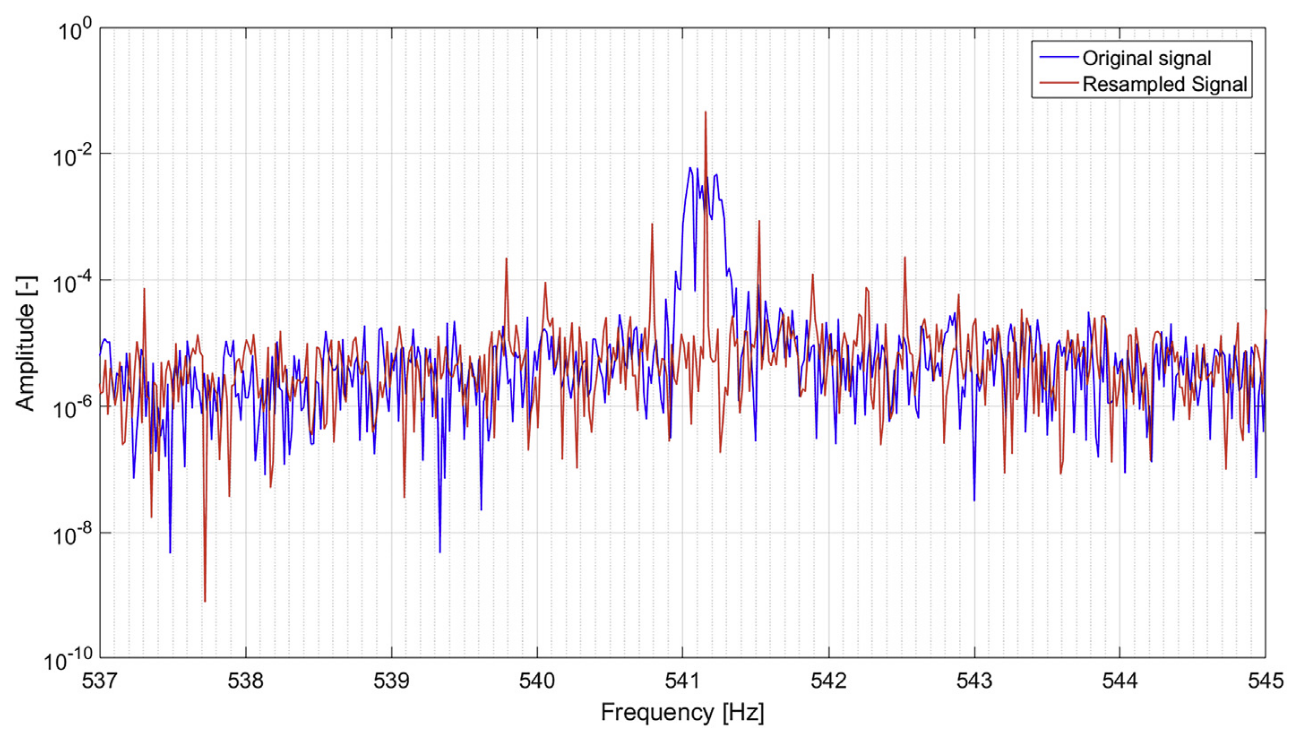
Figure 4Zoomed spectra of original and angular resampled vibration signals measured from a wind turbine gearbox (reproduced from Peeters et al., 2018b).
Order tracking is a fundamental step in spectral analysis, enabling the accurate interpretation of vibration signals. However, it requires knowledge of the instantaneous rotational speed, typically obtained from a tachometer or estimated from vibration data. While wind turbine manufacturers often integrate tachometers into gearboxes, this is not always the case, particularly in direct-drive wind turbines. Various techniques for instantaneous angular speed (IAS) estimation from vibration signals have been proposed in the literature. One common approach involves time–frequency analysis to track dominant speed-synchronous peaks (Zimroz et al., 2011; Protopapadakis et al., 2025; Leclère et al., 2016; Peeters et al., 2017b), while another widely used method relies on phase demodulation of band-pass-filtered signals (Peeters et al., 2022; Boudraa et al., 2004; Peeters et al., 2018a). Peeters et al. (2019) provide a comprehensive review of IAS estimation techniques. Although these studies present general vibration-based IAS estimation methods, some research focuses explicitly on order tracking for wind turbine drivetrain condition monitoring (Peeters et al., 2017b).
For instance, He et al. (2016) introduced an instantaneous frequency estimation method followed by order tracking to enhance vibration spectra for wind turbine gearboxes under non-stationary conditions. By analysing the time–frequency representation of vibration signals, the study successfully detected shaft misalignment in order-tracked spectra. Similarly, Jiang et al. (2016) proposed two IAS estimation methods, which are the time–frequency ridge fusion and the logarithm scheme, where the estimated speed was used for order tracking to identify a faulty bearing in a wind turbine's planetary gearbox. Additionally, Hong et al. (2017) developed a tacho-less diagnostic technique that applies a fast dynamic time-warping algorithm to resample gearbox acceleration signals, aligning a filtered shaft harmonic with a reference signal based on an estimated constant rotational speed. Validated through simulations and experimental data, this method enhances fault detection without requiring speed sensors, demonstrating its effectiveness in industrial applications.
Although order tracking itself is not a fault detection technique, it serves as a crucial pre-processing step and is often followed by spectral, envelope, or time–frequency analysis methods for effective condition monitoring.
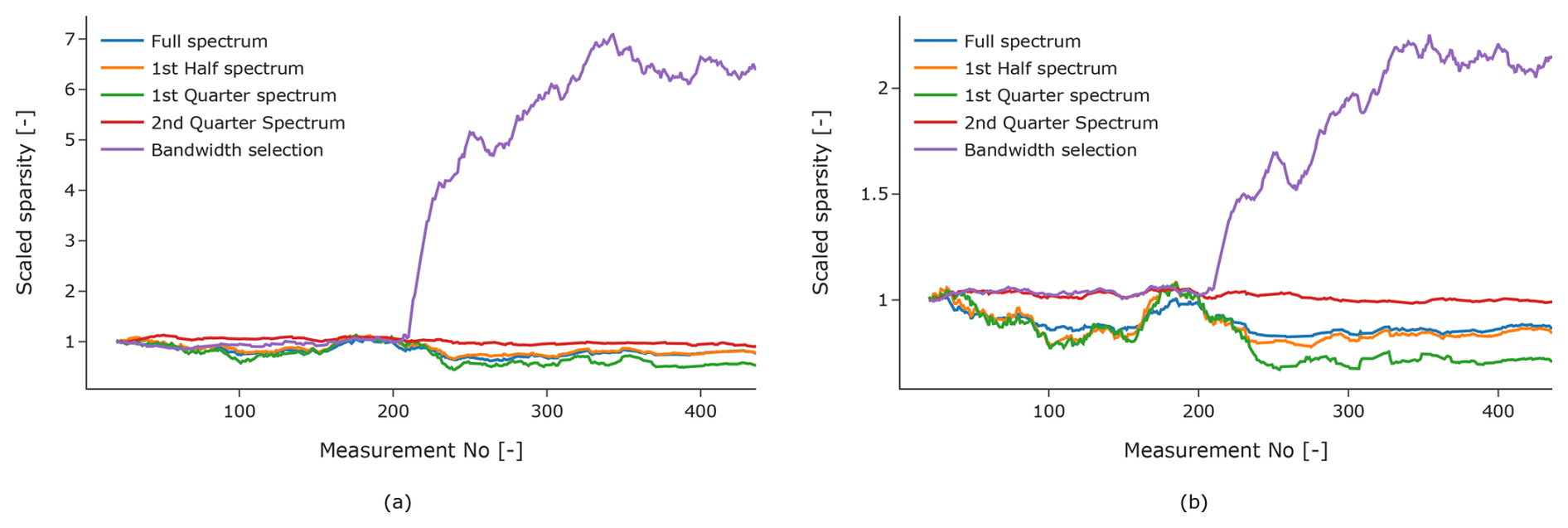
Figure 5The evolution of the sparsity indicators on the blind-filtered signals measured from the gearbox of an offshore wind turbine, using (a) the spectral negentropy and (b) the norm. It demonstrates blind-filtering different bandwidths of the signal to maximize the sparsity of the squared-envelope spectrum. The automated bandwidth selection enables fault detection via blind filters. (reproduced from Kestel et al., 2023).
3.2.3 Signal pre-processing techniques
Following angular resampling, signal editing, or pre-processing constitutes an essential step in the signal processing pipeline for wind turbine drivetrain condition monitoring. This stage primarily aims to enhance the signal-to-noise ratio and reveal relevant information in the vibration signals. These techniques can be combined or employed alone, depending on the component's potential failure modes and the nature of the acquired signals.
-
Cepstral editing. Cepstral analysis, in essence, represents the spectrum of the vibration spectrum. It is a powerful tool for examining harmonic families and their sidebands in vibration spectra. This makes cepstral analysis a particularly valuable technique for monitoring wind turbine gearbox vibrations characterized by numerous harmonics and sidebands. The complex cepstrum of a signal is defined as the inverse Fourier transform of its logarithmic spectrum, expressed as follows:
where ℱ and ℱ−1 represent Fourier and inverse Fourier transform. The free parameter τ denotes the quefrency, with its unit being second, of the cepstrum of the vibration signal x(t). Two additional variations of the cepstrum are commonly defined: the power cepstrum and the real cepstrum. The power cepstrum is derived by squaring the magnitude of the signal's spectrum and then applying the Fourier transform (Randall, 2017). Alternatively, the average power cepstrum can be estimated through Welch-averaging techniques. The real cepstrum, meanwhile, is obtained by extracting the real part of the complex cepstrum, effectively disregarding the phase information of the signal (Randall, 2017).
Cepstral editing is a powerful, indirect method for monitoring component conditions. In this technique, vibration signals are processed in the cepstral domain (using a method called liftering, which is similar to filtering) to remove first-order cyclostationary components within specific quefrency ranges, as shown in Peeters et al. (2017a). This process, known as signal pre-whitening, ensures that strong first-order cyclostationary components do not hide important second-order cyclostationary details, thus improving diagnostics. Another use of cepstral methods is detailed in Randall et al. (2022), where comb-liftering is applied to the cepstra. This removes the effects of varying operating conditions from the vibration spectra, allowing for more precise identification of gear meshing frequency amplitudes and enabling the tracking of gear tooth fault deterioration. Cepstral editing is also an effective tool for detecting and suppressing harmonics from the signal spectrum, which is essential for performing modal analysis used to assess the fatigue life of wind turbine components (Daems et al., 2022; Gioia et al., 2019a, b).
-
Signal filtering. The drivetrain of a wind turbine consists of a large number of components. As a result, vibration signals measured from the drivetrain are combinations of excitations from many sources. Generally, first-order cyclostationary vibrations, such as gear meshing, dominate and can mask second-order contributions. Moreover, bearings, the most frequently failing rotating component type in a wind turbine drivetrain (NRE, 2016), exhibit pseudo-cyclostationary behaviour likely to be buried in the noise floor of the vibration spectrum.
An efficient way to reveal fault-related second-order cyclostationary structures is by filtering the signal around the carrier frequency of the second-order cyclostationary structure. The literature provides predefined filtering approaches that can reveal fault signatures without requiring knowledge or estimation of the fault's carrier frequency, an example of which is shown by Antoni (2007b). However, these approaches may not fully capture the fault carrier, particularly for cyclostationarity with multi-band excitation. Signal-specific adaptive filter optimization algorithms have been proposed to address this issue. These can be broadly categorized into two types: (1) those that exploit machine kinematic information for the optimization problem and (2) those that operate blindly without requiring any kinematic information about the machine.
Non-blind adaptive filter optimization algorithms typically aim to enhance a statistical feature occurring at a known characteristic fault frequency. Notable examples include maximum correlated Kurtosis deconvolution (McDonald et al., 2012) and multipoint optimal minimum entropy deconvolution adjustment (McDonald and Zhao, 2017). In addition to statistical features, Buzzoni et al. (2018) proposed leveraging first- and higher-order cyclostationary components, targeting characteristic frequencies in the squared-envelope spectrum. These methods use prior knowledge of machine fault frequencies to optimize filters that highlight fault-related vibration signatures.
In contrast, blind approaches aim to extract fault information without relying on kinematic data, making them valuable when such information is unavailable or limited. Recent work has advanced blind optimization by focusing on time-domain representations of vibration signals (Li et al., 2012; Jiang et al., 2018). Further developments have improved filter performance by promoting sparsity in the squared-envelope spectrum (Peeters et al., 2020b; Wang et al., 2021a). An enhanced sparsity-based blind-filtering method was also applied to wind turbine gearbox vibrations, demonstrating its practical effectiveness for condition monitoring (Kestel et al., 2023). Given the complex nature of wind turbine drivetrains, which often generate first-order cyclostationary signals, blind methods targeting second-order cyclostationarity may be less effective. Therefore, removing first-order cyclostationary components can significantly improve diagnostic performance. Figure 5 shows the use of blind filters for fault detection in a wind turbine gearbox. By applying blind filters to different frequency bands of the vibration signal and maximizing sparsity in the squared-envelope spectrum, a defective bearing in the high-speed shaft was identified. This diagnosis was later confirmed through a boroscopic inspection.
-
Time synchronous averaging and decomposition. Time-synchronous averaging (TSA) is a technique that isolates periodic waveforms from noisy data, making it particularly useful for gearbox diagnostics in wind turbine drivetrains. By segregating the vibration signal of a specific gear from unrelated noise and vibrations from other components, TSA enhances the condition monitoring process (Bechhoefer and Kingsley, 2009). Moreover, it compensates for shaft speed fluctuations, preventing spectral energy from overlapping with adjacent gear mesh frequency bins. TSA application necessitates a signal synchronized with the angular position of the shaft, which can be achieved by employing a tachometer. Alternatively, phase information can be extracted from gear mesh frequencies to estimate instantaneous angular speed from the acceleration signal, as detailed by Combet and Gelman (2007).
Sawalhi et al. (2014) utilized TSA to extract a residual signal containing the stochastic vibration signature associated with bearing faults in wind turbine gearboxes. Their study focused on analysing the envelope spectrum of residual signals from a high-speed shaft bearing, and they also examined averaged signals from the sun gear, ring gear, and planetary gears for fault detection. In a subsequent study, Bajric et al. (2016) applied TSA to isolate the residual signal and then employed a discrete wavelet transform to identify a gear tooth fault in a wind turbine gearbox. Addressing some limitations of conventional TSA, Ha et al. (2016) proposed an enhanced autocorrelation-based TSA method for diagnosing planet gear faults in wind turbine gearboxes. This technique utilizes an autocorrelation function that captures the physical interactions among the ring, sun, and planet gears to optimize TSA parameters. This improves accuracy and efficiency in fault diagnosis, especially when stationary data are scarce. Furthermore, Yoon et al. (2016) employed Welch's spectral averaging on segmented vibration signals, with segments defined according to the angular positions of individual components within a planetary gearbox. Their work demonstrated that this method effectively isolates the vibration signals of specific components, such as the planetary gears, from the overall system response.
TSA algorithms are commonly employed to isolate vibrations from specific components, particularly planetary gears. However, fault detection in planetary gears and their bearings remains challenging due to the varying positional relationship between these components and the accelerometers over time. Detecting early-stage faults in planetary gears is particularly difficult, and identifying bearing faults is even more challenging, as their vibration signatures are inherently weak due to their pseudo-second-order cyclostationary nature. D'Elia et al. (2017) proposed a method to extract vibrations emitted by planetary gears by leveraging their relative position with respect to the transducer. In the absence of a tachometer, they estimated this relative position directly from the vibration signal. Bearing fault detection was performed on these isolated signals before applying TSA, while TSA was subsequently used to detect an artificially induced tooth fault in one of the planetary gears. Similarly, Ha et al. (2017) demonstrated a method for isolating planetary and sun gear vibrations for fault detection. Their study emphasized the limitations of traditional envelope analysis in such applications and introduced a toothwise fault identification approach for planetary gearboxes.
Recent advances in signal decomposition techniques have further improved fault detection in planetary gearbox components (Peeters et al., 2024). While these methods do not explicitly aim to isolate vibrations from specific components, the decomposed signal components potentially converge to such signal components. One notable example of these signal decomposition techniques is intrinsic time-scale decomposition. Feng et al. (2016) addressed the challenges of planetary gearbox fault diagnosis by proposing a joint amplitude and frequency demodulation analysis method based on intrinsic time-scale decomposition. Simulation and experimental validation demonstrated its effectiveness in diagnosing localized faults in sun, planet, and ring gears. Pan et al. (2021) introduced a novel non-linear sparse mode decomposition method to overcome the limitations of traditional time–frequency-based decomposition techniques, which often struggle with noise, enhancing the adaptability and robustness of signal decomposition. Both simulation and experimental results confirmed its efficacy in fault detection for planetary gearbox fault detection. Further advances include the variational non-linear component decomposition method introduced by Wei et al. (2022) to enhance fault diagnosis under variable speed conditions.
-
Discrete/random separation. Another effective pre-processing approach for extracting the vibration component of interest involves discrete/random separation (DRS) algorithms. Vibration signals inherently consist of two distinct parts: a predictable part, dominated by cyclostationary components; and a random component, primarily attributed to noise. The ability to effectively separate these two constituents can significantly augment the performance of downstream signal processing techniques. Specifically, discrete/random separation techniques identify and isolate the coherent structures in the vibration signals, which represent the predictable part, allowing for the estimation of the remaining random component. This frequency-domain operation offers a relative speed advantage when compared to its time-domain counterparts such as self-adaptive noise-cancelling or linear prediction (Randall et al., 2011). The utility of discrete/random separation on signals exhibiting speed fluctuation has been shown by Borghesani et al. (2012). Moreover, an improved version, multi-delay DRS was later proposed by Peeters et al. (2020a), who also showcased its performance and impact on fault detection in a wind turbine gearbox.
This section has summarized various signal editing and pre-processing techniques that are crucial for subsequent signal processing stages, ultimately leading to indicator estimation. Users must apply one or a combination of these methods to effectively reveal fault information embedded in vibration signals.
3.2.4 Cyclostationarity in drivetrain vibrations
After the vibration signals undergo pre-processing, the analysis typically proceeds to investigate the cyclostationary properties. For condition monitoring applications, comprehending the signal signatures from healthy and faulty drivetrain states is a vital stage of signal processing. While the vibration signatures vary among drivetrain components (e.g. blades produce different vibrations than generator bearings), these signals are classified as cyclostationary. This classification is named from signals' inherent property of exhibiting an underlying periodicity in the temporal flow of energy (Antoni, 2009), a characteristic prevalent in rotating mechanical systems.
Cyclostationary signals cover a wide range of statistical features and are classified with respect to their orders. Generally, cyclostationarity up to the second order is prevalent in vibration signals from rotating machines, and higher orders are typically not of interest for condition monitoring. However, some studies explore the potential to utilize higher orders of cyclostationarity for condition monitoring of rotating machines (Raad et al., 2008). By definition, an nth order cyclostationary signal exhibits periodicity in its nth order moment (Antoni et al., 2004). The first-order cyclostationarity represents the simplest form, where the first moment is periodic. In other words, purely first-order cyclostationary signals have a constant periodic mean. First-order cyclostationary signals can arise from gear meshing, shaft imbalances, or misalignments, and they typically produce prominent peaks in vibration spectra (Antoni et al., 2004). As expected, second-order cyclostationary signals have a second moment that remains constant over periods, or their auto-correlation function is periodic (Antoni et al., 2004). Examples of drivetrain components that emit second-order cyclostationary signals include bearings and blades with high aeroacoustic noise. The term pseudo-cyclostationarity, introduced by Antoni and Randall (2002), describes a specific type of cyclostationarity generated by roller element bearings. This term refers to motions where the cyclic behaviour is not strictly periodic, but the bursts forming cyclostationary signals slightly deviate from the expected repetition frequency.
Since the dominant vibration emitted by rotating drivetrain components exhibits cyclostationary characteristics, signal processing techniques designed to handle cyclostationarity are widely used in drivetrain condition monitoring, such as envelope analysis.
The envelope analysis begins with high-pass or band-pass filtering to isolate the high-frequency components where fault-induced modulations occur, hence removing low-frequency machine vibrations and background noise. The filtered signal is then demodulated to obtain its envelope, which contains information on faults near their theoretical frequencies (Antoni, 2009). Focusing on amplitude modulations rather than raw vibration data provides a more explicit spectrum, reducing noise interference and improving diagnostic accuracy. However, determining the optimal band-pass or high-pass filter settings remains a challenge. The literature discusses predefined and adaptive filtering techniques and correlation maps, which provide carrier frequency information (Randall et al., 2001). Despite its widespread use, envelope analysis requires extensive pre-processing to reveal fault signatures effectively.
Second-order cyclostationary signals exhibit periodic second-order statistics characterized by periodic autocorrelation functions. A typical example is the vibration signal from a rolling element bearing fault, such as a crack in a raceway, which generates impulses convolved with the structure's resonance frequency. The envelope spectrum is traditionally obtained via the Fourier transform of the envelope, estimated from the analytic signal. Alternatively, spectral correlation provides a method to compute the envelope spectrum (Randall et al., 2001), referred to as the enhanced envelope spectrum.
Randall et al. (2001) investigated spectral correlation density maps for diagnosing bearing faults using experimental vibration signals. Their findings suggest that 2D spectral correlation density maps reveal bearing fault frequencies in the discrete cyclic frequency domain. Additionally, the study introduced the enhanced envelope spectrum derived by integrating spectral correlation density maps over the continuous carrier frequency domain. The authors also demonstrated that spectral correlation density maps assist in determining optimal band-pass filter frequencies to highlight modulations in vibration signals from complex machinery.
Several spectral correlation estimation methods have been extensively studied and compared by Antoni (2007a). While cyclic spectral analysis provides deeper insights into vibration signals, it is not significantly more complex than conventional spectral analysis. However, a significant drawback is estimating the discrete modulation frequency α up to an unknown upper limit, which is computationally intensive (Randall et al., 2001; Borghesani and Antoni, 2018). To mitigate this, a fast algorithm employing the short-time Fourier transform has been proposed for spectral correlation or coherence map estimation (Antoni et al., 2017).
3.2.5 Indicator estimation
Following the previous signal processing operations, a range of health indicators is extracted from vibration data as the next step. These include statistical features in the time domain and spectral features in the frequency domain, which are commonly employed to monitor specific kinematic elements of rotating machinery. However, as highlighted in recent research (Antoni and Borghesani, 2019), no single indicator can effectively detect all types of fault in such systems. As a result, multiple indicators are computed to improve the coverage of fault detection. To capture signal characteristics across various frequency bands, filtering techniques are applied, enabling the estimation of statistical parameters from both the deterministic and stochastic components of the signal. Spectral features are derived from both the signal and envelope spectra.
In this context, Antoni and Borghesani (2019) and Antoni et al. (2024) introduced a statistical approach to systematically construct indicators that target specific characteristics in the time and frequency domains. Additionally, a framework for designing new statistical indicators aimed at early fault detection has been proposed (Antoni et al., 2024). This work also reviews commonly used indicators in condition monitoring and links conventional health indicators to actual component degradation mechanisms. Apart from the statistical indicators, fault detection also leverages indicators derived from spectra or cepstra. For instance, several cepstral indicators have proven effective in detecting gear tooth faults (El Badaoui et al., 2001, 2004). While the evolution of harmonic families can be traced in signal or envelope spectra, monitoring their transformation into the cepstral domain offers a more straightforward approach (Siegel et al., 2014).
Given the complex structure of modern wind turbines, which contain numerous rotating elements, a wide range of characteristic frequencies must be monitored. These health indicators are further organized according to different operational and environmental contexts to enable more accurate trend analysis, as their behaviour is influenced by such conditions. Consequently, each vibration measurement generates a large volume of indicators, making manual expert evaluation highly resource intensive (Helsen et al., 2017a). This issue is compounded by the continuous generation of such indicators across all turbines in a fleet, significantly increasing the complexity of condition monitoring tasks (Helsen et al., 2017a). To address this challenge, a practical approach involves integrating health indicators with contextual data to form composite high-level features that better represent the turbine's condition (Jamil et al., 2025).
3.2.6 Emerging signal processing techniques
Advancements in technology have enabled innovative data acquisition and signal processing methods for condition monitoring. One emerging approach involves analysing vibration signals derived from video recordings. Initially, video frames were utilized for performing modal analysis (Wang et al., 2022d). With improvements in camera sampling rates and the availability of larger storage capacities, it is now feasible to capture high-frequency data, even using smartphone cameras (Natili et al., 2020; André et al., 2021). These advancements have allowed applications such as instantaneous rotational speed estimation from video-based vibration data. Moreover, recent studies have demonstrated the feasibility of diagnosing faults in rotating machinery directly from high-speed video frames (Leclère et al., 2025).
3.3 Acoustic emission methods
Monitoring structure-borne sound, also known as acoustic emission (AE), is a non-invasive method for monitoring the dynamic reactions of a material under load or environmental influence. The method is characterized by its sensitivity to defect growth and changes within the material during material degradation. Therefore, it is suitable for the detection of damage precursors and damage at a microscopic stage. Real-time monitoring makes it possible to analyse the growth of inhomogeneities, for example, in the form of degradation processes under load. The frequency range of the AE signal varies depending on the application and is 20 kHz–2 MHz (Deutsches Institut für Normung e.V., 2011). The practical implementation of real-time capability in the condition monitoring system places high demands on the signal processing hardware and data processing software due to the large volumes of data and the complexity of the AE signals.
3.3.1 Physical principle
According to DIN EN 13554, the physical phenomenon of structure-borne sound is characterized by “transient elastic waves within a material” (Deutsches Institut für Normung e.V., 2011). The loading of material by external forces or environmental conditions generates structure-borne sound, for example, caused by “local plastic deformation, crack growth and friction” (Deutsches Institut für Normung e.V., 2011). The resulting elastic waves propagate in the material or neighbouring fluids. In the following, the elastic waves are called structure-borne sound waves. Structure-borne sound waves contain information about the processes, such as wear processes, within the material. The molecular lattice theory can explain the generation of structure-borne sound through friction, as shown in Fig. 6 (Deutsches Institut für Normung e.V., 2011; Mokhtari, 2020).
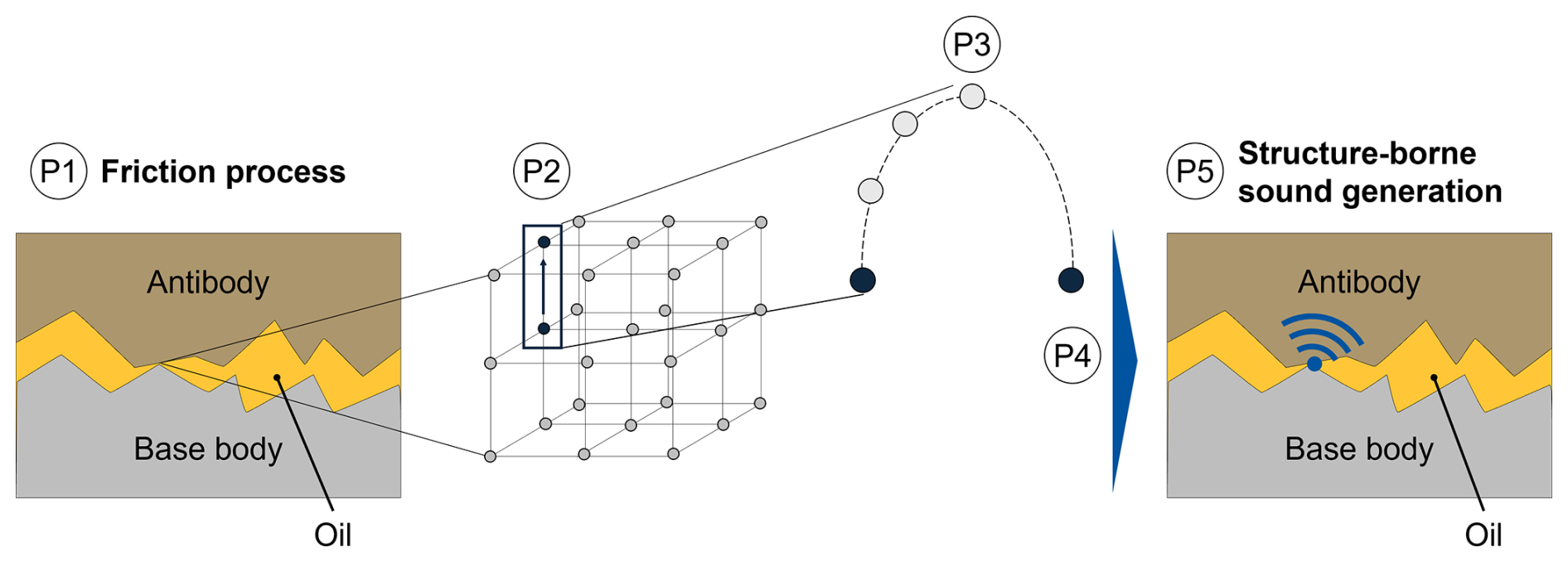
For the explanation, a frictional process between the base and counter body (P1), in the form of a shaft and journal bearing, is considered as an example. The friction process causes a material molecule to change from stable to unstable (P2). The energy is added up during friction until a limit value (P3) is exceeded. The molecule is then transferred to the stable initial state (P4). During the transition from the unstable state (P3) to the stable state (P4), part of the stored energy is released as a structure-borne sound wave from the inside of the material to the surface (P5) (Mokhtari, 2020).
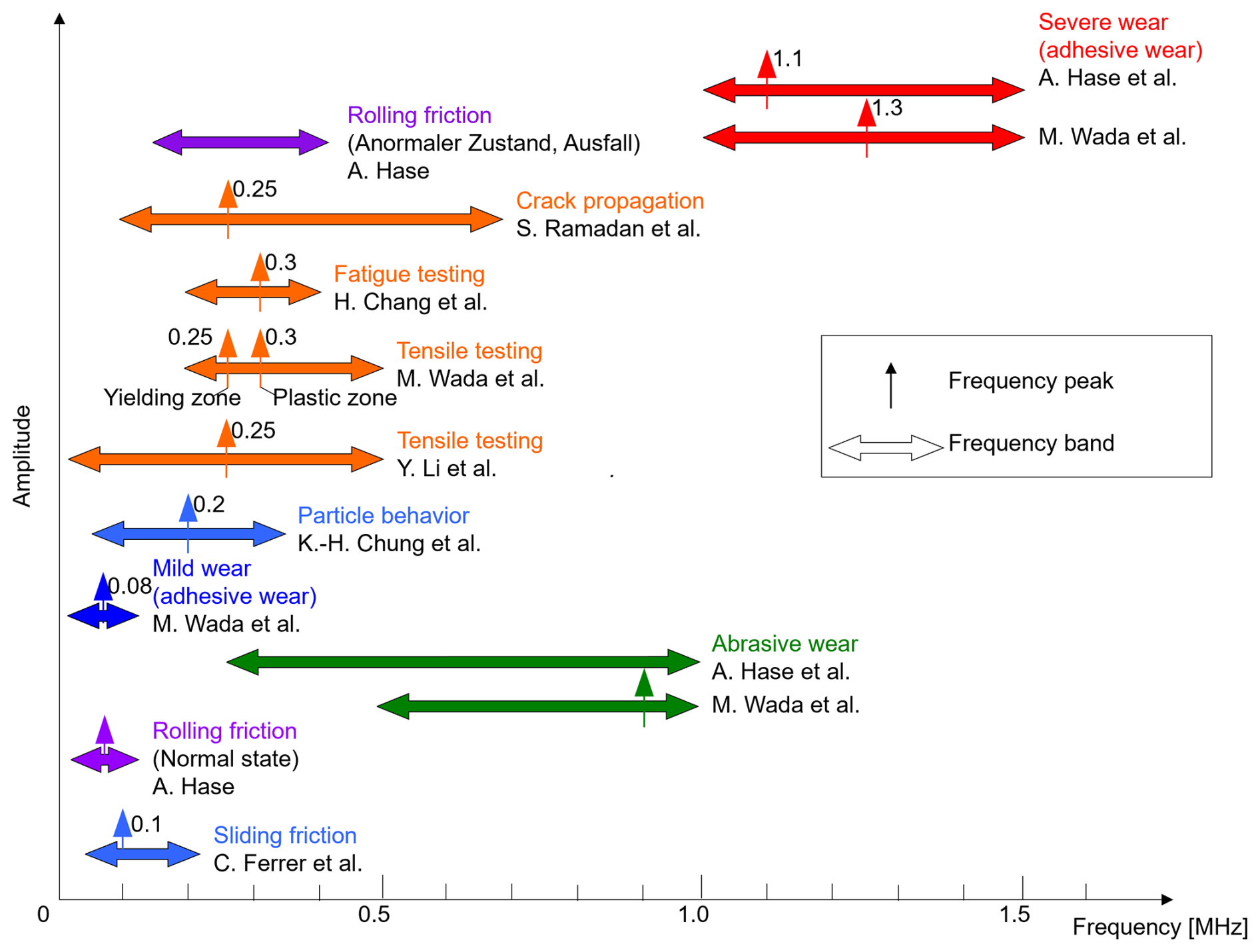
In addition to detecting friction states, according to Hase (2020), inevitable friction and wear phenomena can be detected depending on the frequency range, as shown in Fig. 7. In the diagram, the amplitude is qualitatively assigned to various causes. A quantitative statement is impossible due to many factors influencing the AE signal, such as the measurement system and conditions. Characterizing individual phenomena based on a frequency range mainly depends on the test conditions. Research focusing on the early detection of fatigue damage using the AE technique has shown that fatigue damage in the rolling element bearing raceway surface can be detected from AE signal components in the frequency range of approximately 0.15 to 0.4 MHz (Hase, 2020). Accordingly, peaks observed in this frequency region are considered to be associated with the occurrence of flaking. However, interpreting AE signals solely based on their frequency range remains challenging. Numerous damage mechanisms may overlap in the same frequency band, making it difficult to distinguish between them clearly. Moreover, amplitude-based indicators are often unsuitable, as the signal transmission path, sensor characteristics, and the measurement setup significantly influence them.
3.3.2 Signal characteristics
In the 1950s and throughout the 20th century, research in the field of monitoring systems was characterized by the fact that the performance of these systems was severely limited. For example, continuous recording of AE signals over a long period required disproportionate effort. For this reason, the AE signals were reduced to a few parameters for storage. At the beginning of AE technology, the recording was carried out using analogue methods so that only easily measurable parameters could be recorded, and the approach of reducing a signal to characteristic parameters is known as the parameterized approach (Auerswald, 2016). The characteristic parameters of a transient signal are shown in Fig. 8 using the terms commonly used in the literature.
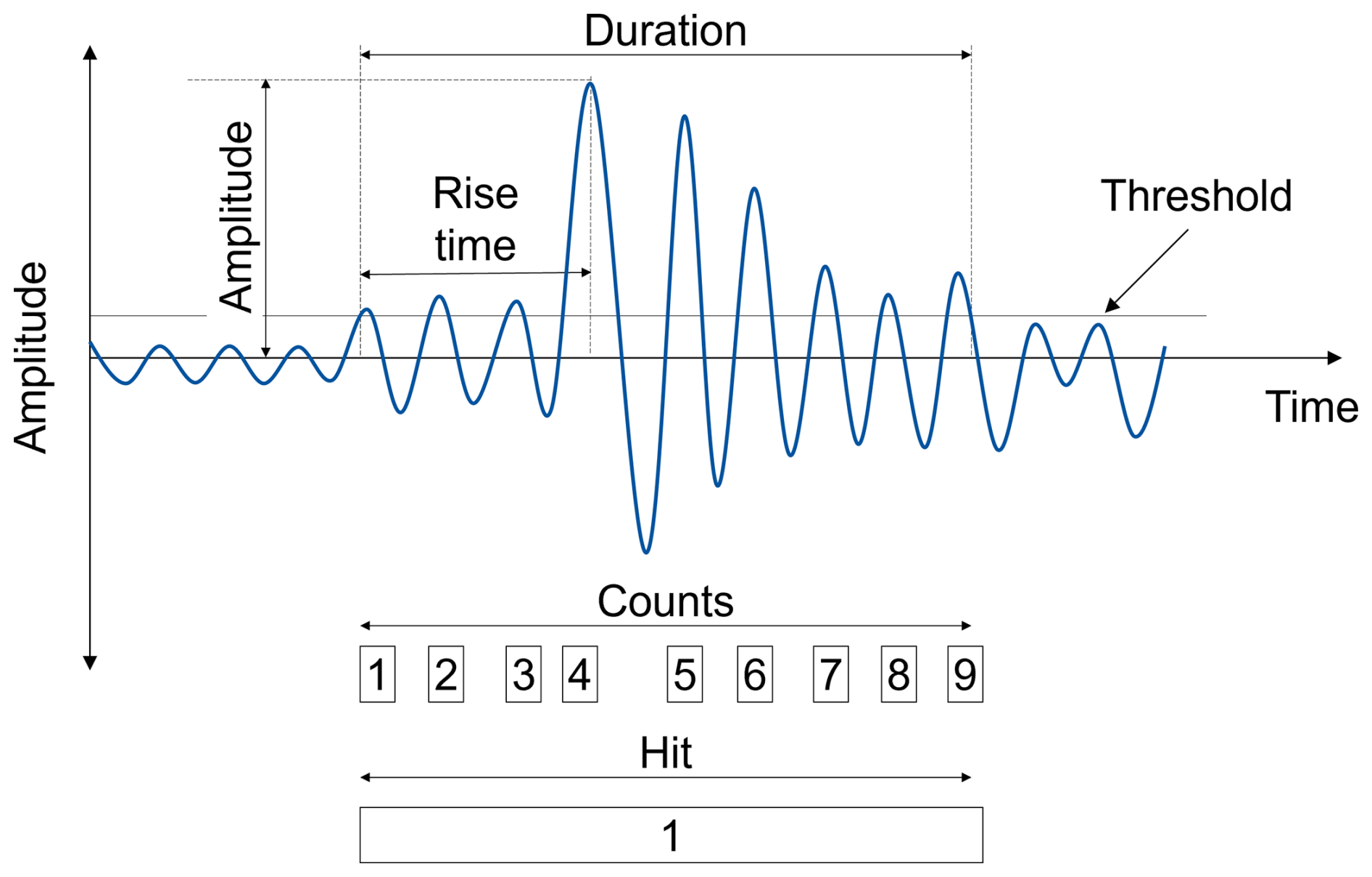
A hit corresponds to the detection of an AE event and is characterized by the occurrence and decay of a structure-borne sound wave. The number of hits per time unit is suitable for evaluating the machine status. A hit begins when a predefined limit value is exceeded for the first time and ends when the limit value is exceeded for the last time. Counts define the number of times the limit value is exceeded during a hit. The amplitude describes the maximum signal level that occurs, which depends on various factors such as the sensor, the coupling between the sensor and the measurement object, and the distance of the sensor to the signal source. The period of a hit is referred to as the duration. The rise time corresponds to the period between the first time the limit value is exceeded and the maximum signal amplitude (Auerswald, 2016).
Other parameters, such as the energy content of a hit, are not displayed. The parameterized evaluation includes a large number of statistical parameters that can be extracted from a signal. These include the root mean square (rms) value, the standard deviation, and the kurtosis value (Vraetz, 2018).
Compared with traditional vibration analyses, AE technology can obtain valuable information about the condition of a measurement object in the preliminary and early stages of damage. However, the evaluation of the data poses a particular challenge. AE signals frequently have a low amplitude (in the microvolt to millivolt range) and are overlaid by ambient noise, necessitating specialized methods for separating relevant events from noise in the AE signal. The following subsections present time-domain analysis, frequency-domain analysis, and time–frequency-domain analysis.
3.3.3 Data analysis: time domain
The evaluation of measurement signals in the time domain is typically predicated on two fundamental principles: the signal progression over time and the analysis of distinctive characteristics. A general distinction between dynamic time signal analysis and time trend analysis can be made. Dynamic time signal analysis is particularly well suited to the assessment of short-term behaviour, for example, in the form of burst events. An integral component of this analysis is statistical feature extraction, in which a range of parameters is calculated to characterize the signal. These include the mean value and the variance, which provide fundamental information about the signal level and its dispersion. The rms value is another key parameter, as it allows for information about the energy of the signal and correlates with the mechanical load on the bearing. The crest factor is also essential, as it describes the relationship between the peak value and the rms value, and high crest factors indicate impulse-like disturbances that can be caused by developing damage. Furthermore, kurtosis can be utilized to identify non-stationary surge signals, as it exhibits sensitivity to outliers in the signal. The time trend analysis is employed to assess the long-term behaviour of the signal curve, for example, with the help of the envelope curve analysis, which is particularly useful for identifying repetitive pulse patterns (Mokhtari, 2020; Klein, 2008).
3.3.4 Data analysis: frequency domain
The transformation of a time domain signal into the frequency domain enables the detection of recurring structures and modulation patterns, which can be utilized to diagnose journal and rolling element bearing damage. The fast Fourier transformation (FFT) is the most prevalent method for decomposing an AE signal into its frequency components. The subsequent frequency analysis of the signal facilitates the classification of its frequency components and, by extension, their attribution to either critical operating conditions or specific damage (Hoffmann and Wolff, 2014; Kolerus and Becker, 2022).
In rolling element bearings, only a fraction of the race is in contact with a rolling element (and therefore under load) at any given time. At a specific point on the race, the load is oscillating at a frequency dependent on the shaft's rotational frequency. Since initialization and growth of faults occur under load, monitoring the over-rolling frequencies allows for the detection of damages with AE. For rolling element bearings, the over-rolling frequencies are listed as follows:
-
BPFO: ball pass frequency outer race
-
BPFI: ball pass frequency inner race
-
Cage speed or FTF: fundamental train frequency
-
BSF: ball spin frequency
where nB is the number of rolling elements, fr is the shaft speed, dB is the diameter of a rolling element, dm is the pitch diameter, and ϕ is the angle of the load from the radial plane (Randall and Antoni, 2011). These equations are derived assuming a stationary outer ring, which represents the most common bearing configuration. However, in scenarios where both the inner and outer rings rotate, such as bearings supporting planet gears in planetary gearboxes, these equations require appropriate modification (Howard, 1994).
These characteristic frequencies, which depend on the shaft speed, are typically lower than 20 kHz. An increased amplitude at one of these frequencies hints at a fault, and when that frequency corresponds to a specific machine element, the fault can be precisely localized. While these characteristic frequencies often do not appear in the raw AE signal, the envelope of the signal (e.g. magnitude of the analytic signal) contains them, enabling AE-based fault detection using established frequency-analysis methods like order analysis (Elasha et al., 2017; Bechhoefer et al., 2013).
In contradistinction to rolling element bearings, the manifestation of damage in journal bearings is less evident in periodic shock pulses than in rolling element bearings. The manifestation of damage is evident in alterations to tribological behaviour and the lubricating film.
Time–frequency methods can be used as an alternative to conventional spectral analysis to improve the diagnosis of non-stationary signal characteristics. These methods are particularly suited for capturing dynamic changes in frequency components due to varying lubrication conditions (König et al., 2021a, b). This is because the frequency components are often not constant and the lubrication condition can change dynamically.
3.3.5 Data analysis: time–frequency domain
Bearing damage often generates non-stationary signals, which is why a pure frequency analysis is usually insufficient to capture all the dynamics of the signal. Time–frequency analysis combines both domains and enables a detailed investigation of signal changes over time. One possibility is to use the short-time Fourier transform (STFT). With the STFT, the signal is divided into time windows to create a local frequency analysis. One disadvantage of the STFT is the constant window size, which requires a compromise between frequency and time resolution. A longer time window leads to better frequency resolution with poorer time resolution. In contrast, a shorter time window leads to better time resolution and poorer frequency resolution. Wavelet analysis uses an alternative segmentation technique and allows variable window sizes. In wavelet analysis, longer time intervals are used to analyse low-frequency information, while shorter time intervals are used for high-frequency details. This allows the signal's low-frequency and high-frequency parts to be examined at different times and frequency resolutions (Kolerus and Becker, 2022; Puente León, 2013).
Journal bearings generate highly non-stationary AE signals as they have been studied on component test rigs that try to mimic critical conditions of planetary gearbox journal bearings. The non-stationary AE signals originate from transient wear events such as two-body abrasion, adhesion, or three-body abrasion caused by particle contamination. Time–frequency methods such as the continuous wavelet transform (CWT) are particularly well suited to capture these events adequately. Unlike traditional methods that rely on statistical descriptors or STFT, the CWT maintains high resolution in both time and frequency domains and enables the localization of specific frequency components over time. This is particularly advantageous for detecting the onset and evolution of wear modes in journal bearings.
Recent studies have demonstrated that AE signals from running in, oil starvation, and particle-contaminated lubrication exhibit distinct 40–700 kHz time–frequency signatures. Figure 9 shows CWT of AE signals recorded under four different operating conditions of a journal bearing, namely hydrodynamic operation, running in, oil starvation, and particle-contaminated lubrication (König et al., 2021a, b).
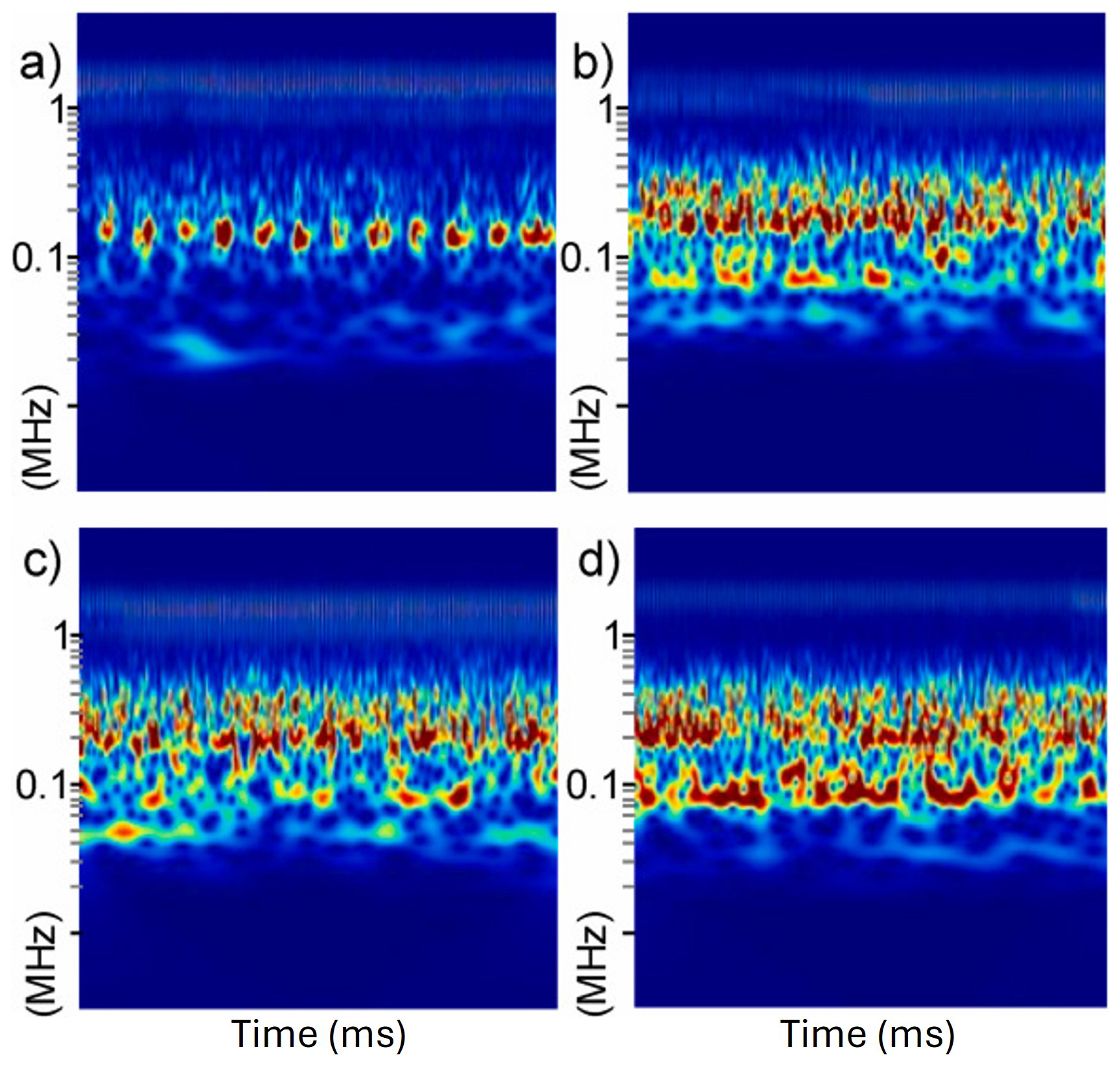
Figure 9CWT of the AE signals for different operating states: (a) hydrodynamic operation, (b) running in, (c) oil starvation, (d) particle contamination (König et al., 2021a, b).
While each condition yields characteristic signal patterns in the 40–700 kHz range, the overall morphology of the CWT spectrograms shows significant overlap between certain operating states, particularly between running in and oil starvation. As a result, a reliable manual classification of these time–frequency representations is nearly impossible. Human observers cannot consistently distinguish subtle yet relevant spectral differences across large datasets. Therefore, ML models are required – specifically, deep convolutional neural networks – trained on labelled CWT spectrograms. These models have been shown to effectively learn discriminative features and achieve classification accuracies above 80 % (König et al., 2021a, b).
The previous sections show that AE is a highly sensitive method for detecting early damage mechanisms in bearings. AE is particularly suitable for monitoring non-stationary and transient processes such as abrasion. Manual data evaluation of the AE signals by human observers is hardly practicable, as the spectral patterns of different operating states sometimes overlap considerably. Integrating ML methods, such as CNNs, opens new perspectives for the automated classification of AE signals in the form of time–frequency information. Existing challenges must be solved before AE technology can be used in field applications. Real-time processing requires powerful signal processing hardware and robust software solutions to process large amounts of data reliably. At the same time, the analysis algorithms must be robust against interference signals, varying environmental conditions and structural differences in the systems to avoid misclassifications.
Components typically undergo measurable changes at the early stages of deterioration. The interval between this initial stage and the occurrence of the fault is commonly referred to as the RUL (Aydemir and Acar, 2020; Si et al., 2011). Predicting the RUL of equipment is a core technology for implementing effective maintenance strategies (Zhang et al., 2023b). In wind energy applications, which rely heavily on automation and complex machinery, accurate RUL estimation is critical (Compare et al., 2020). It enables condition-based and predictive maintenance strategies, transforming asset management and operational risk mitigation. Unplanned downtime poses a major challenge across industries, often leading to substantial financial losses (Zhang et al., 2023b). By leveraging RUL predictions, industries can schedule maintenance proactively, ensuring that machinery is serviced or replaced before failure occurs. Researchers have proposed various classifications for RUL approaches. Jardine et al. (2006) categorized RUL approaches into statistical, model-based, and AI approaches. Heng et al. (2009) grouped them into physics-based, data-driven, and integrated approaches. Javed et al. (2017) classified them into statistical model-based approaches, AI approaches, physics model-based approaches, and hybrid approaches. The famous and more commonly used classifications were approached by Lee et al. (2014), who classified them into three categories: physics-model-based, data-driven and hybrid approaches, as shown in Fig. 10. Data-driven prediction approaches can be further divided into two groups: statistical analysis and AI approaches.
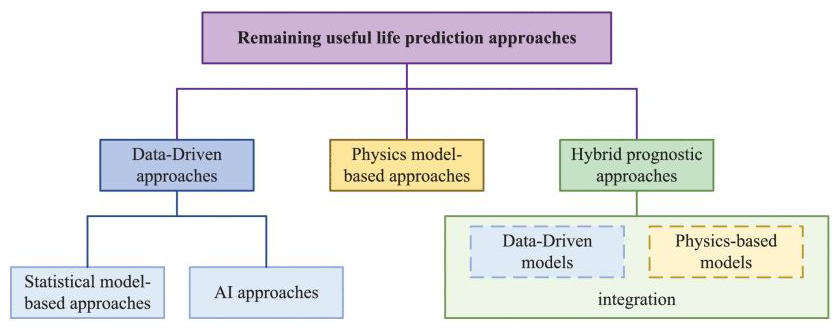
Figure 10Classification of RUL approaches (Zhang et al., 2023b).
4.1 Physics-model-based approaches
Physics-based modelling approaches rely on the physical laws that govern faults and failure mechanisms, which can differ depending on the specific mechanism involved (Patrick-Aldaco, 2007). The physical failure model of equipment primarily predicts the RUL by analysing mainly cracks and wear in critical components (Zhang et al., 2023b; Thirumurugan and Gnanasekar, 2020). The accuracy of these predictions is significantly influenced by the actual load conditions on the components, specialized knowledge of failure mechanisms and a series of necessary assumptions regarding mechanical components. Consequently, a mathematical model is established to accurately represent the physical laws underlying their performance degradation (Zhang et al., 2023b). In the case of cracks, the prediction models are empirical and primarily based on experimental results related to crack growth, such as the Paris formula and the Forman formula. The Paris formula is a widely used model for predicting crack growth, linking the crack growth rate to the stress intensity factor (Leser et al., 2020). It underpins fatigue growth theory and is highly applicable in components like gears and bearings. Leser et al. (2020) developed a crack growth model based on the Paris formula for non-deterministic fatigue life predictions, along with a method to reduce prediction uncertainty.
For wear, empirical models such as Archard's (Archard, 1953) and Fleischer's (Fleischer et al., 1980) focus on material loss rates due to friction and contact stresses, enabling predictions of wear under varying load conditions. These models are often coupled with degradation statistical models to estimate wear life. König introduced a method that combines the Fleischer model with a linear degradation model to determine wear life or journal bearings (König et al., 2024; Gebraeel et al., 2009).
Physics-based approaches depend on knowledge of degradation processes and fault mechanisms in mechanical components, without relying on extensive historical data. These models often incorporate inputs such as material properties, mechanical principles and load monitoring, which provides direct insight into operational stresses that contribute to failure. Developing these models requires specialized knowledge of material failure mechanisms and system behaviour, which may not always be available (Zhang et al., 2023b). As a result, accurately modelling complex mechanical equipment can be impractical, limiting its engineering applications.
4.2 Data-driven approaches
Data-driven approaches rely on the mapping process of collected equipment status information, without requiring specific physical models of fault evolution or degradation processes. This process, often referred to as pattern recognition, is used to diagnose machine faults. This involves translating information from the measurement space and/or features from the feature space into specific machine faults within the fault space. These data-driven approaches can be categorized into two main branches: statistical analysis methods and AI techniques (Jardine et al., 2006; Zhang et al., 2023b).
4.2.1 Statistical-model-based
Statistical-model-based approaches aim to determine the presence of a specific fault using available condition monitoring information (Jardine et al., 2006). These methods utilize specific models or distributions, along with their parameters, to formulate hypotheses regarding fault presence. Subsequently, test statistics are developed to summarize condition monitoring data, facilitating a decision on whether to accept or reject fault prediction (Jardine et al., 2006). Statistical model-based approaches include various methods that aim to estimate the RUL of equipment or components. According to Zhang et al. (2023b), these approaches consist of three models: stochastic filter models, stochastic process models, and similarity-based models. Stochastic filter models, such as the Kalman filter and particle filter, combine noisy measurements with probabilistic models to refine state estimates in real time, addressing uncertainties in both the system and measurement noise (Singleton et al., 2015; Cui et al., 2019). Variants like the extended Kalman filter and the unscented Kalman filter tackle non-linear challenges, while advances such as the unscented particle filter enhance accuracy (Liu et al., 2022; Zhang et al., 2023b). Stochastic process models describe equipment degradation using stochastic processes to estimate RUL by identifying when degradation first reaches a failure threshold. Unlike time-series models, they provide probability distributions for RUL predictions, capturing uncertainty in the forecasts (Zhang et al., 2023b). Examples include Wiener process models (Li et al., 2019b; Wang et al., 2018; Li et al., 2020d), gamma process models (Ling et al., 2019), inverse Gaussian models (Jin et al., 2020), and Markov models (Gu et al., 2020; Zhang et al., 2023b; Ghosh et al., 2019). Similarity-based models estimate RUL by comparing degradation trajectories of a target system with reference systems using historical failure data. This method constructs health indicators and performs similarity matching, proving effective when detailed degradation mechanisms are not available (Lyu et al., 2020; Cannarile et al., 2019; Zhang et al., 2023b).
4.2.2 AI approaches
Traditional statistical analysis methods, which rely on signal processing technology and specific expert knowledge, struggle to address the complexities of mechanical systems (Deutsch and He, 2018). In contrast, AI approaches are taking a leading role by offering innovative solutions for the effective RUL prediction of mechanical equipment (Jia et al., 2016). Unlike traditional physical or statistical models, AI methods eliminate the necessity for precise modelling while effectively managing the complexities associated with degradation prediction in dynamic systems. Zhang et al. (2023b) categorize AI approaches into two methods: shallow learning and deep learning. Shallow learning algorithms, such as ANNs, SVMs, and relevance vector machines, have demonstrated reliable performance in RUL prediction tasks. For instance, one of the earliest studies to utilize an AI approach was conducted by Gebraeel et al. (2009), who developed an RUL prediction model for thrust ball bearings (inner diameter = 3.96 mm) using ANNs based on vibration-based signals. While these algorithms are particularly effective for smaller datasets and specific applications, they may face challenges such as difficulties with parameter tuning. Shallow learning focuses on feature extraction and making predictions from data without requiring deep hierarchical structures, which makes these algorithms faster and easier to train compared to deep learning models (Zhang et al., 2023b). Deep learning algorithms, including CNNs and recurrent neural networks (RNNs), along with their variants such as LSTM, excel in capturing high-dimensional features and temporal correlations within large datasets (Zhang et al., 2023b). These methods provide improved predictive accuracy and adaptability for complex mechanical systems. For example, Li et al. (2020b) utilized CNNs to establish a direct relationship between condition monitoring data collected from approximately 21 sensors, such as total temperature and pressure at the fan inlet, and RUL for aero-engines.
4.3 Hybrid approaches
Hybrid prognostic approaches integrate multiple methodologies, including data-driven and physics-based techniques, to predict the RUL of mechanical systems. These approaches aim to leverage the strengths of various methods while mitigating their individual limitations, hence leading to more accurate and reliable predictions (Zhang et al., 2023b). Such hybrid methods have demonstrated excellent results in predicting wear degradation and fatigue life.
For instance, Shutin et al. (2023) applied Archard's law and the Reynolds equation to develop a physical model for bearings that considers both load and thermal factors. Similarly, Feng et al. (2019) introduced a digital twin application based on a hybrid approach for detecting wear degradation in spur gears. Their method integrated vibration-based signals with a dynamic model developed to simulate gear vibrations, incorporating the Archard wear model. By iteratively updating the dynamic model to account for wear-induced changes and comparing simulated vibrations with measured data, this approach facilitates accurate estimation of the remaining useful life. Their other works further highlighted the effectiveness of digital twins based on hybrid approaches, demonstrating their potential to enhance the accuracy and reliability of predictive maintenance and monitoring processes (Feng et al., 2021, 2022).
4.4 Challenges in the industrial adoption of RUL estimation
Despite the extensive development of physics-based, data-driven and hybrid approaches, the widespread adoption of RUL estimation and prognostic methods in industrial settings remains limited. Transitioning these technologies from academic research to operational wind farms presents several significant practical challenges that must be addressed.
Uncertainty quantification remains a major challenge. Wind turbine drivetrains are inherently noisy and subject to fluctuating operational and environmental conditions. Furthermore, as mechanical designs become increasingly complex, modelling their degradation becomes substantially more difficult (Zhang et al., 2023b). Consequently, RUL predictions are subject to various sources of uncertainty, originating from sensor noise, incomplete degradation models, and unpredictable future loads. For operators to trust these prognostic models, it is essential to provide reliable confidence intervals. However, developing robust mathematical frameworks to accurately quantify and bound this uncertainty in real time is highly complex. The validation of RUL models presents a fundamental difficulty (Zhang et al., 2023b). Allowing wind turbine drivetrains to run to failure incurs substantial costs and is operationally impractical. As a result, historical run-to-failure data are notoriously scarce. Models are frequently trained and validated using accelerated life testing in controlled laboratory environments or through simulated data. These controlled scenarios often fail to capture the complex, noisy degradation pathways observed in the field, making operators sceptical of the model's reliability when deployed in actual operational conditions. Integrating RUL predictions with actual maintenance decision-making may not be straightforward. Even if a model provides an accurate RUL estimate, translating this information into a concrete maintenance action requires overcoming organizational and logistical barriers. These practical challenges must be systematically resolved before RUL models can be widely applied to operational wind farms.
Wind turbines operate under fluctuating environmental conditions, experiencing variable loads that lead to gradual wear and potential failure of drivetrain components. The drivetrain includes key elements such as the main bearing, gearbox, generator, and blades, which require continuous monitoring to prevent unexpected breakdowns. Component-based condition monitoring focuses on the health of individual drivetrain components. Analysing each component's condition enables more effective and efficient maintenance solutions. The primary challenge is selecting the proper monitoring techniques and data granularity for accurate fault detection.
Each drivetrain component in a wind turbine requires a specific combination of condition monitoring techniques to ensure early fault detection. Vibration analysis, oil debris monitoring, electrical signature analysis, and infrared thermography are among the most effective methods. For the best predictive maintenance strategy, a combination of multi-sensor data fusion, AI-based anomaly detection, and SCADA trend analysis can be implemented to maximize turbine reliability and efficiency.
5.1 Data granularity across drivetrain components: requirements and challenges
Multi-sensor data fusion offers powerful capabilities for condition monitoring. However, it also introduces a significant challenge. It requires ensuring the appropriate data granularity for each distinct machine component.
As established in Sect. 3.1.5, the standard 10 min SCADA resolution enables broad operational trend analysis but remains inadequate for resolving incipient fault signatures. Consequently, high-frequency SCADA acquisition (1 Hz) is increasingly necessary, despite the resulting increase in data volume.
Vibration and acoustic emission sensors operate at significantly higher sampling rates than SCADA systems. For large-scale turbines, the data acquisition system must manage the multi-scale requirement discussed in Sect. 3.2.1: balancing extended durations for slow rotor cycles with kilohertz-range frequencies for transient gearbox faults.
Another critical aspect of data granularity is the determination of optimal sampling periodicity. While continuous monitoring may be ideal for condition assessment, it is often impractical due to storage and computational constraints. Depending on the measurement type, sampling frequencies can range from high-frequency SCADA data recorded every second to vibration or acoustic measurements taken only a few times daily. However, no standardized framework exists for determining the optimal sampling periodicity. An efficient approach is to measure intervals frequently enough to capture the full range of operating conditions experienced by the wind turbine drivetrain.
The granularity challenge extends beyond simple sampling rates to include the physical nature of the data itself. Oil debris monitoring, for instance, focuses on the cumulative trending of particle counts rather than continuous waveforms. In this case, “granularity” is defined by the sensor's ability to detect specific particle size bins, typically ranging from 30 to 300 µm, to correlate wear debris with the health of internal bearings and gears. Effectively synchronizing these discrete particle events with high-frequency vibration streams remains a difficult data fusion task.
Electrical-signal-based monitoring, such as current signature analysis, presents a different bottleneck. While current and power signals are often already captured by turbine control and protection systems, extracting the harmonic information necessary for detecting rotor or stator faults requires high-speed acquisition. This adds a third parallel stream of high-volume data that must be processed alongside mechanical signals to provide a complete picture of generator health. Finally, imaging and visual techniques, such as thermography or drone-based X-ray scanning, introduce a unique dimension of spatial granularity. These methods offer unrivaled detail for identifying surface erosion or internal blade delamination. However, they currently suffer from low temporal granularity, as they are largely restricted to periodic, stationary inspections rather than continuous operation. Transitioning these into real-time monitoring streams remains a significant frontier, requiring a substantial increase in computational power to handle high-resolution spatial datasets alongside traditional time-series data.
Several challenges remain in the integration of multi-granularity data for effective condition monitoring. High-frequency vibration and acoustic emission data necessitate advanced computational approaches, such as edge computing or cloud-based analytics, to process and store information efficiently (Verstraeten et al., 2019). While higher data granularity enhances diagnostic capabilities, it also increases hardware, storage, and maintenance costs, requiring careful cost-benefit analyses.
5.2 Main bearings
The main bearing in a wind turbine allows for free rotation of the main shaft, transmitting power-producing torque to the gearbox/generator while transferring potentially harmful non-rotational loads to the bedplate or frame. Currently, all commercially available main bearings for wind turbines are of the rolling element type. Recently identified as a primary driver of O&M cost increases, main bearing reliability has become a critical cost factor for wind energy (EPRI, 2024). The high costs associated with main bearing failures arise from both frequent breakdowns and expensive replacements. Prior high-volume field data studies showed that main bearing L10 field lives1 are around 10.5 years (Hart et al., 2023; EPRI, 2024) for turbines rated at 6 MW or slightly higher. This is close to half the minimum design rating life of 20 years. There is also evidence that larger turbines are experiencing failures earlier (EPRI, 2024). A variety of failure modes have been documented, including damage resulting from surface and subsurface initiation, stray currents, lubrication failures, overloading, and improper bearing assembly/fit (Hart et al., 2023; EPRI, 2024). The principal drivers of premature main bearing failures remain unclear, likely as a result of the challenges presented by (1) complex and highly non-steady operational conditions which make damage modes and expected lifetimes difficult to model or predict (Hart et al., 2022; Kenworthy et al., 2024); (2) main bearing and shaft diameters moving beyond the envelope of prior experience, likely resulting in larger-magnitude bearing deformations, among other possible effects (Nejad et al., 2022); and (3) uncertainty concerning the criticality of main bearing system design versus maintenance and servicing practices when seeking to extend main bearing lifetimes. Condition monitoring and RUL estimation help to mitigate the cost impacts of main bearing failures, providing operators with advanced warning of potential issues and supporting effective scheduling of routine maintenance and investigative, preventative, and/or replacement activities.
5.2.1 Main bearing condition monitoring
Effective condition monitoring of main bearings is widely recognized as a crucial strategy to ensure reliable and minimally interrupted operation. The main bearing experiences high-magnitude fluctuating loads, slow rotational speeds, and harsh environmental conditions, increasing its susceptibility to wear, spalling, and lubrication-related degradation (Hart et al., 2020; Liu and Zhang, 2020). In response, a broad range of sensor-based approaches has been proposed to capture the critical parameters indicative of main bearing health status. Commonly employed sensors include vibration accelerometers or micro-electro-mechanical systems operating at high sampling rates, acoustic emission sensors tailored for early fault detection (Ma et al., 2023), complementary sensors such as thermography devices, and strain gauges collecting lower-frequency signals. Although SCADA systems are also used, the associated 10 min averaged sampling rate often proves insufficient to capture subtle time-sensitive fault signatures (Encalada-Dávila et al., 2021).
The effectiveness of these sensor-based approaches depends not only on the types of sensors deployed but also on the granularity of the data they produce. Data granularity must be carefully selected to balance the level of diagnostic detail required with the computational and bandwidth constraints of the monitoring infrastructure. SCADA data, sampled typically every 10 min, enable broad operational trend analysis (e.g. turbine power, temperature) but do not adequately resolve incipient fault signatures (Encalada-Dávila et al., 2021). Medium-frequency data (on the order of 1 Hz) offer a compromise between signal resolution and data volume by capturing moderate-level anomalies that evolve over minutes or hours. High-frequency signals (on the order of kilohertz) are necessary for revealing localized shock pulses or high-frequency resonances characteristic of early bearing faults (Xiao et al., 2022b; Beretta et al., 2021b). However, these higher sampling rates require greater data handling capacity and more sophisticated processing pipelines.
A variety of CMS signal processing techniques have been employed to extract meaningful fault signatures from raw sensor signals. Time-domain methods are frequently used to compute statistics such as rms or kurtosis, and envelope analysis is applied to isolate impact-type features associated with bearing damage (Hart et al., 2020; Hussain et al., 2024). Frequency-domain approaches, including Fourier-transform-based spectral analysis and cepstrum analysis, are well suited for identifying characteristic fault frequencies (e.g. ball pass frequency on the outer race, ball pass frequency on the inner race). When signal stationarity cannot be assumed, time–frequency-domain methods, such as wavelet transforms or the Hilbert–Huang transform, are effective in tracking transient or non-stationary events (Fu et al., 2024). These advanced signal processing tools are selected with consideration for data availability and sampling frequency, as more complex analyses often offer improved fault resolution but necessitate higher-quality data and greater computational resources.
While these traditional signal processing techniques have proven effective for feature extraction, the growing complexity of main bearing fault detection challenges has driven the integration of ML methods. ML approaches complement these techniques by automating data interpretation and improving fault detection accuracy through advanced pattern recognition (Encalada-Dávila et al., 2021). Traditional supervised algorithms (e.g. SVM, random forests) and unsupervised approaches (e.g. clustering, novelty detection) are employed to distinguish normal from anomalous operating conditions (Beretta et al., 2021b). In situations where large labelled datasets are available, deep learning architectures, such as CNNs or RNNs, are used to learn discriminative features directly from raw vibration signals or time-series data (Xiao et al., 2022a, b). Autoencoders, in particular, are gaining prominence for unsupervised anomaly detection when labelled fault examples are limited (Liu and Zhang, 2020). These ML-based strategies frequently leverage multi-rate data fusion, in which high-frequency vibration measurements are combined with 10 min SCADA observations (e.g. tower acceleration, bearing temperature, turbine power) to enhance contextual understanding and reduce false alarms (De Oliveira-Filho et al., 2022).
The combination of advanced sensor technologies, appropriate data granularity, and robust signal processing or ML methods enables earlier detection of main bearing faults, reduced downtime, and optimized maintenance schedules (Xiao et al., 2022b; Beretta et al., 2021b). Nevertheless, the selection of a specific monitoring strategy typically depends on practical factors such as turbine accessibility, cost constraints, and existing data infrastructure. In particular, wind farm operators must assess whether the added complexity of high-frequency data acquisition and real-time processing can be justified by the potential for reduced corrective maintenance costs and mitigated risk of catastrophic failures (Liu and Zhang, 2020). As wind farm projects continue to scale in size and complexity, further advancements in sensor technology, data handling capacity, and machine/deep learning algorithms are expected to enhance main bearing condition monitoring capabilities while contributing to the overall reliability and cost-effectiveness of wind energy production.
5.2.2 Main bearing remaining useful life prediction
The estimation of RUL for wind turbine main bearings has emerged as a critical but highly complex area of research and application. These components endure non-steady, non-stationary loading conditions and challenging environments, making accurate RUL prediction essential for minimizing downtime and optimizing maintenance schedules. The state of the art in this domain encompasses a spectrum of methodologies, including vibration-based diagnostics, hybrid data fusion techniques, and advanced ML algorithms. This subsection delves into the current state of the art, highlighting the key challenges and opportunities for advancing main bearing RUL estimation.
A robust RUL estimation framework begins with the integration of CMS outputs to acquire high-quality data. Vibration analysis remains the cornerstone of fault detection and prognosis, providing critical insights into bearing degradation through signal processing techniques in the time and frequency domain (Hart et al., 2020; Kordestani et al., 2022). Techniques such as envelope analysis, spectral kurtosis, and wavelet transforms allow the extraction of features indicative of wear and localized damage. However, main bearings present unique challenges due to their low rotational speeds and the influence of external noise, such as gearbox vibrations (Li and Jian, 2024; Rezamand et al., 2020). The effective separation of meaningful fault signals from this noise remains a significant barrier. Hybrid approaches that integrate SCADA data and vibration analysis offer promising solutions. SCADA systems, widely used for operational monitoring, provide valuable metrics such as temperature, power output, and wind speed, although at coarse temporal resolutions (Vieira et al., 2024). Combining these metrics with high-frequency vibration data has proven effective in capturing long-term degradation trends. Recent studies employ cross-validation and data augmentation techniques to address the challenge of limited labelled datasets, improving model robustness and reducing overfitting risks (Vieira et al., 2024). ML and deep learning have revolutionized RUL estimation by automating feature extraction and providing adaptive models capable of handling non-linear degradation patterns. Techniques, such as LSTM networks and CNNs, excel at capturing temporal dependencies and spatial characteristics (Kordestani et al., 2022; Li and Jian, 2024). Hybrid models, such as those that combine tree seed algorithms with LSTM, further improve prediction accuracy and robustness (Rezamand et al., 2020). Bayesian frameworks and ensemble methods also show promise in quantifying uncertainty and improving reliability in real-time applications (Vieira et al., 2024).
Despite these advancements, significant challenges remain. The inherent variability in operating conditions, including fluctuating loads and environmental factors, complicates the identification of consistent degradation trends (Rezamand et al., 2020). Furthermore, the lack of standardized datasets and benchmarking methodologies limits the comparability of proposed models. The high computational demands of deep learning models pose practical constraints on their deployment in resource-constrained environments, particularly for real-time monitoring.
The opportunities for innovation lie in enhancing the interpretability and efficiency of predictive models. Advanced data fusion techniques, such as high-level fusion schemes with bounded uncertainty, offer pathways to integrate diverse data sources while mitigating noise (Kordestani et al., 2022). Furthermore, the use of digital twin technology to simulate operational states and predict faults in varying scenarios presents a further route to improve the estimation of RUL for the main bearing. Future research on main bearing RUL prediction should prioritize the development of scalable, explainable ML frameworks and the establishment of open-access, high-quality, and farm-wide datasets to enable comprehensive training and testing activities at scale.
5.3 Gearbox
The size and power capacity of wind turbine gearboxes are continuously increasing, with diameters reaching 3 m and power up to 20 MW, often utilizing multi-stage designs with four or more planetary gears per stage (Nejad et al., 2022; Abhimanyu, 2024). As summarized in Sect. 2, the gearbox accounts for the longest downtime in wind turbines and incurs high repair costs (Li et al., 2020c). Failure modes of gearboxes are various, as concluded in Sect. 2, with common issues including wear and damage of gears and bearings, shaft misalignment and fractures, oil leakage, and overheating.
The internal structure of wind turbine gearboxes is highly complicated and subjected to miscellaneous alternating loads, which induce irregular behaviours during operation. These behaviours include complex vibration responses caused by the simultaneous meshing of multiple planetary gears, intricate modulation effects, multiple vibration transmission paths, noise interference, and output power fluctuations, as well as variations in voltage and current (Salameh et al., 2018; Wang et al., 2019; Li et al., 2019a). These factors impose substantial challenges on the condition monitoring of wind turbine gearboxes.
The common condition monitoring techniques for gearboxes include vibration analysis, oil and lubrication analysis, acoustic emission analysis, and SCADA data analysis (Salameh et al., 2018). Vibration signals typically contain abundant information on mechanical faults and are particularly sensitive to issues in critical subcomponents of the wind turbine gearbox, such as gears and bearings. Acoustic emissions in wind turbines primarily result from the initiation and propagation of cracks, making it possible to detect structural defects by installing acoustic emission sensors in the gearbox. Oil-based condition monitoring is also widely applied in wind turbine gearboxes. By monitoring parameters such as oil viscosity, moisture content, fluid level, particle count and identification, temperature, and pressure, the process of oil contamination and degradation can be analysed, revealing the health status of the gearbox. Low-frequency parameters in the SCADA system, such as current, voltage, power, rotational speed, and wind speed, indicate the operational status of the wind turbine and provide valuable information regarding gearbox performance.
5.3.1 Machine-learning-based methods
The detailed classification of ML-based approaches has been thoroughly discussed in the preceding sections. Building upon this classification, we now summarize the commonly employed methods and relevant studies in the context of gearbox fault/failure diagnosis.
In the category of shallow learning, supervised learning is mostly used for classification, with common methods applied for gearbox fault/failure diagnosis such as kNN (Bao et al., 2023), SVM (Lu et al., 2020), random forests (Pang et al., 2021), and logistic regression (Su et al., 2022a). Unsupervised learning mainly addresses data dimensionality reduction and clustering. Key algorithms for dimensionality reduction include principal component analysis (Elforjani, 2020), t-distributed stochastic neighbour embedding (Zhu et al., 2024), and linear discriminant analysis (Pang et al., 2021). Clustering methods often include partition-based clustering such as k-means (Zhu et al., 2022a), density-based clustering such as density-based spatial clustering of applications with noise (Shi et al., 2021), and model-based clustering such as the Gaussian mixture model (Fuentes et al., 2020). Furthermore, recent studies have explored the application of reinforcement learning in diagnostics. For instance, in these studies (Wu et al., 2023; Wang et al., 2021b), the diagnostic problem is transformed into an optimization problem, where reinforcement learning is employed to automatically learn optimal classification policies. Deep learning methods for diagnosing wind turbine gearboxes can be broadly categorized as follows: multilayer perception as a basic neural network structure (Bangalore et al., 2017); CNNs, which are effective for handling data with a clear grid structure (e.g. images) (Zhang et al., 2023a); RNNs, which specialize in processing sequential data (He et al., 2023); transformer networks, which leverage self-attention mechanisms to process sequential data (Zhao et al., 2023); autoencoders, which use unsupervised learning to reconstruct input data, aiding in feature extraction and dimensionality reduction (Yang and Zhang, 2020); and generative adversarial networks, consisting of a generator and discriminator for data generation and augmentation (Su et al., 2022b). In addition to shallow and deep learning, ensemble learning (including stacking, boosting, and bagging) leverages multiple compatible ML algorithms to perform a single task, enhancing diagnostic performance and reducing overfitting. For example, in Pichika et al. (2022), the authors proposed a hybrid ensemble method integrating boosting, bagging, and stacking techniques to identify multi-component faults in a wind turbine gearbox. In the context of digitalization, transfer learning has also been applied to wind turbine gearboxes to improve fault diagnosis performance across different turbines and operational conditions, thereby strengthening generalization and advancing the realization of digital twin technologies. For instance, Zhu et al. (2022b) employed three feature-based transfer learning methods to minimize data distribution discrepancies between wind turbines and applied these methods in case studies for fault detection in two 2 MW wind turbines. Hu et al. (2024) proposed a novel method for early fault detection and diagnosis in wind turbines suited for data-limited scenarios, achieving accurate and transferable fault diagnosis. The proposed method was validated using vibration data from actual wind turbine gearboxes.
5.3.2 Condition monitoring system signal processing
Wind turbine gearbox condition monitoring using vibration analysis can be broken down into monitoring the three key components: shafts, gears, and bearings. Each component exhibits unique fault modes and requires specific signal pre-processing and analysis techniques.
-
Shafts. Shafts are typically well designed and robust but can experience significant issues that may lead to catastrophic failures. As the critical link between rotating components, shaft failures can arise from unbalance, misalignment, bending, or cracks. These defects often manifest through increased amplitude at the shaft frequency or its harmonics over time.
An imbalance in rotating machinery can cause mechanical wear, reduced efficiency and failures if not promptly addressed. It occurs when mass distribution in the rotor is uneven, inducing excessive vibrations and stress on bearings. Traditional methods for detecting imbalances focus on vibration analysis, where deviations from expected patterns indicate the issue. Recently, advanced techniques, including frequency spectrum analysis and ML algorithms, have improved the precision of unbalance detection (Carbajal-Hernández et al., 2016).
Shaft misalignment, which can occur in coupled shafts, also affects vibration signatures, particularly at the second and fourth harmonics of shaft speed. However, some studies report no direct correlation between misalignment and increased second harmonic (Mitchell, 1984; Al-Hussain and Redmond, 2002). Vibration-based methods are widely employed for detecting unbalance and misalignment by analysing the machine's vibration signature (Patel and Darpe, 2009a, b).
Although less common, cracks in shafts can manifest as increases in shaft harmonic amplitudes in vibration spectra (Patel and Darpe, 2008). However, small cracks may not significantly alter vibration characteristics. Severe cracks, although dangerous, may only influence vibration patterns once they are sufficiently large (Randall, 2021). Detection methods using vibration analysis, often combined with acoustic emission techniques, are commonly used for condition monitoring (Lu and Chu, 2011). Despite advances in monitoring techniques, there remains substantial potential for developing more effective tools for the early detection of shaft faults as rotating machinery grows more complex.
-
Gears. Gears are essential components in drivetrain systems, typically used to change rotational speed or torque between two shafts (Randall, 2021). According to work on vibration-based condition monitoring by Randall (2021), gear faults can be categorized into four primary types.
The first category of gear faults is slow variations, including processes like wear, runout, and polishing (Feng et al., 2023). Wear is the most common slow deterioration fault, characterized by gradual changes on the gear teeth surfaces. It can be uniform, with all teeth wearing similarly; or non-uniform, leading to different surface shapes across the teeth (Hu et al., 2016). While uniform wear typically increases vibration levels detectable at gear meshing harmonic frequencies, non-uniform wear may cause either an increase or decrease in these amplitudes (Hu et al., 2016; Randall, 2021). Wear increases overall vibration levels due to defects on meshing surfaces contributing to noise and gear meshing vibrations (Feng et al., 2023). Several studies have linked the severity of wear to vibration levels by tracking rms (Feng et al., 2023), and early research introduced the energy ratio (the rms ratio of the stochastic and deterministic parts of the vibration signal) as a measure of wear severity (Swansson, 1980). Gear teeth exposed to wear generate higher vibration levels and additional harmonics (Ziaran and Darula, 2013) and sidebands in the vibration spectra compared to healthy gears. Techniques such as tracking quefrencies in cepstra (Ziaran and Darula, 2013) and sidebands in the spectra (Combet and Gelman, 2011) have been proposed for fault detection.
The second category consists of local faults, which can evolve into distributed faults. Local faults include pitting, spalling, scoring, and foresting, often caused by contaminants in lubrication, subsurface cracks, or prolonged metal-to-metal contact (Liang et al., 2018). The fault identification process for pitting and spalling is similar to wear detection in vibration-based condition monitoring. The vibration spectra of a gear are typically analysed in the time, frequency, time–frequency, and cepstral domains (Kumar et al., 2020). Fault detection approaches for wear and pitting are demonstrated in Feng et al. (2015); Jena et al. (2014); Feng and Liang (2016); and Merainani et al. (2017). Two other types of fault encountered by gears are random errors, such as tooth spacing errors or broken teeth; and systematic errors, referred to as the ghost component. The former represents manufacturing defects or severe faults, and the latter is not necessarily a fault but results from imperfect meshing caused by manufacturing limitations.
A defect in a gear results in vibration patterns that differ significantly from those of a healthy gear. Typically, a fault in a gearbox manifests through several sidebands in the vibration spectra, as gear faults are inherently modulated by amplitude and frequency. While a localized fault generates a flat sideband distribution, a distributed fault results in larger, narrowly spaced sidebands. These sidebands are separated from the central peak at the gear meshing frequency by the shaft frequency. In practice, vibration signals from a gearbox are complex, and sidebands may be challenging to detect depending on fault severity.
A practical approach for detecting gear faults is to demodulate faulty gear vibration signals and apply fault detection techniques to the demodulated signal. However, gear faults present a challenge, as the forcing frequencies and modulation frequencies are often very close, hindering traditional demodulation methods, such as the Hilbert transform (Kumar et al., 2020), which do not satisfy the Bedrosian theorem. Other techniques, including signal modulation and application of problem-specific filters to reveal fault-related frequencies, have been proposed in the literature (Kumar et al., 2020; Feng et al., 2015).
-
Rolling element bearings. Among others, bearings are the most commonly used rotating component in a gearbox (Randall, 2021). Moreover, they represent the primary contributor to machine failures. Consequently, extensive research has been conducted to analyse the vibration characteristics of bearing faults, leading to the development of advanced signal processing techniques for early fault detection.
Rolling element bearings are susceptible to three types of faults: defects on the inner race, outer race, and rolling elements. A defective bearing produces high-frequency bursts at a frequency determined by the bearing's geometry and the affected component. The characteristic frequencies of rolling element bearings are provided in Eqs. (6) to (9). The shaft speed often modulates these trains of bursts generated by a defect, as it is the rate at which the faulty component passes through the load zone. The envelope of the vibration signals contains information about these high-frequency bursts, enabling condition monitoring of the bearing by tracking these bursts in either the time or spectral domain.
However, the characteristic frequencies listed in Eqs. (6) to (9) may not precisely correspond to the actual frequencies due to a phenomenon known as slippage (Antoni and Randall, 2002, 2003). The bearing cage ensures that the rolling elements rotate at an approximately uniform speed; however, variations in the angle θ cause fluctuations in radial and axial forces, leading to slip in some rollers. This results in deviations in the characteristic frequency of up to 2 % (Antoni and Randall, 2002, 2003). This slight variation justifies using the envelope of the signal rather than the raw signal for vibration-based condition monitoring of bearings. Vibration signals dominated by cyclic impulse trains are classified as cyclostationary, whereas in cases where slippage occurs, they are categorized as pseudo-cyclostationary (Antoni and Randall, 2003).
Vibration-based bearing fault detection is typically conducted by analysing high-frequency bursts in the signal or its envelope in the time, frequency, or time–frequency domain. A comprehensive tutorial on rolling element bearing diagnostics was published by Randall and Antoni (2011). A key challenge in bearing fault detection is that the deterministic component of the signal often obscures the vibration signature of the bearing fault. This deterministic component, typically generated by gear meshing or other cyclic phenomena, exhibits a distinct periodic pattern, unlike the stochastic nature of bearing faults. Consequently, the dominant power of the deterministic component may mask the fault-related signals embedded within the stochastic portion of the signal.
A conventional approach to address this issue involves separating the stochastic component and demodulating the vibration signal after applying high-pass or band-pass filtering. However, determining the optimal filter bandwidth is data dependent, as the structure dictates the carrier frequency, and no universal selection method exists. Although ad hoc techniques such as spectral kurtosis (Antoni and Randall, 2006) have been developed to identify the optimal bandwidth, automated filtering methods have also been proposed in the literature (McDonald et al., 2012; Peeters et al., 2020b; Buzzoni et al., 2018).
Following this, statistical indicators can be estimated from the time-domain signal to assess whether the signal exhibits increased impulsiveness or skewness relative to the expected healthy state. Additionally, tracking the amplitudes of characteristic frequencies or sidebands in the signal or envelope spectrum remains a widely used and effective method. Furthermore, advanced techniques employing correlation and coherence maps have been introduced to simultaneously identify modulation and carrier frequencies.
-
Plain bearings. The substitution of roller bearings as planetary bearings in wind turbines with plain bearings has become well established in recent years (Lucassen et al., 2025). Compared to roller bearings, plain bearings are characterized by their low installation space requirements, resulting in a higher power density of the wind turbine drivetrain (Lucassen et al., 2023). When operated exclusively within the liquid friction range, plain bearings operate without wear and theoretically possess an infinite service life. However, critical operational anomalies (e.g. insufficient lubrication due to oil supply failure, overheating of the planetary bearing, or oil contamination) may occur, which cannot be adequately addressed in the design process and can lead to failure of the plain bearing. Nevertheless, incipient damage to plain bearings can be detected at an early stage using CMSs. A variety of CMS metrics have been established for hydrodynamic radial plain bearings and are part of the current state of research and industry (Mokhtari et al., 2020).
Conventional monitoring systems are usually retrofitted to the plain bearings and can only be installed in multi-axis rotating systems, such as planetary gearboxes, at considerable expense due to the complex cabling required for data and power transmission (Kirchner et al., 2024). To monitor planetary plain bearings, vibration- or AE-based condition monitoring methods described in Sect. 3 may potentially be employed, while measuring at the gearbox housing as described in Mokhtari (2020). However, the long transfer path from the planetary plain bearing to the sensor on the gearbox housing introduces many potential sources of interference that must be identified and eliminated through suitable data evaluation.
Another option for monitoring planetary plain bearings involves ultra-low-power-demand monitoring methods integrated directly into the bearing itself, such as temperature sensors. By harnessing energy types generated within planetary plain bearings, such as thermal or mechanical energy, and converting them into electrical energy using energy harvesting techniques, these condition monitoring methods can operate without an external power supply. One such integrated approach is the surface acoustic wave (SAW) method, which utilizes piezoelectric probes embedded beneath the sliding surface to emit short sinusoidal wavelets and to measure the response x(t) once per cycle. As these waves propagate along the surface, interaction with the adjacent oil film causes measurable wave attenuation and a significant time delay (tG) in the response signal. These SAW signal features enable the detection of mixed conditions and the oil film height (Decker et al., 2025a). This active ultrasonic measurement principle is robust against acoustic disturbances due to its specific operating frequency and has been transferred to planetary bearings, using a 160° probe offset to compensate for tilting, to detect mixed friction, oil starvation, and lubricant contamination (Decker et al., 2025b, c).
Complementing SAW is the temperature field measurement (TFM) method, a high-precision self-powered CMS approach (Baszenski et al., 2023). For the TFM approach, digital temperature sensors are placed directly beneath the running track to provide spatially resolved temperature data. By measuring the bearing angle ϕT,max at which the maximum temperature occurs, the system can determine the lubrication gap height via the Gümbel curve in the fluid friction range (Deutsches Institut für Normung e.V., 2017). This method is highly sensitive to transitions between fluid friction and mixed friction zones, allowing for the detection of incipient damage before damage-critical conditions escalate (Paeßens et al., 2024). The TFM system achieves independence from external cabling by utilizing harvested waste heat for power and a Bluetooth low-energy interface for wireless data transmission.
5.3.3 Oil debris monitoring
Oil debris monitoring (Sheng, 2016) refers to the continuous identification and trending of gearbox debris, including ferrous and non-ferrous, shed from contacting surfaces of these components or trapped through contamination and carried in the oil using an oil debris sensor. Whenever a ferrous or non-ferrous particle larger than a certain size passes through the sensor, the magnetic field formed inside the sensor is disturbed and an electric pulse is generated and counted. The counts over time represent the cumulative damage that occurred to the monitored components (e.g. bearings or gears inside wind turbine gearboxes). The oil debris sensor can be installed in the main filtration loop or the side-stream (or kidney) filtration loop (relatively smaller bore size, slower flow rate, and lower oil pressure than main filtration loop) permanently, either before or after the oil pump, but always before the filter. The minimum detectable ferrous wear debris size for this type of sensor can be down to 100 µm and, for non-ferrous wear debris, down to 300 µm, if installed in the main filtration loop. If in the kidney loop, these can be reduced to about 30–50 µm for ferrous debris and 130–150 µm for non-ferrous debris. Measurements of both ferrous and non-ferrous wear debris can be grouped into different size bins and trended, based on which levels of alarms can be generated. The data can be processed alone or integrated with a vibration analysis system, offering more comprehensive monitoring of the gearbox. With the advanced computing and modelling capabilities brought by AI/ML or digital twins, there are opportunities to gain additional benefits from oil debris monitoring.
5.4 Generator
Condition monitoring of electrical generators in wind turbines is critical to ensuring the reliability and efficiency of wind energy systems. As discussed in Sect. 2, generator faults contribute significantly to wind turbine downtime according to reliability studies. Geared turbines mainly use doubly fed induction generators with a partial-power converter. This has been the most popular topology for medium-sized turbines ranging from 3 to 6 MW. In the context of direct-drive systems, low-speed and high-torque permanent magnet synchronous generators are becoming increasingly attractive for offshore applications (Nejad et al., 2022). Diagnosing wind turbine generator faults in real-world applications is particularly challenging due to their rapid progression in uncontrolled environments with highly variable operating conditions. Despite growing concerns about the reliability of wind turbine electrical components and the increasing interest in condition monitoring based on electrical signals, monitoring generator electrical faults has yet to become standard practice in the wind industry.
Rotor winding unbalance, resulting from brush gear or slip-ring wear/faults, or winding electrical faults, contributes significantly to the failure rate of wind turbine generators (Alewine and Chen, 2011; Liu et al., 2024a). Fault detection in doubly fed induction generators based on the analysis of high-frequency current, power, or vibration signals has been extensively researched (Soares et al., 2018). Various diagnostic methods, using time-domain or frequency-domain techniques, have been proposed to identify rotor failures (Tavner et al., 2020; Liu et al., 2024a). Electrical signals contain a wealth of harmonic information that must be interpreted accurately to ensure a confident diagnosis. Among the proposed approaches, current signature analysis is a well-established, non-intrusive diagnostic technique for monitoring and detecting faults in electrical machines by analysing the spectral characteristics of electrical signals (El Hachemi Benbouzid, 2000). Current signature analysis has been extensively researched for the detection of rotor asymmetry in induction machines operating under steady-state conditions, ranging from analytic explanations of the origins of fault frequencies (Yazidi et al., 2010; Gritli et al., 2011) to investigations based on simulation and experimental data (Stefani et al., 2008; Gritli et al., 2013).
In the wind energy industry, electrical-signal-based condition monitoring has attracted significant attention due to its low capital investment requirements. Since electrical signals are readily available through existing wind turbine control and protection systems, there is no need for additional instrumentation. The potential of using high-frequency electrical signals for wind turbine generator fault detection, in some cases combined with mechanical drivetrain signals, has been explored and proved successful in several studies based on experimental data (Zappalá et al., 2019; Brigham et al., 2020; Stone et al., 2023) and complemented with real data from operating wind turbines (Artigao et al., 2018a, 2020). Recent studies have explored novel approaches using SCADA data to assess the health of wind turbine generators. Despite the low sampling frequency of these signals, which limits the full interpretation of the complex dynamics of electrical phenomena of machines subjected to non-stationary conditions, these methods have demonstrated the potential to identify electrical faults (Zhao et al., 2017; Astolfi et al., 2019; Castellani et al., 2021; Jin et al., 2021; Wang et al., 2022a).
Stator winding insulation and connection faults, airgap eccentricity, and demagnetization are among the most critical fault types observed in permanent magnet synchronous generators used in wind turbines. An exhaustive review of condition monitoring methods for permanent magnet synchronous generators proposed in the literature is provided in Freire and Cardoso (2021). However, there is still no consensus on the most effective approach for comprehensive fault detection and diagnosis. Winding insulation failures necessitate immediate shutdown and unplanned corrective maintenance. Although winding insulation is critical to the operation of wind turbines, online condition monitoring technologies for detecting such failures remain at low levels of technological readiness. As a result, these technologies have not yet been widely deployed across turbine fleets.
5.5 Converter
The power converter, located between the generator and power grid, fulfils the requirements for both sides. In very general terms, the power converter has two sections: generator side and grid side. Each section has components such as a power module and a filter interacting with the power converter control system. The DC link or capacitor connects the generator and grid sides (Nejad et al., 2022). Earlier works by Fischer et al. (2019, 2014) indicate that the power module is one of the components most likely to fail. Tartt et al. (2022) investigated the power converter failure of about 400 turbines in different countries. The results show the highest failure rates in converter control units (30 %), the grid-side power module (25 %), and the generator-side power module (21 %). It is also interesting to observe that the same type of converter failed differently in different countries (Tartt et al., 2022).
5.6 Blades and rotor subcomponents
Although catastrophic blade failure is relatively rare, blade failures of varying degrees are not uncommon and wear-through erosion will occur throughout the lifetime of a blade. An estimated 3800 blade failures occur per year globally (Mishnaevsky, 2022). This number of failures equates to a failure rate of approximately 0.016 per turbine per year. For a 100-turbine wind farm operating for 25 years, this means on average 40 blade failures can be expected throughout the farm's lifetime. Sources of blade damage include trailing edge cracks, leading-edge erosion, lightning damage, delamination, and other cracks on the surface of the blade (Wang et al., 2022b). Blade damage through erosion can lead to a reduction in rotor efficiency and energy yield. External and internal cracks can ultimately lead to serious structural damage warranting major repairs or replacement. The early detection of problems is thus important. Blade monitoring can be carried out in several ways (Du et al., 2020; Ding et al., 2023):
-
Visual inspection by eye or by using cameras to inspect external damage;
-
Infrared cameras using thermography to detect external or internal damage;
-
Acoustic emission measurements using an exciter and microphones mounted on external or internal surfaces to detect cracking;
-
Strain measurements using foil or fibre-optic-type sensors;
-
Microphones placed within or outside the blade structure;
-
Ultrasound measurements using a transducer and detector acoustically coupled to the blade to detect cracks;
-
Vibrometry using a transducer to excite the blade and a detection technique, e.g. accelerometer or laser based, to measure changes to the blade response due to potential damage; or
-
X-ray and T-ray scanning of the blades using drones to detect internal damage.
Of these techniques, only visual inspections are routinely carried out by technicians either by climbing blades or using drones. The other techniques listed above have been tested in the lab or field, but only recently have commercial systems started to become available.
5.6.1 Visual techniques
The detection of external damage through visual measurements or inspection has until recently relied on human experience in the field with technicians climbing up the outside or within the structure of a blade to take photographic images and inspect damage. However, ML algorithms have been developed to automate visual damage detection (Sheiati et al., 2024). This, aided by the advent of low-cost uncrewed aerial vehicles or drones, has opened up the field of detailed visual inspection and damage detection in wind turbine blades (Xu et al., 2019; Zhang et al., 2020). These techniques can be effective in detecting and locating external damage but are not so useful in detecting internal blade problems. Moreover, they generally require the turbine rotor to be stationary while a drone is flown around the turbine to record images.
5.6.2 Thermography
Thermographic imaging, using infrared cameras, can be useful for detecting both external and internal blade anomalies. Damage within a blade such as cracking or de-bonding leads to thermal discontinuities. When the structure of the blade is heated by the sun or cools at night, this can lead to “hot spots” around the discontinuities, which can be detected by a thermal imaging device close to the blade. Furthermore, if the blade is cyclically stressed during operation, the hot spots may be enhanced. By appropriate analysis of the infrared images, different types of damage can be detected (Lizaranzu et al., 2015). There are challenges in using this technique in the field, which require some degree of image processing (Doroshtnasir et al., 2016), but ML techniques offer a potential way to enhance the detection of damage (Yu et al., 2023). Changes to the surface of a blade due to damage such as erosion lead to changes in the characteristics of the flow. This gives rise to turbulence patterns which can be imaged in the infrared spectrum using a thermal camera. The detection of these patterns can be automated using AI techniques (Chaudhuri et al., 2025).
5.6.3 Strain measurements
Damage to the structure of a blade can give rise to changes in the local stiffness of the surrounding material. Under loading, this can change the local deformation and thus the strain experienced. Measurements of the strain at targeted locations along the blade where damage might be expected to occur could then be used as a way to detect damage. Such measurements can be made using foil strain gauges whose resistance change is related to the local change in strain. This can be measured electrically with a suitable bridge circuit or fibre Bragg diffraction gratings (FBGs) etched at periodic distances within a fibre glass filament attached to the surface of a blade. When a light source is passed down the filament, each grating passes all but a very narrow band of frequencies that depend on the strain local to the FBG. These are back-reflected and can be measured using a suitable optical detection system. Each FBG is designed to reflect within a unique frequency range so that strain at different locations along the blade can be made simultaneously. Foil or FBG-based strain measurement systems have been shown to be able to detect local blade damage (Sierra-Pérez et al., 2016; Schroeder et al., 2006; Kristensen et al., 2002). The drawbacks of such systems is that the strain gauges are also sensitive to temperature change so that some form of temperature compensation measurement is required, and the strain gauges will only detect damage if it causes changes to the strain close to the location of the gauge. The latter limitation can be overcome to some extent by using strain measurements along the blade to look at changes to the characteristic mode shapes of the blade, which can change in response to localized damage (Khoshmanesh et al., 2023). It is nonetheless still challenging to infer the location of damage using this approach.
5.6.4 Acoustic emission
Cracks in the material of a blade resulting from damage when stress is applied to the structure release energy that is dissipated through the structure in the form of elastic waves with frequencies in the ultrasonic range. By the placing of appropriate acoustic sensors on the surface of the blades, these waves can be detected (Joosse et al., 2002; Tang et al., 2016). By using multiple sensors, the signals can be triangulated to locate the origin of the crack-induced sound waves (Khoshmanesh et al., 2024). By appropriate analysis of the signals received using time-domain or frequency-domain techniques, it is possible to differentiate different types of damage such as fibre breaking, matrix cracking, and de-bonding (Arumugam et al., 2011). This technique requires the placing of sensors within the blade, which may not be straightforward if done post-construction and once the blade is in service.
5.6.5 Microphones
Three types of blade monitoring using microphones have been tested. The first is an active technique where speakers are placed within a blade and the sound emitted is measured using external microphones (Aizawa et al., 2015; Poozesh et al., 2017). This relies on the sounds being modulated or less attenuated by the presence of cracks in the blade structure. The second is a passive technique where microphones are placed within the blade (Traylor et al., 2020; Solimine et al., 2020; Beale et al., 2020). This relies on changes to the sound detected being driven by wind flow over the blade as it moves over or through cracks in the structure. These first two techniques require equipment to be placed within the blade and therefore are challenging to be used at scale in the field. A third, which is entirely remote, is a passive aeroacoustic measurement technique that uses remote microphones only and measures changes to the far-field sound spectrum resulting from changes to the wind flow over a blade, which may be modified by cracks (e.g. trailing edge) or surface damage such as erosion (Zhang et al., 2022, 2023b). This technique has been tested under laboratory conditions on a small scale but is yet to be tested in the field.
5.6.6 Ultrasound
The use of ultrasonic guide waves for blade monitoring employs a transducer attached to the blade surface, which produces ultrasonic pulses that travel within the laminate structure and whose characteristics can be measured at another location on the blade using a detector. The ultrasonic wave propagation is affected by cracks in the surface material or dirt on the blade surface. By suitable signal processing and the use of ML, the received pulses can be used to detect dirt build-up (Arcos Jiménez et al., 2019) or damage in the blade material (Muñoz et al., 2019). This technique can detect damage relatively close to the position of the receiver (a few metres) but requires the receiver to be moved over the blade surface for effective monitoring. Furthermore, as the propagation of the waves is restricted with the confines of the material sheet being examined, it may not be suitable for monitoring damage further inside the blade, e.g. within the spar.
5.6.7 Vibrometry
The characteristic mode shapes of a blade, as mentioned in Sect. 5.6.3, can be used as a way of detecting damage as they can be modified due to changes in stiffness resulting from cracks, for example. Aside from using strain gauges, instrumenting the blades with accelerometers or scanning the structure with a laser can characterize vibration along the blade's length when excited by a surface-mounted actuator or wind loading. By processing the data, it is then possible to infer the blade vibrational modes and monitor changes over time. In the case of a laser, a common technique to measure the motion of the blade is to measure the Doppler shifting of the laser light after it is back-scattered off the blade surface to a detector. Laser Doppler vibrometry has been used, for example, to detect delamination in a small-scale model blade in the laboratory, using wavelets to process the data (Doliński et al., 2018). Changes to the mode shapes were seen, which allowed damage to be detected and localized but changes were small. In addition, changes could only be seen where the largest movements related to a mode shape were observed. This would represent a challenge if damage were located close to a mode-shape node where levels of vibration are small.
5.6.8 X-rays and T-rays
The use of X-rays to scan the interior of wind turbine blades to detect damage is quite new. Two drones are flown in tandem where one generates a beam of X-rays which are focused on the blade, and the second drone has an X-ray detector. Commercial systems have been developed such as SpectX (SpectX, 2025), which uses AI techniques to process X-ray images to provide a scanned image of the interior of a blade and to localize potential sources of damage. A similar idea has been developed to inspect lightning conductors in blades that may have been damaged by a strike (Lee et al., 2024a). The use of terahertz waves, or T-rays, which have widely been used in food safety, package imaging, and airport security, has been investigated in the laboratory for blade imaging (Im et al., 2019). Similar to X-rays, the system uses a source of T-rays which is projected through the blade, and the resulting transmitted radiation is detected by an imaging system. The system was tested for scanning the trailing edge of a blade in the laboratory but so far has not been used to detect damage.
5.6.9 Overall outlook for blade monitoring
Although there are a multitude of methods that can potentially be used for wind turbine blade monitoring, many of them are, as yet, impractical to use in the field or not tested at full scale. At present, the most promising are using drones for visual, infrared, and X-ray inspection. In the future, we are likely to see the use of a combination of different technologies and a preference for those technologies that can be used remotely rather than require sensors attached to the blades. AI will be used increasingly to process and interpret the data from multiple scanning technologies to provide the best estimate of the health of a blade and its potential RUL.
Outputs from various monitoring, modelling, and analysis methods discussed earlier can be used to improve or optimize O&M practices in the wind industry. For a typical wind plant, there are tens or hundreds of turbines, which have multiple mission-critical (e.g. costly or high-downtime) components that should be key focus areas for condition monitoring. Condition-based maintenance, predictive (e.g. enabled by RUL prediction) maintenance, or prescriptive (e.g. enabled by root cause analysis and recommended mitigation) maintenance (Paquette et al., 2024) should be applied to these components whenever feasible. Needed research can be conducted by following a prognostics and health management framework (Sheng and Guo, 2019), which has proved its benefits in mature applications, e.g. aviation, automotive, and manufacturing. For non-mission-critical components, a reactive maintenance may be adopted at a land-based plant. For offshore, even a small component failure that may be relatively cheap or quick to fix on a land-based plant, can become expensive due to the increased challenge of accessibility.
With the estimated RUL for components of interest being available, the maintenance planning can consider various factors such as supply chain constraints, vessel and/or crane and crew availability, wind and wave conditions, and weather forecasts. This helps to enable timely interventions and potentially avoid or minimize costly corrective maintenances and production loss due to increased downtime. With cost and crew data defined for different levels of faults and corresponding maintenance actions, the monitoring – including modelling and analysis strategy with the maximum savings or highest energy outputs – can be chosen from various candidates (Hammond and Cooperman, 2022; Barber et al., 2022). One platform that can support this selection is Windfarm Operations and Maintenance cost-Benefit Analysis Tool (WOMBAT), which is a software package developed by the National Laboratory of the Rockies for offshore wind O&M innovation technology evaluations, such as condition monitoring solutions, and it can also be tailored for land-based wind plant O&M innovation assessments.
The industry has widely adopted reliability engineering life data analysis (Sheng and O'Connor, 2023) approaches for maintenance scheduling at a plant or a fleet. A prerequisite for this type of analysis is enough historical life data of interested components, and it may be only feasible for older turbine models or wind plants. For newer turbine models or plants, the life cycle data gap could potentially be filled through simulations based on advanced modelling technologies, e.g. digital twins enabled by condition monitoring (Helsen et al., 2017b; Perez-Sanjines et al., 2023; Kestel et al., 2025).
The transition towards more sustainable and cost-effective energy production has placed wind energy at the forefront of Europe's energy strategy. A crucial step in achieving this energy vision lies in improving the reliability and efficiency of wind turbine systems, particularly through enhanced maintenance strategies. This paper provides a critical overview and positioning of current approaches, technologies, and research challenges associated with these capabilities in wind turbine systems, focusing especially on drivetrain components.
7.1 Summary
The rapid deployment of wind energy, driven by EU policy, requires advanced maintenance strategies to mitigate the high O&M costs associated with the drivetrain – the most failure-prone and maintenance-intensive subsystem. This paper has evaluated a spectrum of sensing technologies, highlighting a critical transition from low-frequency SCADA trend analysis towards continuous, high-frequency vibration, acoustic emission, and electrical signature analysis to capture transient fault signatures. A central finding of this review is the multi-scale nature of drivetrain data: effective monitoring must balance long-duration sampling to capture full cycles of slow-rotating main bearings with high-frequency resolution for transient gearbox faults.
Although diagnostics provide essential information regarding the current state of the machine, the industrial adoption of prognostics and estimation RUL remains limited by challenges in precision, uncertainty quantification, and the “explainability gap” of black-box AI models. To bridge this gap, digital twins and hybrid-physics-informed models are identified as essential tools to address data sparsity and enhance predictive reliability. The paper elaborates on the necessary evolution of digital twin capability levels, ranging from descriptive to autonomous systems, and the integration of simulated data to model rare or extreme failure modes.
Ultimately, the realization of the wind industry's full monitoring potential is hindered by structural barriers, including proprietary data access, privacy concerns, and a lack of cross-platform standardization. Proposed mitigating strategies include international standardization and the adoption of anonymized sharing platforms (e.g. the National Laboratory of the Rockies' Gearbox Reliability Database, EPRI's WinNER platform) to facilitate collaborative research. Furthermore, the review underscores the critical need for properly labelled and annotated datasets to overcome the inherent imbalance between healthy and faulty operational data, which remains a recurring obstacle to training robust, field-ready AI models.
7.2 Remarks
-
The integration of physics-based models with data-driven techniques provides a robust framework that balances interpretability with flexibility. Such hybrid approaches are instrumental in addressing data scarcity and improving generalization, particularly in scenarios with limited failure data.
-
As condition monitoring and RUL tools are increasingly utilized for high-stakes operational decisions, there is an urgent requirement for models that provide transparent uncertainty quantification. The industry must avoid an over-reliance on “black-box” AI methods without comprehensive validation to mitigate operational risks.
-
Future condition monitoring systems must prioritize computational efficiency and scalability to provide actionable insights in real time. Key technological enablers for this transition include edge computing, cloud-based architectures, and modern database solutions.
-
While single-turbine models offer high precision, the development of cross-turbine and farm-wide models facilitates broader insights through comparative analytics. Innovations such as transfer learning and fleet-wide normal behaviour models represent a significant shift toward more robust, context-aware monitoring.
-
At the component level, advanced signal processing remains the bedrock of effective drivetrain monitoring. Techniques such as order tracking, envelope analysis, and cepstral editing are vital for isolating weak fault signatures within the complex, non-stationary vibration environments characteristic of gearboxes and bearings.
-
Although deep learning, autoencoders, and generative models have shown impressive diagnostic performance, their success is contingent upon high-quality data and domain-specific tuning. The “explainability gap” in AI remains a significant barrier to industrial adoption that must be systematically addressed.
-
Ultimately, progress in this field necessitates collaborative frameworks involving O&M, operators, academia, and regulators. International industry-led initiatives are essential platforms for advancing the standardization and digital maturity required across the sector.
This positioning paper highlights the essential role of condition monitoring for drivetrain components in the wind energy sector's future. It serves as both a technical roadmap and a strategic vision intended to guide researchers, engineers, and policymakers.
As wind farms become larger, more remote, and increasingly complex, smart maintenance strategies enabled by condition monitoring will become indispensable. However, unlocking their full value requires not only technological innovation but also fundamental cultural, organizational, and regulatory shifts. This paper invites the entire ecosystem to collaborate in driving that transformation.
No datasets were used in this article.
The paper was conceived within the EAWE Drivetrain Committee, with contributions from its members. All listed co-authors contributed to the writing of the paper, the generation of the content, and the provision of figures and images. The editing and structuring of the paper were carried out by KK, YV, DZ, EH, XC, and JH.
At least one of the (co-)authors is a member of the editorial board of Wind Energy Science. The peer-review process was guided by an independent editor, and the authors also have no other competing interests to declare.
The views expressed in the article do not necessarily represent the views of the DOE or the U.S. Government.
Publisher's note: Copernicus Publications remains neutral with regard to jurisdictional claims made in the text, published maps, institutional affiliations, or any other geographical representation in this paper. The authors bear the ultimate responsibility for providing appropriate place names. Views expressed in the text are those of the authors and do not necessarily reflect the views of the publisher.
The authors would like to acknowledge FOD Economy for their support through the Energy Transition Fund project SWIFT. They also acknowledge VLAIO for their support in the context of the Blue Cluster, for the ICON project Supersized 5.0, and the cSBO project CORE. This research was also supported by funding from the Flemish Government under the “Onderzoeksprogramma Artificiële Intelligentie (AI) Vlaanderen” programme.
The authors would like to sincerely thank the state of North Rhine-Westphalia and the European Union for funding the research project AEsy as part of the Start-up Transfer. NRW funding programme. The authors would also like to thank COST Action CA23155 (OTC), supported by COST (European Cooperation in Science and Technology), as well as the Research Association for Drive Technology FVA (Forschungsvereinigung Antriebstechnik e.V.) for funding project FVA 878 II. The authors also gratefully acknowledge the German Federal Ministry for Economic Affairs and Climate Action for funding the project CyPhEs-Sens (KK5211204).
Edward Hart is funded by an EPSRC Innovation Launchpad Network+ Researcher in Residence Fellowship (EP/W037009/1), a collaboration with the Offshore Renewable Energy Catapult.
This work is partially funded by (i) grant PID2021-122132OBC21 funded by “ERDF: A way of making Europe” and the European Union; (ii) grant TED2021-129512B-I00 funded by MCIN/AEI/10.13039/5011000110-33 and the European Union NextGenerationEU/PRTR; (iii) grant 2021-SGR-01044 funded by the Generalitat de Catalunya; and (iv) grant KICH1.ED02.20.004 (Holi-DOCTOR) funded by the Dutch Research Council (NWO).
This research has been supported by the Agentschap Innoveren en Ondernemen (grant no. HBC.2023.0702); the Agentschap Innoveren en Ondernemen (grant no. HBC.2024.0130); COST (action CA23155); the Research Association for Drive Technology FVA (project FVA 878 II); the German Federal Ministry for Economic Affairs and Climate Action (project CyPhEs-Sens, KK5211204); the EPSRC (fellowship EP/W037009/1); MCIN/AEI/10.13039/5011000110-33 and the European Union (grants PID2021-122132OBC21 and TED2021-129512B-I00); the Generalitat de Catalunya (grant 2021-SGR-01044); and the Dutch Research Council NWO (grant KICH1.ED02.20.004).
This paper was edited by Raimund Rolfes and reviewed by two anonymous referees.
Abhimanyu, G.: Colossal 20-MW wind turbine is the largest on the planet (for now), https://newatlas.com/energy/world-largest-offshore-wind-turbine-20-mw-mingyang/ (last access: 4 September 2024), 2024. a
Aizawa, K., Poozesh, P., Niezrecki, C., Baqersad, J., Inalpolat, M., and Heilmann, G.: An acoustic-array based structural health monitoring technique for wind turbine blades, Society of Photo-Optical Instrumentation Engineers (SPIE), 94371P, 450–466, https://doi.org/10.1117/12.2084276, 2015. a
Alewine, K. and Chen, W.: A review of electrical winding failures in wind turbine generators, in: 2011 Electrical Insulation Conference (EIC), 392–397, IEEE, https://doi.org/10.1109/EIC.2011.5996185, 2011. a
Al-Hussain, K. and Redmond, I.: Dynamic response of two rotors connected by rigid mechanical coupling with parallel misalignment, J. Sound Vib., 249, 483–498, 2002. a
Ali Qadri, B., Ulriksen, M., Damkilde, L., and Tcherniak, D.: Cointegration for Detecting Structural Blade Damage in an Operating Wind Turbine: An Experimental Study, 173–180, ISBN 978-3-030-12114-3, https://doi.org/10.1007/978-3-030-12115-0_23, 2020. a
Allal, Z., Noura, H. N., Vernier, F., Salman, O., and Chahine, K.: Wind turbine fault detection and identification using a two-tier machine learning framework, Intelligent Systems with Applications, 22, 200372, https://doi.org/10.1016/j.iswa.2024.200372, 2024. a, b
André, H., Leclère, Q., Anastasio, D., Benaïcha, Y., Billon, K., Birem, M., Bonnardot, F., Chin, Z., Combet, F., Daems, P.-J., Daems, P.J. and Daga, A.P. and De Geest, R. and Elyousfi, B. and Griffaton, J. and Gryllias, K. and Hawwari, Y. and Helsen, J. and Lacaze, F. and Laroche, L. and Li, X., and Thomas, X.: Using a smartphone camera to analyse rotating and vibrating systems: Feedback on the SURVISHNO 2019 contest, Mech. Syst. Signal Pr., 154, 107553, https://doi.org/10.1016/j.ymssp.2020.107553, 2021. a
Antoni, J.: Cyclic spectral analysis in practice, Mech. Syst. Signal Pr., 21, 597–630, 2007a. a
Antoni, J.: Fast computation of the kurtogram for the detection of transient faults, Mech. Syst. Signal Pr., 21, 108–124, 2007b. a
Antoni, J.: Cyclostationarity by examples, Mech. Syst. Signal Pr., 23, 987–1036, 2009. a, b
Antoni, J. and Borghesani, P.: A statistical methodology for the design of condition indicators, Mech. Syst. Signal Pr., 114, 290–327, 2019. a, b
Antoni, J. and Randall, R.: Differential diagnosis of gear and bearing faults, J. Vib. Acoust., 124, 165–171, 2002. a, b, c
Antoni, J. and Randall, R.: A stochastic model for simulation and diagnostics of rolling element bearings with localized faults, J. Vib. Acoust., 125, 282–289, 2003. a, b, c
Antoni, J. and Randall, R. B.: The spectral kurtosis: application to the vibratory surveillance and diagnostics of rotating machines, Mech. Syst. Signal Pr., 20, 308–331, https://doi.org/10.1016/j.ymssp.2004.09.002, 2006. a
Antoni, J., Bonnardot, F., Raad, A., and El Badaoui, M.: Cyclostationary modelling of rotating machine vibration signals, Mech. Syst. Signal Pr., 18, 1285–1314, 2004. a, b, c
Antoni, J., Xin, G., and Hamzaoui, N.: Fast computation of the spectral correlation, Mech. Syst. Signal Pr., 92, 248–277, 2017. a
Antoni, J., Kestel, K., Peeters, C., Leclère, Q., Girardin, F., Ooijevaar, T., and Helsen, J.: On the design of Optimal Health Indicators for early fault detection and their statistical thresholds, Mech. Syst. Signal Pr., 218, 111518, https://doi.org/10.1016/j.ymssp.2024.111518, 2024. a, b
Archard, J. F.: Contact and Rubbing of Flat Surfaces, J. Appl. Phys., 24, 981–988, https://doi.org/10.1063/1.1721448, 1953. a
Arcos Jiménez, A., Gómez Muñoz, C. Q., and García Márquez, F. P.: Dirt and mud detection and diagnosis on a wind turbine blade employing guided waves and supervised learning classifiers, Reliability Engineering & System Safety, 184, 2–12, https://doi.org/10.1016/j.ress.2018.02.013, 2019. a
Artigao, E., Honrubia-Escribano, A., and Gomez-Lazaro, E.: Current signature analysis to monitor DFIG wind turbine generators: A case study, Renew. Energ., 116, 5–14, 2018a. a
Artigao, E., Martín-Martínez, S., Honrubia-Escribano, A., and Gómez-Lázaro, E.: Wind turbine reliability: A comprehensive review towards effective condition monitoring development, Appl. Energ., 228, 1569–1583, 2018b. a, b, c
Artigao, E., Honrubia-Escribano, A., and Gómez-Lázaro, E.: In-Service Wind Turbine DFIG Diagnosis Using Current Signature Analysis, IEEE T. Ind. Electr., 67, 2262–2271, 2020. a
Arumugam, V., Sajith, S., and Stanley, A. J.: Acoustic Emission Characterization of Failure Modes in GFRP Laminates Under Mode I Delamination, J. Nondestruct. Eval., 30, 213–219, https://doi.org/10.1007/s10921-011-0109-5, 2011. a
Astolfi, D., Castellani, F., and Terzi, L.: Fault prevention and diagnosis through SCADA temperature data analysis of an onshore wind farm, Diagnostyka, 15, 71–78, 2014. a, b
Astolfi, D., Castellani, F., and Natili, F.: Wind turbine generator slip ring damage detection through temperature data analysis, Diagnostyka, 20, 3–9, 2019. a
Auerswald, C.: Mikromechanischer Körperschall-Sensor zur Strukturüberwachung, Dissertation, TU Chemnitz, Chemnitz, 2016. a, b
Aydemir, G. and Acar, B.: Anomaly monitoring improves remaining useful life estimation of industrial machinery, J. Manuf. Syst., 56, 463–469, https://doi.org/10.1016/j.jmsy.2020.06.014, 2020. a
Bajric, R., Zuber, N., Skrimpas, G. A., and Mijatovic, N.: Feature extraction using discrete wavelet transform for gear fault diagnosis of wind turbine gearbox, Shock Vib., 2016, 6748469, https://doi.org/10.1155/2016/6748469, 2016. a
Bangalore, P. and Tjernberg, L. B.: Self evolving neural network based algorithm for fault prognosis in wind turbines: A case study, in: 2014 International Conference on Probabilistic Methods Applied to Power Systems (PMAPS), Durham, United Kingdom, 7–10 July 2014, 1–6, https://doi.org/10.1109/PMAPS.2014.6960603, 2014. a
Bangalore, P. and Tjernberg, L. B.: An Artificial Neural Network Approach for Early Fault Detection of Gearbox Bearings, IEEE T. Smart Grid, 6, 980–987, https://doi.org/10.1109/TSG.2014.2386305, 2015. a
Bangalore, P., Letzgus, S., Karlsson, D., and Patriksson, M.: An artificial neural network-based condition monitoring method for wind turbines, with application to the monitoring of the gearbox, Wind Energy, 20, 1421–1438, 2017. a
Bao, C., Zhang, T., Hu, Z., Feng, W., and Liu, R.: Wind turbine condition monitoring based on improved active learning strategy and KNN algorithm, IEEE Access, 11, 13545–13553, 2023. a
Barber, S., Lima, L. A. M., Sakagami, Y., Quick, J., Latiffianti, E., Liu, Y., Ferrari, R., Letzgus, S., Zhang, X., and Hammer, F.: Enabling Co-Innovation for a Successful Digital Transformation in Wind Energy Using a New Digital Ecosystem and a Fault Detection Case Study, Energies, 15, https://doi.org/10.3390/en15155638, 2022. a
Barnabei, V. F., De Girolamo, F., Ancora, T. C. M., Tieghi, L., Delibra, G., and Corsini, A.: Normal behaviour modeling of hawt fleets using scada-based feature engineering, in: Proceedings of Global Power & Propulsion Society, Global Power and Propulsion Society, https://doi.org/10.33737/gpps24-tc-101, 2024. a
Baszenski, T., Kauth, K., Kratz, K.-H., Gutiérrez Guzmán, F., Jacobs, G., and Gemmeke, T.: Sensor integrating plain bearings: design of an energy-autonomous, temperature-based condition monitoring system, Forsch. Ingenieurwes., 87, 441–452, https://doi.org/10.1007/s10010-023-00642-1, 2023. a
Beale, C., Inalpolat, M., and Niezrecki, C.: Active acoustic damage detection of structural cavities using internal acoustic excitations, Struct. Health Monit., 19, 48–65, https://doi.org/10.1177/1475921719835761, 2020. a
Bechhoefer, E. and Kingsley, M.: A review of time synchronous average algorithms, in: Annual Conference of the PHM society, vol. 1, Prognostics and Health Management (PHM) Society, 2009. a
Bechhoefer, E., Qu, Y., Zhu, J., and He, D.: Signal processing techniques to improve an acoustic emissions sensor, in: Annual Conference of the PHM Society, vol. 5, Prognostics and Health Management (PHM) Society, https://doi.org/10.36001/phmconf.2013.v5i1.2174, 2013. a
Bejger, A., Frank, E., and Bartoszko, P.: Failure analysis of wind turbine planetary gear, Energies, 14, 6768, https://doi.org/10.3390/en14206768, 2021. a
Beretta M., Cárdenas J., K. C., Cosmin Koch, C., and Cusidó, J.: Wind Fleet Generator Fault Detection via SCADA Alarms and Autoencoders, Appl. Sci., 10, 8649 https://doi.org/10.3390/app10238649, 2020. a
Beretta, M., Julian, A., Sepulveda, J., Cusidó, J., and Porro, O.: An Ensemble Learning Solution for Predictive Maintenance of Wind Turbines Main Bearing, Sensors, 21, 1–20, 2021a. a, b, c
Beretta, M., Vidal, Y., Sepulveda, J., Porro, O., and Cusidó, J.: Improved ensemble learning for wind turbine main bearing fault diagnosis, Appl. Sci., 11, 7523, https://doi.org/10.3390/app11167523, 2021b. a, b, c, d
Bermúdez, K., Ortiz-Holguin, E., Tutivén, C., Vidal, Y., and Benalcázar-Parra, C.: Wind Turbine Main Bearing Failure Prediction using a Hybrid Neural Network, J. Phys. Conf. Ser., 2265, 032090, https://doi.org/10.1088/1742-6596/2265/3/032090, 2022. a, b
Black, I. M., Richmond, M., and Kolios, A.: Condition monitoring systems: a systematic literature review on machine-learning methods improving offshore-wind turbine operational management, International Journal of Sustainable Energy, 40, 923–946, 2021. a, b
Black, I. M., Cevasco, D., and Kolios, A.: Deep Neural Network Hard Parameter Multi-Task Learning for Condition Monitoring of an Offshore Wind Turbine, J. Phys. Conf. Ser., 2265, 032091, https://doi.org/10.1088/1742-6596/2265/3/032091, 2022. a
Bodla, M. K., Malik, S. M., Rasheed, M. T., Numan, M., Ali, M. Z., and Brima, J. B.: Logistic regression and feature extraction based fault diagnosis of main bearing of wind turbines, in: Proceedings of the 2016 IEEE 11th Conference on Industrial Electronics and Applications, 1628–1633, Hefei, China, 2016. a
Borghesani, P. and Antoni, J.: A faster algorithm for the calculation of the fast spectral correlation, Mech. Syst. Signal Pr., 111, 113–118, 2018. a
Borghesani, P., Pennacchi, P., Randall, R., and Ricci, R.: Order tracking for discrete-random separation in variable speed conditions, Mech. Syst. Signal Pr., 30, 1–22, 2012. a
Boudraa, A.-O., Cexus, J.-C., Salzenstein, F., and Guillon, L.: IF estimation using empirical mode decomposition and nonlinear Teager energy operator, in: First International Symposium on Control, Communications and Signal Processing, 2004, 45–48, IEEE, 2004. a
Bray, A., Clifton, A., Sempreviva, A. M., Enevoldsen, P., Fields, J., Purdue, M., Williams, L., and Barber, S.: IEA Wind Task 43: Grand Challenges in the Digitalisation of Wind Energy, windEurope Technology Workshop 2022: Resource Assessment & Analysis of Operating Wind Farms, 23–24 June 2022, https://windeurope.org/tech2022/ (last access: 1 March 2025), 2021. a
Brigham, K., Zappalá, D., Crabtree, C., and Donaghy-Spargo, C.: Electrical & mechanical diagnostic indicators of wind turbine induction generator rotor faults, Wind Energy, 23, 1135–1144, 2020. a
Buzzoni, M., Antoni, J., and D'Elia, G.: Blind deconvolution based on cyclostationarity maximization and its application to fault identification, J. Sound Vib., 432, 569–601, https://doi.org/10.1016/j.jsv.2018.06.055, 2018. a, b
Cambron, P., Masson, C., Tahan, A., and Pelletier, F.: Control chart monitoring of wind turbine generators using the statistical inertia of a wind farm average, Renew. Energ., 116, 88–98, https://doi.org/10.1016/j.renene.2016.09.029, 2018. a, b
Campoverde, L., Tutivén, C., Vidal, Y., and Benaláazar-Parra, C.: SCADA Data-Driven Wind Turbine Main Bearing Fault Prognosis Based on Principal Component Analysis, J. Phys. Conf. Ser., 2265, 032107, https://doi.org/10.1088/1742-6596/2265/3/032107, 2022. a
Cannarile, F., Baraldi, P., and Zio, E.: An evidential similarity-based regression method for the prediction of equipment remaining useful life in presence of incomplete degradation trajectories, Fuzzy Set. Syst., 367, 36–50, https://doi.org/10.1016/j.fss.2018.10.008, 2019. a
Carbajal-Hernández, J. J., Sánchez-Fernández, L. P., Hernández-Bautista, I., Medel-Juárez, J. d. J., and Sánchez-Pérez, L. A.: Classification of unbalance and misalignment in induction motors using orbital analysis and associative memories, Neurocomputing, 175, 838–850, 2016. a
Carroll, J., McDonald, A., and McMillan, D.: Failure rate, repair time and unscheduled O&M cost analysis of offshore wind turbines, Wind Energy, 19, 1107–1119, 2016. a, b, c, d, e, f, g, h
Castellani, F., Astolfi, D., and Natili, F.: SCADA Data Analysis Methods for Diagnosis of Electrical Faults to Wind Turbine Generators, Appl. Sci., 11, 1–14, 2021. a, b
Catapult, O.: SYstem Perforamnce, Availability and Reliability Trend Analysis, https://www.sparta-offshore.com/SpartaHome (last access: 1 March 2025), 2020. a
Cevasco, D., Koukoura, S., and Kolios, A.: Reliability, availability, maintainability data review for the identification of trends in offshore wind energy applications, Renewable and Sustainable Energy Reviews, 136, 110414, https://doi.org/10.1016/j.rser.2020.110414, 2021. a
Chatterjee, J. and Dethlefs, N.: Scientometric review of artificial intelligence for operations & maintenance of wind turbines: The past, present and future, Renewable and Sustainable Energy Reviews, 144, 111051, https://doi.org/10.1016/j.rser.2021.111051, 2021. a
Chaudhuri, S., Stamm, M., Lapšanská, I., Lançon, T., Osterbrink, L., Driebe, T., Hein, D., and Harendt, R.: Infrared Thermography of Turbulence Patterns of Operational Wind Turbine Rotor Blades Supported With High-Resolution Photography: KI-VISIR Dataset, Wind Energy, 28, e2958, https://doi.org/10.1002/we.2958, 2025. a
Chen, H., Liu, H., Chu, X., Liu, Q., and Xue, D.: Anomaly detection and critical SCADA parameters identification for wind turbines based on LSTM-AE neural network, Renew. Energ., 172, 829–840, 2021. a
Chesterman, X., Verstraeten, T., Daems, P.-J., Nowé, A., and Helsen, J.: Condition monitoring of wind turbines using machine learning based anomaly detection and statistical techniques for the extraction of `healthy data', in: Proceedings of the Annual Conference of the PHM Society, edited by: Kulkarni, C., Saxena, A., and Viana, F., Prognostics and Health Management (PHM) Society, https://doi.org/10.36001/phmconf.2021.v13i1.2980, 2021. a
Chesterman, X., Verstraeten, T., Daems, P.-J., Sanjines, F. P., Nowé, A., and Helsen, J.: The detection of generator bearing failures on wind turbines using machine learning based anomaly detection, J. Phys. Conf. Ser., 2265, 032066, https://doi.org/10.1088/1742-6596/2265/3/032066, 2022. a, b, c, d
Chesterman, X., Verstraeten, T., Daems, P.-J., Nowé, A., and Helsen, J.: Overview of normal behavior modeling approaches for SCADA-based wind turbine condition monitoring demonstrated on data from operational wind farms, Wind Energ. Sci., 8, 893–924, https://doi.org/10.5194/wes-8-893-2023, 2023. a
Cho, S., Choi, M., Gao, Z., and Moan, T.: Fault detection and diagnosis of a blade pitch system in a floating wind turbine based on Kalman filters and artificial neural networks, Renew. Energ., 169, 1–13, 2021. a
Colone, L., Dimitrov, N., and Straub, D.: Predictive repair scheduling of wind turbine drive-train components based on machine learning, Wind Energy, 22, 1230–1242, 2019. a
Combet, F. and Gelman, L.: An automated methodology for performing time synchronous averaging of a gearbox signal without speed sensor, Mech. Syst. Signal Pr., 21, 2590–2606, 2007. a
Combet, F. and Gelman, L.: Novel adaptation of the demodulation technology for gear damage detection to variable amplitudes of mesh harmonics, Mech. Syst. Signal Pr., 25, 839–845, 2011. a
Compare, M., Baraldi, P., and Zio, E.: Challenges to IoT-Enabled Predictive Maintenance for Industry 4.0, IEEE Internet Things, 7, 4585–4597, https://doi.org/10.1109/JIOT.2019.2957029, 2020. a
Cui, L., Wang, X., Xu, Y., Jiang, H., and Zhou, J.: A novel Switching Unscented Kalman Filter method for remaining useful life prediction of rolling bearing, Measurement, 135, 678–684, https://doi.org/10.1016/j.measurement.2018.12.028, 2019. a
Daems, P.-J., Peeters, C., Guillaume, P., and Helsen, J.: Removal of non-stationary harmonics for operational modal analysis in time and frequency domain, Mech. Syst. Signal Pr., 165, 108329, https://doi.org/10.1016/j.ymssp.2021.108329, 2022. a
Dao, C., Kazemtabrizi, B., and Crabtree, C.: Wind turbine reliability data review and impacts on levelised cost of energy, Wind Energy, 22, 1848–1871, 2019. a, b, c
Dao, P. B.: On Cointegration Analysis for Condition Monitoring and Fault Detection of Wind Turbines Using SCADA Data, Energies, 16, https://doi.org/10.3390/en16052352, 2023. a
Dao, P. B., Staszewski, W. J., Barszcz, T., and Uhl, T.: Condition monitoring and fault detection in wind turbines based on cointegration analysis of SCADA data, Renew. Energ., 116, 107–122, https://doi.org/10.1016/j.renene.2017.06.089, 2018. a
Decker, T., Jacobs, G., Arneth, P., Raddatz, M., Röder, J., and Schröder, T.: Approach towards the condition monitoring of journal bearings using surface acoustic wave technology, Bearing World Journal Vol. 8, https://vdma-verlag.com/publikation/bearing_world_journal_.html (last access: 1 March 2025), 2025a. a
Decker, T., Jacobs, G., Raddatz, M., Röder, J., Betscher, J., and Arneth, P.: Detection of particle contamination and lubrication outage in journal bearings in wind turbine gearboxes using surface acoustic wave measurements and machine learning, Forsch. Ingenieurwes., 89, 17, https://doi.org/10.1007/s10010-025-00784-4, 2025b. a
Decker, T., Jacobs, G., Röder, J., Scholz, T., Paridon, C., and Schröder, T.: Experimental study on the condition monitoring of planetary journal bearings in wind turbine gearboxes using the surface acoustic wave method, Forsch. Ingenieurwes., 89, 112, https://doi.org/10.1007/s10010-025-00887-y, 2025c. a
De Kooning, J. D., Stockman, K., De Maeyer, J., Jarquin-Laguna, A., and Vandevelde, L.: Digital twins for wind energy conversion systems: a literature review of potential modelling techniques focused on model fidelity and computational load, Processes, 9, 2224, https://doi.org/10.3390/pr9122224, 2021. a
D'Elia, G., Mucchi, E., and Cocconcelli, M.: On the identification of the angular position of gears for the diagnostics of planetary gearboxes, Mech. Syst. Signal Pr., 83, 305–320, 2017. a
de Lima Munguba, C. F., Ochoa, A. A. V., Leite, G. d. N. P., da Costa, A. C. A., da Costa, J. Â. P., de Menezes, F. D., de Mendonça, E. P. A., de Petribú Brennand, L. J., de Castro Vilela, O., and de Souza, M. G. G.: Fault detection framework in wind turbine pitch systems using machine learning: Development, validation, and results, Eng. Appl. Artif. Intel., 138, 109307, https://doi.org/10.1016/j.engappai.2024.109307, 2024. a
De Oliveira-Filho, A. M., Cambron, P., and Tahan, A.: Condition monitoring of wind turbine main bearing using SCADA data and informed by the principle of energy conservation, in: 2022 Prognostics and Health Management Conference (PHM-2022 London), 276–282, IEEE, 2022. a
Deutsch, J. and He, D.: Using Deep Learning-Based Approach to Predict Remaining Useful Life of Rotating Components, IEEE Transactions on Systems, Man, and Cybernetics: Systems, 48, 11–20, https://doi.org/10.1109/TSMC.2017.2697842, 2018. a
Deutsches Institut für Normung e.V.: Zerstörungsfreie Prüfung – Schallemissionsprüfung – Allgemeine Grundsätze, Beuth Verlag, DIN EN 13554:2011-04, 2011. a, b, c, d
Deutsches Institut für Normung e.V.: Plain bearings – Hydrodynamic plain journal bearings under steady-state conditions – Part 2: Functions for calculation of circular cylindrical bearings, DIN 31652-2:2017-01, 2017. a
Dienst, S. and Beseler, J.: Automatic anomaly detection in offshore wind SCADA data, Wind Europe summit 2016, 1–7, 2016. a
Ding, S., Yang, C., and Zhang, S.: Acoustic-Signal-Based Damage Detection of Wind Turbine Blades – A Review, Sensors, 23, https://doi.org/10.3390/s23114987, 2023. a
DNV: Qualification and assurance of digital twins, Recommended Practice DNV-RPA204, 2020. a
Doliński, Ł., Krawczuk, M., and Zak, A.: Detection of Delamination in Laminate Wind Turbine Blades Using One-Dimensional Wavelet Analysis of Modal Responses, Shock Vib., 2018, 4507879, https://doi.org/10.1155/2018/4507879, 2018. a
Doroshtnasir, M., Worzewski, T., Krankenhagen, R., and Röllig, M.: On-site inspection of potential defects in wind turbine rotor blades with thermography, Wind Energy, 19, 1407–1422, https://doi.org/10.1002/we.1927, 2016. a
Du, Y., Zhou, S., Jing, X., Peng, Y., Wu, H., and Kwok, N.: Damage detection techniques for wind turbine blades: A review, Mech. Syst. Signal Pr., 141, 106445, https://doi.org/10.1016/J.YMSSP.2019.106445, 2020. a
El Badaoui, M., Antoni, J., Guillet, F., Daniere, J., and Velex, P.: Use of the moving cepstrum integral to detect and localise tooth spalls in gears, Mech. Syst. Signal Pr., 15, 873–885, 2001. a
El Badaoui, M., Guillet, F., and Daniere, J.: New applications of the real cepstrum to gear signals, including definition of a robust fault indicator, Mech. Syst. Signal Pr., 18, 1031–1046, 2004. a
El Hachemi Benbouzid, M.: A review of induction motors signature analysis as a medium for faults detection, IEEE T. Ind. Electron., 47, 984–993, 2000. a
Elasha, F., Greaves, M., Mba, D., and Fang, D.: A comparative study of the effectiveness of vibration and acoustic emission in diagnosing a defective bearing in a planetry gearbox, Appl. Acoust., 115, 181–195, 2017. a
Elforjani, M.: Diagnosis and prognosis of real world wind turbine gears, Renew. Energ., 147, 1676–1693, 2020. a
Encalada-Dávila, Á., Puruncajas, B., Tutivén, C., and Vidal, Y.: Wind turbine main bearing fault prognosis based solely on scada data, Sensors, 21, 2228, https://doi.org/10.3390/s21062228, 2021. a, b, c, d
EPRI: Wind Turbine Gearbox Physics-Based Machine Learning Model for Effective Health Monitoring: Early Damage Detection to Reduce O&M Costs, Tech. Rep. 3002020145, Electric Power Research Institute, 2020. a
EPRI: Wind Network for Enhanced Reliability (WinNER) Web-based Tool, https://www.epri.com/research/products/000000003002020805 (last access: 15 May 2025), 2021. a
EPRI: Wind turbine main bearing reliability analysis, operations, and maintenance considerations, EPRI, Technical report 3002029874, 2024. a, b, c, d, e, f
Errandonea, I., Beltrán, S., and Arrizabalaga, S.: Digital Twin for maintenance: A literature review, Comput. Ind., 123, 103 316, 2020. a, b
European Commission: Communication on The European Green Deal, eUR-Lex: 52019DC0640, 2019. a
European Commission: REPowerEU Plan, eUR-Lex: 52022DC0230, 2022. a
Feng, K., Borghesani, P., Smith, W. A., Randall, R. B., Chin, Z. Y., Ren, J., and Peng, Z.: Vibration-based updating of wear prediction for spur gears, Wear, 426–427, 1410–1415, https://doi.org/10.1016/j.wear.2019.01.017, 2019. a
Feng, K., Smith, W. A., and Peng, Z.: Use of an improved vibration-based updating methodology for gear wear prediction, Eng. Fail. Anal., 120, 105066, https://doi.org/10.1016/j.engfailanal.2020.105066, 2021. a
Feng, K., Smith, W. A., Randall, R. B., Wu, H., and Peng, Z.: Vibration-based monitoring and prediction of surface profile change and pitting density in a spur gear wear process, Mech. Syst. Signal Pr., 165, 108319, https://doi.org/10.1016/j.ymssp.2021.108319, 2022. a
Feng, K., Ji, J., Ni, Q., and Beer, M.: A review of vibration-based gear wear monitoring and prediction techniques, Mech. Syst. Signal Pr., 182, 109605, https://doi.org/10.1016/j.ymssp.2022.109605, 2023. a, b, c
Feng, Y., Tavner, P. J., and Long, H.: Early experiences with UK round 1 offshore wind farms, Proceedings of the Institution of Civil Engineers-energy, 163, 167–181, 2010. a
Feng, Y., Qiu, Y., Crabtree, C. J., Long, H., and Tavner, P. J.: Monitoring wind turbine gearboxes, Wind Energy, 16, 728–740, 2013. a
Feng, Z. and Liang, M.: Complex signal analysis for planetary gearbox fault diagnosis via shift invariant dictionary learning, Measurement, 90, 382–395, 2016. a
Feng, Z., Chen, X., and Liang, M.: Iterative generalized synchrosqueezing transform for fault diagnosis of wind turbine planetary gearbox under nonstationary conditions, Mech. Syst. Signal Pr., 52, 360–375, 2015. a, b
Feng, Z., Lin, X., and Zuo, M. J.: Joint amplitude and frequency demodulation analysis based on intrinsic time-scale decomposition for planetary gearbox fault diagnosis, Mech. Syst. Signal Pr., 72, 223–240, 2016. a
Fischer, K., Stalin, T., Ramberg, H., Wenske, J., Wetter, G., Karlsson, R., and Thiringer, T.: Field-experience based root-cause analysis of power-converter failure in wind turbines, IEEE T. Power Electr., 30, 2481–2492, 2014. a
Fischer, K., Pelka, K., Puls, S., Poech, M.-H., Mertens, A., Bartschat, A., Tegtmeier, B., Broer, C., and Wenske, J.: Exploring the causes of power-converter failure in wind turbines based on comprehensive field-data and damage analysis, Energies, 12, 593, https://doi.org/10.3390/en12040593, 2019. a
Fleischer G., Gröger H., and Thum H.: Verschleiß und Zuverlässigkeit, VEB Verlag Technik, Berlin, 1980. a
Freire, N. M. A. and Cardoso, A. J. M.: Fault Detection and Condition Monitoring of PMSGs in Offshore Wind Turbines, Machines, 9, 260, https://doi.org/10.3390/machines9110260, 2021. a
Fu, X., Tao, J., Jiao, K., and Liu, C.: A novel semi-supervised prototype network with two-stream wavelet scattering convolutional encoder for TBM main bearing few-shot fault diagnosis, Knowledge-Based Systems, 286, 111408, https://doi.org/10.1016/j.knosys.2024.111408, 2024. a
Fuentes, R., Dwyer-Joyce, R., Marshall, M., Wheals, J., and Cross, E.: Detection of sub-surface damage in wind turbine bearings using acoustic emissions and probabilistic modelling, Renew. Energ., 147, 776–797, 2020. a
Fyfe, K. and Munck, E.: Analysis of computed order tracking, Mech. Syst. Signal Pr., 11, 187–205, 1997. a
Garcia, M. C., Sanz-Bobi, M. A., and del Pico, J.: SIMAP: Intelligent System for Predictive Maintenance: Application to the health condition monitoring of a windturbine gearbox, Comput. Ind., 57, 552–568, https://doi.org/10.1016/j.compind.2006.02.011, 2006. a
Garlick, W., Dixon, R., and Watson, S.: A model-based approach to wind turbine condition monitoring using SCADA data, in: 20th International Conference on Systems Engineering, edited by: Burnham, K. J. and Haas, O. C. L., Control Theory and Applications Centre (CTAC), Coventry University, ISBN: 9781846000294, 1–8, 2009. a, b
Gebel, J., Rezaei, A., Vemuri, A., Liverud Krathe, V., Daems, P.-J., Matthys, J. J., Sterckx, J., Vratsinis, K., Kestel, K., Nejad, A. R., and Helsen, J.: System identification of offshore wind turbines for model updating and validation using field measurements, Wind Energ. Sci. Discuss. [preprint], https://doi.org/10.5194/wes-2024-173, in review, 2025. a, b
Gebraeel, N., Elwany, A., and Pan, J.: Residual life predictions in the absence of prior degradation knowledge, IEEE T. Reliab., 58, 106–117, https://doi.org/10.1109/TR.2008.2011659, 2009. a, b
Ghosh, A. K., Ullah, A. S., and Kubo, A.: Hidden Markov model-based digital twin construction for futuristic manufacturing systems, Artificial Intelligence for Engineering Design, Analysis and Manufacturing, 33, 317–331, https://doi.org/10.1017/S089006041900012X, 2019. a
Gioia, N., Daems, P.-J., Peeters, C., El-Kafafy, M., Guillaume, P., and Helsen, J.: Influence of the harmonics on the modal behavior of wind turbine drivetrains, in: Rotating Machinery, Vibro-Acoustics & Laser Vibrometry, 7, 231–238, Springer, 2019a. a
Gioia, N., Peeters, C., Guillaume, P., and Helsen, J.: Identification of noise, vibration and harshness behavior of wind turbine drivetrain under different operating conditions, Energies, 12, 3401, https://doi.org/10.3390/en12173401, 2019b. a
Gong, Y., Fei, J.-L., Tang, J., Yang, Z.-G., Han, Y.-M., and Li, X.: Failure analysis on abnormal wear of roller bearings in gearbox for wind turbine, Eng. Fail. Anal., 82, 26–38, 2017. a
Grataloup, A., Jonas, S., and Meyer, A.: Wind turbine condition monitoring based on intra- and inter-farm federated learning, arxiv [preprint], https://arxiv.org/abs/2409.03672, 2024. a
Greco, A., Sheng, S., Keller, J., and Erdemir, A.: Material wear and fatigue in wind turbine systems, Wear, 302, 1583–1591, 2013. a
Gritli, Y., Stefani, A., Rossi, C., Filippetti, F., and Chatti, A.: Experimental validation of doubly fed induction machine electrical faults diagnosis under time-varying conditions, Electr. Pow. Syst. Res., 81, 751–766, 2011. a
Gritli, Y., Zarri, L., Rossi, C., Filippetti, F., Capolino, G.-A., and Casadei, D.: Advanced Diagnosis of Electrical Faults in Wound-Rotor Induction Machines, IEEE T. Ind. Electron., 60, 4012–4024, 2013. a
Gu, Y.-K., Xu, B., Huang, H., and Qiu, G.: A Fuzzy Performance Evaluation Model for a Gearbox System Using Hidden Markov Model, IEEE Access, 8, 30 400–30 409, https://doi.org/10.1109/ACCESS.2020.2972810, 2020. a
GWEC: Global Wind Report 2024, https://gwec.net/global-wind-report-2024/ (last access: 15 June 2025), 2024. a
Ha, J. M., Youn, B. D., Oh, H., Han, B., Jung, Y., and Park, J.: Autocorrelation-based time synchronous averaging for condition monitoring of planetary gearboxes in wind turbines, Mech. Syst. Signal Pr., 70, 161–175, 2016. a
Ha, J. M., Park, J., Na, K., Kim, Y., and Youn, B. D.: Toothwise fault identification for a planetary gearbox based on a health data map, IEEE T. Ind. Electron., 65, 5903–5912, 2017. a
Hammond, R. and Cooperman, A.: Windfarm operations and maintenance cost-benefit analysis tool (wombat), Tech. rep., National Renewable Energy Lab.(NREL), Golden, CO (United States), https://doi.org/10.2172/1894867, 2022. a, b
Hart, E., Turnbull, A., Feuchtwang, J., McMillan, D., Golysheva, E., and Elliott, R.: Wind turbine main-bearing loading and wind field characteristics, Wind Energy, 22, 1534–1547, 2019. a, b
Hart, E., Clarke, B., Nicholas, G., Kazemi Amiri, A., Stirling, J., Carroll, J., Dwyer-Joyce, R., McDonald, A., and Long, H.: A review of wind turbine main bearings: design, operation, modelling, damage mechanisms and fault detection, Wind Energ. Sci., 5, 105–124, https://doi.org/10.5194/wes-5-105-2020, 2020. a, b, c, d
Hart, E., Stock, A., Elderfield, G., Elliott, R., Brasseur, J., Keller, J., Guo, Y., and Song, W.: Impacts of wind field characteristics and non-steady deterministic wind events on time-varying main-bearing loads, Wind Energ. Sci., 7, 1209–1226, https://doi.org/10.5194/wes-7-1209-2022, 2022. a
Hart, E., Raby, K., Keller, J., Sheng, S., Long, H., Carroll, J., Brasseur, J., and Tough, F.: Main bearing replacement and damage-a field data study on 15 gigawatts of wind energy capacity, Technical Report NREL/TP-5000-86228, 2023. a, b, c, d
Hase, A.: Early Detection and Identification of Fatigue Damage in Thrust Ball Bearings by an Acoustic Emission Technique, Lubricants, 8, 37, https://doi.org/10.3390/lubricants8030037, 2020. a, b, c
He, G., Ding, K., Li, W., and Jiao, X.: A novel order tracking method for wind turbine planetary gearbox vibration analysis based on discrete spectrum correction technique, Renew. Energ., 87, 364–375, 2016. a
He, Y., Liu, J., Wu, S., and Wang, X.: Condition monitoring and fault detection of wind turbine driveline with the implementation of deep residual long short-term memory network, IEEE Sens. J., 23, 13360–13376, 2023. a
Helsen, J.: Review of research on condition monitoring for improved O&M of offshore wind turbine drivetrains, Acoust. Aust., 49, 251–258, 2021. a
Helsen, J., Gioia, N., Peeters, C., and Jordaens, P.-J.: Integrated condition monitoring of a fleet of offshore wind turbines with focus on acceleration streaming processing, in: J. Phys. Conf. Ser., 842, 012052, https://doi.org/10.1088/1742-6596/842/1/012052, 2017a. a, b
Helsen, J., Peeters, C., Doro, P., Ververs, E., and Jordaens, P. J.: Wind farm operation and maintenance optimization using big data, in: 2017 IEEE Third International Conference on big data computing service and applications (BigDataService), 179–184, IEEE, 2017b. a
Heng, A., Zhang, S., Tan, A. C., and Mathew, J.: Rotating machinery prognostics: State of the art, challenges and opportunities, Mech. Syst. Signal Pr., 23, 724–739, https://doi.org/10.1016/j.ymssp.2008.06.009, 2009. a
Hoffmann, R. and Wolff, M.: Signalanalyse, vol. 1 of Intelligente Signalverarbeitung/Rüdiger Hoffmann Matthias Wolff, Springer Vieweg, Berlin, 2nd edn., ISBN 978-3-662-45322-3, 2014. a
Hong, L., Qu, Y., Dhupia, J. S., Sheng, S., Tan, Y., and Zhou, Z.: A novel vibration-based fault diagnostic algorithm for gearboxes under speed fluctuations without rotational speed measurement, Mech. Syst. Signal Pr., 94, 14–32, 2017. a
Howard, I.: A review of rolling element bearing vibration “detection, diagnosis and prognosis”, Defence Science and Technology Organisation (DSTO), Australia, 1994. a
Hu, C., Smith, W. A., Randall, R. B., and Peng, Z.: Development of a gear vibration indicator and its application in gear wear monitoring, Mech. Syst. Signal Pr., 76, 319–336, 2016. a, b
Hu, W., Jiao, Q., Liu, H., Wang, K., Jiang, Z., Wu, J., Cong, F., and Hao, G.: A transferable diagnosis method with incipient fault detection for a digital twin of wind turbine, Digital Engineering, 1, 100001, https://doi.org/10.2139/ssrn.4447354, 2024. a
Hussain, M., Mirjat, N. H., Shaikh, F., Dhirani, L. L., Kumar, L., and Sleiti, A. K.: Condition Monitoring and Fault Diagnosis of Wind Turbine: A Systematic Literature Review, IEEE Access, 12, 190220–190239, https://doi.org/10.1109/ACCESS.2024.3514747, 2024. a
Ibrahim, M., Rassõlkin, A., Vaimann, T., Kallaste, A., Zakis, J., Hyunh, V. K., and Pomarnacki, R.: Digital Twin as a Virtual Sensor for Wind Turbine Applications, Energies, 16, 6246, https://doi.org/10.3390/en16176246, 2023. a
Ibrion, M., Paltrinieri, N., and Nejad, A. R.: On risk of digital twin implementation in marine industry: Learning from aviation industry, in: J. Phys. Conf. Ser., 1357, 012009, https://doi.org/10.1088/1742-6596/1357/1/012009, 2019. a, b
Im, K.-H., Kim, S.-K., Jung, J.-A., Cho, Y.-T., Wood, Y.-D., and Chiou, C.-P.: NDE characterization and inspection techniques of trailing edges in wind turbine blades using terahertz waves, J. Mech. Sci. Technol., 33, 4745–4753, https://doi.org/10.1007/s12206-019-0915-8, 2019. a
International Renewable Energy Agency: Renewable power generation costs in 2023, International Renewable Energy Agency (IRENA), Abu Dhabi, ISBN: 978-92-9260-621-3, 2024. a, b
Jamil, F., Verstraeten, T., Nowé, A., Peeters, C., and Helsen, J.: A deep boosted transfer learning method for wind turbine gearbox fault detection, Renew. Energ., 197, 331–341, 2022. a, b
Jamil, F., Peeters, C., Verstraeten, T., and Helsen, J.: Leveraging signal processing and machine learning for automated fault detection in wind turbine drivetrains, Wind Energ. Sci., 10, 1963–1978, https://doi.org/10.5194/wes-10-1963-2025, 2025. a
Jardine, A. K., Lin, D., and Banjevic, D.: A review on machinery diagnostics and prognostics implementing condition-based maintenance, Mech. Syst. Signal Pr., 20, 1483–1510, https://doi.org/10.1016/j.ymssp.2005.09.012, 2006. a, b, c, d
Javed, K., Gouriveau, R., and Zerhouni, N.: State of the art and taxonomy of prognostics approaches, trends of prognostics applications and open issues towards maturity at different technology readiness levels, Mech. Syst. Signal Pr., 94, 214–236, https://doi.org/10.1016/j.ymssp.2017.01.050, 2017. a
Jena, D., Sahoo, S., and Panigrahi, S.: Gear fault diagnosis using active noise cancellation and adaptive wavelet transform, Measurement, 47, 356–372, 2014. a
Jia, F., Lei, Y., Lin, J., Zhou, X., and Lu, N.: Deep neural networks: A promising tool for fault characteristic mining and intelligent diagnosis of rotating machinery with massive data, Mech. Syst. Signal Pr., 72–73, 303–315, https://doi.org/10.1016/j.ymssp.2015.10.025, 2016. a
Jiang, X., Li, S., and Wang, Q.: A study on defect identification of planetary gearbox under large speed oscillation, Math. Probl. Eng., 2016, 5289698, https://doi.org/10.1155/2016/5289698, 2016. a
Jiang, X., Cheng, X., Shi, J., Huang, W., Shen, C., and Zhu, Z.: A new l0-norm embedded MED method for roller element bearing fault diagnosis at early stage of damage, Measurement, 127, 414–424, https://doi.org/10.1016/j.measurement.2018.06.016, 2018. a
Jin, C., Ran, Y., Wang, Z., Huang, G., Xiao, L., and Zhang, G.: Reliability analysis of gear rotation meta-action unit based on Weibull and inverse Gaussian competing failure process, Eng. Fail. Anal., 117, 104953, https://doi.org/10.1016/j.engfailanal.2020.104953, 2020. a
Jin, X., Xu, Z., and Qiao, W.: Condition Monitoring of Wind Turbine Generators Using SCADA Data Analysis, IEEE T. Sustain. Energ., 12, 202–210, 2021. a
Johansen, S. S. and Nejad, A. R.: On digital twin condition monitoring approach for drivetrains in marine applications, in: International Conference on Offshore Mechanics and Arctic Engineering, American Society of Mechanical Engineers, 58899, V010T09A013, https://doi.org/10.1115/OMAE2019-95152, 2019. a
Joosse, P. A., Blanch, M. J., Dutton, A. G., Kouroussis, D. A., Philippidis, T. P., and Vionis, P. S.: Acoustic Emission Monitoring of Small Wind Turbine Blades, Journal of Solar Energy Engineering, 124, 446–454, https://doi.org/10.1115/1.1509769, 2002. a
Joshuva, A. and Sugumaran, V.: A data driven approach for condition monitoring of wind turbine blade using vibration signals through best-first tree algorithm and functional trees algorithm: A comparative study, ISA Transactions, 67, 160–172, 2017. a
Kang, J., Sun, L., Sun, H., and Wu, C.: Risk assessment of floating offshore wind turbine based on correlation-FMEA, Ocean Eng., 129, 382–388, 2017. a
Kang, J., Sun, L., and Soares, C. G.: Fault Tree Analysis of floating offshore wind turbines, Renew. Energ., 133, 1455–1467, 2019. a, b, c
Kenworthy, J., Hart, E., Stirling, J., Stock, A., Keller, J., Guo, Y., Brasseur, J., and Evans, R.: Wind turbine main bearing rating lives as determined by IEC 61400-1 and ISO 281: A critical review and exploratory case study, Wind Energy, 27, 179–197, 2024. a
Kestel, K., Peeters, C., Antoni, J., Leclère, Q., Girardin, F., and Helsen, J.: Informed sparsity-based blind filtering in the presence of second-order cyclostationary noise, Mech. Syst. Signal Pr., 199, 110438, https://doi.org/10.1016/j.ymssp.2023.110438, 2023. a, b
Kestel, K., Chesterman, X., Jamil, F., Matthys, J. J., Vratsinis, K., Sterckx, J., Peeters, C., and Helsen, J.: Farm-wide dynamic drivetrain event and diagnosis tracking using multi-modal data, Forsch. Ingenieurwes., 89, 1–16, 2025. a
Khan, P. W., Yeun, C. Y., and Byun, Y. C.: Fault detection of wind turbines using SCADA data and genetic algorithm-based ensemble learning, Eng. Fail. Anal., 148, 107209, https://doi.org/10.1016/j.engfailanal.2023.107209, 2023. a
Khoshmanesh, S., Watson, S., and Zarouchas, D.: New indicator for damage localization in a thick adhesive joint of a composite material used in a wind turbine blade, Eng. Struct., 283, 115870, https://doi.org/10.1016/j.engstruct.2023.115870, 2023. a
Khoshmanesh, S., Watson, S., and Zarouchas, D.: Early detection of impact fatigue damage in an adhesively-bonded connection using acoustic emission, Eng. Struct., 308, 117973, https://doi.org/10.1016/j.engstruct.2024.117973, 2024. a
Kim, K., Parthasarathy, G., Uluyol, O., and Patel, Y.: Use of SCADA Data for Failure Detection in Wind Turbines, ASME 5th Int. Conf. Energy Sustain., 2071–2079, https://doi.org/10.1115/ES2011-54243, 2011. a
Kirchner, E., Wallmersperger, T., Gwosch, T., Menning, J. D. M., Peters, J., Breimann, R., Kraus, B., Welzbacher, P., Küchenhof, J., Krause, D., Knoll, E., Otto, M., Muhammedi, B., Seltmann, S., Hasse, A., Schäfer, G., Lohrengel, A., Thielen, S., Stiemcke, Y., Koch, O., Ewert, A., Rosenlöcher, T., Schlecht, B., Prokopchuk, A., Henke, E.-F. M., Herbst, F., Matthiesen, S., Riehl, D., Keil, F., Hofmann, K., Pape, F., Konopka, D., Poll, G., Steppeler, T., Ottermann, R., Dencker, F., Wurz, M. C., Puchtler, S., Baszenski, T., Winnertz, M., Jacobs, G., Lehmann, B., and Stahl, K.: A Review on Sensor–Integrating Machine Elements, Adv. Sensor Res., 3, 2300113, https://doi.org/10.1002/adsr.202300113, 2024. a
Klein, U.: Schwingungsdiagnostische Beurteilung von Maschinen und Anlagen, Verl. Stahleisen, Düsseldorf, 3., überarb. aufl., unveränd. nachdr edn., ISBN 3514006873, 2008. a
Kolerus, J. and Becker, E.: Condition Monitoring und Instandhaltungsmanagement, expert verlag, ISBN 9783816984894, https://doi.org/10.24053/9783816984894, 2022. a, b
König, F., Jacobs, G., Stratmann, A., and Cornel, D.: Fault detection for sliding bearings using acoustic emission signals and machine learning methods, in: IOP Conference Series: Materials Science and Engineering, IOP Publishing, 1097, 012013, https://doi.org/10.1088/1757-899X/1097/1/012013, 2021a. a, b, c, d
König, F., Sous, C., Chaib, A. O., and Jacobs, G.: Machine learning based anomaly detection and classification of acoustic emission events for wear monitoring in sliding bearing systems, Tribology International, 155, 106811, https://doi.org/10.1016/j.triboint.2020.106811, 2021b. a, b, c, d
König, F., Wirsing, F., Jacobs, G., He, R., Tian, Z., and Zuo, M. J.: Bayesian inference-based wear prediction method for plain bearings under stationary mixed-friction conditions, Friction, 12, 1272–1282, https://doi.org/10.1007/s40544-023-0814-y, 2024. a
Kordestani, M., Rezamand, M., Orchard, M. E., Carriveau, R., Ting, D. S., Rueda, L., and Saif, M.: New condition-based monitoring and fusion approaches with a bounded uncertainty for bearing lifetime prediction, IEEE Sens. J., 22, 9078–9086, 2022. a, b, c
Koukoura, S., Peeters, C., Helsen, J., and Carroll, J.: Investigating parallel multi-step vibration processing pipelines for planetary stage fault detection in wind turbine drivetrains, J. Phys. Conf. Ser., 1618, 022054, https://doi.org/10.1088/1742-6596/1618/2/022054, 2020. a
Kristensen, O., McGugan, M., Sendrup, P., Rheinländer, J., Rusborg, J., Hansen, A., Debel, C., and Sørensen, B.: Fundamentals for remote structural health monitoring of wind turbine blades - a preproject. Annex E. Full-scale test of wind turbine blade, using sensors and NDT, no. 1333(EN) in Denmark, Forskningscenter Risoe. Risoe-R, Risø National Laboratory, ISBN 87-550-3034-3, 2002. a
Kritzinger, W., Karner, M., Traar, G., Henjes, J., and Sihn, W.: Digital Twin in manufacturing: A categorical literature review and classification, Ifac-PapersOnline, 51, 1016–1022, 2018. a, b
Kumar, A., Gandhi, C., Zhou, Y., Kumar, R., and Xiang, J.: Latest developments in gear defect diagnosis and prognosis: A review, Measurement, 158, 107735, https://doi.org/10.1016/j.measurement.2020.107735, 2020. a, b, c
Kusiak, A. and Li, W.: The prediction and diagnosis of wind turbine faults, Renew. Energ., 36, 16–23, 2011. a, b
Kusiak, A. and Verma, A.: Analyzing bearing faults in wind turbines: A data-mining approach, Renew. Energ., 48, 110–116, 2012. a, b, c
Lapira, E. R., Al-Atat, H., and Lee, J.: Turbine-to-turbine prognostics technique for wind farms, uS Patent 8,924,162, 2014. a
Leclère, Q., André, H., and Antoni, J.: A multi-order probabilistic approach for Instantaneous Angular Speed tracking debriefing of the CMMNO' 14 diagnosis contest, Mech. Syst. Signal Pr., 81, 375–386, 2016. a
Leclère, Q., André, H., Antoni, J., Burel, A., Capdessus, C., Cocconcelli, M., D’elia, G., Daga, A. P., Dion, J.-L., El Badaoui, M., El Hidali, A., Garibaldi, L., Girardin, F., Griffaton, J., Gryllias, K., Han, Y., Helsen, J., Karkafi, F., Kestel, K., Kordylas, L., Kunte, D., Lo Feudo, S., Marsick, A., Marx, D., Mauricio, A. R., Miranda-Fuentes, J., Peeters, C., Poupon, T., Rémond, D., Renaud, F., Roussel, J., Touzet, J., Verwimp, T., Viale, L., Yazdanianasr, M., and Zhu, R.: Video-based diagnosis of a rolling element bearing using a high-speed camera: Feedback on the Survishno 2023 conference contest, Mech. Syst. Signal Pr., 230, 112601, https://doi.org/10.1016/j.ymssp.2025.112601, 2025. a
Lee, H., Hwang, Y. M., Lee, J., Kim, N.-W., and Ko, S.-K.: A Drone-Driven X-Ray Image-Based Diagnosis of Wind Turbine Blades for Reliable Operation of Wind Turbine, IEEE Access, 12, 56141–56158, https://doi.org/10.1109/ACCESS.2024.3388494, 2024a. a
Lee, J., Wu, F., Zhao, W., Ghaffari, M., Liao, L., and Siegel, D.: Prognostics and health management design for rotary machinery systems—Reviews, methodology and applications, Mech. Syst. Signal Pr., 42, 314–334, https://doi.org/10.1016/j.ymssp.2013.06.004, 2014. a
Lee, Y., Park, C., Kim, N., Ahn, J., and Jeong, J.: LSTM-Autoencoder Based Anomaly Detection Using Vibration Data of Wind Turbines, Sensors, 24, 2833, https://doi.org/10.3390/s24092833, 2024b. a
Lei, Y., Yang, B., Jiang, X., Jia, F., Li, N., and Nandi, A. K.: Applications of machine learning to machine fault diagnosis: A review and roadmap, Mech. Syst. Signal Pr., 138, 106587, https://doi.org/10.1016/j.ymssp.2019.106587, 2020. a
Leser, P. E., Warner, J. E., Leser, W. P., Bomarito, G. F., Newman, J. A., and Hochhalter, J. D.: A digital twin feasibility study (Part II): Non-deterministic predictions of fatigue life using in-situ diagnostics and prognostics, Eng. Fract. Mech., 229, 106903, https://doi.org/10.1016/j.engfracmech.2020.106903, 2020. a, b
Li, H., Teixeira, A. P., and Soares, C. G.: A two-stage Failure Mode and Effect Analysis of offshore wind turbines, Renew. Energ., 162, 1438–1461, 2020a. a
Li, H., Zhao, W., Zhang, Y., and Zio, E.: Remaining useful life prediction using multi-scale deep convolutional neural network, Appl. Soft Comput., 89, 106113, https://doi.org/10.1016/j.asoc.2020.106113, 2020b. a
Li, J., Lei, X., Li, H., and Ran, L.: Normal Behavior Models for the Condition Assessment of Wind Turbine Generator Systems, Electr. Pow. Compo. Syst., 42, 1201–1212, 2014. a
Li, L. and Jian, Q.: Remaining useful life prediction of Wind Turbine Main-Bearing Based on LSTM Optimized Network, IEEE Sens. J., 24, 21143–21156, https://doi.org/10.1109/JSEN.2024.3402660, 2024. a, b
Li, M., Kang, J., Sun, L., and Wang, M.: Development of optimal maintenance policies for offshore wind turbine gearboxes based on the non-homogeneous continuous-time Markov process, Journal of Marine Science and Application, 18, 93–98, 2019a. a
Li, M., Wang, M., Kang, J., Sun, L., and Jin, P.: An opportunistic maintenance strategy for offshore wind turbine system considering optimal maintenance intervals of subsystems, Ocean Eng., 216, 108067, https://doi.org/10.1016/j.oceaneng.2020.108067, 2020c. a
Li, N., Lei, Y., Yan, T., Li, N., and Han, T.: A Wiener-Process-Model-Based Method for Remaining Useful Life Prediction Considering Unit-to-Unit Variability, IEEE T. Ind. Electron., 66, 2092–2101, https://doi.org/10.1109/TIE.2018.2838078, 2019b. a
Li, T., Pei, H., Pang, Z., Si, X., and Zheng, J.: A Sequential Bayesian Updated Wiener Process Model for Remaining Useful Life Prediction, IEEE Access, 8, 5471–5480, https://doi.org/10.1109/ACCESS.2019.2962502, 2020d. a
Li, X., Li, X., Liang, W., and Chen, L.: regularized minimum entropy deconvolution for ultrasonic NDT & E, NDT & E International, 47, 80–87, https://doi.org/10.1016/j.ndteint.2011.12.005, 2012. a
Li, Y. and Wu, Z.: A condition monitoring approach of multi-turbine based on VAR model at farm level, Renew. Energ., 166, 66–80, 2020. a, b
Liang, X., Zuo, M. J., and Feng, Z.: Dynamic modeling of gearbox faults: A review, Mech. Syst. Signal Pr., 98, 852–876, 2018. a
Ling, M., Ng, H., and Tsui, K.: Bayesian and likelihood inferences on remaining useful life in two-phase degradation models under gamma process, Reliab. Eng. Syst. Safe., 184, 77–85, https://doi.org/10.1016/j.ress.2017.11.017, 2019. a
Liu, H., Wang, Y., Zeng, T., Wang, H., Chan, S.-C., and Ran, L.: Wind turbine generator failure analysis and fault diagnosis: A review, IET Renewable Power Generation, 18, 3127–3148, 2024a. a, b
Liu, J., Yang, G., Li, X., Wang, Q., He, Y., and Yang, X.: Wind turbine anomaly detection based on SCADA: A deep autoencoder enhanced by fault instances, ISA T., 139, 586–605, https://doi.org/10.1016/j.isatra.2023.03.045, 2023. a
Liu, X., Chen, G., Cheng, Z., Wei, X., and Wang, H.: Convolution neural network based particle filtering for remaining useful life prediction of rolling bearing, Adv. Mech. Eng., 14, 16878132221100631, https://doi.org/10.1177/16878132221100631, 2022. a
Liu, Y., Liu, C., and Hermans, K.: Enabling self calibration for the wind turbine digital twin: a blending-function learning algorithm, J. Phys. Conf. Ser., 2767, 032035, https://doi.org/10.1088/1742-6596/2767/3/032035, 2024b. a
Liu, Z. and Zhang, L.: A review of failure modes, condition monitoring and fault diagnosis methods for large-scale wind turbine bearings, Measurement, 149, 107002, https://doi.org/10.1016/j.measurement.2019.107002, 2020. a, b, c
Liu, Z., Zhang, L., and Carrasco, J.: Vibration analysis for large-scale wind turbine blade bearing fault detection with an empirical wavelet thresholding method, Renew. Energ., 146, 99–110, 2020. a, b
Lizaranzu, M., Lario, A., Chiminelli, A., and Amenabar, I.: Non-destructive testing of composite materials by means of active thermography-based tools, Infrared Physics and Technology, 71, 113–120, https://doi.org/10.1016/j.infrared.2015.02.006, 2015. a
Lu, L., He, Y., Ruan, Y., and Yuan, W.: Wind turbine planetary gearbox condition monitoring method based on wireless sensor and deep learning approach, IEEE T. Instrum. Meas., 70, 1–16, 2020. a
Lu, W. and Chu, F.: Shaft crack identification based on vibration and AE signals, Shock Vib., 18, 115–126, 2011. a
Lucassen, M., Decker, T., Guzmán, F. G., Lehmann, B., Bosse, D., and Jacobs, G.: Simulation methodology for the identification of critical operating conditions of planetary journal bearings in wind turbines, Forsch. Ingenieurwes., 87, 147–157, https://doi.org/10.1007/s10010-023-00626-1, 2023. a
Lucassen, M., Jacobs, G., and Lehmann, B.: Efficient dynamic simulations of planetary journal bearings in wind turbine gearboxes, Forsch. Ingenieurwes., 89, https://doi.org/10.1007/s10010-025-00787-1, 2025. a
Lyu, J., Ying, R., Lu, N., and Zhang, B.: Remaining useful life estimation with multiple local similarities, Engineering Applications of Artificial Intelligence, 95, 103849, https://doi.org/10.1016/j.engappai.2020.103849, 2020. a
Ma, Z., Zhao, M., Luo, M., Gou, C., and Xu, G.: An integrated monitoring scheme for wind turbine main bearing using acoustic emission, Signal Process., 205, 108867, https://doi.org/10.1016/j.sigpro.2022.108867, 2023. a
Malik, T. H. and Bak, C.: Full-scale wind turbine performance assessment using the turbine performance integral (TPI) method: a study of aerodynamic degradation and operational influences, Wind Energ. Sci., 9, 2017–2037, https://doi.org/10.5194/wes-9-2017-2024, 2024. a
Mansouri, M., Fezai, R., Trabelsi, M., Mansour, H., Nounou, H., and Nounou, M.: Fault diagnosis of wind energy conversion systems using Gaussian process regression-based multi-class random forest, IFAC-PapersOnLine, 55, 127–132, 2022. a
Maron, J., Anagnostos, D., Brodbeck, B., and Meyer, A.: Artificial intelligence-based condition monitoring and predictive maintenance framework for wind turbines, J. Phys. Conf. Ser., 2151, 1–9, 2022. a
Marti-Puig, P. and Núñez-Vilaplana, C.: Dynamic Clustering of Wind Turbines Using SCADA Signal Analysis, Energies, 17, 2514, https://doi.org/10.3390/en17112514, 2024. a
Marti-Puig, P., Blanco-M., A., Serra-Serra, M., and Solé-Casals, J.: Wind Turbine Prognosis Models Based on SCADA Data and Extreme Learning Machines, Applied Sciences, 11, 590, https://doi.org/ 10.3390/app11020590, 2021. a
Marti-Puig, P., Cusidó, J., Lozano, F. J., Serra-Serra, M., Caiafa, C. F., and Solé-Casals, J.: Detection of wind turbine failures through cross-information between neighbouring turbines, Appl. Sci., 12, 9491, https://doi.org/10.3390/app12199491, 2022. a
Mazidi, P., Bertling, L., and Sanz-Bobi, M. A.: Performance Analysis and Anomaly Detection in Wind Turbines based on Neural Networks and Principal Component Analysis, Universidad Pontificia Comillas (Comillas Pontifical University), Madrid, 1–9, 2017. a
McDonald, G. L. and Zhao, Q.: Multipoint optimal minimum entropy deconvolution and convolution fix: Application to vibration fault detection, Mech. Syst. Signal Pr., 82, 461–477, 2017. a
McDonald, G. L., Zhao, Q., and Zuo, M. J.: Maximum correlated Kurtosis deconvolution and application on gear tooth chip fault detection, Mech. Syst. Signal Pr., 33, 237–255, https://doi.org/10.1016/j.ymssp.2012.06.010, 2012. a, b
McKinnon, C., Carroll, J., McDonald, A., Koukoura, S., Infield, D., and Soraghan, C.: Comparison of New Anomaly Detection Technique for Wind Turbine Condition Monitoring Using Gearbox SCADA Data, Energies, 13, 1–19, 2020. a
McMorland, J., Collu, M., McMillan, D., and Carroll, J.: Operation and maintenance for floating wind turbines: A review, Renewable and Sustainable Energy Reviews, 163, 112499, https://doi.org/10.1016/j.rser.2022.112499, 2022. a
Mehlan, F. C. and Nejad, A. R.: On the modeling errors of digital twins for load monitoring and fatigue assessment in wind turbine drivetrains, Wind Energ. Sci., 10, 417–433, https://doi.org/10.5194/wes-10-417-2025, 2025. a, b
Mehlan, F. C., Nejad, A. R., and Gao, Z.: Digital twin based virtual sensor for online fatigue damage monitoring in offshore wind turbine drivetrains, J. Offshore Mech. Arct., 144, 060901, https://doi.org/10.1115/1.4055551, 2022. a
Mehlan, F. C., Keller, J., and Nejad, A. R.: Virtual sensing of wind turbine hub loads and drivetrain fatigue damage, Forsch. Ingenieurwes., 87, 207–218, 2023. a
Merainani, B., Benazzouz, D., and Rahmoune, C.: Early detection of tooth crack damage in gearbox using empirical wavelet transform combined by Hilbert transform, J. Vib. Control, 23, 1623–1634, 2017. a
Meyer, A.: Early fault detection with multi-target neural networks, CoRR, abs/2106.08957, https://arxiv.org/abs/2106.08957 (last access: 15 June 2025), 2021. a
Miele, E. S., Bonacina, F., and Corsini, A.: Deep anomaly detection in horizontal axis wind turbines using Graph Convolutional Autoencoders for Multivariate Time series, Energy and AI, 8, 100145, https://doi.org/10.1016/j.egyai.2022.100145, 2022. a
Mishnaevsky, L.: Root Causes and Mechanisms of Failure of Wind Turbine Blades: Overview, Materials, 15, https://doi.org/10.3390/MA15092959, 2022. a
Mitchell, L.: Detection of a misaligned disk coupling using spectrum analysis, J. Vib. Acoust., 106, 9, https://doi.org/10.1115/1.3269161, 1984. a
Mokhtari, N.: Überwachung hydrodynamischer Gleitlager basierend auf der Körperschallanalyse: Dissertation, in: Advances in Automation Engineering, vol. 7, Universitätsverlag der TU Berlin (TU Berlin University Press), ISBN 978-3-7983-3184-6, 2020. a, b, c, d, e
Mokhtari, N., Pelham, J. G., Nowoisky, S., Bote-Garcia, J.-L., and Gühmann, C.: Friction and Wear Monitoring Methods for Journal Bearings of Geared Turbofans Based on Acoustic Emission Signals and Machine Learning, Lubricants, 8, 29, https://doi.org/10.3390/lubricants8030029, 2020. a
Momber, A. W., Möller, T., Langenkämper, D., Nattkemper, T. W., and Brün, D.: A Digital Twin concept for the prescriptive maintenance of protective coating systems on wind turbine structures, Wind Engineering, 46, 949–971, 2022. a
Muñoz, C. Q. G., Marquez, F. P. G., Crespo, B. H., and Makaya, K.: Structural health monitoring for delamination detection and location in wind turbine blades employing guided waves, Wind Energy, 22, 698–711, https://doi.org/10.1002/we.2316, 2019. a
Natili, F., Castellani, F., Astolfi, D., and Becchetti, M.: Video-tachometer methodology for wind turbine rotor speed measurement, Sensors, 20, 7314, https://doi.org/10.3390/s20247314, 2020. a
Nejad, A. R., Keller, J., Guo, Y., Sheng, S., Polinder, H., Watson, S., Dong, J., Qin, Z., Ebrahimi, A., Schelenz, R., Gutiérrez Guzmán, F., Cornel, D., Golafshan, R., Jacobs, G., Blockmans, B., Bosmans, J., Pluymers, B., Carroll, J., Koukoura, S., Hart, E., McDonald, A., Natarajan, A., Torsvik, J., Moghadam, F. K., Daems, P. J., Verstraeten, T., Peeters, C., and Helsen, J.: Wind turbine drivetrains: state-of-the-art technologies and future development trends, Wind Energy Science, 7, 387–411, 2022. a, b, c, d, e
NRE: Statistics Show Bearing Problems Cause the Majority of Wind Turbine Gearbox Failures, https://grd.nrel.gov/stats (last access: 18 May 2025), 2016. a
NREL: Gearbox Reliability Database, NREL [data set], https://grd.nrel.gov/ (last access: 18 May 2025), 2018. a
Olabi, A. G., Wilberforce, T., Elsaid, K., Sayed, E. T., Salameh, T., Abdelkareem, M. A., and Baroutaji, A.: A review on failure modes of wind turbine components, Energies, 14, 5241, https://doi.org/10.3390/en14175241, 2021. a, b, c, d, e, f, g
Oliveira-Filho, A., Comeau, M., Cave, J., Nasr, C., Côté, P., and Tahan, A.: Wind Turbine SCADA Data Imbalance: A Review of Its Impact on Health Condition Analyses and Mitigation Strategies, Energies, 18, https://doi.org/10.3390/en18010059, 2025. a
Pacheco-Blazquez, R., Garcia-Espinosa, J., Di Capua, D., and Pastor Sanchez, A.: A Digital Twin for Assessing the Remaining Useful Life of Offshore Wind Turbine Structures, J. Marine Sci. Eng., 12, 573, https://doi.org/10.3390/jmse12040573, 2024. a
Paeßens, J., Kratz, K.-H., Gemmeke, T., Kauth, K., Baszenski, T., Lehmann, B., and Jacobs, G.: Design of a fully integrated sensor system of a plain bearing, Forsch. Ingenieurwes., 88, https://doi.org/10.1007/s10010-024-00740-8, 2024. a
Pan, H., Zheng, J., Yang, Y., and Cheng, J.: Nonlinear sparse mode decomposition and its application in planetary gearbox fault diagnosis, Mech. Mach. Theory, 155, 104082, https://doi.org/10.1016/j.mechmachtheory.2020.104082, 2021. a
Pandit, R., Astolfi, D., Hong, J., Infield, D., and Santos, M.: SCADA data for wind turbine data-driven condition/performance monitoring: A review on state-of-art, challenges and future trends, Wind Engineering, 47, 422–441, https://doi.org/10.1177/0309524X221124031, 2023. a
Pang, B., Tian, T., and Tang, G.-J.: Fault state recognition of wind turbine gearbox based on generalized multi-scale dynamic time warping, Struct. Health Monit., 20, 3007–3023, 2021. a, b
Paquette, J., Williams, M., Clarke, R., Devin, M., Sheng, S., Constant, C., Clark, C., Fields, J., Gevorgian, V., Hall, M., Jonkman, J., Keller, J., Robertson, A., Sethuraman, L., and van Dam, J.: An Operations and Maintenance Roadmap for U.S. Offshore Wind: Enabling a Cost-Effective and Sustainable U.S. Offshore Wind Energy Industry Through Innovative Operations and Maintenance, U.S. Department of Energy Office of Scientific and Technical Information (OSTI), https://doi.org/10.2172/2361054, 2024. a
Patel, T. H. and Darpe, A. K.: Vibration response of a cracked rotor in presence of rotor–stator rub, J. Sound Vib., 317, 841–865, 2008. a
Patel, T. H. and Darpe, A. K.: Experimental investigations on vibration response of misaligned rotors, Mech. Syst. Signal Pr., 23, 2236–2252, 2009a. a
Patel, T. H. and Darpe, A. K.: Vibration response of misaligned rotors, J. Sound Vib., 325, 609–628, 2009b. a
Patrick-Aldaco, R.: A model based framework for fault diagnosis and prognosis of dynamical systems with an application to helicopter transmissions, Semantic Scholar, https://api.semanticscholar.org/CorpusID:114937037 (last access: 15 June 2025), 2007. a
Peeters, C., Guillaume, P., and Helsen, J.: Vibration data pre-processing techniques for rolling element bearing fault detection, in: Proceedings of the 23rd international conference on sound & vibration, edited by: Vogiatzis, K., Kouroussis, G., Crocker, M., and Pawelczyk, M., International Institute of Acoustics and Vibration (IIAV), ISBN (978-960-99226-2-3), 2016. a
Peeters, C., Guillaume, P., and Helsen, J.: A comparison of cepstral editing methods as signal pre-processing techniques for vibration-based bearing fault detection, Mech. Syst. Signal Pr., 91, 354–381, 2017a. a
Peeters, C., Leclere, Q., Antoni, J., Guillaume, P., and Helsen, J.: Vibration-based angular speed estimation for multi-stage wind turbine gearboxes, in: J. Phys. Conf. Ser., 842, 012053, https://doi.org/10.1088/1742-6596/842/1/012053, 2017b. a, b
Peeters, C., Antoni, J., Gioia, N., Guillaume, P., and Helsen, J.: A novel multiharmonic demodulation technique for instantaneous speed estimation, in: Conference on Noise and Vibration Engineering, ISBN (978-90-73802-99-5), 2018a. a
Peeters, C., Guillaume, P., and Helsen, J.: Vibration-based bearing fault detection for operations and maintenance cost reduction in wind energy, Renew. Energ., 116, 74–87, 2018b. a
Peeters, C., Leclere, Q., Antoni, J., Lindahl, P., Donnal, J., Leeb, S., and Helsen, J.: Review and comparison of tacholess instantaneous speed estimation methods on experimental vibration data, Mech. Syst. Signal Pr., 129, 407–436, 2019. a
Peeters, C., Antoni, J., Daems, P.-J., and Helsen, J.: Separation of vibration signal content using an improved discrete-random separation method, in: Proceedings of the ISMA, edited by: Desmet, W., Pluymers, B., Moens, D., and Vandemaele, S., KU Leuven - Departement Werktuigkunde, 22–24, ISBN (978-90-828931-1-3), 2020a. a
Peeters, C., Antoni, J., and Helsen, J.: Blind filters based on envelope spectrum sparsity indicators for bearing and gear vibration-based condition monitoring, Mech. Syst. Signal Pr., 138, 106556, https://doi.org/10.1016/j.ymssp.2019.106556, 2020b. a, b
Peeters, C., Antoni, J., Leclère, Q., Verstraeten, T., and Helsen, J.: Multi-harmonic phase demodulation method for instantaneous angular speed estimation using harmonic weighting, Mech. Syst. Signal Pr., 167, 108533, https://doi.org/10.1016/j.ymssp.2021.108533, 2022. a
Peeters, C., Wang, W., Blunt, D., Verstraeten, T., and Helsen, J.: Fatigue crack detection in planetary gears: Insights from the HUMS2023 data challenge, Mech. Syst. Signal Pr., 212, 111292, https://doi.org/10.1016/j.ymssp.2024.111292, 2024. a
Peeters, C., Antoni, J., and Helsen, J.: A multi-delay extension of the Discrete/Random Separation method, Mech. Syst. Signal Pr., 235, 112322, https://doi.org/10.1016/j.ymssp.2025.112959, 2025. a
Peng, D., Liu, C., Desmet, W., and Gryllias, K.: Deep Unsupervised Transfer Learning for Health Status Prediction of a Fleet of Wind Turbines with Unbalanced Data, Annual Conference of the PHM Society, 13, 1–11, https://doi.org/10.36001/phmconf.2021.v13i1.3069, 2021. a
Perez-Sanjines, F., Peeters, C., Verstraeten, T., Antoni, J., Nowé, A., and Helsen, J.: Fleet-based early fault detection of wind turbine gearboxes using physics-informed deep learning based on cyclic spectral coherence, Mech. Syst. Signal Pr., 185, 109760, https://doi.org/10.1016/j.ymssp.2022.109760, 2023. a
Pichika, S. N., Meganaa, G., Rajasekharan, S. G., and Malapati, A.: Multi-component fault classification of a wind turbine gearbox using integrated condition monitoring and hybrid ensemble method approach, Appl. Acoust., 195, 108814, https://doi.org/10.1016/j.apacoust.2022.108814, 2022. a
Poozesh, P., Aizawa, K., Niezrecki, C., Baqersad, J., Inalpolat, M., and Heilmann, G.: Structural health monitoring of wind turbine blades using acoustic microphone array, Struct. Health Monit., 16, 471–485, https://doi.org/10.1177/1475921716676871, 2017. a
Protopapadakis, G., Peeters, C., Leclère, Q., Antoni, J., and Helsen, J.: Enhancing instantaneous angular speed estimation with an adaptive Multi-Order Probabilistic Approach, Mech. Syst. Signal Pr., 226, 112322, https://doi.org/10.1016/j.ymssp.2025.112322, 2025. a
Puente León, F.: Ereignisdiskrete Systeme: Modellierung und Steuerung Verteilter Systeme, Walter de Gruyter GmbH, Berlin/München/Boston, 3rd edn., ISBN 9783486769715, https://ebookcentral.proquest.com/lib/kxp/detail.action?docID=1346409 (last access: 5 May 2025), 2013. a
Purcell, E., Nejad, A. R., Böhm, A., Sapp, L., Lund, J., von Bock und Polach, F., Nickerson, B. M., Bekker, A., Gilges, M., Saleh, A., Lehmann, B., Jacobs, G., Valavi, M., and Kranz, T.: On Methodology for a Digital Twin of Ship Propulsion Under Harsh Environmental Conditions, in: International Conference on Offshore Mechanics and Arctic Engineering, vol. 87844, V006T07A024, American Society of Mechanical Engineers, 2024. a
Raad, A., Antoni, J., and Sidahmed, M.: Indicators of cyclostationarity: Theory and application to gear fault monitoring, Mech. Syst. Signal Pr., 22, 574–587, 2008. a
Randall, R., Smith, W., Borghesani, P., and Peng, Z.: A new angle-domain cepstral method for generalised gear diagnostics under constant and variable speed operation, Mech. Syst. Signal Pr., 178, 109313, https://doi.org/10.1016/j.ymssp.2022.109313, 2022. a
Randall, R. B.: A history of cepstrum analysis and its application to mechanical problems, Mech. Syst. Signal Pr., 97, 3–19, 2017. a, b
Randall, R. B. (Ed.): Vibration-based condition monitoring: industrial, automotive and aerospace applications, John Wiley & Sons, 2021. a, b, c, d, e, f, g
Randall, R. B. and Antoni, J.: Rolling element bearing diagnostics – A tutorial, Mech. Syst. Signal Pr., 25, 485–520, 2011. a, b, c
Randall, R. B., Antoni, J., and Chobsaard, S.: The relationship between spectral correlation and envelope analysis in the diagnostics of bearing faults and other cyclostationary machine signals, Mech. Syst. Signal Pr., 15, 945–962, 2001. a, b, c, d
Randall, R. B., Sawalhi, N., and Coats, M.: A comparison of methods for separation of deterministic and random signals, International Journal of Condition Monitoring, 1, 11–19, 2011. a
Renström, N., Bangalore, P., and Highcock, E.: System-wide anomaly detection in wind turbines using deep autoencoders, Renew. Energ., 157, 647–659, 2020. a
Rezamand, M., Kordestani, M., Orchard, M. E., Carriveau, R., Ting, D. S.-K., and Saif, M.: Improved remaining useful life estimation of wind turbine drivetrain bearings under varying operating conditions, IEEE T. Ind. Inform., 17, 1742–1752, 2020. a, b, c
Ritschel, U. and Beyer, M.: Designing Wind Turbines, Synthesis Lectures, Springer, https://doi.org/10.1007/978-3-031-08549-9, 2022. a
Rodriguez, P. C., Marti-Puig, P., Caiafa, C. F., Serra-Serra, M., Cusidó, J., and Solé-Casals, J.: Exploratory Analysis of SCADA Data from Wind Turbines Using the K-Means Clustering Algorithm for Predictive Maintenance Purposes, Machines, 11, 270, https://doi.org/10.3390/machines11020270, 2023. a
Salameh, J. P., Cauet, S., Etien, E., Sakout, A., and Rambault, L.: Gearbox condition monitoring in wind turbines: A review, Mech. Syst. Signal Pr., 111, 251–264, 2018. a, b
Sawalhi, N., Randall, R. B., and Forrester, D.: Separation and enhancement of gear and bearing signals for the diagnosis of wind turbine transmission systems, Wind Energy, 17, 729–743, 2014. a
Scheu, M. N., Tremps, L., Smolka, U., Kolios, A., and Brennan, F.: A systematic Failure Mode Effects and Criticality Analysis for offshore wind turbine systems towards integrated condition based maintenance strategies, Ocean Eng., 176, 118–133, 2019. a, b, c, d
Schlechtingen, M. and Santos, I. F.: Condition Monitoring With Wind Turbine SCADA Data Using Neuro-Fuzzy Normal Behavior Models, Turbo Expo: Power for Land, Sea, and Air, 6, 717–726, 2012. a
Schlechtingen, M. and Santos, I. F.: Wind turbine condition monitoring based on SCADA data using normal behavior models. Part 2: Application examples, Appl. Soft Comput., 14, 447–460, 2014. a
Schlechtingen, M., Santos, I. F., and Achiche, S.: Wind turbine condition monitoring based on SCADA data using normal behavior models. Part 1: System description, Appl. Soft Comput., 13, 259–270, 2013. a
Schröder, L., Dimitrov, N. K., Verelst, D. R., and Sørensen, J. A.: Wind turbine site-specific load estimation using artificial neural networks calibrated by means of high-fidelity load simulations, J. Phys. Conf. Ser., 1037, 062027, https://doi.org/10.1088/1742-6596/1037/6/062027, 2018. a
Schroeder, K., Ecke, W., Apitz, J., Lembke, E., and Lenschow, G.: A fibre Bragg grating sensor system monitors operational load in a wind turbine rotor blade, Meas. Scie. Technol., 17, 1167, https://doi.org/10.1088/0957-0233/17/5/S39, 2006. a
Sheiati, S., Jia, X., McGugan, M., Branner, K., and Chen, X.: Artificial intelligence-based blade identification in operational wind turbines through similarity analysis aided drone inspection, Eng. Appl. Artif. Intel., 137, 109234, https://doi.org/10.1016/j.engappai.2024.109234, 2024. a
Sheng, S.: Monitoring of Wind Turbine Gearbox Condition through Oil and Wear Debris Analysis: A Full-Scale Testing Perspective, Tribology Transactions, 59, 149–162, https://doi.org/10.1080/10402004.2015.1055621, 2016. a
Sheng, S. and Guo, Y.: A Prognostics and Health Management Framework for Wind, vol. 9: Oil and Gas Applications; Supercritical CO2 Power Cycles, Wind Energy of Turbo Expo: Power for Land, Sea, and Air, Phoenix, Arizona, USA, 17–21 June 2019, V009T48A013, ASME, https://doi.org/10.1115/GT2019-91533, 2019. a
Sheng, S. and O'Connor, R.: Chapter 14 - Reliability of wind turbines, in: Wind Energy Engineering (Second Edition), edited by: Letcher, T. M., 195–211, Academic Press, 2nd edn., ISBN 978-0-323-99353-1, https://doi.org/10.1016/B978-0-323-99353-1.00016-5, 2023. a
Shi, Y., Liu, Y., and Gao, X.: Study of Wind Turbine Fault Diagnosis and Early Warning Based on SCADA Data, IEEE Access, 9, 124600–124615, https://doi.org/10.1109/ACCESS.2021.3110909, 2021. a, b
Shutin, D., Bondarenko, M., Polyakov, R., Stebakov, I., and Savin, L.: Method for On-Line Remaining Useful Life and Wear Prediction for Adjustable Journal Bearings Utilizing a Combination of Physics-Based and Data-Driven Models: A Numerical Investigation, Lubricants, 11, 33, https://doi.org/10.3390/lubricants11010033, 2023. a
Si, X.-S., Wang, W., Hu, C.-H., and Zhou, D.-H.: Remaining useful life estimation – A review on the statistical data driven approaches, Eur. J. Oper. Res., 213, 1–14, https://doi.org/10.1016/j.ejor.2010.11.018, 2011. a
Siegel, D., Zhao, W., Lapira, E., AbuAli, M., and Lee, J.: A comparative study on vibration-based condition monitoring algorithms for wind turbine drive trains, Wind energy, 17, 695–714, 2014. a
Sierra-Pérez, J., Torres-Arredondo, M. A., and Güemes, A.: Damage and nonlinearities detection in wind turbine blades based on strain field pattern recognition. FBGs, OBR and strain gauges comparison, Composite Structures, 135, 156–166, https://doi.org/10.1016/J.COMPSTRUCT.2015.08.137, 2016. a
Singleton, R. K., Strangas, E. G., and Aviyente, S.: Extended Kalman Filtering for Remaining-Useful-Life Estimation of Bearings, IEEE T. Ind. Electron., 62, 1781–1790, https://doi.org/10.1109/TIE.2014.2336616, 2015. a
Sivalingam, K., Sepulveda, M., Spring, M., and Davies, P.: A review and methodology development for remaining useful life prediction of offshore fixed and floating wind turbine power converter with digital twin technology perspective, in: 2018 2nd international conference on green energy and applications (ICGEA), 197–204, IEEE, 2018. a
Soares, M. N., Gyselinck, J., Mollet, Y., Peeters, C., Gioia, N., and Helsen, J.: Vibration-Based Rotor-Side-Converter Open-Switch-Fault Detection in DFIGs for Wind Turbines, in: 2018 IEEE International Conference on Prognostics and Health Management (ICPHM), 1–6, IEEE, 2018. a
Solimine, J., Niezrecki, C., and Inalpolat, M.: An experimental investigation into passive acoustic damage detection for structural health monitoring of wind turbine blades, Struct. Health Monit., 19, 1711–1725, https://doi.org/10.1177/1475921719895588, 2020. a
Solman, H., Kirkegaard, J. K., Smits, M., Van Vliet, B., and Bush, S.: Digital twinning as an act of governance in the wind energy sector, Environ. Sci. Policy, 127, 272–279, 2022. a
SpectX: Autonomous Industrial Inspections | SpectX, https://www.spectx.nl/, last access: 1 March 2025. a
Stammler, M., Menck, O., Guo, Y., and Keller, J. (Eds.): Wind turbine design guideline dg03: Yaw and pitch bearings, National Renewable Energy Laboratory (NREL), https://doi.org/10.2172/2406870, 2024. a
Stefani, A., Yazidi, A., Rossi, C., Filippetti, F., Casadei, D., and Capolino, G.-A.: Doubly Fed Induction Machines Diagnosis Based on Signature Analysis of Rotor Modulating Signals, IEEE T. Ind. Appl., 44, 1711–1721, 2008. a
Stetco, A., Dinmohammadi, F., Zhao, X., Robu, V., Flynn, D., Barnes, M., Keane, J., and Nenadic, G.: Machine learning methods for wind turbine condition monitoring: A review, Renew. Energ., 133, 620–635, 2019. a, b
Stone, E., Giani, S., Zappalá, D., and Crabtree, C.: Convolutional neural network framework for wind turbine electromechanical fault detection, Wind Energy, 26, 1082–1097, 2023. a
Struggl, S., Berbyuk, V., and Johansson, H.: Review on wind turbines with focus on drive train system dynamics, Wind Energy, 18, 567–590, 2015. a, b
Su, Y., Meng, L., Kong, X., Xu, T., Lan, X., and Li, Y.: Generative adversarial networks for gearbox of wind turbine with unbalanced data sets in fault diagnosis, IEEE Sens. J., 22, 13285–13298, 2022a. a
Su, Y., Meng, L., Kong, X., Xu, T., Lan, X., and Li, Y.: Small sample fault diagnosis method for wind turbine gearbox based on optimized generative adversarial networks, Eng. Fail. Anal., 140, 106573, 2022b. a
Sun, P., Li, J., Wang, C., and Lei, X.: A generalized model for wind turbine anomaly identification based on SCADA data, Appl. Energ., 168, 550–567, 2016. a
Sun, X., Xue, D., Li, R., Li, X., Cui, L., Zhang, X., and Wu, W.: Research on Condition Monitoring of Key Components in wind Turbine based on Cointegration Analysis, IOP Conference Series: Materials Science and Engineering, 575, 012015, https://doi.org/10.1088/1757-899X/575/1/012015, 2019. a
Surucu, O., Gadsden, S. A., and Yawney, J.: Condition monitoring using machine learning: A review of theory, applications, and recent advances, Expert Systems with Applications, 221, 119738, https://doi.org/10.1016/j.eswa.2023.119738, 2023. a
Swansson, N.: Application of vibration signal analysis techniques to condition monitoring, in: Conference on Lubrication, Friction and Wear in Engineering 1980, Melbourne, Preprints of Papers, 262–267, Institution of Engineers, Australia Barton, ACT, 1980. a
Tang, J., Soua, S., Mares, C., and Gan, T.-H.: An experimental study of acoustic emission methodology for in service condition monitoring of wind turbine blades, Renew. Energ., 99, 170–179, https://doi.org/10.1016/j.renene.2016.06.048, 2016. a
Tang, Y., Chang, Y., and Li, K.: Applications of K-nearest neighbor algorithm in intelligent diagnosis of wind turbine blades damage, Renew. Energ., 212, 855–864, 2023. a
Tao, T., Liu, Y., Qiao, Y., Gao, L., Lu, J., Zhang, C., and Wang, Y.: Wind turbine blade icing diagnosis using hybrid features and Stacked-XGBoost algorithm, Renew. Energ., 180, 1004–1013, 2021. a
Tartt, K., Kazemi-Amiri, A., Nejad, A., McDonald, A., and Carroll, J.: Development of a vulnerability map of wind turbine power converters, J. Phys. Conf. Ser., 2265, 032052, https://doi.org/10.1088/1742-6596/2265/3/032052, 2022. a, b
Tautz-Weinert, J. and Watson, S. J.: Using SCADA data for wind turbine condition monitoring – a review, IET Renewable Power Generation, 11, 382–394, 2017. a, b, c, d, e, f
Tavner, P., Ran, L., Penman, J., and Sedding, H.: Condition Monitoring of Rotating Electrical Machines, The Institution of Engineering and Technology (IET), https://doi.org/10.1049/PBPO056E, 2020. a
Thirumurugan, R. and Gnanasekar, N.: Influence of finite element model, load-sharing and load distribution on crack propagation path in spur gear drive, Eng. Fail. Anal., 110, 104383, https://doi.org/10.1016/j.engfailanal.2020.104383, 2020. a
Traylor, C., DiPaola, M., Willis, D. J., and Inalpolat, M.: A computational investigation of airfoil aeroacoustics for structural health monitoring of wind turbine blades, Wind Energy, 23, 795–809, https://doi.org/10.1002/we.2459, 2020. a
Trizoglou, P., Liu, X., and Lin, Z.: Fault detection by an ensemble framework of Extreme Gradient Boosting (XGBoost) in the operation of offshore wind turbines, Renew. Energ., 179, 945–962, https://doi.org/10.1016/j.renene.2021.07.085, 2021. a, b
Tuerxun, W., Chang, X., Hongyu, G., Zhijie, J., and Huajian, Z.: Fault diagnosis of wind turbines based on a support vector machine optimized by the sparrow search algorithm, IEEE Access, 9, 69307–69315, 2021. a
Turnbull, A., Carroll, J., and McDonald, A.: Combining SCADA and vibration data into a single anomaly detection model to predict wind turbine component failure, Wind Energy, 24, 197–211, 2021. a, b
Udo, W. and Yar, M.: Data-Driven Predictive Maintenance of Wind Turbine Based on SCADA Data, IEEE Access, 9, 162370–162388, 2021. a, b, c
Verma, A., Zappalá, D., Sheng, S., and Watson, S. J.: Wind turbine gearbox fault prognosis using high-frequency SCADA data, J. Phys. Conf. Ser., 2265, 032067, https://doi.org/10.1088/1742-6596/2265/3/032067, 2022. a
Verstraeten, T., Marulanda, F. G., Peeters, C., Daems, P.-J., Nowé, A., and Helsen, J.: Edge computing for advanced vibration signal processing, in: Surveillance, Vishno and AVE conferences, INSA-Lyon, Université de Lyon, HAL Archive ID: hal-02188766, 2019. a
Vieira, J. L. D. M., Farias, F. C., Ochoa, A. A. V., de Menezes, F. D., Costa, A. C. A. D., da Costa, J. Â. P., de Novaes Pires Leite, G., Vilela, O. D. C., de Souza, M. G. G., and Michima, P. S. A.: Remaining Useful Life Estimation Framework for the Main Bearing of Wind Turbines Operating in Real Time, Energies, 17, 1430, https://doi.org/10.3390/en17061430, 2024. a, b, c
Vraetz, T.: Entwicklung und Anwendung eines innovativen Konzepts zur Inline-Charakterisierung von Stoffgemischen in kontinuierlichen Massenströmen mittels der Acoustic Emission Technologie, Dissertation, RWTH Aachen University, Ralf Zillekens, Aachen, Germany, 2018. a
Wada, R., Nejad, A. R., Iijima, K., Shimazaki, J., Ibrion, M., Wanaka, S., Nomura, H., Mizushima, Y., Nakashima, T., and Takagi, K.: Floating offshore wind in Japan: addressing the challenges, efforts, and research gaps for large-scale commercialization, Wind Energ. Sci., 11, 1013–1056, https://doi.org/10.5194/wes-11-1013-2026, 2026. a
Wadhwani, M., Deshmukh, S., and Dhiman, H. S.: Digital Twin Framework For Time To Failure Forecasting Of Wind Turbine Gearbox: A Concept, arXiv [preprint] arXiv:2205.03513, https://doi.org/10.36227/techrxiv.19681473.v1, 2022. a
Wagg, D., Worden, K., Barthorpe, R., and Gardner, P.: Digital twins: state-of-the-art and future directions for modeling and simulation in engineering dynamics applications, ASCE-ASME Journal of Risk and Uncertainty in Engineering Systems, Part B: Mechanical Engineering, 6, 030901, https://doi.org/10.1115/1.4046739, 2020. a
Walgern, J., Fischer, K., Hentschel, P., and Kolios, A.: Reliability of electrical and hydraulic pitch systems in wind turbines based on field-data analysis, Energy Reports, 9, 3273–3281, 2023. a
Wang, D., Zhong, J., Li, C., and Peng, Z.: Box-Cox sparse measures: A new family of sparse measures constructed from kurtosis and negative entropy, Mech. Syst. Signal Pr., 160, 107930, https://doi.org/10.1016/j.ymssp.2021.107930, 2021a. a
Wang, H., Xu, J., Sun, C., Yan, R., and Chen, X.: Intelligent fault diagnosis for planetary gearbox using time-frequency representation and deep reinforcement learning, IEEE-ASME T. Mech., 27, 985–998, 2021b. a
Wang, L., Jia, S., Yan, X., Ma, L., and Fang, J.: A SCADA-data-driven condition monitoring method of wind turbine generators, IEEE Access, 10, 67532–67540, 2022a. a, b
Wang, S., Vidal, Y., and Pozo, F.: Recent advances in wind turbine condition monitoring using SCADA data: A state-of-the-art review, Rel. Eng. Syst. Safe., 267, 111838, https://doi.org/10.1016/j.ress.2025.111838, 2026. a
Wang, T., Han, Q., Chu, F., and Feng, Z.: Vibration based condition monitoring and fault diagnosis of wind turbine planetary gearbox: A review, Mech. Syst. Signal Pr., 126, 662–685, 2019. a
Wang, W., Xue, Y., He, C., and Zhao, Y.: Review of the Typical Damage and Damage-Detection Methods of Large Wind Turbine Blades, Energies, 15, https://doi.org/10.3390/en15155672, 2022b. a, b
Wang, X., Liu, Z., Zhang, L., and Heath, W. P.: Wavelet package energy transmissibility function and its application to wind turbine blade fault detection, IEEE T. Ind. Electron., 69, 13597–13606, 2022c. a
Wang, Y., Egner, F. S., Willems, T., Kirchner, M., and Desmet, W.: Camera-based experimental modal analysis with impact excitation: Reaching high frequencies thanks to one accelerometer and random sampling in time, Mech. Syst. Signal Pr., 170, 108879, https://doi.org/10.1016/j.ymssp.2022.108879, 2022d. a
Wang, Z.-Q., Hu, C.-H., Si, X.-S., and Zio, E.: Remaining useful life prediction of degrading systems subjected to imperfect maintenance: Application to draught fans, Mech. Syst. Signal Pr., 100, 802–813, https://doi.org/10.1016/j.ymssp.2017.08.016, 2018. a
Wei, S., Wang, D., Peng, Z., and Feng, Z.: Variational nonlinear component decomposition for fault diagnosis of planetary gearboxes under variable speed conditions, Mech. Syst. Signal Pr., 162, 108016, https://doi.org/10.1016/j.ymssp.2021.108016, 2022. a
Wilkinson, M., Darnell, B., van Delft, T., and Harman, K.: Comparison of methods for wind turbine condition monitoring with SCADA data, IET Renewable Power Generation, 8, 390–397, 2014. a, b
WindEurope: Wind energy in Europe: 2024 Statistics and the outlook for 2025-2030, Tech. rep., WindEurope, https://windeurope.org/intelligence-platform/product/wind-energy-in-europe-2024-statistics-and-the-outlook-for-2025-2030/ (last access: 10 August 2025), 2025. a, b, c
Wu, Y., Tang, B., Deng, L., and Shen, Y.: Hardware-Resource-Constrained Neural Architecture Search for Edge-Side Fault Diagnosis of Wind-Turbine Gearboxes, IEEE T. Ind. Electron., 71, 9812–9822, https://doi.org/10.1109/TIE.2023.3322002, 2023. a
Xiang, L., Yang, X., Hu, A., Su, H., and Wang, P.: Condition monitoring and anomaly detection of wind turbine based on cascaded and bidirectional deep learning networks, Appl. Energ., 305, 117925, https://doi.org/10.1016/j.apenergy.2021.117925, 2022. a
Xiao, X., Liu, J., Liu, D., Tang, Y., Qin, S., and Zhang, F.: A normal behavior-based condition monitoring method for wind turbine main bearing using dual attention mechanism and Bi-LSTM, Energies, 15, 8462, https://doi.org/10.3390/en15228462, 2022a. a
Xiao, X., Liu, J., Liu, D., Tang, Y., and Zhang, F.: Condition monitoring of wind turbine main bearing based on multivariate time series forecasting, Energies, 15, 1951, https://doi.org/10.3390/en15051951, 2022b. a, b, c
Xu, D., Wen, C., and Liu, J.: Wind turbine blade surface inspection based on deep learning and UAV-taken images, Journal of Renewable and Sustainable Energy, 11, 053305, https://doi.org/10.1063/1.5113532, 2019. a
Xu, M., Li, J., Wang, S., Yang, N., and Hao, H.: Damage detection of wind turbine blades by Bayesian multivariate cointegration, Ocean Eng., 258, 111603, https://doi.org/10.1016/j.oceaneng.2022.111603, 2022. a
Yang, L. and Zhang, Z.: Wind turbine gearbox failure detection based on SCADA data: A deep learning-based approach, IEEE T. Instrum. Meas., 70, 1–11, 2020. a
Yang, W. and Jiang, D.: Wind Turbine Fault Diagnosis System Based on A Fuzzy Expert System, in: Proceedings of the 2015 International Power, Electronics and Materials Engineering Conference, 524–529, Atlantis Press, ISBN 978-94-62520-73-8, https://doi.org/10.2991/ipemec-15.2015.98, 2015/05. a
Yang, W., Court, R., and Jiang, J.: Wind turbine condition monitoring by the approach of SCADA data analysis, Renew. Energ., 53, 365–376, 2013. a
Yang, Y., Bai, Y., Li, C., and Yang, Y.-N.: Application Research of ARIMA Model in Wind Turbine Gearbox Fault Trend Prediction, in: 2018 International Conference on Sensing,Diagnostics, Prognostics, and Control (SDPC), 520–526, https://doi.org/10.1109/SDPC.2018.8664793, 2018. a
Yazidi, A., Henao, H., Capolino, G.-A., and Betin, F.: Rotor inter-turn short circuit fault detection in wound rotor induction machines, in: The XIX International Conference on Electrical Machines – ICEM 2010, 1–6, IEEE, https://doi.org/10.1109/ICELMACH.2010.5607929, 2010. a
Yoon, J., He, D., Van Hecke, B., Nostrand, T. J., Zhu, J., and Bechhoefer, E.: Vibration-based wind turbine planetary gearbox fault diagnosis using spectral averaging, Wind Energy, 19, 1733–1747, 2016. a
Yu, J., He, Y., Liu, H., Zhang, F., Li, J., Sun, G., Zhang, X., Yang, R., Wang, P., and Wang, H.: An Improved U-Net Model for Infrared Image Segmentation of Wind Turbine Blade, IEEE Sens. J., 23, 1318–1327, https://doi.org/10.1109/JSEN.2022.3224837, 2023. a
Zaher, A., McArthur, S., Infield, D., and Patel, Y.: Online wind turbine fault detection through automated SCADA data analysis, Wind Energy, 12, 574–593, 2009. a
Zappalá, Sarma, N., Djurović, S., Crabtree, C., Mohammad, A., and Tavner, P.: Electrical & mechanical diagnostic indicators of wind turbine induction generator rotor faults, Renew. Energ., 131, 14–24, 2019. a
Zgraggen, J., Ulmer, M., Jarlskog, E., Pizza, G., and Huber, L. G.: Transfer learning approaches for wind turbine fault detection using deep learning, in: PHM Society European Conference, 6, 12–12, 2021. a, b
Zhang, C., Wen, C., and Liu, J.: Mask-MRNet: A deep neural network for wind turbine blade fault detection, Journal of Renewable and Sustainable Energy, 12, 053302, https://doi.org/10.1063/5.0014223, 2020. a
Zhang, L., Fan, Q., Lin, J., Zhang, Z., Yan, X., and Li, C.: A nearly end-to-end deep learning approach to fault diagnosis of wind turbine gearboxes under nonstationary conditions, Eng. Appl. Artif. Intel., 119, 105735, https://doi.org/10.1016/j.engappai.2022.105735, 2023a. a
Zhang, X., Sun, L., Sun, H., Guo, Q., and Bai, X.: Floating offshore wind turbine reliability analysis based on system grading and dynamic FTA, J. Wind Eng. Ind. Aerod., 154, 21–33, 2016. a
Zhang, Y., Avallone, F., and Watson, S.: Wind turbine blade trailing edge crack detection based on airfoil aerodynamic noise: An experimental study, Appl. Acoust., 191, 108668, https://doi.org/10.1016/j.apacoust.2022.108668, 2022. a
Zhang, Y., Fang, L., Qi, Z., and Deng, H.: A Review of Remaining Useful Life Prediction Approaches for Mechanical Equipment, IEEE Sens. J., 23, 29991–30006, https://doi.org/10.1109/JSEN.2023.3326487, 2023b. a, b, c, d, e, f, g, h, i, j, k, l, m, n, o, p, q, r, s
Zhao, H., Liu, H., Hu, W., and Yan, X.: Anomaly detection and fault analysis of wind turbine components based on deep learning network, Renew. Energ., 127, 825–834, 2018. a
Zhao, W., Zhang, C., Wang, J., Peyrano, O. G., Gu, F., Wang, S., and Lv, D.: Research on main bearing life prediction of direct-drive wind turbine based on digital twin technology, Meas. Scie. Technol., 34, 025013, https://doi.org/10.1088/1361-6501/ac99f4, 2022. a
Zhao, Y., Li, D., Dong, A., Kang, D., Lv, Q., and Shang, L.: Fault Prediction and Diagnosis of Wind Turbine Generators Using SCADA Data, Energies, 10, 3–9, 2017. a
Zhao, Z.-h., Wang, Q., Shao, C.-s., Chen, N., Liu, X.-y., and Wang, G.-b.: A state detection method of offshore wind turbines’ gearbox bearing based on the transformer and GRU, Meas. Scie. Technol., 35, 025903, https://doi.org/10.1088/1361-6501/ad0956, 2023. a
Zhi-Ling, Y., Bin, W., Xing-Hui, D., and Hao, L.: Expert System of Fault Diagnosis for Gear Box in Wind Turbine, Syst. Eng. Proc., 4, 189–195, https://doi.org/10.1016/j.sepro.2011.11.065, 2012. a
Zhongshan, H., Ling, T., Dong, X., Sichao, L., and Yaozhong, W.: Condition monitoring of wind turbine based on copula function and autoregressive neural network, MATEC Web of Conferences, 198, 1–5, 2018. a
Zhu, Y., Zhu, C., Tan, J., Song, C., Chen, D., and Zheng, J.: Fault detection of offshore wind turbine gearboxes based on deep adaptive networks via considering Spatio-temporal fusion, Renew. Energ., 200, 1023–1036, 2022a. a
Zhu, Y., Zhu, C., Tan, J., Tan, Y., and Rao, L.: Anomaly detection and condition monitoring of wind turbine gearbox based on LSTM-FS and transfer learning, Renew. Energ., 189, 90–103, 2022b. a
Zhu, Y., Xie, B., Wang, A., and Qian, Z.: Fault diagnosis of wind turbine gearbox under limited labeled data through temporal predictive and similarity contrast learning embedded with self-attention mechanism, Expert Systems with Applications, 245, 123080, https://doi.org/10.1016/j.eswa.2023.123080, 2024. a
Ziaran, S. and Darula, R.: Determination of the state of wear of high contact ratio gear sets by means of spectrum and cepstrum analysis, J. Vib. Acoust., 135, 021008, https://doi.org/10.1115/1.4023208, 2013. a, b
Zimroz, R., Urbanek, J., Barszcz, T., Bartelmus, W., Millioz, F., and Martin, N.: Measurement of instantaneous shaft speed by advanced vibration signal processing-application to wind turbine gearbox, MTA Review/Military Technical Academy Review, 18, 701–712, 2011. a
Zio, E.: Prognostics and Health Management (PHM): Where are we and where do we (need to) go in theory and practice, Rel. Eng. Syst. Safe., 218, 108119, https://doi.org/10.1016/j.ress.2021.108119, 2022. a
The time at which 10 % of the bearing population has failed.
- Abstract
- Copyright statement
- Introduction
- Failure trends
- Monitoring strategies focused on diagnostics
- Monitoring strategies focused on remaining useful life
- Component-specific monitoring strategies
- O&M strategies and maintenance planning
- Conclusion
- Data availability
- Author contributions
- Competing interests
- Disclaimer
- Acknowledgements
- Financial support
- Review statement
- References
- Abstract
- Copyright statement
- Introduction
- Failure trends
- Monitoring strategies focused on diagnostics
- Monitoring strategies focused on remaining useful life
- Component-specific monitoring strategies
- O&M strategies and maintenance planning
- Conclusion
- Data availability
- Author contributions
- Competing interests
- Disclaimer
- Acknowledgements
- Financial support
- Review statement
- References