
Articles | Volume 11, issue 6
https://doi.org/10.5194/wes-11-2287-2026
© Author(s) 2026. This work is distributed under
the Creative Commons Attribution 4.0 License.
the Creative Commons Attribution 4.0 License.
https://doi.org/10.5194/wes-11-2287-2026
© Author(s) 2026. This work is distributed under
the Creative Commons Attribution 4.0 License.
the Creative Commons Attribution 4.0 License.
Research article
| 
01 Jul 2026
Research article |
| 01 Jul 2026
| 01 Jul 2026
The impact of sea breezes on offshore wind energy resources in Australia
ARC Centre of Excellence for 21st Century Weather, The University of Melbourne, Melbourne, Australia
School of Geography, Earth and Atmospheric Sciences, The University of Melbourne, Melbourne, Australia
Claire Vincent
ARC Centre of Excellence for 21st Century Weather, The University of Melbourne, Melbourne, Australia
School of Geography, Earth and Atmospheric Sciences, The University of Melbourne, Melbourne, Australia
Related authors
Andrew Brown, Claire Vincent, and Ewan Short
Geosci. Model Dev., 19, 933–953, https://doi.org/10.5194/gmd-19-933-2026, https://doi.org/10.5194/gmd-19-933-2026, 2026
Short summary
Short summary
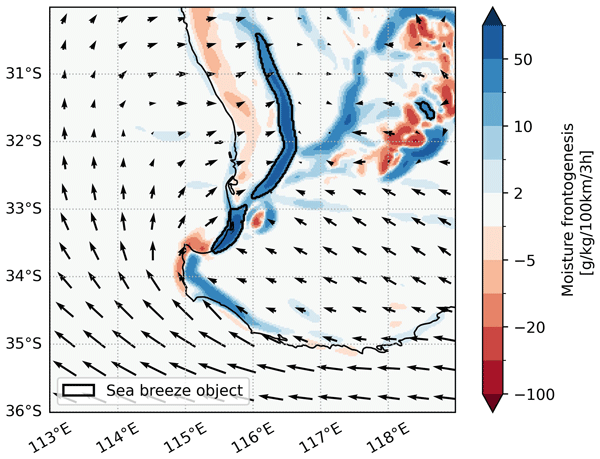
We developed software to identify sea breezes from weather model output, using three different methods, and applied these to four models for a 6-month period over Australia. We tested each method using case studies and statistics of sea breeze occurrences, finding that a method that identifies atmospheric moisture fronts performs well. Some potential errors are demonstrated due to detection of other frontal systems, but this method could be useful for robustly analyzing sea breezes from models.
Andrew Brown, Andrew Dowdy, and Todd P. Lane
Nat. Hazards Earth Syst. Sci., 24, 3225–3243, https://doi.org/10.5194/nhess-24-3225-2024, https://doi.org/10.5194/nhess-24-3225-2024, 2024
Short summary
Short summary
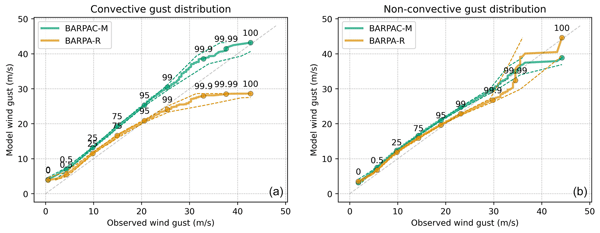
A computer model that simulates the climate of southeastern Australia is shown here to represent extreme wind events associated with convective storms. This is useful as it allows us to investigate possible future changes in the occurrences of these events, and we find in the year 2050 that our model simulates a decrease in the number of occurrences. However, the model also simulates too many events in the historical climate compared with observations, so these future changes are uncertain.
Alanah Chapman, Yi Huang, and Claire Vincent
Weather Clim. Dynam., 7, 1265–1284, https://doi.org/10.5194/wcd-7-1265-2026, https://doi.org/10.5194/wcd-7-1265-2026, 2026
Short summary
Short summary
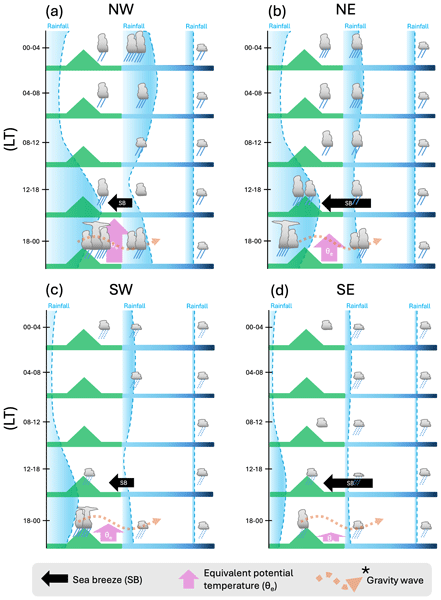
Mass coral bleaching on the Great Barrier Reef is driven by unusually warm ocean temperatures, but cloud cover also plays a critical role by regulating how much sunlight reaches the ocean. This study examines daily patterns of clouds and rainfall over north-east Queensland during bleaching seasons using satellite, radar, and regional weather data. Clouds and rainfall patterns differ between land, ocean and wind conditions, helping improve understanding of processes influencing reef heat stress.
Andrew Brown, Claire Vincent, and Ewan Short
Geosci. Model Dev., 19, 933–953, https://doi.org/10.5194/gmd-19-933-2026, https://doi.org/10.5194/gmd-19-933-2026, 2026
Short summary
Short summary
We developed software to identify sea breezes from weather model output, using three different methods, and applied these to four models for a 6-month period over Australia. We tested each method using case studies and statistics of sea breeze occurrences, finding that a method that identifies atmospheric moisture fronts performs well. Some potential errors are demonstrated due to detection of other frontal systems, but this method could be useful for robustly analyzing sea breezes from models.
Claire L. Vincent, Adam Nahar, and Kelvin Say
Wind Energ. Sci., 10, 2435–2447, https://doi.org/10.5194/wes-10-2435-2025, https://doi.org/10.5194/wes-10-2435-2025, 2025
Short summary
Short summary
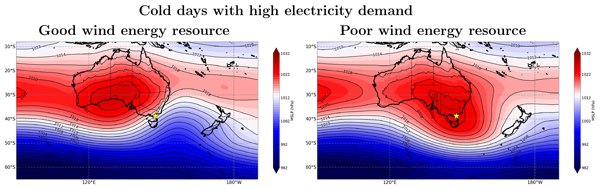
The most important days for wind energy to make a large contribution to the electricity supply are when electricity demand is high. We examined the wind resource of southeast Australia on these days. We found that most hot high-demand days are influenced by a similar weather pattern, while cold high-demand days can be cold, wet, and windy or associated with widespread light winds. These results are important when considering the types of weather that could influence future wind energy.
Andrew Brown, Andrew Dowdy, and Todd P. Lane
Nat. Hazards Earth Syst. Sci., 24, 3225–3243, https://doi.org/10.5194/nhess-24-3225-2024, https://doi.org/10.5194/nhess-24-3225-2024, 2024
Short summary
Short summary
A computer model that simulates the climate of southeastern Australia is shown here to represent extreme wind events associated with convective storms. This is useful as it allows us to investigate possible future changes in the occurrences of these events, and we find in the year 2050 that our model simulates a decrease in the number of occurrences. However, the model also simulates too many events in the historical climate compared with observations, so these future changes are uncertain.
Claire L. Vincent and Andrew J. Dowdy
Atmos. Chem. Phys., 24, 10209–10223, https://doi.org/10.5194/acp-24-10209-2024, https://doi.org/10.5194/acp-24-10209-2024, 2024
Short summary
Short summary
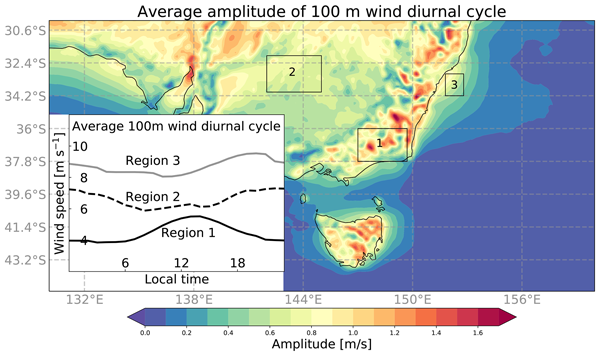
We investigate how wind speed at the height of a wind turbine changes during El Niño and La Niña years and with season and time of day in southeastern Australia. We found that El Niño and La Niña can cause average wind speed differences of around 1 m s-1 in some regions. The highest wind speeds occur in the afternoon or evening around mountains or the coast and during the night for inland areas. The results help show how placement of wind turbines can help balance electricity generation.
Cited articles
Arrillaga, J. A., Jiménez, P., Vilà-Guerau de Arellano, J., Jiménez, M. A., Román-Cascón, C., Sastre, M., and Yagüe, C.: Analyzing the Synoptic-, Meso- and Local- Scale Involved in Sea Breeze Formation and Frontal Characteristics, J. Geophys. Res.-Atmos., 125, https://doi.org/10.1029/2019JD031302, 2020. a
Arritt, R. W.: Numerical modelling of the offshore extent of sea breezes, Q. J. Roy. Meteor. Soc., 115, 547–570, https://doi.org/10.1002/qj.49711548707, 1989. a
Arritt, R. W.: Effects of the Large-Scale Flow on Characteristic Features of the Sea Breeze, J. Appl. Meteorol. Clim., 32, 116–125, https://doi.org/10.1175/1520-0450(1993)032<0116:EOTLSF>2.0.CO;2, 1993. a, b, c
Assireu, A. T., Fisch, G., Carvalho, V. S., Pimenta, F. M., de Freitas, R. M., Saavedra, O. R., Neto, F. L., Júnior, A. R., Oliveira, D. Q., Lopes, D. C., de Lima, S. L., Marcondes, L. G., and Rodrigues, W. K.: Sea breeze-driven effects on wind down-ramps: Their implications for wind farms along the north-east coast of Brazil, Energy, 294, https://doi.org/10.1016/j.energy.2024.130804, 2024. a, b
Australian Energy Market Operator: Appendix 3. Renewable Energy Zones. Appendix to the 2024 Integrated System Plan for the National Energy Market, https://www.aemo.com.au/energy-systems/major-publications/integrated-system-plan-isp/2024-integrated-system-plan-isp (last access: 10 November 2025), 2024. a, b
Azorin-Molina, C., Chen, D., Tijm, S., and Baldi, M.: A multi-year study of sea breezes in a Mediterranean coastal site: Alicante (Spain), Int. J. Climatol., 31, 468–486, https://doi.org/10.1002/joc.2064, 2011. a, b
Bao, S., Pietrafesa, L., Gayes, P., Noble, S., Viner, B., Qian, J. H., Werth, D., Mitchell, G., and Burdette, S.: Mapping the Spatial Footprint of Sea Breeze Winds in the Southeastern United States, J. Geophys. Res.-Atmos., 128, https://doi.org/10.1029/2022JD037524, 2023. a
Bergemann, M., Khouider, B., and Jakob, C.: Coastal Tropical Convection in a Stochastic Modeling Framework, J. Adv. Model. Earth Sy., 9, 2561–2582, https://doi.org/10.1002/2017MS001048, 2017. a, b
Borne, K., Chen, D., and Nunez, M.: A method for finding sea breeze days under stable synoptic conditions and its application to the Swedish west coast, Int. J. Climatol., 18, 901–914, https://doi.org/10.1002/(SICI)1097-0088(19980630)18:8<901::AID-JOC295>3.0.CO;2-F, 1998. a, b
Bortolotti, P., Tarres, H. C., Dykes, K., Merz, K., Sethuraman, L., Verelst, D., and Zahle, F.: IEA Wind Task 37 on Systems Engineering in Wind Energy – WP2.1 Reference Wind Turbines, Tech. rep., International Energy Agency, https://docs.nlr.gov/docs/fy19osti/73492.pdf (las access: 19 June 2026), 2019. a
Brown, A.: andrewbrown31/sea_breeze_analysis: v1.2, Version v1.2, Zenodo [code], https://doi.org/10.5281/zenodo.20082648, 2026. a
Brown, A. and Vincent, C.: A dataset of sea breeze objects over Australia (1979-2024), Zenodo [data set], https://doi.org/10.5281/zenodo.18576337, 2025. a
Brown, A., Short, E., Green, S., and Vincent, C.: sea_breeze: v1.1, Zenodo [code], https://doi.org/10.5281/zenodo.17220916, 2025. a
Cafaro, C., Frame, T. H. A., Methven, J., Roberts, N., and Bröcker, J.: The added value of convection‐permitting ensemble forecasts of sea breeze compared to a Bayesian forecast driven by the global ensemble, Q. J. Roy. Meteor. Soc., 145, 1780–1798, https://doi.org/10.1002/qj.3531, 2019. a, b, c
Chao, S.-Y.: Coastal Jets in the Lower Atmosphere, J. Phys. Oceanogr., 15, 361–371, https://doi.org/10.1175/1520-0485(1985)015<0361:CJITLA>2.0.CO;2, 1985. a
Colle, B. A. and Novak, D. R.: The New York Bight Jet: Climatology and Dynamical Evolution, Mon. Weather Rev., 138, 2385–2404, https://doi.org/10.1175/2009MWR3231.1, 2010. a
Cowin, E., Wang, C., and Walsh, S. D.: Assessing Predictions of Australian Offshore Wind Energy Resources from Reanalysis Datasets, Energies, 16, https://doi.org/10.3390/en16083404, 2023. a
Davidson, M. R. and Millstein, D.: Limitations of reanalysis data for wind power applications, Wind Energy, 25, 1646–1653, https://doi.org/10.1002/we.2759, 2022. a, b
Department of Climate Change, Energy, the Environment and Water: Australia's offshore wind areas, https://www.dcceew.gov.au/energy/renewable/offshore-wind/areas (last access: 13 October 2025), 2024. a
Finocchio, P. M., Biernat, K. A., Doyle, J. D., and Reynolds, C. A.: The Influence of Soil Moisture on the Sea Breeze Circulation and the Marine Atmospheric Boundary Layer in Idealized Simulations, Mon. Weather Rev., 153, 1651–1669, https://doi.org/10.1175/MWR-D-24-0251.1, 2025. a, b, c
Frysinger, J. R., Lindner, B. L., and Brueske, S. L.: A Statistical Sea-Breeze Prediction Algorithm for Charleston, South Carolina, Weather Forecast., 18, 614–625, https://doi.org/10.1175/1520-0434(2003)018<0614:ASSPAF>2.0.CO;2, 2003. a, b
Global Wind Energy Council: Global Wind Report 2025, https://www.gwec.net/reports/globalwindreport, last access: 10 November 2025. a
Gorman, N., Haghdadi, N., Bruce, A., and Macgill, I.: NEMOSIS – NEM Open Source Information Service, in: Asia Pacific Solar Research Conference 2018, Sydney, Australia, https://www.researchgate.net/publication/329798805_NEMOSIS_-_NEM_Open_Source_Information_Service_open-source_access_to_Australian_National_Electricity_Market_Data (last access: 19 June 2026), 2018. a
Gunn, A., Dargaville, R., Jakob, C., and McGregor, S.: Spatial optimality and temporal variability in Australia’s wind resource, Environ. Res. Lett., 18, 114048, https://doi.org/10.1088/1748-9326/ad0253, 2023. a
Huang, Y., Li, S., Zhu, Y., Liu, Y., Hong, Y., Chen, X., Deng, W., Xi, X., Lu, X., and Fan, Q.: Increasing Sea-Land Breeze Frequencies Over Coastal Areas of China in the Past Five Decades, Geophys. Res. Lett., 52, https://doi.org/10.1029/2024GL112480, 2025. a
Keyser, D., Reeder, M. J., and Reed, R. J.: A Generalization of Petterssen's Frontogenesis Function and Its Relation to the Forcing of Vertical Motion, Mon. Weather Rev., 116, 762–781, https://doi.org/10.1175/1520-0493(1988)116<0762:AGOPFF>2.0.CO;2, 1988. a
Kraus, H., Hacker, J. M., and Hartmann, J.: An observational aircraft-based study of sea-breeze frontogenesis, Bound.-Lay. Meteorol., 53, 223–265, https://doi.org/10.1007/BF00154443, 1990. a
Markowski, P. and Richardson, Y.: Air Mass Boundaries, in: Mesoscale Meteorology in Midlatitudes, Wiley Online Books, 115–160, ISBN 9780470682104, https://doi.org/10.1002/9780470682104.ch5, 2010. a
Masouleh, Z. P., Walker, D. J., and Crowther, J. M. C.: A long-term study of sea-breeze characteristics: A case study of the coastal city of Adelaide, J. Appl. Meteorol. Clim., 58, 385–400, https://doi.org/10.1175/JAMC-D-17-0251.1, 2019. a
McCabe, E. J. and Freedman, J. M.: Development of an Objective Methodology for Identifying the Sea-Breeze Circulation and Associated Low-Level Jet in the New York Bight, Weather Forecast., 38, 571–589, https://doi.org/10.1175/WAF-D-22-0119.1, 2023. a
Miao, J. F., Kroon, L. J., de Arellano, J. V.-G., and Holtslag, A. A.: Impacts of topography and land degradation on the sea breeze over eastern Spain, Meteorol. Atmos. Phys., 84, 157–170, https://doi.org/10.1007/s00703-002-0579-1, 2003. a
Miller, S. T., Keim, B. D., Talbot, R. W., and Mao, H.: Sea breeze: Structure, forecasting, and impacts, Rev. Geophys., 41, https://doi.org/10.1029/2003RG000124, 2003. a, b, c
Mulder, F. M.: Implications of diurnal and seasonal variations in renewable energy generation for large scale energy storage, J. Renew. Sustain. Ener., 6, https://doi.org/10.1063/1.4874845, 2014. a
NCI Australia: Bureau of Meteorology Atmospheric high-resolution Regional Reanalysis for Australia – Version 2 (BARRA2), NCI Australia [data set], https://doi.org/10.25914/1x6g-2v48, 2026. a
Palmer, G., Dargaville, R., Su, C. H., Wang, C., Hoadley, A., and Honnery, D.: Validation of BARRA2 and comparison with MERRA-2 and ERA5 using historical wind power generation, Journal of Southern Hemisphere Earth Systems Science, 75, https://doi.org/10.1071/ES24028, 2025. a
Pazandeh Masouleh, Z., Walker, D. J., and Crowther, J. M.: Sea breeze characteristics on two sides of a shallow gulf: Study of the Gulf St Vincent in South Australia, Meteorol. Appl., 23, 222–229, https://doi.org/10.1002/met.1547, 2016. a, b
Pettersen, S.: Weather Analysis and Forecasting, Vol. 1, Motion and Motion Systems, McGraw-Hill, 2nd edn., 1956. a
Pickering, B., Grams, C. M., and Pfenninger, S.: Sub-national variability of wind power generation in complex terrain and its correlation with large-scale meteorology, Environ. Res. Lett., 15, https://doi.org/10.1088/1748-9326/ab70bd, 2020. a, b
Rafiq, S., Pattiaratchi, C., and Janeković, I.: Dynamics of the Land–Sea Breeze System and the Surface Current Response in South-West Australia, Journal of Marine Science and Engineering, 8, 931, https://doi.org/10.3390/jmse8110931, 2020. a, b, c, d
Ranjha, R., Svensson, G., Tjernström, M., and Semedo, A.: Global distribution and seasonal variability of coastal low-level jets derived from ERA-Interim reanalysis, Tellus B, 65, 20412, https://doi.org/10.3402/tellusa.v65i0.20412, 2013. a
Reible, D. D., Simpson, J. E., and Linden, P. F.: The sea breeze and gravity‐current frontogenesis, Q. J. Roy. Meteor. Soc., 119, 1–16, https://doi.org/10.1002/qj.49711950902, 1993. a, b, c, d
Richardson, D., Pitman, A. J., and Ridder, N. N.: Climate influence on compound solar and wind droughts in Australia, npj Climate and Atmospheric Science, 6, 184, https://doi.org/10.1038/s41612-023-00507-y, 2023. a
Richardson, D., Hobeichi, S., Sweet, L.-b., Rey-Costa, E., Abramowitz, G., and Pitman, A. J.: Predicting Australian energy demand variability using weather data and machine learning, Environ. Res. Lett., 20, 014028, https://doi.org/10.1088/1748-9326/ad9b3b, 2025. a, b, c
Rotunno, R.: On the Linear Theory of the Land and Sea Breeze, J. Atmos. Sci., 40, 1999–2009, https://doi.org/10.1175/1520-0469(1983)040<1999:OTLTOT>2.0.CO;2, 1983. a
Short, E., Vincent, C. L., and Lane, T. P.: Diurnal cycle of surface winds in the maritime continent observed through satellite scatterometry, Mon. Weather Rev., 147, 2023–2044, https://doi.org/10.1175/MWR-D-18-0433.1, 2019. a
Simpson, J. E.: Gravity Currents: In the Environment and the Laboratory, Cambridge University Press, ISBN 9780521664011, 1999. a
Simshauser, P. and Wild, P.: Rooftop Solar PV, Coal Plant Inflexibility and the Minimum Load Problem, Energ. J., 46, 93–118, https://doi.org/10.1177/01956574241283732, 2025. a
Soderholm, J., McGowan, H., Richter, H., Walsh, K., Weckwerth, T. M., and Coleman, M.: An 18-year climatology of hailstorm trends and related drivers across southeast Queensland, Australia, Q. J. Roy. Meteor. Soc., 143, 1123–1135, https://doi.org/10.1002/qj.2995, 2017. a, b
Steele, C. J., Dorling, S. R., von Glasow, R., and Bacon, J.: Idealized WRF model sensitivity simulations of sea breeze types and their effects on offshore windfields, Atmos. Chem. Phys., 13, 443–461, https://doi.org/10.5194/acp-13-443-2013, 2013. a, b
Su, C.-H., Torrance, J., Rennie, S., Howard, E., Stassen, C., Warren, R., Smith, A., Dharssi, I., Pepler, A., Tian, S., Lipson, M., Steinle, P., Franklin, C., Le, T., Wang, C., Masoumi, S., and Marshall, J. L.: The Australian regional atmospheric reanalysis system, version 2 – BARRA2, Journal of Southern Hemisphere Earth Systems Science, 75, https://doi.org/10.1071/ES25032, 2025. a
Vincent, C. L. and Dowdy, A. J.: Multi-scale variability of southeastern Australian wind resources, Atmos. Chem. Phys., 24, 10209–10223, https://doi.org/10.5194/acp-24-10209-2024, 2024. a
Vincent, C. L., Nahar, A., and Say, K.: Wind resources of southeast Australia during peak electricity demand days, Wind Energ. Sci., 10, 2435–2447, https://doi.org/10.5194/wes-10-2435-2025, 2025. a
Virtanen, P., Gommers, R., Oliphant, T. E., Haberland, M., Reddy, T., Cournapeau, D., Burovski, E., Peterson, P., Weckesser, W., Bright, J., van der Walt, S. J., Brett, M., Wilson, J., Millman, K. J., Mayorov, N., Nelson, A. R. J., Jones, E., Kern, R., Larson, E., Carey, C. J., Polat, I., Feng, Y., Moore, E. W., VanderPlas, J., Laxalde, D., Perktold, J., Cimrman, R., Henriksen, I., Quintero, E. A., Harris, C. R., Archibald, A. M., Ribeiro, A. H., Pedregosa, F., van Mulbregt, P., and SciPy 1.0 Contributors: SciPy 1.0: Fundamental Algorithms for Scientific Computing in Python, Nat. Methods, 17, 261–272, https://doi.org/10.1038/s41592-019-0686-2, 2020. a
Wang, Y., Sabatino, S. D., Martilli, A., Li, Y., Wong, M. S., Gutiérrez, E., and Chan, P. W.: Impact of land surface heterogeneity on urban heat island circulation and sea-land breeze circulation in Hong Kong, J. Geophys. Res., 122, 4332–4352, https://doi.org/10.1002/2017JD026702, 2017. a, b
Xia, G., Draxl, C., Optis, M., and Redfern, S.: Detecting and characterizing simulated sea breezes over the US northeastern coast with implications for offshore wind energy, Wind Energ. Sci., 7, 815–829, https://doi.org/10.5194/wes-7-815-2022, 2022. a, b, c, d
Short summary
Sea breezes are characterised in potential offshore wind development areas in Australia. For most areas in summer, there are more available wind resources in the afternoon on days with sea breezes (by 15 %–30 %), with higher operational energy demand due to warmer air temperatures. The afternoon peak in wind speeds occurs at around the same time as peak energy demand. These findings have implications for energy system planning and wind farm development.
Sea breezes are characterised in potential offshore wind development areas in Australia. For...


Altmetrics
Final-revised paper
Preprint