
Articles | Volume 11, issue 1
https://doi.org/10.5194/wes-11-251-2026
© Author(s) 2026. This work is distributed under
the Creative Commons Attribution 4.0 License.
the Creative Commons Attribution 4.0 License.
https://doi.org/10.5194/wes-11-251-2026
© Author(s) 2026. This work is distributed under
the Creative Commons Attribution 4.0 License.
the Creative Commons Attribution 4.0 License.
Research article
| 
22 Jan 2026
Research article |
| 22 Jan 2026
| 22 Jan 2026
Validation of a finite-element model of a 5 m three-row roller wind turbine blade bearing
Matthis Graßmann
CORRESPONDING AUTHOR

Fraunhofer Institute for Wind Energy Systems IWES, Large Bearing Laboratory, Am Schleusengraben 22, 21029 Hamburg, Germany
Martin Geibel
Fraunhofer Institute for Wind Energy Systems IWES, Large Bearing Laboratory, Am Schleusengraben 22, 21029 Hamburg, Germany
Florian Schleich
Fraunhofer Institute for Wind Energy Systems IWES, Large Bearing Laboratory, Am Schleusengraben 22, 21029 Hamburg, Germany
Related authors
Matthis Graßmann, Marlene Bantz, Frank Schönberg, and Arne Bartschat
Wind Energ. Sci. Discuss., https://doi.org/10.5194/wes-2026-192, https://doi.org/10.5194/wes-2026-192, 2026
Preprint under review for WES
Short summary
Short summary
Wind turbine blade bearings rely on seals to keep lubricant inside and dirt outside. This study examined how much these bearings deform during operation and whether lubricant pressure could threaten seal performance. Using finite element simulations and original-size tests, this work found that ring deformation remained well within the seal's capability. Pressure stayed very low during normal operation and only increased under unrealistic extreme conditions.
Matthis Graßmann, Oliver Menck, Apoorva Avinash Kulkarni, and Florian Schleich
Wind Energ. Sci. Discuss., https://doi.org/10.5194/wes-2026-112, https://doi.org/10.5194/wes-2026-112, 2026
Revised manuscript under review for WES
Short summary
Short summary
Blade bearings, especially ball bearings, can operate further even with raceway damage. However, any raceway damage will redistribute the load situation in the bearings, changing the bearing behavior. This paper firstly introduces a methodology to implement raceway damages in a finite-element-bearing model and validates the simulation against experimental data. It further investigates the influence on the calculated bearing life and contributes to the general understanding of damage progression.

Oliver Menck, Florian Schleich, and Matthias Stammler
Wind Energ. Sci., 10, 2771–2789, https://doi.org/10.5194/wes-10-2771-2025, https://doi.org/10.5194/wes-10-2771-2025, 2025
Short summary
Short summary
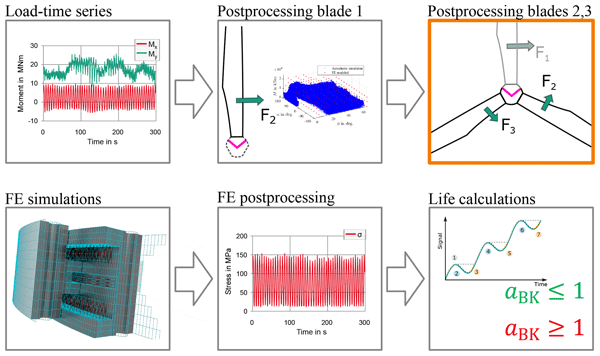
The paper discusses how to calculate the life of a blade bearing that is a roller bearing, as opposed to ball bearings, which most papers on the subject discuss. The raceway fatigue life of the bearing is calculated in a very detailed manner. This includes a validated finite-element simulation model and an approach to determine loads for all operating conditions that the wind turbine experiences.
Matthias Stammler and Florian Schleich
Wind Energ. Sci., 10, 813–826, https://doi.org/10.5194/wes-10-813-2025, https://doi.org/10.5194/wes-10-813-2025, 2025
Short summary
Short summary
The structures at the center of wind turbine rotors are loaded by three rotor blades. The rotor blades have different loads, which depend on their positions and the incoming wind. The number of possible different loads is too high to simulate each of them for later design of the structures. This work attempts to reduce the number of necessary simulations by exploring inherent relations between the loads of the three rotor blades.
Karsten Behnke and Florian Schleich
Wind Energ. Sci., 8, 289–301, https://doi.org/10.5194/wes-8-289-2023, https://doi.org/10.5194/wes-8-289-2023, 2023
Short summary
Short summary
The objective of this work is to find limits within typical operating conditions of a wind turbine below which wear on the bearing raceway does not occur. It covers the test of blade bearings with an outer diameter of 2.6 m. The test parameters are based on a 3 MW reference turbine and are compared to values from the literature. It was shown that it can be possible to avoid wear, which again can be used to design a wind turbine controller.
Cited articles
ASME: Standard for Verification and Validation in Computational Solid Mechanics, ASME, ISBN 9780791873168, 2019.
Becker, D., Handrek, T., Lüneburg, B., Dinner, H., Stebler, R., and Schröter, A.: Gekoppelte thermische Finite Element-Analyse und Simulation der Laufbahnbeanspruchung an einem 6 MW Rotorlager, Tribol. und Schmierungstechnik, 61. Jahrg. 1/2015, 2014.
Chen, G. and Wen, J.: Load Performance of Large-Scale Rolling Bearings with Supporting Structure in Wind Turbines, J. Tribol., 134, 1087, https://doi.org/10.1115/1.4007349, 2012.
Chen, G., Wang, C., and Xiao, Z.: Effects of supporting structure and bolt connection on the fatigue life and carrying capacity of a slewing bearing, Proc IMechE Part J: J. Eng. Tribol., 231, 766–782, https://doi.org/10.1177/1350650116677606, 2017.
Daidié, A., Chaib, Z., and Ghosn, A.: 3D Simplified Finite Elements Analysis of Load and Contact Angle in a Slewing Ball Bearing, J. Mech. Des., 130, 082601, https://doi.org/10.1115/1.2918915, 2008.
Demirhan, N. and Kanber, B.: Stress and Displacement Distributions on Cylindrical Roller Bearing Rings Using FEM, Mech. Based Des. Structures and Machines, 36, 86–102, https://doi.org/10.1080/15397730701842537, 2008.
DIN 26281: Wälzlager – Dynamische Tragzahlen und nominelle Lebensdauer – Berechnung der modifizierten nominellen Referenz-Lebensdauer für Wälzlager, 2010.
DNV GL AS: DNVGL-ST-0437 Loads and site conditions for wind turbines, 2016.
Gao, X. H., Huang, X. D., Wang, H., and Chen, J.: Modelling of ball-raceway contacts in a slewing bearing with non-linear springs, J. Mech. Eng. Sci., 225, 827–831, https://doi.org/10.1177/09544062JMES2454, 2011.
Graßmann, M., Schleich, F., and Stammler, M.: Validation of a finite-element model of a wind turbine blade bearing, Finite Elements in Anal. and Des., 221, 103957, https://doi.org/10.1016/j.finel.2023.103957, 2023.
Graßmann, M., Stammler, M., Menck, O., and Schleich, F.: The influence of anomalies in supporting structures on the validation of finite-element blade bearing models, Finite Elements in Anal. and Des., 242, 104268, https://doi.org/10.1016/j.finel.2024.104268, 2024.
Hao, X., Gu, X., Zhou, X., Liao, X., and Han, Q.: Distribution characteristics of stress and displacement of rings of cylindrical roller bearing, Proc. IMechE Part C: J. Mech. Eng. Sci., 233, 4348–4358, https://doi.org/10.1177/0954406218820551, 2019.
Hau, E.: Windkraftanlagen, Springer Vieweg, Berlin, https://doi.org/10.1007/978-3-662-53154-9, 2016.
He, P., Liu, R., Hong, R., Wang, H., Yang, G., and Lu, C.: Hardened raceway calculation analysis of a three-row roller slewing bearing, Int. J. Mech. Sci., 137, 133–144, https://doi.org/10.1016/j.ijmecsci.2018.01.021, 2018.
ISO/TS 16281: 2008 + Cor. 1:2009: Rolling bearings – Methods for calculating the modified reference rating life for universally loaded bearings, 2008.
JCGM: Guide to the expression of uncertainty in measurement – JCGM 100:2008 (GUM 1995 with minor corrections – Evaluation of measurement data, 2008.
Liu, R., Wang, H., Pang, B. T., Gao, X. H., and Zong, H. Y.: Load Distribution Calculation of a four-Point-Contact Slewing Bearing and its Experimental Verification, Exp. Tech., 42, 243–252, https://doi.org/10.1007/s40799-018-0237-2, 2018.
Palmgren, A.: Grundlagen der Wälzlagertechnik, Frankh'sche Verlagshandlung, Stuttgart, 1964.
Popko, W. and Thomas, P.: IWES Wind Turbine IWT-7.5-164 Rev 4, Fraunhofer Inst. for Wind Energy Syst., https://doi.org/10.24406/IWES-N-518562, 2018.
Schleich, F., Chen, Z., Graßmann, M., Balzani, C., and Stammler, M.: Superelement-based acceleration of finite-element simulations of wind turbine rotors, J. Phys. Conf. Ser., 2767, 52029, https://doi.org/10.1088/1742-6596/2767/5/052029, 2024.
Schwack, F., Stammler, M., and Poll, G.: Free Contact Angles in Pitch Bearings and their Impact on Contact and Stress Conditions, Wind Europe, 2016, https://doi.org/10.24406/publica-fhg-394035, 2016.
Smolnicki, T. and Rusiński, E.: Superelement-Based Modeling of Load Distribution in Large-Size Slewing Bearings, J. Mech. Des., 129, 459–463, https://doi.org/10.1115/1.2437784, 2007.
Stammler, M.: Endurance Runs for Pitch Bearings of Wind Turbines, Fraunhofer Verl., ISBN 978-3-8396-1642-0, 2020.
Stammler, M., Baust, S., Reuter, A., and Poll, G.: Load distribution in a roller-type rotor blade bearing, J. Phys. Conf. Ser., 1037, https://doi.org/10.1088/1742-6596/1037/4/042016, 2018.
Stammler, M., Menck, O., Guo, Y., and Keller, J.: Wind Turbine Design Guideline DG03: Yaw and Pitch Bearings. Golden, CO: National Renewable Energy Laboratory, NREL/TP-5000-89161, https://www.nrel.gov/docs/fy24osti/89161.pdf (last access: 20 January 2026), 2024.
Wang, H., He, P., Pang, B., and Gao, X.: A new computational model of large three-row roller slewing bearings using nonlinear springs, J. Mech. Eng. Sci., 231, 3831–3839, https://doi.org/10.1177/0954406217704223, 2017.
Short summary
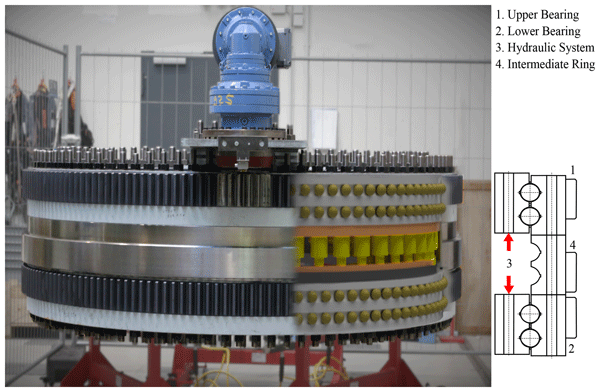
Most important for finite-element models is validation to ensure reliable results. To the knowledge of the authors, all publicly available large rolling bearing models are not validated. This work introduces a finite-element model of a 5 m roller bearing as a wind turbine blade bearing. The authors investigated the influence of different bolt preloads on the bearing rings and validated the model against experimental data using a large blade bearing test rig.
Most important for finite-element models is validation to ensure reliable results. To the...


Altmetrics
Final-revised paper
Preprint