Articles | Volume 11, issue 8
https://doi.org/10.5194/wes-11-2783-2026
© Author(s) 2026. This work is distributed under
the Creative Commons Attribution 4.0 License.
https://doi.org/10.5194/wes-11-2783-2026
© Author(s) 2026. This work is distributed under
the Creative Commons Attribution 4.0 License.
Impact of atmospheric stability and turbulence on wind turbine wake characteristics: a nacelle lidar study

German Aerospace Center, Institute of Atmospheric Physics, Oberpfaffenhofen, Germany
Norman Wildmann
German Aerospace Center, Institute of Atmospheric Physics, Oberpfaffenhofen, Germany
Related authors
No articles found.
Norman Wildmann and Laszlo Györy
Atmos. Meas. Tech., 18, 5527–5544, https://doi.org/10.5194/amt-18-5527-2025, https://doi.org/10.5194/amt-18-5527-2025, 2025
Short summary
Short summary
Fast temperature sensors are deployed on drones to accurately measure temperature changes and fluctuations in the atmosphere. Compared to standard sensors, these new sensors showed better accuracy, especially in rapidly changing temperatures. Over 100 drone flights confirmed the sensors' ability to measure temperature fast enough to compare to standard meteorological instruments. This new method provides valuable data for understanding turbulent heat fluxes in the atmospheric boundary layer.
Linus Wrba, Antonia Englberger, Andreas Dörnbrack, Gerard Kilroy, and Norman Wildmann
Wind Energ. Sci., 10, 2217–2236, https://doi.org/10.5194/wes-10-2217-2025, https://doi.org/10.5194/wes-10-2217-2025, 2025
Short summary
Short summary
It is crucial to understand the loads and power production of wind turbines under different atmospheric situations (e.g., night and day changes). Computational simulations are a widely used tool to get more knowledge of the performance and the wake of wind turbines. In this study realistic velocity profiles of the atmosphere are used as input for simulations so that these simulations become more realistic. The generated flow is used as inflow for wind turbine simulations.
Jeffrey D. Thayer, Gerard Kilroy, and Norman Wildmann
Wind Energ. Sci., 10, 2237–2255, https://doi.org/10.5194/wes-10-2237-2025, https://doi.org/10.5194/wes-10-2237-2025, 2025
Short summary
Short summary
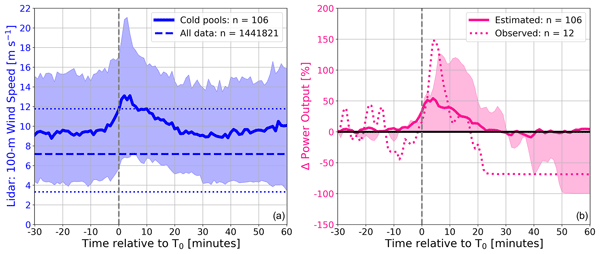
With increasing wind energy in the German energy grid, it is crucial to better understand how different types of weather (including thunderstorms) can impact wind turbines and the surrounding atmosphere. We find rapid wind changes associated with the leading edge of thunderstorm outflows within the height range of wind turbines that would quickly increase wind power output, with longer-lasting changes in the near-surface atmosphere that would affect subsequent wind turbine operations.
Johannes Kistner, Lars Neuhaus, and Norman Wildmann
Atmos. Meas. Tech., 17, 4941–4955, https://doi.org/10.5194/amt-17-4941-2024, https://doi.org/10.5194/amt-17-4941-2024, 2024
Short summary
Short summary
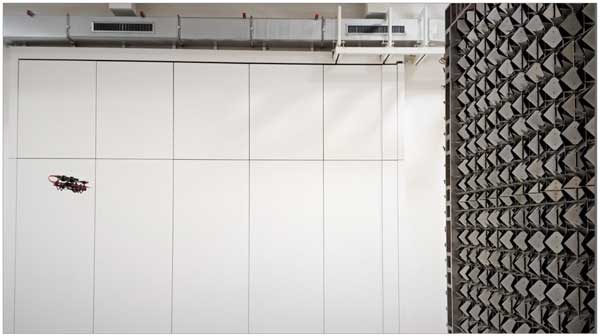
We use a fleet of multicopter drones to measure wind. To improve the accuracy of this wind measurement and to evaluate this improvement, we conducted experiments with the drones in a wind tunnel under various conditions. This wind tunnel can generate different kinds and intensities of wind. Here we measured with the drones and with other sensors as a reference and compared the results. We were able to improve our wind measurement and show how accurately it works in different situations.
Andreas Forstmaier, Jia Chen, Florian Dietrich, Juan Bettinelli, Hossein Maazallahi, Carsten Schneider, Dominik Winkler, Xinxu Zhao, Taylor Jones, Carina van der Veen, Norman Wildmann, Moritz Makowski, Aydin Uzun, Friedrich Klappenbach, Hugo Denier van der Gon, Stefan Schwietzke, and Thomas Röckmann
Atmos. Chem. Phys., 23, 6897–6922, https://doi.org/10.5194/acp-23-6897-2023, https://doi.org/10.5194/acp-23-6897-2023, 2023
Short summary
Short summary
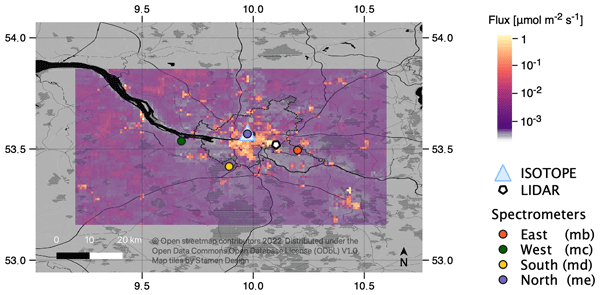
Large cities emit greenhouse gases which contribute to global warming. In this study, we measured the release of one important green house gas, methane, in Hamburg. Multiple sources that contribute to methane emissions were located and quantified. Methane sources were found to be mainly caused by human activity (e.g., by release from oil and gas refineries). Moreover, potential natural sources have been located, such as the Elbe River and lakes.
Tamino Wetz and Norman Wildmann
Wind Energ. Sci., 8, 515–534, https://doi.org/10.5194/wes-8-515-2023, https://doi.org/10.5194/wes-8-515-2023, 2023
Short summary
Short summary
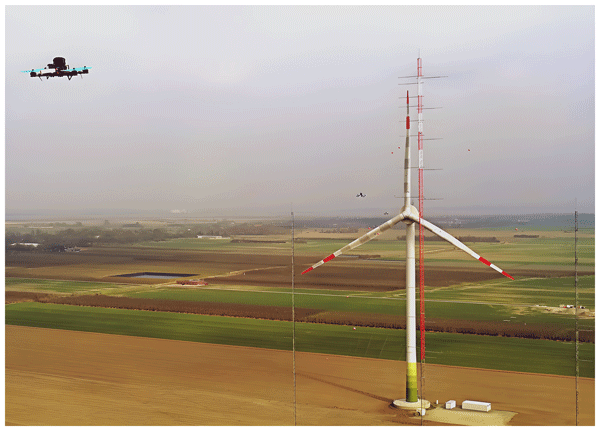
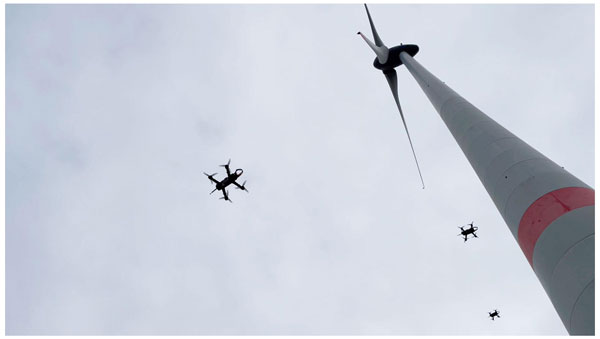
In the present study, for the first time, the SWUF-3D fleet of multirotors is deployed for field measurements on an operating 2 MW wind turbine (WT) in complex terrain. The fleet of multirotors has the potential to fill the meteorological gap of observations in the near wake of WTs with high-temporal and high-spatial-resolution wind vector measurements plus temperature, humidity and pressure. The flow up- and downstream of the WT is measured simultaneously at multiple spatial positions.
Norman Wildmann and Tamino Wetz
Atmos. Meas. Tech., 15, 5465–5477, https://doi.org/10.5194/amt-15-5465-2022, https://doi.org/10.5194/amt-15-5465-2022, 2022
Short summary
Short summary
Multicopter uncrewed aerial systems (UAS, also known as drones) are very easy to use systems for collecting data in the lowest part of the atmosphere. Wind and turbulence are parameters that are particularly important for understanding the dynamics in the atmosphere. Only with three-dimensional measurements of the wind can a full understanding can be achieved. In this study, we show how even the vertical wind through the UAS can be measured with good accuracy.
Julian Quimbayo-Duarte, Johannes Wagner, Norman Wildmann, Thomas Gerz, and Juerg Schmidli
Geosci. Model Dev., 15, 5195–5209, https://doi.org/10.5194/gmd-15-5195-2022, https://doi.org/10.5194/gmd-15-5195-2022, 2022
Short summary
Short summary
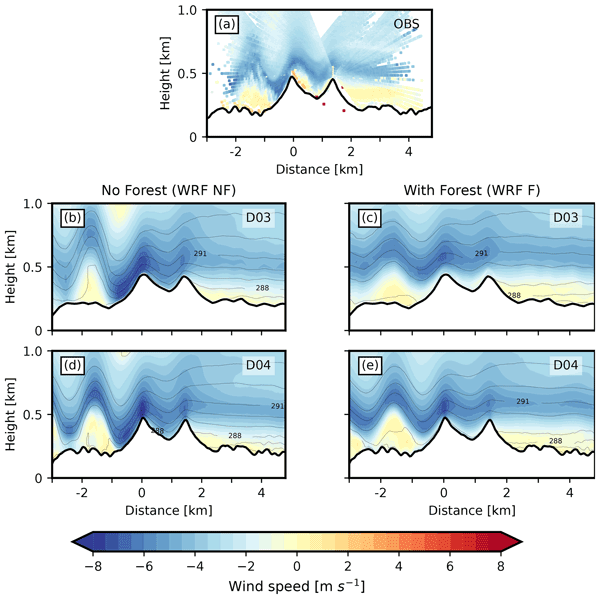
The ultimate objective of this model evaluation is to improve boundary layer flow representation over complex terrain. The numerical model is tested against observations retrieved during the Perdigão 2017 field campaign (moderate complex terrain). We observed that the inclusion of a forest parameterization in the numerical model significantly improves the representation of the wind field in the atmospheric boundary layer.
Andreas Luther, Julian Kostinek, Ralph Kleinschek, Sara Defratyka, Mila Stanisavljević, Andreas Forstmaier, Alexandru Dandocsi, Leon Scheidweiler, Darko Dubravica, Norman Wildmann, Frank Hase, Matthias M. Frey, Jia Chen, Florian Dietrich, Jarosław Nȩcki, Justyna Swolkień, Christoph Knote, Sanam N. Vardag, Anke Roiger, and André Butz
Atmos. Chem. Phys., 22, 5859–5876, https://doi.org/10.5194/acp-22-5859-2022, https://doi.org/10.5194/acp-22-5859-2022, 2022
Short summary
Short summary
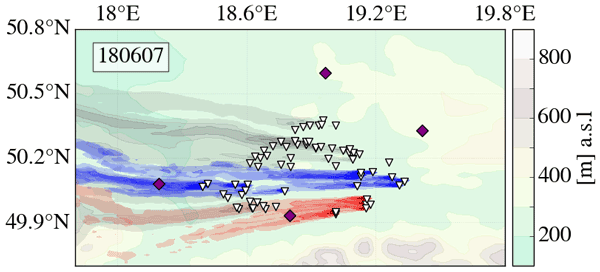
Coal mining is an extensive source of anthropogenic methane emissions. In order to reduce and mitigate methane emissions, it is important to know how much and where the methane is emitted. We estimated coal mining methane emissions in Poland based on atmospheric methane measurements and particle dispersion modeling. In general, our emission estimates suggest higher emissions than expected by previous annual emission reports.
Sven Krautwurst, Konstantin Gerilowski, Jakob Borchardt, Norman Wildmann, Michał Gałkowski, Justyna Swolkień, Julia Marshall, Alina Fiehn, Anke Roiger, Thomas Ruhtz, Christoph Gerbig, Jaroslaw Necki, John P. Burrows, Andreas Fix, and Heinrich Bovensmann
Atmos. Chem. Phys., 21, 17345–17371, https://doi.org/10.5194/acp-21-17345-2021, https://doi.org/10.5194/acp-21-17345-2021, 2021
Short summary
Short summary
Quantification of anthropogenic CH4 emissions remains challenging, but it is essential for near-term climate mitigation strategies. We use airborne remote sensing observations to assess bottom-up estimates of coal mining emissions from one of Europe's largest CH4 emission hot spots located in Poland. The analysis reveals that emissions from small groups of shafts can be disentangled, but caution is advised when comparing observations to commonly reported annual emissions.
Etienne Cheynet, Martin Flügge, Joachim Reuder, Jasna B. Jakobsen, Yngve Heggelund, Benny Svardal, Pablo Saavedra Garfias, Charlotte Obhrai, Nicolò Daniotti, Jarle Berge, Christiane Duscha, Norman Wildmann, Ingrid H. Onarheim, and Marte Godvik
Atmos. Meas. Tech., 14, 6137–6157, https://doi.org/10.5194/amt-14-6137-2021, https://doi.org/10.5194/amt-14-6137-2021, 2021
Short summary
Short summary
The COTUR campaign explored the structure of wind turbulence above the ocean to improve the design of future multi-megawatt offshore wind turbines. Deploying scientific instruments offshore is both a financial and technological challenge. Therefore, lidar technology was used to remotely measure the wind above the ocean from instruments located on the seaside. The experimental setup is tailored to the study of the spatial correlation of wind gusts, which governs the wind loading on structures.
Cited articles
Abkar, M. and Porté-Agel, F.: Influence of atmospheric stability on wind-turbine wakes: A large-eddy simulation study, Phys. Fluids, 27, 035104, https://doi.org/10.1063/1.4913695, 2015. a, b, c, d
Aitken, M. L. and Lundquist, J. K.: Utility-Scale Wind Turbine Wake Characterization Using Nacelle-Based Long-Range Scanning Lidar, J. Atmos. Ocean. Tech., 31, 1529–1539, https://doi.org/10.1175/jtech-d-13-00218.1, 2014. a, b
Aitken, M. L., Banta, R. M., Pichugina, Y. L., and Lundquist, J. K.: Quantifying Wind Turbine Wake Characteristics from Scanning Remote Sensor Data, J. Atmos. Ocean. Tech., 31, 765–787, https://doi.org/10.1175/jtech-d-13-00104.1, 2014. a, b
Alcayaga, L.: Filtering of pulsed lidar data using spatial information and a clustering algorithm, Atmos. Meas. Tech., 13, 6237–6254, https://doi.org/10.5194/amt-13-6237-2020, 2020. a, b, c
Amiri, M. M., Shadman, M., and Estefen, S. F.: A review of physical and numerical modeling techniques for horizontal-axis wind turbine wakes, Renew. Sust. Energ. Rev., 193, 114279, https://doi.org/10.1016/j.rser.2024.114279, 2024. a
Angelou, N., Mann, J., and Dubreuil-Boisclair, C.: Revealing inflow and wake conditions of a 6 MW floating turbine, Wind Energ. Sci., 8, 1511–1531, https://doi.org/10.5194/wes-8-1511-2023, 2023. a
Archer, C. L., Vasel-Be-Hagh, A., Yan, C., Wu, S., Pan, Y., Brodie, J. F., and Maguire, A. E.: Review and evaluation of wake loss models for wind energy applications, Appl. Energ., 226, 1187–1207, https://doi.org/10.1016/j.apenergy.2018.05.085, 2018. a
Barthelmie, R. J., Hansen, K., Frandsen, S. T., Rathmann, O., Schepers, J. G., Schlez, W., Phillips, J., Rados, K., Zervos, A., Politis, E. S., and Chaviaropoulos, P. K.: Modelling and measuring flow and wind turbine wakes in large wind farms offshore, Wind Energy, 12, 431–444, https://doi.org/10.1002/we.348, 2009. a
Bartl, J., Mühle, F., Schottler, J., Sætran, L., Peinke, J., Adaramola, M., and Hölling, M.: Wind tunnel experiments on wind turbine wakes in yaw: effects of inflow turbulence and shear, Wind Energ. Sci., 3, 329–343, https://doi.org/10.5194/wes-3-329-2018, 2018. a
Bastankhah, M. and Porté-Agel, F.: A new analytical model for wind-turbine wakes, Renew. Energ., 70, 116–123, https://doi.org/10.1016/j.renene.2014.01.002, 2014. a
Bastankhah, M. and Porté-Agel, F.: Experimental and theoretical study of wind turbine wakes in yawed conditions, J. Fluid Mech., 806, 506–541, https://doi.org/10.1017/jfm.2016.595, 2016. a, b, c, d
Beck, H. and Kühn, M.: Dynamic Data Filtering of Long-Range Doppler LiDAR Wind Speed Measurements, Remote Sensing, 9, 561, https://doi.org/10.3390/rs9060561, 2017. a
Bhaganagar, K. and Debnath, M.: The effects of mean atmospheric forcings of the stable atmospheric boundary layer on wind turbine wake, J. Renew. Sustain. Ener., 7, https://doi.org/10.1063/1.4907687, 2015. a
Biswas, N. and Buxton, O. R.: Effect of tip speed ratio on coherent dynamics in the near wake of a model wind turbine, J. Fluid Mech., 979, https://doi.org/10.1017/jfm.2023.1095, 2024. a
Brugger, P., Fuertes, F. C., Vahidzadeh, M., Markfort, C. D., and Porté-Agel, F.: Characterization of Wind Turbine Wakes with Nacelle-Mounted Doppler LiDARs and Model Validation in the Presence of Wind Veer, Remote Sensing, 11, 2247, https://doi.org/10.3390/rs11192247, 2019. a, b, c, d
Brugger, P., Debnath, M., Scholbrock, A., Fleming, P., Moriarty, P., Simley, E., Jager, D., Roadman, J., Murphy, M., Zong, H., and Porté-Agel, F.: Lidar measurements of yawed-wind-turbine wakes: characterization and validation of analytical models, Wind Energ. Sci., 5, 1253–1272, https://doi.org/10.5194/wes-5-1253-2020, 2020. a, b, c
Brugger, P., Markfort, C., and Porté-Agel, F.: Field measurements of wake meandering at a utility-scale wind turbine with nacelle-mounted Doppler lidars, Wind Energ. Sci., 7, 185–199, https://doi.org/10.5194/wes-7-185-2022, 2022. a
Carbajo Fuertes, F., Markfort, C. D., and Porté-Agel, F.: Wind Turbine Wake Characterization with Nacelle-Mounted Wind Lidars for Analytical Wake Model Validation, Remote Sensing, 10, 668, https://doi.org/10.3390/rs10050668, 2018. a, b, c, d
De Cillis, G., Cherubini, S., Semeraro, O., Leonardi, S., and De Palma, P.: POD‐based analysis of a wind turbine wake under the influence of tower and nacelle, Wind Energy, 24, 609–633, https://doi.org/10.1002/we.2592, 2020. a, b
El-Asha, S., Zhan, L., and Iungo, G. V.: Quantification of power losses due to wind turbine wake interactions through SCADA, meteorological and wind LiDAR data, Wind Energy, 20, 1823–1839, https://doi.org/10.1002/we.2123, 2017. a
Englberger, A., Dörnbrack, A., and Lundquist, J. K.: Does the rotational direction of a wind turbine impact the wake in a stably stratified atmospheric boundary layer?, Wind Energ. Sci., 5, 1359–1374, https://doi.org/10.5194/wes-5-1359-2020, 2020. a
Fleming, P. A., Gebraad, P. M. O., Lee, S., van Wingerden, J.-W., Johnson, K., Churchfield, M., Michalakes, J., Spalart, P., and Moriarty, P.: Evaluating techniques for redirecting turbine wakes using SOWFA, Renew. Energ., 70, 211–218, https://doi.org/10.1016/j.renene.2014.02.015, 2014. a
Gambuzza, S. and Ganapathisubramani, B.: The influence of free stream turbulence on the development of a wind turbine wake, J. Fluid Mech., 963, https://doi.org/10.1017/jfm.2023.302, 2023. a
Howland, M. F., Bossuyt, J., Martínez-Tossas, L. A., Meyers, J., and Meneveau, C.: Wake structure in actuator disk models of wind turbines in yaw under uniform inflow conditions, J. Renew. Sustain. Ener., 8, https://doi.org/10.1063/1.4955091, 2016. a
IEC: IEC 61400-12-1 Ed2: Wind energy generation systems – Part 12-1: Power performance measurements of electricity producing wind turbines, https://webstore.iec.ch/en/publication/26603 (last access: 29 July 2026), 2017. a
Iungo, G. V. and Porté-Agel, F.: Volumetric Lidar Scanning of Wind Turbine Wakes under Convective and Neutral Atmospheric Stability Regimes, J. Atmos. Ocean. Tech., 31, 2035–2048, https://doi.org/10.1175/jtech-d-13-00252.1, 2014. a
Iungo, G. V., Letizia, S., and Zhan, L.: Quantification of the axial induction exerted by utility-scale wind turbines by coupling LiDAR measurements and RANS simulations, J. Phys. Conf. Ser., 1037, 072023, https://doi.org/10.1088/1742-6596/1037/7/072023, 2018. a
Keane, A.: Advancement of an analytical double-Gaussian full wind turbine wake model, Renew. Energ., 171, 687–708, https://doi.org/10.1016/j.renene.2021.02.078, 2021. a
Kim, S.-H., Shin, H.-K., Joo, Y.-C., and Kim, K.-H.: A study of the wake effects on the wind characteristics and fatigue loads for the turbines in a wind farm, Renew. Energ., 74, 536–543, https://doi.org/10.1016/j.renene.2014.08.054, 2015. a
King, J., Fleming, P., King, R., Martínez-Tossas, L. A., Bay, C. J., Mudafort, R., and Simley, E.: Control-oriented model for secondary effects of wake steering, Wind Energ. Sci., 6, 701–714, https://doi.org/10.5194/wes-6-701-2021, 2021. a
Klemmer, K. S. and Howland, M. F.: Momentum deficit and wake-added turbulence kinetic energy budgets in the stratified atmospheric boundary layer, Phys. Rev. Fluids, 9, 114607, https://doi.org/10.1103/PhysRevFluids.9.114607, 2024. a
Krishnamurthy, R., Choukulkar, A., Calhoun, R., Fine, J., Oliver, A., and Barr, K.: Coherent Doppler lidar for wind farm characterization, Wind Energy, 16, 189–206, https://doi.org/10.1002/we.539, 2012. a
Machefaux, E., Larsen, G. C., Troldborg, N., Gaunaa, M., and Rettenmeier, A.: Empirical modeling of single-wake advection and expansion using full-scale pulsed lidar-based measurements, Wind Energy, 18, 2085–2103, https://doi.org/10.1002/we.1805, 2014. a
Mauz, M., Rautenberg, A., Platis, A., Cormier, M., and Bange, J.: First identification and quantification of detached-tip vortices behind a wind energy converter using fixed-wing unmanned aircraft system, Wind Energ. Sci., 4, 451–463, https://doi.org/10.5194/wes-4-451-2019, 2019. a
Meyers, J., Bottasso, C., Dykes, K., Fleming, P., Gebraad, P., Giebel, G., Göçmen, T., and van Wingerden, J.-W.: Wind farm flow control: prospects and challenges, Wind Energ. Sci., 7, 2271–2306, https://doi.org/10.5194/wes-7-2271-2022, 2022. a
Neunaber, I., Hölling, M., and Obligado, M.: Leading effect for wind turbine wake models, Renew. Energ., 223, 119935, https://doi.org/10.1016/j.renene.2023.119935, 2024. a, b
Onnen, D., Larsen, G. C., Lio, A. W. H., Hulsman, P., Kühn, M., and Petrović, V.: Field comparison of load-based wind turbine wake tracking with a scanning lidar reference, Wind Energ. Sci., 11, 175–193, https://doi.org/10.5194/wes-11-175-2026, 2026. a, b, c
Parinam, A., Benard, P., Terzi, D. v., and Viré, A.: Large-Eddy Simulations of wind turbine wakes in sheared inflows, J. Phys. Conf. Ser., 2505, 012039, https://doi.org/10.1088/1742-6596/2505/1/012039, 2023. a, b
Pedersen, M. M. and Larsen, G. C.: Integrated wind farm layout and control optimization, Wind Energ. Sci., 5, 1551–1566, https://doi.org/10.5194/wes-5-1551-2020, 2020. a
Pierella, F. and Sætran, L.: Wind tunnel investigation on the effect of the turbine tower on wind turbines wake symmetry, Wind Energy, 20, 1753–1769, https://doi.org/10.1002/we.2120, 2017. a
Porté-Agel, F., Bastankhah, M., and Shamsoddin, S.: Wind-Turbine and Wind-Farm Flows: A Review, Bound.-Lay. Meteorol., 174, 1–59, https://doi.org/10.1007/s10546-019-00473-0, 2019. a, b
Reinwardt, I., Schilling, L., Dalhoff, P., Steudel, D., and Breuer, M.: Dynamic wake meandering model calibration using nacelle-mounted lidar systems, Wind Energ. Sci., 5, 775–792, https://doi.org/10.5194/wes-5-775-2020, 2020. a
Robey, R. and Lundquist, J. K.: Influences of lidar scanning parameters on wind turbine wake retrievals in complex terrain, Wind Energ. Sci., 9, 1905–1922, https://doi.org/10.5194/wes-9-1905-2024, 2024. a, b, c
Sengers, B., Steinfeld, G., Heinemann, D., and Kühn, M.: A new method to characterize the curled wake shape under yaw misalignment, J. Phys. Conf. Ser., 1618, 062050, https://doi.org/10.1088/1742-6596/1618/6/062050, 2020. a, b
Stull, R. B.: An introduction to boundary layer meteorology, no. 13 in Atmospheric sciences library, Kluwer, Dordrecht, 1 edn., ISBN 9027727686, https://doi.org/10.1007/978-94-009-3027-8, 1988. a
Sørensen, J. N., Mikkelsen, R. F., Henningson, D. S., Ivanell, S., Sarmast, S., and Andersen, S. J.: Simulation of wind turbine wakes using the actuator line technique, Philos. T. R. Soc. A, 373, 20140071, https://doi.org/10.1098/rsta.2014.0071, 2015. a
Thayer, J. D., Kilroy, G., and Wildmann, N.: How do convective cold pools influence the atmospheric boundary layer near two wind turbines in northern Germany?, Wind Energ. Sci., 10, 2237–2255, https://doi.org/10.5194/wes-10-2237-2025, 2025. a
Thomsen, K. and Sørensen, P.: Fatigue loads for wind turbines operating in wakes, J. Wind Eng. Ind. Aerod., 80, 121–136, https://doi.org/10.1016/S0167-6105(98)00194-9, 1999. a
Trabucchi, D., Trujillo, J.-J., and Kühn, M.: Nacelle-based Lidar Measurements for the Calibration of a Wake Model at Different Offshore Operating Conditions, Energy Proc., 137, 77–88, https://doi.org/10.1016/j.egypro.2017.10.335, 2017. a
Trujillo, J. J., Seifert, J. K., Würth, I., Schlipf, D., and Kühn, M.: Full-field assessment of wind turbine near-wake deviation in relation to yaw misalignment, Wind Energ. Sci., 1, 41–53, https://doi.org/10.5194/wes-1-41-2016, 2016. a, b, c
Vahidi, D. and Porté-Agel, F.: A physics-based model for wind turbine wake expansion in the atmospheric boundary layer, J. Fluid Mech., 943, https://doi.org/10.1017/jfm.2022.443, 2022a. a
Vahidi, D. and Porté-Agel, F.: A New Streamwise Scaling for Wind Turbine Wake Modeling in the Atmospheric Boundary Layer, Energies, 15, 9477, https://doi.org/10.3390/en15249477, 2022b. a
Vasiljevic, N.: A time-space synchronization of coherent Doppler scanning lidars for 3Dmeasurements of wind fields, PhD thesis, DTU Wind Energy, https://backend.orbit.dtu.dk/ws/portalfiles/portal/102963702/NVasiljevic_Thesis.pdf (last access: 27 July 2026), 2014. a
Vermeer, L. J., Sørensen, J. N., and Crespo, A.: Wind turbine wake aerodynamics, Prog. Aerosp. Sci., 39, 467–510, https://doi.org/10.1016/S0376-0421(03)00078-2, 2003. a
Vollmer, L., Steinfeld, G., Heinemann, D., and Kühn, M.: Estimating the wake deflection downstream of a wind turbine in different atmospheric stabilities: an LES study, Wind Energ. Sci., 1, 129–141, https://doi.org/10.5194/wes-1-129-2016, 2016. a, b, c, d
Wetz, T. and Wildmann, N.: Multi-point in situ measurements of turbulent flow in a wind turbine wake and inflow with a fleet of uncrewed aerial systems, Wind Energ. Sci., 8, 515–534, https://doi.org/10.5194/wes-8-515-2023, 2023. a
Wildmann, N. and Kistner, J.: An evaluation of different measurement strategies to measure wind turbine near wake flow with small multicopter UAS, J. Phys. Conf. Ser., 2767, 042004, https://doi.org/10.1088/1742-6596/2767/4/042004, 2024. a
Wildmann, N. and Kistner, J.: In situ measurements of near wake dynamics with a fleet of multicopter drones, J. Phys. Conf. Ser., 3016, 012011, https://doi.org/10.1088/1742-6596/3016/1/012011, 2025. a, b, c
Wildmann, N., Hofsäß, M., Weimer, F., Joos, A., and Bange, J.: MASC – a small Remotely Piloted Aircraft (RPA) for wind energy research, Adv. Sci. Res., 11, 55–61, https://doi.org/10.5194/asr-11-55-2014, 2014. a
Wildmann, N., Kigle, S., and Gerz, T.: Coplanar lidar measurement of a single wind energy converter wake in distinct atmospheric stability regimes at the Perdigão 2017 experiment, J. Phys. Conf. Ser., 1037, 052006, https://doi.org/10.1088/1742-6596/1037/5/052006, 2018. a
Wildmann, N., Hagen, M., and Gerz, T.: Enhanced resource assessment and atmospheric monitoring of the research wind farm WiValdi, J. Phys. Conf. Ser., 2265, 022029, https://doi.org/10.1088/1742-6596/2265/2/022029, 2022. a
Wu, Y.-T. and Porté-Agel, F.: Atmospheric Turbulence Effects on Wind-Turbine Wakes: An LES Study, Energies, 5, 5340–5362, https://doi.org/10.3390/en5125340, 2012. a, b
Zhan, L., Letizia, S., and Iungo, G. V.: LiDAR measurements for an onshore wind farm: Wake variability for different incoming wind speeds and atmospheric stability regimes, Wind Energy, 23, 501–527, https://doi.org/10.1002/we.2430, 2019. a
Zhan, L., Letizia, S., and Iungo, G. V.: Optimal tuning of engineering wake models through lidar measurements, Wind Energ. Sci., 5, 1601–1622, https://doi.org/10.5194/wes-5-1601-2020, 2020. a
Zhou, N., Chen, J., Adams, D. E., and Fleeter, S.: Influence of inflow conditions on turbine loading and wake structures predicted by large eddy simulations using exact geometry, Wind Energy, 19, 803–824, https://doi.org/10.1002/we.1866, 2015. a
Zong, H. and Porté-Agel, F.: A point vortex transportation model for yawed wind turbine wakes, J. Fluid Mech., 890, https://doi.org/10.1017/jfm.2020.123, 2020. a
Short summary
Wind turbines interact with the atmosphere and affect the performance of nearby turbines. Using a large dataset from a wind farm in northern Germany, we studied how inflow conditions shape the flow behind a turbine, called a wake. Higher turbulence reduces the wake's length and impact, while stable conditions make it stronger. Wind direction changes with height can shift and skew the wake’s position. These findings help improve turbine wake models by considering varying atmospheric conditions.
Wind turbines interact with the atmosphere and affect the performance of nearby turbines. Using...
Altmetrics
Final-revised paper
Preprint