
the Creative Commons Attribution 4.0 License.
the Creative Commons Attribution 4.0 License.
 | 02 Oct 2026
Brief communication: A novel wake mixing phenomenon and key parameters for wake recovery of floating wind turbines subjected to surge motions
Christian W. Schulz

Michael Hölling
Joachim Peinke
Thomas Messmer
This letter clarifies the key parameters governing the wake recovery of a floating wind turbine undergoing surge motions. A dedicated wind tunnel campaign covering reduced frequencies (Stp) well beyond the current literature is presented. This enabled a full characterisation of the wake recovery and the discovery of a previously unreported wake mixing phenomenon. We highlight three main findings: (i) enhanced wake recovery of the surging turbine is highly sensitive to thrust, (ii) wake recovery is characterised by the ratio of motion velocity amplitude to wind speed and Stp, and (iii) a previously unreported flow phenomenon improves wake recovery when the motion frequency is slightly lower than the blade passing frequency.
- Article
(2792 KB) - Full-text XML
- BibTeX
- EndNote


Since the growing interest in floating offshore wind turbines (FOWTs) in the mid-2000s, two key questions, among others, have challenged the floating wind community: to what extent do inherent rotor motions of a floating turbine (induced by wind and ocean waves) impact rotor aerodynamics? And how do they impact wake dynamics and recovery? Pioneering work by Jonkman and Matha (2011) and Goupee et al. (2012) analysed the platform dynamics of different standard concepts of floating substructures. Depending on the offshore site, mooring type, substructure type and size, and operating conditions (wind speed, turbulence, ocean waves, turbine operating parameters, etc.), the motions of a floating turbine might be of very different kinds, covering a large range of motion frequencies, fp, and amplitudes, Ap, in the 6 degrees of freedom (DOFs). Thus, rotor aerodynamics and wake dynamics might differ significantly depending on these parameters, which leads to a critical need to characterise the unsteady aerodynamic phenomena acting on rotors and wakes in a broad range of motion parameters.
Sebastian and Lackner (2013) were among the first to investigate the unsteady aerodynamic effects acting on a FOWT due to platform motion and found that the impact of unsteadiness on the blade loads is not only dependent on the platform motion but also varies over the blade span. A first attempt to characterise this impact by a (blade) reduced frequency was made. A possible impact on wake dynamics is also mentioned but not investigated further in the study. Later numerical and experimental studies by Bayati et al. (2018), Fontanella et al. (2021), Dong and Viré (2022), and Schulz et al. (2024) refined the parameters at play in motion-induced unsteady aerodynamics. From these studies, the main results were that the unsteady impact on the loads caused by harmonic tower top surge motions can be characterised by two parameters, the rotor reduced frequency, i.e. platform Strouhal number,1 and the relative rotor velocity ΔV*,2 which is the ratio of the surge velocity amplitude to the incoming wind speed. A recent numerical study by Schulz et al. (2025) applied these findings to a large-scale FOWT and generalised them in terms of a characteristic thrust force response curve covering an extremely wide range of surge motion frequencies.
The impact of motion on the wake of a floating turbine was investigated numerically and experimentally by Rockel et al. (2014), Bayati et al. (2017), Schliffke et al. (2020), Li et al. (2022), Chen et al. (2022), Ramos-García et al. (2022), Li et al. (2024), and Messmer et al. (2024). With regard to surge motions, these studies converge to the following main outcomes: as for wake recovery, Stp is a key parameter. For surge and sway DOFs and , platform motion leads to an increase in wake recovery in the mid- and far wake, linked to the disturbances of near-wake structures and the formation of coherent structures induced by the rotor movements, accelerating the transport of momentum. It was also found that higher motion amplitudes Ap tend to amplify this effect. However, no clear distinction between the impact of Ap and ΔV* was made. Since platform pitch and roll motions translate to a superposition of surge–sway motions and rotations at the tower top, a comparable improvement in the wake recovery can also be expected in the case of pitch and roll motions. Moreover, as inflow turbulence intensity increases, the recovery enhancement due to platform motion decreases, eventually being negligible, while the free-stream turbulence drives wake recovery (Li et al., 2022; Messmer et al., 2025).
The present study focuses on surge-motion-induced wake recovery. In this context, we identified three knowledge gaps in the current literature,3 which we consider to be potentially relevant for the future development of floating wind. First, most studies focused on motion frequency ranges where Stp<1.5, covering platform motions typical for a spar or semi-submersible FOWT at their natural frequency in surge/sway and pitch/roll around rated wind speed.4 Experimental studies covering Stp>1.5 in particular are not present in the current literature. However, it has recently been clarified, e.g. by Schulz et al. (2025), that, for wave-induced platform motions in conjunction with today's 15 MW+ rotors, Stp=10 is still within a realistic range of tower top surge and sway motions, which makes the region Stp>1.5 of great importance. In addition, platform motions at natural periods of TLP (Tension-leg platform) substructures may also enter this range. At first glance, it is tempting to think that, for such high motion frequencies, the motion's effect becomes less relevant since the rotor is moving too fast for the wake aerodynamics to interact with the motion-induced disturbances, but we shall later see that this is not the case. Second, despite the various works investigating the wake recovery at different motion and operation parameters, it remains unclear what the key parameters are to properly characterise the motion's effect on wake recovery. As a consequence, a generalised characterisation of the motion-induced wake recovery, e.g. in terms of a surge-recovery curve over Stp, has not yet been derived. Third, in most studies, only one thrust coefficient () was considered to investigate wake behaviour, but from analyses of fixed wind turbine wakes (Porté-Agel et al., 2020), it is well known that the amount of momentum extracted from the wind has a significant impact on wake development.
Based on these three knowledge gaps, we designed an experimental campaign in the large wind tunnel of the University of Oldenburg utilising the TUHH model turbine (Schulz et al., 2024) to investigate a new region of tower top surge motions up to Stp=7, clarify the key parameters to fully characterise the surge-motion-induced wake recovery, and determine its sensitivity to CT and tip speed ratio. This letter is organised as follows: Sect. 2 details the experimental set-up; Sect. 3 presents the new results of wake profiles and recovery curves depending on Stp, ΔV*, TSR (Tip Speed ratio), and CT; Sect. 4 discusses the findings; and Sect. 5 contextualises them in a broader perspective.
2.1 Set-up
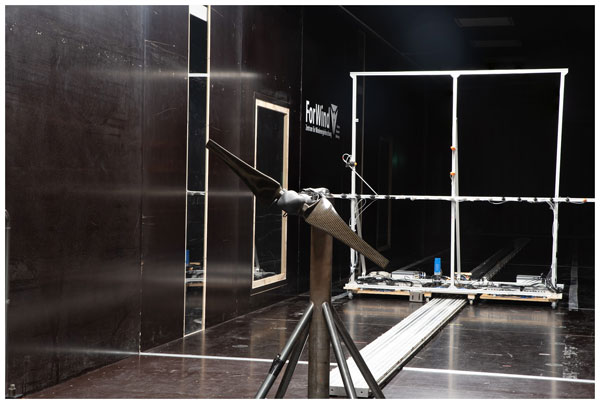
The experiments were carried out in the large wind tunnel of the University of Oldenburg in a closed test section (width: 3 m; height: 3 m; length: 30 m). An almost-laminar inflow condition was obtained with the section free, i.e. without a grid generating turbulence, for which the turbulence intensity TI∞=0.3 %.5 Turbulent inflows were generated using the facility's active grid mounted at the inlet, generating flows with (Neuhaus et al., 2021). We used the TUHH rotor, a two-bladed rotor which has a diameter m, causing a blockage of approx. 7.5 %. It is mounted on a tower/hub that fits a linear actuator enabling surge motion of the rotor with frequencies fp up to 23 Hz and amplitudes Ap up to 20 mm; see Schulz et al. (2024) for more details. The main results of this letter are based on cases with an inflow wind speed U∞ of 3 m s−1 and under laminar conditions (i.e. with TI∞=0.3 %). This choice of wind speed was made to broaden the Stp range, with Stp reaching up to 7 at fp=22.6 Hz. Laminar conditions were chosen to isolate the motion's effect. In addition, reduced measurement series utilising the active turbulence grid were performed to demonstrate that the laminar results can be generalised to turbulent uniform inflows up to a certain level of turbulence.
Wake measurements were performed with a set of 19 hot wires aligned horizontally at hub height (1 m above the floor) and covering a width of , similar to the measurements in Messmer et al. (2024). The hot wires were mounted on a movable cart, enabling measurements at (with x originating at the rotor centre and aligned with the wind in downstream direction).
2.2 Cases investigated
The test campaign aimed to characterise wake recovery by independently varying key parameters influencing the near-wake flow. The wake evolution is governed by the interaction between the vortex-dominated near-wake (1 to 2D downstream) and the surrounding free stream while advected. The near-wake flow – determined by rotor operation and platform motion – acts as the input to this nonlinear dynamic system, while far-wake recovery represents the output. We systematically varied the near-wake flow pattern and its intensity. For surge motion at a constant rotational speed, inflow-velocity fluctuations alter blade loading and vortex strength, generating a pulsating wake. The pulsation frequency (scaled by the platform Strouhal number, Stp) controls the spatial structure, while the amplitude (scaled by ΔV*) controls the intensity – both varied independently. Rotor operating conditions (TSR and blade pitch angle) also influence the near-wake, primarily through induction and vortex geometry. To limit complexity, TSR was varied while blade pitch was held constant, enabling different CT values to be tested.
In this study, we investigated harmonic surge motions with varying frequency of motion, fp, and adapting Ap to maintain ΔV* constant; fp and Ap were varied between [0,22.6] Hz and [0,20] mm, respectively. This resulted in a range of Strouhal numbers and . Most of the cases were run with a constant rotor speed ω=555 rpm, giving a tip speed ratio of (ω in rad s−1 here) and CT=0.8. For this rotational speed, the blade passing frequency is Hz. In addition, the TSR was varied between 5 and 10, which resulted in a range of .
2.3 Recovery definition
Wake recovery, as defined in Messmer et al. (2024), gives an order of magnitude of the averaged wind speed at a given downstream location, seen by a virtual turbine aligned with the turbine generating the wake. It is defined as follows:
with yc the wake centre position.
We present the results in terms of wake profiles and recovery for various Stp, ΔV*, TSR, and CT at different downstream locations for laminar flow conditions in Sect. 3.1, 3.2, and 3.3 and with turbulent inflows in Sect. 3.4.
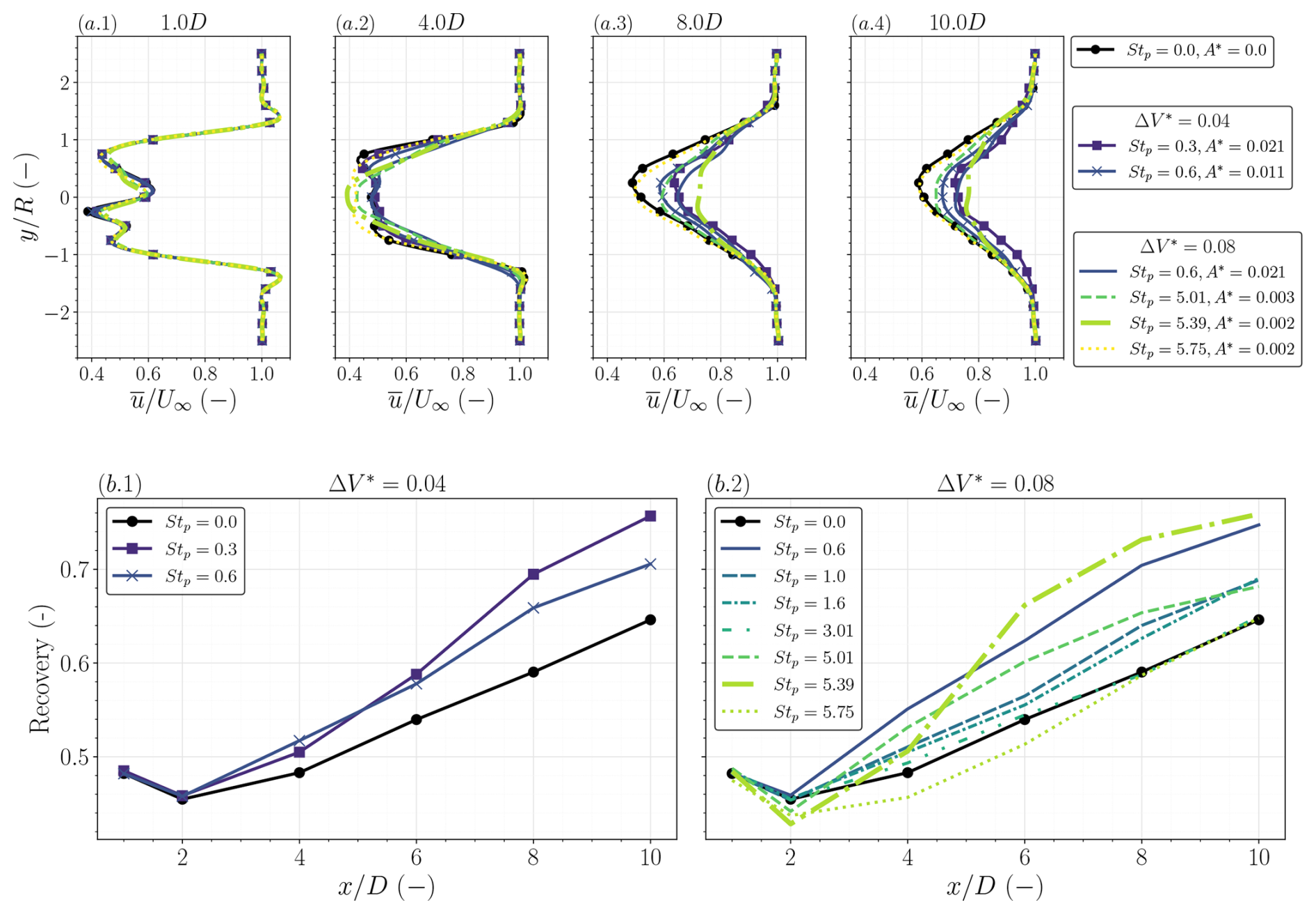
Figure 1(a) Normalised wind speed wake profiles at , (a.1 to a.4) for different St and ΔV*. (b) Wake recovery against downstream position for cases with (b.1) and (b.2) and different St. TSR=9, , and CT=0.80. Laminar inflow with TI∞=0.3 % (no grid).
3.1 Development of wake profiles and recovery in laminar flow
We first examine the evolution of horizontal wake wind speed profiles6 for in Fig. 1a.1 to a.4, focusing on cases with and 8 % at selected Strouhal numbers up to 5.75. At x=1D, the near-wake profiles (see Fig. 1a.1) are nearly identical for all cases, exhibiting a characteristic top-hat shape (Porté-Agel et al., 2020). The wake of the nacelle is visible in the wind profile at x=1D, at the wake centre. Downstream, the profiles for Stp=5.01 and 5.39 (dash-dotted green and dashed green line) transition to a Gaussian-like shape by x=4D, while other cases retain top-hat profiles. By x=8D, all wakes adopt Gaussian profiles typical of the far-wake, with most dynamic cases (Stp>0) showing a profile with a smaller velocity deficit than the fixed case (Stp=0). Comparing the profiles at this downstream position for St=5.01, 5.39, and 5.75, we surprisingly find a strong sensitivity to the motion frequency: Stp=5.39 demonstrates the strongest recovery, while the profile at Stp=5.75 (dotted yellow line) is very similar to the fixed case again.
The wake recovery evolution against in Fig. 1b further describes the dependency on the motion frequency in terms of Stp. In the near-wake (x=1D), all cases show identical mean wind speeds, which dip slightly at x=2D before rising, marking the onset of wake recovery. Recovery is most pronounced for Stp=0.3, as shown in Fig. 1b.1. For (see Fig. 1b.2), the positive impact of the surge motion diminishes, while the fixed case is nearly matched at Stp=3.01. However, for , recovery suddenly increases again, peaking at Stp=5.39 before collapsing when the motion frequency reaches the blade passing frequency at , where the impact of the returning wake effect is strongest; see Schulz et al. (2024). Stb is the reduced frequency of the blade passing frequency, which depends on the tip speed ratio, λ, and the number of blades, nblades.
For St=0.6 and and 8 % in Fig. 1b, the case with doubled motion velocity amplitude shows a larger increase in the wake recovery, consistent with the findings of Li et al. (2022) and Messmer et al. (2024), where higher motion amplitudes tended to increase wake recovery.
3.2 Systematic variation in surge motion parameters in laminar flow
The evolution of wake recovery exhibits a strong dependence on Stp and ΔV*, particularly in the far-wake region (x≥8D). To isolate this dependence, Stp and ΔV* were systematically varied in subsequent tests, with measurements focused at x=10D. In Fig. 2a, the resulting wake recovery is plotted as a function of the reduced frequency Stp for several values of . Figure 2b, c.1, and d.1 present selected power spectra of the streamwise velocity fluctuations in the shear layer at y=R and as done in Messmer et al. (2024). In Fig. 2c.2 and d.2, the phase-averaged velocity variation along the hot-wire array (y axis) and the motion phase (x axis) at x=4D is shown, following the approach of Messmer et al. (2025). Phase averaging was performed at the frequency of the highest spectral peak obtained from the power spectral densities.
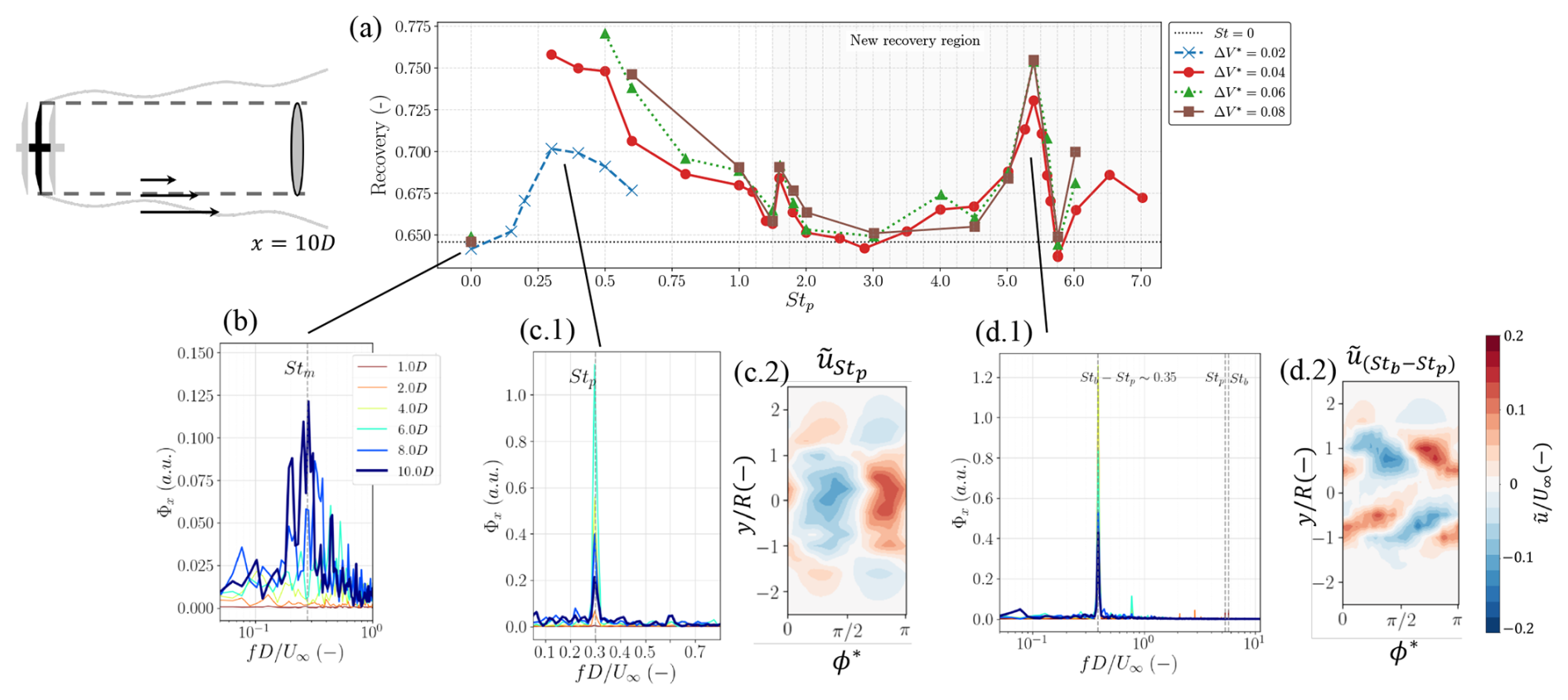
Figure 2(a) Extended recovery curve, i.e. recovery against St at x=10D for at TSR=9, , and CT=0.8. Power spectra of the wind speed fluctuation in the shear layer of the wake at y=R and for Stp=0 (b), Stp=0.3 (c.1) and Stp=5.39 (d.1). Phase-averaged contours of coherent wind-speed fluctuations, at x=4D at Stp=0.3 (c.2) and (d.2). Laminar inflow with TI∞=0.3 % (no grid).
For , an increase in wake recovery from the fixed case up to a Strouhal number of 0.3 can be observed. It is followed by a decay starting from Stp=0.5. Similarly, an enhanced wake recovery and its decay towards Stp>1 can be observed for the cases with higher ΔV*. Due to limitations of the maximum surge amplitude of the actuator, the rise in the wake recovery at lower motion frequencies () could not be resolved experimentally for . The dependency of the wake recovery on Stp between 0 and 1 is in line with previous numerical and experimental findings from Chen et al. (2022) and Messmer et al. (2024). Besides the systematic impact of Stp, a significant dependence of the strength of the wake recovery on ΔV* can be deduced from the measurements in this Stp regime: the higher the ΔV*, the stronger the enhancement of the wake recovery.
The power spectra of the streamwise velocity fluctuations obtained in the shear layer of the wake show a dominant response at the platform motion frequency when Stp=0.3 (Fig. 2c.1). In contrast to this, the power spectrum in the fixed case (Stp=0) shows a broadband energy distribution in the normalised frequency region, , which is characteristic of natural wake meandering (Fig. 2b). The forced response at Stp=0.3 indicates the formation of a coherent structure responsible for enhanced wake recovery (Messmer et al., 2025), depicted in Fig. 2c.2 at x=4D.
At higher frequencies, a second increase in recovery occurs around Stp≈1.5, associated with a spectral peak at the forcing frequency and a self-generated mode at a frequency equaling (not shown here), which is similar to the quasi-periodic dynamics described by Messmer et al. (2024). For , the recovery is nearly identical to the fixed case and shows little dependence on ΔV*.
Surprisingly, for Stp>4, the recovery increases again, especially for Stp=5.39, reaching levels comparable to the optimal low-Stp regime before abruptly decreasing. The power spectra for Stp=5.39 (Fig. 2d.1) exhibit a sharp peak at a low reduced frequency . This peak corresponds exactly to the difference between the Strouhal number related to the platform motion frequency (Stp) and the one related to the blade passing frequency (Stb). This indicates the formation of a coherent wake structure at the frequency Stb−Stp. The corresponding phase-averaged velocity variations (Fig. 2d.2) show the pattern of the coherent structure with a periodicity of , although the surge motion takes place at Stp = 5.39. This pattern significantly differs from the typical pulsating mode observed at Stp=0.3.
3.3 Impact of CT and TSR in laminar flow
The TSR was varied () to investigate the impact of different at a constant on wake recovery at x=10D. Figure 3a–e show that the wake recovery of the fixed cases (Stp=0) decreases when CT increases since more momentum is extracted from the inflow wind. The impact of the motion on the wake recovery, which can be observed by comparing the recovery with motion to the fixed case (dashed grey line), generally diminishes with decreasing CT (and decreasing TSR). While the trend of enhanced recovery at Stp≈0.3 is consistently observed for most cases (CT≥0.75), it nearly completely diminishes for the lowest CT (Fig. 3a). Consistent with the previous observation in Fig. 2, the enhanced recovery in the high-frequency region appears at . Consequently, the minima (Stp=Stb) and maxima () associated with this effect move to lower motion frequencies with decreasing TSR.

Figure 3Recovery (R) against reduced frequency Stp for giving different blade passing frequency fb (represented by the vertical dashed line, ) and different rotor loadings, . CT is given in confined conditions; i.e. no correction for potential blockage effects is applied. Laminar inflow with TI∞=0.3 % (no grid).
3.4 Impact of inflow turbulence
Figure 4 shows the wake recovery curves for 4 % and 8 % at different levels of inflow turbulence . The black lines at TI∞=0.3 % represent the results in the laminar case and are shown for reference here. As expected, the level of wake recovery in the fixed case (shown as dotted, horizontal lines) increases gradually with higher flow turbulence (Porté-Agel et al., 2020). For both motion velocity ratios, the dominant peaks at Strouhal numbers of 0.3 and 5.39 persist, but their height relative to the fixed case recovery decreases as turbulence intensity increases. For the cases, the maxima persist until a turbulence level of 3.8 %, while this value increases to 4.7 % when .

Figure 4Recovery (R) against reduced frequency Stp and two ΔV* for different levels of turbulence intensity up to 6 % (with active grid). TSR=9, , and CT=0.80.
Consistent with previous studies focused on (Chen et al., 2022; Li et al., 2024; Messmer et al., 2024), the results show that motions with Stp≈0.3 yield the strongest recovery enhancement, while an increased motion amplitude tends to amplify this. Similar experiments by Fontanella et al. (2025) recently revealed an increased level of turbulence in the wake at 3 and 5D caused by surge motions. Although only limited impact of the motion on the wake recovery was found at these distances, Fontanella et al. (2025) conclude that the increased turbulence might lead to an enhanced wake recovery further downstream, which is in line with our observations.
In this study, the systematic variation in the motion parameters Stp and ΔV* over a wide range, not previously studied in the literature, clarifies the resulting impact on wake recovery. The results in Fig. 2a show a clear indication that these two parameters indeed characterise the surge-induced wake recovery: while the appearance of minima and maxima and the shape of the recovery curve are determined by Stp in all cases, the intensity of the recovery enhancement at the maxima is driven by ΔV*. Generally, it appears that the impact of ΔV* is comparatively strong when Stp<1, while it is less pronounced in the frequency region where the novel effect occurs in the laminar case. However, in the turbulent cases the impact is clearly visible in the complete frequency band. As discussed in Messmer et al. (2025), a higher value of ΔV* provides greater resilience to inflow turbulence, and the effect of motion on enhanced recovery is therefore higher.
The measurements revealed a significantly improved wake recovery starting at high-frequency, realistic surge motion, peaking at Stp, where . To the authors’ best knowledge, this new phenomenon has not been described in the previous literature. The fact that this peak occurs near ΔS∼0.3 suggests that the coupling between platform motion and rotor rotation excites a natural mode of the wake since a Strouhal number of 0.3 is associated with large energy in the wake of the fixed turbine (see Fig. 2b). However, since ΔS≈0.35 is the measurement point closest to 0.3, the maximum wake recovery occurs at this point. It is fascinating to find that the interaction between surge motion and rotor rotation has such a significant effect on the wake at a location so far from the turbine rotor, namely at x=10D (Fig. 2d.1).
Our current hypothesis to explain this flow phenomenon is as follows: since it was shown that the returning wake effect significantly impacts the loading of large-scale and model-scale rotors (Schulz et al., 2024, 2025) when the motion frequency equals the blade passing frequency, this new phenomenon is likely related to the returning wake effect. When the returning wake effect occurs at Stp=Stb, vortices shed from the trailing edge of the blades form a distinct pattern in the wake so that positive and negative vortices occur at the same azimuth angles in every motion period, respectively. Assuming that a minimum of wake velocity occurs at 0°, another minimum would appear at the opposite side of the rotor (180°), while the maxima occur at 90 and 270° (for a two-bladed rotor). Since the vortices are emitted at the exact same azimuth angle in every surge motion cycle, this flow pattern is persistent across the whole wake. Introducing a slight difference between the blade passing frequency and the platform motion frequency, the generated flow pattern rotates around the rotor axis by a few degrees in every surge motion cycle. As a result, minima and maxima are distributed along a helix with increasing distance from the rotor. The frequency at which this helix rotates equals . When Sthelix∼0.3, the helix excites a natural mode of the wake, leading to the enhanced recovery. Following this hypothesis, another peak should appear at . This could not be confirmed as this case was not considered in the experiments. If this hypothesis holds, the near-field flow pattern at the peak recovery resulting from the surge motion under the action of the returning wake effect would be a similar kind of flow pattern as created by the helix wake mixing strategy (Frederik et al., 2020). Consequently, the helix wake mixing strategy and the peak recovery from surge motions at would be based on the same interaction phenomenon of wake and free stream, while the similar near-field flow patterns are created in two different ways. However, whether this assumption is correct remains to be verified.
It is remarkable to observe that, for all considered cases, the mean flow velocity profiles near the rotor (1D; see Fig. 1a.1) are nearly identical, while significant differences arise in the development of the wake structure with increasing distance to the rotor. This gives a hint as to the non-linear dynamic nature of the underlying physical phenomena: a small excitation in the form of a low-frequency wake pattern such as a pulsating or helical structure becomes extremely amplified if it appears in a suitable frequency region (around Stp=0.3 in this case). Again, this supports the suitability of the approach to consider the wind turbine wake as a non-linear dynamic system with the near-field flow pattern as the most important input.
The observed trends in laminar conditions persist in the cases including wind turbulence, up to TI∞=4.7 % here. It has to be noted that the behaviour observed for the different values of turbulence intensity does not necessarily reflect the full-scale behaviour at the same turbulence intensity since the characteristic of the turbulent wind field is not directly comparable (e.g. power spectrum and integral length scale). Therefore, the impact of motion-induced wake recovery at a certain turbulence intensity could be markedly higher or lower in a full-scale situation.
Another key result of these experiments is the strong sensitivity of wake recovery to the thrust coefficient. For cases with identical Stp and ΔV*, Fig. 3 shows that even small variations in CT lead to markedly different wake recovery responses. When CT is low (here CT=0.58), recovery enhancement is strongly reduced, whereas moderately higher values (CT≳0.78) result in significantly increased recovery of the surging turbine compared to the fixed case. This highlights the fundamental role of the mean axial induction in wake dynamics and recovery. At low CT, the induced velocity deficit is weaker, reducing the shear between the wake and the ambient flow. Early studies on porous discs (Cannon et al., 1993) showed that such weakly sheared wakes exhibit limited dynamics, as the flow is relatively stable. As CT increases, both induction and shear increase, leading to sharper velocity gradients and more unstable shear layers that are more susceptible to reacting to small excitation and forming large-scale coherent structures. Although the theoretical reasoning aligns well with the observations, it is also possible that the TSR itself might play an important role in this context since the two parameters were not varied independently.
It has to be noted that the presented thrust coefficients were measured in confined conditions due to the presence of the wind tunnel walls and may therefore be slightly higher than in a realistic environment. Computational fluid dynamics (CFD) simulations at similar blockage ratios and CT show an increase in CT in the range of 1 %–4 % for similar conditions.7
This letter investigates the impact of surge motion on wake recovery of a model wind turbine using wind tunnel experiments. The unique experimental set-up allowed us to increase the range of motion frequencies up to a platform Strouhal number of 7, exceeding the range of previous experiments by more than a factor of 3. Four main conclusions emerge regarding the dependence of wake recovery on operation and motion parameters:
-
Motion-induced wake recovery is governed jointly by the reduced frequency Stp and the normalised velocity amplitude ΔV*. Increasing ΔV* enhances induction fluctuations and strengthens the forcing of the wake, while the shape of the near-field flow pattern is determined by Stp. For , wake recovery exhibits a largely universal behaviour, with an optimum for , consistent with earlier work and associated with the formation of motion-induced pulsating coherent structures. At higher Stp, the response depends on additional parameters such as rotor rotation and blade number.
-
Wake recovery enhancement due to surge motion is highly sensitive to the thrust coefficient CT and TSR. Small variations in CT lead to markedly different responses: while CT=0.58 results in negligible recovery enhancement (less than 3 % compared to the fixed case), CT=0.80 yields a substantial increase (exceeding 15 %). Higher CT produces stronger shear and more unstable shear layers, which respond more effectively to surge excitation. However, a distinction between the impacts of CT and TSR could not be explicitly made.
-
A previously unreported regime of enhanced wake recovery is identified when the surge frequency approaches the blade passing frequency Stb. In particular, maximum enhancement occurs for ∼ 0.3. This regime is associated with the emergence of a distinct coherent structure linked to the interaction between surge motion and rotor rotation, which may be interpreted as a helical-like wake mode. This newly identified mechanism is of direct relevance for floating wind turbines and may play an important role for large-scale FOWTs.
-
The findings of the motion's impact on the wake recovery persist in turbulent cases. In the considered cases, the impact of motion-induced improved wake recovery could be identified up to a turbulence intensity of 4.7 %, although the relative impact of surge motion decreases as turbulence increases.
Future work should focus on a detailed characterisation of the newly identified mode and on assessing its robustness under more complex inflow conditions, including shear and large-scale flow structures. In addition, it is of major interest to transfer results of the turbulent cases from model to full scale so that a reliable prediction of the motion-induced wake recovery in full scale becomes feasible.
Measurement data are provided to the active members of the IEA Wind TCP Task 56 (OC7). Interested researchers may reach out to Christian W. Schulz if participation in the task is desired. After the task closes, the measurement data and the corresponding report will be made publicly available.
CS and TM designed and carried out the experiments, analysed and interpreted the data, and wrote the manuscript. MH supported the experiments, analysis, and interpretation of the results and writing. JP supported the analysis and interpretation of the results and writing.
At least one of the (co-)authors is a member of the editorial board of Wind Energy Science. The peer-review process was guided by an independent editor, and the authors also have no other competing interests to declare.
Publisher's note: Copernicus Publications remains neutral with regard to jurisdictional claims made in the text, published maps, institutional affiliations, or any other geographical representation in this paper. The authors bear the ultimate responsibility for providing appropriate place names. Views expressed in the text are those of the authors and do not necessarily reflect the views of the publisher.
The authors would like to thank Kimon Silwal, Agnieszka Hölling, Klaus Wieczorek, and Stefan Netzband for their support before and during the experiments. The authors gratefully acknowledge the support of the Federal Ministry for Economic Affairs and Energy (BMWE) for enabling the participation in the IEA Wind TCP Tasks 30 and 56.
Parts of this research and the wind turbine model have been supported by the Federal Ministry for Economic Affairs and Energy (BMWE) by funding the HyStOH (grant no. 03SX409B) and the ProHyGen (grant no. 03EI3084C) projects.
This paper was edited by Jennifer King and reviewed by two anonymous referees.
Bayati, I., Belloli, M., Bernini, L., and Zasso, A.: Wind tunnel wake measurements of floating offshore wind turbines, Energ. Proced., 137, 214–222, https://doi.org/10.1016/j.egypro.2017.10.375, 2017. a
Bayati, I., Belloli, M., Bernini, L., Boldrin, D. M., Boorsma, K., Caboni, M., Cormier, M., Mikkelsen, R., Lutz, T., and Zasso, A.: UNAFLOW project: UNsteady aerodynamics of FLOating wind turbines, J. Phys. Conf. Ser., 1037, 072037, https://doi.org/10.1088/1742-6596/1037/7/072037, 2018. a
Cannon, S., Champagne, F., and Glezer, A.: Observations of large-scale structures in wakes behind axisymmetric bodies, Exp. Fluids, 14, 447–450, https://doi.org/10.1007/BF00190199, 1993. a
Chen, G., Liang, X.-F., and Li, X.-B.: Modelling of wake dynamics and instabilities of a floating horizontal-axis wind turbine under surge motion, Energy, 239, 122110, https://doi.org/10.1016/j.energy.2021.122110, 2022. a, b, c
Dong, J. and Viré, A.: The aerodynamics of floating offshore wind turbines in different working states during surge motion, Renew. Energ., 195, 1125–1136, https://doi.org/10.1016/j.renene.2022.06.016, 2022. a
Fontanella, A., Bayati, I., Mikkelsen, R., Belloli, M., and Zasso, A.: UNAFLOW: a holistic wind tunnel experiment about the aerodynamic response of floating wind turbines under imposed surge motion, Wind Energ. Sci., 6, 1169–1190, https://doi.org/10.5194/wes-6-1169-2021, 2021. a
Fontanella, A., Fusetti, A., Cioni, S., Papi, F., Muggiasca, S., Persico, G., Dossena, V., Bianchini, A., and Belloli, M.: Wake development in floating wind turbines: new insights and an open dataset from wind tunnel experiments, Wind Energ. Sci., 10, 1369–1387, https://doi.org/10.5194/wes-10-1369-2025, 2025. a, b
Frederik, J. A., Doekemeijer, B. M., Mulders, S. P., and van Wingerden, J.-W.: The helix approach: Using dynamic individual pitch control to enhance wake mixing in wind farms, Wind Energy, 23, 1739–1751, https://doi.org/10.1002/we.2513, 2020. a
Goupee, A. J., Koo, B., Lambrakos, K., and Kimball, R.: Model Tests for Three Floating Wind Turbine Concepts, Offshore Technology Conference, OTC–23470–MS, https://doi.org/10.4043/23470-MS, 2012. a
Jonkman, J. M. and Matha, D.: Dynamics of offshore floating wind turbines – analysis of three concepts, Wind Energy, 14, 557–569, https://doi.org/10.1002/we.442, 2011. a
Li, Y., Yu, W., and Sarlak, H.: Wake structures and performance of wind turbine rotor with harmonic surging motions under laminar and turbulent inflows, Wind Energy, 27, 1499–1525, https://doi.org/10.1002/we.2949, 2024. a, b
Li, Z., Dong, G., and Yang, X.: Onset of wake meandering for a floating offshore wind turbine under side-to-side motion, J. Fluid Mech., 934, A29, https://doi.org/10.1017/jfm.2021.1147, 2022. a, b, c
Messmer, T., Hölling, M., and Peinke, J.: Enhanced recovery caused by nonlinear dynamics in the wake of a floating offshore wind turbine, J. Fluid Mech., 984, A66, https://doi.org/10.1017/jfm.2024.175, 2024. a, b, c, d, e, f, g, h
Messmer, T., Peinke, J., Croce, A., and Hölling, M.: The role of motion-excited coherent structures in improved wake recovery of a floating wind turbine, J. Fluid Mech., 1018, A23, https://doi.org/10.1017/jfm.2025.10509, 2025. a, b, c, d
Neuhaus, L., Berger, F., Peinke, J., and Hölling, M.: Exploring the capabilities of active grids, Exp. Fluids, 62, 130, https://doi.org/10.1007/s00348-021-03224-5, 2021. a
Porté-Agel, F., Bastankhah, M., and Shamsoddin, S.: Wind-turbine and wind-farm flows: a review, Bound.-Lay. Meteorol., 174, 1–59, https://doi.org/10.1007/s10546-019-00473-0, 2020. a, b, c
Ramos-García, N., Kontos, S., Pegalajar-Jurado, A., González Horcas, S., and Bredmose, H.: Investigation of the floating IEA Wind 15 MW RWT using vortex methods Part I: Flow regimes and wake recovery, Wind Energy, 25, 468–504, https://doi.org/10.1002/we.2682, 2022. a
Rockel, S., Camp, E., Schmidt, J., Peinke, J., Cal, R. B., and Hölling, M.: Experimental study on influence of pitch motion on the wake of a floating wind turbine model, Energies, 7, 1954–1985, https://doi.org/10.3390/en7041954, 2014. a
Sarlak, H., Nishino, T., Martínez-Tossas, L. A., Meneveau, C., and Sørensen, J. N.: Assessment of blockage effects on the wake characteristics and power of wind turbines, Renew. Energ., 93, 340–352, https://doi.org/10.1016/j.renene.2016.01.101, 2016. a
Schliffke, B., Aubrun, S., and Conan, B.: Wind tunnel study of a “floating” wind turbine’s wake in an atmospheric boundary layer with imposed characteristic surge motion, J. Phys. Conf. Ser., 1618, 062015, https://doi.org/10.1088/1742-6596/1618/6/062015, 2020. a
Schulz, C. W., Netzband, S., Özinan, U., Cheng, P. W., and Abdel-Maksoud, M.: Wind turbine rotors in surge motion: new insights into unsteady aerodynamics of floating offshore wind turbines (FOWTs) from experiments and simulations, Wind Energ. Sci., 9, 665–695, https://doi.org/10.5194/wes-9-665-2024, 2024. a, b, c, d, e
Schulz, C. W., Bergua, R., Branlard, E., Netzband, S., Jonkman, J., and Roberston, A.: Unsteady aerodynamics of large-scale floating offshore wind turbines in surge motion, Renew. Energ., 260, 124977, https://doi.org/10.1016/j.renene.2025.124977, 2025. a, b, c
Sebastian, T. and Lackner, M. A.: Characterization of the unsteady aerodynamics of offshore floating wind turbines, Wind Energy, 16, 339–352, https://doi.org/10.1002/we.545, 2013. a
Zilic de Arcos, F., Tampier, G., and Vogel, C. R.: Numerical analysis of blockage correction methods for tidal turbines, Journal of Ocean Engineering and Marine Energy, 6, 183–197, https://doi.org/10.1007/s40722-020-00168-6, 2020. a
, with D the rotor diameter, fp the motion frequency, and U∞ the incoming wind speed.
, where Ap is the surge motion amplitude.
Since the number of references is limited in the present type of publication, only a small, carefully chosen number of studies could be included in this literature review.
As an example, the UMaine VolturnUS-15 MW floater, which features natural frequencies of Hz in surge/sway and Hz in roll/pitch with U∞≈10 m s−1 shows .
, where is the standard deviation of the incoming wind speed fluctuations in the empty wind tunnel (i.e. with no rotor installed), measured at x=1D from the rotor position over 60 s and averaged across the 19 hot wires.
For all figures, the measured wind speed in the wake is normalised to the wind speed outside the wake region rather than to the inflow wind speed. This is due to the fact that the tunnel speed increases by approx. 4 % behind the rotor and stays constant up to 10D, which is caused by the blockage effect. No relevant restriction of the shown results' validity is expected due to the presence of this effect.
For example: approx. 1.5 % for CT=0.85 and a blockage ratio of 5 % and 4 % for a blockage ratio of 10 % in Zilic de Arcos et al. (2020) or approx. 1 % for CT=0.81 and a blockage ratio of 9 % in Sarlak et al. (2016). Numbers were digitally read from the presented graphs.