Articles | Volume 11, issue 3
https://doi.org/10.5194/wes-11-825-2026
© Author(s) 2026. This work is distributed under
the Creative Commons Attribution 4.0 License.
https://doi.org/10.5194/wes-11-825-2026
© Author(s) 2026. This work is distributed under
the Creative Commons Attribution 4.0 License.
Dual-lidar profilers for measuring atmospheric turbulence
Maxime Thiébaut
CORRESPONDING AUTHOR
France Énergies Marines, Technopôle Brest-Iroise, 525 Avenue Alexis de Rochon, 29280 Plouzané, France
Neil Luxcey
France Énergies Marines, Technopôle Brest-Iroise, 525 Avenue Alexis de Rochon, 29280 Plouzané, France
Related authors
Maxime Thiébaut, Louis Marié, Frédéric Delbos, and Florent Guinot
Wind Energ. Sci., 10, 1869–1885, https://doi.org/10.5194/wes-10-1869-2025, https://doi.org/10.5194/wes-10-1869-2025, 2025
Short summary
Short summary
This study evaluates the impact of an enhanced sampling rate on turbulence measurements using the Vaisala WindCube v2.1 lidar profiler. A prototype configuration, sampling 4 times faster than the commercial setup, is compared to the commercial configuration, with reference measurements provided by a 2D sonic anemometer. The prototype lidar captures greater variance, resulting in turbulence estimates that are more closely aligned with the reference.
Nicolas Thebault, Maxime Thiébaut, Marc Le Boulluec, Guillaume Damblans, Christophe Maisondieu, Cristina Benzo, and Florent Guinot
Wind Energ. Sci. Discuss., https://doi.org/10.5194/wes-2023-126, https://doi.org/10.5194/wes-2023-126, 2023
Preprint withdrawn
Short summary
Short summary
This study examines motion's impact on LOS turbulent velocity fluctuations measured by lidar profilers. Onshore tests used a mobile lidar (WindCube v2.1) on a hexapod, comparing it to a fixed lidar. RMSE was calculated to assess motion effects on turbulence. Results showed alignment, wind speed and amplitude as significant influences on RMSE. Motion frequency affected LOS velocity spectra but had limited impact on RMSE compared to other factors.
Robin Marcille, Maxime Thiébaut, Pierre Tandeo, and Jean-François Filipot
Wind Energ. Sci., 8, 771–786, https://doi.org/10.5194/wes-8-771-2023, https://doi.org/10.5194/wes-8-771-2023, 2023
Short summary
Short summary
A novel data-driven method is proposed to design an optimal sensor network for the reconstruction of offshore wind resources. Based on unsupervised learning of numerical weather prediction wind data, it provides a simple yet efficient method for the siting of sensors, outperforming state-of-the-art methods for this application. It is applied in the main French offshore wind energy development areas to provide guidelines for the deployment of floating lidars for wind resource assessment.
Maxime Thiébaut, Marie Cathelain, Salma Yahiaoui, and Ahmed Esmail
Wind Energ. Sci. Discuss., https://doi.org/10.5194/wes-2022-53, https://doi.org/10.5194/wes-2022-53, 2022
Revised manuscript not accepted
Short summary
Short summary
The characterization of the turbulence intensity (TI) from profiling lidars measurements is still an active area of research. In this paper, a new method is proposed to derive TI from a WindCube v2.1 lidar. The new method allows for a reduction of TI estimation by a factor of more than 3 in comparison to a method commonly used in the wind energy industry. Moreover, a new configuration of WindCube v2.1 with a sampling rate four times higher than that of the commercial lidar is presented.
Youen Kervella, Tessa Chevallier, Boutheina Oueslati, Nicolas Raillard, Marissa Yates, Matéo Pimoult, Coline Poppeschi, Anindita Patra, Neil Luxcey, Florent Guinot, and Laurent Dubus
Wind Energ. Sci. Discuss., https://doi.org/10.5194/wes-2025-266, https://doi.org/10.5194/wes-2025-266, 2025
Preprint under review for WES
Short summary
Short summary
France aims for major offshore wind growth. We examined future climate impacts on wind, waves, and water levels. Results suggest that mean winds and waves may weaken, but extreme waves and sea levels will increase. These trends are nevertheless accompanied by strong model uncertainties. These findings are necessary for designing durable offshore wind farms in France and ensuring reliable energy production for decades to come.
Maxime Thiébaut, Louis Marié, Frédéric Delbos, and Florent Guinot
Wind Energ. Sci., 10, 1869–1885, https://doi.org/10.5194/wes-10-1869-2025, https://doi.org/10.5194/wes-10-1869-2025, 2025
Short summary
Short summary
This study evaluates the impact of an enhanced sampling rate on turbulence measurements using the Vaisala WindCube v2.1 lidar profiler. A prototype configuration, sampling 4 times faster than the commercial setup, is compared to the commercial configuration, with reference measurements provided by a 2D sonic anemometer. The prototype lidar captures greater variance, resulting in turbulence estimates that are more closely aligned with the reference.
Nicolas Thebault, Maxime Thiébaut, Marc Le Boulluec, Guillaume Damblans, Christophe Maisondieu, Cristina Benzo, and Florent Guinot
Wind Energ. Sci. Discuss., https://doi.org/10.5194/wes-2023-126, https://doi.org/10.5194/wes-2023-126, 2023
Preprint withdrawn
Short summary
Short summary
This study examines motion's impact on LOS turbulent velocity fluctuations measured by lidar profilers. Onshore tests used a mobile lidar (WindCube v2.1) on a hexapod, comparing it to a fixed lidar. RMSE was calculated to assess motion effects on turbulence. Results showed alignment, wind speed and amplitude as significant influences on RMSE. Motion frequency affected LOS velocity spectra but had limited impact on RMSE compared to other factors.
Robin Marcille, Maxime Thiébaut, Pierre Tandeo, and Jean-François Filipot
Wind Energ. Sci., 8, 771–786, https://doi.org/10.5194/wes-8-771-2023, https://doi.org/10.5194/wes-8-771-2023, 2023
Short summary
Short summary
A novel data-driven method is proposed to design an optimal sensor network for the reconstruction of offshore wind resources. Based on unsupervised learning of numerical weather prediction wind data, it provides a simple yet efficient method for the siting of sensors, outperforming state-of-the-art methods for this application. It is applied in the main French offshore wind energy development areas to provide guidelines for the deployment of floating lidars for wind resource assessment.
Maxime Thiébaut, Marie Cathelain, Salma Yahiaoui, and Ahmed Esmail
Wind Energ. Sci. Discuss., https://doi.org/10.5194/wes-2022-53, https://doi.org/10.5194/wes-2022-53, 2022
Revised manuscript not accepted
Short summary
Short summary
The characterization of the turbulence intensity (TI) from profiling lidars measurements is still an active area of research. In this paper, a new method is proposed to derive TI from a WindCube v2.1 lidar. The new method allows for a reduction of TI estimation by a factor of more than 3 in comparison to a method commonly used in the wind energy industry. Moreover, a new configuration of WindCube v2.1 with a sampling rate four times higher than that of the commercial lidar is presented.
Cited articles
Bodini, N., Lundquist, J. K., and Newsom, R. K.: Estimation of turbulence dissipation rate and its variability from sonic anemometer and wind Doppler lidar during the XPIA field campaign, Atmos. Meas. Tech., 11, 4291–4308, https://doi.org/10.5194/amt-11-4291-2018, 2018. a
Browning, K. A. and Wexler, R.: The determination of kinematic properties of a wind field using Doppler radar, J. Appl. Meteorol. Clim., 7, 105–113, https://doi.org/10.1175/1520-0450(1968)007<0105:tdokpo>2.0.co;2, 1968. a
Brugger, P., Träumner, K., and Jung, C.: Evaluation of a procedure to correct spatial averaging in turbulence statistics from a Doppler lidar by comparing time series with an ultrasonic anemometer, J. Atmos. Ocean. Tech., 33, 2135–2144, https://doi.org/10.1175/jtech-d-15-0136.1, 2016. a
Burchard, H., Craig, P. D., Gemmrich, J. R., van Haren, H., Mathieu, P.-P., Meier, H. M., Smith, W. A. M. N., Prandke, H., Rippeth, T. P., and Skyllingstad, E. D.: Observational and numerical modeling methods for quantifying coastal ocean turbulence and mixing, Prog. Oceanogr., 76, 399–442, https://doi.org/10.1016/j.pocean.2007.09.005, 2008. a
DNV: Lidar-measured turbulence intensity for wind turbines, Tech. Rep. DNV-RP-0661, https://www.dnv.com/energy/standards-guidelines/dnv-rp-0661-lidar-measured-turbulence-intensity-for-wind-turbines/ (last access: 16 March 2026), 2023. a, b
Doviak, R. J. and Zrnic, D. S.: Doppler Radar & Weather Observations, Courier Corporation, https://doi.org/10.1016/c2009-0-22358-0, 1993. a
Eberhard, W. L., Cupp, R. E., and Healy, K. R.: Doppler lidar measurement of profiles of turbulence and momentum flux, J. Atmos. Ocean. Tech., 6, 809–819, https://doi.org/10.1175/1520-0426(1989)006<0809:dlmopo>2.0.co;2, 1989. a
Foken, T. and Mauder, M.: Micrometeorology, Springer Atmospheric Sciences, https://doi.org/10.1007/978-3-031-47526-9, 2008. a
Gargett, A. E., Tejada-Martinez, A. E., and Grosch, C. E.: Measuring turbulent large-eddy structures with an ADCP. Part 2. Horizontal velocity variance, J. Marine Res., 66, https://doi.org/10.1357/002224009791218823, 2009. a
Goddijn-Murphy, L., Woolf, D. K., and Easton, M. C.: Current patterns in the inner sound (Pentland Firth) from underway ADCP data, J. Atmos. Ocean. Tech., 30, 96–111, https://doi.org/10.1175/jtech-d-11-00223.1, 2013. a
Kaimal, J. C. and Finnigan, J. J.: Atmospheric boundary layer flows: their structure and measurement, Oxford University Press, https://doi.org/10.1093/oso/9780195062397.001.0001, 1994. a, b
Kelberlau, F. and Mann, J.: Better turbulence spectra from velocity–azimuth display scanning wind lidar, Atmos. Meas. Tech., 12, 1871–1888, https://doi.org/10.5194/amt-12-1871-2019, 2019. a
Kelberlau, F. and Mann, J.: Cross-contamination effect on turbulence spectra from Doppler beam swinging wind lidar, Wind Energ. Sci., 5, 519–541, https://doi.org/10.5194/wes-5-519-2020, 2020. a, b
Lenschow, D. H., Mann, J., and Kristensen, L.: How long is long enough when measuring fluxes and other turbulence statistics?, J. Atmos. Ocean. Tech., 11, 661–673, https://doi.org/10.1175/1520-0426(1994)011<0661:hlilew>2.0.co;2, 1994. a
Lenschow, D. H., Wulfmeyer, V., and Senff, C.: Measuring second-through fourth-order moments in noisy data, J. Atmos. Ocean. Tech., 17, 1330–1347, https://doi.org/10.1175/1520-0426(2000)017<1330:mstfom>2.0.co;2, 2000. a
Lu, Y. and Lueck, R. G.: Using a broadband ADCP in a tidal channel. Part I: Mean flow and shear, J. Atmos. Ocean. Tech., 16, 1556–1567, 1999. a
Lueck, R. G., Wolk, F., and Yamazaki, H.: Oceanic velocity microstructure measurements in the 20th century, J. Oceanogr., 58, 153–174, https://doi.org/10.1023/a:1015837020019, 2002. a
Manami, M., Mann, J., Sjöholm, M., Léa, G., and Gorju, G.: Squeezing turbulence statistics out of a pulsed Doppler lidar, Atmos. Meas. Tech., 18, 7513–7523, https://doi.org/10.5194/amt-18-7513-2025, 2025. a
Mann, J., Peña, A., Bingöl, F., Wagner, R., and Courtney, M. S.: Lidar scanning of momentum flux in and above the atmospheric surface layer, J. Atmos. Ocean. Tech., 27, 959–976, https://doi.org/10.1175/2010jtecha1389.1, 2010. a
Mayor, S. D., Lenschow, D. H., Schwiesow, R. L., Mann, J., Frush, C. L., and Simon, M. K.: Validation of NCAR 10.6-micrometer CO2 Doppler lidar radial velocity measurements and comparison with a 915-MHz profiler, J. Atmos. Ocean. Tech., 14, 1110–1126, https://doi.org/10.1175/1520-0426(1997)014<1110:vonmcd>2.0.co;2, 1997. a
McMillan, J. M., Hay, A. E., Lueck, R. G., and Wolk, F.: Rates of dissipation of turbulent kinetic energy in a high Reynolds number tidal channel, J. Atmos. Ocean. Tech., 33, 817–837, https://doi.org/10.1175/jtech-d-15-0167.1, 2016. a
Mercier, P., Thiébaut, M., Guillou, S., Maisondieu, C., Poizot, E., Pieterse, A., Thiébot, J., Filipot, J.-F., and Grondeau, M.: Turbulence measurements: An assessment of Acoustic Doppler Current Profiler accuracy in rough environment, Ocean Eng., 226, 108819, https://doi.org/10.1016/j.oceaneng.2021.108819, 2021. a
Peters, H. and Johns, W. E.: Bottom layer turbulence in the Red Sea outflow plume, J. Phys. Oceanogr., 36, 1763–1785, https://doi.org/10.1175/jpo2939.1, 2006. a
Päschke, E. and Detring, C.: Noise filtering options for conically scanning Doppler lidar measurements with low pulse accumulation, Atmos. Meas. Tech., 17, 3187–3217, https://doi.org/10.5194/amt-17-3187-2024, 2024. a
Rippeth, T. P., Williams, E., and Simpson, J. H.: Reynolds stress and turbulent energy production in a tidal channel, J. Phys. Oceanogr., 32, 1242–1251, https://doi.org/10.1175/1520-0485(2002)032<1242:rsatep>2.0.co;2, 2002. a
Sathe, A. and Mann, J.: Measurement of turbulence spectra using scanning pulsed wind lidars, J. Geophys. Res.-Atmos., 117, https://doi.org/10.1029/2011jd016786, 2012. a
Sathe, A., Gryning, S., and Peña, A.: Comparison of the atmospheric stability and wind profiles at two wind farm sites over a long marine fetch in the North Sea, Wind Energy, 14, 767–780, https://doi.org/10.1002/we.456, 2011. a
Sathe, A., Mann, J., Vasiljevic, N., and Lea, G.: A six-beam method to measure turbulence statistics using ground-based wind lidars, Atmos. Meas. Tech., 8, 729–740, https://doi.org/10.5194/amt-8-729-2015, 2015. a
Sentchev, A., Thiébaut, M., and Schmitt, F. G.: Impact of turbulence on power production by a free-stream tidal turbine in real sea conditions, Renew. Energ., 147, 1932–1940, https://doi.org/10.1016/j.renene.2019.09.136, 2019. a
Smalikho, I. N. and Banakh, V. A.: Measurements of wind turbulence parameters by a conically scanning coherent Doppler lidar in the atmospheric boundary layer, Atmos. Meas. Tech., 10, 4191–4208, https://doi.org/10.5194/amt-10-4191-2017, 2017. a
Stacey, M. T., Monismith, S. G., and Burau, J. R.: Observations of turbulence in a partially stratified estuary, J. Phys. Oceanogr., 29, 1950–1970, https://doi.org/10.1175/1520-0485(1999)029<1950:ootiap>2.0.co;2, 1999a. a
Stacey, M. T., Monismith, S. G., and Burau, J. R.: Measurements of Reynolds stress profiles in unstratified tidal flow, J. Geophys. Res., 104, 10935–10949, https://doi.org/10.1029/1998jc900095, 1999b. a
Strauch, R. G., Merritt, D. A., Moran, K. P., Earnshaw, K. B., and De Kamp, D. V.: The Colorado wind-profiling network, J. Atmos. Ocean. Tech., 1, 37–49, https://doi.org/10.1175/1520-0426(1984)001<0037:tcwpn>2.0.co;2, 1984. a
Theriault, K.: Incoherent multibeam Doppler current profiler performance: Part II – Spatial response, IEEE J. Oceanic Eng., 11, 16–25, https://doi.org/10.1109/joe.1986.1145135, 1986. a
Thiébaut, M., Sentchev, A., and Bailly du Bois, P.: Merging velocity measurements and modeling to improve understanding of tidal stream resource in Alderney Race, Energy, 178, 460–470, https://doi.org/10.1016/j.energy.2019.04.171, 2019. a
Thiébaut, M., Filipot, J.-F., Maisondieu, C., Damblans, G., Duarte, R., Droniou, E., and Guillou, S.: Assessing the turbulent kinetic energy budget in an energetic tidal flow from measurements of coupled ADCPs, Philos. T. R. Soc. A, 378, 20190496, https://doi.org/10.1098/rsta.2019.0496, 2020. a
Thiébaut, M., Quillien, N., Maison, A., Gaborieau, H., Ruiz, N., MacKenzie, S., Connor, G., and Filipot, J.-F.: Investigating the flow dynamics and turbulence at a tidal-stream energy site in a highly energetic estuary, Renew. Energ., 195, 252–262, https://doi.org/10.1016/j.renene.2022.06.020, 2022. a
Thiébaut, M., Vonta, L., Benzo, C., and Guinot, F.: Characterization of the offshore wind dynamics for wind energy production in the Gulf of Lion, Western Mediterranean Sea, Wind Energy and Engineering Research, 1, 100002, https://doi.org/10.1016/j.weer.2024.100002, 2024. a
Thiébaut, M., Marié, L., Delbos, F., and Guinot, F.: Evaluating the enhanced sampling rate for turbulence measurement with a wind lidar profiler, Wind Energ. Sci., 10, 1869–1885, https://doi.org/10.5194/wes-10-1869-2025, 2025. a, b
Thomson, J., Polagye, B., Durgesh, V., and Richmond, M. C.: Measurements of turbulence at two tidal energy sites in Puget Sound, WA, Oceanic Engineering, IEEE J. Oceanic Eng., 37, 363–374, https://doi.org/10.1109/joe.2012.2191656, 2012. a
Vermeulen, B., Hoitink, A. J. F., and Sassi, M. G.: Coupled ADCPs can yield complete Reynolds stress tensor profiles in geophysical surface flows, Geophys. Res. Lett., 38, https://doi.org/10.1029/2011gl046684, 2011. a, b, c
Wang, H., Barthelmie, R. J., Clifton, A., and Pryor, S. C.: Wind measurements from arc scans with Doppler wind lidar, J. Atmos. Ocean. Tech., 32, 2024–2040, https://doi.org/10.1175/jtech-d-14-00059.1, 2015. a
Welch, P.: The use of fast Fourier transform for the estimation of power spectra: A method based on time averaging over short, modified periodograms, IEEE T. Acust. Speech, 15, 70–73, https://doi.org/10.1109/tau.1967.1161901, 1967. a
Wildmann, N., Päschke, E., Roiger, A., and Mallaun, C.: Towards improved turbulence estimation with Doppler wind lidar velocity-azimuth display (VAD) scans, Atmos. Meas. Tech., 13, 4141–4158, https://doi.org/10.5194/amt-13-4141-2020, 2020. a
Short summary
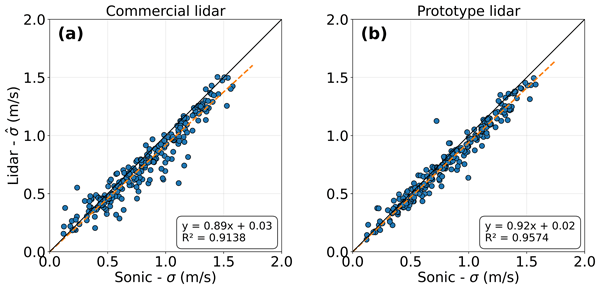
This study tested a two-lidar system to measure wind variations more accurately than traditional single-lidar methods. By comparing 30 days of measurements with a reference instrument, we found that the new approach better captures turbulence and reduces errors in both along- and cross-wind directions. The results show that it can provide more reliable ground-based wind measurements, supporting improved weather monitoring and wind energy assessments.
This study tested a two-lidar system to measure wind variations more accurately than traditional...
Altmetrics
Final-revised paper
Preprint