
Articles | Volume 11, issue 3
https://doi.org/10.5194/wes-11-839-2026
© Author(s) 2026. This work is distributed under
the Creative Commons Attribution 4.0 License.
the Creative Commons Attribution 4.0 License.
https://doi.org/10.5194/wes-11-839-2026
© Author(s) 2026. This work is distributed under
the Creative Commons Attribution 4.0 License.
the Creative Commons Attribution 4.0 License.
Research article
| 
19 Mar 2026
Research article |
| 19 Mar 2026
| 19 Mar 2026
Development of a hardware-in-the-loop wind tunnel setup to study the aerodynamic response of floating offshore wind turbines

Faculty of Aerospace Engineering, Delft University of Technology, Kluyverweg 1, 2629 HS Delft, the Netherlands
Axelle Viré
Faculty of Aerospace Engineering, Delft University of Technology, Kluyverweg 1, 2629 HS Delft, the Netherlands
Related authors
Federico Taruffi, Felipe Novais, and Axelle Viré
Wind Energ. Sci., 9, 343–358, https://doi.org/10.5194/wes-9-343-2024, https://doi.org/10.5194/wes-9-343-2024, 2024
Short summary
Short summary
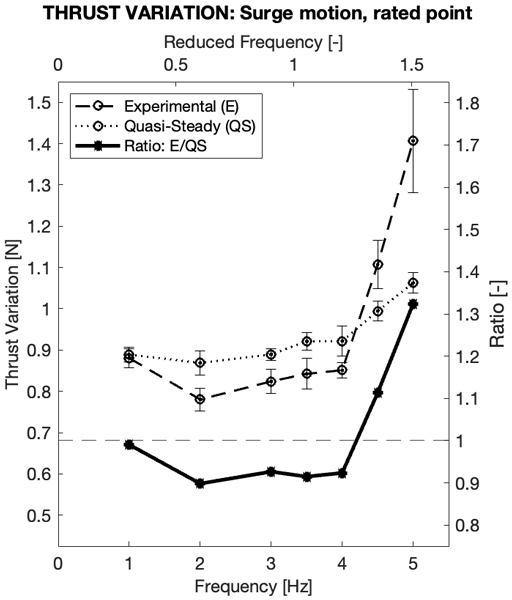
Floating wind turbines are subject to complex aerodynamics that are not yet fully understood. Lab-scale experiments are crucial for capturing these phenomena and validate numerical tools. This paper presents a new wind tunnel experimental setup able to study the response of a wind turbine rotor when subjected to prescribed motions in 6 degrees of freedom. The observed unsteady effects underscore the importance of pursuing research on the impact of floater motions on wind turbine performance.
Federico Taruffi, Simone Di Carlo, Sara Muggiasca, and Marco Belloli
Wind Energ. Sci., 8, 71–84, https://doi.org/10.5194/wes-8-71-2023, https://doi.org/10.5194/wes-8-71-2023, 2023
Short summary
Short summary
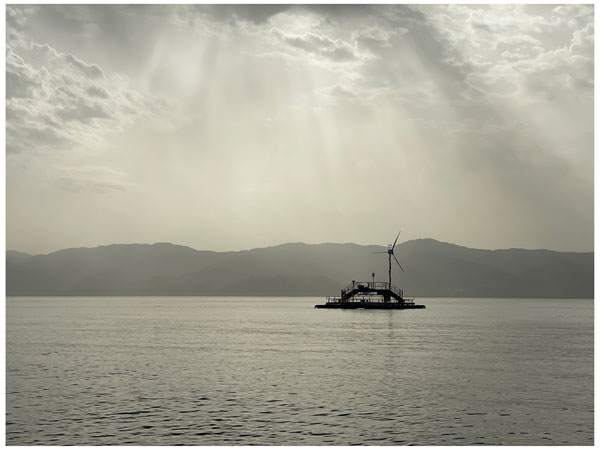
The work focuses on the experimental validation of the design of a large-scale wind turbine model, based on the DTU 10 MW reference wind turbine, installed on a scaled multipurpose platform deployed in an outdoor natural laboratory. The aim of the validation is to assess whether the behaviour of the model respects the targets established during the design phase in terms of structure, rotor aerodynamics and control. The outcome of the investigation ensures the validity of the design process.

Ricardo Amaral, Felix Houtin-Mongrolle, Dominic von Terzi, Kasper Laugesen, Paul Deglaire, and Axelle Viré
Wind Energ. Sci., 11, 3401–3426, https://doi.org/10.5194/wes-11-3401-2026, https://doi.org/10.5194/wes-11-3401-2026, 2026
Short summary
Short summary
This work investigated the effect of a variety of floating-wind-turbine motions on the wake, the slower and more turbulent air left behind the rotor. This was done via computational simulations that reproduced a wind tunnel setup to test the tunnel's impact. While some motions barely disturbed the wake, other motions produced a remarkably different wake structure. The wind tunnel walls influenced the wake to some degree, but the general behavior was consistent with what is seen in the open air.
Evert Ivo Wiegant, Delphine de Tavernier, and Axelle Viré
Wind Energ. Sci. Discuss., https://doi.org/10.5194/wes-2025-276, https://doi.org/10.5194/wes-2025-276, 2025
Preprint under review for WES
Short summary
Short summary
As flow passes over a wing (or a wind turbine blade), a "bound vortex" forms around it. In this work, we describe this vortex as it appears in a type of computer simulation. We use this description to address two problems in literature; to find the correct velocity near the wing (as it is sampled) and to indicate when a simulation appropriately represents the relevant physical phenomena (related to convergence). This work provides understanding of such simulations and means to make them cheaper.
Deepali Singh, Erik Haugen, Kasper Laugesen, Richard P. Dwight, and Axelle Viré
Wind Energ. Sci., 10, 2865–2888, https://doi.org/10.5194/wes-10-2865-2025, https://doi.org/10.5194/wes-10-2865-2025, 2025
Short summary
Short summary
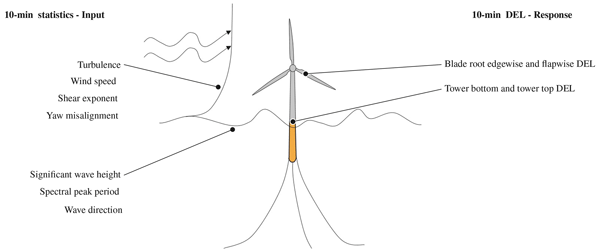
We developed a fast, probabilistic surrogate model to predict fatigue loads on floating wind turbines based on site conditions. Unlike traditional methods, our approach directly uses site data, avoiding complex binning or distribution fitting. A mixture density network is used to capture uncertainties and enables quick lifetime fatigue estimates.
Ricardo Amaral, Felix Houtin-Mongrolle, Dominic von Terzi, Kasper Laugesen, Paul Deglaire, and Axelle Viré
Wind Energ. Sci. Discuss., https://doi.org/10.5194/wes-2025-34, https://doi.org/10.5194/wes-2025-34, 2025
Manuscript not accepted for further review
Short summary
Short summary
This work uses simulations to investigate floating offshore wind turbines which have the potential to supply the world's electricity demand many times by 2040. In particular, the effect of the rotor motion on the wake was investigated by forcing the turbine to move under different motions and the results highlight differences between motions. While some motions led to a wake behavior that was close to that of a fixed-bottom turbine, other motions produced a remarkably different wake structure.
Claudia Muscari, Paolo Schito, Axelle Viré, Alberto Zasso, and Jan-Willem van Wingerden
Wind Energ. Sci. Discuss., https://doi.org/10.5194/wes-2024-149, https://doi.org/10.5194/wes-2024-149, 2025
Publication in WES not foreseen
Short summary
Short summary
This paper presents the findings of a study aimed at describing the flow system downstream of a wind turbine operated with a novel control technology. Results from heavy high-fidelity simulations are used to obtain a low-fidelity model that is quick enough to be used for the optimization of such technologies. Additionally, we were able to retrieve an improved understanding of the physics of such systems under different inflow conditions.
Shyam VimalKumar, Delphine De Tavernier, Dominic von Terzi, Marco Belloli, and Axelle Viré
Wind Energ. Sci., 9, 1967–1983, https://doi.org/10.5194/wes-9-1967-2024, https://doi.org/10.5194/wes-9-1967-2024, 2024
Short summary
Short summary
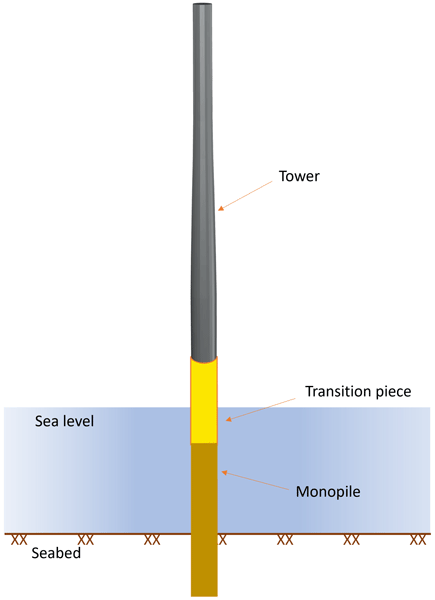
When standing still without a nacelle or blades, the vibrations on a wind turbine tower are of concern to its structural health. This study finds that the air which flows around the tower recirculates behind the tower, forming so-called wakes. These wakes initiate the vibration, and the movement itself causes the vibration to increase or decrease depending on the wind speed. The current study uses a methodology called force partitioning to analyse this in depth.
Deepali Singh, Richard Dwight, and Axelle Viré
Wind Energ. Sci., 9, 1885–1904, https://doi.org/10.5194/wes-9-1885-2024, https://doi.org/10.5194/wes-9-1885-2024, 2024
Short summary
Short summary
The selection of a suitable site for the installation of a wind turbine plays an important role in ensuring a safe operating lifetime of the structure. In this study, we show that mixture density networks can accelerate this process by inferring functions from data that can accurately map the environmental conditions to the loads but also propagate the uncertainty from the inflow to the response.
Federico Taruffi, Felipe Novais, and Axelle Viré
Wind Energ. Sci., 9, 343–358, https://doi.org/10.5194/wes-9-343-2024, https://doi.org/10.5194/wes-9-343-2024, 2024
Short summary
Short summary
Floating wind turbines are subject to complex aerodynamics that are not yet fully understood. Lab-scale experiments are crucial for capturing these phenomena and validate numerical tools. This paper presents a new wind tunnel experimental setup able to study the response of a wind turbine rotor when subjected to prescribed motions in 6 degrees of freedom. The observed unsteady effects underscore the importance of pursuing research on the impact of floater motions on wind turbine performance.
Stefano Cioni, Francesco Papi, Leonardo Pagamonci, Alessandro Bianchini, Néstor Ramos-García, Georg Pirrung, Rémi Corniglion, Anaïs Lovera, Josean Galván, Ronan Boisard, Alessandro Fontanella, Paolo Schito, Alberto Zasso, Marco Belloli, Andrea Sanvito, Giacomo Persico, Lijun Zhang, Ye Li, Yarong Zhou, Simone Mancini, Koen Boorsma, Ricardo Amaral, Axelle Viré, Christian W. Schulz, Stefan Netzband, Rodrigo Soto-Valle, David Marten, Raquel Martín-San-Román, Pau Trubat, Climent Molins, Roger Bergua, Emmanuel Branlard, Jason Jonkman, and Amy Robertson
Wind Energ. Sci., 8, 1659–1691, https://doi.org/10.5194/wes-8-1659-2023, https://doi.org/10.5194/wes-8-1659-2023, 2023
Short summary
Short summary
Simulations of different fidelities made by the participants of the OC6 project Phase III are compared to wind tunnel wake measurements on a floating wind turbine. Results in the near wake confirm that simulations and experiments tend to diverge from the expected linearized quasi-steady behavior when the reduced frequency exceeds 0.5. In the far wake, the impact of platform motion is overestimated by simulations and even seems to be oriented to the generation of a wake less prone to dissipation.
Federico Taruffi, Simone Di Carlo, Sara Muggiasca, and Marco Belloli
Wind Energ. Sci., 8, 71–84, https://doi.org/10.5194/wes-8-71-2023, https://doi.org/10.5194/wes-8-71-2023, 2023
Short summary
Short summary
The work focuses on the experimental validation of the design of a large-scale wind turbine model, based on the DTU 10 MW reference wind turbine, installed on a scaled multipurpose platform deployed in an outdoor natural laboratory. The aim of the validation is to assess whether the behaviour of the model respects the targets established during the design phase in terms of structure, rotor aerodynamics and control. The outcome of the investigation ensures the validity of the design process.

Axelle Viré, Bruce LeBlanc, Julia Steiner, and Nando Timmer
Wind Energ. Sci., 7, 573–584, https://doi.org/10.5194/wes-7-573-2022, https://doi.org/10.5194/wes-7-573-2022, 2022
Short summary
Short summary
There is continuous effort to try and improve the aerodynamic performance of wind turbine blades. This work shows that adding a leading-edge slat to wind turbine blades can significantly enhance the aerodynamic performance of wind turbines, even more than with vortex generators (which are commonly used on commercial turbines). The findings are obtained through wind tunnel tests on different airfoil–slat combinations.
Carlos Ferreira, Wei Yu, Arianna Sala, and Axelle Viré
Wind Energ. Sci., 7, 469–485, https://doi.org/10.5194/wes-7-469-2022, https://doi.org/10.5194/wes-7-469-2022, 2022
Short summary
Short summary
Floating offshore wind turbines may experience large surge motions that, when faster than the local wind speed, cause rotor–wake interaction.
We derive a model which is able to predict the wind speed at the wind turbine, even for large and fast motions and load variations in the wind turbine.
The proposed dynamic inflow model includes an adaptation for highly loaded flow, and it is accurate and simple enough to be easily implemented in most blade element momentum design models.
Cited articles
Armesto, J. A., Jurado, A., Guanche, R., Couñago, B., Urbano, J., and Serna, J.: TELWIND: Numerical Analysis of a Floating Wind Turbine Supported by a Two Bodies Platform, in: Volume 10: Ocean Renewable Energy, American Society of Mechanical Engineers, ISBN 978-0-7918-5131-9, https://doi.org/10.1115/OMAE2018-77587, 2018. a
Azcona, J., Bouchotrouch, F., González, M., Garciandía, J., Munduate, X., Kelberlau, F., and Nygaard, T. A.: Aerodynamic Thrust Modelling in Wave Tank Tests of Offshore Floating Wind Turbines Using a Ducted Fan, J. Phys. Conf. Ser., 524, 012089, https://doi.org/10.1088/1742-6596/524/1/012089, 2014. a
Azcona, J., Bouchotrouch, F., and Vittori, F.: Low-frequency dynamics of a floating wind turbine in wave tank-scaled experiments with SiL hybrid method, Wind Energy, 22, 1402–1413, https://doi.org/10.1002/we.2377, 2019. a
Bachynski, E. E., Thys, M., Sauder, T., Chabaud, V., and Sæther, L. O.: Real-Time Hybrid Model Testing of a Braceless Semi-Submersible Wind Turbine: Part II – Experimental Results, in: Volume 6: Ocean Space Utilization; Ocean Renewable Energy, American Society of Mechanical Engineers, ISBN 978-0-7918-4997-2, https://doi.org/10.1115/OMAE2016-54437, 2016. a
Bayati, I., Belloli, M., Bernini, L., and Zasso, A.: Wind Tunnel Wake Measurements of Floating Offshore Wind Turbines, Energy Proced., 137, 214–222, https://doi.org/10.1016/j.egypro.2017.10.375, 2017. a
Bayati, I., Facchinetti, A., Fontanella, A., and Belloli, M.: 6-DoF hydrodynamic modelling for wind tunnel hybrid/HIL tests of FOWT: the real-time challenge, in: International Conference on Offshore Mechanics and Arctic Engineering, vol. 51319, p. V010T09A078, American Society of Mechanical Engineers, https://doi.org/10.1115/OMAE2018-77804, 2018a. a
Bayati, I., Facchinetti, A., Fontanella, A., Giberti, H., and Belloli, M.: A wind tunnel/HIL setup for integrated tests of Floating Offshore Wind Turbines, J. Phys. Conf. Ser., 1037, 052025, https://doi.org/10.1088/1742-6596/1037/5/052025, 2018b. a
Belloli, M., Bayati, I., Facchinetti, A., Fontanella, A., Giberti, H., Mura, F. L., Taruffi, F., and Zasso, A.: A hybrid methodology for wind tunnel testing of floating offshore wind turbines, Ocean Eng., 210, https://doi.org/10.1016/j.oceaneng.2020.107592, 2020. a, b, c, d
Bredmose, H., Lemmer, F., Borg, M., Pegalajar-Jurado, A., Mikkelsen, R. F., Larsen, T. S., Fjelstrup, T., Yu, W., Lomholt, A. K., Boehm, L., and Armendariz, J. A.: The Triple Spar campaign: Model tests of a 10 MW floating wind turbine with waves, wind and pitch control, Energy Proced., 137, 58–76, https://doi.org/10.1016/j.egypro.2017.10.334, 2017. a, b
Brodtkorb, P. A., Johannesson, P., Lindgren, G., Rychlik, I., Rydén, J., and Sjö, E.: WAFO-a Matlab toolbox for analysis of random waves and loads, in: ISOPE International Ocean and Polar Engineering Conference, pp. ISOPE–I, isope, 2000. a
Cermelli, C., Aubault, A., Roddier, D., and McCoy, T.: Qualification of a semi-submersible floating foundation for multi-megawatt wind turbines, in: Offshore Technology Conference, OTC-20674, OTC, https://doi.org/10.4043/20674-MS, 2010. a
Cummins, W.: The impulse response function and ship motions, https://dome.mit.edu/handle/1721.3/49049 (last access: 18 March 2026), 1962. a
Doisenbant, G., Boulluec, M. L., Scolan, Y.-M., and Guyot, M.: Application to reduced scale model testing, Wind Engineering, 42, 108–114, 2018. a
Dong, J. and Viré, A.: The aerodynamics of floating offshore wind turbines in different working states during surge motion, Renew. Energ., 195, 1125–1136, https://doi.org/10.1016/j.renene.2022.06.016, 2022. a
Duarte, T., Alves, M., Jonkman, J., and Sarmento, A.: State-Space Realization of the Wave-Radiation Force Within FAST, vol. Volume 8: Ocean Renewable Energy of International Conference on Offshore Mechanics and Arctic Engineering, V008T09A021, https://doi.org/10.1115/OMAE2013-10375, 2013. a
Fontanella, A., Da Pra, G., and Belloli, M.: Integrated Design and Experimental Validation of a Fixed-Pitch Rotor for Wind Tunnel Testing, Energies, 16, https://doi.org/10.3390/en16052205, 2023a. a
Fontanella, A., Facchinetti, A., Daka, E., and Belloli, M.: Modeling the coupled aero-hydro-servo-dynamic response of 15 MW floating wind turbines with wind tunnel hardware in the loop, Renew. Energ., 219, 119442, https://doi.org/10.1016/j.renene.2023.119442, 2023b. a, b, c
Goupee, A. J., Fowler, M. J., Kimball, R. W., Helder, J., and de Ridder, E.-J.: Additional Wind/Wave Basin Testing of the DeepCwind Semi-Submersible With a Performance-Matched Wind Turbine, in: Volume 9B: Ocean Renewable Energy, American Society of Mechanical Engineers, ISBN 978-0-7918-4554-7, https://doi.org/10.1115/OMAE2014-24172, 2014a. a
Goupee, A. J., Koo, B. J., Kimball, R. W., Lambrakos, K. F., and Dagher, H. J.: Experimental comparison of three floating wind turbine concepts, J. Offshore Mech. Arct., 136, https://doi.org/10.1115/1.4025804, 2014b. a
Jiang, Z., Wen, B., Chen, G., Tian, X., Li, J., Ouyang, D., Peng, Z., Dong, Y., and Zhou, G.: Real-time hybrid test method for floating wind turbines: Focusing on the aerodynamic load identification, Journal of Ocean Engineering and Science, 10, 449–461, https://doi.org/10.1016/j.joes.2024.06.002, 2025. a
Jonkman, J. M. and Buhl, M. L.: FAST User's Guide: Technical Report, 2005. a
Krieger, A., Ramachandran, G. K. V., L., V., Gómez Alonso, P., González Almería, G., Berque, J., and Aguirre, G.: LIFES50+ D7.2: Design basis, report, 2015. a
Larsen, T. J. and Hanson, T. D.: A method to avoid negative damped low frequent tower vibrations for a floating, pitch controlled wind turbine, J. Phys. Conf. Ser., 75, https://doi.org/10.1088/1742-6596/75/1/012073, 2007. a
Lemmer, F., Raach, S., Schlipf, D., Faerron-Guzmán, R., and Cheng, P. W.: FAST model of the SWE-TripleSpar floating wind turbine platform for the DTU 10 MW reference wind turbine, DaRUS [data set], https://doi.org/10.18419/DARUS-514, 2020. a
Lignarolo, L.: On the turbulent mixing in horizontal axis wind turbine wakes, Ph.D. thesis, Delft University of Technology, 2016. a
Oguz, E., Clelland, D., Day, A. H., Incecik, A., López, J. A., Sánchez, G., and Almeria, G. G.: Experimental and numerical analysis of a TLP floating offshore wind turbine, Ocean Eng., 147, 591–605, https://doi.org/10.1016/j.oceaneng.2017.10.052, 2018. a
Papi, F., Jonkman, J., Robertson, A., and Bianchini, A.: Going beyond BEM with BEM: an insight into dynamic inflow effects on floating wind turbines, Wind Energ. Sci., 9, 1069–1088, https://doi.org/10.5194/wes-9-1069-2024, 2024. a
Ramachandran, G., Vita, L., Krieger, A., and Mueller, K.: Design basis for the feasibility evaluation of four different floater designs, Energy Proced., 137, 186–195, 2017. a
Robertson, A. N., Jonkman, J. M., Goupee, A. J., Coulling, A. J., Prowell, I., Browning, J., Masciola, M. D., and Molta, P.: Summary of Conclusions and Recommendations Drawn From the DeepCwind Scaled Floating Offshore Wind System Test Campaign, vol. Volume 8: Ocean Renewable Energy of International Conference on Offshore Mechanics and Arctic Engineering, V008T09A053, https://doi.org/10.1115/OMAE2013-10817, 2013. a
Ruzzo, C., Muggiasca, S., Malara, G., Taruffi, F., Belloli, M., Collu, M., Li, L., Brizzi, G., and Arena, F.: Scaling strategies for multi-purpose floating structures physical modeling: state of art and new perspectives, Appl. Ocean Res., 108, https://doi.org/10.1016/j.apor.2020.102487, 2021. a
Schulz, C. W., Netzband, S., Özinan, U., Cheng, P. W., and Abdel-Maksoud, M.: Wind turbine rotors in surge motion: new insights into unsteady aerodynamics of floating offshore wind turbines (FOWTs) from experiments and simulations, Wind Energ. Sci., 9, 665–695, https://doi.org/10.5194/wes-9-665-2024, 2024. a
Shi, W., Fu, J., Ren, Z., Jiang, Z., Wang, T., Cui, L., and Li, X.: Real-time hybrid model tests of floating offshore wind turbines: Status, challenges, and future trends, Appl. Ocean Res., 141, https://doi.org/10.1016/j.apor.2023.103796, 2023. a
Taruffi, F., Combette, R., and Viré, A.: Experimental and CFD analysis of a floating offshore wind turbine under imposed motions, J. Phys. Conf. Ser., 2767, 062010, https://doi.org/10.1088/1742-6596/2767/6/062010, 2024a. a
Thys, M., Chabaud, V., Sauder, T., Eliassen, L., Sæther, L. O., and Magnussen, B.: Real-Time Hybrid Model Testing of a Semi-Submersible 10 MW Floating Wind Turbine and Advances in the Test Method, in: ASME 2018 1st International Offshore Wind Technical Conference, American Society of Mechanical Engineers, ISBN 978-0-7918-5197-5, https://doi.org/10.1115/IOWTC2018-1081, 2018. a
van Kuik, G. A. M., Peinke, J., Nijssen, R., Lekou, D., Mann, J., Sørensen, J. N., Ferreira, C., van Wingerden, J. W., Schlipf, D., Gebraad, P., Polinder, H., Abrahamsen, A., van Bussel, G. J. W., Sørensen, J. D., Tavner, P., Bottasso, C. L., Muskulus, M., Matha, D., Lindeboom, H. J., Degraer, S., Kramer, O., Lehnhoff, S., Sonnenschein, M., Sørensen, P. E., Künneke, R. W., Morthorst, P. E., and Skytte, K.: Long-term research challenges in wind energy – a research agenda by the European Academy of Wind Energy, Wind Energ. Sci., 1, 1–39, https://doi.org/10.5194/wes-1-1-2016, 2016. a
Viselli, A. M., Goupee, A. J., and Dagher, H. J.: Model Test of a 1:8-Scale Floating Wind Turbine Offshore in the Gulf of Maine1, J. Offshore Mech. Arct., 137, https://doi.org/10.1115/1.4030381, 2015. a
Vittori, F., Azcona, J., Eguinoa, I., Pires, O., Rodríguez, A., Morató, Á., Garrido, C., and Desmond, C.: Model tests of a 10 MW semi-submersible floating wind turbine under waves and wind using hybrid method to integrate the rotor thrust and moments, Wind Energ. Sci., 7, 2149–2161, https://doi.org/10.5194/wes-7-2149-2022, 2022. a
Zhao, Y. S., She, X. H., He, Y. P., Yang, J. M., Peng, T., and Kou, Y. F.: Experimental Study on New Multi-Column Tension-Leg-Type Floating Wind Turbine, China Ocean Eng., 32, 123–131, https://doi.org/10.1007/s13344-018-0014-0, 2018. a
Short summary
Floating wind turbines are subject to complex aerodynamics that are not yet fully understood. Lab-scale experiments are crucial for capturing these phenomena and validating numerical tools, but due to the different physics, this is difficult with traditional approaches. This paper presents a new, hybrid wind tunnel experimental setup capable of reproducing the coupled aerodynamic and motion response of floating wind turbines.
Floating wind turbines are subject to complex aerodynamics that are not yet fully understood....


Altmetrics
Final-revised paper
Preprint