
Articles | Volume 7, issue 3
https://doi.org/10.5194/wes-7-967-2022
© Author(s) 2022. This work is distributed under
the Creative Commons Attribution 4.0 License.
the Creative Commons Attribution 4.0 License.
https://doi.org/10.5194/wes-7-967-2022
© Author(s) 2022. This work is distributed under
the Creative Commons Attribution 4.0 License.
the Creative Commons Attribution 4.0 License.
Research article
| 
10 May 2022
Research article |
| 10 May 2022
| 10 May 2022
Investigation into boundary layer transition using wall-resolved large-eddy simulations and modeled inflow turbulence
Brandon Arthur Lobo
CORRESPONDING AUTHOR
Mechanical Engineering Department, Kiel University of Applied Sciences, D-24149 Kiel, Germany
Alois Peter Schaffarczyk
Mechanical Engineering Department, Kiel University of Applied Sciences, D-24149 Kiel, Germany
Michael Breuer
Professur für Strömungsmechanik, Helmut-Schmidt-Universität Hamburg, D-22043 Hamburg, Germany
Related authors
Brandon Arthur Lobo, Özge Sinem Özçakmak, Helge Aagaard Madsen, Alois Peter Schaffarczyk, Michael Breuer, and Niels N. Sørensen
Wind Energ. Sci., 8, 303–326, https://doi.org/10.5194/wes-8-303-2023, https://doi.org/10.5194/wes-8-303-2023, 2023
Short summary
Short summary
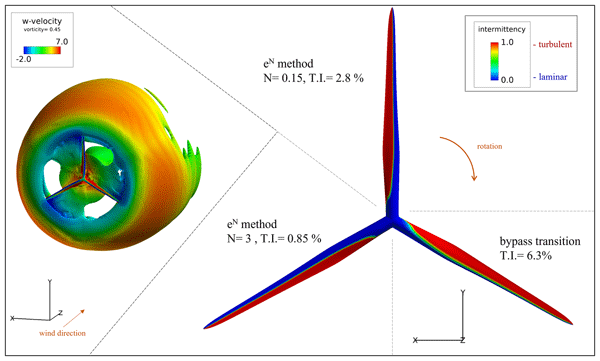
Results from the DAN-AERO and aerodynamic glove projects provide significant findings. The effects of inflow turbulence on transition and wind turbine blades are compared to computational fluid dynamic simulations. It is found that the transition scenario changes even over a single revolution. The importance of a suitable choice of amplification factor is evident from the simulations. An agreement between the power spectral density plots from the experiment and large-eddy simulations is seen.
Koen Boorsma, Gerard Schepers, Helge Aagard Madsen, Georg Pirrung, Niels Sørensen, Galih Bangga, Manfred Imiela, Christian Grinderslev, Alexander Meyer Forsting, Wen Zhong Shen, Alessandro Croce, Stefano Cacciola, Alois Peter Schaffarczyk, Brandon Lobo, Frederic Blondel, Philippe Gilbert, Ronan Boisard, Leo Höning, Luca Greco, Claudio Testa, Emmanuel Branlard, Jason Jonkman, and Ganesh Vijayakumar
Wind Energ. Sci., 8, 211–230, https://doi.org/10.5194/wes-8-211-2023, https://doi.org/10.5194/wes-8-211-2023, 2023
Short summary
Short summary
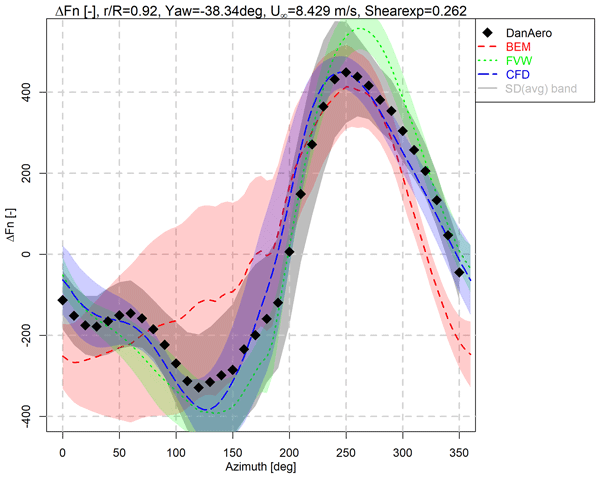
Within the framework of the fourth phase of the International Energy Agency's (IEA) Wind Task 29, a large comparison exercise between measurements and aeroelastic simulations has been carried out. Results were obtained from more than 19 simulation tools of various fidelity, originating from 12 institutes and compared to state-of-the-art field measurements. The result is a unique insight into the current status and accuracy of rotor aerodynamic modeling.
Alois Peter Schaffarczyk and Bhima Masare
Wind Energ. Sci. Discuss., https://doi.org/10.5194/wes-2026-138, https://doi.org/10.5194/wes-2026-138, 2026
Preprint under review for WES
Short summary
Short summary
Wind turbine blades have become so long that they bend noticeably while running. We compared two simplified calculation methods that estimate how this bending changes the air flow along the blade and the extra driving force it creates. Both methods predict the same overall power, yet near the blade tip they disagree strongly, and one of them even depends on how finely the blade is divided in the computer. Local forces at the tips of bent blades should therefore be interpreted with care.
Brandon Arthur Lobo, Özge Sinem Özçakmak, Helge Aagaard Madsen, Alois Peter Schaffarczyk, Michael Breuer, and Niels N. Sørensen
Wind Energ. Sci., 8, 303–326, https://doi.org/10.5194/wes-8-303-2023, https://doi.org/10.5194/wes-8-303-2023, 2023
Short summary
Short summary
Results from the DAN-AERO and aerodynamic glove projects provide significant findings. The effects of inflow turbulence on transition and wind turbine blades are compared to computational fluid dynamic simulations. It is found that the transition scenario changes even over a single revolution. The importance of a suitable choice of amplification factor is evident from the simulations. An agreement between the power spectral density plots from the experiment and large-eddy simulations is seen.
Koen Boorsma, Gerard Schepers, Helge Aagard Madsen, Georg Pirrung, Niels Sørensen, Galih Bangga, Manfred Imiela, Christian Grinderslev, Alexander Meyer Forsting, Wen Zhong Shen, Alessandro Croce, Stefano Cacciola, Alois Peter Schaffarczyk, Brandon Lobo, Frederic Blondel, Philippe Gilbert, Ronan Boisard, Leo Höning, Luca Greco, Claudio Testa, Emmanuel Branlard, Jason Jonkman, and Ganesh Vijayakumar
Wind Energ. Sci., 8, 211–230, https://doi.org/10.5194/wes-8-211-2023, https://doi.org/10.5194/wes-8-211-2023, 2023
Short summary
Short summary
Within the framework of the fourth phase of the International Energy Agency's (IEA) Wind Task 29, a large comparison exercise between measurements and aeroelastic simulations has been carried out. Results were obtained from more than 19 simulation tools of various fidelity, originating from 12 institutes and compared to state-of-the-art field measurements. The result is a unique insight into the current status and accuracy of rotor aerodynamic modeling.
Cited articles
Abu-Ghannam, B. J. and Shaw, R.: Natural transition of boundary layers – The
effects of turbulence, pressure gradient, and flow history, J. Mech. Eng.
Sci., 22, 213–228, https://doi.org/10.1243/JMES_JOUR_1980_022_043_02, 1980. a
Andersson, P., Brandt, L., Bottaro, A., and Henningson, D. S.: On the breakdown
of boundary layer streaks, J. Fluid Mech., 428, 29–60,
https://doi.org/10.1017/s0022112000002421, 2001. a, b, c, d
Asai, M., Minagawa, M., and Nishioka, M.: The instability and breakdown of a
near-wall low-speed streak, J. Fluid Mech., 455, 289–314,
https://doi.org/10.1017/S0022112001007431, 2002. a
Boorsma, K., Schepers, J. G., Gomez-Iradi, S., Herraez, I., Lutz, T., Weihing,
P., Oggiano, L., Pirrung, G., Madsen, H. A., Shen, W. Z., Rahimi, H., and
Schaffarczyk, A. P.: Final report of IEA Wind Task 29 Mexnext (Phase 3), ECN Publications, Tech. Rep. ECN-E–18-003, 2018. a
Brandt, L., Schlatter, P., and Henningson, D. S.: Transition in boundary layers
subject to free-stream turbulence, J. Fluid Mech., 517, 167–198,
https://doi.org/10.1017/S0022112004000941, 2004. a
Breuer, M.: A challenging test case for large–eddy simulation: High
Reynolds number circular cylinder flow, Int. J. Heat Fluid Flow, 21,
648–654, https://doi.org/10.1016/S0142-727X(00)00056-4, 2000. a, b
Breuer, M. and Schmidt, S.: Effect of inflow turbulence on LES of an airfoil
flow with laminar separation bubble, in: ERCOFTAC Series, Direct and
Large-Eddy Simulation XI, 11th Int. ERCOFTAC Workshop on Direct and
Large–Eddy Simulation: DLES-11, edited by:
Salvetti, M. V., Armenio, V., Fröhlich, J., Geurts, B. J., and Kuerten, H., Pisa, Italy, 29–31 May 2017, Springer Nature Switzerland AG, 25, 351–357, https://doi.org/10.1007/978-3-030-04915-7_46, 2019. a, b, c, d, e, f
Butler, K. M. and Farrell, B. F.: Three-dimensional optimal perturbations in
viscous shear flow, Phys. Fluids, 4, 1637–1650, https://doi.org/10.1063/1.858386,
1992. a
Castillo, L., Wang, X., and George, W. K.: Separation criterion for turbulent
boundary layers via similarity analysis, J. Fluids Eng., 126, 297–304,
https://doi.org/10.1115/1.1758262, 2004. a
De Nayer, G., Schmidt, S., Wood, J. N., and Breuer, M.: Enhanced injection
method for synthetically generated turbulence within the flow domain of
eddy–resolving simulations, Computers and Mathematics with Applications, 75,
2338–2355, https://doi.org/10.1016/j.camwa.2017.12.012, 2018. a, b, c, d
Drela, M.: XFOIL: An analysis and design system for low Reynolds number
airfoils, in: Lecture Notes in Engineering, Springer Berlin
Heidelberg, 1–12, 1989. a
Foken, T.: Micrometeorology, Springer, Berlin, 362 pp., https://doi.org/10.1007/978-3-642-25440-6,
2008. a
Fransson, J. H. M., Matsubara, M., and Alfredsson, P. H.: Transition induced by
free-stream turbulence, J. Fluid Mech., 527, 1–25,
https://doi.org/10.1017/S0022112004002770, 2005. a, b, c, d
Galbraith, M. C.: Implicit Large–Eddy Simulation of Low–Reynolds Number
Transitional Flow Past the SD7003 Airfoil., Master thesis, University of
Cincinnati, USA, https://doi.org/10.2514/6.2008-225, 2009. a
Gao, W., Zhang, W., Cheng, W., and Samtaney, R.: Wall-modelled large-eddy simulation of turbulent flow past airfoils, J. Fluid Mech., 873,
174–210, 2019. a
Goldstein, M. E. and Sescu, A.: Boundary-layer transition at high free-stream
disturbance levels – beyond Klebanoff modes, J. Fluid Mech., 613, 95–124,
https://doi.org/10.1017/S0022112008003078, 2008. a
Gostelow, J. P., Blunden, A. R., and Walker, G. J.: Effects of free-stream
turbulence and adverse pressure gradients on boundary layer transition, J.
Turbomach. Trans. ASME, 116, 392–404, https://doi.org/10.1115/1.2929426, 1994. a
Hack, M. J. P. and Zaki, T. A.: Streak instabilities in boundary layers beneath
free-stream turbulence, J. Fluid Mech., 741, 280–315,
https://doi.org/10.1017/jfm.2013.677, 2014. a, b
Herbst, S., Kähler, C., and Hain, R.: SD7003 airfoil in large-scale free
stream turbulence, in: 35th AIAA Applied Aerodynamics Conference, AIAA
AVIATION Forum, (AIAA 2017-3748), Denver, Colorado, USA, 5–9 June 2017, https://doi.org/10.2514/6.2017-3748, 2017. a
Hunt, J. C. R. and Carruthers, D. J.: Rapid distortion theory and the
“problems” of turbulence, J. Fluid Mech., 212, 497,
https://doi.org/10.1017/S0022112090002075, 1990. a
Hunt, J. C. R., Wray, A. A., and Moin, P.: Eddies, Streams, and Convergence
Zones in Turbulent Flows, in: Proc. of the Summer Program 1988,
Center for Turbulence Research, 193–208, 1988. a
Jacobs, R. G. and Durbin, P. A.: Shear sheltering and the continuous spectrum
of the Orr–Sommerfeld equation, Phys. Fluids, 10, 2006–2011,
https://doi.org/10.1063/1.869716, 1998. a
Jones, R. T.: Wing Theory, Princeton University Press, Princeton, NJ, USA, 228 pp., ISBN 9780691633381, 1990. a
Ke, J. and Edwards, J. R.: Numerical simulations of turbulent flow over airfoils near and during static stall, J. Aircr., 54, 1960–1978, 2017. a
Kendall, J. M.: Studies on laminar boundary-layer receptivity to freestream
turbulence near a leading edge, in: Proc. of the Symp., ASME and JSME Joint
Fluids Engineering Conference, (A92-36003 14-34), New York, American Society of Mechanical Engineers, Portland, Oregon, USA, 23–27 June 1991, 23–30, 1991. a
Klebanoff, P. S., Tidstrom, K. D., and Sargent, L. M.: The three-dimensional
nature of boundary-layer instability, J. Fluid Mech., 12, 1–34,
https://doi.org/10.1017/S0022112062000014, 1962. a
Kline, S. J., Reynolds, W. C., Schraub, F. A., and Runstadler, P. W.: The
structure of turbulent boundary layers, J. Fluid Mech., 30, 741–773,
https://doi.org/10.1017/S0022112067001740, 1967. a
Landahl, M. T.: Wave breakdown and turbulence, SIAM J. Appl. Math., 28, 735–756, https://doi.org/10.1137/0128061, 1975. a
Landahl, M. T.: A note on an algebraic instability of inviscid parallel shear
flows, J. Fluid Mech., 98, 243, https://doi.org/10.1017/S0022112080000122, 1980. a
Lardeau, S., Leschziner, M., and Zaki, T. A.: Large eddy simulation of
transitional separated flow over a flat plate and a compressor blade, Flow
Turbulence Combustion, 88, 19–44, https://doi.org/10.1007/s10494-011-9353-0, 2012. a, b
Lobo, B. A., Boorsma, K., and Schaffarczyk, A. P.: Investigation into
boundary layer transition on the MEXICO blade, J. Physics: Conference
Series, 1037, 052020, https://doi.org/10.1088/1742-6596/1037/5/052020, 2018. a
Lund, T. S., Wu, X., and Squires, K. D.: Generation of turbulent inflow inlet
data for spatially–developing boundary layer simulations, J. Comput.
Phys., 140, 233–258, 1998. a
Mack, L. M.: Transition and laminar instability, Tech. rep., Jet Propulsion
Lab., California Inst. of Tech., Pasadena, CA, United States, 1977. a
Mandal, A. C., Venkatakrishnan, L., and Dey, J.: A study on boundary-layer
transition induced by free-stream turbulence, J. Fluid Mech., 660, 114–146,
https://doi.org/10.1017/S0022112010002600, 2010. a
Marquillie, M., Ehrenstein, U., and Laval, J.-P.: Instability of streaks in
wall turbulence with adverse pressure gradient, J. Fluid Mech., 681,
205–240, https://doi.org/10.1017/jfm.2011.193, 2011. a, b, c
Mellen, C. P., Fröhlich, J., and Rodi, W.: Lessons from LESFOIL project on
large-eddy simulation of flow around an airfoil, AIAA J, 41, 573–581,
https://doi.org/10.2514/2.2005, 2003. a, b, c
Mohamed, M. S. and Larue, J. C.: The decay power law in grid-generated
turbulence, J. Fluid Mechanics, 219, 195–214, 1990. a
Morkovin, M. V.: On the many faces of transition, in: Viscous Drag Reduction,
edited by: Wells, C. S., Springer, Boston, MA, 1–31, https://doi.org/10.1007/978-1-4899-5579-1_1, 1969. a
Nagarajan, S., Lele, S. K., and Ferziger, J. H.: Leading-edge effects in bypass
transition, J. Fluid Mech., 572, 471–504, https://doi.org/10.1017/S0022112006001893,
2007. a, b
Piomelli, U. and Chasnov, J. R.: Large–eddy simulations: Theory and
Applications, in: Turbulence and Transition Modeling, edited by: Hallbäck, M., Henningson, D., Johansson, A., and Alfredson, P., Kluwer, 269–331, 1996. a
Rao, V. N., Jefferson-Loveday, R., Tucker, P. G., and Lardeau, S.: Large eddy
simulations in turbines: Influence of roughness and free-stream turbulence,
Flow Turbulence Combustion, 92, 543–561, https://doi.org/10.1007/s10494-013-9465-9,
2014. a, b, c
Reichstein, T., Schaffarczyk, A. P., Dollinger, C., Balaresque, N., Schülein,
E., Jauch, C., and Fischer, A.: Investigation of laminar-turbulent
transition on a rotating wind-turbine blade of multi-megawatt class with
thermography and microphone array, Energies, 12, 2102,
https://doi.org/10.3390/en12112102, 2019. a, b, c, d, e
Reshotko, E.: Boundary-layer stability and transition, Ann. Rev. Fluid Mech.,
8, 311–349, 1976. a
Reshotko, E.: Transient growth: A factor in bypass transition, Phys. Fluids, 13, 1067–1075, 2001. a
Rhie, C. M. and Chow, W. L.: A numerical study of the turbulent flow past an
isolated airfoil with trailing edge separation, AIAA J., 21, 1525–1532,
1983. a
Roach, P. E.: The generation of nearly isotropic turbulence by means of grids,
Int. J. Heat Fluid Flow, 8, 82–92, 1987. a
Schaffarczyk, A. P.: Understanding Wind Power Technology: Theory,
Deployment and Optimisation, John Wiley & Sons, LtD, Chichester, ISBN 978-1-118-64751-6, 2014. a
Schaffarczyk, A. P., Schwab, D., and Breuer, M.: Experimental detection of
laminar–turbulent transition on a rotating wind turbine blade in the free
atmosphere, Wind Energy, 20, 211–220, https://doi.org/10.1002/we.2001, 2017. a, b
Schaffarczyk, A. P., Boisard, R., Boorsma, K., Dose, B., Lienard, C., Lutz, T.,
Madsen, H. A., Rahimi, H., Reichstein, T., Schepers, G., Sørensen, N.,
Stoevesandt, B., and Weihing, P.: Comparison of 3D transitional CFD
simulations for rotating wind turbine wings with measurements, J. Physics:
Conference Series, 1037, 022012, https://doi.org/10.1088/1742-6596/1037/2/022012,
2018. a
Scillitoe, A. D., Tucker, P. G., and Adami, P.: Large eddy simulation of
boundary layer transition mechanisms in a gas-turbine compressor cascade, J. Turbomachinery, 141, 061008, https://doi.org/10.1115/1.4042023, 2019. a, b, c, d
Smagorinsky, J.: General circulation experiments with the primitive equations,
I, The basic experiment, Mon. Weather Rev., 91, 99–165, 1963. a
Solís-Gallego, I., Argüelles Díaz, K. M., Fernández Oro, J. M., and Velarde-Suárez, S.: Wall-resolved LES modeling of a wind turbine airfoil
at different angles of attack, J. Mar. Sci. Eng., 8, 212, https://doi.org/10.3390/jmse8030212, 2020. a
Tabor, G. and Baba-Ahmadi, M.: Inlet conditions for large–eddy simulation: A
review, Comput. Fluids, 39, 553–567, 2010. a
Wissink, J. G. and Rodi, W.: Direct numerical simulations of transitional flow
in turbomachinery, J. Turbomach. Trans. ASME, 128, 668–678,
https://doi.org/10.1115/1.2218517, 2006. a
Wu, X., Jacobs, R. G., Hunt, J. C. R., and Durbin, P. A.: Simulation of
boundary layer transition induced by periodically passing wakes, J. Fluid
Mech., 398, 109–153, https://doi.org/10.1017/s0022112099006205, 1999. a
Yang, Z., Voke, P. R., and Savill, A. M.: Mechanisms and models of boundary
layer receptivity deduced from large-eddy simulation of bypass transition,
in: Direct and Large-Eddy Simulation I. Fluid Mechanics and Its Applications, Springer, Dordrecht, 225–236, https://doi.org/10.1007/978-94-011-1000-6_20, 1994. a
Zaki, T. A.: From streaks to spots and on to turbulence: Exploring the dynamics
of boundary layer transition, Appl. Sci. Res., 91, 451–473,
https://doi.org/10.1007/s10494-013-9502-8, 2013. a
Zaki, T. A. and Durbin, P. A.: Mode interaction and the bypass route to
transition, J. Fluid Mech., 531, 85–111, https://doi.org/10.1017/S0022112005003800,
2005. a
Zaki, T. A. and Saha, S.: On shear sheltering and the structure of vortical
modes in single- and two-fluid boundary layers, J. Fluid Mech., 626,
111–147, https://doi.org/10.1017/S0022112008005648, 2009. a
Short summary
This research involves studying the flow around the section of a wind turbine blade, albeit at a lower Reynolds number or flow speed, using wall-resolved large-eddy simulations, a form of computer simulation that resolves the important scales of the flow. Among the many interesting results, it is shown that the energy entering the boundary layer around the airfoil or section of the blade is proportional to the square of the incoming flow turbulence intensity.
This research involves studying the flow around the section of a wind turbine blade, albeit at a...


Altmetrics
Final-revised paper
Preprint