
Articles | Volume 10, issue 11
https://doi.org/10.5194/wes-10-2771-2025
© Author(s) 2025. This work is distributed under
the Creative Commons Attribution 4.0 License.
the Creative Commons Attribution 4.0 License.
https://doi.org/10.5194/wes-10-2771-2025
© Author(s) 2025. This work is distributed under
the Creative Commons Attribution 4.0 License.
the Creative Commons Attribution 4.0 License.
Research article
| 
27 Nov 2025
Research article |
| 27 Nov 2025
| 27 Nov 2025
Rolling contact fatigue calculation of a three-row roller pitch bearing in a wind turbine
Oliver Menck
CORRESPONDING AUTHOR

Fraunhofer Institute for Wind Energy Systems (IWES), 21029 Hamburg, Germany
Florian Schleich
Fraunhofer Institute for Wind Energy Systems (IWES), 21029 Hamburg, Germany
Matthias Stammler
Fraunhofer Institute for Wind Energy Systems (IWES), 21029 Hamburg, Germany
Related authors
Matthis Graßmann, Oliver Menck, Apoorva Avinash Kulkarni, and Florian Schleich
Wind Energ. Sci. Discuss., https://doi.org/10.5194/wes-2026-112, https://doi.org/10.5194/wes-2026-112, 2026
Preprint under review for WES
Short summary
Short summary
Blade bearings, especially ball bearings, can operate further even with raceway damage. However, any raceway damage will redistribute the load situation in the bearings, changing the bearing behavior. This paper firstly introduces a methodology to implement raceway damages in a finite-element-bearing model and validates the simulation against experimental data. It further investigates the influence on the calculated bearing life and contributes to the general understanding of damage progression.
Oliver Menck and Matthias Stammler
Wind Energ. Sci., 9, 777–798, https://doi.org/10.5194/wes-9-777-2024, https://doi.org/10.5194/wes-9-777-2024, 2024
Short summary
Short summary
Oscillating bearings, like rotating bearings, can fail due to rolling contact fatigue. But the publications in the literature on this topic are difficult to understand. In order to help people decide which method to use, we have summarized the available literature. We also point out some errors and things to look out for to help engineers that want to calculate the rolling contact fatigue life of an oscillating bearing.
Matthis Graßmann, Oliver Menck, Apoorva Avinash Kulkarni, and Florian Schleich
Wind Energ. Sci. Discuss., https://doi.org/10.5194/wes-2026-112, https://doi.org/10.5194/wes-2026-112, 2026
Preprint under review for WES
Short summary
Short summary
Blade bearings, especially ball bearings, can operate further even with raceway damage. However, any raceway damage will redistribute the load situation in the bearings, changing the bearing behavior. This paper firstly introduces a methodology to implement raceway damages in a finite-element-bearing model and validates the simulation against experimental data. It further investigates the influence on the calculated bearing life and contributes to the general understanding of damage progression.
Kayacan Kestel, Xavier Chesterman, Donatella Zappalá, Simon Watson, Mingxin Li, Edward Hart, James Carroll, Yolanda Vidal, Amir R. Nejad, Shawn Sheng, Yi Guo, Matthias Stammler, Florian Wirsing, Ahmed Saleh, Nico Gregarek, Thao Baszenski, Thomas Decker, Martin Knops, Georg Jacobs, Benjamin Lehmann, Florian König, Ines Pereira, Pieter-Jan Daems, Cédric Peeters, and Jan Helsen
Wind Energ. Sci., 11, 2103–2155, https://doi.org/10.5194/wes-11-2103-2026, https://doi.org/10.5194/wes-11-2103-2026, 2026
Short summary
Short summary
Wind energy use has been rapidly expanding worldwide in recent years. Driven by global decarbonization goals and energy security concerns, this growth is expected to continue. To achieve these targets, production costs must decrease, with operation and maintenance being major contributors. This paper reviews current and emerging technologies for monitoring wind turbine drivetrains, and highlights key academic and industrial challenges that may hinder progress.
Matthias Stammler, Faras Jamil, Xinrun Liu, Jens Jo Matthys, Nikhil Sudhakaran, Cédric Peeters, Asger Bech Abrahamsen, and Jan Helsen
Wind Energ. Sci. Discuss., https://doi.org/10.5194/wes-2026-81, https://doi.org/10.5194/wes-2026-81, 2026
Preprint under review for WES
Short summary
Short summary
This study compares traditional and artificial intelligence supported methods for detecting damage in rotating machine parts. Bearings were tested under controlled conditions to see how well each method identified developing problems. The artificial intelligence supported method detected damage as early as, or earlier than, established techniques while needing far less expert attention. This supports automated monitoring of wind turbines, enabling earlier maintenance and lower operating costs.
Bruno Rodrigues Faria, Nikolay Dimitrov, Nikhil Sudhakaran, Matthias Stammler, Athanasios Kolios, W. Dheelibun Remigius, Xiaodong Zhang, and Asger Bech Abrahamsen
Wind Energ. Sci., 11, 1583–1606, https://doi.org/10.5194/wes-11-1583-2026, https://doi.org/10.5194/wes-11-1583-2026, 2026
Short summary
Short summary
This study presents continuous lifetime assessments of wind turbine structural (tower) and rotating components (main bearings) over nearly a decade, combining controller data, calibrated load measurements, and a virtual load sensor at the tower bottom. The components' estimated lifetimes exceeded the design lifetime. Contrary to expectations, lower turbulence intensity at rated wind speed increased fatigue loads of the locating main bearing due to turbulence averaging.
Matthis Graßmann, Martin Geibel, and Florian Schleich
Wind Energ. Sci., 11, 251–264, https://doi.org/10.5194/wes-11-251-2026, https://doi.org/10.5194/wes-11-251-2026, 2026
Short summary
Short summary
Most important for finite-element models is validation to ensure reliable results. To the knowledge of the authors, all publicly available large rolling bearing models are not validated. This work introduces a finite-element model of a 5 m roller bearing as a wind turbine blade bearing. The authors investigated the influence of different bolt preloads on the bearing rings and validated the model against experimental data using a large blade bearing test rig.
Matthias Stammler and Florian Schleich
Wind Energ. Sci., 10, 813–826, https://doi.org/10.5194/wes-10-813-2025, https://doi.org/10.5194/wes-10-813-2025, 2025
Short summary
Short summary
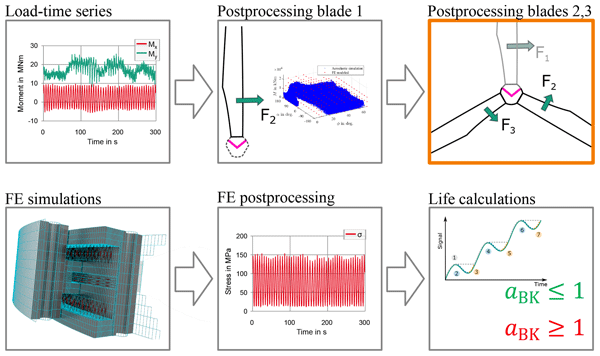
The structures at the center of wind turbine rotors are loaded by three rotor blades. The rotor blades have different loads, which depend on their positions and the incoming wind. The number of possible different loads is too high to simulate each of them for later design of the structures. This work attempts to reduce the number of necessary simulations by exploring inherent relations between the loads of the three rotor blades.
Oliver Menck and Matthias Stammler
Wind Energ. Sci., 9, 777–798, https://doi.org/10.5194/wes-9-777-2024, https://doi.org/10.5194/wes-9-777-2024, 2024
Short summary
Short summary
Oscillating bearings, like rotating bearings, can fail due to rolling contact fatigue. But the publications in the literature on this topic are difficult to understand. In order to help people decide which method to use, we have summarized the available literature. We also point out some errors and things to look out for to help engineers that want to calculate the rolling contact fatigue life of an oscillating bearing.
Matthias Stammler
Wind Energ. Sci., 8, 1821–1837, https://doi.org/10.5194/wes-8-1821-2023, https://doi.org/10.5194/wes-8-1821-2023, 2023
Short summary
Short summary
Wind turbines subject their components to highly variable loads over very long lifetimes. Tests of components like the pitch bearings that connect rotor blades and the rotor hub serve to validate their ability to withstand these loads. Due to the complexity of the operational loads, the definition of test programs is challenging. This work outlines a method that defines wear test programs for specific pitch bearings and gives a case study for an example turbine.
Arne Bartschat, Karsten Behnke, and Matthias Stammler
Wind Energ. Sci., 8, 1495–1510, https://doi.org/10.5194/wes-8-1495-2023, https://doi.org/10.5194/wes-8-1495-2023, 2023
Short summary
Short summary
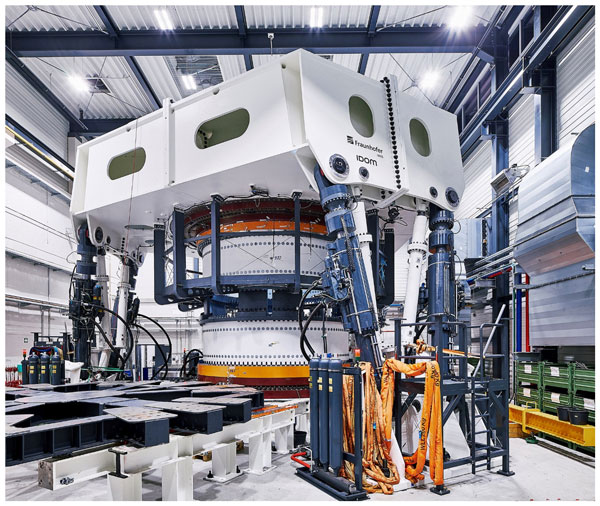
Blade bearings are among the most stressed and challenging components of a wind turbine. Experimental investigations using different test rigs and real-size blade bearings have been able to show that rather short time intervals of only several hours of turbine operation can cause wear damage on the raceways of blade bearings. The proposed methods can be used to assess wear-critical operation conditions and to validate control strategies as well as lubricants for the application.
Karsten Behnke and Florian Schleich
Wind Energ. Sci., 8, 289–301, https://doi.org/10.5194/wes-8-289-2023, https://doi.org/10.5194/wes-8-289-2023, 2023
Short summary
Short summary
The objective of this work is to find limits within typical operating conditions of a wind turbine below which wear on the bearing raceway does not occur. It covers the test of blade bearings with an outer diameter of 2.6 m. The test parameters are based on a 3 MW reference turbine and are compared to values from the literature. It was shown that it can be possible to avoid wear, which again can be used to design a wind turbine controller.
Cited articles
Becker, D.: Pitch bearings for multi-MW wind turbine applications – advanced multi-bearing calculation process and product developments trend regarding pitch bearing and hub modularization, Bearing World Conference 2024, Würzburg, Germany, 2024. a
Becker, D. and Jorgensen, T.: Multi-MW Blade Bearing Applications – Advanced Blade Bearing Design Process and Pitch Bearing Modul Development Trends, Wind Turbine Bearings, Conference for Wind Power Drives 2023, Bremen,2023. a
Becker, D., Esderts, A., Liewen, C., Masendorf, L., Müller, P., Mevius, L., Neidnicht, M., Rollmann, J., Volmer, G., and Wächter, M. (Eds.): Rechnerische Festigkeitsbewertung von zyklisch hochbeanspruchten Flügelverstelllagern in Windenergie-Anlagen auf Basis der FKM-Richtlinie: Deutscher Verband für Materialforschung und -prüfung e.V., https://doi.org/10.48447/FKM-2022-014, 2022. a
Bossanyi, E. A.: Individual Blade Pitch Control for Load Reduction, Wind Energy, 6, 119–128, https://doi.org/10.1002/we.76, 2003. a
Burton, T., Jenkins, N., Sharpe, D., and Bossanyi, E.: Wind energy handbook, in: 2nd Edn., Wiley, Chichester, West Sussex, ISBN 978-0-470-69975-1, 2011. a
Escalero, M., Olave, M., Behnke, K., and Muñiz-Calvente, M.: iKonPro®: A software for the probabilistic prediction of rolling contact fatigue, J. Phys.: Conf. Ser., 2692, 012037, https://doi.org/10.1088/1742-6596/2692/1/012037, 2024. a, b
Graßmann, M., Schleich, F., and Stammler, M.: Validation of a finite-element model of a wind turbine blade bearing, Finite Element. Anal. Design, 221, 103957, https://doi.org/10.1016/j.finel.2023.103957, 2023. a, b, c
Harris, T., Rumbarger, J. H., and Butterfield, C. P.: Wind Turbine Design Guideline DG03: Yaw and Pitch Rolling Bearing Life, NREL, https://doi.org/10.2172/969722, 2009. a
Harris, T. A. and Kotzalas, M. N.: Rolling Bearing Analysis, in: 5th Edn., Taylor & Francis, Boca Raton, Vol.1 ISBN-10 0-8493-7182-1, Vol.2 ISBN-10 0-8493-7183-X, 2007. a
Keller, J. and Guo, Y.: Rating of a Pitch Bearing for a 1.5-Megawatt Wind Turbine, NREL, https://doi.org/10.2172/1902646, 2022. a, b, c
Leupold, S., Schelenz, R., and Jacobs, G.: Method to determine the local load cycles of a blade bearing using flexible multi-body simulation, Forschung im Ingenieurwesen, 85, 211–218, https://doi.org/10.1007/s10010-021-00457-y, 2021. a, b
Lopez, A., Zurutuza, A., Olave, M., Portugal, I., Muñiz-Calvente, M., and Fernandez-Canteli, A.: Pitch bearing lifetime prediction considering the effect of pitch control strategy, J. Phys.: Conf. Ser., 1222, 012017, https://doi.org/10.1088/1742-6596/1222/1/012017, 2019. a, b, c
Lundberg, G.: Elastische Berührung zweier Halbräume, Forschung im Ingenieurwesen, 10, 201–211, https://doi.org/10.1007/BF02584950, 1939. a
Lundberg, G. and Palmgren, A.: Dynamic Capacity of Rolling Bearings: Proceedings of the Royal Swedish Adademy of Engineering Sciences, 196, Generalstabens Litografiska Anstalts Förlag, Stockholm, 1947. a
Menck, O.: The Finite Segment Method – A Numerical Rolling Contact Fatigue Life Model for Bearings Subjected to Stochastic Operating Conditions, J. Tribol., 145, https://doi.org/10.1115/1.4055916, 2023. a, b
Menck, O. and Stammler, M.: Review of rolling contact fatigue life calculation for oscillating bearings and application-dependent recommendations for use, Wind Energ. Sci., 9, 777–798, https://doi.org/10.5194/wes-9-777-2024, 2024. a, b, c
Menck, O., Behnke, K., Stammler, M., Bartschat, A., Schleich, F., and Graßmann, M.: Measurements and modeling of friction torque of wind turbine blade bearings, J. Phys.: Conf. Ser., 2265, 022087, https://doi.org/10.1088/1742-6596/2265/2/022087, 2022. a
Popko, W.: Aero-Elastic Simulation Time Series of IWT7.5 Reference Turbine, Fraunhofer [data set], https://doi.org/10.24406/fordatis/113, 2019. a, b
Potočnik, R., Göncz, P., Flašker, J., and Glodež, S.: Fatigue life of double row slewing ball bearing with irregular geometry, Proced. Eng., 2, 1877–1886, https://doi.org/10.1016/j.proeng.2010.03.202, 2010. a
Rezaei, A., Guo, Y., Keller, J., and Nejad, A. R.: Effects of wind field characteristics on pitch bearing reliability: a case study of 5 MW reference wind turbine at onshore and offshore sites, Forschung im Ingenieurwesen, 87, 321–338, https://doi.org/10.1007/s10010-023-00654-x, 2023. a, b
Rezaei, A., Schleich, F., Menck, O., Grassmann, M., Bartschat, A., and Nejad, A. R.: Comparative analysis of rolling contact fatigue life in a wind turbine pitch bearing with different modeling approaches, J. Phys.: Conf. Ser., 2767, 052036, https://doi.org/10.1088/1742-6596/2767/5/052036, 2024. a
Sadeghi, F., Jalalahmadi, B., Slack, T. S., Raje, N., and Arakere, N. K.: A Review of Rolling Contact Fatigue, J. Tribol., 131, https://doi.org/10.1115/1.3209132, 2009. a
Schleich, F., Chen, Z., Graßmann, M., Balzani, C., and Stammler, M.: Superelement-based acceleration of finite-element simulations of wind turbine rotors, J. Phys.: Conf. Ser., 2767, 052029, https://doi.org/10.1088/1742-6596/2767/5/052029, 2024. a, b
Schwack, F.: Untersuchungen zum Betriebsverhalten oszillierender Wälzlager am Beispiel von Rotorblattlagern in Windenergieanlagen, Dissertation, Leibniz University, Hannover, https://doi.org/10.15488/9756, 2020. a
Schwack, F., Stammler, M., Flory, H., and Poll, G.: Free Contact Angles in Pitch Bearings and their Impact on Contact and Stress Conditions, https://www.researchgate.net/profile/fabian-schwack/publication/308890408_free_contact_angles_in_pitch_bearings_and_their_impact_on_contact_and_stress_conditions (last access: 24 November 2025), 2016a. a
Schwack, F., Stammler, M., Poll, G., and Reuter, A.: Comparison of Life Calculations for Oscillating Bearings Considering Individual Pitch Control in Wind Turbines, J. Phys.: Conf. Ser., 753, 112013, https://doi.org/10.1088/1742-6596/753/11/112013, 2016b. a, b, c, d
Stammler, M.: Endurance test strategies for pitch bearings of wind turbines, Dissertation, Leibniz University, Hannover, https://doi.org/10.15488/10080, 2020. a, b
Stammler, M.: Wear test programs for roller-type pitch bearings of wind turbines, Wind Energ. Sci., 8, 1821–1837, https://doi.org/10.5194/wes-8-1821-2023, 2023. a
Stammler, M. and Schleich, F.: Load case selection for finite-element simulations of wind turbine pitch bearings and hubs, Wind Energ. Sci., 10, 813–826, https://doi.org/10.5194/wes-10-813-2025, 2025. a, b, c
Stammler, M., Schwack, F., Bader, N., Reuter, A., and Poll, G.: Friction torque of wind-turbine pitch bearings – comparison of experimental results with available models, Wind Energ. Sci., 3, 97–105, https://doi.org/10.5194/wes-3-97-2018, 2018. a, b
Stammler, M., Thomas, P., Reuter, A., Schwack, F., and Poll, G.: Effect of load reduction mechanisms on loads and blade bearing movements of wind turbines, Wind Energy, 23, 274–290, https://doi.org/10.1002/we.2428, 2020. a
Short summary
The paper discusses how to calculate the life of a blade bearing that is a roller bearing, as opposed to ball bearings, which most papers on the subject discuss. The raceway fatigue life of the bearing is calculated in a very detailed manner. This includes a validated finite-element simulation model and an approach to determine loads for all operating conditions that the wind turbine experiences.
The paper discusses how to calculate the life of a blade bearing that is a roller bearing, as...


Altmetrics
Final-revised paper
Preprint