Articles | Volume 10, issue 12
https://doi.org/10.5194/wes-10-2841-2025
Research article
 | 
01 Dec 2025
Research article |  | 01 Dec 2025

Fault detection in wind turbines using health index monitoring with variational autoencoders

Shun Wang, Yolanda Vidal, and Francesc Pozo

Related authors

Fostering open science through a digital open innovation platform – structural health monitoring case study
Sarah Barber, Shun Wang, Francesc Pozo, Yolanda Vidal, Marcela Rodrigues Machado, Amanda Aryda Silva Rodrigues de Sousa, Jefferson da Silva Coelho, Xukai Zhang, Yao-Teng Hu, Arash Noshadravan, Theodoros Varouxis, Mahmoud Abdelhak, Ramin Ghiasi, and Abdollah Malekjafarian
Wind Energ. Sci. Discuss., https://doi.org/10.5194/wes-2025-122,https://doi.org/10.5194/wes-2025-122, 2025
Preprint under review for WES
Short summary

Cited articles

Abid, A., Khan, M. T., and Iqbal, J.: A review on fault detection and diagnosis techniques: basics and beyond, Artificial Intelligence Review, 54, 3639–3664, 2021. a
Ashkarkalaei, M., Ghiasi, R., Pakrashi, V., and Malekjafarian, A.: Feature selection for unsupervised defect detection of a wind turbine blade considering operational and environmental conditions, Mechanical Systems and Signal Processing, 230, 112568, https://doi.org/10.1016/j.ymssp.2025.112568, 2025. a, b
Badihi, H., Zhang, Y., Jiang, B., Pillay, P., and Rakheja, S.: A comprehensive review on signal-based and model-based condition monitoring of wind turbines: Fault diagnosis and lifetime prognosis, Proceedings of the IEEE, 110, 754–806, 2022. a
Bertelè, M., Bottasso, C. L., and Cacciola, S.: Automatic detection and correction of pitch misalignment in wind turbine rotors, Wind Energ. Sci., 3, 791–803, https://doi.org/10.5194/wes-3-791-2018, 2018. a
Bilendo, F., Lu, N., Badihi, H., Meyer, A., Cali, Ü., and Cambron, P.: Multitarget normal behavior model based on heterogeneous stacked regressions and change-point detection for wind turbine condition monitoring, IEEE Transactions on Industrial Informatics, 20, 5171–5181, 2023. a
Download
Short summary
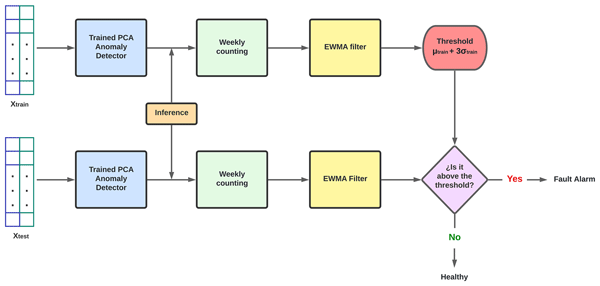
This research aims to improve wind turbine maintenance by detecting faults early using only data from normal operation. The method analyzes vibration signals in both time and frequency domains and uses a variational autoencoder, a type of deep learning model, to learn normal behavior. It then detects anomalies by measuring how much new data deviate from this learned model. Tests on real turbine data show early and accurate detection of faults such as pitch issues and icing.
Share
Altmetrics
Final-revised paper
Preprint