
Articles | Volume 10, issue 12
https://doi.org/10.5194/wes-10-2947-2025
© Author(s) 2025. This work is distributed under
the Creative Commons Attribution 4.0 License.
the Creative Commons Attribution 4.0 License.
https://doi.org/10.5194/wes-10-2947-2025
© Author(s) 2025. This work is distributed under
the Creative Commons Attribution 4.0 License.
the Creative Commons Attribution 4.0 License.
Research article
| 
10 Dec 2025
Research article |
| 10 Dec 2025
| 10 Dec 2025
Probability assessment of static overload in wind turbine blade bearings considering turbulence, design, and manufacturing variability

Department of Marine Technology, Norwegian University of Science and Technology (NTNU), 7491, Trondheim, Norway
Amir Rasekhi Nejad
Department of Marine Technology, Norwegian University of Science and Technology (NTNU), 7491, Trondheim, Norway
Related authors
Jakob Gebel, Ashkan Rezaei, Adithya Vemuri, Veronica Liverud Krathe, Pieter-Jan Daems, Jens Jo Matthys, Jonathan Sterckx, Konstantinos Vratsinis, Kayacan Kestel, Amir R. Nejad, and Jan Helsen
Wind Energ. Sci. Discuss., https://doi.org/10.5194/wes-2024-173, https://doi.org/10.5194/wes-2024-173, 2025
Revised manuscript under review for WES
Short summary
Short summary
A simulation model of a deployed offshore wind turbine was developed using real-world measurement data. The method shows how to obtain, update and validate a simulation model and allows to improve the efficiency and longevity of offshore wind turbines and support operation and maintenance decisions. Simulations were conducted to analyze the effects of turbulence and wind patterns on turbine lifespan, providing insights to improve maintenance planning and reduce operational costs.
Diederik van Binsbergen, Pieter-Jan Daems, Timothy Verstraeten, Konstantinos Vratsinis, Amir Nejad, and Jan Helsen
Wind Energ. Sci. Discuss., https://doi.org/10.5194/wes-2026-120, https://doi.org/10.5194/wes-2026-120, 2026
Revised manuscript has not been submitted
Short summary
Short summary
A key challenge for offshore wind farms is to quantify wakes reliably from turbine measurements. This study develops a statistical approach that learns from measured turbine data how these wakes vary between wind farms and transfers that knowledge to new sites with quantified uncertainty. It also assesses how atmospheric conditions affect wake recovery. The results show that stable conditions lead to slower recovery and larger predicted losses, while unstable conditions support faster recovery.
Vasudev Gupta and Amir R. Nejad
Wind Energ. Sci. Discuss., https://doi.org/10.5194/wes-2026-105, https://doi.org/10.5194/wes-2026-105, 2026
Preprint under review for WES
Short summary
Short summary
This study improves how wind turbine drivetrains are designed by linking structural behavior with long-term critical fatigue effects. By optimizing the main bearing-shaft assembly, for minimum mass, it is shown that design choices strongly affect efficiency and durability. Results reveal that some configurations are limited by ultimate, while others are limited by fatigue, highlighting the need to consider both in novel designs to build lighter and more reliable wind turbines.
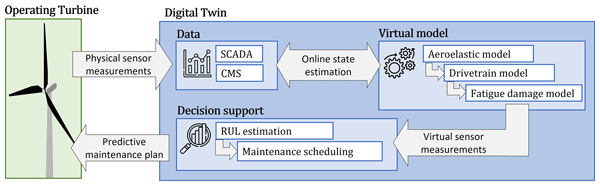
Kayacan Kestel, Xavier Chesterman, Donatella Zappalá, Simon Watson, Mingxin Li, Edward Hart, James Carroll, Yolanda Vidal, Amir R. Nejad, Shawn Sheng, Yi Guo, Matthias Stammler, Florian Wirsing, Ahmed Saleh, Nico Gregarek, Thao Baszenski, Thomas Decker, Martin Knops, Georg Jacobs, Benjamin Lehmann, Florian König, Ines Pereira, Pieter-Jan Daems, Cédric Peeters, and Jan Helsen
Wind Energ. Sci., 11, 2103–2155, https://doi.org/10.5194/wes-11-2103-2026, https://doi.org/10.5194/wes-11-2103-2026, 2026
Short summary
Short summary
Wind energy use has been rapidly expanding worldwide in recent years. Driven by global decarbonization goals and energy security concerns, this growth is expected to continue. To achieve these targets, production costs must decrease, with operation and maintenance being major contributors. This paper reviews current and emerging technologies for monitoring wind turbine drivetrains, and highlights key academic and industrial challenges that may hinder progress.
Felix C. Mehlan and Amir R. Nejad
Wind Energ. Sci. Discuss., https://doi.org/10.5194/wes-2026-90, https://doi.org/10.5194/wes-2026-90, 2026
Revised manuscript accepted for WES
Short summary
Short summary
This study presents a new open-access framework for designing offshore wind turbine drivetrains. The method automatically explores different gearbox layouts and component sizes to find lighter and more efficient designs while satisfying engineering safety requirements. Applied to a 15 megawatt offshore wind turbine, the optimized drivetrain achieved a 31.5 % lower mass than a direct-drive reference design while maintaining similar efficiency.
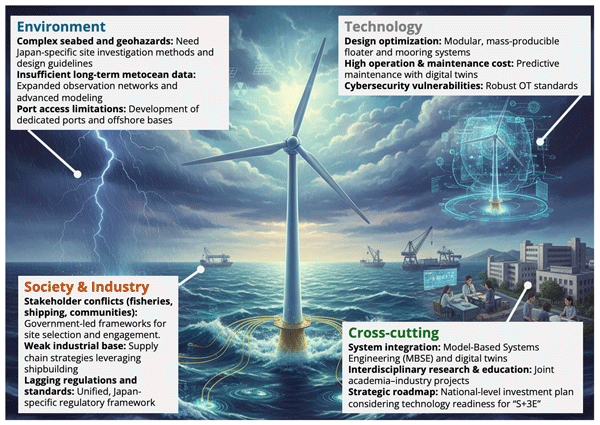
Ryota Wada, Amir R. Nejad, Kazuhiro Iijima, Junji Shimazaki, Mihaela Ibrion, Shinnosuke Wanaka, Hideo Nomura, Yoshitaka Mizushima, Takuya Nakashima, and Ken Takagi
Wind Energ. Sci., 11, 1013–1056, https://doi.org/10.5194/wes-11-1013-2026, https://doi.org/10.5194/wes-11-1013-2026, 2026
Short summary
Short summary
This paper identifies technology gaps on the path to achieving sustainable development of floating offshore wind in Japan. The key challenges, with an emphasis on unique conditions such as earthquakes and tropical cyclones, are addressed. In Japan, the absence of oil and gas has led to social challenges, like a lack of supply chain, infrastructure, and human resources at offshore wind sites. Site selection, design and operation, industry development, and contribution to the national energy policy (S + 3E) are studied.
Jakob Gebel, Pieter-Jan Daems, Diederik van Binsbergen, Veronica Liverud Krathe, Amir R. Nejad, and Jan Helsen
Wind Energ. Sci. Discuss., https://doi.org/10.5194/wes-2026-13, https://doi.org/10.5194/wes-2026-13, 2026
Revised manuscript under review for WES
Short summary
Short summary
The study examines two critical turbine components: the blades and the main bearings. Computer simulations are used to model how turbines respond to disturbed wind from nearby turbines. The analysis is carried out in two stages: first, different turbine spacings and alignments are tested, and second, the method is applied to a real offshore wind farm in the Belgian North Sea.
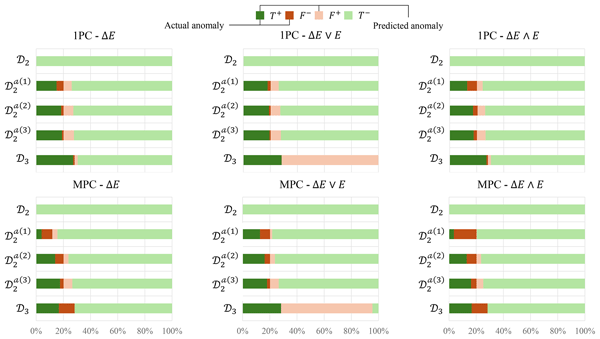
Yuksel R. Alkarem, Ian Ammerman, Kimberly Huguenard, Richard W. Kimball, Babak Hejrati, Amrit Verma, Amir R. Nejad, Reza Hashemi, and Stephan Grilli
Wind Energ. Sci., 10, 2475–2488, https://doi.org/10.5194/wes-10-2475-2025, https://doi.org/10.5194/wes-10-2475-2025, 2025
Short summary
Short summary
Laboratory testing campaigns for the wind energy industry play an essential role in testing innovative control strategies and digital twin applications. But incidents during testing can be detrimental and might cause project delays and damage to expensive equipment. We propose an anomaly detection scheme for laboratory experiments that are developed and tested to enhance reaction time and prediction quality, reducing the likelihood of damage to equipment due to human error or software malfunction.
Jakob Gebel, Ashkan Rezaei, Adithya Vemuri, Veronica Liverud Krathe, Pieter-Jan Daems, Jens Jo Matthys, Jonathan Sterckx, Konstantinos Vratsinis, Kayacan Kestel, Amir R. Nejad, and Jan Helsen
Wind Energ. Sci. Discuss., https://doi.org/10.5194/wes-2024-173, https://doi.org/10.5194/wes-2024-173, 2025
Revised manuscript under review for WES
Short summary
Short summary
A simulation model of a deployed offshore wind turbine was developed using real-world measurement data. The method shows how to obtain, update and validate a simulation model and allows to improve the efficiency and longevity of offshore wind turbines and support operation and maintenance decisions. Simulations were conducted to analyze the effects of turbulence and wind patterns on turbine lifespan, providing insights to improve maintenance planning and reduce operational costs.
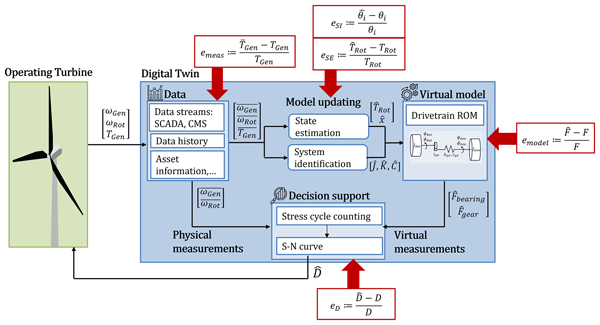
Felix C. Mehlan and Amir R. Nejad
Wind Energ. Sci., 10, 417–433, https://doi.org/10.5194/wes-10-417-2025, https://doi.org/10.5194/wes-10-417-2025, 2025
Short summary
Short summary
A digital twin is a virtual representation that mirrors the wind turbine's real behavior through simulation models and sensor measurements and can assist in making key decisions such as planning the replacement of parts. These models and measurements are, of course, not perfect and only give an incomplete picture of the real behavior. This study investigates how large the uncertainty of such models and measurements is and to what extent it affects the decision-making process.
Ali Dibaj, Mostafa Valavi, and Amir R. Nejad
Wind Energ. Sci., 9, 2063–2086, https://doi.org/10.5194/wes-9-2063-2024, https://doi.org/10.5194/wes-9-2063-2024, 2024
Short summary
Short summary
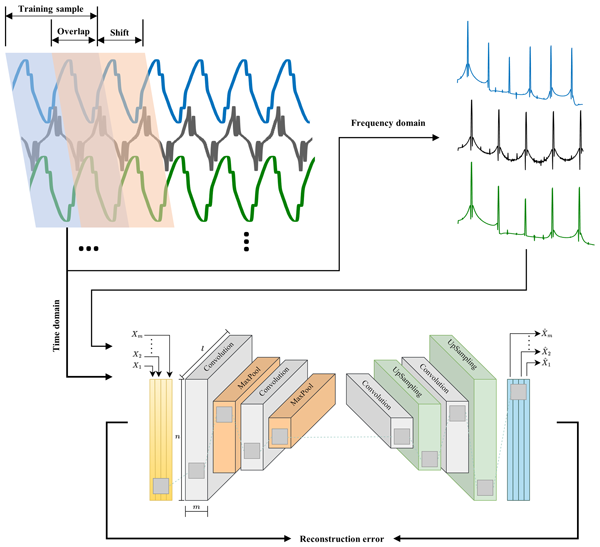
This study emphasizes the need for effective condition monitoring in permanent magnet offshore wind generators to tackle issues like demagnetization and eccentricity. Utilizing a machine learning model and high-resolution measurements, we explore methods of early fault detection. Our findings indicate that flux monitoring with affordable, easy-to-install stray flux sensors with frequency information offers a promising fault detection strategy for large megawatt-scale offshore wind generators.
Diederik van Binsbergen, Pieter-Jan Daems, Timothy Verstraeten, Amir R. Nejad, and Jan Helsen
Wind Energ. Sci., 9, 1507–1526, https://doi.org/10.5194/wes-9-1507-2024, https://doi.org/10.5194/wes-9-1507-2024, 2024
Short summary
Short summary
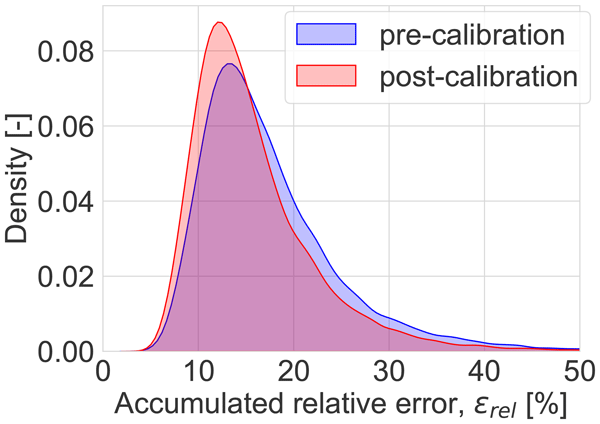
Wind farm yield assessment often relies on analytical wake models. Calibrating these models can be challenging due to the stochastic nature of wind. We developed a calibration framework that performs a multi-phase optimization on the tuning parameters using time series SCADA data. This yields a parameter distribution that more accurately reflects reality than a single value. Results revealed notable variation in resultant parameter values, influenced by nearby wind farms and coastal effects.
Yuksel Rudy Alkarem, Kimberly Huguenard, Richard Kimball, Spencer Hallowell, Amrit Verma, Erin Bachynski-Polić, and Amir Nejad
Wind Energ. Sci. Discuss., https://doi.org/10.5194/wes-2024-67, https://doi.org/10.5194/wes-2024-67, 2024
Preprint withdrawn
Short summary
Short summary
This research is a "less-is-more" demonstration of a novel concept that boost the efficiency of floating wind farms while maintaining fewer number of mooring line/anchors, reducing cost and the large footprint wind farms can have over the ocean bed and the water column. The novelty of this work lies in the passive wake steering method to enhance annual energy production and in integrating that with configurations that allow shared/multiline anchoring potential.
Amir R. Nejad, Jonathan Keller, Yi Guo, Shawn Sheng, Henk Polinder, Simon Watson, Jianning Dong, Zian Qin, Amir Ebrahimi, Ralf Schelenz, Francisco Gutiérrez Guzmán, Daniel Cornel, Reza Golafshan, Georg Jacobs, Bart Blockmans, Jelle Bosmans, Bert Pluymers, James Carroll, Sofia Koukoura, Edward Hart, Alasdair McDonald, Anand Natarajan, Jone Torsvik, Farid K. Moghadam, Pieter-Jan Daems, Timothy Verstraeten, Cédric Peeters, and Jan Helsen
Wind Energ. Sci., 7, 387–411, https://doi.org/10.5194/wes-7-387-2022, https://doi.org/10.5194/wes-7-387-2022, 2022
Short summary
Short summary
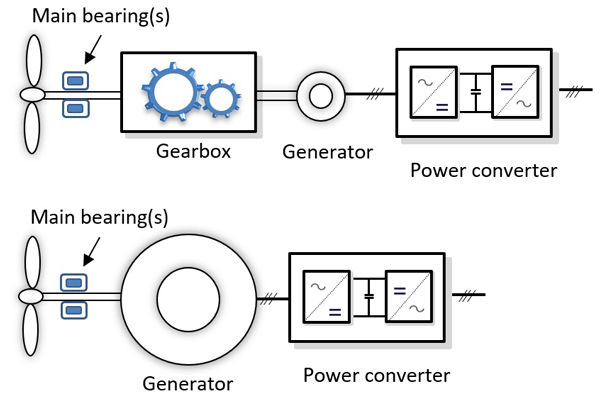
This paper presents the state-of-the-art technologies and development trends of wind turbine drivetrains – the energy conversion systems transferring the kinetic energy of the wind to electrical energy – in different stages of their life cycle: design, manufacturing, installation, operation, lifetime extension, decommissioning and recycling. The main aim of this article is to review the drivetrain technology development as well as to identify future challenges and research gaps.
Cited articles
Alavi, O., Mohammadi, K., and Mostafaeipour, A.: Evaluating the suitability of wind speed probability distribution models: A case of study of east and southeast parts of Iran, Energy Conversion and Management, 119, 101–108, https://doi.org/10.1016/j.enconman.2016.04.039, 2016. a, b
Andreasen, D. K., Rodenas-Soler, C., Oertel, U., Krugel, K., Reinares, I., Mendia, I. S., Nielsen, J. H., Olsen, A., Tinni, A., Vizireanu, D., Cheaytani, J., Kratz, M., and Bousseau, P.: Portability of failure mode detection/prognosis orientations 2.0, Tech. rep., ROMEO, https://www.romeoproject.eu/wp-content/uploads/2022/10/D2_4_Portability_2_3_final.pdf (last access: 14 August 2024), 2022. a
Bain, L. J. and Antle, C. E.: Estimation of Parameters in the Weibull Distribution, Technometrics, 9, 621–627, 1967. a
Cheng, H., Zhang, Y., Lu, W., and Yang, Z.: Reliability sensitivity analysis based on stress–strength model of bearing with random parameters, Review of Scientific Instruments, 91, 073908, https://doi.org/10.1063/1.5143405, 2020. a, b, c, d
Daidié, A., Chaib, Z., and Ghosn, A.: 3D Simplified Finite Elements Analysis of Load and Contact Angle in a Slewing Ball Bearing, Journal of Mechanical Design, 130, 082601, https://doi.org/10.1115/1.2918915, 2008. a
Dawson, C., Abrahart, R., and See, L.: HydroTest: a web-based toolbox of evaluation metrics for the standardised assessment of hydrological forecasts, Environmental Modelling & Software, 22, 1034–1052, https://doi.org/10.1016/j.envsoft.2006.06.008, 2007. a
DNV-ST-0361: Machinery for wind turbines, https://www.dnv.com/energy/standards-guidelines/dnv-st-0361-machinery-for-wind-turbines/ (last access: 6 November 2025), 2016. a
Germanischer Lloyd: Guideline for the Certification of Wind Turbines, Germanischer Lloyd, Hamburg, Germany, 2010. a
GIZ: Vietnam – Wind Measurement Data, https://energydata.info/dataset/vietnam-wind-measurements-giz, last access: 20 January 2023. a
Graßmann, M., Schleich, F., and Stammler, M.: Validation of a finite-element model of a wind turbine blade bearing, Finite Elements in Analysis and Design, 221, 103957, https://doi.org/10.1016/j.finel.2023.103957, 2023. a
Harris, T. A. and Kotzalas, M. N.: Rolling bearing analysis-2 volume set, CRC Press, https://doi.org/10.1201/9781482275148, 2006. a
Haus, L., Sheng, S., and Pulikollu, R. V.: Wind Turbine Major Systems Reliability Trends and Mitigation Strategies, https://app.box.com/s/ktjzjdxn77omu1cjoy9znymbrynlsw0d (last access: 24 September 2024), 2024. a
He, H., Chen, Y., Jin, X., Liu, H., and Wang, C.: Study on predicting rolling contact fatigue of pitch bearing raceway in offshore wind turbine, International Journal of Fatigue, 184, 108284, https://doi.org/10.1016/j.ijfatigue.2024.108284, 2024. a
IEA: Renewable Energy Market Update Outlook for 2023 and 2024, Tech. rep., International Energy Agency (IEA), https://www.iea.org/reports/renewable-energy-market-update-june-2023 (last access: 14 August 2024), 2023. a
IEC 61400-4: Wind energy generation systems, Part 4: Design requirements for wind turbine gearboxes, https://webstore.iec.ch/en/publication/63497 (last access: 17 July 2025), 2025. a
Imdad, A., Arniella, V., Zafra, A., and Belzunce, J.: Tensile behaviour of 42CrMo4 steel submitted to annealed, normalized, and quench and tempering heat treatments with in-situ hydrogen charging, International Journal of Hydrogen Energy, 50, 270–280, https://doi.org/10.1016/j.ijhydene.2023.10.082, 2024. a
Jager, D. and Andreas, A.: NREL National Wind Technology Center (NWTC): M2 Tower, Boulder, Colorado [data], Tech. rep., NREL Report No. DA-5500-56489, https://doi.org/10.5439/1052222, 1996. a
Jonkman, B.: TurbSim User's Guide: Version 1.50, Tech. rep., NREL/TP-500-46198, National Renewable Energy Lab.(NREL), Golden, CO (United States), https://doi.org/10.2172/965520, 2009. a, b
Jonkman, J., Butterfield, S., Musial, W., and Scott, G.: Definition of a 5-MW reference wind turbine for offshore system development, Tech. rep., National Renewable Energy Lab.(NREL), Golden, CO (United States), https://doi.org/10.2172/947422, 2009. a, b
Keller, J. and Guo, Y.: Rating of a Pitch Bearing for a 1.5-MW Wind Turbine, Tech. rep., NREL/TP-5000-82462, National Renewable Energy Lab.(NREL), Golden, CO (United States), https://doi.org/10.2172/1902646, 2022. a, b, c
Lai, J.: A new model for the static load rating of surface induction-hardened bearings, Evolution, 2, 27–32, 2011. a
Lai, J., Ovize, P., Kuijpers, H., Bacchettto, A., and Ioannides, S.: Case Depth and Static Capacity of Surface Induction-Hardened Rings, Journal of ASTM International, 6, 1–16, https://doi.org/10.1520/JAI102630, 2009. a, b
Leupold, S., Schelenz, R., and Jacobs, G.: Method to determine the local load cycles of a blade bearing using flexible multi-body simulation, Forsch. Ingenieurwes., 85, 211–218, https://doi.org/10.1007/s10010-021-00457-y, 2021. a
Lewis, S., Gaillard, L., Seiler, R., Parzianello, G., and LeLetty, R.: Recent Steps Towards a Common Understanding of Ball Bearing Load Capacity, 16th European Space Mechanisms and Tribology Symposium 2015, Bilbao, Spain, 23–25 September 2015, 2015. a
Melchers, R. E. and Beck, A. T.: Structural reliability analysis and prediction, John Wiley & Sons, https://doi.org/10.1002/9781119266105, 2018. a
Menck, O., Stammler, M., and Schleich, F.: Fatigue lifetime calculation of wind turbine blade bearings considering blade-dependent load distribution, Wind Energ. Sci., 5, 1743–1754, https://doi.org/10.5194/wes-5-1743-2020, 2020. a, b, c, d
Mishnaevsky Jr., L. and Thomsen, K.: Costs of repair of wind turbine blades: Influence of technology aspects, Wind Energy, 23, 2247–2255, 2020. a
Nejad, A. R.: Modelling and analysis of drivetrains in offshore wind turbines, Offshore wind energy technology, 37, https://doi.org/10.1002/9781119097808, 2018. a
Ørsted: Green solutions: Offshore wind data, https://orsted.com/en/our-business/offshore-wind/wind-data, last access: 4 June 2022. a
Rezaei, A. and Nejad, A. R.: Effect of wind speed distribution and site assessment on pitch bearing loads and life, Journal of Physics: Conference Series, 2507, 012021, https://doi.org/10.1088/1742-6596/2507/1/012021, 2023. a, b
Rezaei, A., Schleich, F., Menck, O., Grassmann, M., Bartschat, A., and Nejad, A. R.: Comparative analysis of rolling contact fatigue life in a wind turbine pitch bearing with different modeling approaches, Journal of Physics: Conference Series, 2767, 052036, https://doi.org/10.1088/1742-6596/2767/5/052036, 2024. a, b, c
Renewable Energy and Energy Efficiency Organization (SATBA): https://www.satba.gov.ir/, last access: 24 May 2022. a
Schwack, F., Stammler, M., Poll, G., and Reuter, A.: Comparison of life calculations for oscillating bearings considering individual pitch control in wind turbines, Journal of Physics: Conference Series, 753, 112013, https://doi.org/10.1088/1742-6596/753/11/112013, 2016. a
Shi, H., Z. Dong, N. X., and Huang, Q.: Wind Speed Distributions Used in Wind Energy Assessment: A Review, Frontiers in Energy Research, 9, 769920, https://doi.org/10.3389/fenrg.2021.769920, 2021. a, b
Shimizu, S., Tosha, K., and Tsuchiya, K.: New data analysis of probabilistic stress-life (P–S–N) curve and its application for structural materials, International Journal of Fatigue, 32, 565–575, https://doi.org/10.1016/j.ijfatigue.2009.07.017, 2010. a
Solano-Alvarez, W.: Microstructural degradation of bearing steels, PhD thesis, University of Cambridge, https://doi.org/10.17863/CAM.14283, 2015. a
Stehly, T., Duffy, P., and Hernando, D. M.: Cost of Wind Energy Review: 2024 Edition, Tech. rep., NREL/PR-5000-91775, National Renewable Energy Lab.(NREL), Golden, CO (United States), https://doi.org/10.2172/2479271, 2024. a
Wang, X., Wang, B., Chang, M., and Li, L.: Reliability and sensitivity analysis for bearings considering the correlation of multiple failure modes by mixed Copula function, Proceedings of the Institution of Mechanical Engineers, Part O, Journal of Risk and Reliability, 234, 15–26, https://doi.org/10.1177/1748006X19876137, 2020. a, b
Wang, Y., Wang, W., and Zhao, Z.: Effect of race conformities in angular contact ball bearing, Tribology International, 104, 109–120, https://doi.org/10.1016/j.triboint.2016.08.034, 2016. a
World Bank Group: Ethiopia – Wind Measurement Data, https://energydata.info/dataset/ethiopia-wind-measurement-data, last access: 20 January 2023a. a
World Bank Group: Pakistan – Wind Measurement Data, https://energydata.info/dataset/pakistan-wind-measurement-data, last access: 20 January 2023b. a
Yu, J., Fu, Y., Yu, Y., Wu, S., Wu, Y., You, M., Guo, S., and Li, M.: Assessment of Offshore Wind Characteristics and Wind Energy Potential in Bohai Bay, China, Energies, 12, https://doi.org/10.3390/en12152879, 2019. a, b
Short summary
We analyzed the reliability of wind turbine blade bearings under extreme turbulence wind conditions to improve their safety and performance. Using simulations, we studied how factors like turbulence and design variations affect failure probability. Our findings show that current standards may underestimate these risks and highlight the need for stricter controls on critical design parameters.
We analyzed the reliability of wind turbine blade bearings under extreme turbulence wind...


Altmetrics
Final-revised paper
Preprint