
Articles | Volume 11, issue 5
https://doi.org/10.5194/wes-11-1771-2026
© Author(s) 2026. This work is distributed under
the Creative Commons Attribution 4.0 License.
the Creative Commons Attribution 4.0 License.
https://doi.org/10.5194/wes-11-1771-2026
© Author(s) 2026. This work is distributed under
the Creative Commons Attribution 4.0 License.
the Creative Commons Attribution 4.0 License.
Research article
| 
19 May 2026
Research article |
| 19 May 2026
| 19 May 2026
A two-stage framework for identifying and characterizing wind turbine noise data and its validation by listening tests
Susanne Könecke
CORRESPONDING AUTHOR

Leibniz University Hannover, Institute of Structural Analysis/ForWind, Appelstraße 9A, 30167 Hannover, Germany
Clemens Jonscher
Leibniz University Hannover, Institute of Structural Analysis/ForWind, Appelstraße 9A, 30167 Hannover, Germany
Tobias Bohne
Leibniz University Hannover, Institute of Structural Analysis/ForWind, Appelstraße 9A, 30167 Hannover, Germany
Raimund Rolfes
Leibniz University Hannover, Institute of Structural Analysis/ForWind, Appelstraße 9A, 30167 Hannover, Germany
Related authors
Susanne Könecke, Jasmin Hörmeyer, Tobias Bohne, and Raimund Rolfes
Wind Energ. Sci., 8, 639–659, https://doi.org/10.5194/wes-8-639-2023, https://doi.org/10.5194/wes-8-639-2023, 2023
Short summary
Short summary
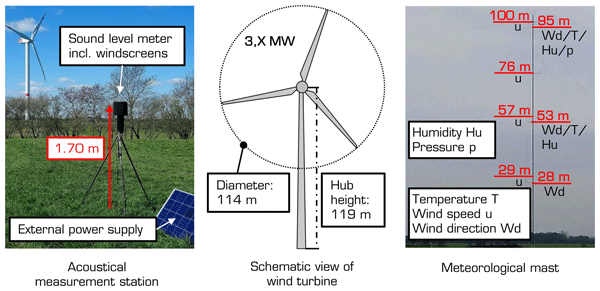
Extensive measurements in the area of wind turbines were performed in order to validate a sound propagation model. The measurements were carried out under various environmental conditions and included the acquisition of acoustical, meteorological and wind turbine performance data. By processing and analysing the measurement data, validation cases and input parameters for the propagation model were derived. Comparing measured and modelled propagation losses, generally good agreement is observed.
Franziska Schmidt, Clemens Hübler, and Raimund Rolfes
Wind Energ. Sci., 11, 3653–3670, https://doi.org/10.5194/wes-11-3653-2026, https://doi.org/10.5194/wes-11-3653-2026, 2026
Short summary
Short summary
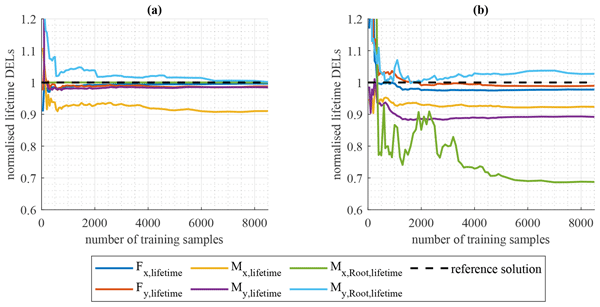
A lifetime reassessment of an offshore wind turbine using Kriging meta-models is performed. This method is compared to a full lifetime reassessment using aeroelastic simulations considering all actually occurring combinations of environmental parameters and to the approach according to International Electrotechnical Commission (IEC) 61400-3. By using the meta-models, the computing time can be significantly reduced compared to the other two methods, while ensuring a high approximation quality in the prediction of lifetime fatigue loads.
Jonathan Thurn, Clemens Jonscher, Benedikt Hofmeister, Gianluca Zorzi, and Raimund Rolfes
Wind Energ. Sci., 11, 3359–3376, https://doi.org/10.5194/wes-11-3359-2026, https://doi.org/10.5194/wes-11-3359-2026, 2026
Short summary
Short summary
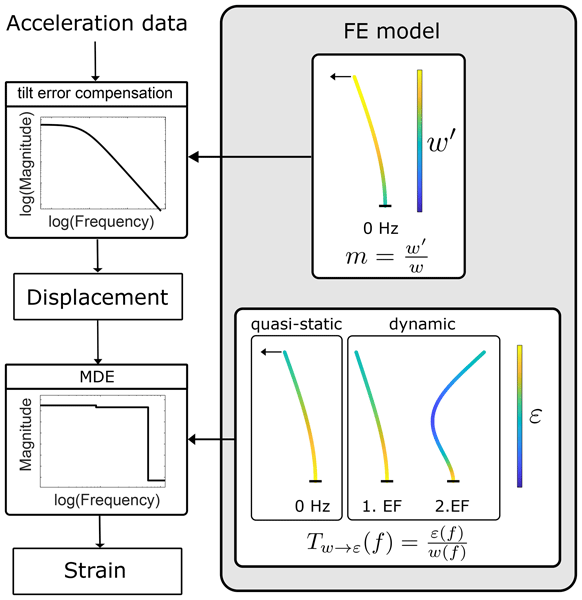
Load monitoring for wind turbine support structures is essential as turbines approach the end of their design life. Typically, load monitoring involves estimating strain from vibrational measurements. This paper introduces an approach that uses a biaxial and DC-capable acceleration sensor to estimate strains across all fatigue-relevant excitation frequencies on the entire support structure, enabled by compensating for gravity-induced biases in acceleration measurements.
Marlene Wolniak, Jasper Ragnitz, Clemens Jonscher, Benedikt Hofmeister, Helge Jauken, Clemens Hübler, and Raimund Rolfes
Wind Energ. Sci., 11, 1227–1249, https://doi.org/10.5194/wes-11-1227-2026, https://doi.org/10.5194/wes-11-1227-2026, 2026
Short summary
Short summary
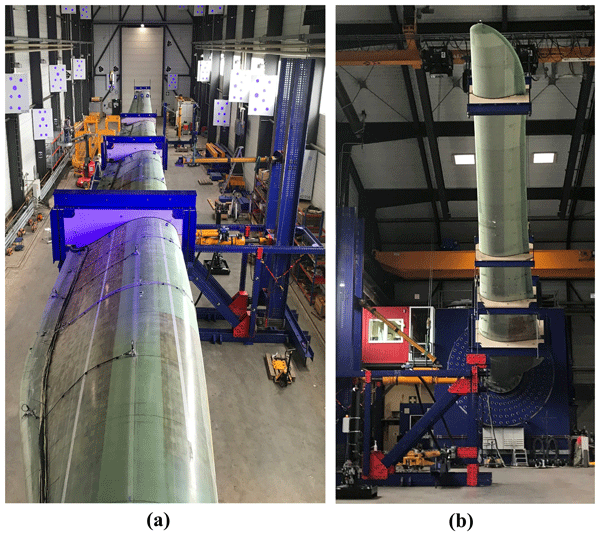
This study investigates how finite-element (FE) models of different fidelity affect the damage identification in a 31 m wind turbine rotor blade tested under edgewise fatigue loading. Different design variable configurations are compared, whereby the FE model updating is based on modal parameters identified from measured vibration data.
Franziska Schmidt, Clemens Hübler, and Raimund Rolfes
Wind Energ. Sci., 10, 3069–3089, https://doi.org/10.5194/wes-10-3069-2025, https://doi.org/10.5194/wes-10-3069-2025, 2025
Short summary
Short summary
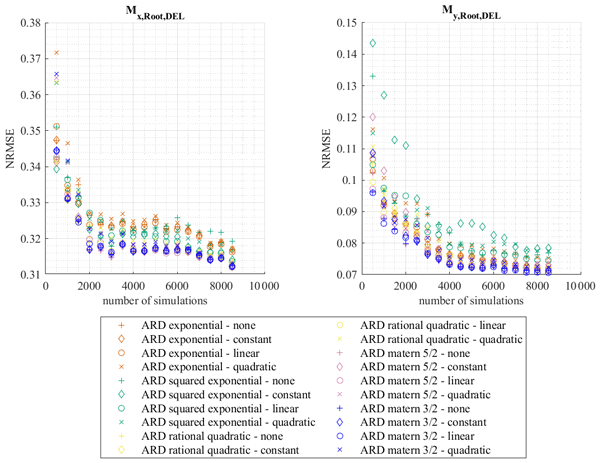
In this work, a Kriging meta-model of an idling offshore wind turbine is analysed in detail for the first time. It becomes clear that the findings regarding meta-modelling of the idling wind turbine are generally similar to the findings regarding meta-modelling of the same wind turbine in normal operation. However, for the approximation of the rotor blade root bending moments, two additional input parameters have to be included compared to the same wind turbine in operation.
Clemens Jonscher, Paula Helming, David Märtins, Andreas Fischer, David Bonilla, Benedikt Hofmeister, Tanja Grießmann, and Raimund Rolfes
Wind Energ. Sci., 10, 193–205, https://doi.org/10.5194/wes-10-193-2025, https://doi.org/10.5194/wes-10-193-2025, 2025
Short summary
Short summary
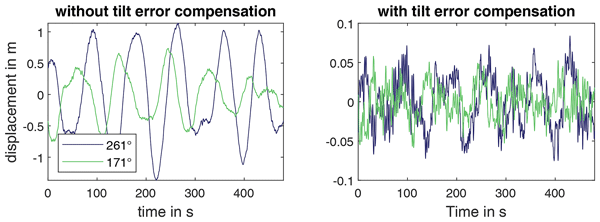
This study investigates dynamic displacement estimation using double-time-integrated acceleration signals for future application in load monitoring based on accelerometers. To estimate displacements without amplitude distortion, a tilt error compensation method for low-frequency vibrations of tower structures using the static bending line without the need for additional sensors is presented. The method is validated using a full-scale onshore wind turbine tower and a terrestrial laser scanner.
Susanne Könecke, Jasmin Hörmeyer, Tobias Bohne, and Raimund Rolfes
Wind Energ. Sci., 8, 639–659, https://doi.org/10.5194/wes-8-639-2023, https://doi.org/10.5194/wes-8-639-2023, 2023
Short summary
Short summary
Extensive measurements in the area of wind turbines were performed in order to validate a sound propagation model. The measurements were carried out under various environmental conditions and included the acquisition of acoustical, meteorological and wind turbine performance data. By processing and analysing the measurement data, validation cases and input parameters for the propagation model were derived. Comparing measured and modelled propagation losses, generally good agreement is observed.
Clemens Hübler and Raimund Rolfes
Wind Energ. Sci., 7, 1919–1940, https://doi.org/10.5194/wes-7-1919-2022, https://doi.org/10.5194/wes-7-1919-2022, 2022
Short summary
Short summary
Offshore wind turbines are beginning to reach their design lifetimes. Hence, lifetime extensions are becoming relevant. To make well-founded decisions on possible lifetime extensions, fatigue damage predictions are required. Measurement-based assessments instead of simulation-based analyses have rarely been conducted so far, since data are limited. Therefore, this work focuses on the temporal extrapolation of measurement data. It is shown that fatigue damage can be extrapolated accurately.
Clemens Jonscher, Benedikt Hofmeister, Tanja Grießmann, and Raimund Rolfes
Wind Energ. Sci., 7, 1053–1067, https://doi.org/10.5194/wes-7-1053-2022, https://doi.org/10.5194/wes-7-1053-2022, 2022
Short summary
Short summary
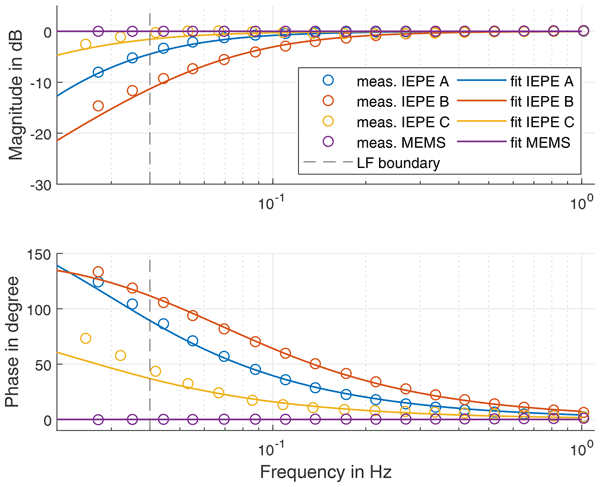
This work presents a method to use low-noise IEPE sensors in the low-frequency range down to 0.05 Hz. In order to achieve phase and amplitude accuracy with this type of sensor in the low-frequency range, a new calibration procedure for this frequency range was developed. The calibration enables the use of the low-noise IEPE sensors for large structures, such as wind turbines. The calibrated sensors can be used for wind turbine monitoring, such as fatigue monitoring.
Cited articles
Blumendeller, E., Gaßner, L., Müller, F. J. Y., Pohl, J., Hübner, G., Ritter, J., and Cheng, P. W.: Quantification of amplitude modulation of wind turbine emissions from acoustic and ground motion recordings, Acta Acust., 7, 55, https://doi.org/10.1051/aacus/2023047, 2023. a
Bolin, K.: Masking of Wind Turbine Sound by Ambient Noise, Licentiate thesis, KTH Royal Institute of Technology, School of Engineering Sciences (SCI), Stockholm, Sweden, https://kth.diva-portal.org/smash/get/diva2:11339/FULLTEXT01.pdf (last access: 16 February 2026), 2006. a
Bolin, K., Conrady, K., Karasalo, I., and Sjöblom, A.: An investigation of the influence of the refractive shadow zone on wind turbine noise, J. Acoust. Soc. Am., 148, EL166–EL171, https://doi.org/10.1121/10.0001589, 2020. a
Conrady, K., Sjöblom, A., and Larsson, C.: Impact of snow on sound propagating from wind turbines, Wind Energy, 21, 1282–1295, https://doi.org/10.1002/we.2254, 2018. a
Conrady, K., Bolin, K., Sjöblom, A., and Rutgersson, A.: Amplitude modulation of wind turbine sound in cold climates, Appl. Acoust., 158, 107024, https://doi.org/10.1016/j.apacoust.2019.107024, 2020. a, b
Evans, T. and Cooper, J.: Influence of wind direction on noise emission and propagation from wind turbines, in: Proceedings of Acoustics 2012, Australian Acoustical Society, Fremantle, Australia, https://www.acoustics.asn.au/conference_proceedings/AAS2012/papers/p139.pdf (last access: 6 February 2026), 2012. a
Fukushima, A., Yamamoto, K., Sueoka, S., Takahashi, H., Sakamoto, S., and Tachibana, H.: Study on the amplitude modulation of wind turbine noise: Part 1 – Physical investigation, in: Proceedings of InterNoise 2013 – 42nd International Congress and Exposition on Noise Control Engineering, pp. 1–10, International Institute of Noise Control Engineering (I-INCE), Innsbruck, Austria, https://docs.wind-watch.org/Fukushima-Internoise-2013.pdf (last access: 16 February 2026), 2013. a, b
Hansen, K.: Long-term investigation into wind farm amplitude modulation and annoyance, in: Acoustics 2021, Australian Acoustical Society, Wollongong, NSW, Australia, 1–15, https://acoustics.asn.au/conference_proceedings/AAS2021/papers/p100.pdf (last access: 16 February 2026), 2021. a
Hansen, K. L., Nguyen, P., Zajamšek, B., Catcheside, P., and Hansen, C. H.: Prevalence of wind farm amplitude modulation at long-range residential locations, J. Sound Vib., 455, 136–149, https://doi.org/10.1016/j.jsv.2019.05.008, 2019. a, b
International Electrotechnical Commission: IEC 61400-11: Wind turbine generator systems – Part 11: Acoustic noise measurement techniques, Edition 2.1. Genf., ISBN 2831886821, 2006. a
International Electrotechnical Commission: IEC 61672-1: Electroacoustics – Sound level meters – Part 1: Specifications, Edition 2.0. Geneva, https://doi.org/10.31030/2154580, 2013. a
International Electrotechnical Commission: IEC 61260-1: Electroacoustics – Octave-band and fractional-octave-band filters – Part 1: Specifications, Edition 1.0. Geneva, https://doi.org/10.31030/2231136, 2014. a
IOA: Methods for Rating Amplitude Modulation in Wind Turbine Noise: Discussion Document, Tech. rep., Institute of Acoustics (IOA), St Albans, Hertfordshire, UK, https://www.ioa.org.uk/sites/default/files/AMWG Discussion Document.pdf (last access: 16 February 2026), 2015. a
IOA: A Method for Rating Amplitude Modulation in Wind Turbine Noise: Final Report, Tech. rep., Institute of Acoustics (IOA), St Albans, Hertfordshire, UK, https://www.ioa.org.uk/sites/default/files/AMWG Final Report-09-08-2016_0.pdf (last access: 16 February 2026), 2016. a, b, c, d, e, f, g, h, i, j, k, l, m, n
Könecke, S., Hörmeyer, J., Bohne, T., and Rolfes, R.: A new base of wind turbine noise measurement data and its application for a systematic validation of sound propagation models, Wind Energ. Sci., 8, 639–659, https://doi.org/10.5194/wes-8-639-2023, 2023a. a, b
Könecke, S., Schössow, D., Preihs, S., Bohne, T., Grießmann, T., Peissig, J., and Rolfes, R.: WEA-Acceptance Data: Wind Turbine Dataset Including Acoustical, Meteorological and Turbine Parameters (Version 2.0), LUIS [data set], https://doi.org/10.25835/c2mv3d7z, 2023b. a
Könecke, S., Jonscher, C., Bohne, T., and Rolfes, R.: Detection Framework and Listening-Test Platform for the Identification of Wind Turbine Noise in Long-Term Field Measurements, LUIS [data set], https://doi.org/10.25835/nu70ehxy, 2026. a, b
Larsson, C. and Öhlund, O.: Amplitude modulation of sound from wind turbines under various meteorological conditions, J. Acoust. Soc. Am., 135, 67–73, https://doi.org/10.1121/1.4836135, 2014. a, b
Lundmark, G.: Measurement of swish noise, a new method, in: Proceedings of the Fourth International Meeting on Wind Turbine Noise, INCE/Europe, Rome, Italy, https://www.windturbinenoise.eu/files/wtn2011_portfolio_of_papers.pdf (last access: 12 May 2026), 2011. a
Martens, S., Boas, M., Bohne, T., and Rolfes, R.: Towards the use of secondary windscreens to improve wind turbine sound measurements, in: Proceedings of 15th EAWE PhD Seminar on Wind Energy, Nantes, France, https://www.researchgate.net/publication/338834113_Towards_the_use_of_secondary_windscreens_to_improve_wind_turbine_sound_measurements (last access: 16 February 2026), 2019a. a
Martens, S., Bohne, T., and Rolfes, R.: Measuring and Analysing the Sound Propagation of Wind Turbines, in: Proceedings of the 8th International Conference on Wind Turbine Noise, 1–12, Lisbon, Portugal, https://www.windturbinenoise.eu/files/wtn2019-papers-alphabetical.pdf (last access: 12 May 2026), 2019b. a, b
Martens, S., Bohne, T., and Rolfes, R.: An evaluation method for extensive wind turbine sound measurement data and its application, Proceedings of Meetings on Acoustics, Acoustical Society of America, 41, https://doi.org/10.1121/2.0001326, 2020. a, b, c
Moorhouse, A. T., Hayes, M., von Hunerbein, S., and Adams, M.: Research into aerodynamic modulation of wind turbine noise: Final report, Tech. rep., Salford University, https://salford-repository.worktribe.com/output/1469379/research-into-aerodynamic-modulation-of-wind-turbine-noise-final-report (last access: 12 May 2026), 2007. a
Nguyen, P. D., Hansen, K. L., Lechat, B., Catcheside, P., Zajamsek, B., and Hansen, C. H.: Benchmark characterisation and automated detection of wind farm noise amplitude modulation, Appl. Acoust., 183, 108286, https://doi.org/10.1016/j.apacoust.2021.108286, 2021. a, b
NSW DPHI: Wind Energy – Technical Supplement for Noise Impact Assessment, Tech. Rep. DOC24/867420, NSW Department of Planning, Housing and Infrastructure, https://www.planning.nsw.gov.au/sites/default/files/2024-11/wind-energy-guideline-noise-technical-supplement.pdf (last access: 16 February 2026), 2024. a
Öhlund, O. and Larsson, C.: Meteorological effects on wind turbine sound propagation, Appl. Acoust., 89, 34–41, https://doi.org/10.1016/j.apacoust.2014.09.009, 2015. a, b, c
Okada, Y., Yoshihisa, K., and Hyodo, S.: Directivity of amplitude modulation sound around a wind turbine under actual meteorological conditions, Acoustical Science and Technology, 40, 1–10, https://doi.org/10.1250/ast.40.1, 2019. a, b, c
Paulraj, T. and Välisuo, P.: Effect of wind speed and wind direction on amplitude modulation of wind turbine noise, in: INTER-NOISE and NOISE-CON Congress and Conference Proceedings, 255, 5479–5489, https://lipas.uwasa.fi/~pvs/Effect of wind speed and wind direction on amplitude modulation of wind turbine noise.pd (last access: 12 May 2026), 2017. a
Persson Waye, K. and Öhrström, E.: Psycho-acoustic characters of relevance for annoyance of wind turbine noise, J. Sound Vib., 250, 65–73, https://doi.org/10.1006/jsvi.2001.3905, 2002. a
Schössow, D., Preihs, S., and Peissig, J.: WEA-Acceptance Data – A Dataset of Acoustic, Meteorological, and Operational Wind Turbine Measurements, Data, 9, 46, https://doi.org/10.3390/data9030046, 2024. a
van den Berg, G. P.: Effects of the wind profile at night on wind turbine sound, J. Sound Vib., 277, 955–970, https://doi.org/10.1016/j.jsv.2003.09.050, 2004. a
Short summary
This paper presents a framework to identify wind turbine noise in long-term field measurements. By combining statistical criteria, turbine operating data, and physics-based signal analysis, periods dominated by wind turbine noise and its key components are detected. The framework is validated using a structured listening test and applied to a 1-month dataset. The framework, listening-test platform, and anonymized audio data are publicly available to support further research.
This paper presents a framework to identify wind turbine noise in long-term field measurements....


Altmetrics
Final-revised paper
Preprint