
Articles | Volume 11, issue 6
https://doi.org/10.5194/wes-11-2191-2026
© Author(s) 2026. This work is distributed under
the Creative Commons Attribution 4.0 License.
the Creative Commons Attribution 4.0 License.
https://doi.org/10.5194/wes-11-2191-2026
© Author(s) 2026. This work is distributed under
the Creative Commons Attribution 4.0 License.
the Creative Commons Attribution 4.0 License.
Research article
| 
19 Jun 2026
Research article |
| 19 Jun 2026
| 19 Jun 2026
Fast response methods for aero-elastic floating wind turbine design
Bogdan Pamfil
CORRESPONDING AUTHOR

DTU Wind and Energy Systems, Koppels Allé, Building 403, 2800 Kgs. Lyngby, Denmark
Henrik Bredmose
DTU Wind and Energy Systems, Koppels Allé, Building 403, 2800 Kgs. Lyngby, Denmark
Taeseong Kim
DTU Wind and Energy Systems, Koppels Allé, Building 403, 2800 Kgs. Lyngby, Denmark
Wind Energy Section, Faculty of Aerospace Engineering, Delft University of Technology, Kluyverweg 1, 2629 HS Delft, the Netherlands
Related authors
Bogdan Pamfil, Henrik Bredmose, and Taeseong Kim
Wind Energ. Sci., 10, 827–856, https://doi.org/10.5194/wes-10-827-2025, https://doi.org/10.5194/wes-10-827-2025, 2025
Short summary
Short summary
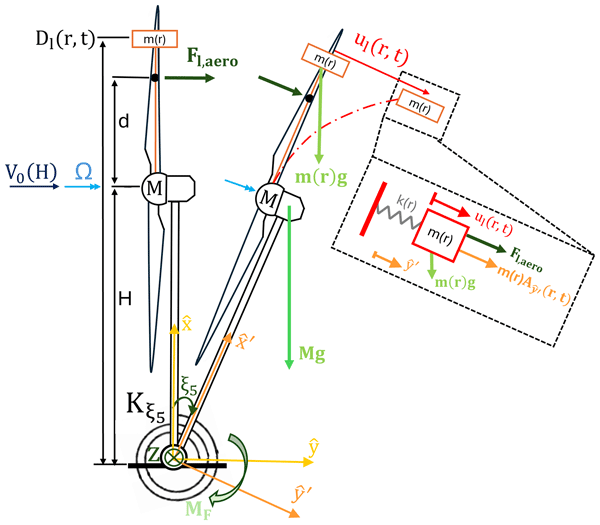
A floating wind turbine time domain model, which considers dynamic stall, is used to develop Coleman-free aero-elastic stability analysis methods, namely Hill's and Floquet's. We clarify how the floater tilt is involved in the stability analysis, show damping effects of aerodynamic states, prove that results of both methods agree and can reproduce the forward- and backward-whirling rotor modes in a Coleman-based analysis, and demonstrate that both methods can be applied to a two-bladed rotor.
Shantanu Purohit, Haoyuan Sun, Andrea Sciacchitano, and Wei Yu
Wind Energ. Sci., 11, 3671–3701, https://doi.org/10.5194/wes-11-3671-2026, https://doi.org/10.5194/wes-11-3671-2026, 2026
Short summary
Short summary
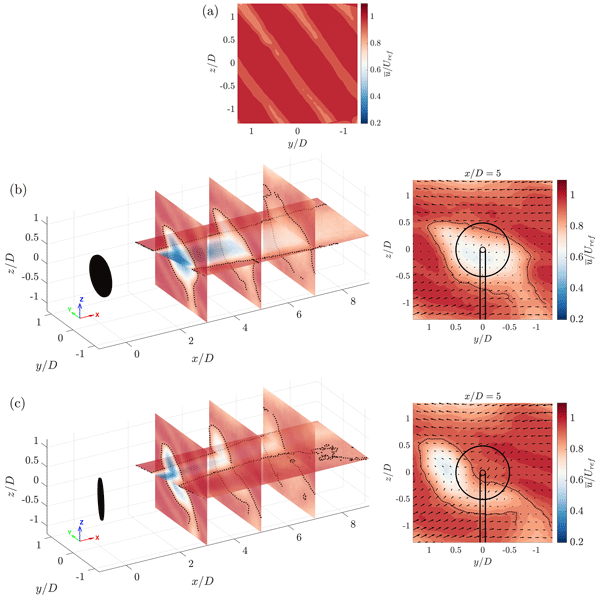
We experimentally investigated how changes in wind direction with height, known as wind veer, affect the wakes of wind turbines. The results demonstrate that wind veer leads to faster wake recovery and higher available power for downwind turbines. The impact of wind veer on yawed turbines is also studied, and it was observed that under strong veer conditions, yawing does not provide a significantly larger benefit for the available power of downwind turbines.
Ana Margarida Antunes, Andreas Zwölfer, David Robert Verelst, Riccardo Riva, Philipp Ulrich Haselbach, and Taeseong Kim
Wind Energ. Sci., 11, 3193–3212, https://doi.org/10.5194/wes-11-3193-2026, https://doi.org/10.5194/wes-11-3193-2026, 2026
Short summary
Short summary
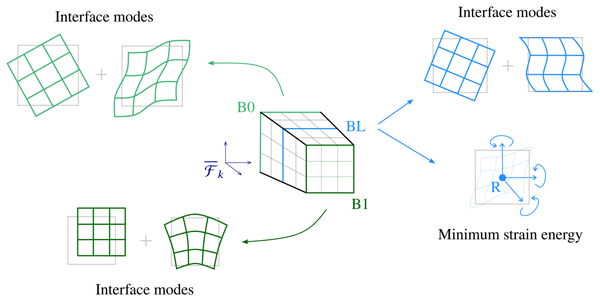
This study addresses the challenges of applying aerodynamic loads to a multibody reduced-order model based on solid finite elements. This model differs from the beam models typically used in wind turbine aeroelastic simulations by relying on a higher-fidelity finite element model. The results show that the proposed load application methodology produces accurate structural responses, while also identifying best practices for this process.
YuanTso Li, Andrea Sciacchitano, and Wei Yu
Wind Energ. Sci. Discuss., https://doi.org/10.5194/wes-2026-116, https://doi.org/10.5194/wes-2026-116, 2026
Preprint under review for WES
Short summary
Short summary
We investigate the regenerative wind farming (RGWF) concept under realistic atmospheric conditions using large-eddy simulations. The effects of convective, neutral, and stable atmospheric boundary layers on the wake of a multi-rotor system with lifting devices (MRSL, the unit of RGWF) are examined. The results show that RGWF concept remains effective across all stability regimes, demonstrating its robustness and providing guidance for its future design and deployment.
Abhratej Sahoo, Wei Yu, and Daniele Ragni
Wind Energ. Sci., 11, 1971–1988, https://doi.org/10.5194/wes-11-1971-2026, https://doi.org/10.5194/wes-11-1971-2026, 2026
Short summary
Short summary
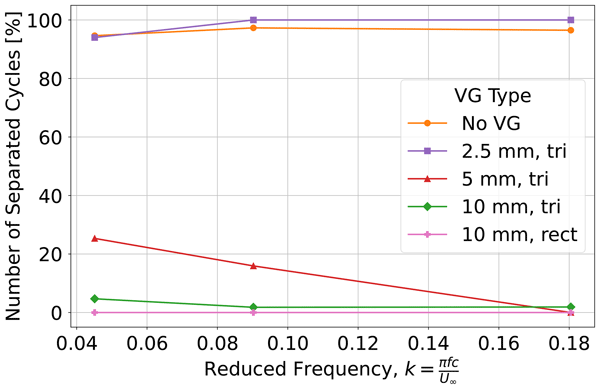
Vortex generators (VGs) are being used to prevent flow separation and stall on wind turbine blades. Optimal VG designs are chosen from steady investigations, assuming similar separation control characteristics between steady and unsteady conditions. Surface pressure measurements on a thick pitching airfoil with VGs show that VGs larger than the optimal steady size and rectangular VGs instead of the common triangular VGs must be used to consistently prevent unsteady flow separation and dynamic stall.
Marinos Manolesos, Sandrine Aubrun, Christian Bak, Paolo Bettini, Filippo Campagnolo, Alessandro Croce, Arslan Salim Dar, Michael Hölling, Stefan Ivanell, Konstantinos Kellaris, Miguel Alfonso Mendez, Pierluigi Montinari, Franz Mühle, George Papadakis, Fernardo Porté-Agel, Daniele Ragni, Sebastiano Randino, Andrea Sciacchitano, Lorenzo Schena, Gerard Schepers, Antonio Segalini, Wei Yu, and Carlo Luigi Bottasso
Wind Energ. Sci. Discuss., https://doi.org/10.5194/wes-2026-51, https://doi.org/10.5194/wes-2026-51, 2026
Manuscript not accepted for further review
Short summary
Short summary
As wind turbines grow to unprecedented sizes, ensuring their reliability requires advanced testing. We reviewed the current state of wind tunnel experiments, examining how scaled physical models are evaluated for wind flow, flexibility, and noise. We conclude that while laboratory testing remains essential, it is most powerful when integrated with computer simulations and real-world data. This combined approach will ultimately drive the design of more efficient and sustainable wind energy.
Abhratej Sahoo, Akshay Koodly Ravishankara, Wei Yu, Daniele Ragni, and Carlos Simao Ferreira
Wind Energ. Sci., 11, 127–154, https://doi.org/10.5194/wes-11-127-2026, https://doi.org/10.5194/wes-11-127-2026, 2026
Short summary
Short summary
A new model incorporates vortex generator (VG) effects into fast aerodynamic tools like XFOIL and RFOIL. It modifies boundary layer equations and uses empirical functions scaled with VG geometry and Reynolds numbers to implement the modified integral boundary layer equations in RFOIL. The model improves accuracy across airfoils and predicts separation delay, stall delay, lift increase, and added drag, enabling VG effects to be included in wind turbine blade design.
YuanTso Li, Marnix Fijen, Brian Dsouza, Wei Yu, Andrea Sciacchitano, and Carlos Ferreira
Wind Energ. Sci., 10, 3091–3124, https://doi.org/10.5194/wes-10-3091-2025, https://doi.org/10.5194/wes-10-3091-2025, 2025
Short summary
Short summary
We tested an innovative wind farm concept using novelly engineered wind turbine systems that can guide airflow more efficiently within the farm. Our experiments showed that wind farms deploying this concept can harvest more than twice the wind power per unit area compared to their traditional counterparts. Furthermore, these findings support earlier simulations and point to a more efficient space-saving future for wind energy.
Pin Chun Yen, YuanTso Li, Fulvio Scarano, and Wei Yu
Wind Energ. Sci., 10, 1775–1805, https://doi.org/10.5194/wes-10-1775-2025, https://doi.org/10.5194/wes-10-1775-2025, 2025
Short summary
Short summary
This study explores how changing wind turbine blade length affects the aerodynamics behind the turbine. Using high-fidelity simulations, we found that varying blade lengths accelerates the leapfrogging event but does not improve wake recovery directly. In contrast, turbulence plays a bigger role, as the wake breakdown process is more influenced by it over the studied rotor asymmetries. These findings provide insights for designing more efficient wind turbine rotors.
Bogdan Pamfil, Henrik Bredmose, and Taeseong Kim
Wind Energ. Sci., 10, 827–856, https://doi.org/10.5194/wes-10-827-2025, https://doi.org/10.5194/wes-10-827-2025, 2025
Short summary
Short summary
A floating wind turbine time domain model, which considers dynamic stall, is used to develop Coleman-free aero-elastic stability analysis methods, namely Hill's and Floquet's. We clarify how the floater tilt is involved in the stability analysis, show damping effects of aerodynamic states, prove that results of both methods agree and can reproduce the forward- and backward-whirling rotor modes in a Coleman-based analysis, and demonstrate that both methods can be applied to a two-bladed rotor.
YuanTso Li, Wei Yu, Andrea Sciacchitano, and Carlos Ferreira
Wind Energ. Sci., 10, 631–659, https://doi.org/10.5194/wes-10-631-2025, https://doi.org/10.5194/wes-10-631-2025, 2025
Short summary
Short summary
A novel wind farm concept, called a regenerative wind farm, is investigated numerically. This concept tackles the significant wake interaction losses among traditional wind farms. Our results show that regenerative wind farms can greatly reduce these losses, boosting power output per unit surface. Unlike traditional farms with three-bladed wind turbines, regenerative farms use multi-rotor systems with lifting devices (MRSLs). This unconventional design effectively reduces wake losses.
Nirav Dangi, Koen Boorsma, Edwin Bot, Wim Bierbooms, and Wei Yu
Wind Energ. Sci. Discuss., https://doi.org/10.5194/wes-2023-90, https://doi.org/10.5194/wes-2023-90, 2023
Preprint withdrawn
Short summary
Short summary
The wind turbine wake is a downstream region of velocity deficit, resulting in a power loss for downstream wind turbines. A turbulator is proposed to minimize this velocity deficit. In this work, a very successful field test campaign was executed which demonstrated the use of segmented Gurney Flaps as a promising add-on to promote enhanced wind turbine wake recovery for improved overall wind farm farm performance.
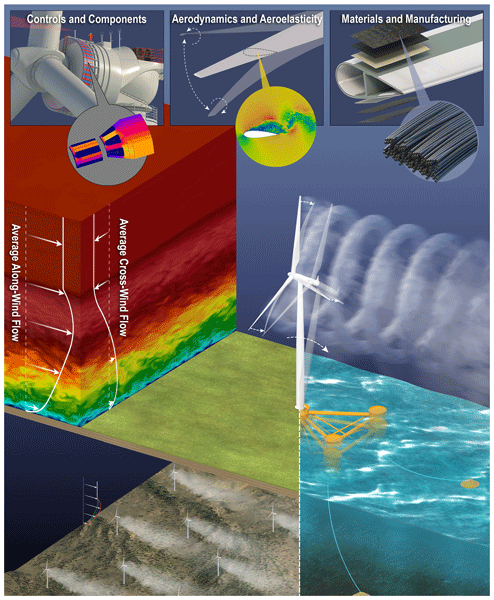
Paul Veers, Carlo L. Bottasso, Lance Manuel, Jonathan Naughton, Lucy Pao, Joshua Paquette, Amy Robertson, Michael Robinson, Shreyas Ananthan, Thanasis Barlas, Alessandro Bianchini, Henrik Bredmose, Sergio González Horcas, Jonathan Keller, Helge Aagaard Madsen, James Manwell, Patrick Moriarty, Stephen Nolet, and Jennifer Rinker
Wind Energ. Sci., 8, 1071–1131, https://doi.org/10.5194/wes-8-1071-2023, https://doi.org/10.5194/wes-8-1071-2023, 2023
Short summary
Short summary
Critical unknowns in the design, manufacturing, and operation of future wind turbine and wind plant systems are articulated, and key research activities are recommended.
Carlos Ferreira, Wei Yu, Arianna Sala, and Axelle Viré
Wind Energ. Sci., 7, 469–485, https://doi.org/10.5194/wes-7-469-2022, https://doi.org/10.5194/wes-7-469-2022, 2022
Short summary
Short summary
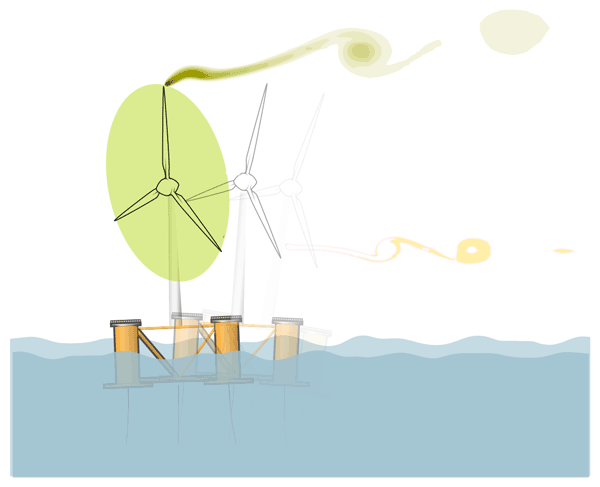
Floating offshore wind turbines may experience large surge motions that, when faster than the local wind speed, cause rotor–wake interaction.
We derive a model which is able to predict the wind speed at the wind turbine, even for large and fast motions and load variations in the wind turbine.
The proposed dynamic inflow model includes an adaptation for highly loaded flow, and it is accurate and simple enough to be easily implemented in most blade element momentum design models.
Cited articles
Abdelmoteleb, S.-E. and Bachynski-Polić, E. E.: Evaluating Different Approaches for Modelling Rotor Aero-servo-dynamics in Frequency-Domain Analysis of Floating Wind Turbines, Authorea [preprint], https://doi.org/10.22541/au.171011099.94143130/v1, 2024. a
Abdelmoteleb, S.-E. and Bachynski-Polić, E. E.: A frequency-domain optimization procedure for catenary and semi-taut mooring systems of floating wind turbines, Marine Struct., 101, 103768, https://doi.org/10.1016/j.marstruc.2024.103768, 2025. a
Bangga, G., Parkinson, S., and Collier, W.: Development and Validation of the IAG Dynamic Stall Model in State-Space Representation for Wind Turbine Airfoils, Energies, 16, https://doi.org/10.3390/en16103994, 2023. a, b
Bender, C. M. and Orszag, S. A.: Advanced Mathematical Methods for Scientists and Engineers I: Asymptotic Methods and Perturbation Theory, Springer, New York, NY, 1st edn., ISBN 978-0-387-98931-0, https://doi.org/10.1007/978-1-4757-3069-2, originally published by McGraw Hill, 1978. Part of the Springer Book Archive. Perturbation theory is covered in Part III, titled “Perturbation Methods”. Chapter 7, “Perturbation Series”, 319–367, 1999. a
Bir, G.: Multi-Blade Coordinate Transformation and its Application to Wind Turbine Analysis, 46th AIAA Aerospace Sciences Meeting and Exhibit, 7–10 January 2008, Reno, Nevada, https://doi.org/10.2514/6.2008-1300, 2008. a
Borg, M., Pegalajar-Jurado, A., Stiesdal, H., Madsen, F., Nielsen, T., Mikkelsen, R., Mirzaei, M., Lomholt, A., and Bredmose, H.: Dynamic response analysis of the TetraSpar floater in waves: Experiment and numerical reproduction, Marine Struct., 94, https://doi.org/10.1016/j.marstruc.2023.103546, 2024. a
Coleman, R. P. and Feingold, A. M.: Theory of Self-Excited Mechanical Oscillations of Helicopter Rotors with Hinged Blades (NACA Report 1351), National Advisory Committee for Aeronautics, Handle: 2060/19930092339, 1958. a
Cooley, J. W. and Tukey, J. W.: An Algorithm for the Machine Calculation of Complex Fourier Series, Math. Comput., 19, 297–301, https://doi.org/10.2307/2003354, 1965. a, b
de Hoog, F. R., Knight, J. H., and Stokes, A. N.: An Improved Method for Numerical Inversion of Laplace Transforms, SIAM Journal on Scientific and Statistical Computing, 3, 357–366, https://doi.org/10.1137/0903022, 1982. a
Floquet, G.: Sur les équations différentielles linéaires à coefficients périodiques, Annales scientifiques de l'École Normale Supérieure, 2e série, 12, 47–88, https://doi.org/10.24033/asens.220, 1883. a
Hall, M., Housner, S., Zalkind, D., Bortolotti, P., Ogden, D., and Barter, G.: An Open-Source Frequency-Domain Model for Floating Wind Turbine Design Optimization, J. Phys. Conf. Ser., 2265, 042020, https://doi.org/10.1088/1742-6596/2265/4/042020, 2022. a, b
Hall, M., West, W., Housner, S., and Lozon, E.: Efficient Modeling of Floating Wind Arrays Including Current Loads and Seabed Bathymetry, in: Proceedings of the ASME 2023 International Offshore Wind Technical Conference, vol. 1, pp. 1–9, American Society of Mechanical Engineers, https://doi.org/10.1115/IOWTC2023-119447, 2023. a
Hansen, M.: Aerodynamics of wind turbines, Earthscan, 3rd edn., ISBN 9781138775077, 2015. a
Hansen, M. H.: Modal dynamics of structures with bladed isotropic rotors and its complexity for two-bladed rotors, Wind Energ. Sci., 1, 271–296, https://doi.org/10.5194/wes-1-271-2016, 2016. a
Hill, G. W.: On the part of the motion of the lunar perigee which is a function of the mean motions of the sun and moon, Acta Mathematica, 36, 1871–2509, https://doi.org/10.1007/BF02417081, 1886. a, b
Larsen, T. J. and Hanson, T. D.: A method to avoid negative damped low frequent tower vibrations for a floating, pitch controlled wind turbine, J. Phys. Conf. Ser., 75, 012073, https://doi.org/10.1088/1742-6596/75/1/012073, 2007. a
Leishman, J. G. and Beddoes, T. S.: A Generalised Model for Airfoil Unsteady Aerodynamic Behaviour and Dynamic Stall Using the Indicial Method, in: Proceedings of the 42nd Annual Forum of the American Helicopter Society, pp. 1–23, presented at the 42nd Annual Forum, American Helicopter Society, Washington, D.C., USA, 1986. a
Lemmer, F., Müller, K., Yu, W., Schlipf, D., and Cheng, P. W.: Optimization of Floating Offshore Wind Turbine Platforms with a Self-Tuning Controller, in: Proceedings of the ASME 2017 36th International Conference on Ocean, Offshore and Arctic Engineering, 10, 1–8, American Society of Mechanical Engineers, https://doi.org/10.18419/opus-9174, 2017. a
Lemmer, F., Yu, W., Luhmann, B., Schlipf, D., and Cheng, P. W.: Multibody modeling for concept-level floating offshore wind turbine design, Multibody System Dynamics, 49, 203–236, https://doi.org/10.1007/s11044-020-09729-x, 2020a. a
Lemmer, F., Yu, W., Schlipf, D., and Cheng, P. W.: Robust gain scheduling baseline controller for floating offshore wind turbines, Wind Energy, 23, 17–30, https://doi.org/10.1002/we.2408, 2020b. a
Lemmer, F., Yu, W., Steinacker, H., Skandali, D., and Raach, S.: Advances on Reduced-Order Modeling of Floating Offshore Wind Turbines, Volume 9: Ocean Renewable Energy, V009T09A034, https://doi.org/10.1115/OMAE2021-63701, 2021. a
Lozon, E., Hall, M., and Mahfouz, M. Y.: Coupled modeling of wake steering and platform offsets for floating wind arrays, J. Phys. Conf. Ser., 2767, 062035, https://doi.org/10.1088/1742-6596/2767/6/062035, 2024. a
Madsen, F. J., Pegalajar-Jurado, A., and Bredmose, H.: Performance study of the QuLAF pre-design model for a 10 MW floating wind turbine, Wind Energ. Sci., 4, 527–547, https://doi.org/10.5194/wes-4-527-2019, 2019. a
Mann, J.: The spatial structure of neutral atmospheric surface-layer turbulence, J. Fluid Mech., 273, 141–168, https://doi.org/10.1017/S0022112094001886, 1994. a, b
Pegalajar-Jurado, A., Borg, M., and Bredmose, H.: An efficient frequency-domain model for quick load analysis of floating offshore wind turbines, Wind Energ. Sci., 3, 693–712, https://doi.org/10.5194/wes-3-693-2018, 2018. a, b, c
Pollini, N., Pegalajar-Jurado, A., and Bredmose, H.: Design optimization of a TetraSpar-type floater and tower for the IEA Wind 15 MW reference wind turbine, Marine Struct., 90, https://doi.org/10.1016/j.marstruc.2023.103437, 2023. a
Schlipf, D., Schlipf, D., and Kühn, M.: Nonlinear Model Predictive Control of Wind Turbines Using LIDAR, Wind Energy, 16, https://doi.org/10.1002/we.1533, 2013. a
Skjoldan, P.: Modal Dynamics of Wind Turbines with Anisotropic Rotors, https://doi.org/10.2514/6.2009-1036, 2009. a
Stehfest, H.: Algorithm 368: Numerical Inversion of Laplace Transforms [D5], Communications of the ACM, 13, 47–49, https://doi.org/10.1145/361953.361969, 1970. a
Talbot, A.: The accurate numerical inversion of Laplace transforms, J. I. Math. Appl., 23, 97–120, https://doi.org/10.1093/imamat/23.1.97, 1979. a
Zalkind, D. and Bortolotti, P.: Control Co-Design Studies for a 22 MW Semisubmersible Floating Wind Turbine Platform, J. Phys. Conf. Ser., 2767, 082020, https://doi.org/10.1088/1742-6596/2767/8/082020, 2024. a
Short summary
We introduce fast response methods to predict how floating wind turbines behave in early design stages. By transforming the equations of motion into a form that is easier to compute, our approach avoids longer simulations while preserving accuracy. We developed both single and double perturbation methods, which run far faster than standard models with errors under 3.5 %. The single perturbation method at second order offers the strongest balance of speed and accuracy.
We introduce fast response methods to predict how floating wind turbines behave in early design...


Altmetrics
Final-revised paper
Preprint