
Articles | Volume 11, issue 7
https://doi.org/10.5194/wes-11-2495-2026
© Author(s) 2026. This work is distributed under
the Creative Commons Attribution 4.0 License.
the Creative Commons Attribution 4.0 License.
https://doi.org/10.5194/wes-11-2495-2026
© Author(s) 2026. This work is distributed under
the Creative Commons Attribution 4.0 License.
the Creative Commons Attribution 4.0 License.
Research article
| 
20 Jul 2026
Research article |
| 20 Jul 2026
| 20 Jul 2026
Influence of the inflow conditions on the dynamics of a floating wind turbine wake under harmonic surge motion
Dimas Alejandro Barile
Universidad de Buenos Aires, Facultad de Ingeniería, Av. Paseo Colón 850, Buenos Aires, C1063ACV, Argentina
CONICET, Centro de Simulación Computacional para Aplicaciones Tecnológicas, Godoy Cruz 2390, Buenos Aires, C1425FQD, Argentina
Roberto Sosa
Universidad de Buenos Aires, Facultad de Ingeniería, Av. Paseo Colón 850, Buenos Aires, C1063ACV, Argentina
CONICET – INTECIN, Av. Paseo Colón 850, Buenos Aires, C1063ACV, Argentina
Sandrine Aubrun
Nantes Université, École Centrale Nantes, CNRS, LHEEA, UMR 6598, 44000 Nantes, France

Universidad de Buenos Aires, Facultad de Ingeniería, Av. Paseo Colón 850, Buenos Aires, C1063ACV, Argentina
CONICET, Centro de Simulación Computacional para Aplicaciones Tecnológicas, Godoy Cruz 2390, Buenos Aires, C1425FQD, Argentina
Related authors
Dimas Alejandro Barile, Roberto Sosa, Sandrine Aubrun, and Alejandro Daniel Otero
Wind Energ. Sci. Discuss., https://doi.org/10.5194/wes-2025-2, https://doi.org/10.5194/wes-2025-2, 2025
Manuscript not accepted for further review
Short summary
Short summary
This work sets out a novel methodology for the CFD simulation of an ABL wind tunnel flow. Initially, the scheme is well validated against experimental measurements, and then it is applied to the study of a floating offshore wind turbine model under surge motion with varying turbulence intensities and motion frequencies. New insights are gained related to wake recovery of a wind turbine under surge motion, as certain frequency cases exhibit a distinctive behaviour regarding coherence structures.
Marinos Manolesos, Sandrine Aubrun, Christian Bak, Paolo Bettini, Filippo Campagnolo, Alessandro Croce, Arslan Salim Dar, Michael Hölling, Stefan Ivanell, Konstantinos Kellaris, Miguel Alfonso Mendez, Pierluigi Montinari, Franz Mühle, George Papadakis, Fernardo Porté-Agel, Daniele Ragni, Sebastiano Randino, Andrea Sciacchitano, Lorenzo Schena, Gerard Schepers, Antonio Segalini, Wei Yu, and Carlo Luigi Bottasso
Wind Energ. Sci. Discuss., https://doi.org/10.5194/wes-2026-51, https://doi.org/10.5194/wes-2026-51, 2026
Manuscript not accepted for further review
Short summary
Short summary
As wind turbines grow to unprecedented sizes, ensuring their reliability requires advanced testing. We reviewed the current state of wind tunnel experiments, examining how scaled physical models are evaluated for wind flow, flexibility, and noise. We conclude that while laboratory testing remains essential, it is most powerful when integrated with computer simulations and real-world data. This combined approach will ultimately drive the design of more efficient and sustainable wind energy.
Antonin Hubert, Boris Conan, and Sandrine Aubrun
Wind Energ. Sci. Discuss., https://doi.org/10.5194/wes-2026-41, https://doi.org/10.5194/wes-2026-41, 2026
Preprint under review for WES
Short summary
Short summary
This article aims at refining the description of the wake of a floating wind turbine subjected to surge motion, and at extracting the related wake dynamics. A critical frequency at which the impact of the motion seems to be the greatest is found, and the spatiotemporal response of the wake is analyzed using phase-averaging processes. Additionally to previous results, shear effects seem to incline the surge-generated coherent structures, and an extra far wake meandering appears.
Carlo L. Bottasso, Sandrine Aubrun, Nicolaos A. Cutululis, Julia Gottschall, Athanasios Kolios, Jakob Mann, and Paul Veers
Wind Energ. Sci., 11, 347–348, https://doi.org/10.5194/wes-11-347-2026, https://doi.org/10.5194/wes-11-347-2026, 2026
Short summary
Short summary
This editorial celebrates the 10th anniversary of Wind Energy Science, reflecting on a decade of rapid scientific progress and the journal’s role in advancing fundamental, interdisciplinary research. It highlights key developments in wind energy, the importance of open science and academia–industry collaboration, and emerging challenges such as data sharing and artificial intelligence. Above all, it honors the research community that has shaped the journal and looks ahead to the next decade.
Caroline Braud, Pascal Keravec, Ingrid Neunaber, Sandrine Aubrun, Jean-Luc Attié, Pierre Durand, Philippe Ricaud, Jean-François Georgis, Emmanuel Leclerc, Lise Mourre, and Claire Taymans
Wind Energ. Sci., 10, 1929–1942, https://doi.org/10.5194/wes-10-1929-2025, https://doi.org/10.5194/wes-10-1929-2025, 2025
Short summary
Short summary
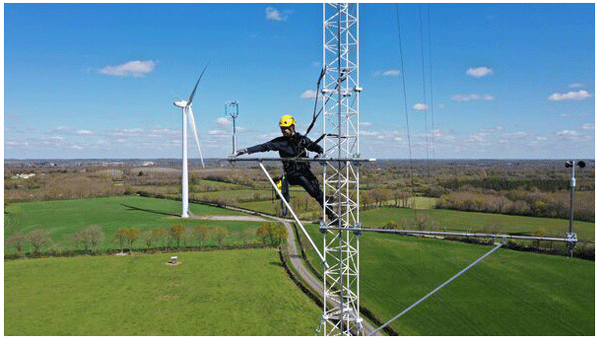
A 3-year meteorological dataset from an operational wind farm of six 2 MW (megawatt) turbines has been made available. This includes a meteorological mast equipped with sonic anemometers at four different heights and radiometer measurements for atmospheric stability analysis. Simultaneously, supervisory control and data acquisition (SCADA) and the scanned geometry of the turbine blades are provided. This database has been made accessible to the research community (https://awit.aeris-data.fr).
Antonin Hubert, Boris Conan, and Sandrine Aubrun
Wind Energ. Sci., 10, 1351–1368, https://doi.org/10.5194/wes-10-1351-2025, https://doi.org/10.5194/wes-10-1351-2025, 2025
Short summary
Short summary
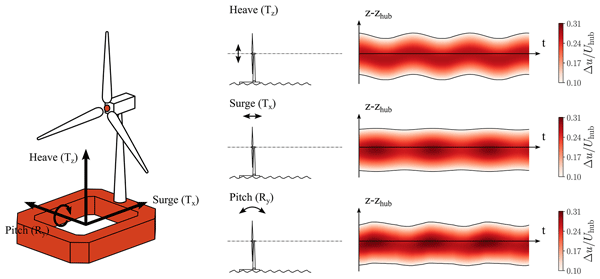
The paper aims to study the far wake of a wind turbine under realistic inflow conditions subjected to harmonic floating motions. The present work shows that phase averaging enables the observation of the coherent spatiotemporal wake behaviour in response to the harmonic motions, contrary to previous studies with time averaging, and that the resulting variations in the chosen metrics exhibit an intensity higher than those expected when using basic quasi-steady-state approaches.
Dimas Alejandro Barile, Roberto Sosa, Sandrine Aubrun, and Alejandro Daniel Otero
Wind Energ. Sci. Discuss., https://doi.org/10.5194/wes-2025-2, https://doi.org/10.5194/wes-2025-2, 2025
Manuscript not accepted for further review
Short summary
Short summary
This work sets out a novel methodology for the CFD simulation of an ABL wind tunnel flow. Initially, the scheme is well validated against experimental measurements, and then it is applied to the study of a floating offshore wind turbine model under surge motion with varying turbulence intensities and motion frequencies. New insights are gained related to wake recovery of a wind turbine under surge motion, as certain frequency cases exhibit a distinctive behaviour regarding coherence structures.
Benyamin Schliffke, Boris Conan, and Sandrine Aubrun
Wind Energ. Sci., 9, 519–532, https://doi.org/10.5194/wes-9-519-2024, https://doi.org/10.5194/wes-9-519-2024, 2024
Short summary
Short summary
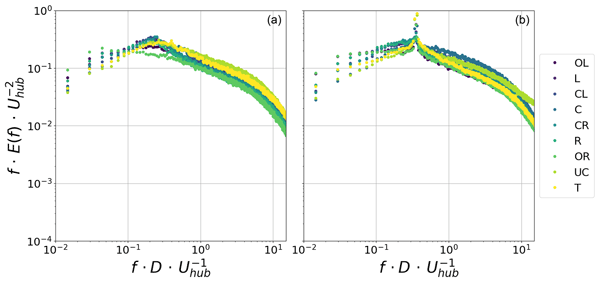
This paper studies the consequences of floater motions for the wake properties of a floating wind turbine. Since wake interactions are responsible for power production loss in wind farms, it is important that we know whether the tools that are used to predict this production loss need to be upgraded to take into account these aspects. Our wind tunnel study shows that the signature of harmonic floating motions can be observed in the far wake of a wind turbine, when motions have strong amplitudes.
Gonzalo Pablo Navarro Diaz, Alejandro Daniel Otero, Henrik Asmuth, Jens Nørkær Sørensen, and Stefan Ivanell
Wind Energ. Sci., 8, 363–382, https://doi.org/10.5194/wes-8-363-2023, https://doi.org/10.5194/wes-8-363-2023, 2023
Short summary
Short summary
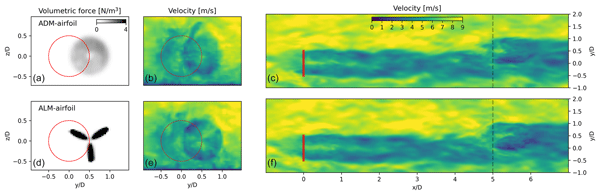
In this paper, the capacity to simulate transient wind turbine wake interaction problems using limited wind turbine data has been extended. The key novelty is the creation of two new variants of the actuator line technique in which the rotor blade forces are computed locally using generic load data. The analysis covers a partial wake interaction case between two wind turbines for a uniform laminar inflow and for a turbulent neutral atmospheric boundary layer inflow.
Cited articles
Ali, N., Calaf, M., and Cal, R. B.: Cluster-based probabilistic structure dynamical model of wind turbine wake, J. Turbul., 22, 497–516, 2021. a
Allen, C., Viscelli, A., Dagher, H., Goupee, A., Gaertner, E., Abbas, N., Hall, M., and Barter, G.: Definition of the UMaine VolturnUS-S reference platform developed for the IEA wind 15-megawatt offshore reference wind turbine, Tech. rep., National Renew. Energ. Laboratory (NREL), https://doi.org/10.2172/1660012, 2020. a
Andersen, S. J., Sørensen, J. N., and Mikkelsen, R.: Reduced order model of the inherent turbulence of wind turbine wakes inside an infinitely long row of turbines, J. Phys. Conf. Ser., 555, 012005, https://doi.org/10.1088/1742-6596/555/1/012005, 2014. a
Arabgolarcheh, A., Micallef, D., Rezaeiha, A., and Benini, E.: Modelling of two tandem floating offshore wind turbines using an actuator line model, Renew. Energ., 216, 119067, https://doi.org/10.1016/j.renene.2023.119067, 2023a. a, b
Aubrun, S., Bastankhah, M., Cal, R., Conan, B., Hearst, R., Hoek, D., Hölling, M., Huang, M., Hur, C., Karlsen, B., Neunaber, I., Obligado, M., Peinke, J., Percin, M., Saetran, L., Schito, P., Schliffke, B., Sims-Williams, D., Uzol, O., Vinnes, M., and Zasso, A.: Round-robin tests of porous disc models, J. Phys. Conf. Ser., 1256, 012004, https://doi.org/10.1088/1742-6596/1256/1/012004, 2019. a, b
Barile, D. A., Sosa, R., Aubrun, S., and Otero, A. D.: Wake study of a FOWT model under surge motion: a POD analysis, in: Wind Energy Science Conference, European Academy of Wind Energy; Centrale Nantes, June 2025, Nantes, France, 2025. a
Bastine, D., Witha, B., Wächter, M., and Peinke, J.: POD Analysis of a Wind Turbine Wake in a Turbulent Atmospheric Boundary Layer, J. Phys. Conf. Ser., 524, 012153, https://doi.org/10.1088/1742-6596/524/1/012153, 2014. a
Bastine, D., Witha, B., Wächter, M., and Peinke, J.: Towards a Simplified DynamicWake Model Using POD Analysis, Energies, 8, 895–920, https://doi.org/10.3390/en8020895, 2015. a
Belvasi, N., Conan, B., Schliffke, B., Perret, L., Desmond, C., Murphy, J., and Aubrun, S.: Far-Wake Meandering of a Wind Turbine Model with Imposed Motions: An Experimental S-PIV Analysis, Energies, 15, https://doi.org/10.3390/en15207757, 2022. a
Chen, Z., Wei, C., Chen, Z., Wang, S., and Tang, L.: Numerical Simulation of Atmospheric Boundary Layer Turbulence in a Wind Tunnel Based on a Hybrid Method, Atmosphere, 13, 2044, https://doi.org/10.3390/atmos13122044, 2022. a
Cherubini, S., Cillis, G. D., Semeraro, O., Leonardi, S., and Palma, P.: How incoming turbulence affects wake recovery of an NREL-5MW wind turbine, J. Phys. Conf. Ser., 2385, 012139, https://doi.org/10.1088/1742-6596/2385/1/012139, 2022. a
Churchfield, M., Lee, S., Moriarty, P., Martinez, L., Leonardi, S., Vijayakumar, G., and Brasseur, J.: A large-eddy simulation of wind-plant aerodynamics, in: 50th AIAA aerospace sciences meeting including the new horizons forum and aerospace exposition, p. 537, https://doi.org/10.2514/6.2012-537, 2012a. a, b, c
Churchfield, M. J., Lee, S., Michalakes, J., and Moriarty, P. J.: A numerical study of the effects of atmospheric and wake turbulence on wind turbine dynamics, J. Turbul., 13, N14, https://doi.org/10.1080/14685248.2012.668191, 2012b. a, b, c
Duan, L., Sun, Q., He, Z., and Li, G.: Wake topology and energy recovery in floating horizontal-axis wind turbines with harmonic surge motion, Energy, 260, 124907, https://doi.org/10.1016/j.energy.2022.124907, 2022. a, b
Farrugia, R., Sant, T., and Micallef, D.: A study on the aerodynamics of a floating wind turbine rotor, Renew. Energ., 86, 770–784, 2016. a
Fontanella, A., Bayati, I., Mikkelsen, R., Belloli, M., and Zasso, A.: UNAFLOW: a holistic wind tunnel experiment about the aerodynamic response of floating wind turbines under imposed surge motion, Wind Energ. Sci., 6, 1169–1190, https://doi.org/10.5194/wes-6-1169-2021, 2021. a
Fontanella, A., Facchinetti, A., Di Carlo, S., and Belloli, M.: Wind tunnel investigation of the aerodynamic response of two 15 MW floating wind turbines, Wind Energ. Sci., 7, 1711–1729, https://doi.org/10.5194/wes-7-1711-2022, 2022a. a
Fontanella, A., Zasso, A., and Belloli, M.: Wind tunnel investigation of the wake-flow response for a floating turbine subjected to surge motion, J. Phys. Conf. Ser., 2265, 042023, https://doi.org/10.1088/1742-6596/2265/4/042023, 2022b. a
Gaertner, E., Rinker, J., Sethuraman, L., Zahle, F., Anderson, B., Barter, G., Abbas, N., Meng, F., Bortolotti, P., Skrzypinski, W., Scott, G. N., Feil, R., Bredmose, H., Dykes, K., Shields, M., Allen, C., and Viselli, A.: IEA Wind TCP Task 37: Definition of the IEA 15-Megawatt Offshore Reference Wind Turbine, https://doi.org/10.2172/1603478, 2020. a
Hamilton, N., Viggiano, B., Calaf, M., Tutkun, M., and Cal, R. B.: A generalized framework for reduced-order modeling of a wind turbine wake, Wind Energ., 21, 373–390, https://doi.org/10.1002/we.2167, 2018. a
Hodgson, E. L., Andersen, S. J., Troldborg, N., Forsting, A. M., Mikkelsen, R. F., and Sørensen, J. N.: A Quantitative Comparison of Aeroelastic Computations using Flex5 and Actuator Methods in LES, J. Phys. Conf. Ser., 1934, 012014, https://doi.org/10.1088/1742-6596/1934/1/012014, 2021. a
Hubert, A., Conan, B., and Aubrun, S.: Spatiotemporal behavior of the far wake of a wind turbine model subjected to harmonic motions: phase averaging applied to stereo particle image velocimetry measurements, Wind Energ. Sci., 10, 1351–1368, https://doi.org/10.5194/wes-10-1351-2025, 2025. a, b, c, d, e
Hubert, A., Conan, B., and Aubrun, S.: Experimental investigation of harmonic surge motions on the far wake of a wind turbine model and analysis of a resulting subharmonic wake response, Wind Energ. Sci. Discuss. [preprint], https://doi.org/10.5194/wes-2026-41, in review, 2026. a
Immer, M. C.: Time-resolved measurement and simulation of local scale turbulent urban flow, Ph.D. thesis, ETH Zurich, https://doi.org/10.3929/ethz-a-010657618, 2016. a
Iungo, G. V., Santoni-Ortiz, C., Abkar, M., Porté-Agel, F., Rotea, M. A., and Leonardi, S.: Data-driven Reduced Order Model for prediction of wind turbine wakes, J. Phys. Conf. Ser., 625, 012009, https://doi.org/10.1088/1742-6596/625/1/012009, 2015. a
Jimenez, A., Crespo, A., Migoya, E., and Garcia, J.: Advances in large-eddy simulation of a wind turbine wake, J. Phys. Conf. Ser., 75, 012041, https://doi.org/10.1088/1742-6596/75/1/012041, 2007. a, b
Johlas, H. M., Martínez-Tossas, L. A., Schmidt, D. P., Lackner, M. A., and Churchfield, M. J.: Large eddy simulations of floating offshore wind turbine wakes with coupled platform motion, J. Phys. Conf. Ser., 1256, 012018, https://doi.org/10.1088/1742-6596/1256/1/012018, 2019. a
Johlas, H. M., Martínez-Tossas, L. A., Lackner, M. A., Schmidt, D. P., and Churchfield, M. J.: Large eddy simulations of offshore wind turbine wakes for two floating platform types, J. Phys. Conf. Ser., 1452, 012034, https://doi.org/10.1088/1742-6596/1452/1/012034, 2020. a
Klein, M., Sadiki, A., and Janicka, J.: A digital filter based generation of inflow data for spatially developing direct numerical or large eddy simulations, J. Comput. Phys., 186, 652–665, https://doi.org/10.1016/S0021-9991(03)00090-1, 2003. a
Kleine, V. G., Franceschini, L., Carmo, B. S., Hanifi, A., and Henningson, D. S.: The stability of wakes of floating wind turbines, Phys. Fluids, 34, 074106, https://doi.org/10.1063/5.0092267, 2022. a
Kopperstad, K. M., Kumar, R., and Shoele, K.: Aerodynamic characterization of barge and spar type floating offshore wind turbines at different sea states, Wind Energy, 23, 2087–2112, 2020. a
Lanzilao, L. and Meyers, J.: An improved fringe-region technique for the representation of gravity waves in large eddy simulation with application to wind farms, Bound.-Lay. Meteorol., 186, 567–593, 2023. a
Lee, H. and Lee, D.-J.: Effects of platform motions on aerodynamic performance and unsteady wake evolution of a floating offshore wind turbine, Renew. Energ., 143, 9–23, https://doi.org/10.1016/j.renene.2019.04.134, 2019. a
Lumley, J. L.: The structure of inhomogeneous turbulent flows, Atmospheric turbulence and radio wave propagation, 166–177, 1967. a
Messmer, T., Hölling, M., and Peinke, J.: Enhanced recovery caused by nonlinear dynamics in the wake of a floating offshore wind turbine, J. Fluid Mech., 984, A66, https://doi.org/10.1017/jfm.2024.175, 2024. a, b, c
Mikkelsen, R.: Actuator Disc Methods Applied to Wind Turbines, Ph.D. thesis, ISBN 87-7475-296-0, 2004. a
Navarro Diaz, G. P., Saulo, A. C., and Otero, A. D.: Comparative study on the wake description using actuator disc model with increasing level of complexity, J. Phys. Conf. Ser., 1256, 012017, https://doi.org/10.1088/1742-6596/1256/1/012017, 2019a. a
Navarro Diaz, G. P., Saulo, A. C., and Otero, A. D.: Wind farm interference and terrain interaction simulation by means of an adaptive actuator disc, J. Wind Eng. Ind. Aerod., 186, 58–67, https://doi.org/10.1016/j.jweia.2018.12.018, 2019b. a
Navarro Diaz, G. P., Saulo, A. C., and Otero, A. D.: Full wind rose wind farm simulation including wake and terrain effects for energy yield assessment, Energy, 237, 121642, https://doi.org/10.1016/j.energy.2021.121642, 2021. a
Navarro Diaz, G. P., Otero, A. D., Asmuth, H., Sørensen, J. N., and Ivanell, S.: Actuator line model using simplified force calculation methods, Wind Energ. Sci., 8, 363–382, https://doi.org/10.5194/wes-8-363-2023, 2023. a
Ninni, D. and Mendez, M. A.: MODULO: A software for Multiscale Proper Orthogonal Decomposition of data, SoftwareX, 12, 100622, https://doi.org/10.1016/j.softx.2020.100622, 2020. a
NREL: SOWFA: Simulator fOr Wind Farm Applications, https://github.com/NatLabRockies/SOWFA (last access: 9 April 2026), 2012. a
Nybø, A., Gunnar Nielsen, F., and Godvik, M.: Sensitivity of the dynamic response of a multimegawatt floating wind turbine to the choice of turbulence model, Wind Energy, 25, 1013–1029, https://doi.org/10.1002/we.2712, 2022. a, b
OpenCFD-Ltd: OpenFOAM, https://www.openfoam.com/ (last access: 10 December 2024), 2004. a
Porté-Agel, F., Wu, Y.-T., Lu, H., and Conzemius, R. J.: Large-eddy simulation of atmospheric boundary layer flow through wind turbines and wind farms, The Fifth International Symposium on Computational Wind Engineering, J. Wind Eng. Ind. Aerod., 99, 154–168, https://doi.org/10.1016/j.jweia.2011.01.011, 2011. a
Raibaudo, C., Piquet, T., Schliffke, B., Conan, B., and Perret, L.: POD analysis of the wake dynamics of an offshore floating wind turbine model, J. Phys. Conf. Ser., 2265, 022085, https://doi.org/10.1088/1742-6596/2265/2/022085, 2022. a
Rezaeiha, A. and Micallef, D.: Wake interactions of two tandem floating offshore wind turbines: CFD analysis using actuator disc model, Renew. Energ., 179, 859–876, 2021. a
Richards, P. and Hoxey, R.: Appropriate boundary conditions for computational wind engineering models using the k-ε turbulence model, Proceedings of the 1st International on Computational Wind Engineering, J. Wind Eng. Ind. Aerod., 46-47, 145–153, https://doi.org/10.1016/0167-6105(93)90124-7, 1993. a
Sarlak, H., Nishino, T., Martínez-Tossas, L., Meneveau, C., and Sørensen, J.: Assessment of blockage effects on the wake characteristics and power of wind turbines, Renew. Energ., 93, 340–352, https://doi.org/10.1016/j.renene.2016.01.101, 2016. a
Schliffke, B., Aubrun, S., and Conan, B.: Wind Tunnel Study of a “Floating” Wind Turbine’s Wake in an Atmospheric Boundary Layer with Imposed Characteristic Surge Motion, J. Phys. Conf. Ser., 1618, 062015, https://doi.org/10.1088/1742-6596/1618/6/062015, 2020. a, b, c, d
Schulz, C. W., Netzband, S., Özinan, U., Cheng, P. W., and Abdel-Maksoud, M.: Wind turbine rotors in surge motion: new insights into unsteady aerodynamics of floating offshore wind turbines (FOWTs) from experiments and simulations, Wind Energ. Sci., 9, 665–695, https://doi.org/10.5194/wes-9-665-2024, 2024. a
Schumann, U.: Subgrid scale model for finite difference simulations of turbulent flows in plane channels and annuli, J. Comput. Phys., 18, 376–404, 1975. a
Sirovich, L.: Turbulence and the dynamics of coherent structures. I. Coherent structures, Q. Appl. Math., 45, 561–571, 1987. a
Sivalingam, K., Martin, S., and Singapore Wala, A. A.: Numerical Validation of Floating Offshore Wind Turbine Scaled Rotors for Surge Motion, Energies, 11, https://doi.org/10.3390/en11102578, 2018. a, b
Sørensen, J. N., Larsen, G. C., and Cazin-Bourguignon, A.: Production and Cost Assessment of Offshore Wind Power in the North Sea, J. Phys. Conf. Ser., 1934, 012019, https://doi.org/10.1088/1742-6596/1934/1/012019, 2021. a
Stevens, R. J., Graham, J., and Meneveau, C.: A concurrent precursor inflow method for large eddy simulations and applications to finite length wind farms, Renew. Energ., 68, 46–50, 2014. a
Stull, R. B.: An introduction to boundary layer meteorology, Vol. 13, Springer Science & Business Media, https://doi.org/10.1007/978-94-009-3027-8, 2012. a
Tran, T. and Kim, D.-H.: A CFD study into the influence of unsteady aerodynamic interference on wind turbine surge motion, Renew. Energ., 90, 204–228, https://doi.org/10.1016/j.renene.2015.12.013, 2016. a
van der Laan, M. P., Kelly, M., Floors, R., and Peña, A.: Rossby number similarity of an atmospheric RANS model using limited-length-scale turbulence closures extended to unstable stratification, Wind Energ. Sci., 5, 355–374, https://doi.org/10.5194/wes-5-355-2020, 2020. a
van der Laan, M. P., Baungaard, M., and Kelly, M.: Inflow modeling for wind farm flows in RANS, J. Phys. Conf. Ser., 1934, 012012, https://doi.org/10.1088/1742-6596/1934/1/012012, 2021. a
VDI: VDI guideline 3783/12: Environmental meteorology – Physical modelling of flow and dispersion processes in the atmospheric boundary layer – Application of Wind Tunnels, Düsseldorf, Germany, Verein Deutscher Ingenieure (VDI), 2000. a
VerHulst, C. and Meneveau, C.: Large eddy simulation study of the kinetic energy entrainment by energetic turbulent flow structures in large wind farms, Phys. Fluids, 26, 025113, https://doi.org/10.1063/1.4865755, 2014. a
Wang, T., Cai, C., Liu, J., Peng, C., Wang, Y., Sun, X., Zhong, X., Zhang, J., and Li, Q.: Wake characteristics and vortex structure evolution of floating offshore wind turbine under surge motion, Energy, 302, 131788, https://doi.org/10.1016/j.energy.2024.131788, 2024. a, b, c, d
Wang, X., Cai, C., Cai, S.-G., Wang, T., Wang, Z., Song, J., Rong, X., and Li, Q.: A review of aerodynamic and wake characteristics of floating offshore wind turbines, Renew. Sustain. Energ. Rev., 175, 113144, https://doi.org/10.1016/j.rser.2022.113144, 2023. a
Wen, B., Tian, X., Dong, X., Peng, Z., and Zhang, W.: Influences of surge motion on the power and thrust characteristics of an offshore floating wind turbine, Energy, 141, 2054–2068, https://doi.org/10.1016/j.energy.2017.11.090, 2017. a
Xu, B., Wang, T., Yuan, Y., and Cao, J.: Unsteady aerodynamic analysis for offshore floating wind turbines under different wind conditions, Philos. T. R. Soc. A, 373, 20140080, https://doi.org/10.1098/rsta.2014.0080, 2015. a
Xu, S., Xue, Y., Zhao, W., and Wan, D.: A Review of High-Fidelity Computational Fluid Dynamics for Floating Offshore Wind Turbines, J. Mar. Sci. Eng., 10, https://doi.org/10.3390/jmse10101357, 2022. a
Xu, S., Zhuang, T., Zhao, W., and Wan, D.: Numerical investigation of aerodynamic responses and wake characteristics of a floating offshore wind turbine under atmospheric boundary layer inflows, Ocean Eng., 279, 114 527, https://doi.org/10.1016/j.oceaneng.2023.114527, 2023. a
Xu, S., Yang, X., Zhao, W., and Wan, D.: Numerical analysis of aero-hydrodynamic wake flows of a floating offshore wind turbine subjected to atmospheric turbulence inflows, Ocean Eng., 300, 117498, https://doi.org/10.1016/j.oceaneng.2024.117498, 2024. a, b
Yoshizawa, A.: Statistical theory for compressible turbulent shear flows, with the application to subgrid modeling, Phys. Fluids, 29, 2152–2164, https://doi.org/10.1063/1.865552, 1986. a
Zahle, F., Bak, C., Sørensen, N. N., Guntur, S., and Troldborg, N.: Comprehensive Aerodynamic Analysis of a 10 MW Wind Turbine Rotor Using 3D CFD, in: 32nd ASME Wind Energy Symposium, https://doi.org/10.2514/6.2014-0359, 2014. a
Zahn, E. and Bou-Zeid, E.: Correction: Setting Up a Large-Eddy Simulation to Focus on the Atmospheric Surface Layer, Bound.-Lay. Meteorol., 190, 19, https://doi.org/10.1007/s10546-024-00865-x, 2024. a, b
Zhou, T., Lan, H., Xu, C., Han, X., and Wu, X.: Wake and performance of floating offshore wind turbines under six degrees of freedom conditions, Phys. Fluids, 37, 015167, https://doi.org/10.1063/5.0246831, 2025. a, b, c
Zhou, Y., Xiao, Q., Liu, Y., Incecik, A., Peyrard, C., Wan, D., Pan, G., and Li, S.: Exploring inflow wind condition on floating offshore wind turbine aerodynamic characterisation and platform motion prediction using blade resolved CFD simulation, Renew. Energ., 182, 1060–1079, https://doi.org/10.1016/j.renene.2021.11.010, 2022. a
Short summary
Floating offshore wind turbines experience platform surge motion that alters wake dynamics and generates vortex structures. This study uses large eddy simulations with an actuator disk to analyse these structures under laminar, turbulent and atmospheric boundary layer inflows. Proper orthogonal decomposition reveals peak vortex energy at specific Strouhal numbers, with lower energy and faster decay under atmospheric conditions. Meandering and wake modulation are dependent on inflow conditions.
Floating offshore wind turbines experience platform surge motion that alters wake dynamics and...


Altmetrics
Final-revised paper
Preprint