Articles | Volume 11, issue 10
https://doi.org/10.5194/wes-11-3823-2026
© Author(s) 2026. This work is distributed under
the Creative Commons Attribution 4.0 License.
https://doi.org/10.5194/wes-11-3823-2026
© Author(s) 2026. This work is distributed under
the Creative Commons Attribution 4.0 License.
Identification of optimal ERA5 model level for wind resource assessments in mountainous terrain

Juan Contreras
CORRESPONDING AUTHOR
Instituto de Estudios de Régimen Seccional del Ecuador (IERSE), Universidad del Azuay, Cuenca, 010204, Ecuador
Department of Earth and Environmental Sciences, KU Leuven, Leuven, 3001, Belgium
Nicole van Lipzig
Department of Earth and Environmental Sciences, KU Leuven, Leuven, 3001, Belgium
Esteban Samaniego
Facultad de Ingeniería, Universidad de Cuenca, Cuenca, 010150, Ecuador
Daniela Ballari
Instituto de Estudios de Régimen Seccional del Ecuador (IERSE), Universidad del Azuay, Cuenca, 010204, Ecuador
Related authors
No articles found.
Florian Sauerland, Pierre-Vincent Huot, Sylvain Marchi, Thierry Fichefet, Hugues Goosse, Konstanze Haubner, François Klein, François Massonnet, Bianca Mezzina, Eduardo Moreno-Chamarro, Pablo Ortega, Frank Pattyn, Charles Pelletier, Deborah Verfaillie, Lars Zipf, and Nicole van Lipzig
EGUsphere, https://doi.org/10.5194/egusphere-2025-2889, https://doi.org/10.5194/egusphere-2025-2889, 2025
Short summary
Short summary
We simulated the Antarctic climate from 1985 to 2014. Our model is driven using the ERA-5 reanalysis for one simulation and the EC-Earth global climate model for three others. Most of the simulated trends, such as sea ice extent and precipitation over land, have opposite signs for the two drivers, but agree between the three EC-Earth driven simulations. We conclude that these opposing trends must be due to the different drivers, and that the climate over land is less predictable than over sea.
Florian Sauerland, Niels Souverijns, Anna Possner, Heike Wex, Preben Van Overmeiren, Alexander Mangold, Kwinten Van Weverberg, and Nicole van Lipzig
Atmos. Chem. Phys., 24, 13751–13768, https://doi.org/10.5194/acp-24-13751-2024, https://doi.org/10.5194/acp-24-13751-2024, 2024
Short summary
Short summary
We use a regional climate model, COSMO-CLM², enhanced with a module resolving aerosol processes, to study Antarctic clouds. We prescribe different concentrations of ice-nucleating particles to our model to assess how these clouds respond to concentration changes, validating results with cloud and aerosol observations from the Princess Elisabeth Antarctica station. Our results show that aerosol–cloud interactions vary with temperature, providing valuable insights into Antarctic cloud dynamics.
Majid Bastankhah, Marcus Becker, Matthew Churchfield, Caroline Draxl, Jay Prakash Goit, Mehtab Khan, Luis A. Martinez Tossas, Johan Meyers, Patrick Moriarty, Wim Munters, Asim Önder, Sara Porchetta, Eliot Quon, Ishaan Sood, Nicole van Lipzig, Jan-Willem van Wingerden, Paul Veers, and Simon Watson
Wind Energ. Sci., 9, 2171–2174, https://doi.org/10.5194/wes-9-2171-2024, https://doi.org/10.5194/wes-9-2171-2024, 2024
Short summary
Short summary
Dries Allaerts was born on 19 May 1989 and passed away at his home in Wezemaal, Belgium, on 10 October 2024 after battling cancer. Dries started his wind energy career in 2012 and had a profound impact afterward on the community, in terms of both his scientific realizations and his many friendships and collaborations in the field. His scientific acumen, open spirit of collaboration, positive attitude towards life, and playful and often cheeky sense of humor will be deeply missed by many.
Jérôme Neirynck, Jonas Van de Walle, Ruben Borgers, Sebastiaan Jamaer, Johan Meyers, Ad Stoffelen, and Nicole P. M. van Lipzig
Wind Energ. Sci., 9, 1695–1711, https://doi.org/10.5194/wes-9-1695-2024, https://doi.org/10.5194/wes-9-1695-2024, 2024
Short summary
Short summary
In our study, we assess how mesoscale weather systems influence wind speed variations and their impact on offshore wind energy production fluctuations. We have observed, for instance, that weather systems originating over land lead to sea wind speed variations. Additionally, we noted that power fluctuations are typically more significant in summer, despite potentially larger winter wind speed variations. These findings are valuable for grid management and optimizing renewable energy deployment.
Ruben Borgers, Marieke Dirksen, Ine L. Wijnant, Andrew Stepek, Ad Stoffelen, Naveed Akhtar, Jérôme Neirynck, Jonas Van de Walle, Johan Meyers, and Nicole P. M. van Lipzig
Wind Energ. Sci., 9, 697–719, https://doi.org/10.5194/wes-9-697-2024, https://doi.org/10.5194/wes-9-697-2024, 2024
Short summary
Short summary
Wind farms at sea are becoming more densely clustered, which means that next to individual wind turbines interfering with each other in a single wind farm also interference between wind farms becomes important. Using a climate model, this study shows that the efficiency of wind farm clusters and the interference between the wind farms in the cluster depend strongly on the properties of the individual wind farms and are also highly sensitive to the spacing between the wind farms.
Rosa Pietroiusti, Inne Vanderkelen, Friederike E. L. Otto, Clair Barnes, Lucy Temple, Mary Akurut, Philippe Bally, Nicole P. M. van Lipzig, and Wim Thiery
Earth Syst. Dynam., 15, 225–264, https://doi.org/10.5194/esd-15-225-2024, https://doi.org/10.5194/esd-15-225-2024, 2024
Short summary
Short summary
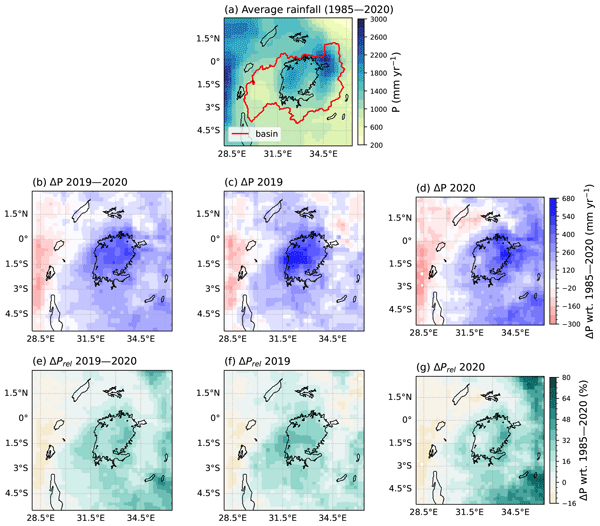
Heavy rainfall in eastern Africa between late 2019 and mid 2020 caused devastating floods and landslides and drove the levels of Lake Victoria to a record-breaking maximum in May 2020. In this study, we characterize the spatial extent and impacts of the floods in the Lake Victoria basin and investigate how human-induced climate change influenced the probability and intensity of the record-breaking lake levels and flooding by applying a multi-model extreme event attribution methodology.
Hugues Goosse, Sofia Allende Contador, Cecilia M. Bitz, Edward Blanchard-Wrigglesworth, Clare Eayrs, Thierry Fichefet, Kenza Himmich, Pierre-Vincent Huot, François Klein, Sylvain Marchi, François Massonnet, Bianca Mezzina, Charles Pelletier, Lettie Roach, Martin Vancoppenolle, and Nicole P. M. van Lipzig
The Cryosphere, 17, 407–425, https://doi.org/10.5194/tc-17-407-2023, https://doi.org/10.5194/tc-17-407-2023, 2023
Short summary
Short summary
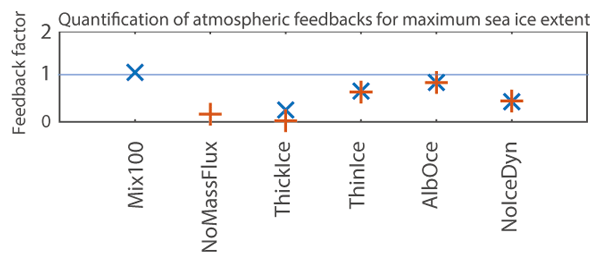
Using idealized sensitivity experiments with a regional atmosphere–ocean–sea ice model, we show that sea ice advance is constrained by initial conditions in March and the retreat season is influenced by the magnitude of several physical processes, in particular by the ice–albedo feedback and ice transport. Atmospheric feedbacks amplify the response of the winter ice extent to perturbations, while some negative feedbacks related to heat conduction fluxes act on the ice volume.
Koen Devesse, Luca Lanzilao, Sebastiaan Jamaer, Nicole van Lipzig, and Johan Meyers
Wind Energ. Sci., 7, 1367–1382, https://doi.org/10.5194/wes-7-1367-2022, https://doi.org/10.5194/wes-7-1367-2022, 2022
Short summary
Short summary
Recent research suggests that offshore wind farms might form such a large obstacle to the wind that it already decelerates before reaching the first turbines. Part of this phenomenon could be explained by gravity waves. Research on these gravity waves triggered by mountains and hills has found that variations in the atmospheric state with altitude can have a large effect on how they behave. This paper is the first to take the impact of those vertical variations into account for wind farms.
Charles Pelletier, Thierry Fichefet, Hugues Goosse, Konstanze Haubner, Samuel Helsen, Pierre-Vincent Huot, Christoph Kittel, François Klein, Sébastien Le clec'h, Nicole P. M. van Lipzig, Sylvain Marchi, François Massonnet, Pierre Mathiot, Ehsan Moravveji, Eduardo Moreno-Chamarro, Pablo Ortega, Frank Pattyn, Niels Souverijns, Guillian Van Achter, Sam Vanden Broucke, Alexander Vanhulle, Deborah Verfaillie, and Lars Zipf
Geosci. Model Dev., 15, 553–594, https://doi.org/10.5194/gmd-15-553-2022, https://doi.org/10.5194/gmd-15-553-2022, 2022
Short summary
Short summary
We present PARASO, a circumpolar model for simulating the Antarctic climate. PARASO features five distinct models, each covering different Earth system subcomponents (ice sheet, atmosphere, land, sea ice, ocean). In this technical article, we describe how this tool has been developed, with a focus on the
coupling interfacesrepresenting the feedbacks between the distinct models used for contribution. PARASO is stable and ready to use but is still characterized by significant biases.
Cited articles
Abdelsattar, M., Ismeil, M. A., Menoufi, K., Moety, A. A., and Emad-Eldeen, A.: Evaluating Machine Learning and Deep Learning models for predicting Wind Turbine power output from environmental factors, PLOS One, 20, https://doi.org/10.1371/journal.pone.0317619, 2025.
Basse, A., Callies, D., Grötzner, A., and Pauscher, L.: Seasonal effects in the long-term correction of short-term wind measurements using reanalysis data, Wind Energ. Sci., 6, 1473–1490, https://doi.org/10.5194/wes-6-1473-2021, 2021.
Bodini, N., Castagneri, S., and Optis, M.: Long-term uncertainty quantification in WRF-modeled offshore wind resource off the US Atlantic coast, Wind Energ. Sci., 8, 607–620, https://doi.org/10.5194/wes-8-607-2023, 2023.
Borgers, R., Dirksen, M., Wijnant, I. L., Stepek, A., Stoffelen, A., Akhtar, N., Neirynck, J., Van de Walle, J., Meyers, J., and van Lipzig, N. P. M.: Mesoscale modelling of North Sea wind resources with COSMO-CLM: model evaluation and impact assessment of future wind farm characteristics on cluster-scale wake losses, Wind Energ. Sci., 9, 697–719, https://doi.org/10.5194/wes-9-697-2024, 2024.
Borowski, J., Schwegmann, S., Avila, K., and Dörenkämper, M.: Evaluating the impact of inter-annual variability on long-term wind speed predictions, Wind Energ. Sci., 11, 661–677, https://doi.org/10.5194/wes-11-661-2026, 2026.
Breiman, L.: Random Forests, Mach. Learn., 45, 5–32, 2001.
Breiman, L., Cutler, A., Liaw, A., and Wiener, M.: Package “randomForest”, Mach. Learn., 5–32, https://doi.org/10.1023/A:1010933404324, 2025.
Brune, S., Keller, J. D., and Wahl, S.: Evaluation of wind speed estimates in reanalyses for wind energy applications, Adv. Sci. Res., 18, 115–126, https://doi.org/10.5194/asr-18-115-2021, 2021.
Carta, J. A., Velázquez, S., and Cabrera, P.: A review of measure-correlate-predict (MCP) methods used to estimate long-term wind characteristics at a target site, Renew. Sust. Energ. Rev., 27, 362–400, https://doi.org/10.1016/j.rser.2013.07.004, 2013.
Cavaiola, M., Tuju, P. E., Ferrari, F., Casciaro, G., and Mazzino, A.: Ensemble Machine Learning greatly improves ERA5 skills for wind energy applications, Energy and AI, 13, https://doi.org/10.1016/j.egyai.2023.100269, 2023.
Cheynet, E., Diezel, J. M., Haakenstad, H., Breivik, Ø., Peña, A., and Reuder, J.: Tall wind profile validation of ERA5, NORA3, and NEWA datasets using lidar observations, Wind Energ. Sci., 10, 733–754, https://doi.org/10.5194/wes-10-733-2025, 2025.
Draeger, C., Radić, V., White, R. H., and Tessema, M. A.: Evaluation of reanalysis data and dynamical downscaling for surface energy balance modeling at mountain glaciers in western Canada, The Cryosphere, 18, 17–42, https://doi.org/10.5194/tc-18-17-2024, 2024.
Gentleman, R. and Poggi, J.-M.: Random Forests with R, Springer, 33–55, https://doi.org/10.1007/978-3-030-56485-8_3, 2020.
Godoy, J. C., Cajo, R., Mesa Estrada, L., and Hamacher, T.: Multi-criteria analysis for energy planning in Ecuador: Enhancing decision-making through comprehensive evaluation, Renew. Energ., 241, https://doi.org/10.1016/j.renene.2024.122278, 2025.
Gualtieri, G.: Reliability of ERA5 Reanalysis Data for Wind Resource Assessment: A Comparison against Tall Towers, Energies (Basel), 14, https://doi.org/10.3390/en14144169, 2021.
Gualtieri, G.: Analysing the uncertainties of reanalysis data used for wind resource assessment: A critical review, Renew. Sust. Energ. Rev., 167, https://doi.org/10.1016/j.rser.2022.112741, 2022.
Hahmann, A. N., Sīle, T., Witha, B., Davis, N. N., Dörenkämper, M., Ezber, Y., García-Bustamante, E., González-Rouco, J. F., Navarro, J., Olsen, B. T., and Söderberg, S.: The making of the New European Wind Atlas – Part 1: Model sensitivity, Geosci. Model Dev., 13, 5053–5078, https://doi.org/10.5194/gmd-13-5053-2020, 2020.
Hahmann, A. N., García-Santiago, O., and Peña, A.: Current and future wind energy resources in the North Sea according to CMIP6, Wind Energ. Sci., 7, 2373–2391, https://doi.org/10.5194/wes-7-2373-2022, 2022.
Hallgren, C., Aird, J. A., Ivanell, S., Körnich, H., Vakkari, V., Barthelmie, R. J., Pryor, S. C., and Sahlée, E.: Machine learning methods to improve spatial predictions of coastal wind speed profiles and low-level jets using single-level ERA5 data, Wind Energ. Sci., 9, 821–840, https://doi.org/10.5194/wes-9-821-2024, 2024.
Hersbach, H., Bell, B., Berrisford, P., Hirahara, S., Horányi, A., Muñoz-Sabater, J., Nicolas, J., Peubey, C., Radu, R., Schepers, D., Simmons, A., Soci, C., Abdalla, S., Abellan, X., Balsamo, G., Bechtold, P., Biavati, G., Bidlot, J., Bonavita, M., De Chiara, G., Dahlgren, P., Dee, D., Diamantakis, M., Dragani, R., Flemming, J., Forbes, R., Fuentes, M., Geer, A., Haimberger, L., Healy, S., Hogan, R. J., Hólm, E., Janisková, M., Keeley, S., Laloyaux, P., Lopez, P., Lupu, C., Radnoti, G., de Rosnay, P., Rozum, I., Vamborg, F., Villaume, S., and Thépaut, J. N.: The ERA5 global reanalysis, Q. J. Roy. Meteor. Soc., 146, 1999–2049, https://doi.org/10.1002/qj.3803, 2020.
Houndekindo, F. and Ouarda, T. B. M. J.: Machine learning and statistical approaches for wind speed estimation at partially sampled and unsampled locations; review and open questions, Energy Convers. Manag., 327, https://doi.org/10.1016/j.enconman.2025.119555, 2025.
Hu, W., Scholz, Y., Yeligeti, M., Bremen, L. von, and Deng, Y.: Downscaling ERA5 wind speed data: a machine learning approach considering topographic influences, Environ. Res. Lett., 18, https://doi.org/10.1088/1748-9326/aceb0a, 2023.
Jourdier, B.: Evaluation of ERA5, MERRA-2, COSMO-REA6, NEWA and AROME to simulate wind power production over France, Adv. Sci. Res., 17, 63–77, https://doi.org/10.5194/asr-17-63-2020, 2020.
Khadka, A., Wagnon, P., Brun, F., Shrestha, D., Lejeune, Y., and Arnaud, Y.: Evaluation of ERA5-Land and HARv2 Reanalysis Data at High Elevation in the Upper Dudh Koshi Basin (Everest Region, Nepal), J. Appl. Meteorol. Clim., 61, 931–954, https://doi.org/10.1175/JAMC-D-21-0091.1, 2022.
Kumar, R., Rutgersson, A., Asim, M., and Routray, A.: Understanding Wind Characteristics Over Different Terrains for Wind Turbine Deployment, Meteorol. Appl., 32, https://doi.org/10.1002/met.70079, 2025.
Liu, B., Ma, X., Guo, J., Li, H., Jin, S., Ma, Y., and Gong, W.: Estimating hub-height wind speed based on a machine learning algorithm: implications for wind energy assessment, Atmos. Chem. Phys., 23, 3181–3193, https://doi.org/10.5194/acp-23-3181-2023, 2023.
Liu, B., Ma, X., Guo, J., Wen, R., Li, H., Jin, S., Ma, Y., Guo, X., and Gong, W.: Extending the wind profile beyond the surface layer by combining physical and machine learning approaches, Atmos. Chem. Phys., 24, 4047–4063, https://doi.org/10.5194/acp-24-4047-2024, 2024.
López, G., Arboleya, P., Núñez, D., Freire, A., and López, D.: Wind resource assessment and influence of atmospheric stability on wind farm design using Computational Fluid Dynamics in the Andes Mountains, Ecuador, Energy Convers. Manag., 284, https://doi.org/10.1016/j.enconman.2023.116972, 2023.
Martinez, J. A., Junquas, C., Bozkurt, D., Viale, M., Fita, L., Trachte, K., Campozano, L., Arias, P. A., Boisier, J. P., Condom, T., Goubanova, K., Pabón-Caicedo, J. D., Poveda, G., Solman, S. A., Sörensson, A. A., and Espinoza, J. C.: Recent progress in atmospheric modeling over the Andes – part I: review of atmospheric processes, Front. Earth Sci. (Lausanne), 12, https://doi.org/10.3389/feart.2024.1427783, 2024.
McKenna, R., Pfenninger, S., Heinrichs, H., Schmidt, J., Staffell, I., Bauer, C., Gruber, K., Hahmann, A. N., Jansen, M., Klingler, M., Landwehr, N., Larsén, X. G., Lilliestam, J., Pickering, B., Robinius, M., Tröndle, T., Turkovska, O., Wehrle, S., Weinand, J. M., and Wohland, J.: High-resolution large-scale onshore wind energy assessments: A review of potential definitions, methodologies and future research needs, Renew. Energ., 182, 659–684, https://doi.org/10.1016/j.renene.2021.10.027, 2022.
MEASNET: Evaluation of Site-Specific Wind Conditions, MEASNET Organisation, 2022.
Olauson, J.: ERA5: The new champion of wind power modelling?, Renew. Energ., 126, 322–331, https://doi.org/10.1016/j.renene.2018.03.056, 2018.
Pauscher, L., Geiger, D., Yuan, D., Bär, F., Good, G., Spangehl, T., Kaspar, F., Weber, H., and Callies, D.: An evaluation and comparison of wind speeds from different reanalysis models in the context of wind energy – the influence of topography, in: EMS Annual Meeting 2024, https://doi.org/10.5194/ems2024-957, 2024.
Ramon, J., Lledó, L., Torralba, V., Soret, A., and Doblas-Reyes, F. J.: What global reanalysis best represents near-surface winds?, Q. J. Roy. Meteor. Soc., 145, 3236–3251, https://doi.org/10.1002/qj.3616, 2019.
Rouholahnejad, F. and Gottschall, J.: Characterization of local wind profiles: a random forest approach for enhanced wind profile extrapolation, Wind Energ. Sci., 10, 143–159, https://doi.org/10.5194/wes-10-143-2025, 2025.
Schwegmann, S., Faulhaber, J., Pfaffel, S., Yu, Z., Dörenkämper, M., Kersting, K., and Gottschall, J.: Enabling Virtual Met Masts for wind energy applications through machine learning-methods, Energy and AI, 11, https://doi.org/10.1016/j.egyai.2022.100209, 2023.
Soares, P. M. M., Lima, D. C. A., and Nogueira, M.: Global offshore wind energy resources using the new ERA-5 reanalysis, Environ. Res. Lett., 15, https://doi.org/10.1088/1748-9326/abb10d, 2020.
Tapia, M., Heinemann, D., and Zondervan, E.: Too many eggs in one basket: On the vulnerability of the Ecuadorian power system and the need for a more sustainable and resilient strategy, Energ. Policy, 209, https://doi.org/10.1016/j.enpol.2025.114951, 2026.
Watson, S.: Handbook of Wind Resource Assessment, John Wiley & Sons Inc., https://doi.org/10.1002/9781119055402, 2023.
Weekes, S. M. and Tomlin, A. S.: Data efficient measure-correlate-predict approaches to wind resource assessment for small-scale wind energy, Renew. Energ., 63, 162–171, https://doi.org/10.1016/j.renene.2013.08.033, 2014.
Short summary
We researched how to improve wind speed estimates for wind resource assessments in the Andes mountains of Ecuador. Instead of relying only on near-ground data from a global reanalysis dataset, we tested wind speeds from higher levels in the atmosphere and combined them with masts measurements through a machine learning model. This strongly improved accuracy and reduced energy calculation errors, offering a more reliable and affordable way to obtain data for planning wind power in complex terrain.
We researched how to improve wind speed estimates for wind resource assessments in the Andes...
Altmetrics
Final-revised paper
Preprint