
Articles | Volume 11, issue 11
https://doi.org/10.5194/wes-11-4255-2026
© Author(s) 2026. This work is distributed under
the Creative Commons Attribution 4.0 License.
the Creative Commons Attribution 4.0 License.
https://doi.org/10.5194/wes-11-4255-2026
© Author(s) 2026. This work is distributed under
the Creative Commons Attribution 4.0 License.
the Creative Commons Attribution 4.0 License.
Research article
| 
13 Nov 2026
Research article |
| 13 Nov 2026
| 13 Nov 2026
Multi-scale simulations of wind farm impacts on nighttime near-surface temperature in complex terrain
Paul Boumendil
IFP Energies Nouvelles, 1–4 Avenue du Bois Préau, 92852 Rueil-Malmaison, France
Météo France, CNRM, 42 Avenue Gaspard Coriolis, 31057 Toulouse, France
Pierre-Antoine Joulin
CORRESPONDING AUTHOR

IFP Energies Nouvelles, 1–4 Avenue du Bois Préau, 92852 Rueil-Malmaison, France
Quentin Rodier
Météo France, CNRM, 42 Avenue Gaspard Coriolis, 31057 Toulouse, France
Valéry Masson
Météo France, CNRM, 42 Avenue Gaspard Coriolis, 31057 Toulouse, France
Related authors
Paul Boumendil, Pierre-Antoine Joulin, Quentin Rodier, and Valéry Masson
Wind Energ. Sci. Discuss., https://doi.org/10.5194/wes-2026-118, https://doi.org/10.5194/wes-2026-118, 2026
Manuscript not accepted for further review
Short summary
Short summary
Wind turbines can modify atmospheric conditions in and around wind farms. This review brings together results from field measurements, satellite observations, and numerical simulations to examine meteorological changes occurring near the ground, where they may influence ecosystems and human activities. The reviewed studies show that wind turbines can affect wind, temperature, humidity, turbulence and surface exchanges, with effects that depend on weather conditions and site characteristics.
Jérémy Bernard, Tim Nagel, Valéry Masson, Aude Lemonsu, Jean Wurtz, Pierre Tulet, and Quentin Rodier
Atmos. Chem. Phys., 26, 12729–12749, https://doi.org/10.5194/acp-26-12729-2026, https://doi.org/10.5194/acp-26-12729-2026, 2026
Short summary
Short summary
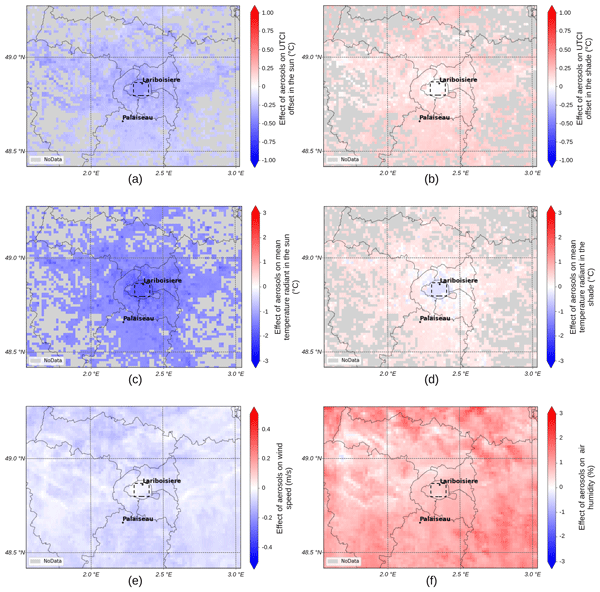
Cities are particularly vulnerable to heat-waves because of their dense population combined with an amplification of the heat hazard caused by the urban heat island phenomenon. Heat event are sometimes associated with aerosol plume in the atmosphere, which affect the thermal comfort. This study shows that aerosol plumes can result in a heat stress reduction of up to 1 °C in sunny areas in cities while no difference in the shade of suburban areas.
Paul Boumendil, Pierre-Antoine Joulin, Quentin Rodier, and Valéry Masson
Wind Energ. Sci. Discuss., https://doi.org/10.5194/wes-2026-118, https://doi.org/10.5194/wes-2026-118, 2026
Manuscript not accepted for further review
Short summary
Short summary
Wind turbines can modify atmospheric conditions in and around wind farms. This review brings together results from field measurements, satellite observations, and numerical simulations to examine meteorological changes occurring near the ground, where they may influence ecosystems and human activities. The reviewed studies show that wind turbines can affect wind, temperature, humidity, turbulence and surface exchanges, with effects that depend on weather conditions and site characteristics.
Robert Schoetter, Cyril Caliot, Florent Retailleau, Tim Nagel, Christophe Coustet, Vincent Eymet, Vincent Forest, Frédéric Hourdin, Atsushi Inagaki, Simone Kotthaus, Valéry Masson, William Morrison, and Najda Villefranque
EGUsphere, https://doi.org/10.5194/egusphere-2026-2061, https://doi.org/10.5194/egusphere-2026-2061, 2026
This preprint is open for discussion and under review for Geoscientific Model Development (GMD).
Short summary
Short summary
Temperature, humidity, radiation, and wind can have a negative impact on human comfort and infrastructure in urban areas. Building-resolving meteorological models can help to quantify such meteorological impacts and the potential benefits of adaptation measures to climate change. Here, a new unified algorithm to calculate the radiation, heat conduction, and sensible heat exchange in urban areas is coupled with an atmospheric model, and evaluated against experimental data.
Lorena de Carvalho Araujo, Valéry Masson, Robert Schoetter, Jean Wurtz, Anouk Le Bihan, and Marion Bonhomme
Earth Syst. Sci. Data Discuss., https://doi.org/10.5194/essd-2026-201, https://doi.org/10.5194/essd-2026-201, 2026
Revised manuscript accepted for ESSD
Short summary
Short summary
Urban populations are increasingly exposed to heat stress due to climate change and the urban heat island effect. Urban climate models require detailed data on building materials (e.g. roof cover material, insulation in walls) to simulate the meteorological impact on humans and infrastructure. This study presents an open database of residential building types by country that has been created based on a global survey of architects and urban climatologists.
Gabriel Colas, Valéry Masson, François Bouttier, and Ludovic Bouilloud
Geosci. Model Dev., 18, 9945–9966, https://doi.org/10.5194/gmd-18-9945-2025, https://doi.org/10.5194/gmd-18-9945-2025, 2025
Short summary
Short summary
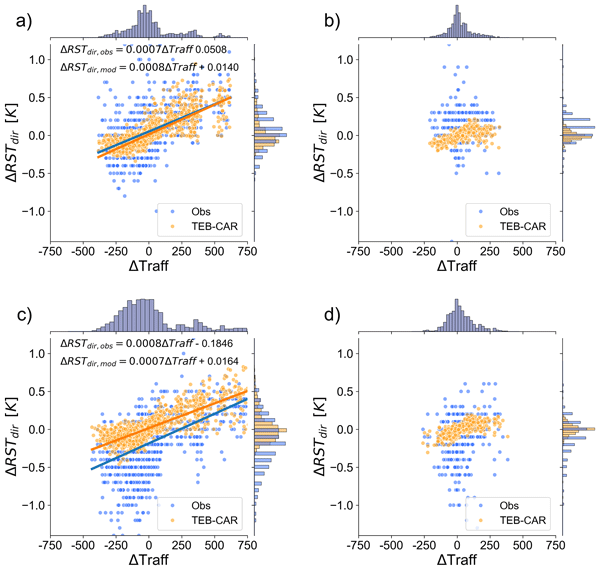
Each vehicle from road traffic is a source of heat and an obstacle that induce wind when it passes. It directly impacts the local atmospheric conditions and the road surface temperature. These impacts are included in the numerical model of the Town Energy Balance, used to simulate local conditions in urbanised environments. Simulations show that road traffic has a significant impact on the road surface temperature up to a few degrees, and on local variables.
William Morrison, Dana Looschelders, Jonnathan Céspedes, Bernie Claxton, Marc-Antoine Drouin, Jean-Charles Dupont, Aurélien Faucheux, Martial Haeffelin, Christopher C. Holst, Simone Kotthaus, Valéry Masson, James McGregor, Jeremy Price, Matthias Zeeman, Sue Grimmond, and Andreas Christen
Earth Syst. Sci. Data, 17, 6507–6529, https://doi.org/10.5194/essd-17-6507-2025, https://doi.org/10.5194/essd-17-6507-2025, 2025
Short summary
Short summary
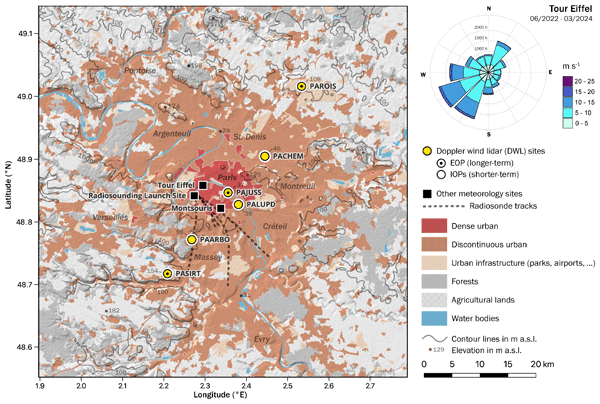
We conducted research using sophisticated wind sensors to better understand wind patterns in Paris. By installing these sensors across the city, we gathered detailed data on wind speeds and directions from 2022 to 2024. This information helps improve weather and climate models, making them more accurate for city environments. Our findings offer valuable insights for scientists studying urban air and weather, improving predictions and understanding of city-scale atmospheric processes.
Aurélien Mirebeau, Cécile de Munck, Bertrand Bonan, Christine Delire, Aude Lemonsu, Valéry Masson, and Stephan Weber
Geosci. Model Dev., 18, 5329–5349, https://doi.org/10.5194/gmd-18-5329-2025, https://doi.org/10.5194/gmd-18-5329-2025, 2025
Short summary
Short summary
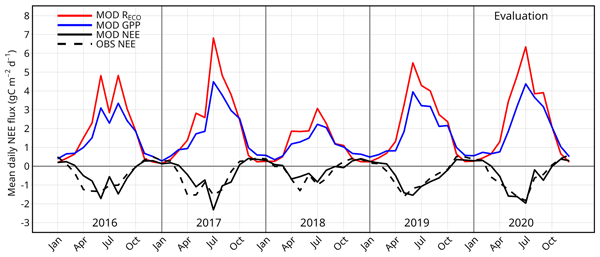
The greening of cities is recommended to limit the effects of climate change. In particular, green roofs can provide numerous environmental benefits, such as urban cooling, water retention, and carbon sequestration. The aim of this research is to develop a new module for calculating green roof CO2 fluxes within a model that can already simulate hydrological and thermal processes of such roofs. The calibration and evaluation of this module take advantage of long-term experimental data.
Gabriel Colas, Valéry Masson, François Bouttier, Ludovic Bouilloud, Laura Pavan, and Virve Karsisto
Geosci. Model Dev., 18, 3453–3472, https://doi.org/10.5194/gmd-18-3453-2025, https://doi.org/10.5194/gmd-18-3453-2025, 2025
Short summary
Short summary
In winter, snow- and ice-covered artificial surfaces are important aspects of the urban climate. They may influence the magnitude of the urban heat island effect, but this is still unclear. In this study, we improved the representation of the snow and ice cover in the Town Energy Balance (TEB) urban climate model. Evaluations have shown that the results are promising for using TEB to study the climate of cold cities.
Robert Schoetter, Robin James Hogan, Cyril Caliot, and Valéry Masson
Geosci. Model Dev., 18, 405–431, https://doi.org/10.5194/gmd-18-405-2025, https://doi.org/10.5194/gmd-18-405-2025, 2025
Short summary
Short summary
Radiation is relevant to the atmospheric impact on people and infrastructure in cities as it can influence the urban heat island, building energy consumption, and human thermal comfort. A new urban radiation model, assuming a more realistic form of urban morphology, is coupled to the urban climate model Town Energy Balance (TEB). The new TEB is evaluated with a reference radiation model for a variety of urban morphologies, and an improvement in the simulated radiative observables is found.
Martial Haeffelin, Jean-François Ribaud, Jonnathan Céspedes, Jean-Charles Dupont, Aude Lemonsu, Valéry Masson, Tim Nagel, and Simone Kotthaus
Atmos. Chem. Phys., 24, 14101–14122, https://doi.org/10.5194/acp-24-14101-2024, https://doi.org/10.5194/acp-24-14101-2024, 2024
Short summary
Short summary
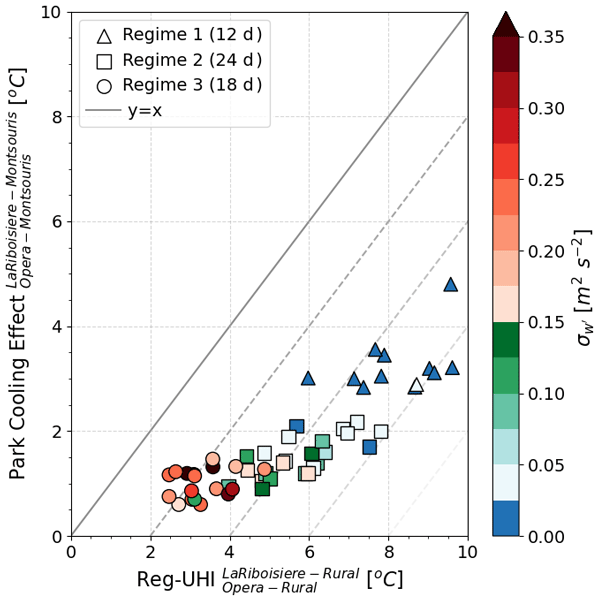
This study highlights how the state of the urban atmospheric boundary layer impacts urban park cooling effect intensity at night. Under summertime heat wave conditions, the urban atmosphere becomes stable at night, which inhibits turbulent motions. Under those specific conditions, urban parks and woods cool much more efficiently than the surrounding built-up neighbourhoods in the evening and through the night, providing cooler air temperatures by 4 to 6° C depending on park size.
Erwan Jézéquel, Frédéric Blondel, and Valéry Masson
Wind Energ. Sci., 9, 97–117, https://doi.org/10.5194/wes-9-97-2024, https://doi.org/10.5194/wes-9-97-2024, 2024
Short summary
Short summary
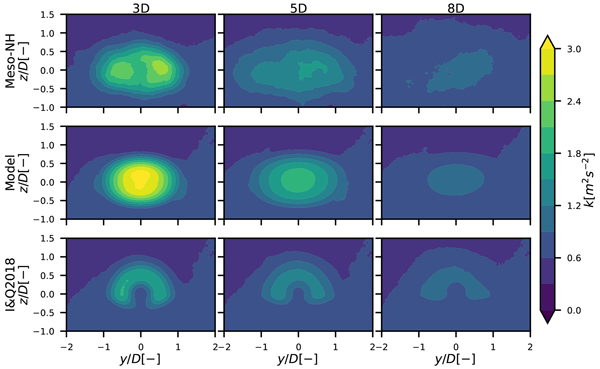
Wind turbine wakes affect the production and lifecycle of downstream turbines. They can be predicted with the dynamic wake meandering (DWM) method. In this paper, the authors break down the velocity and turbulence in the wake of a wind turbine into several terms. They show that it is implicitly assumed in the DWM that some of these terms are neglected. With high-fidelity simulations, it is shown that this can lead to some errors, in particular for the maximum turbulence added by the wake.
Erwan Jézéquel, Frédéric Blondel, and Valéry Masson
Wind Energ. Sci., 9, 119–139, https://doi.org/10.5194/wes-9-119-2024, https://doi.org/10.5194/wes-9-119-2024, 2024
Short summary
Short summary
Analytical models allow us to quickly compute the decreased power output and lifetime induced by wakes in a wind farm. This is achieved by evaluating the modified velocity and turbulence in the wake. In this work, we present a new model based on the velocity and turbulence breakdowns presented in Part 1. This new model is physically based, allows us to compute the whole turbulence profile (rather than the maximum value) and is built to take atmospheric stability into account.

Roger Bergua, Amy Robertson, Jason Jonkman, Emmanuel Branlard, Alessandro Fontanella, Marco Belloli, Paolo Schito, Alberto Zasso, Giacomo Persico, Andrea Sanvito, Ervin Amet, Cédric Brun, Guillén Campaña-Alonso, Raquel Martín-San-Román, Ruolin Cai, Jifeng Cai, Quan Qian, Wen Maoshi, Alec Beardsell, Georg Pirrung, Néstor Ramos-García, Wei Shi, Jie Fu, Rémi Corniglion, Anaïs Lovera, Josean Galván, Tor Anders Nygaard, Carlos Renan dos Santos, Philippe Gilbert, Pierre-Antoine Joulin, Frédéric Blondel, Eelco Frickel, Peng Chen, Zhiqiang Hu, Ronan Boisard, Kutay Yilmazlar, Alessandro Croce, Violette Harnois, Lijun Zhang, Ye Li, Ander Aristondo, Iñigo Mendikoa Alonso, Simone Mancini, Koen Boorsma, Feike Savenije, David Marten, Rodrigo Soto-Valle, Christian W. Schulz, Stefan Netzband, Alessandro Bianchini, Francesco Papi, Stefano Cioni, Pau Trubat, Daniel Alarcon, Climent Molins, Marion Cormier, Konstantin Brüker, Thorsten Lutz, Qing Xiao, Zhongsheng Deng, Florence Haudin, and Akhilesh Goveas
Wind Energ. Sci., 8, 465–485, https://doi.org/10.5194/wes-8-465-2023, https://doi.org/10.5194/wes-8-465-2023, 2023
Short summary
Short summary
This work examines if the motion experienced by an offshore floating wind turbine can significantly affect the rotor performance. It was observed that the system motion results in variations in the load, but these variations are not critical, and the current simulation tools capture the physics properly. Interestingly, variations in the rotor speed or the blade pitch angle can have a larger impact than the system motion itself.
Mathew Lipson, Sue Grimmond, Martin Best, Winston T. L. Chow, Andreas Christen, Nektarios Chrysoulakis, Andrew Coutts, Ben Crawford, Stevan Earl, Jonathan Evans, Krzysztof Fortuniak, Bert G. Heusinkveld, Je-Woo Hong, Jinkyu Hong, Leena Järvi, Sungsoo Jo, Yeon-Hee Kim, Simone Kotthaus, Keunmin Lee, Valéry Masson, Joseph P. McFadden, Oliver Michels, Wlodzimierz Pawlak, Matthias Roth, Hirofumi Sugawara, Nigel Tapper, Erik Velasco, and Helen Claire Ward
Earth Syst. Sci. Data, 14, 5157–5178, https://doi.org/10.5194/essd-14-5157-2022, https://doi.org/10.5194/essd-14-5157-2022, 2022
Short summary
Short summary
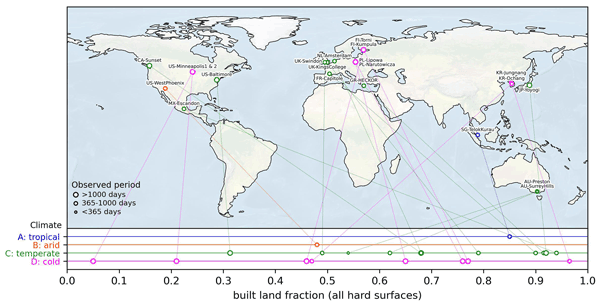
We describe a new openly accessible collection of atmospheric observations from 20 cities around the world, capturing 50 site years. The observations capture local meteorology (temperature, humidity, wind, etc.) and the energy fluxes between the land and atmosphere (e.g. radiation and sensible and latent heat fluxes). These observations can be used to improve our understanding of urban climate processes and to test the accuracy of urban climate models.
Jérémy Bernard, Erwan Bocher, Elisabeth Le Saux Wiederhold, François Leconte, and Valéry Masson
Geosci. Model Dev., 15, 7505–7532, https://doi.org/10.5194/gmd-15-7505-2022, https://doi.org/10.5194/gmd-15-7505-2022, 2022
Short summary
Short summary
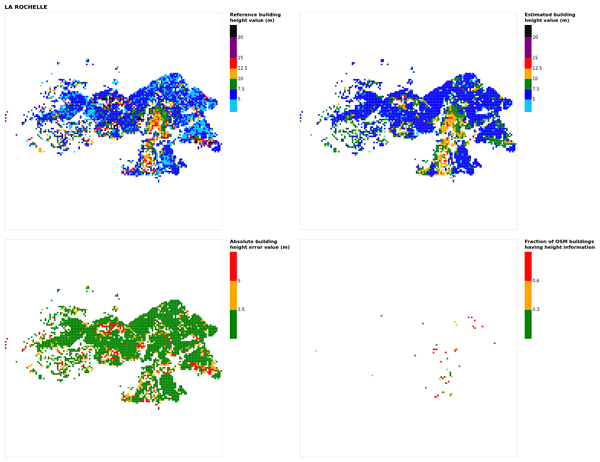
OpenStreetMap is a collaborative project aimed at creaing a free dataset containing topographical information. Since these data are available worldwide, they can be used as standard data for geoscience studies. However, most buildings miss the height information that constitutes key data for numerous fields (urban climate, noise propagation, air pollution). In this work, the building height is estimated using statistical modeling using indicators that characterize the building's environment.
Cited articles
Adkins, K. A. and Sescu, A.: Observations of relative humidity in the near-wake of a wind turbine using an instrumented unmanned aerial system, Int. J. Green Energy, 14, 845–860, https://doi.org/10.1080/15435075.2017.1334661, 2017. a, b
Adkins, K. A. and Sescu, A.: Analysis of near–surface relative humidity in a wind turbine array boundary layer using an instrumented unmanned aerial system and large–eddy simulation, Wind Energy, 21, 1155–1168, https://doi.org/10.1002/we.2220, 2018. a
Al Oqaily, D., Giani, P., and Crippa, P.: Evaluating WRF Multiscale Wind Simulations in Complex Terrain: Insights From the Perdigão Field Campaign, J. Geophys. Res.-Atmos., 130, https://doi.org/10.1029/2025JD044055, 2025. a, b
Armstrong, A., Waldron, S., Whitaker, J., and Ostle, N. J.: Wind farm and solar park effects on plant-soil carbon cycling: uncertain impacts of changes in ground-level microclimate, Global Change Biol., 20, 1699–1706, https://doi.org/10.1111/gcb.12437, 2014. a
Baidya Roy, S.: Simulating impacts of wind farms on local hydrometeorology, J. Wind Eng. Ind. Aerod., 99, 491–498, https://doi.org/10.1016/j.jweia.2010.12.013, 2011. a
Baidya Roy, S. and Traiteur, J. J.: Impacts of wind farms on surface air temperatures, P. Natl. Acad. Sci. USA, 107, 17899–17904, https://doi.org/10.1073/pnas.1000493107, 2010. a, b, c
Baidya Roy, S., Pacala, S. W., and Walko, R. L.: Can large wind farms affect local meteorology?, J. Geophys. Res.-Atmos., 109, https://doi.org/10.1029/2004JD004763, 2004. a, b
Bakhoday-Paskyabi, M., Krutova, M., Bui, H., and Ning, X.: Multiscale Simulation of Offshore Wind Variability During Frontal Passage: Brief Implication on Turbines' Wakes and Load, J. Phys. Conf. Ser., 2362, 012003, https://doi.org/10.1088/1742-6596/2362/1/012003, 2022. a, b
Bleeg, J., Purcell, M., Ruisi, R., and Traiger, E.: Wind Farm Blockage and the Consequences of Neglecting Its Impact on Energy Production, Energies, 11, https://doi.org/10.3390/en11061609, 2018. a
Bocher, E., Bernard, J., Wiederhold, E., Leconte, F., Petit, G., Palominos, S., and Noûs, C.: GeoClimate: a Geospatial processing toolbox for environmental and climate studies, J. Open Source Softw., 6, 3541, https://doi.org/10.21105/joss.03541, 2021. a
Boone, A., Masson, V., Meyers, T., and Noilhan, J.: The Influence of the Inclusion of Soil Freezing on Simulations by a Soil–Vegetation–Atmosphere Transfer Scheme, J. Appl. Meteorol., 39, 1544–1569, https://doi.org/10.1175/1520-0450(2000)039<1544:TIOTIO>2.0.CO;2, 2000. a
Boumendil, P., Rodier, Q., Joulin, P.-A., and Masson, V.: A multi-scale model with an atmosphere – soil – vegetation coupling to explore the effect of wind turbines on near-surface meteorological conditions, J. Phys. Conf. Ser., 3016, 012002, https://doi.org/10.1088/1742-6596/3016/1/012002, 2025. a, b, c, d, e
Caniaux, G., Redelsperger, J.-L., and Lafore, J.-P.: A Numerical Study of the Stratiform Region of a Fast-Moving Squall Line. Part I: General Description and Water and Heat Budgets, J. Atmos. Sci., 51, 2046–2074, https://doi.org/10.1175/1520-0469(1994)051<2046:ANSOTS>2.0.CO;2, 1994. a
Cuxart, J., Bougeault, P., and Redelsperger, J.-L.: A turbulence scheme allowing for mesoscale and large–eddy simulations, Q. J. Roy. Meteor. Soc., 126, 1–30, https://doi.org/10.1002/qj.49712656202, 2000. a
Deardorff, J. W.: Stratocumulus-capped mixed layers derived from a three-dimensional model, Bound.-Lay. Meteorol., 18, 495–527, https://doi.org/10.1007/BF00119502, 1980. a
Decharme, B., Boone, A., Delire, C., and Noilhan, J.: Local evaluation of the Interaction between Soil Biosphere Atmosphere soil multilayer diffusion scheme using four pedotransfer functions, J. Geophys. Res.-Atmos., 116, https://doi.org/10.1029/2011JD016002, 2011. a
Durran, D. R.: Improving the Anelastic Approximation, J. Atmos. Sci., 46, 1453–1461, 1989. a
Faroux, S., Kaptué Tchuenté, A. T., Roujean, J.-L., Masson, V., Martin, E., and Le Moigne, P.: ECOCLIMAP-II/Europe: a twofold database of ecosystems and surface parameters at 1 km resolution based on satellite information for use in land surface, meteorological and climate models, Geosci. Model Dev., 6, 563–582, https://doi.org/10.5194/gmd-6-563-2013, 2013. a, b
Fernando, H. J. S., Mann, J., Palma, J. M. L. M., Lundquist, J. K., Barthelmie, R. J., Belo-Pereira, M., Brown, W. O. J., Chow, F. K., Gerz, T., Hocut, C. M., Klein, P. M., Leo, L. S., Matos, J. C., Oncley, S. P., Pryor, S. C., Bariteau, L., Bell, T. M., Bodini, N., Carney, M. B., Courtney, M. S., Creegan, E. D., Dimitrova, R., Gomes, S., Hagen, M., Hyde, J. O., Kigle, S., Krishnamurthy, R., Lopes, J. C., Mazzaro, L., Neher, J. M. T., Menke, R., Murphy, P., Oswald, L., Otarola-Bustos, S., Pattantyus, A. K., Rodrigues, C. V., Schady, A., Sirin, N., Spuler, S., Svensson, E., Tomaszewski, J., Turner, D. D., van Veen, L., Vasiljević, N., Vassallo, D., Voss, S., Wildmann, N., and Wang, Y.: The Perdigão: Peering into Microscale Details of Mountain Winds, B. Am. Meteorol. Soc., 100, 799–819, https://doi.org/10.1175/BAMS-D-17-0227.1, 2019. a
Fitch, A. C., Olson, J. B., Lundquist, J. K., Dudhia, J., Gupta, A. K., Michalakes, J., and Barstad, I.: Local and Mesoscale Impacts of Wind Farms as Parameterized in a Mesoscale NWP Model, Mon. Weather Rev., 140, 3017–3038, https://doi.org/10.1175/MWR-D-11-00352.1, 2012. a
García-Santiago, O., Hahmann, A. N., Badger, J., and Peña, A.: Evaluation of wind farm parameterizations in the WRF model under different atmospheric stability conditions with high-resolution wake simulations, Wind Energ. Sci., 9, 963–979, https://doi.org/10.5194/wes-9-963-2024, 2024. a
Henschen, M., Herrholtz, B., Rhudy, L., Demchak, K., Doogs, B., Holland, J., Larson, E., Martin, J., and Rudkin, M.: Do Wind Turbines Affect Weather Conditions: A Case Study in Indiana, Journal of Purdue Undergraduate Research, 1, 22–29, https://doi.org/10.5703/jpur.01.1.4, 2011. a, b, c
Hogan, R. J. and Bozzo, A.: A Flexible and Efficient Radiation Scheme for the ECMWF Model, J. Adv. Model. Earth Sy., 10, 1990–2008, https://doi.org/10.1029/2018MS001364, 2018. a
Honnert, R., Masson, V., Lac, C., and Nagel, T.: A Theoretical Analysis of Mixing Length for Atmospheric Models From Micro to Large Scales, Front. Earth Sci., 8, https://doi.org/10.3389/feart.2020.582056, 2021. a
Joulin, P.-A.: Modélisation à fine échelle des interactions entre parcs éoliens et météorologie locale, thèse de doctorat dirigée par Masson, Valéry Océan, atmosphère, climat Toulouse, INPT 2019, https://doi.org/10.70675/7c8be7f3z9598z4c86za4e0z249da7039 2a4, 2019. a, b, c
Joulin, P.-A., Mayol, M. L., Masson, V., Blondel, F., Rodier, Q., Cathelain, M., and Lac, C.: The Actuator Line Method in the Meteorological LES Model Meso-NH to Analyze the Horns Rev 1 Wind Farm Photo Case, Front. Earth Sci., 7, https://doi.org/10.3389/feart.2019.00350, 2020. a, b, c
Boumendil, P., Joulin, P.-A., Rodier, Q., and Masson, V.: Vertical cross-sections of wind speed at 80 m above ground level from a Meso-NH simulation between 7 and 8 April 2021, centered on the Ensemble Éolien Catalan wind farm, located west of Perpignan, France, TIB AV-Portal [video], https://doi.org/10.5446/73018, 2026. a, b
Kaffine, D. T.: Microclimate effects of wind farms on local crop yields, J. Environ. Econ. Manag., 96, 159–173, https://doi.org/10.1016/j.jeem.2019.06.001, 2019. a
Kale, B., Buckingham, S., van Beeck, J., and Cuerva-Tejero, A.: Multi-scale modeling of a wind turbine wake in complex terrain, J. Phys. Conf. Ser., 2505, 012012, https://doi.org/10.1088/1742-6596/2505/1/012012, 2023. a, b, c, d
Keith, D. W., Decarolis, J. F., Denkenberger, D. C., Lenschow, D. H., Malyshev, S. L., Pacala, S., and Rasch, P. J.: The influence of large-scale wind power on global climate, P. Natl. Acad. Sci. USA, 101, 16115–16120, https://doi.org/10.1073/pnas.0406930101, 2004. a
Lac, C., Chaboureau, J.-P., Masson, V., Pinty, J.-P., Tulet, P., Escobar, J., Leriche, M., Barthe, C., Aouizerats, B., Augros, C., Aumond, P., Auguste, F., Bechtold, P., Berthet, S., Bielli, S., Bosseur, F., Caumont, O., Cohard, J.-M., Colin, J., Couvreux, F., Cuxart, J., Delautier, G., Dauhut, T., Ducrocq, V., Filippi, J.-B., Gazen, D., Geoffroy, O., Gheusi, F., Honnert, R., Lafore, J.-P., Lebeaupin Brossier, C., Libois, Q., Lunet, T., Mari, C., Maric, T., Mascart, P., Mogé, M., Molinié, G., Nuissier, O., Pantillon, F., Peyrillé, P., Pergaud, J., Perraud, E., Pianezze, J., Redelsperger, J.-L., Ricard, D., Richard, E., Riette, S., Rodier, Q., Schoetter, R., Seyfried, L., Stein, J., Suhre, K., Taufour, M., Thouron, O., Turner, S., Verrelle, A., Vié, B., Visentin, F., Vionnet, V., and Wautelet, P.: Overview of the Meso-NH model version 5.4 and its applications, Geosci. Model Dev., 11, 1929–1969, https://doi.org/10.5194/gmd-11-1929-2018, 2018. a, b, c, d
Lafore, J. P., Stein, J., Asencio, N., Bougeault, P., Ducrocq, V., Duron, J., Fischer, C., Héreil, P., Mascart, P., Masson, V., Pinty, J. P., Redelsperger, J. L., Richard, E., and Vilà-Guerau de Arellano, J.: The Meso-NH Atmospheric Simulation System. Part I: adiabatic formulation and control simulations, Ann. Geophys., 16, 90–109, https://doi.org/10.1007/s00585-997-0090-6, 1998. a
Lamichhane, J. R.: Rising risks of late-spring frosts in a changing climate, Nat. Clim. Change, 11, 554–555, https://doi.org/10.1038/s41558-021-01090-x, 2021. a
Le Cap, C., Carlier, J., Quénol, H., Heitz, D., and Buisson, E.: Analysis of the spatial variability of temperature with the aim of improving the location of wind machines, Theor. Appl. Climatol., 155, 421–438, https://doi.org/10.1007/s00704-023-04642-7, 2024. a
Le Moigne, P., Albergel, C., Boone, A., Belamari, S., Decharme, B., Dumont, M., Masson, V., Brun, E., Calvet, J.-C., Giordani, H., Lafont, S., Morin, S., Vionnet, V., Faroux, S., Gibelin, A.-L., Lebeaupin Brossier, C., Mahfouf, J.-F., Martin, E., Mironov, D., Noilhan, J., Tulet, P., and Van Den Hurk, B.: SURFEX scientific documentation, CNRM, Météo-France, Toulouse, France, https://www.umr-cnrm.fr/surfex/ (last access: 15 October 2026), 2018. a
Lemoine, A. and Pineaud, A.: Bulletin climatique avril 2021, https://donneespubliques.meteofrance.fr/donnees_libres/bulletins/BCM/202104.pdf (last access: 15 October 2026), 2021. a
Lu, H. and Porté-Agel, F.: Large-eddy simulation of a very large wind farm in a stable atmospheric boundary layer, Phys. Fluids, 23, https://doi.org/10.1063/1.3589857, 2011. a
Lu, H. and Porté-Agel, F.: On the Impact of Wind Farms on a Convective Atmospheric Boundary Layer, Bound.-Lay. Meteorol., 157, 81–96, https://doi.org/10.1007/s10546-015-0049-1, 2015. a
Lundquist, J. K., Letizia, S., and Radünz, W. C.: Can we distinguish between wind-farm-wake-induced and terrain-induced surface warming?, J. Phys. Conf. Ser., 3224, 032069, https://doi.org/10.1088/1742-6596/3224/3/032069, 2026. a, b
Masson, V.: A Physically-Based Scheme For The Urban Energy Budget In Atmospheric Models, Bound.-Lay. Meteorol., 94, 357–397, https://doi.org/10.1023/A:1002463829265, 2000. a
Masson, V., Le Moigne, P., Martin, E., Faroux, S., Alias, A., Alkama, R., Belamari, S., Barbu, A., Boone, A., Bouyssel, F., Brousseau, P., Brun, E., Calvet, J.-C., Carrer, D., Decharme, B., Delire, C., Donier, S., Essaouini, K., Gibelin, A.-L., Giordani, H., Habets, F., Jidane, M., Kerdraon, G., Kourzeneva, E., Lafaysse, M., Lafont, S., Lebeaupin Brossier, C., Lemonsu, A., Mahfouf, J.-F., Marguinaud, P., Mokhtari, M., Morin, S., Pigeon, G., Salgado, R., Seity, Y., Taillefer, F., Tanguy, G., Tulet, P., Vincendon, B., Vionnet, V., and Voldoire, A.: The SURFEXv7.2 land and ocean surface platform for coupled or offline simulation of earth surface variables and fluxes, Geosci. Model Dev., 6, 929–960, https://doi.org/10.5194/gmd-6-929-2013, 2013. a, b, c, d
Meso-NH team: Meso-NH (Version 5.7.1), Zenodo [code], https://doi.org/10.5281/zenodo.15095131, 2024. a
Meso-NH team: Meso-NH (Version 6.0.0), Zenodo [code], https://doi.org/10.5281/zenodo.19398091, 2026. a
Mi, L., Li, B., Chen, H., Zhang, C., Han, Y., and Cai, C. S.: Multiscale coupling wake simulations for a horizontal-axis wind turbine mounted in complex terrains, Energ. Source. Part A, 47, 1817–1835, https://doi.org/10.1080/15567036.2025.2449980, 2025. a, b
Mirocha, J. D., Kosovic, B., Aitken, M. L., and Lundquist, J. K.: Implementation of a generalized actuator disk wind turbine model into the weather research and forecasting model for large-eddy simulation applications, J. Renew. Sustain. Ener., 6, https://doi.org/10.1063/1.4861061, 2014. a, b, c, d
Pergaud, J., Masson, V., Malardel, S., and Couvreux, F.: A Parameterization of Dry Thermals and Shallow Cumuli for Mesoscale Numerical Weather Prediction, Bound.-Lay. Meteorol., 132, 83–106, https://doi.org/10.1007/s10546-009-9388-0, 2009. a
Pinty, J.-P. and Jabouille, P.: A mixed-phase cloud parameterization for use in a mesoscale non-hydrostatic model: Simulations of a squall line of orographic precipitation, Proc. Conf. of Cloud Physics, Everett, WA, USA, Amer. Meteor. Soc., 217–220, 1998. a
Porté-Agel, F., Bastankhah, M., and Shamsoddin, S.: Wind-Turbine and Wind-Farm Flows: A Review, Bound.-Lay. Meteorol., 174, 1–59, https://doi.org/10.1007/s10546-019-00473-0, 2020. a, b
Qin, Y., Li, Y., Xu, R., Hou, C., Armstrong, A., Bach, E., Wang, Y., and Fu, B.: Impacts of 319 wind farms on surface temperature and vegetation in the United States, Environ. Res. Lett., 17, 024026, https://doi.org/10.1088/1748-9326/ac49ba, 2022. a
Quint, D., Lundquist, J. K., Bodini, N., and Rosencrans, D.: Simulated meteorological impacts of offshore wind turbines and sensitivity to the amount of added turbulence kinetic energy, Wind Energ. Sci., 10, 1269–1301, https://doi.org/10.5194/wes-10-1269-2025, 2025. a, b, c, d
Rajewski, D. A., Takle, E. S., Lundquist, J. K., Oncley, S., Prueger, J. H., Horst, T. W., Rhodes, M. E., Pfeiffer, R., Hatfield, J. L., Spoth, K. K., and Doorenbos, R. K.: Crop Wind Energy Experiment (CWEX): Observations of Surface-Layer, Boundary Layer, and Mesoscale Interactions with a Wind Farm, B. Am. Meteorol. Soc., 94, 655–672, https://doi.org/10.1175/BAMS-D-11-00240.1, 2013. a, b, c, d, e
Rajewski, D. A., Takle, E. S., Prueger, J. H., and Doorenbos, R. K.: Toward understanding the physical link between turbines and microclimate impacts from in situ measurements in a large wind farm, J. Geophys. Res.-Atmos., 121, https://doi.org/10.1002/2016JD025297, 2016. a, b
Rasheed, A., Tabib, M., and Kristiansen, J.: Wind Farm Modeling in a Realistic Environment Using a Multiscale Approach, in: Volume 10: Ocean Renewable Energy, American Society of Mechanical Engineers, ISBN 978-0-7918-5778-6, https://doi.org/10.1115/omae2017-61686, 2017. a
Seity, Y., Brousseau, P., Malardel, S., Hello, G., Bénard, P., Bouttier, F., Lac, C., and Masson, V.: The AROME-France Convective-Scale Operational Model, Mon. Weather Rev., 139, 976–991, https://doi.org/10.1175/2010MWR3425.1, 2011. a
Slawsky, L. M., Zhou, L., Baidya Roy, S., Xia, G., Vuille, M., and Harris, R. A.: Observed Thermal Impacts of Wind Farms Over Northern Illinois, Sensors (Basel, Switzerland), 15, 14981–15005, https://doi.org/10.3390/s150714981, 2015. a
Smith, C. M., Barthelmie, R. J., and Pryor, S. C.: In situ observations of the influence of a large onshore wind farm on near-surface temperature, turbulence intensity and wind speed profiles, Environ. Res. Lett., 8, 034006, https://doi.org/10.1088/1748-9326/8/3/034006, 2013. a, b, c
Tang, B., Wu, D., Zhao, X., Zhou, T., Zhao, W., and Wei, H.: The Observed Impacts of Wind Farms on Local Vegetation Growth in Northern China, Remote Sens., 9, 332, https://doi.org/10.3390/rs9040332, 2017. a
Tardieu, J. and Leroy, M.: Radome, le réseau temps réel d'observation au sol de Météo-France, La Météorologie, 8, 40, https://doi.org/10.4267/2042/36262, 2003. a, b
Urziceanu, M., Anastasiu, P., Rozylowicz, L., and Sesan, T. E.: Local-scale impact of wind energy farms on rare, endemic, and threatened plant species, PeerJ, 9, e11390, https://doi.org/10.7717/peerj.11390, 2021. a
Wang, Q., Luo, K., Yuan, R., Wang, S., Fan, J., and Cen, K.: A multiscale numerical framework coupled with control strategies for simulating a wind farm in complex terrain, Energy, 203, 117913, https://doi.org/10.1016/j.energy.2020.117913, 2020. a
Willmott, C. J.: On the Validation of Models, Phys. Geogr., 2, 184–194, https://doi.org/10.1080/02723646.1981.10642213, 1981. a
Willmott, C. J.: Some Comments on the Evaluation of Model Performance, B. Am. Meteorol. Soc., 63, 1309–1313, https://doi.org/10.1175/1520-0477(1982)063<1309:SCOTEO>2.0.CO;2, 1982. a
Wise, A. S., Neher, J. M. T., Arthur, R. S., Mirocha, J. D., Lundquist, J. K., and Chow, F. K.: Meso- to microscale modeling of atmospheric stability effects on wind turbine wake behavior in complex terrain, Wind Energ. Sci., 7, 367–386, https://doi.org/10.5194/wes-7-367-2022, 2022. a, b
Wu, Y.-T. and Porté-Agel, F.: Large-Eddy Simulation of Wind-Turbine Wakes: Evaluation of Turbine Parametrisations, Bound.-Lay. Meteorol., 138, 345–366, https://doi.org/10.1007/s10546-010-9569-x, 2011. a, b, c
Xia, G., Zhou, L., Minder, J. R., Fovell, R. G., and Jimenez, P. A.: Simulating impacts of real-world wind farms on land surface temperature using the WRF model: physical mechanisms, Clim. Dynam., 53, 1723–1739, https://doi.org/10.1007/s00382-019-04725-0, 2019. a, b
Zhou, L., Tian, Y., Baidya Roy, S., Thorncroft, C., Bosart, L. F., and Hu, Y.: Impacts of wind farms on land surface temperature, Nat. Clim. Change, 2, 539–543, https://doi.org/10.1038/nclimate1505, 2012. a, b
Short summary
Wind turbines can modify atmospheric conditions over wind farms. This study uses multi-scale, coupled atmosphere–soil–vegetation–wind turbine simulations to investigate how a wind farm interacts with a spring frost event in a vineyard area with complex terrain. Such a numerical approach provides new insights into turbine–atmosphere interactions and shows that turbine operation induces vertical mixing that disrupts near-surface atmospheric layers, leading to local warming of up to 2 °C.
Wind turbines can modify atmospheric conditions over wind farms. This study uses multi-scale,...


Altmetrics
Final-revised paper
Preprint