
Articles | Volume 11, issue 1
https://doi.org/10.5194/wes-11-51-2026
© Author(s) 2026. This work is distributed under
the Creative Commons Attribution 4.0 License.
the Creative Commons Attribution 4.0 License.
https://doi.org/10.5194/wes-11-51-2026
© Author(s) 2026. This work is distributed under
the Creative Commons Attribution 4.0 License.
the Creative Commons Attribution 4.0 License.
Research article
| 
09 Jan 2026
Research article |
| 09 Jan 2026
| 09 Jan 2026
Model sensitivity across scales: a case study of simulating an offshore low-level jet

National Center for Atmospheric Research, 3450 Mitchell Ln, Boulder, CO 80301, USA
William Lassman
Xcel Energy, work performed while at Lawrence Livermore National Laboratory, Livermore, CA 94550, USA
Timothy W. Juliano
National Center for Atmospheric Research, 3450 Mitchell Ln, Boulder, CO 80301, USA
Branko Kosović
Johns Hopkins University, Baltimore, MD 21218, USA
Sue Ellen Haupt
National Center for Atmospheric Research, 3450 Mitchell Ln, Boulder, CO 80301, USA
Related authors
Tasnim Zaman, Timothy Juliano, Pat Hawbecker, and Marina Astitha
Wind Energ. Sci. Discuss., https://doi.org/10.5194/wes-2023-148, https://doi.org/10.5194/wes-2023-148, 2024
Preprint withdrawn
Short summary
Short summary
We suggest a model configuration to predict offshore wind speed and wind power density in the Northeast US. We focused on wind droughts, long periods of low wind speed that affect the reliability of wind power generation. We show that wind prediction depends primarily on the initial and boundary conditions, and that it is important to evaluate the connection of wind speed to wind power generation, to select the best model configuration.
Sue Ellen Haupt, Branko Kosović, Larry K. Berg, Colleen M. Kaul, Matthew Churchfield, Jeffrey Mirocha, Dries Allaerts, Thomas Brummet, Shannon Davis, Amy DeCastro, Susan Dettling, Caroline Draxl, David John Gagne, Patrick Hawbecker, Pankaj Jha, Timothy Juliano, William Lassman, Eliot Quon, Raj K. Rai, Michael Robinson, William Shaw, and Regis Thedin
Wind Energ. Sci., 8, 1251–1275, https://doi.org/10.5194/wes-8-1251-2023, https://doi.org/10.5194/wes-8-1251-2023, 2023
Short summary
Short summary
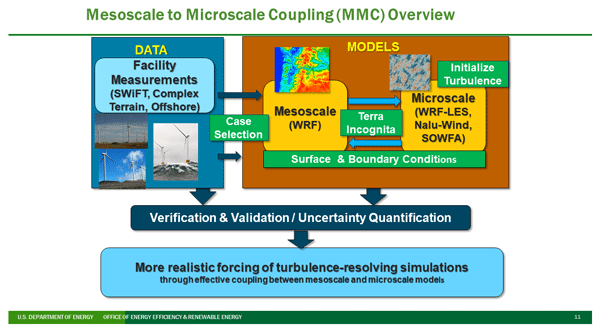
The Mesoscale to Microscale Coupling team, part of the U.S. Department of Energy Atmosphere to Electrons (A2e) initiative, has studied various important challenges related to coupling mesoscale models to microscale models. Lessons learned and discerned best practices are described in the context of the cases studied for the purpose of enabling further deployment of wind energy. It also points to code, assessment tools, and data for testing the methods.
Timothy W. Juliano, Florian Tornow, Ann M. Fridlind, Andrew S. Ackerman, Gregory S. Elsaesser, Bart Geerts, Christian P. Lackner, David Painemal, Israel Silber, Mikhail Ovchinnikov, Gunilla Svensson, Michael Tjernström, Peng Wu, Alejandro Baró Pérez, Peter Bogenschutz, Dmitry Chechin, Kamal Kant Chandrakar, Jan Chylik, Andrey Debolskiy, Rostislav Fadeev, Anu Gupta, Luisa Ickes, Michail Karalis, Martin Köhler, Branko Kosović, Peter Kuma, Weiwei Li, Evgeny Mortikov, Hugh Morrison, Roel A. J. Neggers, Anna Possner, Tomi Raatikainen, Lea Raillard, Sami Romakkaniemi, Niklas Schnierstein, Shin-ichiro Shima, Nikita Silin, Mikhail Tolstykh, Étienne Vignon, Lulin Xue, Meng Zhang, and Xue Zheng
Atmos. Chem. Phys., 26, 13267–13302, https://doi.org/10.5194/acp-26-13267-2026, https://doi.org/10.5194/acp-26-13267-2026, 2026
Short summary
Short summary
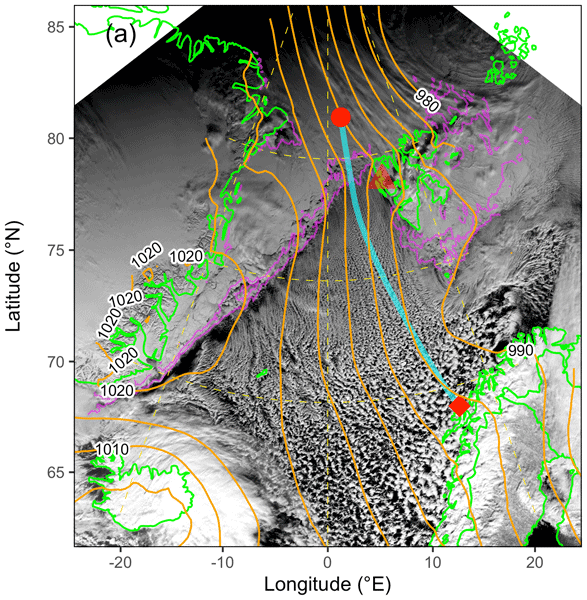
Models struggle to capture cloud and precipitation processes and their radiative effects in marine cold-air outbreaks. We use a quasi-Lagrangian framework to compare large-eddy simulation (LES) and single-column model (SCM) output with field and satellite observations. With fixed droplet and ice numbers, LES and SCM agree in liquid-only tests. In mixed-phase conditions, LES plausibly capture cloud thinning and breakup, while SCMs largely remain overcast and thereby miss cloud radiative effects.
Eric A. Hendricks, Timothy W. Juliano, Branko Kosović, Sue Ellen Haupt, Brian J. Gaudet, and Geng Xia
Geosci. Model Dev., 19, 7369–7387, https://doi.org/10.5194/gmd-19-7369-2026, https://doi.org/10.5194/gmd-19-7369-2026, 2026
Short summary
Short summary
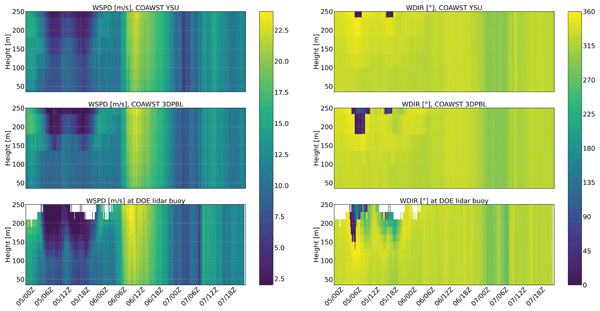
A three-dimensional planetary boundary layer (PBL) parameterization, suited for mesoscale model grid spacings of 100–1000 m with improved treatment of unresolved horizontal mixing, is added to a coupled atmosphere/wave modeling system and the first coupled simulations are executed using the parameterization. Simulations of a significant wind-wave event demonstrate that the new parameterization has similar behaviors as one-dimensional PBL parameterizations and compares well with observations.

Branko Kosović, Sukanta Basu, Jacob Berg, Larry K. Berg, Sue E. Haupt, Xiaoli G. Larsén, Joachim Peinke, Richard J. A. M. Stevens, Paul Veers, and Simon Watson
Wind Energ. Sci., 11, 509–555, https://doi.org/10.5194/wes-11-509-2026, https://doi.org/10.5194/wes-11-509-2026, 2026
Short summary
Short summary
Most human activity happens in the layer of the atmosphere which extends a few hundred meters to a couple of kilometers above the surface of the Earth. The flow in this layer is turbulent. Turbulence impacts wind power production and turbine lifespan. Optimizing wind turbine performance requires understanding how turbulence affects both wind turbine efficiency and reliability. This paper points to gaps in our knowledge that need to be addressed to effectively utilize wind resources.
Timothy W. Juliano, Florian Tornow, Ann M. Fridlind, Andrew S. Ackerman, Gregory S. Elsaesser, Bart Geerts, Christian P. Lackner, David Painemal, Israel Silber, Mikhail Ovchinnikov, Gunilla Svensson, Michael Tjernström, Peng Wu, Alejandro Baró Pérez, Peter Bogenschutz, Dmitry Chechin, Kamal Kant Chandrakar, Jan Chylik, Andrey Debolskiy, Rostislav Fadeev, Anu Gupta, Luisa Ickes, Michail Karalis, Martin Köhler, Branko Kosović, Peter Kuma, Weiwei Li, Evgeny Mortikov, Hugh Morrison, Roel A. J. Neggers, Anna Possner, Tomi Raatikainen, Sami Romakkaniemi, Niklas Schnierstein, Shin-ichiro Shima, Nikita Silin, Mikhail Tolstykh, Lulin Xue, Meng Zhang, and Xue Zheng
EGUsphere, https://doi.org/10.5194/egusphere-2025-6217, https://doi.org/10.5194/egusphere-2025-6217, 2026
Preprint archived
Short summary
Short summary
Models struggle to capture cloud and precipitation processes and their radiative effects in marine cold-air outbreaks. We use a quasi-Lagrangian framework to compare large-eddy simulation (LES) and single-column model (SCM) output with field and satellite observations. With fixed droplet and ice numbers, LES and SCM agree in liquid-only tests. In mixed-phase conditions, LES plausibly capture cloud thinning and breakup, while SCMs largely remain overcast and thereby miss cloud radiative effects.
Mari R. Tye, Ming Ge, Jadwiga H. Richter, Ethan D. Gutmann, Allyson Rugg, Cindy L. Bruyère, Sue Ellen Haupt, Flavio Lehner, Rachel McCrary, Andrew J. Newman, and Andy Wood
Hydrol. Earth Syst. Sci., 29, 1117–1133, https://doi.org/10.5194/hess-29-1117-2025, https://doi.org/10.5194/hess-29-1117-2025, 2025
Short summary
Short summary
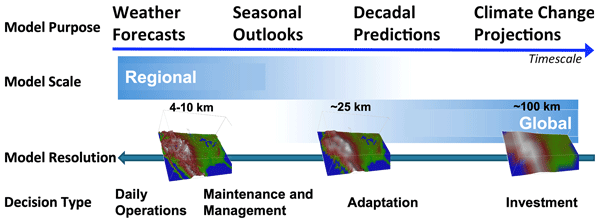
There is a perceived mismatch between the spatial scales on which global climate models can produce data and those needed for water management decisions. However, poor communication of specific metrics relevant to local decisions is also a problem. We assessed the credibility of a set of water management decision metrics in the Community Earth System Model v2 (CESM2). CESM2 shows potentially greater use of its output in long-range water management decisions.
Timothy W. Juliano, Fernando Szasdi-Bardales, Neil P. Lareau, Kasra Shamsaei, Branko Kosović, Negar Elhami-Khorasani, Eric P. James, and Hamed Ebrahimian
Nat. Hazards Earth Syst. Sci., 24, 47–52, https://doi.org/10.5194/nhess-24-47-2024, https://doi.org/10.5194/nhess-24-47-2024, 2024
Short summary
Short summary
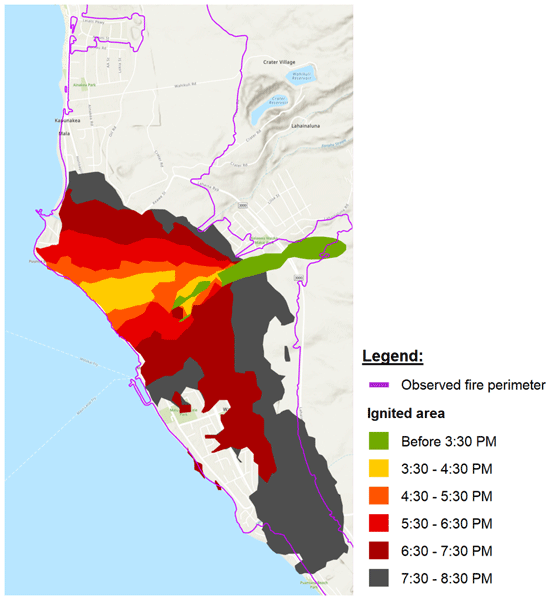
Following the destructive Lahaina Fire in Hawaii, our team has modeled the wind and fire spread processes to understand the drivers of this devastating event. The simulation results show that extreme winds with high variability, a fire ignition close to the community, and construction characteristics led to continued fire spread in multiple directions. Our results suggest that available modeling capabilities can provide vital information to guide decision-making during wildfire events.
Tasnim Zaman, Timothy Juliano, Pat Hawbecker, and Marina Astitha
Wind Energ. Sci. Discuss., https://doi.org/10.5194/wes-2023-148, https://doi.org/10.5194/wes-2023-148, 2024
Preprint withdrawn
Short summary
Short summary
We suggest a model configuration to predict offshore wind speed and wind power density in the Northeast US. We focused on wind droughts, long periods of low wind speed that affect the reliability of wind power generation. We show that wind prediction depends primarily on the initial and boundary conditions, and that it is important to evaluate the connection of wind speed to wind power generation, to select the best model configuration.
Sue Ellen Haupt, Branko Kosović, Larry K. Berg, Colleen M. Kaul, Matthew Churchfield, Jeffrey Mirocha, Dries Allaerts, Thomas Brummet, Shannon Davis, Amy DeCastro, Susan Dettling, Caroline Draxl, David John Gagne, Patrick Hawbecker, Pankaj Jha, Timothy Juliano, William Lassman, Eliot Quon, Raj K. Rai, Michael Robinson, William Shaw, and Regis Thedin
Wind Energ. Sci., 8, 1251–1275, https://doi.org/10.5194/wes-8-1251-2023, https://doi.org/10.5194/wes-8-1251-2023, 2023
Short summary
Short summary
The Mesoscale to Microscale Coupling team, part of the U.S. Department of Energy Atmosphere to Electrons (A2e) initiative, has studied various important challenges related to coupling mesoscale models to microscale models. Lessons learned and discerned best practices are described in the context of the cases studied for the purpose of enabling further deployment of wind energy. It also points to code, assessment tools, and data for testing the methods.
Paul Veers, Katherine Dykes, Sukanta Basu, Alessandro Bianchini, Andrew Clifton, Peter Green, Hannele Holttinen, Lena Kitzing, Branko Kosovic, Julie K. Lundquist, Johan Meyers, Mark O'Malley, William J. Shaw, and Bethany Straw
Wind Energ. Sci., 7, 2491–2496, https://doi.org/10.5194/wes-7-2491-2022, https://doi.org/10.5194/wes-7-2491-2022, 2022
Short summary
Short summary
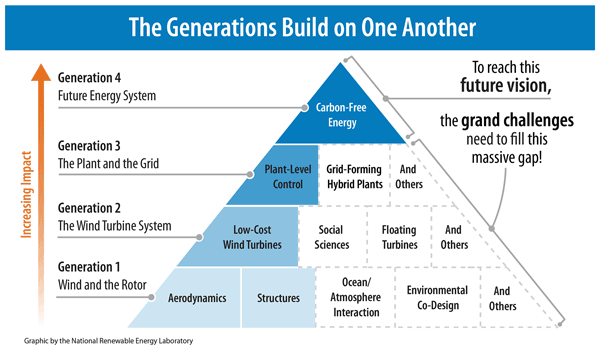
Wind energy will play a central role in the transition of our energy system to a carbon-free future. However, many underlying scientific issues remain to be resolved before wind can be deployed in the locations and applications needed for such large-scale ambitions. The Grand Challenges are the gaps in the science left behind during the rapid growth of wind energy. This article explains the breadth of the unfinished business and introduces 10 articles that detail the research needs.
Cited articles
Aird, J. A., Barthelmie, R. J., Shepherd, T. J., and Pryor, S. C.: Occurrence of low-level jets over the eastern US coastal zone at heights relevant to wind energy, Energies, 15, 445, https://doi.org/10.3390/en15020445, 2022. a
Alvera-Azcárate, A., Barth, A., Rixen, M., and Beckers, J.-M.: Reconstruction of incomplete oceanographic data sets using empirical orthogonal functions: application to the Adriatic Sea surface temperature, Ocean Modelling, 9, 325–346, 2005. a
Alvera-Azcárate, A., Barth, A., Beckers, J.-M., and Weisberg, R. H.: Multivariate reconstruction of missing data in sea surface temperature, chlorophyll, and wind satellite fields, Journal of Geophysical Research: Oceans, 112, https://doi.org/10.1029/2006JC003660, 2007. a
Beare, R. J. and Macvean, M. K.: Resolution sensitivity and scaling of large-eddy simulations of the stable boundary layer, Boundary-Layer Meteorology, 112, 257–281, 2004. a
Beare, R. J., Macvean, M. K., Holtslag, A. A., Cuxart, J., Esau, I., Golaz, J.-C., Jimenez, M. A., Khairoutdinov, M., Kosovic, B., Lewellen, D., and Lund, T. S.: An intercomparison of large-eddy simulations of the stable boundary layer, Boundary-Layer Meteorology, 118, 247–272, 2006. a
Beckers, J.-M. and Rixen, M.: EOF calculations and data filling from incomplete oceanographic datasets, Journal of Atmospheric and Oceanic Technology, 20, 1839–1856, 2003. a
Beckers, J.-M., Barth, A., and Alvera-Azcárate, A.: DINEOF reconstruction of clouded images including error maps – application to the Sea-Surface Temperature around Corsican Island, Ocean Science, 2, 183–199, https://doi.org/10.5194/os-2-183-2006, 2006. a
Bhaganagar, K. and Debnath, M.: Implications of stably stratified atmospheric boundary layer turbulence on the near-wake structure of wind turbines, Energies, 7, 5740–5763, 2014. a
Canada Meteorological Center: GHRSST Level 4 CMC0.1deg Global Foundation Sea Surface Temperature Analysis (GDS version 2), Physical Oceanography Distributed Active Archive Center [data set], https://doi.org/10.5067/GHCMC-4FM03, 2017. a
Colle, B. A. and Novak, D. R.: The New York Bight jet: climatology and dynamical evolution, Monthly Weather Review, 138, 2385–2404, 2010. a
Colle, B. A., Sienkiewicz, M. J., Archer, C., Veron, D., Veron, F., Kempton, W., and Mak, J. E.: Improving the Mapping and Prediction of Offshore Wind Resources (IMPOWR): Experimental overview and first results, Bulletin of the American Meteorological Society, 97, 1377–1390, 2016. a
Deardorff, J. W.: Stratocumulus-capped mixed layers derived from a three-dimensional model, Boundary-Layer Meteorology, 18, 495–527, 1980. a
Debnath, M., Doubrawa, P., Optis, M., Hawbecker, P., and Bodini, N.: Extreme wind shear events in US offshore wind energy areas and the role of induced stratification, Wind Energy Science, 6, 1043–1059, https://doi.org/10.5194/wes-6-1043-2021, 2021. a, b, c
Eghdami, M., Barros, A. P., Jiménez, P. A., Juliano, T. W., and Kosovic, B.: Diagnosis of Second-Order Turbulent Properties of the Surface Layer for Three-Dimensional Flow Based on the Mellor–Yamada Model, Monthly Weather Review, 150, 1003–1021, 2022. a
Ferrier, B. S.: J4. 2 Modifications Of Two Convective Schemes Used In The Ncep Eta Model, in: 20th Conference on Weather Analysis and Forecasting/16th Conference on Numerical Weather Prediction, 2004. a
Gadde, S. N. and Stevens, R. J.: Effect of low-level jet height on wind farm performance, Journal of Renewable and Sustainable Energy, 13, 013305, https://doi.org/10.1063/5.0026232, 2021. a
Gerber, H., Chang, S., and Holt, T.: Evolution of a marine boundary-layer jet, Journal of the Atmospheric Sciences, 46, 1312–1326, 1989. a
Global Modeling and Assimilation Office (GMAO): MERRA-2, const_2d_asm_Nx, Goddard Earth Sciences Data and Information Services Center [data set], https://doi.org/10.5067/ME5QX6Q5IGGU, 2015a. a
Global Modeling and Assimilation Office (GMAO): MERRA-2, inst6_3d_ana_Np, Goddard Earth Sciences Data and Information Services Center [data set], https://doi.org/10.5067/A7S6XP56VZWS, 2015b. a
Global Modeling and Assimilation Office (GMAO): MERRA-2, const_2d_asm_Nx, Goddard Earth Sciences Data and Information Services Center [data set], https://doi.org/10.5067/IUUF4WB9FT4W, 2015c. a
Global Modeling and Assimilation Office (GMAO): MERRA-2, tavg1_2d_lnd_Nx, Goddard Earth Sciences Data and Information Services Center [data set], https://doi.org/10.5067/RKPHT8KC1Y1T, 2015d. a
Global Modeling and Assimilation Office (GMAO): MERRA-2, tavg1_2d_ocn_Nx, Goddard Earth Sciences Data and Information Services Center [data set], https://doi.org/10.5067/Y67YQ1L3ZZ4R, 2015e. a, b
Global Modeling and Assimilation Office (GMAO): MERRA-2, tavg1_2d_slv_Nx, Goddard Earth Sciences Data and Information Services Center [data set], https://doi.org/10.5067/VJAFPLI1CSIV, 2015f. a
Gutierrez, W., Ruiz-Columbie, A., Tutkun, M., and Castillo, L.: Impacts of the low-level jet's negative wind shear on the wind turbine, Wind Energy Science, 2, 533–545, https://doi.org/10.5194/wes-2-533-2017, 2017. a
Hallgren, C., Aird, J. A., Ivanell, S., Körnich, H., Barthelmie, R. J., Pryor, S. C., and Sahlée, E.: Brief communication: On the definition of the low-level jet, Wind Energy Science, 8, 1651–658, https://doi.org/10.5194/wes-8-1651-2023, 2023. a
Haupt, S., Berg, L., Churchfield, M., Kosovic, B., Mirocha, J., and Shaw, W.: Mesoscale to microscale coupling for wind energy applications: Addressing the challenges, in: Journal of Physics: Conference Series, vol. 1452, p. 012076, IOP Publishing, https://doi.org/10.1088/1742-6596/1452/1/012076, 2020. a
Haupt, S. E., Kosovic, B., Shaw, W., Berg, L. K., Churchfield, M., Cline, J., Draxl, C., Ennis, B., Koo, E., Kotamarthi, R., and Mazzaro, L.: On bridging a modeling scale gap: Mesoscale to microscale coupling for wind energy, Bulletin of the American Meteorological Society, 100, 2533–2550, 2019. a
Haupt, S. E., Kosović, B., Berg, L. K., Kaul, C. M., Churchfield, M., Mirocha, J., Allaerts, D., Brummet, T., Davis, S., DeCastro, A., Dettling, S., Draxl, C., Gagne, D. J., Hawbecker, P., Jha, P., Juliano, T., Lassman, W., Quon, E., Rai, R. K., Robinson, M., Shaw, W., and Thedin, R.: Lessons learned in coupling atmospheric models across scales for onshore and offshore wind energy, Wind Energy Science, 8, 1251–1275, https://doi.org/10.5194/wes-8-1251-2023, 2023. a, b, c, d
Hawbecker, P., Lassman, W., Mirocha, J., Rai, R. K., Thedin, R., Churchfield, M. J., Haupt, S. E., and Kaul, C.: Offshore Sensitivities across Scales: A NYSERDA Case Study, in: American Meteorological Society Meeting Abstracts, vol. 102, pp. 6–2, 2022. a
Hersbach, H., Bell, B., Berrisford, P., Hirahara, S., Horányi, A., Muñoz-Sabater, J., Nicolas, J., Peubey, C., Radu, R., Schepers, D., and Simmons, A.: The ERA5 global reanalysis, Quarterly Journal of the Royal Meteorological Society, 146, pp. 1999–2049, https://doi.org/10.1002/qj.3803, 2020. a
Holtslag, M., Bierbooms, W., and Van Bussel, G.: Estimating atmospheric stability from observations and correcting wind shear models accordingly, in: Journal of Physics: Conference Series, vol. 555, p. 012052, IOP Publishing, https://doi.org/10.1088/1742-6596/555/1/012052, 2014. a
Iacono, M. J., Delamere, J. S., Mlawer, E. J., Shephard, M. W., Clough, S. A., and Collins, W. D.: Radiative forcing by long-lived greenhouse gases: Calculations with the AER radiative transfer models, Journal of Geophysical Research: Atmospheres, 113, https://doi.org/10.1029/2008JD009944, 2008. a
Janjić, Z. I.: Nonsingular implementation of the Mellor–Yamada level 2.5 scheme in the NCEP Meso model, NCEP Office Note, 437, 61, 2002. a
Juliano, T. W., Kosović, B., Jiménez, P. A., Eghdami, M., Haupt, S. E., and Martilli, A.: “Gray Zone” simulations using a three-dimensional planetary boundary layer parameterization in the Weather Research and Forecasting Model, Monthly Weather Review, 150, 1585–1619, 2022. a
Kain, J. S.: The Kain–Fritsch convective parameterization: an update, Journal of Applied Meteorology, 43, 170–181, 2004. a
Kalverla, P. C., Duncan Jr., J. B., Steeneveld, G.-J., and Holtslag, A. A. M.: Low-level jets over the North Sea based on ERA5 and observations: together they do better, Wind Energy Science, 4, 193–209, https://doi.org/10.5194/wes-4-193-2019, 2019. a
Kosović, B., Jiménez, P., Haupt, S., Olson, J., Bao, J., Grell, E., and Kenyon, J.: A Three-dimensional PBL Parameterization for High-resolution Mesoscale Simulation over Heterogeneous and Complex Terrain, in: AGU Fall Meeting Abstracts, 2016AGUFM.A21I..05K, 2016. a
Kosović, B., Munoz, P. J., Juliano, T., Martilli, A., Eghdami, M., Barros, A., and Haupt, S.: Three-dimensional planetary boundary layer parameterization for high-resolution mesoscale simulations, in: Journal of Physics: Conference Series, vol. 1452, p. 012080, IOP Publishing, https://doi.org/10.1088/1742-6596/1452/1/012080, 2020. a, b
Krishnamurthy, R., García Medina, G., Gaudet, B., Gustafson Jr., W. I., Kassianov, E. I., Liu, J., Newsom, R. K., Sheridan, L. M., and Mahon, A. M.: Year-long buoy-based observations of the air–sea transition zone off the US west coast, Earth System Science Data, 15, 5667–5699, https://doi.org/10.5194/essd-15-5667-2023, 2023. a
Liu, Y., Bourgeois, A., Warner, T., Swerdlin, S., and Hacker, J.: Implementation of observation-nudging based FDDA into WRF for supporting ATEC test operations, in: WRF/MM5 Users' Workshop June, 27–30, 2005. a
Liu, Y., Bourgeois, A., Warner, T., and Swerdlin, S.: An “observation-nudging”-based FDDA scheme for WRFARW for mesoscale data assimilation and forecasting, in: Preprints, 4th Symp. on Space Weather, San Antonio, TX, Amer. Meteor. Soc, 2007. a
McCabe, E. J. and Freedman, J. M.: Quantifying the uncertainty in the Weather Research and Forecasting Model under sea breeze and low-level jet conditions in the New York Bight: Importance to offshore wind energy, Weather and Forecasting, 40, 425–450, 2025. a
Mirocha, J., Kosović, B., and Kirkil, G.: Resolved turbulence characteristics in large-eddy simulations nested within mesoscale simulations using the Weather Research and Forecasting Model, Monthly Weather Review, 142, 806–831, 2014. a
Muñoz-Esparza, D., Kosović, B., Van Beeck, J., and Mirocha, J.: A stochastic perturbation method to generate inflow turbulence in large-eddy simulation models: Application to neutrally stratified atmospheric boundary layers, Physics of Fluids, 27, 035102, https://doi.org/10.1063/1.4913572, 2015. a, b
Musial, W., Spitsen, P., Duffy, P., Beiter, P., Shields, M., Mulas Hernando, D., Hammond, R., Marquis, M., King, J., and Sathish, S.: Offshore wind market report: 2023 edition, Tech. rep., National Renewable Energy Laboratory (NREL), Golden, CO (United States), https://doi.org/10.2172/2001112, 2023. a
NASA Jet Propulsion Laboratory: GHRSST Level 4 K10_SST Global 10 km Analyzed Sea Surface Temperature from Naval Oceanographic Office (NAVO) in GDS2.0, Physical Oceanography Distributed Active Archive Center [data set], https://doi.org/10.5067/GHK10-L4N01, 2018. a
NASA/JPL: GHRSST Level 4 MUR Global Foundation Sea Surface Temperature Analysis (v4.1), Physical Oceanography Distributed Active Archive Center [data set], https://doi.org/10.5067/GHGMR-4FJ04, 2015. a
NOAA/NESDIS/STAR: GHRSST NOAA/STAR GOES-16 ABI L3C America Region SST. Ver. 2.70, Physical Oceanography Distributed Active Archive Center [data set], https://doi.org/10.5067/GHG16-3UO27, 2019. a
Nunalee, C. G. and Basu, S.: Mesoscale modeling of coastal low-level jets: implications for offshore wind resource estimation, Wind Energy, 17, 1199–1216, 2014. a
OceanTech Services/DNV: NYSERDA Floating LiDAR Buoy Data, https://oswbuoysny.resourcepanorama.dnv.com/ (last access: 6 November 2024), 2019. a
OSPO: GHRSST Level 4 OSPO Global Foundation Sea Surface Temperature Analysis (GDS version 2), Physical Oceanography Distributed Active Archive Center [data set], https://doi.org/10.5067/GHGPB-4FO02, 2015. a
Park, J., Basu, S., and Manuel, L.: Large-eddy simulation of stable boundary layer turbulence and estimation of associated wind turbine loads, Wind Energy, 17, 359–384, 2014. a
Paulsen, J., Schneemann, J., Steinfeld, G., Theuer, F., and Kühn, M.: The impact of low-level jets on the power generated by offshore wind turbines, Wind Energy Science Discussions, pp. 1–37, https://doi.org/10.5194/wes-2025-118, 2025. a
Pichugina, Y., Brewer, W., Banta, R., Choukulkar, A., Clack, C., Marquis, M., McCarty, B., Weickmann, A., Sandberg, S., Marchbanks, R., and Hardesty, R. M.: Properties of the offshore low level jet and rotor layer wind shear as measured by scanning Doppler Lidar, Wind Energy, 20, 987–1002, 2017. a
Piety, C. A.: Radar wind profiler observations in Maryland: a preliminary climatology of the low level jet, The Maryland Department of the Environment Air and Radiation Administration Rep, 2005. a
Quint, D., Lundquist, J. K., and Rosencrans, D.: Simulations suggest offshore wind farms modify low-level jets, Wind Energy Science , 10, 117–142, https://doi.org/10.5194/wes-10-117-2025, 2025. a
Redfern, S., Olson, J. B., Lundquist, J. K., and Clack, C. T.: Incorporation of the rotor-equivalent wind speed into the weather research and forecasting model’s wind farm parameterization, Monthly Weather Review, 147, 1029–1046, 2019. a
Reen, B. P. and Stauffer, D. R.: Data assimilation strategies in the planetary boundary layer, Boundary-Layer Meteorology, 137, 237–269, 2010. a
Shin, H. H. and Hong, S.-Y.: Representation of the subgrid-scale turbulent transport in convective boundary layers at gray-zone resolutions, Monthly Weather Review, 143, 250–271, 2015. a
Skamarock, W. C., Klemp, J. B., Dudhia, J., Gill, D. O., Liu, Z., Berner, J., Wang, W., Powers, J. G., Duda, M. G., Barker, D. M., and Huang, X.-Y.: A description of the advanced research WRF model version 4.3, National Center for Atmospheric Research: Boulder, CO, USA, NCAR/TN-556+STR, 165, https://doi.org/10.5065/1dfh-6p97, 2021. a
Small, R. d., deSzoeke, S. P., Xie, S., O'neill, L., Seo, H., Song, Q., Cornillon, P., Spall, M., and Minobe, S.: Air–sea interaction over ocean fronts and eddies, Dynamics of Atmospheres and Oceans, 45, 274–319, 2008. a
Stehly, T. and Duffy, P.: 2020 cost of wind energy review, Tech. rep., National Renewable Energy Laboratory (NREL), Golden, CO (United States), https://doi.org/10.2172/1838135, 2021. a
Strobach, E., Sparling, L. C., Rabenhorst, S. D., and Demoz, B.: Impact of inland terrain on mid-atlantic offshore wind and implications for wind resource assessment: A case study, Journal of Applied Meteorology and Climatology, 57, 777–796, 2018. a
Sullivan, P. P., Edson, J. B., Hristov, T., and McWilliams, J. C.: Large-eddy simulations and observations of atmospheric marine boundary layers above nonequilibrium surface waves, Journal of the Atmospheric Sciences, 65, 1225–1245, 2008. a
Sullivan, P. P., Weil, J. C., Patton, E. G., Jonker, H. J., and Mironov, D. V.: Turbulent winds and temperature fronts in large-eddy simulations of the stable atmospheric boundary layer, Journal of the Atmospheric Sciences, 73, 1815–1840, 2016. a
Talbot, C., Bou-Zeid, E., and Smith, J.: Nested mesoscale large-eddy simulations with WRF: Performance in real test cases, Journal of Hydrometeorology, 13, 1421–1441, 2012. a
Tewari, M., Chen, F., Wang, W., Dudhia, J., LeMone, M., Mitchell, K., Ek, M., Gayno, G., Wegiel, J., and Cuenca, R.: Implementation and verification of the unified NOAH land surface model in the WRF model, in: 20th Conference on Weather Analysis and Forecasting/16th Conference on Numerical Weather Prediction, vol. 1115, American Meteorological Society Seattle, WA, 2004. a
UKMO: GHRSST Level 4 OSTIA Global Foundation Sea Surface Temperature Analysis, Physical Oceanography Distributed Active Archive Center [data set], https://doi.org/10.5067/GHOST-4FK01, 2005. a
Wharton, S. and Lundquist, J. K.: Atmospheric stability affects wind turbine power collection, Environmental Research Letters, 7, 014005, https://doi.org/10.1088/1748-9326/7/1/014005, 2012. a
Whyte, F. S., Taylor, M. A., Stephenson, T. S., and Campbell, J. D.: Features of the Caribbean low level jet, International Journal of Climatology: A Journal of the Royal Meteorological Society, 28, 119–128, 2008. a
Wyngaard, J. C.: Toward numerical modeling in the “Terra Incognita”, Journal of the Atmospheric Sciences, 61, 1816–1826, 2004. a
Zhang, D.-L., Zhang, S., and Weaver, S. J.: Low-level jets over the mid-Atlantic states: Warm-season climatology and a case study, Journal of Applied Meteorology and Climatology, 45, 194–209, 2006. a
Short summary
Offshore wind turbines can be directly impacted by the jet maximum winds of low-level jets, which makes them very important to the wind energy community. Here, we simulate an offshore low-level jet event using a weather model from low resolution to very high resolution. We run the simulations several times, varying the sea surface temperature to generate different realizations of the event and comparing against observations. We then ask and answer: "Is model performance consistent across scales?"
Offshore wind turbines can be directly impacted by the jet maximum winds of low-level jets,...


Altmetrics
Final-revised paper
Preprint