
Articles | Volume 9, issue 7
https://doi.org/10.5194/wes-9-1465-2024
© Author(s) 2024. This work is distributed under
the Creative Commons Attribution 4.0 License.
the Creative Commons Attribution 4.0 License.
https://doi.org/10.5194/wes-9-1465-2024
© Author(s) 2024. This work is distributed under
the Creative Commons Attribution 4.0 License.
the Creative Commons Attribution 4.0 License.
Research article
| 
08 Jul 2024
Research article |
| 08 Jul 2024
| 08 Jul 2024
Comparison of different cross-sectional approaches for the structural design and optimization of composite wind turbine blades based on beam models
Institute of Lightweight Systems, German Aerospace Center (DLR), Lilienthalplatz 7, 38108 Braunschweig, Germany
Daniel Hardt
Institute of Lightweight Systems, German Aerospace Center (DLR), Lilienthalplatz 7, 38108 Braunschweig, Germany
Claudio Balzani
Institute for Wind Energy Systems, Leibniz University Hannover, Appelstrasse 9A, 30167 Hanover, Germany
Christian Hühne
Institute of Lightweight Systems, German Aerospace Center (DLR), Lilienthalplatz 7, 38108 Braunschweig, Germany
Related authors
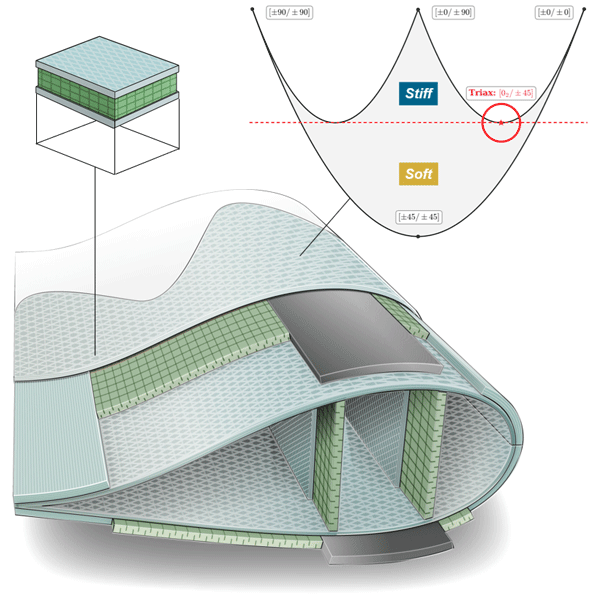
Edgar Werthen, Gustavo Nunes Ribeiro, Sascha Dähne, Lennart Tönjes, David Zerbst, and Christian Hühne
Wind Energ. Sci., 11, 2939–2960, https://doi.org/10.5194/wes-11-2939-2026, https://doi.org/10.5194/wes-11-2939-2026, 2026
Short summary
Short summary
A multi-parametric panel approach, integrated into a wind turbine blade optimization workflow, is provided. The formulation enables sandwich panels to be represented as modular assemblies with independently parameterized materials. This capability enabled the examination of Double-Double laminates as viable replacements for conventional triaxial skins in a large-scale optimization, like demonstrated for a large blade. The results show a mass reduction without changing the production process.
Edgar Werthen, Gustavo Nunes Ribeiro, Sascha Dähne, Lennart Tönjes, David Zerbst, and Christian Hühne
Wind Energ. Sci., 11, 2939–2960, https://doi.org/10.5194/wes-11-2939-2026, https://doi.org/10.5194/wes-11-2939-2026, 2026
Short summary
Short summary
A multi-parametric panel approach, integrated into a wind turbine blade optimization workflow, is provided. The formulation enables sandwich panels to be represented as modular assemblies with independently parameterized materials. This capability enabled the examination of Double-Double laminates as viable replacements for conventional triaxial skins in a large-scale optimization, like demonstrated for a large blade. The results show a mass reduction without changing the production process.
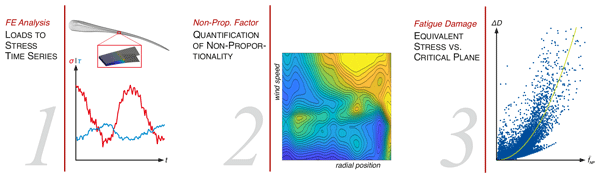
Claudio Balzani and Pablo Noever Castelos
Wind Energ. Sci., 10, 1249–1267, https://doi.org/10.5194/wes-10-1249-2025, https://doi.org/10.5194/wes-10-1249-2025, 2025
Short summary
Short summary
Wind turbine rotor blades consist of subcomponents that are glued together. Such connections are subject to fatigue loads. This paper analyzes the fatigue load characteristics of three different wind turbine rotor blades in trailing edge adhesive joints. It is shown that the fatigue loads have measurable degrees of non-proportionality and that the choice of the procedure to calculate the fatigue damage is crucial for designing reliable blades.
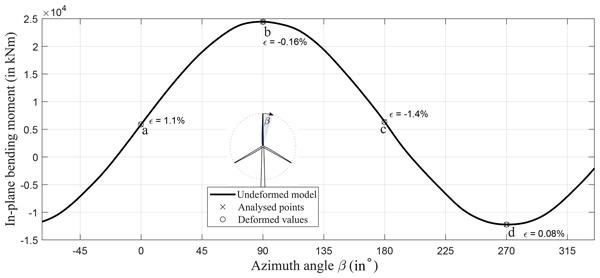
Julia Gebauer, Felix Prigge, Dominik Ahrens, Lars Wein, and Claudio Balzani
Wind Energ. Sci., 10, 679–694, https://doi.org/10.5194/wes-10-679-2025, https://doi.org/10.5194/wes-10-679-2025, 2025
Short summary
Short summary
The amount of energy that can be extracted from wind depends primarily on the blade geometry, which can be affected by elastic deformations. This paper presents a first study analysing the influence of cross-sectional deformations of a 15 MW wind turbine blade on aero-elastic simulations. The results show that cross-sectional deformations have a minor influence on the internal loads of rotor blades in normal operation.
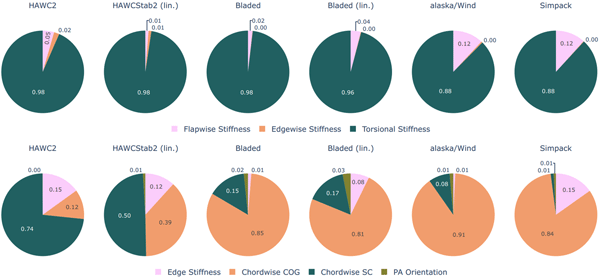
Hendrik Verdonck, Oliver Hach, Jelmer D. Polman, Otto Schramm, Claudio Balzani, Sarah Müller, and Johannes Rieke
Wind Energ. Sci., 9, 1747–1763, https://doi.org/10.5194/wes-9-1747-2024, https://doi.org/10.5194/wes-9-1747-2024, 2024
Short summary
Short summary
Aeroelastic stability simulations are needed to guarantee the safety and overall robust design of wind turbines. To increase our confidence in these simulations in the future, the sensitivity of the stability analysis with respect to variability in the structural properties of the wind turbine blades is investigated. Multiple state-of-the-art tools are compared and the study shows that even though the tools predict similar stability behavior, the sensitivity might be significantly different.
Pablo Noever-Castelos, David Melcher, and Claudio Balzani
Wind Energ. Sci., 7, 623–645, https://doi.org/10.5194/wes-7-623-2022, https://doi.org/10.5194/wes-7-623-2022, 2022
Short summary
Short summary
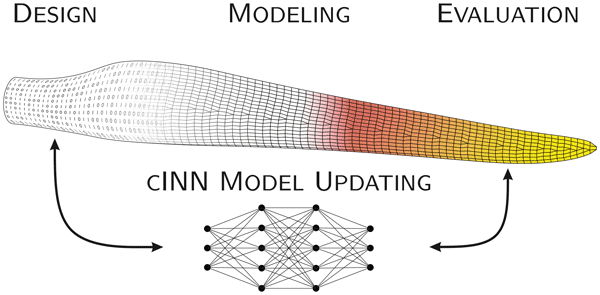
In the wind energy industry, a digital twin is fast becoming a key instrument for the monitoring of a wind turbine blade's life cycle. Here, our introduced model updating with invertible neural networks provides an efficient and powerful technique to represent the real blade as built. This method is applied to a full finite element Timoshenko beam model of a blade to successfully update material and layup parameters. The advantage over state-of-the-art methods is the established inverse model.
Pablo Noever-Castelos, Bernd Haller, and Claudio Balzani
Wind Energ. Sci., 7, 105–127, https://doi.org/10.5194/wes-7-105-2022, https://doi.org/10.5194/wes-7-105-2022, 2022
Short summary
Short summary
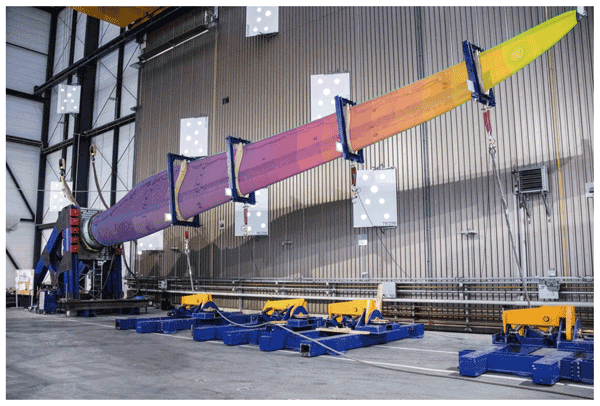
Modern rotor blade designs depend on detailed numerical models and simulations. Thus, a validated modeling methodology is fundamental for reliable designs. This paper briefly presents a modeling algorithm for rotor blades, its validation against real-life full-scale blade tests, and the respective test data. The hybrid 3D shell/solid finite-element model is successfully validated against the conducted classical bending tests in flapwise and lead–lag direction as well as novel torsion tests.
Cited articles
Behnel, S., Bradshaw, R., Citro, C., Dalcin, L., Seljebotn, D. S., and Smith, K.: Cython: The best of both worlds, Comput. Sci. Eng., 13, 31–39, https://doi.org/10.1109/MCSE.2010.118, 2011. a
Bir, G. S.: User's Guide to PreComp (Pre-Processor for Computing Composite Blade Properties), National Renewable Energy Laboratory, https://doi.org/10.2172/876556, 2006. a
Blasques, J.: User's Manual for BECAS: A cross section analysis tool for anisotropic and inhomogeneous beam sections of arbitrary geometry, no. 1785(EN) in Denmark, Forskningscenter Risoe, Risoe-R, Risø DTU – National Laboratory for Sustainable Energy, https://orbit.dtu.dk/en/publications/9a623506-af47-41d6-9d24-5ef0e5b762c1 (last access: 30 March 2024), 2012. a, b, c, d, e, f
Borri, M., Ghiringhelli, G. L., and Merlini, T.: Composite Beam Analysis Linear Analysis of Naturally Curved and Twisted Anisotropic Beams, United States Army, European Research Office of the US army, http://www.dtic.mil/dtic/tr/fulltext/u2/a252652.pdf (last access: 30 March 2024), 1992. a
Bottasso, C., Campagnolo, F., Croce, A., and Tibaldi, C.: Optimization-based study of bend-twist coupled rotor blades for passive and integrated passive/active load alleviation, Wind Energy, 16, 1149–1166, https://doi.org/10.1002/we.1543, 2012. a
Carrera, E. and Petrolo, M.: Refined beam elements with only displacement variables and plate/shell capabilities, Meccanica, 47, 537–556, https://doi.org/10.1007/s11012-011-9466-5, 2011. a
Chandra, R. and Chopra, I.: Structural behavior of two-cell composite rotor blades with elastic couplings, AIAA J., 30, 2914–2921, https://doi.org/10.2514/3.11637, 1992. a, b, c, d
Chen, H., Yu, W., and Capellaro, M.: A critical assessment of computer tools for calculating composite wind turbine blade properties, Wind Energy, 13, 497–516, https://doi.org/10.1002/we.372, 2010. a
Deo, A. and Yu, W.: Thin-walled composite beam cross-sectional analysis using the mechanics of structure genome, Thin Wall. Struct., 152, 106663, https://doi.org/10.1016/j.tws.2020.106663, 2020. a
Dugas, M.: Ein Beitrag zur Auslegung von Faserverbundtragflügeln im Vorentwurf, Universität Stuttgart, https://doi.org/10.18419/opus-3672, 2002. a
Gasch, R. and Twele, J.: Wind Power Plants: Fundamentals, Design, Construction and Operation, Springer Berlin Heidelberg, Berlin, Heidelberg, 2nd edn., ISBN 978-3-642-22937-4, 2012. a
Giavotto, V., Borri, M., Mantegazza, P., Ghiringhelli, G., Carmaschi, V., Maffioli, G. C., and Mussi, F.: Anisotropic beam theory and applications, Comput. Struct., 16, 403–413, https://doi.org/10.1016/0045-7949(83)90179-7, 1983. a
Gjelsvik, A. and Hodges, D. H.: The Theory of Thin-Walled Bars, J. Appl. Mech., 49, 468–468, https://doi.org/10.1115/1.3162198, 1982. a
Johnson, E. R., Vasiliev, V. V., and Vasiliev, D. V.: Anisotropic Thin-Walled Beams with Closed Cross-Sectional Contours, AIAA J., 39, 2389–2393, https://doi.org/10.2514/2.1247, 2001. a, b, c
Jung, S. and Nagaraj, V. T.: Structural Behavior of Thin- and Thick-Walled Composite Blades with Multi-Cell Sections, in: 43rd AIAA/ASME/ASCE/AHS/ASC Structures, Structural Dynamics, and Materials Conference, American Institute of Aeronautics and Astronautics, Reston, Virigina, ISBN 978-1-62410-117-5, https://doi.org/10.2514/6.2002-1432, 2002. a, b, c, d, e, f, g
Jung, S., Kim, C.-J., Ko, J. H., and Kim, C.-W.: Theory of Thin-Walled, Pretwisted Composite Beams with Elastic Couplings, Adv. Compos. Mater., 18, 105–119, https://doi.org/10.1163/156855109X428736, 2009. a
Jung, S. N. and Park, I. J.: Structural Behavior of Thin- and Thick-Walled Composite Blades with Multicell Sections, American Institute of Aeronautics and Astronautics Journal, 43, 572–581, https://doi.org/10.2514/1.12864, 2005. a
Jung, S. N., Nagaraj, V. T., and Chopra, I.: Refined Structural Model for Thin- and Thick-Walled Composite Rotor Blades, AIAA J., 40, 105–116, https://doi.org/10.2514/2.1619, 2002. a, b, c
Kim, C. and White, S. R.: Thick-walled composite beam theory including 3-d elastic effects and torsional warping, Int. J. Solids Struct., 34, 4237–4259, https://doi.org/10.1016/S0020-7683(96)00072-8, 1997. a
Kollár, L. P. and Springer, G. S.: Mechanics of Composite Structures, Cambridge University Press, ISBN 9780511547140, https://doi.org/10.1017/cbo9780511547140, 2003. a, b, c
Lee, J.: Flexural analysis of thin-walled composite beams using shear-deformable beam theory, Compos. Struct., 70, 212–222, https://doi.org/10.1016/j.compstruct.2004.08.023, 2005. a
Lee, S.-L. and Shin, S. J.: Structural design optimization of a wind turbine blade using the genetic algorithm, Eng. Optimiz., 54, 2053–2070, https://doi.org/10.1080/0305215X.2021.1973450, 2022. a
Libove, C.: Stresses and rate of twist in single-cell thin-walled beams with anisotropic walls, AIAA J., 26, 1107–1118, https://doi.org/10.2514/3.10018, 1988. a, b, c
Librescu, L.: Thin-walled composite beams: Theory and application, Springer Link Bücher, vol. 131, Springer Netherlands, Dordrecht, ISBN 9781402042034, https://doi.org/10.1007/1-4020-4203-5, 2006. a, b, c
Librescu, L. and Song, O.: Behavior of thin-walled beams made of advanced composite materials and incorporating non-classical effects, Appl. Mech. Rev., 44, S174, https://doi.org/10.1115/1.3121352, 1991. a
Maes, V. K., Macquart, T., Weaver, P. M., and Pirrera, A.: Sensitivity of cross-sectional compliance to manufacturing tolerances for wind turbine blades, Wind Energ. Sci., 9, 165–180, https://doi.org/10.5194/wes-9-165-2024, 2024. a
Mansfield, E. H. and Sobey, A. J.: The Fibre Composite Helicopter Blade, Aeronaut. Quart., 30, 413–449, https://doi.org/10.1017/S0001925900008623, 1979. a, b, c
Qin, Z. and Librescu, L.: On a shear-deformable theory of anisotropic thin-walled beams: Further contribution and validations, Compos. Struct., 56, 345–358, https://doi.org/10.1016/S0263-8223(02)00019-3, 2002. a
Rehfield, L. W., Atilgan, A. R., and Hodges, D. H.: Nonclassical Behavior of Thin-Walled Composite Beams with Closed Cross Sections, J. Am. Helicopter Soc., 35, 42–50, https://doi.org/10.4050/JAHS.35.42, 1990. a, b, c
Rosemeier, M. and Krimmer, A.: Rotorblattstruktur, in: Einführung in die Windenergietechnik, edited by: Schaffarczyk, A. P., Chap. 5, Carl Hanser Verlag GmbH & Co. KG, 3 edn., 169–220, ISBN 9783446473225, https://doi.org/10.1007/978-3-446-47322-5, 2022. a
Saravia, M.: Calculation of the Cross Sectional Properties of Large Wind Turbine Blades, Mecánica Computacional, 54, 3619–3635, http://www.cimec.org.ar/ojs/index.php/mc/issue/view/876 (last access: 30 March 2024), 2016. a
Saravia, M. C., Saravia, L. J., and Cortínez, V. H.: A one dimensional discrete approach for the determination of the cross sectional properties of composite rotor blades, Renew. Energ., 80, 713–723, https://doi.org/10.1016/j.renene.2015.02.046, 2015. a, b
Scott, S., Macquart, T., Rodriguez, C., Greaves, P., McKeever, P., Weaver, P., and Pirrera, A.: Preliminary validation of ATOM: an aero-servo-elastic design tool for next generation wind turbines, J. Phys. Conf. Ser., 1222, 012012, https://doi.org/10.1088/1742-6596/1222/1/012012, 2019. a, b
Scott, S., Greaves, P., Weaver, P. M., Pirrera, A., and Macquart, T.: Efficient structural optimisation of a 20 MW wind turbine blade, J. Phys. Conf. Ser., 1618, 042025, https://doi.org/10.1088/1742-6596/1618/4/042025, 2020. a
Serafeim, G. P., Manolas, D. I., Riziotis, V. A., Chaviaropoulos, P. K., and Saravanos, D. A.: Optimized blade mass reduction of a 10 MW-scale wind turbine via combined application of passive control techniques based on flap-edge and bend-twist coupling effects, J. Wind Eng. Ind. Aerod., 225, 105002, https://doi.org/10.1016/j.jweia.2022.105002, 2022. a
Suresh, J. K. and Nagaraj, V. T.: Higher-order shear deformation theory for thin-walled composite beams, J. Aircraft, 33, 978–986, https://doi.org/10.2514/3.47044, 1996. a
Vo, T. P. and Lee, J.: Flexural–torsional behavior of thin-walled composite box beams using shear-deformable beam theory, Eng. Struct., 30, 1958–1968, https://doi.org/10.1016/j.engstruct.2007.12.003, 2008. a
Wanke, G., Bergami, L., Zahle, F., and Verelst, D. R.: Redesign of an upwind rotor for a downwind configuration: design changes and cost evaluation, Wind Energ. Sci., 6, 203–220, https://doi.org/10.5194/wes-6-203-2021, 2021. a
Weisshaar, T. A.: Aeroelastic Stability and Performance Characteristics of Aircraft with Advanced Composite Sweptforward Wing Structures, Defence Technical Information Center, https://apps.dtic.mil/sti/citations/ADB032318 (last access; 30 March 2024), 1978. a
Werthen, E., Hardt, D., and Hühne, C.: PreDoCS: Preliminary Design of Composite Structures, Zenodo [code], https://doi.org/10.5281/zenodo.10305952, 2023. a
Wiedemann, J.: Leichtbau: Elemente und Konstruktion, Klassiker der Technik, Springer-Verlag, Berlin, Heidelberg, 3rd edn., ISBN 3-540-33656-7, https://doi.org/10.1007/978-3-540-33657-0, 2007. a, b, c, d
Yu, W.: Efficient High-Fidelity Simulation of Multibody Systems with Composite Dimensionally Reducible Components, J. Am. Helicopter Soc., 52, 49–57, https://doi.org/10.4050/JAHS.52.49, 2007. a, b, c
Yu, W., Hodges, D. H., Volovoi, V. V., and Fuchs, E. D.: A generalized Vlasov theory for composite beams, Thin Wall. Struct., 43, 1493–1511, https://doi.org/10.1016/j.tws.2005.02.003, 2005. a, b
Short summary
We provide a comprehensive overview showing available cross-sectional approaches and their properties in relation to derived requirements for the design of composite rotor blades. The Jung analytical approach shows the best results for accuracy of stiffness terms (coupling and transverse shear) and stress distributions. Improved performance compared to 2D finite element codes could be achieved, making the approach applicable for optimization problems with a high number of design variables.
We provide a comprehensive overview showing available cross-sectional approaches and their...


Altmetrics
Final-revised paper
Preprint