
Articles | Volume 10, issue 12
https://doi.org/10.5194/wes-10-2865-2025
© Author(s) 2025. This work is distributed under
the Creative Commons Attribution 4.0 License.
the Creative Commons Attribution 4.0 License.
https://doi.org/10.5194/wes-10-2865-2025
© Author(s) 2025. This work is distributed under
the Creative Commons Attribution 4.0 License.
the Creative Commons Attribution 4.0 License.
Research article
| 
05 Dec 2025
Research article |
| 05 Dec 2025
| 05 Dec 2025
Data-driven probabilistic surrogate model for floating wind turbine lifetime damage equivalent load prediction

Delft University of Technology, Kluyverweg 1, 2629 HS Delft, the Netherlands
Erik Haugen
Siemens Gamesa Renewable Energy, Tonsbakken 16, 2740 Skovlunde, Denmark
Kasper Laugesen
Siemens Gamesa Renewable Energy, Tonsbakken 16, 2740 Skovlunde, Denmark
Richard P. Dwight
Delft University of Technology, Kluyverweg 1, 2629 HS Delft, the Netherlands
Axelle Viré
Delft University of Technology, Kluyverweg 1, 2629 HS Delft, the Netherlands
Related authors
Deepali Singh, Richard Dwight, and Axelle Viré
Wind Energ. Sci., 9, 1885–1904, https://doi.org/10.5194/wes-9-1885-2024, https://doi.org/10.5194/wes-9-1885-2024, 2024
Short summary
Short summary
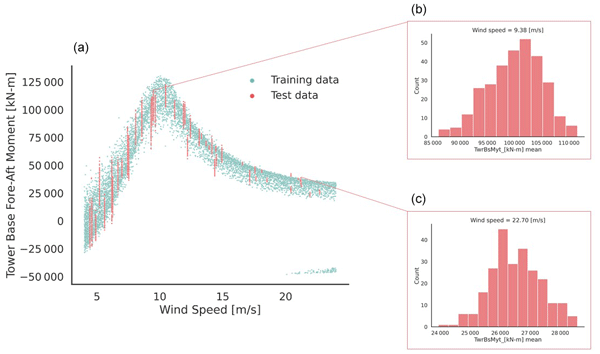
The selection of a suitable site for the installation of a wind turbine plays an important role in ensuring a safe operating lifetime of the structure. In this study, we show that mixture density networks can accelerate this process by inferring functions from data that can accurately map the environmental conditions to the loads but also propagate the uncertainty from the inflow to the response.

Ricardo Amaral, Felix Houtin-Mongrolle, Dominic von Terzi, Kasper Laugesen, Paul Deglaire, and Axelle Viré
Wind Energ. Sci., 11, 3401–3426, https://doi.org/10.5194/wes-11-3401-2026, https://doi.org/10.5194/wes-11-3401-2026, 2026
Short summary
Short summary
This work investigated the effect of a variety of floating-wind-turbine motions on the wake, the slower and more turbulent air left behind the rotor. This was done via computational simulations that reproduced a wind tunnel setup to test the tunnel's impact. While some motions barely disturbed the wake, other motions produced a remarkably different wake structure. The wind tunnel walls influenced the wake to some degree, but the general behavior was consistent with what is seen in the open air.
Federico Taruffi and Axelle Viré
Wind Energ. Sci., 11, 839–860, https://doi.org/10.5194/wes-11-839-2026, https://doi.org/10.5194/wes-11-839-2026, 2026
Short summary
Short summary
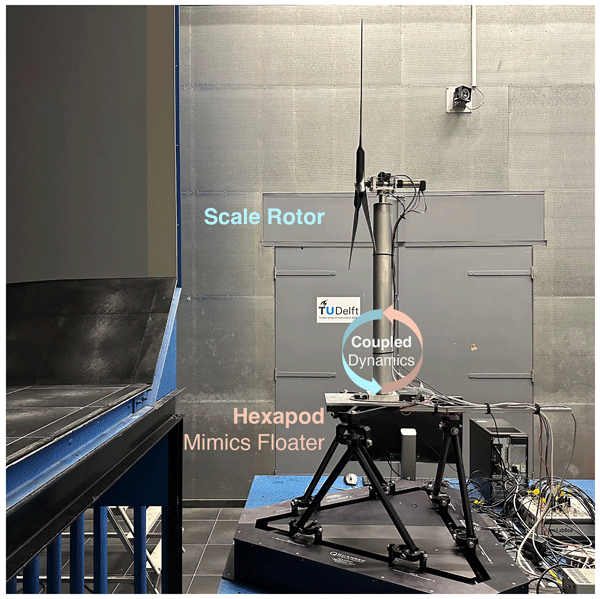
Floating wind turbines are subject to complex aerodynamics that are not yet fully understood. Lab-scale experiments are crucial for capturing these phenomena and validating numerical tools, but due to the different physics, this is difficult with traditional approaches. This paper presents a new, hybrid wind tunnel experimental setup capable of reproducing the coupled aerodynamic and motion response of floating wind turbines.
Evert Ivo Wiegant, Delphine de Tavernier, and Axelle Viré
Wind Energ. Sci. Discuss., https://doi.org/10.5194/wes-2025-276, https://doi.org/10.5194/wes-2025-276, 2025
Preprint under review for WES
Short summary
Short summary
As flow passes over a wing (or a wind turbine blade), a "bound vortex" forms around it. In this work, we describe this vortex as it appears in a type of computer simulation. We use this description to address two problems in literature; to find the correct velocity near the wing (as it is sampled) and to indicate when a simulation appropriately represents the relevant physical phenomena (related to convergence). This work provides understanding of such simulations and means to make them cheaper.
Ricardo Amaral, Felix Houtin-Mongrolle, Dominic von Terzi, Kasper Laugesen, Paul Deglaire, and Axelle Viré
Wind Energ. Sci. Discuss., https://doi.org/10.5194/wes-2025-34, https://doi.org/10.5194/wes-2025-34, 2025
Manuscript not accepted for further review
Short summary
Short summary
This work uses simulations to investigate floating offshore wind turbines which have the potential to supply the world's electricity demand many times by 2040. In particular, the effect of the rotor motion on the wake was investigated by forcing the turbine to move under different motions and the results highlight differences between motions. While some motions led to a wake behavior that was close to that of a fixed-bottom turbine, other motions produced a remarkably different wake structure.
Claudia Muscari, Paolo Schito, Axelle Viré, Alberto Zasso, and Jan-Willem van Wingerden
Wind Energ. Sci. Discuss., https://doi.org/10.5194/wes-2024-149, https://doi.org/10.5194/wes-2024-149, 2025
Publication in WES not foreseen
Short summary
Short summary
This paper presents the findings of a study aimed at describing the flow system downstream of a wind turbine operated with a novel control technology. Results from heavy high-fidelity simulations are used to obtain a low-fidelity model that is quick enough to be used for the optimization of such technologies. Additionally, we were able to retrieve an improved understanding of the physics of such systems under different inflow conditions.
Shyam VimalKumar, Delphine De Tavernier, Dominic von Terzi, Marco Belloli, and Axelle Viré
Wind Energ. Sci., 9, 1967–1983, https://doi.org/10.5194/wes-9-1967-2024, https://doi.org/10.5194/wes-9-1967-2024, 2024
Short summary
Short summary
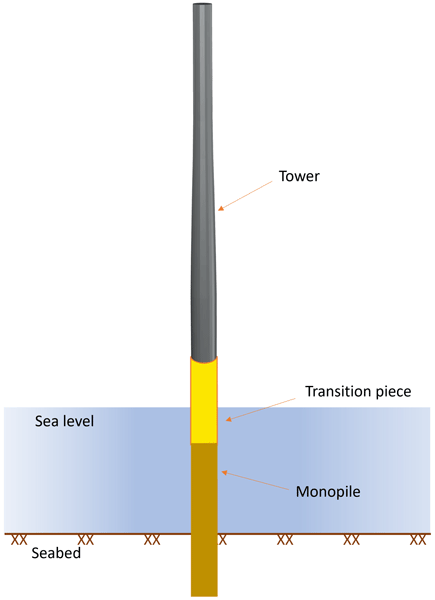
When standing still without a nacelle or blades, the vibrations on a wind turbine tower are of concern to its structural health. This study finds that the air which flows around the tower recirculates behind the tower, forming so-called wakes. These wakes initiate the vibration, and the movement itself causes the vibration to increase or decrease depending on the wind speed. The current study uses a methodology called force partitioning to analyse this in depth.
Deepali Singh, Richard Dwight, and Axelle Viré
Wind Energ. Sci., 9, 1885–1904, https://doi.org/10.5194/wes-9-1885-2024, https://doi.org/10.5194/wes-9-1885-2024, 2024
Short summary
Short summary
The selection of a suitable site for the installation of a wind turbine plays an important role in ensuring a safe operating lifetime of the structure. In this study, we show that mixture density networks can accelerate this process by inferring functions from data that can accurately map the environmental conditions to the loads but also propagate the uncertainty from the inflow to the response.
Federico Taruffi, Felipe Novais, and Axelle Viré
Wind Energ. Sci., 9, 343–358, https://doi.org/10.5194/wes-9-343-2024, https://doi.org/10.5194/wes-9-343-2024, 2024
Short summary
Short summary
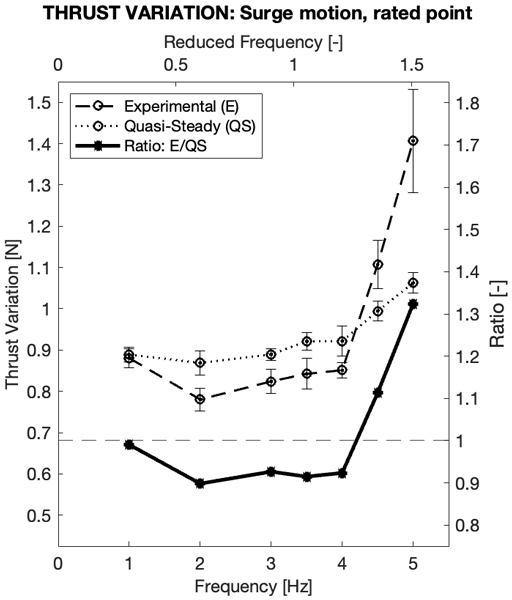
Floating wind turbines are subject to complex aerodynamics that are not yet fully understood. Lab-scale experiments are crucial for capturing these phenomena and validate numerical tools. This paper presents a new wind tunnel experimental setup able to study the response of a wind turbine rotor when subjected to prescribed motions in 6 degrees of freedom. The observed unsteady effects underscore the importance of pursuing research on the impact of floater motions on wind turbine performance.
Stefano Cioni, Francesco Papi, Leonardo Pagamonci, Alessandro Bianchini, Néstor Ramos-García, Georg Pirrung, Rémi Corniglion, Anaïs Lovera, Josean Galván, Ronan Boisard, Alessandro Fontanella, Paolo Schito, Alberto Zasso, Marco Belloli, Andrea Sanvito, Giacomo Persico, Lijun Zhang, Ye Li, Yarong Zhou, Simone Mancini, Koen Boorsma, Ricardo Amaral, Axelle Viré, Christian W. Schulz, Stefan Netzband, Rodrigo Soto-Valle, David Marten, Raquel Martín-San-Román, Pau Trubat, Climent Molins, Roger Bergua, Emmanuel Branlard, Jason Jonkman, and Amy Robertson
Wind Energ. Sci., 8, 1659–1691, https://doi.org/10.5194/wes-8-1659-2023, https://doi.org/10.5194/wes-8-1659-2023, 2023
Short summary
Short summary
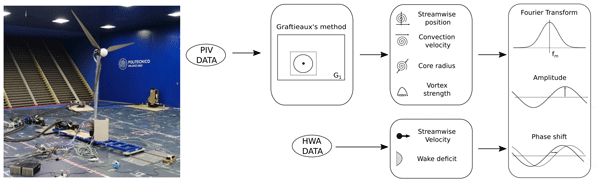
Simulations of different fidelities made by the participants of the OC6 project Phase III are compared to wind tunnel wake measurements on a floating wind turbine. Results in the near wake confirm that simulations and experiments tend to diverge from the expected linearized quasi-steady behavior when the reduced frequency exceeds 0.5. In the far wake, the impact of platform motion is overestimated by simulations and even seems to be oriented to the generation of a wake less prone to dissipation.

Axelle Viré, Bruce LeBlanc, Julia Steiner, and Nando Timmer
Wind Energ. Sci., 7, 573–584, https://doi.org/10.5194/wes-7-573-2022, https://doi.org/10.5194/wes-7-573-2022, 2022
Short summary
Short summary
There is continuous effort to try and improve the aerodynamic performance of wind turbine blades. This work shows that adding a leading-edge slat to wind turbine blades can significantly enhance the aerodynamic performance of wind turbines, even more than with vortex generators (which are commonly used on commercial turbines). The findings are obtained through wind tunnel tests on different airfoil–slat combinations.
Carlos Ferreira, Wei Yu, Arianna Sala, and Axelle Viré
Wind Energ. Sci., 7, 469–485, https://doi.org/10.5194/wes-7-469-2022, https://doi.org/10.5194/wes-7-469-2022, 2022
Short summary
Short summary
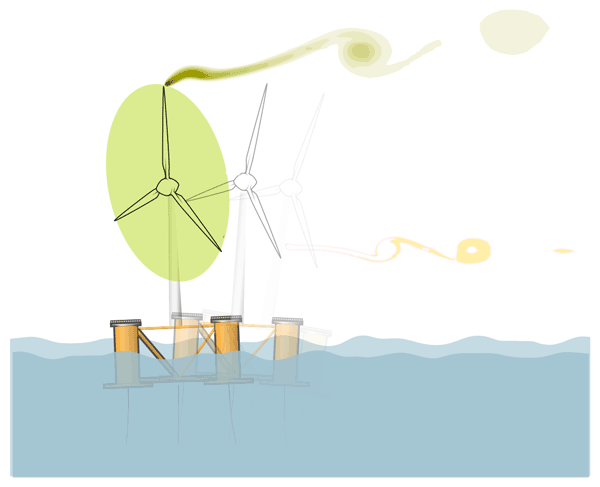
Floating offshore wind turbines may experience large surge motions that, when faster than the local wind speed, cause rotor–wake interaction.
We derive a model which is able to predict the wind speed at the wind turbine, even for large and fast motions and load variations in the wind turbine.
The proposed dynamic inflow model includes an adaptation for highly loaded flow, and it is accurate and simple enough to be easily implemented in most blade element momentum design models.
Cited articles
Abdallah, I., Lataniotis, C., and Sudret, B.: Parametric hierarchical kriging for multi-fidelity aero-servo-elastic simulators – Application to extreme loads on wind turbines, Probabilistic Engineering Mechanics, 55, 67–77, https://doi.org/10.1016/j.probengmech.2018.10.001, 2019. a
Arramounet, V., Winter, C. E., Maljaars, N., Girardin, S., and Robic, H.: Development of coupling module between BHawC aeroelastic software and OrcaFlex for coupled dynamic analysis of floating wind turbines, Journal of Physics: Conference Series, 1356, 1–15, https://doi.org/10.1088/1742-6596/1356/1/012007, 2019. a, b, c
Avendaño-Valencia, L. D., Abdallah, I., and Chatzi, E.: Virtual fatigue diagnostics of wake-affected wind turbine via Gaussian Process Regression, Renewable Energy, 170, 539–561, https://doi.org/10.1016/j.renene.2021.02.003, 2021. a
Björck, A.: AERFORCE: Subroutine Package for unsteady Blade-Element/Momentum Calculations, Tech. rep. (FFA TN 2000-07), Flygtekniska Försörskanstalten, Bromma, Sweden, https://share.google/ZY2v9gavPkVuJbPeH (last access: 04 December 2025), 2000. a
Blei, D. M., Kucukelbir, A., and McAuliffe, J. D.: Variational Inference: A Review for Statisticians, Journal of the American Statistical Association, 112, 859–877, https://doi.org/10.1080/01621459.2017.1285773, 2017. a
Bussemakers, M. P. J.: Validation of aero-hydro-servo-elastic load and motion simulations in BHawC/OrcaFlex for the Hywind Scotland floating offshore wind farm, Tech. Rep. July, Delft University of Technology, http://repository.tudelft.nl/ (last access: 5 November 2025), 2020. a
Couturier, P. J. and Skjoldan, P. F.: Implementation of an advanced beam model in BHawC, Journal of Physics: Conference Series, 1037, 0–10, https://doi.org/10.1088/1742-6596/1037/6/062015, 2018. a, b
Creane, S., Santos, P., Kölle, K., Airoldi, D., Bakhoday-Paskyabi, M., Biglu, M., Brown, W., Cheynet, E., Ecenarro Diaz-Tejeiro, L., Frøyd, L., Hagerman, G., Hall, M., Kim, Y.-Y., Guo Larsén, X., Li, L., Lozon, E., Musialik, M., Naldi, R., Park, M., Shields, M., Tronfeldt Sørensen, J., Tanemoto, J., Yu, Y.-J., and Zouaoui, A.: IEA Wind TCP Task 49: Reference Site Conditions for Floating Wind Arrays, Tech. rep., National Renewable Energy Laboratory (NREL), Golden, CO (United States), https://doi.org/10.2172/2447928, 2024. a, b, c, d, e, f, g, h, i
Dillon, J. V., Langmore, I., Tran, D., Brevdo, E., Vasudevan, S., Moore, D., Patton, B., Alemi, A., Hoffman, M., and Saurous, R. A.: TensorFlow Distributions, arXiv, https://doi.org/10.48550/arXiv.1711.10604, 2017. a
Dimitrov, N., Kelly, M. C., Vignaroli, A., and Berg, J.: From wind to loads: wind turbine site-specific load estimation with surrogate models trained on high-fidelity load databases, Wind Energ. Sci., 3, 767–790, https://doi.org/10.5194/wes-3-767-2018, 2018a. a
Dimitrov, N., Kelly, M. C., Vignaroli, A., and Berg, J.: From wind to loads: wind turbine site-specific load estimation with surrogate models trained on high-fidelity load databases, Wind Energ. Sci., 3, 767–790, https://doi.org/10.5194/wes-3-767-2018, 2018b. a
Edwards, E. C., Holcombe, A., Brown, S., Ransley, E., Hann, M., and Greaves, D.: Evolution of floating offshore wind platforms: A review of at-sea devices, Renewable and Sustainable Energy Reviews, 183, https://doi.org/10.1016/j.rser.2023.113416, 2023. a
Equinor: Hywind Scotland The world’s first commercial floating wind farm, https://www.equinor.com/content/dam/statoil/documents/newsroom-additional-documents/news-attachments/brochure-hywind-a4.pdf (last access: 18 October 2024), 2024. a
Equinor ASA: Hywind Buchan Deep Metocean Design Basis RE2014-002, Tech. rep., Equinor ASA, Scotland, https://marine.gov.scot/data/hywind-scotland-pilot-park-05515150-supporting-studies (last access: 5 November 2025), 2014. a
ESB: Moneypoint Offshore Wind Project – marine-ireland.ie, https://marine-ireland.ie/node/396, last access: 11 February 2025. a
Gasparis, G., Lio, W. H., and Meng, F.: Surrogate Models for Wind Turbine Electrical Power and Fatigue Loads in Wind Farm, Energies, 13, 6360, https://doi.org/10.3390/en13236360, 2020. a
Hlaing, N., Morato, P. G., de Nolasco Santos, F., Weijtjens, W., Devriendt, C., and Rigo, P.: Farm-wide virtual load monitoring for offshore wind structures via Bayesian neural networks, Structural Health Monitoring, 23, 1641–1663, https://doi.org/10.1177/14759217231186048, 2024. a
Hübler, C., Gebhardt, C. G., and Rolfes, R.: Hierarchical four-step global sensitivity analysis of offshore wind turbines based on aeroelastic time domain simulations, Renewable Energy, 111, 878–891, https://doi.org/10.1016/j.renene.2017.05.013, 2017. a
IEC (International Electrotechnical Commission): 61400-1 Ed.3 Wind turbines – Design requirements, Tech. rep., IEC, ISBN 9782889122011, 2010. a
IEC: TS 61400-3-2:2019, Tech. rep., IEC, ISBN 9782832276099, 2024a. a
IEC: TS 61400-9 ED1: Wind energy generation systems – Part 9: Probabilistic design measures for wind turbines, Tech. rep., IEC, 2024b. a
Jonkman, J.: The New Modularization Framework for the FAST Wind Turbine CAE Tool, in: 51st AIAA Aerospace Sciences Meeting including the New Horizons Forum and Aerospace Exposition, AIAA, Grapevine, https://doi.org/10.2514/6.2013-202, 2013. a, b
Kingma, D. P. and Ba, J.: Adam: A Method for Stochastic Optimization, arxiv, https://doi.org/10.48550/arXiv.1412.6980, 2017. a
Larsen, T. and Hansen, A.: How 2 HAWC2, the user's manual, no. 1597(ver. 3-1)(EN) in Denmark. Forskningscenter Risoe. Risoe-R, Risø National Laboratory, ISBN 978-87-550-3583-6, 2007. a
Li, X. and Zhang, W.: Probabilistic fatigue evaluation of floating wind turbine using combination of surrogate model and Copula model, AIAA, https://doi.org/10.2514/6.2019-0247, 2019. a, b
Li, X. and Zhang, W.: Long-term fatigue damage assessment for a fl oating offshore wind turbine under realistic environmental conditions, Renewable Energy, 159, 570–584, https://doi.org/10.1016/j.renene.2020.06.043, 2020. a
Lin, Z., Liu, X., and Lotfian, S.: Impacts of water depth increase on offshore floating wind turbine dynamics, Ocean Engineering, 224, 108697, https://doi.org/10.1016/j.oceaneng.2021.108697, 2021. a, b
Mann, J.: Wind field simulation, Probabilistic Engineering Mechanics, 13, 269–282, https://doi.org/10.1016/s0266-8920(97)00036-2, 1998. a
Masciola, M., Robertson, A., Jonkman, J., and Driscoll, F.: Investigation of a FAST-OrcaFlex Coupling Module for Integrating Turbine and Mooring Dynamics of Offshore Floating Wind Turbines: Preprint, in: International Conference on Offshore Wind Energy and Ocean Energy, National Renewable Energy Lab. (NREL), Golden, CO (United States), https://www.osti.gov/biblio/1029021 (last access: 5 November 2025), 2011. a
Matsuishi, M. and Endo, T.: Fatigue of metals subjected to varying stress, Japan Society of Mechanical Engineers, Fukuoka, Japan, 68, 37–40, 1968. a
Montavon, G., Orr, G. B., and Müller, K.-R. (Eds.): Neural networks: Tricks of the trade, Springer Berlin, Heidelberg, 2 edn., ISBN 978-3-642-35288-1, https://doi.org/10.1007/978-3-642-35289-8, 2012. a
Murcia, J. P., Réthoré, P. E., Dimitrov, N., Natarajan, A., Sørensen, J. D., Graf, P., and Kim, T.: Uncertainty propagation through an aeroelastic wind turbine model using polynomial surrogates, Renewable Energy, 119, 910–922, https://doi.org/10.1016/j.renene.2017.07.070, 2018. a
Ng, A. Y.: Feature Selection, L1 vs. L2 Regularization, and Rotational Invariance, in: Proceedings of the Twenty-First International Conference on Machine Learning, ICML '04, p. 78, Association for Computing Machinery, New York, NY, USA, ISBN 1581138385, https://doi.org/10.1145/1015330.1015435, 2004. a
NREL: OpenFAST/openfast: Main repository for the NREL-supported OpenFAST whole-turbine and FAST.Farm wind farm simulation codes, https://github.com/OpenFAST/openfast (last access: 29 September 2022), 2022. a
Omole, J., Schlipf, D., Venu, A., and Ludde, M.: Bayesian neural network model for estimating fatigue loads on wind turbines, presentation at Wind Energy Science Conference, Zenodo, https://doi.org/10.5281/zenodo.4923193, 2021. a
Papi, F. and Bianchini, A.: A New Perspective on Offshore Wind Turbine Certification Using High Performance Computing, Journal of Physics: Conference Series, 2767, 052008, https://doi.org/10.1088/1742-6596/2767/5/052008, 2024. a, b
Peyré, G. and Cuturi, M.: Computational optimal transport: With applications to data Science, Foundations and Trends in Machine Learning, 11, 355–607, https://doi.org/10.1561/2200000073, 2019. a
Ramdas, A., Garcia, N., and Cuturi, M.: On Wasserstein two sample testing and related families of nonparametric tests, arXiv, https://doi.org/10.48550/arxiv.1509.02237, 2015. a
Rasmussen, C. E. and Williams, C. K. I.: Gaussian processes for machine learning, Adaptive computation and machine learning, MIT Press, Cambridge, Mass., 2006. a
Reddy, L. R., Karystinou, D., Milano, D., Walker, J., and Viré, A.: Influence of wind-wave characteristics on floating wind turbine loads: A sensitivity analysis across different floating concepts, Journal of Physics: Conference Series, 2767, 062030, https://doi.org/10.1088/1742-6596/2767/6/062030, 2024. a, b
Robertson, A. N., Sethuraman, L., Jonkman, J., and Quick, J.: Assessment of Wind Parameter Sensitivity on Extreme and Fatigue Wind Turbine Loads, in: Wind Energy Symposium, National Renewable Energy Laboratory (NREL), Golden, CO (United States), New York, NY, American Institute of Aeronautics and Astronautics, Inc. (AIAA), https://doi.org/10.2514/6.2018-1728, 2018. a
Robertson, A. N., Shaler, K., Sethuraman, L., and Jonkman, J.: Sensitivity analysis of the effect of wind characteristics and turbine properties on wind turbine loads, Wind Energ. Sci., 4, 479–513, https://doi.org/10.5194/wes-4-479-2019, 2019. a
Rouaud, M.: Probability, statistics and estimation. Propagation of Uncertainties, Self-published, ISBN 978-2-9549309-0-9, 2013. a
Rubak, R. and Petersen, J.: Monopile as part of aeroelastic wind turbine simulation code, Proceedings of Copenhagen Offshore Wind, 1–10, http://wind.nrel.gov/public/SeaCon/Proceedings/Copenhagen.Offshore.Wind.2005/documents/papers/Design_calculations_and_risks/R.Rubak_Monopile_as_Part_of_Aeroelastic_WindTurbineSim.pdf (last access: 5 November 2025), 2005. a
Shaler, K., Robertson, A. N., and Jonkman, J.: Sensitivity analysis of the effect of wind and wake characteristics on wind turbine loads in a small wind farm, Wind Energ. Sci., 8, 25–40, https://doi.org/10.5194/wes-8-25-2023, 2023. a
Singh, D., Dwight, R. P., Laugesen, K., Beaudet, L., and Viré, A.: Probabilistic surrogate modeling of offshore wind-turbine loads with chained Gaussian processes, Journal of Physics: Conference Series, 2265, 032070, https://doi.org/10.1088/1742-6596/2265/3/032070, 2022. a
Singh, D., Dwight, R., and Viré, A.: Probabilistic surrogate modeling of damage equivalent loads on onshore and offshore wind turbines using mixture density networks, Wind Energ. Sci., 9, 1885–1904, https://doi.org/10.5194/wes-9-1885-2024, 2024a. a, b
Singh, D., Dwight, R., and Viré, A.: Probabilistic surrogate modeling of damage equivalent loads on onshore and offshore wind turbines using mixture density networks, Wind Energ. Sci., 9, 1885–1904, https://doi.org/10.5194/wes-9-1885-2024, 2024b. a
Singh, D., Haugen, E., Laugesen, K., Chauhan, A., and Viré, A.: Data analysis of the TetraSpar demonstrator measurements, Journal of Physics: Conference Series, 2767, 062025, https://doi.org/10.1088/1742-6596/2767/6/062025, 2024c. a, b, c, d
Slot, R. M., Sørensen, J. D., Sudret, B., Svenningsen, L., and Thøgersen, M. L.: Surrogate model uncertainty in wind turbine reliability assessment, Renewable Energy, 151, 1150–1162, https://doi.org/10.1016/j.renene.2019.11.101, 2020. a
Sobol, I. M.: On the distribution of points in a cube and the approximate evaluation of integrals, USSR Computational Mathematics and Mathematical Physics, 7, 86–112, https://doi.org/10.1016/0041-5553(67)90144-9, 1967. a
Stewart, G., Lackner, M., Haid, L., Matha, D., Jonkman, J., and Robertson, A.: Assessing Fatigue and Ultimate Load Uncertainty in Floating Offshore Wind Turbines Due to Varying Simulation Length, Safety, Reliability, Risk and Life-Cycle Performance of Structures and Infrastructures – Proceedings of the 11th International Conference on Structural Safety and Reliability, ICOSSAR 2013, 239–246, https://docs.nrel.gov/docs/fy13osti/58518.pdf (last access: 04 December 2025), 2013. a
Teixeira, R., O'Connor, A., Nogal, M., Krishnan, N., and Nichols, J.: Analysis of the design of experiments of offshore wind turbine fatigue reliability design with Kriging surfaces, Procedia Structural Integrity, 5, 951–958, https://doi.org/10.1016/j.prostr.2017.07.132, 2017. a
Teixeira, R., O'Connor, A., and Nogal, M.: Probabilistic sensitivity analysis of offshore wind turbines using a transformed Kullback-Leibler divergence, Structural Safety, 81, 101860, https://doi.org/10.1016/j.strusafe.2019.03.007, 2019. a
TensorFlow: MixtureNormal, https://www.tensorflow.org/probability/api_docs/python/tfp/layers/MixtureNormal, last access: 6 August 2025. a
Torsethaugen, K. and Haver, S.: Simplified Double Peak Spectral Model For Ocean Waves, in: International Ocean and Polar Engineering Conference, International Society of Offshore and Polar Engineers (ISOPE), ISSN 1098-6189, ISBN 1-880653-62−1, 2004. a
Velarde, J., Kramhøft, C., and Sørensen, J. D.: Global sensitivity analysis of offshore wind turbine foundation fatigue loads, Renewable Energy, 140, 177–189, https://doi.org/10.1016/j.renene.2019.03.055, 2019. a
Vigara, F., Cerdan, L., Duran, R., Munoz, S., Lynch, M., Doole, S., Molins, C., Trubat, P., and Guanche, R.: COREWIND D1.2 Design Basis, Tech. rep., COREWIND, https://doi.org/10.5281/zenodo.4518828, 2019. a, b, c
Villani, C.: The Wasserstein distances, in: Optimal Transport: Old and New, 93–111, Springer Berlin Heidelberg, Berlin, Heidelberg, ISBN 978-3-540-71050-9, https://doi.org/10.1007/978-3-540-71050-9_6, 2009. a
Wang, Y., Lu, Q., Yao, T., Yin, T., Zhao, Y., Han, Z., Xu, Y., and Jiang, Z.: Global sensitivity analysis of a semi-submersible floating wind turbine using a neural network fitting method, Ocean Engineering, 285, 1–14, https://doi.org/10.1016/j.oceaneng.2023.115351, 2023. a
Wiley, W., Jonkman, J., Robertson, A., and Shaler, K.: Sensitivity analysis of numerical modeling input parameters on floating offshore wind turbine loads, Wind Energ. Sci., 8, 1575–1595, https://doi.org/10.5194/wes-8-1575-2023, 2023. a, b, c
Wind, E. F.: The Emerald Project – Floating Offshore Wind Ireland – emeraldfloatingwind.com, https://emeraldfloatingwind.com/ (last access: 11 February 2025), 2025. a
Yao, Y., Rosasco, L., and Caponnetto, A.: On Early Stopping in Gradient Descent Learning, Constructive Approximation, 26, 289–315, https://doi.org/10.1007/s00365-006-0663-2, 2007. a
Zhu, X. and Sudret, B.: Replication-based emulation of the response distribution of stochastic simulators using generalized lambda distributions, International Journal for Uncertainty Quantification, 10, 249–275, https://doi.org/10.1615/Int.J.UncertaintyQuantification.2020033029, 2020. a
Zhu, X. and Sudret, B.: Emulation of Stochastic Simulators Using Generalized Lambda Models, SIAM/ASA Journal on Uncertainty Quantification, 9, 1345–1380, https://doi.org/10.1137/20M1337302, 2021. a
Short summary
We developed a fast, probabilistic surrogate model to predict fatigue loads on floating wind turbines based on site conditions. Unlike traditional methods, our approach directly uses site data, avoiding complex binning or distribution fitting. A mixture density network is used to capture uncertainties and enables quick lifetime fatigue estimates.
We developed a fast, probabilistic surrogate model to predict fatigue loads on floating wind...


Altmetrics
Final-revised paper
Preprint