Articles | Volume 11, issue 1
https://doi.org/10.5194/wes-11-103-2026
© Author(s) 2026. This work is distributed under
the Creative Commons Attribution 4.0 License.
https://doi.org/10.5194/wes-11-103-2026
© Author(s) 2026. This work is distributed under
the Creative Commons Attribution 4.0 License.
Comparison of different simulation methods regarding loads, considering the centre of wind pressure

ForWind – Institute of Physics, University of Oldenburg, Oldenburg, Germany
Daniela Moreno
ForWind – Institute of Physics, University of Oldenburg, Oldenburg, Germany
Joachim Peinke
ForWind – Institute of Physics, University of Oldenburg, Oldenburg, Germany
Related authors
No articles found.
Leo Höning, Iván Herráez, Bernhard Stoevesandt, and Joachim Peinke
Wind Energ. Sci. Discuss., https://doi.org/10.5194/wes-2025-281, https://doi.org/10.5194/wes-2025-281, 2025
Preprint under review for WES
Short summary
Short summary
High-fidelity fluid-structure coupled simulations of the IEA 15 MW rotor under storm and yaw misalignment shows that certain misalignments trigger strong edgewise vibrations. Growth surges when effective power turns positive near −35° and fades near −43° yaw. Single-blade analysis finds lock-in at −37° with large tip motion and stability at −60° due to off-resonant Strouhal shedding. It is concluded that aeroelastic response is inflow-specific and operational mitigation strategies are needed.
Daniela Moreno, Jan Friedrich, Carsten Schubert, Matthias Wächter, Jörg Schwarte, Gritt Pokriefke, Günter Radons, and Joachim Peinke
Wind Energ. Sci., 10, 2729–2754, https://doi.org/10.5194/wes-10-2729-2025, https://doi.org/10.5194/wes-10-2729-2025, 2025
Short summary
Short summary
Increased sizes of modern turbines require extended descriptions of the atmospheric wind and its correlation to loads. Here, a surrogate stochastic method for estimating the bending moments at the main shaft is proposed. Based on the center of wind pressure dynamics, an advantage is the possibility of stochastically reconstructing large amounts of load data. Atmospheric measurements and modeled data demonstrate the validity of this method.
Christian Wiedemann, Henrik Bette, Matthias Wächter, Jan A. Freund, Thomas Guhr, and Joachim Peinke
Wind Energ. Sci., 10, 2489–2497, https://doi.org/10.5194/wes-10-2489-2025, https://doi.org/10.5194/wes-10-2489-2025, 2025
Short summary
Short summary
This study utilizes a method to analyze power conversion dynamics across different operational states, addressing non-stationarity with a correlation matrix algorithm. Findings reveal distinct dynamics for each state, emphasizing their impact on system behavior and offering a solution for hysteresis effects in power conversion dynamics.
Branko Kosović, Sukanta Basu, Jacob Berg, Larry K. Berg, Sue E. Haupt, Xiaoli G. Larsén, Joachim Peinke, Richard J. A. M. Stevens, Paul Veers, and Simon Watson
Wind Energ. Sci. Discuss., https://doi.org/10.5194/wes-2025-42, https://doi.org/10.5194/wes-2025-42, 2025
Revised manuscript accepted for WES
Short summary
Short summary
Most human activity happens in the layer of the atmosphere which extends a few hundred meters to a couple of kilometers above the surface of the Earth. The flow in this layer is turbulent. Turbulence impacts wind power production and turbine lifespan. Optimizing wind turbine performance requires understanding how turbulence affects both wind turbine efficiency and reliability. This paper points to gaps in our knowledge that need to be addressed to effectively utilize wind resources.
Carsten Schubert, Daniela Moreno, Jörg Schwarte, Jan Friedrich, Matthias Wächter, Gritt Pokriefke, Günter Radons, and Joachim Peinke
Wind Energ. Sci. Discuss., https://doi.org/10.5194/wes-2025-28, https://doi.org/10.5194/wes-2025-28, 2025
Preprint under review for WES
Short summary
Short summary
For modern wind turbines, the effects of inflow wind fluctuations on the loads are becoming increasingly critical. Based on field measurements and simulations, we identify “bump” events responsible for high damage equivalent loads. In this article, we introduce a new characteristic of a wind field: the virtual center of wind pressure which highly correlates to the identified load events observed in the operational measured data.
Daniela Moreno, Jan Friedrich, Matthias Wächter, Jörg Schwarte, and Joachim Peinke
Wind Energ. Sci., 10, 347–360, https://doi.org/10.5194/wes-10-347-2025, https://doi.org/10.5194/wes-10-347-2025, 2025
Short summary
Short summary
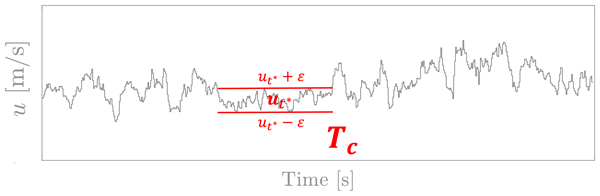
Unexpected load events measured on operating wind turbines are not accurately predicted by numerical simulations. We introduce the periods of constant wind speed as a possible cause of such events. We measure and characterize their statistics from atmospheric data. Further comparisons to standard modelled data and experimental turbulence data suggest that such events are not intrinsic to small-scale turbulence and are not accurately described by current standard wind models.
Khaled Yassin, Arne Helms, Daniela Moreno, Hassan Kassem, Leo Höning, and Laura J. Lukassen
Wind Energ. Sci., 8, 1133–1152, https://doi.org/10.5194/wes-8-1133-2023, https://doi.org/10.5194/wes-8-1133-2023, 2023
Short summary
Short summary
The current turbulent wind field models stated in the IEC 61400-1 standard underestimate the probability of extreme changes in wind velocity. This underestimation can lead to the false calculation of extreme and fatigue loads on the turbine. In this work, we are trying to apply a random time-mapping technique to one of the standard turbulence models to adapt to such extreme changes. The turbulent fields generated are compared with a standard wind field to show the effects of this new mapping.
Ingrid Neunaber, Joachim Peinke, and Martin Obligado
Wind Energ. Sci., 7, 201–219, https://doi.org/10.5194/wes-7-201-2022, https://doi.org/10.5194/wes-7-201-2022, 2022
Short summary
Short summary
Wind turbines are often clustered within wind farms. A consequence is that some wind turbines may be exposed to the wakes of other turbines, which reduces their lifetime due to the wake turbulence. Knowledge of the wake is thus important, and we carried out wind tunnel experiments to investigate the wakes. We show how models that describe wakes of bluff bodies can help to improve the understanding of wind turbine wakes and wind turbine wake models, particularly by including a virtual origin.
Sirko Bartholomay, Tom T. B. Wester, Sebastian Perez-Becker, Simon Konze, Christian Menzel, Michael Hölling, Axel Spickenheuer, Joachim Peinke, Christian N. Nayeri, Christian Oliver Paschereit, and Kilian Oberleithner
Wind Energ. Sci., 6, 221–245, https://doi.org/10.5194/wes-6-221-2021, https://doi.org/10.5194/wes-6-221-2021, 2021
Short summary
Short summary
This paper presents two methods on how to estimate the lift force that is created by a wing. These methods were experimentally assessed in a wind tunnel. Furthermore, an active trailing-edge flap, as seen on airplanes for example, is used to alleviate fluctuating loads that are created within the employed wind tunnel. Thereby, an active flow control device that can potentially serve on wind turbines to lower fatigue or lower the material used for the blades is examined.
Khaled Yassin, Hassan Kassem, Bernhard Stoevesandt, Thomas Klemme, and Joachim Peinke
Wind Energ. Sci. Discuss., https://doi.org/10.5194/wes-2021-3, https://doi.org/10.5194/wes-2021-3, 2021
Revised manuscript not accepted
Short summary
Short summary
When ice forms on wind turbine blades, the smooth surface of the blade becomes rough which changes its aerodynamic performance. So, it is very important to know how to simulate this rough surface since most CFD simulations depend on assuming a smooth surface. This article compares different mathematical models specialized in simulating rough surfaces with results of real ice profiles. The study presents the most accurate model and recommends using it in future airflow simulation of iced blades.
Cited articles
Anderson Jr., J. D.: Fundamentals of Aerodynamics, 6 edn., McGraw-Hill, New York, ISBN 9781259129919, 2016. a
Apsley, D. and Stansby, P.: Unsteady thrust on an oscillating wind turbine: Comparison of blade-element momentum theory with actuator-line CFD, Journal of Fluids and Structures, 98, 103141, https://doi.org/10.1016/j.jfluidstructs.2020.103141, 2020. a
Arneodo, A., Baudet, C., Belin, F., Benzi, R., Castaing, B., Chabaud, B., Chavarria, R., Ciliberto, S., Camussi, R., Chillà, F., Dubrulle, B., Gagne, Y., Hebral, B., Herweijer, J., Marchand, M., Maurer, J., Muzy, J. F., Naert, A., Noullez, A., Peinke, J., Roux, F., Tabeling, P., van de Water, W., and Willaime, H.: Structure functions in turbulence, in various flow configurations, at Reynolds number between 30 and 5000, using extended self-similarity, Europhysics Letters, 34, 411, https://doi.org/10.1209/epl/i1996-00472-2, 1996. a
Bachant, P., Goude, A., and Wosnik, M.: Actuator line modeling of vertical-axis turbines, arXiv [preprint], https://doi.org/10.48550/arXiv.1605.01449, 13 May 2016. a
Bachant, P., Goude, A., daa mec, Wosnik, M., Adhyanth, and Delicious., M. G.: turbinesFoam/turbinesFoam: v0.2.0, Zenodo [code], https://doi.org/10.5281/zenodo.14169486, 2024. a
Chilla, F., Peinke, J., and Castaing, B.: Multiplicative process in turbulent velocity statistics: A simplified analysis, Journal de Physique II, 6, 455–460, https://doi.org/10.1051/jp2:1996191, 1996. a
Churchfield, M. J., Schreck, S. J., Martinez, L. A., Meneveau, C., and Spalart, P. R.: An advanced actuator line method for wind energy applications and beyond, in: 35th Wind Energy Symposium, American Institute of Aeronautics and Astronautics (AIAA), p. 1998, https://doi.org/10.2514/6.2017-1998, 2017. a, b
Davidson, P.: Turbulence: an introduction for scientists and engineers, Oxford University Press, ISBN 9780198722588, 2015. a
Dose, B., Rahimi, H., Herráez, I., Stoevesandt, B., and Peinke, J.: Fluid-structure coupled computations of the NREL 5 MW wind turbine by means of CFD, Renewable Energy, 129, 591–605, https://doi.org/10.1016/j.renene.2018.05.064, 2018. a, b
Ehrich, S., Schwarz, C. M., Rahimi, H., Stoevesandt, B., and Peinke, J.: Comparison of the blade element momentum theory with computational fluid dynamics for wind turbine simulations in turbulent inflow, Applied Sciences, 8, 2513, https://doi.org/10.3390/app8122513, 2018. a
Friedrich, J., Moreno, D., Sinhuber, M., Wächter, M., and Peinke, J.: Superstatistical wind fields from pointwise atmospheric turbulence measurements, PRX Energy, 1, 023006, https://doi.org/10.1103/PRXEnergy.1.023006, 2022. a
Friedrich, R. and Peinke, J.: Description of a turbulent cascade by a Fokker–Planck equation, Phys. Rev. Lett., 78, 863, https://doi.org/10.1103/PhysRevLett.78.863, 1997. a
Froude, W.: On the elementary relation between pitch, slip, and propulsive efficiency, Transaction of the Institute of Naval Architects, 19, 47–57, 1878. a
Gilling, L. and Sørensen, N. N.: Imposing resolved turbulence in CFD simulations, Wind Energy, 14, 661–676, https://doi.org/10.1002/we.449, 2011. a, b
Glauert, H.: Airplane Propellers, in: Aerodynamic Theory, edited by: Durand, W., Springer, Berlin, Heidelberg, Farnborough, England, 169–360, https://doi.org/10.1007/978-3-642-91487-4_3, 1935. a, b
Greenshields, C. J. and Weller, H. G.: Notes on computational fluid dynamics: General principles, CFD Direct Ltd., London, ISBN 978-1399920780, 2022. a
Gritskevich, M. S., Garbaruk, A. V., Schütze, J., and Menter, F. R.: Development of DDES and IDDES formulations for the k−ω shear stress transport model, Flow, turbulence and combustion, 88, 431–449, https://doi.org/10.1007/s10494-011-9378-4, 2012. a
Höning, L., Lukassen, L. J., Stoevesandt, B., and Herráez, I.: Influence of rotor blade flexibility on the near-wake behavior of the NREL 5 MW wind turbine, Wind Energ. Sci., 9, 203–218, https://doi.org/10.5194/wes-9-203-2024, 2024. a
Hsu, S., Meindl, E. A., and Gilhousen, D. B.: Determining the power-law wind-profile exponent under near-neutral stability conditions at sea, J. Appl. Meteorol. Clim., 33, 757–765, https://doi.org/10.1175/1520-0450(1994)033<0757:DTPLWP>2.0.CO;2, 1994. a
Issa, R. I.: Solution of the implicitly discretised fluid flow equations by operator-splitting, Journal of Computational Physics, 62, 40–65, https://doi.org/10.1016/0021-9991(86)90099-9, 1986. a
Jacobitz, F. G. and Schneider, K.: Revisiting Taylor's hypothesis in homogeneous turbulent shear flow, Phys. Rev. Fluids, 9, 044602, https://doi.org/10.1103/PhysRevFluids.9.044602, 2024. a
Jonkman, B., Platt, A., Mudafort, R. M., Branlard, E., Sprague, M., Ross, H., Slaughter, D., Jonkman, J., Hayman, P., cortadocodes, Hall, M., Vijayakumar, G., Buhl, M., Russell9798, Bortolotti, P., Davies, R., reos rcrozier, Ananthan, S., S., M., Rood, J., rdamiani, nrmendoza, sinolonghai, pschuenemann, Sharma, A., kshaler, Chetan, M., Housner, S., Wang, L., and psakievich: OpenFAST/openfast: v2.5, GitHub [code], https://github.com/OpenFAST/openfast/tree/v2.5.0 (last access: 8 January 2026), 2021. a
Jonkman, J.: Definition of a 5-MW Reference Wind Turbine for Offshore System Development, National Renewable Energy Laboratory, https://doi.org/10.2172/947422, 2009. a
Kaimal, J. C., Wyngaard, J., Izumi, Y., and Coté, O.: Spectral characteristics of surface-layer turbulence, Q. J. Roy. Meteor. Soc., 98, 563–589, https://doi.org/10.1002/qj.49709841707, 1972. a
Keck, R.-E., Mikkelsen, R., Troldborg, N., de Maré, M., and Hansen, K. S.: Synthetic atmospheric turbulence and wind shear in large eddy simulations of wind turbine wakes, Wind Energy, 17, 1247–1267, https://doi.org/10.1002/we.1631, 2014. a
Kleinhans, D.: Stochastische Modellierung komplexer Systeme: von den theoretischen Grundlagen zur Simulation atmosphärischer Windfelder, PhD thesis, Münster, Univ., Germany, Diss., http://d-nb.info/990549984/34 (last access: 19 August 2025), 2008. a
Kolmogorov, A. N.: Dissipation of energy in the locally isotropic turbulence, Dokl. Akad. Nauk. SSSR, 32, 19–21, https://doi.org/10.1098/rspa.1991.0076, 1941. a
Kolmogorov, A. N.: A refinement of previous hypotheses concerning the local structure of turbulence in a viscous incompressible fluid at high Reynolds number, J. Fluid Mech., 13, 82–85, https://doi.org/10.1017/S0022112062000518, 1962. a
Kosović, B., Basu, S., Berg, J., Berg, L. K., Haupt, S. E., Larsén, X. G., Peinke, J., Stevens, R. J. A. M., Veers, P., and Watson, S.: Impact of atmospheric turbulence on performance and loads of wind turbines: Knowledge gaps and research challenges, Wind Energ. Sci. Discuss. [preprint], https://doi.org/10.5194/wes-2025-42, in review, 2025. a
Larsen, T. J. and Hansen, A. M.: How 2 HAWC2, the user's manual, Risø National Laboratory, ISBN 978-87-550-3583-6, 2007. a
Liew, J.: jaimeliew1/Mann.rs: Publish Mann.rs v1.0.0, https://doi.org/10.5281/zenodo.7254149, 2022. a
Liew, J., Riva, R., and Göçmen, T.: Efficient Mann turbulence generation for offshore wind farms with applications in fatigue load surrogate modelling, Journal of Physics: Conference Series, 2626, 012050, https://doi.org/10.1088/1742-6596/2626/1/012050, 2023, IOP Publishing. a
Liu, L., Franceschini, L., Oliveira, D. F., Galeazzo, F. C., Carmo, B. S., and Stevens, R. J.: Evaluating the accuracy of the actuator line model against blade element momentum theory in uniform inflow, Wind Energy, 25, 1046–1059, https://doi.org/10.1002/we.2714, 2022. a
Mann, J.: The spatial structure of neutral atmospheric surface-layer turbulence, J. Fluid Mech., 273, 141–168, https://doi.org/10.1017/S0022112094001886, 1994. a, b, c
Mann, J.: Wind field simulation, Probabilistic Engineering Mechanics, 13, 269–282, https://doi.org/10.1016/S0266-8920(97)00036-2, 1998. a, b
Menter, F. R., Kuntz M., and Langtry, R.: Ten years of industrial experience with the SST turbulence model, Turbulence, Heat and Mass Transfer, 4, 625–632, 2003. a
Moreno, D., Schubert, C., Friedrich, J., Wächter, M., Schwarte, J., Pokriefke, G., Radons, G., and Peinke, J.: Dynamics of the virtual center of wind pressure: An approach for the estimation of wind turbine loads, Journal of Physics: Conference Series, 2767, 022028, https://doi.org/10.1088/1742-6596/2767/2/022028, 2024, IOP Publishing. a, b
Moreno, D., Friedrich, J., Schubert, C., Wächter, M., Schwarte, J., Pokriefke, G., Radons, G., and Peinke, J.: From the center of wind pressure to loads on the wind turbine: a stochastic approach for the reconstruction of load signals, Wind Energ. Sci., 10, 2729–2754, https://doi.org/10.5194/wes-10-2729-2025, 2025. a, b, c, d, e, f
Mücke, T., Kleinhans, D., and Peinke, J.: Atmospheric turbulence and its influence on the alternating loads on wind turbines, Wind Energy, 14, 301–316, https://doi.org/10.1002/we.422, 2011. a
Obukhov, A.: Some specific features of atmospheric turbulence, J. Geophys. Res., 67, 3011–3014, https://doi.org/10.1017/S0022112062000506, 1962. a
OpenCFD: OpenFOAM: User Guide v2306, OpenCFD Ltd., https://doc.openfoam.com/2306/ (last access: 7 January 2026), 2023. a
Patankar, S. V. and Spalding, D. B.: A calculation procedure for heat, mass and momentum transfer in three-dimensional parabolic flows, in: Numerical prediction of flow, heat transfer, turbulence and combustion, Elsevier, 54–73, https://doi.org/10.1016/B978-0-08-030937-8.50013-1, 1983. a
Rankine, W. J. M.: On the mechanical principles of the action of propellers, Transactions of the Institution of Naval Architects, 6, 13–39, 1865. a
Schmidt, J., Peralta, C., and Stoevesandt, B.: Automated generation of structured meshes for wind energy applications, in: Open Source CFD International Conference, London, https://www.researchgate.net/publication/271754239_Automated_generation_of_structured_meshes_for_wind_energy_applications (last access: 7 January 2026), 2012. a
Schubert, C., Moreno, D., Schwarte, J., Friedrich, J., Wächter, M., Pokriefke, G., Radons, G., and Peinke, J.: Introduction of the Virtual Center of Wind Pressure for correlating large-scale turbulent structures and wind turbine loads, Wind Energ. Sci. Discuss. [preprint], https://doi.org/10.5194/wes-2025-28, in review, 2025. a, b, c, d, e, f, g
Smagorinsky, J.: General circulation experiments with the primitive equations: I. The basic experiment, Mon. Weather Rev., 91, 99–164, https://doi.org/10.1175/1520-0493(1963)091<0099:GCEWTP>2.3.CO;2, 1963. a, b
Sørensen, J. N. and Kock, C. W.: A model for unsteady rotor aerodynamics, J. Wind Eng. Ind. Aerod., 58, 259–275, https://doi.org/10.1016/0167-6105(95)00027-5, 1995. a
Sorensen, J. N. and Shen, W. Z.: Numerical modeling of wind turbine wakes, J. Fluids Eng., 124, 393–399, https://doi.org/10.1115/1.1471361, 2002. a
Spille-Kohoff, A. and Kaltenbach, H.-J.: Generation of turbulent inflow data with a prescribed shear-stress profile, in: DNS/LES Progress and challenges, 319 pp., Greyden Press, Columbus, Ohio, USA, ADP013648, 2001. a
Stoevesandt, B., Schepers, G., Fuglsang, P., and Sun, Y.: Handbook of wind energy aerodynamics, Springer Nature, ISBN 978-3-030-31307-4, 2022. a
Syed, A. H. and Mann, J.: A model for low-frequency, anisotropic wind fluctuations and coherences in the marine atmosphere, Bound.-Lay. Meteorol., 190, 1, https://doi.org/10.1007/s10546-023-00850-w, 2024a. a, b, c
Syed, A. H. and Mann, J.: Simulating low-frequency wind fluctuations, Wind Energ. Sci., 9, 1381–1391, https://doi.org/10.5194/wes-9-1381-2024, 2024b. a, b
Taylor, G. I.: The spectrum of turbulence, Proceedings of the Royal Society of London, Series A – Mathematical and Physical Sciences, 164, 476–490, https://doi.org/10.1098/rspa.1938.0032, 1938. a
Troldborg, N., Sørensen, J. N., Mikkelsen, R., and Sørensen, N. N.: A simple atmospheric boundary layer model applied to large eddy simulations of wind turbine wakes, Wind Energy, 17, 657–669, https://doi.org/10.1002/we.1608, 2014. a
Veers, P.: Modeling stochastic wind loads on vertical axis wind turbines, in: 25th Structures, Structural Dynamics and Materials Conference, 910–928, https://doi.org/10.2514/6.1984-910, 1984. a
Veers, P., Dykes, K., Lantz, E., Barth, S., Bottasso, C. L., Carlson, O., Clifton, A., Green, J., Green, P., Holttinen, H., Laird, D., Lehtomäki, V., Lundquist, J. K., Manwell, J., Marquis, M., Meneveau, C., Moriarty, P., Munduate, X., Muskulus, M., Naughton, J., Pao, L., Paquette, J., Peinke, J., Robertson, A., Sanz Rodrigo, J., Sempreviva, A. M., Smith, J. C., Tuohy, A., and Wiser, R.: Grand challenges in the science of wind energy, Science, 366, eaau2027, https://doi.org/10.1126/science.aau2027, 2019. a
von Kármán, T.: Progress in the statistical theory of turbulence, P. Natl. Acad. Sci. USA, 34, 530–539, 1948. a
Yassin, K., Helms, A., Moreno, D., Kassem, H., Höning, L., and Lukassen, L. J.: Applying a random time mapping to Mann-modeled turbulence for the generation of intermittent wind fields, Wind Energ. Sci., 8, 1133–1152, https://doi.org/10.5194/wes-8-1133-2023, 2023. a
Short summary
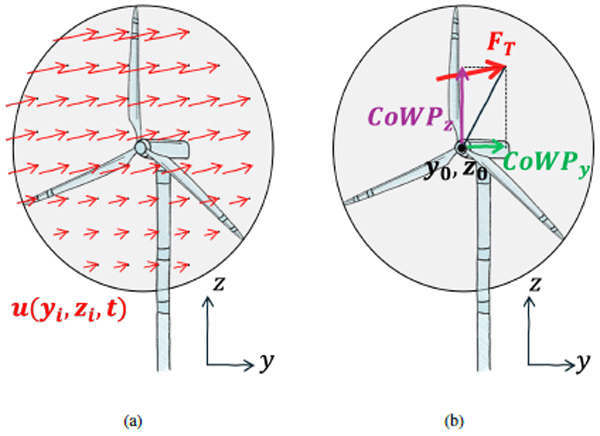
Various simulation tools exist to provide load forecasts in the wind energy field (engineering models and numerical simulations). A newly introduced concept is the center of wind pressure, a quantity extracted from a wind field. In previous works, similar behaviour, then the main shaft bending moments, was shown. However, a clear relationship is missing. In this work, this gap is filled through the introduction of a calibration parameter.
Various simulation tools exist to provide load forecasts in the wind energy field (engineering...
Altmetrics
Final-revised paper
Preprint