
the Creative Commons Attribution 4.0 License.
the Creative Commons Attribution 4.0 License.
 | 08 May 2026
Dependence of wind-farm-induced gravity waves and wind farm performance on non-dimensional atmospheric parameters and simulation configuration
Matthew J. Churchfield
Simon J. Watson
This large-eddy simulation (LES) study examines how wind-farm-induced atmospheric gravity waves (AGWs) and wind farm performance depend on non-dimensional atmospheric parameters and simulation configuration. A hypothetical aligned wind farm of actuator disks is simulated under neutral surface conditions, with a stable capping inversion and a mildly stable free atmosphere, to assess the effects of stratification beyond the atmospheric boundary layer (ABL) on ABL flow. Simulation set-ups fully resolving AGWs are validated to minimize spurious wave generation and reflection from the domain boundaries. The validated set-up is then used to analyze AGW types and characteristics, as well as stratification impacts under conventionally neutral boundary layer (CNBL) conditions. These conditions are governed by four non-dimensional parameters: the Froude numbers of the free atmosphere and capping inversion (Fr, Fri), and the aspect ratios of the ABL and wind farm (, Sh).
Simulation configurations that fully resolve AGWs – capturing at least one wavelength both horizontally and vertically – yield the most realistic stratification effects on ABL flow, whereas partial or unresolved configurations produce non-physical, channel-like behavior. A coherent description of the AGW phenomena is provided, highlighting the central role of capping inversion displacement in linking ABL fluctuations with AGWs. Trapped waves are confined within the capping inversion, while interfacial and internal waves aloft are identified as the AGW types most relevant to wind farm performance. The wavy inversion, analogous to an interfacial wave, forms converging and diverging zones that drive power fluctuations across the farm. The interfacial wavelength, measured over the wind farm, corresponds to one diverging, one converging, and one mildly diverging zone. As the interfacial wavelength decreases with Fri, multiple convergence–divergence zones develop under sub-critical conditions (Fri<1.0), while for super-critical conditions (Fri>1.0), the wavelength approaches the farm length. Wave amplitude increases with decreasing (i.e., shallower capping inversions).
Wind farm performance is most sensitive to : shallow boundary layers increase blockage and reduce efficiency, while deeper layers enhance efficiency. Increasing Fr and Fri mitigates blockage, and increasing Sh mainly improves wake recovery. Although local power fluctuations arise from AGWs, overall wind farm efficiency remains nearly constant with Fr and Fri, improving primarily with larger and Sh.
- Article
(8320 KB) - Full-text XML
- BibTeX
- EndNote


This work was authored in part by the National Laboratory of the Rockies for the US Department of Energy (DOE), operated under contract no. DE-AC36-08GO28308. The US Government retains and the publisher, by accepting the article for publication, acknowledges that the US Government retains a non-exclusive, paid-up, irrevocable, worldwide license to publish or reproduce the published form of this work, or allow others to do so, for US Government purposes.
Numerical flow simulations are often used to investigate the interaction of wind farms with the atmosphere. Thermal stratification within the atmospheric boundary layer (ABL), which significantly affects the strength and structure of ABL turbulence, is often a focus of numerical studies. For example, many studies look to correlate wind turbine wake recovery with ABL stratification. The community often focuses solely on the thermal stratification within the ABL; however, it has become clear that the stratification above the ABL is also significant. A conventionally neutral boundary layer (CNBL), for instance, consists of a neutrally stratified ABL capped by a strongly stable inversion layer and a weakly stable free atmosphere aloft. A wind farm operating in a CNBL can trigger atmospheric gravity waves (AGWs) in the layers above the ABL that contribute to the wind farm blockage effect (Lanzilao and Meyers, 2023). For numerical models to accurately capture AGW effects, thermal and buoyancy effects must be well modeled and the simulation domain has to be properly configured. This study seeks to investigate AGW effects on wind farms while providing guidance on proper simulation design and configuration.
Researchers conduct simulations of offshore wind farms within the neutral ABL at varying levels of complexity depending on the research question. For example, if the focus is on turbulent wake effects, then simulating a truly neutral boundary layer (TNBL) with neutral stability throughout the entire vertical extent of the computational domain, or by neglecting buoyancy altogether, may be sufficient. To provide the next level of realism and complexity, one may include a capping inversion (a roughly 100 m thick layer of very stable stratification) followed by only a few hundred meters of the more weakly stably stratified free atmosphere above (Churchfield et al., 2012; Archer et al., 2013). With this additional realism, the capping inversion acts as a flexible lid on the top of the ABL that can move vertically in response to a strong perturbation from below, such as a large wind farm or terrain. The most realistic simulation configuration, however, is to simulate a CNBL that is capable of fully resolving AGWs by including a capping inversion followed by many kilometers of the weakly stably stratified free atmosphere above. Such a simulation configuration allows the study of wind farm behavior as a function of both ABL stratification and AGW characteristics, a subject that is rapidly gaining attention (Lanzilao and Meyers, 2024). Finally, a recent simplified approach is to neglect any stratified layers and to place a stress-free, rigid, impermeable boundary condition at the expected height of the capping inversion, instead of well above it. Using such a top boundary condition at the top of the computational domain is commonplace, but to use it as an inflexible capping inversion is uncommon (Stipa et al., 2024a). Although this simplified simulation configuration has similarities with the other configurations, it will contain inaccuracies in the velocity and pressure fields because the ABL height cannot adjust to obstacles such as wind turbines (Smith, 2024).
Properly defining the height of the top boundary of the simulation domain is always critical. Suppose one performs a wind farm flow simulation and uses an impermeable top boundary condition; not allowing enough distance between the top of the ABL and the top boundary will unrealistically constrain the flow within the ABL, leading to errors. The top boundary should be placed high enough that the boundary layer can freely expand in the vertical direction while its flow advects through the wind farm, as shown by Stevens et al. (2014), for example. If one wants to capture AGW effects, the simulation domain should be tall enough to accommodate at least one AGW wavelength, usually extending a few kilometers above the capping inversion, as shown by Khan et al. (2024, 2025). The impact of using a domain height shorter than one AGW vertical wavelength is unclear. In addition to the location of simulation boundaries, the ability of those boundaries to properly handle AGW reflections is important. If an AGW reflects off of simulation boundaries, it can seriously contaminate the solution. Khan et al. (2025) explains the criterion that if 90 % or more of the upward-propagating wave energy is absorbed or let out of the domain, the solution will be sufficiently reflection free. The impact of AGW reflections on predicted wind farm power output has not been thoroughly explored.
If the wind farm is large enough and contains turbines that are tall enough relative to the ABL height, AGWs are inevitable under CNBL conditions. To simulate this situation, the CNBL configuration with a many-kilometers-tall domain is the most realistic among those discussed above, especially for offshore sites (Khan et al., 2025; Lanzilao and Meyers, 2024). The literature focuses on the impacts of AGWs on wind farm performance, with limited insight into the AGW phenomenon itself (Allaerts et al., 2018; Lanzilao and Meyers, 2024; Stipa et al., 2024a). For instance, the literature consistently shows that AGWs cause a feedback effect on the flow in the ABL. Smith (2010), Allaerts and Meyers (2015), Lanzilao and Meyers (2024), Stipa et al. (2024b), and Stipa et al. (2024a) argue that AGWs are responsible for the adverse pressure gradients upstream of the wind farm that create a blockage effect and favorable pressure gradients over and downstream of it. Smith (2010) describes the capping inversion displacement caused by the deceleration of the flow within the wind farm as the trigger of the AGWs. Stipa et al. (2024a) describe how the capping inversion displacement couples AGW flow perturbations in the free atmosphere to perturbations within the ABL.
A good description of how AGWs then affect the capping inversion displacement, which trigger those waves in the first place, is lacking. Moreover, different types of wind-farm-induced AGWs are mentioned in the literature without clearly distinguishing them. For example, the work of Khan et al. (2025, 2024) is related to “internal” AGWs, whereas Smith (2010), Allaerts and Meyers (2015), Lanzilao and Meyers (2024), and Stipa et al. (2024a) speak of “interfacial” AGWs as most critical for wind farm performance. “Trapped” AGWs in the capping inversion and even AGWs within the ABL are mentioned (Khan et al., 2024; Allaerts and Meyers, 2017; Lanzilao and Meyers, 2024). There is a need to describe the AGW phenomena clearly, distinguish all the kinds of AGWs, and identify how each kind influences wind farm performance and simulation set-up.
Past studies of AGWs focused on their impacts on wind farms by varying either dimensional or non-dimensional quantities. Allaerts and Meyers (2018), and Lanzilao and Meyers (2024) varied dimensional quantities of interest, including ABL depth and thermal stratification strength of the capping inversion and free atmosphere. In contrast, Smith (2010), Allaerts and Meyers (2019), and Stipa et al. (2024a) focus on AGW impacts on wind farms by varying non-dimensional quantities. Similarly, Khan et al. (2025, 2024) examined various non-dimensional quantities used to establish an optimal large-eddy simulation (LES) set-up for capturing realistic AGW behavior. In this work, we adopt this non-dimensional approach to investigate AGWs and their impact on wind farm performance in a CNBL. We have three objectives, all related to realistic and accurate modeling and understanding of wind-farm–atmosphere interactions under offshore CNBL conditions:
-
We characterize the effects of modeling choices on the simulation of wind-farm–atmosphere interaction by comparing four configurations: (a) the TNBL, (b) the CNBL with a tall domain height, (c) a CNBL with a neutrally stratified free atmosphere, and (d) replacing the flexible capping inversion with an impermeable rigid top boundary.
-
We examine the impact of AGW reflections on wind farm power output.
-
We study the dependence of AGWs and wind farm performance on various non-dimensional parameters defined by Khan et al. (2024).
The remainder of this article is organized as follows: Sect. 2 explains the different kinds of AGWs observed in wind-farm–atmosphere interactions. Section 3 summarizes the non-dimensional metrics used to analyze AGW characteristics and wind farm flow dynamics. The models and simulation configurations are also explained in this section. We compare the different approaches in simulating neutral ABL conditions in Sect. 4.1. Section 4.2 shows the impact of AGW reflections on wind farm power output in a CNBL. Section 4.3 and 4.4 show the dependence of AGW characteristics and wind farm performance on the non-dimensional parameters, respectively. We conclude with Sect. 5.
Various kinds of AGWs are described in the literature, and we sometimes find it challenging to synthesize all the information. Let us give some examples: “interfacial” and “internal” AGWs are described as occurring within the capping inversion and in the free atmosphere, respectively (Khan et al., 2025; Smith, 2010; Allaerts and Meyers, 2017; Lanzilao and Meyers, 2024). Allaerts and Meyers (2017), and Lanzilao and Meyers (2024) describe interfacial waves as two-dimensional waves somehow bound to the top of the capping inversion. They also discuss waves similar to interfacial waves inside the neutral boundary layer, reaching all the way down to the hub height. Khan et al. (2024) identify “trapped” waves confined within the capping inversion, and Ollier and Watson (2023) describe topographically-induced “trapped lee” waves affecting wind farms. Lee waves may also be induced by wind farms, which can affect the flow in a way similar to shallow topography. Because the literature is vast and spread out, we attempt to briefly weave the different kinds of AGWs and their effects into an essential story, giving the reader enough background to understand the results and discussion presented in this article.
The description of wind-farm-induced atmospheric gravity waves involves mass conservation, buoyancy, and wave theory. A wind farm is a sink of horizontal momentum and appears to be similar to a porous blockage, causing the flow to decelerate through the farm. It then begins to accelerate behind the farm as the wind farm wake recovers. As a result of flow continuity, the flow in the ABL is deflected upward at the start of the wind farm and downward at the end of it in response to the horizontal deceleration and acceleration (Allaerts and Meyers, 2017). The capping inversion, as its name implies, is the “cap” on top of the ABL. It is a relatively thin layer of air that is strongly stable in thermal stratification, so it acts as a flexible cap or lid atop the boundary layer. Vertical motions of turbulence within the boundary layer generally do not penetrate this layer – it strongly suppresses them with buoyancy forces. Therefore, it displaces upward over the wind farm and downwards at the end of it due to the flow deflected by the wind farm in that manner. To the flow aloft in the free atmosphere, this deflected capping inversion appears similar to a gentle hill above the wind farm. As does the vertical flow caused by real hills, the vertical flow over the displaced capping inversion activates buoyancy forces that tend to restore air displacements in the free atmosphere and the inversion layer itself, resulting in AGWs.
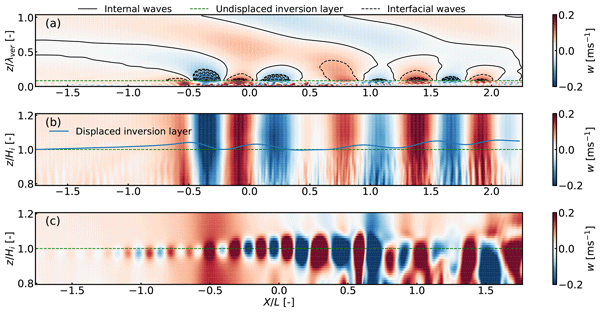
AGWs can be classified into a few different types based on their characteristics and whether they occur in the inversion layer, in the free atmosphere, or at the interface of the two. AGWs are composed of an entire spectrum of wavelengths; however, there is an apparent wavelength dictated by local thermal stratification strength and horizontal wind speed. AGWs propagating in the free atmosphere are referred to as “internal” gravity waves, which are steady if the conditions are steady, as shown in Fig. 1a. Internal waves have a tendency to curve – like an arc of a circle – downstream of the obstacle causing them and may mildly perturb the inversion layer but only downstream of the obstacle. AGWs that may occur in the capping inversion, if its depth is great enough, are referred to as “trapped” waves because they are confined within that layer. The unsteady turbulence that is constantly pushing on the capping inversion from below contributes to the unsteadiness of these trapped waves. An example of trapped waves can be seen in the instantaneous vertical velocity field in Fig. 1c. Because the free atmosphere and capping inversion have different levels of stratification and different wind speeds, they support different apparent wavelengths of AGWs (Khan et al., 2024, 2025). As shown in Fig. 1b, at the interface between the free atmosphere and the capping inversion, we see “interfacial” waves that smoothly blend the internal and trapped gravity waves, and they have their own apparent wavelength. The wavelengths of trapped waves not supported in the free atmosphere are called evanescent waves, and they decay with height. They are contained and advected along the interface (Sachsperger et al., 2015). For sub-critical conditions – wave speed faster than background wind speed – a large part of the wave spectrum becomes evanescent and travels faster than the background wind speed along the interface, especially downstream. These evanescent waves downstream of the obstacle are the “trapped lee waves”, which can relatively strongly perturb the capping inversion.
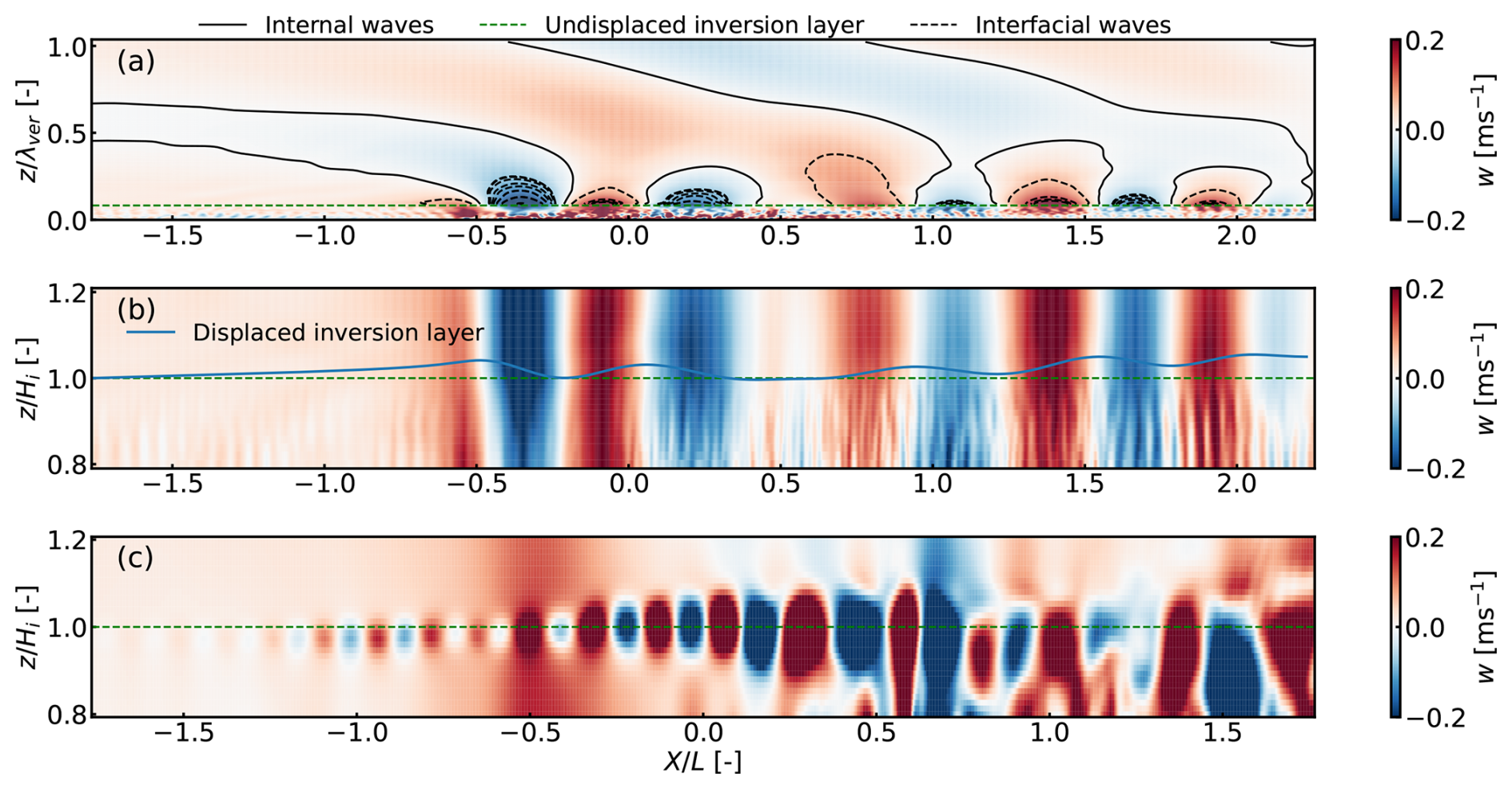
Figure 1Contours of vertical velocity w on a vertical streamwise slice through the middle of the wind farm for Froude number of 0.15, inversion Froude number of 0.75, and wind farm shape factor of 0.025: (a) temporally averaged field showing the internal and interfacial waves; (b) temporally averaged field showing the inversion layer displacement, interfacial waves, and their signature in the ABL; and (c) instantaneous field from a non-precursor-driven simulation that shows the trapped waves in the inversion layer triggered when the wind-farm-induced turbulence hits the inversion layer. The inversion layer mid-point height is at z=500 m, and the wind farm start and end are at and +0.5, respectively, where L is the wind farm length.
Although we summarize AGW formation as a succession of events, we stress that it is really a tightly coupled integrated set of phenomena that happen almost in lockstep. If one parameter in the system changes, the entire ABL-AGW system quickly responds, settling toward a new equilibrium.
3.1 Simulation configuration based on non-dimensional parameters
We simulate a wind farm consisting of a regular 10×5 array of wind turbines with a spacing of five rotor diameters in the streamwise direction and three rotor diameters in the lateral direction. We use the Toolbox fOr Stratified Convective Atmospheres (TOSCA) (Stipa et al., 2024b), an LES code specifically developed to simulate atmospheric flows through wind farms. TOSCA can simulate turbines as actuator lines or actuator disks with controllers for blade pitch, nacelle yaw, and generator speed. This study uses the uniform actuator disk model with a disk-based thrust coefficient (i.e., velocity sampled at the disk) of 1.3. The actuator disks have the same diameter and hub heights as those of the NREL-5 MW wind turbine, 126 m and 90 m, respectively. TOSCA solves the filtered incompressible Navier–Stokes equations under non-hydrostatic conditions using the Boussinesq approximation for buoyancy. The code solves equations for continuity, momentum, and potential temperature. An advection damping layer and Rayleigh damping layers (RDLs) are applied as body forces in the respective forcing zones through the momentum equation, details of which are given in Khan et al. (2024), and Lanzilao and Meyers (2023). We denote the inlet, top, and outlet boundary RDLs as I-RDL, T-RDL, and O-RDL, respectively. Subgrid-scale turbulence is modeled using the dynamic Smagorinsky model with Lagrangian averaging (Meneveau et al., 1996). Further details are given by Stipa et al. (2024b).
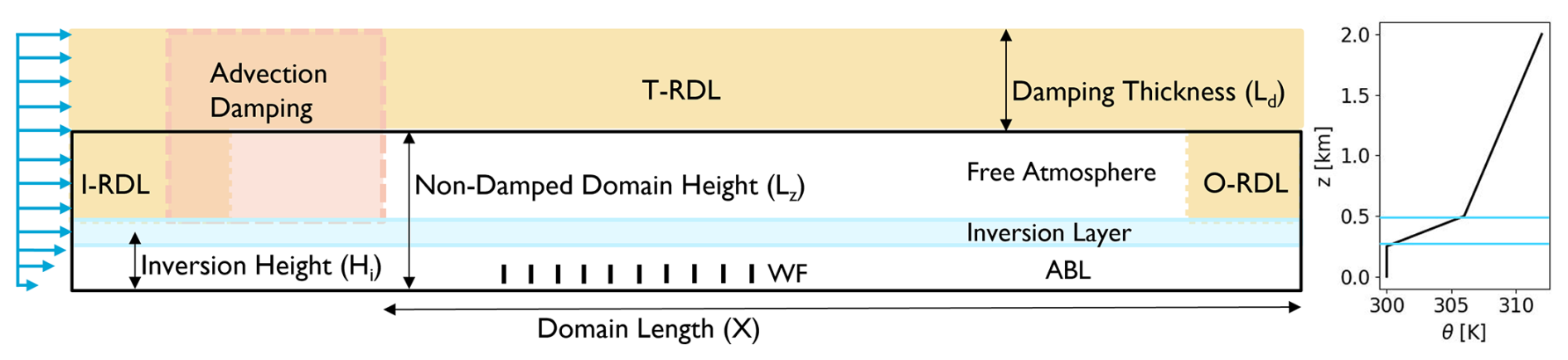
Figure 2Lateral view of the simulation domain that resolves ABL, the capping inversion, and the free atmosphere around a wind farm. Rayleigh damping layers are at the inlet, top, and outlet boundaries, and an advection damping layer is applied, overlapping the inlet Rayleigh damping layer, all in the free atmosphere. A CNBL potential temperature profile is shown on the right for completeness.
Section 2 shows the simulation domain for the wind farm. Turbulent inflow conditions, including wind shear and veer, generated with offline precursor simulation are driven into the domain using an inflow Dirichlet boundary condition. Flow exits the domain using an outflow Neumann boundary condition. A typical wall shear stress lower boundary condition is used. It uses Monin–Obukhov similarity to relate the computed flow within the domain to the wall shear stress; Monin–Obukhov similarity is applied locally. An aerodynamic roughness height of 0.0001 m is used to mimic offshore conditions. Periodic boundary conditions are used in the transverse direction only. The upper boundary is set to a free-slip condition for wind speed. The temperature in the ABL is constant with height, then strongly and linearly increasing in the capping inversion, and finally linearly but more weakly increasing in the free atmosphere. This gives a buoyancy and Brunt–Väisälä frequencies constant with height in both layers. There is no heat flux at the ground, which maintains a neutral ABL throughout the simulation. We impose Coriolis forces corresponding to 41° north latitude.
The precursor simulations have the same configuration except that the inflow–outflow boundary conditions are replaced with periodic boundary conditions. The precursor spin-up time is 25 ks, and inflow data are saved for two flow-through times of the successor domain beyond the spin-up. A driving horizontal pressure gradient controller maintains hub height velocity at 11.5 m s−1 with the direction aligned to the horizontal axis. The computed pressure gradient is also saved and used later by the successor simulation. Moreover, geostrophic damping (details given in Stipa et al. (2024b)) is used in the precursor to damp inertial oscillations in the free atmosphere.
A graded mesh in the y and z directions is used with 20 m ×15 m ×10 m resolution in the wind turbine rotor layer. From the rotor tips, the mesh stretches horizontally to a resolution of 20 m at the lateral boundaries. The mesh is graded vertically; it reduces from uniformly 10 m in the ABL to 5 m in the capping inversion to effectively resolve the trapped waves. The mesh resolution above the capping inversion is uniformly 10 m up to 1 km and stretches above the capping inversion to 200 m resolution at the start of the top of the Rayleigh damping layer. The stretching ratios are 0.9 and 1.1, respectively. Following the recommendations by Khan et al. (2024), the domain size, advection, and Rayleigh damping layer thicknesses are set greater than one effective horizontal and vertical internal gravity wavelength for the respective directions. The domain size, including the damping layers for all cases, unless mentioned otherwise, is 35 km in the x direction, 6 km in the y direction, and 12 km in the z direction. The values of domain width are inferred from Lanzilao and Meyers (2024), which shows that the ratio of domain width to wind farm width should be roughly greater than 3 in deeper CNBLs (i.e., Hi≥500 m). This is required to avoid adverse hydrodynamic effects when periodic boundary conditions are used at the lateral boundaries. For shallow boundary layers, the domain should be much wider, which is why the shallowest boundary layer (i.e., Hi=250 m) simulated in this study is 11 times wider than the wind farm width. This domain width is chosen because the gravity waves mostly disperse before reaching the lateral boundaries, preventing their recycling into the wind farm zone.
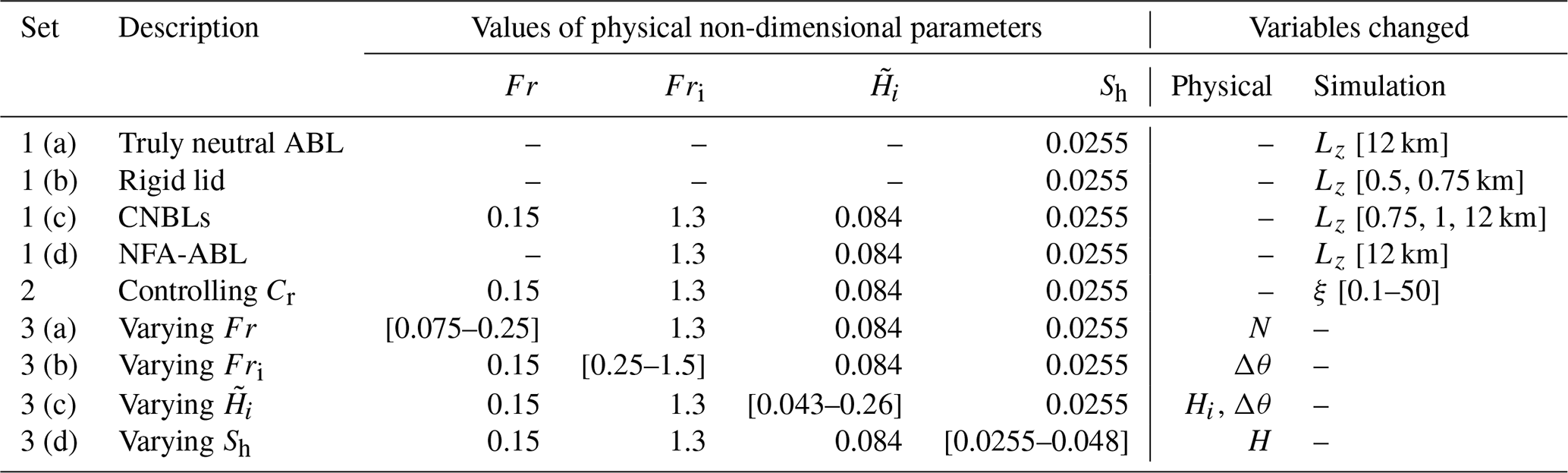
Table 1Non-dimensional parameters with ranges used in this study.
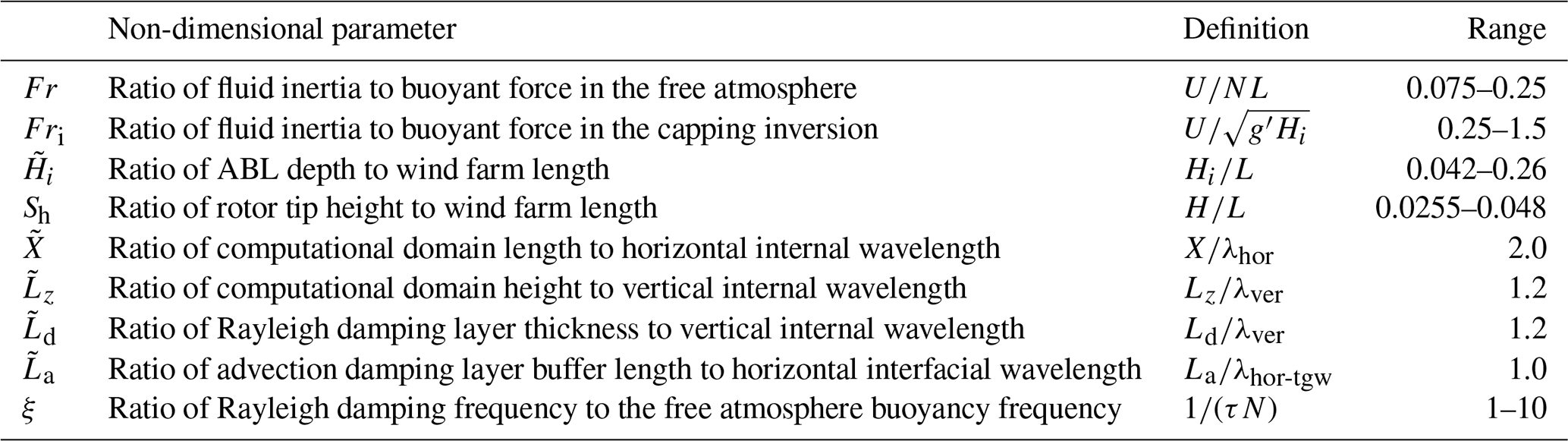
The behavior of atmospheric gravity waves can be characterized using non-dimensional flow parameters. Likewise, the configuration of simulations that capture atmospheric gravity waves can also be defined using non-dimensional parameters. The non-dimensional parameters central to this work, as identified by Khan et al. (2024), are given in Sect. 1. Here, U is the geostrophic wind speed, N is the Brunt–Väisälä frequency, L is length of the wind farm, is a reduced gravitational constant, g is the usual gravitational constant, Δθ is the change in potential temperature across the capping inversion, θ0 is a reference temperature (usually 300 K), Hi is the capping inversion mid-height, H is the wind turbine height (from ground/sea level to the top of the rotor), X is the computational domain length, Lz is non-damped computational domain height, Ld is the computational domain gravity wave Rayleigh damping layer thickness, La is the computational domain gravity wave advection damping layer buffer thickness, λhor is the horizontal wavelength of the internal gravity waves, λhor-ifgw is the horizontal wavelength of the interfacial gravity waves, λver is the vertical wavelength of the internal gravity waves, and τ is the timescale of the gravity wave Rayleigh damping layer. The first four non-dimensional numbers, the Froude numbers for the free atmosphere and capping inversion (Fr and Fri), and the vertical aspect ratios of the ABL and the wind farm ( and ) characterize the physics of the flow, whereas the remaining five characterize the simulation configuration.
3.2 Metric for wave characteristics and reflection coefficient
AGW inclination angles and wavelengths are estimated using a metric that advances an approach proposed by Allaerts et al. (2025) to calculate the inclination of internal waves induced by a hill. The approach of Allaerts et al. (2025) can be applied to the displacement, pressure, and vertical velocity fields; we apply it to only the vertical velocity. A time-averaged vertical velocity plane above the ABL is analyzed to consider only the interfacial and internal waves. The apparent wavelengths of the AGWs can be measured by identifying the local maxima and minima in the vertical velocity field, as shown in Fig. 3 (left) (Khan et al., 2025). Because wind farms induce two internal wave trains, the upstream one is chosen because it is usually undistorted, especially upstream of the wind farm. Meanwhile, the second wave train superimposes onto the first one, leading to complicated wave characteristics that are difficult to characterize. The maxima/minima finding algorithm identifies even local maxima and minima, so the results are filtered to include only the primary maxima and minima of the first wave train, as shown in Fig. 3 (right). While filtering, the first peak, a maximum, is always the one where the wind farm starts and right at the top of the capping inversion, that is, (−3000, 550) m for the case shown in Fig. 3. The minima and maxima locations of the wave field sweep upward and downstream of the first maximum following a roughly parabolic path (Queney, 1948; Allaerts et al., 2025). Thus, a parabola is fit to these locations, starting at the first maximum, always passing through the next minimum, and best fitting the remaining minima and maxima. One AGW metric we wish to obtain is wave field inclination angle. Because the curved parabola has a range of tangent angles, we choose the tangent at the third minimum/maximum from the one at (−3000, 550) m to estimate the representative inclination angle of the first wave train, as shown in Fig. 3 (right). This peak is a maximum corresponding to a vertical location of , where is the buoyancy length. This differs from the observation of Queney (1948) and Allaerts et al. (2025) that the third AGW maximum above the surface occurs at for their simple ridge flow cases.
The apparent wavelength of internal waves in the direction of energy propagation is calculated using the metric suggested by Khan et al. (2025). Here, a wavelength is twice the distance between consecutive maxima and minima of vertical velocity along the parabolic fit line. We measure the distance between the consecutive extrema located along the tangent at the third maximum in the to Hi+Ls range. This eliminates the possibility of capturing extrema affected by the interfacial waves close to the capping inversion and the propagating internal waves damped by the damping layer beyond one vertical wavelength, which is . The horizontal and vertical wavelengths can be estimated by calculating the streamwise and vertical components of the actual apparent wavelength (i.e., we split the wavelength distance vector into its x and y components).
The wavelength of the resultant interfacial wave is calculated using the same metric but by plotting vertical velocity in the streamwise direction stretching over the length of the wind farm at the top of the capping inversion. The reason for confining the streamwise length in measuring the interfacial wavelength is twofold. First, for low Fr, the two interfacial waves may not or partly superimpose onto each other, modulating the interfacial wave field over the wind farm; and second, the waves downstream of the wind farm are imprints of internal waves for super-critical conditions and a merged form of the imprints, and the trapped lee waves for sub-critical and critical conditions. Thus, measuring interfacial wavelength over the wind farm length would give a better idea of their involvement in the aerodynamics of the wind farm that induces them.
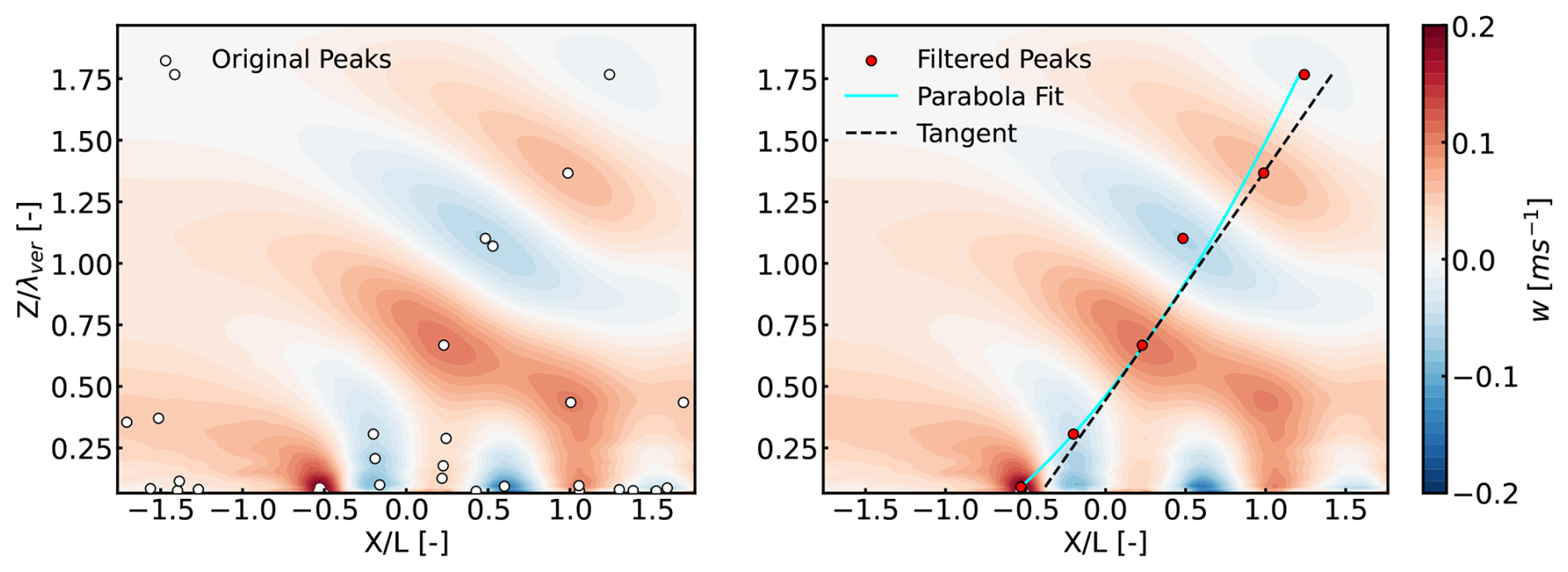
Figure 3Time-averaged vertical velocity field above the ABL extending up to the top boundary, including the T-RDL beyond , where the initially identified peaks are shown with white and filtered peaks with red markers.
The amplitude of internal waves is estimated by tracing the path of a Lagrangian particle being carried in the computed velocity field. The path of a particle at is traced from the inlet to the outlet. The amplitude is the maximum vertical distance between two consecutive peaks on the traced particle path. The same strategy is used to estimate the vertical displacement of the capping inversion or the amplitude of the interfacial wave as a function of x. An air parcel is traced along the top of the capping inversion. Thus, local and maximum inversion layer displacements are extracted, which are useful in determining the capping inversion's response to perturbations from individual wind turbine rows and the entire wind farm, respectively.
Accurate simulations must be free of spurious AGW reflections off of domain boundaries. AGW boundary reflection is quantified using the reflection coefficient (Cr), which is estimated with the method used in Khan et al. (2025) proposed by Allaerts and Meyers (2017). Cr is the ratio of kinetic energy of the downward-propagating waves (reflected waves) to that of the real upward-propagating waves. The reader is directed to Khan et al. (2025) for details about the estimation of Cr. For reflection-free simulations, the criterion Cr <10 % proposed by Khan et al. (2025) is followed, which will be discussed in Sect. 4.2.
3.3 Simulation suite
The simulation suite given in Table 2 is categorized into three sets, each answering one or two of the research questions outlined in Sect. 1. The first set compares simulation configurations – truly neutral, rigid lid, and CNBL – used in modeling wind farms under neutral surface conditions. It is established that the CNBL configuration fully resolving AGWs, proposed by Khan et al. (2024) and adopted for this research, is a more realistic representation of wind-farm–atmosphere interaction. The second set answers how AGW reflections affect the wind farm power output. We show that Cr <10 % is a reasonable criterion for reflection-free simulations. The last simulation set explores the dependence of AGW characteristics and wind farm performance on non-dimensional parameters so that a baseline for wind-farm–atmosphere interaction in CNBLs can be proposed. The following breakdown gives the approach taken for each simulation set to achieve the aims highlighted above.
-
Set 1 focuses on the impact of the vertical temperature profile and the vertical extent of the model domain on the simulated power output of an offshore wind farm. We run four simulation sets:
- a.
Truly neutral ABL and free atmosphere, which contains no gradients of potential temperature, so no buoyancy effects. This uses a domain height of Lz=12 km and contains a wind farm. In this simulation, the turbulent inflow from a 500 m tall precursor domain, without a wind farm, is fed into the tall successor domain. The ABL in the successor simulation can vertically expand without restriction as it flows through the domain.
- b.
Rigid lid, where only a neutral ABL and no capping inversion and free atmosphere above is simulated, and the domain height is set to Lz=500 and 750 m in two separate simulations.
- c.
CNBL, with a capping inversion of 100 m thickness at a mid-point height of Hi=500 m, and a less stable layer above in the free atmosphere where the domain height is set such that the simulations only partly resolve AGWs; that is, Lz=750 m and 1 km. A further CNBL reference case with the same capping inversion set-up is run but Lz=12 km to fully resolve AGWs and avoid reflections, and for conditions defined by Fr=0.15, Fri=1.3, , and Sh=0.0255.
- d.
NFA-ABL, where the set-up is the same as the reference CNBL case, but the free atmosphere is neutrally stratified. This is done by setting the lapse rate in the free atmosphere to zero, while keeping everything else the same as in the reference CNBL case.
- a.
-
Set 2 investigates the impact of AGW reflections from the top boundary on the capping inversion displacement and row-averaged wind farm power output. We simulate the wind farm for conditions matching Fr=0.15, Fri=1.3, , and Sh=0.0255. The non-dimensional damping coefficient of the top Rayleigh damping layer, that is, , is varied from 0.1 to 50. The chosen range of ξ follows Khan et al. (2025), who demonstrated that reflections are minimal for for practical values of N. The rest of the model configuration is kept the same, as described in Sect. 3.1. In doing so, reflections from the top boundary are controlled and are estimated with the Cr metric. The comparison of capping inversion displacements and power outputs from the simulated cases shows the impact of reflections on flow and power output.
-
Set 3 explores three aspects. First, the AGW phenomenon and types (already discussed in Sect. 2); second, the dependence of AGW characteristics on the physical non-dimensional parameters; and third, the dependence of wind farm performance on the physical non-dimensional parameters. In this regard, several simulations are run for each physical non-dimensional parameter by varying only one at a time and keeping the rest constant. Further details are given in Table 2, Set 3(a–d).
This section analyzes three major aspects of modeling the interaction of wind farms with the atmosphere. First, three common approaches to configuring wind farm simulations for neutral ABL conditions are compared to distinguish the most realistic one. As will be shown later in this section, accurate wind farm performance predictions require simulation configurations that include a significant part of the stratified free atmosphere above the capping inversion, thus fully resolving AGWs. Second, the impact of AGW reflections on wind farm flow is investigated to ensure the accuracy of the CNBL set-up. Third, the dependence of AGW characteristics and wind farm performance on the physical non-dimensional parameters is analyzed to better understand the underlying phenomena of wind farm interaction with the atmosphere.
4.1 Comparison of wind farm simulation configurations
Three commonly used wind farm flow simulation configurations – truly neutral, rigid lid, and CNBL – are compared in this section. The aim is to identify any shortcomings associated with each configuration in accurately mimicking the wind-farm–atmosphere interaction. The analysis to compare these configurations is done on the simulations detailed in Table 2, Set 1(a–d). CNBL conditions are defined by Fr=0.15, Fri=1.3, , and Sh=0.025, which are irrelevant for the other two configurations.
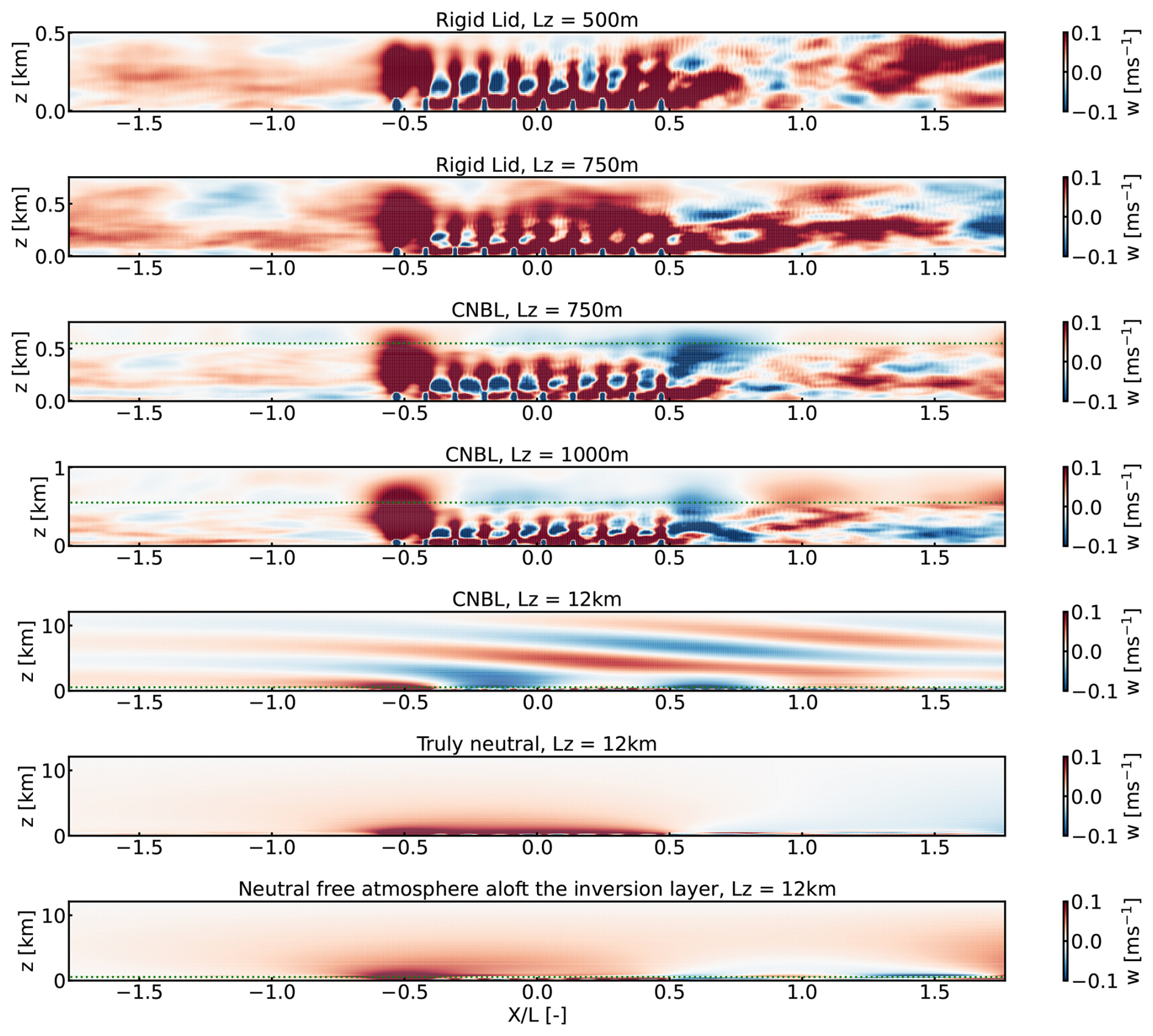
Figure 4Temporally averaged vertical velocity through and around the wind farm with lengths L=5.67 km from simulation configurations characterizing rigid lids, CNBLs, and truly neutral, and the idealized configuration with both the ABL and free atmosphere being neutral. The horizontal dotted line shows the capping inversion mid-height where implemented.
4.1.1 Truly neutral and rigid lid configurations
Truly neutral configurations are helpful when the interaction of the wind farm with only a neutral ABL is of interest. This approach is somewhat of an academic curiosity and might not occur realistically, as it assumes that the atmosphere, even beyond the turbulent ABL, is neutral. It can be of use to study turbines with heights much smaller than the ABL. However, modern wind turbines in large wind farms can interact with the atmosphere above the ABL (Allaerts et al., 2018). Still, many LES studies have used the TNBL configuration, where a pressure gradient or constant geostrophic wind drives the boundary layer (Wu and Porté-Agel, 2015; Stieren and Stevens, 2022).
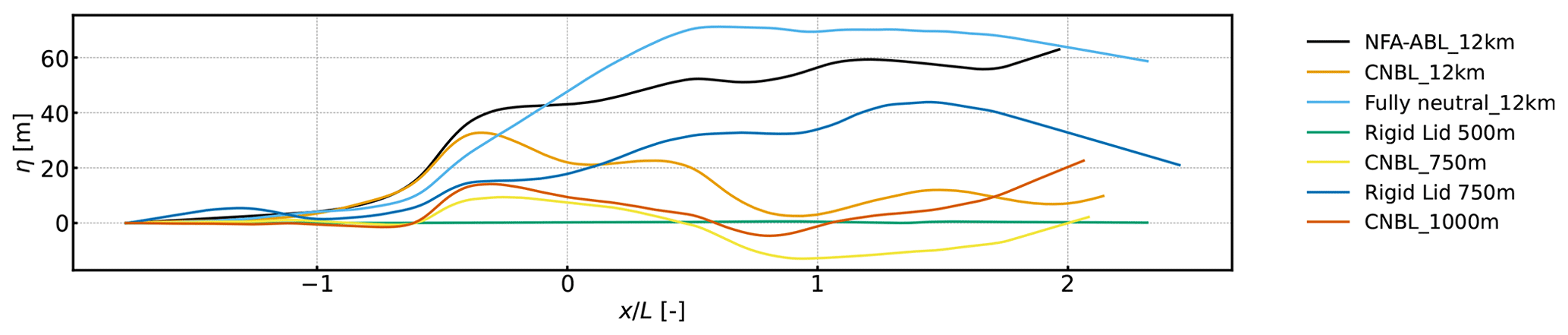
Figure 5Particle vertical displacement η versus horizontal distance along the domain at capping inversion mid-height Lz=500 m, thus representing the displacement of an air parcel perturbed by the wind farm and analogous to capping inversion displacement for the cases simulating one. The wind farm stretches from to 0.47.
For a TNBL simulation, a constant potential temperature in a domain a few times taller than the intended ABL height is simulated. The ABL can freely expand vertically until an equilibrium with the non-turbulent free atmosphere is achieved. Therefore, the truly neutral simulation configuration detailed in Table 2, Set 1(a) has an ABL height of Hi=500 m at the inflow boundary, and the domain height is Lz=12 km. The domain height matches that of the reference case (i.e., CNBL configuration fully resolving AGWs), but the simulation does not use a top RDL because there is no buoyancy to trigger AGWs in the truly neutral case. As shown on the vertical velocity plots in Fig. 4, the ABL displaces vertically in reaction to horizontal flow deceleration through the wind farm without being constrained by the rigid top boundary. This is also confirmed in Fig. 5, as the particle path traced through the domain starting at an initial ABL height of 500 m as the inflow initially rises and then asymptotes at a height far lower than the domain height. Moreover, this particle path shows the highest vertical expansion among the cases investigated, as there is no capping inversion to cap the vertical displacement of the ABL.
Like truly neutral cases, the rigid lid configurations have a constant potential temperature, but the domain height is defined at the inversion layer or ABL height. In a physical sense, the top boundary acts like an immovable capping inversion that constrains the vertical displacement of the flow in reaction to the horizontal flow deceleration caused by the wind farm. This constraint on vertical velocity suggests that, to enforce continuity, the flow cannot decelerate as it naturally would. The closer the top boundary is placed to the top of the turbines, the greater this effect on the wind farm. The fact that the top boundary placement decreased horizontal flow deceleration through the wind farm can be witnessed on the vertical velocity contours for the rigid lid simulations shown in Fig. 4, where the domain heights are 500 m and 750 m. The particle paths for the rigid lid cases shown in Fig. 5 are concrete evidence of an immovable top boundary; vertical flow is completely suppressed when Lz=500 m compared to the truly neutral case. This “channel” effect is milder for the rigid lid Lz=750 m case but is very pronounced compared to the truly neutral and the reference cases that use much taller domains.
4.1.2 Partial to fully resolved CNBL configurations
The discussion in Sect. 4.1.1 clearly shows the importance of simulating domains tall enough to exclude channel effects caused by too low a top boundary. However, temperature conditions beyond a few hundred meters above the sea surface are not always neutral; instead, a stable capping inversion and free atmosphere aloft are frequent. Thus, the discussion naturally leads to whether or not an inversion layer and the free atmosphere should be included in wind farm simulations. Moreover, to what extent should the free atmosphere be resolved to capture all phenomena relevant to wind-farm–atmosphere interaction? These questions can be answered by comparing CNBL configurations that partially resolve AGWs with a configuration that fully resolves them; these configurations are detailed in Table 2, Set 1(c). Only inlet Rayleigh and advection damping layers are implemented for the CNBL-750 m and CNBL-1000 m set-ups, as there is barely any free atmosphere resolved for the internal waves to form.
Besides properly resolving AGWs, avoiding the effect of the top boundary constraining the capping inversion displacement is critical. The evidence of unresolved, partially, and fully resolved AGWs can be seen on the temporally averaged vertical velocity contours for three CNBL cases – Lz=750 m, 1000 m, and 12 km – shown in Fig. 4. No AGWs are seen for the case with Lz=750 m, traces of interfacial waves are seen when Lz=1000 m, and all AGWs are resolved when Lz=12 km. Since AGWs perturb the capping inversion, improperly resolved AGWs will show unrealistic impacts on the flow in the ABL. In less tall computational domains, both improperly resolved AGWs and the channel effect contribute to unrealistic flows in the ABL. This can be appreciated from the particle paths for CNBL cases shown in Fig. 5. A particle traced at the top of the capping inversion shows suppressed vertical movement for the cases with less tall domains compared to the tallest one. Placing the top boundary close to the capping inversion accelerates the flow in the free atmosphere and suppresses the realistic displacement of the capping inversion.
Fully resolving AGWs requires a computational domain much taller (i.e., Lz=2Ls) than one sufficient to eliminate the constraining channel effect of the top boundary. This is obvious when the particle path for the case of fully resolved AGWs is compared to the truly neutral case. The particle path for the case of fully resolving AGWs characterizes the perturbations from the wind farm and the AGWs. The ABL does not expand progressively, and flow acceleration effects from the top boundary are absent. The global maxima and minima on this path are evidence of two disturbance sources, each inducing a wave train in the free atmosphere. The fact that the path is wavy downstream of the wind farm shows the resultant interfacial wave, which is the result of superimposed internal waves in that region and the interfacial waves advected downstream for this super-critical case. Therefore, the configuration fully resolving AGWs is most realistic and accurate in mimicking wind-farm–atmosphere interaction for shallow ABL conditions (i.e., CNBLs).
4.1.3 Capping inversion between neutral free atmosphere and ABL
The discussion on CNBL configurations in Sect. 4.1.2 asks whether modeling a stratified free atmosphere is essential. This curiosity is settled by simulating a configuration similar to the case that fully resolves the AGWs, with the key difference that the free atmosphere potential temperature profile is neutral, details of which are given in Table 2, Set 1(d). The only stable layer is the capping inversion. Figure 4 shows that there are no internal waves, but trapped lee waves at the capping inversion are present. We use no damping layers in this simulation set-up. The significance of including the free atmosphere's stability can be appreciated from the particle path traced for this scenario. The path is similar to that of the case that fully resolves AGWs up to the second row of the wind farm; beyond that, the capping inversion slowly moves upwards and approaches that of the truly neutral case far downstream. This rising tendency of the capping inversion in response to the wind farm perturbation is because the buoyancy of the free atmosphere is absent to mask it. In the physical sense, the free atmosphere's buoyancy acts like a spring's stiffness; the buoyancy of the free atmosphere restores the displaced capping inversion. Without buoyancy, the restoring force that suppresses capping inversion vertical displacement is missing. The impact of flow entrainment at the end of the wind farm on the capping inversion is almost unnoticeable. Moreover, the wavy path downstream of the wind farm is the signature of trapped lee waves only because there are no internal waves.
4.1.4 Comparison of wind farm power for the configurations
Figure 6a compares wind farm power output for the configurations described earlier. The solid lines show the averaged power output of the wind turbines, where we average both in time and along spanwise turbine rows. The dashed lines show the difference between averaged power output for each configuration and that of the case that fully resolves AGWs (the CNBL-12 km case), assuming it is the most realistic. Several conclusions can be drawn from these power plots and their comparisons. First, the power output follows the same trend along the wind farm length, regardless of the configuration used. A few notable aspects of this trend include the greatest power decrease for the turbines in the second row, increasing power output until the fifth row, and slightly decreasing toward the last row. The highest drop for the second row of turbines is because of the velocity deficit caused by the first row of turbines, and little to no turbulent flow entrainment from above. The increasing power output after the second row suggests better wake mixing and recovery from the sides and above the wakes. The flow has fully developed by the fifth row, and mixing has reached equilibrium. The truly neutral simulation gives the best perspective of the power for turbines beyond the fifth row, as it excludes flow “channeling” effects caused either erroneously by too low a top boundary or realistically by inversion layer displacement effects.
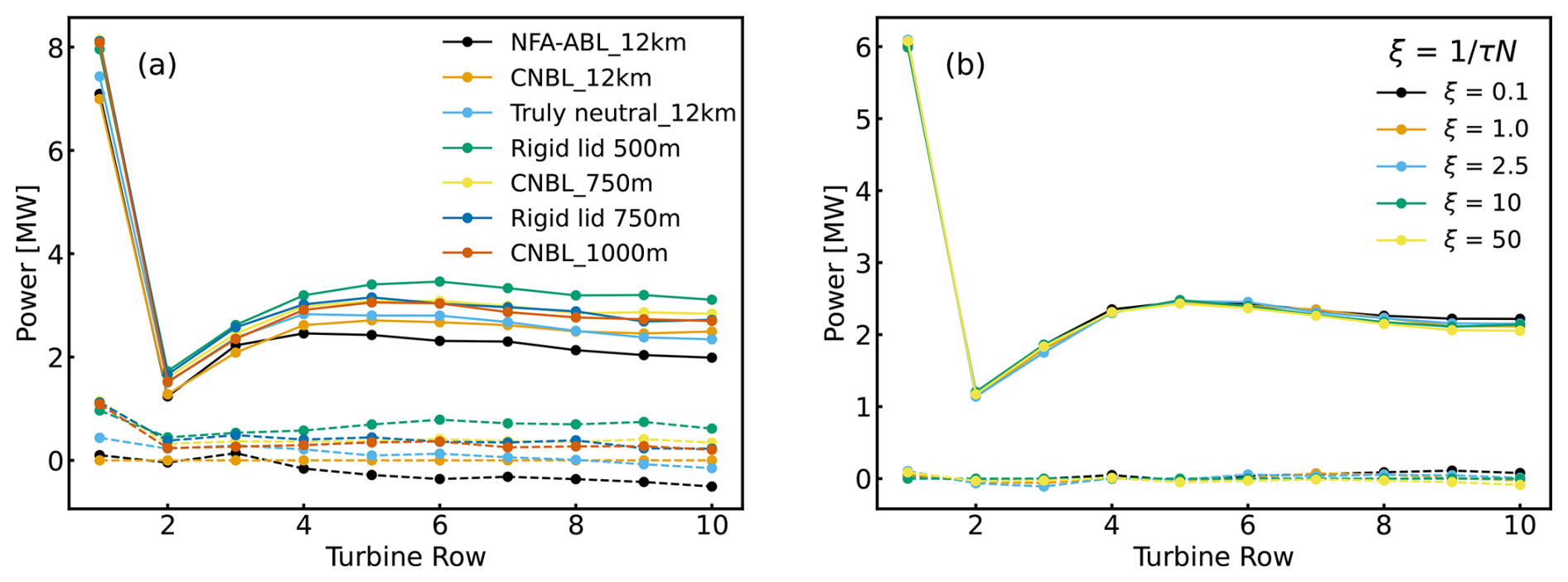
Figure 6Temporal and row-averaged power as a function of (a): domain height for fully neutral, rigid lid, CNBL, and NFA-ABL configurations to mimic neutral surface conditions; and (b): ξ. The solid lines show actual power, whereas the dashed lines show the difference between the actual power predicted by each configuration and that of the reference case for (a) and ξ=10 for (b).
Comparing the configurations, we observe that the rigid lid cases appear to have the most overestimated wind farm power output, inferred in the above discussions as the consequence of the channel effect caused by too low a top boundary. It is further inferred that the row-wise power output for the rigid lid cases would approach that of the truly neutral case if one keeps increasing the domain height. Surprisingly, the power profile predicted by the CNBL cases, partially resolving the AGWs, is almost the same as that of the rigid lid case with the Lz=750 m. This shows that including a capping inversion without sufficiently resolving the free atmosphere has the channeling effect almost completely dominating the stratification effects. The power plot for the case where the free atmosphere was kept neutral above the capping inversion of the same strength as that of the CNBL cases is interesting: this plot roughly matches the reference tall CNBL case until the fourth row. Beyond the fourth row, the simulated power is less than the reference case, signifying the absence of favorable pressure gradients in that region caused by internal waves and the capping inversion constraining the vertical flow mixing in the ABL when compared to the truly neutral case. This mismatch shows the importance of modeling a stable free atmosphere.
The dashed lines show that all configurations, except the one with a neutral free atmosphere, underestimate the global blockage effect and overestimate wind farm power output compared to the reference case that fully resolves AGWs. The higher power produced by the first-row turbines in all cases compared to the reference case is evidence of the underestimated global blockage effect. Interestingly, the simulated power of the reference case approaches that of the truly neutral case toward the far end of the wind farm. Altogether, leaving out buoyancy or simulating TNBLs excludes the hydrostatic or global blockage effect, and the impacts of AGWs on the wind farm performance (Stipa et al., 2024a; Lanzilao and Meyers, 2024). Including a capping inversion and the free atmosphere but partially resolving the AGWs is the same as rigid lid simulations or cases simulating just the ABL. In other words, the channeling effect caused by the top boundary is completely dominant over the stratification effects. Therefore, a more physically realistic simulation, which will also fully resolve AGWs, includes the capping inversion and the free atmosphere, and places the top boundary sufficiently high above the surface.
4.2 Impact of reflections on wind farm flow
AGWs will reflect off of domain boundaries if not properly treated. Reflected waves then affect the flow in the free atmosphere, in turn affecting the displacement of the capping inversion and the flow in the ABL. Hence, the non-physical reflections from the domain boundaries can affect the accuracy of the flow solution. AGWs occur mainly in the free atmosphere, and a major source of spurious reflection is the top boundary. Spurious reflection can occur at the inlet also, but we use an advection damping layer there, as explored by Khan et al. (2024), with an optimal set-up. The impact of the reflections from the top boundary on the capping inversion displacement and wind farm power output requires more attention. The reflections from the top boundary are controlled by setting the timescale τ of the Rayleigh damping layer at the top boundary (T-RDL). As shown on the temporally averaged vertical velocity plots in Fig. 7, the AGWs reflect the most from the top boundary when the damping strength is the weakest or too strong. Damping strength is described by the non-dimensional value . For the range of ξ from 1.0 to 10.0, the waves are damped significantly, and the AGW amplitude decreases toward the top boundary. Using ξ>10 makes the T-RDL damping too strong, and the AGWs reflect off it, as seen in Fig. 7 for ξ=50. This can be seen on the plots for the downward waves where there is a phase shift in the T-RDL when ξ=0.1, as the waves reflect from the top boundary and inside the non-damped layer when ξ=50, with the waves reflecting off the T-RDL itself. For ξ=1.0–10.0, the wave fronts show no phase shift. Note that the strength of downward waves is roughly the same for all values of ξ, as the reflected wave energy is in range of 8 % to 11.5 % of the upward wave energy. See Khan et al. (2025) for more details about extracting the upward and downward waves from the vertical velocity.
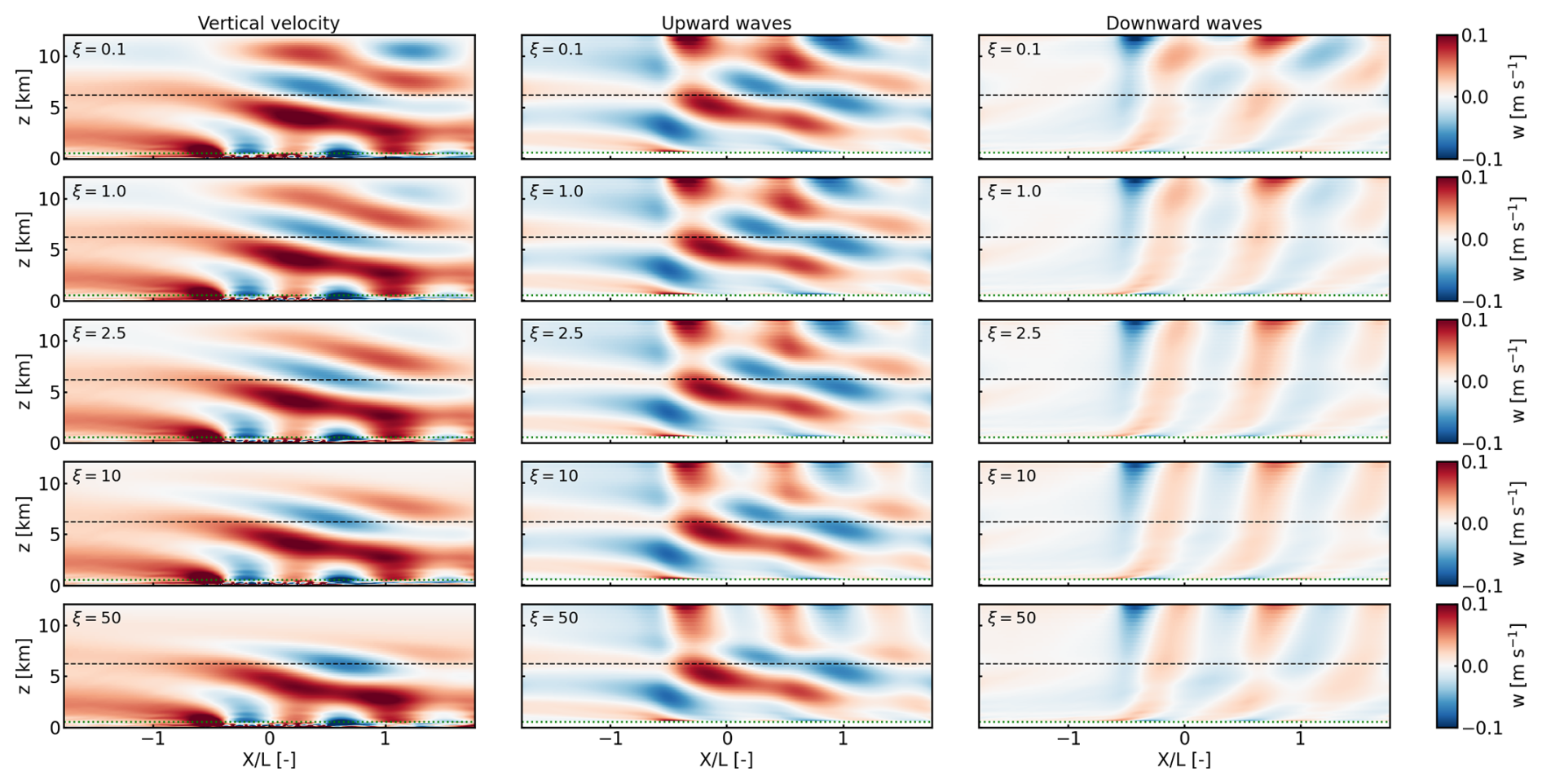
Figure 7Contours of temporally averaged vertical velocity, upwards propagating waves, and downwards propagating waves in a streamwise-oriented vertical plane for varying Rayleigh damping strength (ξ) of the T-RDL. The flow conditions are defined by Fr=0.15, Fri=1.3, , and Sh=0.0255. The dashed green and black lines show the capping inversion mid-height and start of T-RDL, respectively.
The particle paths shown in Fig. 8 give insight into the impact of reflections on the capping inversion displacement. For ξ=1.0 to 10, the capping inversion displacements differ only slightly because the reflections are well controlled, i.e., Cr =8 %–9 %. In contrast, the capping inversion displacement is most different for ξ=0.1, especially toward the end of the wind farm and downstream. This is because the wave reflection angle depends on the wave propagation inclination angle; and for the simulated conditions, the reflected waves fall more downstream of the wind farm. The value of Cr is 10.5 % in this case. For ξ=50, too large a damping strength, the waves reflect off the T-RDL. This can be seen in the capping inversion displacement that looks different all across the domain length than in the case in which reflection is well controlled. This means that the waves are reflected from the T-RDL across the length of the domain, and the reflected waves contribute to perturbing the capping inversion, which is not desired. The value of Cr is 11.4 % in this case.
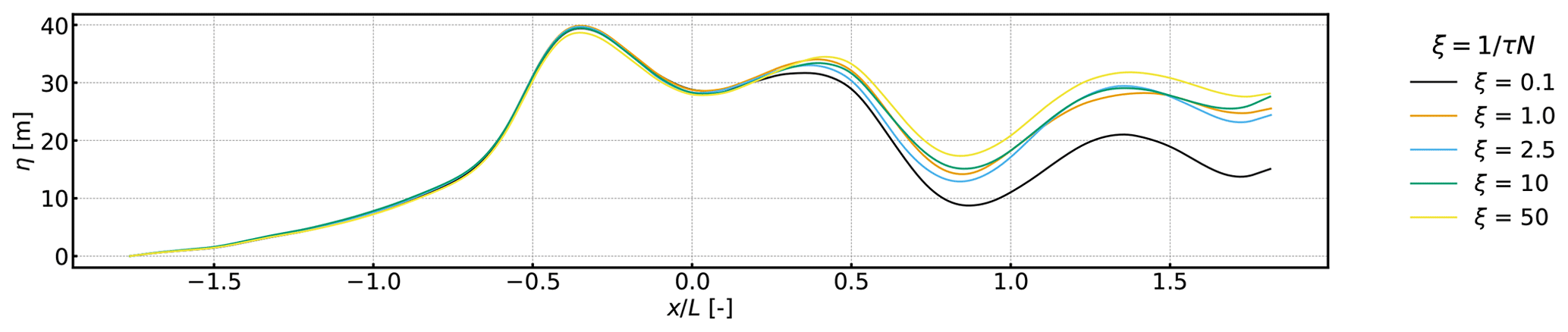
Figure 8Capping inversion displacement, extracted by tracing particle paths at z=550 m, as a function of ξ.
The impact of reflections from the T-RDL on the wind turbine and farm output is rather mild and relates to the capping inversion displacement. As shown in Fig. 6b, the power plots are the same in all cases except for underestimated power toward the end of the wind farm for ξ=0.1. The temporal and row-averaged power looks slightly different from other cases throughout the wind farm length for ξ=50, where the power is overestimated for the first turbine and underestimated for all other turbines except the fifth one.
4.3 Non-dimensional parameter dependence of capping inversion layer shape and AGW characteristics
With optimal T-RDL strength established, we now address the dependence of the AGW characteristics on the physical non-dimensional parameters listed in Table 1. The following subsections discuss capping inversion shape, and interfacial and internal wave characteristics as a function of the physical non-dimensional parameters. The capping inversion shape at steady state shows how the flow in the ABL, capping inversion, and free atmosphere are coupled Stipa et al. (2024a). We estimate the capping inversion shape from temporally averaged streamwise and vertical velocity fields. We examine AGW characteristics using the vertical velocity field. The methods used to measure these representative features should always be used with a thorough visual analysis of flow fields. Note that the domain width was set to 18 km for the case . The initially used 6 km wide domain was too narrow for simulating the capping inversion at a height of only 250 m. The AGWs are strong in shallow boundary layers and high wind veer recycled the AGWs from the lateral boundaries into the wind farm, effecting its power output.
4.3.1 Capping inversion displacement dependence on physical non-dimensional parameters
AGW characteristics are strongly related to the displacement of the capping inversion, which can be depicted by its shape at steady state. For instance, the positive and negative displacements of the capping inversion at the start and the end of the wind farm are a result of the two main flow disturbances that trigger gravity waves, the bulk upflow and downflow at the upstream and downstream wind farm edges, respectively. Moreover, the wavy capping inversion shape downstream of the wind farm shows the resultant interfacial waves. Each positive and negative vertical displacement of the capping inversion is inherently linked to diverging and converging flows underneath in the ABL. The size and strength of these convergent and divergent ABL flow zones are related to AGW characteristics. With a convergence comes a horizontal flow acceleration; with a divergence comes a deceleration.
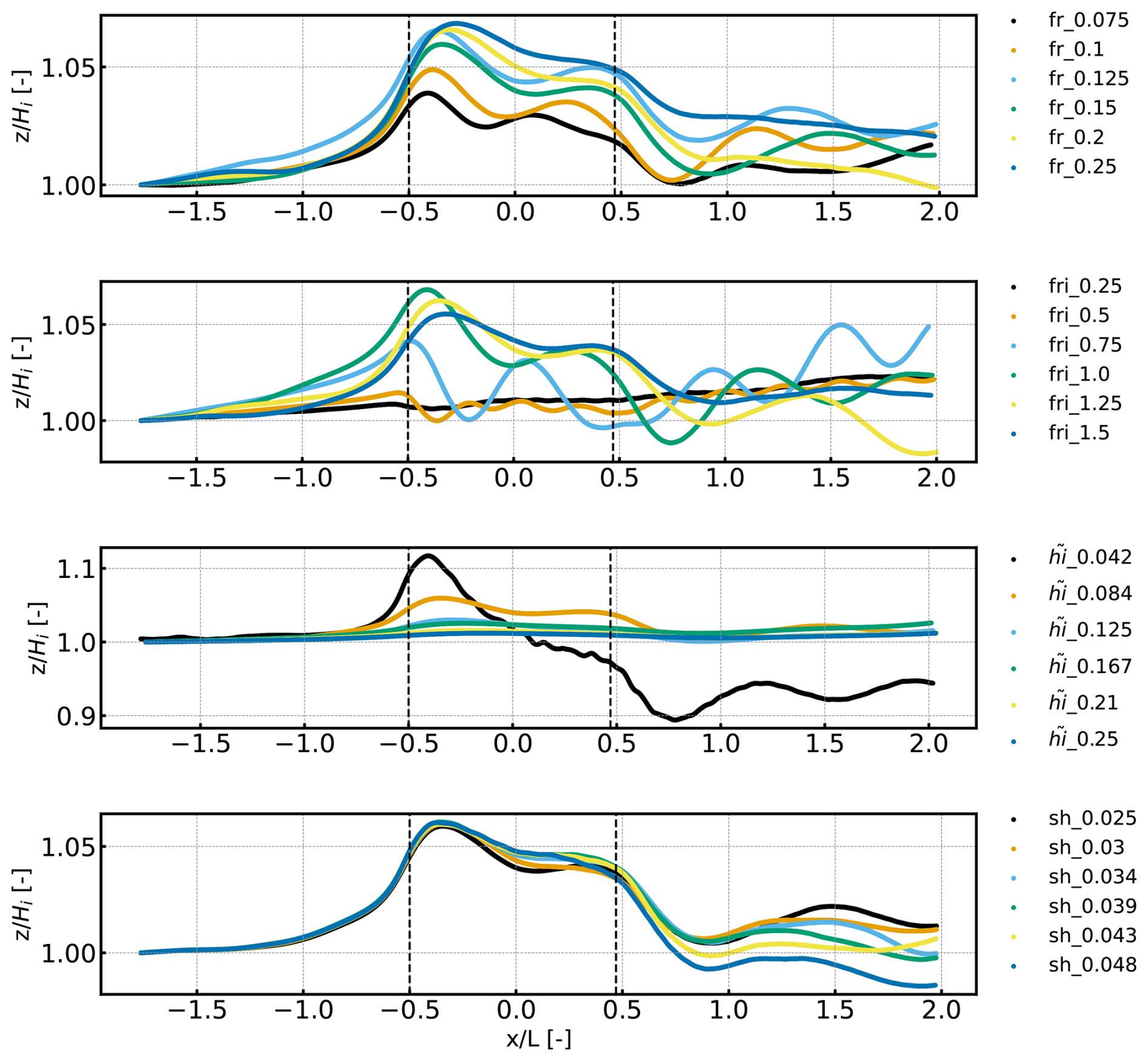
Figure 9Capping inversion displacement along the streamwise direction as a function of Fr, Fri, , and Sh. Unlike the rest, data points Fri=0.25 and 0.5, given for completeness, are created from simulations with laminar inflows.
After initial temporal transients, the capping inversion settles into an equilibrium shape that depends on the flow conditions and wind farm size, which we describe with the physical non-dimensional parameters. The capping inversion height varying in streamwise direction as a function of the physical non-dimensional numbers is shown in Fig. 9. In analyzing these graphs, the focus is on the shape of the capping inversion at various streamwise locations to relate it to the global blockage effect, and favorable and unfavorable pressure distributions through and downstream of the wind farm. As described in Sect. 4.1.2, the capping inversion shape is computed by tracing a particle path along the capping inversion top. As seen in Fig. 9, the general capping inversion shape has global maxima, always at around the wind farm start, linked to the horizontal flow deceleration caused by the wind farm. Conversely, global minima are usually at the end of the wind farm, thus linked to the acceleration of the horizontal flow in the exit and wake regions of the wind farm. In some cases, wave interference leads to complex capping inversion shapes. The maximum capping inversion displacement is also measured from its shape by differencing the highest and lowest vertical positions on the particle path. The variations in interfacial wavelengths for varying values of the non-dimensional parameters can also be appreciated from these capping inversion shapes.
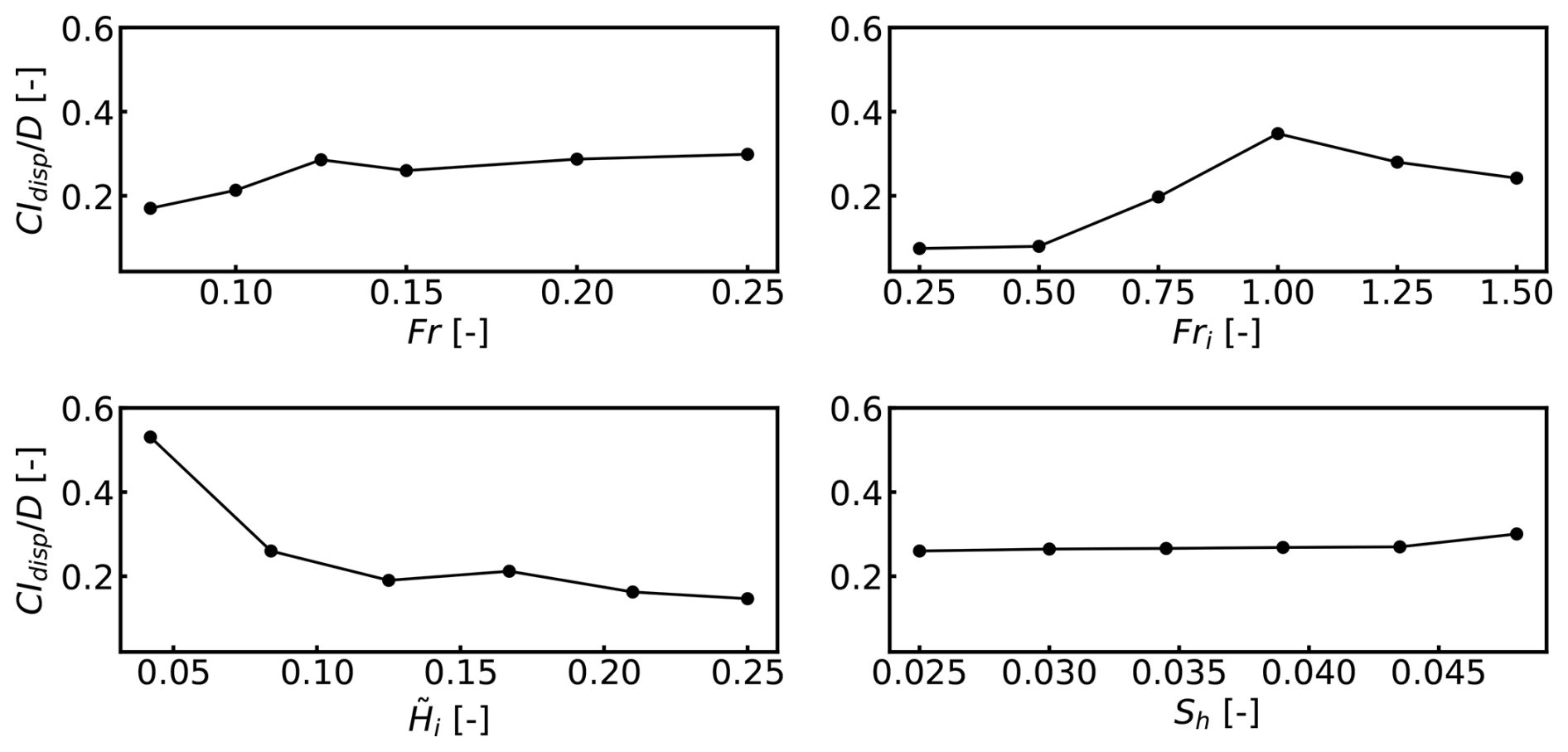
The maximum capping inversion displacement normalized by turbine diameter (CI) as a function of Fr, Fri, , and Sh is shown Fig. 10. CI increases abruptly for increasing Fr until 0.0125, and increases only slightly for larger Fr. The physical meaning of increasing maximum displacement can be inferred as reduced atmospheric stability or milder response by buoyancy. A disturbance can displace the capping inversion slightly more than it could for a more stable free atmosphere. The trend is not monotonic around Fr=0.15, however, which is likely caused by the complex interference of the two internal wave trains. CI is maximum for Fri=1.0, as positive capping inversion displacement is the highest for critical conditions. Note that only one value of Fri<1.0 is practical because values of Fri<0.75 require impractical capping inversion strengths when Hi is kept constant. The estimated capping inversion displacements from the two simulations with impractical capping inversion strengths (i.e., Fri=0.25 and 0.5) confirm capping inversion displacement that is smaller than that of the Fri=1.0 case. In a physical sense, Fri approaching 0 would mimic a rigid lid that would barely move due to the disturbance from a wind farm. On the other hand, the decreasing CI for values of Fri>1.0 is because of background flow washing away buoyancy effects, thus weakly perturbing the capping inversion.
The maximum capping inversion displacement as a function of the ABL aspect ratio shows an intuitive behavior. The maximum capping inversion displacement decreases for increasing values because the capping inversion is further from the wind farm. Thus, the global minimum of capping inversion displacement in the wind farm wake region is barely noticed for values of . The maximum capping inversion displacement is mildly sensitive to Sh as placing the wind turbines closer to the capping inversion perturbs it slightly more than the rotors at standard hub heights, i.e., 90–150 m but still negligible when normalized with the rotor diameter. Note that this observation is in the context of the wind farm layout and turbine size simulated in this study. We infer that a wind farm of higher power density and one with bigger turbines might be stronger momentum sinks, causing bigger capping inversion displacements.
4.3.2 Non-dimensional parameter dependence of interfacial waves
In Sect. 4.3.1, we indicate that the properties of AGWs depend on the physical non-dimensional parameters. This section analyzes the dependence of interfacial wave characteristics on these parameters.
Interfacial waves are bound to the capping inversion, and their wavelengths are correlated to the sizes of converging and diverging zones in the ABL. Thus, the average interfacial wavelengths can be calculated along the inversion layer top by using the following expression.
where (xs,ys) and (xe,ye) are the coordinates of the first and last peaks along the capping inversion that extend from the wind farm entrance to exit, respectively; and npeaks is the total number of peaks (i.e., maxima and minima). Since it is measured in the streamwise direction, it is the average horizontal wavelength. We calculate the interfacial wavelength over the length of the wind farm, as it is more suitable for this study.
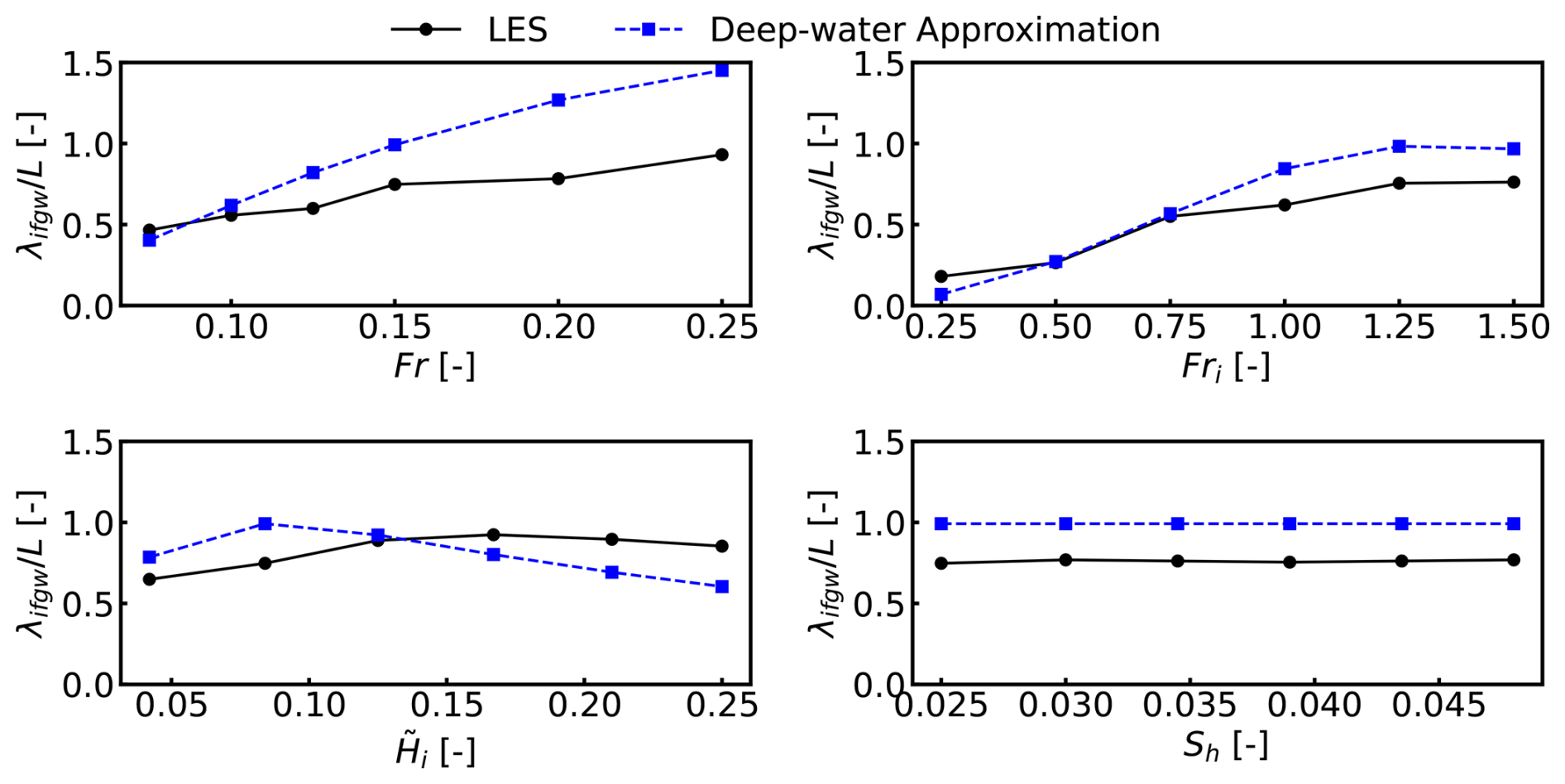
Figure 11Interfacial wavelengths normalized with wind farm length as a function of Fr, Fri, , and Sh. A comparison of wavelengths calculated from LES data with those estimated with the deep-water approximation, where the ABL depth is considered large enough and therefore insignificant.
The interfacial wavelengths normalized with wind farm length () as a function of Fr, Fri, , and Sh are shown in Fig. 11. The interfacial wavelengths based on the deep-water approximation are also calculated, referred hereafter as theoretical wavelengths, and presented for comparison. This approximation excludes the impact of ABL depth on the interfacial wavelengths and is valid when kHi≫1, where k is the horizontal wavenumber given by Sachsperger et al. (2015) as
The theoretical wavelengths calculated from the deep-water equations is then , which depends on the reference potential temperature, the temperature jump across the capping inversion, and the stability in the free atmosphere. Clearly, the theoretical λifgw is independent of the boundary layer height, thus applicable to deep boundary layers only.
As can be visually seen in Fig. 12, the calculated λifgw increases for increasing Fr; the interfacial waves become skewed, which means the height of the darkest-colored regions at the bottom of the contours, which is representative of the interfacial waves, shrinks. Even the propagating internal waves are strongly constrained from propagating vertically, so the wave field appears tilted more downstream. The measured interfacial wavelengths are observed to be half the wind farm length for the lowest Fr and gradually increase to about full wind farm length for the highest Fr. Thus, the sizes of zones of favorable and unfavorable pressure gradient in the ABL vary between 0.25L and 0.5L for increasing Fr. The calculated λifgw for Fr also shows an increasing trend but is distinct from that of the measured one. The calculated values agree with the measured values only for low values of Fr. This could be because kHi for constant Hi=500 m is significantly greater than unity for only low values of Fr.
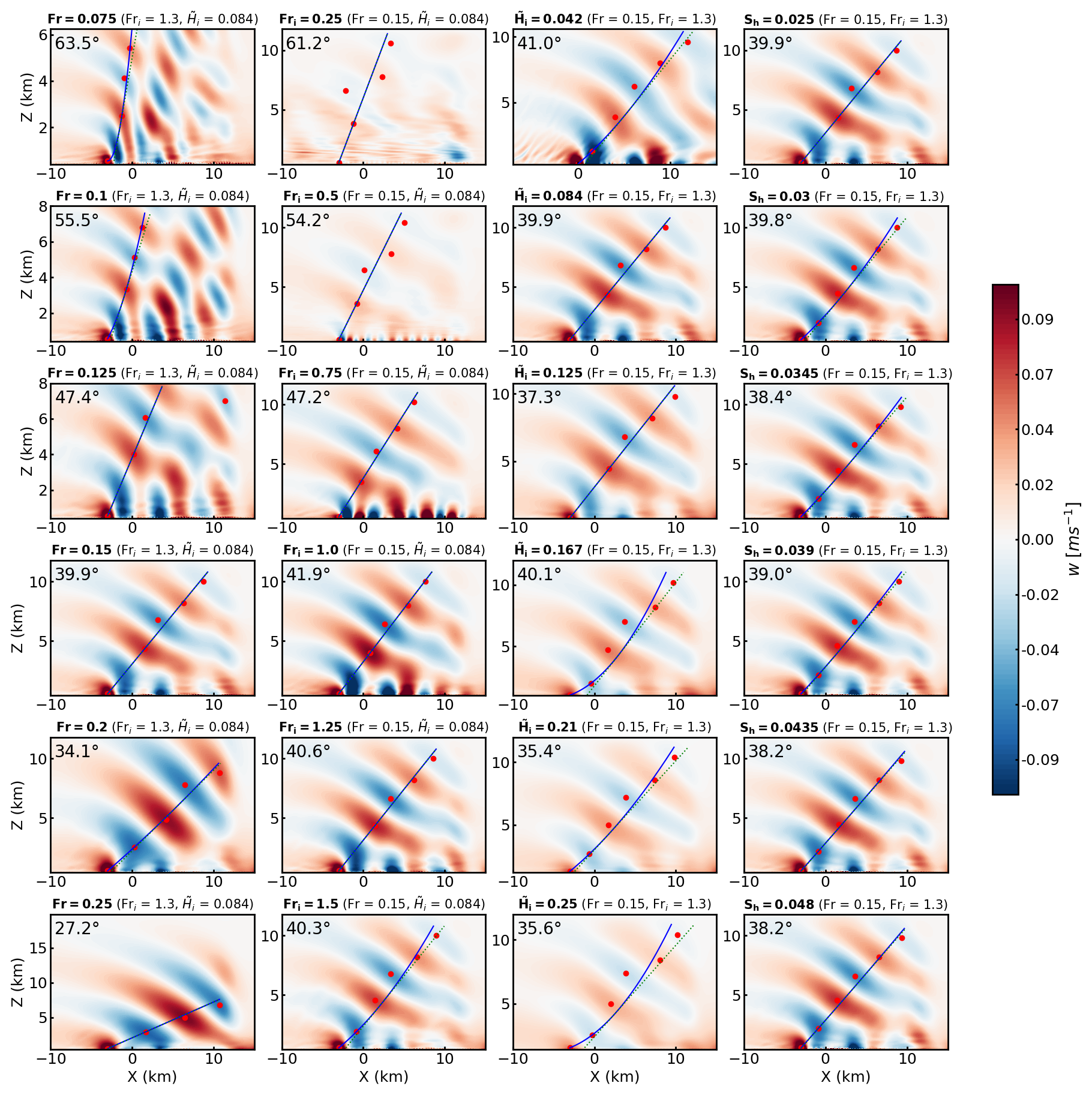
Figure 12Temporally averaged vertical velocity plots, inclination angles with the horizontal axis, and peaks at maximum and minimum vertical velocities fitted with a parabolic curve. The vertical planes in a column are for the varying values of Fr, Fri, , or Sh, while the other parameters were kept constant. Note that plots for Fri=0.25 and 0.5 are taken from simulations driven by uniform inflows, given for completeness.
Both calculated and theoretical λifgw increase roughly linearly with Fri until an asymptote at 0.75L for the calculated and at L for the theoretical is reached when Fri=1.25. There is good agreement between calculated and theoretical wavelengths for sub-critical conditions, but a discrepancy arises beyond critical conditions (Fri≥1.0). The matching values of λifgw are mainly because it varies in response to only varying Δθ in setting Fri while holding Hi and N fixed at 500 m and 0.01 s−1, respectively. We recall from Sect. 4.3.1 that the capping inversion strongly suppresses the perturbations, which is indicated by stronger trapped waves for sub-critical values of Fri. Also, it should be recalled that the interfacial waves are smaller for sub-critical than for super-critical values. For instance, the two laminar inflow cases mentioned in Sect. 4.3.1 (i.e., Fri=0.25 and 0.5) showed that λifgw is of the order of the distance between turbine rows – as if each row is triggering an interfacial wave. Meanwhile, for super-critical conditions, the capping inversion perturbs on length scales, increasing between half to three-quarters of the wind farm length. This means that the sizes of zones of favorable and unfavorable pressure gradients in the ABL vary between row distancing and 0.4L for increasing Fri.
Unlike the theoretical λifgw, the calculated values show an increasing trend against until they reach a maximum of about for . The interfacial wavelengths become slightly shorter for further increasing . This shows that the wind farm is seen as a single disturbance beyond a certain ABL aspect ratio, and the capping inversion receives a weaker and spread-out disturbance. The theoretical λifgw shows the increasing trend only until , beyond which it shows a linearly decreasing trend with an almost perfect match between calculated and theoretical for . These observations indicate that the deep-water approximation follows these simulations only for deep ABLs. The sizes of zones of favorable and unfavorable pressure gradients in the ABL vary between 0.25L and 0.4L for increasing . As expected, Sh has a negligible impact on the interfacial wavelengths; both theoretical and calculated λifgw are independent of it. The λifgw is the same as that of Fr=0.15.
Generally, the amplitude of interfacial waves varies in the narrow range of 0.19D–0.3D, where D is rotor diameter, against the physical non-dimensional parameters, except for , where the range is 0.02D–0.6D, which is shown in Fig. 10. For low values of , the capping inversion displacement is higher, and strong waves are present, as the two are directly proportional (Allaerts et al., 2018). Amplitudes of interfacial waves are analogous to capping inversion displacements, which are already reported in Sect. 4.3.1. Moreover, the orientation of interfacial waves with respect to the lateral axis (i.e., spanwise direction) are dependent only on Fri and have already been investigated by Lanzilao and Meyers (2024). When looking from the top, interfacial waves make a V pattern with the vertex at the induction zone of the wind farm, with the wave fronts extending downstream. The angle on the interior of the V pattern at the vertex is inversely proportional to Fri such that the V pattern becomes increasingly acute for super-critical values. For sub-critical to critical values of Fri, the interfacial waves are blunt at the vertex (i.e., parallel to the lateral axis).
4.3.3 Non-dimensional parameter dependence of internal waves
The propagating internal waves are relatively weaker in strength than the interfacial waves, and their properties depend mainly on Fr and Fri. A major challenge in measuring their properties is that there are two internal wave trains superimposing on each other, one from the front of the farm and one from the rear. Especially for high Fr, the superimposition is evident as the inclination angle is expected to be higher. Therefore, we focus on the first wave train, as we did in Sect. 3.2, as it is less distorted.
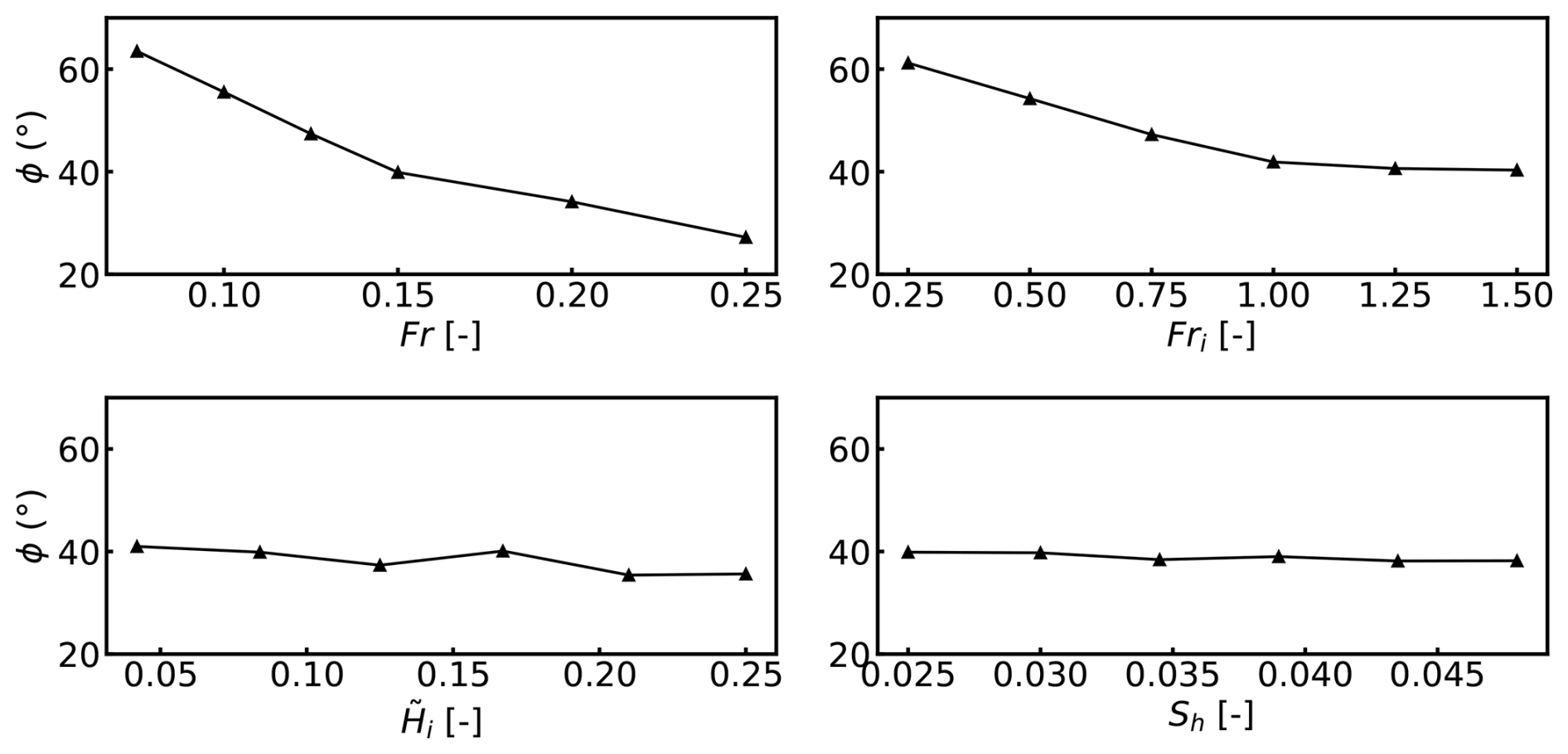
Figure 13 shows wave field inclination angle, as defined in Sect. 3.2, extracted from average vertical velocity fields as a function of the four physical non-dimensional parameters. The inclination angle shows a decreasing trend against increasing Fr, starting at around 63°, for Fr=0.075, and approaching around 27° for Fr=0.25. The reduced slope for Fr≥0.15 of the line connecting the data points means that the two internal wave trains are more distinct; for higher values of Fr, the first wave train stretches across the length of the domain (see Fig. 12). The inclination angle has the same decreasing trend with increasing Fri, decreasing from 61 to 40°. This 40° value is roughly the same as for Fr=0.15; and in the varying Fri cases, Fr is held at 0.15. The inclination angle of the internal waves seems almost independent of and Sh. There is a variation for the former but in a narrow range of 41–35°, probably caused by varying capping inversion displacement against .
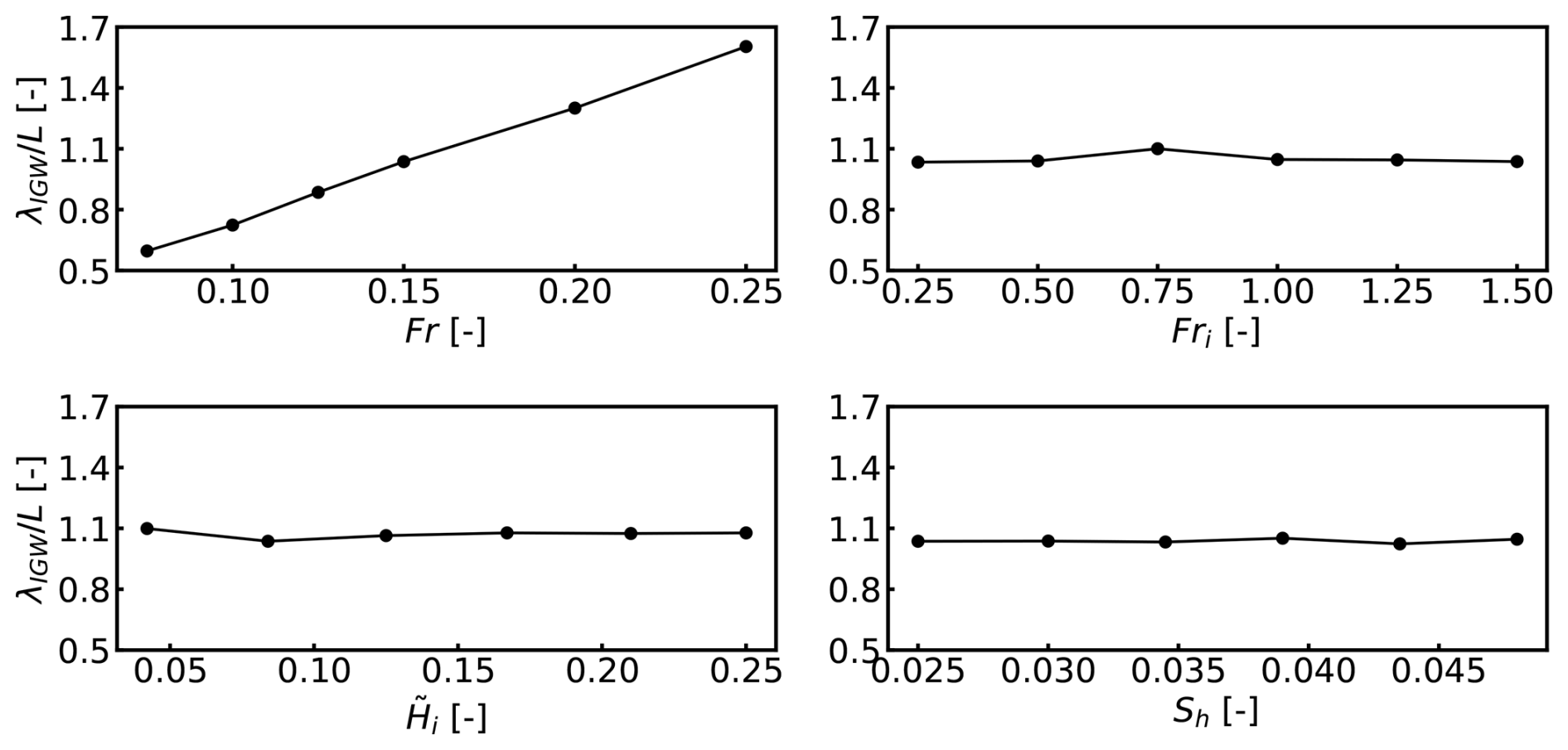
The apparent wavelength, measured along the fit parabola, of the first wave train is dependent on its inclination angle. In measuring this wavelength, it is assumed that the interference of the two wave trains is minimal for values of Fr≤0.15. We also recall that the measured wavelength with the method proposed in Sect. 3.2 allows us to estimate horizontal and vertical components of the actual wavelength. Thus, the effective horizontal wavelength could be λa=2λacos ϕ, equivalent to the sum of horizontal wavelengths of the two dominant wave trains. The apparent wavelength of the first wave train, normalized with L and as a function of the physical non-dimensional parameters, is given in Fig. 14. Generally, this wavelength increases linearly and is smaller than the wind farm length for values of Fr≤0.15. This linear increase is mainly due to increasing buoyancy length (i.e., Ls), which is directly proportional to Fr. Note that the first wave train is dilated and merged with the second for Fr>0.15 by the increasing background speed, and only one wave train is obvious in the solution, as shown in Fig. 12.
As stated at the start of this section, the internal wave properties are mainly affected by Fr. This is obvious when the apparent wavelength plots for the remaining physical non-dimensional parameters are analyzed, where Fr=0.15 while varying each. Thus, varies in the narrow range of 0.9L–1.1L for the simulated values of Fri, , and Sh. The values reported for Fri=0.25 and 0.5 are estimated with less confidence, as negligible internal waves were observed for these idealized cases, as can be seen in Fig. 12. Small variations about the average value (i.e., 1.0L), which is roughly the value for Fr=0.15, for varying Fri, , and Sh are the impacts of the interference of the two wave trains that depend on the inclination angles. For instance, the plot against Fri for its values ≥0.75 resembles the decreasing inclination angle trend against Fri shown in Fig. 13. Both plots asymptote at Fri=1.0 after a sudden drop. Note that we infer this resemblance for data points excluding the less certain values for 0.25 and 0.5, for reasons mentioned earlier. In the case of , the wavelength only mildly increases with increasing , where for the shallowest boundary layer simulated, the wavelength is slightly larger than that for Fr=0.15. For low , the capping inversion feels both disturbance sources more isolated and strongly, but beyond , the wind farm is an entity, as the growing internal boundary layer rather than the two disturbance sources perturb the capping inversion. Thus, the wavelength resembles a dilated single disturbance. There is barely any change in the wavelength against Sh, as all simulated Sh values yield a wavelength as wide as 1.0L, a virtue of the constant Fr=0.15.
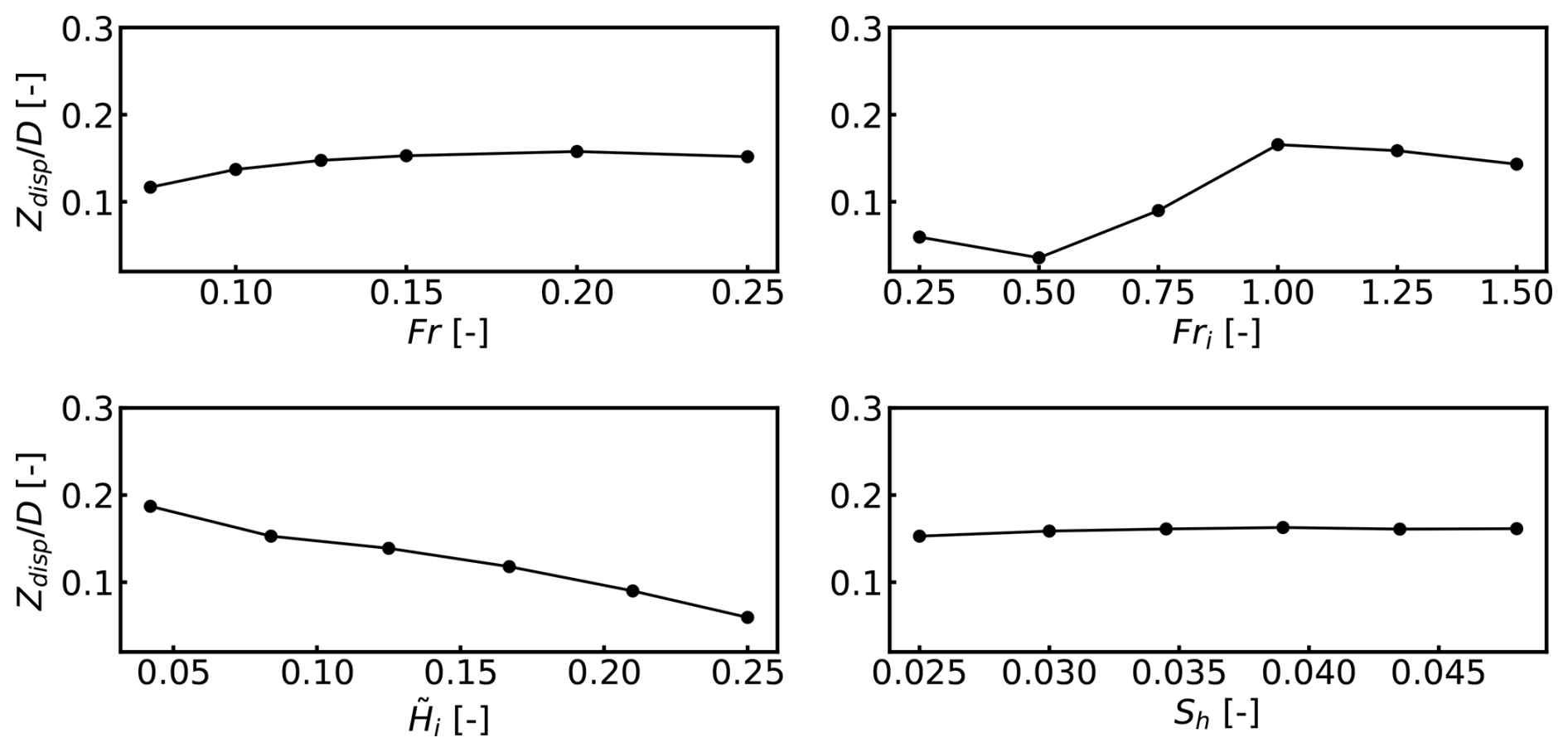
Figure 15The amplitudes of internal waves measured as the amplitude of streamline displacement at a height of as a function of Fr, Fri, , and Sh.
The amplitudes of internal waves, which are measured as the amplitude of streamline displacement, as a function of the physical non-dimensional parameters, are shown in Fig. 15. The amplitudes are measured by tracing a particle at . There is little variation in the amplitudes as a function of Fr, except for a small increase from 0.11D to 0.14D between Fr=0.075 and 0.125. The amplitude increases as a function of Fri only until 0.17D, suggesting that the capping inversion becomes less rigid until the amplitude depends only on Fr. There is an almost linearly decreasing amplitude trend against , going from 0.19D for to 0.08D for . The reason for weaker internal waves for increasing was discussed in Sect. 4.3.1. The amplitudes only slightly increase over 0.17D against Sh, which is the value of amplitude for Fr=0.15.
4.4 Non-dimensional parameter dependence of wind farm aerodynamics
Here, we analyze and discuss the dependence of wind farm performance on the physical non-dimensional parameters that define CNBL flow conditions. The capping inversion displacement couples the flow in the ABL with the capping inversion and the free atmosphere aloft. In this section, the simulated wind turbine power as a function of distance downstream is investigated and related to the capping inversion displacement. It is hypothesized that the local capping inversion displacement affects the power output of the wind turbines below, mainly as an additional effect to the prevailing induction effect for the first row and wake effects for the remaining rows. Thus, an element of the global blockage effect is a consequence of the capping inversion displacement upstream to the first row of the wind turbines as a result of the wind farm's solidity and energy extraction from the atmosphere. Moreover, the internal and interfacial waves (the latter only under sub-critical conditions) may contribute to the global blockage effect, as they can propagate upstream. This is strictly in the case where the upstream propagation of these waves affects the capping inversion displacement, which is difficult to measure in an isolated manner. However, it is obvious that the first interfacial wave strongly contributes to the blockage effect. Often, it is stretched downstream, which affects the localized power output of the first few turbine rows. For values of Fr>0.15, internal waves tilt downstream significantly and may superimpose onto the interfacial waves, affecting localized capping inversion displacement and impacting the localized power output. The enhanced wind farm wake recovery is mainly associated with the dropping of the capping inversion at the end of the wind farm. Under super-critical conditions, internal waves leave an imprint in the velocity field of the wake of the wind farm. Trapped lee waves dominate this imprint for Fri≤1. Adverse and favorable pressure gradients are correlated with the gradient of the capping inversion displacement, which varies in the streamwise direction. The dominant pressure variations are due to the capping inversion displacement caused by upward flow deflection at the entrance of a wind farm and downward deflection in its wake. The intensity of the pressure gradients is most sensitive to the ABL depth. For high values of ABL aspect ratio, these gradients are relatively mild. In the following subsections, all of these preliminary claims will be supported by simulated turbine power outputs.
4.4.1 Wind farm power output as a function of physical non-dimensional parameters
Here, we discuss how the global blockage effect and pressure variations relate to each non-dimensional parameter via the capping inversion displacement height at steady state. Generally, the localized capping inversion displacement has a negative correlation with the row-averaged power output. This means that an upwards displacement of the capping inversion corresponds to decreased power of the row underneath it and vice versa. Temporal and row-averaged power output are analyzed to uncover general trends in wind farm performance in the maximum wake loss scenario (i.e., when wind is straight down the rows). Figure 16a shows the temporal and row-averaged wind turbine power output as a function of Fr and streamwise distance. Wind farm blockage decreases as Fr is increased. However, a narrow variation of 0.2 MW is observed for the power output of the first row over the simulated values of Fr. Note that we interpret the variations in power output of the first row as variations in the wind farm blockage effect, which is quantified as non-local efficiency in the next section. It is astonishing how the power output of the second row is completely independent of Fr as the wake effects dominate. Beyond the second row, the row-wise power output varies about a trend characteristic of aligned wind farm aerodynamics, with a maximum at the fifth or sixth row. Although subtle, variations are bound to the localized capping layer displacement aloft, as discussed in Sect. 4.3.1. Generally, row-wise power output decreases beyond the fifth row until a slight increase is observed for the last two rows. The power output of individual rows beyond the second decreases slightly with increasing Fr except for Fr=0.075, due to its unique capping inversion shape, which is shown in Fig. 9.
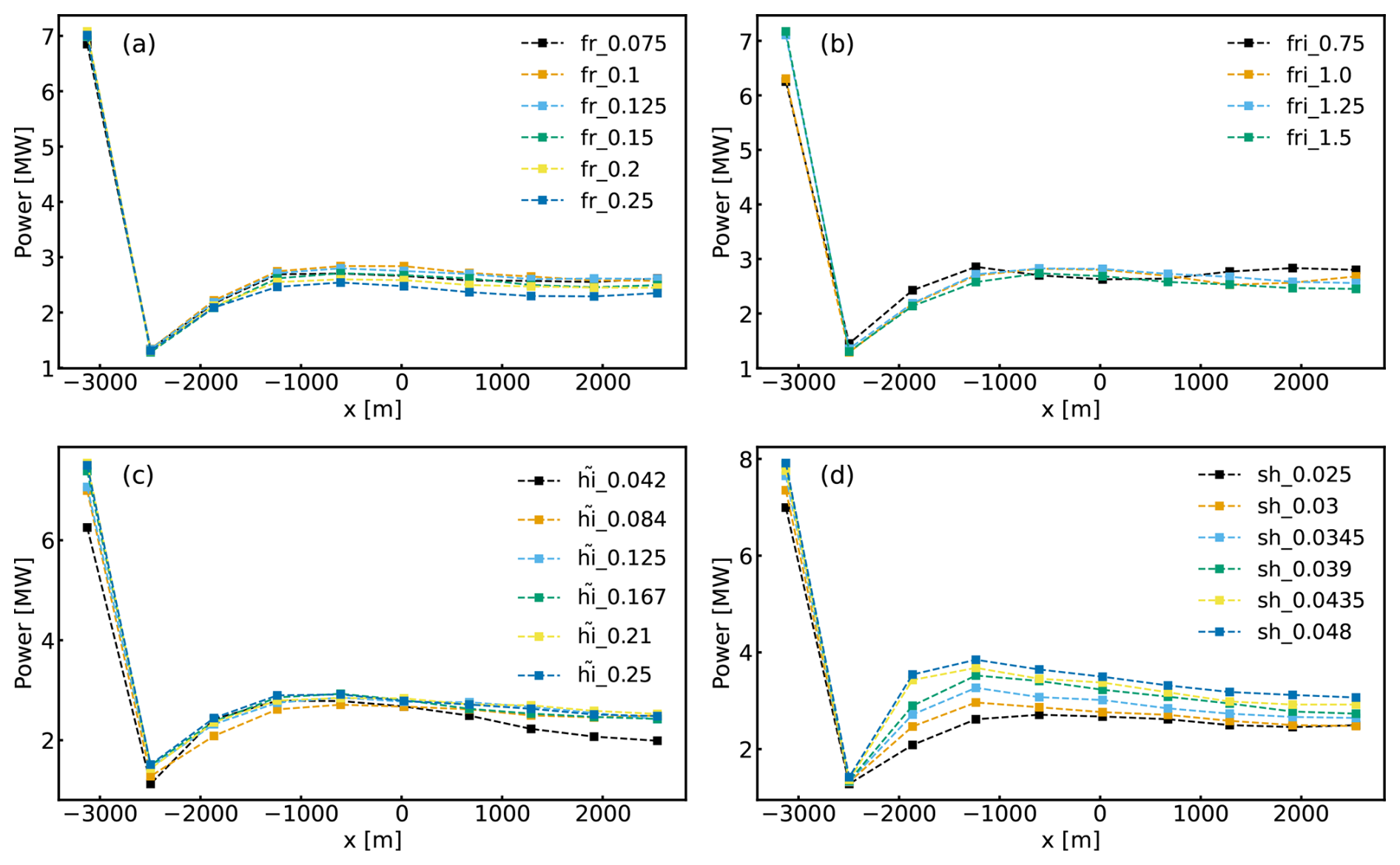
Figure 16Temporal and row-averaged wind turbine power output as a function of (a) Fr, (b) Fri, (c) , and (d) Sh.
Figure 16b shows the row-wise power output for a few values of Fri. The wind farm blockage effect reduces with increasing Fri, where the strongest blockage is observed for the sub-critical case (i.e. Fri=0.75) but is almost the same as the critical case. The simulated power of the second row is the same for values of Fri≥1.0 but higher for Fri=0.75 because the capping inversion displacement is negative in contrast to positive in the remaining cases. The fourth row produces the highest power for Fri=0.75 among the waked rows because of the localized favorable pressure, as the capping inversion in the vicinity is at its lowest point. The highest power output among the waked rows is from the fifth-row turbines for the critical and super-critical cases. The simulated power shows a gradual decrease past the fifth row for values of Fri≥1.0 until the seventh row, beyond which it increases slightly. The fact that power oscillates with distance downstream for Fri=0.75 is evidence of power's negative correlation to the localized capping inversion displacement. This also confirms that gravity waves can cause several zones of converging and diverging flow through the wind farm.
The simulated row-wise power profile is the most sensitive to the ABL aspect ratio, as shown in Fig. 16c. For , the power profile follows the trend as that of Fr=0.15 and Fri=1.3 because these are the constant values simulated while varying . However, the power profile for the shallowest ABL () is most affected by localized capping inversion displacement, which can be revisited in Fig. 9. The wind farm blockage is highest for and reduces as increases until it becomes almost independent for because the deflected flow at the wind farm entrance barely perturbs the capping inversion. The simulated power of the individual turbines increases with increasing because inflow turbulence intensity increases as the ABL gets deeper (Brooke et al., 2023). The simulated power output profiles for are almost the same, as the capping inversion hardly affects the flow build-up through the wind farm. Thus, the flow around the wind farm becomes similar to that of a truly neutral boundary layer with the same ABL height. We can infer that the internal boundary layer has sufficient space to grow vertically, and pressure variations caused by stratification effects or gravity waves become smaller with increasing . For shallow ABLs, the pressure perturbations caused by the stratification effects dominate the internal boundary layer growth and hence the power output profile. Thus, the capping inversion's height determines which phenomenon dominates and, in turn, the wind farm flow aerodynamics. When it is low, the stratification effects are increasingly critical to wind farm performance; otherwise, these effects are secondary when compared to wake losses. Thus, inflow characteristics and wake effects still remain primary to wind farm performance. These aspects are discussed in the next section on wind farm efficiencies.
The vertical wind farm aspect ratio impacts the row-wise power profile mainly in the first half of the wind farm, as shown in Fig. 16d. Again, fixed values of non-dimensional parameters simulated include Fr=0.15, Fri=1.3, and . Thus, the power profiles follow the trend for Fr=0.15 and Fri=1.3, except that the highest power-producing row among the waked turbines shifts from the fifth row to the fourth as Sh increases. Higher velocities for increasing Sh are a clear factor in improved wind turbine and farm powers. However, stratification effects, although small, are still relevant as increasing Sh means putting the turbines closer to the capping inversion, which is similar to stronger perturbations and a different response for varying Sh.
Altogether, it is obvious that is the most critical physical non-dimensional parameter in terms of wind farm performance. Therefore, for low , Fr and Fri can alter the capping inversion shape characteristic of the underlying , thus affecting the row-wise power output. Sh can affect the power output mainly because of placing the wind turbines at higher or lower wind speeds, which has little to do with gravity waves or blockage. While simulating CNBLs, becomes more critical for shallow ABLs and will be of even greater importance for stable surface conditions with shallower ABLs than in CNBLs.
4.4.2 Wind farm efficiencies as a function of physical non-dimensional parameters
Although wind farm performance is thoroughly discussed in the previous section, it is essential to quantify wind farm blockage effect and wake losses relative to the inflow characteristics of each case. This is important because varying atmospheric conditions leads to different inflow characteristics, such as different shear profiles and veers. Allaerts and Meyers (2017) proposed wind farm efficiency (ηt) as the product of non-local and wake efficiencies, the former being an estimate of wind farm blockage effect and the latter of quantify wake loses. These efficiencies are defined as following:
The non-local efficiency (ηnl) is the ratio of average power of the first-row turbine (P1) to the power produced by a turbine in the free stream or isolation (P∞). Since the LES power predictions are based on rotor-average velocities, we calculate P∞ as a function of rotor-equivalent wind speed in the free stream. To this end, we sample velocity over the rotor annulus for each case from the respective precursors and temporally average it over the last flow through time of the successor simulations, as this interval is used to calculate the actual power outputs. This takes into account the unique shear and veer inflow velocity profiles of each CNBL condition. In other words, the variations in the power outputs due to variations in the inflow are excluded from the analysis of blockage effect. Note that ηnl can also be estimated based on the power output of an isolated wind turbine simulated in the same conditions. This approach is computationally taxing in this study as each of at least the and Sh cases would require a separate simulation. The wake efficiency (ηw) is the ratio of total wind farm power output to the power output of the total number of wind turbines in the farm (Nt) operating in the first row, meaning a scenario where no turbine is waked.
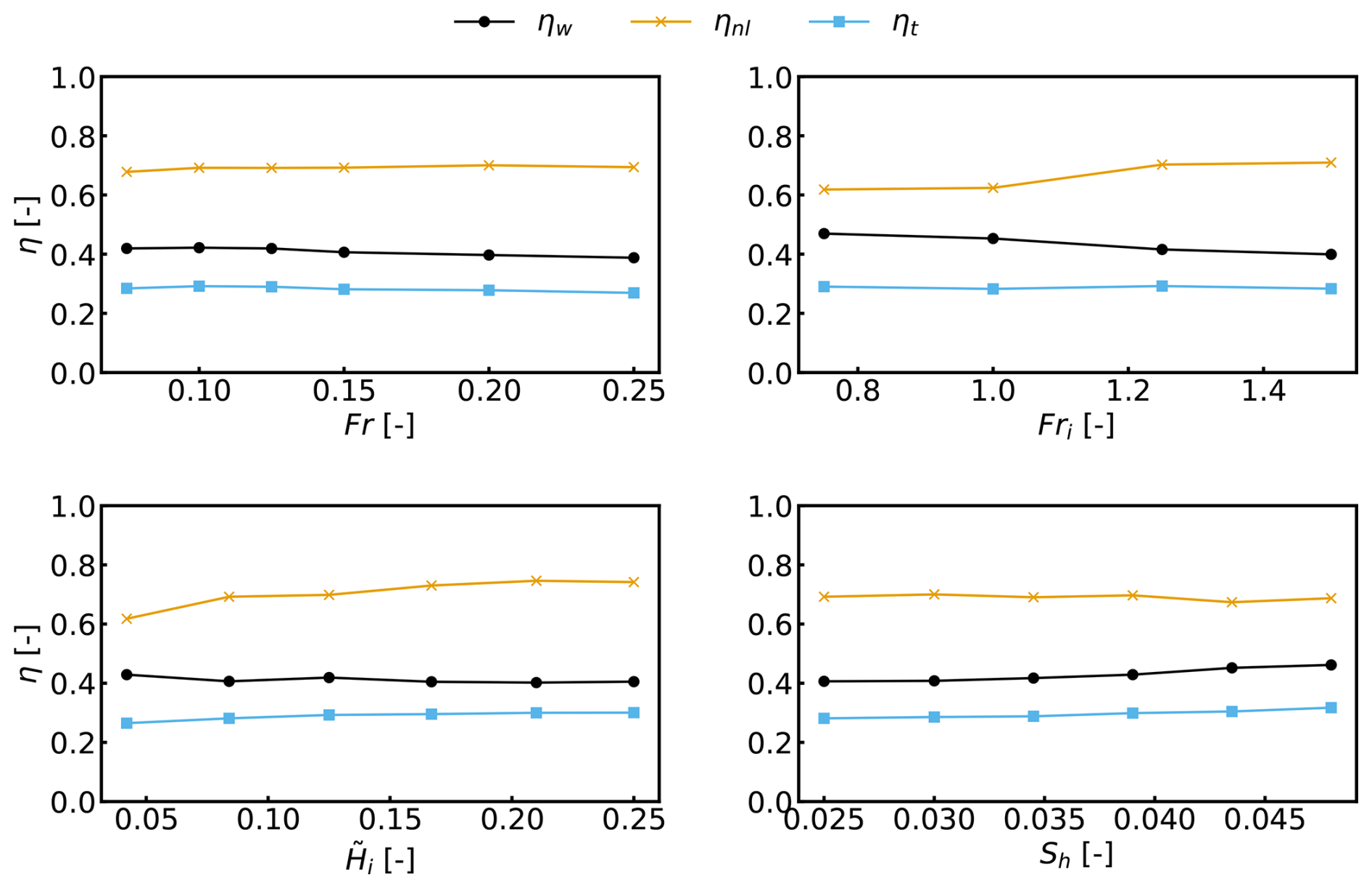
Figure 17Wake, non-local, and total wind farm efficiencies as a function of Fr, Fri, , and Sh.
Figure 17 shows these efficiencies as a function of the non-dimensional parameters. It can be seen that ηnl improves slightly as opposed to a slightly decreasing trend for increasing values of Fr and Fri. Therefore, ηt remains roughly constant. There is a clear increase in ηnl for increasing values of , while ηw decreases slightly, resulting in an overall improved farm efficiency in deeper boundary layers. Non-local efficiency is roughly constant for varying Sh, although improved wake efficiency causes the total wind farm efficiency to improve too. This confirms that variations seen on row-averaged power plots against Sh are mainly due to the turbines operating in higher wind speeds.
This study provides a systematic investigation of wind-farm–atmosphere interactions under neutral surface conditions using LES. Among the tested simulation configurations, CNBL simulation configurations that fully resolve AGWs are likely the most realistic for capturing stratification effects and differ significantly from TNBL cases. The CNBL configurations that only partially resolve AGWs predicted similar power outputs to rigid lid cases, which are less practical. We showed that capping inversion displacement plays a central role in coupling the fluctuations in the ABL with those in the free atmosphere (i.e., AGWs). Interfacial and internal waves were identified as the main AGW types shaping the capping inversion such that interfacial wavelength and the formation of converging and diverging zones in the ABL are correlated. The trapped waves confined within the capping inversion were transient and negligible. Overall, AGW behavior depends strongly on the ABL aspect ratio (), and the Froude numbers of the free atmosphere (Fr) and the capping inversion (Fri). The interfacial wavelength reduces for decreasing Fri and approaches a quarter of the wind farm length for Fri=0.25. Whereas the amplitudes grow stronger for shallow boundary layers, internal wave characteristics depend mainly on Fr.
Wind farm performance was most sensitive to the ABL aspect ratio: shallow boundary layers increased wind farm blockage and reduced wind farm efficiency while slightly facilitating wake recovery, and deeper layers improved the overall power output. Increasing Fr and Fri reduced blockage, which remained almost unaffected for increasing the wind farm aspect ratio (Sh), although enhanced wake recovery for higher Sh improved total wind farm efficiency. Localized spatial variations in power arose from the converging and diverging zones in the ABL associated with the wavy capping inversion. As a result, the total wind farm efficiency – which accounts for both wake losses and stratification effects – remained nearly constant with respect to Fr and Fri but improved with increasing and Sh. These findings suggest that increased wind farm blockage always happens when there is stratification, primarily affecting the front row of turbines. Although weaker than the blockage effect, stratification-induced flow variations can cause downstream turbines to gain or lose power, but these effects were often dominated by stronger wakes.
This work clarifies the role of AGWs, which exist only in the stably stratified atmosphere, in wind-farm–atmosphere interactions and establishes the importance of selecting appropriate LES configurations. Beyond providing a coherent description of wind-farm-induced AGWs, it also gives guidelines for expected AGW characteristics such that one can configure reflection-free domains in high-fidelity (i.e., CFD) flow simulations. Although this study spans a wide range of CNBL conditions, it remains largely confined to canonical CNBL set-ups. We use a simple actuator disk model that is sufficient for generating gross wake effects and for estimating relative power levels. Therefore, we present relative trends in wind farm performance, as opposed to absolute changes, as a function of changes in stratification. Future extensions could explore canonical stable and unstable ABLs, realistic atmospheric conditions, and more advanced actuator models. The results also point to the need for further study of clustered wind farms, particularly under shallow boundary layers where AGWs (i.e., stratification) have clear impacts.
The raw simulated data, an example Jupyter notebook, and LES TOSCA set-ups are archived at 4TU.ReserachData under https://doi.org/10.4121/d10f3eec-4363-4017-ad00-69136a801657.v1 (Khan et al., 2026). These are all open access. Example videos showing the temporal evolution of flow from the cases presented in this article can be made available on request.
Conceptualization: M.A.K., M.J.C., and S.J.C. Methodology: M.A.K. and M.J.C. Software: M.A.K. Validation: M.A.K. Formal analysis: M.A.K. Investigation: M.A.K. Computational resources: M.A.K. Data curation: M.A.K. Writing (original draft preparation): M.A.K. Writing (review and editing): S.J.W. and M.J.C. Visualization: M.A.K. Supervision: S.J.W. and M.J.C. Project administration: M.A.K. and S.J.W. Funding acquisition: S.J.W. All authors have read and agreed to the published version of the paper.
The contact author has declared that none of the authors has any competing interests.
The views expressed in the article do not necessarily represent the views of the DOE or the US Government.
Publisher's note: Copernicus Publications remains neutral with regard to jurisdictional claims made in the text, published maps, institutional affiliations, or any other geographical representation in this paper. The authors bear the ultimate responsibility for providing appropriate place names. Views expressed in the text are those of the authors and do not necessarily reflect the views of the publisher.
We acknowledge Dries Allaerts's contribution in conceptualizing this study and Sebastiano Stipa for his help with fixing several issues related to TOSCA. This publication is part of the project Numerical modelling of Regional-Scale Wind Farm Flow Dynamics, with project no. 2023/ENW/01454045 of the research program ENW, which is (partly) financed by the Dutch Research Council (NWO). A part of the research was performed using computational resources sponsored by the Department of Energy and located at the National Laboratory of the Rockies.
Funding for Mehtab Ahmed Khan and Simon J. Watson was provided by the Delft University of Technology. Funding for Matthew J. Churchfield was provided by the US Department of Energy Office of Energy Efficiency and Renewable Energy Wind Energy Technologies Office.
This paper was edited by Xiaolei Yang and reviewed by two anonymous referees.
Allaerts, D. and Meyers, J.: Large eddy simulation of a large wind-turbine array in a conventionally neutral atmospheric boundary layer, Phys. Fluids, 27, 065108, https://doi.org/10.1063/1.4922339, 2015. a, b
Allaerts, D. and Meyers, J.: Boundary-layer development and gravity waves in conventionally neutral wind farms, J. Fluid Mech., 814, 95–130, https://doi.org/10.1017/jfm.2017.11, 2017. a, b, c, d, e, f
Allaerts, D. and Meyers, J.: Gravity Waves and Wind-Farm Efficiency in Neutral and Stable Conditions, Bound.-Lay. Meteorol., 166, 269–299, https://doi.org/10.1007/s10546-017-0307-5, 2018. a
Allaerts, D. and Meyers, J.: Sensitivity and feedback of wind-farm-induced gravity waves, J. Fluid Mech., 862, 990–1028, https://doi.org/10.1017/jfm.2018.969, 2019. a
Allaerts, D., Broucke, S. V., Van Lipzig, N., and Meyers, J.: Annual impact of wind-farm gravity waves on the Belgian-Dutch offshore wind-farm cluster, J. Phys. Conf. Ser., 1037, https://doi.org/10.1088/1742-6596/1037/7/072006, 2018. a, b, c
Allaerts, D., Khan, M., and Churchfield, M.: Froude number dependency of atmospheric gravity waves: Apparent horizontal wavelength and wave field inclination, J. Fluid Mech., in review, 2025. a, b, c, d
Archer, C. L., Mirzaeisefat, S., and Lee, S.: Quantifying the sensitivity of wind farm performance to array layout options using large-eddy simulation, Geophys. Res. Lett., 40, 4963–4970, https://doi.org/10.1002/grl.50911, 2013. a
Brooke, J. S., Thedin, R., Sharma, A., Branlard, E., Vijayakumar, G., and Michael, A. S.: Effect of the integral length scales of turbulent inflows on wind turbine loads, Renew. Energ., 217, 119-218, https://doi.org/10.1016/j.renene.2023.119218, 2023. a
Churchfield, M. J., Lee, S., Michalakes, J., and Moriarty, P. J.: A numerical study of the effects of atmospheric and wake turbulence on wind turbine dynamics, J. Turbul., 13, 1–32, https://doi.org/10.1080/14685248.2012.668191, 2012. a
Khan, M. A., Watson, S. J., Allaerts, D. J. N., and Churchfield, M.: Recommendations on setup in simulating atmospheric gravity waves under conventionally neutral boundary layer conditions, J. Phys. Conf. Ser., 2767, 092042, https://doi.org/10.1088/1742-6596/2767/9/092042, 2024. a, b, c, d, e, f, g, h, i, j, k, l
Khan, M. A., Allaerts, D., Watson, S. J., and Churchfield, M. J.: Investigating the relationship between simulation parameters and flow variables in simulating atmospheric gravity waves for wind energy applications, Wind Energ. Sci., 10, 1167–1185, https://doi.org/10.5194/wes-10-1167-2025, 2025. a, b, c, d, e, f, g, h, i, j, k, l, m, n
Khan, M., Churchfield, M., and Watson, S.: Supplementary data to publication: Dependence of wind-farm-induced gravity waves and wind farm performance on non-dimensional atmospheric parameters and simulation configuration (Data & Code), Version 1, 4TU.ResearchData [data set] and [code], https://doi.org/10.4121/d10f3eec-4363-4017-ad00-69136a801657.v1, 2026. a
Lanzilao, L. and Meyers, J.: An improved fringe-region technique for the representation of gravity waves in large-eddy simulation with application to wind farms, Bound.-Lay. Meteorol., 186, 567–593, https://doi.org/10.1007/s10546-022-00772-z, 2023. a, b
Lanzilao, L. and Meyers, J.: A parametric large-eddy simulation study of wind-farm blockage and gravity waves in conventionally neutral boundary layers, J. Fluid Mech., 979, A54, https://doi.org/10.1017/jfm.2023.1088, 2024. a, b, c, d, e, f, g, h, i, j, k, l
Meneveau, C., Lund, T. S., and Cabot, W. H.: A Lagrangian dynamic subgrid-scale model of turbulence, J. Fluid Mech., 319, 353–385, https://doi.org/10.1017/S0022112096007379, 1996. a
Ollier, S. J. and Watson, S. J.: Modelling the impact of trapped lee waves on offshore wind farm power output, Wind Energ. Sci., 8, 1179–1200, https://doi.org/10.5194/wes-8-1179-2023, 2023. a
Queney, P.: The Problem of Air Flow Over Mountains: A Summary of Theoretical Studies, B. Am. Meteorol. Soc., 29, 16–26, https://doi.org/10.1175/1520-0477-29.1.16, 1948. a, b
Sachsperger, J., Serafin, S., and Grubišić, V.: Lee Waves on the Boundary-Layer Inversion and Their Dependence on Free-Atmospheric Stability, Front. Earth Sci., 3, https://doi.org/10.3389/feart.2015.00070, 2015. a, b
Smith, R. B.: The wind farm pressure field, Wind Energ. Sci., 9, 253–261, https://doi.org/10.5194/wes-9-253-2024, 2024. a
Smith, R. B.: Gravity wave effects on wind farm efficiency, Wind Energy, 13, 449–458, https://doi.org/10.1002/WE.366, 2010. a, b, c, d, e
Stevens, R. J., Graham, J., and Meneveau, C.: A concurrent precursor inflow method for Large Eddy Simulations and applications to finite length wind farms, Renew. Energ., 68, 46–50, https://doi.org/10.1016/j.renene.2014.01.024, 2014. a
Stieren, A. and Stevens, R. J.: Impact of wind farm wakes on flow structures in and around downstream wind farms, Flow, 2, E21, https://doi.org/10.1017/flo.2022.15, 2022. a
Stipa, S., Ahmed Khan, M., Allaerts, D., and Brinkerhoff, J.: A large-eddy simulation (LES) model for wind-farm-induced atmospheric gravity wave effects inside conventionally neutral boundary layers, Wind Energ. Sci., 9, 1647–1668, https://doi.org/10.5194/wes-9-1647-2024, 2024a. a, b, c, d, e, f, g, h
Stipa, S., Ajay, A., Allaerts, D., and Brinkerhoff, J.: TOSCA – an open-source, finite-volume, large-eddy simulation (LES) environment for wind farm flows, Wind Energ. Sci., 9, 297–320, https://doi.org/10.5194/wes-9-297-2024, 2024b. a, b, c, d
Wu, Y.-T. and Porté-Agel, F.: Modeling turbine wakes and power losses within a wind farm using LES: An application to the Horns Rev offshore wind farm, Renew. Energ., 75, 945–955, https://doi.org/10.1016/j.renene.2014.06.019, 2015. a