
Articles | Volume 11, issue 6
https://doi.org/10.5194/wes-11-2173-2026
© Author(s) 2026. This work is distributed under
the Creative Commons Attribution 4.0 License.
the Creative Commons Attribution 4.0 License.
https://doi.org/10.5194/wes-11-2173-2026
© Author(s) 2026. This work is distributed under
the Creative Commons Attribution 4.0 License.
the Creative Commons Attribution 4.0 License.
Research article
| 
19 Jun 2026
Research article |
| 19 Jun 2026
| 19 Jun 2026
Wake steering under inflow wind direction uncertainty: an LES study

Technical University of Denmark, Department of Wind and Energy Systems, Anker Engelunds Vej 1, 2800 Kgs Lyngby, Denmark
Søren Juhl Andersen
Technical University of Denmark, Department of Wind and Energy Systems, Anker Engelunds Vej 1, 2800 Kgs Lyngby, Denmark
Related authors
Julia Steiner, Emily Louise Hodgson, Maarten Paul van der Laan, Leonardo Alcayaga, Mads Pedersen, Søren Juhl Andersen, Gunner Larsen, and Pierre-Elouan Réthoré
Wind Energ. Sci., 11, 1679–1703, https://doi.org/10.5194/wes-11-1679-2026, https://doi.org/10.5194/wes-11-1679-2026, 2026
Short summary
Short summary
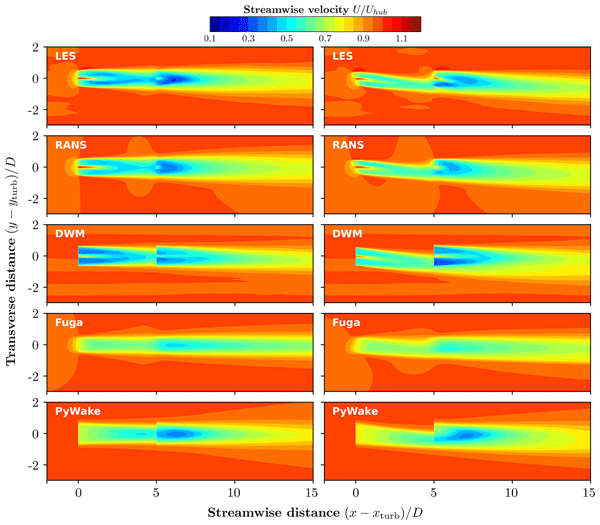
Wake steering is a promising strategy for wind farm optimization, but its success hinges on accurate wake models. We assess models of varying fidelity for a 22 MW reference turbine, comparing single- and two-turbine cases against large-eddy simulations. All models reproduced qualitative trends for power and loads (if applicable), but quantitative agreement varied, and in general the error increased with increasing yaw angle.
Maarten Paul van der Laan, Mark Kelly, Mads Baungaard, Antariksh Dicholkar, and Emily Louise Hodgson
Wind Energ. Sci., 9, 1985–2000, https://doi.org/10.5194/wes-9-1985-2024, https://doi.org/10.5194/wes-9-1985-2024, 2024
Short summary
Short summary
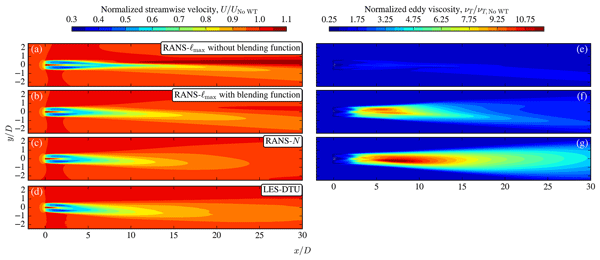
Wind turbines are increasing in size and operate more frequently above the atmospheric surface layer, which requires improved inflow models for numerical simulations of turbine interaction. In this work, a novel steady-state model of the atmospheric boundary layer (ABL) is introduced. Numerical wind turbine flow simulations subjected to shallow and tall ABLs are conducted, and the proposed model shows improved performance compared to other state-of-the-art steady-state models.
Niels Troldborg, Søren J. Andersen, Emily L. Hodgson, and Alexander Meyer Forsting
Wind Energ. Sci., 7, 1527–1532, https://doi.org/10.5194/wes-7-1527-2022, https://doi.org/10.5194/wes-7-1527-2022, 2022
Short summary
Short summary
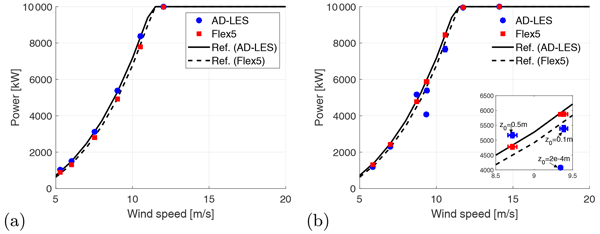
This article shows that the power performance of a wind turbine may be very different in flat and complex terrain. This is an important finding because it shows that the power output of a given wind turbine is governed by not only the available wind at the position of the turbine but also how the ambient flow develops in the region behind the turbine.
Agnese Firpo, Søren Juhl Andersen, and Giacomo Persico
Wind Energ. Sci. Discuss., https://doi.org/10.5194/wes-2026-141, https://doi.org/10.5194/wes-2026-141, 2026
Preprint under review for WES
Short summary
Short summary
Floating offshore wind turbines move with the waves, affecting wake dynamics and influencing the performance of downstream turbines. This study proposes a numerical framework to investigate the wake dynamics of a full-scale floating wind turbine. Results show that the frequency of platform motion affects wake dynamics, while the time mean wake remains largely unchanged. This work contributes to understanding floating wind turbine wakes and supports the development of efficient numerical models.
Esperanza Soto Sagredo, Søren Juhl Andersen, Ásta Hannesdóttir, and Jennifer Marie Rinker
Wind Energ. Sci., 11, 1705–1731, https://doi.org/10.5194/wes-11-1705-2026, https://doi.org/10.5194/wes-11-1705-2026, 2026
Short summary
Short summary
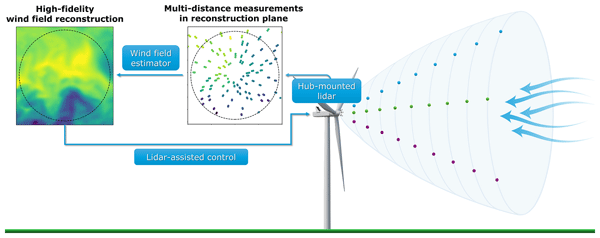
Large wind turbines are highly sensitive to changing winds, yet current measurements miss important details. This study compares three methods to reconstruct the full wind field ahead of a turbine in real time using lidar data and simulations. The results show these approaches can capture detailed inflow structures, which could help turbines anticipate wind changes, improve control strategies, and reduce structural loads.
Julia Steiner, Emily Louise Hodgson, Maarten Paul van der Laan, Leonardo Alcayaga, Mads Pedersen, Søren Juhl Andersen, Gunner Larsen, and Pierre-Elouan Réthoré
Wind Energ. Sci., 11, 1679–1703, https://doi.org/10.5194/wes-11-1679-2026, https://doi.org/10.5194/wes-11-1679-2026, 2026
Short summary
Short summary
Wake steering is a promising strategy for wind farm optimization, but its success hinges on accurate wake models. We assess models of varying fidelity for a 22 MW reference turbine, comparing single- and two-turbine cases against large-eddy simulations. All models reproduced qualitative trends for power and loads (if applicable), but quantitative agreement varied, and in general the error increased with increasing yaw angle.
Stefan Ivanell, Warit Chanprasert, Luca Lanzilao, James Bleeg, Johan Meyers, Antoine Mathieu, Søren Juhl Andersen, Rem-Sophia Mouradi, Eric Dupont, Hugo Olivares-Espinosa, and Niels Troldborg
Wind Energ. Sci., 11, 937–960, https://doi.org/10.5194/wes-11-937-2026, https://doi.org/10.5194/wes-11-937-2026, 2026
Short summary
Short summary
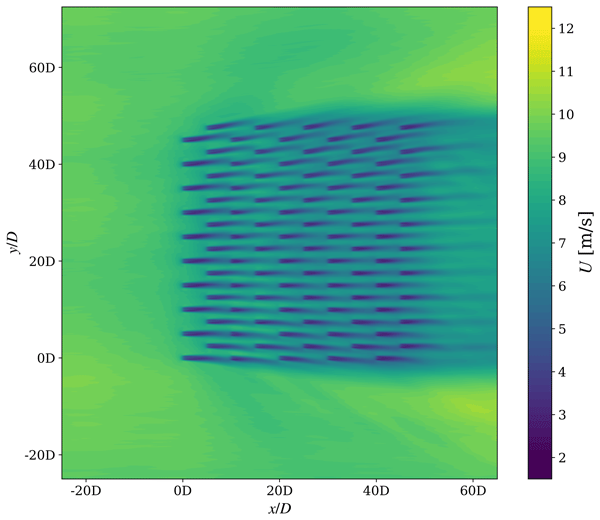
This study explores how the height of the atmosphere's boundary layer impacts wind farm performance, focusing on how this factor influences energy output. By simulating different boundary layer heights and conditions, this research reveals that deeper layers promote better energy recovery. The findings highlight the importance of considering atmospheric conditions when simulating wind farms to maximize energy efficiency, offering valuable insights for the wind energy industry.
Juan Felipe Céspedes Moreno, Juan Pablo Murcia León, and Søren Juhl Andersen
Wind Energ. Sci., 10, 597–611, https://doi.org/10.5194/wes-10-597-2025, https://doi.org/10.5194/wes-10-597-2025, 2025
Short summary
Short summary
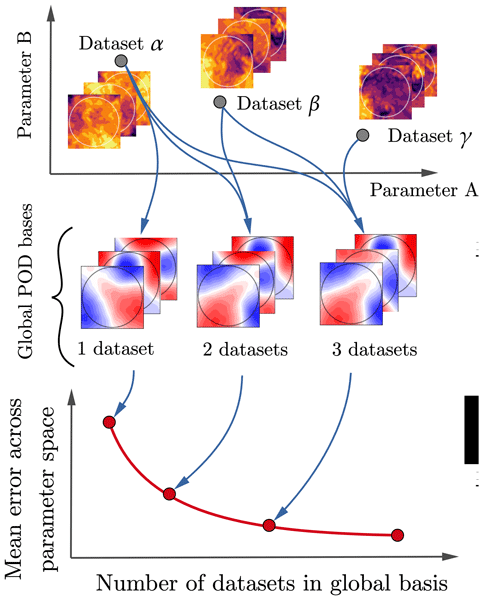
Using a global base in a proper orthogonal decomposition provides a common base for analyzing flows, such as wind turbine wakes, across an entire parameter space. This can be used to compare flows with different conditions using the same physical interpretation. This work shows the convergence of the global base, its small error compared to the truncation error in the flow reconstruction, and the insensitivity to which datasets are included for generating the global base.
Maarten Paul van der Laan, Mark Kelly, Mads Baungaard, Antariksh Dicholkar, and Emily Louise Hodgson
Wind Energ. Sci., 9, 1985–2000, https://doi.org/10.5194/wes-9-1985-2024, https://doi.org/10.5194/wes-9-1985-2024, 2024
Short summary
Short summary
Wind turbines are increasing in size and operate more frequently above the atmospheric surface layer, which requires improved inflow models for numerical simulations of turbine interaction. In this work, a novel steady-state model of the atmospheric boundary layer (ABL) is introduced. Numerical wind turbine flow simulations subjected to shallow and tall ABLs are conducted, and the proposed model shows improved performance compared to other state-of-the-art steady-state models.
Søren Juhl Andersen and Juan Pablo Murcia Leon
Wind Energ. Sci., 7, 2117–2133, https://doi.org/10.5194/wes-7-2117-2022, https://doi.org/10.5194/wes-7-2117-2022, 2022
Short summary
Short summary
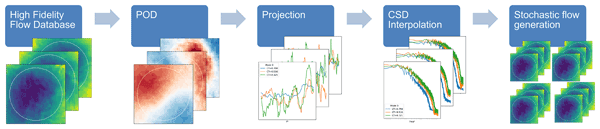
Simulating the turbulent flow inside large wind farms is inherently complex and computationally expensive. A new and fast model is developed based on data from high-fidelity simulations. The model captures the flow dynamics with correct statistics for a wide range of flow conditions. The model framework provides physical insights and presents a generalization of high-fidelity simulation results beyond the case-specific scenarios, which has significant potential for future turbulence modeling.
Tuhfe Göçmen, Filippo Campagnolo, Thomas Duc, Irene Eguinoa, Søren Juhl Andersen, Vlaho Petrović, Lejla Imširović, Robert Braunbehrens, Jaime Liew, Mads Baungaard, Maarten Paul van der Laan, Guowei Qian, Maria Aparicio-Sanchez, Rubén González-Lope, Vinit V. Dighe, Marcus Becker, Maarten J. van den Broek, Jan-Willem van Wingerden, Adam Stock, Matthew Cole, Renzo Ruisi, Ervin Bossanyi, Niklas Requate, Simon Strnad, Jonas Schmidt, Lukas Vollmer, Ishaan Sood, and Johan Meyers
Wind Energ. Sci., 7, 1791–1825, https://doi.org/10.5194/wes-7-1791-2022, https://doi.org/10.5194/wes-7-1791-2022, 2022
Short summary
Short summary
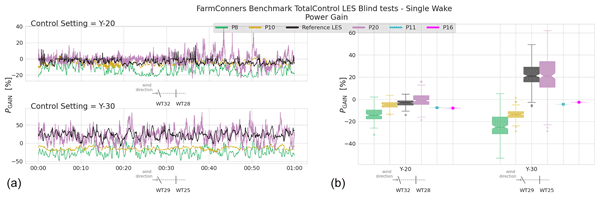
The FarmConners benchmark is the first of its kind to bring a wide variety of data sets, control settings, and model complexities for the (initial) assessment of wind farm flow control benefits. Here we present the first part of the benchmark results for three blind tests with large-scale rotors and 11 participating models in total, via direct power comparisons at the turbines as well as the observed or estimated power gain at the wind farm level under wake steering control strategy.
Niels Troldborg, Søren J. Andersen, Emily L. Hodgson, and Alexander Meyer Forsting
Wind Energ. Sci., 7, 1527–1532, https://doi.org/10.5194/wes-7-1527-2022, https://doi.org/10.5194/wes-7-1527-2022, 2022
Short summary
Short summary
This article shows that the power performance of a wind turbine may be very different in flat and complex terrain. This is an important finding because it shows that the power output of a given wind turbine is governed by not only the available wind at the position of the turbine but also how the ambient flow develops in the region behind the turbine.
Cited articles
Abkar, M. and Porté-Agel, F.: Influence of atmospheric stability on wind-turbine wakes: A large-eddy simulation study, Physics of Fluids, 27, https://doi.org/10.1063/1.4913695, 2015. a
Abkar, M., Bae, H. J., and Moin, P.: Minimum-dissipation scalar transport model for large-eddy simulation of turbulent flows, Phys. Rev. Fluids, 1, 041701, https://doi.org/10.1103/PhysRevFluids.1.041701, 2016. a
Allaerts, D. and Meyers, J.: Large eddy simulation of a large wind-turbine array in a conventionally neutral atmospheric boundary layer, Physics of Fluids, 27, 065108, https://doi.org/10.1063/1.4922339, 2015. a
Allaerts, D. and Meyers, J.: Boundary-layer development and gravity waves in conventionally neutral wind farms, J. Fluid Mech., 814, 95–130, 2017. a
Andersen, S.: Simulation and Prediction of Wakes and Wake Interaction in Wind Farms, PhD thesis, Technical University of Denmark (DTU), 2014. a
Andersen, S. J., Witha, B., Breton, S.-P., Sørensen, J. N., Mikkelsen, R. F., and Ivanell, S.: Quantifying variability of Large Eddy Simulations of very large wind farms, J. Phys. Conf. Ser., 625, 012027, https://doi.org/10.1088/1742-6596/625/1/012027, 2015. a
Annoni, J., Gebraad, P. M. O., Scholbrock, A. K., Fleming, P. A., and Wingerden, J.-W. v.: Analysis of axial-induction-based wind plant control using an engineering and a high-order wind plant model, Wind Energy, 19, 1135–1150, https://doi.org/10.1002/we.1891, 2016. a
Archer, C. L. and Vasel-Be-Hagh, A.: Wake steering via yaw control in multi-turbine wind farms: Recommendations based on large-eddy simulation, Sustainable Energy Technologies and Assessments, 33, https://doi.org/10.1016/j.seta.2019.03.002, 2019. a, b, c
Baricchio, M., van der Hoek, D., Dammann, T., Gebraad, P. M. O., Iori, J., and van Wingerden, J.-W.: Combining wake steering and active wake mixing on a large-scale wind farm, Wind Energ. Sci. Discuss. [preprint], https://doi.org/10.5194/wes-2025-265, in review, 2025. a
Bartl, J., Mühle, F., Schottler, J., Sætran, L., Peinke, J., Adaramola, M., and Hölling, M.: Wind tunnel experiments on wind turbine wakes in yaw: effects of inflow turbulence and shear, Wind Energ. Sci., 3, 329–343, https://doi.org/10.5194/wes-3-329-2018, 2018. a, b
Churchfield, M. J., Lee, S., Michalakes, J., and Moriarty, P. J.: A numerical study of the effects of atmospheric and wake turbulence on wind turbine dynamics, J. Turbul., 13, 1–32, 2012. a
Cortina, G., Calaf, M., and Cal, R. B.: Distribution of mean kinetic energy around an isolated wind turbine and a characteristic wind turbine of a very large wind farm, Phys. Rev. Fluids, 1, 1–18, 2016. a
Debusscher, C. M. J., Göçmen, T., and Andersen, S. J.: Probabilistic surrogates for flow control using combined control strategies, J. Phys. Conf. Ser., 2265, 032110, https://doi.org/10.1088/1742-6596/2265/3/032110, 2022. a
Doekemeijer, B. M., Kern, S., Maturu, S., Kanev, S., Salbert, B., Schreiber, J., Campagnolo, F., Bottasso, C. L., Schuler, S., Wilts, F., Neumann, T., Potenza, G., Calabretta, F., Fioretti, F., and van Wingerden, J.-W.: Field experiment for open-loop yaw-based wake steering at a commercial onshore wind farm in Italy, Wind Energ. Sci., 6, 159–176, https://doi.org/10.5194/wes-6-159-2021, 2021. a, b, c
DTU Computing Center: DTU Computing Center resources, https://doi.org/10.57940/FAFC-6M81, 2021. a
Du, B., Ge, M., Zeng, C., Cui, G., and Liu, Y.: Influence of atmospheric stability on wind-turbine wakes with a certain hub-height turbulence intensity, Phys. Fluids, 33, 055111, 2021. a
España, G., Aubrun, S., Loyer, S., and Devinant, P.: Wind tunnel study of the wake meandering downstream of a modelled wind turbine as an effect of large scale turbulent eddies, J. Wind Eng. Ind. Aerod., 101, 24–33, https://doi.org/10.1016/j.jweia.2011.10.011, 2012. a
Fleming, P., Annoni, J., Churchfield, M., Martinez-Tossas, L. A., Gruchalla, K., Lawson, M., and Moriarty, P.: A simulation study demonstrating the importance of large-scale trailing vortices in wake steering, Wind Energ. Sci., 3, 243–255, https://doi.org/10.5194/wes-3-243-2018, 2018. a, b
Fleming, P., King, J., Dykes, K., Simley, E., Roadman, J., Scholbrock, A., Murphy, P., Lundquist, J. K., Moriarty, P., Fleming, K., van Dam, J., Bay, C., Mudafort, R., Lopez, H., Skopek, J., Scott, M., Ryan, B., Guernsey, C., and Brake, D.: Initial results from a field campaign of wake steering applied at a commercial wind farm – Part 1, Wind Energ. Sci., 4, 273–285, https://doi.org/10.5194/wes-4-273-2019, 2019. a
Fleming, P., King, J., Simley, E., Roadman, J., Scholbrock, A., Murphy, P., Lundquist, J. K., Moriarty, P., Fleming, K., van Dam, J., Bay, C., Mudafort, R., Jager, D., Skopek, J., Scott, M., Ryan, B., Guernsey, C., and Brake, D.: Continued results from a field campaign of wake steering applied at a commercial wind farm – Part 2, Wind Energ. Sci., 5, 945–958, https://doi.org/10.5194/wes-5-945-2020, 2020. a, b
Frederik, J. A., Doekemeijer, B. M., Mulders, S. P., and van Wingerden, J.-W.: The helix approach: Using dynamic individual pitch control to enhance wake mixing in wind farms, Wind Energy, 23, 1739–1751, https://doi.org/10.1002/we.2513, 2020. a
Gaumond, M., Réthoré, P.-E., Ott, S., Peña, A., Bechmann, A., and Hansen, K. S.: Evaluation of the wind direction uncertainty and its impact on wake modeling at the Horns Rev offshore wind farm, Wind Energy, 17, 1169–1178, https://doi.org/10.1002/we.1625, 2014. a, b, c
Gebraad, P. M. O., Teeuwisse, F. W., van Wingerden, J. W., Fleming, P. A., Ruben, S. D., Marden, J. R., and Pao, L. Y.: Wind plant power optimization through yaw control using a parametric model for wake effects—a CFD simulation study, Wind Energy, 19, 95–114, https://doi.org/10.1002/we.1822, 2016. a
Göçmen, T., Campagnolo, F., Duc, T., Eguinoa, I., Andersen, S. J., Petrović, V., Imširović, L., Braunbehrens, R., Liew, J., Baungaard, M., van der Laan, M. P., Qian, G., Aparicio-Sanchez, M., González-Lope, R., Dighe, V. V., Becker, M., van den Broek, M. J., van Wingerden, J.-W., Stock, A., Cole, M., Ruisi, R., Bossanyi, E., Requate, N., Strnad, S., Schmidt, J., Vollmer, L., Sood, I., and Meyers, J.: FarmConners wind farm flow control benchmark – Part 1: Blind test results, Wind Energ. Sci., 7, 1791–1825, https://doi.org/10.5194/wes-7-1791-2022, 2022. a
Hansen, M. and Henriksen, L.: Basic DTU Wind Energy controller, no. 0028 in: DTU Wind Energy E, DTU Wind Energy, Denmark, contract Number: EUDP project Light Rotor; Project Number 46-43028-Xwp3, The report number is DTU-Wind-Energy-Report-E-0028 and not DTU-Wind-Energy-Report-E-0018 as stated inside the report, 2013. a
Hodgson, E. L.: Large Eddy Simulations of Energy Entrainment in Wind Turbine Wakes and Wind Farms, PhD thesis, Technical University of Denmark (DTU), 2023. a
Hodgson, E. L., Andersen, S. J., Troldborg, N., Forsting, A. M., Mikkelsen, R. F., and Sørensen, J. N.: A Quantitative Comparison of Aeroelastic Computations using Flex5 and Actuator Methods in LES, J. Phys. Conf. Ser., 1934, 012014, https://doi.org/10.1088/1742-6596/1934/1/012014, 2021. a, b, c
Hodgson, E. L., Madsen, M. H. A., and Andersen, S. J.: Effects of turbulent inflow time scales on wind turbine wake behavior and recovery, Physics of Fluids, 35, https://doi.org/10.1063/5.0162311, 2023a. a
Hodgson, E. L., Madsen, A. R., Petersen, F. E., Göçmen, T., and Andersen, S. J.: Uncertainty of toggling in wake steering experiments under diurnal cycle atmospheric conditions: an LES study, J. Phys. Conf. Ser., 3016, 012026, https://doi.org/10.1088/1742-6596/3016/1/012026, 2025a. a, b
Hodgson, E. L., Troldborg, N., and Andersen, S. J.: Impact of freestream turbulence integral length scale on wind farm flows and power generation, Renew. Energ., 238, 121804, https://doi.org/10.1016/j.renene.2024.121804, 2025b. a, b
Howland, M. F., Bossuyt, J., Martínez-Tossas, L. A., Meyers, J., and Meneveau, C.: Wake structure in actuator disk models of wind turbines in yaw under uniform inflow conditions, J. Renew. Sustain. Ener., 8, 043301, https://doi.org/10.1063/1.4955091, 2016. a
Hulsman, P., Andersen, S. J., and Göçmen, T.: Optimizing wind farm control through wake steering using surrogate models based on high-fidelity simulations, Wind Energ. Sci., 5, 309–329, https://doi.org/10.5194/wes-5-309-2020, 2020. a
Ivanell, S., Chanprasert, W., Lanzilao, L., Bleeg, J., Meyers, J., Mathieu, A., Juhl Andersen, S., Mouradi, R.-S., Dupont, E., Olivares-Espinosa, H., and Troldborg, N.: An inter-comparison study on the impact of atmospheric boundary layer height on gigawatt-scale wind plant performance, Wind Energ. Sci., 11, 937–960, https://doi.org/10.5194/wes-11-937-2026, 2026. a, b
Jiménez, Á., Crespo, A., and Migoya, E.: Application of a LES technique to characterize the wake deflection of a wind turbine in yaw, Wind Energy, 13, 559–572, https://doi.org/10.1002/we.380, 2010. a
Kanev, S.: Dynamic wake steering and its impact on wind farm power production and yaw actuator duty, Renew. Energ., 146, 9–15, https://doi.org/10.1016/j.renene.2019.06.122, 2020. a
Klemp, J. B. and Lilly, D. K.: Numerical Simulation of Hydrostatic Mountain Waves, J. Atmos. Sci., 35, 78–107, https://doi.org/10.1175/1520-0469(1978)035<0078:NSOHMW>2.0.CO;2, 1978. a
Kobayashi, M. H. and Pereira, J. C. F.: CULATION OF INCOMPRESSIBLE LAMINAR FLOWS ON A NONSTAGGERED, NONORTHOGONAL GRID, Numer. Heat Tr. B-Fund., 19, 243–262, 1991. a
Larsen, G. C., Madsen, H. A., Thomsen, K., and Larsen, T. J.: Wake meandering: a pragmatic approach, Wind Energy, 11, 377–395, 2008. a
Larsen, T. J. and Hansen, A. M.: How 2 HAWC2, the user's manual, ISBN 978-87-550-3583-6, 2007. a
Liew, J., Urbán, A. M., and Andersen, S. J.: Analytical model for the power–yaw sensitivity of wind turbines operating in full wake, Wind Energ. Sci., 5, 427–437, https://doi.org/10.5194/wes-5-427-2020, 2020. a
Medici, D. and Alfredsson, P. H.: Measurements on a wind turbine wake: 3D effects and bluff body vortex shedding, Wind Energy, 9, 219–236, 2006. a
Meyers, J., Bottasso, C., Dykes, K., Fleming, P., Gebraad, P., Giebel, G., Göçmen, T., and van Wingerden, J.-W.: Wind farm flow control: prospects and challenges, Wind Energ. Sci., 7, 2271–2306, https://doi.org/10.5194/wes-7-2271-2022, 2022. a
Michelsen, J. A.: Basis3D – a Platform for Development of Multiblock PDE Solvers, Tech. rep., DTU, 1992. a
Michelsen, J. A.: Block structured Multigrid solution of 2D and 3D elliptic PDE's, Tech. Rep. AFM, DTU, 1994. a
Mittelmeier, N., Blodau, T., and Kühn, M.: Monitoring offshore wind farm power performance with SCADA data and an advanced wake model, Wind Energ. Sci., 2, 175–187, https://doi.org/10.5194/wes-2-175-2017, 2017. a, b
Narasimhan, G., Gayme, D. F., and Meneveau, C.: Effects of wind veer on a yawed wind turbine wake in atmospheric boundary layer flow, Phys. Rev. Fluids, 7, 114609, https://doi.org/10.1103/PhysRevFluids.7.114609, 2022. a
Pedersen, M. M., Forsting, A. M., van der Laan, P., Riva, R., Romàn, L. A. A., Risco, J. C., Friis-Møller, M., Quick, J., Christiansen, J. P. S., Rodrigues, R. V., Olsen, B. T., and Réthoré, P.-E.: PyWake 2.5.0: An open-source wind farm simulation tool, Gitlab [code], https://gitlab.windenergy.dtu.dk/TOPFARM/PyWake (last access: 20 September 2025), 2023. a
Pedersen, M. M., Steiner, J., Nilsen, M. B., Lohmann, J., Hodgson, E. L., Riva, R., Troldborg, N., Andersen, S. J., Larsen, G., Verelst, D. R., and Réthoré, P.-E.: Dynamiks 0.0.4: An open-source Dynamic Wind System Simulator, Gitlab [code], https://gitlab.windenergy.dtu.dk/DYNAMIKS/dynamiks, (last access: 15 February 2026), 2026. a
Peña, A.: Østerild: A natural laboratory for atmospheric turbulence, J. Renew. Sustain. Ener., 11, https://doi.org/10.1063/1.5121486, 2019. a
Peña, A., Réthoré, P.-E., and van der Laan, M. P.: On the application of the Jensen wake model using a turbulence-dependent wake decay coefficient: the Sexbierum case, Wind Energy, 19, 763–776, https://doi.org/10.1002/we.1863, 2016. a
Pirrung, G. R., van der Laan, M. P., Ramos-García, N., and Meyer Forsting, A. R.: A simple improvement of a tip loss model for actuator disc simulations, Wind Energy, 23, 1154–1163, https://doi.org/10.1002/we.2481, 2020. a
Quick, J., King, J., King, R. N., Hamlington, P. E., and Dykes, K.: Wake steering optimization under uncertainty, Wind Energ. Sci., 5, 413–426, https://doi.org/10.5194/wes-5-413-2020, 2020. a, b, c
Shen, W. Z., Michelsen, J. A., Sørensen, N. N., and Sørensen, J. N.: AN IMPROVED SIMPLEC METHOD ON COLLOCATED GRIDS FOR STEADY AND UNSTEADY FLOW COMPUTATIONS, Numer. Heat Tr. B-Fund., 43, 221–239, https://doi.org/10.1080/713836202, 2003. a
Simley, E., Fleming, P., Girard, N., Alloin, L., Godefroy, E., and Duc, T.: Results from a wake-steering experiment at a commercial wind plant: investigating the wind speed dependence of wake-steering performance, Wind Energ. Sci., 6, 1427–1453, https://doi.org/10.5194/wes-6-1427-2021, 2021. a, b, c, d
Sørensen, N. N.: General Purpose Flow Solver Applied to Flow over Hills, PhD thesis, DTU, 1995. a
Steiner, J., Hodgson, E. L., van der Laan, M. P., Alcayaga, L., Pedersen, M., Andersen, S. J., Larsen, G., and Réthoré, P.-E.: A multi-fidelity model benchmark for wake steering of a large turbine in a neutral ABL, Wind Energ. Sci. Discuss. [preprint], https://doi.org/10.5194/wes-2025-200, in review, 2025. a
Türk, M. and Emeis, S.: The dependence of offshore turbulence intensity on wind speed, J. Wind Eng. Ind. Aerod., 98, 466–471, https://doi.org/10.1016/j.jweia.2010.02.005, 2010. a
van der Laan, M., Andersen, S., Kelly, M., and Baungaard, M.: Fluid scaling laws of idealized wind farm simulations, J. Phys. Conf. Ser., 1618, 062018, https://doi.org/10.1088/1742-6596/1618/6/062018, 2020. a
van der Laan, M. P. and Sørensen, N. N.: Why the Coriolis force turns a wind farm wake clockwise in the Northern Hemisphere, Wind Energy Science, 2, 285–294, https://doi.org/10.5194/wes-2-285-2017, 2017. a, b
VerHulst, C. and Meneveau, C.: Large eddy simulation study of the kinetic energy entrainment by energetic turbulent flow structures in large wind farms, Physics of Fluids, 26, 025113, https://doi.org/10.1063/1.4865755, 2014. a
von Brandis, A., Centurelli, G., Schmidt, J., Vollmer, L., Djath, B., and Dörenkämper, M.: An investigation of spatial wind direction variability and its consideration in engineering models, Wind Energ. Sci., 8, 589–606, https://doi.org/10.5194/wes-8-589-2023, 2023. a, b
Wit, L. and van Rhee, C.: Testing an Improved Artificial Viscosity Advection Scheme to Minimise Wiggles in Large Eddy Simulation of Buoyant Jet in Crossflow, Flow Turbul. Combust., 92, https://doi.org/10.1007/s10494-013-9517-1, 2013. a
Wu, Y. T. and Porté-Agel, F.: Large-Eddy Simulation of Wind-Turbine Wakes: Evaluation of Turbine Parametrisations, Bound.-Lay. Meteorol., 138, 345–366, https://doi.org/10.1007/s10546-010-9569-x, 2011. a
Wu, Y. T. and Porté-Agel, F.: Atmospheric turbulence effects on wind-turbine wakes: An LES study, Energies, 5, 5340–5362, 2012. a
Zahle, F., Barlas, A., Lønbæk, K., Bortolotti, P., Zalkind, D., Wang, L., Labuschagne, C., Sethuraman, L., and Barter, G.: Definition of the IEA Wind 22-Megawatt Offshore Reference Wind Turbine, dTU Wind Energy Report E-0243 IEA Wind TCP Task 55, Technical University of Denmark, https://doi.org/10.11581/DTU.00000317,2024. a
Short summary
This work investigates the impact of wind direction uncertainty on wake steering, a promising flow-control strategy that aims to increase the efficiency of wind farms, using high-fidelity computational fluid dynamics. It concludes that wake steering is sensitive to both bias and uncertainty in inflow wind direction due to having a relatively small range over which gains are predicted and showing significant decreases in peak power output with increasing wind direction uncertainty.
This work investigates the impact of wind direction uncertainty on wake steering, a promising...


Altmetrics
Final-revised paper
Preprint