
the Creative Commons Attribution 4.0 License.
the Creative Commons Attribution 4.0 License.
 | 03 Aug 2026
Grand challenges in designing resilient wind energy systems in areas prone to tropical cyclones
Jiali Wang
Sanjay Arwade
Murray Fisher
Brian Hirth
Xiaoli Guo Larsén
Julie K. Lundquist
Andrew Myers
Weichiang Pang
William J. Pringle
Robert Rogers
Miguel Sanchez-Gomez
Atsushi Yamaguchi
Paul Veers
Deployment of wind energy systems in cyclone-prone regions faces considerable challenges due to risks posed by tropical cyclones (TCs). These storms can generate very high winds and waves that have the potential to cause severe structural damage to turbines, disrupt energy production, and result in large financial losses. As such, it is important to better understand and quantify the risks associated with TCs and adapt design standards and operational guidelines to meet the increased reliability requirements for systems in these high-risk areas. Addressing these challenges requires important advancements in modeling capabilities, the collection of high-quality data, and the integration of these resources to ensure that wind systems in cyclone-prone regions achieve a level of reliability comparable to systems in non-cyclone regions (e.g., the North Sea). This article aims to shed light on the grand challenges in designing resilient wind energy systems in cyclone-prone regions by presenting the current state of research and engineering practices and identifying key research gaps. It also aims to offer recommendations for future work, highlighting the need for enhanced modeling tools and data integration techniques and for more resilient design approaches.
- Article
(8459 KB) - Full-text XML
- BibTeX
- EndNote


Wind energy systems deployed in offshore and coastal regions may be exposed to challenges posed by tropical cyclones (TCs), particularly in areas such as the South China Sea, the Sea of Japan, and the Gulf and East coasts of the United States.
Figure 1 shows all currently installed wind turbines (both onshore and offshore) along with global tropical cyclone best track historical data (Knapp et al., 2010). Exposure of wind turbines, particularly offshore, poses substantial risks that must be addressed to ensure the resilience of existing and future projects (Wang et al., 2024a).
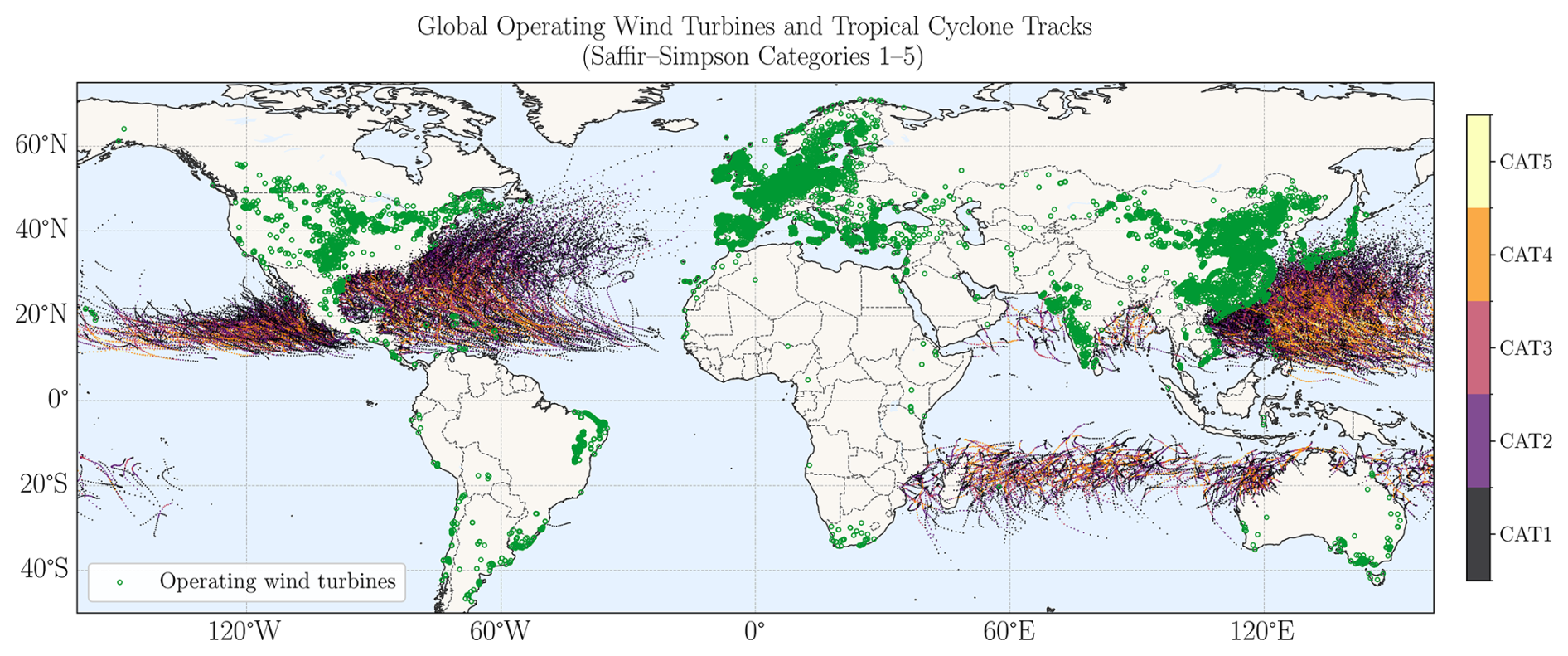
Figure 1Global atlas showing the location of installed wind turbines globally as of February 2025 (Global Energy Monitor, 2025) together with all recorded best tracks of tropical cyclones. Best tracks are obtained from the International Best Track Archive for Climate Stewardship (IBTrACS) (Knapp et al., 2010). Only tropical cyclones of category 1 and above on the Saffir–Simpson scale are shown.
Tropical cyclones can exhibit winds in excess of 50 m s−1 (Tamizi et al., 2020), and ocean significant wave heights in excess of 12 m (Young, 2006). These extreme conditions present significant risks that affect not only individual turbine components, such as blades and towers, but also foundations and onshore/offshore substations, impacting the entire wind energy infrastructure. To account for these extreme conditions, wind turbine standards established by the International Electrotechnical Commission (IEC) have recently introduced a new turbine class, the Tropical T-Class, which sets the reference 10 min average, hub-height wind speed Vref,T equal to 57 m s−1 (IEC 61400-1, 2019a; IEC 61400-3-1, 2019b). An additional subset of marine design load cases related to wave, and combined wave/current are included (Annex I of IEC 61400-3-1, 2019b) for offshore wind turbines. In both cases, site-specific assessments are needed to determine the reference wind and wave parameters (Wang et al., 2024a). Although such assessments may require turbine designers to ultimately strengthen blades, towers, foundations, and other components (e.g., inter-array and export cables), the current standards simplify the complexity of tropical cyclones and do not consider the possibility that other design load cases (DLCs) might exist in the form of extreme microscale vorticity, extreme shear and veer, and low-frequency storm-driven fatigue loading, among other phenomena.
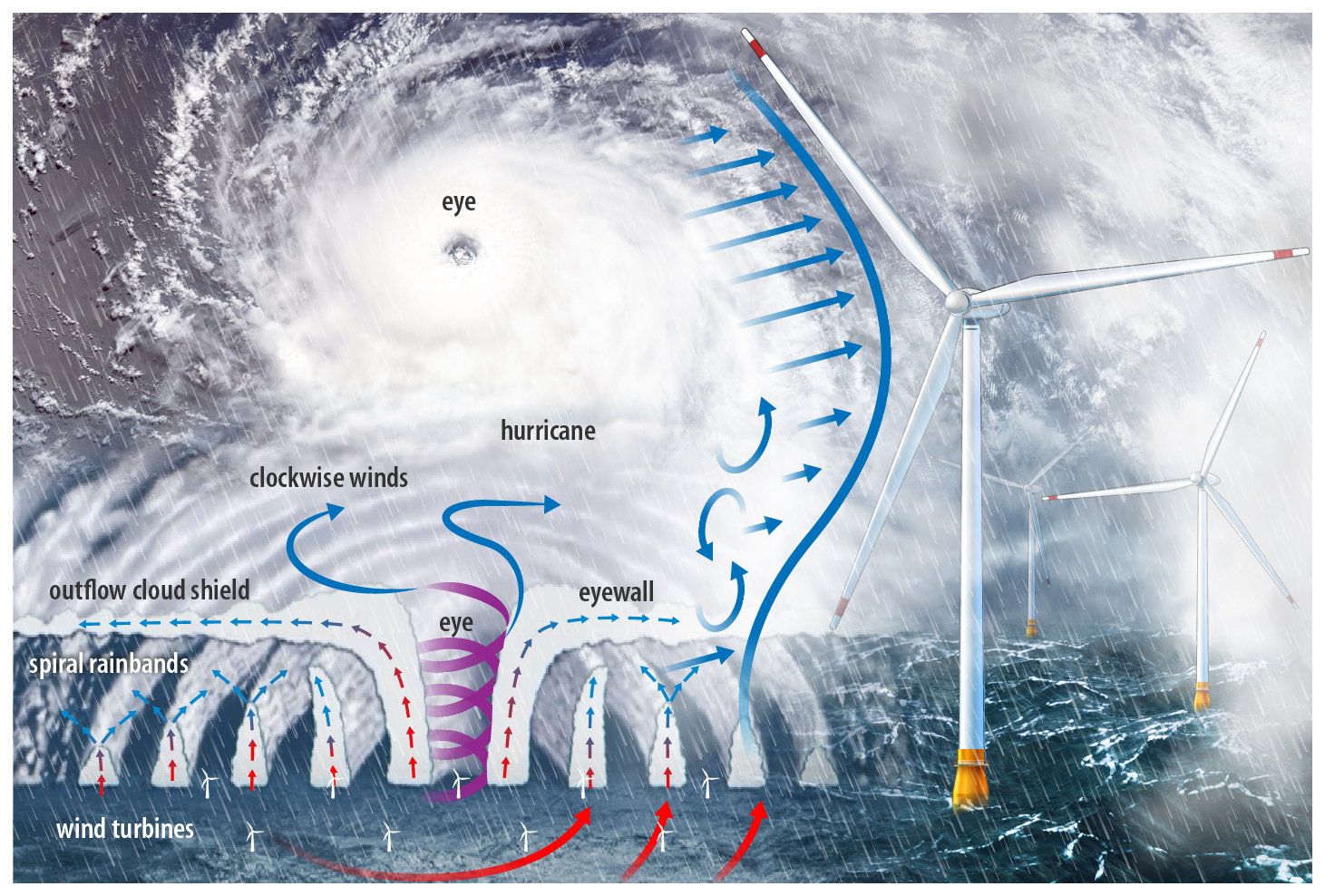
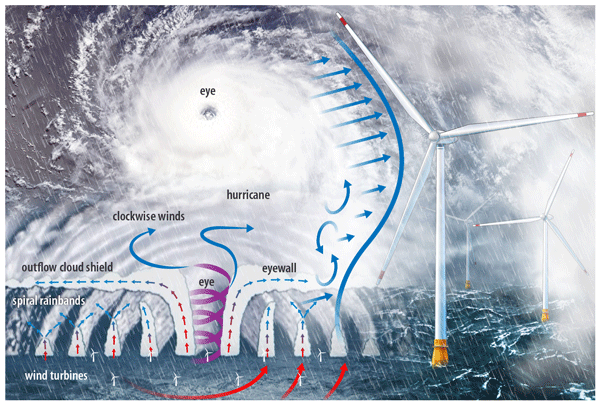
Figure 2Schematic representation of the atmospheric and oceanic phenomena of a tropical cyclone (image credit Alfred Hicks).
To successfully deploy wind energy systems in TC-prone regions, a comprehensive understanding of the TC-induced hazards (extreme wind, waves, current) and the associated risk to wind energy infrastructure should be well understood by wind turbine manufacturers, developers, insurers, financiers, and regulators. This requires accurately characterizing storm behavior, quantifying associated risks, and refining design standards to ensure system reliability comparable to that achieved in other regions not exposed to TC hazards (e.g., northern Europe). In the next paragraphs we shall present past TC events that have affected wind turbine systems and have led to extensive damage.
1.1 Past events and available data on TC impact
Past events of TCs passing by wind turbines have resulted in significant damage (e.g., blade failure, tower collapse, or foundation overturn). The earliest documented case is that of Typhoon Maemi (2003) in Japan (Ishihara et al., 2005). The case sheds light on the risks posed by TCs and underscores the need for robust and resilient turbine design practices. With peak gusts of 74 m s−1, the storm caused extensive damage to all turbines at an onshore coastal wind farm (Ishihara et al., 2005). Three years later, Super Typhoon Saomai struck Cangnan County in China, causing failures in 27 of 28 wind turbines, including the collapse of five towers. At the turbine site, 10 min maximum wind speeds exceeded 60 m s−1, with 3 s gusts surpassing 80 m s−1. More recently, Hurricane Maria in 2017, a category 4 storm at landfall, impacted two onshore wind farms in Puerto Rico: Santa Isabel and Punta Lima. Although Santa Isabel escaped much damage by avoiding the eyewall, Punta Lima was directly hit, sustaining severe damage, including collapsed towers (Kwasinski, 2018). The most recent case involved Super Typhoon Yagi in 2024. As a category 4 storm at landfall in Mulan Bay, Haikou Province, China, it severely impacted the Wenchang Wind Power Plant, a site undergoing repowering, and damaged numerous turbines (Recharge News, 2024). An extensive list of TC events that impacted wind turbines is presented in Table 1. The list, although not exhaustive, indicates the location, name, and year of the TC along with the intensity at impact and the reported damage.
Ishihara et al. (2005)Chen et al. (2015)Li et al. (2013)Chou et al. (2013)Chen et al. (2016)Chen et al. (2015)Chen et al. (2015)Chen et al. (2016)Wind Power Monthly (2016)Kwasinski (2018)Recharge News (2024)Guy Carpenter & Company (2025)Table 1Documented cases of wind turbines impacted by tropical cyclones (TCs), including affected regions, cyclone name and year, shortest distance to the TC track, total number of turbines, rated power, reported wind speeds, and level of damage. A hyphen (–) indicates that the information was not reported or is unavailable in the cited reference. Numbers in parentheses in the blade damage and tower collapse columns indicate the number of turbines affected. “Foundation” in the tower collapse column denotes that foundation failure was reported rather than tower structural collapse. All listed events correspond to onshore wind farms unless otherwise noted.
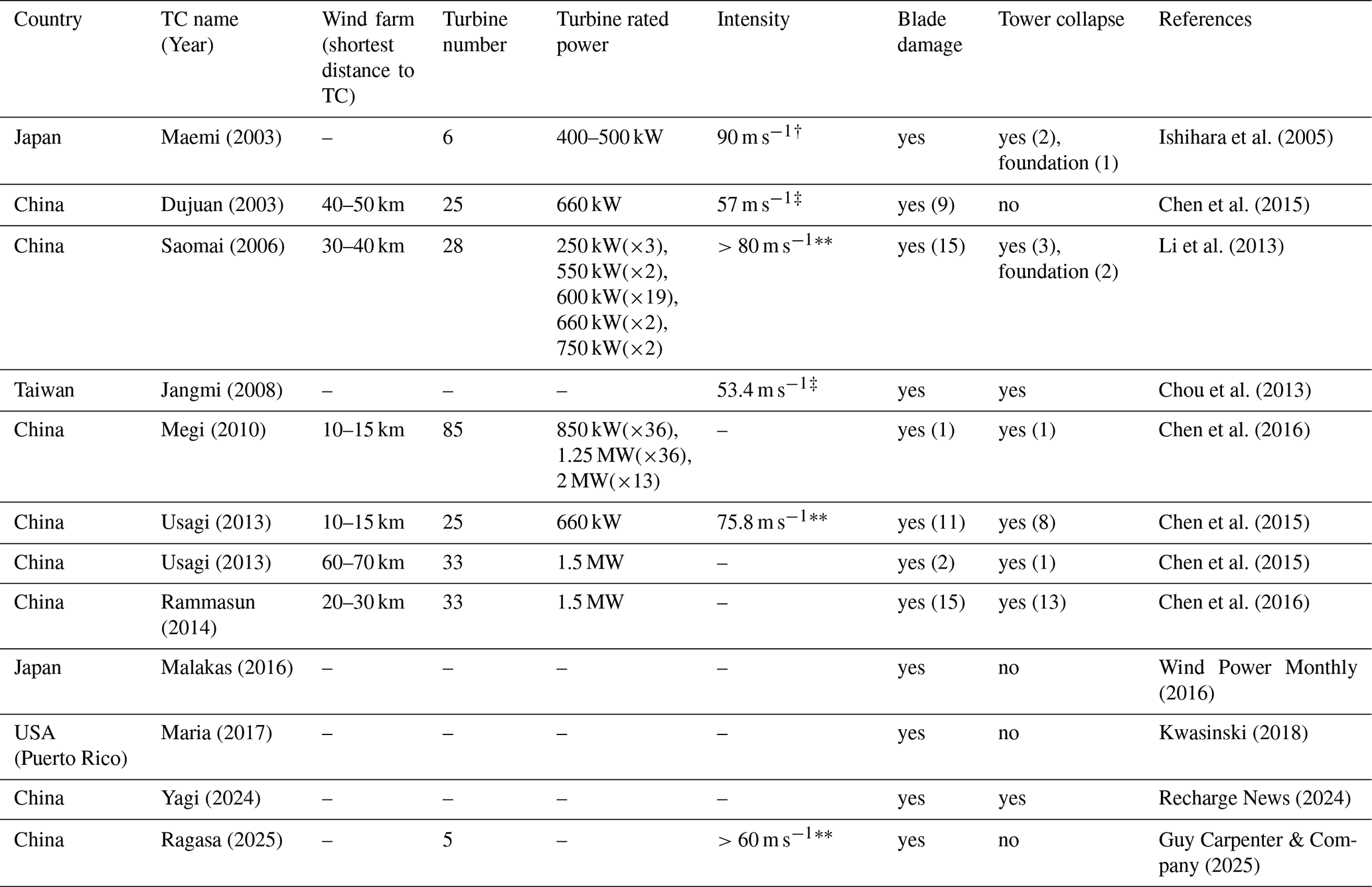
3 s gust. ‡ Instantaneous maximum wind speed. † Estimated maximum gust at turbine site from numerical simulation. Where no superscript is shown, the wind speed was not reported.
We note that many of the instances have reported damage after “forensic engineering” studies (Ishihara et al., 2005; Chou et al., 2013; Chen et al., 2015). The majority of these instances of damage correspond to previous generation machines with ratings from 500 kW to 2 MW, and do not allow us to make conclusions regarding the vulnerability of more recent T-Class designs. Moreover, the documented cases in Table 1 are predominantly from onshore wind farms, reflecting both the longer deployment history of onshore turbines in TC-prone regions and the limited exposure of offshore installations to date. As the offshore wind industry expands into these regions, the challenges discussed below increasingly emphasize offshore-specific considerations, including wave loading, substructure design, and coupled metocean hazards. In the following sections, we shall discuss the state of current research efforts, provide an overview of current practices, guidelines, and standards, and bring attention to remaining knowledge gaps.
1.2 Tropical cyclones and the Grand Challenges Initiative
Before proceeding to the scope and structure of this paper, it is worth connecting this work to the broader scope of the “Grand Challenges” initiative. The Grand Challenges initiative emerged from an International Energy Agency (IEA) Wind Topical Experts Meeting assessing the Grand Challenges for wind energy to meet its full potential, followed by a review article in Science (Veers et al., 2019). The original paper names three high-level categories that future research should focus on to improve our understanding: atmospheric and wind power plant flow physics; aerodynamics, structural dynamics, and offshore wind hydrodynamics of enlarged wind turbines; and systems science for the integration of wind power plants into the future electricity grid. This initial outline of grand challenges identified the need for a concerted effort by the international research community to provide a detailed description of the challenges, identify specific research gaps, and outline recommendations for future research. These include grand challenges in the design, manufacturing, and operation of future wind energy systems (Veers et al., 2023), the digitalization of wind energy (Clifton et al., 2023), and the characterization of offshore wind resources (Shaw et al., 2022), wind farm flow control, small wind energy technology (Bianchini et al., 2022), and turbulence on performance and loads of turbines (Kosović et al., 2026). A summary of the initiative can be found in Veers et al. (2022). A number of these articles have partially addressed extreme weather challenges including tropical cyclones (e.g., Shaw et al., 2022; Kosović et al., 2026); however, their broader focus has not allowed them to systematically present research needs specific to tropical cyclones. In this paper, we focus on the following:
-
the high-severity and low-probability nature of tropical cyclones and their potentially catastrophic consequences to wind energy systems;
-
the fact that during a major TC event, wind turbines will typically be idling, while remaining fully exposed to extreme wind/wave loads and directional shifts;
-
the lack of long-term data and established standards for designing wind energy systems in tropical-cyclone-prone regions.
Based on the above, this paper is intended to be a complement to previous work within the Grand Challenges initiative. Where appropriate, we shall refer the reader to these prior studies for additional context and further reading.
1.3 Scope and structure of this paper
This paper attempts to identify the challenges in designing resilient wind energy systems in areas prone to TCs. As such, it provides a comprehensive review of the current state-of-the-art on TC modeling, including storm tracking and wind/wave field modeling, with a focus on their impact on wind turbines. The paper also addresses key gaps in current standards and guidelines, emphasizing the importance of refining risk quantification frameworks and moving toward probabilistic models to more accurately assess the long-term impacts of TCs on wind energy systems. The aim is not only to provide a comprehensive overview of the ongoing research but also to identify critical areas for future work. We note that the scope of this paper is focused on the physical hazard characterization, modeling, and structural design aspects of wind energy systems in TC-prone regions. Important related topics, including insurance and financial risk assessment, grid-level resilience, power system recovery, and broader socioeconomic impacts, are beyond the scope of this work and represent important avenues for future interdisciplinary research. To this end, we present the current research status and challenges of measurement and modeling in Sect. 2, followed by the current status and challenges of engineering design in Sect. 3, and challenges in quantifying TC risk in Sect. 4. In Sect. 5 we discuss how to “bridge the gap” between research and engineering practice, including identifying future research paths and approaches that the wind engineering community should adopt. Finally, in Sect. 6, we provide a summary of the discussed Grand Challenges and the conclusions from this study.
2.1 Field measurements and available data
Measuring tropical cyclones across different scales involves a variety of data sources and measurement platforms to understand storm characteristics like frequency, intensity, size, and wind structure. At the regional/climatological scale, best track data such as IBTrACS (Knapp et al., 2010) and the National Hurricane Center's HURricane DATa 2nd generation (HURDAT2, Atlantic Basin database) are critical for tracking storm frequency and peak intensity and monitoring long-term trends in TC activity. Observations at the storm scale are focused on storm size and wind field distribution. Observations of these parameters are provided by spaceborne, airborne, and ground-based platforms. Spaceborne platforms provide global coverage and can sometimes provide measurements nearly continuously. These measurements include Dvorak estimates from cloud patterns and both passive radiometer and active scatterometer wind measurements. The recent deployment of synthetic aperture radar (SAR) on satellite systems is a promising technology that provides very-high-resolution (less than 100 m, with 3 km gridded fields) measurements of winds (Fig. 3) even at very high values and in rainy environments (Mouche et al., 2017, 2019; Ricciardulli et al., 2023).
Airborne platforms provide the ability to sample winds over the open ocean, far removed from the coastline. Such measurements include flight-level measurements from reconnaissance aircraft, dropsondes, Stepped Frequency Microwave Radiometer (SFMR), airborne Doppler radars and scatterometers (see Fig. 3), and uncrewed systems. Offshore buoys, ships, and platforms like saildrones further enhance storm observation capabilities far from the coastline. Aircraft observations of TC wind structures have occurred in the Atlantic Basin for decades, and also in the western Atlantic, Caribbean Sea, and US Gulf states (Rogers et al., 2006, 2013; Zawislak et al., 2022). Similar capabilities have been developed in the West Pacific Basin and South and East China seas (Chan et al., 2011; Ito et al., 2018; Holbach et al., 2023; Rogers et al., 2025, 2026) over the past 10–15 years, providing more global coverage of airborne TC measurements.
Ground-based platforms can provide spatial coverage and temporal continuity to wind measurements. National radar networks, like the Weather Surveillance Radar – 88 Doppler (WSR88D) operating in the S-band and aviation focused Terminal Doppler Weather Radars (TDWR) in the US operating in the C-band, alongside various commercial radars, provide detailed storm insights at varying scales as a function of specific radar operation parameters and measurement resolutions. At a more local scale, specialized mobile research radar systems such as the Shared Mobile Atmospheric Research and Teaching Radars (SMART-R; C-band), Doppler on Wheels (DOW; X-band), and Texas Tech University Ka-band (TTU-Ka) systems are deployed into landfalling TCs to capture specific wind features, including mean and turbulence fields near the surface with varied spatial and temporal resolution and data availability (Fig. 4). Surface measurements such as Automated Surface Observing System/Automated Weather Observing System (ASOS/AWOS), tower-based lidars, and anemometer measurements from fixed oil and gas platforms, as well as in situ portable research systems like the Florida Coastal Monitoring Program (FCMP; four 10 m towers), TTU StickNet (48 2.25 m towers), and James Cook University SwirlNet (six 3.2 m towers), also contribute valuable time histories documenting the local wind field of record. In addition, Das (2022) presented lidar measurements of TC wind profiles and structure during severe storms in the Gulf of Mexico, demonstrating the capability of lidar systems in characterizing TC boundary layer winds over offshore environments. Wind measurement standardization, highlighted in Powell et al. (1996), is critical for merging data from various platforms, accounting for differences in measurement height, averaging time, and exposure.
An optimal observing system for TC winds in the context of wind energy includes spatially extensive and temporally continuous observations at high spatiotemporal resolution, with observations through the vertical layer encompassing most turbines (20–350 m a.g.l.). While a multitude of platforms have been developed to observe winds within the TC boundary layer, there are still gaps in our ability to obtain continuous wind measurements in this altitude range, at the spatial and temporal resolutions important for offshore wind plant operations and control. SAR offers great promise for measuring winds globally, independent of high wind speeds and heavy rain rates, but it only provides observations at a given location once or twice per day. TC wind speed estimates derived from geostationary satellites (e.g., Dvorak technique) and associated wind field products (e.g., cloud-drift winds) provide near-continuous measurements with relatively fast revisit times (30 s to 5 min, depending on operational mode), but there are significant uncertainties associated with the inferred wind speeds and little to no available information on the vertical wind structure, particularly in the lowest 300 m. These satellite-based measurements also lack the spatial and temporal resolution necessary to characterize the flow at the scale of individual turbines. Dropsondes from aircraft provide valuable vertical profiles through the TC boundary layer but only offer point measurements during descent, resulting in uncertainty when adapting their data to represent 10 min sustained winds, 3 s wind gust, or turbulence statistics estimates. Other remote and in situ measurements from aircraft (e.g., SFMR, airborne radar and scatterometers, small uncrewed aerial vehicle (UAV)) are also limited by aircraft range and availability. Ground-based operational and research radars offer the potential of spatially extensive and temporally continuous measurements at relatively high resolution in the lowest 300 m but to date have been generally constrained to overland deployments, leading to sparse data coverage offshore.
To date, there exists no ideal dedicated measurement system(s) for documenting TC winds specifically for the offshore wind community. However, the recent application of remote sensing technologies, such as customized research Doppler radars (e.g., TTU X-band; Hirth et al., 2024) and commercially available long-range scanning lidars (e.g., WindCube 200s, Streamline XR) originally developed for multiscale wind energy applications, shows potential promise if properly adapted for this purpose. Future implementation includes adapting and deploying ground-based radar systems at offshore locations, such as on existing platforms or offshore wind farm infrastructure, providing an optimal measurement coverage domain further offshore over open water. A major advantage of radar is the ability to design optimal scanning strategies to achieve the horizontal coverage, vertical depth, and measurement revisit times that are desired for a given site. One important consideration for offshore-mounted radar or lidar systems is the correction required for wave-induced platform motion. This is a non-trivial task, particularly for lidar systems deployed on offshore platforms, where accurate estimation of higher-order turbulence statistics such as turbulence intensity, spectral characteristics, and spatial coherence is required (Gottschall et al., 2014; Désert et al., 2021).
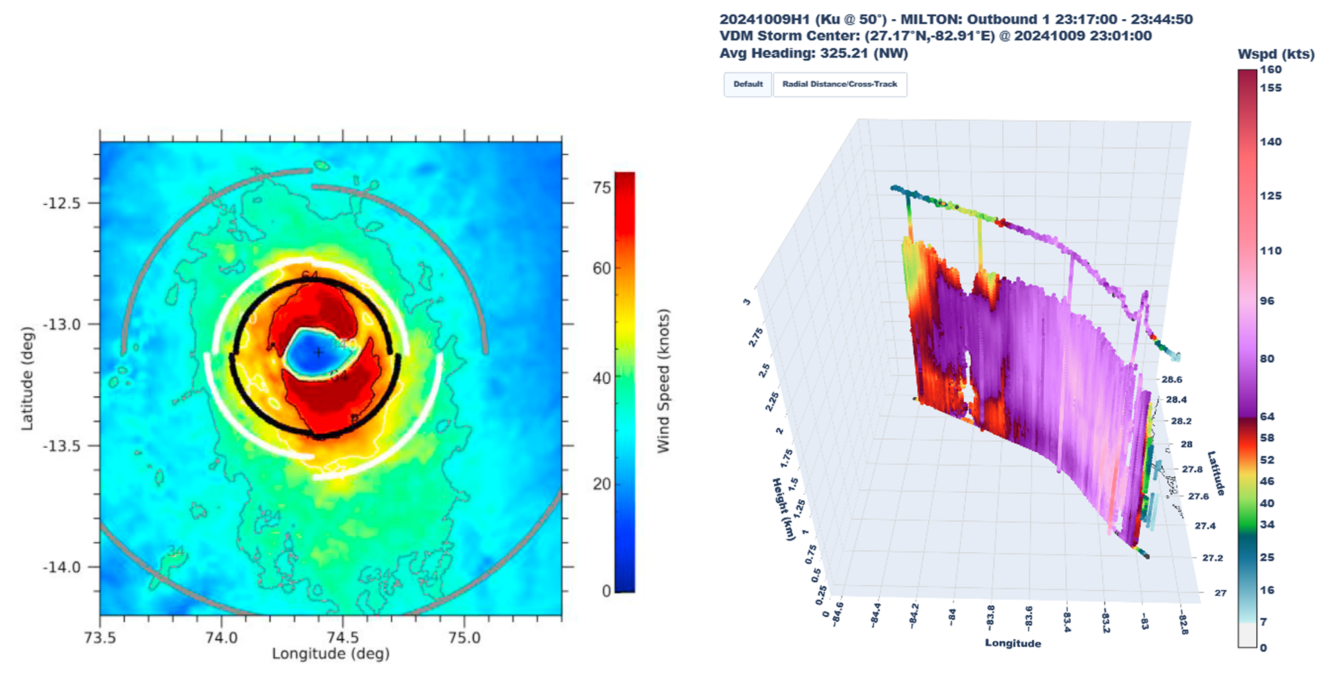
Figure 3Left: SAR-derived wind speed map for Cyclone Halima on 24 March 2022 from Sentinel-1A. The black, white, and gray curves represent 64, 50, and 34 kt wind radii, respectively, for each quadrant. Adapted from (Ricciardulli et al., 2023). Right: three-dimensional rendering of vertical profile of wind speed from a conically scanning Imaging Wind and Rain Airborne Profiler (IWRAP) onboard the NOAA WP-3D aircraft. Image courtesy of NOAA NESDIS Center for Satellite Applications and Research: https://manati.star.nesdis.noaa.gov/datasets (last access: 30 July 2026).
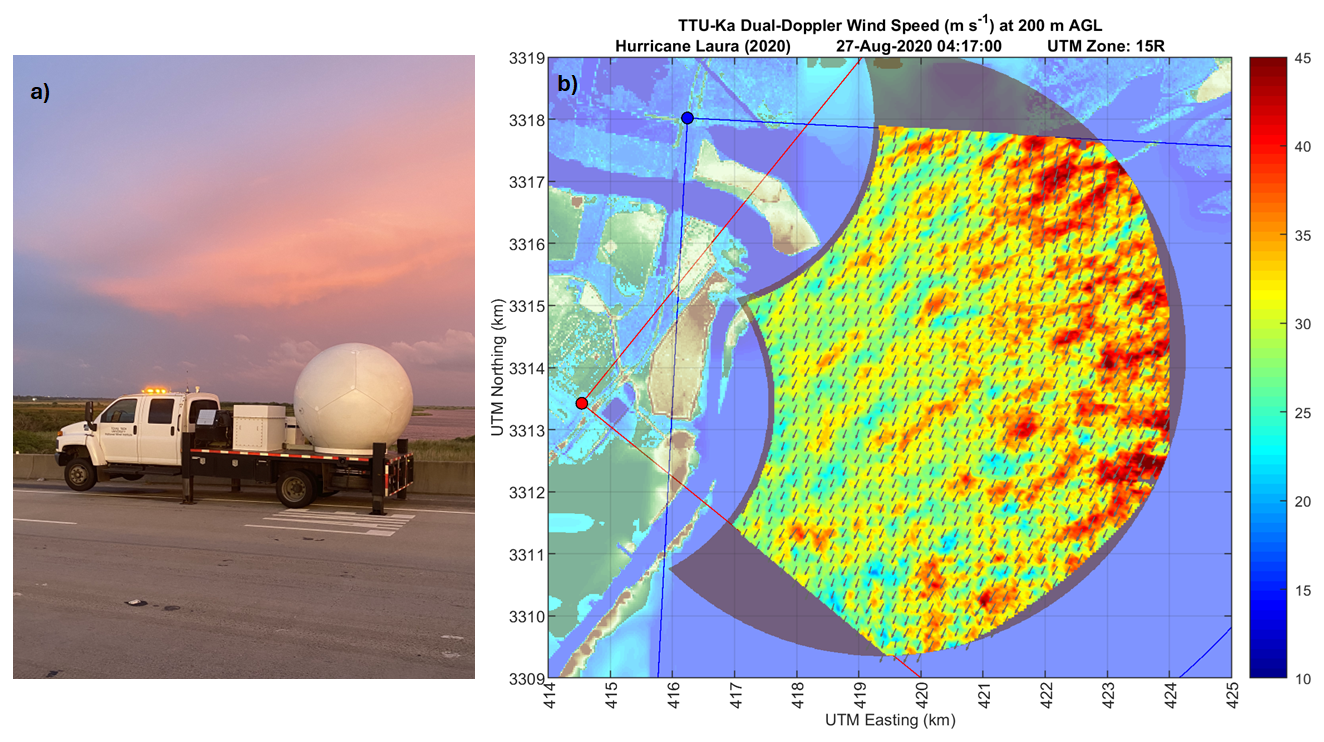
Figure 4(a) TTU-Ka radar deployment during Hurricane Laura (2020) at Port Arthur, TX, and (b) a resulting snapshot dual-Doppler wind speed (m s−1) map from 27 August 2020 04:17 UTC at 200 m a.g.l. documenting detailed gust structure within Laura's wind field at the coastal interface.
2.2 Probabilistic and statistical description of tropical cyclones
2.2.1 Synthetic track models
Synthetic storm track models are widely used tools for generating event-based statistical representations of TCs. By producing extended catalogs of synthetic events, they enable the estimation of return periods and occurrence probabilities for extreme hazards – key inputs for engineering design and risk assessment. In contrast to historical storm databases, which are temporally limited and spatially sparse, synthetic approaches can simulate hundreds of thousands of years of TC activity, thereby extending well beyond the observational record and capturing rare but high-impact events (Vickery et al., 2000; Hall and Jewson, 2007). This capability is particularly important for offshore wind infrastructure, where design return periods extend well beyond historic records and therefore require probabilistic characterization of extreme winds, waves, and storm surge.
Nevertheless, synthetic track models are firmly anchored in observational data. Historical TC archives such as HURDAT2 (Landsea and Franklin, 2013) and IBTrACS (Knapp et al., 2010) provide the statistical foundations for storm genesis, intensity, and track characteristics across different basins. Key parameters typically include the storm center position, central pressure, radius of maximum wind (RMW), forward speed, maximum wind speed (Vmax), and wind radii thresholds (e.g., R34 kt, R50 kt, R64 kt). Over the past five decades, methodologies have evolved from early probabilistic models (Russell, 1971; Batts et al., 1980) to full-track simulation frameworks (Vickery et al., 2000), auto-regressive and Markov chain formulations (James and Mason, 2005; Emanuel et al., 2006), and environmentally driven track–intensity models (Lee et al., 2018). More recently, artificial intelligence and machine learning (AI/ML) methods have been introduced to enhance storm track and intensity prediction, such as recurrent neural networks and random forest-based hybrid frameworks (Bose et al., 2023).
While synthetic storm tracks have long been applied to onshore risk assessment (Vickery et al., 2009), their application to offshore wind energy remains in its early stages, with only a few studies beginning to address this critical domain (Mudd and Vickery, 2025). Recent advances have further strengthened the utility of synthetic storm models for offshore infrastructure. At Pacific Northwest National Laboratory (PNNL), the Risk Analysis Framework for Tropical Cyclones (RAFT) has been developed to combine physics-based models with statistical methods for generating large ensembles of synthetic storm tracks, intensities, and rainfall (Xu et al., 2024). The RAFT database contains tens of thousands of synthetic North Atlantic storms and provides a robust foundation for probabilistic risk assessments. The same group have also highlighted climate-driven increases in nearshore intensification rates of tropical cyclones, which may amplify risks for wind energy systems (Balaguru et al., 2024).
Furthermore, for offshore wind energy applications, synthetic storm track catalogs must be coupled with metocean models to produce concurrent and physically coherent fields of wind, waves, surge, and currents from which ocean design values are derived. Current practice typically involves driving parametric wind models with synthetic track parameters, which in turn force spectral wave models and ocean circulation models. However, maintaining physical consistency across the coupled system, particularly regarding the phasing and spatial coherence of compound hazards, remains a significant challenge. Future research should focus on developing fully integrated synthetic metocean datasets that ensure temporal concurrency and inter-variable coherence across the full range of metocean parameters needed for design.
Nevertheless, synthetic track models are inherently constrained by the observational record used for their calibration and validation. The reliable satellite-era record spans approximately 45 years (post-1979), and pre-satellite records are known to suffer from systematic undercounting and intensity underestimation (Chang and Guo, 2007). Consequently, the statistical representation of the rarest TC events, those with return periods of 500 years or more, relies on extrapolation well beyond the observational window. This introduces considerable uncertainty in the tails of the hazard distributions, precisely where design-critical information resides. Strategies to partially address this limitation include the use of paleotempestological records (McCloskey and Keller, 2009), large-ensemble climate model simulations (Emanuel, 2021), and systematic sensitivity analyses that quantify how catalog size and observational gaps propagate into return period estimates (Meiler et al., 2023).
In the following sections, we distinguish between present-climate simulations, drawing on over four decades of historical data, and future-climate projections informed by the most widely adopted climate scenarios.
2.2.2 Present-climate predictions
Wind turbines are typically designed with a 20-year lifetime for land-based systems and a 30-year lifetime for offshore systems. Wind turbines deployed today are designed using the present climate by reviewing events that occurred over the last few decades. Figure 5 presents the number of historical events (all storms) that occurred between 1850 and 2025 in the North Atlantic Basin along with a 20-year moving average. Overall, there has been an increase in the frequency of storm occurrence, averaging more than 16 events per year in the last 20 years. We note that, as described in Sect. 2.1 during the course of the last 150 years, measurement techniques have evolved substantially, with modern satellite techniques (Dvorak) that provide global and continuous coverage introduced in the late 70s. Large trends in the increase in event occurrence since 1900 may partially be attributed to basin-wide under-counts in the pre-satellite era (Vecchi et al., 2021).
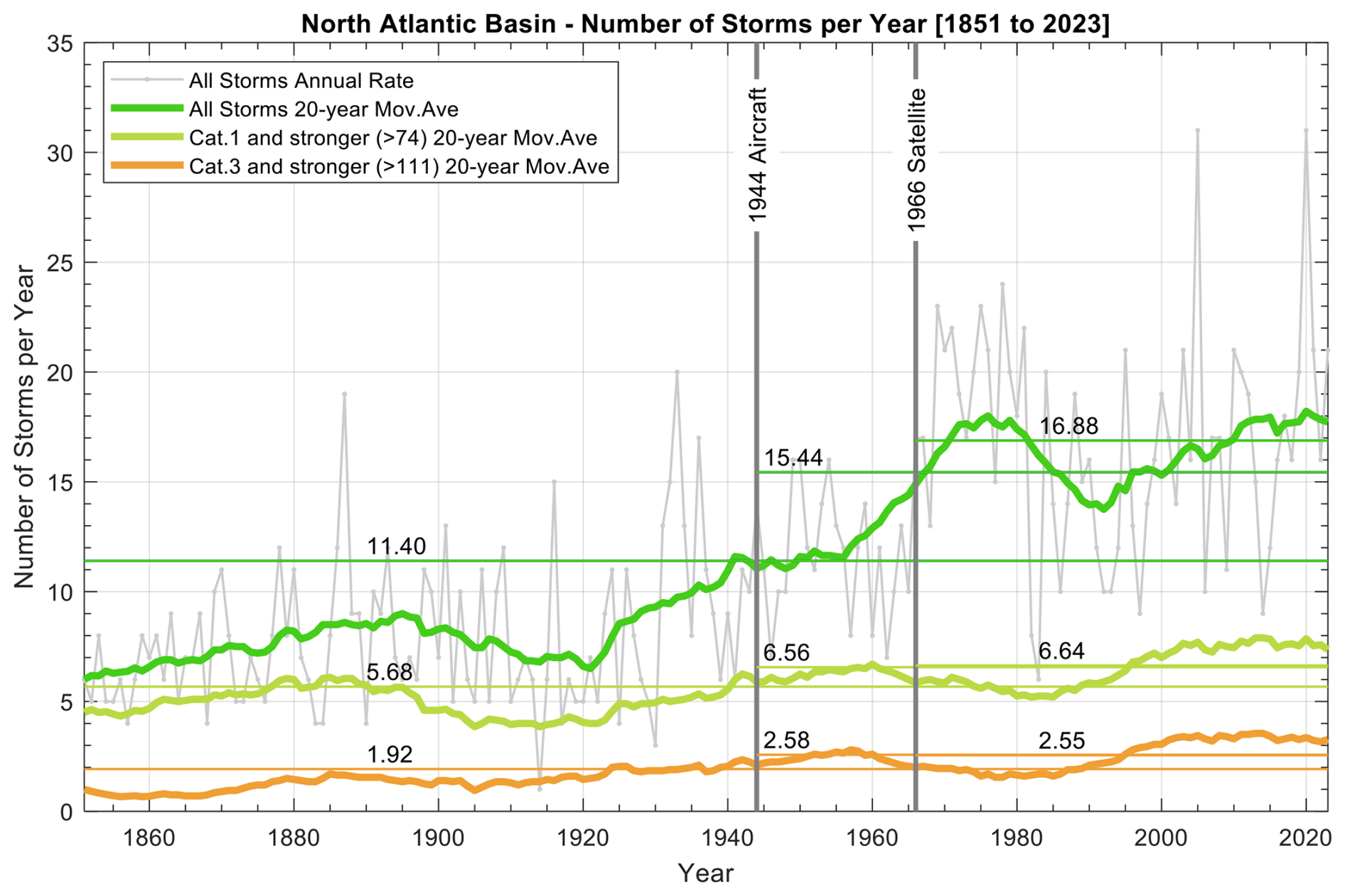
Figure 5Number of storms spawned in the Atlantic Basin per year from 1851 to 2023. “All Storms” refers to all named tropical weather systems recorded in the HURDAT2 database, including tropical depressions, tropical storms, and hurricanes. Twenty-year moving averages of storm numbers vs. time are shown for all storms, for Cat 1 and stronger (>74 mph or 33 m s−1), and for Cat 3 and stronger (>111 mph or 50 m s−1). In addition, averages of cyclone activity are shown over different time windows differentiating between earlier and modern periods of data collection, i.e., 1861 (begin of data collection), 1944 (start of aircraft reconnaissance), and 1966 (start of polar orbiting satellite coverage).
Nevertheless, between 1980 to 2020, there has been an era with increased mean TC frequency and intensity (Kossin et al., 2020; Emanuel, 2020; Elsner, 2020), slower translation speeds (Kossin, 2018; Wu et al., 2022), heavier precipitation (Touma et al., 2019; Murakami et al., 2022; Jong et al., 2024), and slower inland decay rates (Li and Chakraborty, 2020). Additionally, Bhatia et al. (2019) found that TC intensification rates have increased in the North Atlantic. Similarly, storm surge heights are found to increase due to sea level rise and stronger wind forcing, whereas ocean surface wave heights and wave energy footprint (area) have been increasing in the past several decades (Shi et al., 2024), threatening both offshore infrastructure and coastal grid connectivity.
2.2.3 Future-climate projections
The term “future-climate projections” refers to long-term alterations in the Earth's climate system driven primarily by rising temperatures (IPCC, 2021; National Research Council, 2010). Since the pre-industrial era, global surface temperatures have increased by about 1.1 °C and could rise by 3.3–5.7 °C by 2100 under high-emission scenarios (IPCC, 2021; National Climatic Data Center (NCDC), 2014; Conway, 2008). These changes may influence TC behavior, as storm development depends on warm sea surface temperature (SSTs) and persistent circulation patterns, among other factors.
For offshore wind energy, the potential for intensified TCs raises particular concern as it may require in-depth review of design standards and the incorporation of higher extreme wind and wave design reference values. The effect of intensifying TC was studied by Wen et al. (2024), who indicated that future climate may pose a greater risk for offshore wind turbines. This concern is reinforced by Zhao et al. (2025), who analyzed ERA5 reanalysis data (1940–2023) and found that oceanic 50-year return wind speeds are increasing at a rate of 0.016 m s−1 yr−1 across 63 % of coastal regions, with over 40 % of commissioned or planned offshore wind farms in Asia and Europe having already experienced winds exceeding IEC Class III design thresholds. Nonetheless, significant challenges remain in applying stochastic track simulation to offshore wind risk assessment. Key limitations include the short duration and observational biases of historical records such as HURDAT2, assumptions of stationarity in stochastic models despite non-stationary climate signals, and the need for statistical or dynamical downscaling of coarse-resolution global climate model outputs (Camargo and Wing, 2016). Additional barriers involve difficulties in representing compound hazards (wind, waves, surge, currents) due to sparse observational datasets (Hall and Jewson, 2007) and the computational intensity of high-resolution ensemble simulations. Critically, current design standards such as IEC 61400-3 (IEC, 2009) do not yet incorporate stochastic or future scenarios, creating a gap between science and practice. Recent efforts are beginning to address this gap: AI/ML models have expanded typhoon track datasets in the Northwest Pacific (Huang et al., 2020; Fang et al., 2022), classification-based models now incorporate environmental drivers, and hybrid full-track Monte Carlo frameworks have improved storm lifecycle representation (Huang et al., 2021). Engineering-focused approaches, including a probabilistic gust factor model for typhoon winds (Fang et al., 2024) and a probabilistic hurricane genesis framework for the North Atlantic under climate change (Bhowmik et al., 2023), represent important progress. Collectively, these advances underscore the need to integrate stochastic track simulations with future-climate scenarios for offshore wind hazard assessment, while simultaneously addressing data, downscaling, and uncertainty challenges. Despite continuous improvement, the coarse resolution of current GCMs (∼ 50–100 km) remains a fundamental barrier to drawing meaningful conclusions for individual wind projects. Future research should pursue several complementary strategies: (i) dynamical and statistical downscaling approaches that bridge the gap between GCM outputs and site-specific TC hazard characterization; (ii) large-ensemble high-resolution GCM experiments targeting TC-active basins to better sample rare events under future-climate conditions; (iii) integration of GCM projections with synthetic track models to produce climate-conditional hazard estimates at project-relevant scales; and (iv) development of uncertainty quantification frameworks that systematically propagate GCM uncertainties through to site-level design parameters such as V50, Hs,50, and associated return period values.
2.3 Weather-scale models
Weather-scale models provide three-dimensional deterministic views of the dynamics of historical or idealized tropical cyclones. As such, they have been extensively used for research purposes. Despite their wide use, key challenges remain, particularly the insufficient spatiotemporal resolution required to accurately capture high winds, the associated fluctuation in cyclone substructures, and the representation of turbulence dynamics. The length scale of large-scale flow features in the upper portion of the TC boundary layer has been measured at ∼ 2 km over the open ocean, with horizontal-to-vertical aspect ratios near 1 (Guimond et al., 2018; Protzko et al., 2023). Therefore, both high horizontal and vertical resolutions are required to realistically simulate hurricane intensity and turbulence. Moreover, the effective resolution of numerical models is significantly coarser than the nominal grid spacing due to numerical diffusion that dampens energy at the smallest resolved scales. While the Nyquist limit is 2Δx, the effective resolution is typically 5–7Δx (Skamarock, 2004), implying that resolving flow features of approximately 2 km may require a grid spacing of Δx≈280–400 m. However, increasing resolution is often impractical due to computational demands and the need for changes in physical parameterizations when transitioning to horizontal resolution finer than ∼ 1 km (Wyngaard, 2004). Additionally, large uncertainties exist in physics parameterizations and model setups, requiring extensive testing and expert knowledge in hurricane modeling. For example, research shows that microphysics and boundary layer schemes have a more significant impact on hurricane intensity than other physics schemes (Li and Pu, 2008; Tao et al., 2011; Wu et al., 2021; Chen, 2022; Sanchez Gomez et al., 2025a). However, an optimal configuration for one TC simulation may not work for another.
On the other hand, in the offshore environment, the coupled processes between the atmosphere, ocean, and waves significantly impact extreme events and their potential impact on wind turbines. Numerically coupling atmospheric and oceanic processes in simulation frameworks is crucial for understanding and capturing their interactions. More specifically, high SSTs fuel storm intensity, while wave effects, especially wave–current–wind misalignment, can alter the dynamics of TC boundary layer. Currently used models range from offline one-way coupling, to fully two-way coupled systems, such as the Coupled Ocean-Atmosphere-Wave-Sediment Transport (COAWST) system (Warner et al., 2010), the coupled ocean-atmosphere-wave with unstructured ocean grid (Jung et al., 2026), the Coupled Boundary Layer Air-Sea Transfer (CBLAST) Hurricane Program's Ocean-Atmosphere-Wave model (Chen et al., 2007), the operational Hurricane Weather Research and Forecasting (HWRF) model (Gopalakrishnan et al., 2010), and NOAA's latest Hurricane Analysis and Forecasting System (Gopalakrishnan et al., 2021; Hazelton et al., 2024). Other advanced models include the Integrated Forecast System (IFS) of the European Centre for Medium-Range Weather Forecasts (ECMWF) (Mogensen et al., 2017), the Non-Hydrostatic Model of the Japan Meteorological Agency (Wada et al., 2018), the Global/Regional Assimilation and Prediction System (GRAPES) of the China Meteorological Administration (Zhang and Shen, 2008), and European institutions (e.g., Denmark Technical University and Uppsala University Coupled model (UU-CM) (Wu et al., 2019)). These frameworks exchange variables interactively and have advanced TC simulation through moving nests, multiscale resolution, and wind–wave interaction. Moving nested grids for multiple storms allows for TC interactions and higher resolution (Alaka et al., 2022), reducing forecast errors compared to single-storm setups. Advances in unstructured grids enable topographic refinement around wind farms, improving resolution of localized dynamics (Jung et al., 2026). Coupled wave-induced processes like surface roughness variation, wind–wave–current interactions, and sea spray generation can influence momentum and heat and moisture fluxes during TCs. The Technical University of Denmark's recent integration of the Wave Boundary Layer Model into Simulating WAves Nearshore (SWAN) and its coupling with WRF improves wind and wave predictions under extreme conditions (Du et al., 2022; Larsén et al., 2017b, a, 2019) over the North Sea and Taiwan regions (Fischereit et al., 2023). More discussion about atmosphere–ocean–wave coupling can be found in Wang et al. (2024b). Recent coupled COAWST simulations of Hurricanes Irene and Sandy across US East Coast offshore wind lease areas have demonstrated that wind–wave misalignment can exceed 30° and that coupled simulations produce more intense hurricanes than atmosphere-only runs, suggesting that uncoupled models may underestimate risk (Thompson et al., 2025). Furthermore, Deng et al. (2024) showed that large-scale offshore wind farms can intensify tropical cyclones through surface pressure perturbations and SST warming via reduced ocean mixing, highlighting the importance of two-way TC–wind farm interactions that are not yet accounted for in current design frameworks.
An important limitation of idealized TC simulations is their tendency to produce overly symmetric vortex structures about the eye. These frameworks are typically initialized with axisymmetric profiles or rely on internal forcing methods that inherently impose symmetry, suppressing the mesoscale variability that gives rise to realistic storm asymmetries (Rotunno et al., 2009). In contrast, mesoscale simulations of historical storms naturally capture these asymmetries by representing environmental wind shear, baroclinic processes, and SST gradients. This distinction is particularly relevant for storms undergoing extra-tropical transition (ET), where asymmetries become pronounced in both wind and precipitation fields. When such processes are not represented, modeled wind fields tend to underestimate right-of-track extremes and misrepresent the spatial extent of the wind field, while ocean responses may fail to capture the strong wave field asymmetry and swell propagation patterns characteristic of transitioning storms. Future modeling frameworks should therefore prioritize representing ET processes and mesoscale–microscale coupling to produce more realistic wind and wave fields for turbines located in regions where TCs frequently undergo such transitions.
Beyond these advancements, high-frequency wind–wave coupled modeling remains critically challenging. While wave coupling may have minimal impact on the wind structure in most parts of the boundary layer under normal conditions, it becomes critical during TCs. Under typical conditions, surface roughness varies within a narrow range (e.g., 1–5 × 10⁻⁴ m), only marginally affecting wind, but during storms, roughness can increase by several orders of magnitude (e.g., from 10−4 to 2.5 × 10⁻³ m). Waves also undergo complex transitions depending on sea state, often deviating from the linear wind–wave relationships assumed in uncoupled simulations. Larsén et al. (2017b, 2019) demonstrated that improving sea state representation (e.g., fetch, wave age, and breaking processes) enhances peak wind speed predictions by several meters per second, aligning better with observations. This has significant implications for extreme wind calculations and wind turbine classification (Larsén et al., 2019). For high-resolution mesoscale modeling, fully coupled models are increasingly essential. Additionally, synchronizing wave and atmospheric data is crucial for a complete understanding of storm dynamics.
2.4 Wind profiles and coherent structures
Accurately characterizing wind turbulence in TCs and its effects across multiple scales, from mesoscale to microscale, may require the use of higher-fidelity turbulence-resolving models. Turbulence characteristics of the wind field, such as turbulence intensity, integral length scale of the flow, spatial coherence, and the mean wind structure (e.g., wind shear, wind veer), are known to modify loads on operational wind turbines (Stanislawski et al., 2023; Thomsen and Sørensen, 1999; Robertson et al., 2019; Gao et al., 2020; Doubrawa et al., 2019; Nybø et al., 2020; Eggers et al., 2003; Churchfield et al., 2012). However, wind turbine loads under high-wind conditions are often still uncertain due to TC boundary layer mean wind structure and turbulence characteristics remaining largely unknown. Turbulence data in TCs at wind turbine heights are extremely limited (Wang et al., 2024b). Dropsonde data provide valuable insights into the near-instantaneous vertical profile of the storm at a given location, enabling composite analyses that can be used to characterize the ensemble-average wind profile in TCs (Vickery et al., 2009; Zhang et al., 2011; Wang et al., 2015); however, deriving turbulence statistics, such as spatial coherence of the flow and integral length scales, from sparse vertical profiles is not possible. High-resolution airborne radar measurements, like the Imaging Wind and Rain Airborne Profiler (IWRAP), may provide additional insight into the larger scales of turbulence within the lowest portion of the TC boundary layer (Fernandez et al., 2005; Guimond et al., 2018; Protzko et al., 2023). However, the effective spatial resolution of the IWRAP (Δx≈150–250 m) may not be sufficient to fully characterize the scales of turbulence that are relevant for wind turbine design. Given the lack of observational data and the importance of the nature of turbulence to wind turbine loads, high-fidelity turbine-scale numerical simulations of the TC boundary layer are becoming prevalent to fully characterize the mean wind and turbulence structure at turbine heights.
LES-based high-fidelity simulation methods have become prevalent for simulating turbulence in TCs as they can represent the temporal evolution of the storm across a wide range of temporal and spatial scales (Bryan et al., 2017; Chen et al., 2021; Ito et al., 2017; Rotunno et al., 2009; Green and Zhang, 2015; Rozoff et al., 2023; Stern et al., 2021; Ma and Sun, 2021; Ma et al., 2024; Sanchez Gomez et al., 2023; Sanchez-Gomez et al., 2025b). LES can offer site-specific high-resolution TC wind data, which are missing in field measurements. However, it should be recognized that LES studies with grid spacings of approximately 100 m may still be too coarse to fully resolve the turbulence scales relevant to wind turbine structural loading (Sanchez-Gomez et al., 2026), particularly when considering the effective resolution of the numerical methods employed. LES domains typically span 10–100 km along the horizontal directions; however, TCs span hundreds of kilometers. Therefore, a challenge with LES is the definition of inflow conditions for the limited-area domains that realistically represent the atmospheric (wind, temperature, moisture) characteristics in TCs. There are two approaches to simulating TCs using LES: internal forcing and boundary coupling. In the internal forcing approach, the large-scale structure of TCs is represented in the LES via inertial and pressure-gradient acceleration terms added to the governing equations (Bryan et al., 2017). By representing large-scale advection and centrifugal acceleration, the LES can reproduce wind conditions far from the eyewall in TCs. However, this method is only applicable far from the eyewall, where mean vertical motions are small, and relies on user-specified tendency terms for the momentum and temperature equations to simulate an idealized storm (Bryan et al., 2017). The boundary-coupled approach prescribes atmospheric variables from a precursor simulation at the LES domain boundaries, thereby embedding the large-scale storm structure within the LES (e.g., Li et al., 2021b; Sanchez-Gomez et al., 2025b). To acquire realistic TC wind field results, coupled mesoscale models, such as the WRF model (Skamarock et al., 2019), can be integrated with microscale LES models to better simulate TC wind fields. In this way, the mesoscale model configuration captures the large-scale structure of the TC using grid spacing Δx>1 km (Fig. 6a, b), while the LES resolves the dominant turbulent structures that can directly impact wind loads on the turbine structure using much finer grid spacing (Fig. 6c,d). The boundary-coupled approach offers the flexibility to simulate idealized (Rotunno et al., 2009; Ren et al., 2020; Sanchez Gomez et al., 2023) or historical storms (Li et al., 2021b; Sanchez-Gomez et al., 2025b), enabling analyses of site-specific TC wind data. Idealized TC simulations also offer the possibility to evaluate the entire tropical lifecycle (from initial vortex to maturity) by not having to represent the storm's translation in the LES (Ito et al., 2026).
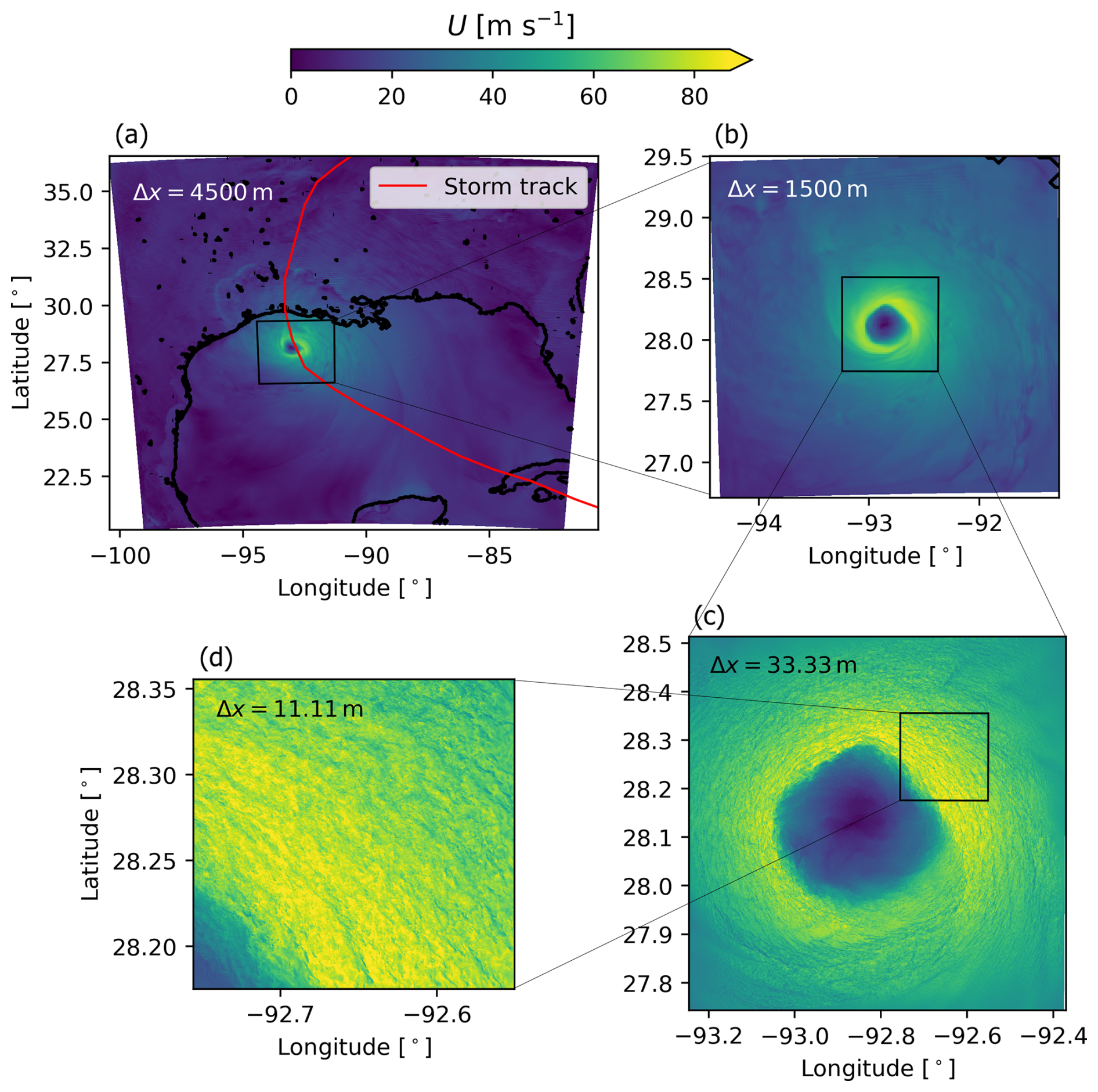
Figure 6Coupled mesoscale–microscale simulation of Hurricane Laura (2020) using the Weather Research and Forecasting model. The large-scale structure of Laura develops in a two-domain mesoscale simulation with grid spacing Δx=4.5 km (panel a) and a vortex-following grid with Δx=1.5 km (panel b). The mesoscale simulation data provide initial and boundary conditions to high-resolution microscale domains with grid spacing Δx=33.33 m (panel c) and Δx=11.11 m (panel d) using an offline coupling method, as described in Sanchez-Gomez et al. (2025b).
Although high-resolution LES of TCs can provide a faithful representation of mean wind and turbulence conditions in hurricanes, their computational cost is prohibitively high for engineering design. Engineering practice, particularly as established by international standards and guidelines, specifies synthetic turbulence models such as the Mann spectral model (Mann, 1998) and the Kaimal spectral and exponential coherence model (Kaimal et al., 1972) for the purposes of wind turbine design. However, such models may not realistically reflect the turbulence characteristics and spatial coherence of extreme TC winds. Holmes (2024) proposed an alternative turbulence model specifically designed for TC conditions, accounting for the distinct intensity and spectral characteristics of TC boundary layer turbulence. TC winds can be more turbulent and can have larger coherent structures than canonical atmosphere boundary layer (ABL) winds (R. C., 2005; Schroeder, 2003; Ma and Sun, 2021), which can induce increased aerodynamic loads on the blades, nacelle, tower, foundation, mooring system, and other supporting structures of offshore wind turbines. In turn, high-fidelity numerical simulations can be used to inform engineering wind models used for structural design.
Although significant work has focused on characterizing the large-scale structure of the TC boundary layer, key challenges remain in understanding turbulence and mean winds in TCs at turbine heights and considering its effect in wind turbine design. Mean winds in the lowest 1 km of the TC boundary layer are characterized by having large radial, azimuthal, and vertical gradients (Zhang et al., 2011; Wang et al., 2015). Exploring how these spatial gradients translate into the mean wind structure across the turbine rotor layer is still an open question. Turbulent structures are likely to also show large spatial differences, which may impact wind turbine loads; however, characterizing turbulence at turbine heights in the TC boundary layer is largely unexplored. Specific phenomena that need to be resolved for wind turbines offshore and in coastal regions include extreme winds near the eyewall, wind misalignment, shear/veer, mesoscale vortices, and rapid direction changes over short periods–each of which poses challenges for turbine structures. Precipitation, while less impactful to wind turbine structural loading than wind and waves, should also be reviewed in the context of existing studies, with observational data from typhoon cases in Japan providing valuable insight (Pfahl and Wernli, 2012; Nayak and Takemi, 2020). From an engineering perspective, wind models must accurately represent the structure of the hurricane across the turbine rotor layer to enable the understanding of the loads on individual turbines exposed to various hurricane intensities and geographic locations. Furthermore, the same engineering wind models should capture the relevant radial, azimuthal, and vertical differences in the mean wind profile and turbulence characteristics to understand how wind loads vary across a wind farm, as turbines in different positions relative to the storm's center may experience different impacts. LES data can potentially enhance existing synthetic turbulence methods used by engineers (Keith et al., 2021; Izmailov et al., 2024). Recent studies have made such attempts, particularly Müller et al. (2026), who used sonic measurements at 60 m to validate the Mann turbulence model during typhoon conditions, or the study of Müller et al. (2024), which has provided useful insights into the levels of enhanced shear and veer in the Taiwan Strait during typhoon passage. A comprehensive treatment of typhoon wind and turbulence structure and its impact on wind energy applications can be found in Müller (2025).
2.5 Parametric wind and wave models
Under TC conditions a range of metocean components – boundary layer winds, ocean surface waves, ocean currents, and high water levels (storm surge) – produce loads on offshore structures (DNV, 2018). As wind, wave, and ocean conditions are highly correlated with significant temporal variation throughout the passage of the storm, these individual metocean components should not be treated as independent variables. In particular, due to the cyclonic nature of TCs and the differing response times of the atmosphere and the ocean, metocean components can be well-aligned at some times and locations and significantly misaligned at others (Chen and Curcic, 2016). Therefore, one of the challenges for metocean conditions is to derive an appropriately extreme load combination (or set of combinations) for a given TC. This should be efficient enough to be repeatable for at least 10 to 100 000 years worth of TCs (e.g., from a synthetic TC catalog; Sect. 2.2) to develop an accurate assessment of the recurrence interval.
Inherently, coupled atmosphere–ocean–wave weather-scale models (Sect. 2.3) can provide metocean time series. However, being able to accurately represent each TC and repeat it for the large number of TCs required presents an almost prohibitive computational cost. To this end, significant research effort has been devoted to the development of reduced-order parametric TC wind field models to facilitate timely predictions. These parametric wind field models have been used in turn to force parametric wave field models (Young, 1988; Young and Burchell, 1996; Young, 1998, 2006; Young and Vinoth, 2013; Grossmann-Matheson et al., 2023, 2025). For parametric wind field models, variations include, but are not limited to, the semi-empirical model of Holland (1980) and its enhanced version (Holland et al., 2010; Fujii and Mitsuta, 1986; Willoughby et al., 2006), as well as the fully analytical model of Chavas et al. (2015), which evolved from the foundational theoretical works of Emanuel (2004) and Emanuel and Rotunno (2011). These models involve a functional form for the rotational winds based on the gradient wind balance at the top of the boundary layer. Reduction factors and frictional inflow angles are applied to reduce the wind down to the surface, and a translational component is added, usually proportional to the storm motion, to obtain the total surface wind (e.g., Schwerdt et al., 1979; Lin and Chavas, 2012; Iwamoto et al., 2023).
We note an important connection between parametric wind field models and their role as forcing inputs for coupled metocean hindcasts used in engineering design. Reconstructed wind fields based on parametric models, combined with coupled ocean models, have contributed to fundamental advances in project engineering. For instance, Powell et al. (2010) demonstrated the reconstruction of Hurricane Katrina's wind fields for storm surge and wave hindcasting, illustrating how parametric models serve as essential components in the design chain from storm characterization to structural loading. However, limitations in parametric model fidelity, particularly regarding asymmetric wind structures, boundary layer depth variations, and interactions with complex topography, can propagate into the metocean hindcast products and ultimately affect design values.
Depth-averaged boundary layer models are also employed (e.g., Vickery et al., 2009; Mudd and Vickery, 2025), which can produce additional complex features of the TC due to surface friction effects. This is particularity important as a TC approaches the coastal zone and interacts with the land surface. In addition, AI/ML models have been proposed to overcome some of the inherent assumptions of traditional parametric models. For instance, the probabilistic ML model of Loridan et al. (2017) and the deep-learning generative adversarial network (GAN) model of Mulia et al. (2023) both trained on weather-scale model data with the potential for incorporating observational data.
Ocean waves are known to be significantly larger on the right-hand side of the TC than the left due to the extended (cumulative) fetch as waves propagate with the storm motion, and tend to be swept in behind the storm center as storm motion increases and outruns the group wave speed (Young, 2017). Furthermore, the spatial extent of wave fields are larger than the wind fields because waves continue propagating once generated. The self-similarity of surface wave development under tropical cyclones has also been investigated (Kudryavtsev et al., 2021). By defining the equivalent fetch for wave growth in a TC, Young (1988) pioneered parametric models for the maximum significant wave height in a TC as a function of the maximum sustained wind speed (Vmax). Non-dimensional diagrams based on second-generation wave modeling are used to determine the spatial variation as a function of Vmax and storm motion. Additional theoretical and empirical developments also led to equations for the peak frequency, as well as for one-dimensional and directional spectra (Young, 2017). More recently, state-of-the-art parametric TC wave models have been calibrated against a large database of third-generation spectral wave model outputs, which include the effect of nonlinear source terms that transfer energy from the local wind–sea to the dominant peak waves (Grossmann-Matheson et al., 2023, 2025). ML surrogate models have also been developed that can more fully describe the potential range of wave fields for a given set of TC parameters (e.g., Qiao and Myers, 2022). This model was trained with parametric Holland model wind forcing. Future work may consider employing a unified AI/ML modeling framework for both wind and wave fields of TCs.
One key research need is improving parametric hurricane wave models to better capture the full wave spectrum and provide more comprehensive inputs for phase-resolving models. In particular, the extent to which environmental conditions outside of the local TC wind field (e.g., external wind conditions, swell) influence the sea state conditions is an open question that influences the effectiveness of parametric wave models. Some preliminary modeling by Qiao et al. (2020) suggests that, for the most intense TCs, the sea state conditions are dominated by the local TC wind field; this finding is consistent with the broader body of work establishing that the largest waves generated by TCs are wind-driven (Holthuijsen et al., 2012; Young, 2017), but these issues are not fully resolved. The sea state, complicated by the interplay of wind-driven waves and swell within the vortex tropical cyclone system, is not fully resolved (e.g., Pouplin et al., 2024). Another challenge lies in the representation of wave breaking effects, particularly in extreme TC conditions, where significant wave heights can saturate and wave growth and decay may reach equilibrium (Holthuijsen et al., 2012; Shimura et al., 2024). Additionally, for shallow waters, understanding seabed mobility, scour effects, and wave–current interactions during storms is crucial for ensuring the stability of fixed wind turbines and array and export cables. As hydrodynamic modeling continues to advance (noting that breaking and surge effects are already captured to varying degrees in current wave–current coupled models, although coupling characteristics vary in quality), future research must focus on improving the fidelity of these representations. Specific needs include better simulation of wave-breaking forces on offshore structures, improved integration of storm surge effects with wave and current models, and refined coupling methods that maintain physical consistency across the metocean system for more accurate turbine and infrastructure load predictions under extreme conditions.
2.6 Wind energy system response
2.6.1 Rotor–nacelle assembly (RNA) and tower
During tropical cyclones, wind turbines are expected to remain idle and not produce energy from the extreme winds. The blades are designed to feather or point into the wind to reduce their surface area exposure. At the same time, the yaw drive, located in the wind turbine's nacelle, continuously points the rotor into the wind to avoid large cross-wind loads. Despite such systems and protocols being in place, challenges to the structures can still occur, motivating the need for improving wind turbine aero-servo-elasticity models. These models are critical for understanding the complex interactions between aerodynamic forces and the structural dynamics of wind turbine blades and towers , ensuring the reliability of turbines in extreme wind and wave environments. Aeroelastic models such as OpenFAST (NREL, 2023), HAWC2 (Larsen and Hansen, 2007), and Bladed (DNV, 2025) have been validated for power-producing, operational conditions. However, under non-operational, idling conditions, modeling uncertainties and instabilities challenge the validity of these models, particularly due to the negative lift curve slope, experienced during deep stall. This situation can lead to local negative aerodynamic damping, resulting in divergent oscillations known as stall-induced vibrations (SIVs), especially near the first flapwise and edgewise modes.
Stall-induced vibrations during operational conditions have been studied by Hansen (2003); Riziotis et al. (2004) using modal analysis, showing differences in aerodynamic damping for forward and backward edgewise whirling modes. More recent studies have focused on parked or idling rotors, with Politis et al. (2009) investigating the stability of an isolated parked blade at various inflow angles using an eigenvalue approach and Skrzypiński and Gaunaa (2015) analyzing the stability of an elastically mounted 2-D section of a parked blade with unsteady aerodynamics. Blade-geometry-resolving simulations have also been performed to understand vortex-shedding phenomena, including the influence of tip geometry (Horcas et al., 2022). In addition, dynamic stall models are being improved to address technical challenges in modeling idling rotors (Bangga et al., 2023). Meng et al. (2025) recently demonstrated that vortex generators can mitigate stall-induced aeroelastic instabilities by reducing the yaw misalignment range susceptible to edgewise instability by approximately 23 %–30 % for the NREL 5 MW and IEA 15 MW reference turbines, offering a practical passive mitigation strategy for parked turbines during extreme wind events.
Despite existing uncertainties in modeling of idling turbines, recent studies have used engineering turbine models to simulate the impact of extreme wind events but generally for smaller turbines than the currently deployed turbines larger than 15 MW. These studies include both fixed-bottom (Worsnop et al., 2017; Kapoor et al., 2020) and floating cases (Li et al., 2021a). Xie et al. (2025) presented a comprehensive comparison of semi-submersible, spar, and tension leg platform responses under Typhoon Rammasun conditions, finding that semi-submersible platforms excel in heave suppression while spar platforms reduce displacements in five degrees of freedom. Additionally, Yang et al. (2025) investigated the unique loading conditions during typhoon eye passage, where rapid wind direction reversal induces severe wind–wave misalignment effects on floating offshore wind turbines.
2.6.2 Substructure
When considering the impact of TC events on offshore wind substructure, site-specific information is often applied. Substructure design includes the collection of historical metocean data for storm event-based frequency analysis, and load analysis is applied for a given return period. For different types of substructures (monopile, three-leg jacket, four-leg jacket, floating), textbook design methodologies (Bhattacharya, 2019) and engineering guidelines (e.g., DNV-ST-0437, 2016) are typically used. Note that accurate prediction of the extreme wave loads are associated with ultimate limit state (ULS) loads, which partially drive the dimensioning of the substructure such as thickness, outer diameter, and member length of all or individual members.
The standard procedure for extreme wave design typically relies on regular stream-function wave theory (Fenton, 1985) and assumes a linear representation of the background irregular wave spectrum. Because of its simplicity the method has gained widespread use but it also comes with notable limitations (Chaplin, 1979). This is because stream-function wave theory assumes two-dimensional wave motion, a flat bed, periodicity, and symmetry around the crest, conditions that do not necessarily reflect a real extreme wave, which is transient, irregular, and embedded in a stochastic sea state. As a result, the imposed constant wave shape may diverge significantly from the true physical characteristics of extreme events. Moreover, steep waves actively break when they exceed a certain limit, leading to peak wave loads on monopiles (Bredmose and Jacobsen, 2010), and other structures.
For wave–structure interaction, the Morison equation (Morison et al., 1950) remains a classical tool. It represents hydrodynamic loading through a drag term proportional to the square of the velocity – using a drag coefficient similar to that in steady flow – and an inertia term proportional to the horizontal acceleration of the displaced water mass. While effective for slender structures, its simplicity limits its applicability under highly nonlinear conditions where higher-order wave kinematics and viscous effects become significant (Sarpkaya, 2010). Equally important is the treatment of nonlinear structural responses, such as material plasticity, buckling, and global or local instability which influence the robustness of offshore wind turbine substructures. Similarly for floating platforms, accurately computing hydrodynamic coefficients for wave loading remains a major challenge, particularly in integrating complex time-domain models, which require high computational resources (Otter et al., 2022). Similarly, soil–structure interactions requires the application of advanced models incorporating nonlinear soil springs and true continuum 2D/3D soil models are essential, alongside the inclusion of cyclic soil response.
Finally, a small number of studies have directly assessed hurricane and typhoon impacts. Mroczek et al. (2024) proposed a conceptual design methodology for monopiles supporting the IEA 15 MW reference turbine, beginning with fatigue lifetime assessment and followed by ultimate limit state (ULS) and natural frequency analysis. They reported this sequence as more efficient, reducing design iterations, and found that fatigue-driven loads generally govern monopile sizing, except in cases where wave-breaking effects dominate ULS demands. Similarly, ultimate load analysis in typhoon-prone regions was undertaken for jacket-type offshore wind turbines by Ju et al. (2019) and for various support structures by Chi et al. (2020). The latter study examined typhoon impacts on foundation design in Taiwan, starting from natural frequency analysis and proceeding through ULS and fatigue limit state checks. The authors concluded that overall substructure geometry is neither controlled by allowable natural periods nor highly sensitive to increased return periods. However, when comparing foundation types, they showed that increasing the storm return period from 50 to 100 years leads to substantial member-level demand increases, corresponding to rises of about 30 % in maximum overturning moments for jacket structures and up to 26.8 % for monopiles.
Beyond turbines and their foundations, other critical offshore wind infrastructure components, including substations and cable systems (array cables, export cables, and landfalling cable sections), are also vulnerable to TC impacts but have received comparatively less attention in the literature. Offshore substations face risks from extreme wave crest heights that may exceed design deck clearances. While substantial work in the offshore oil and gas sector has addressed extreme wave crest characterization and wave-in-deck loading for offshore platforms and air-gap design (Forristall, 2000), important gaps remain in translating these approaches to the specific configurations, operational requirements, and exposure profiles of offshore wind substations (McElman et al., 2025). Cable systems are subject to TC-driven sediment transport and scour processes, which can vary substantially depending on storm characteristics, track, hydrodynamic forcing, and local soil conditions. These processes may result in buried cables becoming uncovered and exposed above the stable seabed (Sharples, 2011; Griffiths et al., 2023). In addition, climate-driven changes in extreme marine hazards may further increase risks to global subsea cable infrastructure (Clare et al., 2023). The characterization of TC-induced seabed mobility and its implications for cable burial depth requirements, routing, and protection strategies therefore represents an important area for future research.
3.1 Design, international standards, and technical guidelines
Turbine design is governed by structural loads that are unique to wind energy systems. The design should establish a target reliably and then assess performance considering appropriate levels of hazards throughout the intended lifetime, accounting for both the ultimate limit state and the fatigue limit state. Standard design approaches evaluate the characteristic load, S, and characteristic resistance, R, by considering their distributions, and they check structural integrity through partial load factors, α and ϕ, using the criterion αS<ϕR. Although these conditions may vary across sites and individual turbines, the IEC 61400-1 (2019a) standard establish a general design basis that can be tailored to site-specific conditions (e.g., sea state) or aligned with turbine class requirements (Class I, II, III). Within the IEC framework, multiple methods are proposed to estimate the hub-height wind speed Vhub, significant wave height Hs, and peak wave period Tp for extreme events, specifically around design conditions, i.e., 50-year return period (IEC 61400-15-1, 2024). For wind turbines installed in TC-prone regions, these same design parameters may need modification to reflect the more severe environmental conditions. A key distinction between cyclone-prone and non-cyclone-prone regions is the introduction of the Tropical T-Class reference wind speed, which sets the 50-year return-period wind speed to V50= 57 m s−1. While this new class requires higher design wind speeds, it does not provide guidance on the additional uncertainties associated with tail-event estimation, nor does it address regions where wind speeds may exceed this threshold.
An additional point of concern is that the default IEC load partial-safety factors (e.g., α, discussed earlier) are appropriate for extra-tropical regions but not for areas exposed to tropical cyclones. Such regions may require larger safety factors due to the greater variability in their extreme environmental conditions. Figure 7 schematically illustrates this variability by showing the extreme wave height (in meters) for two hypothetical sites (one extra-tropical and one tropical), and the normalized load ratio as functions of the load return period (in years). To achieve an equivalent safety level in tropical-cyclone-prone regions, the solution has been to adjust the partial safety factors. In particular, a load factor of 1.35, developed for DLC 6.1 for regions exposed to extra-tropical cyclones, may need to be increased for tropical cyclones, as schematically shown in Fig. 7. We note that load factors are governed by the probability distribution of loads and relate to the respective extreme wind-speed and wave-height probability distributions.
Probabilistic design was first introduced to the IEC standards in edition 4 of 61400-1 and also to 61400-3-1 with regards to wind–wave relationship (Annex F). We also note that Monte Carlo simulation methods for tropical cyclones have been included in the same edition of the IEC 61400-1 standard, providing an established framework for probabilistic hazard assessment. Additionally, 61400-9 supplements 61400-1 by providing appropriate methodologies and requirements for full probabilistic design taking into account specific uncertainties in not only material properties but also in environmental conditions, design models, and the degree of validation. Under a probabilistic design approach, both the load, S, and resistance, R, are variables that can be described by a distribution. A reliability-based method then calculates the probability of failure,
where M is a normally distributed variable (derived from ), μM is the mean value, σM is the standard deviation, and is the reliability index. The method works well when both load and resistance are normally distributed. However, when S or R are not normally distributed, other methods must be used. Common alternative approaches include the environmental contour (EC) method which is closely related to the first-order reliability method (FORM). Both EC and FORM work well when data can be modeled by Weibull or log-normal methods. Equally, if the reliability index, β, is chosen beforehand, the inverse first-order reliability method (IFORM) can be employed (Winterstein et al., 1993).
Finally, another important note regarding the IEC 61400-3-1 (2019b) standard, is that it provides an optional robustness check (Annex I). The robustness check applies only to the support structure and follows the same philosophy as the American Petroleum Institute (API, 2014) standards for moderate consequence of failure at a medium exposure level (L2 in ISO 19900). Consequently, the design engineer must calculate loads under 500-year return-period conditions, V500 and Hs,500 but check structural integrity by applying a unity safety factor, i.e., S500≤ϕR.
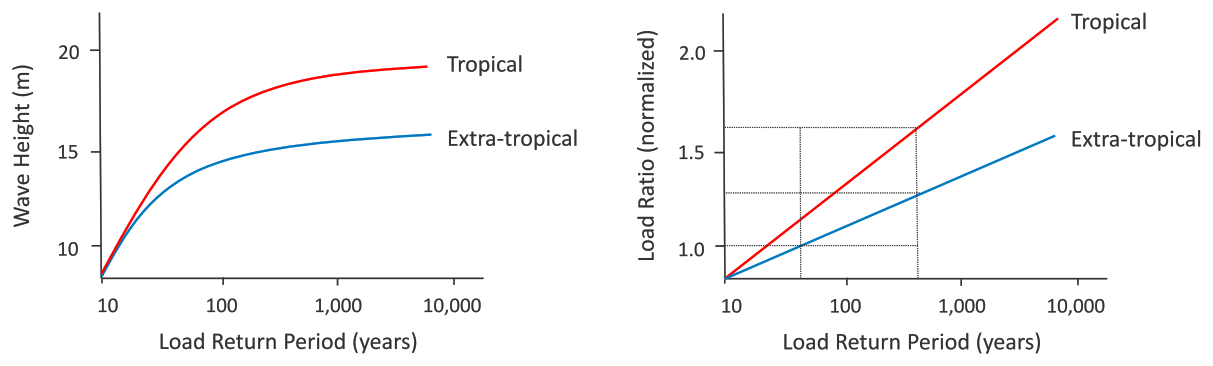
Figure 7Design wave height and IEC partial safety factors for different load return periods. Safety factors need to be adjusted from extra-tropical regions to ensure equivalent reliability in tropical cyclone regimes (Jonkman et al., 2024).
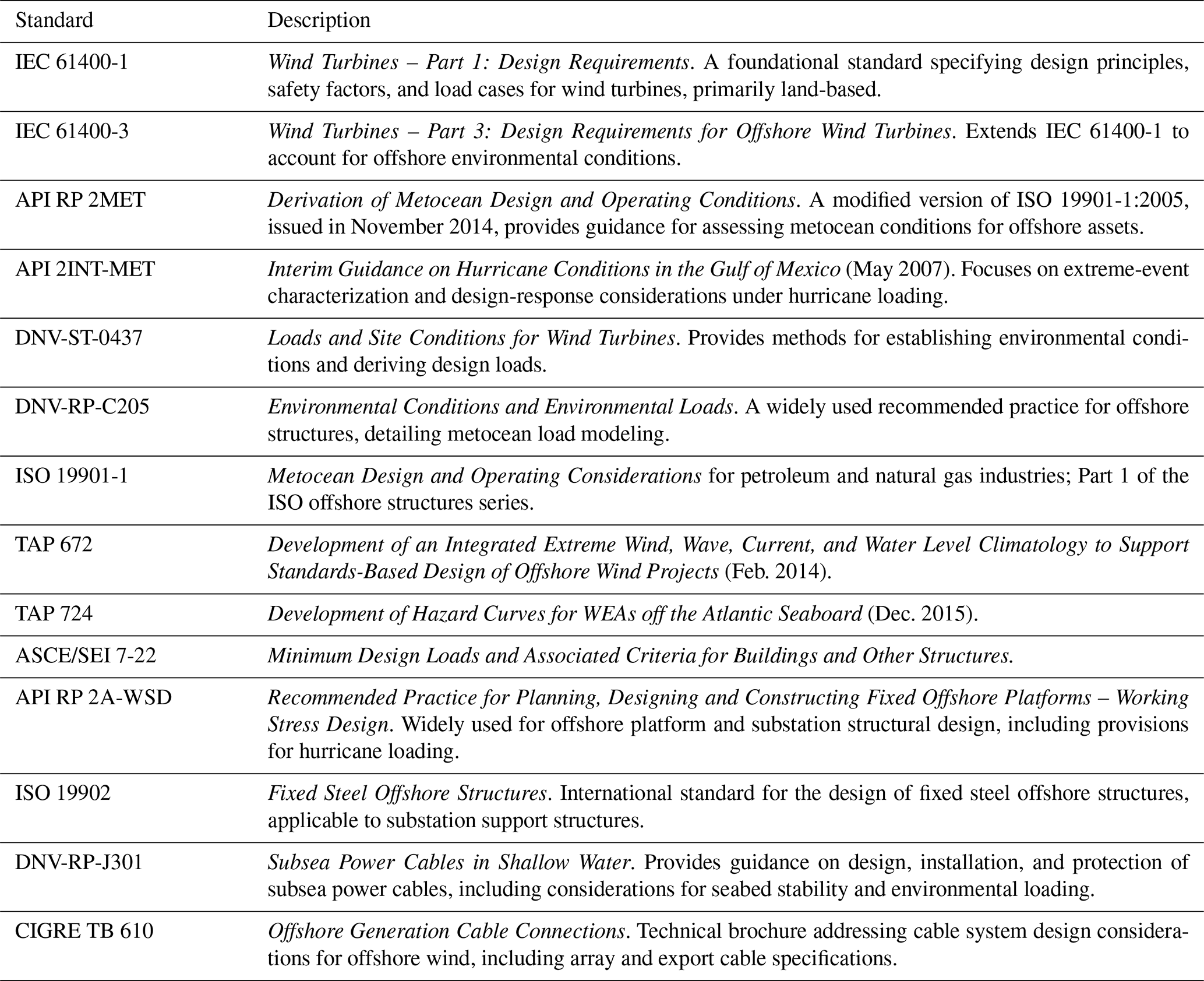
Apart from the IEC design standards, a number of additional guidelines and standards are available to design engineers (see Table 2). The American Society of Civil Engineers (ASCE) standards (, ) provide inland hazard maps for hurricane-prone regions at 10 m above sea level, while standards from the Architectural Institute of Japan (AIJ) include hazard maps along with topographic factors to be used to estimate typhoon-driven winds (Architectural Institute of Japan, 2004). Other relevant technical reports and guidelines, such as those from DNV-RP-C205 (2017) and DNV-ST-0437 (2016), focus on the determination of extreme wind and wave conditions. Both guidelines emphasize that extreme load design under TC conditions requires wind conditions at hub height, ocean surface wave characteristics, ocean currents (both surface and depth-dependent), and water levels (including storm surge) evaluated at specified return periods (e.g., 50-year, 100-year, 500-year).
Table 2Standards and guidelines widely used by engineering practitioners for wind turbine design in tropical-cyclone-prone regions.
Nonetheless, significant gaps remain in current standards and guidelines, particularly regarding the site-specific estimation of the reference wind speed V50 (e.g., Larsén et al., 2022; Larsén and Ott, 2022), the levels of wind shear and veer that should be considered (Sanchez Gomez et al., 2023), the appropriate characterization of turbulence (Sanchez Gomez et al., 2023; Sanchez-Gomez et al., 2025b), and the magnitude of extreme wave height (McElman et al., 2025), as well as the significant uncertainties inherent in extreme value analysis of wind and wave data for hurricane-prone regions (Kresning et al., 2024). Moreover, existing turbulence models, such as Mann and Kaimal, remain insufficient for accurately representing TC conditions (e.g., Müller, 2025). The definition of a “reasonable worst-case” scenario for turbine design also lacks clarity, whereas a number of questions remain regarding potential fatigue implications from multiple lower-category storms impacting a wind farm over its design lifetime (Chen et al., 2022).
An important additional consideration for TC-prone design is the compounding effect of multiple conservative assumptions throughout the design process. TC-driven wave heights are often both larger and more uncertain than their extra-tropical counterparts, requiring the use of elevated safety factors and reliability margins to account for the increased variability and uncertainty associated with TC environments (DNV-RP-C205, 2017; DNV-ST-0437, 2016). At the same time, uncertainties in derived environmental parameters, including wave periods, current profiles, directional spreading, and wave crest distributions, propagate through the metocean and structural design chain (Vanem, 2018). The interaction between these uncertainties and conservative partial safety factors can lead either to excessive conservatism and economically prohibitive over-design or, if uncertainties are underestimated, to insufficient reliability margins (Sørensen and Toft, 2017). A systematic assessment of how these compounding effects influence overall design reliability is therefore needed for offshore wind systems deployed in TC-prone regions.
Designers must also assess the total load environment with respect to site location and proximity to historical and projected storm paths. Rather than relying solely on the nearest historical storm track, best practice involves filtering synthetic storm track catalogs by proximity to the site, performing directional hazard analyses, and considering the full range of storm approach angles, translation speeds, and intensities that could affect the project location. This site-specific probabilistic approach to load environment characterization is essential for capturing the spatial variability in TC hazards across and between wind farms.
3.2 Load mitigation strategies
Load mitigation strategies for wind turbines under tropical cyclones can involve a variety of approaches aimed at reducing the impact of high winds and storm forces. Maintaining yaw and pitch control is crucial, with battery backup systems or other alternative power sources ensuring continued control during power loss. Instrumentation plays a critical role in monitoring turbine performance, diagnosing increased loads in real-time, and enabling responsive actions. Vibration control techniques, such as active, semi-active, and passive mass dampers help manage dynamic loads and reduce the risk of structural damage. Scour protection is also essential to maintain turbine stability under severe conditions.
3.2.1 Active yaw control with battery backup systems
Active yaw control supported by a dedicated battery backup system or a diesel generator represents a critical resilience feature widely adopted by the offshore wind industry. Under extreme wind conditions, rapid directional shifts of up to ±180° can occur during the passage of a tropical cyclone, and if grid power is lost, a nacelle locked in place may be exposed to severe cross-flow loading (Kim and Manuel, 2014). Such large yaw misalignment amplifies aerodynamic loads across the rotor, tower, and foundation, resulting in load extremes well beyond conventional IEC Design Load Case (DLC) 6.1 conditions (IEC 61400-1, 2019a). A properly designed battery backup system allows yaw drives to remain operable even during extended grid outages, maintaining yaw misalignment within a narrow error band (e.g., ±8°). This minimizes dynamic loading, reduces the probability of stall-induced vibrations, and mitigates the risk of catastrophic component failure under survival conditions.
The implementation of battery-powered yaw control introduces several design and operational challenges. Energy storage capacity must be sufficient to sustain yaw actuation throughout the full duration of a worst-case TC event, which may extend over many hours, including periods preceding grid failure and post-storm diagnostics. The yaw active duty cycle during storm passages is characterized by intermittent but high-power demands, as the drive system must overcome aerodynamic loads, nacelle inertia, and friction at critical moments of wind direction change. Reliability of the backup system is therefore paramount: redundancy, robust state-of-health monitoring, and integration with supervisory control and data acquisition (SCADA) systems are required to ensure that yaw functionality is available whenever needed. In this way, active yaw control with battery backup provides an effective means of reducing extreme load risks, complementing existing IEC design load cases, and ensuring turbine survivability during the demanding TC-generated metocean environments.
3.2.2 Vibration control via tuned mass dampers
Vibration control techniques, such as active, semi-active, and passive tuned mass dampers, can help mitigate dynamic loads and reduce the risk of structural damage. Offshore wind turbines suffer from large complex dynamic loads under combined extreme wind and wave impacts caused by TCs. Active tuned mass dampers, which directly impose control forces on target structures to counteract external load effects (Staino and Basu, 2012; Fitzgerald B., 2014; Li, 2024), have been shown to be effective in mitigating the dynamic responses of turbine blades and towers. However, active tuned mass dampers require actuators, sensing and controlling systems, and stable external power supplies to maintain their efficacy, which may become ineffective during extreme TCs. In comparison, semi-active tuned mass dampers can provide comparable load mitigation effects as their active counterparts, yet require orders of magnitude smaller power supply. Existing studies show that semi-active tuned mass dampers (Arrigan, 2011; Dinh, 2016; Sun, 2017, 2018; Nazokkar and Dezvareh, 2022) are effective in mitigating the dynamic loads/responses of offshore wind turbines under wind and wave impacts, structural damage and time-varying environmental conditions. In contrast with active and semi-active tuned mass dampers, passive mass dampers are more convenient (actuator, power supply, and sensing are not needed) for application and hence are extensively utilized in offshore wind turbines to mitigate the dynamic loads. Early research (Colwell and Basu, 2009; Murtagh et al., 2007; Lackner and Rotea, 2011) primarily focused on unidirectional dynamic load/response reduction. However, offshore wind turbine blades, nacelles, towers, foundations, and mooring systems always experience bidirectional or three-dimensional dynamic responses under combined wind–wave–current loads. To address this challenge, researchers (Sun and Jahangiri, 2018, 2019; Jahangiri and Sun, 2020; Jahangiri et al., 2019; Jahangiri and Sun, 2022; Jahangiri et al., 2024; Leng et al., 2023; Lei et al., 2023; Zhu et al., 2024, 2025) developed multi-directional tuned mass dampers (including inerter enhancement) to effectively mitigate the two- or three-dimensional dynamic loads/responses of offshore wind turbine blades, towers, foundations, and floating platforms exposed to wind, wave, and current loads. Although significant progress has been made in developing effective vibration control techniques for dynamic load mitigation of offshore wind turbines, the evaluation of the integrated performance of vibration control and yaw/pitch control under extreme TCs is inadequate. Future research efforts need to be focused on evaluating and improving the overall performance of vibration control techniques used in collaboration with yaw and/or pitch control during extreme TCs. Innovative dampers realized through new materials (e.g., metamaterials), novel designs, and effective control strategies are needed to maintain the structural integrity of offshore wind turbines exposed to future extreme TCs.
Emerging and theoretical solutions for load mitigation include innovative designs like downwind and teetering rotors, which alter the aerodynamic characteristics to reduce loading, and passive yaw control systems. Co-locating renewable energy sources, such as wave energy converters or solar power, as backup power during extreme conditions also shows promise. Additional strategies might involve adding material to key structures, such as turbine blades, to reinforce them against increased loading. These technologies, both available and emerging, aim to improve turbine durability and reduce the risk of damage from extreme weather events.
3.2.3 Innovative cyclone-resilient designs
Lastly, innovative cyclone-resilient designs have been proposed to deal with the extreme conditions posed by tropical cyclones. The proposed concepts include designs inspired by the structural resilience of palm trees, incorporating downwind-oriented segmented blades that deploy to capture wind during normal operation but fold together under extreme loading conditions and thus mitigating storm-induced loads (Qin et al., 2016; Ichter et al., 2016). In addition to segmentation, the use of advanced composites such as carbon fiber is expected to reduce the rotor mass by up to 50 %, allowing blade lengths approaching 200 m while alleviating cantilever loads and tower strike risks.
Despite adherence to cyclone-region design criteria, detailed risk quantification at the project and region levels is still required to understand the consequences of exceeding design limits. Today, risk assessment for wind energy projects presents several grand challenges, particularly when deciding on an appropriate framework in which to place the, often, disparate definitions and assessment of hazard, failure, and consequence that prevail in fields such as meteorology, structural and mechanical engineering, grid operations, and human ecology. This framework has proven highly successful, in the field of earthquake engineering by defining risk as a convolution of the probability of system failure or damage and the consequence of that failure or damage event, with the consequence typically being measured in monetary units such as USD (Porter, 2003; Krawinkler and Miranda, 2004; Moehle and Deierlein, 2004). In mathematical terms, the framework can be written as,
or, isolating the failure probability
where 𝔼 is the expected value function and fX and FX are functions providing the probability density and cumulative distribution of random variable X, respectively. Here IM is the intensity measure of external, potentially damaging, actions or hazards on the system (e.g., wind and wave from a cyclone), EDP is the engineering demand parameter that converts the external actions to demands on the system (e.g., bending moment in a blade root), DM is a damage measure that typically ranges from zero damage to complete system failure, and C is a consequence that maps damage measures onto financial consequence, possibly including the importance of resilience. The framework, up through the failure probability Pf can also be depicted graphically as in Fig. 8, which uses results from Hallowell et al. (2018) to illustrate the various components of the integrand of the risk calculation.
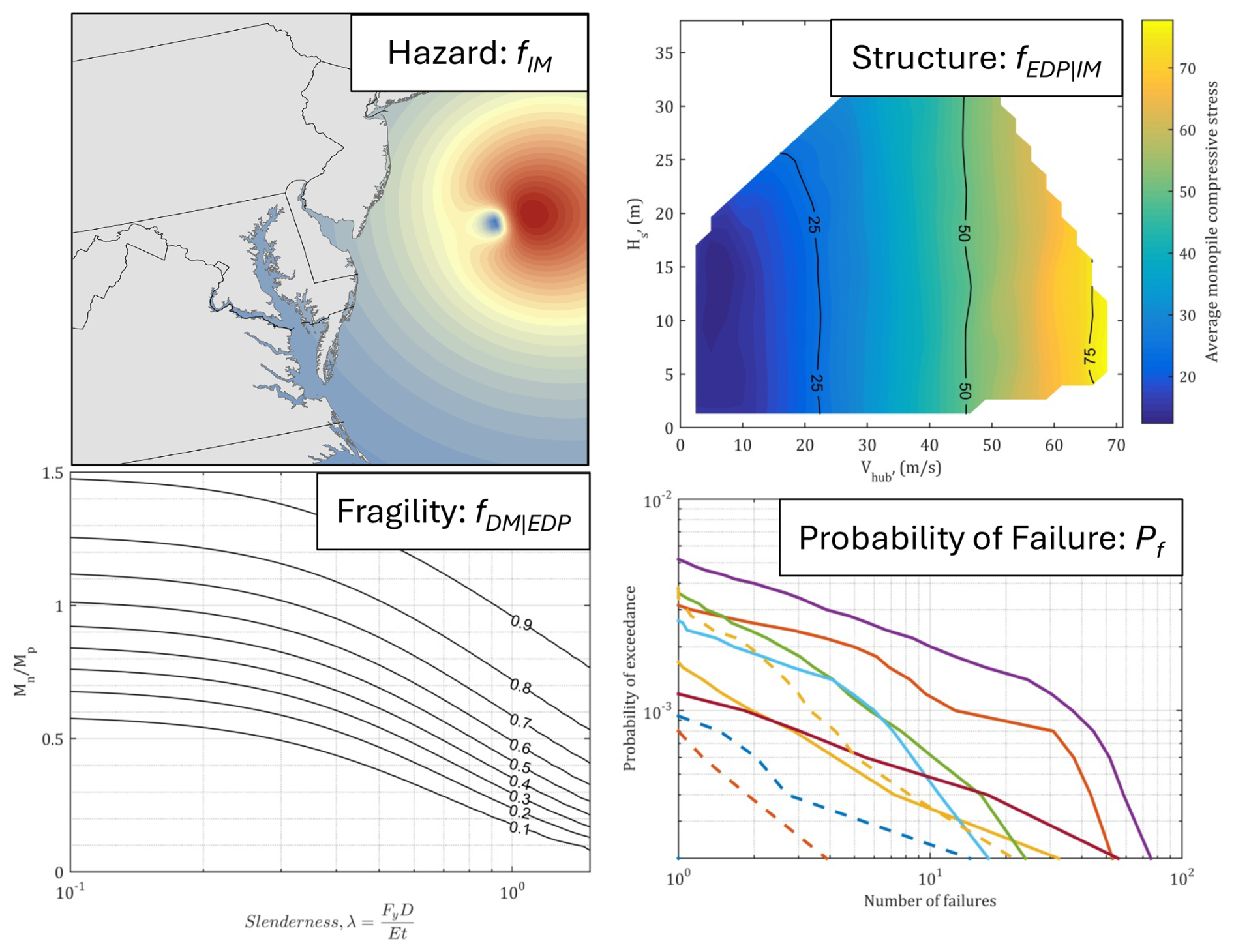
Figure 8Graphical representation of the calculation of failure probability that can be convolved with consequence to calculate risk.
While this approach to risk calculation is well established and implemented globally (including seismically active regions such as the American Pacific Coast, the East Asian Pacific Rim, and New Zealand), only a handful of studies have implemented a tropical-cyclone-driven risk quantification framework for offshore wind (Jha et al., 2010; Powell and Cocke, 2012; Rose et al., 2012a, b; Kim and Manuel, 2012; Mardfekri and Gardoni, 2013, 2015; Hallowell et al., 2018; Wilkie and Galasso, 2020). Recent work by Song et al. (2025) has advanced reliability analysis of floating offshore wind turbines by considering multiple correlated failure modes under extreme typhoon-wave conditions, demonstrating that traditional single-failure-mode analyses may underestimate the probability of structural failure. More broadly, Goteman et al. (2025) provide a comprehensive review of resilience concepts for offshore renewable energy systems under extreme metocean conditions, identifying key knowledge gaps in resilience frameworks. Even in those cases, the actual consequences were not calculated due to significant challenges in estimating the dollar cost of the consequences of the various damage states. While the integral formulation of the risk is a useful tool, significant challenges remain regarding its implementation for tropical cyclone risk to offshore wind, among which are as follows.
-
The availability of data suitable to calibrate input to the probability models required for risk calculation. For example, when assessing risk, it is essential to understand the frequency and characteristics of extreme occurrences of natural hazards, which, by definition, occur very infrequently and therefore cannot typically be sufficiently characterized by analysis of the historical record. For offshore wind infrastructure exposed to tropical cyclones, the hazard assessment must include characteristics of both wind and sea state, including, if relevant, their correlation. Some relevant information exists in the US in documents such as API-2INT-MET, but these maps are too coarse to be usable for design and assessment of risk and the correlations are not explicitly considered. There is currently no consensus on the preferred methodology for characterizing hazard and calculations must be done on an ad hoc basis.
-
The complexity of wind energy systems and the interactions among its many components as well as the need to establish and harmonize engineering- and physics-based models in the many domains that contribute to wind farm response to tropical cyclone conditions. Accurate probabilistic assessment of environmental conditions, structural loads, structural fragilities, and consequences of damage is deeply interdisciplinary, requiring expertise from structural and geotechnical engineering, mechanical engineering, controls, atmospheric science, and risk science. Knowledge from all of these domains of expertise must be represented numerically in models. Ideally, there would be a single model that sufficiently represents all of these phenomena, but no such model exists.
-
The need to incorporate human ecology aspects particularly of offshore wind response to tropical cyclones (e.g., operator response to cyclone activity affecting downtime and DM consequence), aspects in which methods of quantifying probabilities of human behavior may be completely absent or be incompatible with the mathematical formulation of risk presented above.
Each of these challenges will require substantial research to overcome so that a probabilistic risk assessment framework can be implemented for offshore wind and so that the framework can then be put to use by regulators, governments, and developers to mitigate risk.
A critical factor influencing risk quantification is the sensitivity of hazard estimates to TC track characteristics. Due to the steep spatial gradients in TC wind and wave fields, even modest shifts in storm track position can produce order-of-magnitude changes in local hazard intensity. Consequently, risk estimates are highly sensitive to track parameters including path position, angle of approach relative to the coastline, and translation speed (Lin and Emanuel, 2016). This sensitivity underscores the importance of using sufficiently large synthetic TC catalogs that adequately sample the full space of plausible track geometries and storm characteristics for a given site (Meiler et al., 2023).
A related practical question is the minimum number of synthetic events required for statistically reliable risk estimation. The answer depends on the target return period, site location, and desired confidence level. In general, catalogs spanning approximately 10 000 to 100 000 years of synthetic TC activity are typically required for robust estimation of events with return periods of 500 to 10 000 years. Shorter catalogs may yield unstable estimates in the tails of the hazard distribution, which are precisely the events most relevant for wind turbine and offshore infrastructure design (Wada et al., 2022).
5.1 Improving observational capacity
A major priority for advancing resilient wind energy design in TC-prone regions is the expansion of observational capabilities at turbine-relevant heights (20–350 m). Existing satellite, airborne, and ground-based platforms remain sparse offshore and lack the temporal resolution needed to capture long-duration time series of turbulence, wind veer, spectral coherence, and gust features that are critical for load modeling and control strategies. These limitations are compounded by the broader challenges that hinder operational use of observations, including the restricted spatial and temporal continuity of current measurements, insufficient spatiotemporal resolution to represent rapid TC-driven wind field variability, the scarcity of data within the 20–350 m a.g.l. layer, and the absence of offshore platforms situated far enough from land to provide representative sampling in open-water environments. Significant opportunities lie in deploying long-range scanning lidars and research-grade Doppler radars offshore, including configurations mounted directly on wind farm infrastructure. These systems must be capable of resolving turbulence statistics, gust factors, misalignment events, and rapid wind field transitions with the accuracy required for engineering applications, while standardized measurement protocols across basins will ensure comparability and facilitate integration of heterogeneous datasets into global design standards.
To address these gaps, a key mitigation strategy is the broader adoption of advanced remote-sensing systems, particularly customized Doppler radars and long-range scanning lidars that can deliver the required spatial coverage, temporal continuity, and sampling density across turbine-relevant heights. Mounting these instruments on offshore structures, including wind farm assets, offers a practical pathway to substantially extend observational reach and improve TC characterization over the ocean. In addition to wind measurements, improved temporal and spatial coverage of ocean current and wave observations is equally critical, as discussed further in Sect. 5.6.
5.2 Refining synthetic and probabilistic models
Synthetic track models offer an essential tool for characterizing the long-term probability of TC events, but their application to offshore wind systems is still in its infancy. Future research should validate these models against observed offshore storms, explicitly accounting for the combined impacts of wind, waves, and surge. Probabilistic hazard models also need to evolve to represent plausible future scenarios, such as more intense high category storms, slower translation speeds, and intensified rainfall. Hybrid approaches that integrate deterministic physics-based methods with emerging generative AI foundation models capable of producing stochastic ensembles (Hatanpää et al., 2025) will be especially valuable for producing synthetic catalogs that are both computationally efficient and scientifically robust. Stochastic simulation of synthetic storm tracks thus provides a critical tool for assessing TC risks in future weather conditions. When coupled with global climate models, these frameworks allow exploration of how storm frequency, intensity, and spatial distribution may evolve under different greenhouse gas emission and socioeconomic pathways (Emanuel et al., 2006; Camargo and Wing, 2016). For offshore wind applications, such integration enables site-specific quantification of risk in tropical cyclone–prone regions, including existing projects in the US Atlantic Coast, the Taiwan Strait, the South China Sea and in emerging offshore wind markets such as Japan, Korea, Vietnam, and the Philippines. Importantly, this probabilistic perspective also supports resilience-oriented infrastructure planning, offering a pathway to “future-proof” wind turbine design standards that currently rely heavily on historical climatology (IEC, 2009).
5.3 High-fidelity simulations and reduced-order models
The research landscape around high-fidelity and reduced-order models is evolving, and key studies (Bryan et al., 2017; Chen et al., 2021; Ito et al., 2017; Rotunno et al., 2009; Green and Zhang, 2015; Rozoff et al., 2023; Stern et al., 2021; Ma and Sun, 2021; Ma et al., 2024; Sanchez Gomez et al., 2023; Sanchez-Gomez et al., 2025b; Ren et al., 2020) continue to refine LES methods to simulate tropical cyclone boundary layer winds, offering new insights into the turbulence dynamics that influence wind turbine resilience. Challenges in applying these methods to real-world scenarios include balancing computational costs with the need for high-resolution data and understanding the complex interactions between wind, ocean, and wave dynamics in a TC. These advances are critical for developing resilient wind energy systems capable of withstanding the extreme conditions posed by tropical cyclones. One possible approach to reducing the computational requirements for large-eddy simulations is shifting to GPU-based simulation codes such as FastEddy (Muñoz-Esparza et al., 2020, 2022), ERF (Myers et al., 2024; Lattanzi et al., 2025), and Cloud Model 1 (Bryan and Fritsch, 2002; Bryan and Rotunno, 2009). Establishing tiered modeling frameworks where high-fidelity models inform reduced-order surrogates, which in turn inform engineering standards, thus ensures that cutting-edge science translates into practical design tools.
5.4 Redefining turbulence and load frameworks
Current turbulence models used in wind turbine design, such as the Mann and Kaimal spectra, fail to capture the elevated turbulence intensities, larger coherent structures, and rapid directional shifts observed in TCs. Future work should focus on redefining turbulence characterization for TC boundary layers, including moving beyond the standard 10 min averaging window, which may obscure damaging gusts. Engineering wind models must capture shear, veer, and coherence across the rotor layer, as well as radial and azimuthal variations around the storm (Sanchez Gomez et al., 2023; Müller, 2025). Incorporating these refined inflow models into coupled aero-hydro-servo-elastic simulations will enable more accurate prediction of loads on blades, nacelles, towers, foundations, and mooring systems during extreme events.
5.5 Loads, standards, and mitigation techniques
Existing design standards, such as the IEC 61400 series and DNV guidelines, provide partial coverage for tropical cyclone conditions but remain inadequate for site-specific hazards and turbine sizes now exceeding 15 MW. Future research should address three areas: (i) improved load case definitions that reflect cyclone-induced turbulence and wave–current misalignment; (ii) development of probabilistic safety factors tailored for tropical basins; and (iii) systematic evaluation of load mitigation strategies, including tuned mass dampers, advanced control algorithms, and innovative rotor or substructure designs. Research should also explore the integration of passive and active load mitigation methods with yaw/pitch control systems under TC conditions. Importantly, new standards must be informed by a rigorous evidence base, combining observational data, advanced simulations, and probabilistic hazard analysis to ensure turbines achieve resilience without over-design.
An additional consideration is the treatment of fatigue under TC conditions. In non-cyclone regions, fatigue damage is accumulated relatively uniformly over time because wind speeds and loads vary stochastically over the lifetime and converge to the long-term distribution. However, in TC-prone regions, a turbine either experiences a storm or it does not. Conditional on experiencing a TC, the relevant question becomes whether the structure can withstand the fatigue loading accumulated during the storm's passage. This damage should not be spread over the turbine's lifetime, nor should it be probability-weighted in the same manner as non-TC wind speeds. Therefore, fatigue survival of a TC event should be treated as an additional limit state, separate from the overall lifetime fatigue assessment. This is particularly relevant when considering the cumulative fatigue from multiple lower-category storms over a wind farm's design lifetime, as discussed in Sect. 3.1 (Chen et al., 2022). The current T-Class addition to the IEC design standard does not explicitly address this distinction, representing a gap that future standards development should resolve.
5.6 Breaking wave characterization and ocean current representation
TC-generated breaking waves represent a significant and under-characterized loading mechanism for offshore wind structures. While wave breaking and slamming loads can dominate ultimate limit state demands for monopiles in shallow to intermediate water depths, current design methods still rely heavily on simplified representations that may not capture the full complexity of TC-generated breaking conditions (Wienke and Oumeraci, 2005). The characterization of breaking wave statistics, including the probability, height, kinematics, and spatial occurrence of breaking events embedded within irregular and directionally spread TC-generated seas, remains an active area of research (McElman et al., 2025). Future work should focus on the development of improved breaking-wave models validated against TC-specific conditions and their integration into structural loading calculations for offshore wind foundations.
Similarly, the representation of ocean currents in design activities warrants greater attention. Current design practice often relies on sparse in situ measurements and reanalysis products that may not adequately capture the extreme current velocities, directional variability, and complex vertical current profiles generated during TC passage (DNV-RP-C205, 2017). The limited spatial and temporal availability of direct current and wave measurements in TC-prone offshore wind regions means that assimilated datasets and hindcast products may systematically underrepresent TC-driven environmental extremes (Cornett, 2008; Meiler et al., 2023). Wave measurements and associated spectral parameters are particularly sparse in many TC-prone basins, and the influence of observational gaps on the quality of hindcast and assimilated metocean products used for offshore wind design should be systematically assessed. Standardized protocols for ocean current and wave measurements during TC events, together with improved data assimilation techniques, are needed to reduce these uncertainties and improve the reliability of offshore wind design conditions.
5.7 Defining TC survivability
The operation and maintenance of wind energy systems in TC-prone regions hinges on a clear and broadly accepted definition of what “surviving” a tropical cyclone means. Currently, no consensus exists across academia, developers, regulators, and the insurance industry on this fundamental question. Survivability could range from purely structural survival (no collapse or irreversible damage) to full post-storm operational readiness within a specified recovery timeline. A comprehensive definition should address: (i) allowable damage states for each infrastructure component (turbines, foundations, substations, cables); (ii) maximum acceptable recovery timelines before return to power production; (iii) required post-storm inspection and certification protocols; and (iv) the relationship between design return periods and expected damage levels. Establishing such a definition through multi-stakeholder engagement is essential for enabling consistent risk communication, insurance underwriting, and regulatory frameworks for offshore wind in TC-prone regions.
5.8 Integrated risk assessment frameworks
Finally, resilient design requires the development of integrated risk frameworks that combine hazard, fragility, and consequence models into a consistent decision-making tool. Current approaches often rely on partial safety factors calibrated for extra-tropical conditions, neglecting the higher variability and cascading risks posed by TCs. Future research must establish TC-specific reliability targets, quantify material and economic costs of meeting these targets, and incorporate downtime losses into probabilistic risk frameworks. Such frameworks will provide developers, insurers, and regulators with a transparent basis for balancing upfront investment with long-term resilience. Ultimately, this integration of hazard science, engineering design, and economics will be critical to ensuring wind energy viability in cyclone-exposed regions. These efforts must also overcome major challenges, including the scarcity of suitable data for calibrating probabilistic hazard models, the lack of consensus on methodologies for characterizing extreme wind–wave conditions, and the absence of unified models capable of representing the complex interactions across atmospheric, oceanic, structural, and control-system domains. Moreover, human ecology factors, such as operator response to cyclone activity and its effects on downtime and damage consequences, must be incorporated despite limited probabilistic tools for modeling human behavior.
Wind energy is expanding rapidly into regions exposed to tropical cyclones, yet the scientific, engineering, and risk frameworks required to ensure resilient design remain under-developed. This Grand Challenges paper highlights major advances in field measurements, modeling capabilities, engineering standards, and risk quantification, while also identifying critical gaps that must be addressed.
On the observational side, significant progress has been made in deploying multi-platform systems – ranging from satellites with SAR capability to airborne radars, uncrewed systems, and ground-based Doppler lidars – yet comprehensive wind measurements at turbine-relevant altitudes (20–350 m) remain sparse, particularly offshore. Synthetic track and probabilistic storm models have matured into essential tools for estimating return periods and extreme hazards, but their application to offshore wind remains limited and insufficiently validated. Weather- and turbine-scale models, especially LES and coupled atmosphere–ocean–wave frameworks, are beginning to capture cyclone turbulence and inflow conditions with unprecedented fidelity, though their computational demands and uncertainties in parameterizations limit direct application to engineering design. Parametric models and reduced-order surrogates provide a promising bridge but require further development to capture cyclone-specific turbulence, wind–wave misalignment, and compound hazard effects.
From an engineering perspective, existing standards (IEC, DNV, API, AIJ) provide only partial coverage for tropical cyclone conditions and often rely on assumptions originally developed for extra-tropical cyclones. Default turbulence models and partial safety load factors underestimate the variability and intensity of cyclone-driven wind and waves, creating a mismatch between current design practice and site-specific hazard profiles. Advances in load mitigation strategies ranging from tuned mass dampers to advanced yaw and pitch control and novel rotor or substructure concepts offer potential pathways to reduce structural vulnerability, yet their integration into reliability-based design frameworks is still at an early stage. Finally, risk quantification remains particularly challenging: while probabilistic frameworks from earthquake engineering provide a robust template, the lack of a widely accepted wind-energy-specific hazard, fragility, and consequence data limits implementation and adoption by project developers and insurers.
Beyond the scope of this paper, several important dimensions of resilience remain largely unaddressed in the literature and warrant dedicated future investigation. These include the development of insurance and financial risk frameworks tailored to TC-exposed wind energy assets, encompassing parametric insurance products, portfolio-level risk aggregation, and the economic trade-offs between structural hardening and risk transfer. Equally important is the broader question of grid-level resilience: how TC-induced failures cascade through electrical infrastructure, the role of black-start capability and microgrids in post-storm recovery, and the integration of wind energy systems into resilience-oriented grid planning.
In conclusion, resilient wind energy development in cyclone-prone regions will require advances across multiple disciplines. Priority areas include (i) expanding and standardizing measurements at turbine-relevant scales; (ii) validating synthetic storm and climate-informed hazard models against offshore observations; (iii) developing reduced-order simulators and turbulence models that capture cyclone-specific dynamics; (iv) revising international standards to incorporate probabilistic safety factors and compound hazard effects; and (v) integrating hazard, fragility, and consequence models into transparent risk assessment frameworks. Addressing these gaps will require collaboration across atmospheric science, oceanography, engineering, and risk modeling. Through this concerted effort, wind energy systems can be designed to account for the risks associated with tropical cyclones, supporting long-term reliability in coastal and offshore regions exposed to tropical cyclones.
No data sets were used in this article.
GD conceived and led the study, coordinated the co-author contributions, and prepared the final integrated draft of the manuscript. RR and BH led the preparation of the section on field measurements and available data. WP, WJP, GD, AY, and JKL led the preparation of the section on the probabilistic and statistical description of tropical cyclones. JW, JKL, WJP, AY, and XGL led the preparation of the section on weather-scale models. JKL, MSG, and CS led the preparation of the section on wind profiles and coherent structures. WJP, AM, and SA led the preparation of the section on parametric wind and wave models. GD, MF, SA, and AM led the preparation of the section on wind energy system response. MF, AY, GD, and PV led the preparation of the section on design, international standards, and technical guidelines. MF, CS, and GD led the preparation of the section on load mitigation strategies. AM, SA, WP, and GD led the preparation of the section on risk quantification. All co-authors contributed to the recommendations for future research and reviewed and edited the final manuscript.
At least one of the (co-)authors is a member of the editorial board of Wind Energy Science. The peer-review process was guided by an independent editor, and the authors also have no other competing interests to declare.
Publisher's note: Copernicus Publications remains neutral with regard to jurisdictional claims made in the text, published maps, institutional affiliations, or any other geographical representation in this paper. The authors bear the ultimate responsibility for providing appropriate place names. Views expressed in the text are those of the authors and do not necessarily reflect the views of the publisher.
Argonne National Laboratory is a U.S. Department of Energy laboratory managed by UChicago Argonne, LLC, under Contract DE-AC02-06CH11357. X.G.L acknowledges the support from the Horizon Europe project DTWO (101146689). Chao Sun acknowledges support from the National Science Foundation (no. 2401026).
This research has been supported by the Horizon 2020 (grant no. 01146689) and the National Science Foundation (grant no. 2401026).
This paper was edited by Johan Arnqvist and reviewed by two anonymous referees.
Alaka, G. J., Zhang, X., and Gopalakrishnan, S. G.: High-Definition Hurricanes: Improving Forecasts with Storm-Following Nests, B. Am. Meteorol. Soc., 103, E680–E703, https://doi.org/10.1175/BAMS-D-20-0134.1, 2022. a
API: Derivation of Metocean Design and Operating Conditions, American Petroleum Institute, Washington, D.C., 1st edn., 2014. a
Architectural Institute of Japan: AIJ Recommendations for Loads on Buildings, Architectural Institute of Japan, Tokyo, Japan, https://www.aij.or.jp/eng/publish/wwwpub.htm (last access: 30 July 2026), 2004. a
Arrigan, J., Pakrashi, V., Basu, B., and Nagarajaiah, S.: Control of flapwise vibrations in wind turbine blades using semi-active tuned mass dampers, Struct. Control Hlth., 18, 840–851, 2011. a
ASCE/SEI 7-22: Minimum Design Loads and Associated Criteria for Buildings and Other Structures, https://doi.org/10.1061/9780784415788, 2022. a
Balaguru, K., Chang, C.-C., Leung, L. R., Foltz, G. R., Hagos, S. M., Wehner, M. F., Kossin, J. P., Ting, M., and Xu, W.: A global increase in nearshore tropical cyclone intensification, Earth's Future, 12, e2023EF004230, https://doi.org/10.1029/2023EF004230, 2024. a
Bangga, G., Carrion, M., Collier, W., and Parkinson, S.: Technical modeling challenges for large idling wind turbines, J. Phys. Conf. Ser., 2626, 012026, https://doi.org/10.1088/1742-6596/2626/1/012026, 2023. a
Batts, M. E., Simiu, E., and Russell, L. R.: Hurricane Wind Speeds in the United States, Journal of the Structural Division, 106, 2001–2016, https://doi.org/10.1061/JSDEAG.0005541, 1980. a
Bhatia, K. T., Vecchi, G. A., Knutson, T. R., Murakami, H., Kossin, J., Dixon, K. W., and Whitlock, C. E.: Recent increases in tropical cyclone intensification rates, Nat. Commun., 10, 635, https://doi.org/10.1038/s41467-019-08471-z, 2019. a
Bhattacharya, S.: Design of Foundations for Offshore Wind Turbines, John Wiley & Sons Ltd, ISBN 9781119128120, https://doi.org/10.1002/9781119128137, 2019. a
Bhowmik, S., Pang, W., and Stoner, M.: Probabilistic modeling of North Atlantic ocean hurricane spawn considering climate change, in: Proceedings of the 14th International Conference on Applications of Statistics and Probability in Civil Engineering (ICASP14), Dublin, Ireland, https://open.clemson.edu/civileng_pubs/41/ (last access: 30 July 2026), 2023. a
Bianchini, A., Bangga, G., Baring-Gould, I., Croce, A., Cruz, J. I., Damiani, R., Erfort, G., Simao Ferreira, C., Infield, D., Nayeri, C. N., Pechlivanoglou, G., Runacres, M., Schepers, G., Summerville, B., Wood, D., and Orrell, A.: Current status and grand challenges for small wind turbine technology, Wind Energ. Sci., 7, 2003–2037, https://doi.org/10.5194/wes-7-2003-2022, 2022. a
Bose, R., Pintar, A. L., and Simiu, E.: Simulation of Atlantic Hurricane Tracks and Features: A Coupled Machine Learning Approach, Artificial Intelligence for the Earth Systems, 2, 220060, https://doi.org/10.1175/AIES-D-22-0060.1, 2023. a
Bredmose, H. and Jacobsen, N.: Breaking wave impacts on offshore wind turbine foundations: Focused wave groups and CFD, in: OMAE2010, p. 20368, The American Society of Mechanical Engineers (ASME), United States, 29th International Conference on Ocean, Offshore and Arctic Engineering: Offshore Measurement and Data Interpretation, OMAE 2010; 6–11 June 2010, https://doi.org/10.1115/OMAE2010-20368, 2010. a
Bryan, G. H. and Fritsch, J. M.: A Benchmark Simulation for Moist Nonhydrostatic Numerical Models, Mon. Weather Rev., 130, 2917–2928, https://doi.org/10.1175/1520-0493(2002)130<2917:ABSFMN>2.0.CO;2, 2002. a
Bryan, G. H. and Rotunno, R.: The Maximum Intensity of Tropical Cyclones in Axisymmetric Numerical Model Simulations, Mon. Weather Rev., 137, 1770–1789, https://doi.org/10.1175/2008MWR2709.1, 2009. a
Bryan, G. H., Worsnop, R. P., Lundquist, J. K., and Zhang, J. A.: A Simple Method for Simulating Wind Profiles in the Boundary Layer of Tropical Cyclones, Bound.-Lay. Meteorol., 162, 475–502, https://doi.org/10.1007/s10546-016-0207-0, 2017. a, b, c, d
Camargo, S. J. and Wing, A. A.: Tropical cyclones in climate models, Wiley Interdisciplinary Reviews: Climate Change, 7, 211–237, 2016. a, b
Chan, P., Hon, K., and Foster, S.: Wind data collected by a fixed-wing aircraft in the vicinity of a tropical cyclone over the south China coastal waters, Meteorol. Z., 20, 313–321, https://doi.org/10.1127/0941-2948/2011/0505, 2011. a
Chang, E. K. M. and Guo, Y.: Is the number of North Atlantic tropical cyclones significantly underestimated prior to the availability of satellite observations?, Geophys. Res. Lett., 34, https://doi.org/10.1029/2007GL030169, 2007. a
Chaplin, J. R.: Developments of stream-function wave theory, Coastal Engineering, 3, 179–205, https://doi.org/10.1016/0378-3839(79)90020-6, 1979. a
Chavas, D. R., Lin, N., and Emanuel, K.: A model for the complete radial structure of the tropical cyclone wind field. Part I: Comparison with observed structure, J. Atmos. Sci., 72, 3647–3662, https://doi.org/10.1175/JAS-D-15-0014.1, 2015. a
Chen, S. S. and Curcic, M.: Ocean surface waves in Hurricane Ike (2008) and Superstorm Sandy (2012): Coupled model predictions and observations, Ocean Modell., 103, 161–176, https://doi.org/10.1016/j.ocemod.2015.08.005, 2016. a
Chen, S. S., Price, J. F., Zhao, W., Donelan, M. A., and Walsh, E. J.: The CBLAST-Hurricane Program and the Next-Generation Fully Coupled Atmosphere–Wave–Ocean Models for Hurricane Research and Prediction, B. Am. Meteorol. Soc., 88, 311–317, https://doi.org/10.1175/BAMS-88-3-311, 2007. a
Chen, X.: How Do Planetary Boundary Layer Schemes Perform in Hurricane Conditions: A Comparison With Large-Eddy Simulations, J. Adv. Model. Earth Sy., 14, e2022MS003088, https://doi.org/10.1029/2022MS003088, 2022. a
Chen, X., Li, C., and Xu, J.: Failure investigation on a coastal wind farm damaged by super typhoon: A forensic engineering study, J. Wind Eng. Ind. Aerod., 147, 132–142, https://doi.org/10.1016/j.jweia.2015.10.007, 2015. a, b, c, d
Chen, X., Li, C., and Tang, J.: Structural integrity of wind turbines impacted by tropical cyclones: A case study from China, J. Phys. Conf. Ser., 753, 042003, https://doi.org/10.1088/1742-6596/753/4/042003, 2016. a, b
Chen, X., Bryan, G. H., Zhang, J. A., Cione, J. J., and Marks, F. D.: A Framework for Simulating the Tropical Cyclone Boundary Layer Using Large-Eddy Simulation and Its Use in Evaluating PBL Parameterizations, J. Atmos. Sci., 78, 3559–3574, 2021. a, b
Chen, Y., Wu, D., Li, H., and Gao, W.: Quantifying the fatigue life of wind turbines in cyclone-prone regions, Appl. Math. Model., 110, 455–474, https://doi.org/10.1016/j.apm.2022.06.001, 2022. a, b
Chi, S.-Y., Liu, C.-J., Tan, C.-H., and Chen, Y.-H.: Study of typhoon impacts on the foundation design of offshore wind turbines in Taiwan, Proceedings of the Institution of Civil Engineers – Forensic Engineering, 173, 35–47, https://doi.org/10.1680/jfoen.19.00011, 2020. a
Chou, J.-S., Chiu, C.-K., Huang, I.-K., and Chi, K.-N.: Failure analysis of wind turbine blade under critical wind loads, Eng. Fail. Anal., 27, 99–118, https://doi.org/10.1016/j.engfailanal.2012.08.002, 2013. a, b
Churchfield, M. J., Lee, S., Michalakes, J., and Moriarty, P. J.: A numerical study of the effects of atmospheric and wake turbulence on wind turbine dynamics, J. Turbul., 13, N14, https://doi.org/10.1080/14685248.2012.668191, 2012. a
lare, M. A., Yeo, I. A., Bricheno, L., Aksenov, Y., Brown, J., Haigh, I. D., Wahl, T., Hunt, J., Sams, C., Chaytor, J., Bett, B. J., and Carter, L.: Climate change hotspots and implications for the global subsea telecommunications network, Earth-Sci. Rev., 237, 104296, https://doi.org/10.1016/j.earscirev.2022.104296, 2023. a
Clifton, A., Barber, S., Bray, A., Enevoldsen, P., Fields, J., Sempreviva, A. M., Williams, L., Quick, J., Purdue, M., Totaro, P., and Ding, Y.: Grand challenges in the digitalisation of wind energy, Wind Energ. Sci., 8, 947–974, https://doi.org/10.5194/wes-8-947-2023, 2023. a
Colwell, S. and Basu, B.: Tuned liquid column dampers in offshore wind turbines for structural control, Eng. Struct., 31, 358–368, https://doi.org/10.1016/j.engstruct.2008.09.001, 2009. a
Conway, E.: What's in a name? Global warming vs climate change, NASA, https://www.jpl.nasa.gov/news/whats-in-a-name/ (last access: 30 July 2026), 2008. a
Cornett, A.: A Global Wave and Wind Climatology for Hurricane Conditions, in: Offshore Technology Conference, https://doi.org/10.4043/19310-MS, 2008. a
Das, S.: Wind profile and structure during severe storms in the Gulf of Mexico, in: Proceedings of the ASME 2022 41st International Conference on Ocean, Offshore and Arctic Engineering (OMAE2022), oMAE2022-86835, https://doi.org/10.1115/OMAE2022-86835, 2022. a
Deng, S., Chen, S., Sui, Y., and Hu, Z.-Z.: Intensification of an Autumn Tropical Cyclone by Offshore Wind Farms in the Northern South China Sea, J. Geophys. Res.-Atmos., 129, e2024JD041489, https://doi.org/10.1029/2024JD041489, 2024. a
Désert, T., Knapp, G., and Aubrun, S.: Quantification and correction of wave-induced turbulence intensity bias for a floating LIDAR system, Remote Sensing, 13, 2973, https://doi.org/10.3390/rs13152973, 2021. a
Dinh, V.-N., Basu, B., and Nagarajaiah, S.: Semi-active control of vibrations of spar type floating offshore wind turbines, Smart Structures and Systems, 18, 683–705, https://doi.org/10.12989/sss.2016.18.4.683, 2016. a
DNV: Metocean Characterization Recommended Practices for US Offshore Wind Energy, https://tethys.pnnl.gov/publications/metocean-characterization-recommended-practices (last access: 30 July 2026), 2018. a
DNV: Bladed 4.16.4 Release Notes, DNV, release notes for Bladed version 4.16.4, https://mysoftware.dnv.com/download/public/renewables/bladed/docs/Bladed%204.16.4%20Release%20Notes.pdf (last access: 30 July 2026), 2025. a
DNV-RP-C205: Environmental Conditions and Environmental Loads, Recommended Practice, https://www.dnv.com/energy/standards-guidelines/dnv-rp-c205-environmental-conditions-and-environmental-loads/ (last access: 30 July 2026), 2017. a, b, c
DNV-ST-0437: Loads and Site Conditions for Wind Turbines, Standard, https://www.dnv.com/energy/standards-guidelines/dnv-st-0437-loads-and-site-conditions-for-wind-turbines/ (last access: 30 July 2026), 2016. a, b, c
Doubrawa, P., Churchfield, M. J., Godvik, M., and Sirnivas, S.: Load response of a floating wind turbine to turbulent atmospheric flow, Appl. Energ., 242, 1588–1599, https://doi.org/10.1016/j.apenergy.2019.01.165, 2019. a
Du, J., Larsén, X. G., Chen, S., Bolaños, R., Badger, M. B., and Yang, Y.: The impact of wind-wave coupling with WBLM on coastal storm simulations, Ocean Model., 180, 102135, https://doi.org/10.1016/j.ocemod.2022.102135, 2022. a
Eggers, A. J., Digumarthi, R., and Chaney, K.: Wind Shear and Turbulence Effects on Rotor Fatigue and Loads Control, Journal of Solar Energy Engineering, 125, 402–409, https://doi.org/10.1115/1.1629752, 2003. a
Elsner, J. B.: Continued Increases in the Intensity of Strong Tropical Cyclones, B. Am. Meteorol. Soc., 101, E1301–E1303, https://doi.org/10.1175/BAMS-D-19-0338.1, 2020. a
Emanuel, K.: Tropical Cyclone Energetics and Structure, in: Atmospheric Turbulence and Mesoscale Meteorology, edited by: Fedorovich, E., Rotunno, R., and Stevens, B., Cambridge University Press, 165–192, https://doi.org/10.1017/CBO9780511735035.010, 2004. a
Emanuel, K.: Evidence that hurricanes are getting stronger, P. Natl. Acad. Sci. USA, 117, 13194–13195, https://doi.org/10.1073/pnas.2007742117, 2020. a
Emanuel, K.: Atlantic tropical cyclones downscaled from climate reanalyses show increasing activity over past 150 years, Nat. Commun., 12, 7027, https://doi.org/10.1038/s41467-021-27364-8, 2021. a
Emanuel, K. and Rotunno, R.: Self-stratification of tropical cyclone outflow. Part I: Implications for storm structure, J. Atmos. Sci., 68, 2236–2249, https://doi.org/10.1175/JAS-D-10-05024.1, 2011. a
Emanuel, K., Ravela, S., Vivant, E., and Risi, C.: A Statistical Deterministic Approach to Hurricane Risk Assessment, B. Am. Meteorol. Soc., 87, 299–314, https://doi.org/10.1175/bams-87-3-299, 2006. a, b
Fang, G., Pang, W., and Liu, Z.: Probabilistic gust factor model of typhoon winds, J. Struct. Eng., 150, 04023205, https://doi.org/10.1061/JSENDH.STENG-11997, 2024. a
Fang, Y., Sun, Y., Zhang, L., Chen, G., Du, M., and Guo, Y.: Stochastic Simulation of Typhoon in Northwest Pacific Basin Based on Machine Learning, Comput. Intell. Neurosci., 2022, 6760944, https://doi.org/10.1155/2022/6760944, 2022. a
Fenton, J. D.: A Fifth-Order Stokes Theory for Steady Waves, J. Waterw. Port C., 111, 216–234, https://doi.org/10.1061/(ASCE)0733-950X(1985)111:2(216), 1985. a
Fernandez, D., Kerr, E., Castells, A., Carswell, J., Frasier, S., Chang, P., Black, P., and Marks, F.: IWRAP: the Imaging Wind and Rain Airborne Profiler for remote sensing of the ocean and the atmospheric boundary layer within tropical cyclones, IEEE T. Geosci. Remote, 43, 1775–1787, https://doi.org/10.1109/TGRS.2005.851640, 2005. a
Fischereit, J., Müller, S., Imberger, M., and Larsén, X.: Influence of wind farm wakes and wind-wave interactions on a typhoon over the Taiwan Strait, in: Wind Energy Science Conference, Glasgow, UK, 23–26 May, 2023. a
Fitzgerald B., B. B.: Cable connected active tuned mass dampers for control of in-plane, J. Sound Vib., 333, 5980–6004, 2014. a
Forristall, G. Z.: Wave Crest Distributions: Observations and Second-Order Theory, J. Phys. Oceanogr., 30, 1931–1943, https://doi.org/10.1175/1520-0485(2000)030<1931:WCDOAS>2.0.CO;2, 2000. a
Fujii, T. and Mitsuta, Y.: Simulation of winds in typhoons by a stochastic model, J. Wind Eng., 1986, 1–12, https://doi.org/10.5359/jawe.1986.28_1, 1986. a
Gao, L., Yang, S., Abraham, A., and Hong, J.: Effects of inflow turbulence on structural response of wind turbine blades, J. Wind Eng. Ind. Aerod., 199, 104137, https://doi.org/10.1016/j.jweia.2020.104137, 2020. a
Global Energy Monitor: Global Wind Power Tracker, February 2025 release, https://globalenergymonitor.org/projects/global-wind-power-tracker/ (last access: 17 January 2026), 2025. a
Gopalakrishnan, S., Liu, Q., Marchok, T., Sheini, D., Surgi, N., Tuleya, R., Yablonsky, R., and Zhang, X.: Hurricane Weather Research and Forecasting (HWRF) model scientific documentation, Tech. rep., https://dtcenter.org/sites/default/files/community-code/hwrf/docs/scientific_documents/HWRF_final_2-2_cm.pdf (last access: 30 July 2026), 2010. a
Gopalakrishnan, S., Hazelton, A., and Zhang, J. A.: Improving Hurricane Boundary Layer Parameterization Scheme Based on Observations, Earth and Space Science, 8, e2020EA001422, https://doi.org/10.1029/2020EA001422, 2021. a
Goteman, M., Panteli, M., Rutgersson, A., Hayez, L., Virtanen, M. J., Anvari, M., and Johansson, J.: Resilience of offshore renewable energy systems to extreme metocean conditions: A review, Renewable and Sustainable Energy Reviews, 216, 115649, https://doi.org/10.1016/j.rser.2025.115649, 2025. a
Gottschall, J., Wolken-Möhlmann, G., Viergutz, T., and Lange, B.: Results and conclusions of a floating-lidar offshore test, Enrgy Proced., 53, 156–161, https://doi.org/10.1016/j.egypro.2014.07.224, 2014. a
Green, B. W. and Zhang, F.: Idealized Large-Eddy Simulations of a Tropical Cyclone-like Boundary Layer, J. Atmos. Sci., 72, 1743–1764, 2015. a, b
Griffiths, J., Hastie, M., Franklin, R., and Johanning, L.: The offshore renewables industry may be better served by bespoke subsea cable design guidance, Frontiers in Marine Science, 10, 1030665, https://doi.org/10.3389/fmars.2023.1030665, 2023. a
Grossmann-Matheson, G., Young, I. R., Alves, J.-H., and Meucci, A.: Development and validation of a parametric tropical cyclone wave height prediction model, Ocean Eng., 283, 115353, https://doi.org/10.1016/j.oceaneng.2023.115353, 2023. a, b
Grossmann-Matheson, G., Young, I. R., Meucci, A., Alves, J.-H., and Tamizi, A.: A model for the spatial distribution of ocean wave parameters in tropical cyclones, Ocean Eng., 317, 120091, https://doi.org/10.1016/j.oceaneng.2024.120091, 2025. a, b
Guimond, S. R., Zhang, J. A., Sapp, J. W., and Frasier, S. J.: Coherent Turbulence in the Boundary Layer of Hurricane Rita (2005) during an Eyewall Replacement Cycle, J. Atmos. Sci., 75, 3071–3093, https://doi.org/10.1175/JAS-D-17-0347.1, 2018. a, b
Guy Carpenter & Company: Post-Event Report: 2025 Western North Pacific Typhoon Ragasa, Technical Report GC CAT Resource Center, Guy Carpenter & Company, https://www.guycarp.com/content/dam/guycarp-rebrand/insights-images/2025/10/10_16_2025_post_event_typoon_ragasa_clean.pdf (last access: 30 July 2026), 2025. a
Hall, T. M. and Jewson, S.: Statistical modelling of North Atlantic tropical cyclone tracks, Tellus A, 59, 486, https://doi.org/10.1111/j.1600-0870.2007.00240.x, 2007. a, b
Hallowell, S. T., Myers, A. T., Arwade, S. R., Pang, W., Rawal, P., Hines, E. M., Hajjar, J. F., Qiao, C., Valamanesh, V., Wei, K., Carswell, W., and Fontana, C. M.: Hurricane risk assessment of offshore wind turbines, Renewable Energy, 125, 234–249, https://doi.org/10.1016/j.renene.2018.02.090, 2018. a, b
Hansen, M. H.: Improved Modal Dynamics of Wind Turbines to Avoid Stall-induced Vibrations, Wind Energy, 6, 179–195, https://doi.org/10.1002/we.79, 2003. a
Hatanpää, V., Ku, E., Stock, J., Emani, M., Foreman, S., Jung, C., Madireddy, S., Nguyen, T., Sastry, V., Sinurat, R. A. O., Wheeler, S., Zheng, H., Arcomano, T., Vishwanath, V., and Kotamarthi, R.: AERIS: Argonne Earth Systems Model for Reliable and Skillful Predictions, arXiv [preprint], https://doi.org/10.48550/arXiv.2509.13523, 2025. a
Hazelton, A., Chen, X., Alaka, G. J., Alvey, G. R., Gopalakrishnan, S., and Marks, F.: Sensitivity of HAFS-B Tropical Cyclone Forecasts to Planetary Boundary Layer and Microphysics Parameterizations, Weather Forecast., 39, 655–678, https://doi.org/10.1175/WAF-D-23-0124.1, 2024. a
Hirth, B. D., Schroeder, J. L., and Guynes, J. G.: An Onshore Deployment of Advanced Dual-Doppler Radar for Wind Energy Applications, J. Phys. Conf. Ser., 2745, 012013, https://doi.org/10.1088/1742-6596/2745/1/012013, 2024. a
Holbach, H. M., Bousquet, O., Bucci, L., Chang, P., Cione, J., Ditchek, S., Doyle, J., Duvel, J.-P., Elston, J., Goni, G., Hon, K. K., Ito, K., Jelenak, Z., Lei, X., Lumpkin, R., McMahon, C. R., Reason, C., Sanabia, E., Shay, L. K., Sippel, J. A., Sushko, A., Tang, J., Tsuboki, K., Yamada, H., Zawislak, J., and Zhang, J. A.: Recent advancements in aircraft and in situ observations of tropical cyclones, Tropical Cyclone Research and Review, 12, 81–99, https://doi.org/10.1016/j.tcrr.2023.06.001, 2023. a
Holland, G. J.: An Analytic Model of the Wind and Pressure Profiles in Hurricanes, Mon. Weather Rev., 108, 1212–1218, https://doi.org/10.1175/1520-0493(1980)108<1212:AAMOTW>2.0.CO;2, 1980. a
Holland, G. J., Belanger, J. I., and Fritz, A.: A Revised Model for Radial Profiles of Hurricane Winds, Mon. Weather Rev., 138, 4393–4401, https://doi.org/10.1175/2010MWR3317.1, 2010. a
Holmes, J. D.: A turbulence model for tropical cyclones, Wind Struct., 39, 305–313, https://doi.org/10.12989/was.2024.39.4.305, 2024. a
Holthuijsen, L. H., Powell, M. D., and Pietrzak, J. D.: Wind and waves in extreme hurricanes, J. Geophys. Res.-Oceans, 117, C09003, https://doi.org/10.1029/2012JC007983, 2012. a, b
Horcas, S. G., Sørensen, N. N., Zahle, F., Pirrung, G. R., and Barlas, T.: Vibrations of wind turbine blades in standstill: Mapping the influence of the inflow angles, Phys. Fluids, 34, 054105, https://doi.org/10.1063/5.0088036, 2022. a
Huang, M., Wang, Q., and Li, Q.: Typhoon wind hazard estimation by full-track simulation with various wind intensity models, J. Wind Eng. Ind. Aerod., 218, 104792, https://doi.org/10.1016/j.jweia.2021.104792, 2021. a
Huang, W., Liu, D., and Shao, M.-K.: Stochastic simulation of tropical cyclone tracks in the Northwest Pacific with a classification model, J. Trop. Meteorol., 26, 641–653, 2020. a
Ichter, B., Steele, A., Loth, E., Moriarty, P., and Selig, M.: A morphing downwind-aligned rotor concept based on a 13-MW wind turbine, Wind Energy, 19, 625–637, 2016. a
IEC: IEC 61400-3: Design Requirements for Offshore Wind Turbines, Tech. rep., International Electrotechnical Commission, https://webstore.iec.ch/en/publication/5446 (last access: 30 July 2026), 2009. a, b
IEC 61400-1: Wind energy generation systems – Part 1: Design requirements, https://webstore.iec.ch/en/publication/26423 (last access: 30 July 2026), 2019a. a, b, c
IEC 61400-3-1: Wind energy generation systems – Part 3-1: Design requirements for fixed offshore wind turbines, https://webstore.iec.ch/en/publication/29360 (last access: 30 July 2026), 2019b. a, b, c
IEC 61400-15-1: Wind energy generation systems – Part 15-1: Site suitability input conditions for wind power plants, Final Draft International Standard (FDIS) IEC 61400-15-1 Ed.1, IEC TC 88: Wind Energy Generation Systems, Geneva, Switzerland, https://webstore.iec.ch/en/publication/29169 (last access: 30 July 2026), 2024. a
IPCC: Sixth Assessment Report (AR6): Climate Change 2021 – The Physical Science Basis, Cambridge University Press, https://doi.org/10.1017/9781009157896, 2021. a, b
Ishihara, T., Yamaguchi, A., Takahara, K., Mekaru, T., and Matsuura, S.: An analysis of damaged wind turbines by typhoon Maemi in 2003, Proc. 6th Asia-Pacific Conference on Wind Engineering (APCWE-VI), Seoul, Korea, 1413–1428, 2005. a, b, c, d
Ito, J., Oizumi, T., and Niino, H.: Near-surface coherent structures explored by large eddy simulation of entire tropical cyclones, Scientific Reports, 7, 3798, https://doi.org/10.1038/s41598-017-03848-w, 2017. a, b
Ito, J., Sakurai, Y., Tonga, L. P. S., Niino, H., and Miyamoto, Y.: Large Eddy Simulation of an Entire Tropical Cyclone From Initial Vortex to Maturity, Geophys. Res. Lett., 53, e2025GL119560, https://doi.org/10.1029/2025GL119560, 2026. a
Ito, K., Yamada, H., Yamaguchi, M., Nakazawa, T., Nagahama, N., Shimizu, K., Ohigashi, T., Shinoda, T., and Tsuboki, K.: Analysis and Forecast Using Dropsonde Data from the Inner-Core Region of Tropical Cyclone Lan (2017) Obtained during the First Aircraft Missions of T-PARCII, SOLA, 14, 105–110, https://doi.org/10.2151/sola.2018-018, 2018. a
Iwamoto, T., Takagawa, T., Shibayama, T., Esteban, M., and Mäll, M.: A proposal of a semi-empirical method for modifying the atmospheric pressure and wind fields of tropical cyclones, Coast. Eng. J., 65, 418–432, https://doi.org/10.1080/21664250.2023.2228005, 2023. a
Izmailov, A., Meeker, M., Deskos, G., and Keith, B.: DRDMannTurb: A Python package for scalable, data-drivensynthetic turbulence, Journal of Open Source Software, 9, 6838, https://doi.org/10.21105/joss.06838, 2024. a
Jahangiri, V. and Sun, C.: Three Dimensional Vibration Control of Spar-type Offshore Wind Turbines Using Multiple Tuned Mass Dampers, Ocean Eng., 206, 107196, https://doi.org/10.1016/j.oceaneng.2020.107196, 2020. a
Jahangiri, V. and Sun, C.: A novel three-dimensional nonlinear tuned mass damper and its application for reducing vibrations of offshore floating wind turbines, Ocean Eng., 250, 117371, https://doi.org/10.1016/j.oceaneng.2022.110703, 2022. a
Jahangiri, V., Sun, C., and Kong, F.: Study on a 3D pounding pendulum tuned mass damper for mitigating bi-directional vibration of offshore wind turbines, Eng. Struct., 241, 112383, https://doi.org/10.1016/j.engstruct.2021.112383, 2019. a
Jahangiri, V., Sun, C., and Babaei, H.: Application of a new two-dimensional nonlinear tuned mass damper in bi-directional vibration mitigation of wind turbine blades, Eng. Struct., 302, 117371, https://doi.org/10.1016/j.engstruct.2023.117371, 2024. a
James, M. K. and Mason, L. B.: Synthetic Tropical Cyclone Database, J. Waterw. Port C., 131, 181–192, https://doi.org/10.1061/(ASCE)0733-950X(2005)131:4(181), 2005. a
Jha, A., Dolan, D. K., Musial, W., and Smith, C.: SS: Offshore Wind Energy Special Session: On Hurricane Risk to Offshore Wind Turbines in US Waters, in: Proceedings of the Offshore Technology Conference, OTC-20811, https://doi.org/10.4043/20811-MS, OTC, 2010. a
Jong, B., Murakami, H., Delworth, T. L., and Cooke, W. F.: Contributions of Tropical Cyclones and Atmospheric Rivers to Extreme Precipitation Trends Over the Northeast US, Earth's Future, 12, e2023EF004370, https://doi.org/10.1029/2023EF004370, 2024. a
Jonkman, J., Deskos, G., and Chetan, M.: Engineering Design and Modeling of Offshore Wind Turbine Structures Under Tropical Cyclone Conditions, in: IEA Wind Task Expert Meeting (TEM #112), IEA Wind, New Brunswick, NJ, USA, conference presentation at TEM #112, Zimmerli Art Museum, 29 October, 2024. a
Ju, S.-H., Su, F.-C., Jiang, Y.-T., and Chiu, Y.-C.: Ultimate load design of jacket-type offshore wind turbines under tropical cyclones, Wind Energy, 22, 685–697, https://doi.org/10.1002/we.2315, 2019. a
Jung, C., Xue, P., Huang, C., Pringle, W., Biswas, M., Nain, G., and Wang, J.: Fully coupled, high-resolution atmosphere–ocean–wave simulations of the offshore wind energy environment during Hurricane Henri (2021), Wind Energ. Sci., 11, 1321–1341, https://doi.org/10.5194/wes-11-1321-2026, 2026. a, b
Kaimal, J. C., Wyngaard, J. C., Izumi, Y., and Coté, O. R.: Spectral characteristics of surface-layer turbulence, Q. J. Roy. Meteor. Soc., 98, 563–589, https://doi.org/10.1002/qj.49709841707, 1972. a
Kapoor, A., Ouakka, S., Arwade, S. R., Lundquist, J. K., Lackner, M. A., Myers, A. T., Worsnop, R. P., and Bryan, G. H.: Hurricane eyewall winds and structural response of wind turbines, Wind Energ. Sci., 5, 89–104, https://doi.org/10.5194/wes-5-89-2020, 2020. a
Keith, B., Khristenko, U., and Wohlmuth, B.: Learning the structure of wind: A data-driven nonlocal turbulence model for the atmospheric boundary layer, Phys. Fluids, 33, 095110, https://doi.org/10.1063/5.0064394, 2021. a
Kim, E. and Manuel, L.: A Framework for Hurricane Risk Assessment of Offshore Wind Farms, in: Proceedings of the ASME International Conference on Offshore Mechanics and Arctic Engineering (OMAE), vol. 44946, 617–622, American Society of Mechanical Engineers, Rio de Janeiro, Brazil, https://doi.org/10.1115/OMAE2012-84147, 2012. a
Kim, E. and Manuel, L.: Hurricane-Induced Loads on Offshore Wind Turbines with Considerations for Nacelle Yaw and Blade Pitch Control, Wind Engineering, 38, 413–423, https://doi.org/10.1260/0309-524X.38.4.413, 2014. a
Knapp, K. R., Kruk, M. C., Levinson, D. H., Diamond, H. J., and Neumann, C. J.: The International Best Track Archive for Climate Stewardship (IBTrACS): Unifying Tropical Cyclone Data, B. Am. Meteorol. Soc., 91, 363–376, https://doi.org/10.1175/2009BAMS2755.1, 2010. a, b, c, d
Kosović, B., Basu, S., Berg, J., Berg, L. K., Haupt, S. E., Larsén, X. G., Peinke, J., Stevens, R. J. A. M., Veers, P., and Watson, S.: Impact of atmospheric turbulence on performance and loads of wind turbines: knowledge gaps and research challenges, Wind Energ. Sci., 11, 509–555, https://doi.org/10.5194/wes-11-509-2026, 2026. a, b
Kossin, J. P.: A global slowdown of tropical-cyclone translation speed, Nature, 558, 104–107, https://doi.org/10.1038/s41586-018-0158-3, 2018. a
Kossin, J. P., Knapp, K. R., Olander, T. L., and Velden, C. S.: Global increase in major tropical cyclone exceedance probability over the past four decades, P. Natl. Acad. Sci. USA, 117, 11975–11980, https://doi.org/10.1073/pnas.1920849117, 2020. a
Krawinkler, H. and Miranda, E.: A Perspective of Performance-Based Earthquake Engineering, in: Earthquake Engineering: From Engineering Seismology to Performance-Based Engineering, edited by: Bozorgnia, Y. and Bertero, V. V., chap. 9.1, 87–104, CRC Press, Boca Raton, FL, USA, https://doi.org/10.1201/9780203486245.ch9, 2004. a
Kresning, B., Hashemi, M. R., Shirvani, A., and Hashemi, J.: Uncertainty of extreme wind and wave loads for marine renewable energy farms in hurricane-prone regions, Renewable Energy, 220, 119570, https://doi.org/10.1016/j.renene.2023.119570, 2024. a
Kudryavtsev, V., Golubkin, P., and Chapron, B.: Self-similarity of surface wave developments under tropical cyclones, J. Geophys. Res.-Oceans, 126, e2020JC016916, https://doi.org/10.1029/2020JC016916, 2021. a
Kwasinski, A.: Effects of Hurricane Maria on Renewable Energy Systems in Puerto Rico, in: 2018 7th International Conference on Renewable Energy Research and Applications (ICRERA), IEEE, Paris, 383–390, ISBN 978-1-5386-5982-3, https://doi.org/10.1109/ICRERA.2018.8566922, 2018. a, b
Lackner, M. and Rotea, M.: Passive structural control of offshore wind turbines, Wind Energy, 14, 373–388, https://doi.org/10.1002/we.426, 2011. a
Landsea, C. W. and Franklin, J. L.: Atlantic hurricane database uncertainty and presentation of a new database format, Mon. Weather Rev., 141, 3576–3592, 2013. a
Larsen, T. J. and Hansen, A. M.: How 2 HAWC2: The User's Manual, Technical Report Risø-R-1597, DTU Wind Energy, Risø National Laboratory, Roskilde, Denmark, https://orbit.dtu.dk/en/publications/how-2-hawc2-the-users-manual (last access: 30 July 2026), 2007. a
Larsén, X. G. and Ott, S.: Adjusted spectral correction method for calculating extreme winds in tropical-cyclone-affected water areas, Wind Energ. Sci., 7, 2457–2468, https://doi.org/10.5194/wes-7-2457-2022, 2022. a
Larsén, X., Bolaños, R., Du, J., Kelly, M., Kofoed-Hansen, H., Larsen, S., Karagali, I., Badger, M., Hahmann, A., Imberger, M., Tornfeldt Sørensen, J., Jackson, S., Volker, P., Svenstrup Petersen, O., Jenkins, A., and Graham, A.: Extreme winds and waves for offshore turbines: Coupling atmosphere and wave modeling for design and operation in coastal zones, DTU Wind Energy, 154, https://orbit.dtu.dk/en/publications/ (last access: 30 July 2026), 2017a. a
Larsén, X. G., Du, J., Bolaños, R., and Larsen, S.: On the impact of wind on the development of wave field during storm Britta, Ocean Dynamics, 67, 1407–1427, https://doi.org/10.1007/s10236-017-1100-1, 2017b. a, b
Larsén, X. G., Du, J., Bolaños, R., Imberger, M., Kelly, M. C., Badger, M., and Larsen, S.: Estimation of offshore extreme wind from wind-wave coupled modeling, Wind Energy, 22, 1043–1057, https://doi.org/10.1002/we.2339, 2019. a, b, c
Larsén, X., Davis, N., Hannesdóttir, Á., Kelly, M., Svenningsen, L., Slot, L., Imberger, M., Olsen, B., and Floors, R.: The Global Atlas for Siting Parameters project: Extreme wind, turbulence, and turbine classes, Wind Energy, 25, https://doi.org/10.1002/we.2771, 2022. a
Lattanzi, A., Almgren, A., Quon, E., Natarajan, M., Kosovic, B., Mirocha, J., Perry, B., Wiersema, D., Willcox, D., Yuan, X., and Zhang, W.: ERF: Energy research and forecasting model, J. Adv. Model. Earth Sy., 17, e2024MS004884, https://doi.org/10.1029/2024MS004884, 2025. a
Lee, C. Y., Tippett, M. K., Sobel, A. H., and Camargo, S. J.: An environmentally forced tropical cyclone hazard model, J. Adv. Model. Earth Sy., 10, 223–241, https://doi.org/10.1002/2017MS001186, 2018. a
Lei, Z., Liu, G., and Wen, M.: Vibration attenuation for offshore wind turbine by a 3D prestressed tuned mass damper considering the variable pitch and yaw behaviors, Ocean Eng., 281, 114741, https://doi.org/10.1016/j.oceaneng.2023.114741, 2023. a
Leng, D., Wang, R., Yang, Y., Li, Y., and Liu, G.: Study on a three-dimensional variable-stiffness TMD for mitigating bi-directional vibration of monopile offshore wind turbines, Ocean Eng., 281, 114791, https://doi.org/10.1016/j.oceaneng.2023.114791, 2023. a
Li, J., Bian, J., Ma, Y., and Jiang, Y.: Impact of Typhoons on Floating Offshore Wind Turbines: A Case Study of Typhoon Mangkhut, Journal of Marine Science and Engineering, 9, https://doi.org/10.3390/jmse9050543, 2021a. a
Li, J., Zhu, S., Zhang, J., Ma, R., and Zuo, H.: Vibration control of offshore wind turbines with a novel energy-adaptive self-powered active mass damper, Eng. Struct., 302, 117450, https://doi.org/10.1016/j.engstruct.2024.117450, 2024. a
Li, L. and Chakraborty, P.: Slower decay of landfalling hurricanes in a warming world, Nature, 587, 230–234, https://doi.org/10.1038/s41586-020-2867-7, 2020. a
Li, X. and Pu, Z.: Sensitivity of Numerical Simulation of Early Rapid Intensification of Hurricane Emily (2005) to Cloud Microphysical and Planetary Boundary Layer Parameterizations, Mon. Weather Rev., 136, 4819–4838, https://doi.org/10.1175/2008MWR2366.1, 2008. a
Li, X., Pu, Z., and Gao, Z.: Effects of Roll Vortices on the Evolution of Hurricane Harvey during Landfall, J. Atmos. Sci., 78, 1847–1867, https://doi.org/10.1175/JAS-D-20-0270.1, 2021b. a, b
Li, Z.-Q., Chen, S.-J., Ma, H., and Feng, T.: Design defect of wind turbine operating in typhoon activity zone, Eng. Fail. Anal., 27, 165–172, https://doi.org/10.1016/j.engfailanal.2012.08.013, 2013. a
Lin, N. and Chavas, D.: On hurricane parametric wind and applications in storm surge modeling, J. Geophys. Res., 117, D09120, https://doi.org/10.1029/2011JD017126, 2012. a
Lin, N. and Emanuel, K.: Grey swan tropical cyclones, Nat. Clim. Change, 6, 106–111, https://doi.org/10.1038/nclimate2777, 2016. a
Loridan, T., Crompton, R. P., and Dubossarsky, E.: A machine learning approach to modeling tropical cyclone wind field uncertainty, Mon. Weather Rev., 145, 3203–3221, https://doi.org/10.1175/MWR-D-16-0429.1, 2017. a
Ma, T. and Sun, C.: Large eddy simulation of hurricane boundary layer turbulence and its application for power transmission system, J. Wind Eng. Ind. Aerod., 210, 104520, https://doi.org/10.1016/j.jweia.2021.104520, 2021. a, b, c
Ma, T., Sun, C., and Miller, P.: Large eddy simulation of non-stationary highly turbulent hurricane boundary layer winds, Phys. Fluids, 36, 075158, https://doi.org/10.1063/5.0214627, 2024. a, b
Mann, J.: Wind field simulation, Probabilist. Eng. Mech., 13, 269–282, https://doi.org/10.1016/S0266-8920(97)00036-2, 1998. a
Mardfekri, M. and Gardoni, P.: Probabilistic Demand Models and Fragility Estimates for Offshore Wind Turbine Support Structures, Eng. Struct., 52, 478–487, 2013. a
Mardfekri, M. and Gardoni, P.: Multi-Hazard Reliability Assessment of Offshore Wind Turbines, Wind Energy, 18, 1433–1450, 2015. a
McCloskey, T. and Keller, G.: 5000 year sedimentary record of hurricane strikes on the central coast of Belize, Quatern. Int., 195, 53–68, https://doi.org/10.1016/j.quaint.2008.03.003, 2009. a
McElman, S., Verma, A. S., and Goupee, A.: Quantifying tropical-cyclone-generated waves in extreme-value-derived design for offshore wind, Wind Energ. Sci., 10, 1529–1550, https://doi.org/10.5194/wes-10-1529-2025, 2025. a, b, c
Meiler, S., Ciullo, A., Kropf, C. M., Emanuel, K., and Bresch, D. N.: Uncertainties and sensitivities in the quantification of future tropical cyclone risk, Communications Earth & Environment, 4, 371, https://doi.org/10.1038/s43247-023-00998-w, 2023. a, b, c
Meng, Q., Chen, C., Hua, X., and Yu, W.: Wind Turbine Stall-Induced Aeroelastic Instability Mitigation Using Vortex Generators, Wind Energy, 28, e70004, https://doi.org/10.1002/we.70004, 2025. a
Moehle, J. and Deierlein, G. G.: A Framework Methodology for Performance-Based Earthquake Engineering, in: Proceedings of the 13th World Conference on Earthquake Engineering, vol. 679, p. 12, WCEE, Vancouver, Canada, https://www.iitk.ac.in/nicee/wcee/article/13_679.pdf (last access: 30 July 2026), 2004. a
Mogensen, K. S., Magnusson, L., and Bidlot, J.: Tropical cyclone sensitivity to ocean coupling in the ECMWF coupled model, J. Geophys. Res.-Oceans, 122, 4392–4412, https://doi.org/10.1002/2017JC012753, 2017. a
Morison, J., Johnson, J., and Schaaf, S.: The Force Exerted by Surface Waves on Piles, J. Petrol. Technol., 2, 149–154, https://doi.org/10.2118/950149-G, 1950. a
Mouche, A., Chapron, B., Knaff, J., Zhao, Y., Zhang, B., and Combot, C.: Copolarized and Cross-Polarized SAR Measurements for High-Resolution Description of Major Hurricane Wind Structures: Application to Irma Category 5 Hurricane, J. Geophys. Res.-Oceans, 124, 3905–3922, https://doi.org/10.1029/2019JC015056, 2019. a
Mouche, A. A., Chapron, B., Zhang, B., and Husson, R.: Combined Co- and Cross-Polarized SAR Measurements Under Extreme Wind Conditions, IEEE T. Geosci. Remote, 55, 6746–6755, https://doi.org/10.1109/TGRS.2017.2732508, 2017. a
Mroczek, M. M., Arwade, S. R., Davis, M., Hallowell, S., Myers, A., Riyanto, R. D., and Pang, W.: Reference monopile designs for US East Coast sites supporting the IEA 15 MW reference turbine using a novel conceptual design methodology, Ocean Eng., 304, 117814, https://doi.org/10.1016/j.oceaneng.2024.117814, 2024. a
Mudd, L. A. and Vickery, P. J.: Gulf of Mexico hurricane hazard assessment for offshore wind energy sites, Wind Energ. Sci., 10, 2685–2703, https://doi.org/10.5194/wes-10-2685-2025, 2025. a, b
Mulia, I. E., Ueda, N., Miyoshi, T., Iwamoto, T., and Heidarzadeh, M.: A novel deep learning approach for typhoon-induced storm surge modeling through efficient emulation of wind and pressure fields, Scientific Reports, 13, 7918, https://doi.org/10.1038/s41598-023-35093-9, 2023. a
Müller, S.: Typhoon wind and turbulence structure, and its impact on wind energy application, Ph.D. thesis, DTU Wind and Energy Systems, https://backend.orbit.dtu.dk/ws/portalfiles/portal/406854858/PhD_thesis_-_Sara_Mller.pdf (last access: 30 July 2026), 2025. a, b, c
Müller, S., Larsén, X. G., and Verelst, D.: Enhanced shear and veer in the Taiwan Strait during typhoon passage, in: The Science of Making Torque from Wind (TORQUE 2024): Wind resource, wakes, and wind farms, J. Phys. Conf. Ser., 2767, 092030, https://doi.org/10.1088/1742-6596/2767/9/092030, 2024. a
Müller, S., Larsén, X. G., and Hu, F.: How well can the Mann model describe typhoon turbulence?, Wind Energ. Sci., 11, 961–981, https://doi.org/10.5194/wes-11-961-2026, 2026. a
Muñoz-Esparza, D., Sauer, J. A., Shin, H. H., Sharman, R., Kosović, B., Meech, S., Meech, S., Garcia-Sanchez, C., Steiner, M., Knievel, J., Pinto, J., and Swerdlin, S.: Inclusion of building-resolving capabilities into the FastEddy® GPU-LES model using an immersed body force method, J. Adv. Model. Earth Sy., 12, e2020MS002141, https://doi.org/10.1029/2020MS002141, 2020. a
Muñoz-Esparza, D., Becker, C., Sauer, J. A., Gagne, D. J., Schreck, J., and Kosović, B.: On the application of an observations-based machine learning parameterization of surface layer fluxes within an atmospheric large-eddy simulation model, J. Geophys. Res.-Atmos., 127, e2021JD036214, https://doi.org/10.1029/2021JD036214, 2022. a
Murakami, H., Delworth, T. L., Cooke, W. F., Kapnick, S. B., and Hsu, P.: Increasing Frequency of Anomalous Precipitation Events in Japan Detected by a Deep Learning Autoencoder, Earth's Future, 10, e2021EF002481, https://doi.org/10.1029/2021EF002481, 2022. a
Murtagh, P., Ghosh, A., Basu, B., and Broderick, B.: Passive control of wind turbine vibrations including blade/tower interaction and rotationally sampled turbulence, Wind Energy, 11, 305–317, https://doi.org/10.1002/we.249, 2007. a
Myers, A., Zhang, W., Almgren, A., Antoun, T., Bell, J., Huebl, A., and Sinn, A.: AMReX and pyAMReX: Looking beyond the exascale computing project, Int. J. High Perform. C., 38, 599–611, 2024. a
National Climatic Data Center (NCDC): Global Surface Temperature Anomalies Dataset, NOAA, https://www.ncei.noaa.gov/products/land-based-station/noaa-global-temp (last access: 30 July 2026), 2014. a
National Research Council: Advancing the Science of Climate Change, The National Academies Press, Washington, D.C., https://doi.org/10.17226/12782, 2010. a
Nayak, S. and Takemi, T.: Typhoon-induced precipitation characterization over northern Japan: a case study for typhoons in 2016, Progress in Earth and Planetary Science, 7, https://doi.org/10.1186/s40645-020-00347-x, 2020. a
Nazokkar, A. and Dezvareh, R.: Vibration control of floating offshore wind turbine using semi-active liquid column gas damper, Ocean Eng., 265, 112574, https://doi.org/10.1016/j.oceaneng.2022.112574, 2022. a
NREL: OpenFAST Documentation, https://openfast.readthedocs.io (last access: 30 July 2026), 2023. a
Nybø, A., Nielsen, F. G., Reuder, J., Churchfield, M. J., and Godvik, M.: Evaluation of different wind fields for the investigation of the dynamic response of offshore wind turbines, Wind Energy, 23, 1810–1830, https://doi.org/10.1002/we.2518, 2020. a
Otter, A., Murphy, J., Pakrashi, V., Robertson, A., and Desmond, C.: A review of modelling techniques for floating offshore wind turbines, Wind Energy, 25, 831–857, https://doi.org/10.1002/we.2701, 2022. a
Pfahl, S. and Wernli, H.: Quantifying the relevance of cyclones for precipitation extremes, J. Climate, 25, 6770–6780, 2012. a
Politis, E., Chaviaropoulos, P., Riziotis, V., Voutsinas, S., and Romero-Sanz, I.: Stability analysis of parked wind turbine blades, Proc. European Wind Energy Conference (EWEC 2009), Marseille, France, 16–19 March, 2009. a
Porter, K. A.: An Overview of PEER's Performance-Based Earthquake Engineering Methodology, in: Proc. 9th International Conference on Applications of Statistics and Probability in Civil Engineering (ICASP9), San Francisco, CA, 6–9 July, 973–980, Millpress, Rotterdam, 2003. a
Pouplin, A., Mouche, A., and Chapron, B.: Sea state under tropical cyclones, Geophys. Res. Lett., https://doi.org/10.1029/2024GL109712, 2024. a
Powell, M. D. and Cocke, S.: Hurricane Wind Fields Needed to Assess Risk to Offshore Wind Farms, P. Natl. Acad. Sci. USA, 109, E2192–E2192, 2012. a
Powell, M. D., Houston, S. H., and Reinhold, T. A.: Hurricane Andrew's landfall in South Florida. Part I: Standardizing measurements for documentation of surface wind fields, Weather Forecast., 11, 304–328, https://doi.org/10.1175/1520-0434(1996)011<0304:HALISF>2.0.CO;2, 1996. a
Powell, M. D., Murillo, S., Dodge, P., Uhlhorn, E., Gamache, J., Cardone, V., Cox, A., Otero, S., Carrasco, N., Annane, B., and St. Fleur, R.: Reconstruction of hurricane Katrina's wind fields for storm surge and wave hindcasting, Ocean Eng., 37, 26–36, https://doi.org/10.1016/j.oceaneng.2009.08.014, 2010. a
Protzko, D. E., Guimond, S. R., Jackson, C. R., Sapp, J. W., Jelenak, Z., and Chang, P. S.: Documenting Coherent Turbulent Structures in the Boundary Layer of Intense Hurricanes through Wavelet Analysis on IWRAP and SAR Data, IEEE T. Geosci. Remote, 61, 4105316, https://doi.org/10.1109/TGRS.2023.3305998, 2023. a, b
Qiao, C. and Myers, A. T.: Surrogate modeling of time-dependent metocean conditions during hurricanes, Nat. Hazards, 110, 1545–1563, https://doi.org/10.1007/s11069-021-05002-2, 2022. a
Qiao, C., Myers, A. T., and Arwade, S. R.: Validation and uncertainty quantification of metocean models for assessing hurricane risk, Wind Energy, 23, 220–234, https://doi.org/10.1002/we.2424, 2020. a
Qin, C., Loth, E., Lee, S., and Moriarty, P.: Blade Load Reduction for a 13 MW Downwind Pre-Aligned Rotor, 34th Wind Energy Symposium, AIAA SciTech Forum, https://doi.org/10.2514/6.2016-1264, 2016. a
Foster, R. C.: Why rolls are prevalent in the hurricane boundary layer, J. Atmos. Sci, 62, 2647–2661, 2005. a
Recharge News: Super Typhoon devastates wind farm on Chinese coast, https://www.rechargenews.com/wind/super-typhoon-devastates-wind-farm-on-chinese-coast/2-1-1706161 (last access: 30 July 2026), 2024. a, b
Ren, H., Dudhia, J., and Li, H.: Large-Eddy Simulation of Idealized Hurricanes at Different Sea Surface Temperatures, J. Adv. Model. Earth Sy., 12, e2020MS002057, https://doi.org/10.1029/2020MS002057, 2020. a, b
Ricciardulli, L., Howell, B., Jackson, C. R., Hawkins, J., Courtney, J., Stoffelen, A., Langlade, S., Fogarty, C., Mouche, A., Blackwell, W., Meissner, T., Heming, J., Candy, B., McNally, T., Kazumori, M., Khadke, C., and Glaiza Escullar, M. A.: Remote sensing and analysis of tropical cyclones: Current and emerging satellite sensors, Tropical Cyclone Research and Review, 12, 267–293, https://doi.org/10.1016/j.tcrr.2023.12.003, 2023. a, b
Riziotis, V. A., Voutsinas, S. G., Politis, E. S., and Chaviaropoulos, P. K.: Aeroelastic stability of wind turbines: the problem, the methods and the issues, Wind Energy, 7, 373–392, https://doi.org/10.1002/we.133, 2004. a
Robertson, A. N., Shaler, K., Sethuraman, L., and Jonkman, J.: Sensitivity analysis of the effect of wind characteristics and turbine properties on wind turbine loads, Wind Energ. Sci., 4, 479–513, https://doi.org/10.5194/wes-4-479-2019, 2019. a
Rogers, R. F., Aberson, S. D., Black, M. L., Black, P., Cione, J., Dodge, P., Dunion, J., Gamache, J., Kaplan, J., Powell, M., Shay, N., Surgi, N., and Uhlhorn, E.: The Intensity Forecasting Experiment (IFEX): A NOAA Multi-year Field Program for Improving Tropical Cyclone Intensity Forecasts, B. Am. Meteorol. Soc., 87, 1523–1537, https://doi.org/10.1175/BAMS-87-11-1523, 2006. a
Rogers, R. F., Aberson, S., Aksoy, A., Annane, B., Black, M., Cione, J., Dorst, N., Dunion, J., Gamache, J., Goldenberg, S., Gopalakrishnan, S., Kaplan, J., Klotz, B., Lorsolo, S., Marks, F., Murillo, S., Powell, M., Reasor, P., Sellwood, K., Uhlhorn, E., Vukicevic, T., Zhang, J., and Zhang, X.: NOAA'S Hurricane Intensity Forecasting Experiment: A Progress Report, B. Am. Meteorol. Soc., 94, 859–882, https://doi.org/10.1175/BAMS-D-12-00089.1, 2013. a
Rogers, R. F., Chan, P. W., Cheung, P., Lei, X., and Tang, J.: Typhoon Airborne Observational Field Campaigns in the Western North Pacific: Successes and Future Prospects, Tropical Cyclone Research and Review, https://doi.org/10.1016/j.tcrr.2025.11.009, 2025. a
Rogers, R. F., Chan, P. W., Cheung, P., Chong, M. L., Dai, Y., Niu, Z., Tang, J., and Wang, S.: Opportunities for Advancing the Understanding and Prediction of Typhoons in the South China Sea with Multi-aircraft Missions: Supertyphoon Ragasa (2025), Tropical Cyclone Research and Review, in press, 2026. a
Rose, S., Jaramillo, P., Small, M. J., Grossmann, I., and Apt, J.: Quantifying the hurricane risk to offshore wind turbines, P. Natl. Acad. Sci. USA, 109, 3247–3252, https://doi.org/10.1073/pnas.1111769109, 2012a. a
Rose, S., Jaramillo, P., Small, M. J., Grossmann, I., and Apt, J.: Reply to Powell and Cocke: On the Probability of Catastrophic Damage to Offshore Wind Farms from Hurricanes in the US Gulf Coast, P. Natl. Acad. Sci. USA, 109, E2193–E2194, 2012b. a
Rotunno, R., Chen, Y., Wang, W., Davis, C., Dudhia, J., and Holland, G. J.: Large-Eddy Simulation of an Idealized Tropical Cyclone, B. Am. Meteorol. Soc., 90, 1783–1788, 2009. a, b, c, d
Rozoff, C. M., Nolan, D. S., Bryan, G. H., Hendricks, E. A., and Knievel, J. C.: Large-Eddy Simulations of the Tropical Cyclone Boundary Layer at Landfall in an Idealized Urban Environment, J. Appl. Meteorol. Clim., 62, 1457–1478, 2023. a, b
Russell, L. R.: Probability Distributions for Hurricane Effects, Journal of the Waterways, Harbors and Coastal Engineering Division, 97, 139–154, https://doi.org/10.1061/AWHCAR.0000056, 1971. a
Sanchez Gomez, M., Lundquist, J. K., Deskos, G., Arwade, S. R., Myers, A. T., and Hajjar, J. F.: Wind Fields in Category 1–3 Tropical Cyclones Are Not Fully Represented in Wind Turbine Design Standards, J. Geophys. Res.-Atmos., 128, e2023JD039233, https://doi.org/10.1029/2023JD039233, 2023. a, b, c, d, e, f
Sanchez Gomez, M., Deskos, G., and Lundquist, J. K.: Toward Understanding the Differences between Mesoscale and Large-Eddy Simulations of Tropical Cyclones, J. Atmos. Sci., 82, 1293–1315, https://doi.org/10.1175/JAS-D-24-0131.1, 2025a. a
Sanchez-Gomez, M., Deskos, G., and Lundquist, J. K.: Turbulence-resolving simulations of Hurricane Laura (2020): Insights into extreme winds and eyewall turbulence, Q. J. Roy. Meteor. Soc., 151, e70003, https://doi.org/10.1002/qj.70003, 2025b. a, b, c, d, e, f
Sanchez-Gomez, M., Carmo, L., Churchfield, M., Jonkman, J., and Lundquist, J. K.: Long-duration large-eddy simulations of historical hurricanes for structural design load assessments, J. Phys. Conf. Ser., 3224, 022051, https://doi.org/10.1088/1742-6596/3224/2/022051, 2026. a
Sarpkaya, T.: Wave Forces on Offshore Structures, Cambridge University Press, ISBN 9780521896252, 2010. a
Schroeder, J.L., S. D.: Hurricane bonnie wind flow characteristics as determined from WEMITE, J. Wind Eng. Ind. Aerod, 91, 767–789, 2003. a
Schwerdt, R. W., Ho, F. P., and Watkins, R. R.: Meteorological Criteria for Standard Project Hurricane and Probable Maximum Hurricane Windfields, Gulf and East Coasts of the United States, https://repository.library.noaa.gov/view/noaa/6948/noaa_6948_DS1.pdf (last access: 30 July 2026), 1979. a
Sharples, M.: Offshore Electrical Cable Burial for Wind Farms: State of the Art, Standards and Guidance, BSEE TAP-671, US Department of the Interior, https://www.bsee.gov/research-record/ (last access: 30 July 2026), 2011. a
Shaw, W. J., Berg, L. K., Debnath, M., Deskos, G., Draxl, C., Ghate, V. P., Hasager, C. B., Kotamarthi, R., Mirocha, J. D., Muradyan, P., Pringle, W. J., Turner, D. D., and Wilczak, J. M.: Scientific challenges to characterizing the wind resource in the marine atmospheric boundary layer, Wind Energ. Sci., 7, 2307–2334, https://doi.org/10.5194/wes-7-2307-2022, 2022. a, b
Shi, J., Feng, X., Toumi, R., Zhang, C., Hodges, K. I., Tao, A., Zhang, W., and Zheng, J.: Global increase in tropical cyclone ocean surface waves, Nat. Commun., 15, 174, https://doi.org/10.1038/s41467-023-43532-4, 2024. a
Shimura, T., Mori, N., and Miyashita, T.: Footprint of the air-sea momentum transfer saturation observed by ocean wave buoy network in extreme tropical cyclones, Coast. Eng., 191, 104537, https://doi.org/10.1016/j.coastaleng.2024.104537, 2024. a
Skamarock, W. C.: Evaluating mesoscale NWP models using kinetic energy spectra, Mon. Weather Rev., 132, 3019–3032, https://doi.org/10.1175/MWR2830.1, 2004. a
Skamarock, W. C., Klemp, J. B., Dudhia, J., Gill, D. O., Liu, Z., Berner, J., Wang, W., Powers, J. G., Duda, M. G., Barker, D. M., and Huang, X.-Y.: A Description of the Advanced Research WRF Version 4, Tech. Rep. NCAR/TN-556+STR, National Center for Atmospheric Research, https://doi.org/10.5065/1dfh-6p97, 2019. a
Skrzypiński, W. and Gaunaa, M.: Wind turbine blade vibration at standstill conditions – the effect of imposing lag on the aerodynamic response of an elastically mounted airfoil, Wind Energy, 18, 515–527, https://doi.org/10.1002/we.1712, 2015. a
Song, Y., Hong, X., Zhang, Z., Sun, T., and Cai, Y.: Reliability analysis of floating offshore wind turbine considering multiple failure modes under extreme typhoon-wave condition, Ocean Eng., 323, 120564, https://doi.org/10.1016/j.oceaneng.2025.120564, 2025. a
Sørensen, J. D. and Toft, H. S.: Reliability-based calibration of load and resistance factors for offshore wind turbines, Eng. Struct., 150, 956–967, https://doi.org/10.1016/j.engstruct.2016.08.041, 2017. a
Staino, A. and Basu, B., N. S.: Actuator control of edgewise vibrations in wind turbine blades, J. Sound Vib., 331, 1233–1256, 2012. a
Stanislawski, B. J., Thedin, R., Sharma, A., Branlard, E., Vijayakumar, G., and Sprague, M. A.: Effect of the integral length scales of turbulent inflows on wind turbine loads, Renewable Energy, 217, 119218, https://doi.org/10.1016/j.renene.2023.119218, 2023. a
Stern, D. P., Bryan, G. H., Lee, C. Y., and Doyle, J. D.: Large-Eddy Simulations of the Tropical Cyclone Boundary Layer at Landfall in an Idealized Urban Environment, J. Appl. Meteorol. Clim., 149, 4183–4204, 2021. a, b
Sun, C.: Mitigation of offshore wind turbine responses under wind and wave loading: considering soil effects and damage, Struct. Control Hlth., 25, e2117, https://doi.org/10.1002/stc.2117, 2017. a
Sun, C.: Semi-active control of monopile offshore wind turbines under multi-hazards, Mech. Syst. Signal Pr., 99, 285–305, https://doi.org/10.1016/j.ymssp.2017.06.016, 2018. a
Sun, C. and Jahangiri, V.: Bi-directional vibration control of offshore wind turbines using a 3D pendulum tuned mass damper, Mech. Syst. Signal Pr., 105, 373–388, https://doi.org/10.1016/j.ymssp.2017.12.011, 2018. a
Sun, C. and Jahangiri, V.: Fatigue damage mitigation of offshore wind turbines under real wind and wave conditions, Eng. Struct., 178, 472–483, https://doi.org/10.1016/j.engstruct.2018.10.053, 2019. a
Tamizi, A., Young, I. R., Ribal, A., and Alves, J.-H.: Global Scatterometer Observations of the Structure of Tropical Cyclone Wind Fields, Mon. Weather Rev., 148, 4673–4692, https://doi.org/10.1175/MWR-D-20-0196.1, 2020. a
Tao, W.-K., Shi, J. J., Chen, S. S., Lang, S., Lin, P.-L., Hong, S.-Y., Peters-Lidard, C., and Hou, A.: The impact of microphysical schemes on hurricane intensity and track, Asia-Pac. J. Atmos. Sci., 47, 1–16, https://doi.org/10.1007/s13143-011-1001-z, 2011. a
Thompson, K. B., Barthelmie, R. J., and Pryor, S. C.: Hurricane impacts in the United States East Coast offshore wind energy lease areas, Wind Energ. Sci., 10, 2639–2661, https://doi.org/10.5194/wes-10-2639-2025, 2025. a
Thomsen, K. and Sørensen, P.: Fatigue loads for wind turbines operating in wakes, J. Wind Eng. Ind. Aerod., 80, 121–136, https://doi.org/10.1016/S0167-6105(98)00194-9, 1999. a
Touma, D., Stevenson, S., Camargo, S. J., Horton, D. E., and Diffenbaugh, N. S.: Variations in the Intensity and Spatial Extent of Tropical Cyclone Precipitation, Geophys. Res. Lett., 46, 13992–14002, https://doi.org/10.1029/2019GL083452, 2019. a
Vanem, E.: A review of environmental contour methods for estimating extreme environmental conditions for marine design, Ocean Eng., 158, 80–92, https://doi.org/10.1016/j.oceaneng.2018.03.035, 2018. a
Vecchi, G. A., Landsea, C., Zhang, W., Villarini, G., and Knutson, T.: Changes in Atlantic major hurricane frequency since the late-19th century, Nat. Commun., 12, 4054, https://doi.org/10.1038/s41467-021-24268-5, 2021. a
Veers, P., Dykes, K., Lantz, E., Barth, S., Bottasso, C. L., Carlson, O., Clifton, A., Green, J., Green, P., Holttinen, H., Laird, D., Lehtomäki, V., Lundquist, J. K., Manwell, J., Marquis, M., Meneveau, C., Moriarty, P., Munduate, X., Muskulus, M., Naughton, J., Pao, L., Paquette, J., Peinke, J., Robertson, A., Sanz Rodrigo, J., Sempreviva, A. M., Smith, J. C., Tuohy, A., and Wiser, R.: Grand challenges in the science of wind energy, Science, https://doi.org/10.1126/science.aau2027, 2019. a
Veers, P., Dykes, K., Basu, S., Bianchini, A., Clifton, A., Green, P., Holttinen, H., Kitzing, L., Kosovic, B., Lundquist, J. K., Meyers, J., O'Malley, M., Shaw, W. J., and Straw, B.: Grand Challenges: wind energy research needs for a global energy transition, Wind Energ. Sci., 7, 2491–2496, https://doi.org/10.5194/wes-7-2491-2022, 2022. a
Veers, P., Bottasso, C. L., Manuel, L., Naughton, J., Pao, L., Paquette, J., Robertson, A., Robinson, M., Ananthan, S., Barlas, T., Bianchini, A., Bredmose, H., Horcas, S. G., Keller, J., Madsen, H. A., Manwell, J., Moriarty, P., Nolet, S., and Rinker, J.: Grand challenges in the design, manufacture, and operation of future wind turbine systems, Wind Energ. Sci., 8, 1071–1131, https://doi.org/10.5194/wes-8-1071-2023, 2023. a
Vickery, P. J., Skerlj, P. F., and Twisdale, L. A.: Simulation of Hurricane Risk in the U.S. Using Empirical Track Model, J. Struct. Eng., 126, https://doi.org/10.1061/(ASCE)0733-9445(2000)126:10(1222), 2000. a, b
Vickery, P. J., Wadhera, D., Powell, M. D., and Chen, Y.: A hurricane boundary layer and wind field model for use in engineering applications, J. Appl. Meteorol. Clim., 48, 381–405, https://doi.org/10.1175/2008JAMC1841.1, 2009. a, b, c
Wada, A., Kanada, S., and Yamada, H.: Effect of Air-Sea Environmental Conditions and Interfacial Processes on Extremely Intense Typhoon Haiyan (2013), J. Geophys. Res.-Atmos., 123, https://doi.org/10.1029/2017JD028139, 2018. a
Wada, R., Rohmer, J., Krien, Y., and Jonathan, P.: Statistical estimation of spatial wave extremes for tropical cyclones from small data samples: validation of the STM-E approach using long-term synthetic cyclone data for the Caribbean Sea, Nat. Hazards Earth Syst. Sci., 22, 431–444, https://doi.org/10.5194/nhess-22-431-2022, 2022. a
Wang, J., Deskos, G., Pringle, W. J., Haupt, S. E., Feng, S., Berg, L. K., Churchfield, M., Biswas, M., Musial, W., Muradyan, P., Hendricks, E., Kotamarthi, R., Xue, P., Rozoff, C. M., and Bryan, G.: Impact of Tropical and Extratropical Cyclones on Future U.S. Offshore Wind Energy, B. Am. Meteorol. Soc., 105, E1506–E1513, https://doi.org/10.1175/BAMS-D-24-0080.1, 2024a. a, b
Wang, J., Hendricks, E., Rozoff, C. M., Churchfield, M., Zhu, L., Feng, S., Pringle, W. J., Biswas, M., Haupt, S. E., Deskos, G., Jung, C., Xue, P., Berg, L. K., Bryan, G., Kosovic, B., and Kotamarthi, R.: Modeling and observations of North Atlantic cyclones: Implications for U.S. Offshore wind energy, J. Renew. Sustain. Ener., 16, https://doi.org/10.1063/5.0214806, 2024b. a, b
Wang, J. J., Young, K., Hock, T., Lauritsen, D., Behringer, D., Black, M., Black, P. G., Franklin, J., Halverson, J., Molinari, J., Nguyen, L., Reale, T., Smith, J., Sun, B., Wang, Q., and Zhang, J. A.: A Long-Term, High-Quality, High-Vertical-Resolution GPS Dropsonde Dataset for Hurricane and Other Studies, B. Am. Meteorol. Soc., 96, 961–973, https://doi.org/10.1175/BAMS-D-13-00203.1, 2015. a, b
Warner, J. C., Armstrong, B., He, R., and Zambon, J. B.: Development of a Coupled Ocean–Atmosphere–Wave–Sediment Transport (COAWST) Modeling System, Ocean Modell., 35, 230–244, https://doi.org/10.1016/j.ocemod.2010.07.010, 2010. a
Wen, Z., Wang, F., Wan, J., Wang, Y., Yang F., and Guo, C.: Assessment of the tropical cyclone-induced risk on offshore wind turbines under climate change, Nat. Hazards, 120, 5811–5839, https://doi.org/10.1007/s11069-023-06390-3, 2024. a
Wienke, J. and Oumeraci, H.: Breaking wave impact force on a vertical and inclined slender pile – theoretical and large-scale model investigations, Coast. Eng., 52, 435–462, https://doi.org/10.1016/j.coastaleng.2004.12.008, 2005. a
Wilkie, D. and Galasso, C.: A probabilistic framework for offshore wind turbine loss assessment, Renewable Energy, 147, 1772–1783, https://doi.org/10.1016/j.renene.2019.09.043, 2020. a
Willoughby, H. E., Darling, R. W. R., and Rahn, M. E.: Parametric representation of the primary hurricane vortex. Part II: A new family of sectionally continuous profiles, Mon. Weather Rev., 134, 1102–1120, https://doi.org/10.1175/MWR3106.1, 2006. a
Wind Power Monthly: Typhoon Malakas damages projects in southern Japan, https://www.windpowermonthly.com/article/1409615?website&utm_medium=social (last access: 30 July 2026), 2016. a
Winterstein, S., Ude, T., Cornell, C., Bjerager, P., and Haver, S.: Environmental parameters for extreme response: inverse FORM with omission factors, Proc. of Intl. Conf. on Structural Safety and Reliability (ICOSSAR93), Innsbruck, Austria, 9–13 August, Balkema, Rotterdam, 1993. a
Worsnop, R. P., Lundquist, J. K., Bryan, G. H., Damiani, R., and Musial, W.: Gusts and shear within hurricane eyewalls can exceed offshore wind turbine design standards, Geophys. Res. Lett., 44, 6413–6420, https://doi.org/10.1002/2017GL073537, 2017. a
Wu, D., Zhang, F., Chen, X., Ryzhkov, A., Zhao, K., Kumjian, M. R., Chen, X., and Chan, P.-W.: Evaluation of Microphysics Schemes in Tropical Cyclones Using Polarimetric Radar Observations: Convective Precipitation in an Outer Rainband, Mon. Weather Rev., 149, 1055–1068, https://doi.org/10.1175/MWR-D-19-0378.1, 2021. a
Wu, K., Wang, C., Wu, L., Zhao, H., and Cao, J.: Slowdown in Landfalling Tropical Cyclone Motion in South China, Geophys. Res. Lett., 49, e2022GL100428, https://doi.org/10.1029/2022GL100428, 2022. a
Wu, L., Breivik, Ã., and Rutgersson, A.: Ocean-Wave-Atmosphere Interaction Processes in a Fully Coupled Modeling System, J. Adv. Model. Earth Sy., 11, 3852–3874, https://doi.org/10.1029/2019MS001761, 2019. a
Wyngaard, J. C.: Toward Numerical Modeling in the “Terra Incognita”, J. Atmos. Sci., 61, 1816–1826, https://doi.org/10.1175/1520-0469(2004)061<1816:TNMITT>2.0.CO;2, 2004. a
Xie, J., Wang, H., Cai, X., Xin, Z., Ren, L., and Cai, M.: Comprehensive analysis of the typhoon-induced impact on large offshore wind turbines using different floating platforms, Ocean Eng., 342, 122880, https://doi.org/10.1016/j.oceaneng.2025.122880, 2025. a
Xu, W., Balaguru, K., Judi, D. R., Rice, J., Leung, L. R., and Lipari, S.: A North Atlantic synthetic tropical cyclone track, intensity, and rainfall dataset, Sci. Data, 11, 130, https://doi.org/10.1038/s41597-024-02952-7, 2024. a
Yang, C.-Y., Tzeng, Y.-A., Jhan, Y.-T., Cheng, C.-W., and Yang, S.-H.: Typhoon Eye-Induced Misalignment Effects on the Serviceability of Floating Offshore Wind Turbines: Insights Typhoon SOULIK, Energies, 18, 490, https://doi.org/10.3390/en18030490, 2025. a
Young, I. R.: Parametric Hurricane Wave Prediction Model, J. Waterw. Port C., 114, 637–652, https://doi.org/10.1061/(ASCE)0733-950X(1988)114:5(637), 1988. a, b
Young, I. R.: Observations of the spectra of hurricane generated waves, Ocean Eng., 25, 261–276, https://doi.org/10.1016/S0029-8018(97)00011-5, 1998. a
Young, I. R.: Directional spectra of hurricane wind waves, J. Geophys. Res.-Oceans, 111, 2006JC003540, https://doi.org/10.1029/2006JC003540, 2006. a, b
Young, I. R.: A review of parametric descriptions of tropical cyclone wind-wave generation, Atmosphere, 8, 194, https://doi.org/10.3390/atmos8100194, 2017. a, b, c
Young, I. R. and Burchell, G. P.: Hurricane generated waves as observed by satellite, Ocean Eng., 23, 761–776, https://doi.org/10.1016/0029-8018(96)00001-7, 1996. a
Young, I. R. and Vinoth, J.: An “extended fetch” model for the spatial distribution of tropical cyclone wind–waves as observed by altimeter, Ocean Eng., 70, 14–24, https://doi.org/10.1016/j.oceaneng.2013.05.015, 2013. a
Zawislak, J. A., Rogers, R. F., Bucci, L., Dunion, J. P., Reasor, P. D., Aberson, S. D., Alaka, G., Alvey, G., Aksoy, A., Cione, J., Dorst, N., Fischer, M., Gamache, J., Gopalakrishnan, S., Hazelton, A., Holbach, H., Kaplan, J., Leighton, H., Marks, F. D., Murillo, S. T., Ryan, K., Sellwood, K., Sippel, J., and Zhang, J. A.: Accomplishments of NOAA's Airborne Hurricane Field Program and a Broader Future Approach to Forecast Improvement, B. Am. Meteorol. Soc., 103, E311–E338, https://doi.org/10.1175/BAMS-D-20-0174.1, 2022. a
Zhang, J. A., Rogers, R. F., Nolan, D. S., and Marks, F. D.: On the Characteristic Height Scales of the Hurricane Boundary Layer, Mon. Weather Rev., 139, 2523–2535, https://doi.org/10.1175/MWR-D-10-05017.1, 2011. a, b
Zhang, R. and Shen, X.: On the development of the GRAPES – A new generation of the national operational NWP system in China, Sci. Bull., 53, 3429–3432, https://doi.org/10.1007/s11434-008-0462-7, 2008. a
Zhao, Y., Tao, Y., Chen, Y., Yan, J., and Zeng, Z.: Increasing extreme winds challenge offshore wind energy resilience, Nat. Commun., 16, 9529, https://doi.org/10.1038/s41467-025-65105-3, 2025. a
Zhu, B., Wu, Y., Sun, C., and Sun, D.: An improved inerter-pendulum tuned mass damper and its application in monopile offshore wind turbines, Ocean Eng., 298, 117172, https://doi.org/10.1016/j.oceaneng.2024.117172, 2024. a
Zhu, B., Wu, Y., Sun, C., and Sun, J.: Dynamic response mitigation of offshore wind turbines under ice and wind using an inerter-pendulum mass damper, Ocean Eng., 327, 120932, https://doi.org/10.1016/j.oceaneng.2025.120932, 2025. a
- Abstract
- Introduction
- Current research status of measurement and modeling
- Current status of WES engineering practice
- Risk quantification
- Bridging the gap: recommendations for future research toward resilient design
- Conclusions
- Data availability
- Author contributions
- Competing interests
- Disclaimer
- Acknowledgements
- Financial support
- Review statement
- References
- Abstract
- Introduction
- Current research status of measurement and modeling
- Current status of WES engineering practice
- Risk quantification
- Bridging the gap: recommendations for future research toward resilient design
- Conclusions
- Data availability
- Author contributions
- Competing interests
- Disclaimer
- Acknowledgements
- Financial support
- Review statement
- References