Articles | Volume 11, issue 8
https://doi.org/10.5194/wes-11-3031-2026
© Author(s) 2026. This work is distributed under
the Creative Commons Attribution 4.0 License.
Special issue:
https://doi.org/10.5194/wes-11-3031-2026
© Author(s) 2026. This work is distributed under
the Creative Commons Attribution 4.0 License.
Verification of discrete-event-simulation-based O&M models for floating offshore wind
Lu-Jan Huang
CORRESPONDING AUTHOR
The Netherlands Organisation for Applied Scientific Research (TNO), Kessler Park 1, 2288 GH Rijswijk, the Netherlands
Simone Mancini
The Netherlands Organisation for Applied Scientific Research (TNO), Kessler Park 1, 2288 GH Rijswijk, the Netherlands
Daniel Mulas Hernando
International Energy Agency (IEA) Wind Task 49, 19001 W. 119th Ave., Arvada, CO 80007, USA
Rob Hammond
International Energy Agency (IEA) Wind Task 49, 19001 W. 119th Ave., Arvada, CO 80007, USA
Related authors
No articles found.
Rob Hammond and Eric Simley
Wind Energ. Sci., 11, 1251–1265, https://doi.org/10.5194/wes-11-1251-2026, https://doi.org/10.5194/wes-11-1251-2026, 2026
Short summary
Short summary
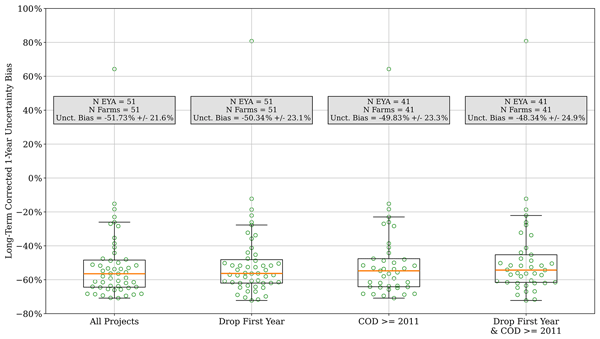
Estimating the energy production of a wind plant before construction is a historically difficult task. We build on prior research comparing the actual energy production of wind plants and their estimated energy production using owner-provided energy data. Similar to prior studies, we found an increasing bias of overestimating annual energy production. In general, estimates before construction are not conservative enough, suggesting room for improvements in the energy yield assessment process.
Stefano Cioni, Francesco Papi, Leonardo Pagamonci, Alessandro Bianchini, Néstor Ramos-García, Georg Pirrung, Rémi Corniglion, Anaïs Lovera, Josean Galván, Ronan Boisard, Alessandro Fontanella, Paolo Schito, Alberto Zasso, Marco Belloli, Andrea Sanvito, Giacomo Persico, Lijun Zhang, Ye Li, Yarong Zhou, Simone Mancini, Koen Boorsma, Ricardo Amaral, Axelle Viré, Christian W. Schulz, Stefan Netzband, Rodrigo Soto-Valle, David Marten, Raquel Martín-San-Román, Pau Trubat, Climent Molins, Roger Bergua, Emmanuel Branlard, Jason Jonkman, and Amy Robertson
Wind Energ. Sci., 8, 1659–1691, https://doi.org/10.5194/wes-8-1659-2023, https://doi.org/10.5194/wes-8-1659-2023, 2023
Short summary
Short summary
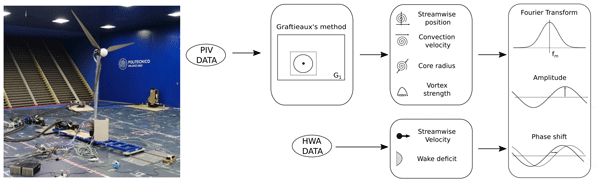
Simulations of different fidelities made by the participants of the OC6 project Phase III are compared to wind tunnel wake measurements on a floating wind turbine. Results in the near wake confirm that simulations and experiments tend to diverge from the expected linearized quasi-steady behavior when the reduced frequency exceeds 0.5. In the far wake, the impact of platform motion is overestimated by simulations and even seems to be oriented to the generation of a wake less prone to dissipation.
Roger Bergua, Amy Robertson, Jason Jonkman, Emmanuel Branlard, Alessandro Fontanella, Marco Belloli, Paolo Schito, Alberto Zasso, Giacomo Persico, Andrea Sanvito, Ervin Amet, Cédric Brun, Guillén Campaña-Alonso, Raquel Martín-San-Román, Ruolin Cai, Jifeng Cai, Quan Qian, Wen Maoshi, Alec Beardsell, Georg Pirrung, Néstor Ramos-García, Wei Shi, Jie Fu, Rémi Corniglion, Anaïs Lovera, Josean Galván, Tor Anders Nygaard, Carlos Renan dos Santos, Philippe Gilbert, Pierre-Antoine Joulin, Frédéric Blondel, Eelco Frickel, Peng Chen, Zhiqiang Hu, Ronan Boisard, Kutay Yilmazlar, Alessandro Croce, Violette Harnois, Lijun Zhang, Ye Li, Ander Aristondo, Iñigo Mendikoa Alonso, Simone Mancini, Koen Boorsma, Feike Savenije, David Marten, Rodrigo Soto-Valle, Christian W. Schulz, Stefan Netzband, Alessandro Bianchini, Francesco Papi, Stefano Cioni, Pau Trubat, Daniel Alarcon, Climent Molins, Marion Cormier, Konstantin Brüker, Thorsten Lutz, Qing Xiao, Zhongsheng Deng, Florence Haudin, and Akhilesh Goveas
Wind Energ. Sci., 8, 465–485, https://doi.org/10.5194/wes-8-465-2023, https://doi.org/10.5194/wes-8-465-2023, 2023
Short summary
Short summary
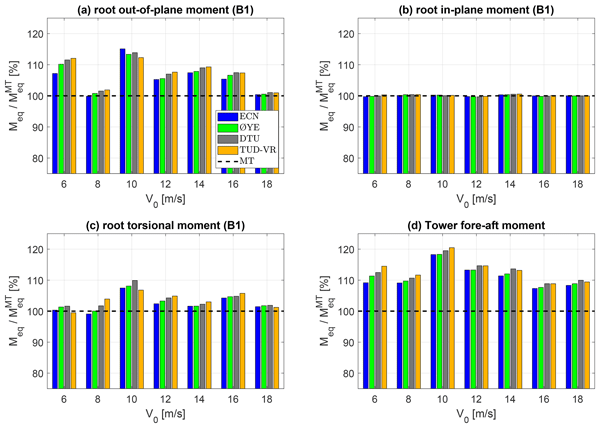
This work examines if the motion experienced by an offshore floating wind turbine can significantly affect the rotor performance. It was observed that the system motion results in variations in the load, but these variations are not critical, and the current simulation tools capture the physics properly. Interestingly, variations in the rotor speed or the blade pitch angle can have a larger impact than the system motion itself.
Simone Mancini, Koen Boorsma, Gerard Schepers, and Feike Savenije
Wind Energ. Sci., 8, 193–210, https://doi.org/10.5194/wes-8-193-2023, https://doi.org/10.5194/wes-8-193-2023, 2023
Short summary
Short summary
Modern wind turbines are subject to complex wind conditions that are far from the hypothesis of steady uniform inflow at the core of blade element momentum methods (the current industry standard for wind turbine design). Various corrections have been proposed to model this complexity. The present work focuses on modelling the unsteady evolution of wind turbine wakes (dynamic inflow), comparing the different corrections available and highlighting their effects on design load predictions.
Cited articles
Ahn, D., Shin, S., Kim, S., Kharoufi, H., and Kim, H.: Comparative evaluation of different offshore wind turbine installation vessels for Korean west–south wind farm, Int. J. Naval Archit. Ocean Eng., 9, 45–54, https://doi.org/10.1016/j.ijnaoe.2016.12.001, 2017. a
Allen, C. E. A.: Definition of the UMaine VolturnUS-S Reference Platform Developed for the IEA Wind 15-Megawatt Offshore Reference Wind Turbine, https://docs.nlr.gov/docs/fy20osti/76773.pdf (last access: 1 October 2025), 2020. a
Bayati, I. and Efthimiou, L.: Challenges and Opportunities of Major Maintenance for Floating Offshore Wind, World Forum Offshore Wind, Hamburg, Germany, December 2021, https://wfo-global.org/wp-content/uploads/2023/01/WFO_OM-WhitePaper-December2021-FINAL.pdf (last access: 1 October 2025), 2021. a
Benabadji, A., Rahmoun, K., Bahar, F., Dahani, A., Martinez, A., and Iglesias, G.: Geospatial LCOE analysis for floating offshore wind energy in SW Mediterranean Sea, Renew. Energ., 245, 122797, https://doi.org/10.1016/j.renene.2025.122797, 2025. a
C3S: ERA5 hourly data on single levels from 1940 to present, https://doi.org/10.24381/cds.adbb2d47, 2023. a
Carbon Trust: Floating Wind Joint Industry Programme Phase IV Summary Report, https://ctprodstorageaccountp.blob.core.windows.net/prod-drupal-files/documents/resource/public/FLW_P4_Summaryreport.pdf (last access: 1 October 2025), 2022. a
Carroll, J.: Failure rate, repair time and unscheduled O&M cost analysis of offshore wind turbines, Wind Energy, 19, 1443–1457, https://doi.org/10.1002/we.1887, 2016. a
Carroll, J.: Availability, operation and maintenance costs of offshore wind turbines, Wind Energy, 20, 201–211, https://doi.org/10.1002/we.2011, 2017. a
Crowle, A.: Challenges during installation of floating wind turbines, Conference Contribution, University of Exeter, https://ore.exeter.ac.uk/articles/conference_contribution/Challenges_during_installation_of_floating_wind_turbines/29781815 (last access: 1 October 2025), 2021. a
Dewan, A. and Asgarpour, M.: Reference O&M Concepts for Near and Far Offshore Wind Farms, Energy Research Centre of the Netherlands (ECN), ECN-E–16-055, https://publicaties.ecn.nl/PdfFetch.aspx?nr=ECN-E--16-055 (last access: 1 October 2025), 2016. a
Dighe, V., Huang, L.-J., Montfort, J., and Serraris, J.-J.: Improving O&M Simulations by Integrating Vessel Motions for Floating Wind Farms, J. Mar. Sci. Eng., 12, 1948, https://doi.org/10.3390/jmse12111948, 2024. a, b, c, d
Dinwoodie, I.: Development of a Combined Operational and Strategic Decision Support Model for Offshore Wind, Energy Procedia, 35, 157–166, https://doi.org/10.1016/j.egypro.2013.07.169, 2013. a, b
Dinwoodie, I., Endrerud, O.-E., Hofmann, M., Martin, R., and Sperstad, I.: Reference cases for verification of operation and maintenance simulation models for offshore wind farms, Wind Eng., 39, 1–14, https://doi.org/10.1260/0309-524X.39.1.1, 2015. a
DNV: Floating Offshore Wind: The Next Five Years, https://www.dnv.com/focus-areas/floating-offshore-wind/floating-offshore-wind-the-next-five-years/ (last access: 1 October 2025), 2025. a
DNV GL: DNV-OS-H101: Marine Operations, General, https://pdfcoffee.com/dnv-os-h101-marine-operations-general-pdf-free.html (last access: 1 October 2025), 2011. a
DNV GL: DNVGL-ST-N001: Marine Operations and Marine Warranty, https://www.dnv.com/energy/standards-guidelines/dnv-st-n001-marine-operations-and-marine-warranty/ (last access: 1 October 2025), 2020. a
Douard, F., Domecq, C., and Lair, W.: A probabilistic approach to introduce risk measurement indicators to an offshore wind project evaluation—improvement to an existing tool ECUME, Energy Procedia, 24, 255–262, https://doi.org/10.1002/we.1539, 2012. a, b
Endrerud, O., Liyanage, J., and Keseric, N.: Marine logistics decision support for operation and maintenance of offshore wind parks with a multi method simulation model, in: Proceedings of the Winter Simulation Conference 2014, IEEE, Piscataway, NJ, USA, 1712–1722, https://ieeexplore.ieee.org/abstract/document/7020021 (last access: 13 August 2026), 2014. a, b
Equinor: Hywind Scotland, https://www.equinor.com/energy/hywind-scotland (last access: 1 October 2025), 2025. a
Flotation Energy: How many floating offshore windfarms are there in the world?, https://flotationenergy.com/how-many-floating-offshore-windfarms-are-there-in-the-world/ (last access: 1 October 2025), 2025. a
Gaertner, E. e. a.: Definition of the IEA 15-Megawatt Offshore Reference Wind, nREL/TP-5000-75698, https://docs.nlr.gov/docs/fy20osti/75698.pdf (last access: 1 October 2025), 2020. a
Galle, K.: Major Component Replacement on Floating Wind Turbines, https://www.diva-portal.org/smash/record.jsf?pid=diva2:1744052 (last access: 1 October 2025), 2023. a
Goupee, A., Koo, B., Kimball, R., and Lambrakos, K.: Experimental Comparison of Three Floating Wind Turbine Concepts, J. Offshore Mech. Arct. Eng., 136, 021101, https://doi.org/10.1115/OMAE2012-83645, 2012. a
Guide to an Offshore Wind Farm: Wind farm costs, https://guidetoanoffshorewindfarm.com/wind-farm-costs/ (last access: 1 October 2025), 2025. a
GWEC: Floating Offshore Wind – A Global Opportunity, https://www.gov.br/mme/pt-br/assuntos/secretarias/sntep/ (last access: 1 October 2025), 2022. a
Hammond, R. and Cooperman, A.: Windfarm Operations and Maintenance Cost-Benefit Analysis Tool (WOMBAT), https://docs.nlr.gov/docs/fy23osti/83712.pdf (last access: 1 October 2025), 2022. a
Hammond, R. and Cooperman, A.: WOMBAT: Windfarm Operations and Maintenance Cost-Benefit Analysis Tool, https://wisdem.github.io/WOMBAT/ (last access: 1 October 2025), 2025. a
Hammond, R. and Mulas Hernando, D.: WAVES (Version 0.7.1), Zenodo [software], https://doi.org/10.5281/zenodo.21986934, 2026. a
Huang, L.-J., Mancini, S., and de Jong, M.: Modeling of Marine Assembly Logistics for an Offshore Floating Photovoltaic Plant Subject to Weather Dependencies, J. Mar. Sci. Eng., 13, 1493, https://doi.org/10.3390/jmse13081493,2025. a
IRENA: Renewable Power Generation Costs in 2022, https://www.irena.org/-/media/Files/IRENA/Agency/Publication/2023/Aug/IRENA_Renewable_power_generation_costs_in_2022.pdf (last access: 1 October 2025), 2023. a
IRENA: Floating Offshore Wind Outlook, https://www.irena.org/-/media/Files/IRENA/Agency/Publication/2024/Jul/IRENA_G7_Floating_offshore_wind_outlook_2024.pdf (last access: 1 October 2025), 2024. a
Kolios, A.: Deliverable Report D8.1: Review of Existing Cost and O&M Models, and Development of a High-Fidelity Cost/Revenue Model for Impact Assessment, https://romeoproject.eu/wp-content/uploads/2018/12/D8.1_ROMEO_Report-reviewing-exsiting-cost-and-OM-support-models.pdf (last access: 1 October 2025), 2018. a
Lerch, M., De-Prada-Gil, M., Molins, C., and Benveniste, G.: Sensitivity analysis on the levelized cost of energy for floating offshore wind farms, Sustainable Energy Technologies and Assessments, 30, 77–90, https://doi.org/10.1016/j.seta.2018.05.007, 2018. a, b
Li, H. and Guedes Soares, C.: Assessment of failure rates and reliability of floating offshore wind turbines, Reliab. Eng. Syst. Safe., 228, 108777, https://doi.org/10.1016/j.ress.2022.108777, 2022. a
Mancini, S., Bloothoofd, J., Dighe, V., and van der Meijer, H.: Development and verification of a discrete event simulation tool for high-fidelity modelling of offshore wind and solar farm decommissioning campaigns, J. Phys. Conf. Ser., 2745, 012010, https://doi.org/10.1088/1742-6596/2745/1/012010, 2024. a
McMorland, J., Collu, M., McMillan, D., and Carroll, J.: Operation and maintenance for floating wind turbines: A review, Renew. Sustain. Energ. Rev., 163, 112499, https://doi.org/10.1016/j.rser.2022.112499, 2022. a, b, c
Ramachandran, R., Desmond, C., Judge, F., Serraris, J.-J., and Murphy, J.: Floating wind turbines: marine operations challenges and opportunities, Wind Energy Sci., 7, 903–924, https://doi.org/10.5194/wes-7-903-2022, 2022. a, b
RAMBOLL: Floating Wind O&M Strategies Assessment, https://corewind.eu/wp-content/uploads/files/ (last access: 1 October 2025), 2022. a, b, c
RenewableUK: Global Floating Wind Project Pipeline Grows by 9 % Over Last 12 Months, https://www.renewableuk.com/news-and-resources/press-releases/ (last access: 1 October 2025), 2024. a
Seyr, H. and Muskulus, M.: Decision Support Models for Operations and Maintenance for Offshore Wind Farms: A Review, Appl. Sci., 9, 278, https://doi.org/10.3390/app9020278, 2019. a
Smart, G., Smith, A., Warner, E., Sperstad, I., Prinsen, B., and Lacal-Arántegui, R.: IEA Wind Task 26: Offshore Wind Farm Baseline Documentation, https://docs.nlr.gov/docs/fy16osti/66262.pdf (last access: 1 October 2025), 2016. a
Stehly, T., Beiter, P., and Duffy, P.: 2019 Cost of Wind Energy Review, https://docs.nlr.gov/docs/fy21osti/78471.pdf (last access: 1 October 2025), 2020. a
Stehly, T., Duffy, P., and Mulas Hernando, D.: 2024 Cost of Wind Energy Review, https://docs.nlr.gov/docs/fy25osti/91775.pdf (last access: 1 October 2025), 2024. a
TNO: UWiSE: A platform for simulation of offshore renewable energy systems, https://uwise.tno.nl/ (last access: 1 October 2025), 2025. a
Tobaben, L.-A.: Floating Offshore Wind: Using Tow-to-Port Approach, https://sea-impact.com/blog/2023/09/06/floating-offshore-wind-using-tow-to-port-approach/ (last access: 1 October 2025), 2023. a
Tobaben, L.-A.: Hywind Scotland's Heavy Maintenance: Tow-to-Port Approach, https://sea-impact.com/blog/2024/07/29/hywind-scotlands-heavy-maintenance-tow-to-port-approach/ (last access: 1 October 2025), 2024. a
Watissée, P., Gregor, J., Vanheeghe, T., Carstensen, C. L., and Bayati, I.: Tow-to-port operations for offshore floating wind farms: numerical modelling informed by real-world insights, in: EERA DeepWind Conference 2025: Journal of Physics: Conference Series 3131, 012049, https://doi.org/10.1088/1742-6596/3131/1/012049, 2025. a
Wiser, R., Bolinger, M., and Lantz, E.: Assessing wind power operating costs in the United States: Results from a survey of wind industry experts, Renew. Energ. Focus, 30, 46–57, 2019. a
Short summary
This study shows how different modeling assumptions made in discrete-event simulation models can change predictions of maintenance costs and power losses for floating offshore wind farms. By testing two models under the same conditions, we identify which assumptions matter most and how they shape results. The findings help improve the reliability of future models and support better planning of maintenance strategies for floating-wind projects.
This study shows how different modeling assumptions made in discrete-event simulation models can...
Special issue
Altmetrics
Final-revised paper
Preprint