Articles | Volume 11, issue 9
https://doi.org/10.5194/wes-11-3249-2026
© Author(s) 2026. This work is distributed under
the Creative Commons Attribution 4.0 License.
https://doi.org/10.5194/wes-11-3249-2026
© Author(s) 2026. This work is distributed under
the Creative Commons Attribution 4.0 License.
Experimental investigation of the effect of wake steering on the noise emission of a commercial wind turbine

ENGIE Green France, 6 rue Alexander Fleming, 69007 Lyon, France
Arthur Finez
CORRESPONDING AUTHOR
ENGIE Green France, 6 rue Alexander Fleming, 69007 Lyon, France
Related authors
Vasilis Pettas, Tuhfe Göçmen, Thomas Duc, Andreas Vad, and Antonina Vukobrat
Wind Energ. Sci., 11, 3077–3105, https://doi.org/10.5194/wes-11-3077-2026, https://doi.org/10.5194/wes-11-3077-2026, 2026
Short summary
Short summary
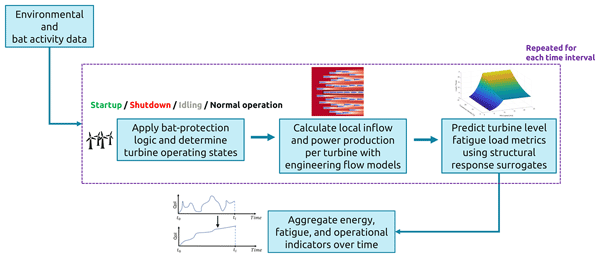
Bat protection in wind farms can require temporarily stopping turbines, reducing energy production and affecting structural loading. We developed a data-driven method combining operational records, bat activity measurements, wind-farm flow modeling, and load models to estimate production impacts and long-term fatigue. In a French onshore case study, event-triggered curtailment reduced production losses relative to fixed schedules, while load impacts were small and depended on wind conditions.
Tuhfe Göçmen, Filippo Campagnolo, Thomas Duc, Irene Eguinoa, Søren Juhl Andersen, Vlaho Petrović, Lejla Imširović, Robert Braunbehrens, Jaime Liew, Mads Baungaard, Maarten Paul van der Laan, Guowei Qian, Maria Aparicio-Sanchez, Rubén González-Lope, Vinit V. Dighe, Marcus Becker, Maarten J. van den Broek, Jan-Willem van Wingerden, Adam Stock, Matthew Cole, Renzo Ruisi, Ervin Bossanyi, Niklas Requate, Simon Strnad, Jonas Schmidt, Lukas Vollmer, Ishaan Sood, and Johan Meyers
Wind Energ. Sci., 7, 1791–1825, https://doi.org/10.5194/wes-7-1791-2022, https://doi.org/10.5194/wes-7-1791-2022, 2022
Short summary
Short summary
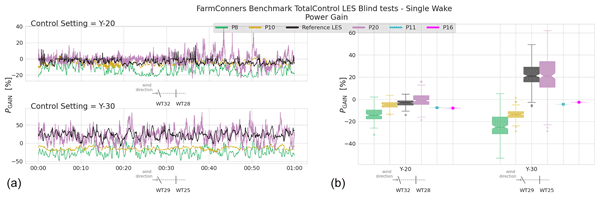
The FarmConners benchmark is the first of its kind to bring a wide variety of data sets, control settings, and model complexities for the (initial) assessment of wind farm flow control benefits. Here we present the first part of the benchmark results for three blind tests with large-scale rotors and 11 participating models in total, via direct power comparisons at the turbines as well as the observed or estimated power gain at the wind farm level under wake steering control strategy.
Eric Simley, Paul Fleming, Nicolas Girard, Lucas Alloin, Emma Godefroy, and Thomas Duc
Wind Energ. Sci., 6, 1427–1453, https://doi.org/10.5194/wes-6-1427-2021, https://doi.org/10.5194/wes-6-1427-2021, 2021
Short summary
Short summary
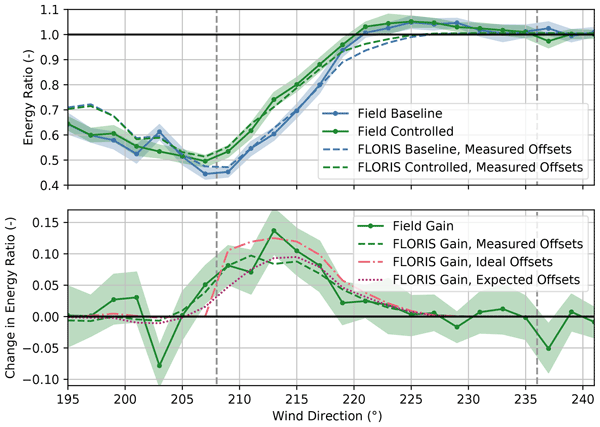
Wake steering is a wind farm control strategy in which upstream wind turbines are misaligned with the wind to deflect their low-velocity wakes away from downstream turbines, increasing overall power production. Here, we present results from a two-turbine wake-steering experiment at a commercial wind plant. By analyzing the wind speed dependence of wake steering, we find that the energy gained tends to increase for higher wind speeds because of both the wind conditions and turbine operation.
Vasilis Pettas, Tuhfe Göçmen, Thomas Duc, Andreas Vad, and Antonina Vukobrat
Wind Energ. Sci., 11, 3077–3105, https://doi.org/10.5194/wes-11-3077-2026, https://doi.org/10.5194/wes-11-3077-2026, 2026
Short summary
Short summary
Bat protection in wind farms can require temporarily stopping turbines, reducing energy production and affecting structural loading. We developed a data-driven method combining operational records, bat activity measurements, wind-farm flow modeling, and load models to estimate production impacts and long-term fatigue. In a French onshore case study, event-triggered curtailment reduced production losses relative to fixed schedules, while load impacts were small and depended on wind conditions.
Tuhfe Göçmen, Filippo Campagnolo, Thomas Duc, Irene Eguinoa, Søren Juhl Andersen, Vlaho Petrović, Lejla Imširović, Robert Braunbehrens, Jaime Liew, Mads Baungaard, Maarten Paul van der Laan, Guowei Qian, Maria Aparicio-Sanchez, Rubén González-Lope, Vinit V. Dighe, Marcus Becker, Maarten J. van den Broek, Jan-Willem van Wingerden, Adam Stock, Matthew Cole, Renzo Ruisi, Ervin Bossanyi, Niklas Requate, Simon Strnad, Jonas Schmidt, Lukas Vollmer, Ishaan Sood, and Johan Meyers
Wind Energ. Sci., 7, 1791–1825, https://doi.org/10.5194/wes-7-1791-2022, https://doi.org/10.5194/wes-7-1791-2022, 2022
Short summary
Short summary
The FarmConners benchmark is the first of its kind to bring a wide variety of data sets, control settings, and model complexities for the (initial) assessment of wind farm flow control benefits. Here we present the first part of the benchmark results for three blind tests with large-scale rotors and 11 participating models in total, via direct power comparisons at the turbines as well as the observed or estimated power gain at the wind farm level under wake steering control strategy.
Thomas Potentier, Emmanuel Guilmineau, Arthur Finez, Colin Le Bourdat, and Caroline Braud
Wind Energ. Sci., 7, 1771–1790, https://doi.org/10.5194/wes-7-1771-2022, https://doi.org/10.5194/wes-7-1771-2022, 2022
Short summary
Short summary
A wind turbine blade equipped with root spoilers is analysed using time domain aeroelastic simulations to assess the impact of passive devices on the turbine AEP and lifetime. A novel way to account for aerofoil-generated unsteadiness in the fatigue calculation is proposed and detailed. The outcome shows that spoilers, on average, can increase the AEP of the turbine. However, the structural impacts on the turbine can be severe if not accounted for initially in the turbine design.
Thomas Potentier, Emmanuel Guilmineau, Arthur Finez, Colin Le Bourdat, and Caroline Braud
Wind Energ. Sci., 7, 647–657, https://doi.org/10.5194/wes-7-647-2022, https://doi.org/10.5194/wes-7-647-2022, 2022
Short summary
Short summary
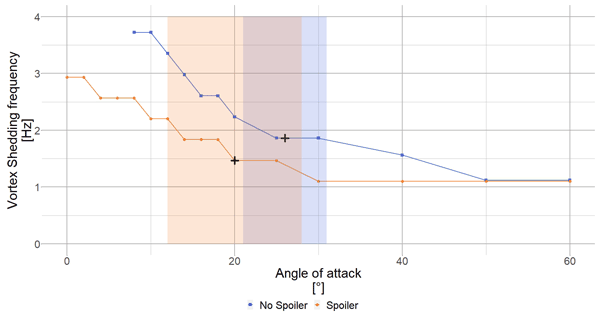
The spoiler is found to efficiently rearrange the mean flow seen by thick aerofoil: adding lift throughout the positive angles of attack, the drawback is a high drag penalty coupled with high unsteadiness of the aerodynamic forces. The impact of this type of excitation will be quantified further in terms of energy production and fatigue in future work.
Eric Simley, Paul Fleming, Nicolas Girard, Lucas Alloin, Emma Godefroy, and Thomas Duc
Wind Energ. Sci., 6, 1427–1453, https://doi.org/10.5194/wes-6-1427-2021, https://doi.org/10.5194/wes-6-1427-2021, 2021
Short summary
Short summary
Wake steering is a wind farm control strategy in which upstream wind turbines are misaligned with the wind to deflect their low-velocity wakes away from downstream turbines, increasing overall power production. Here, we present results from a two-turbine wake-steering experiment at a commercial wind plant. By analyzing the wind speed dependence of wake steering, we find that the energy gained tends to increase for higher wind speeds because of both the wind conditions and turbine operation.
Cited articles
Astolfi, D., Gao, L., Pandit, R., and Hong, J.: Experimental Analysis Of The Effect Of Static Yaw Error On Wind Turbine Nacelle Anemometer Measurements, in: 2023 IEEE International Conference on Environment and Electrical Engineering and 2023 IEEE Industrial and Commercial Power Systems Europe, 1–6, https://doi.org/10.1109/EEEIC/ICPSEurope57605.2023.10194644, 2023. a
Bertagnolio, F., Fischer, A., Appel, C., Herr, M., Seel, F., Lutz, T., Boorsma, K., Schepers, G., Botero, M., Casalino, D., van der Velden, W., Sucameli, C., and Bortolotti, P.: Wind turbine noise code benchmark: A comparison and verification exercise, 1, 62–82, Dublin, Ireland, ISBN: 9781713882916, 2023. a, b
Boersma, S., Doekemeijer, B. M., Gebraad, P. M., Fleming, P. A., Annoni, J., Scholbrock, A. K., Frederik, J. A., and van Wingerden, J.-W.: A tutorial on control-oriented modeling and control of wind farms, in: 2017 American control conference (ACC), 1–18, IEEE, https://doi.org/10.23919/ACC.2017.7962923, 2017. a, b
Borraccino, A., Schlipf, D., Haizmann, F., and Wagner, R.: Wind field reconstruction from nacelle-mounted lidar short-range measurements, Wind Energ. Sci., 2, 269–283, https://doi.org/10.5194/wes-2-269-2017, 2017. a
Bossanyi, E. and Ruisi, R.: Axial induction controller field test at Sedini wind farm, Wind Energ. Sci., 6, 389–408, https://doi.org/10.5194/wes-6-389-2021, 2021. a
Buck, S., Oerlemans, S., and Palo, S.: Experimental characterization of turbulent inflow noise on a full-scale wind turbine, J. Sound Vib., 385, 219–238, 2016. a
Damiani, R., Dana, S., Annoni, J., Fleming, P., Roadman, J., van Dam, J., and Dykes, K.: Assessment of wind turbine component loads under yaw-offset conditions, Wind Energy Sci., 3, 173–189, https://doi.org/10.5194/wes-3-173-2018, 2018. a
Dana, S., Ivanov, H., and Doubrawa, P.: Lifetime fatigue response due to wake steering on a pair of utility-scale wind turbines, J. Phys. Conf. Ser., 2265, 022106, https://doi.org/10.1088/1742-6596/2265/2/022106, 2022. a
Doekemeijer, B. M., Kern, S., Maturu, S., Kanev, S., Salbert, B., Schreiber, J., Campagnolo, F., Bottasso, C. L., Schuler, S., Wilts, F., Neumann, T., Potenza, G., Calabretta, F., Fioretti, F., and van Wingerden, J.-W.: Field experiment for open-loop yaw-based wake steering at a commercial onshore wind farm in Italy, Wind Energ. Sci., 6, 159–176, https://doi.org/10.5194/wes-6-159-2021, 2021. a
Finez, A., Duc, T., , and Le Bourdat, C.: Measurement of directivity patterns of a commercial wind turbine under yaw offset, in: 11th Edition of the International Conferences on Wind Turbine Noise: Conference Proceedings, 270–285, Copenhagen, Denmark, https://doi.org/10.11581/08042886-dea0-4511-b4bd-6c5403125735, 2025. a
Fleming, P., Annoni, J., Shah, J. J., Wang, L., Ananthan, S., Zhang, Z., Hutchings, K., Wang, P., Chen, W., and Chen, L.: Field test of wake steering at an offshore wind farm, Wind Energ. Sci., 2, 229–239, https://doi.org/10.5194/wes-2-229-2017, 2017. a
Fleming, P., King, J., Dykes, K., Simley, E., Roadman, J., Scholbrock, A., Murphy, P., Lundquist, J. K., Moriarty, P., Fleming, K., van Dam, J., Bay, C., Mudafort, R., Lopez, H., Skopek, J., Scott, M., Ryan, B., Guernsey, C., and Brake, D.: Initial results from a field campaign of wake steering applied at a commercial wind farm – Part 1, Wind Energ. Sci., 4, 273–285, https://doi.org/10.5194/wes-4-273-2019, 2019. a
Fleming, P., King, J., Simley, E., Roadman, J., Scholbrock, A., Murphy, P., Lundquist, J. K., Moriarty, P., Fleming, K., van Dam, J., Bay, C., Mudafort, R., Jager, D., Skopek, J., Scott, M., Ryan, B., Guernsey, C., and Brake, D.: Continued results from a field campaign of wake steering applied at a commercial wind farm – Part 2, Wind Energ. Sci., 5, 945–958, https://doi.org/10.5194/wes-5-945-2020, 2020. a
Fleming, P., Sinner, M., Young, T., Lannic, M., King, J., Simley, E., and Doekemeijer, B.: Experimental results of wake steering using fixed angles, Wind Energ. Sci., 6, 1521–1531, https://doi.org/10.5194/wes-6-1521-2021, 2021. a
Göçmen, T.: Possible Power Estimation of Down-Regulated Offshore Wind Power Plants, Ph.D. thesis, Technical University of Denmark, ISBN: 978-87-93278-53-0, 2016. a
Guillemin, F., Nguyen, H.-N., Sabiron, G., Di Domenico, D., and Boquet, M.: Real-time three dimensional wind field reconstruction from nacelle LiDAR measurements, J. Phys. Conf. Ser., 1037, 032037, https://doi.org/10.1088/1742-6596/1037/3/032037, 2018. a
Hamilton, N., Bortolotti, P. E., Jager, D., Guo, Y., Roadman, J. M., and Simley, E.: Aeroacoustic Assessment of Wind Plant Controls, Tech. rep., National Renewable Energy Lab. (NREL), Golden, CO, USA, https://doi.org/10.2172/1785330, 2021. a, b, c, d
Harrison, M., Vishwakarma, P., Williams, R., Smith, G., Downes, P., King, J., and Landberg, L.: Results of the first DNV joint industry project on wind farm flow control, in: Wind Energ. Sci. Conference 2025, Nantes, France, 2025. a
Howland, M. F., Quesada, J. B., Martínez, J. J. P., Larrañaga, F. P., Yadav, N., Chawla, J. S., Sivaram, V., and Dabiri, J. O.: Collective wind farm operation based on a predictive model increases utility-scale energy production, Nat. Energ., 7, 818–827, 2022. a
IEC: IEC 61400–12-1, wind turbines – part 12-1: Power performance of electricity producing wind turbines, Tech. rep., International Electrotechnical Commission, ISBN: 9782832238233, 2017. a
Kanev, S.: AWC validation methodology, Tech. Rep. R11300, TNO, https://resolver.tno.nl/uuid:fdae4c94-fbcc-4337-b49f-5a39c93ef2cf (last access: 31 August 2026), 2020. a
Mazoyer, P. and Boquet, M.: Retrieving wind speed at constant height above ground level in complex terrain with a Wind Iris 4-beam nacelle Lidar, in: Wind Europe Summit 2016, 27–29 September, Hamburg, Germany, https://windeurope.org/summit2016/conference/allposters/PO263.pdf (last access: 31 August 2026), 2016. a
McKay, P. M., Carriveau, R., Ting, D. S.-K., and Johrendt, J. L.: Global sensitivity analysis of wind turbine power output, Wind Energy, 17, 983–995, https://doi.org/10.1002/we.1614, 2014. a
Meyers, J., Bottasso, C., Dykes, K., Fleming, P., Gebraad, P., Giebel, G., Göçmen, T., and van Wingerden, J.-W.: Wind farm flow control: prospects and challenges, Wind Energ. Sci., 7, 2271–2306, https://doi.org/10.5194/wes-7-2271-2022, 2022. a
Nyborg, C. M., Fischer, A., Réthoré, P.-E., and Feng, J.: Optimization of wind farm operation with a noise constraint, Wind Energ. Sci., 8, 255–276, https://doi.org/10.5194/wes-8-255-2023, 2023. a
Oerlemans, S., Sijtsma, P., and Méndez López, B.: Location and quantification of noise sources on a wind turbine, J. Sound Vib., 299, 869–883, https://doi.org/10.1016/j.jsv.2006.07.032, 2007. a
Okada, Y., Yoshihisa, K., Higashi, K., and Nishimura, N.: Horizontal directivity of sound emitted from wind turbines, Acoustical Science and Technology, 37, 239–246, 2016. a
Raach, S., Schlipf, D., Haizmann, F., and Cheng, P. W.: Three dimensional dynamic model based wind field reconstruction from lidar data, J. Phys. Conf. Ser., 524, 012005, https://doi.org/10.1088/1742-6596/524/1/012005, 2014. a
Roger, M. and Moreau, S.: Extensions and limitations of analytical airfoil broadband noise models, Int. J. Aeroacoust., 9, https://doi.org/10.1260/1475-472X.9.3.273, 2010. a
Romani, G., Casalino, D., and Velden, W. v. d.: Numerical Analysis of Airfoil Trailing-Edge Noise for Straight and Serrated Edges at Incidence, AIAA J., 59, 2558–2577, https://doi.org/10.2514/1.J059457, 2021. a
Rott, A., Höning, L., Hulsman, P., Lukassen, L. J., Moldenhauer, C., and Kühn, M.: Wind vane correction during yaw misalignment for horizontal-axis wind turbines, Wind Energ. Sci., 8, 1755–1770, https://doi.org/10.5194/wes-8-1755-2023, 2023. a
Shahar, D. J.: Minimizing the variance of a weighted average, Open Journal of Statistics, 7, 216–224, 2017. a
Simley, E., Fleming, P., Girard, N., Alloin, L., Godefroy, E., and Duc, T.: Results from a wake-steering experiment at a commercial wind plant: investigating the wind speed dependence of wake-steering performance, Wind Energ. Sci., 6, 1427–1453, https://doi.org/10.5194/wes-6-1427-2021, 2021. a
Tian, Y. and Cotté, B.: Wind Turbine Noise Modeling Based on Amiet's Theory: Effects of Wind Shear and Atmospheric Turbulence, Acta Acustica united with Acustica, 102, 626–639, https://doi.org/10.3813/AAA.918979, 2016. a
Tukey: Exploratory data analysis, Vol. 2, Springer, ISBN: 9780201076165, 1977. a
TWAIN: Integrated, Value-based, and Multi-objective Wind Farm Control powered by Artificial Intelligence, https://twainproject.eu/ (last access: 31 August 2026), 2023. a
van der Hoek, D., Kanev, S., Allin, J., Bieniek, D., and Mittelmeier, N.: Effects of axial induction control on wind farm energy production – A field test, Renew. Energ., 140, 994–1003, https://doi.org/10.1016/j.renene.2019.03.117, 2019. a
van Wingerden, J. W., Fleming, P. A., Göçmen, T., Eguinoa, I., Doekemeijer, B., Dykes, K., Lawson, M., Simley, E., King, J., Astrain, D., et al.: Expert elicitation on wind farm control, J. Phys. Conf. Ser., 1618, 022025, https://doi.org/10.5194/wes-6-159-2021, 2020. a
Willis, H.: Curtailment strategies due to environmental constraints in France. Evolution of their occurrence and impact over time, in: WindEurope Annual Event 2023, Copenhagen, Denmark, https://www.eoltech.fr/media/pdfs/PO038.pdf (last access: 31 August 2026), 2023. a
Short summary
This work presents the outcomes of an acoustic experimental campaign conducted on an industrial wind turbine under normal operation and yaw misalignment. The objective of this test was to study the effect of yaw misalignment on turbine noise magnitude and directivity. The results show a slight increase in the noise emitted by the turbine when it is misaligned and a rotation of the noise directivity pattern consistent with the rotation of the nacelle.
This work presents the outcomes of an acoustic experimental campaign conducted on an industrial...
Altmetrics
Final-revised paper
Preprint