
Articles | Volume 11, issue 9
https://doi.org/10.5194/wes-11-3509-2026
© Author(s) 2026. This work is distributed under
the Creative Commons Attribution 4.0 License.
the Creative Commons Attribution 4.0 License.
https://doi.org/10.5194/wes-11-3509-2026
© Author(s) 2026. This work is distributed under
the Creative Commons Attribution 4.0 License.
the Creative Commons Attribution 4.0 License.
Research article
| 
16 Sep 2026
Research article |
| 16 Sep 2026
| 16 Sep 2026
Case study of a site-specific design and operation optimization of a wind farm co-located PEM electrolyzer and BESS including degradation
Dustin Frings
CORRESPONDING AUTHOR

Chair for Wind Power Drives, RWTH Aachen University, 52074 Aachen, Germany
Georg Jacobs
Chair for Wind Power Drives, RWTH Aachen University, 52074 Aachen, Germany
Thorsten Reichartz
Chair for Wind Power Drives, RWTH Aachen University, 52074 Aachen, Germany
Thora Potthoff
Chair for Wind Power Drives, RWTH Aachen University, 52074 Aachen, Germany
Lucas Blickwedel
Chair for Wind Power Drives, RWTH Aachen University, 52074 Aachen, Germany
Martin Knops
Chair for Wind Power Drives, RWTH Aachen University, 52074 Aachen, Germany
Related authors
Patrick Erik Marcel De Smet, Georg Jacobs, Dustin Frings, Leon Schenke, Stefan Witter, Thorsten Reichartz, and Martin Knops
Wind Energ. Sci. Discuss., https://doi.org/10.5194/wes-2026-130, https://doi.org/10.5194/wes-2026-130, 2026
Preprint under review for WES
Short summary
Short summary
To accurately assess and optimize a wind farm's cost to produce energy over its entire lifetime in the planning phase, we integrate the effects from blade fatigue using a new design approach that considers both energy production and turbine lifetime. The method identifies wind farm layouts that reduce hidden costs caused by uneven loading on blades. Results show that lifetime-aware optimization can lower long-term costs without reducing energy output.
Patrick Erik Marcel De Smet, Georg Jacobs, Dustin Frings, Leon Schenke, Stefan Witter, Thorsten Reichartz, and Martin Knops
Wind Energ. Sci. Discuss., https://doi.org/10.5194/wes-2026-130, https://doi.org/10.5194/wes-2026-130, 2026
Preprint under review for WES
Short summary
Short summary
To accurately assess and optimize a wind farm's cost to produce energy over its entire lifetime in the planning phase, we integrate the effects from blade fatigue using a new design approach that considers both energy production and turbine lifetime. The method identifies wind farm layouts that reduce hidden costs caused by uneven loading on blades. Results show that lifetime-aware optimization can lower long-term costs without reducing energy output.
Kayacan Kestel, Xavier Chesterman, Donatella Zappalá, Simon Watson, Mingxin Li, Edward Hart, James Carroll, Yolanda Vidal, Amir R. Nejad, Shawn Sheng, Yi Guo, Matthias Stammler, Florian Wirsing, Ahmed Saleh, Nico Gregarek, Thao Baszenski, Thomas Decker, Martin Knops, Georg Jacobs, Benjamin Lehmann, Florian König, Ines Pereira, Pieter-Jan Daems, Cédric Peeters, and Jan Helsen
Wind Energ. Sci., 11, 2103–2155, https://doi.org/10.5194/wes-11-2103-2026, https://doi.org/10.5194/wes-11-2103-2026, 2026
Short summary
Short summary
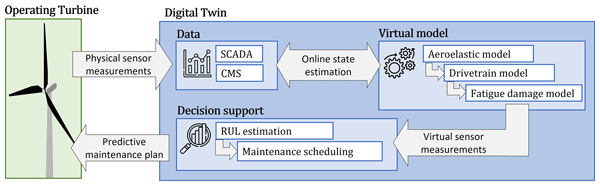
Wind energy use has been rapidly expanding worldwide in recent years. Driven by global decarbonization goals and energy security concerns, this growth is expected to continue. To achieve these targets, production costs must decrease, with operation and maintenance being major contributors. This paper reviews current and emerging technologies for monitoring wind turbine drivetrains, and highlights key academic and industrial challenges that may hinder progress.
Thorsten Reichartz, Georg Jacobs, Tom Rathmes, Lucas Blickwedel, and Ralf Schelenz
Wind Energ. Sci., 9, 281–295, https://doi.org/10.5194/wes-9-281-2024, https://doi.org/10.5194/wes-9-281-2024, 2024
Short summary
Short summary
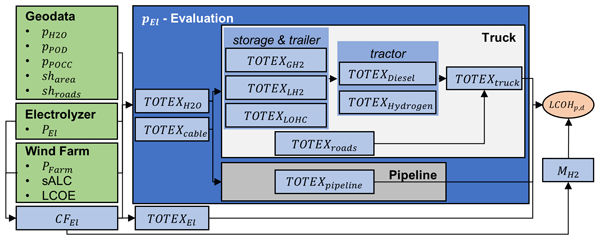
The production of green hydrogen from wind power is a promising approach to store energy from renewable energy sources. This work proposes a method to optimize the design of wind–hydrogen systems for onshore wind farms in order to achieve the lowest hydrogen cost. Therefore, the electrolyzer position and the optimal hydrogen transport mode are calculated specifically for a wind farm site. This results in a reduction of up to 10 % of the hydrogen production cost.
Cited articles
Abdin, Z., Webb, C. J., and Gray, E.: Modelling and simulation of a proton exchange membrane (PEM) electrolyser cell, Int. J. Hydrogen Energ., 40, 13243–13257, https://doi.org/10.1016/j.ijhydene.2015.07.129, 2015.
anemos: Wind and Yield Index Report, https://www.windindustrie-in-deutschland.de/publikationen/fachartikel/anemos-wind-und-ertragsindex-report-2024 (last access: 2 June 2026), 2024.
Balderrama, S., Lombardi, F., Riva, F., Canedo, W., Colombo, E., and Quoilin, S.: A two-stage linear programming optimization framework for isolated hybrid microgrids in a rural context: The case study of the “El Espino” community, Energy, 188, 116073, https://doi.org/10.1016/j.energy.2019.116073, 2019.
Bechmann, A. and Quick, J.: Market-Driven Wind Resource Assessment, J. Phys. Conf. Ser., 3025, 12001, https://doi.org/10.1088/1742-6596/3025/1/012001, 2025.
Bockelmann, M., Becker, M., Stypka, S., Bauer, S., Minke, C., and Turek, T.: Erzeugung von Wasserstoff durch Elektrolyse, Chem. Unserer Zeit, 58, 29–45, https://doi.org/10.1002/ciuz.202300024, 2024.
Bosch: Hybrion PEM-Elektrolysis Stack, https://www.bosch-hydrogen-energy.com/media/pem_electrolysis/hybrion_pem_electrolysis_stacks/bosch-hybrion-pem-electrolysis-stacks-specification-sheet.pdf (last access: 2 June 2026), 2025.
Bošnjaković, M., Katinić, M., Santa, R., and Marić, D.: Wind Turbine Technology Trends, Appl. Sci., 12, 8653, https://doi.org/10.3390/app12178653, 2022.
Buttler, A. and Spliethoff, H.: Current status of water electrolysis for energy storage, grid balancing and sector coupling via power-to-gas and power-to-liquids: A review, Renew. Sust. Energ. Rev., 82, 2440–2454, https://doi.org/10.1016/j.rser.2017.09.003, 2018.
Canbulat, S., Balci, K., Canbulat, O., and Bayram, I. S.: Techno-Economic Analysis of On-Site Energy Storage Units to Mitigate Wind Energy Curtailment: A Case Study in Scotland, Energies, 14, 1691, https://doi.org/10.3390/en14061691, 2021.
Carmo, M., Fritz, D. L., Mergel, J., and Stolten, D.: A comprehensive review on PEM water electrolysis, Int. J. Hydrogen Energ., 38, 4901–4934, https://doi.org/10.1016/j.ijhydene.2013.01.151, 2013.
Chatzistlyianos, E., Psarros, G., Chinaris, P., and Papathanassiou, S.: Cost Estimation for Green Hydrogen Production and Distribution, in: 2025 21st International Conference on the European Energy Market (EEM), Lisbon, Portugal, 27–29 May 2025, 1–6, https://doi.org/10.1109/EEM64765.2025.11050347, 2025.
Chen, R., Gao, C., and Ming, H.: Rolling‐horizon optimization strategy for wind‐storage system in electricity market, IET Renew. Power Gener., 18, 825–836, https://doi.org/10.1049/rpg2.12954, 2024.
Cheng, K., He, S., and Hu, B.: Power adaptive control strategy for multi-stack PEM photovoltaic hydrogen systems considering electrolysis unit efficiency and hydrogen production rate, Sust. Energy Technol. Assess., 75, 104200, https://doi.org/10.1016/j.seta.2025.104200, 2025.
Cole, W., Ramasamy, V., and Turan, M.: Cost Projections for Utility-Scale Battery Storage: 2025 Update, Golden, CO 80401, NREL/TP-6A40-93281, https://doi.org/10.2172/2583471, 2025.
Cozzolino, R. and Bella, G.: A review of electrolyzer-based systems providing grid ancillary services: current status, market, challenges and future directions, Front. Energy Res., 12, 1358333, https://doi.org/10.3389/fenrg.2024.1358333, 2024.
Dolatabadi, A., Ebadi, R., and Mohammadi-Ivatloo, B.: A Two-Stage Stochastic Programming Model for the Optimal Sizing of Hybrid PV/diesel/battery in Hybrid Electric Ship System, Journal of Operation and Automation in Power Engineering, 7, 16–26, https://doi.org/10.22098/joape.2019.4395.1349, 2019.
EEX: Hydrogen, https://www.eex.com/en/markets/hydrogen (last access: 16 January 2026), 2026.
Eltamaly, A. M. and Almutairi, Z. A.: Nested Optimization Algorithms for Accurately Sizing a Clean Energy Smart Grid System, Considering Uncertainties and Demand Response, Sustainability, 17, 2744, https://doi.org/10.3390/su17062744, 2025.
Energy-Charts: Spot Market Prices, Fraunhofer ISE, https://www.energy-charts.info/charts/price_spot_market/chart.htm?l=en&c=DE&interval=year&year=2024&minuteInterval=60min&legendItems=ey5 (last access: 16 January 2026), 2026.
European Parliament and Council: REGULATION (EU) 2021/1119 OF THE EUROPEAN PARLIAMENT AND OF THE COUNCIL of 30 June 2021 establishing the framework for achieving climate neutrality and amending Regulations (EC) No 401/2009 and (EU) 2018/1999 (“European Climate Law”): European Climate Law (Reg. (EU) 2021/1119), CELEX-Number: 32021R1119, 2021.
Fabianek, P. and Madlener, R.: Techno-economic analysis and optimal sizing of hybrid PV-wind systems for hydrogen production by PEM electrolysis in California and Northern Germany, Int. J. Hydrogen Energ., 67, 1157–1172, https://doi.org/10.1016/j.ijhydene.2023.11.196, 2024.
Federal Network Agency: Hydrogen core network, https://www.bundesnetzagentur.de/EN/Areas/Energy/HydrogenCoreNetwork/start.html (last access: 15 January 2026), 2026.
Federal Office of Justice: §85a EEG 2023, https://www.gesetze-im-internet.de/eeg_2014/__85a.html (last access: 16 January 2026), 2026.
Frensch, S. H., Fouda-Onana, F., Serre, G., Thoby, D., Araya, S. S., and Kær, S. K.: Influence of the operation mode on PEM water electrolysis degradation, Int. J. Hydrogen Energ., 44, 29889–29898, https://doi.org/10.1016/j.ijhydene.2019.09.169, 2019.
García-Valverde, R., Espinosa, N., and Urbina, A.: Simple PEM water electrolyser model and experimental validation, Int. J. Hydrogen Energ., 37, 1927–1938, https://doi.org/10.1016/j.ijhydene.2011.09.027, 2012.
Görgün, H.: Dynamic modelling of a proton exchange membrane (PEM) electrolyzer, Int. J. Hydrogen Energ., 31, 29–38, https://doi.org/10.1016/j.ijhydene.2005.04.001, 2006.
Grant, E., Brunik, K., King, J., and Clark, C. E.: Hybrid power plant design for low-carbon hydrogen in the United States, J. Phys. Conf. Ser., 2767, 82019, https://doi.org/10.1088/1742-6596/2767/8/082019, 2024.
Gurobi Optimization: Nonlinear Constraints – Gurobi Optimizer Reference Manual, https://docs.gurobi.com/projects/optimizer/en/current/features/nonlinear.html#subsubsectiongenconstrfunctionpwl (last access: 2 February 2026), 2026.
Han, B., Steen, S. M., Mo, J., and Zhang, F.-Y.: Electrochemical performance modeling of a proton exchange membrane electrolyzer cell for hydrogen energy, Int. J. Hydrogen Energ., 40, 7006–7016, https://doi.org/10.1016/j.ijhydene.2015.03.164, 2015.
Hernández-Gómez, Á., Ramirez, V., and Guilbert, D.: Investigation of PEM electrolyzer modeling: Electrical domain, efficiency, and specific energy consumption, Int. J. Hydrogen Energ., 45, 14625–14639, https://doi.org/10.1016/j.ijhydene.2020.03.195, 2020.
Hilpert, S., Kaldemeyer, C., Krien, U., Günther, S., Wingenbach, C., and Plessmann, G.: The Open Energy Modelling Framework (oemof) – A new approach to facilitate open science in energy system modelling, Energy Strategy Rev., 22, 16–25, https://doi.org/10.1016/j.esr.2018.07.001, 2018.
Hofrichter, A., Rank, D., Heberl, M., and Sterner, M.: Determination of the optimal power ratio between electrolysis and renewable energy to investigate the effects on the hydrogen production costs, Int. J. Hydrogen Energ., 48, 1651–1663, https://doi.org/10.1016/j.ijhydene.2022.09.263, 2023.
Ibáñez-Rioja, A., Puranen, P., Järvinen, L., Kosonen, A., Ruuskanen, V., Hynynen, K., Ahola, J., and Kauranen, P.: Baseload hydrogen supply from an off-grid solar PV–wind power–battery–water electrolyzer plant, Energy, 322, 135304, https://doi.org/10.1016/j.energy.2025.135304, 2025.
IRENA: Green hydrogen cost reduction, https://h2.pe/uploads/IRENA_Green_hydrogen_cost_2020.pdf (last access: 2 June 2026), 2020.
IRENA: Renewable power generation costs in 2023, https://www.irena.org/Publications/2024/Sep/Renewable-Power-Generation-Costs-in-2023 (last access: 6 March 2026), 2024.
Kallrath, J.: Gemischt-ganzzahlige Optimierung: Modellierung in der Praxis, Springer Fachmedien Wiesbaden, Wiesbaden, https://doi.org/10.1007/978-3-658-00690-7, 2013.
Kansara, R. and Roldán Serrano, M. I.: Coupled Design and Operation Optimization for Decarbonization of Industrial Energy Systems Using an Open-Source In-House Tool, Eng, 5, 3033–3048, https://doi.org/10.3390/eng5040158, 2024.
Krien, U., Schönfeldt, P., Launer, J., Hilpert, S., Kaldemeyer, C., and Pleßmann, G.: oemof.solph – A model generator for linear and mixed-integer linear optimisation of energy systems, Software Impacts, 6, 100028, https://doi.org/10.1016/j.simpa.2020.100028, 2020.
Kurzweil, P. and Dietlmeier, O. K.: Elektrochemische Speicher, Springer Fachmedien Wiesbaden, Wiesbaden, https://doi.org/10.1007/978-3-658-21829-4, 2018.
Lim, D., Lee, B., Lee, H., Byun, M., Cho, H.-S., Cho, W., Kim, C.-H., Brigljević, B., and Lim, H.: Impact of voltage degradation in water electrolyzers on sustainability of synthetic natural gas production: Energy, economic, and environmental analysis, Energy Convers. Manage., 245, 114516, https://doi.org/10.1016/j.enconman.2021.114516, 2021.
Lu, X., Du, B., Zhou, S., Zhu, W., Li, Y., Yang, Y., Xie, C., Zhao, B., Zhang, L., Song, J., and Deng, Z.: Optimization of power allocation for wind-hydrogen system multi-stack PEM water electrolyzer considering degradation conditions, Int. J. Hydrogen Energ., 48, 5850–5872, https://doi.org/10.1016/j.ijhydene.2022.11.092, 2023.
Lynus: Lynus Batteriespeichersystem, https://shop-eu.lynus.io/WebRoot/epagesDE/Shops/lynus/679B/9A1C/E513/585D/F8BA/0A0C/05B7/B53A/Lynus_Batteriespeicher_Containerlosung_500kW___1MWh.pdf (last access: 12 May 2026), 2026.
Makhsoos, A., Kandidayeni, M., Pollet, B. G., and Boulon, L.: Proton exchange membrane water electrolyzers degradation models review: implications for power allocation and energy management, J. Power Sources, 655, 238003, https://doi.org/10.1016/j.jpowsour.2025.238003, 2025.
Mohamed, A., Rigo-Mariani, R., Debusschere, V., and Pin, L.: Stacked revenues for energy storage participating in energy and reserve markets with an optimal frequency regulation modeling, Appl. Energ., 350, 121721, https://doi.org/10.1016/j.apenergy.2023.121721, 2023.
Nachit, I., Naanani, H., and Ikharrazne, L.: Dynamic and techno-economic assessment of electrolyser technologies under intermittent renewable energy: Performance and cost competitiveness across six countries, Int. J. Hydrogen Energ., 201, 152841, https://doi.org/10.1016/j.ijhydene.2025.152841, 2026.
Nel: PEM Electrolyser – PEM Series, https://nelhydrogen.com/product/psm-series-electrolyser/ (last access: 1 June 2026), 2025.
New European Wind Atlas: Welcome to the New European Wind Atlas, https://map.neweuropeanwindatlas.eu/ (last access: 15 January 2026), 2026.
OECD Economic Surveys: European Union and Euro Area 2025, OECD Publishing, https://doi.org/10.1787/5ec8dcc2-en, 2025.
Papakonstantinou, G., Algara-Siller, G., Teschner, D., Vidaković-Koch, T., Schlögl, R., and Sundmacher, K.: Degradation study of a proton exchange membrane water electrolyzer under dynamic operation conditions, Appl. Energ., 280, 115911, https://doi.org/10.1016/j.apenergy.2020.115911, 2020.
Peng, J., Vijayshankar, S., King, J., and Mathieu, J.: Trade-offs between Battery Energy Storage and Hydrogen Storage in Off-Grid Green Hydrogen Systems, in: Proceedings of the 57th Hawaii International Conference on System Sciences, 3097, https://doi.org/10.24251/HICSS.2025.373, 2025.
Reichartz, T., Jacobs, G., Rathmes, T., Blickwedel, L., and Schelenz, R.: Optimal position and distribution mode for on-site hydrogen electrolyzers in onshore wind farms for a minimal levelized cost of hydrogen (LCoH), Wind Energ. Sci., 9, 281–295, https://doi.org/10.5194/wes-9-281-2024, 2024a.
Reichartz, T., Jacobs, G., Blickwedel, L., Frings, D., and Schelenz, R.: Co-Design of a Wind–Hydrogen System: The Effect of Varying Wind Turbine Types on Techno-Economic Parameters, Energies, 17, 4710, https://doi.org/10.3390/en17184710, 2024b.
Reuß, M. E.: Techno-ökonomische Analyse alternativer Wasserstoffinfrastruktur, PhD thesis, RWTH Aachen University, https://doi.org/10.18154/RWTH-2019-07432, 2019.
Robinius, M., Otto, A., Heuser, P., Welder, L., Syranidis, K., Ryberg, D., Grube, T., Markewitz, P., Peters, R., and Stolten, D.: Linking the Power and Transport Sectors – Part 1: The Principle of Sector Coupling, Energies, 10, 956, https://doi.org/10.3390/en10070956, 2017.
Roscher, B.: Multi-dimensional wind farm optimization in the concept phase, PhD thesis, RWTH Aachen University, https://doi.org/10.18154/RWTH-2020-03444, 2020.
Rozzi, E., Grimaldi, A., Minuto, F. D., and Lanzini, A.: Model complexity and optimization trade-offs in the design and scheduling of hybrid hydrogen-battery systems, Energy Convers. Manage., 344, 120306, https://doi.org/10.1016/j.enconman.2025.120306, 2025.
Sayed-Ahmed, H., Toldy, Á., and Santasalo-Aarnio, A.: Dynamic operation of proton exchange membrane electrolyzers – Critical review, Renew. Sust. Energ. Rev., 189, 113883, https://doi.org/10.1016/j.rser.2023.113883, 2024.
Schnuelle, C., Wassermann, T., Fuhrlaender, D., and Zondervan, E.: Dynamic hydrogen production from PV & wind direct electricity supply – Modeling and techno-economic assessment, Int. J. Hydrogen Energ., 45, 29938–29952, https://doi.org/10.1016/j.ijhydene.2020.08.044, 2020.
Shams, M. H., Niaz, H., Na, J., Anvari-Moghaddam, A., and Liu, J. J.: Machine learning-based utilization of renewable power curtailments under uncertainty by planning of hydrogen systems and battery storages, J. Energy Storage, 41, 103010, https://doi.org/10.1016/j.est.2021.103010, 2021.
Shiva Kumar, S. and Himabindu, V.: Hydrogen production by PEM water electrolysis – A review, Mater. Sci. Energy Technol., 2, 442–454, https://doi.org/10.1016/j.mset.2019.03.002, 2019.
Smolinka, T., Wiebe, N., Sterchele, P., Palzer, A., Lehner, F., Jansen, M., Kiemel, S., Miehe, R., Wahren, S., and Zimmermann, F.: Industrialisierung der Wasserelektrolyse in Deutschland: Chancen und Herausforderungen für nachhaltigen Wasserstoff für Verkehr, Strom und Wärme, https://www.ipa.fraunhofer.de/de/Publikationen/studien/studie-industrialisierung-wasserelektrolyse.html (last access: 2 June 2026), 2018.
Storn, R. and Price, K.: Differential Evolution – A Simple and Efficient Heuristic for global Optimization over Continuous Spaces, J. Glob. Optim., 11, 341–359, https://doi.org/10.1023/A:1008202821328, 1997.
Tezer, T.: Multi-objective optimization of hybrid renewable energy systems with green hydrogen integration and hybrid storage strategies, Int. J. Hydrogen Energ., 142, 1249–1271, https://doi.org/10.1016/j.ijhydene.2025.03.006, 2025.
Tofighi-Milani, M., Fattaheian-Dehkordi, S., and Lehtonen, M.: Electrolysers: A Review on Trends, Electrical Modeling, and Their Dynamic Responses, IEEE Access, 13, 39870–39885, https://doi.org/10.1109/ACCESS.2025.3546546, 2025.
Tomić, A. Z., Pivac, I., and Barbir, F.: A review of testing procedures for proton exchange membrane electrolyzer degradation, J. Power Sources, 557, 232569, https://doi.org/10.1016/j.jpowsour.2022.232569, 2023.
Tully, Z., Starke, G., Johnson, K., and King, J.: An Investigation of Heuristic Control Strategies for Multi-Electrolyzer Wind-Hydrogen Systems Considering Degradation, in: 2023 IEEE Conference on Control Technology and Applications (CCTA), Bridgetown, Barbados, 16–18 August 2023, 817–822, https://doi.org/10.1109/CCTA54093.2023.10252187, 2023.
van Phan, L., Nguyen-Dinh, N. P., Nguyen, K. M., and Nguyen-Duc, T.: Advanced frequency control schemes and technical analysis for large-scale PEM and Alkaline electrolyzer plants in renewable-based power systems, Int. J. Hydrogen Energ., 89, 1354–1367, https://doi.org/10.1016/j.ijhydene.2024.09.360, 2024.
Windpark Rhede GmbH & Co. KG: The wind farm, https://windpark-rhede.de/ (last access: 15 January 2026), 2025.
Xu, B., Oudalov, A., Ulbig, A., Andersson, G., and Kirschen, D. S.: Modeling of Lithium-Ion Battery Degradation for Cell Life Assessment, IEEE Trans. Smart Grid, 9, 1131–1140, https://doi.org/10.1109/TSG.2016.2578950, 2018.
Yodwong, B., Guilbert, D., Phattanasak, M., Kaewmanee, W., Hinaje, M., and Vitale, G.: Faraday's Efficiency Modeling of a Proton Exchange Membrane Electrolyzer Based on Experimental Data, Energies, 13, 4792, https://doi.org/10.3390/en13184792, 2020.
Zheng, Y., You, S., Bindner, H. W., and Münster, M.: Incorporating optimal operation strategies into investment planning for wind/electrolyser system, CSEE JPES, 8, 347–359, https://doi.org/10.17775/CSEEJPES.2021.04240, 2022.
Zheng, Y., Huang, C., Tan, J., You, S., Zong, Y., and Træholt, C.: Off-grid wind/hydrogen systems with multi-electrolyzers: Optimized operational strategies, Energy Convers. Manage., 295, 117622, https://doi.org/10.1016/j.enconman.2023.117622, 2023.
Zhou, Z., Zheng, M., Dong, B., and Li, J.: Cluster allocation strategy of multi-electrolyzers in wind-hydrogen system considering electrolyzer degradation under fluctuating operating conditions, Renew. Energy, 242, 122381, https://doi.org/10.1016/j.renene.2025.122381, 2025.
Short summary
This research developed an optimal design model for hydrogen and battery equipment for a wind farm in northwest Germany. By accounting for equipment aging and part-load efficiency of a polymer electrolyte membrane electrolyzer, the tool provides a realistic economic assessment. Results show that neglecting these effects leads to a significant overestimation of profits. This method offers developers a reliable way to plan renewable hydrogen systems and ensures secure investment decisions.
This research developed an optimal design model for hydrogen and battery equipment for a wind...


Altmetrics
Final-revised paper
Preprint