
Articles | Volume 11, issue 9
https://doi.org/10.5194/wes-11-3555-2026
© Author(s) 2026. This work is distributed under
the Creative Commons Attribution 4.0 License.
the Creative Commons Attribution 4.0 License.
https://doi.org/10.5194/wes-11-3555-2026
© Author(s) 2026. This work is distributed under
the Creative Commons Attribution 4.0 License.
the Creative Commons Attribution 4.0 License.
Research article
| 
18 Sep 2026
Research article |
| 18 Sep 2026
| 18 Sep 2026
Assessing the accuracy of a 3-year high-resolution mesoscale wind farm wake simulation with lidar and satellite radar data
Alexandros Palatos-Plexidas
CORRESPONDING AUTHOR

von Karman Institute for Fluid Dynamics, Environmental and Applied Fluid Dynamics, Waterloosesteenweg 72, 1640 Sint-Genesius-Rode, Belgium
Vrije Universiteit Brussel, Electronics and Informatics Department, Pleinlaan 2, 1050 Brussels, Belgium
Simone Gremmo
von Karman Institute for Fluid Dynamics, Environmental and Applied Fluid Dynamics, Waterloosesteenweg 72, 1640 Sint-Genesius-Rode, Belgium
Jeroen van Beeck
von Karman Institute for Fluid Dynamics, Environmental and Applied Fluid Dynamics, Waterloosesteenweg 72, 1640 Sint-Genesius-Rode, Belgium
Lesley De Cruz
Vrije Universiteit Brussel, Electronics and Informatics Department, Pleinlaan 2, 1050 Brussels, Belgium
Royal Meteorological Institute of Belgium, Observations and Research scientific services, Ringlaan 3, 1180 Brussels, Belgium
Wim Munters
von Karman Institute for Fluid Dynamics, Environmental and Applied Fluid Dynamics, Waterloosesteenweg 72, 1640 Sint-Genesius-Rode, Belgium
Related authors
No articles found.
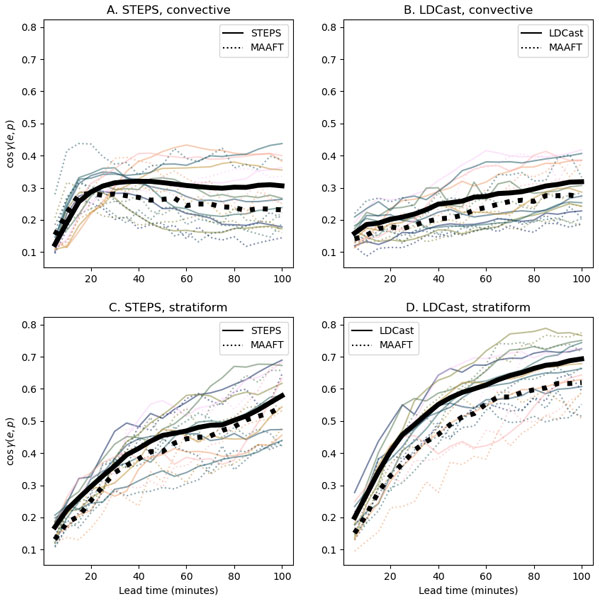
Martin Bonte, Lesley De Cruz, Fabian Debal, and Stéphane Vannitsem
Weather Clim. Dynam., 7, 1837–1852, https://doi.org/10.5194/wcd-7-1837-2026, https://doi.org/10.5194/wcd-7-1837-2026, 2026
Short summary
Short summary
The predictability of the generative AI-based nowcasting model LDCast is evaluated over Belgium, together with the pysteps implementation of the nowcasting algorithm STEPS. It appears that the ensembles of both models correctly estimate the error size through their spread, but fail at spatially representing the error. The analysis is done for two dynamically different types of events, showing how the models adapt their ensembles depending on the situation.
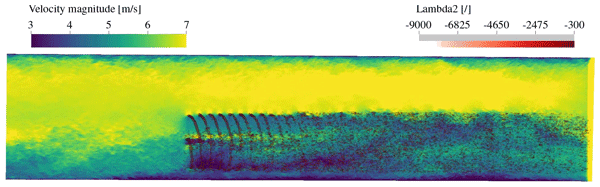
Emmanuel Gillyns, Sophia Buckingham, Jeroen van Beeck, and Grégoire Winckelmans
Wind Energ. Sci., 11, 3531–3553, https://doi.org/10.5194/wes-11-3531-2026, https://doi.org/10.5194/wes-11-3531-2026, 2026
Short summary
Short summary
We built a small wind turbine model and tested it in a wind tunnel while improving computer simulations. Results show simulations accurately predict wind turbine wake behavior behind spinning blades, matching measurements. Some differences remain near blade roots. Combining experiments with refined models helps engineers predict wind turbine performance with greater confidence, supporting more efficient renewable energy design.
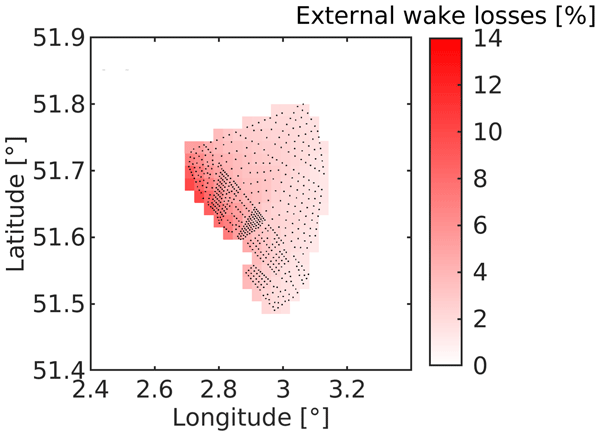
Sara Porchetta, Wim Munters, Maxime Lejeune, Ruben Borgers, Sophia Buckingham, and Michael F. Howland
Wind Energ. Sci., 11, 3273–3294, https://doi.org/10.5194/wes-11-3273-2026, https://doi.org/10.5194/wes-11-3273-2026, 2026
Short summary
Short summary
This study examines how a newly built offshore wind farm affects the power production of nearby existing wind farms. Using a full year of simulations, we compare detailed weather-based models with faster simplified models. The results show clear differences in predicted power losses, especially during calm summer conditions, highlighting the importance of model choice for future offshore wind farm planning and design.
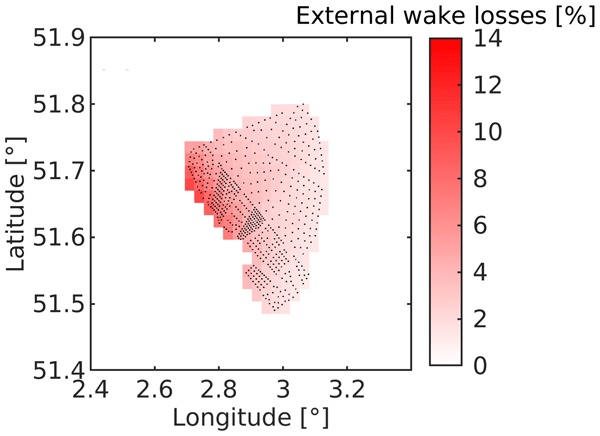
Sara Porchetta, Michael F. Howland, Maxime Lejeune, Ruben Borgers, Sophia Buckingham, and Wim Munters
Wind Energ. Sci., 11, 3295–3319, https://doi.org/10.5194/wes-11-3295-2026, https://doi.org/10.5194/wes-11-3295-2026, 2026
Short summary
Short summary
This study examines how a newly built offshore wind farm affects the power production of nearby existing wind farms. Using a full year of simulations, we compare detailed weather-based models with faster simplified models. The results show clear differences in predicted power losses, especially during calm summer conditions, highlighting the importance of model choice for future offshore wind farm planning and design.
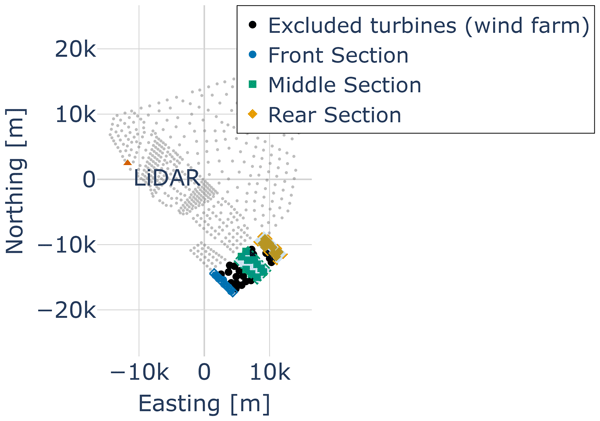
Konstantinos Vratsinis, Rebeca Marini, Pieter-Jan Daems, Lukas Pauscher, Jeroen van Beeck, and Jan Helsen
Wind Energ. Sci., 11, 1803–1820, https://doi.org/10.5194/wes-11-1803-2026, https://doi.org/10.5194/wes-11-1803-2026, 2026
Short summary
Short summary
Using data collected over 13 months at an offshore wind farm, our study shows that a wind turbine’s position within the farm influences its energy output at a given nacelle-measured wind speed. Front-row turbines respond differently to similar wind speeds and turbulence than those further back. This finding suggests that current methods for characterizing inflow conditions may not fully capture actual wind behavior, underscoring the need for improved performance analysis techniques.
Etienne Muller, Simone Gremmo, Felix Houtin-Mongrolle, Laurent Beaudet, Juliette Coussy, Luis A. Martínez-Tossas, and Pierre Bénard
Wind Energ. Sci. Discuss., https://doi.org/10.5194/wes-2026-37, https://doi.org/10.5194/wes-2026-37, 2026
Manuscript not accepted for further review
Short summary
Short summary
The energy yield of wind turbines within wind farms can be increased with control strategies. One way consists in misaligning the turbines with respect to the wind direction, to redirect their wake away from downstream turbines. Using models and advanced simulations, this work confirms a true potential but stresses how measurement biases on the wind direction and the flow complexity may critically affect both the performance in the field, and the reliability of the field validation campaigns.
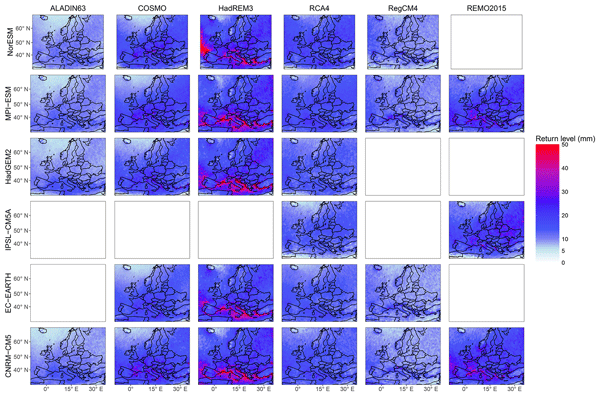
Anouk Dierickx, Wout Dewettinck, Bert Van Schaeybroeck, Lesley De Cruz, Steven Caluwaerts, Piet Termonia, and Hans Van de Vyver
Earth Syst. Sci. Data, 17, 6747–6762, https://doi.org/10.5194/essd-17-6747-2025, https://doi.org/10.5194/essd-17-6747-2025, 2025
Short summary
Short summary
This study introduces the EURO-SUPREME dataset consisting of extreme precipitation events selected from a large ensemble of climate models over Europe. The dataset contains information on extreme precipitation events with a precipitation duration of 1 to 72 h that can lead to flooding, high mortality rates and infrastructure damage. We highlight the usefulness of the dataset as a benchmark for improving high-resolution climate models for risk assessment of future extreme floods.
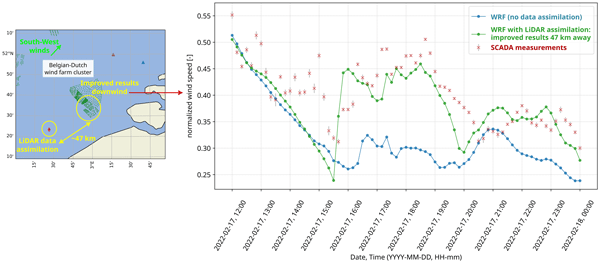
Tsvetelina Ivanova, Sara Porchetta, Sophia Buckingham, Gertjan Glabeke, Jeroen van Beeck, and Wim Munters
Wind Energ. Sci., 10, 245–268, https://doi.org/10.5194/wes-10-245-2025, https://doi.org/10.5194/wes-10-245-2025, 2025
Short summary
Short summary
This study explores how wind and power predictions can be improved by introducing local forcing of measurement data in a numerical weather model while taking into account the presence of neighboring wind farms. Practical implications for the wind energy industry include insights for informed offshore wind farm planning and decision-making strategies using open-source models, even under adverse weather conditions.

Majid Bastankhah, Marcus Becker, Matthew Churchfield, Caroline Draxl, Jay Prakash Goit, Mehtab Khan, Luis A. Martinez Tossas, Johan Meyers, Patrick Moriarty, Wim Munters, Asim Önder, Sara Porchetta, Eliot Quon, Ishaan Sood, Nicole van Lipzig, Jan-Willem van Wingerden, Paul Veers, and Simon Watson
Wind Energ. Sci., 9, 2171–2174, https://doi.org/10.5194/wes-9-2171-2024, https://doi.org/10.5194/wes-9-2171-2024, 2024
Short summary
Short summary
Dries Allaerts was born on 19 May 1989 and passed away at his home in Wezemaal, Belgium, on 10 October 2024 after battling cancer. Dries started his wind energy career in 2012 and had a profound impact afterward on the community, in terms of both his scientific realizations and his many friendships and collaborations in the field. His scientific acumen, open spirit of collaboration, positive attitude towards life, and playful and often cheeky sense of humor will be deeply missed by many.

Vera Melinda Galfi, Tommaso Alberti, Lesley De Cruz, Christian L. E. Franzke, and Valerio Lembo
Nonlin. Processes Geophys., 31, 185–193, https://doi.org/10.5194/npg-31-185-2024, https://doi.org/10.5194/npg-31-185-2024, 2024
Short summary
Short summary
In the online seminar series "Perspectives on climate sciences: from historical developments to future frontiers" (2020–2021), well-known and established scientists from several fields – including mathematics, physics, climate science and ecology – presented their perspectives on the evolution of climate science and on relevant scientific concepts. In this paper, we first give an overview of the content of the seminar series, and then we introduce the written contributions to this special issue.
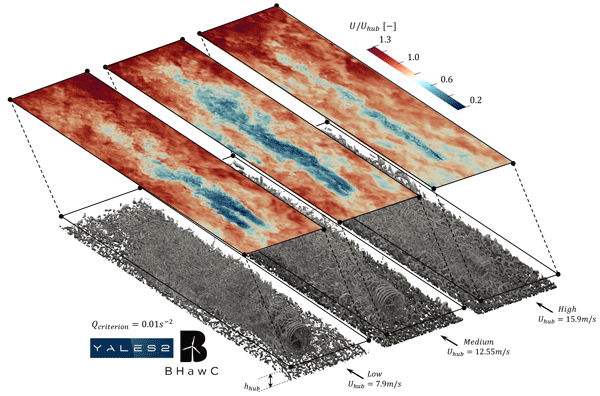
Etienne Muller, Simone Gremmo, Félix Houtin-Mongrolle, Bastien Duboc, and Pierre Bénard
Wind Energ. Sci., 9, 25–48, https://doi.org/10.5194/wes-9-25-2024, https://doi.org/10.5194/wes-9-25-2024, 2024
Short summary
Short summary
This article presents an advanced tool designed for the high-fidelity and high-performance simulation of operating wind turbines, allowing for instance the computation of a blade deformation, as well as of the surrounding airflow. As this tool relies on coupling two existing codes, the coupling strategy is first described in depth. The article then compares the code results to field data for validation.
Adithya Vemuri, Sophia Buckingham, Wim Munters, Jan Helsen, and Jeroen van Beeck
Wind Energ. Sci., 7, 1869–1888, https://doi.org/10.5194/wes-7-1869-2022, https://doi.org/10.5194/wes-7-1869-2022, 2022
Short summary
Short summary
The sensitivity of the WRF mesoscale modeling framework in accurately representing and predicting wind-farm-level environmental variables for three extreme weather events over the Belgian North Sea is investigated in this study. The overall results indicate highly sensitive simulation results to the type and combination of physics parameterizations and the type of the weather phenomena, with indications that scale-aware physics parameterizations better reproduce wind-related variables.
Nicolas Ghilain, Stéphane Vannitsem, Quentin Dalaiden, Hugues Goosse, Lesley De Cruz, and Wenguang Wei
Earth Syst. Sci. Data, 14, 1901–1916, https://doi.org/10.5194/essd-14-1901-2022, https://doi.org/10.5194/essd-14-1901-2022, 2022
Short summary
Short summary
Modeling the climate at high resolution is crucial to represent the snowfall accumulation over the complex orography of the Antarctic coast. While ice cores provide a view constrained spatially but over centuries, climate models can give insight into its spatial distribution, either at high resolution over a short period or vice versa. We downscaled snowfall accumulation from climate model historical simulations (1850–present day) over Dronning Maud Land at 5.5 km using a statistical method.
Cited articles
Ahsbahs, T., Badger, M., Karagali, I., and Larsén, X. G.: Validation of Sentinel-1A SAR Coastal Wind Speeds Against Scanning LiDAR, Remote Sens., 9, https://doi.org/10.3390/rs9060552, 2017. a, b
Ahsbahs, T., Badger, M., Volker, P., Hansen, K. S., and Hasager, C. B.: Applications of satellite winds for the offshore wind farm site Anholt, Wind Energ. Sci., 3, 573–588, https://doi.org/10.5194/wes-3-573-2018, 2018. a
Ahsbahs, T., Nygaard, N. G., Newcombe, A., and Badger, M.: Wind Farm Wakes from SAR and Doppler Radar, Remote Sens., 12, https://doi.org/10.3390/rs12030462, 2020. a
Ali, K., Schultz, D. M., Revell, A., Stallard, T., and Ouro, P.: Assessment of five wind-farm parameterizations in the weather research and forecasting model: a case study of wind farms in the North Sea, Mon. Weather Rev., 151, 2333–2359, https://doi.org/10.1175/MWR-D-23-0006.1, 2023. a, b, c, d, e, f, g
Archer, C. L., Colle, B. A., Veron, D. L., Veron, F., and Sienkiewicz, M. J.: On the predominance of unstable atmospheric conditions in the marine boundary layer offshore of the US northeastern coast, J. Geophys. Res.-Atmos., 121, 8869–8885, https://doi.org/10.1002/2016JD024896, 2016. a
Archer, C. L., Wu, S., Ma, Y., and Jiménez, P. A.: Two corrections for turbulent kinetic energy generated by wind farms in the WRF model, Mon. Weather Rev., 148, 4823–4835, https://doi.org/10.1175/MWR-D-20-0097.1, 2020. a, b, c
Bergman, G., Verhoef, J., and van der Werff, P.: Lichteiland Goeree LiDAR measurement campaign, Instrumentation Report 2022, TNO, https://resolver.tno.nl/uuid:53bf464e-4538-492d-acf5-631de37adea4 (last access: 2 May 2025), 2022. a
Cañadillas, B., Foreman, R., Barth, V., Siedersleben, S., Lampert, A., Platis, A., Djath, B., Schulz-Stellenfleth, J., Bange, J., Emeis, S., and Neumann, T.: Offshore wind farm wake recovery: Airborne measurements and its representation in engineering models, Wind Energy, 23, 1249–1265, https://doi.org/10.1002/we.2484, 2020. a, b
de Montera, L., Remmers, T., O'Connell, R., and Desmond, C.: Validation of Sentinel-1 offshore winds and average wind power estimation around Ireland, Wind Energ. Sci., 5, 1023–1036, https://doi.org/10.5194/wes-5-1023-2020, 2020. a
Dörenkämper, M., Olsen, B. T., Witha, B., Hahmann, A. N., Davis, N. N., Barcons, J., Ezber, Y., García-Bustamante, E., González-Rouco, J. F., Navarro, J., Sastre-Marugán, M., Sīle, T., Trei, W., Žagar, M., Badger, J., Gottschall, J., Sanz Rodrigo, J., and Mann, J.: The Making of the New European Wind Atlas – Part 2: Production and evaluation, Geosci. Model Dev., 13, 5079–5102, https://doi.org/10.5194/gmd-13-5079-2020, 2020. a
Fischereit, J., Brown, R., Larsén, X. G., Badger, J., and Hawkes, G.: Review of mesoscale wind-farm parametrizations and their applications, Bound.-Lay. Meteorol., 182, 175–224, https://doi.org/10.1007/s10546-021-00652-y, 2022a. a, b
Fischereit, J., Schaldemose Hansen, K., Larsén, X. G., van der Laan, M. P., Réthoré, P.-E., and Murcia Leon, J. P.: Comparing and validating intra-farm and farm-to-farm wakes across different mesoscale and high-resolution wake models, Wind Energ. Sci., 7, 1069–1091, https://doi.org/10.5194/wes-7-1069-2022, 2022b. a
Fischereit, J., Vedel, H., Larsén, X. G., Theeuwes, N. E., Giebel, G., and Kaas, E.: Modelling wind farm effects in HARMONIE–AROME (cycle 43.2.2) – Part 1: Implementation and evaluation, Geosci. Model Dev., 17, 2855–2875, https://doi.org/10.5194/gmd-17-2855-2024, 2024. a, b
Fitch, A. C., Olson, J. B., Lundquist, J. K., Dudhia, J., Gupta, A. K., Michalakes, J., and Barstad, I.: Local and mesoscale impacts of wind farms as parameterized in a mesoscale NWP model, Mon. Weather Rev., 140, 3017–3038, https://doi.org/10.1175/MWR-D-11-00352.1, 2012. a, b
Flamary, R., Courty, N., Gramfort, A., Alaya, M. Z., Boisbunon, A., Chambon, S., Chapel, L., Corenflos, A., Fatras, K., Fournier, N., Gautheron, L., Gayraud, N. T. H., Janati, H., Rakotomamonjy, A., Redko, I., Rolet, A., Schutz, A., Seguy, V., Sutherland, D. J., Tavenard, R., Tong, A., and Vayer, T.: POT: Python Optimal Transport, J. Mach. Learn. Res., 22, 1–8, http://jmlr.org/papers/v22/20-451.html (last access: 22 July 2025), 2021. a
García-Santiago, O., Badger, J., and Hahmann, A. N.: Wind farm wake recovery under different Planetary Boundary Layer schemes in WRF, EGU General Assembly 2023, Vienna, Austria, 24–28 Apr 2023, EGU23-14911, https://doi.org/10.5194/egusphere-egu23-14911, 2023. a
García-Santiago, O., Hahmann, A. N., Badger, J., and Peña, A.: Evaluation of wind farm parameterizations in the WRF model under different atmospheric stability conditions with high-resolution wake simulations, Wind Energ. Sci., 9, 963–979, https://doi.org/10.5194/wes-9-963-2024, 2024. a, b, c, d
Glabeke, G., Buckingham, S., De Mulder, T., and van Beeck, J.: Anomalous wind events over the Belgian North Sea at heights relevant to wind energy, in: Wind Energy Science Conference 2023 Mini-Symposium 1.5 IEA Wind Task 52: Replacing met masts and Accelerating offshore wind deployment, Submission Number 438, https://zenodo.org/record/8034397 (last access: 15 May 2925), 2023. a
Gomez, M. S., Deskos, G., Lundquist, J. K., and Juliano, T. W.: Can mesoscale models capture the effect from cluster wakes offshore?, J. Phys. Conf. Ser., 2767, 062013, https://doi.org/10.1088/1742-6596/2767/6/062013, 2024. a
Gryning, S.-E., Batchvarova, E., Brümmer, B., Jørgensen, H., and Larsen, S.: On the extension of the wind profile over homogeneous terrain beyond the surface boundary layer, Bound.-Lay. Meteorol., 124, 251–268, https://doi.org/10.1007/s10546-007-9166-9, 2007. a, b
Hahmann, A. N., Sīle, T., Witha, B., Davis, N. N., Dörenkämper, M., Ezber, Y., García-Bustamante, E., González-Rouco, J. F., Navarro, J., Olsen, B. T., and Söderberg, S.: The making of the New European Wind Atlas – Part 1: Model sensitivity, Geosci. Model Dev., 13, 5053–5078, https://doi.org/10.5194/gmd-13-5053-2020, 2020. a
Hampel, F. R.: A general qualitative definition of robustness, Ann. Math. Stat., 42, 1887–1896, https://doi.org/10.1214/aoms/1177693054, 1971. a
Harris, C. R., Millman, K. J., van der Walt, S. J., Gommers, R., Virtanen, P., Cournapeau, D., Wieser, E., Taylor, J., Berg, S., Smith, N. J., Kern, R., Picus, M., Hoyer, S., van Kerkwijk, M. H., Brett, M., Haldane, A., del Río, J. F., Wiebe, M., Peterson, P., Gérard-Marchant, P., Sheppard, K., Reddy, T., Weckesser, W., Abbasi, H., Gohlke, C., and Oliphant, T. E.: Array programming with NumPy, Nature, 585, 357–362, https://doi.org/10.1038/s41586-020-2649-2, 2020. a
Hasager, C. B., Badger, M., Peña, A., Larsén, X. G., and Bingöl, F.: SAR-Based Wind Resource Statistics in the Baltic Sea, Remote Sens., 3, 117–144, https://doi.org/10.3390/rs3010117, 2011a. a
Hasager, C. B., Badger, M., Peña, A., Larsén, X. G., and Bingöl, F.: SAR-Based Wind Resource Statistics in the Baltic Sea, Remote Sens., 3, 117–144, https://doi.org/10.3390/rs3010117, 2011b. a
Hasager, C. B., Vincent, P., Badger, J., Badger, M., Di Bella, A., Peña, A., Husson, R., and Volker, P. J. H.: Using Satellite SAR to Characterize the Wind Flow around Offshore Wind Farms, Energies, 8, 5413–5439, https://doi.org/10.3390/en8065413, 2015. a
Hasager, C. B., Imber, J., Fischereit, J., Fujita, A., Dimitriadou, K., and Badger, M.: Wind Speed-Up in Wind Farm Wakes Quantified From Satellite SAR and Mesoscale Modeling, Wind Energy, 27, 1369–1387, https://doi.org/10.1002/we.2943, 2024. a
Haupt, S. E., Kosović, B., Berg, L. K., Kaul, C. M., Churchfield, M., Mirocha, J., Allaerts, D., Brummet, T., Davis, S., DeCastro, A., Dettling, S., Draxl, C., Gagne, D. J., Hawbecker, P., Jha, P., Juliano, T., Lassman, W., Quon, E., Rai, R. K., Robinson, M., Shaw, W., and Thedin, R.: Lessons learned in coupling atmospheric models across scales for onshore and offshore wind energy, Wind Energ. Sci., 8, 1251–1275, https://doi.org/10.5194/wes-8-1251-2023, 2023. a
Hersbach, H., Stoffelen, A., and de Haan, S.: An improved C-band scatterometer ocean geophysical model function: CMOD5, J. Geophys. Res.-Oceans, 112, https://doi.org/10.1029/2006JC003743, 2007. a
Hersbach, H., Bell, B., Berrisford, P., Hirahara, S., Horányi, A., Muñoz-Sabater, J., Nicolas, J., Peubey, C., Radu, R., Schepers, D., Simmons, A., Cornel, S., Abdalla, S., Abellan, X., Balsamo, G., Bechtold, Biavati, P. G., Bidlot, J., Bonavita, M., De Chiara, G., Dahlgren, P., Dee, D., Diamantakis, M., Dragani, R., Flemming, J., Forbes, R., Fuentes, M., Geer, A., Haimberger, L., Healy, S., Hogan, R. J., Hólm, E., Janisková, M., Keeley, S., Laloyaux, P., Lopez, P., Lupu, C., Radnoti, G., de Rosnay, P., Rozum, I., Vamborg, F., Villaume, S., and Thépaut, J.-N.: The ERA5 global reanalysis, Q. J. Roy. Meteor. Soc., 146, 1999–2049, https://doi.org/10.1002/qj.3803, 2020. a, b
Hersbach, H., Bell, B., Berrisford, P., Biavati, G., Horányi, A., Muñoz Sabater, J., Nicolas, J., Peubey, C., Radu, R., Rozum, I., Schepers, D., Simmons, A., Soci, C., Dee, D., and Thépaut, J.-N.: ERA5 hourly data on pressure levels from 1940 to present, Copernicus Climate Change Service (C3S) Climate Data Store (CDS) [data set], https://doi.org/10.24381/cds.bd0915c6, 2023. a
Hoeser, T., Feuerstein, S., and Kuenzer, C.: DeepOWT: a global offshore wind turbine data set derived with deep learning from Sentinel-1 data, Earth Syst. Sci. Data, 14, 4251–4270, https://doi.org/10.5194/essd-14-4251-2022, 2022. a
Hong, S.-Y., Dudhia, J., and Chen, S.-H.: A revised approach to ice microphysical processes for the bulk parameterization of clouds and precipitation, Mon. Weather Rev., 132, 103–120, https://doi.org/10.1175/1520-0493(2004)132<0103:ARATIM>2.0.CO;2, 2004. a
Iacono, M. J., Delamere, J. S., Mlawer, E. J., Shephard, M. W., Clough, S. A., and Collins, W. D.: Radiative forcing by long-lived greenhouse gases: Calculations with the AER radiative transfer models, J. Geophys. Res.-Atmos., 113, https://doi.org/10.1029/2008JD009944, 2008. a
Ivanova, T., Porchetta, S., Buckingham, S., Glabeke, G., van Beeck, J., and Munters, W.: Improving wind and power predictions via four-dimensional data assimilation in the WRF model: case study of storms in February 2022 at Belgian offshore wind farms, Wind Energ. Sci., 10, 245–268, https://doi.org/10.5194/wes-10-245-2025, 2025. a, b
Jézéquel, E., Blondel, F., and Masson, V.: Breakdown of the velocity and turbulence in the wake of a wind turbine – Part 1: Large-eddy-simulation study, Wind Energ. Sci., 9, 97–117, https://doi.org/10.5194/wes-9-97-2024, 2024. a
Kain, J. S.: The Kain–Fritsch convective parameterization: an update, J. Appl. Meteorol., 43, 170–181, https://doi.org/10.1175/1520-0450(2004)043<0170:TKCPAU>2.0.CO;2, 2004. a
Kale, B., Buckingham, S., Beeck, J. v., and Cuerva-Tejero, A.: Multi-scale modeling of a wind turbine wake in complex terrain, J. Phys. Conf. Ser., 2505, 012012, https://doi.org/10.1088/1742-6596/2505/1/012012, 2023. a
Kalverla, P., Steeneveld, G.-J., Ronda, R., and Holtslag, A. A.: Evaluation of three mainstream numerical weather prediction models with observations from meteorological mast IJmuiden at the North Sea, Wind Energy, 22, 34–48, https://doi.org/10.1002/we.2267, 2019. a
Knoop, S. and de Jong, M.: Wind lidars within Dutch offshore wind farms, EMS Annual Meeting 2023, Bratislava, Slovakia, 4–8 Sep 2023, EMS2023-271, https://doi.org/10.5194/ems2023-271, 2023. a
Larsén, X. G. and Fischereit, J.: A case study of wind farm effects using two wake parameterizations in the Weather Research and Forecasting (WRF) model (V3.7.1) in the presence of low-level jets, Geosci. Model Dev., 14, 3141–3158, https://doi.org/10.5194/gmd-14-3141-2021, 2021. a, b
Larsén, X. G., Du, J., Bolaños, R., Imberger, M., Kelly, M. C., Badger, M., and Larsen, S.: Estimation of offshore extreme wind from wind-wave coupled modeling, Wind Energy, 22, 1043–1057, https://doi.org/10.1002/we.2339, 2019. a
Lee, J. C. Y. and Fields, M. J.: An overview of wind-energy-production prediction bias, losses, and uncertainties, Wind Energ. Sci., 6, 311–365, https://doi.org/10.5194/wes-6-311-2021, 2021. a
Lee, J. C. Y. and Lundquist, J. K.: Evaluation of the wind farm parameterization in the Weather Research and Forecasting model (version 3.8.1) with meteorological and turbine power data, Geosci. Model Dev., 10, 4229–4244, https://doi.org/10.5194/gmd-10-4229-2017, 2017. a
Ma, Y., Archer, C. L., and Vasel-Be-Hagh, A.: Comparison of individual versus ensemble wind farm parameterizations inclusive of sub-grid wakes for the WRF model, Wind Energy, 25, 1573–1595, https://doi.org/10.1002/we.2758, 2022a. a
Ma, Y., Archer, C. L., and Vasel-Be-Hagh, A.: The Jensen wind farm parameterization, Wind Energ. Sci., 7, 2407–2431, https://doi.org/10.5194/wes-7-2407-2022, 2022b. a
Mardia, K. V. and Jupp, P. E.: Directional statistics, John Wiley & Sons, https://doi.org/10.1002/9780470316979, 2009. a, b
Tewari, M., Chen, F., Wang, W., Dudhia, J., LeMone, M. A., Mitchell K., and Ek, M., Gayno, G., Wegiel, J., and Cuenca, R. H.: Implementation and verification of the unified NOAH land surface model in the WRF model (Formerly Paper Number 17.5), in: Proceedings of the 20th conference on weather analysis and forecasting/16th conference on numerical weather prediction, Seattle, WA, USA, 14, 11–15, 2004. a
Müller, S., Larsén, X. G., and Verelst, D. R.: Tropical cyclone low-level wind speed, shear, and veer: sensitivity to the boundary layer parametrization in the Weather Research and Forecasting model, Wind Energ. Sci., 9, 1153–1171, https://doi.org/10.5194/wes-9-1153-2024, 2024. a
Muñoz-Esparza, D., Kosović, B., Mirocha, J., and van Beeck, J.: Bridging the transition from mesoscale to microscale turbulence in numerical weather prediction models, Bound.-Lay. Meteorol., 153, 409–440, https://doi.org/10.1007/s10546-014-9956-9, 2014. a
Nakanishi, M. and Niino, H.: An improved Mellor–Yamada level-3 model: Its numerical stability and application to a regional prediction of advection fog, Bound.-Lay. Meteorol., 119, 397–407, https://doi.org/10.1007/s10546-005-9030-8, 2006. a, b
Olsen, A.-M., Øiestad, M., Berge, E., Køltzow, M. Ø., and Valkonen, T.: Evaluation of marine wind profiles in the North Sea and Norwegian Sea based on measurements and satellite-derived wind products, Tellus A, 74, https://doi.org/10.16993/tellusa.43, 2022. a
Olsen, B. T. E., Hahmann, A. N., Alonso-de-Linaje, N. G., Žagar, M., and Dörenkämper, M.: Low-level jets in the North and Baltic seas: mesoscale model sensitivity and climatology using WRF V4.2.1, Geosci. Model Dev., 18, 4499–4533, https://doi.org/10.5194/gmd-18-4499-2025, 2025. a, b, c
Optis, M., Monahan, A., and Bosveld, F. C.: Limitations and breakdown of Monin–Obukhov similarity theory for wind profile extrapolation under stable stratification, Wind Energy, 19, 1053–1072, https://doi.org/10.1002/we.1883, 2016. a
Peña, A. and Hahmann, A. N.: Atmospheric stability and turbulence fluxes at Horns Rev–an intercomparison of sonic, bulk and WRF model data, Wind Energy, 15, 717–731, https://doi.org/10.1002/we.500, 2012. a
Peña, A., Mirocha, J. D., and Van Der Laan, M. P.: Evaluation of the Fitch wind-farm wake parameterization with large-eddy simulations of wakes using the Weather Research and Forecasting Model, Mon. Weather Rev., 150, 3051–3064, https://doi.org/10.1175/MWR-D-22-0118.1, 2022. a
Pentikäinen, P., O'Connor, E. J., and Ortiz-Amezcua, P.: Evaluating wind profiles in a numerical weather prediction model with Doppler lidar, Geosci. Model Dev., 16, 2077–2094, https://doi.org/10.5194/gmd-16-2077-2023, 2023. a
Platis, A., Siedersleben, S. K., Bange, J., Lampert, A., Bärfuss, K., Hankers, R., Cañadillas, B., Foreman, R., Schulz-Stellenfleth, J., Djath, B., Neumann, T., and Emeis, S.: First in situ evidence of wakes in the far field behind offshore wind farms, Sci. Rep., 8, 2163, https://doi.org/10.1038/s41598-018-20389-y, 2018. a, b
Porchetta, S., Howland, M. F., Borgers, R., Buckingham, S., and Munters, W.: Annual wake impacts in and between wind farm clusters modelled by a mesoscale numerical weather prediction model and fast-running engineering models, Wind Energ. Sci. Discuss. [preprint], https://doi.org/10.5194/wes-2024-58, in review, 2024. a, b
Pronk, V., Bodini, N., Optis, M., Lundquist, J. K., Moriarty, P., Draxl, C., Purkayastha, A., and Young, E.: Can reanalysis products outperform mesoscale numerical weather prediction models in modeling the wind resource in simple terrain?, Wind Energ. Sci., 7, 487–504, https://doi.org/10.5194/wes-7-487-2022, 2022. a
Pryor, S., Barthelmie, R., and Shepherd, T.: 20 % of US electricity from wind will have limited impacts on system efficiency and regional climate, Sci. Rep., 10, 541, https://doi.org/10.1038/s41598-019-57371-1, 2020. a
Pryor, S. C. and Barthelmie, R. J.: A global assessment of extreme wind speeds for wind energy applications, Nature Energy, 6, 268–276, https://doi.org/10.1038/s41560-020-00773-7, 2021. a
Pryor, S. C., Shepherd, T. J., Barthelmie, R. J., Hahmann, A. N., and Volker, P.: Wind Farm Wakes Simulated Using WRF, J. Phys. Conf. Ser., 1256, 012025, https://doi.org/10.1088/1742-6596/1256/1/012025, 2019. a
Quint, D., Lundquist, J. K., and Rosencrans, D.: Simulations suggest offshore wind farms modify low-level jets, Wind Energ. Sci., 10, 117–142, https://doi.org/10.5194/wes-10-117-2025, 2025. a, b
Santoni, C., García-Cartagena, E. J., Ciri, U., Zhan, L., Valerio Iungo, G., and Leonardi, S.: One-way mesoscale-microscale coupling for simulating a wind farm in North Texas: Assessment against SCADA and LiDAR data, Wind Energy, 23, 691–710, https://doi.org/10.1002/we.2452, 2020. a
Shenoy, M., Raju, P., and Prasad, J.: Optimization of physical schemes in WRF model on cyclone simulations over Bay of Bengal using one-way ANOVA and Tukey’s test, Sci. Rep., 11, 24412, https://doi.org/10.1038/s41598-021-02723-z, 2021. a
Siedersleben, S. K., Platis, A., Lundquist, J. K., Djath, B., Lampert, A., Bärfuss, K., Cañadillas, B., Schulz-Stellenfleth, J., Bange, J., Neumann, T., and Emeis, S.: Turbulent kinetic energy over large offshore wind farms observed and simulated by the mesoscale model WRF (3.8.1), Geosci. Model Dev., 13, 249–268, https://doi.org/10.5194/gmd-13-249-2020, 2020. a, b, c, d
Skamarock, W. C., Klemp, J. B., Dudhia, J., Gill, D. O., Liu, Z., Berner, J., Wang, W., Powers, J. G., Duda, M. G., Barker, D. M., and Huang, X.-Y.: A description of the advanced research WRF version 4, NCAR tech. note ncar/tn-556+ str, NCAR, 145, https://doi.org/10.5065/1dfh-6p97, 2019. a, b
Sorensen, J. N. and Shen, W. Z.: Numerical modeling of wind turbine wakes, J. Fluids Eng., 124, 393–399, https://doi.org/10.1115/1.1471361, 2002. a
Stanley, A. P. J., King, J., Bay, C., and Ning, A.: A model to calculate fatigue damage caused by partial waking during wind farm optimization, Wind Energ. Sci., 7, 433–454, https://doi.org/10.5194/wes-7-433-2022, 2022. a
Stevens, R. J., Martínez-Tossas, L. A., and Meneveau, C.: Comparison of wind farm large eddy simulations using actuator disk and actuator line models with wind tunnel experiments, Renew. Energ., 116, 470–478, https://doi.org/10.1016/j.renene.2017.08.072, 2018. a
Stipa, S., Ajay, A., and Brinkerhoff, J.: The actuator farm model for large eddy simulation (LES) of wind-farm-induced atmospheric gravity waves and farm–farm interaction, Wind Energ. Sci., 9, 2301–2332, https://doi.org/10.5194/wes-9-2301-2024, 2024. a
Stiperski, I. and Calaf, M.: Generalizing Monin-Obukhov Similarity Theory (1954) for Complex Atmospheric Turbulence, Phys. Rev. Lett., 130, 124001, https://doi.org/10.1103/PhysRevLett.130.124001, 2023. a
Stull, R. B.: Practical meteorology: an algebra-based survey of atmospheric science, University of British Columbia, https://www.eoas.ubc.ca/books/Practical_Meteorology/ (last access: 15 July 2025), 2015. a
Vanderwende, B. J., Lundquist, J. K., Rhodes, M. E., Takle, E. S., and Irvin, S. L.: Observing and simulating the summertime low-level jet in central Iowa, Mon. Weather Rev., 143, 2319–2336, https://doi.org/10.1175/MWR-D-14-00325.1, 2015. a
Virtanen, P., Gommers, R., Oliphant, T. E., Haberland, M., Reddy, T., Cournapeau, D., Burovski, E., Peterson, P., Weckesser, W., Bright, J., van der Walt, S. J., Brett, M., Wilson, J., Millman, K. J., Mayorov, N., Nelson, A. R. J., Jones, E., Kern, R., Larson, E., Carey, C. J., Polat, İ., Feng, Y., Moore, E. W., VanderPlas, J., Laxalde, D., Perktold, J., Cimrman, R., Henriksen, I., Quintero, E. A., Harris, C. R., Archibald, A. M., Ribeiro, A. H., Pedregosa, F., van Mulbregt, P., and SciPy 1.0 Contributors: SciPy 1.0: fundamental algorithms for scientific computing in Python, Nat. Methods, 17, 261–272, https://doi.org/10.1038/s41592-019-0686-2, 2020. a, b
Volker, P. J. H., Badger, J., Hahmann, A. N., and Ott, S.: The Explicit Wake Parametrisation V1.0: a wind farm parametrisation in the mesoscale model WRF, Geosci. Model Dev., 8, 3715–3731, https://doi.org/10.5194/gmd-8-3715-2015, 2015. a, b
Vollmer, L., Sengers, B. A. M., and Dörenkämper, M.: Brief communication: A simple axial induction modification to the Weather Research and Forecasting Fitch wind farm parameterization, Wind Energ. Sci., 9, 1689–1693, https://doi.org/10.5194/wes-9-1689-2024, 2024. a, b
Short summary
In this study, we use advanced weather simulations, real-world measurements, and satellite images, showing that modeling wind farm effects improves accuracy, especially in areas influenced by turbines. Focusing on one of the largest wind farm clusters in the North Sea, we investigate wind speed deficits based on different atmospheric conditions. These findings help quantify the influence of large wind farm clusters, improve predictions, and support planning for future wind energy development.
In this study, we use advanced weather simulations, real-world measurements, and satellite...


Altmetrics
Final-revised paper
Preprint