Articles | Volume 11, issue 9
https://doi.org/10.5194/wes-11-3745-2026
© Author(s) 2026. This work is distributed under
the Creative Commons Attribution 4.0 License.
https://doi.org/10.5194/wes-11-3745-2026
© Author(s) 2026. This work is distributed under
the Creative Commons Attribution 4.0 License.
Offshore wind profile characteristics and their impact on floating wind turbine power production

Technical University of Denmark (DTU), Frederiksborgvej 399, Roskilde, 4000, Denmark
Camille Dubreuil-Boisclair
Equinor ASA, Sandslivegen 90, Sandsli, 5254, Norway
Related authors
Liqin Jin, Jakob Mann, Nikolas Angelou, and Mikael Sjöholm
Atmos. Meas. Tech., 16, 6007–6023, https://doi.org/10.5194/amt-16-6007-2023, https://doi.org/10.5194/amt-16-6007-2023, 2023
Short summary
Short summary
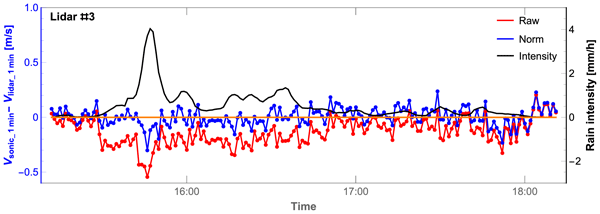
By sampling the spectra from continuous-wave Doppler lidars very fast, the rain-induced Doppler signal can be suppressed and the bias in the wind velocity estimation can be reduced. The method normalizes 3 kHz spectra by their peak values before averaging them down to 50 Hz. Over 3 h, we observe a significant reduction in the bias of the lidar data relative to the reference sonic data when the largest lidar focus distance is used. The more it rains, the more the bias is reduced.
Nikolas Angelou, Jakob Mann, and Camille Dubreuil-Boisclair
Wind Energ. Sci., 8, 1511–1531, https://doi.org/10.5194/wes-8-1511-2023, https://doi.org/10.5194/wes-8-1511-2023, 2023
Short summary
Short summary
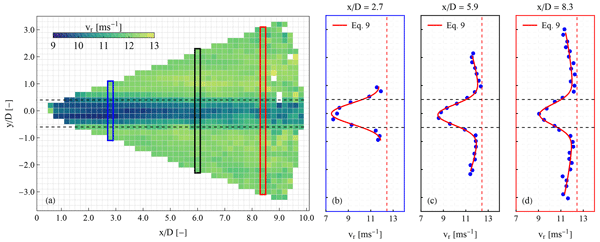
This study presents the first experimental investigation using two nacelle-mounted wind lidars that reveal the upwind and downwind conditions relative to a full-scale floating wind turbine. We find that in the case of floating wind turbines with small pitch and roll oscillating motions (< 1°), the ambient turbulence is the main driving factor that determines the propagation of the wake characteristics.
Nikolas Angelou, Jakob Mann, and Ebba Dellwik
Atmos. Chem. Phys., 22, 2255–2268, https://doi.org/10.5194/acp-22-2255-2022, https://doi.org/10.5194/acp-22-2255-2022, 2022
Short summary
Short summary
In this study we use state-of-the-art scanning wind lidars to investigate the wind field in the near-wake region of a mature, open-grown tree. Our measurements provide for the first time a picture of the mean and the turbulent spatial fluctuations in the flow in the wake of a tree in its natural environment. Our observations support the hypothesis that even simple models can realistically simulate the turbulent fluctuations in the wake and thus predict the effect of trees in flow models.
Nicola Bodini, Patrick Moriarty, Regis Thedin, Paula Doubrawa, Cristina Archer, Myra Blaylock, Carlo Bottasso, Bruno Carmo, Lawrence Cheung, Camille Dubreuil, Rogier Floors, Thomas Herges, Daniel Houck, Ali Kanjari, Colleen M. Kaul, Christopher Kelley, Ru Li, Julie K. Lundquist, Desirae Major, Anh Kiet Nguyen, Mike Optis, Luan R. C. Parada, Alfredo Peña, Julian Quick, David Ricarte, William C. Radünz, Raj K. Rai, Oscar García-Santiago, Jonas Schulte, Knut S. Seim, M. Paul van der Laan, Kisorthman Vimalakanthan, and Adam Wise
Wind Energ. Sci., 11, 3107–3135, https://doi.org/10.5194/wes-11-3107-2026, https://doi.org/10.5194/wes-11-3107-2026, 2026
Short summary
Short summary
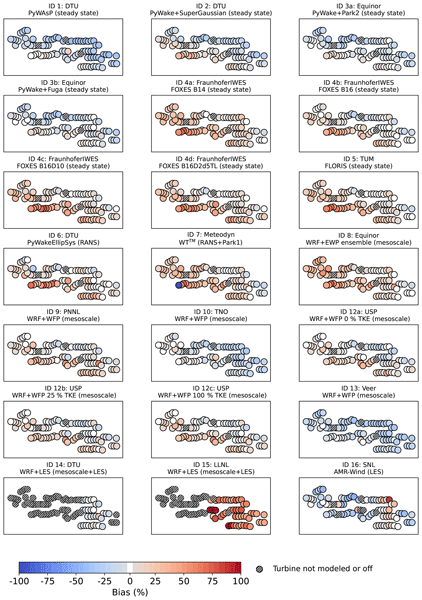
Predicting wind farm energy production is challenging because wind patterns are complex. We tested 16 different models against real data from a major field experiment to see which worked best. Surprisingly, the most expensive and detailed models were not always more accurate than simpler ones. We found that feeding models better weather data was the most effective way to improve accuracy. These results help the industry choose the right tools for designing more-efficient wind farms.
Liqin Jin, Jakob Mann, Nikolas Angelou, and Mikael Sjöholm
Atmos. Meas. Tech., 16, 6007–6023, https://doi.org/10.5194/amt-16-6007-2023, https://doi.org/10.5194/amt-16-6007-2023, 2023
Short summary
Short summary
By sampling the spectra from continuous-wave Doppler lidars very fast, the rain-induced Doppler signal can be suppressed and the bias in the wind velocity estimation can be reduced. The method normalizes 3 kHz spectra by their peak values before averaging them down to 50 Hz. Over 3 h, we observe a significant reduction in the bias of the lidar data relative to the reference sonic data when the largest lidar focus distance is used. The more it rains, the more the bias is reduced.
Nikolas Angelou, Jakob Mann, and Camille Dubreuil-Boisclair
Wind Energ. Sci., 8, 1511–1531, https://doi.org/10.5194/wes-8-1511-2023, https://doi.org/10.5194/wes-8-1511-2023, 2023
Short summary
Short summary
This study presents the first experimental investigation using two nacelle-mounted wind lidars that reveal the upwind and downwind conditions relative to a full-scale floating wind turbine. We find that in the case of floating wind turbines with small pitch and roll oscillating motions (< 1°), the ambient turbulence is the main driving factor that determines the propagation of the wake characteristics.
Maarten Paul van der Laan, Oscar García-Santiago, Mark Kelly, Alexander Meyer Forsting, Camille Dubreuil-Boisclair, Knut Sponheim Seim, Marc Imberger, Alfredo Peña, Niels Nørmark Sørensen, and Pierre-Elouan Réthoré
Wind Energ. Sci., 8, 819–848, https://doi.org/10.5194/wes-8-819-2023, https://doi.org/10.5194/wes-8-819-2023, 2023
Short summary
Short summary
Offshore wind farms are more commonly installed in wind farm clusters, where wind farm interaction can lead to energy losses. In this work, an efficient numerical method is presented that can be used to estimate these energy losses. The novel method is verified with higher-fidelity numerical models and validated with measurements of an existing wind farm cluster.
Nikolas Angelou, Jakob Mann, and Ebba Dellwik
Atmos. Chem. Phys., 22, 2255–2268, https://doi.org/10.5194/acp-22-2255-2022, https://doi.org/10.5194/acp-22-2255-2022, 2022
Short summary
Short summary
In this study we use state-of-the-art scanning wind lidars to investigate the wind field in the near-wake region of a mature, open-grown tree. Our measurements provide for the first time a picture of the mean and the turbulent spatial fluctuations in the flow in the wake of a tree in its natural environment. Our observations support the hypothesis that even simple models can realistically simulate the turbulent fluctuations in the wake and thus predict the effect of trees in flow models.
Cited articles
Borraccino, A., Schlipf, D., Haizmann, F., and Wagner, R.: Wind field reconstruction from nacelle-mounted lidar short-range measurements, Wind Energ. Sci., 2, 269–283, https://doi.org/10.5194/wes-2-269-2017, 2017. a
Bui, H., Bakhoday-Paskyabi, M., and Reuder, J.: Characterization and bias correction of low-level jets at FINO1 using lidar observations and reanalysis data, Wind Energ. Sci., 11, 2307–2321, https://doi.org/10.5194/wes-11-2307-2026, 2026. a, b
Conway, J. T.: Analytical solutions for the actuator disk with variable radial distribution of load, J. Fluid Mech., 297, 327–355, https://doi.org/10.1017/S0022112095003120, 1995. a
Couto, A., Justino, P., Simões, T., and Estanqueiro, A.: Impact of the wave/wind induced oscillations on the power performance of the WindFloat wind turbine, J. Phys.: Conference Series, 2362, 012010, https://doi.org/10.1088/1742-6596/2362/1/012010, 2022. a
Debnath, M., Doubrawa, P., Optis, M., Hawbecker, P., and Bodini, N.: Extreme wind shear events in US offshore wind energy areas and the role of induced stratification, Wind Energ. Sci., 6, 1043–1059, https://doi.org/10.5194/wes-6-1043-2021, 2021. a
Doosttalab, A., Siguenza-Alvarado, D., Pulletikurthi, V., Jin, Y., Bocanegra Evans, H., Chamorro, L. P., and Castillo, L.: Interaction of low-level jets with wind turbines: On the basic mechanisms for enhanced performance, J. Renew. Sustain. Energ., 12, https://doi.org/10.1063/5.0017230, 2020. a
Fang, Y., Li, C., Liu, L., Guo, F., and Gao, Z.: Identification of wind inflow characteristics from nacelle lidar measurements in the induction zone of a 9 MW wind turbine, Renew. Energ., 256, https://doi.org/10.1016/j.renene.2025.124523, 2026. a
FINO: Forschungsplattformen in Nord- und Ostsee (Research platforms in the North Sea and Baltic Sea), https://www.fino-offshore.de/de/index.html (last access: 21 September 2026), 2025. a
Fontanella, A., Colpani, G., De Pascali, M., Muggiasca, S., and Belloli, M.: Assessing the impact of waves and platform dynamics on floating wind-turbine energy production, Wind Energ. Sci., 9, 1393–1417, https://doi.org/10.5194/wes-9-1393-2024, 2024. a
Foussekis, D. and Mouzakis, F.: Wind resource assessment uncertainty for a TLP-based met mast, J. Phys.: Conference Series, 2018, 012018, https://doi.org/10.1088/1742-6596/2018/1/012018, 2021. a
Fu, S., Jin, Y., Zheng, Y., and Chamorro, L. P.: Wake and power fluctuations of a model wind turbine subjected to pitch and roll oscillations, Appl. Energ., 253, 113605, https://doi.org/10.1016/j.apenergy.2019.113605, 2019. a
Furevik, B. R. and Haakenstad, H.: Near-surface marine wind profiles from rawinsonde and NORA10 hindcast, J. Geophys. Res.-Atmos., 117, https://doi.org/10.1029/2012JD018523, 2012. a, b
Gadde, S. N. and Stevens, R. J.: Effect of low-level jet height on wind farm performance, J. Renew. Sustain. Energ., 13, https://doi.org/10.1063/5.0026232, 2021. a
Gottschall, J., Gribben, B., Stein, D., and Würth, I.: Floating lidar as an advanced offshore wind speed measurement technique: current technology status and gap analysis in regard to full maturity, WIREs Energy and Environment, 6, https://doi.org/10.1002/wene.250, 2017. a
Gräfe, M., Pettas, V., Gottschall, J., and Cheng, P. W.: Quantification and correction of motion influence for nacelle-based lidar systems on floating wind turbines, Wind Energ. Sci., 8, 925–946, https://doi.org/10.5194/wes-8-925-2023, 2023. a, b, c
Guo, F., Schlipf, D., and Gao, Z.: A method for validating loads and responses of large floating wind turbines using nacelle-mounted lidar, Mar. Struct., 108, 104019, https://doi.org/10.1016/j.marstruc.2026.104019, 2026. a, b
Gutierrez, W., Ruiz-Columbie, A., Tutkun, M., and Castillo, L.: Impacts of the low-level jet's negative wind shear on the wind turbine, Wind Energ. Sci., 2, 533–545, https://doi.org/10.5194/wes-2-533-2017, 2017. a
Hahmann, A. N., Alonso De Linaje, N. G., and Mitsakou, A.: Assessing the wind energy technical potential of the North Sea – Final Project Report, Tech. rep., DTU Wind and Energy Systems, Roskilde, Denmark, ISBN 978-87-87335-65-2, 2023. a
Hallgren, C., Aird, J. A., Ivanell, S., Körnich, H., Barthelmie, R. J., Pryor, S. C., and Sahlée, E.: Brief communication: On the definition of the low-level jet, Wind Energ. Sci., 8, 1651–1658, https://doi.org/10.5194/wes-8-1651-2023, 2023. a
Jacobsen, A. and Godvik, M.: Influence of wakes and atmospheric stability on the floater responses of the Hywind Scotland wind turbines, Wind Energ., 24, 149–161, https://doi.org/10.1002/we.2563, 2021. a, b, c, d
Kalverla, P. C., Steeneveld, G. J., Ronda, R. J., and Holtslag, A. A.: An observational climatology of anomalous wind events at offshore meteomast IJmuiden (North Sea), Journal of Wind Engineering and Industrial Aerodynamics, 165, 86–99, https://doi.org/10.1016/j.jweia.2017.03.008, 2017. a, b, c
Kim, J. Y., Oh, K. Y., Kim, M. S., and Kim, K. Y.: Evaluation and characterization of offshore wind resources with long-term met mast data corrected by wind lidar, Renew. Energ., 41–55, https://doi.org/10.1016/j.renene.2018.06.097, 2019. a
Larsen, G. C. and Hansen, K. S.: Full-scale measurements of aerodynamic induction in a rotor plane, Journal of Physics: Conference Series, 555, 12063, https://doi.org/10.1088/1742-6596/555/1/012063, 2014. a
Li, L., Liu, Y., Yuan, Z., and Gao, Y.: Wind field effect on the power generation and aerodynamic performance of offshore floating wind turbines, Energy, 157, 379–390, https://doi.org/10.1016/j.energy.2018.05.183, 2018. a
Medici, D., Ivanell, S., Dahlberg, J. Ã., and Alfredsson, P. H.: The upstream flow of a wind turbine: Blockage effect, Wind Energ., 14, 691–697, https://doi.org/10.1002/we.451, 2011. a, b
Mian, H. H., Siddiqui, M. S., Franchina, N., Kouaissah, O., Wang, G., and Nygaard, T. A.: Aerodynamic and Structural Assessment of Floating Wind Turbine Rotor under Varying Tilt Angle, in: Journal of Physics: Conference Series, vol. 2767, Institute of Physics, ISSN 17426596, https://doi.org/10.1088/1742-6596/2767/2/022053, 2024. a
Murphy, P., Lundquist, J. K., and Fleming, P.: How wind speed shear and directional veer affect the power production of a megawatt-scale operational wind turbine, Wind Energ. Sci., 5, 1169–1190, https://doi.org/10.5194/wes-5-1169-2020, 2020. a
Nunalee, C. G. and Basu, S.: Mesoscale modeling of coastal low-level jets: Implications for offshore wind resource estimation, Wind Energ., 17, 1199–1216, https://doi.org/10.1002/we.1628, 2014. a
Olsen, B. T. E., Hahmann, A. N., Alonso-de-Linaje, N. G., Žagar, M., and Dörenkämper, M.: Low-level jets in the North and Baltic seas: mesoscale model sensitivity and climatology using WRF V4.2.1, Geosci. Model Dev., 18, 4499–4533, https://doi.org/10.5194/gmd-18-4499-2025, 2025. a, b, c, d
Özinan, U., Liu, D., Adam, R., Choisnet, T., and Cheng, P. W.: Power curve measurement of a floating offshore wind turbine with a nacelle-based lidar, J. Phys.: Conference Series, 2265, 042016, https://doi.org/10.1088/1742-6596/2265/4/042016, 2022. a
Panthi, K. and Iungo, G. V.: Wind tunnel experiments and model predictions of the performance of a floating offshore wind turbine undergoing pitch motion, J. Renew. Sustain. Energ., 17, https://doi.org/10.1063/5.0301237, 2025. a
Peña, A., Gryning, S.-E., and Hasager, C. B.: Measurements and Modelling of the Wind Speed Profile in the Marine Atmospheric Boundary Layer, Bound.-Lay. Meteorol., 129, 479–495, https://doi.org/10.1007/s10546-008-9323-9, 2008. a, b
Peña, A., Mann, J., and Dimitrov, N.: Turbulence characterization from a forward-looking nacelle lidar, Wind Energ. Sci., 2, 133–152, https://doi.org/10.5194/wes-2-133-2017, 2017. a, b
Peña, A., Mann, J., Angelou, N., and Jacobsen, A.: A Motion-Correction Method for Turbulence Estimates from Floating Lidars, Remote Sens., 14, https://doi.org/10.3390/rs14236065, 2022. a
Peña, A., Angelou, N., and Mann, J.: Impact of floating turbine motion on nacelle lidar turbulence measurements, J. Phys.: Conference Series, 2767, 042003, https://doi.org/10.1088/1742-6596/2767/4/042003, 2024. a
Rausch, T., Cañadillas, B., Hampel, O., Simsek, T., Tayfun, Y. B., Neumann, T., Siedersleben, S., and Lampert, A.: Wind Lidar and Radiosonde Measurements of Low-Level Jets in Coastal Areas of the German Bight, Atmosphere, 13, https://doi.org/10.3390/atmos13050839, 2022. a, b, c, d
Robertson, A., Musial, W., Shields, M., Aubault, A., Ikari, M., and Kitzing, L.: Considerations for the global commercialization of floating offshore wind energy, Nature Reviews Clean Technology, 1, 734–749, https://doi.org/10.1038/s44359-025-00093-7, 2025. a
Sant, T., Bonnici, D., Farrugia, R., and Micallef, D.: Measurements and modelling of the power performance of a model floating wind turbine under controlled conditions, Wind Energ., 18, 811–834, https://doi.org/10.1002/we.1730, 2015. a
Schepers, G., van Dorp, P., Verzijlbergh, R., Baas, P., and Jonker, H.: Aeroelastic loads on a 10 MW turbine exposed to extreme events selected from a year-long large-eddy simulation over the North Sea, Wind Energ. Sci., 6, 983–996, https://doi.org/10.5194/wes-6-983-2021, 2021. a
Shaw, W. J., Berg, L. K., Debnath, M., Deskos, G., Draxl, C., Ghate, V. P., Hasager, C. B., Kotamarthi, R., Mirocha, J. D., Muradyan, P., Pringle, W. J., Turner, D. D., and Wilczak, J. M.: Scientific challenges to characterizing the wind resource in the marine atmospheric boundary layer, Wind Energ. Sci., 7, 2307–2334, https://doi.org/10.5194/wes-7-2307-2022, 2022. a
Simley, E., Angelou, N., Mikkelsen, T., Sjöholm, M., Mann, J., and Pao, L. Y.: Characterization of wind velocities in the upstream induction zone of a wind turbine using scanning continuous-wave lidars, J. Renew. Sustain. Energ., 8, https://doi.org/10.1063/1.4940025, 2016. a, b
Troldborg, N. and Meyer Forsting, A. R.: A simple model of the wind turbine induction zone derived from numerical simulations, Wind Energ., 20, 2011–2020, https://doi.org/10.1002/we.2137, 2017. a
Tuononen, M., Sinclair, V. A., and Vihma, T.: A climatology of low-level jets in the mid-latitudes and polar regions of the Northern Hemisphere, Atmos. Sci. Lett., 16, 492–499, https://doi.org/10.1002/asl.587, 2015. a
Van Sark, W. G., Van der Velde, H. C., Coelingh, J. P., and Bierbooms, W. A.: Do we really need rotor equivalent wind speed?, Wind Energ., 22, 745–763, https://doi.org/10.1002/we.2319, 2019. a
Vratsinis, K., Marini, R., Daems, P.-J., Pauscher, L., van Beeck, J., and Helsen, J.: Impact of inflow conditions and turbine placement on the performance of offshore wind turbines exceeding 7 MW, Wind Energ. Sci., 11, 1803–1820, https://doi.org/10.5194/wes-11-1803-2026, 2026. a
Wagner, R., Antoniou, I., Pedersen, S. M., Courtney, M. S., and Jørgensen, H. E.: The influence of the wind speed profile on wind turbine performance measurements, Wind Energ., 12, 348–362, https://doi.org/10.1002/we.297, 2009. a
Wagner, R., Courtney, M., Gottschall, J., and Lindelöw-Marsden, P.: Accounting for the speed shear in wind turbine power performance measurement, Wind Energ., 14, 993–1004, https://doi.org/10.1002/we.509, 2011. a, b
Wagner, R., Cañadillas, B., Clifton, A., Feeney, S., Nygaard, N., Poodt, M., Martin, C. S., Tüxen, E., and Wagenaar, J. W.: Rotor equivalent wind speed for power curve measurement – comparative exercise for IEA Wind Annex 32, J. Phys.: Conference Series, 524, 012108, https://doi.org/10.1088/1742-6596/524/1/012108, 2014a. a
Wagner, R., Pedersen, T. F., Courtney, M., Antoniou, I., Davoust, S., and Rivera, R. L.: Power curve measurement with a nacelle mounted lidar, Wind Energ., 17, 1441–1453, https://doi.org/10.1002/we.1643, 2014b. a
Wen, B., Tian, X., Dong, X., Peng, Z., and Zhang, W.: Influences of surge motion on the power and thrust characteristics of an offshore floating wind turbine, Energy, 141, 2054–2068, https://doi.org/10.1016/j.energy.2017.11.090, 2017. a
Wen, B., Dong, X., Tian, X., Peng, Z., Zhang, W., and Wei, K.: The power performance of an offshore floating wind turbine in platform pitching motion, Energy, 154, 508–521, https://doi.org/10.1016/j.energy.2018.04.140, 2018a. a
Wen, B., Tian, X., Dong, X., Peng, Z., and Zhang, W.: On the power coefficient overshoot of an offshore floating wind turbine in surge oscillations, Wind Energ., 21, 1076–1091, https://doi.org/10.1002/we.2215, 2018b. a
Short summary
We examined how variations in vertical wind profiles influence floating offshore wind turbines. Using data from a turbine in Scotland, we found that wind speed can change unexpectedly with height. These conditions occur frequently and, if not fully characterized, can complicate power curve verification. Our findings highlight the fact that measuring wind across the entire rotor using nacelle-mounted lidars is essential for improving performance assessment and turbine efficiency.
We examined how variations in vertical wind profiles influence floating offshore wind turbines....
Altmetrics
Final-revised paper
Preprint