
the Creative Commons Attribution 4.0 License.
the Creative Commons Attribution 4.0 License.
 | 15 Oct 2026
Beyond wind-sector management: optimal wind farm operational planning for balancing fatigue damage and extending lifetime
Niklas Requate

Lukas Vollmer
René Hofmann
We present an optimization framework for long-term wind farm operation that balances fatigue loads and energy yield to extend turbine and farm lifetime. The approach plans per-turbine derating set points for discrete wind conditions using an engineering wake model and surrogate models for power and damage. We formulate the problem as a nonlinear program and solve it either for the full farm in a single run or iteratively per turbine. The method is demonstrated on a nine-turbine farm under onshore and offshore turbulence conditions and across multiple failure modes. For tower bottom bending, modest lifetime extensions of 2–5 years increase net present value (NPV) between (5 % and more than 100 %) with small losses of annual energy production (AEP) of 1 %–4 % onshore and less than 0.2 % offshore. The per-turbine optimization achieves similar results to the full-farm approach in most cases. Under offshore turbulence, upstream derating more effectively reduces wake-induced turbulence, and the coordinated farm optimization yields additional benefits. When blade edgewise loads are included, lifetime gains require stronger derating due to rotational-speed sensitivity and reduced economic benefits. The framework produces implementable look-up tables that can be integrated into wind farm planning and control. While results rely on steady wake models and design-style damage estimation and thus represent first-order comparisons, they show that targeted derating can redistribute damage and extend lifetime with limited impact on energy.
- Article
(7705 KB) - Full-text XML
- BibTeX
- EndNote


In wind farms, the wake effect has two negative effects: reduced energy production due to lower wind speeds and increased loads due to higher turbulence. Both energy and loads can be influenced by control at the affected turbine or at neighboring turbines. For pure energy production, the objective is clear: maximize farm-level annual energy production (AEP). For loads, however, the challenge is greater because energy production inevitably induces fatigue on multiple components of each turbine, and it is not straightforward to define a single optimization target. Although standard methods like Miner's rule can estimate the impact of loads on the lifetime of structural components, these estimates are often associated with significant uncertainty. Nevertheless, it is clear that turbines exposed to wakes more frequently experience higher loads over their lifetime than other turbines. In every wind farm, the lifetime fatigue damage of each turbine needs to remain below the design fatigue budget, which is usually the same for each turbine and is defined by standards. If the fatigue budget is exceeded for some turbines of the farm during their nominal operation, some wind farms are required to apply sector management and shut down turbines in certain wind directions at the cost of a significant energy loss. By using derating1 as an instrument for load reduction in individual turbines and full wind farms, the opportunity to redistribute fatigue damage for different inflow conditions opens. Using this, wind farm operation can be optimized to extend wind farm lifetime and to maximize revenue. According to BDEW (2025), longer wind farm operation also has macroeconomic benefits for society.
To put this work in context, we focus on wind farm flow control and load reduction at the farm level and on methods for long-term operational planning. Research into wind farm control has grown significantly in recent years, with numerous studies focusing on strategies to optimize power production and reduce structural fatigue. Several overview papers summarize these advancements, including works by Houck (2022), Nash et al. (2021), Kölle et al. (2022), Meyers et al. (2022), and Eguinoa et al. (2021). Previous research in wind farm control has predominantly emphasized maximizing power generation at the farm level by mitigating wake effects. A distinction between wind farm flow control, summarizing techniques for wake mitigation, and wind farm power plant control (WPPC) was introduced in Eguinoa et al. (2021).
WPPC focuses on the interface of the wind farm with the power grid, which is not covered within this work. Despite the fact that the maximization of power production comes with its own challenges mentioned in the literature above, the explicit focus on damage distribution and lifetime has a few major disadvantages and additional complications. Firstly, it is required to use additional models for the influence of the parameters on the different components. In the context of farm flow optimization and control, this is often addressed through surrogate models. Secondly, the power maximization problem can be divided into simplified subproblems because the annual energy production can be maximized by maximizing the power production under each separate condition. Turbine lifetime is determined by the cumulative damage accumulated under various operating conditions. Consequently, dividing the optimization process into smaller independent problems leads to suboptimal results.
In several studies on wind farm flow control, load reduction or lifetime of the turbines is considered, but only as a side objective or constraint. In Gharbia et al. (2025), the complexity of the full optimization approach for turbine lifetime is explicitly discussed. Therefore, they also perform a bin-wise optimization under local load constraints followed by an a posteriori check of the global lifetime damage-equivalent loads (DELs). The global approach proved to be too time-consuming for their study with 15 turbines and a high resolution of the selected bins. In Liew et al. (2024), it was possible to consider lifetime DELs as global constraints when maximizing AEP. The resolution of bins, and thus the size of the optimization problem, remains unclear. Unlike in this work, both studies use yaw misalignment and derating as control instruments. Both studies highlight optimization approaches that are directly related to our work and underscore the need for further research in this area.
Various studies have also examined the role of derating strategies as a means to manage loads in wind farms and their impact on downstream turbines. For instance, Astrain Juangarcia et al. (2018) and Meng et al. (2020) demonstrate that reducing the thrust of upstream turbines can be used to reduce loads at downstream turbines. More recently, Guilloré et al. (2024) presented an approach for control-oriented surrogate models for wind farms for both wake steering and derating applications. Such methods can be applied to improve accuracy of wind farm optimization approaches. () investigated the combined use of derating, power boost strategies, and individual pitch control to optimize wind farm operation. They further applied these approaches in the context of electricity price optimization to improve economic outcomes (, ). However, derating poses certain challenges. For example, Robbelein et al. (2023) highlighted that it can induce negative effects on the loads experienced by the tower or substructure, particularly for offshore wind turbines, due to reduced negative damping. To address this, Ziegler et al. (2024) proposed optimizing curtailment intervals to mitigate such risks effectively. Moreover, condition monitoring system (CMS) technology, as demonstrated by Pacheco et al. (2025), provides improved tools for assessing the blade-specific impacts of derating strategies in field applications.
In the context of wind farm control, derating is mainly applied for active power tracking when the farm power needs to be limited. In this case, the derating can be distributed among the turbines of the farm and influences loads in different ways (Jensen et al., 2016; Gonzalez Silva et al., 2023; Stock et al., 2020), but it is only applicable when the farm needs to be curtailed for a lifetime balancing of the farm. Derating is explicitly used for lifetime optimization of a wind farm in the commercial software WindPro (EMD International, 2025a). Here, a heuristic optimization process is used to reduce the fatigue damage below a certain level. The controller set points (or modes) are iteratively reduced under the wind conditions where it is most favorable for the damage–energy relationship (EMD International, 2025b). With that approach, the energy yield of the farm is only maximized indirectly, and an improved solution, but not necessarily the optimal one, might be found.
In Requate et al. (2023), we presented a mathematical optimization method to distribute the fatigue damage of a single turbine within a wind farm. However, the impact of modified control behavior through derating on other turbines was not yet considered. Building on this foundation, the method has now been expanded to optimize damage distribution across an entire wind farm, addressing wake-induced interactions between turbines. Since turbine loads are influenced by both individual operation and wake effects from neighboring turbines, this optimization addresses the interface between turbine and wind farm control. Requate et al. (2023) introduced the concept of integrating turbine fatigue management into farm-level control. Meyer and Requate (2023) expanded this idea by embedding long-term operational planning into a multi-layered, system-wide wind farm control paradigm.
This work introduces an optimization framework to find operational strategies for wind farm operation that enables a system-wide optimized damage distribution for all turbines of a wind farm. It specifically employs derating not only as a strategy to extend the operational lifetime of wind turbines within a farm but also to balance fatigue damage across the turbines, thereby equalizing their overall value. The framework handles different layouts, site-specific conditions and constraints, and multiple failure modes. In practice, the choice of failure modes and target fatigue budgets or lifetimes depends on site assumptions, parameters, and operator preferences.
Within this work, we demonstrate the approach on an exemplary nine-turbine wind farm under onshore and offshore turbulence conditions with different failure modes. For each of these two conditions, we first consider the tower bottom bending moment (tower bm) as the relevant failure mode. This choice is taken because the tower is a component which is usually not replaced and thus decisive for the full lifetime of a turbine. Subsequently, three failure modes are considered for the optimization process under offshore-turbulence conditions. Because the optimization problem in a wind farm with many turbines can become very large, we compare two approaches for all the cases mentioned. In addition to a coordinated solution for the entire wind farm, we investigate an iterative approach in which each turbine is optimized separately. We show that the coordinated approach is particularly effective under offshore conditions when turbulence in the wake is significantly increased.
At first, a general optimization problem for the operational planning of wind farms under given constraints on the fatigue budget is presented in Sect. 2. Then, the proposed approaches for the derating optimization are presented in Sect. 3. In Sect. 4, results for each of the three cases are presented. They are discussed in Sect. 5. A conclusion is given in Sect. 6.
We formulate a nonlinear optimization problem to find an operational plan for arbitrary wind farms. An operational plan is a set of control set points to be applied under specific external (ambient) conditions. In this work, the external conditions are ambient wind conditions; the plan exploits the nonlinear relationship between energy yield and damage. In Requate et al. (2023), a four-step process for optimal operational planning of a single turbine was introduced. Here, we extend the system boundary to the entire farm and develop a method that produces an operational plan for each turbine, accounting for wake interactions.
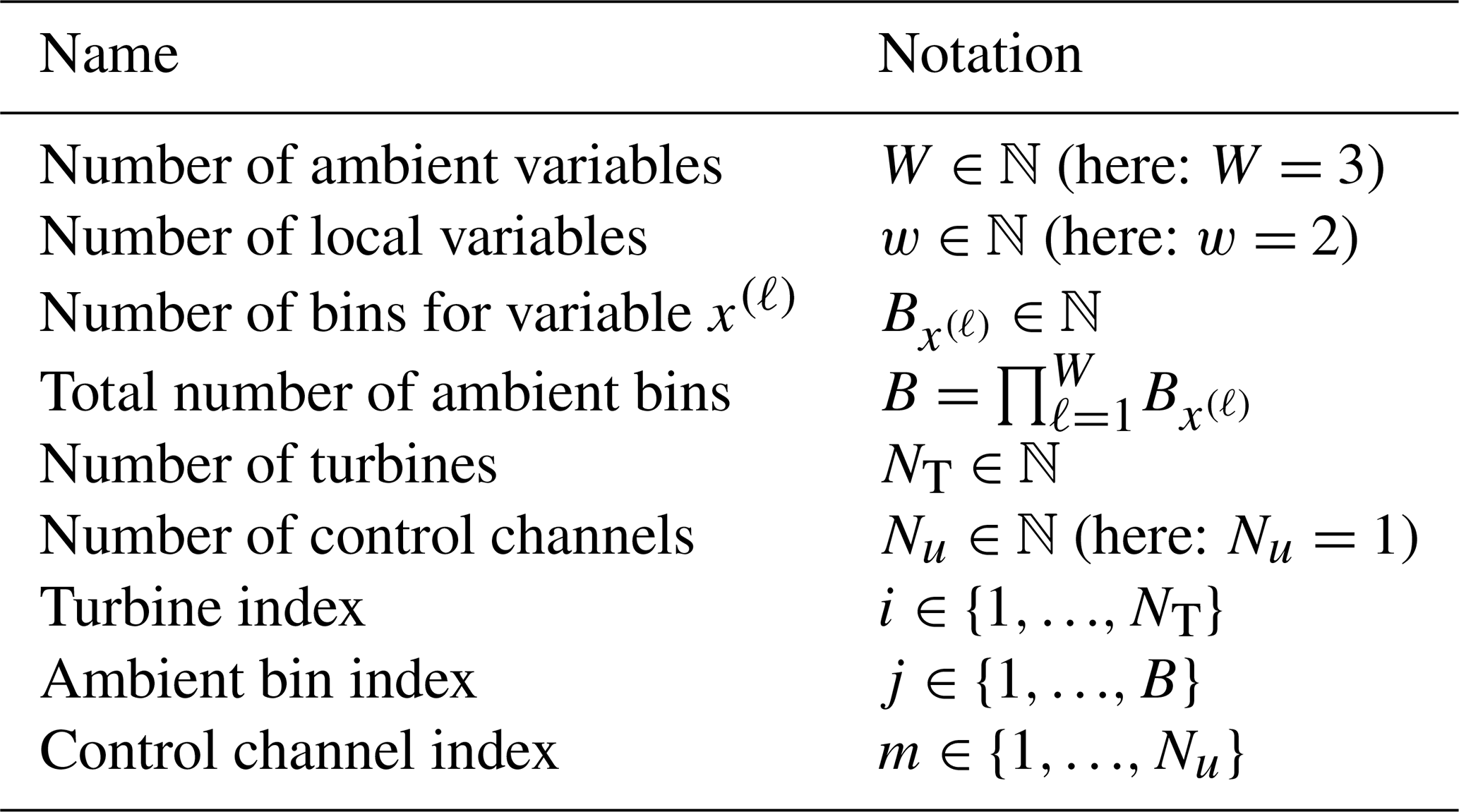
The optimization problem is constructed to select an optimal control set point for each combination of discretized input conditions. The result is a look-up table that a wind farm control system can follow. We now introduce the key quantities and their relationships step by step. A summary of all indices and dimensions is provided in Table 1.
- Ambient conditions and binning.
-
The wind farm inflow is described by an ambient input vector with W ambient variables. These ambient conditions represent the undisturbed inflow to the farm. They are the same for all turbines and serve as the external input to the optimization. The continuous range of ambient conditions is discretized into B bins, where is the product of the number of bins per variable. Each bin j is represented by a central value , and all representatives are collected in the matrix . For example, with W=3 ambient variables (wind direction θamb, wind speed vamb, turbulence intensity TIamb) and bins of 10° and 3 m s−1, one obtains bins with representatives such as .
- Local conditions.
-
In a wind farm, each turbine experiences different wind conditions due to wake effects. We denote the local (at-turbine) conditions by , representing the effective wind at the turbine rotor after accounting for wake deficits and added turbulence from upstream turbines. Local conditions depend on the ambient inflow, the farm layout, and the operational set points of all turbines. The collection of local conditions for all turbines and bins forms a tensor with the per-turbine, per-bin vector . For example, with w=2 local variables (wind speed v, turbulence intensity TI), a turbine operating in the wake of an upstream neighbor might see when the ambient conditions are .
- Control set points and operational plan.
-
For each turbine and each ambient bin, the controller applies a set point with Nu control channels. In this work, a single control channel is used: the derating factor δP that reduces the available power output by a given percentage (Nu=1). The collection of all set points forms the operational plan , or simply for the derating-only case. Each entry uij specifies the derating set point for turbine i in ambient bin j. For example, the value means that turbine 1 operates at 90 % of its available power in ambient bin 0, i.e., at . More generally, additional control channels such as yaw misalignment could be included, but all results in this paper use Nu=1.
Table 1Dimensions and indices used in the problem formulation.
With these definitions, the following subsections describe how the wake model maps ambient conditions and control set points to local conditions (Sect. 2.1), how surrogate models translate local conditions into power and damage (Sect. 2.2), and how these components are combined into the optimization problem (Sect. 2.3).
2.1 Wake modeling
The ambient bin matrix Xamb and control plan U jointly determine local (at-turbine) wind conditions via an engineering wake model (FOXES; Schmidt, 2022). The wake model computes fwake steady-state values x(u) for wind speed and turbulence intensity (TI). We denote the mapping for local wind condition X(U) by
Per ambient bin, turbines are coupled through wakes, and each bin is evaluated independently by the wake model. With a total number of bins B and number of turbines NT, the per-turbine local wind conditions are computed by
Given xij(U), at-turbine damage and power can be computed using surrogate models implemented as turbine models in FOXES.
2.2 Surrogate models and lifetime metrics
We assume surrogate models for per-hour damage rate dfm(x,u) for failure mode fm and for power P(x,u), as functions of both local conditions x and control set point u. In this work, the surrogate models are polynomial regression fits through damage-equivalent loads (DELs) obtained from aeroelastic simulations over a range of wind speeds, turbulence intensities, and derating set points. Their construction and the underlying simulation database are described in detail in Requate et al. (2023). For simplicity, all turbines share the same surrogate models, though per-turbine models are possible. Both x and u depend on ambient conditions via Eq. (2).
The lifetime frequency vector over ambient bins is h∈ℝB with elements hj≥0 and . Alternatively, using probabilities with and a horizon H, one may replace hj by H pj.
The lifetime energy production of turbine i under plan U is
and the lifetime damage of turbine i for failure mode fm is
In each wind condition bin, control set points and local wind conditions are interdependent and are computed by FOXES for all turbines via an internal iteration process. This process can be performed for all bins j in parallel. The aggregate values of energy production and fatigue damage are then used to find an optimal operational plan under the expected average occurrence for each input condition.
2.3 General optimization problem
We seek an operational plan U that maximizes an objective (e.g., total energy) subject to per-turbine damage budgets for selected failure modes fm∈ℱ:
For maximizing energy production, we use the objective function
The optimization problem Eq. (5) is a large-scale nonlinear program (NLP). Nonlinearity arises from aerodynamic wake interactions and fatigue damage surrogate models dfm(x,u), and we cannot assume convexity. The number of decision variables scales as NTBNu with , so even moderate discretizations of wind direction and speed lead to thousands of variables. For calculating the wind farm wake effects, the ambient conditions at least contain the wind direction θ and wind speed v as ambient variables. With a bin width of 10° for θamb and 1 m s−1 for vamb in a wind speed range from 5 to 25 m s−1, this results in bins, i.e., almost 6500 variables in a nine-turbine farm and 72 000 in an offshore farm with 100 turbines when only one control variable is used. Thus, the problem needs to be reduced in complexity and dedicated solvers selected.
2.4 Economic evaluation of results
When solving the optimization problem in Eq. (5) to maximize energy production (Eq. 6), we determine the maximum amount of energy production under the constraints for a target fatigue budget. In other words, a trade-off between lifetime and energy production is found, and different target values for the lifetime can be selected. We evaluate strategies economically using the net present value (NPV) with constant average price, capital and operating expenditure (CAPEX and OPEX), and weighted average cost of capital (WACC), following Requate et al. (2023) and adapting it to the farm level.
We need to define the lifetime of the full wind farm dependent on the selected operational plan. To do so, we assume that the wind farm's lifetime ends when the first turbine reaches its target fatigue budget, i.e., when . Thus, the lifetime of each turbine for a specific failure mode is given by
and the full number of operating years is given by
This assumption allows for a straightforward comparison of the operational plans of full wind farms but depends on strong deterministic assumptions about the end of life. Thus, it can only be used as a first indicator for the selection and evaluation of the operational plans.
The NPV over a horizon of Y years is computed as
with constant parameters for the interest rate CWACC covered by the WACC, constant annual maintenance costs COPEX, and a constant average price of electricity CelPrice. The repayment can be variable over the entire operating period and is made depending on the annual energy yield .
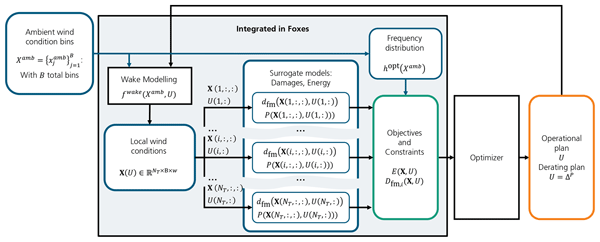
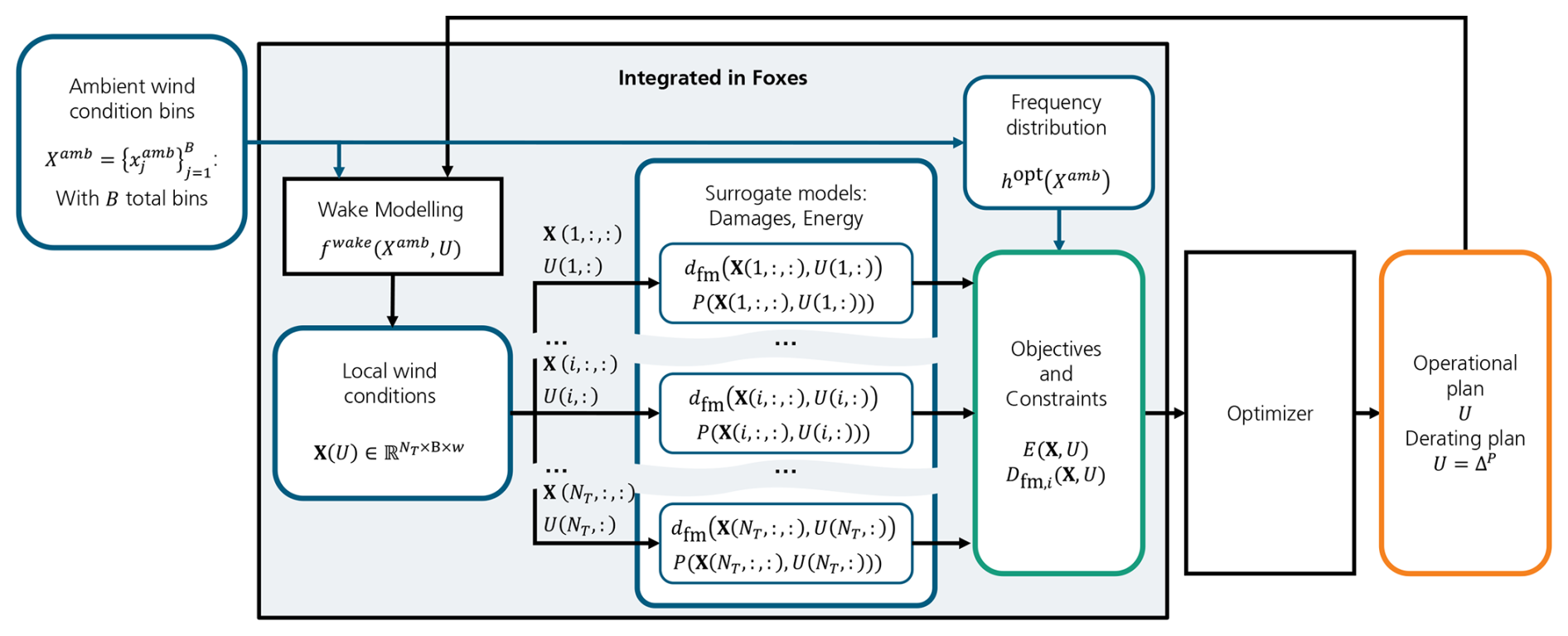
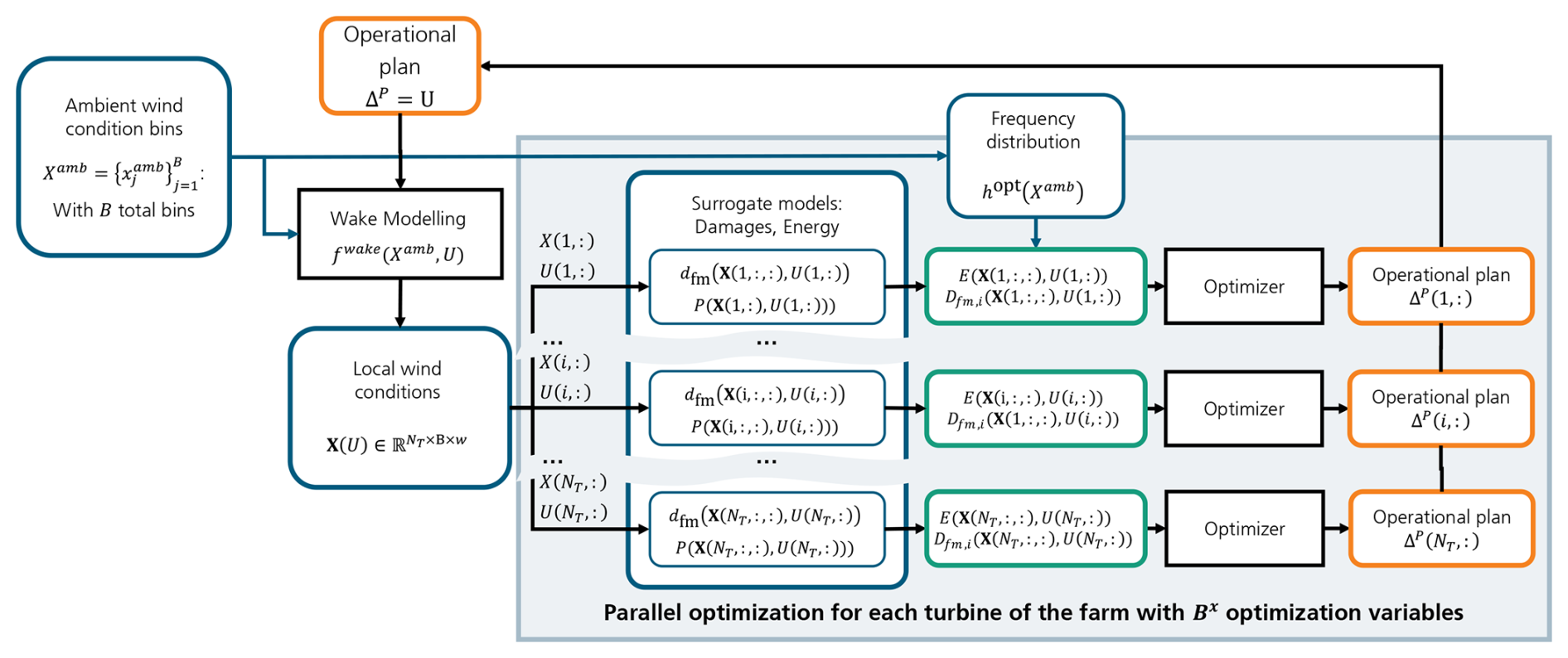
Within this study, an optimized operational plan using derating set points of the wind turbines is found. The specific variables and parameters for the presented use case are described in Sect. 4. At this stage, the general problem is reduced to the required parameters for solving the derating problem. Subsequently, the iterative approach for solving the optimization problem for each turbine of the farm separately is introduced. The processes for both of the approaches are shown in Fig. 1 (denoted as full-farm optimization) and Fig. 2 (denoted as per-turbine optimization). Finally, the implementation of both algorithms is described.
3.1 Final formulation for single optimization run
The surrogate damage models depend on the local wind speed v and turbulence intensity TI, i.e., , as well as on a derating control set point u=δP. Local conditions are computed from ambient values for wind direction θamb, wind speed vamb, turbulence intensity TIamb, and air density ρ. The parameter ρ is kept constant, and TIamb may be treated as a function of wind speed. The derating set point δP reduces power by a percentage amount at all wind conditions. The full operation plan for the wind farm (derating-only) is denoted as ΔP consistent with U. With this setup, we seek
and the optimization problem
The problem in Eq. (10) yields a single derating per turbine for each combination of wind speed and wind direction. Thus, the number of optimization variables depends on the number of bins and and on the number of turbines.
When using the frequency distribution over wind bins, some combinations of wind speed and wind direction are very rare. To reduce the number of variables with negligible influence on the objective and constraints, we removed the selected conditions from the optimization variables by testing their influence on the fatigue damage. All values for which the maximum change in fatigue damage over all turbines and failure modes is less than 3 % are excluded. These are later set to the nominal power set point of 100 % (no derating) automatically. In addition, power set points are rounded to integer values after the continuous optimization process to obtain realistic set points for a wind farm control algorithm. The effect on the results is negligibly small.
An overview of the setup of the optimization problem is given in Fig. 1.
3.2 Iterative loop optimizing separately for each turbine with derating
Since derating primarily affects the derated turbine and influences the wake only indirectly via reduced thrust, we investigate whether comparable results can be achieved when each turbine is optimized separately. This approach is easily scalable to large wind farms because each per-turbine problem has B variables, and the problems can be solved in parallel. To include wake effects, we use an iterative procedure that optimizes each turbine's plan while holding the current local wind condition fixed, then updates them after each iteration. An overview of the loop approach is shown in Fig. 2 and described in Algorithm 1.
Within each iteration k, the local wind conditions for all turbines are computed simultaneously by the wake model (which internally resolves the upstream-to-downstream propagation order for each wind direction). The subsequent per-turbine optimizations (inner loop over i) are therefore independent of each other and insensitive to the order in which turbines are processed since they all operate on the same fixed local conditions X(k). Here, the exact same problem as described in Requate et al. (2023) is solved. Coupling between turbines only occurs between iterations when updated derating set points change the wake field.
Algorithm 1Iterative loop optimizing separately for each turbine with derating (using ΔP), graphically represented in Fig. 2
3.3 Implementation and selection of solvers
The problem is set up using an internally developed Python framework VIOLA (Value Integrated Optimization of Lifetime Asset Operation), which integrates all the required steps from building up the problem with suitable surrogate models and the integration of those models into the wake modeling tool FOXES up to the solution of the problem with dedicated solvers and the evaluation of results. For this study, the framework was enhanced with the integration of the fatigue damage models into FOXES and the subsequent setup of the optimization problem for a full wind farm. In addition, the loop iteration approach was implemented. For the high-dimensional, nonlinear problem (NLP), the gradient-based interior point solver IPOPT was selected (Waechter and Laird, 2022). Despite the lack of analytical gradients, the nonlinear, but differentiable behavior of the fatigue damage models and the scalability to a large number of optimization variables led to this choice. In contrast, deterministic global optimization (e.g., branch-and-bound with convex relaxations) and metaheuristics (e.g., evolutionary algorithms, particle swarm optimization) generally scale poorly with dimension due to the exponential growth of the search space and large numbers of function evaluations. With IPOPT, the problem could be solved within reasonable time for the selected problem size.
The proposed method is applied for different wind farm scenarios with 7.5 MW wind turbines (rotor diameter: 164 m; hub height: 100 m) using the simulation database as described in Requate et al. (2023), available on Zenodo (Requate and Meyer, 2023). The example wind farm consists of nine turbines with a regular 3×3 layout, and the wind comes mainly from the southwest (see Fig. 3). Throughout this work, turbines are referenced by their index as shown in Fig. 3a, where indices 0–2 correspond to the bottom row (westernmost), 3–5 to the middle row, and 6–8 to the top row (easternmost). The frequency distribution of wind speed is computed from a 30-year time series of ERA5 data in the German North Sea (Hersbach et al., 2018). The utilized terms and parameters for the damage models are summarized in Table 2. For the wake models in FOXES, the local wind speed is computed using the Gauss-type wake model by Bastankhah and Porté-Agel (2016). The wake-induced TI is calculated using the top-hat wake model as described in IEC (2019a). For the wind speed, a quadratic superposition is used, and TI is superposed using the maximum rule.

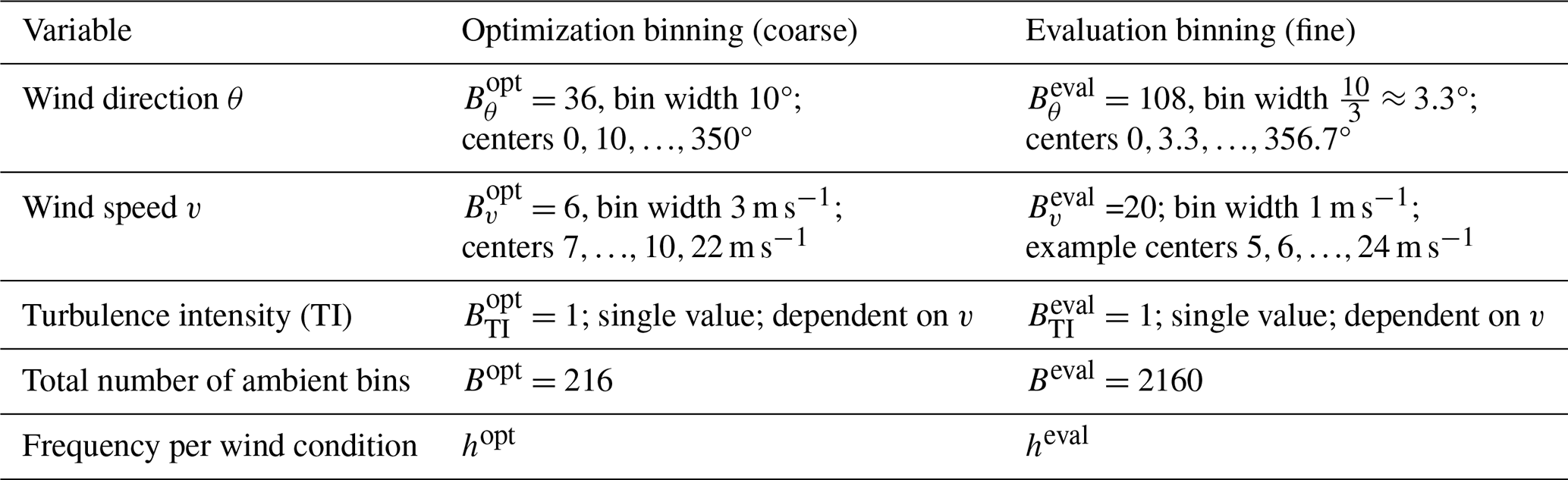
As explained in Sect. 2, the binning of ambient wind conditions is a key design choice because it determines the number of optimization variables. A compromise between computational effort and accuracy is required, and the granularity should remain implementable for the usage of the set points on real turbines. To assess this trade-off, we computed total energy and damage (Eqs. 3 and 4) for several discretizations. In addition, the optimization was first tested with coarser discretizations and then refined. With a bin width of 10° for ambient wind direction and 3 m s−1 for wind speed, results were obtained in reasonable time, and the relative changes in annual energy and resulting lifetime were close to the finest tested discretization (using 3.3° and 1 m s−1).
The total frequency for both distributions is shown in Fig. 3. For the evaluation, we use the fine discretization to evaluate the results and include a sensitivity to the coarser discretization. TI is handled as a single value depending on the wind speed to keep problem size manageable; this also reflects practical limitations of the TI values, which are difficult to measure in reality and thus less suitable as input for a control set point. The parameters for both binnings are summarized in Table 3. The number of ambient bins Bopt is reduced by about 10 % for all use cases by removing low-frequency conditions as described in Sect. 3. This mainly applies to wind speeds of 22 m s−1 in some northwestern wind directions.
Table 3Binning parameters for optimization (coarse) and evaluation (fine).
In different subsections, we present results for the different use cases with ambient turbulence values for onshore and offshore and considering different failure modes in the optimization. The impact of the upstream on the downstream turbines strongly depends on the ambient TI value used. Offshore, the ambient TI is usually lower than onshore because of the low surface roughness of the sea. Thus, TI-induced loads are generally lower than onshore, but differences between turbines are higher. To illustrate the influences of those differences on the planning, we present results for onshore and offshore scenarios where the ambient TI values strongly differ. Onshore, the 50 % quantile of the turbulence class B of the design standard 61400-1 (IEC, 2019a) is used (IEC, 2019a), and offshore the mean value of measurements from met mast Fino1 in the North Sea (Türk and Emeis, 2010) is used. The ambient wind distribution from offshore is also used for the onshore scenario to clearly see these effects. Due to this fact, the AEP for the onshore scenario is significantly higher than usual. This also has a strong effect on the economic evaluation with different cost assumptions for onshore and offshore taken from Stehly et al. (2024). Therefore, significantly different constant electricity prices are selected in order to get comparable results on the NPV for all cases. All parameters for each of the cases are summarized in Table 4.
Table 4Overview of parameters for the use cases: failure modes, ambient TI, and economic values.

In all cases, we assume that the wind farm is designed so that the turbine with the highest damage progression can operate for 25 years. In this case, a nominal operational ΔP,nom plan with all turbines operating at of power at all times is used. Therefore, we first compute
The lifetime of each turbine is computed under the assumption of a nominal lifetime of 25 years by using Eq. (7) with the finer binning distribution heval, i.e., calculating for each turbine and failure mode. The optimization problem described in Eq. (10) is solved using the coarser binning hopt for all calculations. The evaluation is done with the finer binning afterwards.
The nominal lifetime of the tower, with no derating applied, is shown in Fig. 4 for the on- and offshore cases. The tower lifetime of the turbine in the center is 25 years for both cases. Offshore, the turbine in the lower left corner could operate 4 years longer. In the offshore case, differences among the turbines are significantly higher, and lifetime of the turbine in the lower left corner is almost 20 years longer (43 years in total) compared to the turbine in the center. In total, all turbines' loads are significantly lower in the offshore case due to the lower ambient TI. But for this study, we are mainly interested in the relative differences between the turbines.
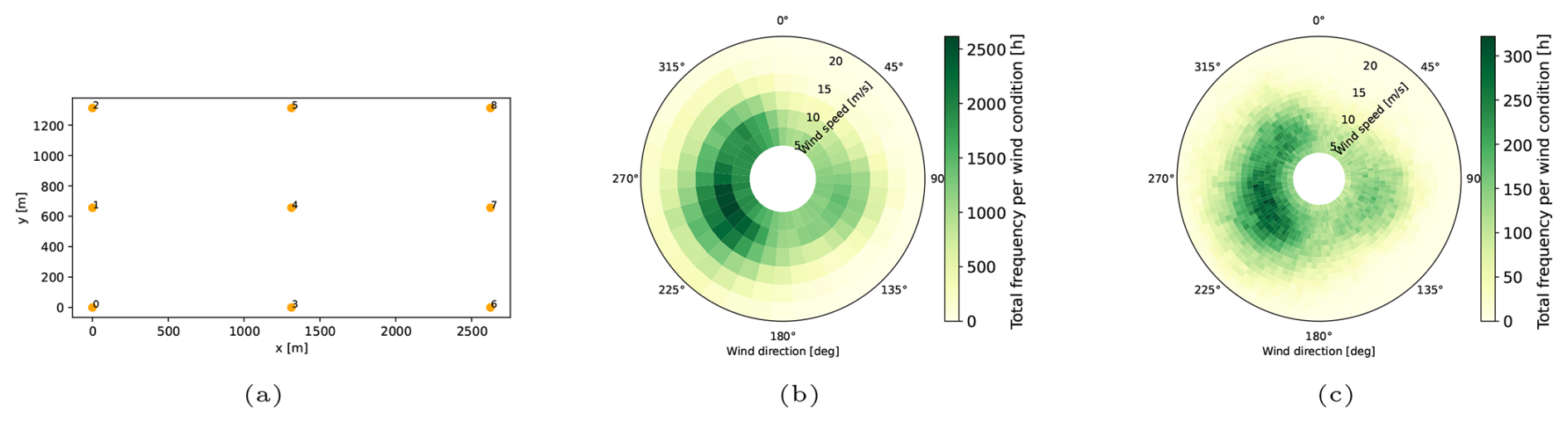
Figure 3Farm layout with distance in meters; 1 rotor diameter = 164 m (a). Wind distribution given as lifetime frequency for each combination of wind speed and wind direction with broader binning used for optimization hopt (b) and fine-binning used for evaluation heval (c).
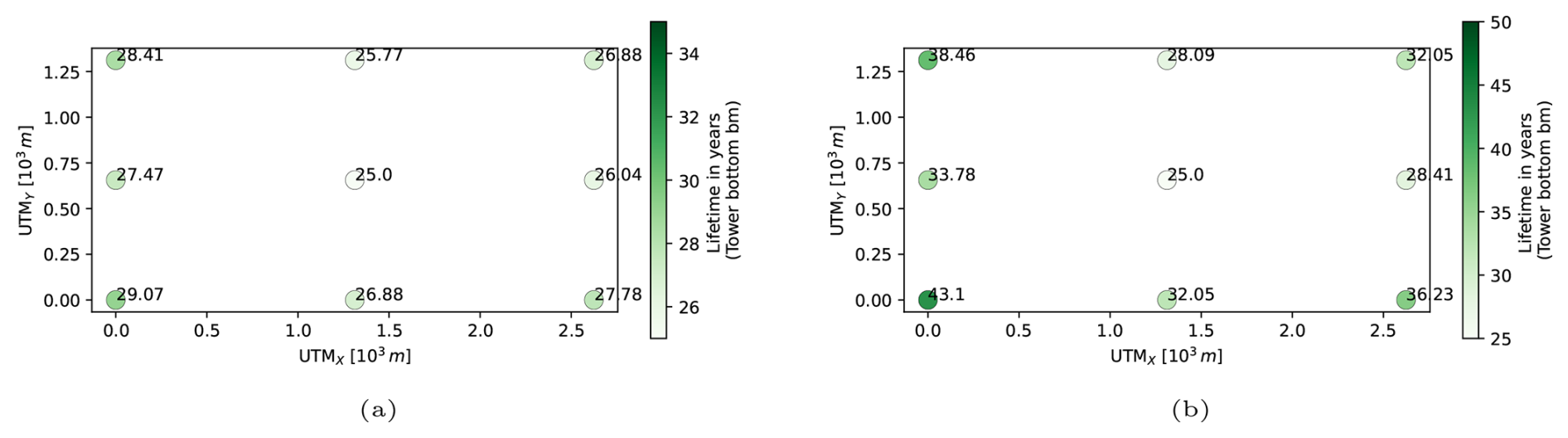
Figure 4Nominal lifetime (no derating) of the tower bending moment (bm) for the onshore scenario (a) and offshore scenario (b).
For all three use cases, we compare the optimal result from solving the full-farm optimization problem of Eq. (10) in a single run with the iterative per-turbine approach. The energy production is always maximized over the original lifetime of 25 years under the constraint of different target lifetimes for the turbines. The target fatigue budget is given by the reciprocal value, i.e., by . The AEP and the NPV with different target lifetimes are compared for both methods in all three cases. Subsequently, one of the results of each case is presented in more detail by showing the results for each turbine and the optimized derating plan. In the first two cases, the details are shown when the lifetime of all turbines is balanced. In the appendix, the course of energy production and NPV over the operating years (Appendix A) as well as an evaluation of different binning sizes is presented additionally (Appendix B).
4.1 Case 1: tower lifetime with onshore turbulence scenario
In this scenario, we solve the optimization problem for different target constraints for the selected failure mode of all turbines. The target fatigue budget is given by the reciprocal value, i.e., by . We aim for target lifetimes , i.e., 2, 4, 5, and 10 years of extension. The turbine with the lowest lifetime is always assumed to determine the lifetime of the total wind farm, and only full operational years are considered (see Sect. 2.4). For evaluation, we use the finest binning (heval; θ: 3 degrees, bin width for wind speed v: 1 m s−1).
In Fig. 5, the AEP and the NPV are plotted over the lifetime of the farm as defined above. The curves for the two methods are almost identical for lifetimes up to 30 years, and the difference in energy production and NPV is less than 0.2 %. The full-farm optimization always yields a slightly higher value. The target lifetime of 35 years cannot be reached with both methods. While this is caused by differences from the fine-binning and the binning used for optimization in the full-farm optimization, not all constraints could be fulfilled in the per-turbine approach. The targeted lifetimes are reached at a slight energy loss between 1 % and 4 % up to a lifetime extension of 5 years (20 % more lifetime). A lifetime extension of 10 years (40 %) results in an energy loss of 20 %. In comparison to the energy production, the NPV considers interest rates and thus penalizes a loss in AEP in early operating years additionally. With low AEP losses, NPV can be increased by up to 10 % due to lifetime extensions between 2 and 5 years. An extension of 10 years reduces the AEP production and thus even leads to a reduction in NPV compared to the nominal cases. The highest NPV is reached after a lifetime of 29 years, which is now discussed in more detail.
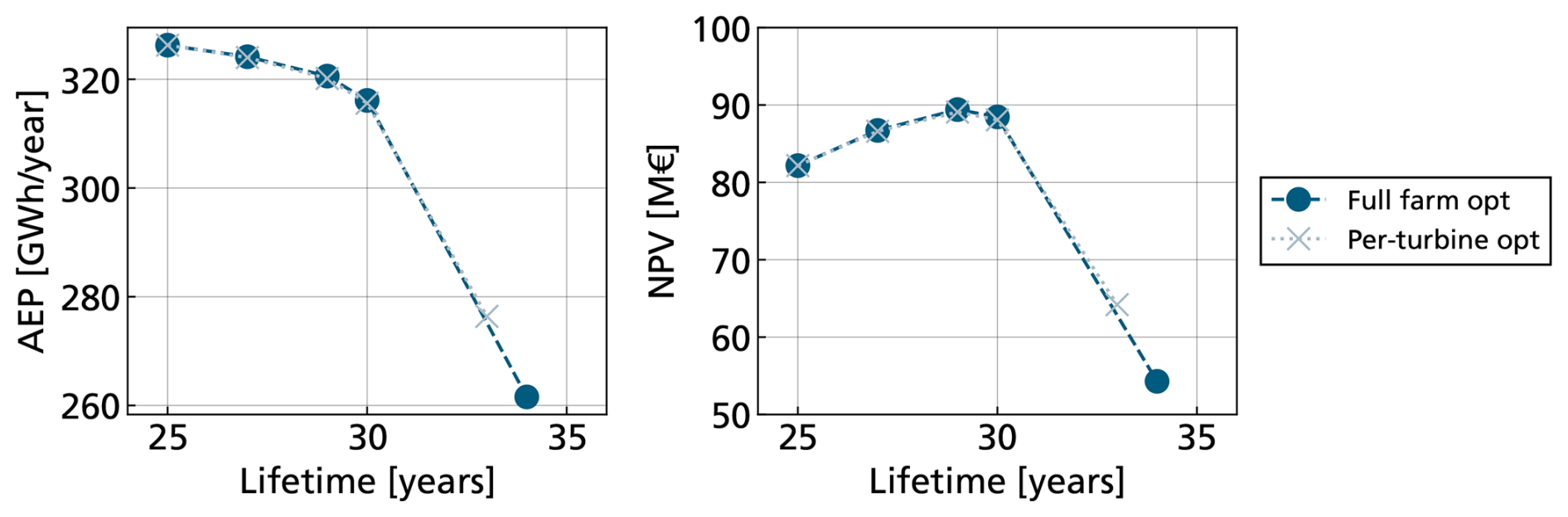
Figure 5Case 1, onshore scenario with different target values for tower lifetime: comparison of AEP and NPV for the optimization approaches.
With nominal operation, the turbine with the highest lifetime could operate for 25 years when considering the selected failure mode. With this target value, the lifetime of all turbines can be balanced at that value. Figure 6 shows the tower lifetime and the AEP for each of the nine turbines with both optimization approaches. With both approaches, the target lifetime of 29 years is slightly exceeded, and all turbines reach a value between 29 and 30 years.
The AEP is reduced the most at the turbine in the center (index 4). When evaluating the relative difference in lifetime and AEP compared to the nominal case with no derating applied (Fig. 7) two things can be observed. As seen in Fig. 5, the difference between the two optimization approaches is very low. The AEP with the full-farm optimization is less than 1 % higher at turbine 4. In addition, the relative lifetime extension for all turbines is significantly higher than the loss in AEP. For turbine 4, 20 % more lifetime can be achieved at 5 % energy loss. When comparing the resulting operational plans in Fig. 8, one can see similarities and differences in the results. A derating plan can be applied to best reduce damage for a turbine by itself. Derating is primarily applied when a turbine operates in the wake of others or at low wind speeds. In addition, upstream turbines reduce power in some cases when it is beneficial for turbines downstream. Due to the upstream derating, the amount and number of deratings can be reduced at downstream turbines. When comparing the results for the turbine in the center, the turbine can operate more often at full power while still meeting the required target damage. This is especially visible for no-wake situations, e.g., between 15 and 65 or between 125 and 160°. The differences in the operation plans are thus explainable because the optimizer can find a higher value for the farm energy and are still almost negligible for the overall AEP.
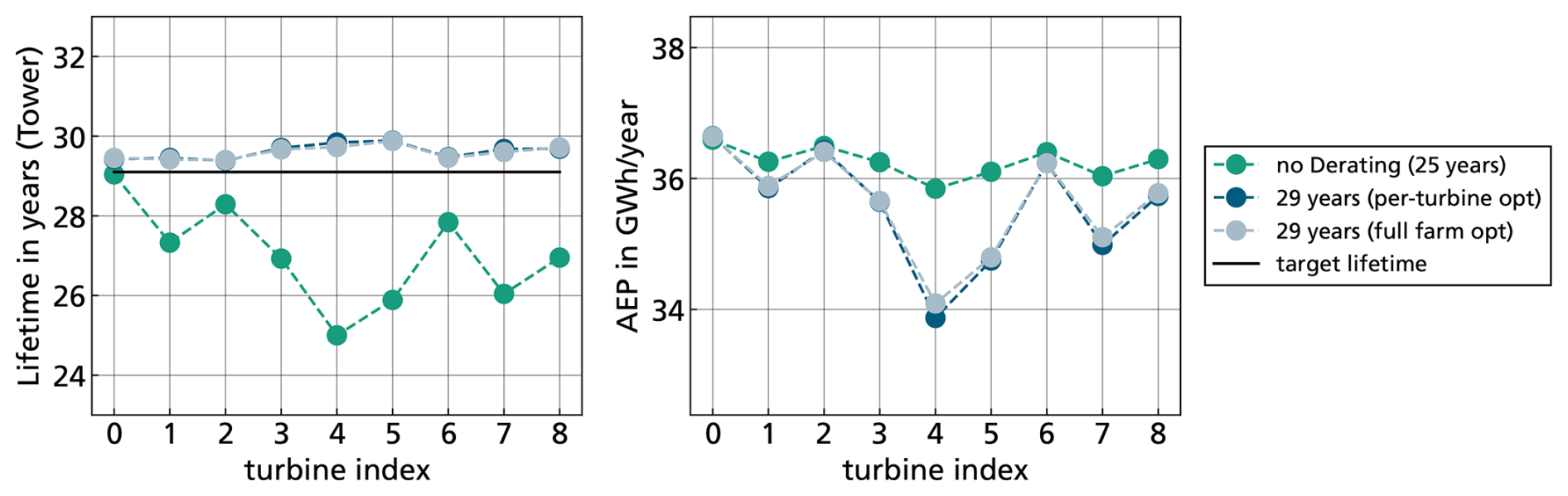
Figure 6Case 1, onshore scenario balancing tower lifetime at 29 years: absolute lifetime and AEP on each turbine for both optimization methods.
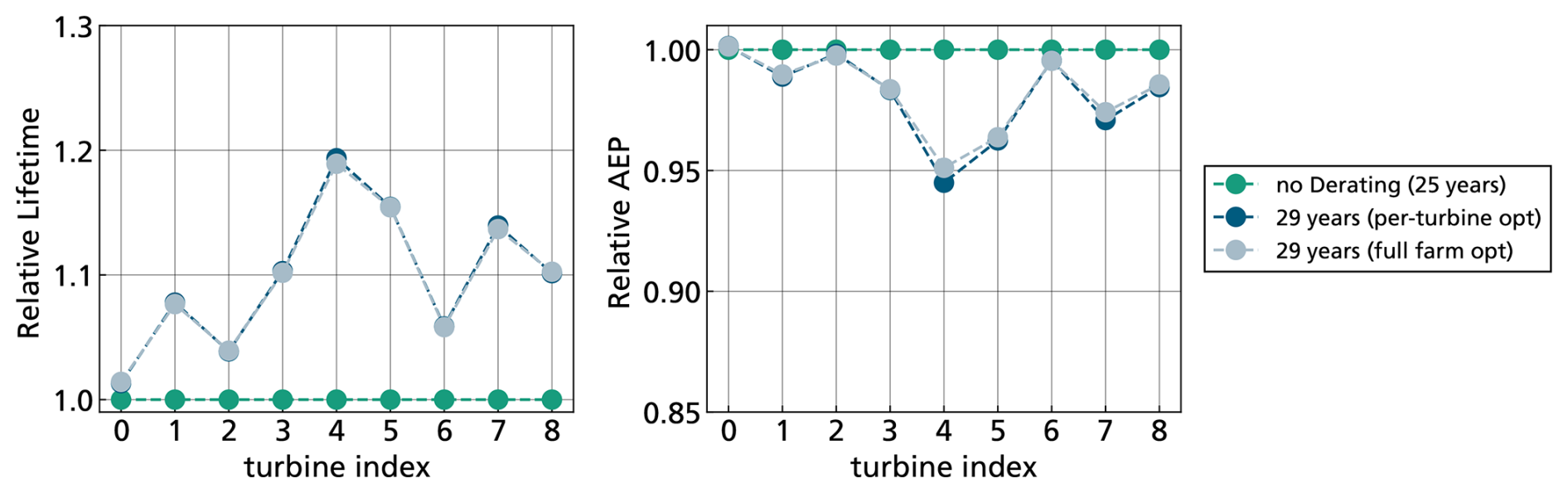
Figure 7Case 1, onshore scenario balancing tower lifetime at 29 years: relative values compared to nominal operation (no derating) for lifetime and AEP on each turbine for both optimization methods.
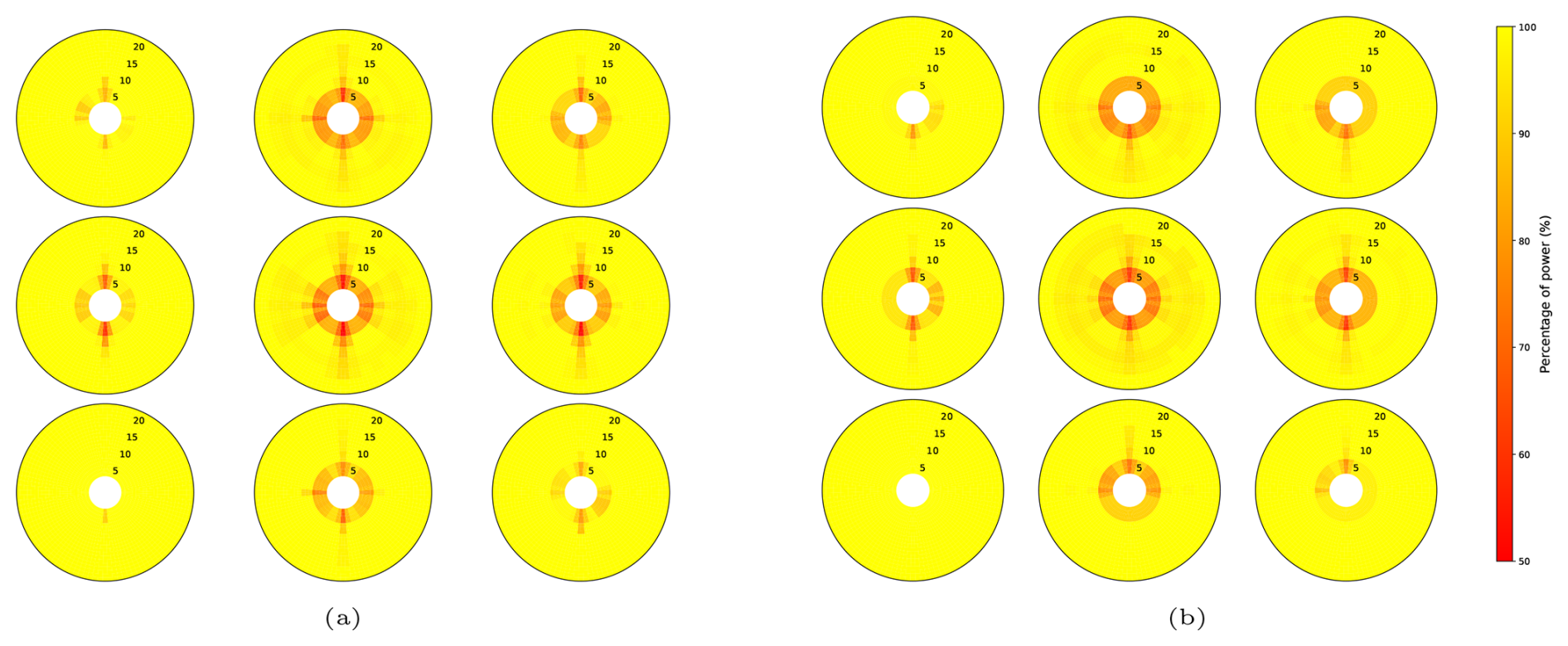
Figure 8Case 1, onshore scenario with tower as failure mode: optimized operational plan full-farm optimization (a) and per-turbine optimization (b).
4.2 Case 2: tower lifetime with offshore turbulence scenario
For this use case, we are also aiming for different target values for extending the lifetime of the wind farm (2, 5, 10, and 20 years), i.e., . The results for AEP and NPV are shown in Fig. 9, where, again, the main evaluation is done with the finest binning. In this scenario, aiming at a lifetime of 29 years for all turbines only requires a load reduction on three turbines (see Fig. 4b or green curve in Fig. 10). Therefore, the energy loss of the complete farm is negligibly small (less than 0.1 %), and a significantly higher NPV (41 %) can be achieved when operating the farm 2 more years. A lifetime extension of 10 years yields the highest NPV under the given conditions. This also applies for both optimization methods, the full-farm optimization and the per-turbine approach. When considering lifetimes below 30 years, the difference between both approaches remains minor because only few turbines are concerned, with a small need for reducing damage. At 35 years, the AEP loss with the per-turbine approach is about 0.8 % lower, resulting in an NPV difference of almost 5 % compared to the full-farm optimization. When aiming at balancing the lifetime after 45 years of operation, the loss in NPV with the full-farm optimization is so high that the NPV is lower than after 35 years but still higher than after 25 years. With the per-turbine optimization, the target lifetime constraint cannot be fulfilled for some turbines, and the lifetime is only 37 years, with a higher loss in NPV and energy production.
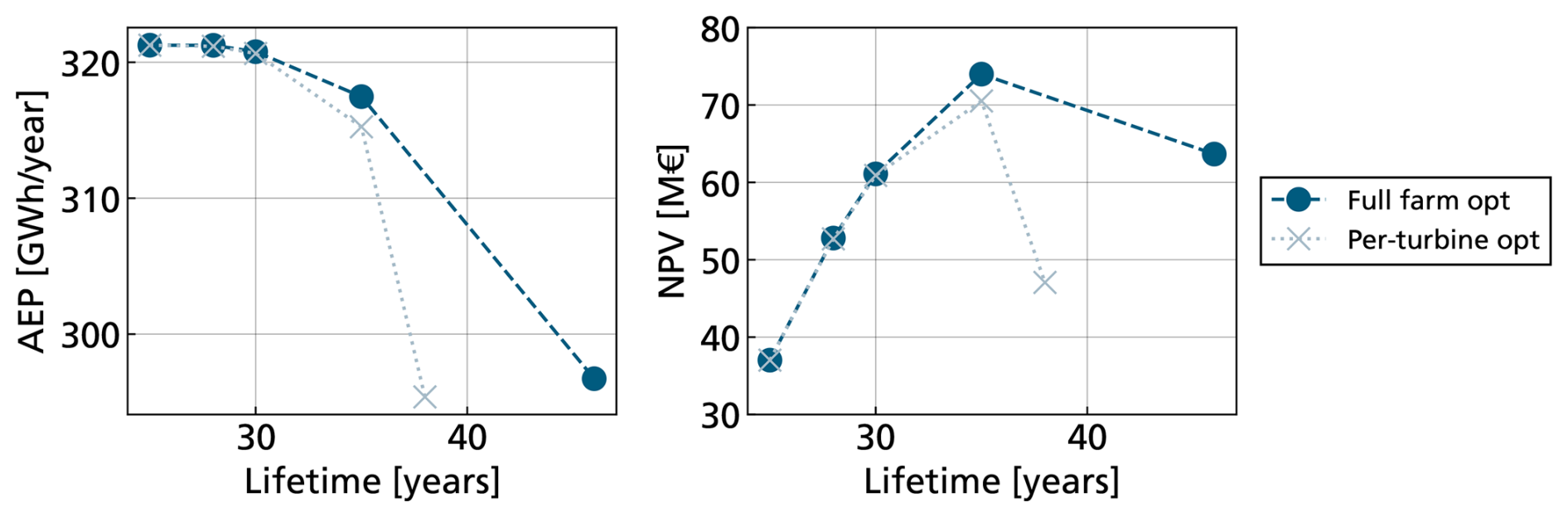
Figure 9Case 2: offshore scenario with different target values for tower lifetime: comparison of AEP and NPV for the optimization approaches.
This result is now discussed in more detail. In Fig. 10, it can be observed that the targeted lifetime cannot be reached by three out of the nine turbines with the per-turbine optimization, while the target is met with the full-farm approach. When studying the AEP, it can be observed that the energy AEP of some turbines needs to be reduced significantly (index 0, 1, 2, 6) to enable less derating at turbines 4 and 5, resulting in an overall higher AEP.
With the per-turbine approach, the three turbines not reaching the target lifetime are derated to their maximum level (Fig. 12). At most wind speeds, derating down to 50 % induces higher loads than a moderate derating to about 80 %, which is selected by the optimizer. With the full-farm optimization, upstream turbines are derated to their maximum level in some wind directions (e.g., 90° for the lowest row, 0° for the upper row). Especially downstream turbines with a low distance (4D in the horizontal direction) derate at all wind speeds for relevant wind directions to spare the turbines downstream. This way, the lifetime of the turbine with the lowest lifetime can be increased to the target value without it having to derate under all conditions. Due to the lower ambient TI, the influence of derating on the wake-induced turbulence is higher and more effective for the load reduction on downstream turbines. With the relative values shown in Fig. 11, it can again be seen that the relative lifetime extension is significantly higher than the loss in AEP for all turbines, e.g almost 80 % more lifetime for turbine 4 in the center at only 10 % AEP reduction.
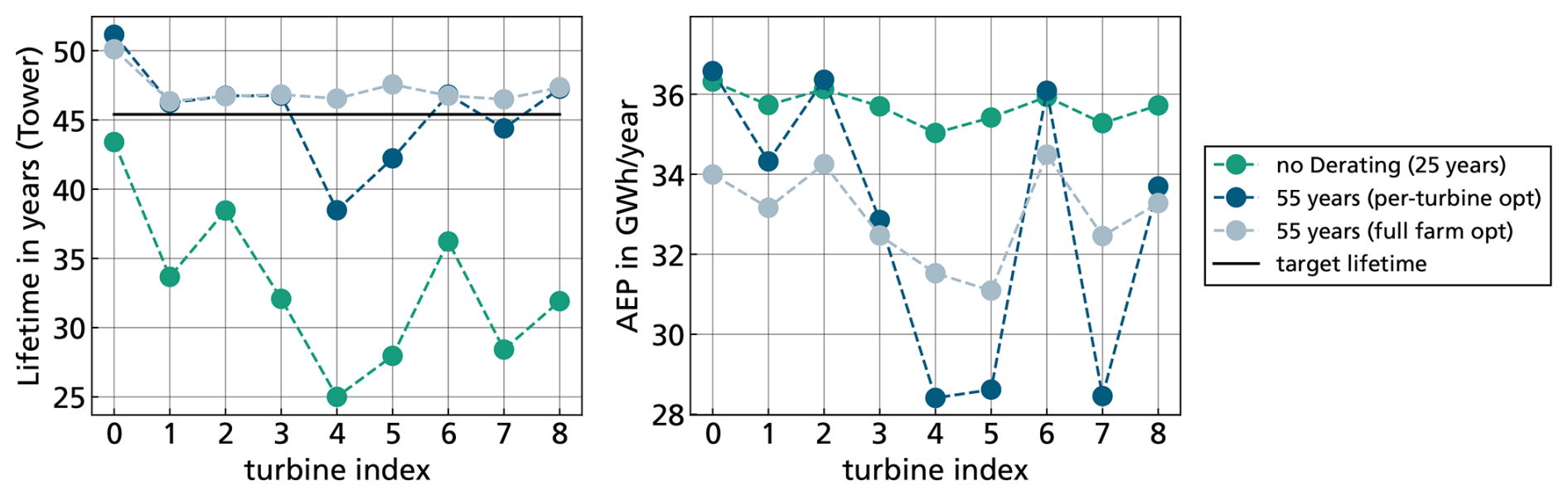
Figure 10Case 2, offshore scenario balancing tower lifetime at 45 years: absolute lifetime and AEP on each turbine for both optimization methods.
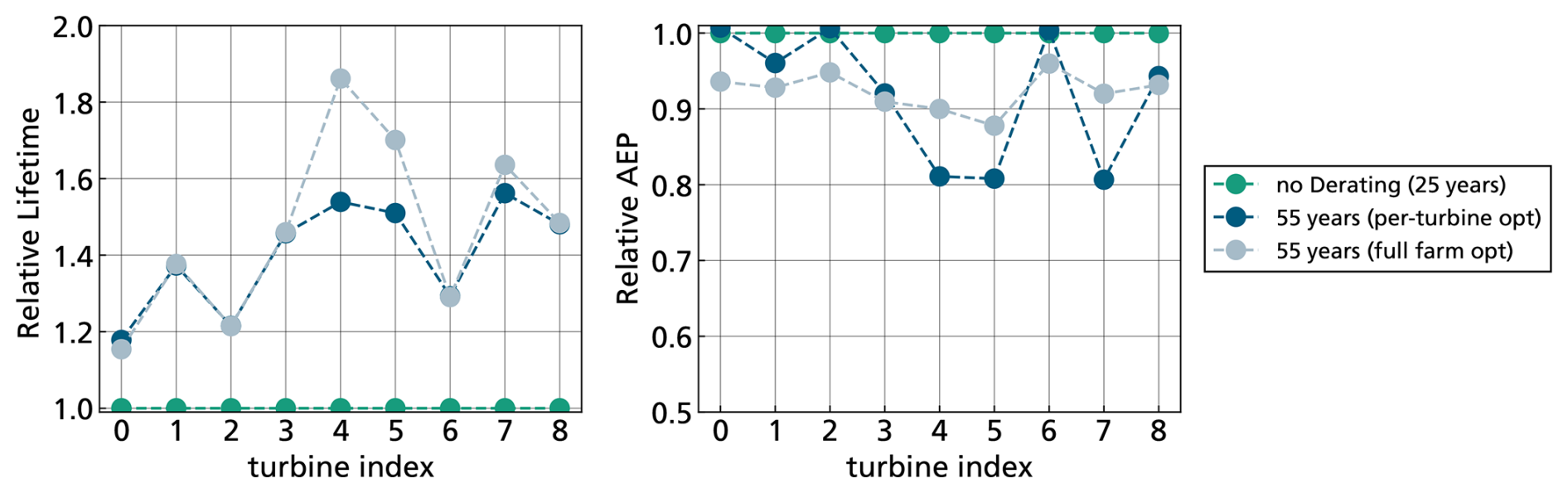
Figure 11Case 2, offshore scenario balancing tower lifetime at 45 years: relative values compared to nominal operation (no derating) for lifetime and AEP on each turbine for both optimization methods.
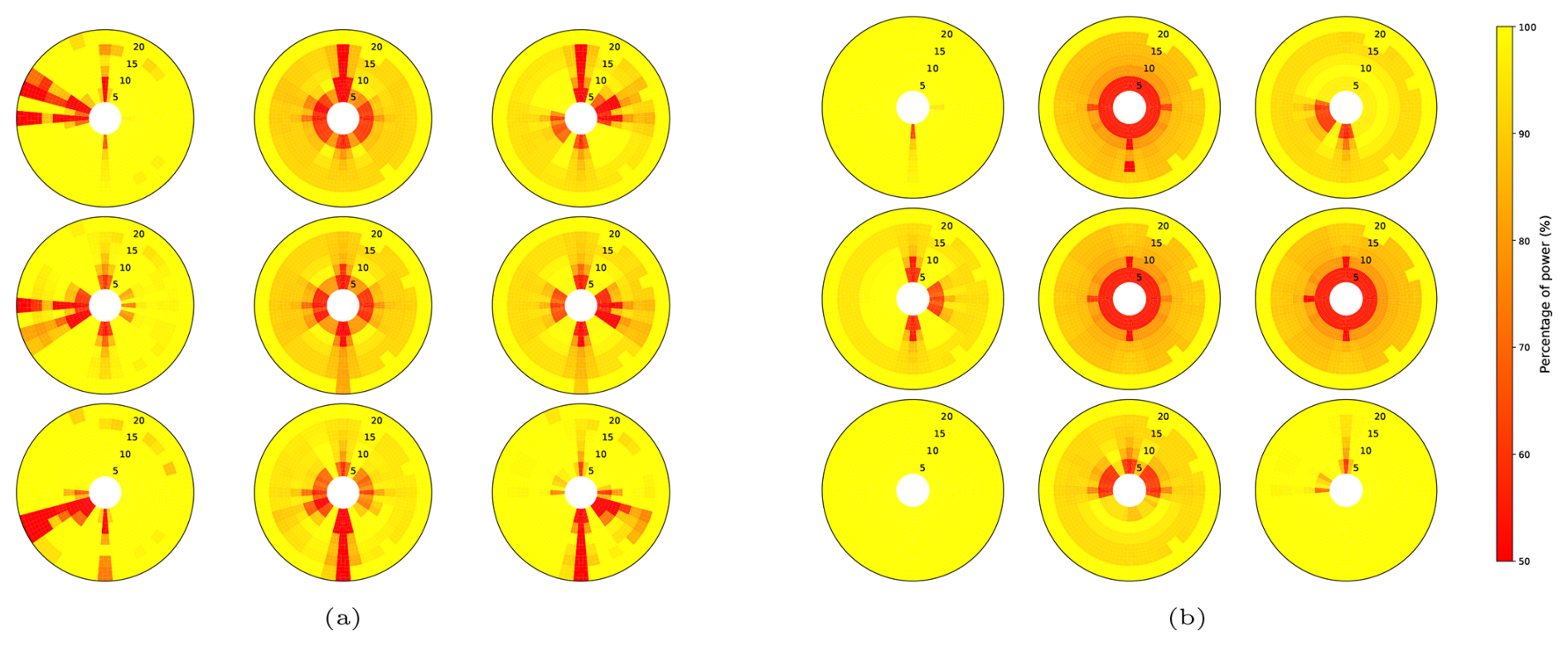
Figure 12Case 2, offshore scenario balancing tower lifetime at 45 years: optimized operational plan full-farm optimization (a) and per-turbine optimization (b).
4.3 Case 3: lifetime extension on all selected failure modes in offshore scenario
In the third scenario, we impose two lifetime targets across all turbines and all failure modes: 27 and 30 years, i.e., 2 and 5 years of extension (, resulting in 27 constraints in total). All three considered failure modes show a different behavior dependent on the influencing parameters wind speed, turbulence intensity, and derating factor. While the tower bending moment and the flapwise blade root bending moments are strongly influenced by the turbulence intensity, the edgewise moment is mainly driven by the rotational speed due to gravitational loads. Thus, the wake-induced differences in lifetime between turbines are very low. Due to the low influence of TI, the edgewise bending moment is the dominant failure mode when all failure modes are considered in the computation of the total farm lifetime (using Eq. 8 for the computation of the total farm lifetime). For a better understanding of the result, we first discuss the lifetime extension to 27 years in detail. The nominal lifetimes without derating for all three failure modes can be seen in the green curves in Figs. 13 and 14.
For the failure mode represented by the edgewise bending moment, the lifetime of all turbines is approximately 25 years and can be extended to almost 28 years (about 10 %) for all turbines at an average AEP loss of about 6 % (see Fig. 15). The lifetime of all turbines and failure modes is higher than 28 years in this case; i.e., all constraints are fulfilled. The comparably high energy loss results from the dependency on the edgewise loads on the rotational speed. For this reason, it is difficult to improve the relationship between induced damage and energy production. The results for the full-farm and the per-turbine optimization are almost identical, with minimally higher AEP for the full-farm approach. The lifetime of the other two failure modes is strongly increased for all turbines and above the target (see Fig. 14).
When studying the optimized operational plan for this optimization run, two patterns can be observed (Fig. 16): a derating to 90 % or 80 % is applied to all turbines for almost all wind speeds and directions below 15 m s−1 with both optimization approaches. At this level of derating, the rotational speed is reduced significantly and thus leads to the most effective reduction in damage. The resulting plan thus differs from the previous optimized plans in the other two use cases significantly. With the full-farm approach, upstream turbines also reduce their power in full wake situations in the partial-load region between 4 and 7 m s−1 down to 50 % or 60 %. Despite these differences in the operational plan, the resulting AEP is almost the same. The results are determined by the underlying relationship of wind, wake effects, and influence of the controller, and the optimizer is able to find the best possible relationship under the given constraints.
Figure 17 shows the AEP and NPV for the two target lifetimes. The lower AEP is too significant for the initial investment and level of interest rate so that the final value of NPV is lower by 60 % after 27 years of operation. By aiming at 29 years of operation, the NPV is even below 0.
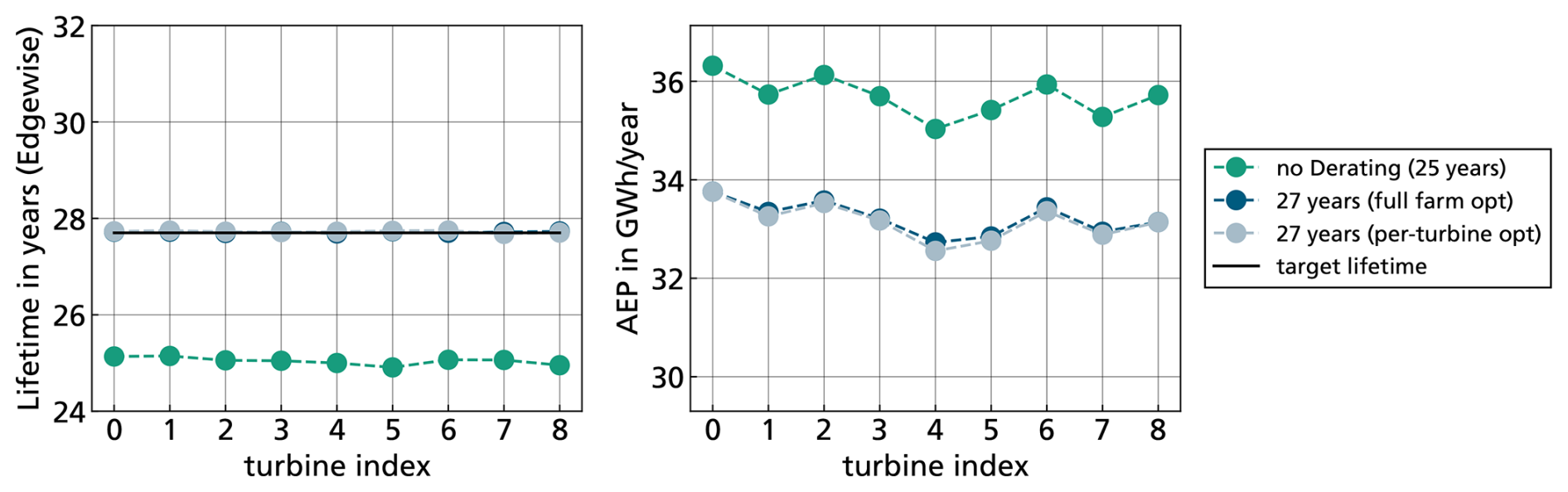
Figure 13Case 3, offshore scenario with all failure modes: absolute lifetime and AEP on each turbine for both optimization methods.
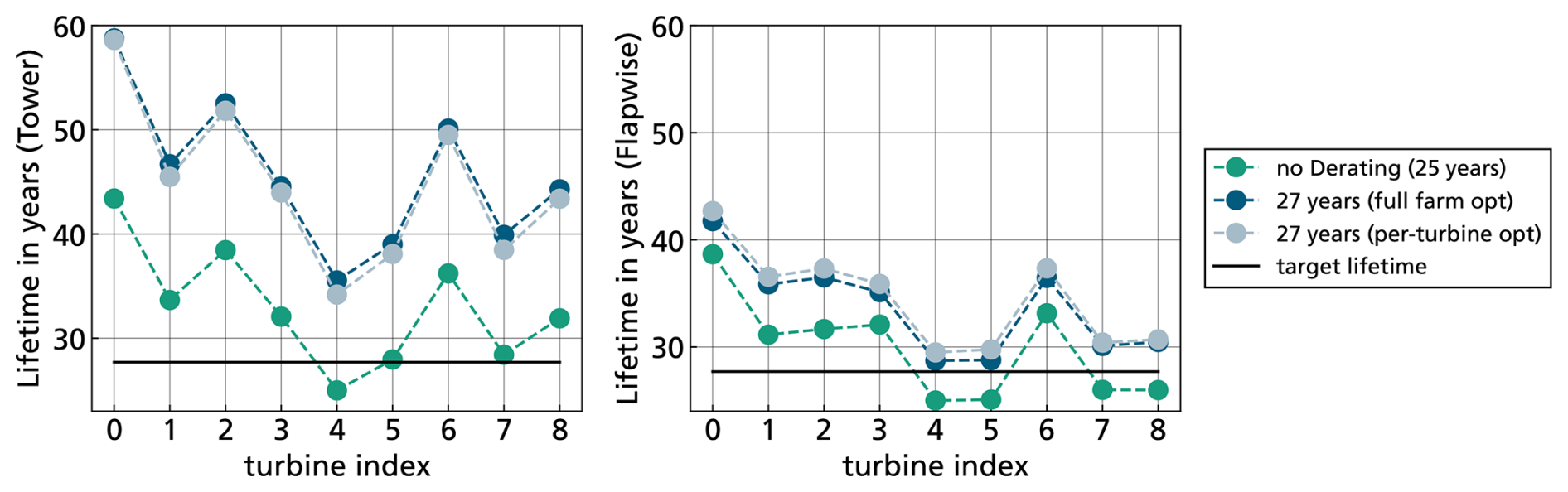
Figure 14Case 3, offshore scenario with all failure modes: absolute for lifetime for flapwise blade bm and tower bm on each turbine for both optimization methods.
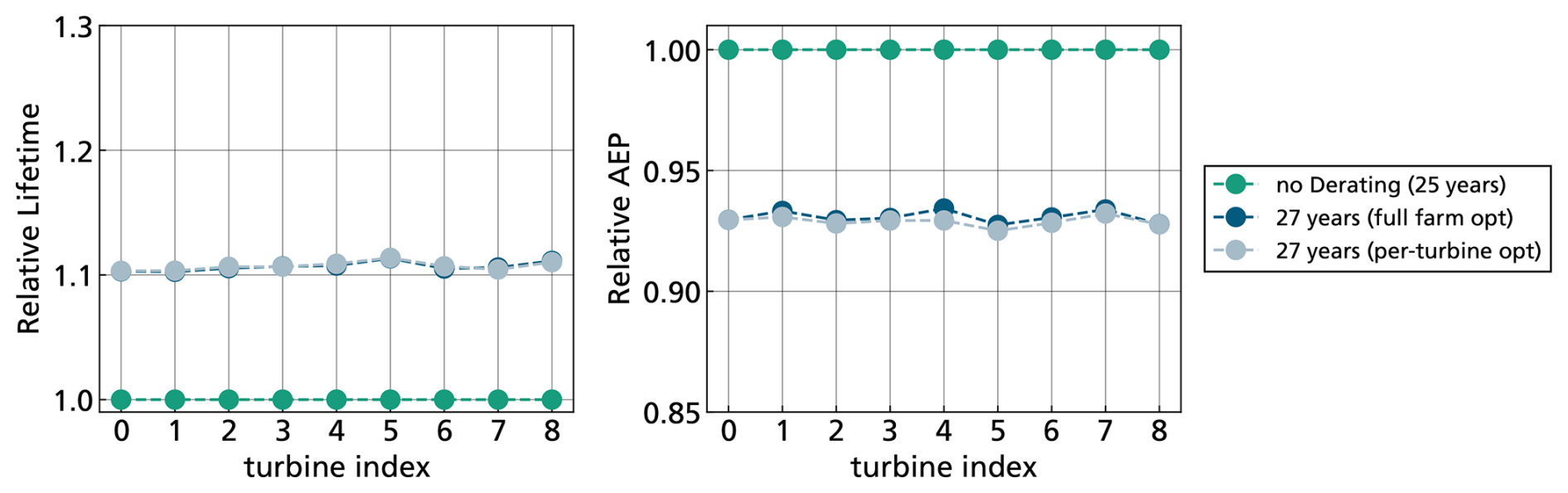
Figure 15Case 3, offshore scenario with all failure modes: relative values compared to nominal operation (no derating) for lifetime and AEP on each turbine for both optimization methods.
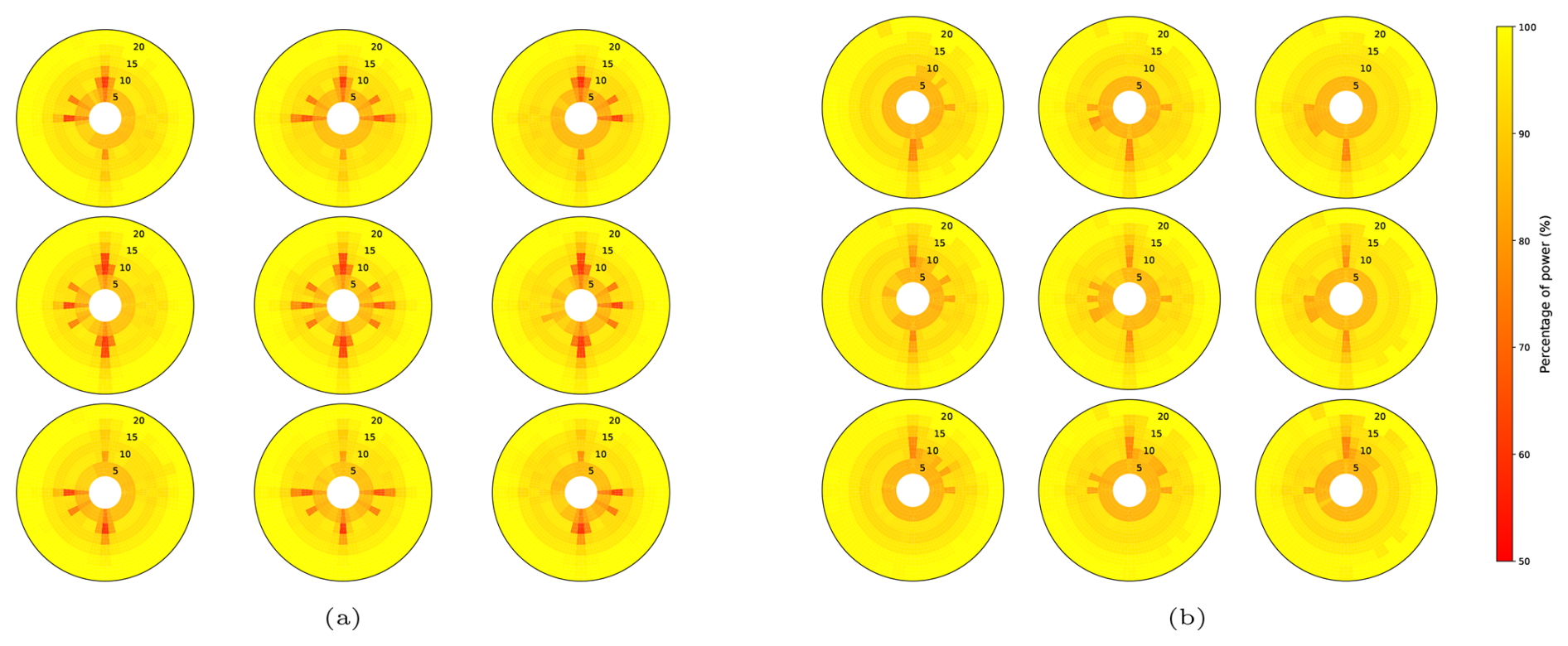
Figure 16Case 3, offshore scenario with all failure modes: optimized operational plan full-farm optimization (a) and per-turbine optimization (b).
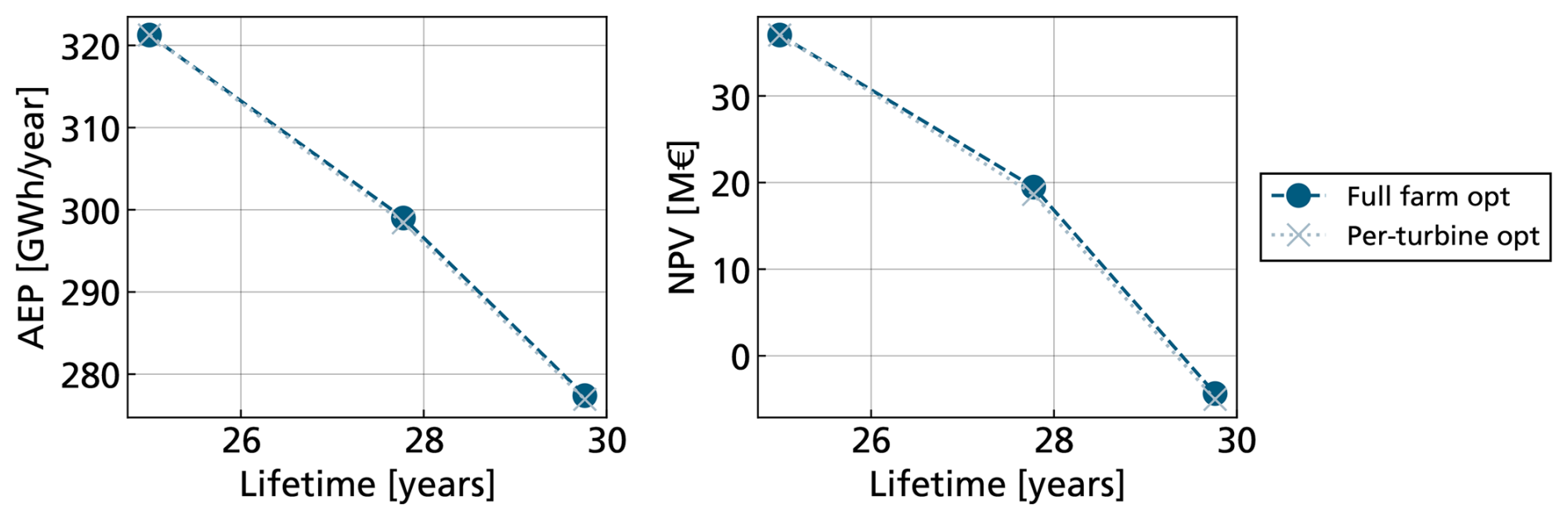
Figure 17Case 3, evaluation of results: offshore scenario with all failure modes, comparison of AEP and NPV for the optimization approaches.
The application of VIOLA to the example wind farm indicates that condition-based operational planning can redistribute damage away from operating situations with an unfavorable relation between energy and damage while preserving energy yield where the trade-off is more advantageous.
In all of the studied cases, the optimization systematically reduces the fatigue damage by the amount of derating so that the overall energy production is maximized and improves the damage–energy relationship of each individual turbine and the full wind farm. When only considering the tower bm as a failure mode, fatigue damage can be strongly reduced under some conditions so that the loss in energy production is significantly lower in total. A consistent observation is that derating still yields its largest benefit on the derated turbine itself. The consideration of derating of upstream turbines has an impact on the optimal achievable energy production of the farm which can only be captured by the full-farm optimization approach. This impact depends on the scenario and on the targeted lifetime extension for the different failure modes. In most of the studied cases, the difference in AEP between the full-farm and the per-turbine optimization was low. Despite the fact that the resulting operational plans differ, and the full-farm approach uses derating of upstream turbines to yield the best overall result, the AEP gain compared to the per-turbine approaches is less than 1 % in almost every case. The benefit of the full-farm approach mainly applies when many of the turbines require a significant derating and under offshore turbulence conditions.
When multiple failure modes are considered, turbulence-driven modes (e.g., tower bottom bending, blade flapwise root loads) respond well to the wake-aware derating, whereas gravity-/rotational-speed-driven modes (blade edgewise) require high reductions in rotational speed and therefore incur higher energy losses. By comparing onshore and offshore scenarios for the ambient turbulence intensity, the influence of this parameter on the wake and subsequently on the fatigue lifetime is shown as an example. With a higher ambient turbulence, the flow behind the turbine adapts more quickly to the surrounding conditions and thus reduces variability in loads between the turbines. With a lower ambient TI, the reduction in the thrust of upstream turbines more effectively reduces the TI downstream.
When interpreting results for farm lifetime, lifetime energy, and NPV, note that the evaluation is intentionally simple and supports first-order comparisons. We show that higher NPV can be achieved by modestly extending lifetime at the expense of a small reduction in AEP. The assumption of lifetime and decommissioning based on a deterministic and relative consideration of lifetime fatigue damage is strong and should not be applied directly to real projects. The basis for the fatigue damage calculation in the optimization process is the same as for design calculations and can thus be integrated into the planning process of wind farm operation.
In addition to the uncertainties in the long-term evaluation of the economic benefits, the results also depend on the underlying models, which are used on several levels, i.e., the configuration of the turbine controller, the surrogate models for the fatigue damage calculation, and the wake models. Controller-specific choices influence how loads and the wake respond to derating. The surrogate models used here are polynomial fits through DELs from aeroelastic time domain simulations. These fits interpolate between discrete simulation points and thus introduce additional approximation errors. However, when the underlying simulations are sufficiently accurate, and the turbine–controller interaction is tuned appropriately, these interpolation errors are small compared to the uncertainties inherent in the fatigue damage estimation itself. The surrogate approach based on DELs and linear damage accumulation is tractable and standard for design- and control-oriented analysis of wind turbines, but it does not capture sequence effects or material nonlinearities that can be relevant for composites. A detailed discussion of these modeling uncertainties, including the sensitivity to controller tuning, is provided in Requate et al. (2023) and applies equally to the farm-level extension presented here. In the wind farm context, the wake modeling approach also influences results. Firstly, dynamic effects cannot be represented with steady-state models. Secondly, the parameters of the steady-state model influence the effect of the turbines on the wake.
Under the given model assumptions and parameters, the optimizer attempts to find the best possible solution. Essentially, the problems for a per-turbine approach and for the wind farm are both nonconvex NLPs, making them suitable for nonlinear gradient-based optimizers. On the one hand, we cannot guarantee that a global or even local optimum of the problem is found because of the nonconvexity and unfulfilled requirements in the underlying functions. On the other hand, the shape of the resulting operational plans as well as the consistent results in all of the studied cases assure that an optimal or close-to-optimal solution is found in all cases.
Nevertheless, the gradient-based solution process suffers from an objective function which can be very flat close to the optimal solution. This effect is caused by the frequency distribution, which has very low values under some conditions, especially at higher wind speeds in some wind directions. This effect affects both optimization approaches but also scales with the number of turbines in the full-farm approach.
Overall, the iterative per-turbine optimization scales easily and is attractive to use when the coupling between turbines is weak or when moderate lifetime extensions on some turbines are targeted. Pragmatic workflows which combine partial solutions on small subsets of larger farms, combined with the iterative process, could be tested. In addition, heuristic solutions which incorporate additional knowledge about the problem behavior could be integrated and potentially combined with nonlinear optimization. The optimization problem can still increase strongly in size with larger wind farms; a finer binning of conditions, more conditions, or other control set points (like yaw misalignment) should be considered. This can be done by further fine-tuning the setup of the optimization problem, e.g., by implementing analytical gradients automatically or through decomposition of the problem.
We present a condition-based planning method that redistributes fatigue damage over turbine lifetime by combining surrogate models with a long-term optimization. We compare two optimization approaches and show, across use cases, how optimized operational plans can extend lifetime for some or all turbines in a wind farm and increase revenue through longer operation. The method identifies operational plans that reduce damage under wake-affected, high-turbulence conditions while retaining energy in more favorable situations, resulting in a more efficient relationship between energy production and fatigue damage for each turbine. We show that an individual per-turbine optimization process is almost as effective as the approach for optimizing the full wind farm including all wake interaction effects for the dedicated problem. The optimization process was applied under different turbulence conditions (onshore and offshore) and under consideration of different failure modes. Especially onshore, the wake interaction between turbines is lower, and upstream derating only has a small influence on downstream TI and subsequent damage.
The benefits of the approach for optimized operational planning are quantified for the nine-turbine example farm: onshore, extending tower lifetime by 2–5 years lowers AEP by only 1 %–4 % and raises NPV by up to 10 %. For the turbine with the highest required reduction in loads, lifetime is extended by 20 % at an energy loss of only 5 %. Offshore, extending tower lifetime of the most highly loaded turbines by up to 5 years only requires the derating of a few turbines. This is possible at very low AEP losses of less than 0.2 %, resulting in high NPV increases by more than 50 %. For larger lifetime extensions, a significant reduction in AEP is required (up to 20 %) to extend the lifetime by 80 % so that NPV is still higher than in the nominal case with no derating applied. When blade edgewise loads are included, reaching 28 years requires 6 % AEP reduction and sharply reduces NPV (60 %), reflecting the strong rotational-speed sensitivity.
In total, we can find an optimal relation of consumed fatigue life and energy production for a given target and thus contribute to a more efficient way of operating wind farms and each individual turbine within the farm. With the modular optimization framework, the groundwork for further developments is made. The iterative approach represents a scalable solution for large wind farms. It can be integrated into a pragmatic workflow for optimized wind farm planning. The full-farm approach can initially be used as a comparative solution for parts of the farm for validation purposes, or it can be scaled to large farms using improved methods and longer computing times.
A key challenge and barrier for practical implementation is quantifying how reductions in predicted fatigue loads translate into changes in failure probability and mean time to failure under real operating conditions. This issue can partially be addressed by improving the underlying models and assessing uncertainties and sensitivities. Nevertheless, the process is in line with current standard methods for design load calculations of wind turbines according to the IEC (IEC, 2019b). However, the advantage of energy loss must be clearly demonstrated to an operator in order to make such a strategy applicable. To further prove the benefits of applying such more individual operational strategies to the turbines, an extensive stochastic analysis considering uncertainties and different end-of-life scenarios would be required. Any long-term plan depends on assumptions about the wind climate and the economic development. Frequency distributions derived from historical data are practical and commonly used, but they do not fully capture seasonal and interannual variability or longer-term shifts.
In addition, the economic evaluation is sensitive to price trajectories, discount rates, and maintenance cost assumptions. For this reason, deterministic results should be interpreted alongside scenario analyses or sensitivities. Periodic re-planning with updated site data and asset condition, combined with simple Monte Carlo sampling over wind roses and economic parameters, can provide a more robust view of risk and value.
Some of the advantages of the operational planning cannot be estimated by the simple economic evaluation as done within this work. In addition to stochastic analysis to address uncertainties, the benefits of a more coordinated end of life among the turbines need to be investigated. Furthermore, such strategies can explicitly be used to reduce the design fatigue budget or to adapt a turbine to a site with more severe operational conditions than assumed during the design process.
A further step for practical usage is the integration of external influences beyond the environmental conditions. In particular, the integration of electricity prices into the planning process will be relevant for future wind farms operating in flexible markets, especially those with strong price variations. We have recently extended our single-turbine planning approach to account for the wind–price correlation as an additional input dimension and presented initial results at the Deepwind conference (Requate et al., 2026). Extending this to the farm level is a natural next step. In addition, how the energy reserve from derating can be used for participation in the balancing market could also be investigated.
The evaluations in this study assumed that the optimized operational plan is applied consistently throughout the lifetime. In practice, however, economic and regulatory conditions change over decades of operation, and the turbine's condition evolves differently than predicted. The proposed framework can therefore be applied not only once before commissioning but periodically throughout the farm's lifetime, using updated site data, measured fatigue consumption, and revised economic assumptions. In this sense, the approach can be interpreted as a very slow model-predictive control scheme: at each re-planning point, the remaining fatigue budget is assessed, and the operational strategy for the remaining years is re-optimized. Nevertheless, the planning will always depend on the assumptions about future conditions and thus needs to be carefully compared to standard operation and potential drawbacks. In Requate et al. (2024), we additionally investigated annually variable operational strategies where the derating plan is allowed to differ between years. Notably, the benefit of year-to-year variability was found to be small because the nonlinear relationship between energy production and induced damage, which determines where lifetime can be saved most efficiently, is largely independent of when during the lifetime the derating is applied. However, the benefit also depends on external circumstances such as interest rates, price developments, and the farm's remuneration model, meaning that annually variable strategies may still be valuable under certain conditions.
Regarding the implementation in a wind farm controller, the optimized plan is delivered as a look-up table of derating set points per turbine and bin of wind direction and speed. This is compatible with most turbines since derating is standard for grid power tracking. In operation, the interval width for binning should be aligned with sensing of the environmental conditions and filtered to avoid frequent switching. Wind direction and speed estimates from SCADA or lidar can be used. As the plan is applied, safeguards must ensure compliance with certification and address set point-specific risks (e.g., negative damping offshore). Over time, the planning can be refreshed with updated site data, asset condition, and economic assumptions and extended with targeted uprating or additional control channels (like wake steering) to improve the lifetime–energy trade-off.
To illustrate how the interest rate translates energy production into NPV, Figs. A1 and A2 show the course of the total energy production and the NPV over the operating years for all use cases with the full-farm optimization approach. By taking interest into account, the linear growth of energy production translates to a nonlinear course of NPV over the years. While total energy production over the lifetime is higher than under nominal operation for all optimized results, NPV can decrease when the reduction in AEP is too large relative to the lifetime extension.
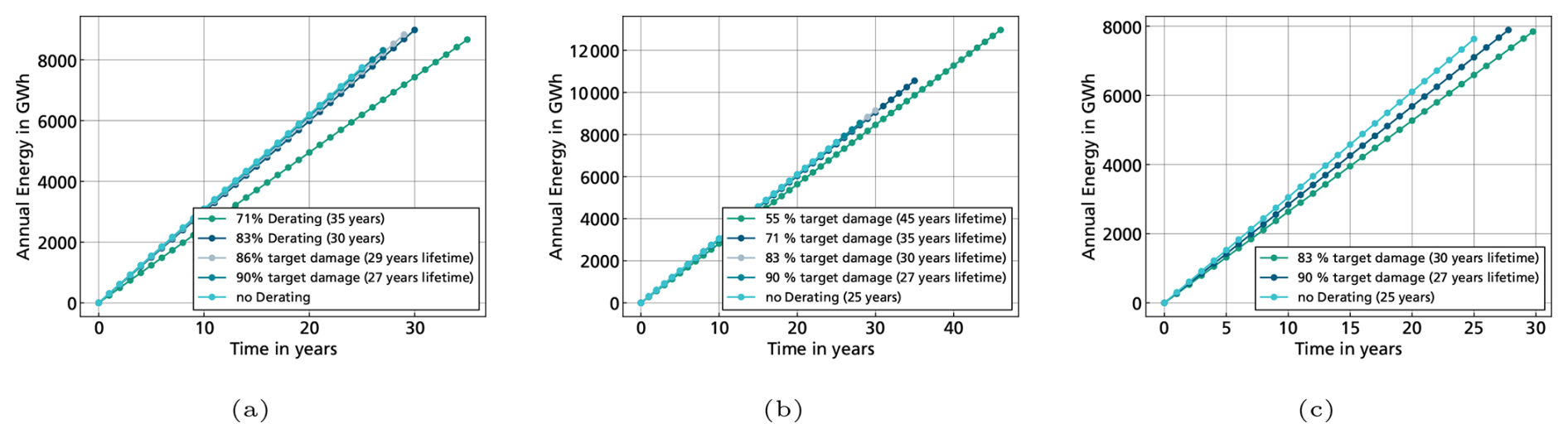
Figure A1Total energy production over operating years of the wind farm using the full-farm optimization for case 1 (a), case 2 (b), and case 3 (c).
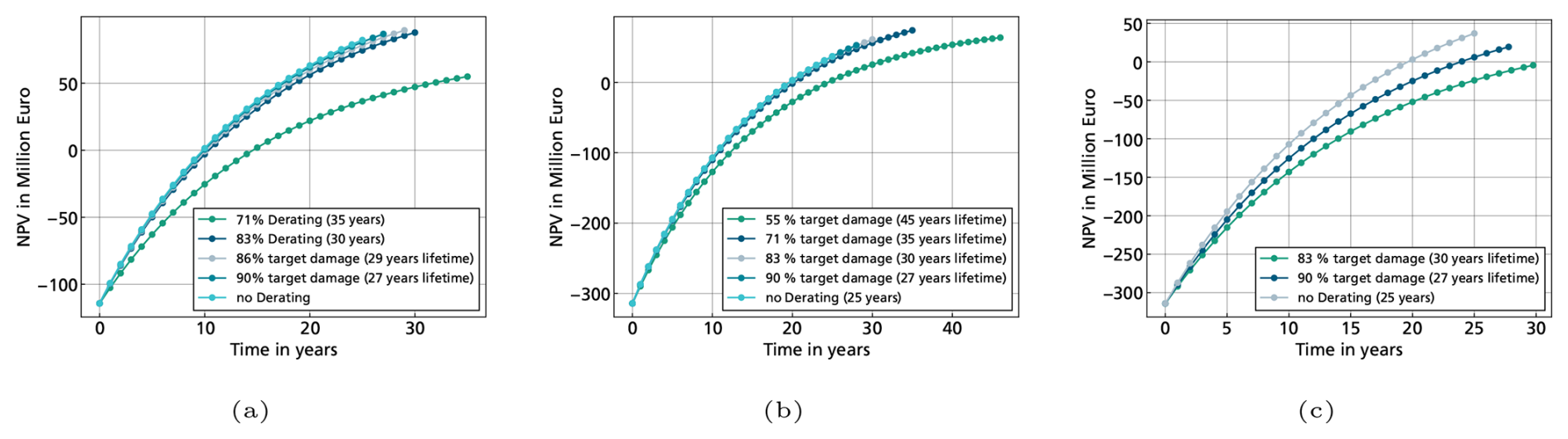
Figure A2NPV over operating years of the wind farm using the full-farm optimization for case 1 (a), case 2 (b), and case 3 (c).
To study the sensitivity of the results on the selected binning size of the ambient conditions, the evaluations for different binnings are compared for all the studied cases with the full-farm optimization approach (Figs. B1, B2, and B3). When comparing all results, the relative course of the curves is very similar for both AEP and NPV. With the broadest binning (dotted curve), a strong deviation can be observed even for the nominal lifetime. In this case, the area for the wake effects is too broad and neglects some effects which seem sufficiently captured with a bin width of 10°. In addition, the derating set points are applied to a broader area and thus reduce efficiency. With the selected bin sizes from Table 3, a good compromise seems to be chosen for finding an optimized plan under the given assumptions.
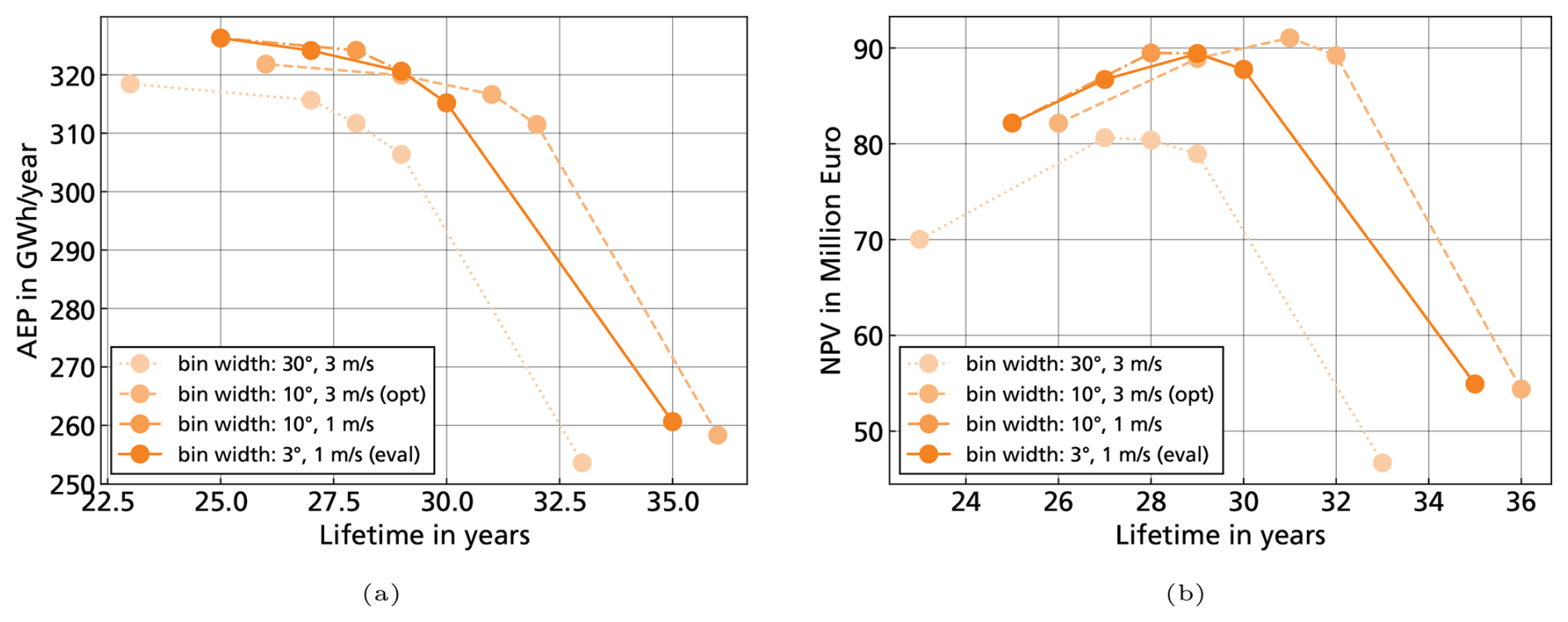
Figure B1Case 1, onshore scenario with tower as failure mode: comparison of binning sizes of AEP (a) and NPV (b).
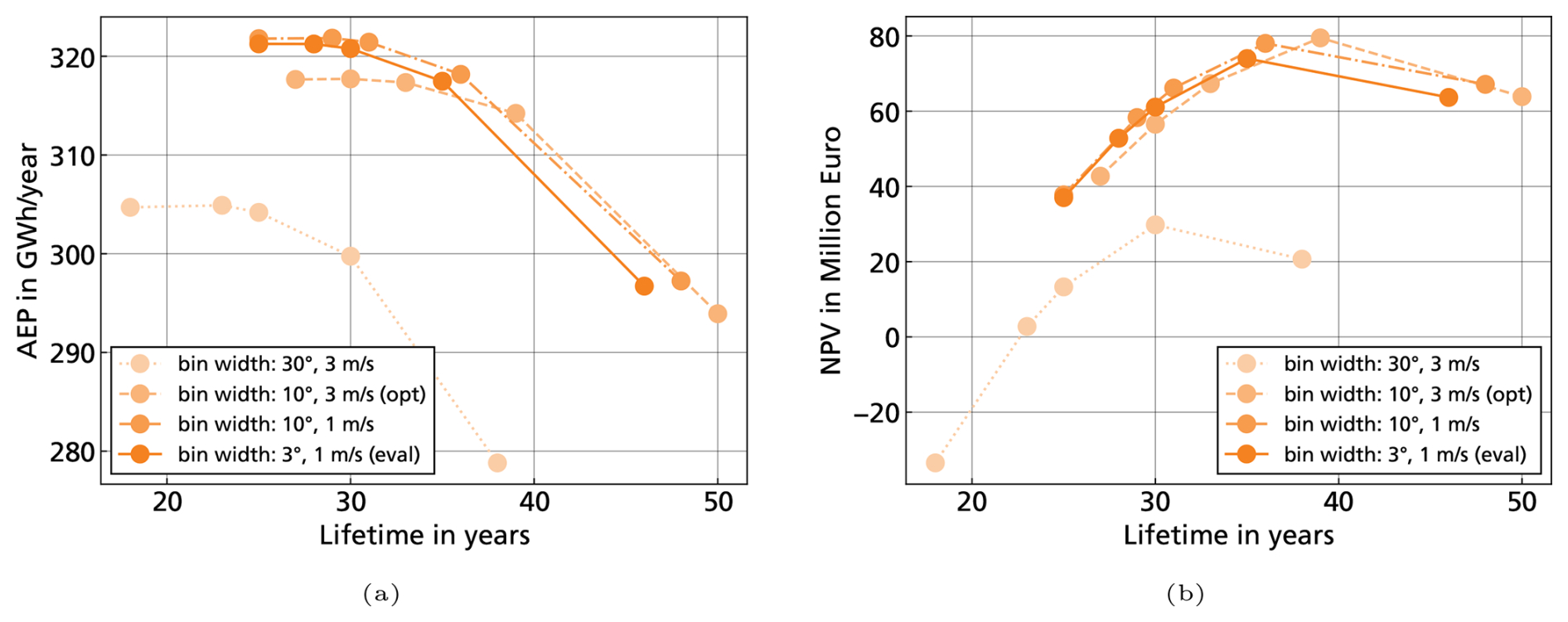
Figure B2Case 2, offshore scenario with tower as failure mode: comparison of binning sizes of AEP (a) and NPV (b).
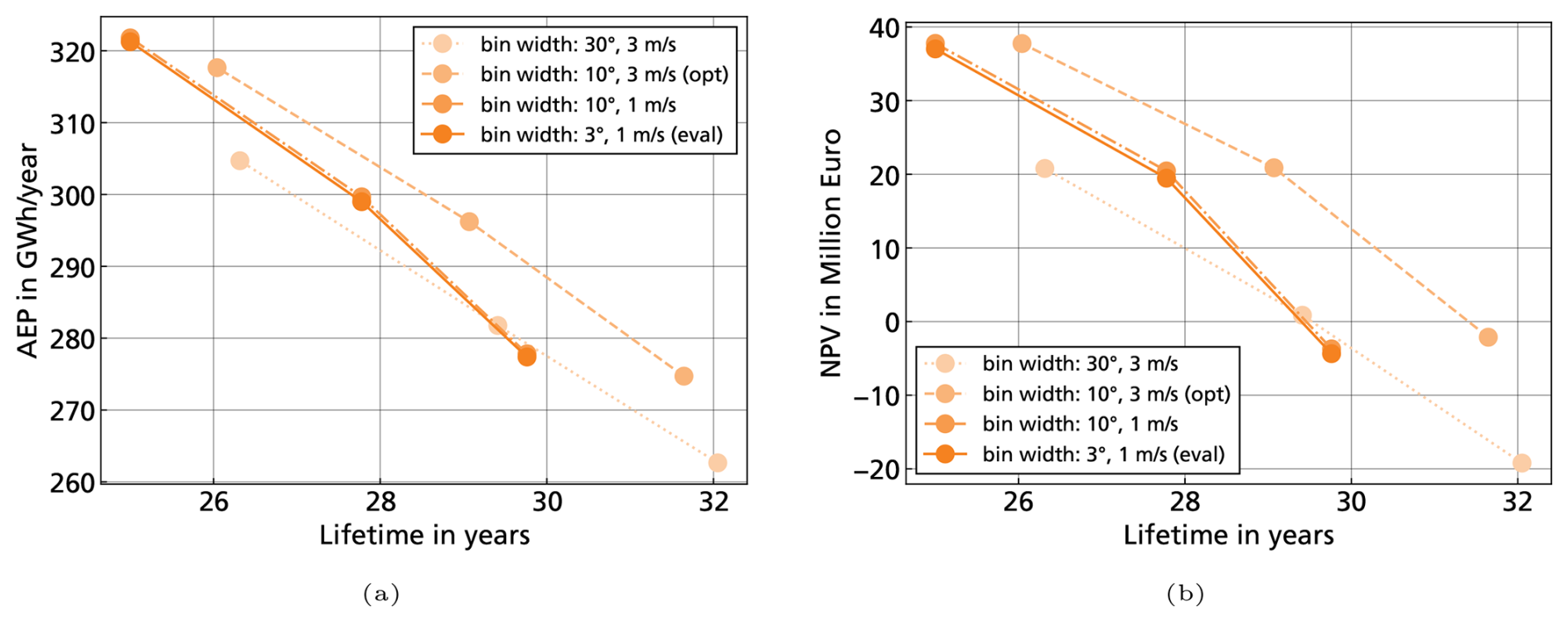
Figure B3Case 3, offshore scenario with all failure modes: comparison of binning sizes of AEP (a) and NPV (b).
| Symbol | Meaning |
| xamb∈ℝW | Ambient input vector (e.g., direction, speed, turbulence). |
| W∈ℕ | Number of selected ambient variables. |
| Matrix of ambient bin representatives; rows are . | |
| B∈ℕ | Total number of ambient bins (often ). |
| Number of bins for ambient direction, speed, turbulence. | |
| x∈ℝw | Local (at-turbine) condition vector (e.g., ). |
| w∈ℕ | Number of selected local variables. |
| Tensor of local (per-turbine, per-bin) wind conditions. | |
| Local condition at turbine i, ambient bin j. | |
| Control set point vector for local condition x. | |
| Nu∈ℕ | Number of control channels. |
| Operational plan tensor; entries uijm (for Nu=1, uij). | |
| NT∈ℕ | Number of turbines. |
| Indices for turbine, ambient bin, control channel. | |
| fwake(⋅) | Wake model mapping from ambient bins and controls to local conditions. |
| X(U) | Local-condition tensor from wake model under plan U. |
| Ambient vector at ambient bin j. | |
| xij(U) | Local condition at turbine i, bin j under plan U. |
| fm | Failure mode index (e.g., tower bm, blade flapwise, blade edgewise). |
| ℱ | Set of considered failure modes. |
| dfm(x,u) | Surrogate damage rate [1 h−1] for failure mode fm. |
| P(x,u) | Surrogate power model [W]. |
| h∈ℝB | Lifetime frequency vector over ambient bins; . |
| hj | Expected hours in ambient bin j. |
| Htotal | Total time horizon in hours. |
| p∈ℝB | Ambient bin probabilities; . |
| H | Alternative horizon (hours) used with p via hj=H pj. |
| Ei(U;h) | Lifetime energy of turbine i under plan U [Wh]. |
| Lifetime damage for failure mode fm on turbine i. |
| Symbol | Meaning |
| F(U;h) | Objective function (e.g., total farm energy). |
| Control box bounds. | |
| θamb, vamb | Ambient wind direction [deg], speed [m s−1]. |
| v, TI | Local wind speed [m s−1], turbulence intensity [–]. |
| u=δP | Derating control set point (percentage of rated power). |
| θ | Local wind direction [deg]. |
| TIamb | Ambient turbulence intensity [–]. |
| ρ | Air density [kg m−3]. |
| δP | Derating factor (0–1 or %). |
| Derating-only operational plan; entries . | |
| Derating set point for turbine i in ambient bin j. | |
| Number of bins for ambient direction and speed. | |
| ΔP,(k) | Derating plan at iteration k (loop approach). |
| K | Number of loop iterations. |
| X(k) | Local-condition tensor at iteration k. |
| Local condition for turbine i, bin j, at iteration k. | |
| Final derating plan after loop. | |
| Final local-condition tensor under . | |
| Implied lifetime [years] of turbine i for failure mode fm. | |
| Ylife | Farm lifetime in full years (minimum across all turbines/modes). |
| NPV(Y) | Net present value over Y years. |
| CelPrice | Average electricity price [ct kWh−1]. |
| Eannual(ΔP;h) | Annual energy [Wh] under plan ΔP. |
| COPEX | Annual OPEX [EUR per year]. |
| CWACC | Weighted average cost of capital (discount rate) [–]. |
| Bopt, Beval | Total ambient bins for optimization/evaluation. |
| hopt, heval | Frequency vectors for optimization/evaluation. |
| ΔP,nom | Nominal plan (e.g., all entries 100 %). |
| Target lifetime [years] for tower failure mode. | |
| Target fatigue budget for tower failure mode [–]. | |
| y | Yaw misalignment set point [deg] (if used as a control channel). |
| Damage rates for flapwise, edgewise, and tower bm. |
The Python tool VIOLA was developed for an in-house workflow and has not yet been publicly released. The code can be shared upon request to the corresponding author. The dataset of short-term DELs used to create the surrogate models is available at https://doi.org/10.5281/zenodo.8385296 (Requate and Meyer, 2023). For further inquiries about data or code, please contact the authors.
NR developed the concept for the study and the research methods. NR developed the code and produced the results under the supervision of and with valuable input from LV. RH reviewed the draft version and gave valuable feedback on the draft, the concept, and the results. NR reviewed and edited the draft version.
The contact author has declared that none of the authors has any competing interests.
Publisher's note: Copernicus Publications remains neutral with regard to jurisdictional claims made in the text, published maps, institutional affiliations, or any other geographical representation in this paper. The authors bear the ultimate responsibility for providing appropriate place names. Views expressed in the text are those of the authors and do not necessarily reflect the views of the publisher.
As main author (NR) I would like to thank my former colleague and mentor, Tobias Meyer. He helped initiate many of the ideas for this work and contributed to the preliminary research for this paper. I am grateful that he has always been and continues to be willing to engage in discussion and provide feedback.
The research was carried out by Fraunhofer IWES under the framework of the FlexiWind project (FKZ: grant no. 2503EE3071A) funded by the Bundesministerium für Wirtschaft und Energie (BMBE).
This paper was edited by Jennifer King and reviewed by two anonymous referees.
Astrain Juangarcia, D., Eguinoa, I., and Knudsen, T.: Derating a single wind farm turbine for reducing its wake and fatigue, J. Phys. Conf. Ser., 1037, 032039, https://doi.org/10.1088/1742-6596/1037/3/032039, 2018. a
Bastankhah, M. and Porté-Agel, F.: Experimental and theoretical study of wind turbine wakes in yawed conditions, J. Fluid Mech., 806, 506–541, https://doi.org/10.1017/jfm.2016.595, 2016. a
BDEW: Koordinierter Weiterbetrieb von Offshore-Windparks kann Kosteneffizienz und Stromerträge erhöhen, https://www.bdew.de/presse/koordinierter-weiterbetrieb-von-offshore-windparks-kann-kosteneffizienz-und-stromertraege-erhoehen/ (last access: 13 October 2026), 2025. a
Eguinoa, I., Göçmen, T., Garcia-Rosa, P. B., Das, K., Petrović, V., Kölle, K., Manjock, A., Koivisto, M. J., and Smailes, M.: Wind farm flow control oriented to electricity markets and grid integration: Initial perspective analysis, Advanced Control for Applications, 3, https://doi.org/10.1002/adc2.80, 2021. a, b
EMD International: Lifetime Optimisation: Ensure wind turbine lifetime with windPRO optimisation, https://www.emd-international.com/lifetime-optimisation (last access: 13 October 2026), 2025a. a
EMD International: WindPro 4.2 User Manual: 8c: Load Curtailment Optimization, https://help.emd.dk/knowledgebase/content/windPRO4.2/c8c-UK_windPRO4.2-Load_Curtailment_Optimization.pdf (last access: 13 October 2026), 2025b. a
Gharbia, I. B., Khvoenkova, N., Tona, P., Guillemin, F., Dupoiron, M., Quenedey, E., and Cousin, A.: A bin-wise approach to wake steering optimization under fatigue load constraints, J. Phys. Conf. Ser., 3025, 012017, https://doi.org/10.1088/1742-6596/3025/1/012017, 2025. a
Gonzalez Silva, J., Ferrari, R., and van Wingerden, J.-W.: Wind farm control for wake-loss compensation, thrust balancing and load-limiting of turbines, Renewable Energy, 203, 421–433, https://doi.org/10.1016/j.renene.2022.11.113, 2023. a
Guilloré, A., Campagnolo, F., and Bottasso, C. L.: A control-oriented load surrogate model based on sector-averaged inflow quantities: capturing damage for unwaked, waked, wake-steering and curtailed wind turbines, J. Phys. Conf. Ser., 2767, 032019, https://doi.org/10.1088/1742-6596/2767/3/032019, 2024. a
Hersbach, H., Bell, B., Berrisford, P., Biavati, G., Horányi, A., Muñoz Sabater, J., Nicolas, J., Peubey, C., Radu, R., Rozum, I., Schepers, D., Simmons, A., Soci, C., Dee, D., and Thépaut, J.-N.: ERA5 hourly data on single levels from 1959 to present, Copernicus Climate Change Service (C3S) Climate Data Store (CDS) [data set], https://doi.org/10.24381/cds.adbb2d47, 2018. a
Houck, D. R.: Review of wake management techniques for wind turbines, Wind Energy, 25, 195–220, https://doi.org/10.1002/we.2668, 2022. a
IEC: Wind energy generation systems – Part 3-1: Design requirements for fixed offshore wind turbines, https://webstore.iec.ch/en/publication/29360 (last access: 13 October 2026), 2019a. a, b
IEC: Wind Turbines – Part 1: Design Requirements, https://webstore.iec.ch/en/publication/26423 (last access: 13 October 2026), 2019b. a
Jensen, T. N., Knudsen, T., and Bak, T.: Fatigue minimising power reference control of a de-rated wind farm, J. Phys. Conf. Ser., 753, 052022, https://doi.org/10.1088/1742-6596/753/5/052022, 2016. a
Kölle, K., Göçmen, T., Eguinoa, I., Alcayaga Román, L. A., Aparicio-Sanchez, M., Feng, J., Meyers, J., Pettas, V., and Sood, I.: FarmConners market showcase results: wind farm flow control considering electricity prices, Wind Energ. Sci., 7, 2181–2200, https://doi.org/10.5194/wes-7-2181-2022, 2022. a
Liew, J., Riva, R., Friis-Møller, M., and Göçmen, T.: Wind Farm Control Optimisation Under Load Constraints Via Surrogate Modelling, J. Phys. Conf. Ser., 2767, 092039, https://doi.org/10.1088/1742-6596/2767/9/092039, 2024. a
Meng, F., Hou Lio, A. W., and Liew, J.: The effect of minimum thrust coefficient control strategy on power output and loads of a wind farm, J. Phys. Conf. Ser., 1452, 012009, https://doi.org/10.1088/1742-6596/1452/1/012009, 2020. a
Meyer, T. and Requate, N.: Advanced concepts for control of wind turbine and wind farm systems, in: Wind Turbine System Design. Volume 2: Electrical systems, grid integration, control and monitoring, edited by: Wenske, J., Institution of Engineering and Technology, 411–441, ISBN 9781785618581, https://doi.org/10.1049/PBPO142G_ch9, 2023. a
Meyers, J., Bottasso, C., Dykes, K., Fleming, P., Gebraad, P., Giebel, G., Göçmen, T., and van Wingerden, J.-W.: Wind farm flow control: prospects and challenges, Wind Energ. Sci., 7, 2271–2306, https://doi.org/10.5194/wes-7-2271-2022, 2022. a
Nash, R., Nouri, R., and Vasel-Be-Hagh, A.: Wind turbine wake control strategies: A review and concept proposal, Energ. Convers. Manage., 245, 114581, https://doi.org/10.1016/j.enconman.2021.114581, 2021. a
Pacheco, J., Berezyak, M., Martins, J., Teixeira, N., Pereira, C., Figueiredo, R., and Oliveira, C.: Push power where you can and prevent damage where you need, J. Phys. Conf. Ser., 3025, 012015, https://doi.org/10.1088/1742-6596/3025/1/012015, 2025. a
Pettas, V.: Wind turbine operational optimization considering revenue and fatigue objectives, PhD thesis, OPUS, https://doi.org/10.18419/opus-13959, 2024. a, b
Requate, N. and Meyer, T.: Database of Short Term Damage Equivalent Loads (DEL) of IWT7.5MW wind turbine depending on wind, TI, yaw and derating, Zenodo [data set], https://doi.org/10.5281/zenodo.8385296, 2023. a, b
Requate, N., Meyer, T., and Hofmann, R.: From wind conditions to operational strategy: optimal planning of wind turbine damage progression over its lifetime, Wind Energ. Sci., 8, 1727–1753, https://doi.org/10.5194/wes-8-1727-2023, 2023. a, b, c, d, e, f, g, h, i
Requate, N., Meyer, T., and Hofmann, R.: Maximizing value through optimized annual selection of Pareto-optimal wind turbine operating strategies, J. Phys. Conf. Ser., 2767, 032045, https://doi.org/10.1088/1742-6596/2767/3/032045, 2024. a
Requate, N., Schmelter, J., and Ruck, N.: Comparison of optimization approaches for price-dependent wind turbine operational strategies: Presentation at EERA DeepWind Conference 2026, https://ntnu.eventsair.com/QuickEventWebsitePortal/deepwind2026/programme/Speaker (last access: 13 October 2026), 2026. a
Robbelein, K., Daems, P. J., Verstraeten, T., Noppe, N., Weijtjens, W., Helsen, J., and Devriendt, C.: Effect of curtailment scenarios on the loads and lifetime of offshore wind turbine generator support structures, Journal of Phys. Conf. Ser., 2507, 012013, https://doi.org/10.1088/1742-6596/2507/1/012013, 2023. a
Schmidt, J.: FOXES (Farm Optimization and eXtended yield Evaluation Software), https://fraunhoferiwes.github.io/foxes.docs/index.html (last access: 13 October 2026), 2022. a
Stehly, T., Duffy, P., and Hernando, D. M.: Cost of Wind Energy Review: 2024 Edition, https://github.com/FraunhoferIWES/foxes (last access: 13 October 2026), 2024. a
Stock, A., Cole, M., Leithead, W., and Amos, L.: Distributed Control of Wind Farm Power Set Points to Minimise Fatigue Loads, in: 2020 American Control Conference (ACC), IEEE, 4843–4848, ISBN 978-1-5386-8266-1, https://doi.org/10.23919/ACC45564.2020.9147732, 2020. a
Türk, M. and Emeis, S.: The dependence of offshore turbulence intensity on wind speed, J. Wind Eng. Ind. Aerod., 98, 466–471, https://doi.org/10.1016/j.jweia.2010.02.005, 2010. a
Waechter, A. and Laird, C.: Ipopt, https://coin-or.github.io/Ipopt/index.html (last access: 13 October 2026), 2022. a
Ziegler, L., Schulze, A., and Henning, M.: Optimization of curtailment intervals of wind turbines through assessment of measured loads during start-up and shutdown events, J. Phys. Conf. Ser., 2767, 032006, https://doi.org/10.1088/1742-6596/2767/3/032006, 2024. a
In general, there are various terms for reducing the power of a wind turbine, and the usage often depends on the context. In wind farm control, the term axial-induction control is often used. Also, downregulation and curtailment are prominent terms. The latter is often referred to in the context of requests by the grid operator. Just like in Requate et al. (2023), the term derating is used throughout this work.
- Abstract
- Introduction
- General optimization problem for the operational planning of wind farms
- Optimization problem for optimal planning of derating
- Results
- Discussion
- Conclusion and outlook
- Appendix A: Net present value calculations
- Appendix B: Comparison of binning sizes
- Appendix C: List of symbols
- Code and data availability
- Author contributions
- Competing interests
- Disclaimer
- Acknowledgements
- Financial support
- Review statement
- References
- Abstract
- Introduction
- General optimization problem for the operational planning of wind farms
- Optimization problem for optimal planning of derating
- Results
- Discussion
- Conclusion and outlook
- Appendix A: Net present value calculations
- Appendix B: Comparison of binning sizes
- Appendix C: List of symbols
- Code and data availability
- Author contributions
- Competing interests
- Disclaimer
- Acknowledgements
- Financial support
- Review statement
- References