
Articles | Volume 11, issue 10
https://doi.org/10.5194/wes-11-3863-2026
© Author(s) 2026. This work is distributed under
the Creative Commons Attribution 4.0 License.
the Creative Commons Attribution 4.0 License.
https://doi.org/10.5194/wes-11-3863-2026
© Author(s) 2026. This work is distributed under
the Creative Commons Attribution 4.0 License.
the Creative Commons Attribution 4.0 License.
Research article
| 
15 Oct 2026
Research article |
| 15 Oct 2026
| 15 Oct 2026
Beyond wind-sector management: optimal wind farm operational planning for balancing fatigue damage and extending lifetime
Niklas Requate
CORRESPONDING AUTHOR

Fraunhofer IWES, Bremerhaven, Germany
TU Wien, Vienna, Austria
Lukas Vollmer
Fraunhofer IWES, Bremerhaven, Germany
René Hofmann
TU Wien, Vienna, Austria
Related authors
Niklas Requate, Tobias Meyer, and René Hofmann
Wind Energ. Sci., 8, 1727–1753, https://doi.org/10.5194/wes-8-1727-2023, https://doi.org/10.5194/wes-8-1727-2023, 2023
Short summary
Short summary
Wind turbines produce energy over a lifetime of at least 20 years, and they are designed to withstand the induced loads from the environment. During that long operating time, we cannot avoid causing damage to a turbine and using up the utilized materials. To gain maximum benefit from the material of each turbine, we developed a method which makes best use of their given design damage budget by optimally distributing its usage over the operating time. An operational plan is optimized to do so.
Tuhfe Göçmen, Filippo Campagnolo, Thomas Duc, Irene Eguinoa, Søren Juhl Andersen, Vlaho Petrović, Lejla Imširović, Robert Braunbehrens, Jaime Liew, Mads Baungaard, Maarten Paul van der Laan, Guowei Qian, Maria Aparicio-Sanchez, Rubén González-Lope, Vinit V. Dighe, Marcus Becker, Maarten J. van den Broek, Jan-Willem van Wingerden, Adam Stock, Matthew Cole, Renzo Ruisi, Ervin Bossanyi, Niklas Requate, Simon Strnad, Jonas Schmidt, Lukas Vollmer, Ishaan Sood, and Johan Meyers
Wind Energ. Sci., 7, 1791–1825, https://doi.org/10.5194/wes-7-1791-2022, https://doi.org/10.5194/wes-7-1791-2022, 2022
Short summary
Short summary
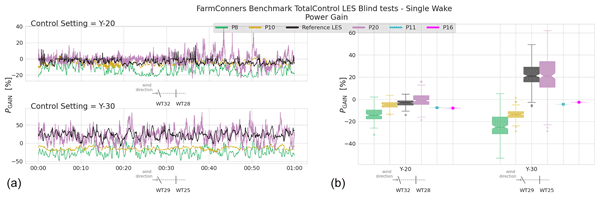
The FarmConners benchmark is the first of its kind to bring a wide variety of data sets, control settings, and model complexities for the (initial) assessment of wind farm flow control benefits. Here we present the first part of the benchmark results for three blind tests with large-scale rotors and 11 participating models in total, via direct power comparisons at the turbines as well as the observed or estimated power gain at the wind farm level under wake steering control strategy.
Sandra Schwegmann, Tanguy Lunel, Lukas Vollmer, and Martin Dörenkämper
Wind Energ. Sci. Discuss., https://doi.org/10.5194/wes-2026-103, https://doi.org/10.5194/wes-2026-103, 2026
Preprint under review for WES
Short summary
Short summary
This study investigates the feasibility of the Weather Research and Forecasting Model (WRF) to represent turbulence intensity (TI) and quantifies its uncertainties for the North Sea. At mesoscales, using subgrid-scale TKE for TI calculation, a mean absolute percentage error of about 30 % can be achieved. Out of the used PBL schemes, MYNN provides the lowest deviation to observed TI at a resolution of 2 km. Gray-zone simulations with a resolution of up to 111 m do rarely improve TI.
Astrid Lampert, Beatriz Cañadillas, Thomas Rausch, Lea Schmitt, Bughsin' Djath, Johannes Schulz-Stellenfleth, Andreas Platis, Kjell zum Berge, Ines Schäfer, Jens Bange, Lukas Gruchot, Thomas Neumann, Martin Dörenkämper, Bernhard Stoevesandt, Julia Gottschall, Lukas Vollmer, Stefan Emeis, Mares Barekzai, Simon Siedersleben, Martin Kühn, Gerald Steinfeld, Detlev Heinemann, Joachim Peinke, Hendrik Heißelmann, Jörge Schneemann, Gabriele Centurelli, Philipp Waldmann, and Konrad Bärfuss
Wind Energ. Sci., 11, 3057–3075, https://doi.org/10.5194/wes-11-3057-2026, https://doi.org/10.5194/wes-11-3057-2026, 2026
Short summary
Short summary
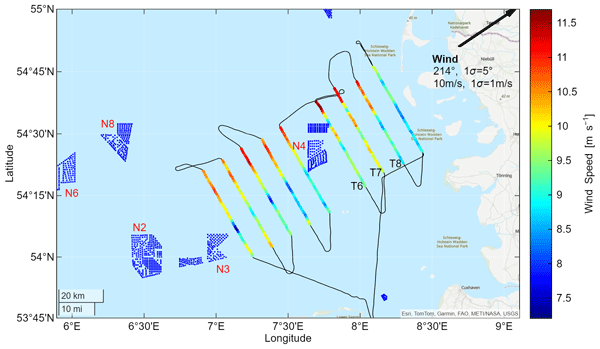
Two major aircraft measurement campaigns above the North Sea provide insights into modifications of the wind field and sea surface induced by wind farms. The aircraft performed transects at hub height upstream and downstream of wind farm clusters and identified different effects, e.g. how long it takes for the wind speed to recover after the wind farm, how changes across the coastline interact with wind energy, and if wind farms are well represented in numerical simulations.
Balthazar Arnoldus Maria Sengers, Lukas Vollmer, and Martin Dörenkämper
Wind Energ. Sci. Discuss., https://doi.org/10.5194/wes-2026-80, https://doi.org/10.5194/wes-2026-80, 2026
Preprint under review for WES
Short summary
Short summary
This work compared parameterizations used in mesoscale models to estimate wind energy production against operational data from several offshore sites. Results showed differences of about five percent, with higher resolution reducing generated power due to stronger wakes. One approach best reproduced key aspects of wind farm performance. Overall, results underline known limitations, but confirm these models are useful for estimating wind farm performance.
Sonja Steinbrück, Thorben Eilers, Lukas Vollmer, Kerstin Avila, and Gerald Steinfeld
Wind Energ. Sci. Discuss., https://doi.org/10.5194/wes-2024-146, https://doi.org/10.5194/wes-2024-146, 2024
Preprint withdrawn
Short summary
Short summary
This paper introduces an enhanced coupling between the LES code PALM and the aeroelastic code FAST, enabling detailed turbine output in temporally and spatially heterogeneous atmospheric flows while maintaining computational efficiency. A wind speed correction is added to reduce errors from force smearing on the numerical grid. Results were evaluated through comparisons between different model setups and turbine measurements, including assessments in a two-turbine wake situation.
Lukas Vollmer, Balthazar Arnoldus Maria Sengers, and Martin Dörenkämper
Wind Energ. Sci., 9, 1689–1693, https://doi.org/10.5194/wes-9-1689-2024, https://doi.org/10.5194/wes-9-1689-2024, 2024
Short summary
Short summary
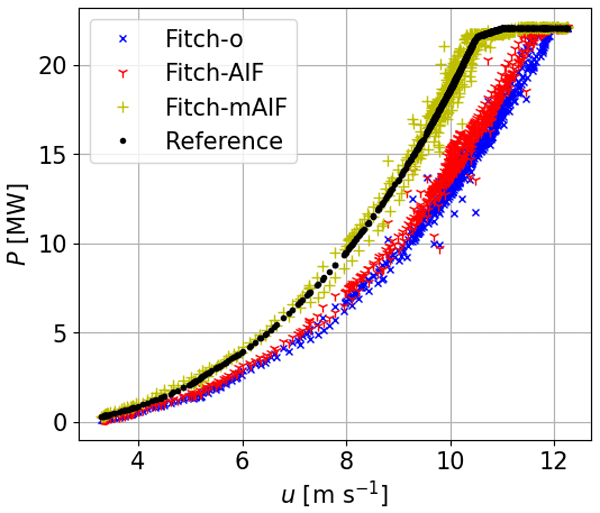
This study proposes a modification to a well-established wind farm parameterization used in mesoscale models. The wind speed at the location of the turbine, which is used to calculate power and thrust, is corrected to approximate the free wind speed. Results show that the modified parameterization produces more accurate estimates of the turbine’s power curve.
Niklas Requate, Tobias Meyer, and René Hofmann
Wind Energ. Sci., 8, 1727–1753, https://doi.org/10.5194/wes-8-1727-2023, https://doi.org/10.5194/wes-8-1727-2023, 2023
Short summary
Short summary
Wind turbines produce energy over a lifetime of at least 20 years, and they are designed to withstand the induced loads from the environment. During that long operating time, we cannot avoid causing damage to a turbine and using up the utilized materials. To gain maximum benefit from the material of each turbine, we developed a method which makes best use of their given design damage budget by optimally distributing its usage over the operating time. An operational plan is optimized to do so.
Anna von Brandis, Gabriele Centurelli, Jonas Schmidt, Lukas Vollmer, Bughsin' Djath, and Martin Dörenkämper
Wind Energ. Sci., 8, 589–606, https://doi.org/10.5194/wes-8-589-2023, https://doi.org/10.5194/wes-8-589-2023, 2023
Short summary
Short summary
We propose that considering large-scale wind direction changes in the computation of wind farm cluster wakes is of high relevance. Consequently, we present a new solution for engineering modeling tools that accounts for the effect of such changes in the propagation of wakes. The new model is evaluated with satellite data in the German Bight area. It has the potential to reduce uncertainty in applications such as site assessment and short-term power forecasting.
Tuhfe Göçmen, Filippo Campagnolo, Thomas Duc, Irene Eguinoa, Søren Juhl Andersen, Vlaho Petrović, Lejla Imširović, Robert Braunbehrens, Jaime Liew, Mads Baungaard, Maarten Paul van der Laan, Guowei Qian, Maria Aparicio-Sanchez, Rubén González-Lope, Vinit V. Dighe, Marcus Becker, Maarten J. van den Broek, Jan-Willem van Wingerden, Adam Stock, Matthew Cole, Renzo Ruisi, Ervin Bossanyi, Niklas Requate, Simon Strnad, Jonas Schmidt, Lukas Vollmer, Ishaan Sood, and Johan Meyers
Wind Energ. Sci., 7, 1791–1825, https://doi.org/10.5194/wes-7-1791-2022, https://doi.org/10.5194/wes-7-1791-2022, 2022
Short summary
Short summary
The FarmConners benchmark is the first of its kind to bring a wide variety of data sets, control settings, and model complexities for the (initial) assessment of wind farm flow control benefits. Here we present the first part of the benchmark results for three blind tests with large-scale rotors and 11 participating models in total, via direct power comparisons at the turbines as well as the observed or estimated power gain at the wind farm level under wake steering control strategy.
Cited articles
Astrain Juangarcia, D., Eguinoa, I., and Knudsen, T.: Derating a single wind farm turbine for reducing its wake and fatigue, J. Phys. Conf. Ser., 1037, 032039, https://doi.org/10.1088/1742-6596/1037/3/032039, 2018. a
Bastankhah, M. and Porté-Agel, F.: Experimental and theoretical study of wind turbine wakes in yawed conditions, J. Fluid Mech., 806, 506–541, https://doi.org/10.1017/jfm.2016.595, 2016. a
BDEW: Koordinierter Weiterbetrieb von Offshore-Windparks kann Kosteneffizienz und Stromerträge erhöhen, https://www.bdew.de/presse/koordinierter-weiterbetrieb-von-offshore-windparks-kann-kosteneffizienz-und-stromertraege-erhoehen/ (last access: 13 October 2026), 2025. a
Eguinoa, I., Göçmen, T., Garcia-Rosa, P. B., Das, K., Petrović, V., Kölle, K., Manjock, A., Koivisto, M. J., and Smailes, M.: Wind farm flow control oriented to electricity markets and grid integration: Initial perspective analysis, Advanced Control for Applications, 3, https://doi.org/10.1002/adc2.80, 2021. a, b
EMD International: Lifetime Optimisation: Ensure wind turbine lifetime with windPRO optimisation, https://www.emd-international.com/lifetime-optimisation (last access: 13 October 2026), 2025a. a
EMD International: WindPro 4.2 User Manual: 8c: Load Curtailment Optimization, https://help.emd.dk/knowledgebase/content/windPRO4.2/c8c-UK_windPRO4.2-Load_Curtailment_Optimization.pdf (last access: 13 October 2026), 2025b. a
Gharbia, I. B., Khvoenkova, N., Tona, P., Guillemin, F., Dupoiron, M., Quenedey, E., and Cousin, A.: A bin-wise approach to wake steering optimization under fatigue load constraints, J. Phys. Conf. Ser., 3025, 012017, https://doi.org/10.1088/1742-6596/3025/1/012017, 2025. a
Gonzalez Silva, J., Ferrari, R., and van Wingerden, J.-W.: Wind farm control for wake-loss compensation, thrust balancing and load-limiting of turbines, Renewable Energy, 203, 421–433, https://doi.org/10.1016/j.renene.2022.11.113, 2023. a
Guilloré, A., Campagnolo, F., and Bottasso, C. L.: A control-oriented load surrogate model based on sector-averaged inflow quantities: capturing damage for unwaked, waked, wake-steering and curtailed wind turbines, J. Phys. Conf. Ser., 2767, 032019, https://doi.org/10.1088/1742-6596/2767/3/032019, 2024. a
Hersbach, H., Bell, B., Berrisford, P., Biavati, G., Horányi, A., Muñoz Sabater, J., Nicolas, J., Peubey, C., Radu, R., Rozum, I., Schepers, D., Simmons, A., Soci, C., Dee, D., and Thépaut, J.-N.: ERA5 hourly data on single levels from 1959 to present, Copernicus Climate Change Service (C3S) Climate Data Store (CDS) [data set], https://doi.org/10.24381/cds.adbb2d47, 2018. a
Houck, D. R.: Review of wake management techniques for wind turbines, Wind Energy, 25, 195–220, https://doi.org/10.1002/we.2668, 2022. a
IEC: Wind Turbines – Part 1: Design Requirements, https://webstore.iec.ch/en/publication/26423 (last access: 13 October 2026), 2019b. a
Jensen, T. N., Knudsen, T., and Bak, T.: Fatigue minimising power reference control of a de-rated wind farm, J. Phys. Conf. Ser., 753, 052022, https://doi.org/10.1088/1742-6596/753/5/052022, 2016. a
Kölle, K., Göçmen, T., Eguinoa, I., Alcayaga Román, L. A., Aparicio-Sanchez, M., Feng, J., Meyers, J., Pettas, V., and Sood, I.: FarmConners market showcase results: wind farm flow control considering electricity prices, Wind Energ. Sci., 7, 2181–2200, https://doi.org/10.5194/wes-7-2181-2022, 2022. a
Liew, J., Riva, R., Friis-Møller, M., and Göçmen, T.: Wind Farm Control Optimisation Under Load Constraints Via Surrogate Modelling, J. Phys. Conf. Ser., 2767, 092039, https://doi.org/10.1088/1742-6596/2767/9/092039, 2024. a
Meng, F., Hou Lio, A. W., and Liew, J.: The effect of minimum thrust coefficient control strategy on power output and loads of a wind farm, J. Phys. Conf. Ser., 1452, 012009, https://doi.org/10.1088/1742-6596/1452/1/012009, 2020. a
Meyer, T. and Requate, N.: Advanced concepts for control of wind turbine and wind farm systems, in: Wind Turbine System Design. Volume 2: Electrical systems, grid integration, control and monitoring, edited by: Wenske, J., Institution of Engineering and Technology, 411–441, ISBN 9781785618581, https://doi.org/10.1049/PBPO142G_ch9, 2023. a
Meyers, J., Bottasso, C., Dykes, K., Fleming, P., Gebraad, P., Giebel, G., Göçmen, T., and van Wingerden, J.-W.: Wind farm flow control: prospects and challenges, Wind Energ. Sci., 7, 2271–2306, https://doi.org/10.5194/wes-7-2271-2022, 2022. a
Nash, R., Nouri, R., and Vasel-Be-Hagh, A.: Wind turbine wake control strategies: A review and concept proposal, Energ. Convers. Manage., 245, 114581, https://doi.org/10.1016/j.enconman.2021.114581, 2021. a
Pacheco, J., Berezyak, M., Martins, J., Teixeira, N., Pereira, C., Figueiredo, R., and Oliveira, C.: Push power where you can and prevent damage where you need, J. Phys. Conf. Ser., 3025, 012015, https://doi.org/10.1088/1742-6596/3025/1/012015, 2025. a
Pettas, V.: Wind turbine operational optimization considering revenue and fatigue objectives, PhD thesis, OPUS, https://doi.org/10.18419/opus-13959, 2024. a, b
Requate, N. and Meyer, T.: Database of Short Term Damage Equivalent Loads (DEL) of IWT7.5MW wind turbine depending on wind, TI, yaw and derating, Zenodo [data set], https://doi.org/10.5281/zenodo.8385296, 2023. a, b
Requate, N., Meyer, T., and Hofmann, R.: Maximizing value through optimized annual selection of Pareto-optimal wind turbine operating strategies, J. Phys. Conf. Ser., 2767, 032045, https://doi.org/10.1088/1742-6596/2767/3/032045, 2024. a
Requate, N., Schmelter, J., and Ruck, N.: Comparison of optimization approaches for price-dependent wind turbine operational strategies: Presentation at EERA DeepWind Conference 2026, https://ntnu.eventsair.com/QuickEventWebsitePortal/deepwind2026/programme/Speaker (last access: 13 October 2026), 2026. a
Robbelein, K., Daems, P. J., Verstraeten, T., Noppe, N., Weijtjens, W., Helsen, J., and Devriendt, C.: Effect of curtailment scenarios on the loads and lifetime of offshore wind turbine generator support structures, Journal of Phys. Conf. Ser., 2507, 012013, https://doi.org/10.1088/1742-6596/2507/1/012013, 2023. a
Schmidt, J.: FOXES (Farm Optimization and eXtended yield Evaluation Software), https://fraunhoferiwes.github.io/foxes.docs/index.html (last access: 13 October 2026), 2022. a
Stehly, T., Duffy, P., and Hernando, D. M.: Cost of Wind Energy Review: 2024 Edition, https://github.com/FraunhoferIWES/foxes (last access: 13 October 2026), 2024. a
Stock, A., Cole, M., Leithead, W., and Amos, L.: Distributed Control of Wind Farm Power Set Points to Minimise Fatigue Loads, in: 2020 American Control Conference (ACC), IEEE, 4843–4848, ISBN 978-1-5386-8266-1, https://doi.org/10.23919/ACC45564.2020.9147732, 2020. a
Türk, M. and Emeis, S.: The dependence of offshore turbulence intensity on wind speed, J. Wind Eng. Ind. Aerod., 98, 466–471, https://doi.org/10.1016/j.jweia.2010.02.005, 2010. a
Waechter, A. and Laird, C.: Ipopt, https://coin-or.github.io/Ipopt/index.html (last access: 13 October 2026), 2022. a
Ziegler, L., Schulze, A., and Henning, M.: Optimization of curtailment intervals of wind turbines through assessment of measured loads during start-up and shutdown events, J. Phys. Conf. Ser., 2767, 032006, https://doi.org/10.1088/1742-6596/2767/3/032006, 2024. a
Short summary
Wind turbines age unevenly within a farm because of site conditions and the influence of surrounding turbines. We present an approach to set lower power under certain winds to reduce fatigue loads while keeping energy high. On a nine‑turbine example farm, this added 2 to 5 years of life with small energy losses of less than 1% and increased net present value. The method is scalable to any wind farm and delivers simple look-up tables for usage in operational planning and control.
Wind turbines age unevenly within a farm because of site conditions and the influence of...


Altmetrics
Final-revised paper
Preprint