Articles | Volume 11, issue 2
https://doi.org/10.5194/wes-11-443-2026
© Author(s) 2026. This work is distributed under
the Creative Commons Attribution 4.0 License.
https://doi.org/10.5194/wes-11-443-2026
© Author(s) 2026. This work is distributed under
the Creative Commons Attribution 4.0 License.
A machine-learning-based approach for better prediction of fatigue life of offshore wind turbine foundations using smaller data sizes

OWI-Lab, AVRG, Vrije Universiteit Brussel (VUB), Brussels, 1050, Belgium
Wout Weijtjens
OWI-Lab, AVRG, Vrije Universiteit Brussel (VUB), Brussels, 1050, Belgium
Negin Sadeghi
OWI-Lab, AVRG, Vrije Universiteit Brussel (VUB), Brussels, 1050, Belgium
24SEA, Brussels, 1000, Belgium
Christof Devriendt
OWI-Lab, AVRG, Vrije Universiteit Brussel (VUB), Brussels, 1050, Belgium
24SEA, Brussels, 1000, Belgium
Related authors
No articles found.
Yacine Bel-Hadj, Francisco de Nolasco Santos, Wout Weijtjens, and Christof Devriendt
Wind Energ. Sci. Discuss., https://doi.org/10.5194/wes-2025-255, https://doi.org/10.5194/wes-2025-255, 2025
Revised manuscript under review for WES
Short summary
Short summary
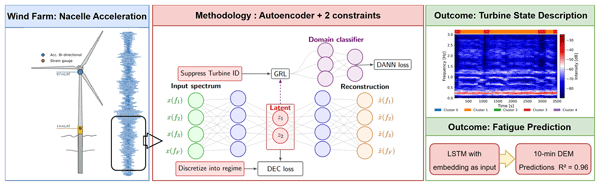
We show that simple vibration sensors on wind turbines can reveal how each machine is operating without relying on control system data. By learning patterns from short acceleration segments, our model identifies turbine behavior, detects changes in operation, and tracks events over time. These patterns also support estimating fatigue, providing a new way to understand turbine performance using only vibration measurements.
Negin Sadeghi, Pietro D'Antuono, Nymfa Noppe, Koen Robbelein, Wout Weijtjens, and Christof Devriendt
Wind Energ. Sci., 8, 1839–1852, https://doi.org/10.5194/wes-8-1839-2023, https://doi.org/10.5194/wes-8-1839-2023, 2023
Short summary
Short summary
Analysis of long-term fatigue damage of four offshore wind turbines using 3 years of measurement data was performed for the first time to gain insight into the low-frequency fatigue damage (LFFD) impact on overall consumed life. The LFFD factor depends on the (linear) stress–life (SN) curve slope, heading, site, signal, and turbine type. Up to ∼ 65 % of the total damage can be related to LFFDs. Therefore, in this case study, the LFFD effect has a significant impact on the final damage.
Francisco d N Santos, Nymfa Noppe, Wout Weijtjens, and Christof Devriendt
Wind Energ. Sci., 7, 299–321, https://doi.org/10.5194/wes-7-299-2022, https://doi.org/10.5194/wes-7-299-2022, 2022
Short summary
Short summary
The estimation of fatigue in offshore wind turbine is highly relevant, as it can help extend the lifetime of these assets. This article attempts to answer this issue by developing a methodology based on artificial intelligence and data collected by sensors installed in real-world turbines. Good results are obtained, and this methodology is further used to learn the value of eight different sensor setups and employed in a real-world wind farm with 48 wind turbines.
Cited articles
Agency for Maritime Services and Coast: Meetnet Vlaamse Banken, https://meetnetvlaamsebanken.be/, last access: 1 January 2025, 2025. a
Basquin, O. H.: The exponential law of endurance tests, Proc. Am. Soc. Test Mater., 10, 625–630, 1910. a
Bergstra, J., Yamins, D., and Cox, D.: Making a Science of Model Search: Hyperparameter Optimization in Hundreds of Dimensions for Vision Architectures, in: Proceedings of the 30th International Conference on Machine Learning, vol. 28 of Proceedings of Machine Learning Research, 115–123, Atlanta, Georgia, USA, http://proceedings.mlr.press/v28/bergstra13.pdf (last access: 10 June 2025), 2013. a
Bezziccheri, M., Castellini, P., Evangelisti, P., Santolini, C., and Paone, N.: Measurement of mechanical loads in large wind turbines: Problems on calibration of strain gage bridges and analysis of uncertainty, Wind Energy, 20, 1997–2010, https://doi.org/10.1002/we.2136, 2017. a
Bossanyi, E.: Surrogate model for fast simulation of turbine loads in wind farms, J. Phys. Conf. Ser., 2265, 042038, https://doi.org/10.1088/1742-6596/2265/4/042038, 2022. a
Bouty, C., Schafhirt, S., Ziegler, L., and Muskulus, M.: Lifetime extension for large offshore wind farms: Is it enough to reassess fatigue for selected design positions?, Energy Procedia, 137, 523–530, https://doi.org/10.1016/j.egypro.2017.10.381, 2017. a
Breiman, L.: Random forests, Mach. Learn., 45, 5–32, https://doi.org/10.1023/A:1010933404324, 2001. a, b
Breiman, L.: Manual on setting up, using, and understanding random forests, https://www.stat.berkeley.edu/~breiman/Using_random_forests_v4.0.pdf (last access: 15 September 2025), 2002. a
Buljan, A.: 25-Year-Old Danish Offshore Wind Farm Gets Approval to Operate for 25 More Years, https://www.offshorewind.biz/2025/06/27/25-year-old-danish-offshore-wind-farm-gets-approval-to-operate-for-25-more-years/ (last access: 14 July 2025), 2025. a
D'Antuono, P., Weijtjens, W., and Devriendt, C.: OWI-Lab/py_fatigue: Zenodo registration, Zenodo [code], https://doi.org/10.5281/zenodo.7656681, 2023. a
de N Santos, F., D'Antuono, P., Robbelein, K., Noppe, N., Weijtjens, W., and Devriendt, C.: Long-term fatigue estimation on offshore wind turbines interface loads through loss function physics-guided learning of neural networks, Renewable Energy, 205, 461–474, https://doi.org/10.1016/j.renene.2023.01.093, 2023. a, b
de N Santos, F., Noppe, N., Weijtjens, W., and Devriendt, C.: Farm-wide interface fatigue loads estimation: A data-driven approach based on accelerometers, Wind Energy, 27, 321–340, https://doi.org/10.1002/we.2888, 2024. a
DNV: Lifetime extension of wind turbines, DNV-ST-0262, https://www.dnv.com/energy/standards-guidelines/dnv-st-0262-lifetime-extension-of-wind-turbines/ (last access: 13 August 2024), 2016. a
Encalada-Dávila, Á., Vidal, Y., and Tutivén, C.: Strain virtual sensor for offshore wind turbine jacket supports: A time series transformer approach validated with Alpha Ventus wind farm data, Mechanical Systems and Signal Processing, 231, 112653, https://doi.org/10.1016/j.ymssp.2025.112653, 2025. a, b
Fallais, D., Sastre Jurado, C., Weijtjens, W., and Devriendt, C.: Long-term validation of a model-based virtual sensing method for fatigue monitoring of offshore wind turbine support structures: Comparing as-designed with state-of-the-art foundation models, Marine Structures, 104, 103841, https://doi.org/10.1016/j.marstruc.2025.103841, 2025. a
Freudenreich, K. and Argyriadis, K.: The Load Level of Modern Wind Turbines according to IEC 61400-1, J. Phys. Conf. Ser., 75, 012075, https://doi.org/10.1088/1742-6596/75/1/012075, 2007. a
Gasparis, G., Lio, A. W. H., and Meng, F.: Surrogate models for wind turbine electrical power and fatigue loads in wind farm, Energies, 13, https://doi.org/10.3390/en13236360, 2020. a
Guyon, I., Weston, J., Barnhill, S., and Vapnik, V.: Gene selection for cancer classification using support vector machines, Mach. Learn., 46, 389–422, https://doi.org/10.1023/A:1012487302797, 2002. a
He, R., Yang, H., Sun, S., Lu, L., Sun, H., and Gao, X.: A machine learning-based fatigue loads and power prediction method for wind turbines under yaw control, Applied Energy, 326, 120013, https://doi.org/10.1016/j.apenergy.2022.120013, 2022. a
International Electrotechnical Commission: Wind turbines – Part 13: Measurement of mechanical loads, IEC 61400-13:2015, https://webstore.iec.ch/en/publication/23971 (last access: 15 September 2025), 2021. a
Karadeniz, A.: Advancing harmonic prediction for offshore wind farms using synthetic data and machine learning, Computers and Electrical Engineering, 127, 110613, https://doi.org/10.1016/j.compeleceng.2025.110613, 2025. a, b, c, d
Kinne, M. and Thöns, S.: Fatigue reliability based on predicted posterior stress ranges determined from strain measurements of wind turbine support structures, Energies, 16, 2225, https://doi.org/10.3390/en16052225, 2023. a
Link, M. and Weiland, M.: Structural health monitoring of the monopile foundation structure of an offshore wind turbine, in: International Conference on Structural Dynamics, 3565–3572, Porto, Portugal, ISBN 978-972-752-165-4, 2014. a
Miner, M. A.: Cumulative damage in fatigue, J. Appl. Mech., 12, A159–A164, https://doi.org/10.1115/1.4009458, 1945. a
Moynihan, B., Tronci, E. M., Hughes, M. C., Moaveni, B., and Hines, E.: Virtual sensing via Gaussian Process for bending moment response prediction of an offshore wind turbine using SCADA data, Renewable Energy, 227, 120466, https://doi.org/10.1016/j.renene.2024.120466, 2024. a, b
Pacheco, J., Pimenta, F., Pereira, S., Cunha, Á., and Magalhães, F.: Fatigue assessment of wind turbine towers: Review of processing strategies with illustrative case study, Energies, 15, 4782, https://doi.org/10.3390/en15134782, 2022. a, b, c
Pedregosa, F., Varoquaux, G., Gramfort, A., Michel, V., Thirion, B., Grisel, O., Blondel, M., Prettenhofer, P., Weiss, R., Dubourg, V., Vanderplas, J., Passos, A., Cournapeau, D., Brucher, M., Perrot, M., Duchesnay, E., and Louppe, G.: Scikit-learn: Machine Learning in Python, J. Mach. Learn. Res., 12, 2825–2830, https://doi.org/10.48550/arXiv.1201.0490, 2012. a
Raju, S. K., Periyasamy, M., Alhussan, A. A., Kannan, S., Raghavendran, S., and El-kenawy, E.-S. M.: Machine learning boosts wind turbine efficiency with smart failure detection and strategic placement, Sci. Rep., 15, 1485, https://doi.org/10.1038/s41598-025-85563-5, 2025. a
Rouholahnejad, F. (. and Gottschall, J.: Characterization of local wind profiles: a random forest approach for enhanced wind profile extrapolation, Wind Energ. Sci., 10, 143–159, https://doi.org/10.5194/wes-10-143-2025, 2025. a, b, c
Sadeghi, N., D'Antuono, P., Noppe, N., Robbelein, K., Weijtjens, W., and Devriendt, C.: Quantifying the effect of low-frequency fatigue dynamics on offshore wind turbine foundations: a comparative study, Wind Energ. Sci., 8, 1839–1852, https://doi.org/10.5194/wes-8-1839-2023, 2023a. a, b
Sadeghi, N., D'Antuono, P., Robbelein, K., Noppe, N., Weijtjens, W., and Devriendt, C.: Deterministic and probabilistic damage calculation of offshore wind turbines considering the low-frequency fatigue dynamics, in: Life-Cycle of Structures and Infrastructure Systems, CRC Press, 3570–3577, https://doi.org/10.1201/9781003323020-437, 2023b. a, b
Sadeghi, N., Noppe, N., Morato, P. G., Weijtjens, W., and Devriendt, C.: Uncertainty quantification of wind turbine fatigue lifetime predictions through binning, J. Phys. Conf. Ser., 2767, 032024, https://doi.org/10.1088/1742-6596/2767/3/032024, 2024. a
Shafiee, M.: Extending the Lifetime of Offshore Wind Turbines: Challenges and Opportunities, Energies, 17, https://doi.org/10.3390/en17164191, 2024. a
Simpson, H. A., Chatzi, E. N., and Chatzis, M. N.: A sub-structuring approach to overcome model limitations for input-state estimation of offshore wind turbines, Journal of Sound and Vibration, 612, 119153, https://doi.org/10.1016/j.jsv.2025.119153, 2025. a
Singh, D., Dwight, R., Laugesen, K., Beaudet, L., and Viré, A.: Probabilistic surrogate modeling of offshore wind turbine loads with chained Gaussian processes, J. Phys. Conf. Ser., 2265, 032070, https://doi.org/10.1088/1742-6596/2265/3/032070, 2022. a
Sparrevik, P.: Offshore wind turbine foundations state of the art, in: From Research to Applied Geotechnics, IOS Press, 216–238, https://doi.org/10.3233/ASMGE190019, 2019. a
Tewolde, S., Höffer, R., Haard, H., and Krieger, J.: Lessons learned from practical structural health monitoring of offshore wind turbine support structures in the North Sea, in: Proceedings of The International Conference on Wind Energy Harvesting (WINERCOST 2018), 21–23 March 2018, Catanzaro Lido, Italy, 2018. a
Velarde, J., Kramhøft, C., Sørensen, J. D., and Zorzi, G.: Fatigue reliability of large monopiles for offshore wind turbines, International Journal of Fatigue, 134, 105487, https://doi.org/10.1016/j.ijfatigue.2020.105487, 2020. a
Weijtens, W., Noppe, N., Verbelen, T., Iliopoulos, A., and Devriendt, C.: Offshore wind turbine foundation monitoring, extrapolating fatigue measurements from fleet leaders to the entire wind farm, J. Phys. Conf. Ser., 753, 092018, https://doi.org/10.1088/1742-6596/753/9/092018, 2016. a, b
WindEurope: Repowering and lifetime extension, https://windeurope.org/wp-content/uploads/files/policy/position-papers/WindEurope-Repowering-and-Lifetime-Extension.pdf (last access: 14 July 2025), 2017. a
Wu, S., Zhang, H., Chen, Z., Liu, X., Zheng, L., Du, M., Li, R., and Li, D.: Experimental Study on Nonlinear Vibrations of Flexible Monopile-Foundation Offshore Wind Turbines in Regular Waves, Water, 17, 1176, https://doi.org/10.3390/w17081176, 2025. a
Zhang, Z., Zhang, W., and Zhang, S.: Strain response prediction of offshore wind turbine tower under free vibration, Maint. Reliab. Cond. Monit., 4, 32–43, https://doi.org/10.21595/marc.2024.23921, 2024. a
Zhou, Z., Li, X., and Wu, H.: Wind Power Prediction based on Random Forests, in: Proc. 2016 4th Int. Conf. Electr. Electron. Eng. Comput. Sci. (ICEEECS 2016), https://doi.org/10.2991/iceeecs-16.2016.73, 2016. a
Ziegler, L. and Muskulus, M.: Lifetime extension of offshore wind monopiles: Assessment process and relevance of fatigue crack inspection, in: 12th EAWE PhD Seminar on Wind Energy in Europe, DTU Lyngby, Denmark, 2016. a
Ziegler, L., Smolka, U., Cosack, N., and Muskulus, M.: Brief communication: Structural monitoring for lifetime extension of offshore wind monopiles: can strain measurements at one level tell us everything?, Wind Energ. Sci., 2, 469–476, https://doi.org/10.5194/wes-2-469-2017, 2017. a, b
Ziegler, L., Cosack, N., Kolios, A., and Muskulus, M.: Structural monitoring for lifetime extension of offshore wind monopiles: Verification of strain-based load extrapolation algorithm, Marine Structures, 66, 154–163, https://doi.org/10.1016/j.marstruc.2019.04.003, 2019. a
Zou, J., Lourens, E.-M., and Cicirello, A.: Virtual sensing of subsoil strain response in monopile-based offshore wind turbines via Gaussian process latent force models, Mechanical Systems and Signal Processing, 200, 110488, https://doi.org/10.1016/j.ymssp.2023.110488, 2023. a
Short summary
This study proposes a random-forest-based machine learning (ML) model for fatigue life prediction of offshore wind turbine monopile foundations compared to traditional approaches, using long-term strain data from turbines in the Belgian North Sea. This study shows that the ML model predicts the fatigue life of monopile foundations more reliably when only short-term measurements are available, whereas for longer monitoring periods of greater than 12 months, simpler binning methods perform equally well.
This study proposes a random-forest-based machine learning (ML) model for fatigue life...
Altmetrics
Final-revised paper
Preprint