Articles | Volume 10, issue 3
https://doi.org/10.5194/wes-10-535-2025
© Author(s) 2025. This work is distributed under
the Creative Commons Attribution 4.0 License.
https://doi.org/10.5194/wes-10-535-2025
© Author(s) 2025. This work is distributed under
the Creative Commons Attribution 4.0 License.
Flow acceleration statistics: a new paradigm for wind-driven loads, towards probabilistic turbine design
Department of Wind Energy, Danish Technical University, Risø Lab/Campus, Roskilde 4000, Denmark
Related authors
Maarten Paul van der Laan, Mark Kelly, Mads Baungaard, Antariksh Dicholkar, and Emily Louise Hodgson
Wind Energ. Sci., 9, 1985–2000, https://doi.org/10.5194/wes-9-1985-2024, https://doi.org/10.5194/wes-9-1985-2024, 2024
Short summary
Short summary
Wind turbines are increasing in size and operate more frequently above the atmospheric surface layer, which requires improved inflow models for numerical simulations of turbine interaction. In this work, a novel steady-state model of the atmospheric boundary layer (ABL) is introduced. Numerical wind turbine flow simulations subjected to shallow and tall ABLs are conducted, and the proposed model shows improved performance compared to other state-of-the-art steady-state models.
Mark Kelly and Maarten Paul van der Laan
Wind Energ. Sci., 8, 975–998, https://doi.org/10.5194/wes-8-975-2023, https://doi.org/10.5194/wes-8-975-2023, 2023
Short summary
Short summary
The turning of the wind with height, which is known as veer, can affect wind turbine performance. Thus far meteorology has only given idealized descriptions of veer, which has not yet been related in a way readily usable for wind energy. Here we derive equations for veer in terms of meteorological quantities and provide practically usable forms in terms of measurable shear (change in wind speed with height). Flow simulations and measurements at turbine heights support these developments.
Maarten Paul van der Laan, Oscar García-Santiago, Mark Kelly, Alexander Meyer Forsting, Camille Dubreuil-Boisclair, Knut Sponheim Seim, Marc Imberger, Alfredo Peña, Niels Nørmark Sørensen, and Pierre-Elouan Réthoré
Wind Energ. Sci., 8, 819–848, https://doi.org/10.5194/wes-8-819-2023, https://doi.org/10.5194/wes-8-819-2023, 2023
Short summary
Short summary
Offshore wind farms are more commonly installed in wind farm clusters, where wind farm interaction can lead to energy losses. In this work, an efficient numerical method is presented that can be used to estimate these energy losses. The novel method is verified with higher-fidelity numerical models and validated with measurements of an existing wind farm cluster.
Maarten Paul van der Laan, Mads Baungaard, and Mark Kelly
Wind Energ. Sci., 8, 247–254, https://doi.org/10.5194/wes-8-247-2023, https://doi.org/10.5194/wes-8-247-2023, 2023
Short summary
Short summary
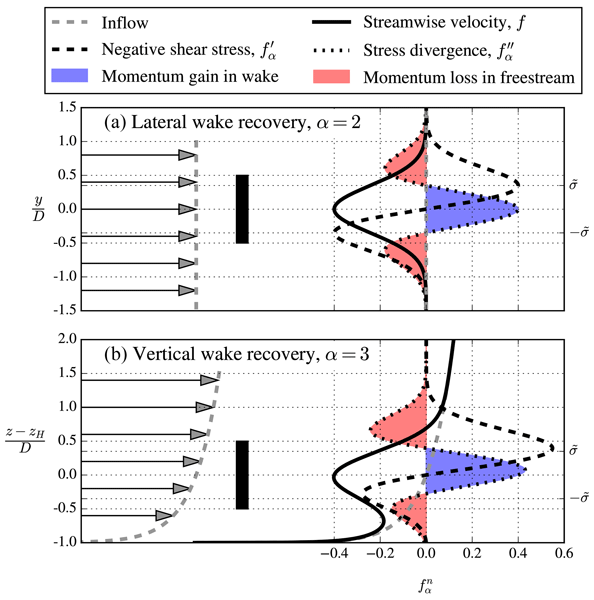
Understanding wind turbine wake recovery is important to mitigate energy losses in wind farms. Wake recovery is often assumed or explained to be dependent on the first-order derivative of velocity. In this work we show that wind turbine wakes recover mainly due to the second-order derivative of the velocity, which transport momentum from the freestream towards the wake center. The wake recovery mechanisms and results of a high-fidelity numerical simulation are illustrated using a simple model.
Mads Baungaard, Stefan Wallin, Maarten Paul van der Laan, and Mark Kelly
Wind Energ. Sci., 7, 1975–2002, https://doi.org/10.5194/wes-7-1975-2022, https://doi.org/10.5194/wes-7-1975-2022, 2022
Short summary
Short summary
Wind turbine wakes in the neutral atmospheric surface layer are simulated with Reynolds-averaged Navier–Stokes (RANS) using an explicit algebraic Reynolds stress model. Contrary to standard two-equation turbulence models, it can predict turbulence anisotropy and complex physical phenomena like secondary motions. For the cases considered, it improves Reynolds stress, turbulence intensity, and velocity deficit predictions, although a more top-hat-shaped profile is observed for the latter.
Mads Baungaard, Maarten Paul van der Laan, and Mark Kelly
Wind Energ. Sci., 7, 783–800, https://doi.org/10.5194/wes-7-783-2022, https://doi.org/10.5194/wes-7-783-2022, 2022
Short summary
Short summary
Wind turbine wakes are dependent on the atmospheric conditions, and it is therefore important to be able to simulate in various different atmospheric conditions. This paper concerns the specific case of an unstable atmospheric surface layer, which is the lower part of the typical daytime atmospheric boundary layer. A simple flow model is suggested and tested for a range of single-wake scenarios, and it shows promising results for velocity deficit predictions.
Mark Kelly, Søren Juhl Andersen, and Ásta Hannesdóttir
Wind Energ. Sci., 6, 1227–1245, https://doi.org/10.5194/wes-6-1227-2021, https://doi.org/10.5194/wes-6-1227-2021, 2021
Short summary
Short summary
Via 11 years of measurements, we made a representative ensemble of wind ramps in terms of acceleration, mean speed, and shear. Constrained turbulence and large-eddy simulations were coupled to an aeroelastic model for each ensemble member. Ramp acceleration was found to dominate the maxima of thrust-associated loads, with a ramp-induced increase of 45 %–50 % plus ~ 3 % per 0.1 m/s2 of bulk ramp acceleration magnitude. The LES indicates that the ramps (and such loads) persist through the farm.
Maarten Paul van der Laan, Mark Kelly, and Mads Baungaard
Wind Energ. Sci., 6, 777–790, https://doi.org/10.5194/wes-6-777-2021, https://doi.org/10.5194/wes-6-777-2021, 2021
Short summary
Short summary
Wind farms operate in the atmospheric boundary layer, and their performance is strongly dependent on the atmospheric conditions. We propose a simple model of the atmospheric boundary layer that can be used as an inflow model for wind farm simulations for isolating a number of atmospheric effects – namely, the change in wind direction with height and atmospheric boundary layer depth. In addition, the simple model is shown to be consistent with two similarity theories.
Maarten Paul van der Laan, Mark Kelly, Mads Baungaard, Antariksh Dicholkar, and Emily Louise Hodgson
Wind Energ. Sci., 9, 1985–2000, https://doi.org/10.5194/wes-9-1985-2024, https://doi.org/10.5194/wes-9-1985-2024, 2024
Short summary
Short summary
Wind turbines are increasing in size and operate more frequently above the atmospheric surface layer, which requires improved inflow models for numerical simulations of turbine interaction. In this work, a novel steady-state model of the atmospheric boundary layer (ABL) is introduced. Numerical wind turbine flow simulations subjected to shallow and tall ABLs are conducted, and the proposed model shows improved performance compared to other state-of-the-art steady-state models.
Mark Kelly and Maarten Paul van der Laan
Wind Energ. Sci., 8, 975–998, https://doi.org/10.5194/wes-8-975-2023, https://doi.org/10.5194/wes-8-975-2023, 2023
Short summary
Short summary
The turning of the wind with height, which is known as veer, can affect wind turbine performance. Thus far meteorology has only given idealized descriptions of veer, which has not yet been related in a way readily usable for wind energy. Here we derive equations for veer in terms of meteorological quantities and provide practically usable forms in terms of measurable shear (change in wind speed with height). Flow simulations and measurements at turbine heights support these developments.
Maarten Paul van der Laan, Oscar García-Santiago, Mark Kelly, Alexander Meyer Forsting, Camille Dubreuil-Boisclair, Knut Sponheim Seim, Marc Imberger, Alfredo Peña, Niels Nørmark Sørensen, and Pierre-Elouan Réthoré
Wind Energ. Sci., 8, 819–848, https://doi.org/10.5194/wes-8-819-2023, https://doi.org/10.5194/wes-8-819-2023, 2023
Short summary
Short summary
Offshore wind farms are more commonly installed in wind farm clusters, where wind farm interaction can lead to energy losses. In this work, an efficient numerical method is presented that can be used to estimate these energy losses. The novel method is verified with higher-fidelity numerical models and validated with measurements of an existing wind farm cluster.
Maarten Paul van der Laan, Mads Baungaard, and Mark Kelly
Wind Energ. Sci., 8, 247–254, https://doi.org/10.5194/wes-8-247-2023, https://doi.org/10.5194/wes-8-247-2023, 2023
Short summary
Short summary
Understanding wind turbine wake recovery is important to mitigate energy losses in wind farms. Wake recovery is often assumed or explained to be dependent on the first-order derivative of velocity. In this work we show that wind turbine wakes recover mainly due to the second-order derivative of the velocity, which transport momentum from the freestream towards the wake center. The wake recovery mechanisms and results of a high-fidelity numerical simulation are illustrated using a simple model.
Mads Baungaard, Stefan Wallin, Maarten Paul van der Laan, and Mark Kelly
Wind Energ. Sci., 7, 1975–2002, https://doi.org/10.5194/wes-7-1975-2022, https://doi.org/10.5194/wes-7-1975-2022, 2022
Short summary
Short summary
Wind turbine wakes in the neutral atmospheric surface layer are simulated with Reynolds-averaged Navier–Stokes (RANS) using an explicit algebraic Reynolds stress model. Contrary to standard two-equation turbulence models, it can predict turbulence anisotropy and complex physical phenomena like secondary motions. For the cases considered, it improves Reynolds stress, turbulence intensity, and velocity deficit predictions, although a more top-hat-shaped profile is observed for the latter.
Mads Baungaard, Maarten Paul van der Laan, and Mark Kelly
Wind Energ. Sci., 7, 783–800, https://doi.org/10.5194/wes-7-783-2022, https://doi.org/10.5194/wes-7-783-2022, 2022
Short summary
Short summary
Wind turbine wakes are dependent on the atmospheric conditions, and it is therefore important to be able to simulate in various different atmospheric conditions. This paper concerns the specific case of an unstable atmospheric surface layer, which is the lower part of the typical daytime atmospheric boundary layer. A simple flow model is suggested and tested for a range of single-wake scenarios, and it shows promising results for velocity deficit predictions.
Mark Kelly, Søren Juhl Andersen, and Ásta Hannesdóttir
Wind Energ. Sci., 6, 1227–1245, https://doi.org/10.5194/wes-6-1227-2021, https://doi.org/10.5194/wes-6-1227-2021, 2021
Short summary
Short summary
Via 11 years of measurements, we made a representative ensemble of wind ramps in terms of acceleration, mean speed, and shear. Constrained turbulence and large-eddy simulations were coupled to an aeroelastic model for each ensemble member. Ramp acceleration was found to dominate the maxima of thrust-associated loads, with a ramp-induced increase of 45 %–50 % plus ~ 3 % per 0.1 m/s2 of bulk ramp acceleration magnitude. The LES indicates that the ramps (and such loads) persist through the farm.
Maarten Paul van der Laan, Mark Kelly, and Mads Baungaard
Wind Energ. Sci., 6, 777–790, https://doi.org/10.5194/wes-6-777-2021, https://doi.org/10.5194/wes-6-777-2021, 2021
Short summary
Short summary
Wind farms operate in the atmospheric boundary layer, and their performance is strongly dependent on the atmospheric conditions. We propose a simple model of the atmospheric boundary layer that can be used as an inflow model for wind farm simulations for isolating a number of atmospheric effects – namely, the change in wind direction with height and atmospheric boundary layer depth. In addition, the simple model is shown to be consistent with two similarity theories.
Cited articles
Abramowitz, M. and Stegun, I. A.: Handbook of Mathematical Functions with Formulas, Graphs, and Mathematical Tables, 9th edn., Dover, New York, ISBN 0-486-61272-4, 1972.
Agee, E. M.: Meso-scale cellular convection over the oceans, Dyn. Atmos. Oceans, 10, 317–341, 1987.
Alcayaga, L. A.: From gusts to turbulence; vertical structure, Master of Science Thesis, DTU/Oldenburg, DTU Wind Energy report M-0176, 2017.
Beljaars, A. C. M.: The influence of sampling and filtering on measured wind gusts, J. Atmos. Ocean. Tech., 4, 613–626, https://doi.org/10.1175/1520-0426(1987)004<0613:TIOSAF>2.0.CO;2, 1987.
Chen, J., Hui, M. C. H., and Xu, Y. L.: A comparative study of stationary and non-stationary wind models using field measurements, Bound.-Lay. Meteorol., 122, 105–121, https://doi.org/10.1007/s10546-006-9085-1, 2007.
Cook, N. J.: Automated classification of gust events in the contiguous USA, J. Wind Eng. Ind. Aerodyn. 234, 105330, https://doi.org/10.1016/j.jweia.2023.105330, 2023.
Davis, F. K. and Newstein, H.: The Variation of Gust Factors with Mean Wind Speed and with Height, J. Appl. Meteorol., 7, 372–378, https://doi.org/10.1175/1520-0450(1968)007<0372:TVOGFW>2.0.CO;2, 1968.
Dimitrov, N., Natarajan, A., and Mann, J.: Effects of normal and extreme turbulence spectral parameters on wind turbine loads, Renew. Energ., 101, 1180–1193, https://doi.org/10.1016/j.renene.2016.10.001, 2017.
Dimitrov, N., Kelly, M. C., Vignaroli, A., and Berg, J.: From wind to loads: wind turbine site-specific load estimation with surrogate models trained on high-fidelity load databases, Wind Energ. Sci., 3, 767–790, https://doi.org/10.5194/wes-3-767-2018, 2018.
Einaudi, F. and Finnigan, J. J.: Wave-turbulence dynamics in the stably stratified boundary-layer, J. Atmos. Sci., 50, 1841–1864, 1993.
Engineering Sciences Data Unit (ESDU): ESDU 87035, Calculation methods for along-wind loading. Part 2. Response of line-like structures to atmospheric turbulence, Denver, USA, 57 pp,, ISBN 9780856796289, 2012.
Finnigan, J. J., Einaudi, F., and Fua, D.: The interaction between an internal gravity-wave and turbulence in the stably-stratified nocturnal boundary-layer, J. Atmos. Sci., 41, 2409–2436, 1984.
Forristall, G. Z.: Wind spectra and gust factors over water, Proc. 20th Annual Offshore Tech. Conf., Houston, Texas, 2–5 May 1988, OTC 5735, 449–460, 1987.
Frandsen, S. T.: Turbulence and turbulence-generated structural loading in wind turbine clusters, Report No. 1188, Risø National Laboratory, Denmark, 130 pp., ISBN 87-550-3458-6, 2007.
Hahmann, A. N., García-Santiago, O., and Peña, A.: Current and future wind energy resources in the North Sea according to CMIP6, Wind Energ. Sci., 7, 2373–2391, https://doi.org/10.5194/wes-7-2373-2022, 2022.
Hannesdóttir, Á. and Kelly, M.: Detection and characterization of extreme wind speed ramps, Wind Energ. Sci., 4, 385–396, https://doi.org/10.5194/wes-4-385-2019, 2019.
Hannesdóttir, Á., Kelly, M., and Dimitrov, N. K.: Extreme variance vs. turbulence: What can the IEC cover?, Wind Energy Denmark (poster session), 2 October 2017, Herning, Denmark, https://orbit.dtu.dk/en/publications/abd3e22f-549c-4336-a512-c2fa46a0e64a (last access: 25 February 2025), 2017.
Hannesdóttir, Á., Kelly, M., and Dimitrov, N.: Extreme wind fluctuations: joint statistics, extreme turbulence, and impact on wind turbine loads, Wind Energ. Sci., 4, 325–342, https://doi.org/10.5194/wes-4-325-2019, 2019.
Hannesdóttir, Á., Verelst, D. R., and Urbán, A. M.: Extreme coherent gusts with direction change – probabilistic model, yaw control, and wind turbine loads, Wind Energ. Sci., 8, 231–245, https://doi.org/10.5194/wes-8-231-2023, 2023.
Hansen, K. S. and Larsen, G. C.: Full scale experimental analysis of extreme coherent gust with wind direction changes (ECD), J. Phys. Conf. Ser., 75, 012055, https://doi.org/10.1088/1742-6596/75/1/012055, 2007.
International Electrotechnical Commission (IEC): IEC 61400-1, Wind turbines – Part 1: Design requirements, 4th edn., International Electrotechnical Commission, Geneva, Switzerland, ISBN 978-2-8322-6253-5, 2019.
International Electrotechnical Commission (IEC): IEC 61400-12-1, Wind energy generation systems – Part 12-1: Power performance measurements of electricity producing wind turbines, 3rd edn., International Electrotechnical Commission, Geneva, Switzerland, ISBN 978-2-8322-5621-3, 2022a.
International Electrotechnical Commission (IEC): IEC 61400-12-2, Wind energy generation systems – Part 12-2: Power performance of electricity producing wind turbines based on nacelle anemometry, 2nd edn., International Electrotechnical Commission, Geneva, Switzerland, ISBN 978-2-8322-5594-0, 2022b.
International Electrotechnical Commission (IEC): IEC 61400-50-1, Wind energy generation systems – Part 50-1: Wind measurement – Application of meteorological mast, nacelle and spinner mounted instruments, International Electrotechnical Commission, Geneva, Switzerland, ISBN 978-2-8322-5937-5, 2022c.
Kelly, M.: From standard wind measurements to spectral characterization: turbulence length scale and distribution, Wind Energ. Sci., 3, 533–543, https://doi.org/10.5194/wes-3-533-2018, 2018.
Kelly, M., Troen, I., and Jørgensen, H. E.: Weibull-k Revisited: “Tall” Profiles and Height Variation of Wind Statistics, Bound.-Lay. Meteorol., 152, 107–124, https://doi.org/10.1007/s10546-014-9915-5, 2014.
Kelly, M., Cersosimo, R. A., and Berg, J.: A universal wind profile for the inversion-capped neutral atmospheric boundary layer, Q. J. Roy. Meteor. Soc., 145, 982–992, https://doi.org/10.1002/qj.3472, 2019.
Kelly, M., Andersen, S. J., and Hannesdóttir, Á.: Statistical impact of wind-speed ramp events on turbines, via observations and coupled fluid-dynamic and aeroelastic simulations, Wind Energ. Sci., 6, 1227–1245, https://doi.org/10.5194/wes-6-1227-2021, 2021.
Kristensen, L.: Cup Anemometer Behavior in Turbulent Environments, J. Atmos. Ocean. Tech., 15, 5–17, https://doi.org/10.1175/1520-0426(1998)015<0005:CABITE>2.0.CO;2, 1998.
Kristensen, L.: Measuring Higher-Order Moments with a Cup Anemometer, J. Atmos. Ocean. Tech., 17, 1139–1148, https://doi.org/10.1175/1520-0426(2000)017<1139:MHOMWA>2.0.CO;2, 2000.
Larsen, G. C. and Hansen, K. S.: Rational Calibration of Four IEC 61400-1 Extreme External Conditions, Wind Energy, 11, 685–702, https://doi.org/10.1002/we.302, 2008.
Larsen, G. C. and Hansen, K. S.: De-trending of wind speed variance based on first-order and second-order statistical moments only, Wind Energy, 17, 1905–1920, https://doi.org/10.1002/we.1676, 2014.
Liu, S. and Liang, X.-Z.: Observed Diurnal Cycle Climatology of Planetary Boundary Layer Height, J. Climate, 23, 5790–5809, https://doi.org/10.1175/2010JCLI3552.1, 2010.
Mann, J.: The spatial structure of neutral atmospheric surface-layer turbulence, J. Fluid Mech., 273, 141–168, https://doi.org/10.1017/S0022112094001886, 1994.
McWilliam, M., Kelly, M., and Dimitrov, N. K.: Reference data and simulations for wind turbine loads due to extreme wind acceleration events, Technical University of Denmark [data set], https://doi.org/10.11583/DTU.22067816.v1, 2023a.
McWilliam, M., Kelly, M., and Dimitrov, N. K.: Comparison of wind turbine extreme loads due to extreme filtered acceleration events and the IEC 61400-1 standard, Wind Energ. Sci. Conf., 25 May 2023, Glasgow, UK, paper 499, 2023b.
Moriarty, P. J., Holley, W. E., and Butterfield, S.: Extrapolation of Extreme and Fatigue Loads Using Probabilistic Methods, NREL report TP-500-34421, Golden, CO, USA, 2004.
Nielsen, J. S., Toft, H. S., and Violato, G. O.: Risk-Based Assessment of the Reliability Level for Extreme Limit States in IEC 61400-1, Energies, 16, 1885, https://doi.org/10.3390/en16041885, 2023.
Nielsen, M., Larsen, G. C., Mann, J., Ott, S., Hansen, K. S., and Pedersen, B. J.: Wind simulation for extreme and fatigue loads, Risø tech. rep., Risø-R-1437(EN), 104 pp., ISBN 87-550-3281-8, 2004.
Otte, M. J. and Wyngaard, J. C.: Stably Stratified Interfacial-Layer Turbulence from Large-Eddy Simulation, J. Atmos. Sci., 58, 3424–3442, https://doi.org/10.1175/1520-0469(2001)058<3424:SSILTF>2.0.CO;2, 2001.
Pedersen, J. G., Gryning, S.-E., and Kelly, M.: On the Structure and Adjustment of Inversion-Capped Neutral Atmospheric Boundary-Layer Flows: Large-Eddy Simulation Study, Bound.-Lay. Meteorol., 153, 43–62, https://doi.org/10.1007/s10546-014-9937-z, 2014.
Peña, A., Floors, R., Sathe, A., Gryning, S.-E., Wagner, R., Courtney, M. S., Larsén, X. G., Hahmann, A. H., and Hasager, C. B.: Ten Years of Boundary-Layer and Wind-Power Meteorology at Høvsøre, Denmark, Bound.-Lay. Meteorol., 158, 1–26, https://doi.org/10.1007/s10546-015-0079-8, 2016.
Ratnam, M. V. and Basha, S. G.: A robust method to determine global distribution of atmospheric boundary layer top from COSMIC GPS RO measurements, Atmos. Sci. Lett., 11, 216–222, https://doi.org/10.1002/asl.277, 2010.
Shu, Z. R., Chan, P. W., Li, Q. S., He, Y. C., Yan, B. W., Li, L., Lu, C., Zhang, L., and Yang, H. L.: Assessing Wind Gust Characteristics at Wind Turbine Relevant Height, J. Renew. Sustain. Energy, 13, 063308, https://doi.org/10.1063/5.0053077, 2021.
Sullivan, P. P., Moeng, C.-H., Stevens, B., Lenschow, D. H., and Mayor, S. D.: Structure of the entrainment zone capping the convective atmospheric boundary layer, J. Atmos. Sci., 55, 3042–3064, https://doi.org/10.1175/1520-0469(1998)055<3042:SOTEZC>2.0.CO;2, 1998.
Suomi, I, Gryning, S.-E., Floors, R., Vihma, T., and Fortelius, C.: On the vertical structure of wind gusts, J. Roy. Met. Soc., 141, 1658–1670, https://doi.org/10.1002/qj.2468, 2015.
Syed, A. H. and Mann, J.: A Model for Low-Frequency, Anisotropic Wind Fluctuations and Coherences in the Marine Atmosphere, Bound.-Lay. Meteorol., 190, 1, https://doi.org/10.1007/s10546-023-00850-w, 2024.
van Eijk, S. F., Bos, R., and Bierbooms, W. A. A. M.: The risks of extreme load extrapolation, Wind Energ. Sci., 2, 377–386, https://doi.org/10.5194/wes-2-377-2017, 2017.
Vincent, C. L., Hahmann, A. N., and Kelly, M.: Idealized Mesoscale Model Simulations of Open Cellular Convection Over the Sea, Bound.-Lay. Meteorol., 142, 103–121, https://doi.org/10.1007/s10546-011-9664-7, 2012.
Yahaya, S. and Frangi, J. P.: Cup anemometer response to the wind turbulence-measurement of the horizontal wind variance, Ann. Geophys., 22, 3363–3374, https://doi.org/10.5194/angeo-22-3363-2004, 2004.
Yamartino, R. J.: A comparison of several “single-pass” estimators of the standard deviation of wind direction, J. Clim. Appl. Meteorol. 23, 1362–1366, https://doi.org/10.1175/1520-0450(1984)023<1362:ACOSPE>2.0.CO;2, 1984.
Zhang, X., Kelly, M., Dimitrov, N. K., Sønderkær Nielsen, J., Abeendranath, A. K., and Dalsgaard Sørensen, J.: ProbWind D10: Pre-standard for Probabilistic Design and Background Document, project report, Aalborg University, https://vbn.aau.dk/en/publications/probwind-d10-pre-standard-for-probabilistic-design-and-background (last access: 1 March 2025), 2023.
Short summary
Industrial standards for wind turbine design are based on 10 min statistics of wind speed at turbine hub height, treating fluctuations as turbulence. But recent work shows that the effect of strong transients is described by flow acceleration. We devise a method to measure the acceleration that turbines encounter; the extremes offshore defy 10 min averages due to various phenomena beyond turbulence. These findings are translated into a recipe supporting statistical design.
Industrial standards for wind turbine design are based on 10 min statistics of wind speed at...
Altmetrics
Final-revised paper
Preprint