
Articles | Volume 11, issue 1
https://doi.org/10.5194/wes-11-195-2026
© Author(s) 2026. This work is distributed under
the Creative Commons Attribution 4.0 License.
the Creative Commons Attribution 4.0 License.
https://doi.org/10.5194/wes-11-195-2026
© Author(s) 2026. This work is distributed under
the Creative Commons Attribution 4.0 License.
the Creative Commons Attribution 4.0 License.
Research article
| 
16 Jan 2026
Research article |
| 16 Jan 2026
| 16 Jan 2026
Concurrent aerodynamic design of the wing and the turbines of airborne wind energy systems
Filippo Trevisi
CORRESPONDING AUTHOR

Department of Electronics, Information and Bioengineering, Politecnico di Milano, Via Ponzio, 34, 20133 Milano, Italy
Gianni Cassoni
Department of Aeronautical Technologies Engineering, Roma Tre University, Via della Vasca Navale, 79, 00146 Rome, Italy
Department of Aerospace Science and Technology, Politecnico di Milano, Via La Masa, 34, 20156 Milano, Italy
Mac Gaunaa
DTU Wind Energy, Frederiksborgvej 399, 4000 Roskilde, Denmark
Lorenzo Mario Fagiano
Department of Electronics, Information and Bioengineering, Politecnico di Milano, Via Ponzio, 34, 20133 Milano, Italy
Related authors
Filippo Trevisi, Carlo E. D. Riboldi, and Alessandro Croce
Wind Energ. Sci., 8, 1639–1650, https://doi.org/10.5194/wes-8-1639-2023, https://doi.org/10.5194/wes-8-1639-2023, 2023
Short summary
Short summary
The power equations of crosswind Ground-Gen and Fly-Gen airborne wind energy systems (AWESs) are refined to include the contribution from the aerodynamic wake. A novel power coefficient is defined by normalizing the aerodynamic power with the wind power passing through a disk with a radius equal to the AWES wingspan, allowing us to compare systems with different wingspans. Ground-Gen and Fly-Gen AWESs are compared in terms of their aerodynamic power potential.
Filippo Trevisi, Carlo E. D. Riboldi, and Alessandro Croce
Wind Energ. Sci., 8, 999–1016, https://doi.org/10.5194/wes-8-999-2023, https://doi.org/10.5194/wes-8-999-2023, 2023
Short summary
Short summary
Modeling the aerodynamic wake of airborne wind energy systems (AWESs) is crucial to properly estimating power production and to designing such systems. The velocities induced at the AWES from its own wake are studied with a model for the near wake and one for the far wake, using vortex methods. The model is validated with the lifting-line free-vortex wake method implemented in QBlade.

Filippo Trevisi, Iván Castro-Fernández, Gregorio Pasquinelli, Carlo Emanuele Dionigi Riboldi, and Alessandro Croce
Wind Energ. Sci., 7, 2039–2058, https://doi.org/10.5194/wes-7-2039-2022, https://doi.org/10.5194/wes-7-2039-2022, 2022
Short summary
Short summary
The optimal control problem for the flight trajectories of Fly-Gen AWESs is expressed with a novel methodology in the frequency domain through a harmonic balance formulation. The solution gives the optimal trajectory and the optimal control inputs. Optimal trajectories have a circular shape squashed along the vertical direction, and the optimal control inputs can be modeled with only one or two harmonics. Analytical approximations for optimal trajectory characteristics are also given.
Ang Li, Mac Gaunaa, and Georg Raimund Pirrung
Wind Energ. Sci. Discuss., https://doi.org/10.5194/wes-2026-168, https://doi.org/10.5194/wes-2026-168, 2026
Preprint under review for WES
Short summary
Short summary
Wind turbine simulations need to predict how blade forces change under unsteady conditions in attached flow. We developed an implementation-ready method that combines the required aerodynamic effects in one consistent framework and tested it on two rotor cases. The results show that omitting some effects can noticeably change predicted power and loads, while the complete model avoids unphysical predictions. The work supports more reliable wind turbine aerodynamic and aeroelastic simulations.
Clemens Paul Zengler, Mac Gaunaa, and Niels Troldborg
Wind Energ. Sci., 11, 2601–2619, https://doi.org/10.5194/wes-11-2601-2026, https://doi.org/10.5194/wes-11-2601-2026, 2026
Short summary
Short summary
When wind turbines operate in conditions which they were not designed for, e.g., complex terrain, they might show unexpected performance variations. Complex-terrain flow physics, such as streamwise flow acceleration, alter maximum performance. It is asked whether this also affects steady-state turbine control. We show that rotor-torque-based control strategies can lead to suboptimal control in these conditions, but the effect of the background flow on performance is larger.
Ang Li, Mac Gaunaa, and Georg Raimund Pirrung
Wind Energ. Sci. Discuss., https://doi.org/10.5194/wes-2026-85, https://doi.org/10.5194/wes-2026-85, 2026
Preprint under review for WES
Short summary
Short summary
To design larger and more flexible wind turbine blades, engineers need fast tools to predict how curved shapes and deflections affect performance and loads. We developed a new method that models key blade shape effects in one practical approach. By testing it against advanced computational fluid dynamics simulations, we found that it predicts loads well for general curved blades. This can support more accurate and efficient blade design.
Jelle Agatho Wilhelm Poland, Johannes Marinus van Spronsen, Mac Gaunaa, and Roland Schmehl
Wind Energ. Sci., 11, 911–936, https://doi.org/10.5194/wes-11-911-2026, https://doi.org/10.5194/wes-11-911-2026, 2026
Short summary
Short summary
We tested a small model of an energy-generating kite in a wind tunnel to study its aerodynamic behaviour. By comparing measurements to computer simulations, we validated the models and identified where they match the real performance and where they fall short. These insights will guide more accurate aerodynamic modelling and inform design choices for kites used in airborne wind energy systems.
Nanako Sasanuma, Akihiro Honda, Christian Bak, Niels Troldborg, Mac Gaunaa, Morten Nielsen, and Teruhisa Shimada
Wind Energ. Sci., 11, 265–284, https://doi.org/10.5194/wes-11-265-2026, https://doi.org/10.5194/wes-11-265-2026, 2026
Short summary
Short summary
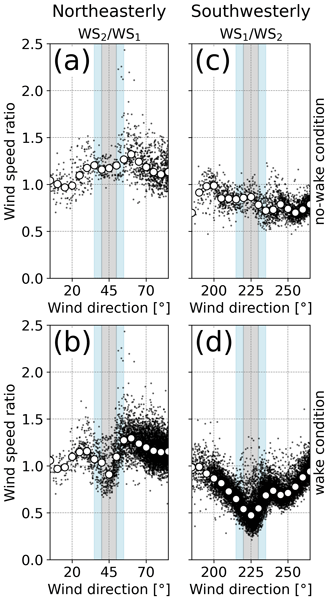
We verify wake effects between two wind turbines in complex terrain using supervisory control and data acquisition data. By identifying “wake conditions” and “no-wake conditions” detected by the blade pitch angle of upstream wind turbines, we evaluate wake effects on wind speed ratio, turbulent intensity, and power output. Results show that flow downhill has a significant impact on wake effects compared to flow uphill. The method shows the potential of SCADA data during the downtime of wind turbines.
Ang Li, Mac Gaunaa, and Georg Raimund Pirrung
Wind Energ. Sci., 10, 2515–2550, https://doi.org/10.5194/wes-10-2515-2025, https://doi.org/10.5194/wes-10-2515-2025, 2025
Short summary
Short summary
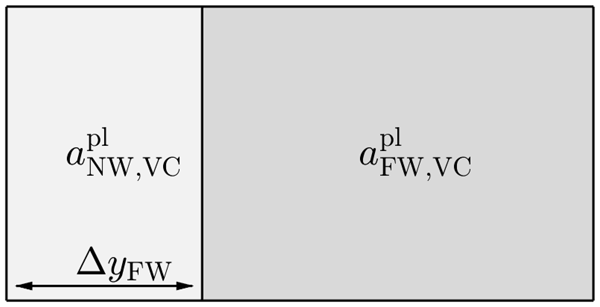
Wind turbines with swept blades have the potential to improve power production and reduce loads, but their actual benefits are uncertain, and they are difficult to analyse. We developed a simplified yet accurate aerodynamic model, coupling two engineering models, to predict their performance. Tests against high-fidelity simulations show that the method offers reliable results with low computational effort, making it ideal for load calculations and design optimization of swept blades.
Ang Li, Mac Gaunaa, Georg Raimund Pirrung, and Kenneth Lønbæk
Wind Energ. Sci., 10, 2299–2349, https://doi.org/10.5194/wes-10-2299-2025, https://doi.org/10.5194/wes-10-2299-2025, 2025
Short summary
Short summary
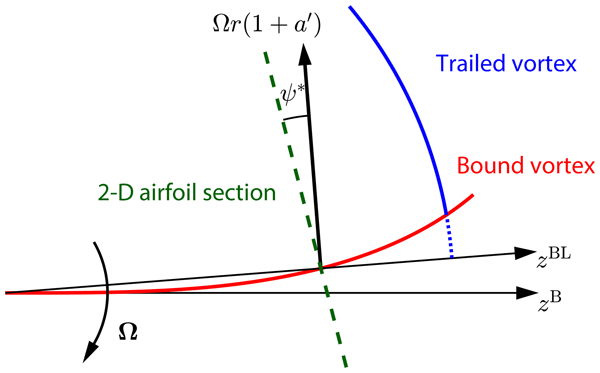
This study improves the analysis of curved wind turbine blades, such as those with sweep or prebend. Existing methods often blend different effects on blade performance, making design optimization challenging. We developed a framework that disentangles these effects, providing clearer insights. Our findings show that the aerodynamic influences of sweep and prebend can be modeled separately and combined, simplifying modeling processes and supporting more efficient blade design.
Clemens Paul Zengler, Niels Troldborg, and Mac Gaunaa
Wind Energ. Sci., 10, 1485–1497, https://doi.org/10.5194/wes-10-1485-2025, https://doi.org/10.5194/wes-10-1485-2025, 2025
Short summary
Short summary
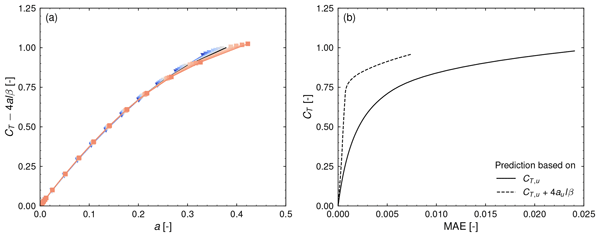
Wind turbine power performance is mostly calculated based on the wind speed measured at the turbine position. The presented results imply that it is necessary to also assess how the undisturbed wind speed changes in the flow direction to accurately predict the power performance. In other words, the acceleration of the flow is relevant for the energy production. An outcome of this work is a simple model that can be used to include flow acceleration in power performance predictions.
Filippo Trevisi, Carlo E. D. Riboldi, and Alessandro Croce
Wind Energ. Sci., 8, 1639–1650, https://doi.org/10.5194/wes-8-1639-2023, https://doi.org/10.5194/wes-8-1639-2023, 2023
Short summary
Short summary
The power equations of crosswind Ground-Gen and Fly-Gen airborne wind energy systems (AWESs) are refined to include the contribution from the aerodynamic wake. A novel power coefficient is defined by normalizing the aerodynamic power with the wind power passing through a disk with a radius equal to the AWES wingspan, allowing us to compare systems with different wingspans. Ground-Gen and Fly-Gen AWESs are compared in terms of their aerodynamic power potential.
Filippo Trevisi, Carlo E. D. Riboldi, and Alessandro Croce
Wind Energ. Sci., 8, 999–1016, https://doi.org/10.5194/wes-8-999-2023, https://doi.org/10.5194/wes-8-999-2023, 2023
Short summary
Short summary
Modeling the aerodynamic wake of airborne wind energy systems (AWESs) is crucial to properly estimating power production and to designing such systems. The velocities induced at the AWES from its own wake are studied with a model for the near wake and one for the far wake, using vortex methods. The model is validated with the lifting-line free-vortex wake method implemented in QBlade.

Mac Gaunaa, Niels Troldborg, and Emmanuel Branlard
Wind Energ. Sci., 8, 503–513, https://doi.org/10.5194/wes-8-503-2023, https://doi.org/10.5194/wes-8-503-2023, 2023
Short summary
Short summary
We present an analytical vortex model. Despite its simplicity, the model is fully consistent with 1D momentum theory. It shows that the flow through a non-uniformly loaded rotor operating in non-uniform inflow behaves locally as predicted by 1D momentum theory. As a consequence, the local power coefficient (based on local inflow) of an ideal rotor is unaltered by the presence of shear. Finally, the model shows that there is no cross-shear deflection of the wake of a rotor in sheared inflow.
Filippo Trevisi, Iván Castro-Fernández, Gregorio Pasquinelli, Carlo Emanuele Dionigi Riboldi, and Alessandro Croce
Wind Energ. Sci., 7, 2039–2058, https://doi.org/10.5194/wes-7-2039-2022, https://doi.org/10.5194/wes-7-2039-2022, 2022
Short summary
Short summary
The optimal control problem for the flight trajectories of Fly-Gen AWESs is expressed with a novel methodology in the frequency domain through a harmonic balance formulation. The solution gives the optimal trajectory and the optimal control inputs. Optimal trajectories have a circular shape squashed along the vertical direction, and the optimal control inputs can be modeled with only one or two harmonics. Analytical approximations for optimal trajectory characteristics are also given.
Ang Li, Mac Gaunaa, Georg Raimund Pirrung, Alexander Meyer Forsting, and Sergio González Horcas
Wind Energ. Sci., 7, 1341–1365, https://doi.org/10.5194/wes-7-1341-2022, https://doi.org/10.5194/wes-7-1341-2022, 2022
Short summary
Short summary
A consistent method of using two-dimensional airfoil data when using generalized lifting-line methods for the aerodynamic load calculation of non-planar horizontal-axis wind turbines is described. The important conclusions from the unsteady two-dimensional airfoil aerodynamics are highlighted. The impact of using a simplified approach instead of using the full model on the prediction of the aerodynamic performance of non-planar rotors is shown numerically for different aerodynamic models.
Ang Li, Georg Raimund Pirrung, Mac Gaunaa, Helge Aagaard Madsen, and Sergio González Horcas
Wind Energ. Sci., 7, 129–160, https://doi.org/10.5194/wes-7-129-2022, https://doi.org/10.5194/wes-7-129-2022, 2022
Short summary
Short summary
An engineering aerodynamic model for the swept horizontal-axis wind turbine blades is proposed. It uses a combination of analytical results and engineering approximations. The performance of the model is comparable with heavier high-fidelity models but has similarly low computational cost as currently used low-fidelity models. The model could be used for an efficient and accurate load calculation of swept wind turbine blades and could eventually be integrated in a design optimization framework.

Ang Li, Mac Gaunaa, Georg Raimund Pirrung, and Sergio González Horcas
Wind Energ. Sci., 7, 75–104, https://doi.org/10.5194/wes-7-75-2022, https://doi.org/10.5194/wes-7-75-2022, 2022
Short summary
Short summary
An engineering aerodynamic model for non-planar horizontal-axis wind turbines is proposed. The performance of the model is comparable with high-fidelity models but has similarly low computational cost as currently used low-fidelity models, which do not have the capability to model non-planar rotors. The developed model could be used for an efficient and accurate load calculation of non-planar wind turbines and eventually be integrated in a design optimization framework.
Cited articles
Alborghetti, M., Trevisi, F., Boffadossi, R., and Fagiano, L.: Optimal Power Smoothing of Airborne Wind Energy Systems via Pseudo-Spectral Methods and Multi-objective Analysis, in: 2025 European Control Conference (ECC), 2446–2451, https://doi.org/10.23919/ECC65951.2025.11187024, 2025. a
Branlard, E.: Wind Turbine Aerodynamics and Vorticity-Based Methods, Springer Cham, ISBN 978-3-319-55163-0, https://doi.org/10.1007/978-3-319-55164-7, 2017. a
Branlard, E. and Gaunaa, M.: Cylindrical vortex wake model: right cylinder, Wind Energy, 18, 1973–1987, https://doi.org/10.1002/we.1800, 2015. a
Branlard, E. and Gaunaa, M.: Superposition of vortex cylinders for steady and unsteady simulation of rotors of finite tip-speed ratio, Wind Energy, 19, 1307–1323, https://doi.org/10.1002/we.1899, 2016. a
Chirico, G., Barakos, G. N., and Bown, N.: Numerical aeroacoustic analysis of propeller designs, The Aeronautical Journal, 122, 283–315, https://doi.org/10.1017/aer.2017.123, 2018. a, b
Cottet, G.-H. and Koumoutsakos, P.: Vortex methods – theory and practice, ISBN 978-0-521-62186-1, https://doi.org/10.1017/CBO9780511526442, 2000. a
Damiani, R., Wendt, F. F., Jonkman, J. M., and Sicard, J.: A Vortex Step Method for Nonlinear Airfoil Polar Data as Implemented in KiteAeroDyn, in: AIAA Scitech 2019 Forum, https://doi.org/10.2514/6.2019-0804, 2019. a, b
De Fezza, G. and Barber, S.: Parameter analysis of a multi-element airfoil for application to airborne wind energy, Wind Energ. Sci., 7, 1627–1640, https://doi.org/10.5194/wes-7-1627-2022, 2022. a, b
Diehl, M.: Airborne Wind Energy: Basic Concepts and Physical Foundations, in: Airborne Wind Energy, edited by: Ahrens, U., Diehl, M., and Schmehl, R., 3–22, Springer Berlin Heidelberg, Berlin, Heidelberg, ISBN 978-3-642-39965-7, https://doi.org/10.1007/978-3-642-39965-7_1, 2013. a
Echeverri, P., Fricke, T., Homsy, G., and Tucker, N.: The Energy Kite. Selected Results From the Design, Development and Testing of Makani's Airborne Wind Turbines. Part II., Tech. rep., Makani Technologies LLC, https://x.company/projects/makani/ (last access: 4 December 2025), 2020b. a
Fagiano, L. and Schnez, S.: On the take-off of airborne wind energy systems based on rigid wings, Renewable Energy, 107, 473–488, https://doi.org/10.1016/j.renene.2017.02.023, 2017. a
Fagiano, L., Quack, M., Bauer, F., Carnel, L., and Oland, E.: Autonomous Airborne Wind Energy Systems: Accomplishments and Challenges, Annual Review of Control, Robotics, and Autonomous Systems, 5, 603–631, https://doi.org/10.1146/annurev-control-042820-124658, 2022. a
Fasel, U., Keidel, D., Molinari, G., and Ermanni, P.: Aerostructural optimization of a morphing wing for airborne wind energy applications, Smart Materials and Structures, 26, 095043, https://doi.org/10.1088/1361-665X/aa7c87, 2017. a, b
Frirdich, A.: Rotor Design Procedure for a Drag Power Kite, Master's thesis, Technische Universität München, https://cdn.prod.website-files.com/60a7e7bc31a1214a325709bc/6446c7aadf11605410de910f_MT_Frirdich.pdf (last access: 4 December 2025), 2019. a
Gallay, S. and Laurendeau, E.: Nonlinear Generalized Lifting-Line Coupling Algorithms for Pre/Poststall Flows, AIAA Journal, 53, 1784–1792, https://doi.org/10.2514/1.J053530, 2015. a
Gaunaa, M., Forsting, A. M., and Trevisi, F.: An engineering model for the induction of crosswind kite power systems, Journal of Physics: Conference Series, 1618, 032010, https://doi.org/10.1088/1742-6596/1618/3/032010, 2020. a
Katz, J. and Plotkin, A.: Low-Speed Aerodynamics, Cambridge Aerospace Series, Cambridge University Press, 2 edn., https://doi.org/10.1017/CBO9780511810329, 2001. a
Kitekraft GmbH: Building Flying Wind Turbines, https://www.kitekraft.de/ (last access: 18 June 2025), 2025. a
Li, A., Gaunaa, M., Pirrung, G. R., Meyer Forsting, A., and Horcas, S. G.: How should the lift and drag forces be calculated from 2-D airfoil data for dihedral or coned wind turbine blades?, Wind Energ. Sci., 7, 1341–1365, https://doi.org/10.5194/wes-7-1341-2022, 2022. a
Makani Technologies LLC: Makani. Harnessing wind energy with kites to create renewable electricity, https://x.company/projects/makani/ (last access: 18 June, 2025), 2025. a
Manwell, J. F., McGowan, J. G., and Rogers, A. L.: Wind Energy Explained: Theory, Design and Application, John Wiley & Sons, Ltd, ISBN 9781119994367, https://doi.org/10.1002/9781119994367, 2009. a
Mehr, J., Alvarez, E. J., and Ning, A.: Interactional Aerodynamics Analysis of a Multirotor Energy Kite, Wind Energy, e2957, https://doi.org/10.1002/we.2957, 2024. a, b
Miranda, L. and Brennan, J.: Aerodynamic effects of wingtip-mounted propellers and turbines, 4th Applied Aerodynamics Conference, https://doi.org/10.2514/6.1986-1802, 1986. a, b
Niro, C., Savino, A., Cocco, A., and Zanotti, A.: Mid-fidelity numerical approach for the investigation of wing-propeller aerodynamic interaction, Aerospace Science and Technology, 146, 108950, https://doi.org/10.1016/j.ast.2024.108950, 2024. a, b, c
Patterson, J. J. and Bartlett, G.: Effect of a wing-tip mounted pusher turboprop on the aerodynamic characteristics of a semi-span wing, AIAA, https://doi.org/10.2514/6.1985-1286, 1985. a
Porta Ko, A., Smidt, S., Schmehl, R., and Mandru, M.: Optimisation of a Multi-Element Airfoil for a Fixed-Wing Airborne Wind Energy System, Energies, 16, https://doi.org/10.3390/en16083521, 2023. a, b
Prandtl, L.: Induced drag of multiplanes, Tech. rep., NACA-TN-182, https://ntrs.nasa.gov/citations/19930080964 (last access 4 December 2025), 1924. a
Rangriz, S. and Kheiri, M.: Design of Optimal Airfoils for Crosswind Kite Power Systems, AIAA Journal, 1–11, https://doi.org/10.2514/1.J065382, 2025. a, b
Sinnige, T., Stokkermans, T., van Arnhem, N., and Veldhuis, L. L.: Aerodynamic Performance of a Wingtip-Mounted Tractor Propeller Configuration in Windmilling and Energy-Harvesting Conditions, AIAA, https://doi.org/10.2514/6.2019-3033, 2019a. a
Sinnige, T., van Arnhem, N., Stokkermans, T. C. A., Eitelberg, G., and Veldhuis, L. L. M.: Wingtip-Mounted Propellers: Aerodynamic Analysis of Interaction Effects and Comparison with Conventional Layout, Journal of Aircraft, 56, 295–312, https://doi.org/10.2514/1.C034978, 2019b. a
Snyder, M. H. and Zumwalt, G. W.: Effects of wingtip-mounted propellers on wing lift and induced drag, Journal of Aircraft, 6, 392–397, https://doi.org/10.2514/3.44076, 1969. a
Sommerfeld, M., Dörenkämper, M., De Schutter, J., and Crawford, C.: Scaling effects of fixed-wing ground-generation airborne wind energy systems, Wind Energ. Sci., 7, 1847–1868, https://doi.org/10.5194/wes-7-1847-2022, 2022. a
Trevisi, F.: Code and data for the final publication of “Concurrent aerodynamic design of the wing and the turbines of AWESs” (Version v0), Zenodo [code, data set], https://doi.org/10.5281/zenodo.18200346, 2026. a, b
Trevisi, F., Gaunaa, M., and Mcwilliam, M.: The Influence of Tether Sag on Airborne Wind Energy Generation, Journal of Physics: Conference Series, 1618, https://doi.org/10.1088/1742-6596/1618/3/032006, 2020. a, b
Trevisi, F., Gaunaa, M., and Mcwilliam, M.: Configuration optimization and global sensitivity analysis of Ground-Gen and Fly-Gen Airborne Wind Energy Systems, Renewable Energy, 178, 385–402, https://doi.org/10.1016/j.renene.2021.06.011, 2021. a, b
Trevisi, F., Riboldi, C. E. D., and Croce, A.: Refining the airborne wind energy system power equations with a vortex wake model, Wind Energ. Sci., 8, 1639–1650, https://doi.org/10.5194/wes-8-1639-2023, 2023a. a, b
Trevisi, F., Sabug, L. J., and Fagiano, L.: A Gaussian wake model for Airborne Wind Energy Systems, Journal of Physics: Conference Series, 3016, 012038, https://doi.org/10.1088/1742-6596/3016/1/012038, 2025. a
Tucker, N.: Airborne Wind Turbine Performance: Key Lessons From More Than a Decade of Flying Kites, in: The Energy Kite Part I., edited by: Echeverri, P., Fricke, T., Homsy, G., and Tucker, N., 93–224, Makani Technologies LLC, https://x.company/projects/makani/# (last access: 4 December 2025), 2020. a
Tugnoli, M., Montagnani, D., Syal, M., Droandi, G., and Zanotti, A.: Mid-fidelity approach to aerodynamic simulations of unconventional VTOL aircraft configurations, Aerospace Science and Technology, 115, 106804, https://doi.org/10.1016/j.ast.2021.106804, 2021. a
Vander Lind, D.: Analysis and Flight Test Validation of High Performance AirborneWind Turbines, in: Airborne Wind Energy, edited by: Ahrens, U., Diehl, M., and Schmehl, R., 473–490, Springer Berlin Heidelberg, Berlin, Heidelberg, ISBN 978-3-642-39965-7, https://doi.org/10.1007/978-3-642-39965-7_28, 2013. a
Veldhuis, L.: Review of propeller-wing aerodynamic interference, ICAS 2004-6.3.1, in: 24th International Congress of the Aeronautical Sciences, Yokohama, Japan, https://www.icas.org/icas_archive/ICAS2004/ABSTRACTS/065.HTM (last access: 4 December 2025), 2004. a
Vermillion, C., Cobb, M., Fagiano, L., Leuthold, R., Diehl, M., Smith, R. S., Wood, T. A., Rapp, S., Schmehl, R., Olinger, D., and Demetriou, M.: Electricity in the air: Insights from two decades of advanced control research and experimental flight testing of airborne wind energy systems, Annual Reviews in Control, 52, 330–357, https://doi.org/10.1016/j.arcontrol.2021.03.002, 2021. a
Weissinger, J.: The Lift Distribution of Swept-Back Wings, Tech. rep., National Advisory Commitee for Aeronautics, Langley Aeronautical Lab, NACA Technical Memorandum 1120, https://ntrs.nasa.gov/citations/20030064148 (last access: 4 December 2025), 1947. a
WindLift: The Future of Energy is Airborne, https://windlift.com/ (last access: 18 June, 2025), 2025. a
Short summary
This paper investigates the optimal aerodynamic design of the wing and the onboard turbines of the fly-gen airborne wind energy system aircraft, named wind plane here, with a novel comprehensive engineering aerodynamic model and with the vortex particle method. Placing the turbines at the wing tips, rotating them inboard downward with a low tip speed ratio, and using conventional efficient airfoils for the wing are found to be optimal for wind planes.
This paper investigates the optimal aerodynamic design of the wing and the onboard turbines of...


Altmetrics
Final-revised paper
Preprint