
Articles | Volume 11, issue 7
https://doi.org/10.5194/wes-11-2601-2026
© Author(s) 2026. This work is distributed under
the Creative Commons Attribution 4.0 License.
the Creative Commons Attribution 4.0 License.
https://doi.org/10.5194/wes-11-2601-2026
© Author(s) 2026. This work is distributed under
the Creative Commons Attribution 4.0 License.
the Creative Commons Attribution 4.0 License.
Research article
| 
23 Jul 2026
Research article |
| 23 Jul 2026
| 23 Jul 2026
Aerodynamic analysis of standard variable-speed torque control in complex terrain

Department of Wind and Energy Systems, Technical University of Denmark, Frederiksborgvej 399, 4000 Roskilde, Denmark
Mac Gaunaa
Department of Wind and Energy Systems, Technical University of Denmark, Frederiksborgvej 399, 4000 Roskilde, Denmark
Niels Troldborg
Department of Wind and Energy Systems, Technical University of Denmark, Frederiksborgvej 399, 4000 Roskilde, Denmark
Related authors
Clemens Paul Zengler, Niels Troldborg, and Mac Gaunaa
Wind Energ. Sci., 10, 1485–1497, https://doi.org/10.5194/wes-10-1485-2025, https://doi.org/10.5194/wes-10-1485-2025, 2025
Short summary
Short summary
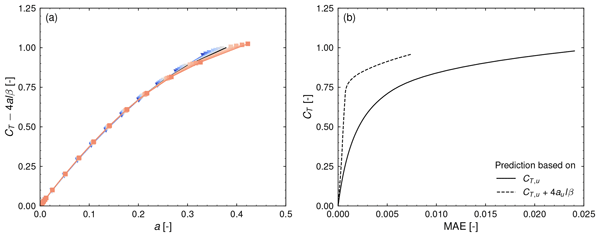
Wind turbine power performance is mostly calculated based on the wind speed measured at the turbine position. The presented results imply that it is necessary to also assess how the undisturbed wind speed changes in the flow direction to accurately predict the power performance. In other words, the acceleration of the flow is relevant for the energy production. An outcome of this work is a simple model that can be used to include flow acceleration in power performance predictions.
Ang Li, Mac Gaunaa, and Georg Raimund Pirrung
Wind Energ. Sci. Discuss., https://doi.org/10.5194/wes-2026-85, https://doi.org/10.5194/wes-2026-85, 2026
Preprint under review for WES
Short summary
Short summary
To design larger and more flexible wind turbine blades, engineers need fast tools to predict how curved shapes and deflections affect performance and loads. We developed a new method that models key blade shape effects in one practical approach. By testing it against advanced computational fluid dynamics simulations, we found that it predicts loads well for general curved blades. This can support more accurate and efficient blade design.
Stefan Ivanell, Warit Chanprasert, Luca Lanzilao, James Bleeg, Johan Meyers, Antoine Mathieu, Søren Juhl Andersen, Rem-Sophia Mouradi, Eric Dupont, Hugo Olivares-Espinosa, and Niels Troldborg
Wind Energ. Sci., 11, 937–960, https://doi.org/10.5194/wes-11-937-2026, https://doi.org/10.5194/wes-11-937-2026, 2026
Short summary
Short summary
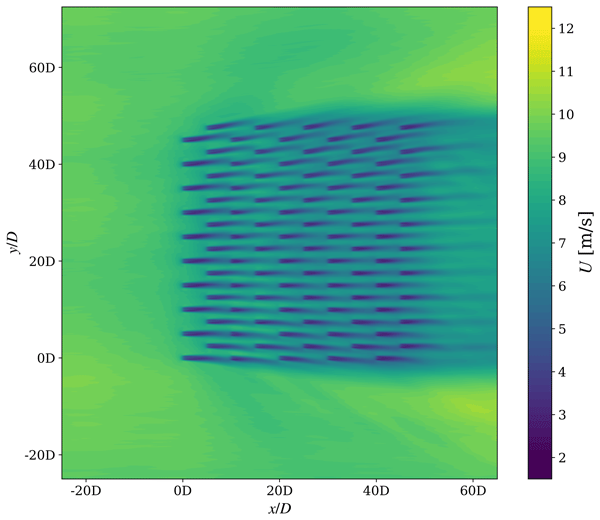
This study explores how the height of the atmosphere's boundary layer impacts wind farm performance, focusing on how this factor influences energy output. By simulating different boundary layer heights and conditions, this research reveals that deeper layers promote better energy recovery. The findings highlight the importance of considering atmospheric conditions when simulating wind farms to maximize energy efficiency, offering valuable insights for the wind energy industry.
Jelle Agatho Wilhelm Poland, Johannes Marinus van Spronsen, Mac Gaunaa, and Roland Schmehl
Wind Energ. Sci., 11, 911–936, https://doi.org/10.5194/wes-11-911-2026, https://doi.org/10.5194/wes-11-911-2026, 2026
Short summary
Short summary
We tested a small model of an energy-generating kite in a wind tunnel to study its aerodynamic behaviour. By comparing measurements to computer simulations, we validated the models and identified where they match the real performance and where they fall short. These insights will guide more accurate aerodynamic modelling and inform design choices for kites used in airborne wind energy systems.
Nanako Sasanuma, Akihiro Honda, Christian Bak, Niels Troldborg, Mac Gaunaa, Morten Nielsen, and Teruhisa Shimada
Wind Energ. Sci., 11, 265–284, https://doi.org/10.5194/wes-11-265-2026, https://doi.org/10.5194/wes-11-265-2026, 2026
Short summary
Short summary
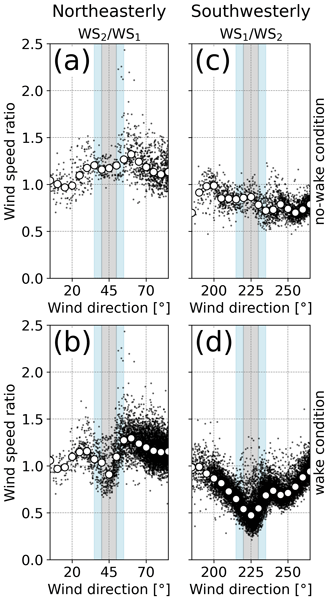
We verify wake effects between two wind turbines in complex terrain using supervisory control and data acquisition data. By identifying “wake conditions” and “no-wake conditions” detected by the blade pitch angle of upstream wind turbines, we evaluate wake effects on wind speed ratio, turbulent intensity, and power output. Results show that flow downhill has a significant impact on wake effects compared to flow uphill. The method shows the potential of SCADA data during the downtime of wind turbines.
Filippo Trevisi, Gianni Cassoni, Mac Gaunaa, and Lorenzo Mario Fagiano
Wind Energ. Sci., 11, 195–216, https://doi.org/10.5194/wes-11-195-2026, https://doi.org/10.5194/wes-11-195-2026, 2026
Short summary
Short summary
This paper investigates the optimal aerodynamic design of the wing and the onboard turbines of the fly-gen airborne wind energy system aircraft, named wind plane here, with a novel comprehensive engineering aerodynamic model and with the vortex particle method. Placing the turbines at the wing tips, rotating them inboard downward with a low tip speed ratio, and using conventional efficient airfoils for the wing are found to be optimal for wind planes.
Ang Li, Mac Gaunaa, and Georg Raimund Pirrung
Wind Energ. Sci., 10, 2515–2550, https://doi.org/10.5194/wes-10-2515-2025, https://doi.org/10.5194/wes-10-2515-2025, 2025
Short summary
Short summary
Wind turbines with swept blades have the potential to improve power production and reduce loads, but their actual benefits are uncertain, and they are difficult to analyse. We developed a simplified yet accurate aerodynamic model, coupling two engineering models, to predict their performance. Tests against high-fidelity simulations show that the method offers reliable results with low computational effort, making it ideal for load calculations and design optimization of swept blades.
Ang Li, Mac Gaunaa, Georg Raimund Pirrung, and Kenneth Lønbæk
Wind Energ. Sci., 10, 2299–2349, https://doi.org/10.5194/wes-10-2299-2025, https://doi.org/10.5194/wes-10-2299-2025, 2025
Short summary
Short summary
This study improves the analysis of curved wind turbine blades, such as those with sweep or prebend. Existing methods often blend different effects on blade performance, making design optimization challenging. We developed a framework that disentangles these effects, providing clearer insights. Our findings show that the aerodynamic influences of sweep and prebend can be modeled separately and combined, simplifying modeling processes and supporting more efficient blade design.
Clemens Paul Zengler, Niels Troldborg, and Mac Gaunaa
Wind Energ. Sci., 10, 1485–1497, https://doi.org/10.5194/wes-10-1485-2025, https://doi.org/10.5194/wes-10-1485-2025, 2025
Short summary
Short summary
Wind turbine power performance is mostly calculated based on the wind speed measured at the turbine position. The presented results imply that it is necessary to also assess how the undisturbed wind speed changes in the flow direction to accurately predict the power performance. In other words, the acceleration of the flow is relevant for the energy production. An outcome of this work is a simple model that can be used to include flow acceleration in power performance predictions.

Mac Gaunaa, Niels Troldborg, and Emmanuel Branlard
Wind Energ. Sci., 8, 503–513, https://doi.org/10.5194/wes-8-503-2023, https://doi.org/10.5194/wes-8-503-2023, 2023
Short summary
Short summary
We present an analytical vortex model. Despite its simplicity, the model is fully consistent with 1D momentum theory. It shows that the flow through a non-uniformly loaded rotor operating in non-uniform inflow behaves locally as predicted by 1D momentum theory. As a consequence, the local power coefficient (based on local inflow) of an ideal rotor is unaltered by the presence of shear. Finally, the model shows that there is no cross-shear deflection of the wake of a rotor in sheared inflow.
Niels Troldborg, Søren J. Andersen, Emily L. Hodgson, and Alexander Meyer Forsting
Wind Energ. Sci., 7, 1527–1532, https://doi.org/10.5194/wes-7-1527-2022, https://doi.org/10.5194/wes-7-1527-2022, 2022
Short summary
Short summary
This article shows that the power performance of a wind turbine may be very different in flat and complex terrain. This is an important finding because it shows that the power output of a given wind turbine is governed by not only the available wind at the position of the turbine but also how the ambient flow develops in the region behind the turbine.
Ang Li, Mac Gaunaa, Georg Raimund Pirrung, Alexander Meyer Forsting, and Sergio González Horcas
Wind Energ. Sci., 7, 1341–1365, https://doi.org/10.5194/wes-7-1341-2022, https://doi.org/10.5194/wes-7-1341-2022, 2022
Short summary
Short summary
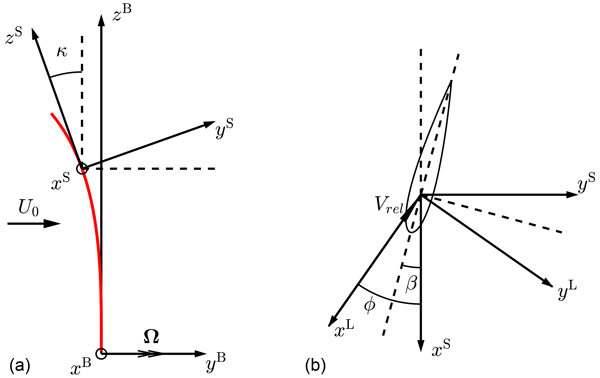
A consistent method of using two-dimensional airfoil data when using generalized lifting-line methods for the aerodynamic load calculation of non-planar horizontal-axis wind turbines is described. The important conclusions from the unsteady two-dimensional airfoil aerodynamics are highlighted. The impact of using a simplified approach instead of using the full model on the prediction of the aerodynamic performance of non-planar rotors is shown numerically for different aerodynamic models.
Alessandro Sebastiani, Alfredo Peña, Niels Troldborg, and Alexander Meyer Forsting
Wind Energ. Sci., 7, 875–886, https://doi.org/10.5194/wes-7-875-2022, https://doi.org/10.5194/wes-7-875-2022, 2022
Short summary
Short summary
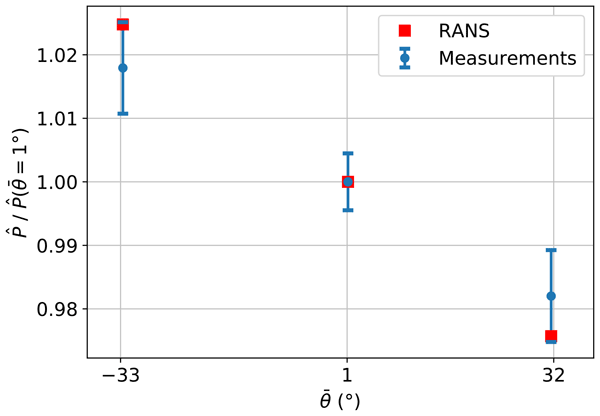
The power performance of a wind turbine is often tested with the turbine standing in a row of several wind turbines, as it is assumed that the performance is not affected by the neighbouring turbines. We test this assumption with both simulations and measurements, and we show that the power performance can be either enhanced or lowered by the neighbouring wind turbines. Consequently, we also show how power performance testing might be biased when performed on a row of several wind turbines.
Ang Li, Georg Raimund Pirrung, Mac Gaunaa, Helge Aagaard Madsen, and Sergio González Horcas
Wind Energ. Sci., 7, 129–160, https://doi.org/10.5194/wes-7-129-2022, https://doi.org/10.5194/wes-7-129-2022, 2022
Short summary
Short summary
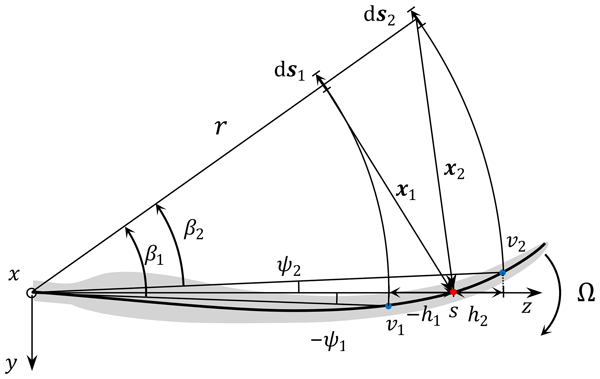
An engineering aerodynamic model for the swept horizontal-axis wind turbine blades is proposed. It uses a combination of analytical results and engineering approximations. The performance of the model is comparable with heavier high-fidelity models but has similarly low computational cost as currently used low-fidelity models. The model could be used for an efficient and accurate load calculation of swept wind turbine blades and could eventually be integrated in a design optimization framework.

Ang Li, Mac Gaunaa, Georg Raimund Pirrung, and Sergio González Horcas
Wind Energ. Sci., 7, 75–104, https://doi.org/10.5194/wes-7-75-2022, https://doi.org/10.5194/wes-7-75-2022, 2022
Short summary
Short summary
An engineering aerodynamic model for non-planar horizontal-axis wind turbines is proposed. The performance of the model is comparable with high-fidelity models but has similarly low computational cost as currently used low-fidelity models, which do not have the capability to model non-planar rotors. The developed model could be used for an efficient and accurate load calculation of non-planar wind turbines and eventually be integrated in a design optimization framework.
Thanasis Barlas, Georg Raimund Pirrung, Néstor Ramos-García, Sergio González Horcas, Robert Flemming Mikkelsen, Anders Smærup Olsen, and Mac Gaunaa
Wind Energ. Sci., 6, 1311–1324, https://doi.org/10.5194/wes-6-1311-2021, https://doi.org/10.5194/wes-6-1311-2021, 2021
Short summary
Short summary
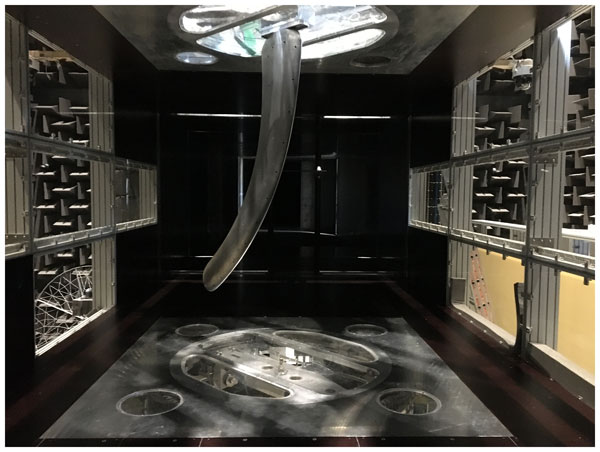
Curved blade tips can potentially have a significant impact on wind turbine performance and loads. A swept tip shape optimized for wind turbine applications is tested in a wind tunnel. A range of numerical aerodynamic simulation tools with various levels of fidelity are compared. We show that all numerical tools except for the simplest blade element momentum based are in good agreement with the measurements, suggesting the required level of model fidelity necessary for the design of such tips.
Cited articles
Abbas, N. J., Zalkind, D. S., Pao, L., and Wright, A.: A reference open-source controller for fixed and floating offshore wind turbines, Wind Energ. Sci., 7, 53–73, https://doi.org/10.5194/wes-7-53-2022, 2022. a, b, c, d
Bak, C., Zahle, F., Bitsche, R., KIm, T., Yde, A., Henriksen, L. C., Natarajan, A., and Hansen, M. H.: Description of the DTU 10 MW Reference Wind Turbine, Tech. Rep. DTU Wind Energy Report-I-0092, DTU Wind Energy, Roskilde, Denmark, https://gitlab.windenergy.dtu.dk/rwts/dtu-10mw-rwt/-/blob/3e1d7a82db7633807f72156b3232b773ac55dee7/docs/DTU_Wind_Energy_Report-I-0092.pdf (last access: 2 July 2026), 2013. a, b, c, d, e, f
Bianchi, F. D., Mantz, R. J., and Battista, H. D. (Eds.): Wind Turbine Control Systems: Principles, Modelling and Gain Scheduling Design, Advances in Industrial Control, Springer London, London, https://doi.org/10.1007/1-84628-493-7, 2007. a
Bossanyi, E. A.: The Design of closed loop controllers for wind turbines, Wind Energy, 3, 149–163, https://doi.org/10.1002/we.34, 2000. a, b
Cai, T., Cheng, S., Segalini, A., and Chamorro, L. P.: Local topography‐induced pressure gradient effects on the wake and power output of a model wind turbine, Theoretical and Applied Mechanics Letters, 11, 100297, https://doi.org/10.1016/j.taml.2021.100297, 2021. a
Calaf, M., Meneveau, C., and Meyers, J.: Large eddy simulation study of fully developed wind-turbine array boundary layers, Phys. Fluids, 22, 015110, https://doi.org/10.1063/1.3291077, 2010. a
Creaby, J., Li, Y., and Seem, J. E.: Maximizing Wind Turbine Energy Capture Using Multivariable Extremum Seeking Control, Wind Engineering, 33, 361–387, https://doi.org/10.1260/030952409789685753, 2009. a
Crespo, A., Hernández, J., and Frandsen, S.: Survey of Modelling Methods for Wind Turbine Wakes and Wind Farms, Wind Energy, 2, 1–24, https://doi.org/10.1002/(SICI)1099-1824(199901/03)2:1<1::AID-WE16>3.0.CO;2-7, 1999. a
Dar, A. S. and Porté-Agel, F.: An Analytical Model for Wind Turbine Wakes under Pressure Gradient, Energies, 2022, 5345, https://doi.org/10.3390/en15155345, 2022. a
Dar, A. S., Gertler, A. S., and Porté-Agel, F.: An experimental and analytical study of wind turbine wakes under pressure gradient, Physics of Fluids, 35, 045 140, https://doi.org/10.1063/5.0145043, 2023. a, b
Dar, A. S., Revaz, T., and Porté-Agel, F.: A model for the effect of pressure gradient on the induction and power of wind turbines, Phys. Fluids, 37, 085128, https://doi.org/10.1063/5.0277577, 2025. a, b
Dar, A. S., Revaz, T., and Porté-Agel, F.: Theoretical efficiency of a wind turbine in non-uniform base flow: Revisiting the Betz–Joukowsky limit, Phys. Fluids, 38, 041702, https://doi.org/10.1063/5.0300485, 2026. a
Elliot, D. L. and Cadogan, J. B.: Effects of Wind Shear and Turbulence on Wind Turbine Power Curves, in: European Community Wind Energy Conference. Proceedings of an International Conference (eur 13251), edited by: Palz, W. and Stephens, H. S., Madrid, Spain, 79–83, ISBN 978-0-9510271-8-9, 1990. a
Hansen, M. H. and Henriksen, L. C.: Basic DTU Wind Energy controller, Tech. Rep. E-0028, DTU Wind Energy, Roskilde, Denmark, ISBN 978-87-92896-27-8, 2013. a
Hansen, M. O. L.: Aerodynamics of wind turbines, Routledge, London, New York, 3 Edn., https://doi.org/10.4324/9781315769981, 2015. a
Hodgson, E. L., Andersen, S. J., Troldborg, N., Forsting, A. M., Mikkelsen, R. F., and Sørensen, J. N.: A Quantitative Comparison of Aeroelastic Computations using Flex5 and Actuator Methods in LES, J. Phys. Conf. Ser., 1934, 012014, https://doi.org/10.1088/1742-6596/1934/1/012014, 2021. a
Johnson, K. E., Pao, L. Y., Balas, M. J., and Fingerish, L. J.: Control of variable-speed wind turbines: standard and adaptive techniques for maximizing energy capture, IEEE Control Systems, 26, 70–81, https://doi.org/10.1109/mcs.2006.1636311, 2006. a
Jonkman, B., Platt, A., Mudafort, R. M., Slaughter, D., Branlard, E., Wang, L., Ross, H., Sprague, M., HaymanConsulting, Davies, R., jjonkman, Chetan, M., cortadocodes, Hall, M., Vijayakumar, G., Buhl, M., reos rcrozier, Russell9798, Bergua, R., Bortolotti, P., Gupta, A., Ananthan, S., JustinPorter88, Rood, J., rdamiani, nrmendoza, Barter, G., Bhuiyan, F. H., sinolonghai, and Sakievich, P.: OpenFAST/openfast: Release v5.0.0, Zenodo [code], https://doi.org/10.5281/zenodo.18992186, 2026. a
Jonkman, J., Butterfield, S., Musial, W., and Scott, G.: Definition of a 5-MW Reference Wind Turbine for Offshore System Development, Tech. Rep. NREL/TP-500-38060, 947422, National Renewable Energy Laboratory, https://doi.org/10.2172/947422, 2009. a, b, c
Kolmogorov, D. K., Shen, W. Z., Sørensen, N. N., and Sørensen, J. N.: Fully Consistent SIMPLE-Like Algorithms on Collocated Grids, Numer. Heat TR B, 67, 101–123, https://doi.org/10.1080/10407790.2014.949583, 2015. a
Larsen, T. J. and Hansen, A. M.: How 2 HAWC2, the user's manual, Tech. Rep. Risø-R-1597, Department of Wind and Energy Systems, Roskilde, Denmark, ISBN 978-87-550-3583-6, 2025. a
Liew, J., Heck, K. S., and Howland, M. F.: Unified momentum model for rotor aerodynamics across operating regimes, Nat. Commun., 15, 6658, https://doi.org/10.1038/s41467-024-50756-5, 2024. a
Meyers, J. and Meneveau, C.: Large Eddy Simulations of Large Wind-Turbine Arrays in the Atmospheric Boundary Layer, in: 48th AIAA Aerospace Sciences Meeting Including the New Horizons Forum and Aerospace Exposition, American Institute of Aeronautics and Astronautics, Orlando, Florida, ISBN 978-1-60086-959-4, https://doi.org/10.2514/6.2010-827, 2010. a, b
Michelsen, J.: Basis3D – a Platform for Development of Multiblock PDE Solvers, Tech. rep., Technical University of Denmark, AFM 92-05, 1992. a
Michelsen, J.: Block structured multigrid solution of 2D and 3D elliptic PDE's, Tech. rep., Technical University of Denmark, AFM 94-06, 1994. a
Mikkelsen, R.: Actuator disc methods applied to wind turbines, PhD thesis, Technical University of Denmark, Lyngby, Denmark, ISBN 87-7475-296-0, 2004. a
Mishra, A., Arya, N., and Bhattacharya, A.: Wake steering of wind turbine in the presence of a two-dimensional hill, Phys. Fluids, 36, 045125, https://doi.org/10.1063/5.0185842, 2024. a, b
Øye, S.: Flex4 simulation of wind turbine dynamics, in: Proc. of 28th IEA Meeting of Experts Concerning State of the Art of Aeroelastic Codes for Wind Turbine Calculations, 71–76, IEA, Lyngby, Denmark, 1996. a
Pao, L. Y. and Johnson, K. E.: Control of Wind Turbines, IEEE Control Systems, 31, 44–62, https://doi.org/10.1109/mcs.2010.939962, 2011. a
Prospathopoulos, J. M., Cabezon, D., Politis, E. S., Chaviaropoulos, P. K., Rados, K. G., Schepers, J. G., Hansen, K., and Barthelmie, R. J.: Simulation of Wind Farms in Flat and Complex Terrain using CFD, in: Torque 2010: The science of making torque from wind, 359–370, https://orbit.dtu.dk/en/publications/simulation-of-wind-farms-in-flat-amp-complex-terrain-using-cfd/ (last access: 2 July 2026), 2010. a
Réthoré, P.-E., van der laan, M. P., Troldborg, N., Zahle, F., and Sørensen, N. N.: Verification and validation of an actuator disc model, Wind Energy, 17, 919–937, https://doi.org/10.1002/we.1607, 2014. a
Sørensen, N. N.: General purpose flow solver applied to flow over hills, PhD thesis, Risø National Laboratory, ISBN 87-550-2079-8, 1995. a
Sørensen, N. N., Bechmann, A., Johansen, J., Myllerup, L., Botha, P., Vinther, S., and Nielsen, B. S.: Identification of severe wind conditions using a Reynolds Averaged Navier-Stokes solver, J. Phys. Conf. Ser., 75, 012053, https://doi.org/10.1088/1742-6596/75/1/012053, 2007. a
Technical University of Denmark: Sophia HPC Cluster, Research Computing at DTU, https://doi.org/10.57940/fafc-6m81, 2019. a
Troen, I. and Petersen, E. L.: European wind atlas, Risø National Laboratory, Roskilde, Denmark, ISBN 87-550-1482-8, 1989. a
Troldborg, N., Sørensen, N., Réthoré, P.-E., and van der Laan, M. P.: A consistent method for finite volume discretization of body forces on collocated grids applied to flow through an actuator disk, Computers & Fluids, 119, 197–203, https://doi.org/10.1016/j.compfluid.2015.06.028, 2015. a
van der Laan, M. P., Sørensen, N. N., Réthoré, P.-E., Mann, J., Kelly, M. C., and Troldborg, N.: The k-ε-fp model applied to double wind turbine wakes using different actuator disk force methods, Wind Energy, 18, 2223–2240, https://doi.org/10.1002/we.1816, 2014. a
van der Laan, M. P., Sørensen, N. N., Réthoré, P.-E., Mann, J., Kelly, M. C., Troldborg, N., Hansen, K. S., and Murcia, J. P.: The
van der Laan, M. P., Sørensen, N. N., Réthoré, P.-E., Mann, J., Kelly, M. C., Troldborg, N., Schepers, J. G., and Machefaux, E.: An improved k-ε model applied to a wind turbine wake in atmospheric turbulence, Wind Energy, 18, 889–907, https://doi.org/10.1002/we.1736, 2015b. a
van der Laan, M. P., Andersen, S., Kelly, M., and Baungaard, M.: Fluid scaling laws of idealized wind farm simulations, J. Phys. Conf. Ser., 1618, 062018, https://doi.org/10.1088/1742-6596/1618/6/062018, 2020. a
Wagner, R., Courtney, M., Gottschall, J., and Lindelöw-Marsden, P.: Accounting for the speed shear in wind turbine power performance measurement, Wind Energy, 14, 993–1004, https://doi.org/10.1002/we.509, 2011. a
Wu, Y.-T. and Porté-Agel, F.: Modeling turbine wakes and power losses within a wind farm using LES: An application to the Horns Rev offshore wind farm, Renew. Energ., 75, 945–955, https://doi.org/10.1016/j.renene.2014.06.019, 2015. a
Zengler, C. P., Troldborg, N., and Gaunaa, M.: Predicting the impact of flow field acceleration on wind turbine performance in complex terrain and wind farms, J. Phys. Conf. Ser., 3016, 012003, https://doi.org/10.1088/1742-6596/3016/1/012003, 2025b. a, b, c, d
Short summary
When wind turbines operate in conditions which they were not designed for, e.g., complex terrain, they might show unexpected performance variations. Complex-terrain flow physics, such as streamwise flow acceleration, alter maximum performance. It is asked whether this also affects steady-state turbine control. We show that rotor-torque-based control strategies can lead to suboptimal control in these conditions, but the effect of the background flow on performance is larger.
When wind turbines operate in conditions which they were not designed for, e.g., complex...


Altmetrics
Final-revised paper
Preprint