
Articles | Volume 11, issue 1
https://doi.org/10.5194/wes-11-265-2026
© Author(s) 2026. This work is distributed under
the Creative Commons Attribution 4.0 License.
the Creative Commons Attribution 4.0 License.
https://doi.org/10.5194/wes-11-265-2026
© Author(s) 2026. This work is distributed under
the Creative Commons Attribution 4.0 License.
the Creative Commons Attribution 4.0 License.
Research article
| 
23 Jan 2026
Research article |
| 23 Jan 2026
| 23 Jan 2026
Bidirectional wakes over complex terrain using SCADA data and wake models
Nanako Sasanuma
CORRESPONDING AUTHOR

Graduate School of Science and Technology, Hirosaki University, Bunkyo–cho 3, Hirosaki, 036–8561, Japan
Akihiro Honda
Aomori Public University, Department of Management and Economics, Aomori, 030-0196, Japan
Christian Bak
DTU Wind and Energy Systems, Technical University of Denmark, Roskilde, 4000, Denmark
Niels Troldborg
DTU Wind and Energy Systems, Technical University of Denmark, Roskilde, 4000, Denmark
Mac Gaunaa
DTU Wind and Energy Systems, Technical University of Denmark, Roskilde, 4000, Denmark
Morten Nielsen
DTU Wind and Energy Systems, Technical University of Denmark, Roskilde, 4000, Denmark
Teruhisa Shimada
Graduate School of Science and Technology, Hirosaki University, Bunkyo–cho 3, Hirosaki, 036–8561, Japan
Related authors
No articles found.
Ang Li, Mac Gaunaa, and Georg Raimund Pirrung
Wind Energ. Sci. Discuss., https://doi.org/10.5194/wes-2026-168, https://doi.org/10.5194/wes-2026-168, 2026
Preprint under review for WES
Short summary
Short summary
Wind turbine simulations need to predict how blade forces change under unsteady conditions in attached flow. We developed an implementation-ready method that combines the required aerodynamic effects in one consistent framework and tested it on two rotor cases. The results show that omitting some effects can noticeably change predicted power and loads, while the complete model avoids unphysical predictions. The work supports more reliable wind turbine aerodynamic and aeroelastic simulations.
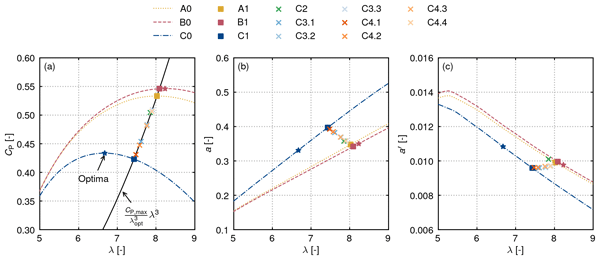
Clemens Paul Zengler, Mac Gaunaa, and Niels Troldborg
Wind Energ. Sci., 11, 2601–2619, https://doi.org/10.5194/wes-11-2601-2026, https://doi.org/10.5194/wes-11-2601-2026, 2026
Short summary
Short summary
When wind turbines operate in conditions which they were not designed for, e.g., complex terrain, they might show unexpected performance variations. Complex-terrain flow physics, such as streamwise flow acceleration, alter maximum performance. It is asked whether this also affects steady-state turbine control. We show that rotor-torque-based control strategies can lead to suboptimal control in these conditions, but the effect of the background flow on performance is larger.
Ang Li, Mac Gaunaa, and Georg Raimund Pirrung
Wind Energ. Sci. Discuss., https://doi.org/10.5194/wes-2026-85, https://doi.org/10.5194/wes-2026-85, 2026
Preprint under review for WES
Short summary
Short summary
To design larger and more flexible wind turbine blades, engineers need fast tools to predict how curved shapes and deflections affect performance and loads. We developed a new method that models key blade shape effects in one practical approach. By testing it against advanced computational fluid dynamics simulations, we found that it predicts loads well for general curved blades. This can support more accurate and efficient blade design.
Marinos Manolesos, Sandrine Aubrun, Christian Bak, Paolo Bettini, Filippo Campagnolo, Alessandro Croce, Arslan Salim Dar, Michael Hölling, Stefan Ivanell, Konstantinos Kellaris, Miguel Alfonso Mendez, Pierluigi Montinari, Franz Mühle, George Papadakis, Fernardo Porté-Agel, Daniele Ragni, Sebastiano Randino, Andrea Sciacchitano, Lorenzo Schena, Gerard Schepers, Antonio Segalini, Wei Yu, and Carlo Luigi Bottasso
Wind Energ. Sci. Discuss., https://doi.org/10.5194/wes-2026-51, https://doi.org/10.5194/wes-2026-51, 2026
Manuscript not accepted for further review
Short summary
Short summary
As wind turbines grow to unprecedented sizes, ensuring their reliability requires advanced testing. We reviewed the current state of wind tunnel experiments, examining how scaled physical models are evaluated for wind flow, flexibility, and noise. We conclude that while laboratory testing remains essential, it is most powerful when integrated with computer simulations and real-world data. This combined approach will ultimately drive the design of more efficient and sustainable wind energy.
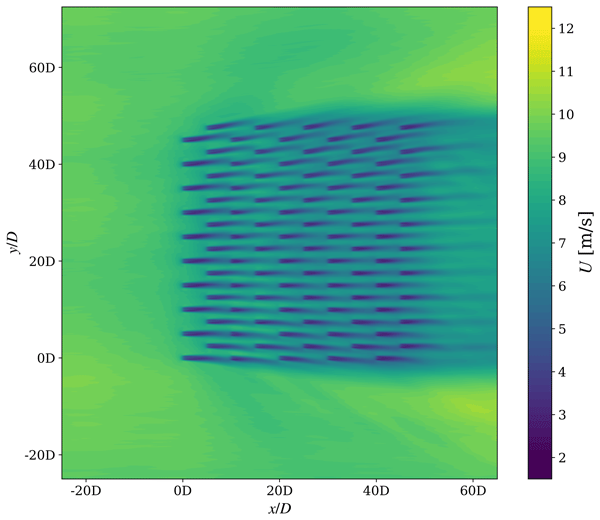
Stefan Ivanell, Warit Chanprasert, Luca Lanzilao, James Bleeg, Johan Meyers, Antoine Mathieu, Søren Juhl Andersen, Rem-Sophia Mouradi, Eric Dupont, Hugo Olivares-Espinosa, and Niels Troldborg
Wind Energ. Sci., 11, 937–960, https://doi.org/10.5194/wes-11-937-2026, https://doi.org/10.5194/wes-11-937-2026, 2026
Short summary
Short summary
This study explores how the height of the atmosphere's boundary layer impacts wind farm performance, focusing on how this factor influences energy output. By simulating different boundary layer heights and conditions, this research reveals that deeper layers promote better energy recovery. The findings highlight the importance of considering atmospheric conditions when simulating wind farms to maximize energy efficiency, offering valuable insights for the wind energy industry.
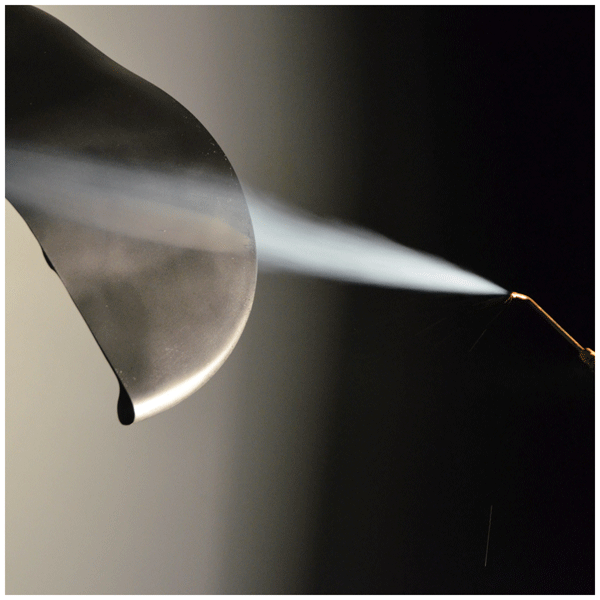
Jelle Agatho Wilhelm Poland, Johannes Marinus van Spronsen, Mac Gaunaa, and Roland Schmehl
Wind Energ. Sci., 11, 911–936, https://doi.org/10.5194/wes-11-911-2026, https://doi.org/10.5194/wes-11-911-2026, 2026
Short summary
Short summary
We tested a small model of an energy-generating kite in a wind tunnel to study its aerodynamic behaviour. By comparing measurements to computer simulations, we validated the models and identified where they match the real performance and where they fall short. These insights will guide more accurate aerodynamic modelling and inform design choices for kites used in airborne wind energy systems.
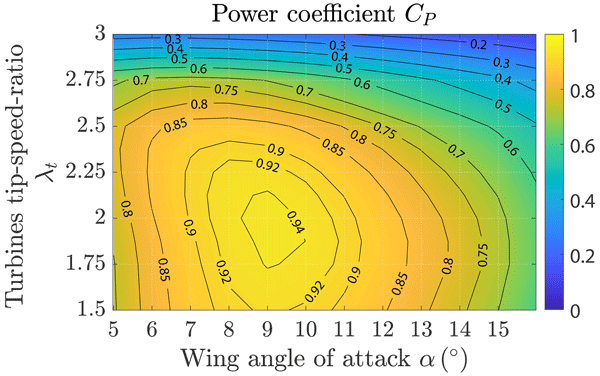
Filippo Trevisi, Gianni Cassoni, Mac Gaunaa, and Lorenzo Mario Fagiano
Wind Energ. Sci., 11, 195–216, https://doi.org/10.5194/wes-11-195-2026, https://doi.org/10.5194/wes-11-195-2026, 2026
Short summary
Short summary
This paper investigates the optimal aerodynamic design of the wing and the onboard turbines of the fly-gen airborne wind energy system aircraft, named wind plane here, with a novel comprehensive engineering aerodynamic model and with the vortex particle method. Placing the turbines at the wing tips, rotating them inboard downward with a low tip speed ratio, and using conventional efficient airfoils for the wing are found to be optimal for wind planes.
Ang Li, Mac Gaunaa, and Georg Raimund Pirrung
Wind Energ. Sci., 10, 2515–2550, https://doi.org/10.5194/wes-10-2515-2025, https://doi.org/10.5194/wes-10-2515-2025, 2025
Short summary
Short summary
Wind turbines with swept blades have the potential to improve power production and reduce loads, but their actual benefits are uncertain, and they are difficult to analyse. We developed a simplified yet accurate aerodynamic model, coupling two engineering models, to predict their performance. Tests against high-fidelity simulations show that the method offers reliable results with low computational effort, making it ideal for load calculations and design optimization of swept blades.
Ang Li, Mac Gaunaa, Georg Raimund Pirrung, and Kenneth Lønbæk
Wind Energ. Sci., 10, 2299–2349, https://doi.org/10.5194/wes-10-2299-2025, https://doi.org/10.5194/wes-10-2299-2025, 2025
Short summary
Short summary
This study improves the analysis of curved wind turbine blades, such as those with sweep or prebend. Existing methods often blend different effects on blade performance, making design optimization challenging. We developed a framework that disentangles these effects, providing clearer insights. Our findings show that the aerodynamic influences of sweep and prebend can be modeled separately and combined, simplifying modeling processes and supporting more efficient blade design.
Clemens Paul Zengler, Niels Troldborg, and Mac Gaunaa
Wind Energ. Sci., 10, 1485–1497, https://doi.org/10.5194/wes-10-1485-2025, https://doi.org/10.5194/wes-10-1485-2025, 2025
Short summary
Short summary
Wind turbine power performance is mostly calculated based on the wind speed measured at the turbine position. The presented results imply that it is necessary to also assess how the undisturbed wind speed changes in the flow direction to accurately predict the power performance. In other words, the acceleration of the flow is relevant for the energy production. An outcome of this work is a simple model that can be used to include flow acceleration in power performance predictions.
Tahir H. Malik and Christian Bak
Wind Energ. Sci., 10, 269–291, https://doi.org/10.5194/wes-10-269-2025, https://doi.org/10.5194/wes-10-269-2025, 2025
Short summary
Short summary
This research integrates custom sensors into wind turbine simulation models for improved performance monitoring utilising a turbine performance integral (TPI) method developed here. Real-world data validation demonstrates that appropriate sensor selection improves wind turbine performance monitoring. This approach addresses the need for precise performance assessments in the evolving wind energy sector, ultimately promoting sustainability and efficiency.
Tahir H. Malik and Christian Bak
Wind Energ. Sci., 10, 227–243, https://doi.org/10.5194/wes-10-227-2025, https://doi.org/10.5194/wes-10-227-2025, 2025
Short summary
Short summary
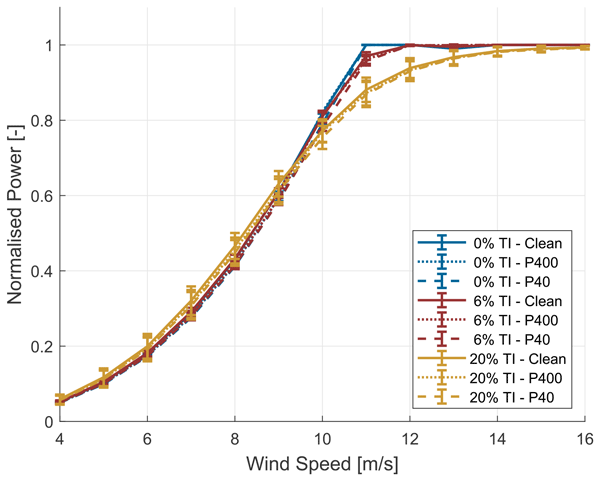
This study investigates how wind turbine blades damaged by erosion, along with changing wind conditions, affect power output. Even minor blade damage can lead to significant energy losses, especially in turbulent winds. Using simulations, it was discovered that standard power data analysis methods, including time averaging, can hide these losses. This research highlights the need for better blade damage detection and careful wind data analysis to optimise wind farm performance.
Tahir H. Malik and Christian Bak
Wind Energ. Sci., 9, 2017–2037, https://doi.org/10.5194/wes-9-2017-2024, https://doi.org/10.5194/wes-9-2017-2024, 2024
Short summary
Short summary
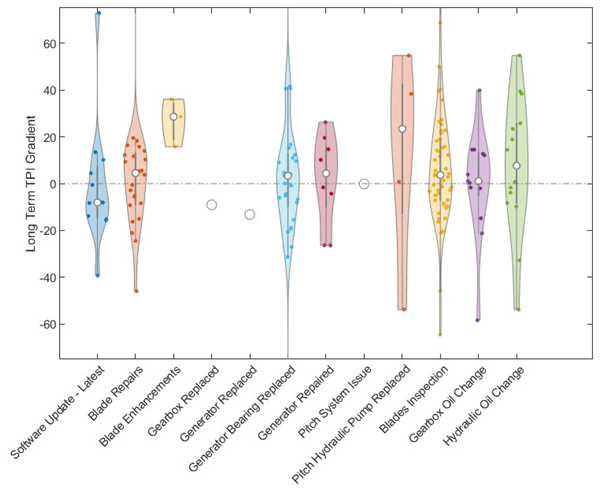
We explore the effect of blade modifications on offshore wind turbines' performance through a detailed analysis of 12 turbines over 12 years. Introducing the turbine performance integral method, which utilises time-series decomposition that combines various data sources, we uncover how blade wear, repairs and software updates impact efficiency. The findings offer valuable insights into improving wind turbine operations, contributing to the enhancement of renewable energy technologies.

Mac Gaunaa, Niels Troldborg, and Emmanuel Branlard
Wind Energ. Sci., 8, 503–513, https://doi.org/10.5194/wes-8-503-2023, https://doi.org/10.5194/wes-8-503-2023, 2023
Short summary
Short summary
We present an analytical vortex model. Despite its simplicity, the model is fully consistent with 1D momentum theory. It shows that the flow through a non-uniformly loaded rotor operating in non-uniform inflow behaves locally as predicted by 1D momentum theory. As a consequence, the local power coefficient (based on local inflow) of an ideal rotor is unaltered by the presence of shear. Finally, the model shows that there is no cross-shear deflection of the wake of a rotor in sheared inflow.
Niels Troldborg, Søren J. Andersen, Emily L. Hodgson, and Alexander Meyer Forsting
Wind Energ. Sci., 7, 1527–1532, https://doi.org/10.5194/wes-7-1527-2022, https://doi.org/10.5194/wes-7-1527-2022, 2022
Short summary
Short summary
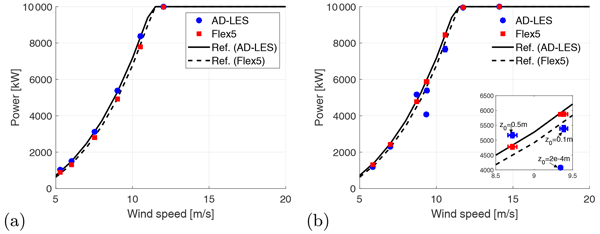
This article shows that the power performance of a wind turbine may be very different in flat and complex terrain. This is an important finding because it shows that the power output of a given wind turbine is governed by not only the available wind at the position of the turbine but also how the ambient flow develops in the region behind the turbine.
Ang Li, Mac Gaunaa, Georg Raimund Pirrung, Alexander Meyer Forsting, and Sergio González Horcas
Wind Energ. Sci., 7, 1341–1365, https://doi.org/10.5194/wes-7-1341-2022, https://doi.org/10.5194/wes-7-1341-2022, 2022
Short summary
Short summary
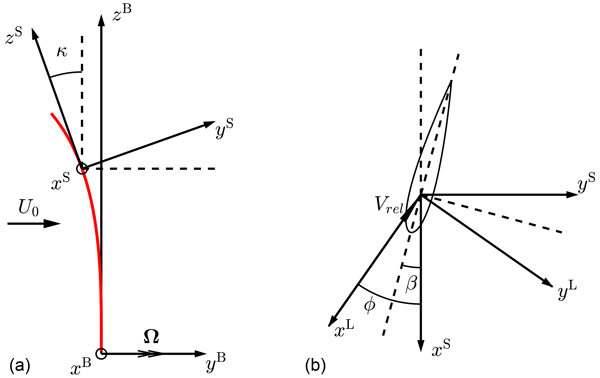
A consistent method of using two-dimensional airfoil data when using generalized lifting-line methods for the aerodynamic load calculation of non-planar horizontal-axis wind turbines is described. The important conclusions from the unsteady two-dimensional airfoil aerodynamics are highlighted. The impact of using a simplified approach instead of using the full model on the prediction of the aerodynamic performance of non-planar rotors is shown numerically for different aerodynamic models.
Alessandro Sebastiani, Alfredo Peña, Niels Troldborg, and Alexander Meyer Forsting
Wind Energ. Sci., 7, 875–886, https://doi.org/10.5194/wes-7-875-2022, https://doi.org/10.5194/wes-7-875-2022, 2022
Short summary
Short summary
The power performance of a wind turbine is often tested with the turbine standing in a row of several wind turbines, as it is assumed that the performance is not affected by the neighbouring turbines. We test this assumption with both simulations and measurements, and we show that the power performance can be either enhanced or lowered by the neighbouring wind turbines. Consequently, we also show how power performance testing might be biased when performed on a row of several wind turbines.
Ang Li, Georg Raimund Pirrung, Mac Gaunaa, Helge Aagaard Madsen, and Sergio González Horcas
Wind Energ. Sci., 7, 129–160, https://doi.org/10.5194/wes-7-129-2022, https://doi.org/10.5194/wes-7-129-2022, 2022
Short summary
Short summary
An engineering aerodynamic model for the swept horizontal-axis wind turbine blades is proposed. It uses a combination of analytical results and engineering approximations. The performance of the model is comparable with heavier high-fidelity models but has similarly low computational cost as currently used low-fidelity models. The model could be used for an efficient and accurate load calculation of swept wind turbine blades and could eventually be integrated in a design optimization framework.

Ang Li, Mac Gaunaa, Georg Raimund Pirrung, and Sergio González Horcas
Wind Energ. Sci., 7, 75–104, https://doi.org/10.5194/wes-7-75-2022, https://doi.org/10.5194/wes-7-75-2022, 2022
Short summary
Short summary
An engineering aerodynamic model for non-planar horizontal-axis wind turbines is proposed. The performance of the model is comparable with high-fidelity models but has similarly low computational cost as currently used low-fidelity models, which do not have the capability to model non-planar rotors. The developed model could be used for an efficient and accurate load calculation of non-planar wind turbines and eventually be integrated in a design optimization framework.
Cited articles
Astolfi, D., Castellani, F., and Terzi, L.: A study of wind turbine wakes in complex terrain through RANS simulation and SCADA data, J. Sol. Energy Eng., 140, 031001, https://doi.org/10.1115/1.4039093, 2018.
Bastankhah, M. and Porté-Agel, F.: A new analytical model for wind-turbine wakes, Renewable Energy, 70, 116–123, https://doi.org/10.1016/j.renene.2014.01.002, 2014.
Bastankhah, M. and Porté-Agel, F.: Experimental and theoretical study of wind turbines wakes in yawed conditions, Journal of Fluid Mechanics, 806, 506–541, https://doi.org/10.1017/jfm.2016.595, 2016.
Bechmann, A.: WAsP CFD A new beginning in wind resource assessment, Tech. rep., Risø National Laboratory, Denmark, https://www.wasp.dk/-/media/sites/wasp/news/wasp-cfd-a-new-beginning-in-wind-resource-assessment.pdf (last access: 15 January 2026), 2012.
Bechmann, A.: Perdigão CFD Grid Study, DTU Wind Energy E 0120, 2016.
Bechmann, A., Sørensen, N. N., Berg, J., Mann, J., and Réthoré, P.-E.: The Bolund Experiment, Part II: Blind Comparison of Microscale Flow Models, Boundary-Layer Meteorology, 141, 245–271, https://doi.org/10.1007/s10546-011-9637-x, 2011.
Berg, J., Troldborg, N., Sørensen, N.N., Patton E. G., and Sullivan, P. P.: Large-Eddy Simulation of turbine wake in complex terrain, J. Phys.: Conf. Se., 854, 012003, https://doi.org/10.1088/1742-6596/854/1/012003, 2017.
Blondel, F.: Brief communication: A momentum-conserving superposition method applied to the super-Gaussian wind turbine wake model, Wind Energ. Sci., 8, 141–147, https://doi.org/10.5194/wes-8-141-2023, 2023.
Blondel, F. and Cathelain, M.: An alternative form of the super-Gaussian wind turbine wake model, Wind Energ. Sci., 5, 1225–1236, https://doi.org/10.5194/wes-5-1225-2020, 2020.
Carbajo Fuertes, F., Markfort, C. D., and Porté-Agel, F.: Wind Turbine Wake Characterization with Nacelle-Mounted Wind Lidars for Analytical Wake Model Validation, Remote Sensing, 10, 668, https://doi.org/10.3390/rs10050668, 2018.
Castellani, F., Astolfi, D., Burlando, M., and Terzi, L.: Numerical modelling for wind farm operational assessment in complex terrain, Journal of Wind Engineering and Industrial Aerodynamics, 147, 320–329, https://doi.org/10.1016/j.jweia.2015.07.016, 2015.
Centurelli, G., Dörenkämper, M., Bange, J., and Platis, A.: Evaluation of Engineering Models for large-scale cluster wakes with the help of in situ airborne measurements, Wind Energy, 27, 1040–1062, https://doi.org/10.1002/we.2942, 2024.
Dar, A. S., Berg, J., Troldborg, N., and Patton, E. G.: On the self-similarity of wind turbine wakes in a complex terrain using large eddy simulation, Wind Energ. Sci., 4, 633–644, https://doi.org/10.5194/wes-4-633-2019, 2019.
Dilip, D. and Porté-Agel, F.: Wind turbine wake mitigation through blade pitch offset, Energies, 10, 757, https://doi.org/10.3390/en10060757, 2017.
Duncan Jr., J. B., Hirth, B. D., and Schroeder, J. L.: Exploring the complexities associated with full-scale wind plant wake mitigation control experiments, Wind Energ. Sci., 5, 469–488, https://doi.org/10.5194/wes-5-469-2020, 2020.
El-Asha, S., Zhan, L., and Iungo, G. V.: Quantification of power losses due to wind turbine wake interaction through SCADA, meteorological and wind LiDAR data, Wind Energy, 20, 1823–1839, https://doi.org/10.1002/we.2123, 2017.
Enomoto, S., Inomata, N., Yamada, T., Chiba, H., Tanikawa, R., Oota, T., and Fukuda, H.: Prediction of power output from wind farm using local meteorological analysis, in: Proceedings of the European Wind Energy Conference, Copenhagen, Denmark, 2–5 June 2001, 749–752, ISBN 3-936338-09-4, 2001.
Farrell, A., King, J., Draxl, C., Mudafort, R., Hamilton, N., Bay, C. J., Fleming, P., and Simley, E.: Design and analysis of a wake model for spatially heterogeneous flow, Wind Energ. Sci., 6, 737–758, https://doi.org/10.5194/wes-6-737-2021, 2021.
Fischereit, J., Schaldemose Hansen, K., Larsén, X. G., van der Laan, M. P., Réthoré, P.-E., and Murcia Leon, J. P.: Comparing and validating intra-farm and farm-to-farm wakes across different mesoscale and high-resolution wake models, Wind Energ. Sci., 7, 1069–1091, https://doi.org/10.5194/wes-7-1069-2022, 2022.
Fleming, P., King, J., Dykes, K., Simley, E., Roadman, J., Scholbrock, A., Murphy, P., Lundquist, J. K., Moriarty, P., Fleming, K., van Dam, J., Bay, C., Mudafort, R., Lopez, H., Skopek, J., Scott, M., Ryan, B., Guernsey, C., and Brake, D.: Initial results from a field campaign of wake steering applied at a commercial wind farm – Part 1, Wind Energ. Sci., 4, 273–285, https://doi.org/10.5194/wes-4-273-2019, 2019.
Fleming, P., King, J., Simley, E., Roadman, J., Scholbrock, A., Murphy, P., Lundquist, J. K., Moriarty, P., Fleming, K., van Dam, J., Bay, C., Mudafort, R., Jager, D., Skopek, J., Scott, M., Ryan, B., Guernsey, C., and Brake, D.: Continued results from a field campaign of wake steering applied at a commercial wind farm – Part 2, Wind Energ. Sci., 5, 945–958, https://doi.org/10.5194/wes-5-945-2020, 2020.
Fujikawa, T., Iwasaki, N., Suguro, Y., Iwanaga, Y., and Shibata, M.: Mitsubishi high efficiency large capacity wind turbines, Mitsubishi heavy industries, Ltd. Technical review, 39, 101–106, https://www.researchgate.net/publication/237268778 (last access: 15 January 2026), 2002.
Geospatial Information Authority of Japan: Digital national land web, Geospatial information authority map, https://maps.gsi.go.jp/, last access: 9 April 2025.
Göçmen, T., Laan, P. V. D., Réthoré, P., Diaz, A. P., Larsen, G. C., and Ott, S.: Wind turbine wake models developed at the technical university of Denmark: A review, Renewable and Sustainable Energy Reviews, 60, 752–769, https://doi.org/10.1016/j.rser.2016.01.113, 2016.
Han, X., Liu, D., Xu, C., and Shen, W., Z.: Atmospheric stability and topography effects on wind turbine performance and wake properties in complex terrain, Renewable Energy, 126, 640–651, https://doi.org/10.1016/j.renene.2018.03.048, 2018.
Hansen, K. S., Larsen, G. C., Menke, R., Vasiljevic, N., Angelou, N., Feng, J., Zhu, W. J., Vignaroli, A., Liu, W., Xu, C., and Shen, W. Z.: Wind turbine wake measurement in complex terrain, J. Phys. Conf. Ser. 753, 1–10, https://doi.org/10.1088/1742-6596/753/3/032013, 2016.
Hasegawa, Y., Kikuyama, K., Imamura, H., Inomata, N., Suzuki, H., and Ishikawa, H.: Fundamental study for estimation of wind energy resources (Wind Measurements at Tappi Wind Park), Nihon kikai gakki ronbunshu, B Hen/Transactions of the Japan Society of Mechanical Engineers, Part B, 69, 2052–2058, https://doi.org/10.1299/kikaib.69.2052, 2003.
Inomata, N., Tsuchiya, K., and Yamada, S.: Measurement of stress on blade of NEDO's 500 kW prototype wind turbine, Renewable Energy, 16, 912–915, https://doi.org/10.1016/S0960-1481(98)00309-7, 1999.
International Electrotechnical Commission (IEC): IEC 61400-1: Wind energy generation systems – Part 1: Design requirements, 4th edn., Geneva, Switzerland, https://webstore.iec.ch/en/publication/26423 (last access: 15 January 2026), 2019.
Jeon, S., Kim, B., and Huh, J.: Comparison and verification of wake models in an onshore wind farm considering single wake condition of the 2 MW wind turbine, Energy, 93, 1769–1777, https://doi.org/10.1016/j.energy.2015.09.086, 2015.
Jensen, N., O.: A note on wind generator interaction, Risø National Laboratory, ISBN 87-550-0971-9, https://orbit.dtu.dk/en/publications/a-note-on-wind-generator-interaction/ (last access: 15 January 2026), 1983.
Larsen, G. C.: A simple stationary semi-analytical wake model”, Risø National Laboratory for Sustainable Energy, Technical University of Denmark, Denmark, Forskningscenter Risoe. Risoe-R, No. 1713(EN), https://orbit.dtu.dk/en/publications/a-simple-stationary-semi-analytical-wake-model/ (last access: 15 January 2026), 2009.
Launder, B. E. and Spalding, D. B.: The numerical computation of turbulent flows, Computer Methods in Applied Mechanics and Engineering, 3, 269–289, https://doi.org/10.1016/0045-7825(74)90029-2, 1974.
Letzgus, P., Guma, G., and Lutz, T.: Computational fluid dynamics studies on wind turbine interactions with the turbulent local flow field influenced by complex topography and thermal stratification, Wind Energ. Sci., 7, 1551–1573, https://doi.org/10.5194/wes-7-1551-2022, 2022.
Mittelmeier, N., Allin, J., Blodau, T., Trabucchi, D., Steinfeld, G., Rott, A., and Kühn, M.: An analysis of offshore wind farm SCADA measurements to identify key parameters influencing the magnitude of wake effects, Wind Energ. Sci., 2, 477–490, https://doi.org/10.5194/wes-2-477-2017, 2017.
Niayifar, A. and Porté-Agel, F.: Analytical Modeling of Wind Farms: A New Approach for Power Prediction. Energies, 9, 741, https://doi.org/10.3390/en9090741, 2016.
Nygaard, N., G., Steen, S., T., Poulsen, L., and Pedersen, J., G.: Modelling cluster wakes and wind farm blockage, J. Phys. Conf. Sr., 1618, 062072, https://doi.org/10.1088/1742-6596/1618/6/062072, 2020.
Oqaily, D. A., Giani, P., and Crippa, P.: Evaluating WRF Multiscale Wind Simulations in Complex Terrain: Insights from the Perdigão Field Campaign, Journal of Geophysical Research: Atmospheres, 130, e2025JD044055, https://doi.org/10.1029/2025JD044055, 2025.
Ott, S., Berg, J., and Nielsen, M.: Linearised CFD models for wakes. Technical report, Danmarks Tekniske Universitet, Risø Nationallaboratoriet for Bæredygtig Energi, Forskningscenter Risoe, Risoe-R No. 1772(EN), https://orbit.dtu.dk/en/publications/linearised-cfd-models-for-wakes/ (last access: 15 January 2026), 2011.
Pedersen, J. G., Svensson, E., Poulsen, L., and Nygaard, N. G.: Turbulence Optimized Park model with Gaussian wake profile, J. Phys. Conf. Sr., 2265 022063, https://doi.org/10.1088/1742-6596/2265/2/022063, 2022.
Pedersen, M. M., van der Laan, P., Friis-Møller, M., Forsting, A. M., Riva, R., Romàn, L. A. A., Risco, J., C., Quick, J., Christiansen, J. P. S., Olsen B. T., Rodrigues, R. V., and Réthoré, P. E., DTU WindEnergy/PyWake: PyWake (v2.5.0), Zenodo [code], https://doi.org/10.5281/zenodo.6806136, 2023.
Politis, E. S., Prospathopoulos, J., Cabezon, D., Hansen, K. S., Chaviaropoulos, P. K., and Barthelmie, R. J.: Modeling wake effects in large wind farms in complex terrain: The problem, the methods and the issues, Wind Energy, 15, 161–182, https://doi.org/10.1002/we.481, 2011.
Porté-Agel, F., Bastankhah, M., and Shamsoddin, S.: Wind-Turbine and Wind-Farm Flows: A Review, Boundary-Layer Meteorol., 174, 1–59, https://doi.org/10.1007/s10546-019-00473-0, 2020.
Rhodes, M. E. and Lundquist, J. K.: The effect of wind-turbine wakes on summertime US midwest atmospheric wind profiles as observed with ground-based Doppler lider, 149, 85–103, https://doi.org/10.1007/s10546-013-9834-x, 2013.
Ruisi, R. and Bossanyi, E.: Engineering models for turbine wake velocity deficit and wake deflection. A new proposed approach for onshore and offshore applications, in: Journal of Physics: Conference Series, vol. 1222, 012004, https://doi.org/10.1088/1742-6596/1222/1/012004, 2019.
Sasanuma, N. and Honda, A.: Wind analyzing of wind turbines and lighthouse in Tappi with relative point of view, Wind Engineering Symposium, 26, 19–24, https://doi.org/10.14887/natsympwindengproc.26.0_19, 2020.
Sasanuma, N. and Honda, A.: Study on wind characteristic and wind wake effect in complex terrain, Journal of Wind Engineering, 27, 294–302, https://doi.org/10.14887/windengresearch.27.0_294, 2022.
Sasanuma, N. and Honda, A.: Observation survey on wind turines installed close to complex terrain: the effects terrain and wind tubine wake, Journal of Wind Engineering, 28, 267–275, https://doi.org/10.14887/windengresearch.28.0_267, 2024.
Sessarego, M., Feng, J., Friis-Møller, M., Xu, Y., Xu, M., and Shen, W., Z.: Development of a streamline wake model for wind farm perfomance predictions, J. Phys. Conf. Sr., 1618, 062027, https://doi.org/10.1088/1742-6596/1618/6/062027, 2020.
Sharma, P. K., Warudkar, V., and Ahmed, S.: Application of a new method to develop a CFD model to analyze wind characteristics for a complex terrain, Sustainable Energy Technologies and Assessments, 37, 100580, https://doi.org/10.1016/j.seta.2019.100580, 2020.
Shimada, T., Sawada, M., and Iwasaki, T.: Indices of cool summer climate in northern Japan: Yamase indices, J. Meteor. Soc. Japan, 92, 17–35, https://doi.org/10.2151/jmsj.2014-102, 2014.
Troen, I. and Hansen, B. O.: Wind Resource Estimation in Complex Terrain: Prediction Skill of Linear and Nonlinear Micro-Scale Models, Paper presented at AWEA Windpower Conference & Exhibition, Orlando Orange County Convention Center, United States. May 18, https://backend.orbit.dtu.dk/ws/portalfiles/portal/110738156/Wind_resource_estimation.pdf (last access: 15 January 2026), 2015.
Troldborg, N., Andersen, S. J., Hodgson, E. L., and Meyer Forsting, A.: Brief communication: How does complex terrain change the power curve of a wind turbine?, Wind Energ. Sci., 7, 1527–1532, https://doi.org/10.5194/wes-7-1527-2022, 2022.
Uchida, T. and Takakuwa, S.: Numerical Investigation of Stable Stratification Effects on Wind Resource Assessment in Complex Terrain, Energies, 13, 6638, https://doi.org/10.3390/en13246638, 2019.
Ushiyama, I.: Wind energy activities in Japan, Renewable Energy, 16, 811–816, https://doi.org/10.1016/S0960-1481(98)00261-4, 1999.
Wagner, J., Gerz, T., Wildmann, N., and Gramitzky, K.: Long-term simulation of the boundary layer flow over the double-ridge site during the Perdigão 2017 field campaign, Atmos. Chem. Phys., 19, 1129–1146, https://doi.org/10.5194/acp-19-1129-2019, 2019.
Wenz, F., Langner, J., Lutz, T., and Krämer, E.: Impact of the wind field at the complex-terrain site Perdigão on the surface pressure fluctuations of a wind turbine, Wind Energ. Sci., 7, 1321–1340, https://doi.org/10.5194/wes-7-1321-2022, 2022.
Yamaguchi, A., Ishihara, T., and Fujino, Y.: Applicability of linear and nonlinear wind prediction models to wind flow in complex terrain, in: Proceedings of The World Wind Energy Conference and Exhibition, Berlin, Germany, 3–8 July 2002, 1–4, https://www.researchgate.net/publication/266863617 (last access: 15 January 2026), 2002.
Yamaguchi, A., Tavana, A., and Ishihara, T.: Assessment of wind over complex terrain considering the effects of topography, Atmospheric stability and turbine wakes, Atmosphere, 15, 723, https://www.mdpi.com/2073-4433/15/6/723 (last access: 15 January 2026), 2024.
Yang, X., Sotiropoulos, F., Conzemius, R. J., Wachtler, J. N., and Strong, M. B.: Large-eddy simulation of turbulent flow past wind turbines/farms: The Virtual Wind Simulator (VWiS), Wind Energy, 18, 2025–2045, https://doi.org/10.1002/we.1802, 2015.
Zong, H. and Porté-Agel, F.: A momentum-conserving wake superposition method for wind farm power prediction, Journal of Fluid Mechanics, 889, https://doi.org/10.1017/jfm.2020.77, 2020.
zum Berge, K., Centurelli, G., Dörenkämper, M., Bange, J., and Platis, A.: Evaluation of Engineering Models for large-scale cluster wakes with the help of in situ airborne measurements, Wind Energy, 27, 1040–1062, https://doi.org/10.1002/we.2942, 2024.
Short summary
We verify wake effects between two wind turbines in complex terrain using supervisory control and data acquisition data. By identifying “wake conditions” and “no-wake conditions” detected by the blade pitch angle of upstream wind turbines, we evaluate wake effects on wind speed ratio, turbulent intensity, and power output. Results show that flow downhill has a significant impact on wake effects compared to flow uphill. The method shows the potential of SCADA data during the downtime of wind turbines.
We verify wake effects between two wind turbines in complex terrain using supervisory control...


Altmetrics
Final-revised paper
Preprint