
Articles | Volume 11, issue 9
https://doi.org/10.5194/wes-11-3295-2026
© Author(s) 2026. This work is distributed under
the Creative Commons Attribution 4.0 License.
the Creative Commons Attribution 4.0 License.
https://doi.org/10.5194/wes-11-3295-2026
© Author(s) 2026. This work is distributed under
the Creative Commons Attribution 4.0 License.
the Creative Commons Attribution 4.0 License.
Research article
| 
07 Sep 2026
Research article |
| 07 Sep 2026
| 07 Sep 2026
Annual wake impacts in and between wind farm clusters – Part 2: Comparison of WRF and fast-running engineering wake models
Sara Porchetta
CORRESPONDING AUTHOR

Massachusetts Institute of Technology, Civil and Environmental Engineering, 77 Massachusetts Avenue, 1-290, Cambridge, MA 02139, USA
Faculty of Civil Engineering and Geosciences, Delft University of Technology, Delft, the Netherlands
von Karman Institute for Fluid Dynamics, 1640 Sint-Genesius-Rode, Belgium
Michael F. Howland
Massachusetts Institute of Technology, Civil and Environmental Engineering, 77 Massachusetts Avenue, 1-290, Cambridge, MA 02139, USA
Maxime Lejeune
von Karman Institute for Fluid Dynamics, 1640 Sint-Genesius-Rode, Belgium
Ruben Borgers
Department of Earth and Environmental Sciences, KU Leuven, Belgium
Sophia Buckingham
ENGIE Laborelec, 1630 Linkebeek, Belgium
Wim Munters
von Karman Institute for Fluid Dynamics, 1640 Sint-Genesius-Rode, Belgium
Related authors
Sara Porchetta, Wim Munters, Maxime Lejeune, Ruben Borgers, Sophia Buckingham, and Michael F. Howland
Wind Energ. Sci., 11, 3273–3294, https://doi.org/10.5194/wes-11-3273-2026, https://doi.org/10.5194/wes-11-3273-2026, 2026
Short summary
Short summary
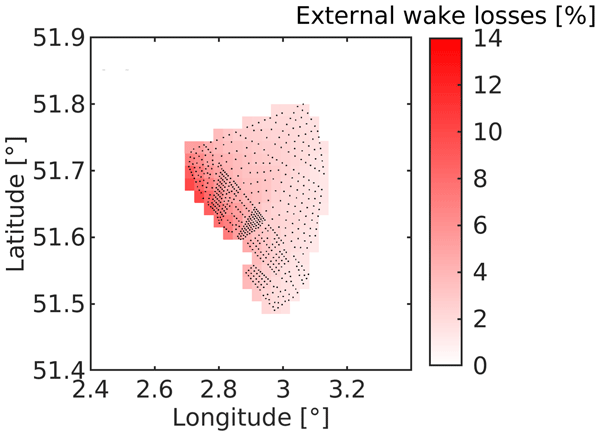
This study examines how a newly built offshore wind farm affects the power production of nearby existing wind farms. Using a full year of simulations, we compare detailed weather-based models with faster simplified models. The results show clear differences in predicted power losses, especially during calm summer conditions, highlighting the importance of model choice for future offshore wind farm planning and design.
Tsvetelina Ivanova, Sara Porchetta, Sophia Buckingham, Gertjan Glabeke, Jeroen van Beeck, and Wim Munters
Wind Energ. Sci., 10, 245–268, https://doi.org/10.5194/wes-10-245-2025, https://doi.org/10.5194/wes-10-245-2025, 2025
Short summary
Short summary
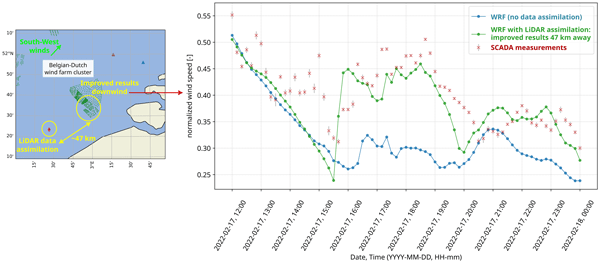
This study explores how wind and power predictions can be improved by introducing local forcing of measurement data in a numerical weather model while taking into account the presence of neighboring wind farms. Practical implications for the wind energy industry include insights for informed offshore wind farm planning and decision-making strategies using open-source models, even under adverse weather conditions.

Majid Bastankhah, Marcus Becker, Matthew Churchfield, Caroline Draxl, Jay Prakash Goit, Mehtab Khan, Luis A. Martinez Tossas, Johan Meyers, Patrick Moriarty, Wim Munters, Asim Önder, Sara Porchetta, Eliot Quon, Ishaan Sood, Nicole van Lipzig, Jan-Willem van Wingerden, Paul Veers, and Simon Watson
Wind Energ. Sci., 9, 2171–2174, https://doi.org/10.5194/wes-9-2171-2024, https://doi.org/10.5194/wes-9-2171-2024, 2024
Short summary
Short summary
Dries Allaerts was born on 19 May 1989 and passed away at his home in Wezemaal, Belgium, on 10 October 2024 after battling cancer. Dries started his wind energy career in 2012 and had a profound impact afterward on the community, in terms of both his scientific realizations and his many friendships and collaborations in the field. His scientific acumen, open spirit of collaboration, positive attitude towards life, and playful and often cheeky sense of humor will be deeply missed by many.
Alexandros Palatos-Plexidas, Simone Gremmo, Jeroen van Beeck, Lesley De Cruz, and Wim Munters
Wind Energ. Sci., 11, 3555–3585, https://doi.org/10.5194/wes-11-3555-2026, https://doi.org/10.5194/wes-11-3555-2026, 2026
Short summary
Short summary
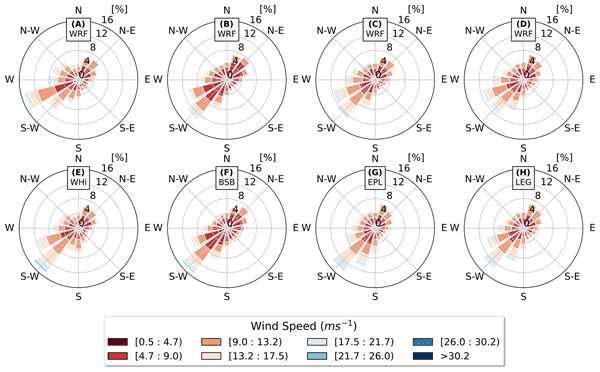
In this study, we use advanced weather simulations, real-world measurements, and satellite images, showing that modeling wind farm effects improves accuracy, especially in areas influenced by turbines. Focusing on one of the largest wind farm clusters in the North Sea, we investigate wind speed deficits based on different atmospheric conditions. These findings help quantify the influence of large wind farm clusters, improve predictions, and support planning for future wind energy development.
Emmanuel Gillyns, Sophia Buckingham, Jeroen van Beeck, and Grégoire Winckelmans
Wind Energ. Sci., 11, 3531–3553, https://doi.org/10.5194/wes-11-3531-2026, https://doi.org/10.5194/wes-11-3531-2026, 2026
Short summary
Short summary
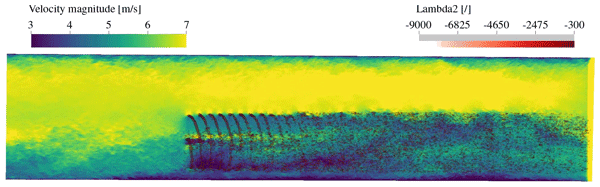
We built a small wind turbine model and tested it in a wind tunnel while improving computer simulations. Results show simulations accurately predict wind turbine wake behavior behind spinning blades, matching measurements. Some differences remain near blade roots. Combining experiments with refined models helps engineers predict wind turbine performance with greater confidence, supporting more efficient renewable energy design.
Sara Porchetta, Wim Munters, Maxime Lejeune, Ruben Borgers, Sophia Buckingham, and Michael F. Howland
Wind Energ. Sci., 11, 3273–3294, https://doi.org/10.5194/wes-11-3273-2026, https://doi.org/10.5194/wes-11-3273-2026, 2026
Short summary
Short summary
This study examines how a newly built offshore wind farm affects the power production of nearby existing wind farms. Using a full year of simulations, we compare detailed weather-based models with faster simplified models. The results show clear differences in predicted power losses, especially during calm summer conditions, highlighting the importance of model choice for future offshore wind farm planning and design.
Kirby S. Heck and Michael F. Howland
Wind Energ. Sci. Discuss., https://doi.org/10.5194/wes-2026-149, https://doi.org/10.5194/wes-2026-149, 2026
Preprint under review for WES
Short summary
Short summary
Wind turbine wakes are regions of slower, turbulent flow that reduce power generated downstream. Engineering models often simplify how atmospheric conditions shape these wakes, limiting accuracy, especially as turbines grow larger. We develop a model that captures these effects by jointly predicting changes in wind speed and turbulence. Across the wind farms and atmospheric conditions tested, the new model improves predictions of wind farm performance, supporting future design and operation.
Baris Kale, Mohammadreza Asadbeigi, Aditya K. Aiyer, and Michael F. Howland
EGUsphere, https://doi.org/10.5194/egusphere-2026-2292, https://doi.org/10.5194/egusphere-2026-2292, 2026
Short summary
Short summary
We implemented two existing methods that account for how ocean waves influence the wind within a high-resolution atmospheric simulation model. By comparing them with a more detailed but computationally expensive approach, we show that they capture key effects but miss some smaller-scale motions. This work provides a practical framework for studying air-sea interactions relevant to weather and offshore wind energy.
Kirby S. Heck, Jaime Liew, Ilan M. L. Upfal, and Michael F. Howland
Wind Energ. Sci. Discuss., https://doi.org/10.5194/wes-2025-90, https://doi.org/10.5194/wes-2025-90, 2025
Preprint under review for WES
Short summary
Short summary
Wind turbines within a wind farm can be controlled collectively, rather than individually, to mitigate wake interactions between turbines and enhance power production. Here, we join two common wind farm control strategies synergistically, enabled by advances in aerodynamic rotor modeling. The joint strategy outperforms other control strategies when compared with advanced computer simulations, and future improvements on wake modeling can further extend these power gains for large wind farms.
Marcus Becker, Maxime Lejeune, Philippe Chatelain, Dries Allaerts, Rafael Mudafort, and Jan-Willem van Wingerden
Wind Energ. Sci., 10, 1055–1075, https://doi.org/10.5194/wes-10-1055-2025, https://doi.org/10.5194/wes-10-1055-2025, 2025
Short summary
Short summary
Established turbine wake models are steady-state. This paper presents an open-source dynamic wake modeling framework that complements established steady-state wake models with dynamics. It is advantageous over steady-state wake models to describe wind farm power and energy over shorter periods. The model enables researchers to investigate the effectiveness of wind farm flow control strategies. This leads to a better utilization of wind farms and allows them to be used to their fullest extent.
Tsvetelina Ivanova, Sara Porchetta, Sophia Buckingham, Gertjan Glabeke, Jeroen van Beeck, and Wim Munters
Wind Energ. Sci., 10, 245–268, https://doi.org/10.5194/wes-10-245-2025, https://doi.org/10.5194/wes-10-245-2025, 2025
Short summary
Short summary
This study explores how wind and power predictions can be improved by introducing local forcing of measurement data in a numerical weather model while taking into account the presence of neighboring wind farms. Practical implications for the wind energy industry include insights for informed offshore wind farm planning and decision-making strategies using open-source models, even under adverse weather conditions.
Majid Bastankhah, Marcus Becker, Matthew Churchfield, Caroline Draxl, Jay Prakash Goit, Mehtab Khan, Luis A. Martinez Tossas, Johan Meyers, Patrick Moriarty, Wim Munters, Asim Önder, Sara Porchetta, Eliot Quon, Ishaan Sood, Nicole van Lipzig, Jan-Willem van Wingerden, Paul Veers, and Simon Watson
Wind Energ. Sci., 9, 2171–2174, https://doi.org/10.5194/wes-9-2171-2024, https://doi.org/10.5194/wes-9-2171-2024, 2024
Short summary
Short summary
Dries Allaerts was born on 19 May 1989 and passed away at his home in Wezemaal, Belgium, on 10 October 2024 after battling cancer. Dries started his wind energy career in 2012 and had a profound impact afterward on the community, in terms of both his scientific realizations and his many friendships and collaborations in the field. His scientific acumen, open spirit of collaboration, positive attitude towards life, and playful and often cheeky sense of humor will be deeply missed by many.
Marion Coquelet, Maxime Lejeune, Laurent Bricteux, Aemilius A. W. van Vondelen, Jan-Willem van Wingerden, and Philippe Chatelain
Wind Energ. Sci., 9, 1923–1940, https://doi.org/10.5194/wes-9-1923-2024, https://doi.org/10.5194/wes-9-1923-2024, 2024
Short summary
Short summary
An extended Kalman filter is used to estimate the wind impinging on a wind turbine based on the blade bending moments and a turbine model. Using large-eddy simulations, this paper verifies how robust the estimator is to the turbine control strategy as it impacts loads and operating parameters. It is shown that including dynamics in the turbine model to account for delays between actuation and bending moments is needed to maintain the accuracy of the estimator when dynamic pitch control is used.
Jérôme Neirynck, Jonas Van de Walle, Ruben Borgers, Sebastiaan Jamaer, Johan Meyers, Ad Stoffelen, and Nicole P. M. van Lipzig
Wind Energ. Sci., 9, 1695–1711, https://doi.org/10.5194/wes-9-1695-2024, https://doi.org/10.5194/wes-9-1695-2024, 2024
Short summary
Short summary
In our study, we assess how mesoscale weather systems influence wind speed variations and their impact on offshore wind energy production fluctuations. We have observed, for instance, that weather systems originating over land lead to sea wind speed variations. Additionally, we noted that power fluctuations are typically more significant in summer, despite potentially larger winter wind speed variations. These findings are valuable for grid management and optimizing renewable energy deployment.
Ruben Borgers, Marieke Dirksen, Ine L. Wijnant, Andrew Stepek, Ad Stoffelen, Naveed Akhtar, Jérôme Neirynck, Jonas Van de Walle, Johan Meyers, and Nicole P. M. van Lipzig
Wind Energ. Sci., 9, 697–719, https://doi.org/10.5194/wes-9-697-2024, https://doi.org/10.5194/wes-9-697-2024, 2024
Short summary
Short summary
Wind farms at sea are becoming more densely clustered, which means that next to individual wind turbines interfering with each other in a single wind farm also interference between wind farms becomes important. Using a climate model, this study shows that the efficiency of wind farm clusters and the interference between the wind farms in the cluster depend strongly on the properties of the individual wind farms and are also highly sensitive to the spacing between the wind farms.
Adithya Vemuri, Sophia Buckingham, Wim Munters, Jan Helsen, and Jeroen van Beeck
Wind Energ. Sci., 7, 1869–1888, https://doi.org/10.5194/wes-7-1869-2022, https://doi.org/10.5194/wes-7-1869-2022, 2022
Short summary
Short summary
The sensitivity of the WRF mesoscale modeling framework in accurately representing and predicting wind-farm-level environmental variables for three extreme weather events over the Belgian North Sea is investigated in this study. The overall results indicate highly sensitive simulation results to the type and combination of physics parameterizations and the type of the weather phenomena, with indications that scale-aware physics parameterizations better reproduce wind-related variables.
Michael F. Howland, Aditya S. Ghate, Jesús Bas Quesada, Juan José Pena Martínez, Wei Zhong, Felipe Palou Larrañaga, Sanjiva K. Lele, and John O. Dabiri
Wind Energ. Sci., 7, 345–365, https://doi.org/10.5194/wes-7-345-2022, https://doi.org/10.5194/wes-7-345-2022, 2022
Short summary
Short summary
Wake steering control, in which turbines are intentionally misaligned with the incident wind, has demonstrated potential to increase wind farm energy. We investigate wake steering control methods in simulations of a wind farm operating in the terrestrial diurnal cycle. We develop a statistical wind direction forecast to improve wake steering in flows with time-varying states. Closed-loop wake steering control increases wind farm energy production, compared to baseline and open-loop control.
Cited articles
Akhtar, N., Geyer, B., Rockel, B., and Schrum, C.: Accelerating deployment of offshore wind energy alter wind climate and reduce future power generation potentials, Sci. Rep., 11, https://doi.org/10.1038/s41598-021-91283-3, 2021. a
Antonini, E. and Caldeira, K.: Atmospheric pressure gradients and Coriolis forces provide geophysical limits to power density of large wind farms, Appl. Energ., 281, 459–469, 2021. a
Barthelmie, R. J., Pryor, S. C., Frandsen, S. T., Hansen, K. S., Schepers, J. G., Rados, K., Schlez, W., Neubert, A., Jensen, L. E., and Neckelmann, S.: Quantifying the Impact of Wind Turbine Wakes on Power Output at Offshore Wind Farms, J. Atmos. Ocean. Tech., 27, 1302–1317, 2010. a
Bastankhah, M., Welch, B. L., Martínez-Tossas, L. A., King, J., and Fleming, P.: Analytical solution for the cumulative wake of wind turbines in wind farms, J. Fluid Mech., 911, A53, https://doi.org/10.1017/jfm.2020.1037, 2021. a
Bay, C. J., Fleming, P., Doekemeijer, B., King, J., Churchfield, M., and Mudafort, R.: Addressing deep array effects and impacts to wake steering with the cumulative-curl wake model, Wind Energ. Sci., 8, 401–419, https://doi.org/10.5194/wes-8-401-2023, 2023. a, b, c
Borgers, R., Dirksen, M., Wijnant, I. L., Stepek, A., Stoffelen, A., Akhtar, N., Neirynck, J., Van de Walle, J., Meyers, J., and van Lipzig, N. P. M.: Mesoscale modelling of North Sea wind resources with COSMO-CLM: model evaluation and impact assessment of future wind farm characteristics on cluster-scale wake losses, Wind Energ. Sci., 9, 697–719, https://doi.org/10.5194/wes-9-697-2024, 2024. a
Cuevas-Figueroa, G., Stansby, P., and Stallard, T.: Accuracy of WRF for prediction of operational wind farm data and assessment of influence of upwind farms on power production, Energy, 254, 124362, https://doi.org/10.1016/j.energy.2022.124362, 2022. a
Emeis, S.: A simple analytical wind park model considering atmospheric stability, Wind Energy, 13, 459–469, 2010. a
Farrell, A., King, J., Draxl, C., Mudafort, R., Hamilton, N., Bay, C. J., Fleming, P., and Simley, E.: Design and analysis of a wake model for spatially heterogeneous flow, Wind Energ. Sci., 6, 737–758, https://doi.org/10.5194/wes-6-737-2021, 2021. a
Fischereit, J., Brown, R., Larsén, X., Badger, J., and Hawkes, G.: Review of mesoscale wind-farm parameterizations and their applications, Bound.-Lay. Meteorol., 182, 175–224, 2022a. a
Fischereit, J., Schaldemose Hansen, K., Larsén, X. G., van der Laan, M. P., Réthoré, P.-E., and Murcia Leon, J. P.: Comparing and validating intra-farm and farm-to-farm wakes across different mesoscale and high-resolution wake models, Wind Energ. Sci., 7, 1069–1091, https://doi.org/10.5194/wes-7-1069-2022, 2022b. a, b, c, d, e, f, g, h
Fischereit, J., Sahan, M. E., Imberger, M., and Larsén, X. G.: Benchmarking model coupling and wind farm parameterizations for wind energy applications, EMS Annual Meeting 2025, Ljubljana, Slovenia, 7–12 Sep 2025, EMS2025-495, https://doi.org/10.5194/ems2025-495, 2025. a
Frandsen, S.: Turbulence and turbulence-generated structural loading in wind turbine clusters, Ph.D. thesis, ISBN 87-550-3458-6, risø-R-1188(EN), 2007. a
Hansen, K., Rethore, P.-E., Palma, J., Hevia, B., Prospathopoulos, J., Pena, A., Ott, S., Schepers, G., Palomares, A., van der Laan, M., and Volker, P.: Simulation of wake effects between two wind farms, J. Phys. Conf. Ser., 625, 012008, https://doi.org/10.1088/1742-6596/625/1/012008, 2015. a
King, J., Fleming, P., King, R., Martínez-Tossas, L. A., Bay, C. J., Mudafort, R., and Simley, E.: Control-oriented model for secondary effects of wake steering, Wind Energ. Sci., 6, 701–714, https://doi.org/10.5194/wes-6-701-2021, 2021. a
Larsén, X. G.: Calculating Turbulence Intensity from mesoscale modeled Turbulence Kinetic Energy, Technical report (dtu wind energy e-0233), DTU Wind Energy, Technical University of Denmark, Roskilde, Denmark, https://backend.orbit.dtu.dk/ws/portalfiles/portal/364980906/TKE2TI-20240627.pdf (last access: 1 June 2026), 2024. a
Lundquist, J., DuVivier, K., Kaffine, D., and Tomaszewski, J.: Costs and consequences of wind turbine wake effects arising from uncoordinated wind energy development, Nature Energy, 4, 26–34, https://doi.org/10.1038/s41560-018-0281-2, 2019. a
Maas, O. and Raasch, S.: Wake properties and power output of very large wind farms for different meteorological conditions and turbine spacings: a large-eddy simulation case study for the German Bight, Wind Energ. Sci., 7, 715–739, https://doi.org/10.5194/wes-7-715-2022, 2022. a
Munters, W., Adiloglu, B., Buckingham, S., and van Beeck, J.: Wake impact of constructing a new offshore wind farm zone on an existing downwind cluster: a case study of the Belgian Princess Elisabeth zone using FLORIS, J. Phys. Conf. Ser., 2265, 022049, https://doi.org/10.1088/1742-6596/2265/2/022049, 2022. a
Nygaard, N. and Hansen, S.: Wake effects between two neighbouring wind farms, J. Phys. Conf. Ser., 753, 032020, https://doi.org/10.1088/1742-6596/753/3/032020, 2016. a
Nygaard, N., Steen, S., Poulsen, L., and Pedersen, J.: Modelling cluster wakes and wind farm blockage, J. Phys. Conf. Ser., 1618, 062072, https://doi.org/10.1088/1742-6596/1618/6/062072, 2020. a, b, c, d
Nygaard, N., Poulsen, L., Svensson, E., and Pedersen, J.: Large-scale benchmarking of wake models for offshore wind farms, J. Phys. Conf. Ser., 2265, 022008, https://doi.org/10.1088/1742-6596/2265/2/022008, 2022. a, b
Pedersen, J., Svensson, E., Poulsen, L., and Nygaard, N.: Turbulence Optimized Park model with Gaussian wake profile, J. Phys. Conf. Ser., 2265, 022063, https://doi.org/10.1088/1742-6596/2265/2/022063, 2022. a, b, c, d
Peña, A., Réthoré, P.-E., and van der Laan, M. P.: On the application of the Jensen wake model using a turbulence-dependent wake decay coefficient: the Sexbierum case, Wind Energy, 19, 763–776, 2016. a
Peña, A., Schaldemose Hansen, K., Ott, S., and van der Laan, M. P.: On wake modeling, wind-farm gradients, and AEP predictions at the Anholt wind farm, Wind Energ. Sci., 3, 191–202, https://doi.org/10.5194/wes-3-191-2018, 2018. a
Porchetta, S., Munters, W., Lejeune, M., Borgers, R., Buckingham, S., and Howland, M. F.: Annual wake impacts in and between wind farm clusters – Part 1: WRF-simulated wake losses for different atmospheric conditions, Wind Energ. Sci., 11, 3273–3294, https://doi.org/10.5194/wes-11-3273-2026, 2026. a, b
Porté-Agel, F., Bastankhah, M., and Shamsoddin, S.: Wind-Turbine and Wind-Farm Flows: A review, Bound.-Lay. Meteorol., 174, 1–59, 2020. a
Prosper, M., Otero-Casal, C., Canoura Fernandez, F., and Miguez-Macho, G.: Wind power forecasting for a real onshore wind farm on complex terrain using WRF high resolution simulations, Renew. Energ., 135, 674–686, 2019. a
Pryor, S., Barthelmie, R., and Shepherd, T.: Wind power production from very large offshore wind farms, Joule, 5, 2663–2686, 2021. a
Skamarock, W. C., Klemp, J. B., Dudhia, J., Gill, D. O., Barker, D., Duda, M. G., and Powers, J. G.: A Description of the Advanced Research WRF Version 3, Tech. Rep. NCAR/TN-475+STR, National Center for Atmospheric Research, Boulder (CO), USA, 2008. a
Stevens, R. J., Gayme, D. F., and Meneveau, C.: Coupled wake boundary layer model of wind-farms, J. Renew. Sustain. Ener., 7, https://doi.org/10.1063/1.4915287, 2015. a
Stieren, A. and Stevens, R.: Impact of wind farm wakes on flow structures in and around downstream wind farms, Flow, 2, https://doi.org/10.1017/flo.2022.15, 2022. a, b
van der Laan, M., Hansen, K., Sorensen, N., and Rethore, P.-E.: Predicting wind farm wake interaction with RANS: an investigation of the Coriolis force, J. Phys. Conf. Ser., 625, 012026, https://doi.org/10.1088/1742-6596/625/1/012026, 2015. a
van der Laan, M. P., García-Santiago, O., Kelly, M., Meyer Forsting, A., Dubreuil-Boisclair, C., Sponheim Seim, K., Imberger, M., Peña, A., Sørensen, N. N., and Réthoré, P.-E.: A new RANS-based wind farm parameterization and inflow model for wind farm cluster modeling, Wind Energ. Sci., 8, 819–848, https://doi.org/10.5194/wes-8-819-2023, 2023. a, b, c
Van Wijk, A., Beljaars, A., Holtslag, A., and Turkenburg, W.: Evaluation of stability corrections in wind speed profiles over the North Sea, J. Wind Eng. Ind. Aerod., 33, 551–566, 1990. a
Veers, P., Dykes, K., Lantz, E., Barth, S., Bottasso, C., Carlson, O., Clifton, A., Green, J., Green, P., Holttinen, H., Laird, D., Lehtomäki, V., Lundquist, J., Manwell, J., Marquis, M., Meneveau, C., Moriarty, P., Munduate, X., Muskulus, M., Naughton, J., Pao, L., Paquette, J., Peinke, J., Robertson, A., Rodrigo, J. S., Sempreviva, A., Smith, J. C., Tuohy, A., and Wiser, R.: Grand challenges in the science of wind energy, Science, 366, https://doi.org/10.1126/science.aau2027, 2019. a, b
Short summary
This study examines how a newly built offshore wind farm affects the power production of nearby existing wind farms. Using a full year of simulations, we compare detailed weather-based models with faster simplified models. The results show clear differences in predicted power losses, especially during calm summer conditions, highlighting the importance of model choice for future offshore wind farm planning and design.
This study examines how a newly built offshore wind farm affects the power production of nearby...


Altmetrics