
Articles | Volume 11, issue 11
https://doi.org/10.5194/wes-11-4147-2026
© Author(s) 2026. This work is distributed under
the Creative Commons Attribution 4.0 License.
the Creative Commons Attribution 4.0 License.
https://doi.org/10.5194/wes-11-4147-2026
© Author(s) 2026. This work is distributed under
the Creative Commons Attribution 4.0 License.
the Creative Commons Attribution 4.0 License.
Research article
| 
10 Nov 2026
Research article |
| 10 Nov 2026
| 10 Nov 2026
Computational aerodynamics for leading-edge inflatable kite design
Jelle Agatho Wilhelm Poland
CORRESPONDING AUTHOR

Faculty of Aerospace Engineering, Delft University of Technology, Kluyverweg 1, 2629 HS, Delft, the Netherlands
Kasper Raphaël G. Masure
Faculty of Aerospace Engineering, Delft University of Technology, Kluyverweg 1, 2629 HS, Delft, the Netherlands
Oriol Cayon
Faculty of Aerospace Engineering, Delft University of Technology, Kluyverweg 1, 2629 HS, Delft, the Netherlands
Roland Schmehl
Faculty of Aerospace Engineering, Delft University of Technology, Kluyverweg 1, 2629 HS, Delft, the Netherlands
Related authors
Jelle Agatho Wilhelm Poland, Erik Fritz, and Roland Schmehl
Wind Energ. Sci., 11, 1461–1485, https://doi.org/10.5194/wes-11-1461-2026, https://doi.org/10.5194/wes-11-1461-2026, 2026
Short summary
Short summary
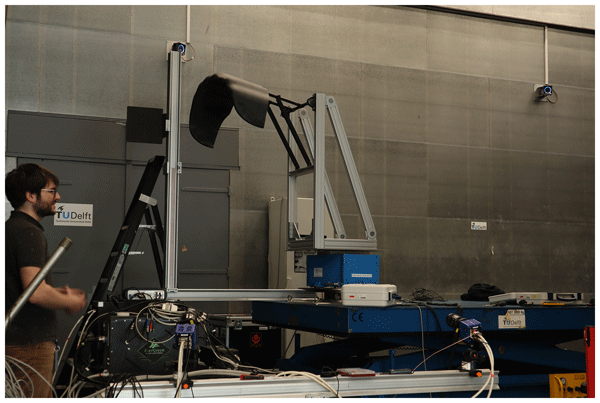
We studied how air flows around a rigid-scale model of a soft-wing kite used for harvesting airborne wind energy and wind-assisted ship propulsion. Using a wind tunnel and a laser-based imaging method, we measured the airflow at different angles to compare with simulations. Measured flow field results confirm numerical predictions.
For the measurements with low uncertainty, the derived lift force quantities also correspond well with numerical predictions.
For the measurements with low uncertainty, the derived lift force quantities also correspond well with numerical predictions.
Jelle Agatho Wilhelm Poland, Johannes Marinus van Spronsen, Mac Gaunaa, and Roland Schmehl
Wind Energ. Sci., 11, 911–936, https://doi.org/10.5194/wes-11-911-2026, https://doi.org/10.5194/wes-11-911-2026, 2026
Short summary
Short summary
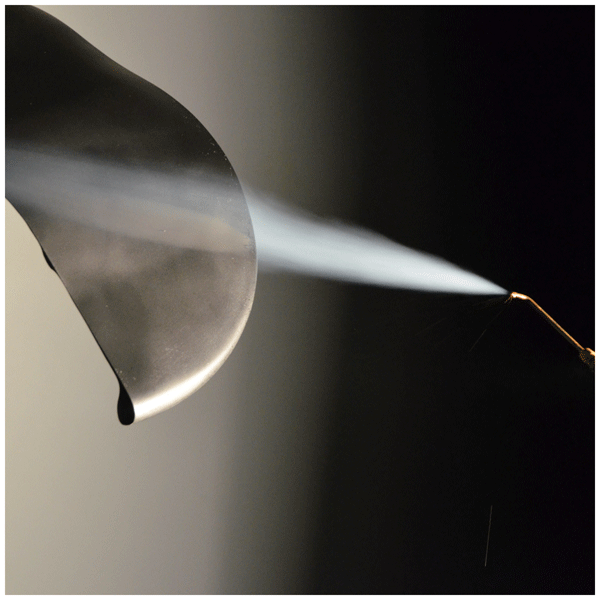
We tested a small model of an energy-generating kite in a wind tunnel to study its aerodynamic behaviour. By comparing measurements to computer simulations, we validated the models and identified where they match the real performance and where they fall short. These insights will guide more accurate aerodynamic modelling and inform design choices for kites used in airborne wind energy systems.
Monika Pasquali, Oriol Cayon, Spilios Theodoulis, Christophe Farges, Tudor-Bogdan Airimitoaie, Patrick Lanusse, and Roland Schmehl
Wind Energ. Sci. Discuss., https://doi.org/10.5194/wes-2026-180, https://doi.org/10.5194/wes-2026-180, 2026
Preprint under review for WES
Short summary
Short summary
Predicting critical load events is crucial for reliable autonomous operation of airborne wind energy systems. The present study explores a data-driven approach to predict tether force peaks 1 s in advance, using measurement data from Kitepower's V9 soft-kite system, comprising over 1000 pumping cycles and 26 h of continuous autonomous operation.
Jelle Agatho Wilhelm Poland, Erik Fritz, and Roland Schmehl
Wind Energ. Sci., 11, 1461–1485, https://doi.org/10.5194/wes-11-1461-2026, https://doi.org/10.5194/wes-11-1461-2026, 2026
Short summary
Short summary
We studied how air flows around a rigid-scale model of a soft-wing kite used for harvesting airborne wind energy and wind-assisted ship propulsion. Using a wind tunnel and a laser-based imaging method, we measured the airflow at different angles to compare with simulations. Measured flow field results confirm numerical predictions.
For the measurements with low uncertainty, the derived lift force quantities also correspond well with numerical predictions.
For the measurements with low uncertainty, the derived lift force quantities also correspond well with numerical predictions.
Dylan Eijkelhof, Nicola Rossi, and Roland Schmehl
Wind Energ. Sci., 11, 1287–1304, https://doi.org/10.5194/wes-11-1287-2026, https://doi.org/10.5194/wes-11-1287-2026, 2026
Short summary
Short summary
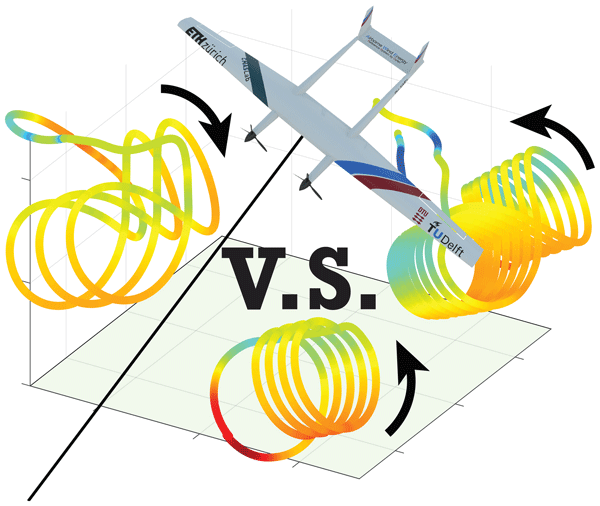
This study compares circular and figure-of-eight flight patterns for airborne wind energy systems, evaluating power output, stability, and system lifespan. Findings indicate that circular paths maximise energy generation in confined spaces, while figure-of-eight trajectories, particularly those ascending through the centre, provide smoother, more consistent power and extend kite longevity. These insights contribute to the improved design and performance of kite energy systems.
Oriol Cayon, Vince van Deursen, and Roland Schmehl
Wind Energ. Sci., 11, 1097–1121, https://doi.org/10.5194/wes-11-1097-2026, https://doi.org/10.5194/wes-11-1097-2026, 2026
Short summary
Short summary
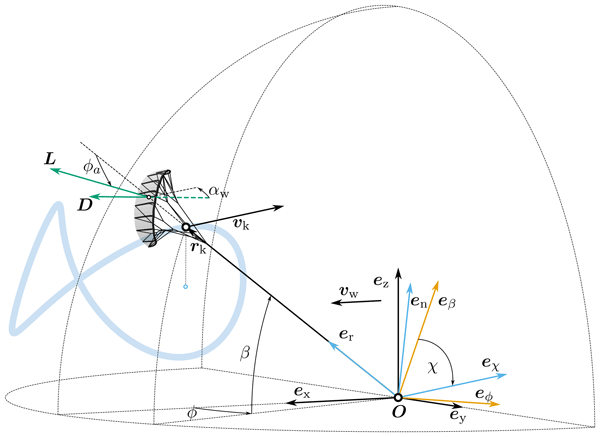
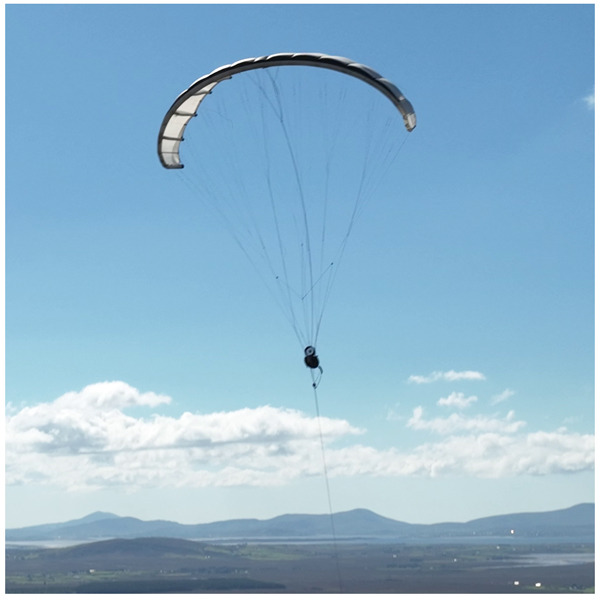
Kites can generate renewable energy by flying crosswind, but their motion is difficult to describe accurately and efficiently. This study develops a simplified model that captures how kites move through the air using a reduced number of parameters. The model was validated with flight data and provides a clearer understanding of kite motion, supporting the design of improved control strategies and energy generation.
Jelle Agatho Wilhelm Poland, Johannes Marinus van Spronsen, Mac Gaunaa, and Roland Schmehl
Wind Energ. Sci., 11, 911–936, https://doi.org/10.5194/wes-11-911-2026, https://doi.org/10.5194/wes-11-911-2026, 2026
Short summary
Short summary
We tested a small model of an energy-generating kite in a wind tunnel to study its aerodynamic behaviour. By comparing measurements to computer simulations, we validated the models and identified where they match the real performance and where they fall short. These insights will guide more accurate aerodynamic modelling and inform design choices for kites used in airborne wind energy systems.
Oriol Cayon, Simon Watson, and Roland Schmehl
Wind Energ. Sci., 10, 2161–2188, https://doi.org/10.5194/wes-10-2161-2025, https://doi.org/10.5194/wes-10-2161-2025, 2025
Short summary
Short summary
This study demonstrates how kites used to generate wind energy can act as sensors to measure wind conditions and system behaviour. By combining data from existing sensors, such as those measuring position, speed, and forces on the tether, a sensor fusion technique accurately estimates wind conditions and kite performance. This approach can be integrated into control systems to help optimize energy generation and enhance the reliability of these systems under changing wind conditions.
Rishikesh Joshi, Dominic von Terzi, and Roland Schmehl
Wind Energ. Sci., 10, 695–718, https://doi.org/10.5194/wes-10-695-2025, https://doi.org/10.5194/wes-10-695-2025, 2025
Short summary
Short summary
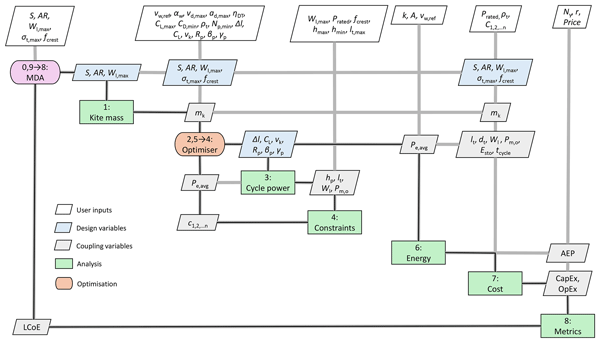
This paper presents a methodology for assessing the system design and scaling trends in airborne wind energy (AWE). A multi-disciplinary design, analysis, and optimisation (MDAO) framework was developed, integrating power, energy production, and cost models for the fixed-wing ground-generation (GG) AWE concept. Using the levelized cost of electricity (LCoE) as the design objective, we found that the optimal size of systems lies between the rated power of 100 and 1000 kW.
Helena Schmidt, Renatto M. Yupa-Villanueva, Daniele Ragni, Roberto Merino-Martínez, Piet J. R. van Gool, and Roland Schmehl
Wind Energ. Sci., 10, 579–595, https://doi.org/10.5194/wes-10-579-2025, https://doi.org/10.5194/wes-10-579-2025, 2025
Short summary
Short summary
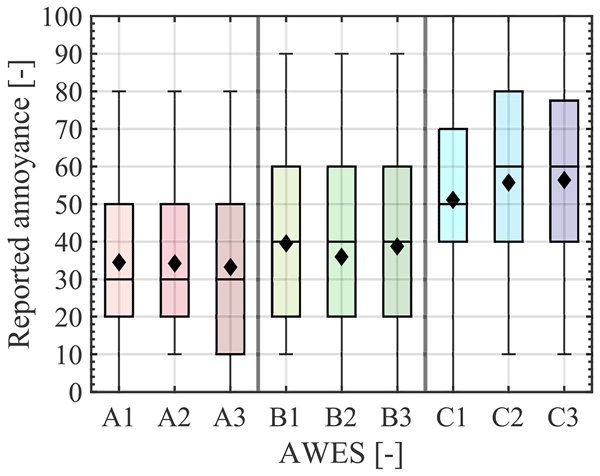
This study investigates noise annoyance caused by airborne wind energy systems (AWESs), a novel wind energy technology that uses kites to harness high-altitude winds. Through a listening experiment with 75 participants, sharpness was identified as the key factor predicting annoyance. Fixed-wing kites generated more annoyance than soft-wing kites, likely due to their sharper, more tonal sound. The findings can help improve AWESs’ designs, reducing noise-related disturbances for nearby residents.
Christoph Elfert, Dietmar Göhlich, and Roland Schmehl
Wind Energ. Sci., 9, 2261–2282, https://doi.org/10.5194/wes-9-2261-2024, https://doi.org/10.5194/wes-9-2261-2024, 2024
Short summary
Short summary
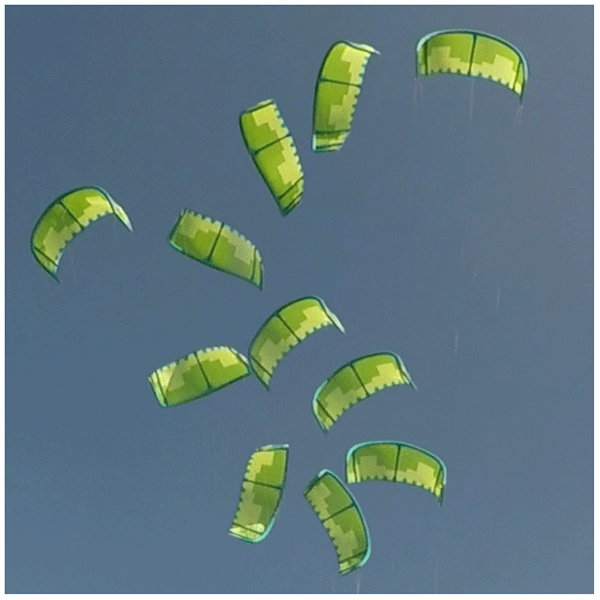
This article presents a tow test procedure for measuring the steering behaviour of tethered membrane wings. The experimental set-up includes a novel onboard sensor system for measuring the position and orientation of the towed wing, complemented by an attached low-cost multi-hole probe for measuring the relative flow velocity vector at the wing. The measured data (steering gain and dead time) can be used to improve kite models and simulate the operation of airborne wind energy systems.
Rishikesh Joshi, Roland Schmehl, and Michiel Kruijff
Wind Energ. Sci., 9, 2195–2215, https://doi.org/10.5194/wes-9-2195-2024, https://doi.org/10.5194/wes-9-2195-2024, 2024
Short summary
Short summary
This paper presents a fast cycle–power computation model for fixed-wing ground-generation airborne wind energy systems. It is suitable for sensitivity and scalability studies, which makes it a valuable tool for design and innovation trade-offs. It is also suitable for integration with cost models and systems engineering tools, enhancing its applicability in assessing the potential of airborne wind energy in the broader energy system.
Mark Schelbergen and Roland Schmehl
Wind Energ. Sci., 9, 1323–1344, https://doi.org/10.5194/wes-9-1323-2024, https://doi.org/10.5194/wes-9-1323-2024, 2024
Short summary
Short summary
We present a novel two-point model of a kite with a suspended control unit to describe the characteristic swinging motion of this assembly during turning manoeuvres. Quasi-steady and dynamic model variants are combined with a discretised tether model, and simulation results are compared with measurement data of an instrumented kite system. By resolving the pitch of the kite, the model allows for computing the angle of attack, which is essential for estimating the generated aerodynamic forces.
Maaike Sickler, Bart Ummels, Michiel Zaaijer, Roland Schmehl, and Katherine Dykes
Wind Energ. Sci., 8, 1225–1233, https://doi.org/10.5194/wes-8-1225-2023, https://doi.org/10.5194/wes-8-1225-2023, 2023
Short summary
Short summary
This paper investigates the effect of wind farm layout on the performance of offshore wind farms. A regular farm layout is compared to optimised irregular layouts. The irregular layouts have higher annual energy production, and the power production is less sensitive to wind direction. However, turbine towers require thicker walls to counteract increased fatigue due to increased turbulence levels in the farm. The study shows that layout optimisation can be used to maintain high-yield performance.
Cited articles
Anderson, J., Corda, S., and Wie, D. V.: Numerical lifting line theory applied to drooped leading-edge wings below and above stall, J. Aircraft, 17, 898–904, https://doi.org/10.2514/3.44690, 1980. a
Barnes, J. P.: Semi-Empirical Vortex Step Method for the Lift and Induced Drag Loading of 2D or 3D Wings, in: Proceedings of the 1997 World Aviation Congress, Anaheim, CA, USA, https://doi.org/10.2514/6.1997-5559, 1997. a
Batchelor, G.: An Introduction to Fluid Dynamics, Cambridge University Press, https://doi.org/10.1017/CBO9780511800955, 1967. a, b
Belloc, H.: Wind Tunnel Investigation of a Rigid Paraglider Reference Wing, J. Aircraft, 52, 703–708, https://doi.org/10.2514/1.C032513, 2015. a, b
Bhagwat, M. J. and Leishman, J. G.: Generalized Viscous Vortex Model for Application to Free-Vortex Wake and Aeroacoustic Calculations, in: Proceedings of the 58th Annual Forum and Technology Display of the American Helicopter Society International, https://www.researchgate.net/publication/255470975_Generalized_viscous_vortex_model_for_application_to_free-vortex_wake_and_aeroacoustic_calculations (last access: 16 February 2026), 2002. a
Bosch, A., Schmehl, R., Tiso, P., and Rixen, D.: Dynamic nonlinear aeroelastic model of a kite for power generation, Journal of Guidance, Control and Dynamics, 37, 1426–1436, https://doi.org/10.2514/1.G000545, 2014. a
Branlard, E., Brownstein, I., Strom, B., Jonkman, J., Dana, S., and Baring-Gould, E. I.: A multipurpose lifting-line flow solver for arbitrary wind energy concepts, Wind Energ. Sci., 7, 455–467, https://doi.org/10.5194/wes-7-455-2022, 2022. a
Braslow, A. and Knox, E.: Simplified method for determining critical height of distributed roughness particles for boundary-layer transition, Tech. Rep. TN 4363, NACA, https://ntrs.nasa.gov/citations/19930085292 (last access: 16 February 2026), 1958. a
Breukels, J., Schmehl, R., and Ockels, W.: Aeroelastic Simulation of Flexible Membrane Wings based on Multibody System Dynamics, in: Airborne Wind Energy, edited by: Ahrens, U., Diehl, M., and Schmehl, R., Green Energy and Technology, 287–305, Springer, Berlin Heidelberg, https://doi.org/10.1007/978-3-642-39965-7_16, 2013. a
Candade, A. A., Ranneberg, M., and Schmehl, R.: Aero-structural Design of Composite Wings for Airborne Wind Energy Applications, J. Phys.-Conf. Ser., 1618, 032016, https://doi.org/10.1088/1742-6596/1618/3/032016, 2020. a
Castro-Fernández, I., Sánchez-Arriaga, G., and García-Villalba, M.: A review of the aerodynamics of airborne wind energy systems, Progress in Aerospace Sciences, 161, 101157, https://doi.org/10.1016/j.paerosci.2025.101157, 2026. a
Cayon, O., Gaunaa, M., and Schmehl, R.: Fast Aero-Structural Model of a Leading-Edge Inflatable Kite, Energies, 16, 3061, https://doi.org/10.3390/en16073061, 2023. a, b, c, d
Cayon, O., van Deursen, V., and Schmehl, R.: Translational dynamics of bridled kites: a reduced-order model in the course reference frame, Wind Energ. Sci., 11, 1097–1121, https://doi.org/10.5194/wes-11-1097-2026, 2026. a, b
Chattot, J.-J.: Analysis and design of wings and wing/winglet combinations at low speeds, in: Proceedings of the 42nd AIAA Aerospace Sciences Meeting and Exhibit, Reno, NV, USA, https://doi.org/10.2514/6.2004-220, 2004. a
Deaves, M.: An Investigation of the Non-Linear 3D Flow Effects Relevant for Leading Edge Inflatable Kites, Master's thesis, Delft University of Technology, https://resolver.tudelft.nl/uuid:ccb56154-0b70-4a41-8223-24b0f8d145c5 (last access: 16 February 2015), 2015. a
Dekking, F., Kraaikamp, C., Lopuhaä, H., and Meester, L.: A Modern Introduction to Probability and Statistics: Understanding Why and How, Springer, London, 1st edn., https://doi.org/10.1007/1-84628-168-7, 2005. a, b
Den Boer, R.: Low Speed Aerodynamic Characteristics of a Two-Dimensional Sail Wing with Adjustable Slack of the Sail, Tech. Rep. LR-307, Technische Hogeschool Delft, Luchtvaart- en Ruimtevaarttechniek, https://resolver.tudelft.nl/uuid:18ae2cc6-434e-49c8-9296-d3fa450850a5 (last access: 16 February 2026), 1980. a
Dias, J. N.: Nonlinear lifting-line algorithm for unsteady and post-stall conditions, in: Proceedings of the 34th AIAA Applied Aerodynamics Conference, 1–11, Washington, DC, USA, https://doi.org/10.2514/6.2016-4164, 2016. a
Dorn, N. H. V. and DeYoung, J.: A Comparison of Three Theoretical Methods of Calculating Span Load Distribution on Swept Wings, Tech. Rep. Technical Note 1476, National Advisory Committee for Aeronautics (NACA), https://ntrs.nasa.gov/citations/19930082478 (last access: 4 January 2026), 1947. a
Duport, C.: Modeling with consideration of the fluid-structure interaction of the behavior under load of a kite for auxiliary traction of ships, Ph.D. thesis, University of Bretagne, https://theses.hal.science/tel-02383312 (last access: 21 April 2026), 2018. a
Duport, C., Leroux, J.-B., Roncin, K., Jochum, C., and Parlier, Y.: Benchmarking of a 3D non-linear lifting line method against 3D RANSE simulations, La Houille Blanche, 105, 70–73, https://doi.org/10.1051/lhb/2019029, 2019. a
Elfert, C., Göhlich, D., and Schmehl, R.: Measurement of the turning behaviour of tethered membrane wings using automated flight manoeuvres, Wind Energ. Sci., 9, 2261–2282, https://doi.org/10.5194/wes-9-2261-2024, 2024. a
Ferziger, J. H., Perić, M., and Street, R. L.: Computational Methods for Fluid Dynamics, Springer Nature Switzerland AG, Cham, Switzerland, 4th edn., https://doi.org/10.1007/978-3-319-99693-6, 2020. a
Folkersma, M., Schmehl, R., and Viré, A.: Steady-State Aeroelasticity of a Ram-Air Wing for Airborne Wind Energy Applications, J. Phys.-Conf. Ser., 1618, 032018, https://doi.org/10.1088/1742-6596/1618/3/032018, 2020. a
Folkersma, M. A. M.: Aeroelasticity of Membrane Kites, Ph.D. thesis, Delft University of Technology, https://doi.org/10.4233/uuid:eae39f5a-49bc-438b-948f-b6ab51208068, 2022. a
Fransson, J. H. M., Matsubara, M., and Alfredsson, P. H.: Transition induced by free-stream turbulence, J. Fluid Mech., 527, 1–25, https://doi.org/10.1017/S0022112004002770, 2005. a
Fritz, E. K.: Swept Away: Numerical and Experimental Investigations into Swept Wind Turbine Blades, Ph.D. thesis, Delft University of Technology, https://doi.org/10.4233/uuid:55415991-053c-4c74-b31a-3db8724bfab7, 2024. a
Gallay, S. and Laurendeau, E.: Nonlinear generalized lifting-line coupling algorithms for pre/poststall flows, AIAA Journal, 53, 1784–1792, https://doi.org/10.2514/1.J053530, 2015. a
Garrel, A. V.: Development of a Wind Turbine Aero-Module for FOCUS, Tech. rep., Energy Research Centre of the Netherlands (ECN), https://publications.ecn.nl/ECN-C--03-079 (last access: 16 February 2026), 2003. a
Gaunaa, M., Li, Y., Pirrung, G., Kallesøe, B. S., and Madsen, H. A.: A correction model for the effect of spanwise flow on the viscous force contribution in BEM and Lifting Line methods, J. Phys.-Conf. Ser., 2767, 022068, https://doi.org/10.1088/1742-6596/2767/2/022068, 2024. a
Gaunaa, M., Carqueija P. F. P., Réthoré, P.-E., and Sørensen, N. N.: A Computationally Efficient Method for Determining the Aerodynamic Performance of Kites for Wind Energy Applications, in: EWEA Annual Event 2011, European Wind Energy Association (EWEA), https://backend.orbit.dtu.dk/ws/portalfiles/portal/6241674/Gaunaa_poster_EWEA2011presentation[1].pdf (last access: 16 February 2026), 2011. a
Goates, C. and Hunsaker, D.: Practical Implementation of a General Numerical Lifting-Line Method, in: AIAA Scitech 2021 Forum, https://doi.org/10.2514/6.2021-0118, 2021. a
Hummel, J., Göhlich, D., and Schmehl, R.: Automatic measurement and characterization of the dynamic properties of tethered membrane wings, Wind Energ. Sci., 4, 41–55, https://doi.org/10.5194/wes-4-41-2019, 2019. a
Hunsaker, D.: Post stall behavior of a lifting line algorithm, https://digitalcommons.usu.edu/mae_facpub/103/ (last access: 12 August 2025), 2007. a
Jain, I., Katiyar, S., and Sarkar, S.: Influence of Varying Freestream Turbulence on Flow Transition Over Distributed Surface Roughness, in: Proceedings of the ASME Turbo Expo 2024: Turbomachinery Technical Conference and Exposition, GT2024, V12CT32A018, ASME, https://doi.org/10.1115/GT2024-124283, 2024. a
Kitepower: Kitepower; Airborne Wind Energy; Plug and Play, Mobile Wind Energy, https://thekitepower.com/ (last access: 9 January 2025), 2025. a
Kutta, M. W.: Auftriebskräfte in strömenden Flüssigkeiten, Illustrierte Aeronautische Mitteilungen, 6, 133, 1902. a
Leloup, R., Roncin, K., Bles, G., Leroux, J. B., Jochum, C., and Parlier, Y.: Estimation of the lift-to-drag ratio using the lifting line method: Application to a leading edge inflatable kite, in: Airborne Wind Energy, edited by: Ahrens, U., Schmehl, R., and Diehl, M., 339–355, Springer, https://doi.org/10.1007/978-3-642-39965-7_19, 2013. a
Lolies, T., Gourdain, N., Charlotte, M., and Goldsmith, B.: Numerical Methods for Efficient Fluid–Structure Interaction Simulations of Paragliders, Aerotec. Missili Spaz., 98, 221–229, https://doi.org/10.1007/s42496-019-00017-2, 2019. a
Loyd, M. L.: Crosswind kite power (for large-scale wind power production), J. Energy, 4, 106–111, https://doi.org/10.2514/3.48021, 1980. a
Menter, F. R.: Two-equation eddy-viscosity turbulence models for engineering applications, AIAA Journal, 32, 1598–1605, https://doi.org/10.2514/3.12149, 1994. a
Mukherjee, R. and Gopalarathnam, A.: Poststall prediction of multiple-lifting-surface configurations using a decambering approach, J. Aircraft, 43, 660–668, https://doi.org/10.2514/1.15149, 2006. a
Oehler, J. and Schmehl, R.: Aerodynamic characterization of a soft kite by in situ flow measurement, Wind Energ. Sci., 4, 1–21, https://doi.org/10.5194/wes-4-1-2019, 2019. a
OpenFOAM: OpenFOAM, OpenCFD [code], https://www.openfoam.com/ (last access: 16 February 2026), 2006. a
Pedregosa, F., Varoquaux, G., Gramfort, A., Michel, V., Thirion, B., Grisel, O., Blondel, M., Prettenhofer, P., Weiss, R., Dubourg, V., Vanderplas, J., Passos, A., Cournapeau, D., Brucher, M., Perrot, M., and Duchesnay, E.: Scikit-learn: Machine Learning in Python, J. Mach. Learn. Res., 12, 2825–2830, 2011. a, b
Phillips, W. F. and Snyder, D. O.: Modern Adaptation of Prandtl’s Classic Lifting-Line Theory, J. Aircraft, 37, 662–670, https://doi.org/10.2514/2.2649, 2000. a, b
Pistolesi, E.: Aerodinamica, Biblioteca dell'Ingegnere, Scienze Propedeutiche, I, Unions Tipografica Editrice Torinese, https://openlibrary.org/works/OL8269760W/Aerodinamica?edition=key:/books/OL6290732M (last access: 16 February 2026), 1932. a
Pointwise: Fidelity Pointwise [code], https://www.cfd-technologies.co.uk/fidelity-pointwise/ (last access: 16 February 2026), 2025. a
Poland, J. A. W., Lebesque, G., Schmehl, R., and Viré, A.: Surface mesh of the TUDELFT_V3_KITE CAD with edge fillets, in: Wind Energy Science (Version 0.0.1, Issue -), Zenodo [data set], https://doi.org/10.5281/zenodo.15316036, 2025a. a
Poland, J. A. W., Masure, K. R. G., and Schmehl, R.: Machine learning models for leading-edge inflatable airfoil aerodynamics, Zenodo [data set], https://doi.org/10.5281/zenodo.16925759, 2025b. a
Poland, J. A. W., Fritz, E., and Schmehl, R.: Flow field analysis of a leading-edge inflatable kite rigid-scale model using stereoscopic particle image velocimetry, Wind Energ. Sci., 11, 1461–1485, https://doi.org/10.5194/wes-11-1461-2026, 2026a. a, b
Poland, J. A. W., Masure, K. R. G., Cayon, O., and Schmehl, R.: Computational aerodynamics for soft-wing kite design (Version v1.0.2), Zenodo [code], https://doi.org/10.5281/zenodo.18351808, 2026. a
Poland, J. A. W., Schmehl, R., Cayón Domingo, O., and Masure, K. R. G.: Supporting dataset to analysis code, use to generate figures for the paper: “Computational aerodynamics for leading-edge inflatable kite design”, in: Wind Energy Science, Zenodo [data set], https://doi.org/10.5281/zenodo.18351331, 2026d. a
Prandtl, L.: Tragflügeltheorie, I. Mitteilung, Nachrichten von der Gesellschaft der Wissenschaften zu Göttingen, Mathematisch-Physikalische Klasse, 1918, 451–477, http://eudml.org/doc/59036 (last access: 16 February 2026), 1918. a
Sharpe, P.: NeuralFoil: An airfoil aerodynamics analysis tool using physics-informed machine learning, GitHub [code], https://github.com/peterdsharpe/NeuralFoil (last access: 16 February 2026), 2023. a
Simonet, T., Roncin, K., Faure, T., and Daridon, L.: An Efficient 3D Non-Linear Lifting-Line Method with Correction for Post-Stall Regime, Research Square [preprint], https://doi.org/10.21203/rs.3.rs-3955527/v1, in review, 2026. a, b
Tani, I.: A Simple Method of Calculating the Induced Velocity of a Monoplane Wing, Bulletin of the Aeronautical Research Institute, Tokyo Imperial University, 9, 64–76, https://jaxa.repo.nii.ac.jp/records/35482 (last access: 16 February 2026), 1934. a
Thedens, P.: An integrated aero-structural model for ram-air kite simulations: with application to airborne wind energy, Ph.D. thesis, Delft University of Technology, https://doi.org/10.4233/uuid:16e90401-62fc-4bc3-bf04-7a8c7bb0e2ee, 2022. a
Van der Vlugt, R., Bley, A., Noom, M., and Schmehl, R.: Quasi-steady model of a pumping kite power system, Renew. Energ., 131, 83–99, https://doi.org/10.1016/j.renene.2018.07.023, 2019. a
Viré, A., Demkowicz, P., Folkersma, M., Roullier, A., and Schmehl, R.: Reynolds-averaged Navier-Stokes simulations of the flow past a leading edge inflatable wing for airborne wind energy applications, J. Phys.-Conf. Ser., 1618, 032007, https://doi.org/10.1088/1742-6596/1618/3/032007, 2020. a, b, c, d, e, f, g
Weissinger, J.: The Lift Distribution of Swept-Back Wings, Tech. Rep. Technical Memorandum 1120, National Advisory Committee for Aeronautics (NACA), translation of Forschungsbericht 1553: Über die Auftriebsverteilung von Pfeilflügeln, https://ntrs.nasa.gov/citations/20030064148 (last access: 17 November 2025), 1947. a
Wick, B. H.: Study of the Subsonic Forces and Moments on an Inclined Plate of Infinite Span, Technical Note NACA-TN-3221, National Advisory Committee for Aeronautics, Washington, D.C., https://ntrs.nasa.gov/api/citations/19930084119/downloads/19930084119.pdf (last access: 16 February 2026), 1954. a
Zhang, Y., Zhou, Z., Wang, K., and Li, X.: Aerodynamic Characteristics of Different Airfoils under Varied Turbulence Intensities at Low Reynolds Numbers, Appl. Sci., 10, 1706, https://doi.org/10.3390/app10051706, 2020. a
Short summary
Soft inflatable kites are promising tools for renewable applications, but their unusual shape makes them difficult to analyse with conventional aerodynamic methods. A fast, accurate computer model is presented based on detailed airflow simulations and wind tunnel measurements. Aerodynamic forces are predicted within about 10% of experimental values while requiring far less computing time. It also helps designers to balance efficiency and stability, enabling faster, more reliable kite development.
Soft inflatable kites are promising tools for renewable applications, but their unusual shape...


Altmetrics
Final-revised paper
Preprint