
Articles | Volume 11, issue 11
https://doi.org/10.5194/wes-11-4367-2026
© Author(s) 2026. This work is distributed under
the Creative Commons Attribution 4.0 License.
https://doi.org/10.5194/wes-11-4367-2026
© Author(s) 2026. This work is distributed under
the Creative Commons Attribution 4.0 License.
Research article
| 
27 Nov 2026
Research article |
| 27 Nov 2026
Effects of atmospheric thermal stratification on wake aerodynamics of a regenerative wind farm unit

Delft University of Technology, Faculty of Aerospace Engineering, Kluyerweg 1, 2629 HS Delft, the Netherlands
Andrea Sciacchitano
Delft University of Technology, Faculty of Aerospace Engineering, Kluyerweg 1, 2629 HS Delft, the Netherlands
Delft University of Technology, Faculty of Aerospace Engineering, Kluyerweg 1, 2629 HS Delft, the Netherlands
Related authors
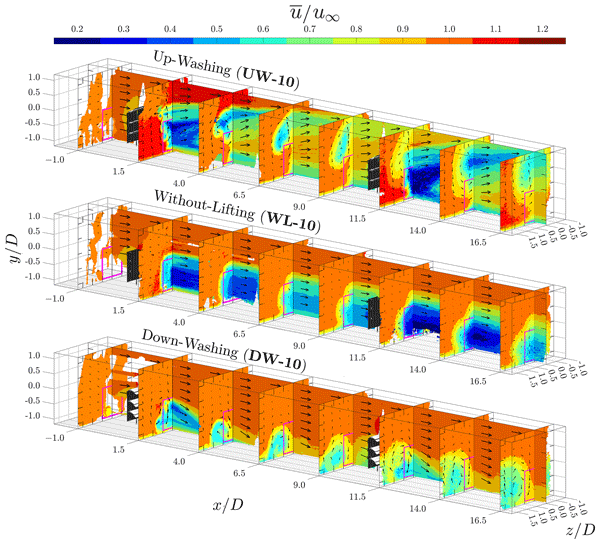
YuanTso Li, Marnix Fijen, Brian Dsouza, Wei Yu, Andrea Sciacchitano, and Carlos Ferreira
Wind Energ. Sci., 10, 3091–3124, https://doi.org/10.5194/wes-10-3091-2025, https://doi.org/10.5194/wes-10-3091-2025, 2025
Short summary
Short summary
We tested an innovative wind farm concept using novelly engineered wind turbine systems that can guide airflow more efficiently within the farm. Our experiments showed that wind farms deploying this concept can harvest more than twice the wind power per unit area compared to their traditional counterparts. Furthermore, these findings support earlier simulations and point to a more efficient space-saving future for wind energy.
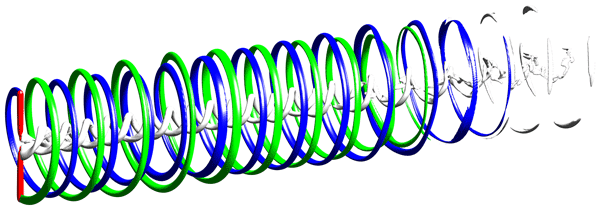
Pin Chun Yen, YuanTso Li, Fulvio Scarano, and Wei Yu
Wind Energ. Sci., 10, 1775–1805, https://doi.org/10.5194/wes-10-1775-2025, https://doi.org/10.5194/wes-10-1775-2025, 2025
Short summary
Short summary
This study explores how changing wind turbine blade length affects the aerodynamics behind the turbine. Using high-fidelity simulations, we found that varying blade lengths accelerates the leapfrogging event but does not improve wake recovery directly. In contrast, turbulence plays a bigger role, as the wake breakdown process is more influenced by it over the studied rotor asymmetries. These findings provide insights for designing more efficient wind turbine rotors.
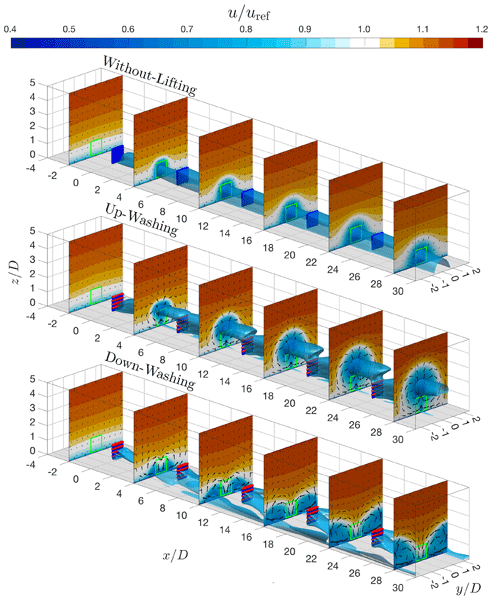
YuanTso Li, Wei Yu, Andrea Sciacchitano, and Carlos Ferreira
Wind Energ. Sci., 10, 631–659, https://doi.org/10.5194/wes-10-631-2025, https://doi.org/10.5194/wes-10-631-2025, 2025
Short summary
Short summary
A novel wind farm concept, called a regenerative wind farm, is investigated numerically. This concept tackles the significant wake interaction losses among traditional wind farms. Our results show that regenerative wind farms can greatly reduce these losses, boosting power output per unit surface. Unlike traditional farms with three-bladed wind turbines, regenerative farms use multi-rotor systems with lifting devices (MRSLs). This unconventional design effectively reduces wake losses.
Simone Tamaro, Franz Volker Mühle, Brian Dsouza, Davide Bortolin, İris Alagöz, Filippo Campagnolo, Marinos Manolesos, Andrea Sciacchitano, and Carlo Luigi Bottasso
Wind Energ. Sci. Discuss., https://doi.org/10.5194/wes-2026-214, https://doi.org/10.5194/wes-2026-214, 2026
Preprint under review for WES
Short summary
Short summary
We investigate whether combining wake steering with helix control can boost wind farm power. Wind tunnel experiments show that the benefits of the two strategies are not additive, and the combination brings no advantage over either alone. Flow measurements reveal that the vortices generated by the two strategies interact, reducing both mixing and deflection. Simulations support this mechanism, showing that individual control effects cannot simply be superimposed in engineering models.
Tim Dammann, Wei Yu, and Jan-Willem van Wingerden
Wind Energ. Sci. Discuss., https://doi.org/10.5194/wes-2026-209, https://doi.org/10.5194/wes-2026-209, 2026
Preprint under review for WES
Short summary
Short summary
When wind turbines extract kinetic energy from the wind, they leave behind a trail of slow moving air. these so-called wake effects drastically lower power production of wind farms. The helix approach aims to mitigate these wake effects by deforming the wake into a helixal shape and thereby enhance mixing with the surrounding air. Using detailed supercomputer simulations, we developed the first fast engineering model that dscribes this spiral as it evolves in space and time.
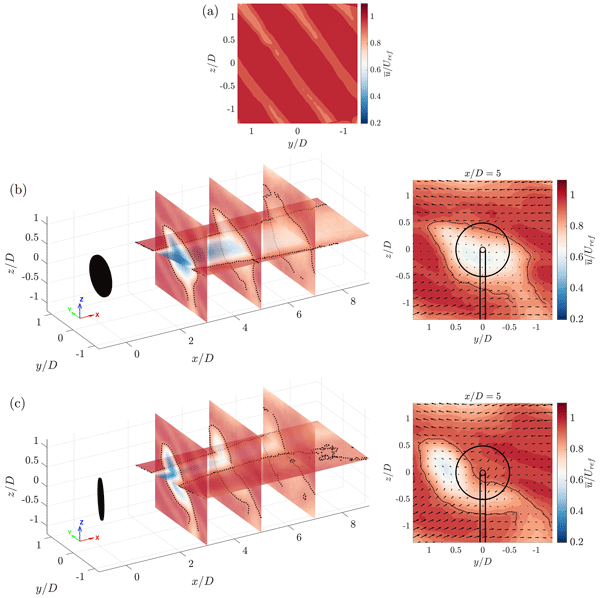
Shantanu Purohit, Haoyuan Sun, Andrea Sciacchitano, and Wei Yu
Wind Energ. Sci., 11, 3671–3701, https://doi.org/10.5194/wes-11-3671-2026, https://doi.org/10.5194/wes-11-3671-2026, 2026
Short summary
Short summary
We experimentally investigated how changes in wind direction with height, known as wind veer, affect the wakes of wind turbines. The results demonstrate that wind veer leads to faster wake recovery and higher available power for downwind turbines. The impact of wind veer on yawed turbines is also studied, and it was observed that under strong veer conditions, yawing does not provide a significantly larger benefit for the available power of downwind turbines.
Bogdan Pamfil, Henrik Bredmose, Taeseong Kim, and Wei Yu
Wind Energ. Sci., 11, 2191–2227, https://doi.org/10.5194/wes-11-2191-2026, https://doi.org/10.5194/wes-11-2191-2026, 2026
Short summary
Short summary
We introduce fast response methods to predict how floating wind turbines behave in early design stages. By transforming the equations of motion into a form that is easier to compute, our approach avoids longer simulations while preserving accuracy. We developed both single and double perturbation methods, which run far faster than standard models with errors under 3.5 %. The single perturbation method at second order offers the strongest balance of speed and accuracy.
Abhratej Sahoo, Wei Yu, and Daniele Ragni
Wind Energ. Sci., 11, 1971–1988, https://doi.org/10.5194/wes-11-1971-2026, https://doi.org/10.5194/wes-11-1971-2026, 2026
Short summary
Short summary
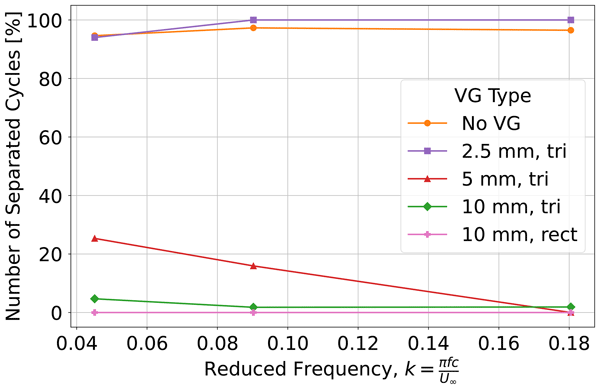
Vortex generators (VGs) are being used to prevent flow separation and stall on wind turbine blades. Optimal VG designs are chosen from steady investigations, assuming similar separation control characteristics between steady and unsteady conditions. Surface pressure measurements on a thick pitching airfoil with VGs show that VGs larger than the optimal steady size and rectangular VGs instead of the common triangular VGs must be used to consistently prevent unsteady flow separation and dynamic stall.
Marinos Manolesos, Sandrine Aubrun, Christian Bak, Paolo Bettini, Filippo Campagnolo, Alessandro Croce, Arslan Salim Dar, Michael Hölling, Stefan Ivanell, Konstantinos Kellaris, Miguel Alfonso Mendez, Pierluigi Montinari, Franz Mühle, George Papadakis, Fernardo Porté-Agel, Daniele Ragni, Sebastiano Randino, Andrea Sciacchitano, Lorenzo Schena, Gerard Schepers, Antonio Segalini, Wei Yu, and Carlo Luigi Bottasso
Wind Energ. Sci. Discuss., https://doi.org/10.5194/wes-2026-51, https://doi.org/10.5194/wes-2026-51, 2026
Manuscript not accepted for further review
Short summary
Short summary
As wind turbines grow to unprecedented sizes, ensuring their reliability requires advanced testing. We reviewed the current state of wind tunnel experiments, examining how scaled physical models are evaluated for wind flow, flexibility, and noise. We conclude that while laboratory testing remains essential, it is most powerful when integrated with computer simulations and real-world data. This combined approach will ultimately drive the design of more efficient and sustainable wind energy.
Abhratej Sahoo, Akshay Koodly Ravishankara, Wei Yu, Daniele Ragni, and Carlos Simao Ferreira
Wind Energ. Sci., 11, 127–154, https://doi.org/10.5194/wes-11-127-2026, https://doi.org/10.5194/wes-11-127-2026, 2026
Short summary
Short summary
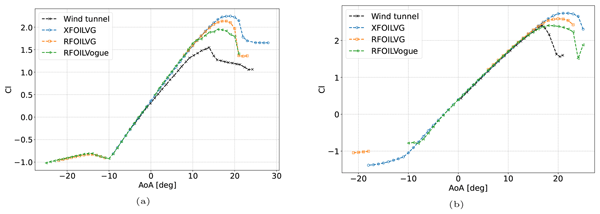
A new model incorporates vortex generator (VG) effects into fast aerodynamic tools like XFOIL and RFOIL. It modifies boundary layer equations and uses empirical functions scaled with VG geometry and Reynolds numbers to implement the modified integral boundary layer equations in RFOIL. The model improves accuracy across airfoils and predicts separation delay, stall delay, lift increase, and added drag, enabling VG effects to be included in wind turbine blade design.
YuanTso Li, Marnix Fijen, Brian Dsouza, Wei Yu, Andrea Sciacchitano, and Carlos Ferreira
Wind Energ. Sci., 10, 3091–3124, https://doi.org/10.5194/wes-10-3091-2025, https://doi.org/10.5194/wes-10-3091-2025, 2025
Short summary
Short summary
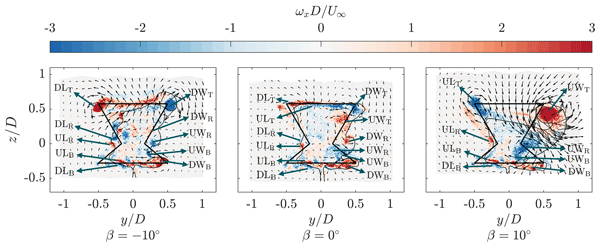
We tested an innovative wind farm concept using novelly engineered wind turbine systems that can guide airflow more efficiently within the farm. Our experiments showed that wind farms deploying this concept can harvest more than twice the wind power per unit area compared to their traditional counterparts. Furthermore, these findings support earlier simulations and point to a more efficient space-saving future for wind energy.
David Bensason, Andrea Sciacchitano, and Carlos Ferreira
Wind Energ. Sci., 10, 2137–2159, https://doi.org/10.5194/wes-10-2137-2025, https://doi.org/10.5194/wes-10-2137-2025, 2025
Short summary
Short summary
This study is an experimental exploration of the wake of the novel X-Rotor vertical-axis wind turbine. Passive blade pitch is used to favorably modify the wake topology and subsequent energy replenishment process. The results demonstrate significant increases in available power for downstream rotors and the underlying mechanisms, highlighting the potential of vertical-axis wind turbines and passive blade pitch control for high-energy-density wind farm applications.
Pin Chun Yen, YuanTso Li, Fulvio Scarano, and Wei Yu
Wind Energ. Sci., 10, 1775–1805, https://doi.org/10.5194/wes-10-1775-2025, https://doi.org/10.5194/wes-10-1775-2025, 2025
Short summary
Short summary
This study explores how changing wind turbine blade length affects the aerodynamics behind the turbine. Using high-fidelity simulations, we found that varying blade lengths accelerates the leapfrogging event but does not improve wake recovery directly. In contrast, turbulence plays a bigger role, as the wake breakdown process is more influenced by it over the studied rotor asymmetries. These findings provide insights for designing more efficient wind turbine rotors.
David Bensason, Jayant Mulay, Andrea Sciacchitano, and Carlos Ferreira
Wind Energ. Sci., 10, 1499–1528, https://doi.org/10.5194/wes-10-1499-2025, https://doi.org/10.5194/wes-10-1499-2025, 2025
Short summary
Short summary
The wake of a scaled vertical-axis wind turbine farm was measured, resulting in the first experimental database of 3D-resolved flow-field measurements. In addition to the baseline operating conditions, two modes of wake control were tested, which involve the passive adjustment of the rotor blade pitch. The results highlight the impacts of these mode adjustments on the trailing vorticity system, wake topology, and affinity towards increasing the rate of wake recovery throughout the farm.
YuanTso Li, Wei Yu, Andrea Sciacchitano, and Carlos Ferreira
Wind Energ. Sci., 10, 631–659, https://doi.org/10.5194/wes-10-631-2025, https://doi.org/10.5194/wes-10-631-2025, 2025
Short summary
Short summary
A novel wind farm concept, called a regenerative wind farm, is investigated numerically. This concept tackles the significant wake interaction losses among traditional wind farms. Our results show that regenerative wind farms can greatly reduce these losses, boosting power output per unit surface. Unlike traditional farms with three-bladed wind turbines, regenerative farms use multi-rotor systems with lifting devices (MRSLs). This unconventional design effectively reduces wake losses.
Nirav Dangi, Koen Boorsma, Edwin Bot, Wim Bierbooms, and Wei Yu
Wind Energ. Sci. Discuss., https://doi.org/10.5194/wes-2023-90, https://doi.org/10.5194/wes-2023-90, 2023
Preprint withdrawn
Short summary
Short summary
The wind turbine wake is a downstream region of velocity deficit, resulting in a power loss for downstream wind turbines. A turbulator is proposed to minimize this velocity deficit. In this work, a very successful field test campaign was executed which demonstrated the use of segmented Gurney Flaps as a promising add-on to promote enhanced wind turbine wake recovery for improved overall wind farm farm performance.
Carlos Ferreira, Wei Yu, Arianna Sala, and Axelle Viré
Wind Energ. Sci., 7, 469–485, https://doi.org/10.5194/wes-7-469-2022, https://doi.org/10.5194/wes-7-469-2022, 2022
Short summary
Short summary
Floating offshore wind turbines may experience large surge motions that, when faster than the local wind speed, cause rotor–wake interaction.
We derive a model which is able to predict the wind speed at the wind turbine, even for large and fast motions and load variations in the wind turbine.
The proposed dynamic inflow model includes an adaptation for highly loaded flow, and it is accurate and simple enough to be easily implemented in most blade element momentum design models.
Cited articles
Abkar, M. and Porté-Agel, F.: Influence of atmospheric stability on wind-turbine wakes: A large-eddy simulation study, Phys. Fluids, 27, 035104, https://doi.org/10.1063/1.4913695, 2015. a, b, c
Ainslie, J. F.: Calculating the flowfield in the wake of wind turbines, J. Wind Eng. Ind. Aerod., 27, 213–224, https://doi.org/10.1016/0167-6105(88)90037-2, 1988. a
Allaerts, D.: Large-eddy simulation of wind farms in conventionally neutral and stable atmospheric boundary layers, Ph.D. thesis, KU Leuven, https://kuleuven.limo.libis.be/discovery/fulldisplay?docid=lirias 1731391&context=SearchWebhook&vid=32KUL_KUL:Lirias &lang=en&search_scope=lirias_profile&adaptor=SearchWebhook &tab=LIRIAS&query=any,contains,Dries allaerts&offset=0 (last access: 24 November 2026), 2016. a
Allaerts, D. and Meyers, J.: Boundary-layer development and gravity waves in conventionally neutral wind farms, J. Fluid Mech., 814, 95–130, https://doi.org/10.1017/jfm.2017.11, 2017. a, b
Andersson, L. E., Anaya-Lara, O., Tande, J. O., Merz, K. O., and Imsland, L.: Wind farm control-Part I: A review on control system concepts and structures, IET Renew. Power Gen., 15, 2085–2108, https://doi.org/10.1049/rpg2.12160, 2021. a
Avila Correia Martins, F., van Zuijlen, A., and Simão Ferreira, C.: Proof of concept for multirotor systems with vortex-generating modes for regenerative wind energy: a study based on numerical simulations and experimental data, Wind Energ. Sci., 10, 41–58, https://doi.org/10.5194/wes-10-41-2025, 2025. a, b
Bachant, P., Goude, A., daa-mec, and Wosnik, M.: turbinesFoam/turbinesFoam: v0.1.1, Zenodo [code], https://doi.org/10.5281/zenodo.3542301, 2019. a
Barthelmie, R. J., Hansen, K., Frandsen, S. T., Rathmann, O., Schepers, J. G., Schlez, W., Phillips, J., Rados, K., Zervos, A., Politis, E. S., and Chaviaropoulos, P. K.: Modelling and measuring flow and wind turbine wakes in large wind farms offshore, Wind Energy, 12, 431–444, https://doi.org/10.1002/we.348, 2009. a
Barthelmie, R. J., Pryor, S. C., Frandsen, S. T., Hansen, K. S., Schepers, J., Rados, K., Schlez, W., Neubert, A., Jensen, L., and Neckelmann, S.: Quantifying the impact of wind turbine wakes on power output at offshore wind farms, J. Atmos. Ocean. Tech., 27, 1302–1317, https://doi.org/10.1175/2010JTECHA1398.1, 2010. a
Bastankhah, M. and Porté-Agel, F.: A new analytical model for wind-turbine wakes, Renew. Energ., 70, 116–123, https://doi.org/10.1016/j.renene.2014.01.002, 2014. a
Bastankhah, M. and Porté-Agel, F.: Wind farm power optimization via yaw angle control: A wind tunnel study, J. Renew. Sustain. Ener., 11, https://doi.org/10.1063/1.5077038, 2019. a
Bastankhah, M., Zunder, J. K., Hydon, P. E., Deebank, C., and Placidi, M.: Modelling turbulence in axisymmetric wakes: an application to wind turbine wakes, J. Fluid Mech., 1000, A2, https://doi.org/10.1017/jfm.2024.664, 2024. a
Bosch, J., Staffell, I., and Hawkes, A. D.: Global levelised cost of electricity from offshore wind, Energy, 189, 116357, https://doi.org/10.1016/j.energy.2019.116357, 2019. a, b
Bossuyt, J., Scott, R., Ali, N., and Cal, R. B.: Quantification of wake shape modulation and deflection for tilt and yaw misaligned wind turbines, J. Fluid Mech., 917, A3, https://doi.org/10.1017/jfm.2021.237, 2021. a
Broertjes, T., Bensason, D., Sciacchitano, A., and Ferreira, C.: Lift-induced wake re-energization for a VAWT-based multi-rotor system, J. Phys. Conf. Ser., 2767, 072012, https://doi.org/10.1088/1742-6596/2767/7/072012, 2024. a, b
Calaf, M., Meneveau, C., and Meyers, J.: Large eddy simulation study of fully developed wind-turbine array boundary layers, Phys. Fluids, 22, 015110, https://doi.org/10.1063/1.3291077, 2010. a, b, c
Chamorro, L. P. and Porté-Agel, F.: Effects of thermal stability and incoming boundary-layer flow characteristics on wind-turbine wakes: a wind-tunnel study, Bound.-Lay. Meteorol., 136, 515–533, https://doi.org/10.1007/s10546-010-9512-1, 2010. a
Churchfield, M. J., Lee, S., Michalakes, J., and Moriarty, P. J.: A numerical study of the effects of atmospheric and wake turbulence on wind turbine dynamics, J. Turbul., 13, N14, https://doi.org/10.1080/14685248.2012.668191, 2012. a, b, c
Dangi, N., Sodja, J., Ferreira, C. S., and Yu, W.: The effect of turbulent coherent structures in atmospheric flow on wind turbine loads, Renew. Energ., 241, 122248, https://doi.org/10.1016/j.renene.2024.122248, 2025. a, b, c, d
Dar, A. S., Kotsarinis, K., and Porté-Agel, F.: Effect of thermal stability on wind turbine wakes: an experimental and analytical study, Bound.-Lay. Meteorol., 192, 27, https://doi.org/10.1007/s10546-026-00972-x, 2026. a, b, c
Deardorff, J. W.: Stratocumulus-capped mixed layers derived from a three-dimensional model, Bound.-Lay. Meteorol., 18, 495–527, https://doi.org/10.1007/BF00119502, 1980. a
DNV: Ocean's Future to 2050, https://www.dnv.com/publications/ocean-s-future-to-2050-report-213872/ (last access: 24 December 2025), 2021. a
Duan, G. and Porté-Agel, F.: Cyclic yaw control for wind farm power optimization: Effects on wake flow in the atmospheric boundary layer, Appl. Energ., 403, 127060, https://doi.org/10.1016/j.apenergy.2025.127060, 2026. a
Dupont, E., Koppelaar, R., and Jeanmart, H.: Global available wind energy with physical and energy return on investment constraints, Appl. Energ., 209, 322–338, https://doi.org/10.1016/j.apenergy.2017.09.085, 2018. a
Dutch Research Council: Numerical assessment on regenerative wind farm – a potential remedy for the wake losses among wind farms, Dutch Research Council, https://doi.org/10.61686/BYOPA39968 (last access: 25 March 2026), 2025. a, b
Ferreira, C., Bensason, D., Broertjes, T. J., Sciacchitano, A., Martins, F. A., and Ajay, A. G.: Enhancing Wind Farm Efficiency Through Active Control of the Atmospheric Boundary Layer's Vertical Entrainment of Momentum, J. Phys. Conf. Ser., 2767, 092107, https://doi.org/10.1088/1742-6596/2767/9/092107, 2024. a, b
Ferreira, C. S., Larsen, G. C., and Sørensen, J. N.: A theoretical upper limit for offshore wind energy extraction, Cell Reports Sustainability, 3, 100573, https://doi.org/10.1016/j.crsus.2025.100573, 2026. a, b, c
Fleming, P. A., Gebraad, P. M., Lee, S., van Wingerden, J.-W., Johnson, K., Churchfield, M., Michalakes, J., Spalart, P., and Moriarty, P.: Evaluating techniques for redirecting turbine wakes using SOWFA, Renew. Energ., 70, 211–218, https://doi.org/10.1016/j.renene.2014.02.015, 2014. a
Frederik, J. A., Doekemeijer, B. M., Mulders, S. P., and van Wingerden, J.-W.: The helix approach: Using dynamic individual pitch control to enhance wake mixing in wind farms, Wind Energy, 23, 1739–1751, https://doi.org/10.1002/we.2513, 2020a. a
Frederik, J. A., Weber, R., Cacciola, S., Campagnolo, F., Croce, A., Bottasso, C., and van Wingerden, J.-W.: Periodic dynamic induction control of wind farms: proving the potential in simulations and wind tunnel experiments, Wind Energ. Sci., 5, 245–257, https://doi.org/10.5194/wes-5-245-2020, 2020b. a
Gao, Z., Li, Y., Wang, T., Ke, S., and Li, D.: Recent improvements of actuator line-large-eddy simulation method for wind turbine wakes, Appl. Math. Mech., 42, 511–526, https://doi.org/10.1007/s10483-021-2717-8, 2021. a, b
Gebraad, P., Thomas, J. J., Ning, A., Fleming, P., and Dykes, K.: Maximization of the annual energy production of wind power plants by optimization of layout and yaw-based wake control, Wind Energy, 20, 97–107, https://doi.org/10.1002/we.1993, 2017. a
Global Wind Energy Council: Global Wind Report 2025, https://www.gwec.net/reports/globalwindreport (last access: 24 December 2025), 2025. a
Herbert-Acero, J. F., Probst, O., Réthoré, P.-E., Larsen, G. C., and Castillo-Villar, K. K.: A review of methodological approaches for the design and optimization of wind farms, Energies, 7, 6930–7016, https://doi.org/10.3390/en7116930, 2014. a
Jha, P. K. and Schmitz, S.: Actuator curve embedding–an advanced actuator line model, J. Fluid Mech., 834, R2, https://doi.org/10.1017/jfm.2017.793, 2018. a
Jha, P. K., Churchfield, M. J., Moriarty, P. J., and Schmitz, S.: Guidelines for volume force distributions within actuator line modeling of wind turbines on large-eddy simulation-type grids, J. Sol. Energ. E., 136, 031003, https://doi.org/10.1115/1.4026252, 2014. a, b
Khan, M. A., Allaerts, D., Watson, S. J., and Churchfield, M. J.: Investigating the relationship between simulation parameters and flow variables in simulating atmospheric gravity waves for wind energy applications, Wind Energ. Sci., 10, 1167–1185, https://doi.org/10.5194/wes-10-1167-2025, 2025. a
Kirkegaard, J. K., Rudolph, D. P., Nyborg, S., Solman, H., Gill, E., Cronin, T., and Hallisey, M.: Tackling grand challenges in wind energy through a socio-technical perspective, Nature Energy, 8, 655–664, https://doi.org/10.1038/s41560-023-01266-z, 2023. a
Lalas, D. P. and Ratto, C. F.: Modelling of atmospheric flow fields, World scientific, ISBN 9810225091, 1996. a
Lanzilao, L. and Meyers, J.: A parametric large-eddy simulation study of wind-farm blockage and gravity waves in conventionally neutral boundary layers, J. Fluid Mech., 979, A54, https://doi.org/10.1017/jfm.2023.1088, 2024. a
Lee, S., Churchfield, M. J., and Fleming, P.: Simulator for Wind Farm Applications (SOWFA), DOE CODE, https://doi.org/10.11578/dc.20171025.1778, 2016. a
Li, Y., Yu, W., and Sarlak, H.: Wake structures and performance of wind turbine rotor with harmonic surging motions under laminar and turbulent inflows, Wind Energy, 27, 1499–1525, https://doi.org/10.1002/we.2949, 2024. a
Li, Y., Yu, W., and Sarlak, H.: Wake interaction of dual surging FOWT rotors in tandem, Renew. Energ., 239, 122062, https://doi.org/10.1016/j.renene.2024.122062, 2025b. a
Li, Y., Sciacchitano, A., and Yu, W.: Augmenting Vertical Energy Entrainment within Wind Farms via Lifting Devices, J. Phys. Conf. Ser., 3224, 092006, https://doi.org/10.1088/1742-6596/3224/9/092006, 2026b. a
Martínez-Tossas, L. A., Churchfield, M. J., and Leonardi, S.: Large eddy simulations of the flow past wind turbines: actuator line and disk modeling, Wind Energy, 18, 1047–1060, https://doi.org/10.1002/we.1747, 2015. a
Mehta, M., Zaaijer, M., and von Terzi, D.: Drivers for optimum sizing of wind turbines for offshore wind farms, Wind Energ. Sci., 9, 141–163, https://doi.org/10.5194/wes-9-141-2024, 2024. a
Melani, P. F., Balduzzi, F., Ferrara, G., and Bianchini, A.: Tailoring the actuator line theory to the simulation of Vertical-Axis Wind Turbines, Energ. Convers. Manage., 243, 114422, https://doi.org/10.1016/j.enconman.2021.114422, 2021. a
Meyers, J. and Meneveau, C.: Optimal turbine spacing in fully developed wind farm boundary layers, Wind Energy, 15, 305–317, https://doi.org/10.1002/we.469, 2012. a
Meyers, J., Bottasso, C., Dykes, K., Fleming, P., Gebraad, P., Giebel, G., Göçmen, T., and van Wingerden, J.-W.: Wind farm flow control: prospects and challenges, Wind Energ. Sci., 7, 2271–2306, https://doi.org/10.5194/wes-7-2271-2022, 2022. a
Moeng, C.-H.: A large-eddy-simulation model for the study of planetary boundary-layer turbulence, J. Atmos. Sci., 41, 2052–2062, https://doi.org/10.1175/1520-0469(1984)041<2052:ALESMF>2.0.CO;2, 1984. a
Niayifar, A. and Porté-Agel, F.: Analytical modeling of wind farms: A new approach for power prediction, Energies, 9, 741, https://doi.org/10.3390/en9090741, 2016. a
OpenCFD Ltd.: OpenFOAM, https://gitlab.com/openfoam/core/openfoam (last access: 25 March 2026), 2021. a
OpenFOAM Foundation: OpenFOAM version 6, https://github.com/OpenFOAM/OpenFOAM-6 (last access: 11 December 2024), 2018. a
Paulson, C. A.: The mathematical representation of wind speed and temperature profiles in the unstable atmospheric surface layer, J. Appl. Meteorol., 9, 857–861, https://doi.org/10.1175/1520-0450(1970)009<0857:TMROWS>2.0.CO;2, 1970. a, b, c
Peña, A.: Østerild: A natural laboratory for atmospheric turbulence, J. Renew. Sustain. Ener., 11, https://doi.org/10.1063/1.5121486, 2019. a, b
Pope, S. B.: Turbulent flows, Cambridge University Press, ISBN 9780521591256, 2000. a
Porté-Agel, F., Bastankhah, M., and Shamsoddin, S.: Wind-turbine and wind-farm flows: A review, Bound.-Lay. Meteorol., 174, 1–59, https://doi.org/10.1007/s10546-019-00473-0, 2020. a, b
Qian, G.-W. and Ishihara, T.: Wind farm power maximization through wake steering with a new multiple wake model for prediction of turbulence intensity, Energy, 220, 119680, https://doi.org/10.1016/j.energy.2020.119680, 2021. a
Schumann, U.: Subgrid scale model for finite difference simulations of turbulent flows in plane channels and annuli, J. Comput. Phys., 18, 376–404, https://doi.org/10.1016/0021-9991(75)90093-5, 1975. a
Shiraishi, K., Paliwal, U., Abhyankar, N., Kammen, D. M., Phadke, A., and Park, W. Y.: Exploring offshore wind’s potential to enhance energy security in nations with limited land and fuel resources, Environ. Res. Lett., 20, 034006, https://doi.org/10.1088/1748-9326/adaed5, 2025. a, b
Sorensen, J. N. and Shen, W. Z.: Numerical modeling of wind turbine wakes, J. Fluids Eng., 124, 393–399, https://doi.org/10.1115/1.1471361, 2002. a, b, c, d
Stevens, R. J. and Meneveau, C.: Flow structure and turbulence in wind farms, Annu. Rev. Fluid Mech., 49, 311–339, https://doi.org/10.1146/annurev-fluid-010816-060206, 2017. a, b
Stevens, R. J., Gayme, D. F., and Meneveau, C.: Effects of turbine spacing on the power output of extended wind-farms, Wind Energy, 19, 359–370, https://doi.org/10.1002/we.1835, 2016. a
Stoll, R., Gibbs, J. A., Salesky, S. T., Anderson, W., and Calaf, M.: Large-eddy simulation of the atmospheric boundary layer, Bound.-Lay. Meteorol., 177, 541–581, https://doi.org/10.1007/s10546-020-00556-3, 2020. a
Tang, R., Wang, Y., Jiang, Y., Liu, M., Peng, Z., Hu, Y., Huang, L., and Li, Z.-L.: A review of global products of air-sea turbulent heat flux: accuracy, mean, variability, and trend, Earth-Sci. Rev., 249, 104662, https://doi.org/10.1016/j.earscirev.2023.104662, 2024. a
Troldborg, N.: Actuator line modeling of wind turbine wakes, Ph.D. thesis, Technical University of Denmark, ISBN 978-87-89502-80-9, 2009. a
Veers, P., Bottasso, C. L., Manuel, L., Naughton, J., Pao, L., Paquette, J., Robertson, A., Robinson, M., Ananthan, S., Barlas, T., Bianchini, A., Bredmose, H., Horcas, S. G., Keller, J., Madsen, H. A., Manwell, J., Moriarty, P., Nolet, S., and Rinker, J.: Grand challenges in the design, manufacture, and operation of future wind turbine systems, Wind Energ. Sci., 8, 1071–1131, https://doi.org/10.5194/wes-8-1071-2023, 2023. a
Victoria, M., Haegel, N., Peters, I. M., Sinton, R., Jäger-Waldau, A., Del Cañizo, C., Breyer, C., Stocks, M., Blakers, A., Kaizuka, I., Komoto, K., and Smets, A.: Solar photovoltaics is ready to power a sustainable future, Joule, 5, 1041–1056, https://doi.org/10.1016/j.joule.2021.03.005, 2021. a
Weller, H. G., Tabor, G., Jasak, H., and Fureby, C.: A tensorial approach to computational continuum mechanics using object-oriented techniques, Comp. Phys., 12, 620–631, https://doi.org/10.1063/1.168744, 1998. a
Wu, Y.-T. and Porté-Agel, F.: Modeling turbine wakes and power losses within a wind farm using LES: An application to the Horns Rev offshore wind farm, Renew. Energ., 75, 945–955, https://doi.org/10.1016/j.renene.2014.06.019, 2015. a
Wurps, H., Steinfeld, G., and Heinz, S.: Grid-resolution requirements for large-eddy simulations of the atmospheric boundary layer, Bound.-Lay. Meteorol., 175, 179–201, https://doi.org/10.1007/s10546-020-00504-1, 2020. a, b
Yen, P. C., Li, Y., Scarano, F., and Yu, W.: Near-wake behavior of an asymmetric wind turbine rotor, Wind Energ. Sci., 10, 1775–1805, https://doi.org/10.5194/wes-10-1775-2025, 2025. a
Yu, L. and Weller, R. A.: Objectively analyzed air–sea heat fluxes for the global ice-free oceans (1981–2005), B. Am. Meteorol. Soc., 88, 527–540, https://doi.org/10.1175/BAMS-88-4-527, 2007. a
Zhao, Z., Jiang, R., Feng, J., Liu, H., Wang, T., Shen, W., Chen, M., Wang, D., and Liu, Y.: Researches on vortex generators applied to wind turbines: A review, Ocean Eng., 253, 111266, https://doi.org/10.1016/j.oceaneng.2022.111266, 2022. a
Zormpa, M., Zilic de Arcos, F., Chen, X., Vogel, C. R., and Willden, R. H.: The effect of flow sampling on the robustness of the actuator line method, Wind Energy, 28, e2965, https://doi.org/10.1002/we.2965, 2025. a
Short summary
We investigate the regenerative wind farming (RGWF) concept under realistic atmospheric conditions using large-eddy simulations. The effects of convective, neutral, and stable atmospheric boundary layers on the wake of a multi-rotor system with lifting devices (MRSL, the unit of RGWF) are examined. The results show that the RGWF concept remains effective across all stability regimes, demonstrating its robustness and providing guidance for its future design and deployment.
We investigate the regenerative wind farming (RGWF) concept under realistic atmospheric...


Altmetrics
Final-revised paper
Preprint