
Articles | Volume 11, issue 2
https://doi.org/10.5194/wes-11-661-2026
© Author(s) 2026. This work is distributed under
the Creative Commons Attribution 4.0 License.
the Creative Commons Attribution 4.0 License.
https://doi.org/10.5194/wes-11-661-2026
© Author(s) 2026. This work is distributed under
the Creative Commons Attribution 4.0 License.
the Creative Commons Attribution 4.0 License.
Research article
| 
24 Feb 2026
Research article |
| 24 Feb 2026
| 24 Feb 2026
Evaluating the impact of inter-annual variability on long-term wind speed predictions
Johanna Borowski
CORRESPONDING AUTHOR

Fraunhofer IWES, Fraunhofer Institute for Wind Energy Systems IWES, Küpkersweg 70, 26129 Oldenburg, Germany
Carl von Ossietzky Universität Oldenburg, School of Mathematics and Science, Institute of Physics, Ammerländer Heerstraße 114–118, 26129 Oldenburg, Germany
Sandra Schwegmann
Fraunhofer IWES, Fraunhofer Institute for Wind Energy Systems IWES, Küpkersweg 70, 26129 Oldenburg, Germany
Kerstin Avila
ForWind – Center for Wind Energy Research, Küpkersweg 70, 26129 Oldenburg, Germany
Carl von Ossietzky Universität Oldenburg, School of Mathematics and Science, Institute of Physics, Ammerländer Heerstraße 114–118, 26129 Oldenburg, Germany
Martin Dörenkämper
Fraunhofer IWES, Fraunhofer Institute for Wind Energy Systems IWES, Küpkersweg 70, 26129 Oldenburg, Germany
Related authors
Johanna Borowski, Kerstin Avila, and Martin Dörenkämper
Wind Energ. Sci. Discuss., https://doi.org/10.5194/wes-2026-129, https://doi.org/10.5194/wes-2026-129, 2026
Preprint under review for WES
Short summary
Short summary
This study introduces a methodology that integrates climate model ensembles into the measure-correlate-predict framework for site-specific wind resource assessments. Using ERA5 reanalysis data and tall tower measurements from European sites, the approach bias-corrects climate model data to local conditions and reproduces historical wind climates. Results indicate decreases in summer wind speeds (typically 0.1–0.4 m s−¹) and slight winter increases but with greater ensemble spread in this season.
Sandra Schwegmann, Tanguy Lunel, Lukas Vollmer, and Martin Dörenkämper
Wind Energ. Sci. Discuss., https://doi.org/10.5194/wes-2026-103, https://doi.org/10.5194/wes-2026-103, 2026
Preprint under review for WES
Short summary
Short summary
This study investigates the feasibility of the Weather Research and Forecasting Model (WRF) to represent turbulence intensity (TI) and quantifies its uncertainties for the North Sea. At mesoscales, using subgrid-scale TKE for TI calculation, a mean absolute percentage error of about 30 % can be achieved. Out of the used PBL schemes, MYNN provides the lowest deviation to observed TI at a resolution of 2 km. Gray-zone simulations with a resolution of up to 111 m do rarely improve TI.
Astrid Lampert, Beatriz Cañadillas, Thomas Rausch, Lea Schmitt, Bughsin' Djath, Johannes Schulz-Stellenfleth, Andreas Platis, Kjell zum Berge, Ines Schäfer, Jens Bange, Lukas Gruchot, Thomas Neumann, Martin Dörenkämper, Bernhard Stoevesandt, Julia Gottschall, Lukas Vollmer, Stefan Emeis, Mares Barekzai, Simon Siedersleben, Martin Kühn, Gerald Steinfeld, Detlev Heinemann, Joachim Peinke, Hendrik Heißelmann, Jörge Schneemann, Gabriele Centurelli, Philipp Waldmann, and Konrad Bärfuss
Wind Energ. Sci., 11, 3057–3075, https://doi.org/10.5194/wes-11-3057-2026, https://doi.org/10.5194/wes-11-3057-2026, 2026
Short summary
Short summary
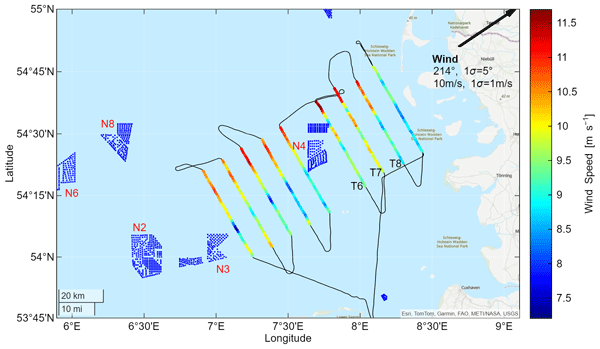
Two major aircraft measurement campaigns above the North Sea provide insights into modifications of the wind field and sea surface induced by wind farms. The aircraft performed transects at hub height upstream and downstream of wind farm clusters and identified different effects, e.g. how long it takes for the wind speed to recover after the wind farm, how changes across the coastline interact with wind energy, and if wind farms are well represented in numerical simulations.
Johanna Borowski, Kerstin Avila, and Martin Dörenkämper
Wind Energ. Sci. Discuss., https://doi.org/10.5194/wes-2026-129, https://doi.org/10.5194/wes-2026-129, 2026
Preprint under review for WES
Short summary
Short summary
This study introduces a methodology that integrates climate model ensembles into the measure-correlate-predict framework for site-specific wind resource assessments. Using ERA5 reanalysis data and tall tower measurements from European sites, the approach bias-corrects climate model data to local conditions and reproduces historical wind climates. Results indicate decreases in summer wind speeds (typically 0.1–0.4 m s−¹) and slight winter increases but with greater ensemble spread in this season.
Balthazar Arnoldus Maria Sengers, Lukas Vollmer, and Martin Dörenkämper
Wind Energ. Sci. Discuss., https://doi.org/10.5194/wes-2026-80, https://doi.org/10.5194/wes-2026-80, 2026
Revised manuscript under review for WES
Short summary
Short summary
This work compared parameterizations used in mesoscale models to estimate wind energy production against operational data from several offshore sites. Results showed differences of about five percent, with higher resolution reducing generated power due to stronger wakes. One approach best reproduced key aspects of wind farm performance. Overall, results underline known limitations, but confirm these models are useful for estimating wind farm performance.
Johannes Paulsen, Gerald Steinfeld, Martin Kühn, and Martin Dörenkämper
Wind Energ. Sci. Discuss., https://doi.org/10.5194/wes-2026-23, https://doi.org/10.5194/wes-2026-23, 2026
Revised manuscript under review for WES
Short summary
Short summary
We investigated the potential benefits in wake development and power production of a new turbine concept with a low specific rating and low induction and compared it to a reference design with same rated power. Our results show that the design can strongly increase the AEP and shows especially strong benefits during doldrum events and in strongly cluster wake affected areas. While the inner farm wake wakes are strongly decreased by the new concept, the outer farm wakes are slightly stronger.
Bjarke T. E. Olsen, Andrea N. Hahmann, Nicolas G. Alonso-de-Linaje, Mark Žagar, and Martin Dörenkämper
Geosci. Model Dev., 18, 4499–4533, https://doi.org/10.5194/gmd-18-4499-2025, https://doi.org/10.5194/gmd-18-4499-2025, 2025
Short summary
Short summary
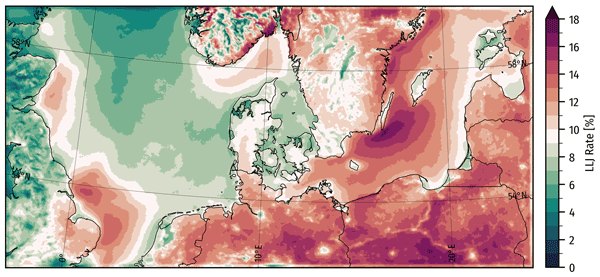
Low-level jets (LLJs) are strong winds in the lower atmosphere that are important for wind energy as turbines get taller. This study compares a weather model (WRF) with real data across five North and Baltic Sea sites. Adjusting the model improved accuracy over the widely used ERA5. In key offshore regions, LLJs occur 10–15 % of the time and significantly boost wind power, especially in spring and summer, contributing up to 30 % of total capacity in some areas.
Sonja Steinbrück, Thorben Eilers, Lukas Vollmer, Kerstin Avila, and Gerald Steinfeld
Wind Energ. Sci. Discuss., https://doi.org/10.5194/wes-2024-146, https://doi.org/10.5194/wes-2024-146, 2024
Preprint withdrawn
Short summary
Short summary
This paper introduces an enhanced coupling between the LES code PALM and the aeroelastic code FAST, enabling detailed turbine output in temporally and spatially heterogeneous atmospheric flows while maintaining computational efficiency. A wind speed correction is added to reduce errors from force smearing on the numerical grid. Results were evaluated through comparisons between different model setups and turbine measurements, including assessments in a two-turbine wake situation.
Lukas Vollmer, Balthazar Arnoldus Maria Sengers, and Martin Dörenkämper
Wind Energ. Sci., 9, 1689–1693, https://doi.org/10.5194/wes-9-1689-2024, https://doi.org/10.5194/wes-9-1689-2024, 2024
Short summary
Short summary
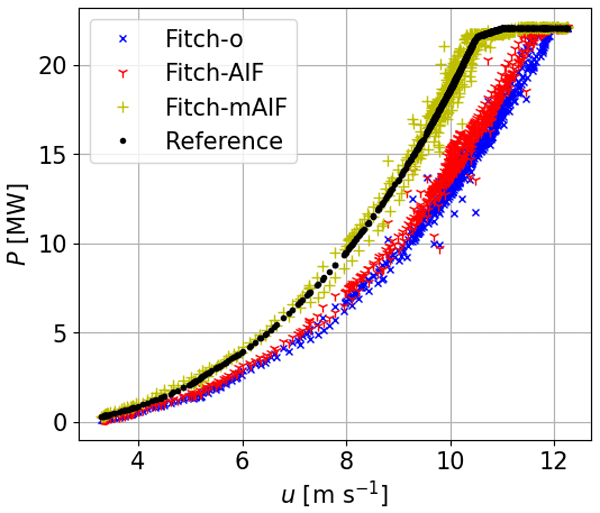
This study proposes a modification to a well-established wind farm parameterization used in mesoscale models. The wind speed at the location of the turbine, which is used to calculate power and thrust, is corrected to approximate the free wind speed. Results show that the modified parameterization produces more accurate estimates of the turbine’s power curve.
Markus Sommerfeld, Martin Dörenkämper, Jochem De Schutter, and Curran Crawford
Wind Energ. Sci., 8, 1153–1178, https://doi.org/10.5194/wes-8-1153-2023, https://doi.org/10.5194/wes-8-1153-2023, 2023
Short summary
Short summary
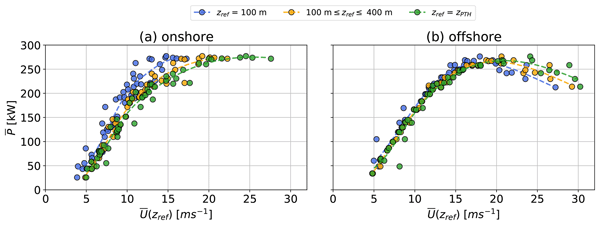
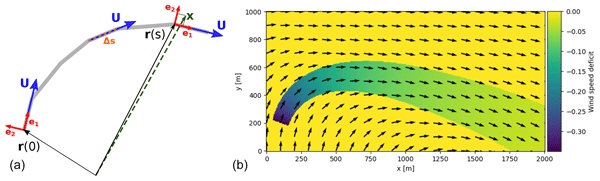
This study investigates the performance of pumping-mode ground-generation airborne wind energy systems by determining power-optimal flight trajectories based on realistic, k-means clustered, vertical wind velocity profiles. These profiles, derived from mesoscale weather simulations at an offshore and an onshore site in Europe, are incorporated into an optimal control model that maximizes average cycle power by optimizing the kite's trajectory.
Anna von Brandis, Gabriele Centurelli, Jonas Schmidt, Lukas Vollmer, Bughsin' Djath, and Martin Dörenkämper
Wind Energ. Sci., 8, 589–606, https://doi.org/10.5194/wes-8-589-2023, https://doi.org/10.5194/wes-8-589-2023, 2023
Short summary
Short summary
We propose that considering large-scale wind direction changes in the computation of wind farm cluster wakes is of high relevance. Consequently, we present a new solution for engineering modeling tools that accounts for the effect of such changes in the propagation of wakes. The new model is evaluated with satellite data in the German Bight area. It has the potential to reduce uncertainty in applications such as site assessment and short-term power forecasting.
Markus Sommerfeld, Martin Dörenkämper, Jochem De Schutter, and Curran Crawford
Wind Energ. Sci., 7, 1847–1868, https://doi.org/10.5194/wes-7-1847-2022, https://doi.org/10.5194/wes-7-1847-2022, 2022
Short summary
Short summary
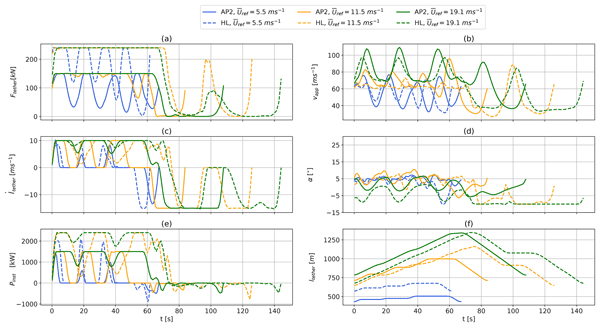
This research explores the ground-generation airborne wind energy system (AWES) design space and investigates scaling effects by varying design parameters such as aircraft wing size, aerodynamic efficiency and mass. Therefore, representative simulated onshore and offshore wind data are implemented into an AWES trajectory optimization model. We estimate optimal annual energy production and capacity factors as well as a minimal operational lift-to-weight ratio.
Beatriz Cañadillas, Maximilian Beckenbauer, Juan J. Trujillo, Martin Dörenkämper, Richard Foreman, Thomas Neumann, and Astrid Lampert
Wind Energ. Sci., 7, 1241–1262, https://doi.org/10.5194/wes-7-1241-2022, https://doi.org/10.5194/wes-7-1241-2022, 2022
Short summary
Short summary
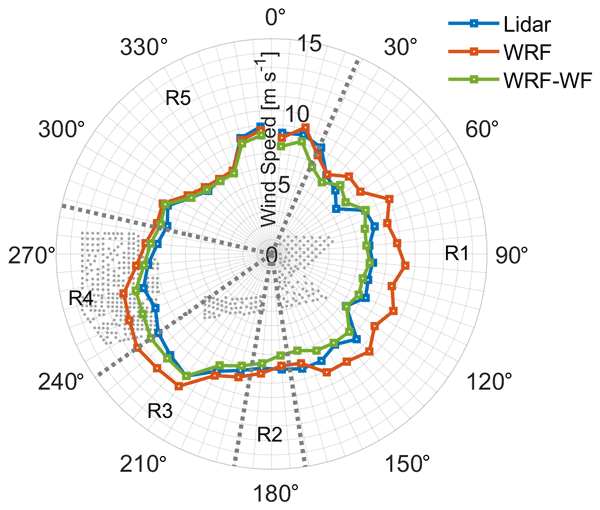
Scanning lidar measurements combined with meteorological sensors and mesoscale simulations reveal the strong directional and stability dependence of the wake strength in the direct vicinity of wind farm clusters.
Cited articles
Baker, R. W., Walker, S. N., and Wade, J. E.: Annual and seasonal variations in mean wind speed and wind turbine energy production, Sol. Energy, 45, 285–289, https://doi.org/10.1016/0038-092X(90)90013-3, 1990. a
Bakhoday-Paskyabi, M.: Predictive Analysis of Machine Learning Schemes in Forecasting Offshore Wind Speed, J. Phys. Conf. Ser., https://doi.org/10.1088/1742-6596/1669/1/012017, 2020. a
Barber, S. and Nordborg, H.: Improving site-dependent power curve prediction accuracy using regression trees, J. Phys. Conf. Ser., 1618, https://doi.org/10.1088/1742-6596/1618/6/062003, 2020. a
Bass, J. H., Rebbeck, M., Landberg, L., Cabré, M. F., and Hunter, A.: An improved measure-correlate-predict algorithm for the prediction of the long term wind climate in regions of complex environment: Final Report JOR3-CT98-0295, in: Renewable Energy Systems Ltd (UK), Risø National Laboratory (Denmark), Ecotecnia (Spain), University of Sunderland (UK), https://hdl.handle.net/10779/lincoln.24373816.v1 (last access: 13 February 2026), 2000. a
Basse, A., Callies, D., Grötzner, A., and Pauscher, L.: Seasonal effects in the long-term correction of short-term wind measurements using reanalysis data, Wind Energ. Sci., 6, 1473–1490, https://doi.org/10.5194/wes-6-1473-2021, 2021. a
Bodini, N. and Optis, M.: How accurate is a machine learning-based wind speed extrapolation under a round-robin approach?, J. Phys. Conf. Ser., 1618, https://doi.org/10.1088/1742-6596/1618/6/062037, 2020. a
Carta, J. A., Velázquez, S., and Cabrera, P.: A review of measure-correlate-predict (MCP) methods used to estimate long-term wind characteristics at a target site, Renew. Sustain. Energy Rev., 27, 362–400, https://doi.org/10.1016/j.rser.2013.07.004, 2013. a, b, c, d
Corotis, R. B.: Stochastic modelling of site wind characteristics, Tech. Rep. Final report, DOE – Department of Energy's, USA, https://doi.org/10.2172/7257559, 1976. a
Daniel, L. O., Sigauke, C., Chibaya, C., and Mbuvha, R.: Short-term wind speed forecasting using statistical and machine learning methods, Algorithms, 13, https://doi.org/10.3390/a13060132, 2020. a
Davis, K. J., Bakwin, P. S., Yi, C., Berger, B. W., Zhao, C., Teclaw, R. M., and Isebrands, J. G.: The annual cycles of CO2 and H2O exchange over a northern mixed forest as observed from a very tall tower, Glob. Change Biol., 9, 1278–1293, https://doi.org/10.1046/j.1365-2486.2003.00672.x, 2003. a, b
Dörenkämper, M., Olsen, B. T., Witha, B., Hahmann, A. N., Davis, N. N., Barcons, J., Ezber, Y., García-Bustamante, E., González-Rouco, J. F., Navarro, J., Sastre-Marugán, M., Sīle, T., Trei, W., Žagar, M., Badger, J., Gottschall, J., Sanz Rodrigo, J., and Mann, J.: The Making of the New European Wind Atlas – Part 2: Production and evaluation, Geosci. Model Dev., 13, 5079–5102, https://doi.org/10.5194/gmd-13-5079-2020, 2020. a
FGW e.V.: Technical Guidelines for Wind Turbines – Part 6 (TG6) Determination of Wind Potential and Energy Yield – Revision 12, Technical guideline, Fördergesellschaft Windenergie und andere Dezentrale Energien, https://wind-fgw.de/themen/richtlinienarbeit/ (last access: 13 February 2026), 2023. a, b, c
Freund, Y. and Schapire, R. E.: A Decision-Theoretic Generalization of On-Line Learning and an Application to Boosting, J. Comput. Syst. Sci., 55, 119–139, https://doi.org/10.1006/jcss.1997.1504, 1997. a
Früh, W.-G.: Long-term wind resource and uncertainty estimation using wind records from Scotland as example, Renew. Energy, 50, 1014–1026, https://doi.org/10.1016/j.renene.2012.08.047, 2013. a
Fukunaga, K. and Narendra, P. M.: A branch and bound algorithm for computing k-nearest neighbors, IEEE Trans. Comput., 100, 750–753, https://doi.org/10.1109/T-C.1975.224297, 1975. a
Gottschall, J. and Dörenkämper, M.: Understanding and mitigating the impact of data gaps on offshore wind resource estimates, Wind Energ. Sci., 6, 505–520, https://doi.org/10.5194/wes-6-505-2021, 2021. a, b
Grömping, U.: Variable importance assessment in regression: linear regression versus random forest, Am. Stat., 63, 308–319, https://doi.org/10.1198/tast.2009.08199, 2009. a, b
Hahmann, A. N., Sīle, T., Witha, B., Davis, N. N., Dörenkämper, M., Ezber, Y., García-Bustamante, E., González-Rouco, J. F., Navarro, J., Olsen, B. T., and Söderberg, S.: The making of the New European Wind Atlas – Part 1: Model sensitivity, Geosci. Model Dev., 13, 5053–5078, https://doi.org/10.5194/gmd-13-5053-2020, 2020. a
Hamlington, B. D., Hamlington, P. E., Collins, S. G., Alexander, S. R., and Kim, K.-Y.: Effects of climate oscillations on wind resource variability in the United States, Geophys. Res. Lett., 42, 145–152, https://doi.org/10.1002/2014GL062370, 2015. a
Hersbach, H., Bell, B., Berrisford, P., Hirahara, S., Horányi, A., Muñoz‐Sabater, J., Nicolas, J., Peubey, C., Radu, R., Schepers, D., Simmons, A., Soci, C., Abdalla, S., Abellan, X., Balsamo, G., Bechtold, P., Biavati, G., Bidlot, J., Bonavita, M., Chiara, G., Dahlgren, P., Dee, D., Diamantakis, M., Dragani, R., Flemming, J., Forbes, R., Fuentes, M., Geer, A., Haimberger, L., Healy, S., Hogan, R. J., Hólm, E., Janisková, M., Keeley, S., Laloyaux, P., Lopez, P., Lupu, C., Radnoti, G., Rosnay, P., Rozum, I., Vamborg, F., Villaume, S., and Thépaut, J.: The ERA5 global reanalysis, Q. J. R. Meteorol. Soc., 146, 1999–2049, https://doi.org/10.1002/qj.3803, 2020. a
Holtslag, E.: Improved Bankability: The Ecofys position on LiDAR use, Utrecht, the Netherlands, https://www.nrgsystems.com/assets/resources/Ecofys-2013-position-paper-on-lidar-use-Whitepapers.pdf (last access: 13 February 2026), 2013. a
IEC 61400-15-1:2025: Wind energy generation systems – Part 15-1: Site suitability input conditions for wind power plants, ISBN 9782832702697, 2025. a
Jager, D. and Andreas, A.: NREL National Wind Technology Center (NWTC): M2 Tower; Boulder, Colorado (Data), NREL Report No. DA-5500-56489, Tech. rep., National Renewable Energy Laboratory, https://doi.org/10.5439/1052222, 1996. a, b
Justus, C. G., Mani, K., and Mikhail, A. S.: Interannual and Month-to-Month Variations of Wind Speed, J. Appl. Meteorol. Climatol., 18, 913–920, https://doi.org/10.1175/1520-0450(1979)018<0913:IAMTMV>2.0.CO;2, 1979. a
King, C. and Hurley, B.: The SpeedSort, DynaSort and Scatter Wind Correlation Methods, Wind Eng., 29, 217–241, https://doi.org/10.1260/030952405774354868, 2005. a, b, c
Klink, K.: Trends and Interannual Variability of Wind Speed Distributions in Minnesota, J. Clim., 15, 3311–3317, https://doi.org/10.1175/1520-0442(2002)015<3311:TAIVOW>2.0.CO;2, 2002. a
Kohler, M., Metzger, J., and Kalthoff, N.: Trends in temperature and wind speed from 40 years of observations at a 200-m high meteorological tower in Southwest Germany, Int. J. Climatol., 38, 23–34, https://doi.org/10.1002/joc.5157, 2018. a, b
LaValle, S. M., Branicky, M. S., and Lindemann, S. R.: On the relationship between classical grid search and probabilistic roadmaps, Int. J. Robot. Res., 23, 673–692, https://doi.org/10.1177/0278364904045481, 2004. a
Lee, J. C. Y. and Fields, M. J.: An overview of wind-energy-production prediction bias, losses, and uncertainties, Wind Energ. Sci., 6, 311–365, https://doi.org/10.5194/wes-6-311-2021, 2021. a, b, c
ee, J. C. Y., Fields, M. J., and Lundquist, J. K.: Assessing variability of wind speed: comparison and validation of 27 methodologies, Wind Energ. Sci., 3, 845–868, https://doi.org/10.5194/wes-3-845-2018, 2018. a
Li, X., Zhong, S., Bian, X., and Heilman, W. E.: Climate and climate variability of the wind power resources in the Great Lakes region of the United States, J. Geophys. Res., 115, https://doi.org/10.1029/2009JD013415, 2010. a
Martin, L.: Wind Energy – The Facts: A Guide to the Technology, Economics and Future of Wind Power, J. Clean Prod., 18, 1122–1123, https://doi.org/10.1016/j.jclepro.2010.02.016, 2010. a
Meyer, P. J. and Gottschall, J.: How do NEWA and ERA5 compare for assessing offshore wind resources and wind farm siting conditions?, J. Phys. Conf. Ser., 2151, 012009, https://doi.org/10.1088/1742-6596/2151/1/012009, 2022. a
Mohammadi, K. and Goudarzi, N.: Study of inter-correlations of solar radiation, wind speed and precipitation under the influence of El Niño Southern Oscillation (ENSO) in California, Renew. Energy, 120, 190–200, https://doi.org/10.1016/j.renene.2017.12.069, 2018. a
NOAA/National Weather Service: Cold and Warm Episodes by Season, https://www.cpc.ncep.noaa.gov/products/analysis_monitoring/ensostuff/ONI_v5.php (last access: 13 February 2026), 2025. a
Olauson, J.: ERA5: The new champion of wind power modelling?, Renew. Energy, 126, 322–331, https://doi.org/10.1016/j.renene.2018.03.056, 2018. a
Optis, M., Bodini, N., Debnath, M., and Doubrawa, P.: New methods to improve the vertical extrapolation of near-surface offshore wind speeds, Wind Energ. Sci., 6, 935–948, https://doi.org/10.5194/wes-6-935-2021, 2021. a, b
Pedregosa, F., Varoquaux, G., Gramfort, A., Michel, V., Thirion, B., Grisel, O., Blondel, M., Prettenhofer, P., Weiss, R., Dubourg, V., Vanderplas, J., Passos, A., Cournapeau, D., Brucher, M., Perrot, M., and Duchesnay, E.: Scikit-learn: Machine Learning in Python, J. Mach. Learn. Res., 12, 2825–2830, https://doi.org/10.5555/1953048.2078195, 2011. a
Pryor, S. C., Barthelmie, R. J., and Schoof, J. T.: Inter-annual variability of wind indices across Europe, Wind Energy, 9, 27–38, https://doi.org/10.1002/we.178, 2006. a
Pullinger, D., Zhang, M., Hill, N., and Crutchley, T.: Improving uncertainty estimates: Inter-annual variability in Ireland, J. Phys. Conf. Ser., 926, 012006, https://doi.org/10.1088/1742-6596/926/1/012006, 2017. a
Riedel, V., Strack, M., and Waldl, H.: Robust approximation of functional relationships between meteorological data: alternative measure-correlate-predict algorithms, WIP Renewable Energies, 806–9, ISBN 3-936338-09-4, 2001. a
Rohrig, K., Berkhout, V., Callies, D., Durstewitz, M., Faulstich, S., Hahn, B., Jung, M., Pauscher, L., Seibel, A., Shan, M., Siefert, M., Steffen, J., Collmann, M., Czichon, S., Do, M., Lange, B., Ruhle, A., Sayer, F., Stoevesandt, B., and Wenske, J.: Powering the 21st century by wind energy – Options, facts, figures, Appl. Phys. Rev., 6, 031303, https://doi.org/10.1063/1.5089877, 2019. a
Schwegmann, S., Faulhaber, J., Pfaffel, S., Yu, Z., Dörenkämper, M., Kersting, K., and Gottschall, J.: Enabling Virtual Met Masts for wind energy applications through machine learning-methods, Energy AI, 11, 100209, https://doi.org/10.1016/j.egyai.2022.100209, 2023. a, b, c
Solomatine, D. P. and Shrestha, D. L.: AdaBoost. RT: a boosting algorithm for regression problems, in: 2004 IEEE International Joint Conference on Neural Networks (IEEE Cat. No. 04CH37541), 2, 1163–1168, https://doi.org/10.1109/IJCNN.2004.1380102, 2004. a
Stetco, A., Dinmohammadi, F., Zhao, X., Robu, V., Flynn, D., Barnes, M., Keane, J., and Nenadic, G.: Machine learning methods for wind turbine condition monitoring: A review, Renew. Energy, 133, 620–635, https://doi.org/10.1016/j.renene.2018.10.047, 2019. a
Velázquez, S., Carta, J. A., and Matías, J. M.: Comparison between ANNs and linear MCP algorithms in the long-term estimation of the cost per kWh produced by a wind turbine at a candidate site: A case study in the Canary Islands, Appl. Energy, 88, 3869–3881, https://doi.org/10.1016/j.apenergy.2011.05.007, 2011. a
Watson, S. J., Kritharas, P., and Hodgson, G. J.: Wind speed variability across the UK between 1957 and 2011, Wind Energy, 18, 21–42, https://doi.org/10.1002/we.1679, 2015. a
Wohland, J., Omrani, N. E., Keenlyside, N., and Witthaut, D.: Significant multidecadal variability in German wind energy generation, Wind Energ. Sci., 4, 515–526, https://doi.org/10.5194/wes-4-515-2019, 2019. a, b
Zhang, J., Chowdhury, S., Messac, A., and Hodge, B.-M.: A hybrid measure-correlate-predict method for long-term wind condition assessment, Energy Convers. Manag., 697–710, https://doi.org/10.1016/j.enconman.2014.07.057, 2014. a
Short summary
Assessing wind resources and mitigating the associated uncertainties are crucial to wind farm profitability. The study quantifies the uncertainty due to inter-annual variability, averaging 6.5 % and ranging from 1 % to 14 %, using long-term, quality-controlled wind measurements from tall met masts in terrain of varying complexity. Further, the results indicate that machine learning models are beneficial in mitigating the impact of inter-annual variability in heterogeneous and complex terrain.
Assessing wind resources and mitigating the associated uncertainties are crucial to wind farm...


Altmetrics
Final-revised paper
Preprint