
Articles | Volume 11, issue 6
https://doi.org/10.5194/wes-11-2037-2026
© Author(s) 2026. This work is distributed under
the Creative Commons Attribution 4.0 License.
the Creative Commons Attribution 4.0 License.
https://doi.org/10.5194/wes-11-2037-2026
© Author(s) 2026. This work is distributed under
the Creative Commons Attribution 4.0 License.
the Creative Commons Attribution 4.0 License.
Research article
| 
10 Jun 2026
Research article |
| 10 Jun 2026
| 10 Jun 2026
Experimental validation and extension of a blade element momentum model for counter-rotation dual-rotor wind turbine with double rotational armature design
Niels Cornelis Adema
CORRESPONDING AUTHOR

Entrance – Centre of Expertise Energy part of Hanze UAS, Groningen, 9747AA, the Netherlands
Josep Gil-Vernet Pagonabarraga
Entrance – Centre of Expertise Energy part of Hanze UAS, Groningen, 9747AA, the Netherlands
Institute of Engineering, section Mechanical Engineering, Hanze UAS, Groningen, 9747AS, the Netherlands
Wouter Swart Ranshuysen
Institute of Engineering, section Mechanical Engineering, Hanze UAS, Groningen, 9747AS, the Netherlands
Arjen de Ruijter
Institute of Engineering, section Mechanical Engineering, Hanze UAS, Groningen, 9747AS, the Netherlands
Gerard Schepers
Entrance – Centre of Expertise Energy part of Hanze UAS, Groningen, 9747AA, the Netherlands
TNO Energy Transition and Materials, 2628 CK, Delft, the Netherlands
Related authors
Cristina Mata, Daniel Romero, and Niels Cornelis Adema
Wind Energ. Sci. Discuss., https://doi.org/10.5194/wes-2025-188, https://doi.org/10.5194/wes-2025-188, 2025
Preprint withdrawn
Short summary
Short summary
This study examines how to choose the best locations for offshore wind farms. Researchers compared a traditional ranking method with a probability-based approach using computer simulations. The probability method better handles uncertainties by testing thousands of scenarios. Results showed this approach identifies suitable locations with greater confidence. This improved decision-making could help planners build environmentally sustainable and economically viable wind farms.
Marinos Manolesos, Sandrine Aubrun, Christian Bak, Paolo Bettini, Filippo Campagnolo, Alessandro Croce, Arslan Salim Dar, Michael Hölling, Stefan Ivanell, Konstantinos Kellaris, Miguel Alfonso Mendez, Pierluigi Montinari, Franz Mühle, George Papadakis, Fernardo Porté-Agel, Daniele Ragni, Sebastiano Randino, Andrea Sciacchitano, Lorenzo Schena, Gerard Schepers, Antonio Segalini, Wei Yu, and Carlo Luigi Bottasso
Wind Energ. Sci. Discuss., https://doi.org/10.5194/wes-2026-51, https://doi.org/10.5194/wes-2026-51, 2026
Manuscript not accepted for further review
Short summary
Short summary
As wind turbines grow to unprecedented sizes, ensuring their reliability requires advanced testing. We reviewed the current state of wind tunnel experiments, examining how scaled physical models are evaluated for wind flow, flexibility, and noise. We conclude that while laboratory testing remains essential, it is most powerful when integrated with computer simulations and real-world data. This combined approach will ultimately drive the design of more efficient and sustainable wind energy.
Cristina Mata, Daniel Romero, and Niels Cornelis Adema
Wind Energ. Sci. Discuss., https://doi.org/10.5194/wes-2025-188, https://doi.org/10.5194/wes-2025-188, 2025
Preprint withdrawn
Short summary
Short summary
This study examines how to choose the best locations for offshore wind farms. Researchers compared a traditional ranking method with a probability-based approach using computer simulations. The probability method better handles uncertainties by testing thousands of scenarios. Results showed this approach identifies suitable locations with greater confidence. This improved decision-making could help planners build environmentally sustainable and economically viable wind farms.
Koen Boorsma, Gerard Schepers, Helge Aagard Madsen, Georg Pirrung, Niels Sørensen, Galih Bangga, Manfred Imiela, Christian Grinderslev, Alexander Meyer Forsting, Wen Zhong Shen, Alessandro Croce, Stefano Cacciola, Alois Peter Schaffarczyk, Brandon Lobo, Frederic Blondel, Philippe Gilbert, Ronan Boisard, Leo Höning, Luca Greco, Claudio Testa, Emmanuel Branlard, Jason Jonkman, and Ganesh Vijayakumar
Wind Energ. Sci., 8, 211–230, https://doi.org/10.5194/wes-8-211-2023, https://doi.org/10.5194/wes-8-211-2023, 2023
Short summary
Short summary
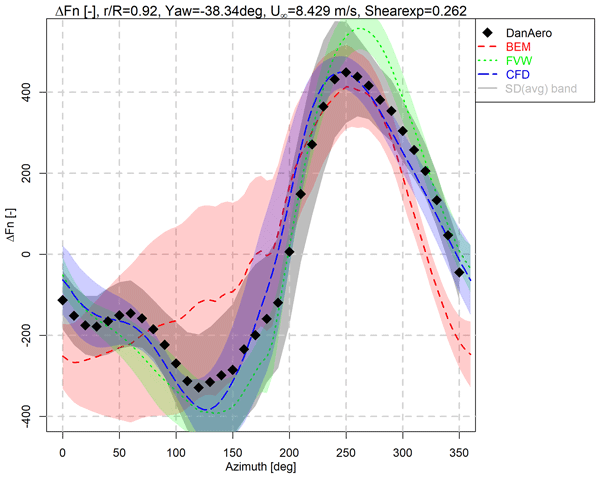
Within the framework of the fourth phase of the International Energy Agency's (IEA) Wind Task 29, a large comparison exercise between measurements and aeroelastic simulations has been carried out. Results were obtained from more than 19 simulation tools of various fidelity, originating from 12 institutes and compared to state-of-the-art field measurements. The result is a unique insight into the current status and accuracy of rotor aerodynamic modeling.
Simone Mancini, Koen Boorsma, Gerard Schepers, and Feike Savenije
Wind Energ. Sci., 8, 193–210, https://doi.org/10.5194/wes-8-193-2023, https://doi.org/10.5194/wes-8-193-2023, 2023
Short summary
Short summary
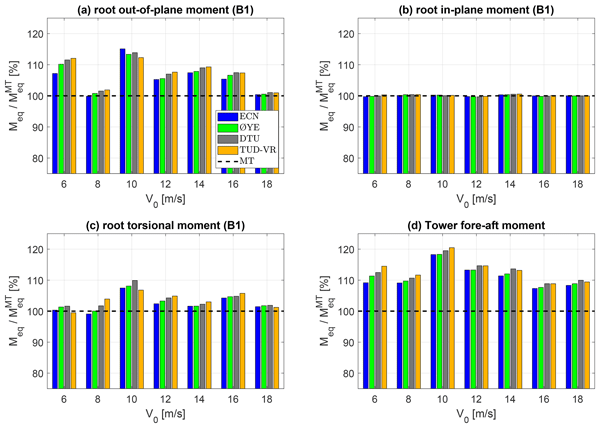
Modern wind turbines are subject to complex wind conditions that are far from the hypothesis of steady uniform inflow at the core of blade element momentum methods (the current industry standard for wind turbine design). Various corrections have been proposed to model this complexity. The present work focuses on modelling the unsteady evolution of wind turbine wakes (dynamic inflow), comparing the different corrections available and highlighting their effects on design load predictions.
Kisorthman Vimalakanthan, Harald van der Mijle Meijer, Iana Bakhmet, and Gerard Schepers
Wind Energ. Sci., 8, 41–69, https://doi.org/10.5194/wes-8-41-2023, https://doi.org/10.5194/wes-8-41-2023, 2023
Short summary
Short summary
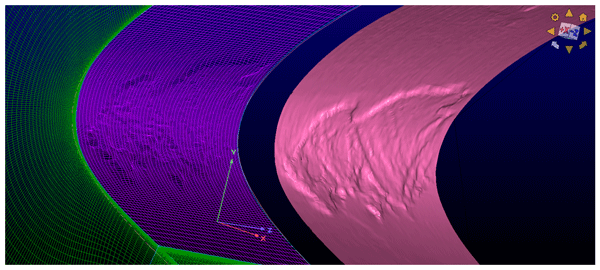
Leading edge erosion (LEE) is one of the most critical degradation mechanisms that occur with wind turbine blades. A detailed understanding of the LEE process and the impact on aerodynamic performance due to the damaged leading edge is required to optimize blade maintenance. Providing accurate modeling tools is therefore essential. This novel study assesses CFD approaches for modeling high-resolution scanned LE surfaces from an actual blade with LEE damages.
Alessandro Bianchini, Galih Bangga, Ian Baring-Gould, Alessandro Croce, José Ignacio Cruz, Rick Damiani, Gareth Erfort, Carlos Simao Ferreira, David Infield, Christian Navid Nayeri, George Pechlivanoglou, Mark Runacres, Gerard Schepers, Brent Summerville, David Wood, and Alice Orrell
Wind Energ. Sci., 7, 2003–2037, https://doi.org/10.5194/wes-7-2003-2022, https://doi.org/10.5194/wes-7-2003-2022, 2022
Short summary
Short summary
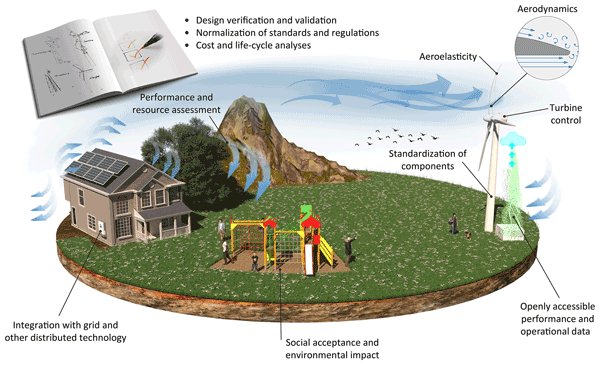
The paper is part of the Grand Challenges Papers for Wind Energy. It provides a status of small wind turbine technology in terms of technical maturity, diffusion, and cost. Then, five grand challenges that are thought to be key to fostering the development of the technology are proposed. To tackle these challenges, a series of unknowns and gaps are first identified and discussed. Improvement areas are highlighted, within which 10 key enabling actions are finally proposed to the wind community.
Frederik Berger, Lars Neuhaus, David Onnen, Michael Hölling, Gerard Schepers, and Martin Kühn
Wind Energ. Sci., 7, 1827–1846, https://doi.org/10.5194/wes-7-1827-2022, https://doi.org/10.5194/wes-7-1827-2022, 2022
Short summary
Short summary
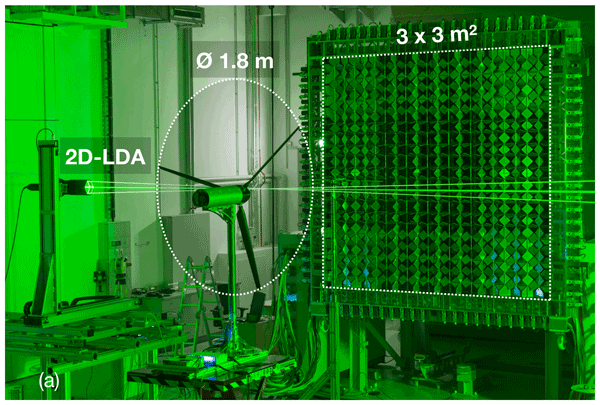
We proof the dynamic inflow effect due to gusts in wind tunnel experiments with MoWiTO 1.8 in the large wind tunnel of ForWind – University of Oldenburg, where we created coherent gusts with an active grid. The effect is isolated in loads and rotor flow by comparison of a quasi-steady and a dynamic case. The observed effect is not caught by common dynamic inflow engineering models. An improvement to the Øye dynamic inflow model is proposed, matching experiment and corresponding FVWM simulations.
Benjamin Sanderse, Vinit V. Dighe, Koen Boorsma, and Gerard Schepers
Wind Energ. Sci., 7, 759–781, https://doi.org/10.5194/wes-7-759-2022, https://doi.org/10.5194/wes-7-759-2022, 2022
Short summary
Short summary
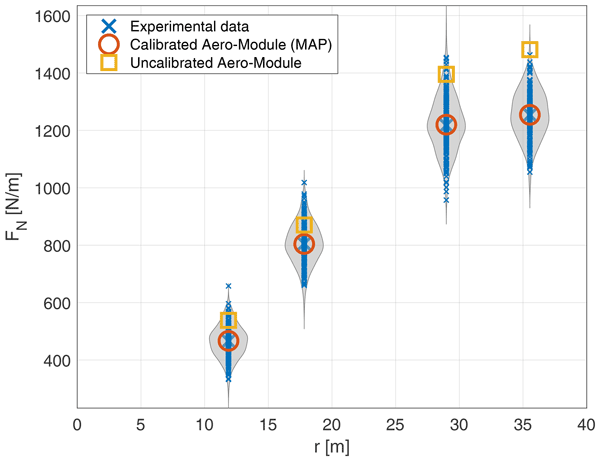
An accurate prediction of loads and power of an offshore wind turbine is needed for an optimal design. However, such predictions are typically performed with engineering models that contain many inaccuracies and uncertainties. In this paper we have proposed a systematic approach to quantify and calibrate these uncertainties based on two experimental datasets. The calibrated models are much closer to the experimental data and are equipped with an estimate of the uncertainty in the predictions.
Frederik Berger, David Onnen, Gerard Schepers, and Martin Kühn
Wind Energ. Sci., 6, 1341–1361, https://doi.org/10.5194/wes-6-1341-2021, https://doi.org/10.5194/wes-6-1341-2021, 2021
Short summary
Short summary
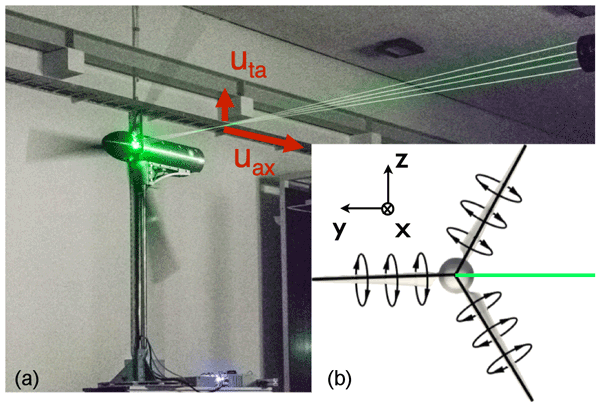
Dynamic inflow denotes the unsteady aerodynamic response to fast changes in rotor loading and leads to load overshoots. We performed a pitch step experiment with MoWiTO 1.8 in the large wind tunnel of ForWind – University of Oldenburg. We measured axial and tangential inductions with a recent method with a 2D-LDA system and performed load and wake measurements. These radius-resolved measurements allow for new insights into the dynamic inflow phenomenon.
Cited articles
Adema, N., Swart-Ranshuysen, W., De Ruijter, A., and Schepers, G.: Wind Tunnel Test of Counter-Rotating Dual Rotor Wind Turbine With Double Rotational Armature Design, Wind Energy, 28, https://doi.org/10.1002/we.70039, 2025.
Al-Obaidi, A. S. M. and Madivaanan, G.: Investigation of the Blockage Correction to Improve the Accuracy of Taylor's Low-Speed Wind Tunnel, J. Phys. Conf. Ser., 2222, 012008, https://doi.org/10.1088/1742-6596/2222/1/012008, 2022.
Amoretti, T., Huet, F., Garambois, P., and Roucoules, L.: Configurable dual rotor wind turbine model based on BEM method: Co-rotating and counter-rotating comparison, Energ. Convers. Manage., 293, 117461, https://doi.org/10.1016/j.enconman.2023.117461, 2023.
Bai, H., Wang, N., and Wan, D.: Numerical study of aerodynamic performance of horizontal axis dual-rotor wind turbine under atmospheric boundary layers, Ocean Eng., 280, 114944, https://doi.org/10.1016/j.oceaneng.2023.114944, 2023.
Bereziartua-Gonzalez, L., Retegi, A., and Ukar, O.: Human-centered integration of small wind turbines in urban environments: a semi-systematic review from an industrial design perspective, Front. Sustain. Cities, 7, https://doi.org/10.3389/frsc.2025.1561894, 2025.
Bianchini, A., Bangga, G., Baring-Gould, I., Croce, A., Cruz, J. I., Damiani, R., Erfort, G., Simao Ferreira, C., Infield, D., Nayeri, C. N., Pechlivanoglou, G., Runacres, M., Schepers, G., Summerville, B., Wood, D., and Orrell, A.: Current status and grand challenges for small wind turbine technology, Wind Energ. Sci., 7, 2003–2037, https://doi.org/10.5194/wes-7-2003-2022, 2022.
Bontempo, R. and Manna, M.: Optimum design of contra-rotating wind turbines with adjacent rotors, Energ. Conv. Manage., 324, 119267, https://doi.org/10.1016/j.enconman.2024.119267, 2025.
Booker, J. D., Mellor, P. H., Wrobel, R., and Drury, D.: A compact, high efficiency contra-rotating generator suitable for wind turbines in the urban environment, Renew. Energ., 35, 2027–2033, https://doi.org/10.1016/j.renene.2010.02.003, 2010.
Braud, C., Podvin, B., and Deparday, J.: Study of the wall pressure variations on the stall inception of a thick cambered profile at high Reynolds number, Phys. Rev. Fluids, 9, 014605, https://doi.org/10.1103/PhysRevFluids.9.014605, 2024.
Calautit, K. and Johnstone, C.: State-of-the-art review of micro to small-scale wind energy harvesting technologies for building integration, Energ. Conv. Manage., 20, 100457, https://doi.org/10.1016/j.ecmx.2023.100457, 2023.
Chagas, C. C. M., Pereira, M. G., Rosa, L. P., da Silva, N. F., Freitas, M. A. V., and Hunt, J. D.: From Megawatts to Kilowatts: A Review of Small Wind Turbine Applications, Lessons From The US to Brazil, Sustainability, 12, 2760, https://doi.org/10.3390/su12072760, 2020.
Chen, T. Y. and Liou, L. R.: Blockage corrections in wind tunnel tests of small horizontal-axis wind turbines, Exp. Therm. Fluid Sci., 35, 565–569, https://doi.org/10.1016/j.expthermflusci.2010.12.005, 2011.
Drela, M.: XFOIL: An Analysis and Design System for Low Reynolds Number Airfoils, in: Low Reynolds Number Aerodynamics, 1–12, https://doi.org/10.1007/978-3-642-84010-4_1, 1989.
Erturk, E., Sivrioglu, S., and Bolat, F. C.: Analysis Model of a Small Scale Counter-Rotating Dual Rotor Wind Turbine with Double Rotational Generator Armature, International Journal of Renewable Energy Research (IJRER), 8, 1849–1858, 2018.
Gur, O.: Extending Blade-Element Model to Contra-Rotating Configuration, IOP Conf. Ser., Mater. Sci. Eng., 638, 012001, https://doi.org/10.1088/1757-899X/638/1/012001, 2019.
Habash, R. W. Y., Groza, V., Yang, Y., Blouin, C., and Guillemette, P.: Performance of a Contrarotating Small Wind Energy Converter, International Scholarly Research Notices, 2011, 828739, https://doi.org/10.5402/2011/828739, 2011.
Hansen, M.: Aerodynamics of Wind Turbines, 3rd Edn., Routledge, London, 188 pp., https://doi.org/10.4324/9781315769981, 2015.
Hollands, E. O., He, C., and Gan, L.: A particle image velocimetry study of dual-rotor counter-rotating wind turbine near wake, J. Vis., 23, 425–435, https://doi.org/10.1007/s12650-020-00643-0, 2020.
Jansma, H.: Development and Optimization of a Generator Test Rig for Small Wind Turbines: Improving Performance and Efficiency, MSc Thesis, Hanze UAS, Groningen, 74 pp., 2024.
Jeong, H., Lee, S., and Kwon, S.-D.: Blockage corrections for wind tunnel tests conducted on a Darrieus wind turbine, J. Wind Eng. Ind. Aerod., 179, 229–239, https://doi.org/10.1016/j.jweia.2018.06.002, 2018.
Jung, S. N., No, T.-S., and Ryu, K.-W.: Aerodynamic performance predictionof a 30 kW counter-rotating wind turbine system, Renew. Energ., 30, 631–644, https://doi.org/10.1016/j.renene.2004.07.005, 2005.
Jurasz, J., Bochenek, B., Wieczorek, J., Jaczewski, A., Kies, A., and Figurski, M.: Energy potential and economic viability of small-scale wind turbines, Energy, 322, 135608, https://doi.org/10.1016/j.energy.2025.135608, 2025.
Koehuan, V. A., Sugiyono, and Kamal, S.: Investigation of Counter-Rotating Wind Turbine Performance using Computational Fluid Dynamics Simulation, IOP Conf. Ser. Mater. Sci. Eng., 267, 012034, https://doi.org/10.1088/1757-899X/267/1/012034, 2017.
Kutt, F., Blecharz, K., and Karkosiński, D.: Axial-Flux Permanent-Magnet Dual-Rotor Generator for a Counter-Rotating Wind Turbine, Energies, 13, 2833, https://doi.org/10.3390/en13112833, 2020.
Lee, S., Kim, H., Son, E., and Lee, S.: Effects of design parameters on aerodynamic performance of a counter-rotating wind turbine, Renew. Energ., 42, 140–144, https://doi.org/10.1016/j.renene.2011.08.046, 2012.
Li, Y., Zhang, J., Li, Z., Yang, P., and Wang, H.: Design and verification of a novel double rotor without stator wind turbine generation system, Energy Reports, 7, 161–172, https://doi.org/10.1016/j.egyr.2021.10.041, 2021.
Mitulet, L.-A., Oprina, G., Chihaia, R.-A., Nicolaie, S., Nedelcu, A., and Popescu, M.: Wind Tunnel Testing for a New Experimental Model of Counter-rotating Wind Turbine, Procedia Engineer., 100, 1141–1149, https://doi.org/10.1016/j.proeng.2015.01.477, 2015.
Montgomerie, B.: Methods for Root Effects, Tip Effects and Extending the Angle of Attack Range to ±180°, with Application to Aerodynamics for Blades on Wind Turbines and Propellers, Swedish Defence Research Agency, https://www.foi.se/rest-api/report/FOI-R--1305--SE (last access: 3 June 2026), 2004.
Mühle, F., Adaramola, M. S., and Sætran, L.: The effect of rotational direction on the wake of a wind turbine rotor – a comparison study of aligned co- and counter rotating turbine arrays, Energy Proced., 137, 238–245, https://doi.org/10.1016/j.egypro.2017.10.346, 2017.
Newman, B. G.: Multiple actuator-disc theory for wind turbines,J. Wind Eng. Ind. Aerod., 24, 215–225, https://doi.org/10.1016/0167-6105(86)90023-1, 1986.
Ozbay, A., Tian, W., and Hu, H.: An Experimental Investigation on the Aeromechanics and Near Wake Characteristics of Dual-Rotor Wind Turbines (DRWTs), in: 32nd ASME Wind Energy Symposium, American Institute of Aeronautics and Astronautics, https://doi.org/10.2514/6.2014-1085, 2014.
Peng, X., Duan, L., Li, G., Jin, Y., and Han, Z.: Interference between main and auxiliary rotors in floating dual-rotor wind turbines under stationary and surge conditions, Ocean Eng., 322, 120462, https://doi.org/10.1016/j.oceaneng.2025.120462, 2025.
QBlade: QBlade – Next Generation Wind Turbine Simulation, https://qblade.org/, last access: 13 April 2026.
Rosenberg, A., Selvaraj, S., and Sharma, A.: A Novel Dual-Rotor Turbine for Increased Wind Energy Capture, J. Phys. Conf. Ser., 524, 012078, https://doi.org/10.1088/1742-6596/524/1/012078, 2014.
Schepers, J. G., Adema, N. C., Lipian, M., Kulak, M., Shahid, A., Best, A., Bendre, T., Gallicchio, I., Elsabbagh, A., Mostafa, A., Kim, T., Mikkelsen, R., Gaunaa, M., Teuwen, J. J. E., Rudolf, R. T., Wood, D., and Holierhoek, J. G.: Lessons learned from 10 years of wind tunnel tests on small wind turbines designed by students, J. Phys. Conf. Ser., 2767, 072009, https://doi.org/10.1088/1742-6596/2767/7/072009, 2024.
Simic, Z., Havelka, J. G., and Bozicevic Vrhovcak, M.: Small wind turbines – A unique segment of the wind power market, Renew. Energ., 50, 1027–1036, 2013.
Sundararaju, H., Lo, K. H., Metcalfe, R., and Wang, S. S.: Aerodynamics and CFD analysis of equal size dual-rotor wind turbine, J. Renew. Sustain. Ener., 9, 043305, https://doi.org/10.1063/1.4999500, 2017.
Wang, K., Liu, T., Wan, Y., Ong, M. C., and Wu, T.: Numerical Investigation on Aerodynamic Characteristics of Dual-Rotor Wind Turbines, J. Mar. Sci. Eng., 10, 1887, https://doi.org/10.3390/jmse10121887, 2022.
Wang, Z., Ozbay, A., Tian, W., and Hu, H.: An experimental study on the aerodynamic performances and wake characteristics of an innovative dual-rotor wind turbine, Energy, 147, 94–109, https://doi.org/10.1016/j.energy.2018.01.020, 2018.
Yin, F. F., Chen, J. J., Li, X. K., Ye, Z. L., Tang, W., Shen, X., and Guo, X. J.: A blade element momentum model for dual-rotor wind turbines considering inter-rotor velocity interferences, J. Phys. Conf. Ser., 2265, 042058, https://doi.org/10.1088/1742-6596/2265/4/042058, 2022.
Yuan, W., Tian, W., Ozbay, A., and Hu, H.: An experimental study on the effects of relative rotation direction on the wake interferences among tandem wind turbines, Sci. China Phys. Mech. Astron., 57, 935–949, https://doi.org/10.1007/s11433-014-5429-x, 2014.
Zhao, X., Zhou, P., Liang, X., and Gao, S.: The aerodynamic coupling design and wind tunnel test of contra-rotating wind turbines, Renew. Energ., 146, 1–8, https://doi.org/10.1016/j.renene.2019.06.118, 2020.
Short summary
Small wind turbines could help to generate renewable energy but are often inefficient and expensive. This study tested a counter-rotating dual-rotor design with both rotors connected through one generator, eliminating gearboxes. Wind tunnel tests achieved a 1 kW output with 33 % efficiency. A computational model showed that the turbine could theoretically reach 56 % efficiency with optimized blade angles. This compact design reduces mechanical complexity and suits urban applications.
Small wind turbines could help to generate renewable energy but are often inefficient and...


Altmetrics
Final-revised paper
Preprint