
Articles | Volume 11, issue 9
https://doi.org/10.5194/wes-11-3719-2026
© Author(s) 2026. This work is distributed under
the Creative Commons Attribution 4.0 License.
the Creative Commons Attribution 4.0 License.
https://doi.org/10.5194/wes-11-3719-2026
© Author(s) 2026. This work is distributed under
the Creative Commons Attribution 4.0 License.
the Creative Commons Attribution 4.0 License.
Research article
| 
24 Sep 2026
Research article |
| 24 Sep 2026
| 24 Sep 2026
SANDWake3D: a 3D parabolic RANS solver for atmospheric surface layers and turbine wakes

Sandia National Laboratories, Livermore, CA, USA
Prakash Mohan
National Laboratory of the Rockies, Golden, CO, USA
Marc T. Henry de Frahan
National Laboratory of the Rockies, Golden, CO, USA
Gopal R. Yalla
Sandia National Laboratories, Albuquerque, NM, USA
Alan Hsieh
Sandia National Laboratories, Albuquerque, NM, USA
Kenneth Brown
Sandia National Laboratories, Albuquerque, NM, USA
Nathaniel deVelder
Sandia National Laboratories, Albuquerque, NM, USA
Sam Kaufman-Martin
Sandia National Laboratories, Livermore, CA, USA
University of California, Santa Barbara, CA, USA
Marc Day
National Laboratory of the Rockies, Golden, CO, USA
Michael Sprague
National Laboratory of the Rockies, Golden, CO, USA
Related authors
Nicola Bodini, Patrick Moriarty, Regis Thedin, Paula Doubrawa, Cristina Archer, Myra Blaylock, Carlo Bottasso, Bruno Carmo, Lawrence Cheung, Camille Dubreuil, Rogier Floors, Thomas Herges, Daniel Houck, Ali Kanjari, Colleen M. Kaul, Christopher Kelley, Ru Li, Julie K. Lundquist, Desirae Major, Anh Kiet Nguyen, Mike Optis, Luan R. C. Parada, Alfredo Peña, Julian Quick, David Ricarte, William C. Radünz, Raj K. Rai, Oscar García-Santiago, Jonas Schulte, Knut S. Seim, M. Paul van der Laan, Kisorthman Vimalakanthan, and Adam Wise
Wind Energ. Sci., 11, 3107–3135, https://doi.org/10.5194/wes-11-3107-2026, https://doi.org/10.5194/wes-11-3107-2026, 2026
Short summary
Short summary
Predicting wind farm energy production is challenging because wind patterns are complex. We tested 16 different models against real data from a major field experiment to see which worked best. Surprisingly, the most expensive and detailed models were not always more accurate than simpler ones. We found that feeding models better weather data was the most effective way to improve accuracy. These results help the industry choose the right tools for designing more-efficient wind farms.
Juan M. Restrepo, Matthew Norman, Stuart Slattery, Lawrence Cheung, and Yihan Liu
Wind Energ. Sci., 11, 2915–2938, https://doi.org/10.5194/wes-11-2915-2026, https://doi.org/10.5194/wes-11-2915-2026, 2026
Short summary
Short summary
A comparison between the power generated by a 5 MW turbine mounted on a tension-leg platform and subjected to fully developed ocean wave movements, and the same platform/turbine not subjected to ocean motions shows that these wave motions have little effect on time-average power output over a large wind speed range.
Neil Matula, Gopal Yalla, Bumseok Lee, Ganesh Vijayakumar, Nathaniel deVelder, Lawrence Cheung, Michael Sprague, and Paul Crozier
Wind Energ. Sci. Discuss., https://doi.org/10.5194/wes-2025-263, https://doi.org/10.5194/wes-2025-263, 2026
Revised manuscript accepted for WES
Short summary
Short summary
This paper presents the results of a validation campaign of the fluid-structure interaction capability of the ExaWind software suite using the Pazy wing case, an aeroelastic benchmark featuring large nonlinear deformations of a very flexible wing under low-speed conditions. The results show good agreement with the published experimental and simulation results for tip deflection and flutter onset speed, and provide credibility evidence for the predictive capability of the ExaWind suite.
Gopal R. Yalla, Kenneth Brown, Lawrence Cheung, Dan Houck, Nathaniel deVelder, and Balaji Jayaraman
Wind Energ. Sci. Discuss., https://doi.org/10.5194/wes-2025-250, https://doi.org/10.5194/wes-2025-250, 2025
Revised manuscript under review for WES
Short summary
Short summary
This study examines the increase in annual energy production of a wind farm when using a new control technology designed to re-energize the wind between turbines by enhancing the mixing in the flow behind a turbine. High-fidelity computer simulations are used to create training data for a lower-fidelity model that efficiently predicts wind farm performance. Additionally, the power performance gains are compared to a standard control approach that steers wakes away from downstream turbines.
Gopal R. Yalla, Kenneth Brown, Lawrence Cheung, Dan Houck, Nathaniel deVelder, and Nicholas Hamilton
Wind Energ. Sci., 10, 2449–2474, https://doi.org/10.5194/wes-10-2449-2025, https://doi.org/10.5194/wes-10-2449-2025, 2025
Short summary
Short summary
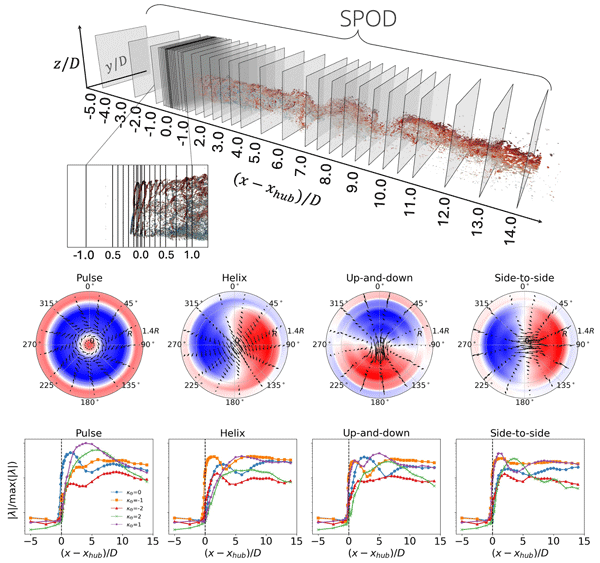
When wind reaches the first set of turbines in a wind farm, energy is extracted, reducing the energy available for downstream turbines. This study examines emerging technologies aimed at re-energizing the wind between turbines in a wind farm to improve overall power production. Optimizing these technologies depends on understanding the complex flow features of the atmosphere and the wakes behind turbines, which is accomplished using high-fidelity computer simulations and data analysis techniques.
Juan M. Restrepo, Matthew Norman, Stuart Slattery, Lawrence Cheung, and Yihan Liu
Wind Energ. Sci. Discuss., https://doi.org/10.5194/wes-2025-208, https://doi.org/10.5194/wes-2025-208, 2025
Manuscript not accepted for further review
Short summary
Short summary
We examine the average power output of a single and a collection of 5 MW wind turbines, mounted on a Tension-Leg Platform (TLP) under the action of fully developed ocean waves. We find that wave motions have a negligible effect on power output.
Kenneth Brown, Gopal Yalla, Lawrence Cheung, Joeri Frederik, Dan Houck, Nathaniel deVelder, Eric Simley, and Paul Fleming
Wind Energ. Sci., 10, 1737–1762, https://doi.org/10.5194/wes-10-1737-2025, https://doi.org/10.5194/wes-10-1737-2025, 2025
Short summary
Short summary
This paper presents one half of a companion paper series that studies strategies to reduce negative aerodynamic interference (i.e., wake effects) between nearby wind turbines in a wind farm. The approach leverages high-fidelity flow simulations of an open-source design for a wind turbine. Complimenting the companion paper’s analysis of the power and loading effects of the wake-control strategies, this article uncovers the underlying fluid-dynamic causes for these effects.
Lawrence Cheung, Gopal Yalla, Prakash Mohan, Alan Hsieh, Kenneth Brown, Nathaniel deVelder, Daniel Houck, Marc T. Henry de Frahan, Marc Day, and Michael Sprague
Wind Energ. Sci., 10, 1403–1420, https://doi.org/10.5194/wes-10-1403-2025, https://doi.org/10.5194/wes-10-1403-2025, 2025
Short summary
Short summary
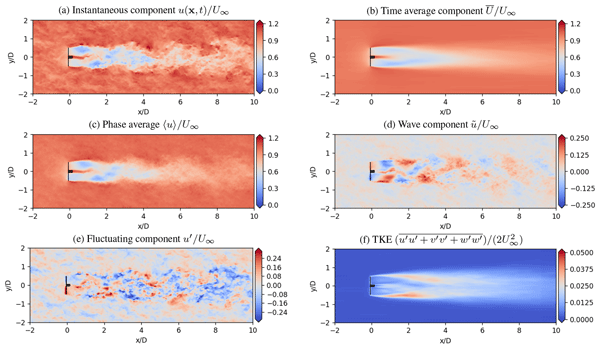
Mitigating turbine wakes is an important aspect to maximizing wind farm energy production but is a challenge to model. We demonstrate a new approach to modeling active wake mixing, which re-energizes turbine wake through periodic blade pitching. The new model divides the wake into separate steady, unsteady, and turbulent components and solves for each in a computationally efficient manner. Our results show that the model can reasonably predict the faster wake recovery due to mixing.
Joeri A. Frederik, Eric Simley, Kenneth A. Brown, Gopal R. Yalla, Lawrence C. Cheung, and Paul A. Fleming
Wind Energ. Sci., 10, 755–777, https://doi.org/10.5194/wes-10-755-2025, https://doi.org/10.5194/wes-10-755-2025, 2025
Short summary
Short summary
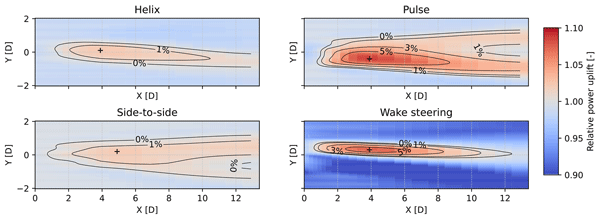
In this paper, we present results from advanced computer simulations to determine the effects of applying different control strategies to a small wind farm. We show that when there is variability in wind direction over height, steering the wake of a turbine away from other turbines is the most effective strategy. When this variability is not present, actively changing the pitch angle of the blades to increase turbulence in the wake could be more effective.
Helge Aagaard Madsen, Pietro Bortolotti, Thanasis Barlas, Pourya Nikoueeyan, Christopher Kelley, Claus Brian Munk Pedersen, Per Hansen, Andreas Fischer, Chris Ivanov, Jason Roadman, Jonathan Naughton, Kenneth Brown, Mark Iverson, and Simon Thao
Wind Energ. Sci., 11, 3337–3357, https://doi.org/10.5194/wes-11-3337-2026, https://doi.org/10.5194/wes-11-3337-2026, 2026
Short summary
Short summary
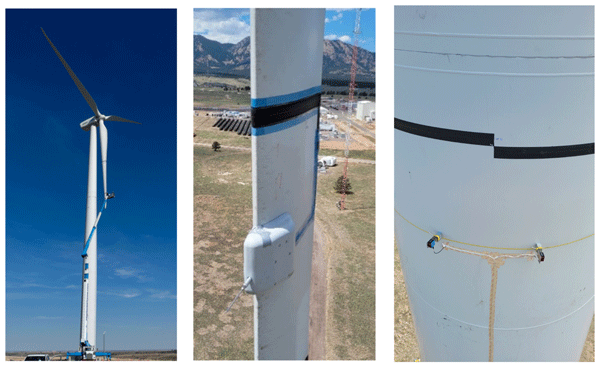
We present a detailed experimental investigation of the flow details of the blade/tower interaction (BTI) on a 1.5 MW wind turbine operating in a downwind configuration. The objective is to clarify some of the most important barriers for the downwind turbine concept linked to the impulsive loading from the blade/tower interaction generating low-frequency noise and increased loading. Unique instrumentation was used, comprising two extruded pressure belts on one of the blades and on the tower.
Nicola Bodini, Patrick Moriarty, Regis Thedin, Paula Doubrawa, Cristina Archer, Myra Blaylock, Carlo Bottasso, Bruno Carmo, Lawrence Cheung, Camille Dubreuil, Rogier Floors, Thomas Herges, Daniel Houck, Ali Kanjari, Colleen M. Kaul, Christopher Kelley, Ru Li, Julie K. Lundquist, Desirae Major, Anh Kiet Nguyen, Mike Optis, Luan R. C. Parada, Alfredo Peña, Julian Quick, David Ricarte, William C. Radünz, Raj K. Rai, Oscar García-Santiago, Jonas Schulte, Knut S. Seim, M. Paul van der Laan, Kisorthman Vimalakanthan, and Adam Wise
Wind Energ. Sci., 11, 3107–3135, https://doi.org/10.5194/wes-11-3107-2026, https://doi.org/10.5194/wes-11-3107-2026, 2026
Short summary
Short summary
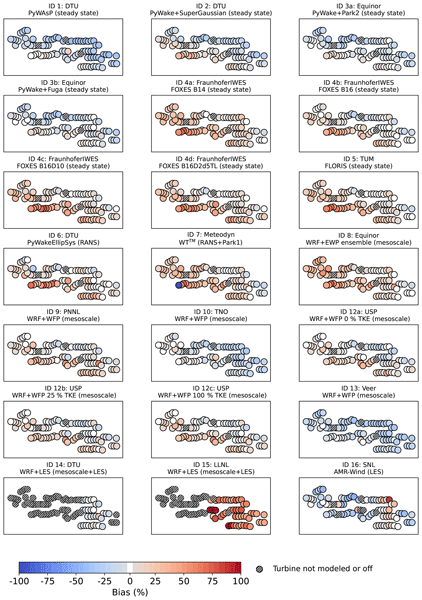
Predicting wind farm energy production is challenging because wind patterns are complex. We tested 16 different models against real data from a major field experiment to see which worked best. Surprisingly, the most expensive and detailed models were not always more accurate than simpler ones. We found that feeding models better weather data was the most effective way to improve accuracy. These results help the industry choose the right tools for designing more-efficient wind farms.
Juan M. Restrepo, Matthew Norman, Stuart Slattery, Lawrence Cheung, and Yihan Liu
Wind Energ. Sci., 11, 2915–2938, https://doi.org/10.5194/wes-11-2915-2026, https://doi.org/10.5194/wes-11-2915-2026, 2026
Short summary
Short summary
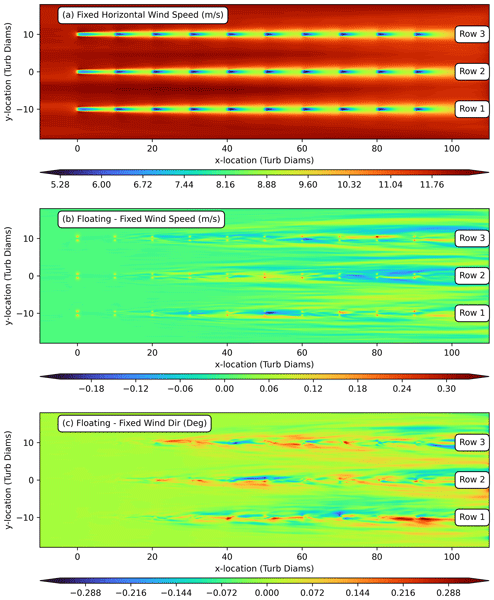
A comparison between the power generated by a 5 MW turbine mounted on a tension-leg platform and subjected to fully developed ocean wave movements, and the same platform/turbine not subjected to ocean motions shows that these wave motions have little effect on time-average power output over a large wind speed range.
Neil Matula, Gopal Yalla, Bumseok Lee, Ganesh Vijayakumar, Nathaniel deVelder, Lawrence Cheung, Michael Sprague, and Paul Crozier
Wind Energ. Sci. Discuss., https://doi.org/10.5194/wes-2025-263, https://doi.org/10.5194/wes-2025-263, 2026
Revised manuscript accepted for WES
Short summary
Short summary
This paper presents the results of a validation campaign of the fluid-structure interaction capability of the ExaWind software suite using the Pazy wing case, an aeroelastic benchmark featuring large nonlinear deformations of a very flexible wing under low-speed conditions. The results show good agreement with the published experimental and simulation results for tip deflection and flutter onset speed, and provide credibility evidence for the predictive capability of the ExaWind suite.
Gopal R. Yalla, Kenneth Brown, Lawrence Cheung, Dan Houck, Nathaniel deVelder, and Balaji Jayaraman
Wind Energ. Sci. Discuss., https://doi.org/10.5194/wes-2025-250, https://doi.org/10.5194/wes-2025-250, 2025
Revised manuscript under review for WES
Short summary
Short summary
This study examines the increase in annual energy production of a wind farm when using a new control technology designed to re-energize the wind between turbines by enhancing the mixing in the flow behind a turbine. High-fidelity computer simulations are used to create training data for a lower-fidelity model that efficiently predicts wind farm performance. Additionally, the power performance gains are compared to a standard control approach that steers wakes away from downstream turbines.
Gopal R. Yalla, Kenneth Brown, Lawrence Cheung, Dan Houck, Nathaniel deVelder, and Nicholas Hamilton
Wind Energ. Sci., 10, 2449–2474, https://doi.org/10.5194/wes-10-2449-2025, https://doi.org/10.5194/wes-10-2449-2025, 2025
Short summary
Short summary
When wind reaches the first set of turbines in a wind farm, energy is extracted, reducing the energy available for downstream turbines. This study examines emerging technologies aimed at re-energizing the wind between turbines in a wind farm to improve overall power production. Optimizing these technologies depends on understanding the complex flow features of the atmosphere and the wakes behind turbines, which is accomplished using high-fidelity computer simulations and data analysis techniques.
Juan M. Restrepo, Matthew Norman, Stuart Slattery, Lawrence Cheung, and Yihan Liu
Wind Energ. Sci. Discuss., https://doi.org/10.5194/wes-2025-208, https://doi.org/10.5194/wes-2025-208, 2025
Manuscript not accepted for further review
Short summary
Short summary
We examine the average power output of a single and a collection of 5 MW wind turbines, mounted on a Tension-Leg Platform (TLP) under the action of fully developed ocean waves. We find that wave motions have a negligible effect on power output.
Kenneth Brown, Gopal Yalla, Lawrence Cheung, Joeri Frederik, Dan Houck, Nathaniel deVelder, Eric Simley, and Paul Fleming
Wind Energ. Sci., 10, 1737–1762, https://doi.org/10.5194/wes-10-1737-2025, https://doi.org/10.5194/wes-10-1737-2025, 2025
Short summary
Short summary
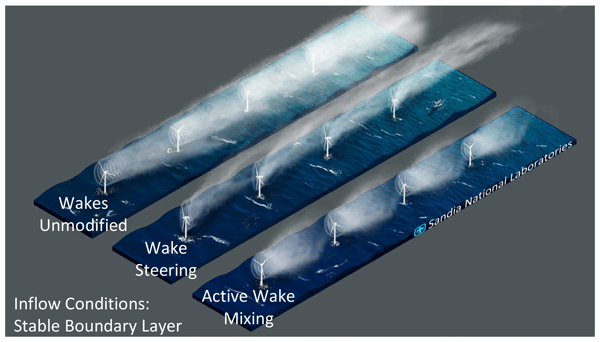
This paper presents one half of a companion paper series that studies strategies to reduce negative aerodynamic interference (i.e., wake effects) between nearby wind turbines in a wind farm. The approach leverages high-fidelity flow simulations of an open-source design for a wind turbine. Complimenting the companion paper’s analysis of the power and loading effects of the wake-control strategies, this article uncovers the underlying fluid-dynamic causes for these effects.
Lawrence Cheung, Gopal Yalla, Prakash Mohan, Alan Hsieh, Kenneth Brown, Nathaniel deVelder, Daniel Houck, Marc T. Henry de Frahan, Marc Day, and Michael Sprague
Wind Energ. Sci., 10, 1403–1420, https://doi.org/10.5194/wes-10-1403-2025, https://doi.org/10.5194/wes-10-1403-2025, 2025
Short summary
Short summary
Mitigating turbine wakes is an important aspect to maximizing wind farm energy production but is a challenge to model. We demonstrate a new approach to modeling active wake mixing, which re-energizes turbine wake through periodic blade pitching. The new model divides the wake into separate steady, unsteady, and turbulent components and solves for each in a computationally efficient manner. Our results show that the model can reasonably predict the faster wake recovery due to mixing.
Joeri A. Frederik, Eric Simley, Kenneth A. Brown, Gopal R. Yalla, Lawrence C. Cheung, and Paul A. Fleming
Wind Energ. Sci., 10, 755–777, https://doi.org/10.5194/wes-10-755-2025, https://doi.org/10.5194/wes-10-755-2025, 2025
Short summary
Short summary
In this paper, we present results from advanced computer simulations to determine the effects of applying different control strategies to a small wind farm. We show that when there is variability in wind direction over height, steering the wake of a turbine away from other turbines is the most effective strategy. When this variability is not present, actively changing the pitch angle of the blades to increase turbulence in the wake could be more effective.
Kenneth Brown, Pietro Bortolotti, Emmanuel Branlard, Mayank Chetan, Scott Dana, Nathaniel deVelder, Paula Doubrawa, Nicholas Hamilton, Hristo Ivanov, Jason Jonkman, Christopher Kelley, and Daniel Zalkind
Wind Energ. Sci., 9, 1791–1810, https://doi.org/10.5194/wes-9-1791-2024, https://doi.org/10.5194/wes-9-1791-2024, 2024
Short summary
Short summary
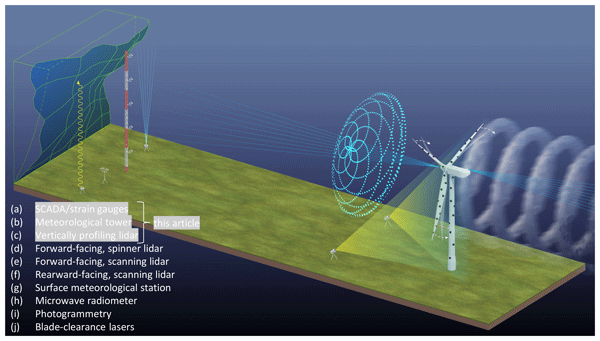
This paper presents a study of the popular wind turbine design tool OpenFAST. We compare simulation results to measurements obtained from a 2.8 MW land-based wind turbine. Measured wind conditions were used to generate turbulent flow fields through several techniques. We show that successful validation of the tool is not strongly dependent on the inflow generation technique used for mean quantities of interest. The type of inflow assimilation method has a larger effect on fatigue quantities.
Erik K. Fritz, Christopher L. Kelley, and Kenneth A. Brown
Wind Energ. Sci., 9, 1713–1726, https://doi.org/10.5194/wes-9-1713-2024, https://doi.org/10.5194/wes-9-1713-2024, 2024
Short summary
Short summary
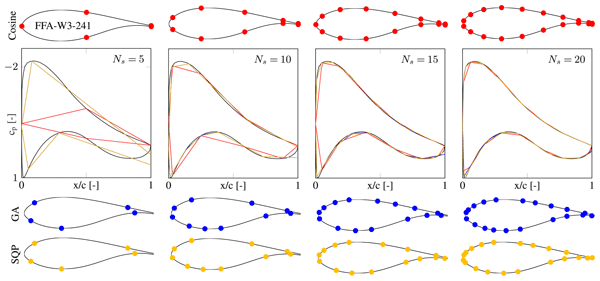
This study investigates the benefits of optimizing the spacing of pressure sensors for measurement campaigns on wind turbine blades and airfoils. It is demonstrated that local aerodynamic properties can be estimated considerably more accurately when the sensor layout is optimized compared to commonly used simpler sensor layouts. This has the potential to reduce the number of sensors without losing measurement accuracy and, thus, reduce the instrumentation complexity and experiment cost.

Daniel R. Houck, Nathaniel B. de Velder, David C. Maniaci, and Brent C. Houchens
Wind Energ. Sci., 9, 1189–1209, https://doi.org/10.5194/wes-9-1189-2024, https://doi.org/10.5194/wes-9-1189-2024, 2024
Short summary
Short summary
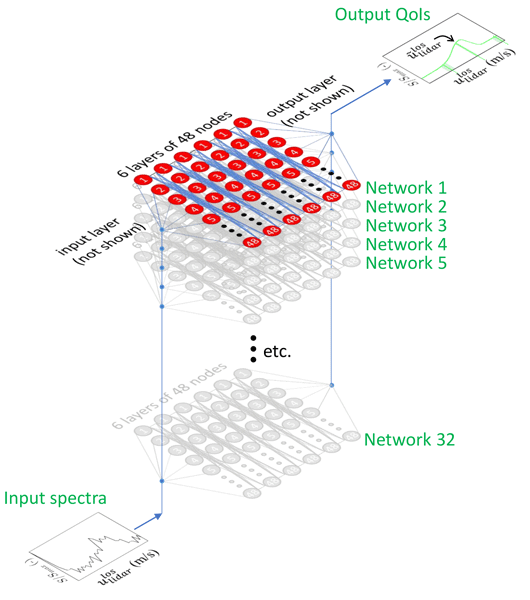
Experiments offer incredible value to science, but results must come with an uncertainty quantification to be meaningful. We present a method to simulate a proposed experiment, calculate uncertainties, and determine the measurement duration (total time of measurements) and the experiment duration (total time to collect the required measurement data when including condition variability and time when measurement is not occurring) required to produce statistically significant and converged results.
Kenneth A. Brown and Thomas G. Herges
Atmos. Meas. Tech., 15, 7211–7234, https://doi.org/10.5194/amt-15-7211-2022, https://doi.org/10.5194/amt-15-7211-2022, 2022
Short summary
Short summary
The character of the airflow around and within wind farms has a significant impact on the energy output and longevity of the wind turbines in the farm. For both research and control purposes, accurate measurements of the wind speed are required, and these are often accomplished with remote sensing devices. This article pertains to a field experiment of a lidar mounted to a wind turbine and demonstrates three data post-processing techniques with efficacy at extracting useful airflow information.
Cited articles
Ainslie, J. F.: Calculating the flowfield in the wake of wind turbines, J. Wind Eng. Ind. Aerod., 27, 213–224, 1988. a
Bastankhah, M. and Porté-Agel, F.: A new analytical model for wind-turbine wakes, Renew. Energ., 70, 116–123, 2014. a
Bradstock, P. and Schlez, W.: Theory and verification of a new 3D RANS wake model, Wind Energ. Sci., 5, 1425–1434, https://doi.org/10.5194/wes-5-1425-2020, 2020. a
Brown, K., Cheung, L., Yalla, G., Houck, D., and deVelder, N.: Active-wake mixing in atmospheric boundary layers with one-turbine arrays, Oak Ridge National Laboratory [data set], https://doi.org/10.13139/OLCF/3000779, 2026. a
Brown, K., Bortolotti, P., Branlard, E., Chetan, M., Dana, S., deVelder, N., Doubrawa, P., Hamilton, N., Ivanov, H., Jonkman, J., Kelley, C., and Zalkind, D.: One-to-one aeroservoelastic validation of operational loads and performance of a 2.8 MW wind turbine model in OpenFAST, Wind Energ. Sci., 9, 1791–1810, https://doi.org/10.5194/wes-9-1791-2024, 2024. a
Brown, K., Yalla, G., Cheung, L., Frederik, J., Houck, D., deVelder, N., Simley, E., and Fleming, P.: Comparison of wind-farm control strategies under realistic offshore wind conditions: wake quantities of interest, Wind Energ. Sci., 10, 1737–1762, https://doi.org/10.5194/wes-10-1737-2025, 2025. a, b, c
Byrd, R. H., Lu, P., Nocedal, J., and Zhu, C.: A limited memory algorithm for bound constrained optimization, SIAM J. Sci. Comput., 16, 1190–1208, 1995. a
Cheung, L., Hsieh, A., Blaylock, M., Herges, T., deVelder, N., Brown, K., Sakievich, P., Houck, D., Maniaci, D., Kaul, C., Rai, R., Hamilton, N., Rybchuk, A., Scott, R., Thedin, R., Brazell, M., Churchfield, M., and Sprague, M.: Investigations of Farm-to-Farm Interactions and Blockage Effects from AWAKEN Using Large-Scale Numerical Simulations, J. Phys. Conf. Ser., 2505, 012023, https://doi.org/10.1088/1742-6596/2505/1/012023, 2023. a
Cheung, L., Brown, K., Sakievich, P., Develder, N., Herges, T., Houck, D., and Hsieh, A.: A Green's Function Wind Turbine Induction Model That Incorporates Complex Inflow Conditions, Wind Energy, 27, 1526–1544, 2024a. a
Cheung, L., Yalla, G., Brown, K., deVelder, N., Houck, D., Herges, T., Maniaci, D., Sakievich, P., and Abraham, A.: Modification of wind turbine wakes by large-scale convective atmospheric boundary layer structures, J. Renew. Sustain. Ener., 16, https://doi.org/10.1063/5.0211722, 2024b. a
Cheung, L., Yalla, G., Mohan, P., Hsieh, A., Brown, K., deVelder, N., Houck, D., Henry de Frahan, M. T., Day, M., and Sprague, M.: Modeling the effects of active wake mixing on wake behavior through large-scale coherent structures, Wind Energ. Sci., 10, 1403–1420, https://doi.org/10.5194/wes-10-1403-2025, 2025. a, b, c, d, e, f
Crespo, A. and Herna, J.: Turbulence characteristics in wind-turbine wakes, J. Wind Eng. Ind. Aerod., 61, 71–85, 1996. a
Durbin, P. A.: Near-wall turbulence closure modeling without “damping functions, Theor. Comput. Fluid Dyn., 3, 1–13, 1991. a
Fedeli, L., Huebl, A., Boillod-Cerneux, F., Clark, T., Gott, K., Hillairet, C., Jaure, S., Leblanc, A., Lehe, R., Myers, A., Piechurski, C., Sato, M., Zaim, N., Zhang, W., Vay, J.-L., and Vincenti, H.: Pushing the frontier in the design of laser-based electron accelerators with groundbreaking mesh-refined particle-in-cell simulations on exascale-class supercomputers, in: SC22: International Conference for High Performance Computing, Networking, Storage and Analysis, IEEE Computer Society, Los Alamitos, CA, USA, 1–12, https://doi.org/10.1109/SC41404.2022.00008, 2022. a
Frederik, J. A., Simley, E., Brown, K. A., Yalla, G. R., Cheung, L. C., and Fleming, P. A.: Comparison of wind farm control strategies under realistic offshore wind conditions: turbine quantities of interest, Wind Energ. Sci., 10, 755–777, https://doi.org/10.5194/wes-10-755-2025, 2025. a, b
Gaertner, E., Rinker, J., Sethuraman, L., Zahle, F., Anderson, B., Barter, G., Abbas, N., Meng, F., Bortolotti, P., Skrzypinski, W., Scott, G., Feil, R. Bredmose, H., Dykes, K., Shields, M., Allen, C., and Viselli, A.: IEA wind TCP task 37: definition of the IEA 15-megawatt offshore reference wind turbine, Tech. rep., National Renewable Energy Laboratory (NREL), Golden, CO (United States), https://doi.org/10.2172/1603478, 2020. a
Gunn, K., Stock-Williams, C., Burke, M., Willden, R., Vogel, C., Hunter, W., Stallard, T., Robinson, N., and Schmidt, S.: Limitations to the validity of single wake superposition in wind farm yield assessment, J. Phys. Conf. Ser., 749, 012003, https://doi.org/10.1088/1742-6596/749/1/012003, 2016. a
Heck, K. S. and Howland, M. F.: Coriolis effects on wind turbine wakes across neutral atmospheric boundary layer regimes, J. Fluid Mech., 1008, https://doi.org/10.1017/jfm.2025.35, 2025. a
Henry de Frahan, M. T., Rood, J. S., Day, M. S., Sitaraman, H., Yellapantula, S., Perry, B. A., Grout, R. W., Almgren, A., Zhang, W., Bell, J. B., and Chen, J. H.: PeleC: An adaptive mesh refinement solver for compressible reacting flows, Int. J. High Perform. Comput. Appl., 2022, https://doi.org/10.1177/10943420221121151, 2022. a
Henry de Frahan, M. T., Esclapez, L., Rood, J., Wimer, N. T., Mullowney, P., Perry, B. A., Owen, L., Sitaraman, H., Yellapantula, S., Hassanaly, M., Rahimi, M. J., Martin, M. J., Doronina, O. A., A., S. N., Rieth, M., Ge, W., Sankaran, R., Almgren, A. S., Zhang, W., Bell, J. B., Grout, R., Day, M. S., and Chen, J. H.: The Pele simulation suite for reacting flows at exascale, in: Proceedings of the 2024 SIAM Conference on Parallel Processing for Scientific Computing, pp. 13–25, https://doi.org/10.1137/1.9781611977967.2, 2024. a
Hsieh, A. S., Cheung, L. C., Blaylock, M. L., Brown, K. A., Houck, D. R., Herges, T. G., deVelder, N. B., Maniaci, D. C., Yalla, G. R., Sakievich, P. J., Radunz, W. C., and Carmo, B. S.: Model intercomparison of the ABL, turbines, and wakes within the AWAKEN wind farms under neutral stability conditions, J. Renew. Sustain. Ener., 17, 023301, https://doi.org/10.1063/5.0211729, 2025. a, b
Iungo, G. V., Santhanagopalan, V., Ciri, U., Viola, F., Zhan, L., Rotea, M. A., and Leonardi, S.: Parabolic RANS solver for low-computational-cost simulations of wind turbine wakes, Wind Energy, 21, 184–197, https://doi.org/10.1002/we.2154, 2018. a
Jensen, N. O.: A note on wind generator interaction, Risø National Laboratory, ISBN 87-550-0971-9, https://orbit.dtu.dk/files/55857682/ris_m_2411.pdf (last access: September 2026) 1983. a
Jones, W. P. and Launder, B. E.: The prediction of laminarization with a two-equation model of turbulence, Int. J. Heat Mass Tran., 15, 301–314, 1972. a
Jonkman, J. M., Wright, A. D., Hayman, G. J., and Robertson, A. N.: Full-system linearization for floating offshore wind turbines in OpenFAST, in: International Conference on Offshore Mechanics and Arctic Engineering, American Society of Mechanical Engineers, vol. 51975, V001T01A028, https://doi.org/10.1115/IOWTC2018-1025, 2018. a
Kuhn, M. B., Henry de Frahan, M. T., Mohan, P., Deskos, G., Churchfield, M., Cheung, L., Sharma, A., Almgren, A., Ananthan, S., Brazell, M. J., A., M. L., Thedin, R., Rood, J., Sakievich, P., Vijayakumar, G., Zhang, W., and Sprague, M. A.: AMR-Wind: A performance-portable, high-fidelity flow solver for wind farm simulations, Wind Energy, 28, e70010, https://doi.org/10.1002/we.70010, 2025. a
lawrenceccheung, Henry de Frahan, M. T., Kaufman-Martin, S., and prakash: sandialabs/SANDwake3D: Initial release (Version v0.1), Zenodo [code], https://doi.org/10.5281/zenodo.22289207, 2026. a
Letizia, S. and Iungo, G. V.: Pseudo-2D RANS: A LiDAR-driven mid-fidelity model for simulations of wind farm flows, J. Renew. Sustain. Ener., 14, https://doi.org/10.1063/5.0076739, 2022. a
Martínez-Tossas, L. A., King, J., Quon, E., Bay, C. J., Mudafort, R., Hamilton, N., Howland, M. F., and Fleming, P. A.: The curled wake model: a three-dimensional and extremely fast steady-state wake solver for wind plant flows, Wind Energ. Sci., 6, 555–570, https://doi.org/10.5194/wes-6-555-2021, 2021. a, b
Narasimhan, G., Gayme, D. F., and Meneveau, C.: Effects of wind veer on a yawed wind turbine wake in atmospheric boundary layer flow, Physical Review Fluids, 7, 114609, https://doi.org/10.1103/PhysRevFluids.7.114609, 2022. a
Narasimhan, G., Gayme, D. F., and Meneveau, C.: An extended analytical wake model and applications to yawed wind turbines in atmospheric boundary layers with different levels of stratification and veer, J. Renew. Sustain. Ener., 17, https://doi.org/10.1063/5.0251305, 2025. a
Niayifar, A. and Porté-Agel, F.: Analytical modeling of wind farms: A new approach for power prediction, Energies, 9, 741, https://doi.org/10.3390/en9090741, 2016. a
NREL: ROSCO, Version 2.4.1, GitHub [code], https://github.com/NatLabRockies/ROSCO (last access: September 2026), 2021. a
NREL: OpenFAST Documentation, https://openfast.readthedocs.io (last access: September 2026), 2023. a
NREL: FLORIS, Version 4.4, GitHub [code], https://github.com/NatLabRockies/floris (last access: September 2026), 2025. a
Rood, J., Ananthan, S., Kuhn, M. B., Almgren, A., Henry de Frahan, M. T., Brazell, M. J., Zhang, W., Deskos, G. (Yorgos), prakash, mic84, Martinez, T., Sakievich, P., Harish, Vijayakumar, G., lawrenceccheung, Sharma, A., Dave, M., Beckers, D., Polimeno, M., Churchfield, M., deVelder, N., Thedin, R., Quon, E., Bidadi, S., Katz, M., Montgomery, D., jbbel, and Topcuoglu, I.: kynema/kynema-sgf: v4.2.0 (Version v4.2.0), Zenodo [code], https://doi.org/10.5281/zenodo.22778632, 2026. a
Sharma, A., Brazell, M. J., Vijayakumar, G., Ananthan, S., Cheung, L., deVelder, N., Henry de Frahan, M. T., Matula, N., Mullowney, P., Rood, J., Sakievich, P., Almgren, A., Crozier, P. S., and Sprague, M.: ExaWind: Open-source CFD for hybrid-RANS/LES geometry-resolved wind turbine simulations in atmospheric flows, Wind Energy, 27, 225–257, https://doi.org/10.1002/we.2886, 2024. a
Sinner, M. and Fleming, P.: Robust wind farm layout optimization, J. Phys. Conf. Ser., 2767, 032036, https://doi.org/10.1088/1742-6596/2767/3/032036, 2024. a
Sprague, M. A., Ananthan, S., Vijayakumar, G., and Robinson, M.: ExaWind: A multifidelity modeling and simulation environment for wind energy, J. Phys. Conf. Ser., 1452, 012071, https://doi.org/10.1088/1742-6596/1452/1/012071, 2020. a
Thomas, J. J., Baker, N. F., Malisani, P., Quaeghebeur, E., Sanchez Perez-Moreno, S., Jasa, J., Bay, C., Tilli, F., Bieniek, D., Robinson, N., Stanley, A. P. J., Holt, W., and Ning, A.: A comparison of eight optimization methods applied to a wind farm layout optimization problem, Wind Energ. Sci., 8, 865–891, https://doi.org/10.5194/wes-8-865-2023, 2023. a
US Department of Energy: ExaWind benchmark repository, https://kynema.github.io/kynema-benchmarks/ (last access: September 2026), 2026. a
van der Laan, M. P., Kelly, M. C., and Sørensen, N. N.: A new k-epsilon model consistent with Monin–Obukhov similarity theory, Wind Energy, 20, 479–489, https://doi.org/10.1002/we.2017, 2017. a
van der Laan, M. P. and Andersen, S. J.: The turbulence scales of a wind turbine wake: A revisit of extended k-epsilon models, J. Phys. Conf. Ser., 1037, 072001, https://doi.org/10.1088/1742-6596/1037/7/072001, 2018. a
Zhang, W., Almgren, A., Beckner, V., Bell, J., Blaschke, J., Chan, C., Day, M., Friesen, B., Gott, K., Graves, D., Katz, M., Myers, A., Nguyen, T., Nonaka, A., Rosso, M., Williams, S., and Zingale, M.: AMReX: a framework for block-structured adaptive mesh refinement, Journal of Open Source Software, 4, 1370, https://doi.org/10.21105/joss.01370, 2019. a
Zhu, C., Byrd, R. H., Lu, P., and Nocedal, J.: Algorithm 778: L-BFGS-B: Fortran subroutines for large-scale bound-constrained optimization, ACM T. Math. Software (TOMS), 23, 550–560, 1997. a
Short summary
Modeling turbine wakes is critical to maximizing wind farm energy production but is also challenging due to the complicated phenomena that must be accounted for, including wind shear, veer, atmospheric stratification, and overlapping wakes. Our work introduces a new, efficient method of modeling wakes which naturally captures these complex wake behaviors. We show that our wake modeling approach is as accurate as higher-fidelity methods, but with much less computational cost.
Modeling turbine wakes is critical to maximizing wind farm energy production but is also...


Altmetrics
Final-revised paper
Preprint