Articles | Volume 8, issue 12
https://doi.org/10.5194/wes-8-1839-2023
© Author(s) 2023. This work is distributed under
the Creative Commons Attribution 4.0 License.
https://doi.org/10.5194/wes-8-1839-2023
© Author(s) 2023. This work is distributed under
the Creative Commons Attribution 4.0 License.
Quantifying the effect of low-frequency fatigue dynamics on offshore wind turbine foundations: a comparative study
OWI-Lab, AVRG, Vrije Universiteit Brussel (VUB), Brussels, 1050, Belgium
Pietro D'Antuono
OWI-Lab, AVRG, Vrije Universiteit Brussel (VUB), Brussels, 1050, Belgium
Nymfa Noppe
OWI-Lab, AVRG, Vrije Universiteit Brussel (VUB), Brussels, 1050, Belgium
24SEA, Brussels, 1000, Belgium
Koen Robbelein
OWI-Lab, AVRG, Vrije Universiteit Brussel (VUB), Brussels, 1050, Belgium
24SEA, Brussels, 1000, Belgium
Wout Weijtjens
OWI-Lab, AVRG, Vrije Universiteit Brussel (VUB), Brussels, 1050, Belgium
Christof Devriendt
OWI-Lab, AVRG, Vrije Universiteit Brussel (VUB), Brussels, 1050, Belgium
Related authors
Negin Sadeghi, Pablo G. Morato, Nymfa Noppe, Nandar Hlaing, Wout Weijtjens, and Christof Devriendt
Wind Energ. Sci. Discuss., https://doi.org/10.5194/wes-2026-65, https://doi.org/10.5194/wes-2026-65, 2026
Preprint under review for WES
Short summary
Short summary
We studied how stationary the long-term damage estimates are when based on only short periods of measurement in offshore wind turbines. Using eight years of real data, we compared many one‑year measurement windows and showed that results can differ strongly depending on which year is used, even when current uncertainty methods suggest high confidence. So short measurements may not represent long-term behaviour, if proper conditioning to environmental and operational conditions is not done.
Ahmed Mujtaba, Wout Weijtjens, Negin Sadeghi, and Christof Devriendt
Wind Energ. Sci., 11, 443–467, https://doi.org/10.5194/wes-11-443-2026, https://doi.org/10.5194/wes-11-443-2026, 2026
Short summary
Short summary
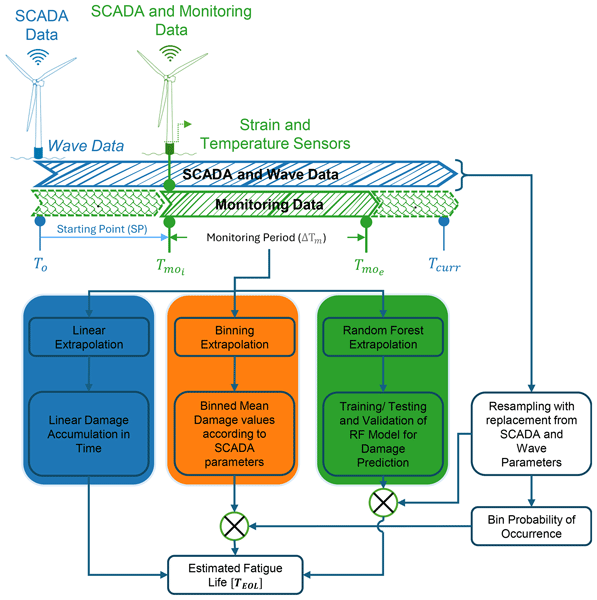
This study proposes a random-forest-based machine learning (ML) model for fatigue life prediction of offshore wind turbine monopile foundations compared to traditional approaches, using long-term strain data from turbines in the Belgian North Sea. This study shows that the ML model predicts the fatigue life of monopile foundations more reliably when only short-term measurements are available, whereas for longer monitoring periods of greater than 12 months, simpler binning methods perform equally well.
Yacine Bel-Hadj, Francisco de Nolasco Santos, Wout Weijtjens, and Christof Devriendt
Wind Energ. Sci., 11, 1363–1382, https://doi.org/10.5194/wes-11-1363-2026, https://doi.org/10.5194/wes-11-1363-2026, 2026
Short summary
Short summary
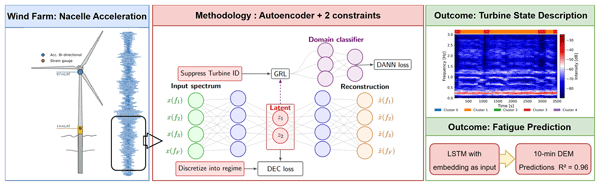
We show that simple vibration sensors on wind turbines can reveal how each machine is operating without relying on control system data. By learning patterns from short acceleration segments, our model identifies turbine behavior, detects changes in operation, and tracks events over time. These patterns also support estimating fatigue, providing a new way to understand turbine performance using only vibration measurements.
Negin Sadeghi, Pablo G. Morato, Nymfa Noppe, Nandar Hlaing, Wout Weijtjens, and Christof Devriendt
Wind Energ. Sci. Discuss., https://doi.org/10.5194/wes-2026-65, https://doi.org/10.5194/wes-2026-65, 2026
Preprint under review for WES
Short summary
Short summary
We studied how stationary the long-term damage estimates are when based on only short periods of measurement in offshore wind turbines. Using eight years of real data, we compared many one‑year measurement windows and showed that results can differ strongly depending on which year is used, even when current uncertainty methods suggest high confidence. So short measurements may not represent long-term behaviour, if proper conditioning to environmental and operational conditions is not done.
Ahmed Mujtaba, Wout Weijtjens, Negin Sadeghi, and Christof Devriendt
Wind Energ. Sci., 11, 443–467, https://doi.org/10.5194/wes-11-443-2026, https://doi.org/10.5194/wes-11-443-2026, 2026
Short summary
Short summary
This study proposes a random-forest-based machine learning (ML) model for fatigue life prediction of offshore wind turbine monopile foundations compared to traditional approaches, using long-term strain data from turbines in the Belgian North Sea. This study shows that the ML model predicts the fatigue life of monopile foundations more reliably when only short-term measurements are available, whereas for longer monitoring periods of greater than 12 months, simpler binning methods perform equally well.
Francisco d N Santos, Nymfa Noppe, Wout Weijtjens, and Christof Devriendt
Wind Energ. Sci., 7, 299–321, https://doi.org/10.5194/wes-7-299-2022, https://doi.org/10.5194/wes-7-299-2022, 2022
Short summary
Short summary
The estimation of fatigue in offshore wind turbine is highly relevant, as it can help extend the lifetime of these assets. This article attempts to answer this issue by developing a methodology based on artificial intelligence and data collected by sensors installed in real-world turbines. Good results are obtained, and this methodology is further used to learn the value of eight different sensor setups and employed in a real-world wind farm with 48 wind turbines.
Cited articles
Amzallag, C., Gerey, J. P., Robert, J. L., and Bahuaud, J.: Standardization of the rainflow counting method for fatigue analysis, Int. J. Fatigue, 16, 287–293, https://doi.org/10.1016/0142-1123(94)90343-3, 1994.
Archer, C. L., Colle, B. A., Delle Monache, L., Dvorak, M. J., Lundquist, J., Bailey, B. H., Beaucage, P., Churchfield, M. J., Fitch, A., Kosovic, B., Lee, S., Moriarty, P. J., Simao, H., Stevens, R. J. A., Veron, D., and Zack, J.: Meteorology for coastal/offshore wind energy in the United States: Recommendations and research needs for the next 10 years, B. Am. Meteorol. Soc., 95, 515–519, https://doi.org/10.1175/BAMS-D-13-00108.1, 2014.
ASTM International: Standard Practices for Cycle Counting in Fatigue Analysis, https://doi.org/10.1520/E1049-85R17, 2017.
Basquin, O. H.: The exponential law of endurance tests, Proc. Am. Soc. Test Mater., 10, 625–630, https://doi.org/10.4236/ojanes.2014.41001, 1910.
Ciavarella, M., D'antuono, P., and Papangelo, A.: On the connection between Palmgren-Miner rule and crack propagation laws, Fatigue Fract. Eng. Mater. Struct., 41, 1469–1475, https://doi.org/10.1111/ffe.12789, 2018.
D'Antuono, P., Weijtjens, W., and Devriendt, C.: On the minimum required sampling frequency for reliable fatigue lifetime estimation in structural health monitoring. How much is enough?, in: Proceedings of the 10th European Workshop on Structural Health Monitoring – EWSHM 2022, Springer International Publishing, Palermo, Italy, https://doi.org/10.1007/978-3-031-07254-3_14, 2022.
D'Antuono, P., Weijtjens, W., and Devriendt, C.: OWI-Lab/py_fatigue, Zenodo [code], https://doi.org/10.5281/zenodo.7656680, 2023.
DNV: DNV GL-ST-0437: Loads and Site Conditions for Wind Turbines, DNV GL, Oslo, Norway, https://www.dnv.com/energy/standards-guidelines/dnv-st-0437-loads-and-site-conditions-for-wind-turbines.html (last access: November 2016), 2016.
DNV: Fatigue Design of Offshore Steel Structures: DNVGL-RP-C203, DNV GL AS, https://www.dnv.com/oilgas/download/dnv-rp-c203-fatigue-design-of-offshore-steel-structures.html (last access date: September 2019), 2019.
EASA: Certification Specifications for Large Aeroplanes (CS-25), https://www.easa.europa.eu/en/document-library/certification-specifications/group/cs-25-large-aeroplanes#cs-25-large-aeroplanes (last access: 10 January 2023), 2020.
Hectors, K. and De Waele, W.: Cumulative Damage and Life Prediction Models for High-Cycle Fatigue of Metals: A Review, Metals, 11, 204, https://doi.org/10.3390/met11020204, 2021.
Hsiao, A., Lee, W., and Basaran, C.: A review of damage, void evolution and fatigue life prediction models, Metals, 11, 609, https://doi.org/10.3390/met11040609, 2021.
Hübler, C., Weijtjens, W., Rolfes, R., and Devriendt, C.: Reliability analysis of fatigue damage extrapolations of wind turbines using offshore strain measurements, J. Phys.: Conf. Ser., 1037, 2035, https://doi.org/10.1088/1742-6596/1037/3/032035, 2018.
IEC: IEC-61400-13, Measurement of mechanical loads, https://webstore.iec.ch/publication/68197 (last access: 3 December 2021), 2001.
Iliopoulos, A., Weijtjens, W., Van Hemelrijck, D., and Devriendt, C.: Fatigue assessment of offshore wind turbines on monopile foundations using multi-band modal expansion, Wind Energy, 20, 1463–1479, https://doi.org/10.1002/we.2104, 2017.
Larsen, G. C. and Thomsen, K.: Low cycle fatigue loads, Risoe-R No. 913(EN), Forskningscenter Risoe, Denmark, https://findit.dtu.dk/en/catalog/537f105074bed2fd2100b4f6 (last access: 1 October 2023), 1996.
Laszlo, A., Bhattacharya, S., Macdonald, J., and Hogan, J.: Closed form solution of Eigen frequency of monopile supported offshore wind turbines in deeper waters incorporating stiffness of substructure and SSI, Soil Dynam. Earthq. Eng., 83, 18–32, https://doi.org/10.1016/j.soildyn.2015.12.011, 2016.
Marsh, G., Wignall, C., Thies, P. R., Barltrop, N., Incecik, A., Venugopal, V., and Johanning, L.: Review and application of Rainflow residue processing techniques for accurate fatigue damage estimation, Int. J. Fatigue, 82, 757–765, https://doi.org/10.1016/j.ijfatigue.2015.10.007, 2016.
Miner, M. A.: Cumulative Damage in Fatigue, J. Appl. Mech., 12, 159–164, https://doi.org/10.1115/1.4009458, 1945.
Natarajan, A.: Damage equivalent load synthesis and stochastic extrapolation for fatigue life validation, Wind Energ. Sci., 7, 1171–1181, https://doi.org/10.5194/wes-7-1171-2022, 2022.
Noppe, N., Hübler, C., Devriendt, C., and Weijtjens, W.: Validated extrapolation of measured damage within an offshore wind farm using instrumented fleet leaders, J. Phys.: Conf. Ser., 1618, 022005, https://doi.org/10.1088/1742-6596/1618/2/022005, 2020.
Pacheco, J., Pimenta, F., Pereira, S., Cunha, Á., and Magalhães, F.: Fatigue Assessment of Wind Turbine Towers: Review of Processing Strategies with Illustrative Case Study, Energies, 15, 4782, https://doi.org/10.3390/en15134782, 2022.
Pakenham, B., Ermakova, A., and Mehmanparast, A.: A Review of Life Extension Strategies for Offshore Wind Farms Using Techno-Economic Assessments, Energies, 14, 1936, https://doi.org/10.3390/en14071936, 2021.
Palmgren, A. G.: Die Lebensdauer von Kugellagern – Life Length of Roller Bearings, VDI Zeitschrift – Zeitschrift des Vereines Deutscher Ingenieure, ISSN 0341–7258, 1924.
Sadeghi, N., Robbelein, K., D'Antuono, P., Noppe, N., Weijtjens, W., and Devriendt, C.: Fatigue damage calculation of offshore wind turbines' longterm data considering the low-frequency fatigue dynamics, J. Phys.: Conf. Ser., 2265, 032063, https://doi.org/10.1088/1742-6596/2265/3/032063, 2022.
Socie, D.: Rainflow Cycle Counting: A Historical Perspective, in: The Rainflow Method in Fatigue, Butterworth-Heinemann, 3–10, ISBN 9781483161426, 1992.
Sutherland, H.: On the Fatigue Analysis of Wind Turbines, Sandia National Laboratories, USA, https://doi.org/10.2172/9460, 1999.
Weijtens, W., Noppe, N., Verbelen, T., Iliopoulos, A., and Devriendt, C.: Offshore wind turbine foundation monitoring, extrapolating fatigue measurements from fleet leaders to the entire wind farm, J. Phys.: Conf. Ser., 753, 092018, https://doi.org/10.1088/1742-6596/753/9/092018, 2016.
Short summary
Analysis of long-term fatigue damage of four offshore wind turbines using 3 years of measurement data was performed for the first time to gain insight into the low-frequency fatigue damage (LFFD) impact on overall consumed life. The LFFD factor depends on the (linear) stress–life (SN) curve slope, heading, site, signal, and turbine type. Up to ∼ 65 % of the total damage can be related to LFFDs. Therefore, in this case study, the LFFD effect has a significant impact on the final damage.
Analysis of long-term fatigue damage of four offshore wind turbines using 3 years of measurement...
Altmetrics
Final-revised paper
Preprint