
Articles | Volume 11, issue 5
https://doi.org/10.5194/wes-11-1583-2026
© Author(s) 2026. This work is distributed under
the Creative Commons Attribution 4.0 License.
the Creative Commons Attribution 4.0 License.
https://doi.org/10.5194/wes-11-1583-2026
© Author(s) 2026. This work is distributed under
the Creative Commons Attribution 4.0 License.
the Creative Commons Attribution 4.0 License.
Research article
| 
06 May 2026
Research article |
| 06 May 2026
| 06 May 2026
Continuous-lifetime-monitoring technique for structural components and main bearings in wind turbines based on measured strain and virtual load sensors
Bruno Rodrigues Faria
CORRESPONDING AUTHOR

DTU Wind and Energy Systems, Technical University of Denmark, 4000 Roskilde, Denmark
Nikolay Dimitrov
DTU Wind and Energy Systems, Technical University of Denmark, 4000 Roskilde, Denmark
Nikhil Sudhakaran
DTU Wind and Energy Systems, Technical University of Denmark, 4000 Roskilde, Denmark
Matthias Stammler
DTU Wind and Energy Systems, Technical University of Denmark, 4000 Roskilde, Denmark
Large Bearing Laboratory, Fraunhofer Institute for Wind Energy Systems IWES, 21029 Hamburg, Germany
Athanasios Kolios
DTU Wind and Energy Systems, Technical University of Denmark, 4000 Roskilde, Denmark
W. Dheelibun Remigius
Shell India Markets Private Limited, 562149 Bengaluru, India
Xiaodong Zhang
Science and Technology Institute, China Three Gorges Corporation, 101100 Beijing, China
Asger Bech Abrahamsen
DTU Wind and Energy Systems, Technical University of Denmark, 4000 Roskilde, Denmark
Related authors
No articles found.
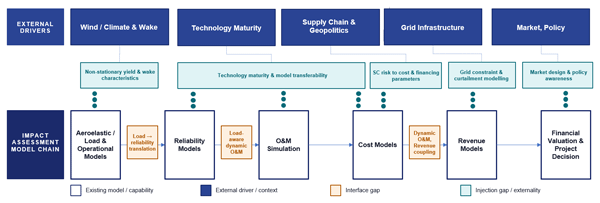
Moritz Gräfe, Azélice Ludot, Matt Shields, Athanasios Kolios, Rajasekhar Pulikollu, and Nikolay Dimitrov
Wind Energ. Sci., 11, 3475–3507, https://doi.org/10.5194/wes-11-3475-2026, https://doi.org/10.5194/wes-11-3475-2026, 2026
Short summary
Short summary
This study examines the risk drivers of the economic success of wind energy projects and how interacting risks threaten that success. We combined expert opinions, survey results, and literature findings to identify key challenges in planning and operation. The results show that risks interact and can cause uneven financial losses, highlighting the need for integrated decision support tools.
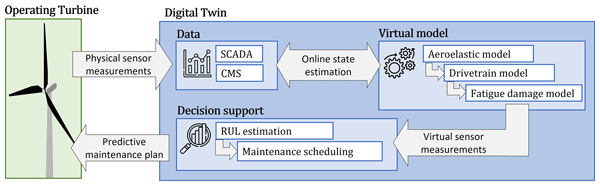
Kayacan Kestel, Xavier Chesterman, Donatella Zappalá, Simon Watson, Mingxin Li, Edward Hart, James Carroll, Yolanda Vidal, Amir R. Nejad, Shawn Sheng, Yi Guo, Matthias Stammler, Florian Wirsing, Ahmed Saleh, Nico Gregarek, Thao Baszenski, Thomas Decker, Martin Knops, Georg Jacobs, Benjamin Lehmann, Florian König, Ines Pereira, Pieter-Jan Daems, Cédric Peeters, and Jan Helsen
Wind Energ. Sci., 11, 2103–2155, https://doi.org/10.5194/wes-11-2103-2026, https://doi.org/10.5194/wes-11-2103-2026, 2026
Short summary
Short summary
Wind energy use has been rapidly expanding worldwide in recent years. Driven by global decarbonization goals and energy security concerns, this growth is expected to continue. To achieve these targets, production costs must decrease, with operation and maintenance being major contributors. This paper reviews current and emerging technologies for monitoring wind turbine drivetrains, and highlights key academic and industrial challenges that may hinder progress.
Matthias Stammler, Faras Jamil, Xinrun Liu, Jens Jo Matthys, Nikhil Sudhakaran, Cédric Peeters, Asger Bech Abrahamsen, and Jan Helsen
Wind Energ. Sci. Discuss., https://doi.org/10.5194/wes-2026-81, https://doi.org/10.5194/wes-2026-81, 2026
Preprint under review for WES
Short summary
Short summary
This study compares traditional and artificial intelligence supported methods for detecting damage in rotating machine parts. Bearings were tested under controlled conditions to see how well each method identified developing problems. The artificial intelligence supported method detected damage as early as, or earlier than, established techniques while needing far less expert attention. This supports automated monitoring of wind turbines, enabling earlier maintenance and lower operating costs.
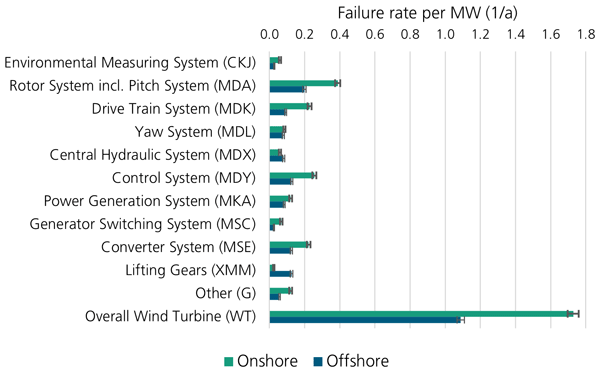
Julia Walgern, Nils Stratmann, Martin Horn, Nathalene W. Y. Then, Moritz Menzel, Fraser Anderson, Athanasios Kolios, and Katharina Fischer
Wind Energ. Sci., 11, 1553–1568, https://doi.org/10.5194/wes-11-1553-2026, https://doi.org/10.5194/wes-11-1553-2026, 2026
Short summary
Short summary
This study analyses maintenance data from over 1000 onshore and offshore wind turbines, covering 4200 operating years, to assess failure rates, repair times, and maintenance needs. It compares failure rates per turbine and per megawatt, examines time-dependent failure behaviour, and evaluates maintenance interventions. Results show higher onshore failure rates and identify the pitch, control, and converter systems as most critical.
Andreas Vad, Adrien Guilloré, Abhinav Anand, Vasilis Pettas, Anik H. Shah, Ion Lizarraga-Saenz, Maria Aparicio-Sanchez, Irene Eguinoa, Nicolau Conti Gost, Iasonas Tsaklis, Ariane Frère, Koen W. Hermans, Joseph K. Kamau, Nikolay Dimitrov, Tuhfe Göçmen, and Carlo L. Bottasso
Wind Energ. Sci. Discuss., https://doi.org/10.5194/wes-2026-45, https://doi.org/10.5194/wes-2026-45, 2026
Revised manuscript under review for WES
Short summary
Short summary
A modular, computationally efficient framework for wind‑farm response modeling is presented. It combines an engineering wake model with surrogate models trained on extensive aeroelastic simulations generated using a novel method for synthetic waked and clean inflows. The wind‑farm‑agnostic framework supports multiple turbine types and layouts, enabling accurate, low‑cost predictions for design, operation, and control.
Carlo L. Bottasso, Sandrine Aubrun, Nicolaos A. Cutululis, Julia Gottschall, Athanasios Kolios, Jakob Mann, and Paul Veers
Wind Energ. Sci., 11, 347–348, https://doi.org/10.5194/wes-11-347-2026, https://doi.org/10.5194/wes-11-347-2026, 2026
Short summary
Short summary
This editorial celebrates the 10th anniversary of Wind Energy Science, reflecting on a decade of rapid scientific progress and the journal’s role in advancing fundamental, interdisciplinary research. It highlights key developments in wind energy, the importance of open science and academia–industry collaboration, and emerging challenges such as data sharing and artificial intelligence. Above all, it honors the research community that has shaped the journal and looks ahead to the next decade.
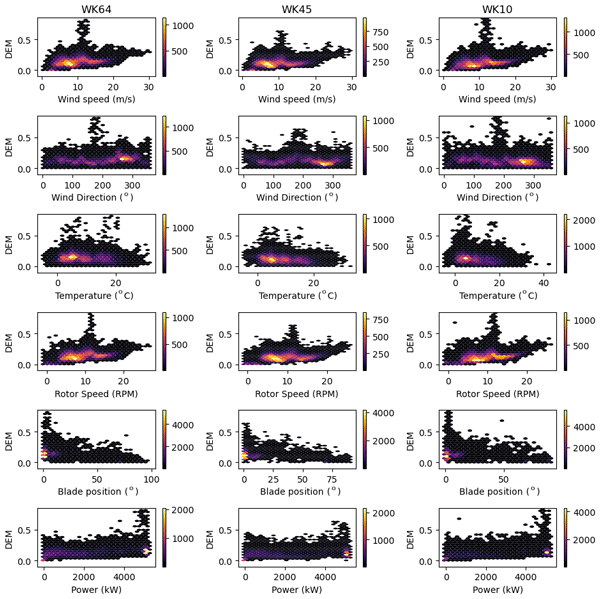
Innes Murdo Black, Moritz Werther Häckell, and Athanasios Kolios
Wind Energ. Sci., 10, 2889–2901, https://doi.org/10.5194/wes-10-2889-2025, https://doi.org/10.5194/wes-10-2889-2025, 2025
Short summary
Short summary
Population-based structural health monitoring minimises costs by efficiently sharing information within a wind farm, reducing the need for many sensors and model updates.

Oliver Menck, Florian Schleich, and Matthias Stammler
Wind Energ. Sci., 10, 2771–2789, https://doi.org/10.5194/wes-10-2771-2025, https://doi.org/10.5194/wes-10-2771-2025, 2025
Short summary
Short summary
The paper discusses how to calculate the life of a blade bearing that is a roller bearing, as opposed to ball bearings, which most papers on the subject discuss. The raceway fatigue life of the bearing is calculated in a very detailed manner. This includes a validated finite-element simulation model and an approach to determine loads for all operating conditions that the wind turbine experiences.
Büsra Yildirim, Nikolay Dimitrov, Athanasios Kolios, and Asger Bech Abrahamsen
Wind Energ. Sci. Discuss., https://doi.org/10.5194/wes-2025-115, https://doi.org/10.5194/wes-2025-115, 2025
Revised manuscript not accepted
Short summary
Short summary
A surrogate-based design optimization framework has been implemented for a floating wind turbine. By integrating surrogate modeling and analytical design constraints, computationally efficient exploration of design spaces is ensured. This integration provides a connection between conceptual and detailed design. The proposed methodology achieved a reduction of 3.7 % in the Levelized Cost of Energy, considering ultimate, fatigue, and serviceability limit states.
Matthias Stammler and Florian Schleich
Wind Energ. Sci., 10, 813–826, https://doi.org/10.5194/wes-10-813-2025, https://doi.org/10.5194/wes-10-813-2025, 2025
Short summary
Short summary
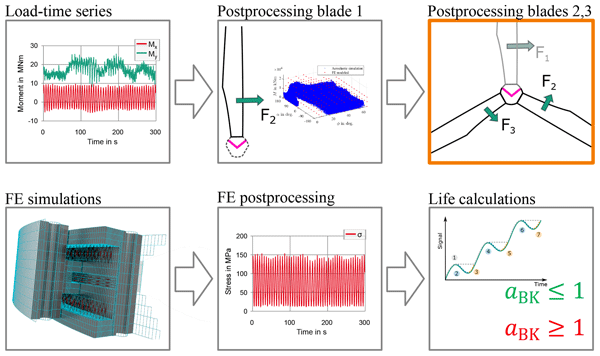
The structures at the center of wind turbine rotors are loaded by three rotor blades. The rotor blades have different loads, which depend on their positions and the incoming wind. The number of possible different loads is too high to simulate each of them for later design of the structures. This work attempts to reduce the number of necessary simulations by exploring inherent relations between the loads of the three rotor blades.
Azélice Ludot, Thor Heine Snedker, Athanasios Kolios, and Ilmas Bayati
Wind Energ. Sci. Discuss., https://doi.org/10.5194/wes-2024-162, https://doi.org/10.5194/wes-2024-162, 2025
Preprint withdrawn
Short summary
Short summary
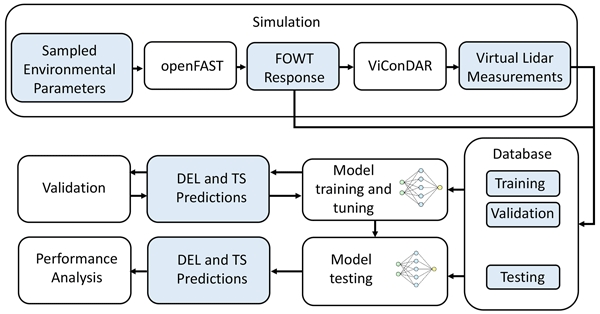
This paper presents a methodology to develop machine learning models designed to predict, in real-time, hourly fatigue damage accumulation in the mooring lines of floating wind turbines, from measurements of five environmental variables: wind speed, wind direction, wave height, wave period, and wind-wave misalignment. The proposed tool is intended for predictive maintenance applications, which has been identified as a key area for cost reduction in floating wind.
Moritz Gräfe, Vasilis Pettas, Nikolay Dimitrov, and Po Wen Cheng
Wind Energ. Sci., 9, 2175–2193, https://doi.org/10.5194/wes-9-2175-2024, https://doi.org/10.5194/wes-9-2175-2024, 2024
Short summary
Short summary
This study explores a methodology using floater motion and nacelle-based lidar wind speed measurements to estimate the tension and damage equivalent loads (DELs) on floating offshore wind turbines' mooring lines. Results indicate that fairlead tension time series and DELs can be accurately estimated from floater motion time series. Using lidar measurements as model inputs for DEL predictions leads to similar accuracies as using displacement measurements of the floater.
Oliver Menck and Matthias Stammler
Wind Energ. Sci., 9, 777–798, https://doi.org/10.5194/wes-9-777-2024, https://doi.org/10.5194/wes-9-777-2024, 2024
Short summary
Short summary
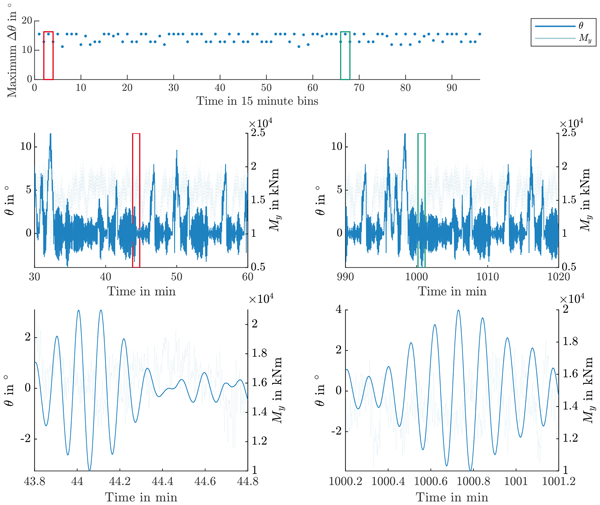
Oscillating bearings, like rotating bearings, can fail due to rolling contact fatigue. But the publications in the literature on this topic are difficult to understand. In order to help people decide which method to use, we have summarized the available literature. We also point out some errors and things to look out for to help engineers that want to calculate the rolling contact fatigue life of an oscillating bearing.
Matthias Stammler
Wind Energ. Sci., 8, 1821–1837, https://doi.org/10.5194/wes-8-1821-2023, https://doi.org/10.5194/wes-8-1821-2023, 2023
Short summary
Short summary
Wind turbines subject their components to highly variable loads over very long lifetimes. Tests of components like the pitch bearings that connect rotor blades and the rotor hub serve to validate their ability to withstand these loads. Due to the complexity of the operational loads, the definition of test programs is challenging. This work outlines a method that defines wear test programs for specific pitch bearings and gives a case study for an example turbine.
Xiaodong Zhang and Nikolay Dimitrov
Wind Energ. Sci., 8, 1613–1623, https://doi.org/10.5194/wes-8-1613-2023, https://doi.org/10.5194/wes-8-1613-2023, 2023
Short summary
Short summary
Wind turbine extreme response estimation based on statistical extrapolation necessitates using a small number of simulations to calculate a low exceedance probability. This is a challenging task especially if we require small prediction error. We propose the use of a Gaussian mixture model as it is capable of estimating a low exceedance probability with minor bias error, even with limited simulation data, having flexibility in modeling the distributions of varying response variables.
Arne Bartschat, Karsten Behnke, and Matthias Stammler
Wind Energ. Sci., 8, 1495–1510, https://doi.org/10.5194/wes-8-1495-2023, https://doi.org/10.5194/wes-8-1495-2023, 2023
Short summary
Short summary
Blade bearings are among the most stressed and challenging components of a wind turbine. Experimental investigations using different test rigs and real-size blade bearings have been able to show that rather short time intervals of only several hours of turbine operation can cause wear damage on the raceways of blade bearings. The proposed methods can be used to assess wear-critical operation conditions and to validate control strategies as well as lubricants for the application.

Xiaodong Zhang and Anand Natarajan
Wind Energ. Sci., 7, 2135–2148, https://doi.org/10.5194/wes-7-2135-2022, https://doi.org/10.5194/wes-7-2135-2022, 2022
Short summary
Short summary
Joint probability distribution of 10 min mean wind speed and the standard deviation is proposed using the Gaussian mixture model and has been shown to agree well with 15 years of measurements. The environmental contour with a 50-year return period (extreme turbulence) is estimated. The results from the model could be taken as inputs for structural reliability analysis and uncertainty quantification of wind turbine design loads.
Mareike Leimeister, Maurizio Collu, and Athanasios Kolios
Wind Energ. Sci., 7, 259–281, https://doi.org/10.5194/wes-7-259-2022, https://doi.org/10.5194/wes-7-259-2022, 2022
Short summary
Short summary
Floating offshore wind technology has high potential but still faces challenges for gaining economic competitiveness to allow commercial market uptake. Hence, design optimization plays a key role; however, the final optimum floater obtained highly depends on the specified optimization problem. Thus, by considering alternative structural realization approaches, not very stringent limitations on the structure and dimensions are required. This way, more innovative floater designs can be captured.
Cited articles
ASTM D341-93: Viscosity–Temperature Charts for Liquid Petroleum Products, ASTM Standard ASTM D341-93 (Reapproved 1998), ASTM International, West Conshohocken, PA, USA, an American National Standard, 1998. a
ASTM E1049-85: Standard Practices for Cycle Counting in Fatigue Analysis, ASTM Standard ASTM E1049-85 (Reapproved 2017), ASTM International, West Conshohocken, PA, USA, 2017. a
Bak, C., Zahle, F., Bitsche, R., Kim, T., Yde, A., Henriksen, L. C., Natarajan, A., and Hansen, M. H.: Description of the DTU 10 MW Reference Wind Turbine, Dtu wind energy report-i-0092, DTU Wind Energy, Technical University of Denmark, Roskilde, Denmark, https://gitlab.windenergy.dtu.dk/rwts/dtu-10mw-rwt/-/raw/master/docs/DTU_Wind_Energy_Report-I-0092.pdf (last access: 22 March 2026), 2013. a, b
Bengio, Y., Simard, P., and Frasconi, P.: Learning long-term dependencies with gradient descent is difficult, IEEE T. Neural Networ., 5, 157–166, https://doi.org/10.1109/72.279181, 1994. a, b
Budynas, R. G. and Nisbett, J. K.: Shigley's Mechanical Engineering Design, McGraw-Hill Education, New York, NY, 11th edn., 2020. a
D'Antuono, P., Weijtjens, W., and Devriendt, C.: On the Minimum Required Sampling Frequency for Reliable Fatigue Lifetime Estimation in Structural Health Monitoring. How Much is Enough?, in: European Workshop on Structural Health Monitoring, edited by: Rizzo, P. and Milazzo, A., 133–142, Springer International Publishing, Cham, ISBN 978-3-031-07254-3, 2023. a
de N Santos, F., Noppe, N., Weijtjens, W., and Devriendt, C.: Farm-wide interface fatigue loads estimation: A data-driven approach based on accelerometers, Wind Energy, 27, 321–340, https://doi.org/10.1002/we.2888, 2024. a, b, c
d N Santos, F., Noppe, N., Weijtjens, W., and Devriendt, C.: Data-driven farm-wide fatigue estimation on jacket-foundation OWTs for multiple SHM setups, Wind Energ. Sci., 7, 299–321, https://doi.org/10.5194/wes-7-299-2022, 2022. a
Faria, B. R. and Jafaripour, L. Z.: Strain gauge calibration for wind turbine towers, https://pypi.org/project/yaw-sweep-sg-cali/ (last access: 22 March 2026), 2023. a
Faria, B. R., Sadeghi, N., Dimitrov, N., Kolios, A., and Abrahamsen, A. B.: Inclusion of low-frequency cycles on tower fatigue lifetime assessment through relevant environmental and operational conditions, J. Phys. Conf. Ser., 2767, 042021, https://doi.org/10.1088/1742-6596/2767/4/042021, 2024. a, b, c, d
Faria, B. R., Dimitrov, N., Perez, V., Kolios, A., and Abrahamsen, A. B.: Virtual load sensors based on calibrated wind turbine strain sensors for damage accumulation estimation: a gap-filling technique, J. Phys. Conf. Ser., 3025, 012011, https://doi.org/10.1088/1742-6596/3025/1/012011, 2025. a, b
Fingersh, L., Hand, M., and Laxson, A.: Wind Turbine Design Cost and Scaling Model, Technical Report NREL/TP-500-40566, National Renewable Energy Laboratory (NREL), Golden, CO, USA, https://doi.org/10.2172/897434, 2006. a
Gräfe, M., Pettas, V., Dimitrov, N., and Cheng, P. W.: Machine-learning-based virtual load sensors for mooring lines using simulated motion and lidar measurements, Wind Energ. Sci., 9, 2175–2193, https://doi.org/10.5194/wes-9-2175-2024, 2024. a, b
Haastrup, M., Hansen, M. R., and Ebbesen, M. K.: Modeling of Wind Turbine Gearbox Mounting, Modeling, Identification and Control, 32, 141–149, https://doi.org/10.4173/mic.2011.4.2, 2011. a, b, c
Hart, E., Clarke, B., Nicholas, G., Kazemi Amiri, A., Stirling, J., Carroll, J., Dwyer-Joyce, R., McDonald, A., and Long, H.: A review of wind turbine main bearings: design, operation, modelling, damage mechanisms and fault detection, Wind Energ. Sci., 5, 105–124, https://doi.org/10.5194/wes-5-105-2020, 2020. a
Hart, E., Raby, K., Keller, J., Sheng, S., Long, H., Carroll, J., Brasseur, J., and Tough, F.: Main Bearing Replacement and Damage – A Field Data Study on 15 Gigawatts of Wind Energy Capacity, vol. NREL/TP-5000-86228, published by the US National Renewable Energy Laboratory (NREL) as Technical Report NREL/TP-5000-86228, July 2023, 2023. a
HIPERWIND D5.1: Component Life Models, Project Deliverable Deliverable D5.1, HIPERWIND Project – HIghly advanced Probabilistic design and Enhanced Reliability methods for high-value, cost-efficient offshore WIND, Lyngby, Denmark, https://www.hiperwind.eu/deliverables-and-publications (last access: 22 March 2026), 2023. a
HIPERWIND D5.4: Development and implementation of probabilistic and uncertainty quantification methods for reliability sensitivity analysi, Project Deliverable Deliverable D5.4, HIPERWIND Project – HIghly advanced Probabilistic design and Enhanced Reliability methods for high-value, cost-efficient offshore WIND, Lyngby, Denmark, https://www.hiperwind.eu/deliverables-and-publications (last access: 22 March 2026), 2024. a
Hoffmann, K.: An Introduction to Measurements Using Strain Gages, Hottinger Baldwin Messtechnik GmbH, Darmstadt, Germany, all rights reserved. © Hottinger Baldwin Messtechnik GmbH, 1989. Reproduction or distribution, in whole or in part, requires express written permission from the publisher, 1989. a
Hübler, C. and Rolfes, R.: Probabilistic temporal extrapolation of fatigue damage of offshore wind turbine substructures based on strain measurements, Wind Energ. Sci., 7, 1919–1940, https://doi.org/10.5194/wes-7-1919-2022, 2022. a, b
IEA and NEA: Projected Costs of Generating Electricity: 2020 Edition, Tech. rep., International Energy Agency and OECD Nuclear Energy Agency, Paris, ISBN 978-92-64-55471-9, https://doi.org/10.1787/a6002f3b-en, 2020. a
IEC 61400-13: Wind energy generation systems – Part 13: Measurement of mechanical loads, IEC 61400-13:2016, International Electrotechnical Commission, Geneva, Switzerland, 2016. a
IEC-TS-61400-28: Wind energy generation systems – Part 28: Through life management and life extension of wind power assets, IEC TS 61400-28:2025, International Electrotechnical Commission, Geneva, Switzerland, 2025. a
IRENA: Renewable Power Generation Costs in 2023, Tech. rep., International Renewable Energy Agency, Abu Dhabi, ISBN 978-92-9260-621-3, https://www.irena.org/Publications/2024/Sep/Renewable-Power-Generation-Costs-in-2023 (last access: 22 March 2026), 2024. a
Keller, J., Guo, Y., and Sethuraman, L.: Gearbox Reliability Collaborative: Investigation of Gearbox Motion and High-Speed-Shaft Loads, Technical Report NREL/TP-5000-65321, National Renewable Energy Laboratory (NREL), Golden, CO, USA, https://doi.org/10.2172/1243302, 2016. a, b, c
Kenworthy, J., Hart, E., Stirling, J., Stock, A., Keller, J., Guo, Y., Brasseur, J., and Evans, R.: Wind turbine main bearing rating lives as determined by IEC 61400-1 and ISO 281: A critical review and exploratory case study, Wind Energy, 27, 179–197, https://doi.org/10.1002/we.2883, 2024. a, b, c, d
Loraux, C. and Brühwiler, E.: The use of long term monitoring data for the extension of the service duration of existing wind turbine support structures, J. Phys. Conf. Ser., 753, 072023, https://doi.org/10.1088/1742-6596/753/7/072023, 2016. a
Mehlan, F. C., Keller, J., and Nejad, A. R.: Virtual sensing of wind turbine hub loads and drivetrain fatigue damage, Forschung im Ingenieurwesen, 87, 207–218, https://doi.org/10.1007/s10010-023-00627-0, 2023. a
Miner, M. A.: Cumulative Damage in Fatigue, J. Appl. Mech., 12, A159–A164, https://doi.org/10.1115/1.4009458, 1945. a
Needelman, W. M. and Zaretsky, E. V.: Recalibrated Equations for Determining the Effect of Oil Filtration on Rolling Bearing Life, Tech. Rep. NASA/TM–2014-218071, National Aeronautics and Space Administration, Glenn Research Center, Cleveland, OH, https://ntrs.nasa.gov/search (last access: 22 March 2026), 2014. a, b
Pacheco, J., Pimenta, F., Guimarães, S., Castro, G., Álvaro Cunha, Matos, J. C., and Magalhães, F.: Experimental evaluation of fatigue in wind turbine blades with wake effects, Eng. Struct., 300, https://doi.org/10.1016/j.engstruct.2023.117140, 2024. a, b, c
Papadopoulos, K., Morfiadakis, E., Philippidis, T. P., and Lekou, D. J.: Assessment of the strain gauge technique for measurement of wind turbine blade loads, Wind Energy, 3, 35–65, https://doi.org/10.1002/1099-1824(200001/03)3:1<35::AID-WE30>3.0.CO;2-D, 2000. a
Pedregosa, F., Varoquaux, G., Gramfort, A., Michel, V., Thirion, B., Grisel, O., Blondel, M., Prettenhofer, P., Weiss, R., Dubourg, V., VanderPlas, J., Passos, A., Cournapeau, D., Brucher, M., Perrot, M., and Duchesnay, E.: scikit-learn: Machine Learning in Python, J. Mach. Learn. Res., 12, 2825–2830, 2011. a
Pimenta, F., Ribeiro, D., Román, A., and Magalhães, F.: Predictive model for fatigue evaluation of floating wind turbines validated with experimental data, Renew. Energ., 223, 119981, https://doi.org/10.1016/j.renene.2024.119981, 2024. a
Pulikollu, R., Haus, L., Mclaughlin, J., and Sheng, S.: Wind Turbine Main Bearing Reliability Analysis, Operations, and Maintenance Considerations: Electric Power Research Institute (EPRI), https://www.epri.com/research/products/000000003002029874 (last access: 22 March 2026), 2024. a
Quick, J., Hart, E., Nilsen, M. B., Lund, R. S., Liew, J., Huang, P., Rethore, P.-E., Keller, J., Song, W., and Guo, Y.: Reductions in wind farm main bearing rating lives resulting from wake impingement, Wind Energ. Sci., 11, 493–507, https://doi.org/10.5194/wes-11-493-2026, 2026. a
Rinker, J. M., Hansen, M. H., and Larsen, T. J.: Calibrating a wind turbine model using diverse datasets, J. Phys. Conf. Ser., 1037, 062026, https://doi.org/10.1088/1742-6596/1037/6/062026, 2018. a
Rumelhart, D. E., Hinton, G. E., and Williams, R. J.: Learning representations by back-propagating errors, Nature, 323, 533–536, https://doi.org/10.1038/323533a0, 1986. a
Sadeghi, N., Noppe, N., Morato, P. G., Weijtjens, W., and Devriendt, C.: Uncertainty quantification of wind turbine fatigue lifetime predictions through binning, J. Phys. Conf. Ser., 2767, https://doi.org/10.1088/1742-6596/2767/3/032024, 2024. a
Schillaci, M. A.: Estimating the population variance, standard deviation and coefficient of variation: sample size and accuracy, Stat. Probabil. Lett., 188, 110420, https://doi.org/10.1016/j.jhevol.2022.103230, 2022. a
Scribd: V52–850 kW Wind Turbine Technical Specification (Vestas Document), https://www.scribd.com/document/524089466/v52 (last access: 29 October 2025), 2021. a
SKF Group: SKF Product Select – Single Bearing, https://productselect.skf.com/#/type-arrangement/single-bearing, last access: 27 October 2025. a
UNECE: Carbon Neutrality in the UNECE Region: Integrated Life-cycle Assessment of Electricity Sources, ECE Energy Series, United Nations, ISBN 978-92-1-001485-4, https://doi.org/10.18356/9789210014854, 2022. a
Ziegler, L., Gonzalez, E., Rubert, T., Smolka, U., and Melero, J. J.: Lifetime extension of onshore wind turbines: A review covering Germany, Spain, Denmark, and the UK, Renewable and Sustainable Energy Reviews, 82, 1261–1271, https://doi.org/10.1016/j.rser.2017.09.100, 2018. a
Short summary
This study presents continuous lifetime assessments of wind turbine structural (tower) and rotating components (main bearings) over nearly a decade, combining controller data, calibrated load measurements, and a virtual load sensor at the tower bottom. The components' estimated lifetimes exceeded the design lifetime. Contrary to expectations, lower turbulence intensity at rated wind speed increased fatigue loads of the locating main bearing due to turbulence averaging.
This study presents continuous lifetime assessments of wind turbine structural (tower) and...


Altmetrics
Final-revised paper
Preprint