
Articles | Volume 11, issue 5
https://doi.org/10.5194/wes-11-1679-2026
© Author(s) 2026. This work is distributed under
the Creative Commons Attribution 4.0 License.
the Creative Commons Attribution 4.0 License.
https://doi.org/10.5194/wes-11-1679-2026
© Author(s) 2026. This work is distributed under
the Creative Commons Attribution 4.0 License.
the Creative Commons Attribution 4.0 License.
Research article
| 
11 May 2026
Research article |
| 11 May 2026
| 11 May 2026
A multi-fidelity model intercomparison for wake steering of a large turbine in a conventionally neutral atmospheric boundary layer

Department of Wind and Energy Systems, Technical University of Denmark, Frederiksborgvej 399, 4000 Roskilde, Denmark
Emily Louise Hodgson
Department of Wind and Energy Systems, Technical University of Denmark, Anker Engelunds Vej 1, 2800 Kgs Lyngby, Denmark
Maarten Paul van der Laan
Department of Wind and Energy Systems, Technical University of Denmark, Frederiksborgvej 399, 4000 Roskilde, Denmark
Leonardo Alcayaga
Department of Wind and Energy Systems, Technical University of Denmark, Frederiksborgvej 399, 4000 Roskilde, Denmark
Mads Pedersen
Department of Wind and Energy Systems, Technical University of Denmark, Frederiksborgvej 399, 4000 Roskilde, Denmark
Søren Juhl Andersen
Department of Wind and Energy Systems, Technical University of Denmark, Anker Engelunds Vej 1, 2800 Kgs Lyngby, Denmark
Gunner Larsen
Department of Wind and Energy Systems, Technical University of Denmark, Frederiksborgvej 399, 4000 Roskilde, Denmark
Pierre-Elouan Réthoré
Department of Wind and Energy Systems, Technical University of Denmark, Frederiksborgvej 399, 4000 Roskilde, Denmark
Related authors
No articles found.
Maarten Paul van der Laan and Simon Watson
Wind Energ. Sci., 11, 3763–3774, https://doi.org/10.5194/wes-11-3763-2026, https://doi.org/10.5194/wes-11-3763-2026, 2026
Short summary
Short summary
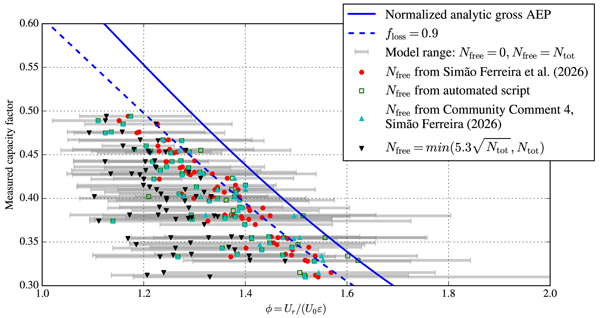
A theoretical limit for the energy extraction of offshore wind farms has been suggested by Simão Ferreira et al. (2026) based on a simple model of an infinite wind farm and an ad hoc method to correct the model for application to finite wind farms. In this work, we discuss a number of concerns and we conclude that the limit proposed in Simão Ferreira et al. (2026) is not a theoretical limit but rather a limit supported by the non-reproducible finite wind farm correction.
Nicola Bodini, Patrick Moriarty, Regis Thedin, Paula Doubrawa, Cristina Archer, Myra Blaylock, Carlo Bottasso, Bruno Carmo, Lawrence Cheung, Camille Dubreuil, Rogier Floors, Thomas Herges, Daniel Houck, Ali Kanjari, Colleen M. Kaul, Christopher Kelley, Ru Li, Julie K. Lundquist, Desirae Major, Anh Kiet Nguyen, Mike Optis, Luan R. C. Parada, Alfredo Peña, Julian Quick, David Ricarte, William C. Radünz, Raj K. Rai, Oscar García-Santiago, Jonas Schulte, Knut S. Seim, M. Paul van der Laan, Kisorthman Vimalakanthan, and Adam Wise
Wind Energ. Sci., 11, 3107–3135, https://doi.org/10.5194/wes-11-3107-2026, https://doi.org/10.5194/wes-11-3107-2026, 2026
Short summary
Short summary
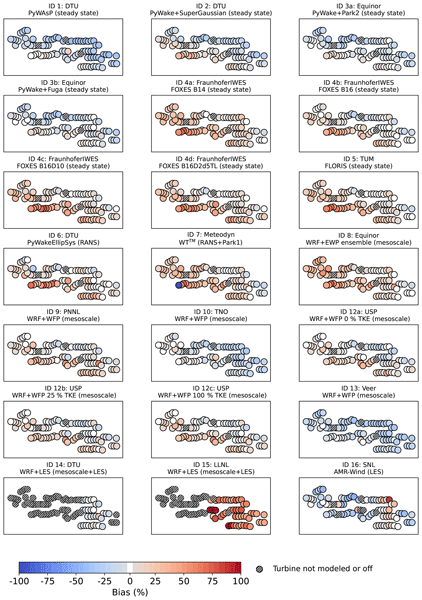
Predicting wind farm energy production is challenging because wind patterns are complex. We tested 16 different models against real data from a major field experiment to see which worked best. Surprisingly, the most expensive and detailed models were not always more accurate than simpler ones. We found that feeding models better weather data was the most effective way to improve accuracy. These results help the industry choose the right tools for designing more-efficient wind farms.
Agnese Firpo, Søren Juhl Andersen, and Giacomo Persico
Wind Energ. Sci. Discuss., https://doi.org/10.5194/wes-2026-141, https://doi.org/10.5194/wes-2026-141, 2026
Preprint under review for WES
Short summary
Short summary
Floating offshore wind turbines move with the waves, affecting wake dynamics and influencing the performance of downstream turbines. This study proposes a numerical framework to investigate the wake dynamics of a full-scale floating wind turbine. Results show that the frequency of platform motion affects wake dynamics, while the time mean wake remains largely unchanged. This work contributes to understanding floating wind turbine wakes and supports the development of efficient numerical models.
Jens Peter Schøler, Frederik Peder Weilmann Rasmussen, M. Paul van der Laan, Alfredo Peña, and Pierre-Elouan Réthoré
Wind Energ. Sci., 11, 2869–2893, https://doi.org/10.5194/wes-11-2869-2026, https://doi.org/10.5194/wes-11-2869-2026, 2026
Short summary
Short summary
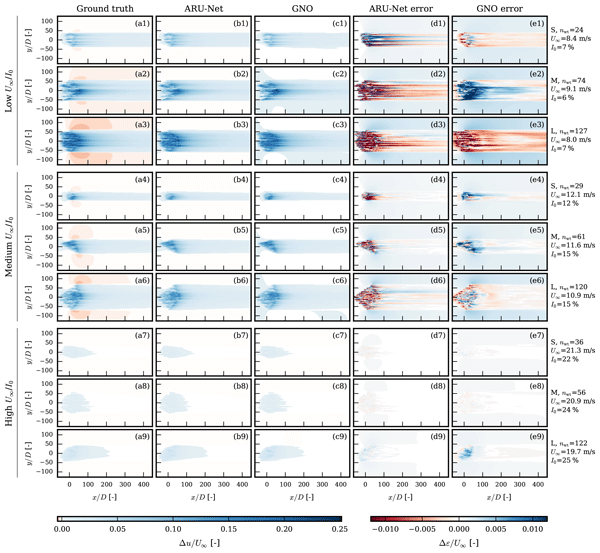
As offshore wind farms are built closer together, predicting how they affect each other becomes critical. We compared two AI approaches for this task, training both on cheap approximate data before refining them with expensive high-accuracy simulations. One predicts wake boundaries better, while the other estimates wind speeds more accurately, offering complementary tools for future wind farm design.
Jens Peter Schøler, Ernestas Simutis, M. Paul van der Laan, Julian Quick, and Pierre-Elouan Réthoré
Wind Energ. Sci., 11, 2845–2868, https://doi.org/10.5194/wes-11-2845-2026, https://doi.org/10.5194/wes-11-2845-2026, 2026
Short summary
Short summary
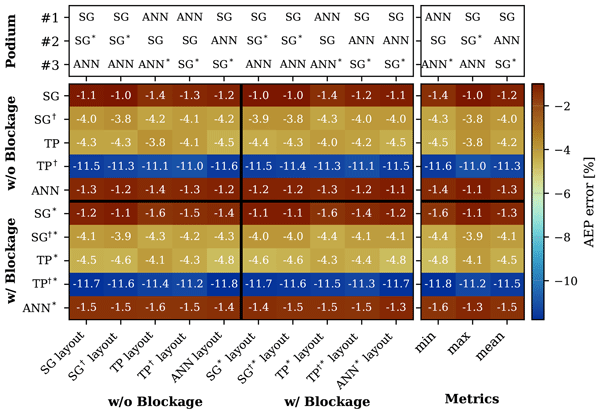
Wind turbines create wakes, which reduce downstream power. Optimizing turbine placement requires accounting for these reductions. We compared a neural network trained on numerical simulations against engineering wake models across various farm sizes. The neural network predicted flow most accurately but was slower. Surprisingly, a simple TurbOPark model produced layouts with higher validated energy output, suggesting that accuracy is not the only important metric for such models.

Maarten Paul van der Laan, Alexander Meyer Forsting, and Pierre-Elouan Réthoré
Wind Energ. Sci., 11, 2647–2668, https://doi.org/10.5194/wes-11-2647-2026, https://doi.org/10.5194/wes-11-2647-2026, 2026
Short summary
Short summary
Wind turbine interaction can lead to energy losses. This article introduces a fast open-source wind turbine interaction model that can be used to design energy-efficient wind farms, including effects of atmospheric turbulence and temperature. The model can inherit the accuracy of a higher-fidelity model while being about 5 orders of magnitude faster. However, the model is an order of magnitude slower than analytic wind turbine interaction models, and more research is needed to reduce it.
Jens Peter Schøler, Frederik Peder Weilmann Rasmussen, Julian Quick, and Pierre-Elouan Réthoré
Wind Energ. Sci., 11, 2229–2256, https://doi.org/10.5194/wes-11-2229-2026, https://doi.org/10.5194/wes-11-2229-2026, 2026
Short summary
Short summary
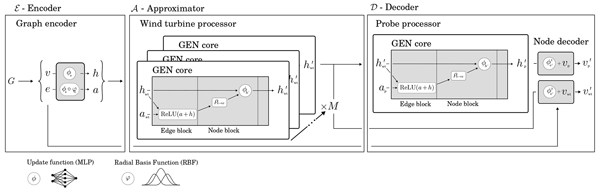
We propose a machine learning model that represents wind turbines as nodes in a graph, learning how they interact to predict the wind speed at any location on a farm. Trained on thousands of simulated farms, it captures complex wake interactions across varying layouts and sizes at low computational cost, supporting faster neighboring farm wake assessment.
Emily Louise Hodgson and Søren Juhl Andersen
Wind Energ. Sci., 11, 2173–2190, https://doi.org/10.5194/wes-11-2173-2026, https://doi.org/10.5194/wes-11-2173-2026, 2026
Short summary
Short summary
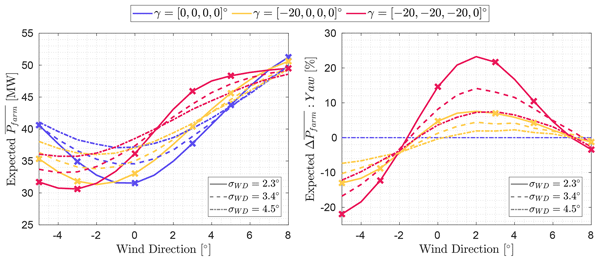
This work investigates the impact of wind direction uncertainty on wake steering, a promising flow-control strategy that aims to increase the efficiency of wind farms, using high-fidelity computational fluid dynamics. It concludes that wake steering is sensitive to both bias and uncertainty in inflow wind direction due to having a relatively small range over which gains are predicted and showing significant decreases in peak power output with increasing wind direction uncertainty.
Øyvind Waage Hanssen-Bauer, Paula Doubrawa, Helge A. Madsen, Henrik Asmuth, Jason Jonkman, Gunner C. Larsen, Stefan Ivanell, and Roy Stenbro
Wind Energ. Sci., 11, 1913–1948, https://doi.org/10.5194/wes-11-1913-2026, https://doi.org/10.5194/wes-11-1913-2026, 2026
Short summary
Short summary
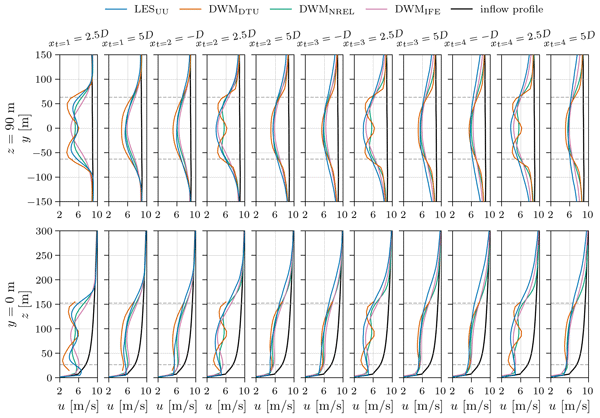
We studied how different industry-oriented computer models predict the behavior of winds behind turbines in a wind farm. These
wakesreduce energy output and can affect turbines further down the row. By comparing these three models with more detailed simulations, we found they agree well on overall power but differ in how they capture turbulence and wear on machines. Our results show where the models need improvement to make wind farm computer models more accurate and reliable in the future.
Esperanza Soto Sagredo, Søren Juhl Andersen, Ásta Hannesdóttir, and Jennifer Marie Rinker
Wind Energ. Sci., 11, 1705–1731, https://doi.org/10.5194/wes-11-1705-2026, https://doi.org/10.5194/wes-11-1705-2026, 2026
Short summary
Short summary
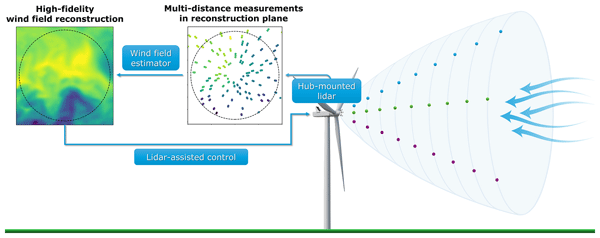
Large wind turbines are highly sensitive to changing winds, yet current measurements miss important details. This study compares three methods to reconstruct the full wind field ahead of a turbine in real time using lidar data and simulations. The results show these approaches can capture detailed inflow structures, which could help turbines anticipate wind changes, improve control strategies, and reduce structural loads.
Oscar García-Santiago, Jake Badger, Andrea N. Hahmann, Patrick J. H. Volker, Søren Ott, M. Paul van der Laan, and Mark Kelly
EGUsphere, https://doi.org/10.5194/egusphere-2026-2144, https://doi.org/10.5194/egusphere-2026-2144, 2026
Short summary
Short summary
We improve how weather models represent the turbulence generated by wind turbines within and behind wind farms. Rather than adding this turbulence only at grid squares with turbine locations, the new method transports it through the wake as it moves downwind. Tests against high-resolution simulations of an idealised wind farm showed better agreement in wake turbulence and more accurate reductions in wind speed, providing a more realistic picture of wake effects across the wind farm.
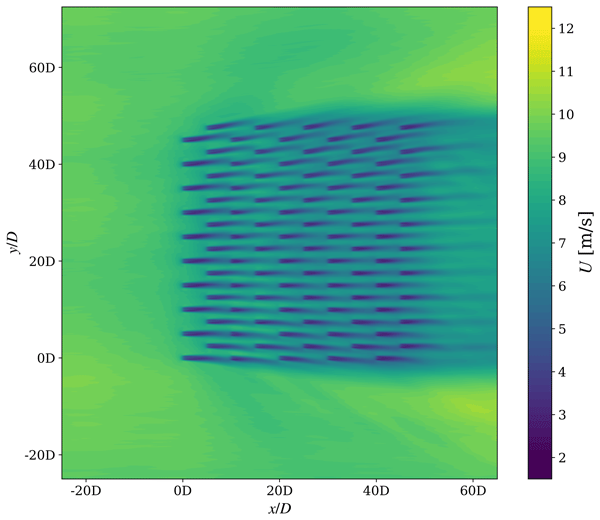
Stefan Ivanell, Warit Chanprasert, Luca Lanzilao, James Bleeg, Johan Meyers, Antoine Mathieu, Søren Juhl Andersen, Rem-Sophia Mouradi, Eric Dupont, Hugo Olivares-Espinosa, and Niels Troldborg
Wind Energ. Sci., 11, 937–960, https://doi.org/10.5194/wes-11-937-2026, https://doi.org/10.5194/wes-11-937-2026, 2026
Short summary
Short summary
This study explores how the height of the atmosphere's boundary layer impacts wind farm performance, focusing on how this factor influences energy output. By simulating different boundary layer heights and conditions, this research reveals that deeper layers promote better energy recovery. The findings highlight the importance of considering atmospheric conditions when simulating wind farms to maximize energy efficiency, offering valuable insights for the wind energy industry.
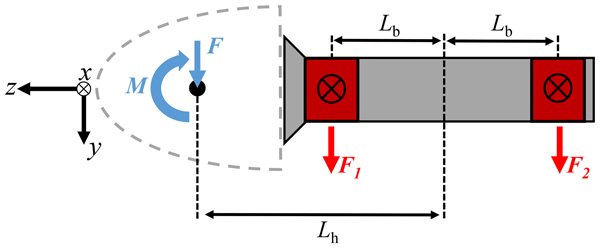
Julian Quick, Edward Hart, Marcus Binder Nilsen, Rasmus Sode Lund, Jaime Liew, Piinshin Huang, Pierre-Elouan Rethore, Jonathan Keller, Wooyong Song, and Yi Guo
Wind Energ. Sci., 11, 493–507, https://doi.org/10.5194/wes-11-493-2026, https://doi.org/10.5194/wes-11-493-2026, 2026
Short summary
Short summary
Wind turbine main bearings often fail prematurely, creating costly maintenance challenges. This study examined how wake effects – where upstream turbines create disturbed airflow that impacts downstream turbines – affect bearing lifespans. Using computer simulations, we found that wake effects reduce bearing life by 16 % on average. The direction of wake impact matters significantly due to interactions between wind forces and gravity, informing better wind turbine and farm design strategies.
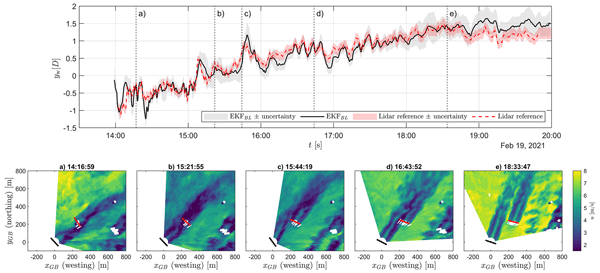
David Onnen, Gunner Christian Larsen, Alan Wai Hou Lio, Paul Hulsman, Martin Kühn, and Vlaho Petrović
Wind Energ. Sci., 11, 175–193, https://doi.org/10.5194/wes-11-175-2026, https://doi.org/10.5194/wes-11-175-2026, 2026
Short summary
Short summary
Neighbouring wind turbines influence each other, as they leave a complex footprint of reduced wind speed and changed turbulence in the flow, called wake. Modern wind farm control sees the turbines as team players and aims to mitigate the negative effects of such interaction. To do so, the exact flow situation in the wind farm must be known. We show how to use wind turbines as sensors for waked inflow, test this in the field and compare it with independent laser measurements of the flow field.
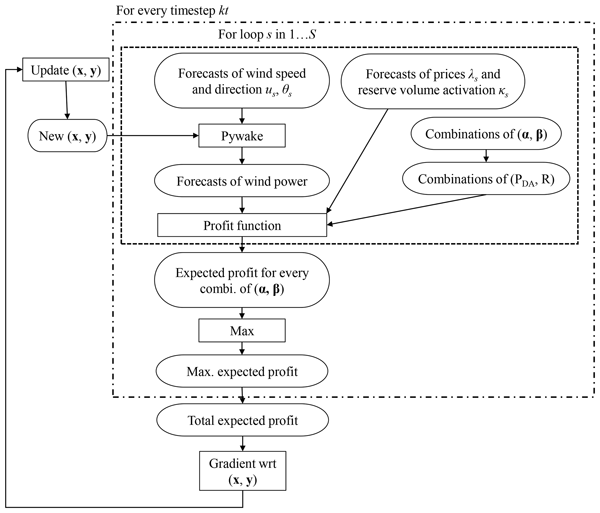
Thuy-Hai Nguyen, Julian Quick, Pierre-Elouan Réthoré, Jean-François Toubeau, Emmanuel De Jaeger, and François Vallée
Wind Energ. Sci., 10, 1661–1680, https://doi.org/10.5194/wes-10-1661-2025, https://doi.org/10.5194/wes-10-1661-2025, 2025
Short summary
Short summary
Current offshore wind farms have been designed to maximize their production of electricity at all times and not to keep a reserve of power in case of unexpected events on the grid. We present a new formulation for designing wind farms to maximize revenues from both energy and reserve markets. We apply it to a real-life wind farm and show that profits are expected to increase in a significant way for wind farms designed and operated for reserve, with less energy supplied.
Mads Baungaard, Takafumi Nishino, and Maarten Paul van der Laan
Wind Energ. Sci. Discuss., https://doi.org/10.5194/wes-2025-50, https://doi.org/10.5194/wes-2025-50, 2025
Manuscript not accepted for further review
Short summary
Short summary
A systematic comparison between 2D and 3D Reynolds-averaged Navier-Stokes simulations of wind farm flows have been conducted. It is found that the 2D simulations are, at least, two orders of magnitude computationally cheaper than their corresponding 3D simulations, while the predicted farm power is within -30 % to 15 % for all cases considered. The large computational speed-ups and sensible results makes 2D simulations a promising option in the low- to mid-fidelity range.
Juan Felipe Céspedes Moreno, Juan Pablo Murcia León, and Søren Juhl Andersen
Wind Energ. Sci., 10, 597–611, https://doi.org/10.5194/wes-10-597-2025, https://doi.org/10.5194/wes-10-597-2025, 2025
Short summary
Short summary
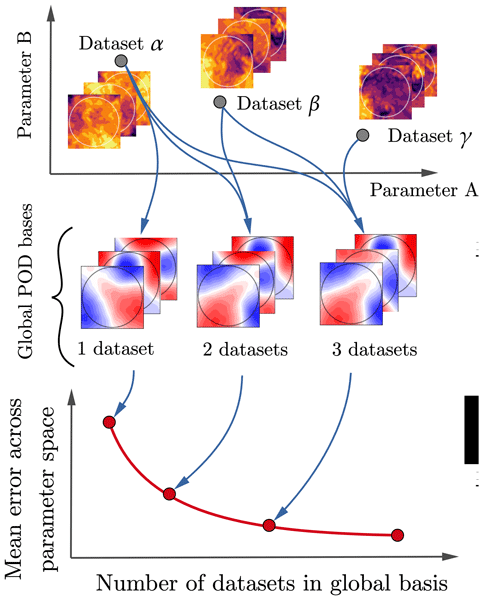
Using a global base in a proper orthogonal decomposition provides a common base for analyzing flows, such as wind turbine wakes, across an entire parameter space. This can be used to compare flows with different conditions using the same physical interpretation. This work shows the convergence of the global base, its small error compared to the truncation error in the flow reconstruction, and the insensitivity to which datasets are included for generating the global base.
Maarten Paul van der Laan, Mark Kelly, Mads Baungaard, Antariksh Dicholkar, and Emily Louise Hodgson
Wind Energ. Sci., 9, 1985–2000, https://doi.org/10.5194/wes-9-1985-2024, https://doi.org/10.5194/wes-9-1985-2024, 2024
Short summary
Short summary
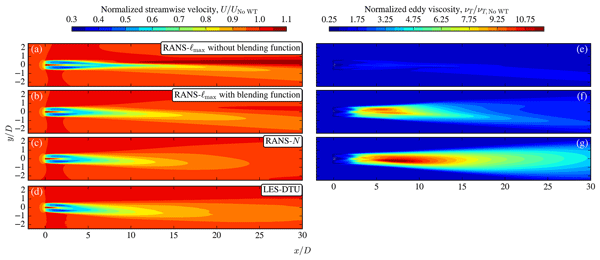
Wind turbines are increasing in size and operate more frequently above the atmospheric surface layer, which requires improved inflow models for numerical simulations of turbine interaction. In this work, a novel steady-state model of the atmospheric boundary layer (ABL) is introduced. Numerical wind turbine flow simulations subjected to shallow and tall ABLs are conducted, and the proposed model shows improved performance compared to other state-of-the-art steady-state models.
Jens Visbech, Tuhfe Göçmen, Özge Sinem Özçakmak, Alexander Meyer Forsting, Ásta Hannesdóttir, and Pierre-Elouan Réthoré
Wind Energ. Sci., 9, 1811–1826, https://doi.org/10.5194/wes-9-1811-2024, https://doi.org/10.5194/wes-9-1811-2024, 2024
Short summary
Short summary
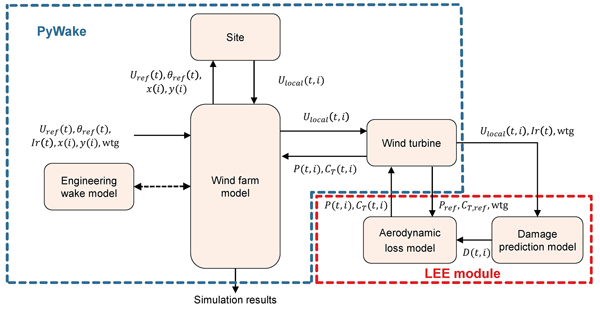
Leading-edge erosion (LEE) can impact wind turbine aerodynamics and wind farm efficiency. This study couples LEE prediction, aerodynamic loss modeling, and wind farm flow modeling to show that LEE's effects on wake dynamics can affect overall energy production. Without preventive initiatives, the effects of LEE increase over time, resulting in significant annual energy production (AEP) loss.
Javier Criado Risco, Rafael Valotta Rodrigues, Mikkel Friis-Møller, Julian Quick, Mads Mølgaard Pedersen, and Pierre-Elouan Réthoré
Wind Energ. Sci., 9, 585–600, https://doi.org/10.5194/wes-9-585-2024, https://doi.org/10.5194/wes-9-585-2024, 2024
Short summary
Short summary
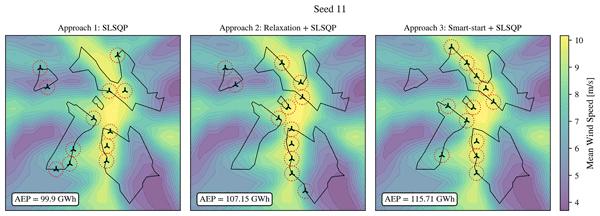
Wind energy developers frequently have to face some spatial restrictions at the time of designing a new wind farm due to different reasons, such as the existence of protected natural areas around the wind farm location, fishing routes, and the presence of buildings. Wind farm design has to account for these restricted areas, but sometimes this is not straightforward to achieve. We have developed a methodology that allows for different inclusion and exclusion areas in the optimization framework.
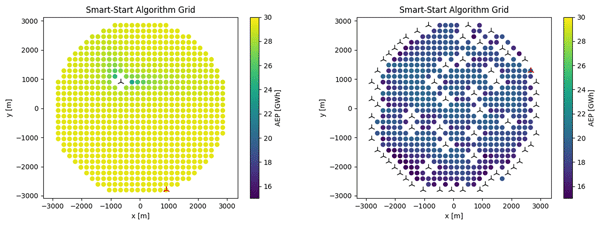
Rafael Valotta Rodrigues, Mads Mølgaard Pedersen, Jens Peter Schøler, Julian Quick, and Pierre-Elouan Réthoré
Wind Energ. Sci., 9, 321–341, https://doi.org/10.5194/wes-9-321-2024, https://doi.org/10.5194/wes-9-321-2024, 2024
Short summary
Short summary
The use of wind energy has been growing over the last few decades, and further increase is predicted. As the wind energy industry is starting to consider larger wind farms, the existing numerical methods for analysis of small and medium wind farms need to be improved. In this article, we have explored different strategies to tackle the problem in a feasible and timely way. The final product is a set of recommendations when carrying out trade-off analysis on large wind farms.
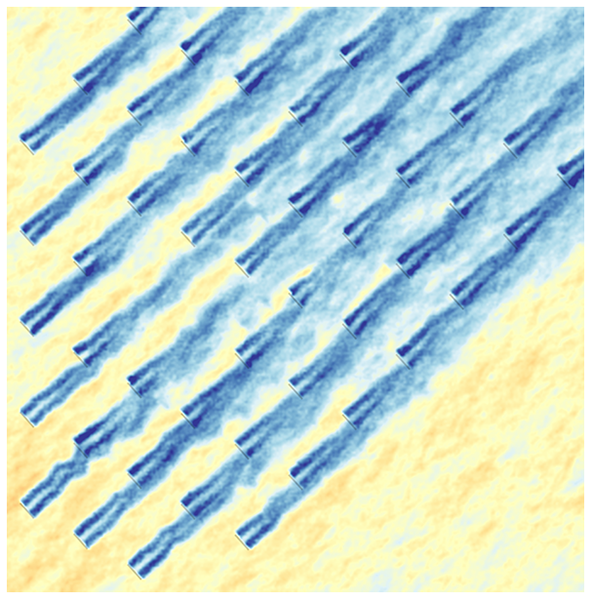
Jaime Liew, Tuhfe Göçmen, Alan W. H. Lio, and Gunner Chr. Larsen
Wind Energ. Sci., 8, 1387–1402, https://doi.org/10.5194/wes-8-1387-2023, https://doi.org/10.5194/wes-8-1387-2023, 2023
Short summary
Short summary
We present recent research on dynamically modelling wind farm wakes and integrating these enhancements into the wind farm simulator, HAWC2Farm. The simulation methodology is showcased by recreating dynamic scenarios observed in the Lillgrund offshore wind farm. We successfully recreate scenarios with turning winds, turbine shutdown events, and wake deflection events. The research provides opportunities to better identify wake interactions in wind farms, allowing for more reliable designs.
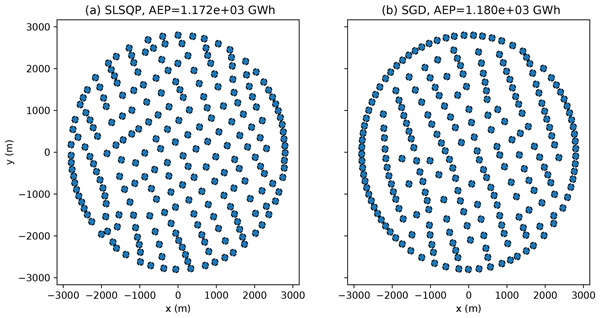
Julian Quick, Pierre-Elouan Rethore, Mads Mølgaard Pedersen, Rafael Valotta Rodrigues, and Mikkel Friis-Møller
Wind Energ. Sci., 8, 1235–1250, https://doi.org/10.5194/wes-8-1235-2023, https://doi.org/10.5194/wes-8-1235-2023, 2023
Short summary
Short summary
Wind turbine positions are often optimized to avoid wake losses. These losses depend on atmospheric conditions, such as the wind speed and direction. The typical optimization scheme involves discretizing the atmospheric inputs, then considering every possible set of these discretized inputs in every optimization iteration. This work presents stochastic gradient descent (SGD) as an alternative, which randomly samples the atmospheric conditions during every optimization iteration.
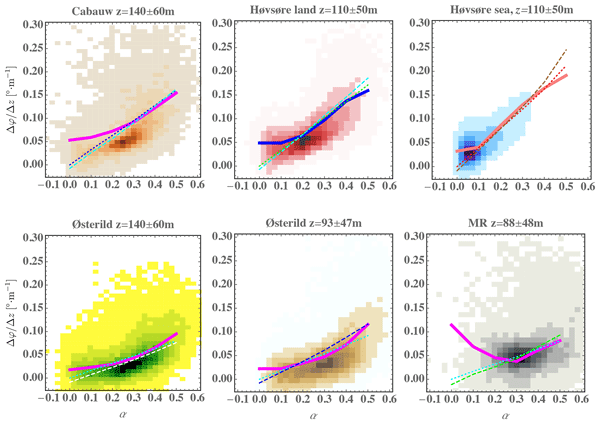
Mark Kelly and Maarten Paul van der Laan
Wind Energ. Sci., 8, 975–998, https://doi.org/10.5194/wes-8-975-2023, https://doi.org/10.5194/wes-8-975-2023, 2023
Short summary
Short summary
The turning of the wind with height, which is known as veer, can affect wind turbine performance. Thus far meteorology has only given idealized descriptions of veer, which has not yet been related in a way readily usable for wind energy. Here we derive equations for veer in terms of meteorological quantities and provide practically usable forms in terms of measurable shear (change in wind speed with height). Flow simulations and measurements at turbine heights support these developments.

Maarten Paul van der Laan, Oscar García-Santiago, Mark Kelly, Alexander Meyer Forsting, Camille Dubreuil-Boisclair, Knut Sponheim Seim, Marc Imberger, Alfredo Peña, Niels Nørmark Sørensen, and Pierre-Elouan Réthoré
Wind Energ. Sci., 8, 819–848, https://doi.org/10.5194/wes-8-819-2023, https://doi.org/10.5194/wes-8-819-2023, 2023
Short summary
Short summary
Offshore wind farms are more commonly installed in wind farm clusters, where wind farm interaction can lead to energy losses. In this work, an efficient numerical method is presented that can be used to estimate these energy losses. The novel method is verified with higher-fidelity numerical models and validated with measurements of an existing wind farm cluster.
Camilla Marie Nyborg, Andreas Fischer, Pierre-Elouan Réthoré, and Ju Feng
Wind Energ. Sci., 8, 255–276, https://doi.org/10.5194/wes-8-255-2023, https://doi.org/10.5194/wes-8-255-2023, 2023
Short summary
Short summary
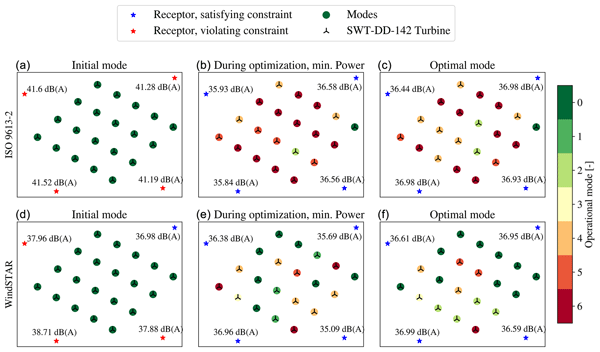
Our article presents a way of optimizing the wind farm operation by keeping the emitted noise level below a defined limit while maximizing the power output. This is done by switching between noise reducing operational modes. The method has been developed by using two different noise models, one more advanced than the other, to study the advantages of each model. Furthermore, the optimization method is applied to different wind farm cases.
Maarten Paul van der Laan, Mads Baungaard, and Mark Kelly
Wind Energ. Sci., 8, 247–254, https://doi.org/10.5194/wes-8-247-2023, https://doi.org/10.5194/wes-8-247-2023, 2023
Short summary
Short summary
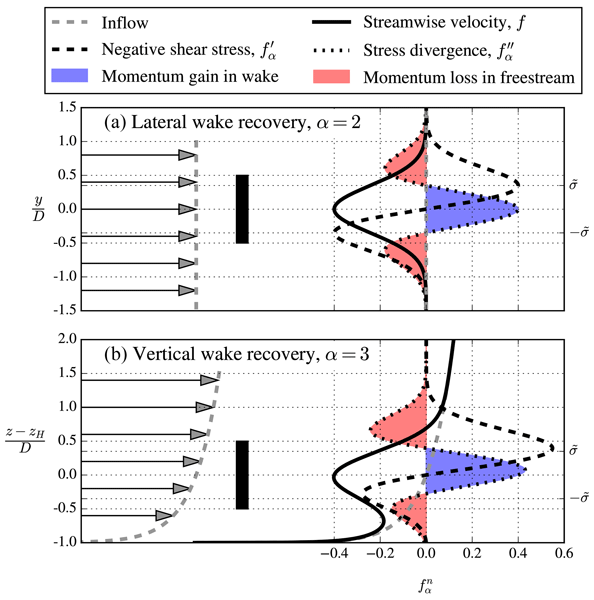
Understanding wind turbine wake recovery is important to mitigate energy losses in wind farms. Wake recovery is often assumed or explained to be dependent on the first-order derivative of velocity. In this work we show that wind turbine wakes recover mainly due to the second-order derivative of the velocity, which transport momentum from the freestream towards the wake center. The wake recovery mechanisms and results of a high-fidelity numerical simulation are illustrated using a simple model.
Ishaan Sood, Elliot Simon, Athanasios Vitsas, Bart Blockmans, Gunner C. Larsen, and Johan Meyers
Wind Energ. Sci., 7, 2469–2489, https://doi.org/10.5194/wes-7-2469-2022, https://doi.org/10.5194/wes-7-2469-2022, 2022
Short summary
Short summary
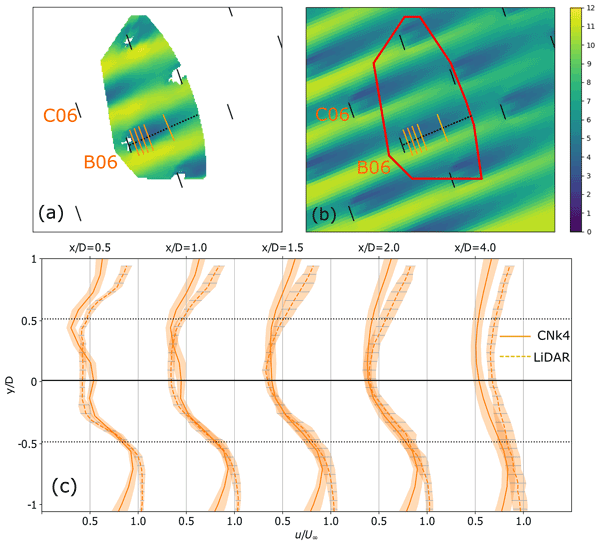
In this work, we conduct a validation study to compare a numerical solver against measurements obtained from the offshore Lillgrund wind farm. By reusing a previously developed inflow turbulent dataset, the atmospheric conditions at the wind farm were recreated, and the general performance trends of the turbines were captured well. The work increases the reliability of numerical wind farm solvers while highlighting the challenges of accurately representing large wind farms using such solvers.
Konstanze Kölle, Tuhfe Göçmen, Irene Eguinoa, Leonardo Andrés Alcayaga Román, Maria Aparicio-Sanchez, Ju Feng, Johan Meyers, Vasilis Pettas, and Ishaan Sood
Wind Energ. Sci., 7, 2181–2200, https://doi.org/10.5194/wes-7-2181-2022, https://doi.org/10.5194/wes-7-2181-2022, 2022
Short summary
Short summary
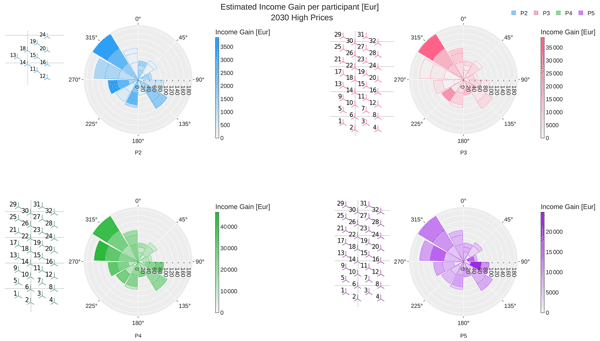
The paper studies wind farm flow control (WFFC) in simulations with variable electricity prices. The results indicate that considering the electricity price in the operational strategy can be beneficial with respect to the gained income compared to focusing on the power gain only. Moreover, revenue maximization by balancing power production and structural load reduction is demonstrated at the example of a single wind turbine.
Søren Juhl Andersen and Juan Pablo Murcia Leon
Wind Energ. Sci., 7, 2117–2133, https://doi.org/10.5194/wes-7-2117-2022, https://doi.org/10.5194/wes-7-2117-2022, 2022
Short summary
Short summary
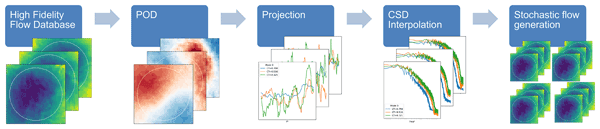
Simulating the turbulent flow inside large wind farms is inherently complex and computationally expensive. A new and fast model is developed based on data from high-fidelity simulations. The model captures the flow dynamics with correct statistics for a wide range of flow conditions. The model framework provides physical insights and presents a generalization of high-fidelity simulation results beyond the case-specific scenarios, which has significant potential for future turbulence modeling.
Mads Baungaard, Stefan Wallin, Maarten Paul van der Laan, and Mark Kelly
Wind Energ. Sci., 7, 1975–2002, https://doi.org/10.5194/wes-7-1975-2022, https://doi.org/10.5194/wes-7-1975-2022, 2022
Short summary
Short summary
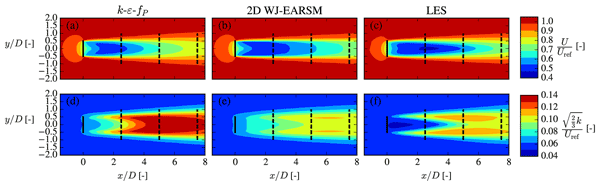
Wind turbine wakes in the neutral atmospheric surface layer are simulated with Reynolds-averaged Navier–Stokes (RANS) using an explicit algebraic Reynolds stress model. Contrary to standard two-equation turbulence models, it can predict turbulence anisotropy and complex physical phenomena like secondary motions. For the cases considered, it improves Reynolds stress, turbulence intensity, and velocity deficit predictions, although a more top-hat-shaped profile is observed for the latter.
Tuhfe Göçmen, Filippo Campagnolo, Thomas Duc, Irene Eguinoa, Søren Juhl Andersen, Vlaho Petrović, Lejla Imširović, Robert Braunbehrens, Jaime Liew, Mads Baungaard, Maarten Paul van der Laan, Guowei Qian, Maria Aparicio-Sanchez, Rubén González-Lope, Vinit V. Dighe, Marcus Becker, Maarten J. van den Broek, Jan-Willem van Wingerden, Adam Stock, Matthew Cole, Renzo Ruisi, Ervin Bossanyi, Niklas Requate, Simon Strnad, Jonas Schmidt, Lukas Vollmer, Ishaan Sood, and Johan Meyers
Wind Energ. Sci., 7, 1791–1825, https://doi.org/10.5194/wes-7-1791-2022, https://doi.org/10.5194/wes-7-1791-2022, 2022
Short summary
Short summary
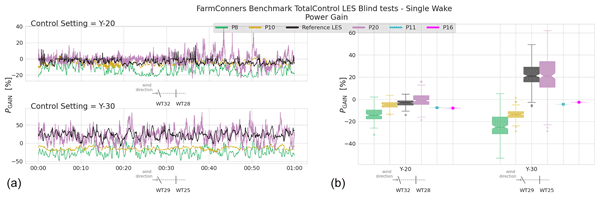
The FarmConners benchmark is the first of its kind to bring a wide variety of data sets, control settings, and model complexities for the (initial) assessment of wind farm flow control benefits. Here we present the first part of the benchmark results for three blind tests with large-scale rotors and 11 participating models in total, via direct power comparisons at the turbines as well as the observed or estimated power gain at the wind farm level under wake steering control strategy.
Niels Troldborg, Søren J. Andersen, Emily L. Hodgson, and Alexander Meyer Forsting
Wind Energ. Sci., 7, 1527–1532, https://doi.org/10.5194/wes-7-1527-2022, https://doi.org/10.5194/wes-7-1527-2022, 2022
Short summary
Short summary
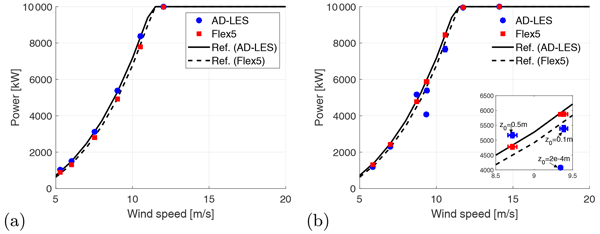
This article shows that the power performance of a wind turbine may be very different in flat and complex terrain. This is an important finding because it shows that the power output of a given wind turbine is governed by not only the available wind at the position of the turbine but also how the ambient flow develops in the region behind the turbine.
Jana Fischereit, Kurt Schaldemose Hansen, Xiaoli Guo Larsén, Maarten Paul van der Laan, Pierre-Elouan Réthoré, and Juan Pablo Murcia Leon
Wind Energ. Sci., 7, 1069–1091, https://doi.org/10.5194/wes-7-1069-2022, https://doi.org/10.5194/wes-7-1069-2022, 2022
Short summary
Short summary
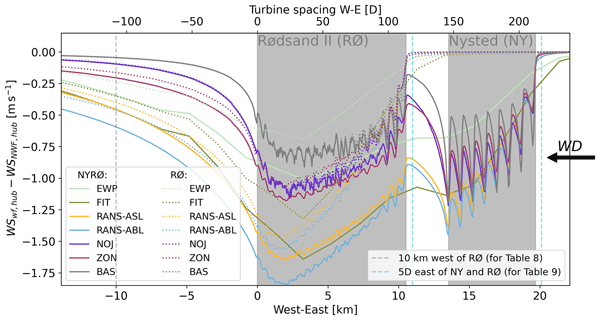
Wind turbines extract kinetic energy from the flow to create electricity. This induces a wake of reduced wind speed downstream of a turbine and consequently downstream of a wind farm. Different types of numerical models have been developed to calculate this effect. In this study, we compared models of different complexity, together with measurements over two wind farms. We found that higher-fidelity models perform better and the considered rapid models cannot fully capture the wake effect.
Mads Baungaard, Maarten Paul van der Laan, and Mark Kelly
Wind Energ. Sci., 7, 783–800, https://doi.org/10.5194/wes-7-783-2022, https://doi.org/10.5194/wes-7-783-2022, 2022
Short summary
Short summary
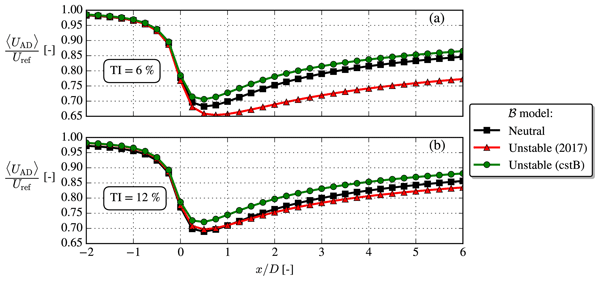
Wind turbine wakes are dependent on the atmospheric conditions, and it is therefore important to be able to simulate in various different atmospheric conditions. This paper concerns the specific case of an unstable atmospheric surface layer, which is the lower part of the typical daytime atmospheric boundary layer. A simple flow model is suggested and tested for a range of single-wake scenarios, and it shows promising results for velocity deficit predictions.
Cited articles
Abkar, M., Bae, H. J., and Moin, P.: Minimum-dissipation scalar transport model for large-eddy simulation of turbulent flows, Phys. Rev. Fluids, 1, 041701, https://doi.org/10.1103/PhysRevFluids.1.041701, 2016. a
Abkar, M., Sørensen, J. N., and Porté-Agel, F.: An Analytical Model for the Effect of Vertical Wind Veer on Wind Turbine Wakes, Energies, 11, https://doi.org/10.3390/en11071838, 2018. a
Allaerts, D. and Meyers, J.: Large eddy simulation of a large wind-turbine array in a conventionally neutral atmospheric boundary layer, Phys. Fluids, 27, 065108, https://doi.org/10.1063/1.4922339, 2015. a
Andersen, S. J. and Murcia Leon, J. P.: Stochastic wind farm flow generation using a reduced order model of LES, J. Phys. Conf. Ser., 2505, 012050, https://doi.org/10.1088/1742-6596/2505/1/012050, 2023. a
Bastankhah, M. and Porté-Agel, F.: Experimental and theoretical study of wind turbine wakes in yawed conditions, J. Fluid Mech., 806, 506–541, https://doi.org/10.1017/jfm.2016.595, 2016. a
Bernard, V., Andersen, S., Leon, J. M., Beaudet, L., Verelst, D., and Iliopoulos, A.: Corrigendum: Observation and modelling of asymmetric loading on large offshore wind turbines in wake conditions, J. Phys. Conf. Ser., 2767, 092112, https://doi.org/10.1088/1742-6596/2767/9/092092, 2024. a, b, c
Blondel, F.: Brief communication: A momentum-conserving superposition method applied to the super-Gaussian wind turbine wake model, Wind Energ. Sci., 8, 141–147, https://doi.org/10.5194/wes-8-141-2023, 2023. a
Branlard, E., Martínez‐Tossas, L. A., and Jonkman, J.: A time‐varying formulation of the curled wake model within the FAST.Farm framework, Wind Energy, 26, 44–63, https://doi.org/10.1002/we.2785, 2022. a, b
Crespo, A. and Hernández, J.: Turbulence characteristics in wind-turbine wakes, J. Wind Eng. Ind. Aerod., 61, 71–85, https://doi.org/10.1016/0167-6105(95)00033-X, 1996. a
Debusscher, C. M. J., Göçmen, T., and Andersen, S. J.: Probabilistic surrogates for flow control using combined control strategies, J. Phys. Conf. Ser., 2265, 032110, https://doi.org/10.1088/1742-6596/2265/3/032110, 2022. a
Dimitrov, N., Kelly, M. C., Vignaroli, A., and Berg, J.: From wind to loads: wind turbine site-specific load estimation with surrogate models trained on high-fidelity load databases, Wind Energ. Sci., 3, 767–790, https://doi.org/10.5194/wes-3-767-2018, 2018. a, b
Doubrawa, P., Quon, E. W., Martinez-Tossas, L. A., Shaler, K., Debnath, M., Hamilton, N., Herges, T. G., Maniaci, D., Kelley, C. L., Hsieh, A. S., Blaylock, M. L., van der Laan, P., Andersen, S. J., Krueger, S., Cathelain, M., Schlez, W., Jonkman, J., Branlard, E., Steinfeld, G., Schmidt, S., Blondel, F., Lukassen, L. J., and Moriarty, P.: Multimodel validation of single wakes in neutral and stratified atmospheric conditions, Wind Energy, 23, 2027–2055, https://doi.org/10.1002/we.2543, 2020. a, b
Doubrawa, P., Shaler, K., and Jonkman, J.: Difference in load predictions obtained with effective turbulence vs. a dynamic wake meandering modeling approach, Wind Energ. Sci., 8, 1475–1493, https://doi.org/10.5194/wes-8-1475-2023, 2023. a
DTU Wind and Energy Systems: PyWakeEllipSys v5.3, https://topfarm.pages.windenergy.dtu.dk/cuttingedge/pywake/pywake_ellipsys/ (last access: 22 April 2026), 2025. a
Fleming, P., Annoni, J., Churchfield, M., Martinez-Tossas, L. A., Gruchalla, K., Lawson, M., and Moriarty, P.: A simulation study demonstrating the importance of large-scale trailing vortices in wake steering, Wind Energ. Sci., 3, 243–255, https://doi.org/10.5194/wes-3-243-2018, 2018. a, b
Göçmen, T., Campagnolo, F., Duc, T., Eguinoa, I., Andersen, S. J., Petrović, V., Imširović, L., Braunbehrens, R., Liew, J., Baungaard, M., van der Laan, M. P., Qian, G., Aparicio-Sanchez, M., González-Lope, R., Dighe, V. V., Becker, M., van den Broek, M. J., van Wingerden, J.-W., Stock, A., Cole, M., Ruisi, R., Bossanyi, E., Requate, N., Strnad, S., Schmidt, J., Vollmer, L., Sood, I., and Meyers, J.: FarmConners wind farm flow control benchmark – Part 1: Blind test results, Wind Energ. Sci., 7, 1791–1825, https://doi.org/10.5194/wes-7-1791-2022, 2022. a
Hanssen-Bauer, O. W., Doubrawa, P., Aa Madsen, H., Asmuth, H., Jonkman, J., Larsen, G. C., Ivanell, S., and Stenbro, R.: Comparison of three DWM-based wake models at above-rated wind speeds, J. Phys. Conf. Ser., 2505, 012054, https://doi.org/10.1088/1742-6596/2505/1/012054, 2023. a, b
Hanssen-Bauer, Ø. W., Doubrawa, P., Madsen, H. Aa., Asmuth, H., Jonkman, J., Larsen, G. C., Ivanell, S., and Stenbro, R.: Comparison of three DWM-based wake models at below-rated wind speeds, Wind Energ. Sci. Discuss. [preprint], https://doi.org/10.5194/wes-2025-163, in review, 2025. a, b
Herges, T. G., Berg, J. C., Bryant, J. T., White, J. R., Paquette, J. A., and Naughton, B. T.: Detailed analysis of a waked turbine using a high-resolution scanning lidar, J. Phys. Conf. Ser., 1037, 072009, https://doi.org/10.1088/1742-6596/1037/7/072009, 2018. a
Hodgson, E. L., Andersen, S. J., Troldborg, N., Forsting, A. M., Mikkelsen, R. F., and Sørensen, J. N.: A quantitative comparison of aeroelastic computations using flex5 and actuator methods in les, J. Phys. Conf. Ser., 1934, https://doi.org/10.1088/1742-6596/1934/1/012014, 2021. a
Hodgson, E. L., Grinderslev, C., Meyer Forsting, A. R., Troldborg, N., Sørensen, N. N., Sørensen, J. N., and Andersen, S. J.: Validation of Aeroelastic Actuator Line for Wind Turbine Modelling in Complex Flows, Frontiers in Energy Research, 10, https://doi.org/10.3389/fenrg.2022.864645, 2022. a
Hodgson, E. L., Souaiby, M., Troldborg, N., Porté-Agel, F., and Andersen, S. J.: Cross-code verification of non-neutral ABL and single wind turbine wake modelling in LES, J. Phys. Conf. Ser., 2505, 012009, https://doi.org/10.1088/1742-6596/2505/1/012009, 2023. a, b
Howland, M. F., Bossuyt, J., Martínez-Tossas, L. A., Meyers, J., and Meneveau, C.: Wake structure in actuator disk models of wind turbines in yaw under uniform inflow conditions, J. Renew. Sustain. Ener., 8, https://doi.org/10.1063/1.4955091, 2016. a
Hulsman, P., Andersen, S. J., and Göçmen, T.: Optimizing wind farm control through wake steering using surrogate models based on high-fidelity simulations, Wind Energ. Sci., 5, 309–329, https://doi.org/10.5194/wes-5-309-2020, 2020. a, b, c
Jiménez, A., Crespo, A., and Migoya, E.: Application of a LES technique to characterize the wake deflection of a wind turbine in yaw, Wind Energy, 13, 559–572, https://doi.org/10.1002/we.380, 2010. a, b, c
Keck, R.-E., Veldkamp, D., Madsen, H. A., and Larsen, G.: Implementation of a Mixing Length Turbulence Formulation Into the Dynamic Wake Meandering Model, Journal of Solar Energy Engineering, 134, https://doi.org/10.1115/1.4006038, 2012. a, b
Keck, R.-E., de Maré, M., Churchfield, M. J., Lee, S., Larsen, G., and Madsen, H. A.: Two improvements to the dynamic wake meandering model: including the effects of atmospheric shear on wake turbulence and incorporating turbulence build-up in a row of wind turbines, Wind Energy, 18, 111–132, https://doi.org/10.1002/we.1686, 2015. a, b
Kheirabadi, A. C. and Nagamune, R.: A quantitative review of wind farm control with the objective of wind farm power maximization, J. Wind Eng. Ind. Aerod., 192, 45–73, https://doi.org/10.1016/j.jweia.2019.06.015, 2019. a
King, J., Fleming, P., King, R., Martínez-Tossas, L. A., Bay, C. J., Mudafort, R., and Simley, E.: Control-oriented model for secondary effects of wake steering, Wind Energ. Sci., 6, 701–714, https://doi.org/10.5194/wes-6-701-2021, 2021. a
Klemp, J. B. and Lilly, D. K.: Numerical Simulation of Hydrostatic Mountain Waves, J. Atmos. Sci., 35, 78–107, https://doi.org/10.1175/1520-0469(1978)035<0078:NSOHMW>2.0.CO;2, 1978. a
Kobayashi, M. H. and Pereira, J. C. F.: Culation of Incompressible Laminar Flows on a Nonstaggered, Nonorthogonal Grid, Numer. Heat Tr. B-Fund., 19, 243–262, 1991. a
Larsen, G. and Lio, A.: Low-pass filtering of meandering scales, J. Phys. Conf. Ser., 3016, https://doi.org/10.1088/1742-6596/3016/1/012020, 2025. a, b
Larsen, G., Ott, S., Liew, J., van der Laan, M., Simon, E., Thorsen, G., and Jacobs, P.: Yaw induced wake deflection-a full-scale validation study, J. Phys. Conf. Ser., 1618, 062047, https://doi.org/10.1088/1742-6596/1618/6/062047, 2020. a, b, c, d
Larsen, G. C., Madsen, H. A., Thomsen, K., and Larsen, T. J.: Wake meandering: a pragmatic approach, Wind Energy, 11, 377–395, https://doi.org/10.1002/we.267, 2008. a, b
Liew, J., Göçmen, T., Lio, A. W. H., and Larsen, G. Chr.: Extending the dynamic wake meandering model in HAWC2Farm: a comparison with field measurements at the Lillgrund wind farm, Wind Energ. Sci., 8, 1387–1402, https://doi.org/10.5194/wes-8-1387-2023, 2023. a, b
Madsen, H. A., Larsen, G. C., Larsen, T. J., Troldborg, N., and Mikkelsen, R.: Calibration and Validation of the Dynamic Wake Meandering Model for Implementation in an Aeroelastic Code, Journal of Solar Energy Engineering, 132, 041014, https://doi.org/10.1115/1.4002555, 2010. a
Mann, J.: The spatial structure of neutral atmospheric surface-layer turbulence, J. Fluid Mech., 273, 141–168, https://doi.org/10.1017/S0022112094001886, 1994. a
Martínez-Tossas, L. A., Annoni, J., Fleming, P. A., and Churchfield, M. J.: The aerodynamics of the curled wake: a simplified model in view of flow control, Wind Energ. Sci., 4, 127–138, https://doi.org/10.5194/wes-4-127-2019, 2019. a
Meyers, J., Bottasso, C., Dykes, K., Fleming, P., Gebraad, P., Giebel, G., Göçmen, T., and van Wingerden, J.-W.: Wind farm flow control: prospects and challenges, Wind Energ. Sci., 7, 2271–2306, https://doi.org/10.5194/wes-7-2271-2022, 2022. a
Michelsen, J. A.: Basis3D – a platform for development of multiblock PDE solvers., Tech. Rep. AFM 92-05, Technical University of Denmark, Lyngby, Denmark, https://orbit.dtu.dk/en/publications/basis3d-a-platform-for-development-of-multiblock-pde-solvers-%CE%B2-re/ (last access: 22 April 2026), 1992. a
Michelsen, J. A.: Block structured Multigrid solution of 2D and 3D elliptic PDE's, Tech. Rep. Technical University of Denmark AFM 94-06, 1994. a
Mittal, A., Briley, W. R., Sreenivas, K., and Taylor, L. K.: A parabolic velocity-decomposition method for wind turbines, J. Comput. Phys., 330, 650–667, https://doi.org/10.1016/j.jcp.2016.10.038, 2017. a
Ott, S., van der Laan, P., and Larsen, G. C.: Upgrade of Fuga. Delivery D1.7 of the TotalControl project, Tech. rep., DTU Wind Energy, https://www.totalcontrolproject.eu/dissemination-activities/public-deliverables (last access: 22 April 2026), 2019. a
Pedersen, M. M., van der Laan, P., Friis-Møller, M., Forsting, A. M., Riva, R., Romàn, L. A. A., Risco, J. C., Quick, J., Christiansen, J. P. S., Olsen, B. T., Rodrigues, R. V., and Réthoré, P.-E.: DTUWindEnergy/PyWake: PyWake, Zenodo [software], https://doi.org/10.5281/zenodo.6806136, 2023. a, b
Pedersen, M. M., Steiner, J., Nilsen, M. B., Lohmann, J., Hodgson, E. L., Riva, R., Troldborg, N., Andersen, S. J., Larsen, G., Verelst, D. R., and Réthoré, P.-E.: Dynamiks 0.0.4: An open-source Dynamic Wind System Simulator, GitLab [code], https://gitlab.windenergy.dtu.dk/DYNAMIKS/dynamiks, last access: 22 April 2026. a, b, c
Porté-Agel, F., Bastankhah, M., and Shamsoddin, S.: Wind-Turbine and Wind-Farm Flows: A Review, Bound.-Lay. Meteorol., 174, 1–59, https://doi.org/10.1007/s10546-019-00473-0, 2020. a
Quon, E.: SAMWICH Toolbox, GitHub [code], https://github.com/ewquon/waketracking, last access: 10 January 2025. a
Réthoré, P.-E., van der Laan, M. P., Troldborg, N., Zahle, F., and Sørensen, N. N.: Verification and validation of an actuator disc model, Wind Energy, 17, 919–937, https://doi.org/10.1002/we.1607, 2014. a
Rinker, J. M., Soto Sagredo, E., and Bergami, L.: The Importance of Wake Meandering on Wind Turbine Fatigue Loads in Wake, Energies, 14, https://doi.org/10.3390/en14217313, 2021. a
Rivera-Arreba, I., Li, Z., Yang, X., and Bachynski-Polić, E. E.: Comparison of the dynamic wake meandering model against large eddy simulation for horizontal and vertical steering of wind turbine wakes, Renewable Energy, 221, 119807, https://doi.org/10.1016/j.renene.2023.119807, 2024. a
Schøler, J. P., Rosi, N., Quick, J., Riva, R., Andersen, S. J., Murcia Leon, J. P., Van Der Laan, M. P., and Réthoré, P.-E.: RANS wake surrogate: Impact of Physics Information in Neural Networks, J. Phys. Conf. Ser., 2767, 092033, https://doi.org/10.1088/1742-6596/2767/9/092033, 2024. a
Schottler, J., Bartl, J., Mühle, F., Sætran, L., Peinke, J., and Hölling, M.: Wind tunnel experiments on wind turbine wakes in yaw: redefining the wake width, Wind Energ. Sci., 3, 257–273, https://doi.org/10.5194/wes-3-257-2018, 2018. a
Sescu, A. and Meneveau, C.: A control algorithm for statistically stationary large-eddy simulations of thermally stratified boundary layers, Q. J. Roy. Meteor. Soc., 140, 2017–2022, https://doi.org/10.1002/qj.2266, 2014. a
Shaler, K., Robertson, A. N., and Jonkman, J.: Sensitivity analysis of the effect of wind and wake characteristics on wind turbine loads in a small wind farm, Wind Energ. Sci., 8, 25–40, https://doi.org/10.5194/wes-8-25-2023, 2023. a, b
Shapiro, C. R., Gayme, D. F., and Meneveau, C.: Modelling yawed wind turbine wakes: a lifting line approach, J. Fluid Mech., 841, R1, https://doi.org/10.1017/jfm.2018.75, 2018. a, b
Shen, W. Z., Michelsen, J. A., Sørensen, N. N., and Sørensen, J. N.: An Improved Simplec Method on Collocated Grids for Steady and Unsteady Flow Computations, Numer. Heat Tr. B-Fund., 43, 221–239, https://doi.org/10.1080/713836202, 2003. a
Sørensen, J. N., Nilsson, K., Ivanell, S., Asmuth, H., and Mikkelsen, R. F.: Analytical body forces in numerical actuator disc model of wind turbines, Renewable Energy, 147, 2259, https://doi.org/10.1016/j.renene.2019.09.134, 2020. a
Sørensen, N. N.: General purpose flow solver applied to flow over hills, PhD thesis, Risø National Laboratory, Roskilde, Denmark, https://orbit.dtu.dk/en/publications/general-purpose-flow-solver-applied-to-flow-over-hills/ (last access: 22 April 2026), 1994. a
Sørensen, N. N., Bechmann, A., Johansen, J., Myllerup, L., Botha, P., Vinther, S., and Nielsen, B. S.: Identification of severe wind conditions using a Reynolds Averaged Navier-Stokes solver, J. Phys. Conf. Ser., 75, 1–13, https://doi.org/10.1088/1742-6596/75/1/012053, 2007. a
van der Laan, M. P. and Sørensen, N. N.: A 1D version of EllipSys, Tech. Rep. DTU Wind Energy E-0141, Technical University of Denmark, https://orbit.dtu.dk/en/publications/a-1d-version-of-ellipsys/ (last access: 22 April 2026), 2017. a
van der Laan, M. P., Sørensen, N. N., Réthoré, P.-E., Mann, J., Kelly, M. C., and Troldborg, N.: The k-ε-fP model applied to double wind turbine wakes using different actuator disk force methods, Wind Energy, 18, 2223–2240, https://doi.org/10.1002/we.1816, 2015a. a
van der Laan, M. P., Sørensen, N. N., Réthoré, P.-E., Mann, J., Kelly, M. C., Troldborg, N., Schepers, J. G., and Machefaux, E.: An improved k-ε model applied to a wind turbine wake in atmospheric turbulence, Wind Energy, 18, 889–907, https://doi.org/10.1002/we.1736, 2015b. a
van der Laan, M. P., Kelly, M., Baungaard, M., Dicholkar, A., and Hodgson, E. L.: A simple steady-state inflow model of the neutral and stable atmospheric boundary layer applied to wind turbine wake simulations, Wind Energ. Sci., 9, 1985–2000, https://doi.org/10.5194/wes-9-1985-2024, 2024. a, b
Vollmer, L., Steinfeld, G., Heinemann, D., and Kühn, M.: Estimating the wake deflection downstream of a wind turbine in different atmospheric stabilities: an LES study, Wind Energ. Sci., 1, 129–141, https://doi.org/10.5194/wes-1-129-2016, 2016. a
Wit, L. and van Rhee, C.: Testing an Improved Artificial Viscosity Advection Scheme to Minimise Wiggles in Large Eddy Simulation of Buoyant Jet in Crossflow, Flow Turbul. Combust., 92, https://doi.org/10.1007/s10494-013-9517-1, 2013. a
Yang, X. and Sotiropoulos, F.: A Review on the Meandering of Wind Turbine Wakes, Energies, 12, https://doi.org/10.3390/en12244725, 2019. a
Zahle, F., Barlas, A., Lønbæk, K., Bortolotti, P., Zalkind, D., Wang, L., Labuschagne, C., Sethuraman, L., and Barter, G.: Definition of the IEA Wind 22-Megawatt Offshore Reference Wind Turbine, Tech. Rep. DTU Wind Report E-0243, https://doi.org/10.11581/DTU.00000317, 2024. a
Zong, H. and Porté-Agel, F.: A momentum-conserving wake superposition method for wind farm power prediction, J. Fluid Mech., 889, A8, https://doi.org/10.1017/jfm.2020.77, 2020. a, b, c
Short summary
Wake steering is a promising strategy for wind farm optimization, but its success hinges on accurate wake models. We assess models of varying fidelity for a 22 MW reference turbine, comparing single- and two-turbine cases against large-eddy simulations. All models reproduced qualitative trends for power and loads (if applicable), but quantitative agreement varied, and in general the error increased with increasing yaw angle.
Wake steering is a promising strategy for wind farm optimization, but its success hinges on...


Altmetrics
Final-revised paper
Preprint