
Articles | Volume 11, issue 5
https://doi.org/10.5194/wes-11-1705-2026
© Author(s) 2026. This work is distributed under
the Creative Commons Attribution 4.0 License.
the Creative Commons Attribution 4.0 License.
https://doi.org/10.5194/wes-11-1705-2026
© Author(s) 2026. This work is distributed under
the Creative Commons Attribution 4.0 License.
the Creative Commons Attribution 4.0 License.
Research article
| 
11 May 2026
Research article |
| 11 May 2026
| 11 May 2026
Wind field estimation for lidar-assisted control: a comparison of proper orthogonal decomposition and interpolation techniques

Department of Wind and Energy Systems, Technical University of Denmark, Roskilde, Denmark
Søren Juhl Andersen
Department of Wind and Energy Systems, Technical University of Denmark, Roskilde, Denmark
Ásta Hannesdóttir
Department of Wind and Energy Systems, Technical University of Denmark, Roskilde, Denmark
Jennifer Marie Rinker
Department of Wind and Energy Systems, Technical University of Denmark, Roskilde, Denmark
Related authors
No articles found.
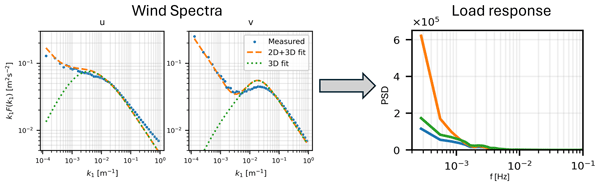
Abdul Haseeb Syed, Ásta Hannesdóttir, and Jakob Mann
Wind Energ. Sci., 11, 3321–3336, https://doi.org/10.5194/wes-11-3321-2026, https://doi.org/10.5194/wes-11-3321-2026, 2026
Short summary
Short summary
Large offshore wind turbines are exposed to slow changes in wind speed, which are often overlooked in design studies. We investigate how these slow wind variations impact the forces and motions of both fixed and floating wind turbines through computer simulations. Slow wind changes can lead to increased long-term structural wear and significantly impact platform motion in floating turbines. Accounting for these variations is crucial for the design and lifetime assessment of future turbines.
Agnese Firpo, Søren Juhl Andersen, and Giacomo Persico
Wind Energ. Sci. Discuss., https://doi.org/10.5194/wes-2026-141, https://doi.org/10.5194/wes-2026-141, 2026
Preprint under review for WES
Short summary
Short summary
Floating offshore wind turbines move with the waves, affecting wake dynamics and influencing the performance of downstream turbines. This study proposes a numerical framework to investigate the wake dynamics of a full-scale floating wind turbine. Results show that the frequency of platform motion affects wake dynamics, while the time mean wake remains largely unchanged. This work contributes to understanding floating wind turbine wakes and supports the development of efficient numerical models.
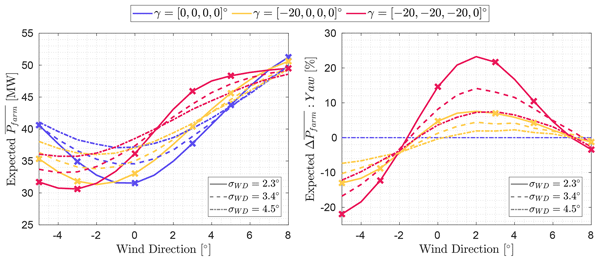
Emily Louise Hodgson and Søren Juhl Andersen
Wind Energ. Sci., 11, 2173–2190, https://doi.org/10.5194/wes-11-2173-2026, https://doi.org/10.5194/wes-11-2173-2026, 2026
Short summary
Short summary
This work investigates the impact of wind direction uncertainty on wake steering, a promising flow-control strategy that aims to increase the efficiency of wind farms, using high-fidelity computational fluid dynamics. It concludes that wake steering is sensitive to both bias and uncertainty in inflow wind direction due to having a relatively small range over which gains are predicted and showing significant decreases in peak power output with increasing wind direction uncertainty.
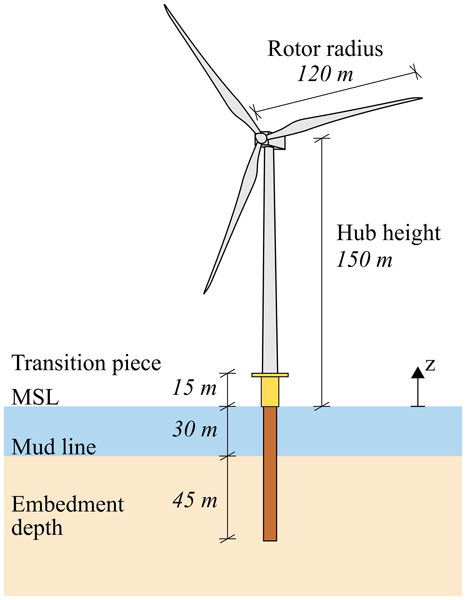
Mads Greve Pedersen, Jennifer Marie Rinker, Isaac Farreras Alcover, and Jan Høgsberg
Wind Energ. Sci., 11, 2053–2091, https://doi.org/10.5194/wes-11-2053-2026, https://doi.org/10.5194/wes-11-2053-2026, 2026
Short summary
Short summary
Offshore wind turbines are prone to fatigue caused by wind, wave, and operational loads, and lifetime extension may be enabled by monitoring stress histories. However, this is challenging because parts of the structure are sub‑sea and sub‑soil parts. Model‑based virtual sensing offers a solution, but current models simplify the rotor, which can lead to errors. This work addresses these errors and concludes that accuracy may be improved by including a flexible-rotor model and environmental variability.
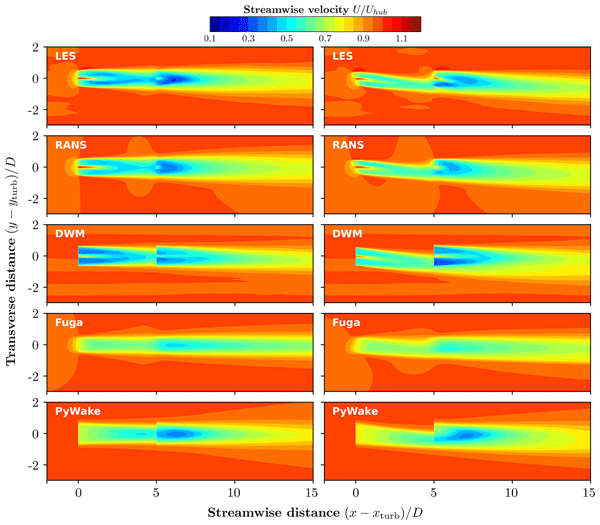
Julia Steiner, Emily Louise Hodgson, Maarten Paul van der Laan, Leonardo Alcayaga, Mads Pedersen, Søren Juhl Andersen, Gunner Larsen, and Pierre-Elouan Réthoré
Wind Energ. Sci., 11, 1679–1703, https://doi.org/10.5194/wes-11-1679-2026, https://doi.org/10.5194/wes-11-1679-2026, 2026
Short summary
Short summary
Wake steering is a promising strategy for wind farm optimization, but its success hinges on accurate wake models. We assess models of varying fidelity for a 22 MW reference turbine, comparing single- and two-turbine cases against large-eddy simulations. All models reproduced qualitative trends for power and loads (if applicable), but quantitative agreement varied, and in general the error increased with increasing yaw angle.
Alex Rybchuk, Henrik Asmuth, Armin Haghshenas, Ásta Hannesdóttir, Jan Friedrich, Jaime Liew, Jennifer M. Rinker, Daniel R. Houck, Regis Thedin, and Patrick Moriarty
Wind Energ. Sci. Discuss., https://doi.org/10.5194/wes-2026-77, https://doi.org/10.5194/wes-2026-77, 2026
Preprint under review for WES
Short summary
Short summary
Wind turbine engineers use wind simulation tools as part of the design process. We conducted a benchmark study for these tools. We collected detailed wind data from two sets of environments (a field campaign and a research-grade simulation). We gave benchmark participants limited information about this data, and they used their wind simulation tools of choice to reconstruct the winds. We compared the output of the different simulation codes, identifying strengths and shortcomings.
Stefan Ivanell, Warit Chanprasert, Luca Lanzilao, James Bleeg, Johan Meyers, Antoine Mathieu, Søren Juhl Andersen, Rem-Sophia Mouradi, Eric Dupont, Hugo Olivares-Espinosa, and Niels Troldborg
Wind Energ. Sci., 11, 937–960, https://doi.org/10.5194/wes-11-937-2026, https://doi.org/10.5194/wes-11-937-2026, 2026
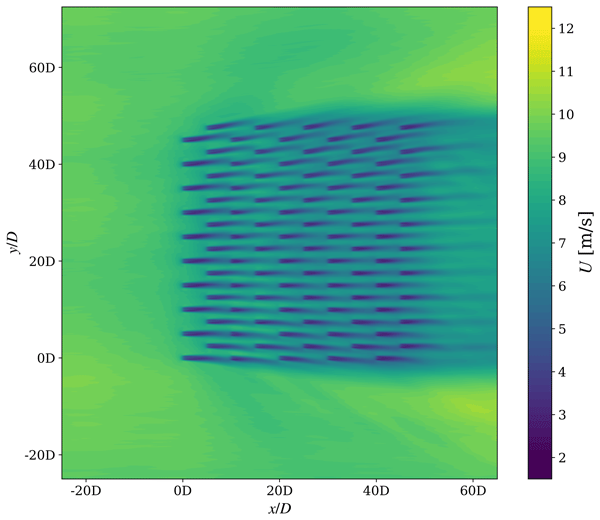
Short summary
Short summary
This study explores how the height of the atmosphere's boundary layer impacts wind farm performance, focusing on how this factor influences energy output. By simulating different boundary layer heights and conditions, this research reveals that deeper layers promote better energy recovery. The findings highlight the importance of considering atmospheric conditions when simulating wind farms to maximize energy efficiency, offering valuable insights for the wind energy industry.
Shadan Mozafari, Jennifer Marie Rinker, Paul Veers, and Katherine Dykes
Wind Energ. Sci., 11, 621–641, https://doi.org/10.5194/wes-11-621-2026, https://doi.org/10.5194/wes-11-621-2026, 2026
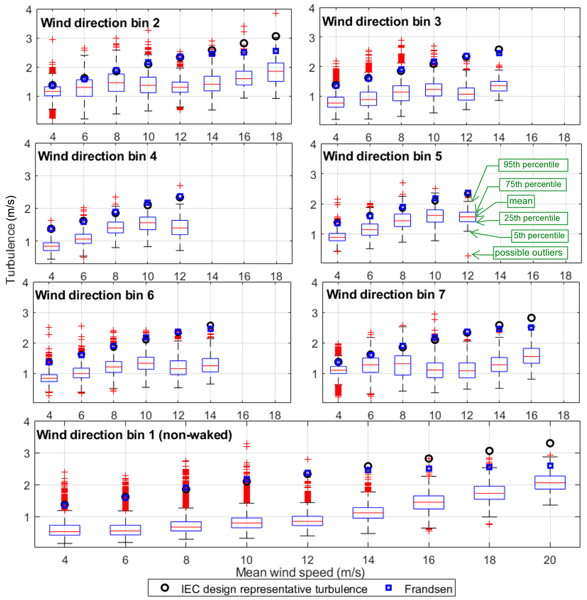
Short summary
Short summary
The study showcases the added value of using structural response measurements in lifetime extension assessments within wind farms. In addition, it answers two of the common questions in different methods of assessment. First, it assesses the applicability of the Frandsen model for estimating conservative waked turbulence in the compact layout of wind farms. Second, it showcases probabilistic extrapolation of short- to mid-term data for long-term site-specific fatigue assessments.
Juan Felipe Céspedes Moreno, Juan Pablo Murcia León, and Søren Juhl Andersen
Wind Energ. Sci., 10, 597–611, https://doi.org/10.5194/wes-10-597-2025, https://doi.org/10.5194/wes-10-597-2025, 2025
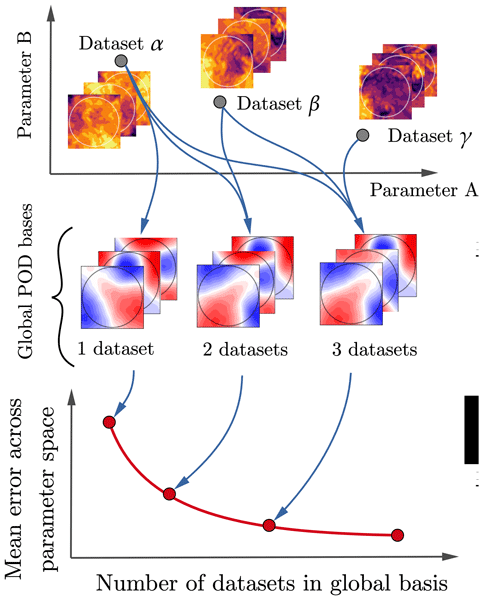
Short summary
Short summary
Using a global base in a proper orthogonal decomposition provides a common base for analyzing flows, such as wind turbine wakes, across an entire parameter space. This can be used to compare flows with different conditions using the same physical interpretation. This work shows the convergence of the global base, its small error compared to the truncation error in the flow reconstruction, and the insensitivity to which datasets are included for generating the global base.
Jens Visbech, Tuhfe Göçmen, Özge Sinem Özçakmak, Alexander Meyer Forsting, Ásta Hannesdóttir, and Pierre-Elouan Réthoré
Wind Energ. Sci., 9, 1811–1826, https://doi.org/10.5194/wes-9-1811-2024, https://doi.org/10.5194/wes-9-1811-2024, 2024
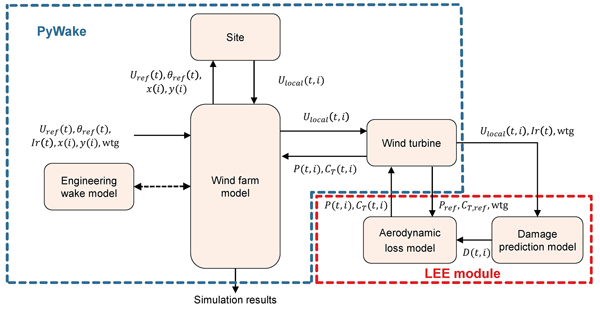
Short summary
Short summary
Leading-edge erosion (LEE) can impact wind turbine aerodynamics and wind farm efficiency. This study couples LEE prediction, aerodynamic loss modeling, and wind farm flow modeling to show that LEE's effects on wake dynamics can affect overall energy production. Without preventive initiatives, the effects of LEE increase over time, resulting in significant annual energy production (AEP) loss.
Shadan Mozafari, Paul Veers, Jennifer Rinker, and Katherine Dykes
Wind Energ. Sci., 9, 799–820, https://doi.org/10.5194/wes-9-799-2024, https://doi.org/10.5194/wes-9-799-2024, 2024
Short summary
Short summary
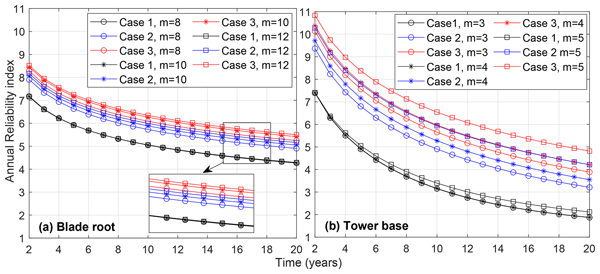
Turbulence is one of the main drivers of fatigue in wind turbines. There is some debate on how to model the turbulence in normal wind conditions in the design phase. To address such debates, we study the fatigue load distribution and reliability following different models of the International Electrotechnical Commission 61400-1 standard. The results show the lesser importance of load uncertainty due to turbulence distribution compared to the uncertainty of material resistance and Miner’s rule.
Ásta Hannesdóttir, David R. Verelst, and Albert M. Urbán
Wind Energ. Sci., 8, 231–245, https://doi.org/10.5194/wes-8-231-2023, https://doi.org/10.5194/wes-8-231-2023, 2023
Short summary
Short summary
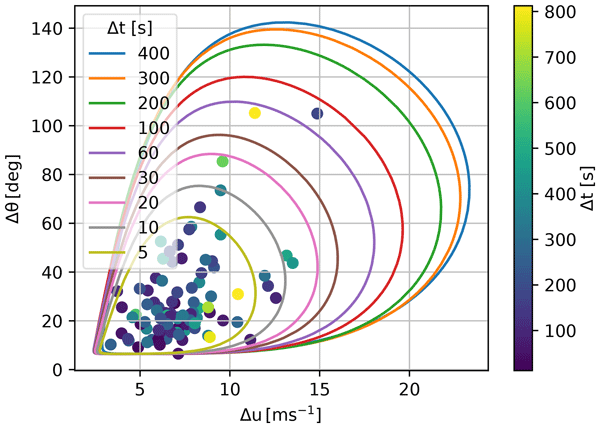
In this work we use observations of large coherent fluctuations to define a probabilistic gust model. The gust model provides the joint description of the gust rise time, amplitude, and direction change. We perform load simulations with a coherent gust according to the wind turbine safety standard and with the probabilistic gust model. A comparison of the simulated loads shows that the loads from the probabilistic gust model can be significantly higher due to variability in the gust parameters.
Xiaoli Guo Larsén, Marc Imberger, Ásta Hannesdóttir, and Andrea N. Hahmann
Wind Energ. Sci. Discuss., https://doi.org/10.5194/wes-2022-102, https://doi.org/10.5194/wes-2022-102, 2023
Revised manuscript not accepted
Short summary
Short summary
We study how climate change will impact extreme winds and choice of turbine class. We use data from 18 CMIP6 members from a historic and a future period to access the change in the extreme winds. The analysis shows an overall increase in the extreme winds in the North Sea and the southern Baltic Sea, but a decrease over the Scandinavian Peninsula and most of the Baltic Sea. The analysis is inconclusive to whether higher or lower classes of turbines will be installed in the future.
Merete Badger, Haichen Zuo, Ásta Hannesdóttir, Abdalmenem Owda, and Charlotte Hasager
Wind Energ. Sci., 7, 2497–2512, https://doi.org/10.5194/wes-7-2497-2022, https://doi.org/10.5194/wes-7-2497-2022, 2022
Short summary
Short summary
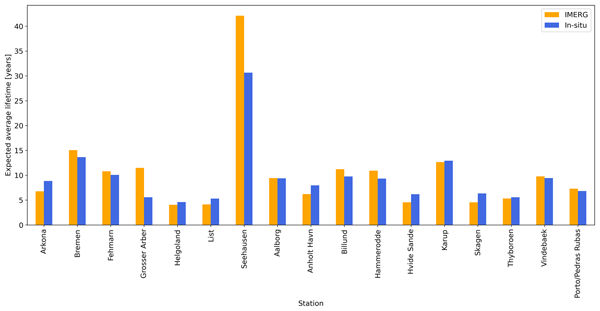
When wind turbine blades are exposed to strong winds and heavy rainfall, they may be damaged and their efficiency reduced. The problem is most pronounced offshore where turbines are tall and the climate is harsh. Satellites provide global half-hourly rain observations. We use these rain data as input to a model for blade lifetime prediction and find that the satellite-based predictions agree well with predictions based on observations from weather stations on the ground.
Søren Juhl Andersen and Juan Pablo Murcia Leon
Wind Energ. Sci., 7, 2117–2133, https://doi.org/10.5194/wes-7-2117-2022, https://doi.org/10.5194/wes-7-2117-2022, 2022
Short summary
Short summary
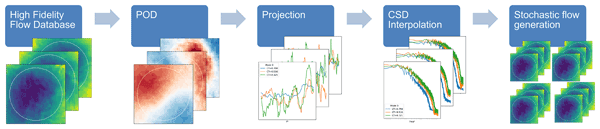
Simulating the turbulent flow inside large wind farms is inherently complex and computationally expensive. A new and fast model is developed based on data from high-fidelity simulations. The model captures the flow dynamics with correct statistics for a wide range of flow conditions. The model framework provides physical insights and presents a generalization of high-fidelity simulation results beyond the case-specific scenarios, which has significant potential for future turbulence modeling.
Tuhfe Göçmen, Filippo Campagnolo, Thomas Duc, Irene Eguinoa, Søren Juhl Andersen, Vlaho Petrović, Lejla Imširović, Robert Braunbehrens, Jaime Liew, Mads Baungaard, Maarten Paul van der Laan, Guowei Qian, Maria Aparicio-Sanchez, Rubén González-Lope, Vinit V. Dighe, Marcus Becker, Maarten J. van den Broek, Jan-Willem van Wingerden, Adam Stock, Matthew Cole, Renzo Ruisi, Ervin Bossanyi, Niklas Requate, Simon Strnad, Jonas Schmidt, Lukas Vollmer, Ishaan Sood, and Johan Meyers
Wind Energ. Sci., 7, 1791–1825, https://doi.org/10.5194/wes-7-1791-2022, https://doi.org/10.5194/wes-7-1791-2022, 2022
Short summary
Short summary
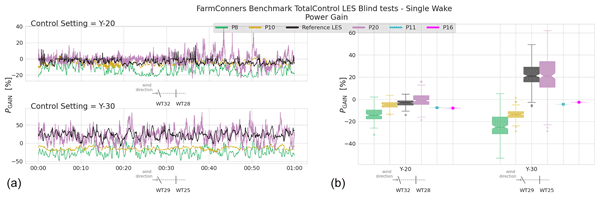
The FarmConners benchmark is the first of its kind to bring a wide variety of data sets, control settings, and model complexities for the (initial) assessment of wind farm flow control benefits. Here we present the first part of the benchmark results for three blind tests with large-scale rotors and 11 participating models in total, via direct power comparisons at the turbines as well as the observed or estimated power gain at the wind farm level under wake steering control strategy.
Niels Troldborg, Søren J. Andersen, Emily L. Hodgson, and Alexander Meyer Forsting
Wind Energ. Sci., 7, 1527–1532, https://doi.org/10.5194/wes-7-1527-2022, https://doi.org/10.5194/wes-7-1527-2022, 2022
Short summary
Short summary
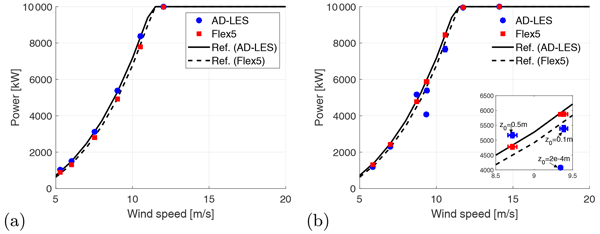
This article shows that the power performance of a wind turbine may be very different in flat and complex terrain. This is an important finding because it shows that the power output of a given wind turbine is governed by not only the available wind at the position of the turbine but also how the ambient flow develops in the region behind the turbine.
Cited articles
Andersen, S. J., Sørensen, J. N., and Mikkelsen, R.: Simulation of the inherent turbulence and wake interaction inside an infinitely long row of wind turbines, J. Turbul., 14, 1–24, https://doi.org/10.1080/14685248.2013.796085, 2013. a
Andersen, S. J., Sørensen, J. N., and Mikkelsen, R. F.: Turbulence and entrainment length scales in large wind farms, Philos. T. R. Soc. S.-A, 375, https://doi.org/10.1098/rsta.2016.0107, 2017. a
Angelou, N. and Sjöholm, M.: Data reliability enhancement for wind-turbine-mounted lidars, Remote Sens.-Basel, 14, https://doi.org/10.3390/rs14133225, 2022. a, b, c
Bak, C., Zahle, F., Bitsche, R., Kim, T., Yde, A., Henriksen, L. C., Hansen, M. H., Blasques, J. P. A. A., Gaunaa, M., and Natarajan, A.: The DTU 10-MW Reference Wind Turbine, Sound/Visual production (digital), https://orbit.dtu.dk/files/55645274/The DTU 10MW Reference Turbine Christian Bak.pdf (last access: 6 May 2026) 2013. a
Bao, Y., Tan, C., and Jia, J.: Fast dual-LiDAR reconstruction for dynamic wind field retrieval, Atmosphere-Basel, 13, https://doi.org/10.3390/atmos13060905, 2022. a
Bastine, D., Vollmer, L., Wächter, M., and Peinke, J.: Stochastic wake modelling based on POD analysis, Energies, 11, 1–29, https://doi.org/10.3390/en11030612, 2018. a
Bauweraerts, P. and Meyers, J.: Bayesian based estimation of turbulent flow fields from lidar observations in a conventionally neutral atmospheric boundary layer, J. Phys. Conf. Ser., 1618, 032047, https://doi.org/10.1088/1742-6596/1618/3/032047, 2020. a
Bauweraerts, P. and Meyers, J.: Reconstruction of turbulent flow fields from lidar measurements using large-eddy simulation, J. Fluid Mech., 906, A17, https://doi.org/10.1017/jfm.2020.805, 2021. a
Beck, H. and Kühn, M.: Temporal up-sampling of planar long-range Doppler LiDAR wind speed measurements using space-time conversion, Remote Sens.-Basel, 11, 867, https://doi.org/10.3390/rs11070867, 2019. a
Berkooz, G., Holmes, P., and Lumley, J. L.: The proper orthogonal decomposition in the analysis of turbulent flows, Annu. Rev. Fluid Mech., 25, 539–575, https://doi.org/10.1146/annurev.fl.25.010193.002543, 1993. a
Bokati, L., Velasco, A., and Kreinovich, V.: Scale-invariance and fuzzy techniques explain the empirical success of inverse distance weighting and of dual inverse distance weighting in geosciences, in: Fuzzy Information Processing 2020. NAFIPS 2020. Advances in Intelligent Systems and Computing, edited by: Bede, B., Ceberio, M., De Cock, M., and Kreinovich, V., Vol. 1337, Springer International Publishing, Cham, https://doi.org/10.1007/978-3-030-81561-5_32, 379–390, 2022. a, b
Borraccino, A., Schlipf, D., Haizmann, F., and Wagner, R.: Wind field reconstruction from nacelle-mounted lidar short-range measurements, Wind Energ. Sci., 2, 269–283, https://doi.org/10.5194/wes-2-269-2017, 2017. a
Bossanyi, E.: Un-freezing the turbulence: application to LiDAR-assisted wind turbine control, IET Renew. Power Gen., 7, 321–329, https://doi.org/10.1049/iet-rpg.2012.0260, 2013. a
Bossanyi, E. A., Kumar, A., and Hugues-Salas, O.: Wind turbine control applications of turbine-mounted LIDAR, J. Phys. Conf. Ser., 555, 012011, https://doi.org/10.1088/1742-6596/555/1/012011, 2012. a, b
Canet, H., Loew, S., and Bottasso, C. L.: What are the benefits of lidar-assisted control in the design of a wind turbine?, Wind Energ. Sci., 6, 1325–1340, https://doi.org/10.5194/wes-6-1325-2021, 2021. a
Castro, I.: Rough-wall boundary layers: Mean flow universality, J. Fluid Mech, 585, 469–485, https://doi.org/10.1017/S0022112007006921, 2007. a
Céspedes Moreno, J. F., Murcia León, J. P., and Andersen, S. J.: Convergence and efficiency of global bases using proper orthogonal decomposition for capturing wind turbine wake aerodynamics, Wind Energ. Sci., 10, 597–611, https://doi.org/10.5194/wes-10-597-2025, 2025. a, b, c
Chu, J., Han, Y., Sun, D., Han, F., and Liu, H.: Statistical interpolation technique based on coherent Doppler lidar for real-time horizontal wind shear observations and forewarning, Opt. Eng., 60, 046102, https://doi.org/10.1117/1.OE.60.4.046102, 2021. a
De Cillis, G., Cherubini, S., Semeraro, O., Leonardi, S., and De Palma, P.: POD analysis of the recovery process in wind turbine wakes, J. Phys. Conf. Ser., 1618, 062016, https://doi.org/10.1088/1742-6596/1618/6/062016, 2020. a
de Maré, M. and Mann, J.: On the space-time structure of sheared turbulence, Bound.-Lay. Meteorol., 160, 453–474, https://doi.org/10.1007/s10546-016-0143-z, 2016. a
Dimitrov, N. and Natarajan, A.: Application of simulated lidar scanning patterns to constrained Gaussian turbulence fields for load validation, Wind Energy, 20, 79–95, https://doi.org/10.1002/we.1992, 2016. a, b
Dimitrov, N., Kelly, M. C., Vignaroli, A., and Berg, J.: From wind to loads: wind turbine site-specific load estimation with surrogate models trained on high-fidelity load databases, Wind Energ. Sci., 3, 767–790, https://doi.org/10.5194/wes-3-767-2018, 2018. a
Dong, L., Lio, W. H., and Simley, E.: On turbulence models and lidar measurements for wind turbine control, Wind Energ. Sci., 6, 1491–1500, https://doi.org/10.5194/wes-6-1491-2021, 2021. a
Doubrawa, P., Churchfield, M. J., Godvik, M., and Sirnivas, S.: Load response of a floating wind turbine to turbulent atmospheric flow, Appl. Energ., 242, 1588–1599, https://doi.org/10.1016/j.apenergy.2019.01.165, 2019. a
DTU Wind Energy: HAWC2 Horizontal Axis Wind turbine simulation Code 2nd generation, https://tools.windenergy.dtu.dk/home/HAWC2/ (last access: 11 July 2025), 2024. a
Dunne, F., Pao, L. Y., Wright, A., Jonkman, B., Kelley, N., and Simley, E.: Adding feedforward blade pitch control for load mitigation in wind turbines: non-causal series expansion, preview control, and optimized fir filter methods, 49th AIAA Aerospace Sciences Meeting Including the New Horizons Forum and Aerospace Exposition, https://doi.org/10.2514/6.2011-819, 2011. a
Dunne, F., Schlipf, D., Pao, L., Wright, A., Jonkman, B., Kelley, N., and Simley, E.: Comparison of two independent LIDAR-based pitch control designs, in: 50th AIAA Aerospace Sciences Meeting Including the New Horizons Forum and Aerospace Exposition, American Institute of Aeronautics and Astronautics, https://doi.org/10.2514/6.2012-1151, 2012:1151, 2012. a, b
Friedland, C. J., Joyner, T. A., Massarra, C., Rohli, R. V., Treviño, A. M., Ghosh, S., Huyck, C., and Weatherhead, M.: Isotropic and anisotropic kriging approaches for interpolating surface-level wind speeds across large, geographically diverse regions, Geomat. Nat. Haz. Risk, 8, 207–224, https://doi.org/10.1080/19475705.2016.1185749, 2016. a
Fu, W., Sebastiani, A., Pe˜na, A. and Mann, J.: Influence of nacelle-lidar scanning patterns on inflow turbulence characterization, J. Phys. Conf. Ser., 2265, 022016, https://doi.org/10.1088/1742-6596/2265/2/022016, 2022. a
Fu, W., Guo, F., Schlipf, D., and Peña, A.: Feedforward pitch control for a 15 MW wind turbine using a spinner-mounted single-beam lidar, Wind Energ. Sci., 8, 1893–1907, https://doi.org/10.5194/wes-8-1893-2023, 2023. a, b
Gräfe, M., Pettas, V., Gottschall, J., and Cheng, P. W.: Quantification and correction of motion influence for nacelle-based lidar systems on floating wind turbines, Wind Energ. Sci., 8, 925–946, https://doi.org/10.5194/wes-8-925-2023, 2023. a
Guo, F., Mann, J., Peña, A., Schlipf, D., and Cheng, P. W.: The space-time structure of turbulence for lidar-assisted wind turbine control, Renew. Energ., 195, 293–310, https://doi.org/10.1016/j.renene.2022.05.133, 2022. a
Guo, F., Schlipf, D., and Cheng, P. W.: Evaluation of lidar-assisted wind turbine control under various turbulence characteristics, Wind Energ. Sci., 8, 149–171, https://doi.org/10.5194/wes-8-149-2023, 2023. a
Halko, N., Martinsson, P. G., and Tropp, J. A.: Finding structure with randomness: probabilistic algorithms for constructing approximate matrix decompositions, SIAM Rev., 53, 217–288, https://doi.org/10.1137/090771806, 2011. a
Hamilton, N., Doubrawa, P., Moriarty, P., Letizia, S., and Thedin, R.: Modal dynamics of wind turbine wake meandering from lidar observations, Renew. Energ., 254, 123555, https://doi.org/10.1016/j.renene.2025.123555, 2025. a
Held, D. P. and Mann, J.: Lidar estimation of rotor-effective wind speed – an experimental comparison, Wind Energ. Sci., 4, 421–438, https://doi.org/10.5194/wes-4-421-2019, 2019. a, b
Herges, T. G., Maniaci, D. C., Naughton, B. T., Mikkelsen, T., and Sjöholm, M.: High resolution wind turbine wake measurements with a scanning lidar, J. Phys. Conf. Ser., 854, 012021, https://doi.org/10.1088/1742-6596/854/1/012021, 2017. a
Iqbal, M. O. and Thomas, F. O.: Coherent structure in a turbulent jet via a vector implementation of the proper orthogonal decomposition, J. Fluid Mech., 571, 281–326, https://doi.org/10.1017/S0022112006003351, 2007. a
Joyner, T. A., Friedland, C. J., Rohli, R. V., Treviño, A. M., Massarra, C., and Paulus, G.: Cross-correlation modeling of european windstorms: a cokriging approach for optimizing surface wind estimates, Spat. Stat., 13, 62–75, https://doi.org/10.1016/j.spasta.2015.05.003, 2015. a
Kelberlau, F. and Mann, J.: Cross-contamination effect on turbulence spectra from Doppler beam swinging wind lidar, Wind Energ. Sci., 5, 519–541, https://doi.org/10.5194/wes-5-519-2020, 2020. a
Kidambi Sekar, A. P., van Dooren, M. F., Rott, A., and Kühn, M.: Lower order description and reconstruction of sparse scanning lidar measurements of wind turbine inflow using proper orthogonal decomposition, Remote Sens.-Basel, 14, 2681, https://doi.org/10.3390/rs14112681, 2022. a
Letizia, S., Brugger, P., Bodini, N., Krishnamurthy, R., Scholbrock, A., Simley, E., Porté-Agel, F., Hamilton, N., Doubrawa, P., and Moriarty, P.: Characterization of wind turbine flow through nacelle-mounted lidars: a review, Front. Mech. Eng., 9, 1261017, https://doi.org/10.3389/fmech.2023.1261017, 2023. a, b, c
Li, Z., Zhang, X., Zhu, R., Zhang, Z., and Weng, Z.: Integrating data-to-data correlation into inverse distance weighting, Computat. Geosci., 24, 203–216, https://doi.org/10.1007/s10596-019-09913-9, 2020. a
Liverud Krathe, V., Jonkman, J., Gebel, J., Rivera-Arreba, I., Nejad, A., and Bachynski-Polić, E.: Investigation of main bearing fatigue estimate sensitivity to synthetic turbulence models using a novel drivetrain model implemented in OpenFAST, Wind Energy, 28, e70005, https://doi.org/10.1002/we.70005, 2025. a
Lumley, J. L.: The Structure of Inhomogeneous Turbulence, in: Atmospheric Turbulence and Wave Propagation, Nauka, Moscow, 166–178, ISBN 9783937655239, 1967. a
Luo, W., Taylor, M., and Parker, S.: A comparison of spatial interpolation methods to estimate continuous wind speed surfaces using irregularly distributed data from england and wales, Int. J. Climatol., 28, 947–959, https://doi.org/10.1002/joc.1583, 2007. a
Mann, J.: Wind field simulation, Probabilist. Eng. Mech., 13, 269–282, https://doi.org/10.1016/S0266-8920(97)00036-2, 1998. a
Mann, J., Peña, A., Troldborg, N., and Andersen, S. J.: How does turbulence change approaching a rotor?, Wind Energ. Sci., 3, 293–300, https://doi.org/10.5194/wes-3-293-2018, 2018. a
Meneveau, C.: Big wind power: seven questions for turbulence research, J. Turbul., 20, 2–20, https://doi.org/10.1080/14685248.2019.1584664, 2019. a
Meyer Forsting, A. R., Troldborg, N., and Borraccino, A.: Modelling lidar volume-averaging and its significance to wind turbine wake measurements, J. Phys. Conf. Ser., 854, 012014, https://doi.org/10.1088/1742-6596/854/1/012014, 2017. a
Michelsen, J. A.: Basis3D – a Platform for Development of Multiblock PDE Solvers: β-release, Technical report, Technical University of Denmark, https://backend.orbit.dtu.dk/ws/portalfiles/portal/272917945/Michelsen J Basis3D.pdf (last access: 27 April 2026), 1992. a
Michelsen, J. A.: Block structured Multigrid solution of 2D and 3D elliptic PDE's, Technical Report AFM 94-06, Technical University of Denmark, 1994. a
Mikkelsen, T., Angelou, N., Hansen, K., Sjöholm, M., Harris, M., Slinger, C., Hadley, P., Scullion, R., Ellis, G., and Vives, G.: A spinner integrated wind lidar for enhanced wind turbine control, Wind Energy, 16, 625–643, https://doi.org/10.1002/we.1564, 2013. a
Moore, E. H.: On the reciprocal of the general algebraic matrix, B. Am. Math. Soc., 26, 394–395, 1920. a
Munters, W., Meneveau, C., and Meyers, J.: Shifted periodic boundary conditions for simulations of wall-bounded turbulent flows, Phys. Fluids, 28, 025112, https://doi.org/10.1063/1.4941912, 2016. a
Newman, A. J., Drew, D. A., and Castillo, L.: Pseudo spectral analysis of the energy entrainment in a scaled down wind farm, Renew. Energ., 70, 129–141, https://doi.org/10.1016/j.renene.2014.02.003, 2014. a
OpenAI: GPT-4 Technical Report, arXiv [preprint], https://doi.org/10.48550/arXiv.2303.08774, 2023. a
Peña, A., Hasager, C. B., Lange, J., Anger, J., Badger, M., Bingöl, F., Bischoff, O., Cariou, J.-P., Dunne, F., Emeis, S., Harris, M., Hofsäss, M., Karagali, I., Laks, J., Larsen, S. E., Mann, J., Mikkelsen, T., Pao, L. Y., Pitter, M., and Würth, I.: Remote Sensing for Wind Energy, Tech. Rep. E No. 0029(EN), DTU Wind Energy, ISBN 978-87-92896-41-4, https://backend.orbit.dtu.dk/ws/portalfiles/portal/55501125/Remote Sensing for Wind Energy.pdf (last access: 27 April 2026), 2013. a
Peña, A., Hasager, C., Badger, M., Barthelmie, R., Bingöl, F., Cariou, J.-P., Emeis, S., Frandsen, S., Harris, M., Karagali, I., Larsen, S., Mann, J., Mikkelsen, T., Pitter, M., Pryor, S., Sathe, A., Schlipf, D., Slinger, C., and Wagner, R.: Remote sensing for wind energy, Tech. rep., DTU Wind Energy, ISBN 978-87-93278-34-9, https://backend.orbit.dtu.dk/ws/portalfiles/portal/111814239/DTU Wind Energy Report E 0084.pdf (last access: 27 April 2026), 2015. a
Peña, A., Mann, J., and Dimitrov, N.: Turbulence characterization from a forward-looking nacelle lidar, Wind Energ. Sci., 2, 133–152, https://doi.org/10.5194/wes-2-133-2017, 2017. a, b
Penrose, R.: A generalized inverse for matrices, P. Camb. Philos. Soc., 51, 406–413, 1955. a
Raach, S., Schlipf, D., Haizmann, F., and Cheng, P. W.: Three dimensional dynamic model based wind field reconstruction from lidar data, J. Phys. Conf. Ser., 524, 012005, https://doi.org/10.1088/1742-6596/524/1/012005, 2014. a
Rinker, J. M.: Impact of rotor size on aeroelastic uncertainty with lidar-constrained turbulence, J. Phys. Conf. Ser., 2265, 032011, https://doi.org/10.1088/1742-6596/2265/3/032011, 2022. a
Rivera-Arreba, I., Wise, A. S., Hermile, M., Chow, F. K., and Bachynski-Polić, E. E.: Effects of atmospheric stability on the structural response of a 12 MW semisubmersible floating wind turbine, Wind Energy, 25, 1917–1937, https://doi.org/10.1002/we.2775, 2022. a
Russell, A. J., Collu, M., McDonald, A. S., Thies, P. R., Keane, A., and Quayle, A. R.: Lidar assisted feedforward individual pitch control of a 15 MW floating offshore wind turbine, Wind Energy, 27, 341–362, https://doi.org/10.1002/we.2891, 2024. a, b, c
Sathe, A., Banta, R., Pauscher, L., Vogstad, K., Schlipf, D., and Wylie, S.: Estimating turbulence statistics and parameters from ground- and nacelle-based lidar measurements: IEA wind expert report, Tech. Rep. Grant no: 0602-02486B, DTU Wind Energy, ISBN 978-87-93278-35-6, https://backend.orbit.dtu.dk/ws/portalfiles/portal/116998413/Estimating Turbulence Statistics.pdf (last access: 27 April 2026) 2015. a
Schlipf, D.: Lidar-Assisted Control Concepts for Wind Turbines, PhD thesis, University of Stuttgart, Institute of Aircraft Design, University of Stuttgart, https://doi.org/10.18419/opus-8796, 2016. a, b
Schlipf, D. and Kühn, M.: Prospects of a collective pitch control by means of predictive disturbance compensation assisted by wind speed measurements, in: Proceedings of the 9th German Wind Energy Conference DEWEK 2008, 26–27 November, Bremen, Germany, https://doi.org/10.18419/opus-3900, 2008. a
Schlipf, D., Schuler, S., Grau, P., Allgöwer, F., and Kühn, M.: Look-ahead cyclic pitch control using lidar, in: Proceedings of the Science of Making Torque from Wind 2010, Crete, Greece, https://doi.org/10.18419/opus-4538, 2010. a
Schlipf, D., Schlipf, D. J., and Kühn, M.: Nonlinear model predictive control of wind turbines using LIDAR, Wind Energy, 16, 1107–1129, https://doi.org/10.1002/we.1533, 2013. a
Schlipf, D., Haizmann, F., Cosack, N., Siebers, T., and Cheng, P. W.: Detection of wind evolution and lidar trajectory optimization for lidar-assisted wind turbine control, Meteorol. Z., 24, 565–579, https://doi.org/10.1127/metz/2015/0634, 2015. a
Schlipf, D., Hille, N., Raach, S., Scholbrock, A., and Simley, E.: IEA Wind Task 32: best practices for the certification of lidar-assisted control applications, J. Phys. Conf. Ser., 1102, 012010, https://doi.org/10.1088/1742-6596/1102/1/012010, 2018. a
Scholbrock, A., Fleming, P., Schlipf, D., Wright, A., Johnson, K., and Wang, N.: Lidar-enhanced wind turbine control: past, present, and future, Amer. Contr. Conf. Conf., 555, 1399–1406, https://doi.org/10.1109/acc.2016.7525113, 2016. a
Sebastiani, A., Peña, A., and Troldborg, N.: Wind turbine power performance characterization through aeroelastic simulations and virtual nacelle lidar measurements, J. Phys. Conf. Ser., 2265, 022059, https://doi.org/10.1088/1742-6596/2265/2/022059, 2022. a
Sekar, A. P. K., van Dooren, M. F., and Kühn, M.: Overcoming blade interference: a gappy-pod data reconstruction method for nacelle-mounted lidar measurements, J. Phys. Conf. Ser., 2265, 022078, https://doi.org/10.1088/1742-6596/2265/2/022078, 2022. a
Simley, E., Pao, L., Frehlich, R., Jonkman, B., and Kelley, N.: Analysis of wind speed measurements using continuous wave LIDAR for wind turbine control, in: 49th AIAA Aerospace Sciences Meeting including the New Horizons Forum and Aerospace Exposition, Orlando, Florida, https://doi.org/10.2514/6.2011-263, 2011. a
Simley, E., Pao, L. Y., Kelley, N., Jonkman, B., and Frehlich, R.: LIDAR wind speed measurements of evolving wind fields, in: 50th AIAA Aerospace Sciences Meeting Including the New Horizons Forum and Aerospace Exposition, AIAA, Nashville, Tennessee, https://doi.org/10.2514/6.2012-656, 2012. a
Simley, E., Pao, L. Y., Frehlich, R., Jonkman, B., and Kelley, N.: Analysis of light detection and ranging wind speed measurements for wind turbine control, Wind Energy, 17, 413–433, https://doi.org/10.1002/we.1584, 2014. a
Simley, E., Fürst, H., Haizmann, F., and Schlipf, D.: Optimizing lidars for wind turbine control applications – results from the IEA Wind Task 32 workshop, Remote Sens.-Basel, 10, 863, https://doi.org/10.3390/rs10060863, 2018. a, b, c
Soto Sagredo, E. A.: Wind field reconstruction methods for a hub-mounted lidar, PhD thesis, DTU Wind and Energy Systems, Technical University of Denmark, https://doi.org/10.11581/6ada55bf-2225-4f18-89d2-bf50696949f7, in press, 2026. a
Soto Sagredo, E., Rinker, J. M., and Lund, R. S.: Verification of numerical lidars in HAWC2: Analysis of nacelle- and hub-mounted lidars, Tech. Rep. E-0239, DTU Wind Energy, https://doi.org/10.11581/DTU.00000302, 2023. a
Soto Sagredo, E., Rinker, J. M., Andersen, S. J., and Forrest, J. P.: Wind-field characterization using synthetic lidar measurements and proper orthogonal decomposition, J. Phys. Conf. Ser., 2767, 052061, https://doi.org/10.1088/1742-6596/2767/5/052061, 2024a. a
Soto Sagredo, E. A., Hannesdóttir, A., Rinker, J. M., and Courtney, M.: Reconstructing turbulent wind-fields using inverse-distance-weighting interpolation and measurements from a pulsed mounted-hub lidar, J. Phys. Conf. Ser., 2745, 012017, https://doi.org/10.1088/1742-6596/2745/1/012017, 2024b. a
Soto Sagredo, E., Rinker, J. M., and Andersen, S. J.: Numerical hub-lidar data from LES-generated turbulence boxes using HAWC2 v13.1 and DTU 10MW reference wind turbine, Technical University of Denmark [data set], https://doi.org/10.11583/DTU.28151724, 2025a. a, b
Soto Sagredo, E., Rinker, J. M., Hannesdóttir, A., and Courtney, M.: Numerical evaluation of the smearing effect in a spinner-mounted lidar for wind field reconstruction, J. Phys. Conf. Ser., 3025, 012006, https://doi.org/10.1088/1742-6596/3025/1/012006, 2025b. a
Sørensen, J. N., Mikkelsen, R. F., Henningson, D. S., Ivanell, S., Sarmast, S., and Andersen, S. J.: Simulation of wind turbine wakes using the actuator line technique, Philos. T. Roy. Soc. A, 373, 20140071, https://doi.org/10.1098/rsta.2014.0071, 2015. a
Sørensen, N. N.: General Purpose Flow Solver Applied to Flow over Hills, Risø National Laboratory, https://backend.orbit.dtu.dk/ws/portalfiles/portal/12280331/Ris R 827.pdf (last access: 27 April 2026), 1995. a
Taylor, G. I.: The spectrum of turbulence, P. Roy. Soc. A-Math. Phy., 164, 476–490, https://doi.org/10.1098/rspa.1938.0032, 1938. a
Technical University of Denmark: Sophia HPC Cluster, https://doi.org/10.57940/FAFC-6M81, 2019. a
Thedin, R., Quon, E., Churchfield, M., and Veers, P.: Investigations of correlation and coherence in turbulence from a large-eddy simulation, Wind Energ. Sci., 8, 487–502, https://doi.org/10.5194/wes-8-487-2023, 2023. a
Troldborg, N., Andersen, S. J., Hodgson, E. L., and Meyer Forsting, A.: Brief communication: How does complex terrain change the power curve of a wind turbine?, Wind Energ. Sci., 7, 1527–1532, https://doi.org/10.5194/wes-7-1527-2022, 2022. a
VerHulst, C. and Meneveau, C.: Large eddy simulation study of the kinetic energy entrainment by energetic turbulent flow structures in large wind farms, Phys. Fluids, 26, 025113, https://doi.org/10.1063/1.4865755, 2014. a
Zhang, J. and Zhao, X.: Spatiotemporal wind field prediction based on physics-informed deep learning and LIDAR measurements, Appl. Energ., 288, 116641, https://doi.org/10.1016/j.apenergy.2021.116641, 2021a. a
Zhang, J. and Zhao, X.: Three-dimensional spatiotemporal wind field reconstruction based on physics-informed deep learning, Appl. Energ., 300, 117390, https://doi.org/10.1016/j.apenergy.2021.117390, 2021b. a
Short summary
Large wind turbines are highly sensitive to changing winds, yet current measurements miss important details. This study compares three methods to reconstruct the full wind field ahead of a turbine in real time using lidar data and simulations. The results show these approaches can capture detailed inflow structures, which could help turbines anticipate wind changes, improve control strategies, and reduce structural loads.
Large wind turbines are highly sensitive to changing winds, yet current measurements miss...


Altmetrics
Final-revised paper
Preprint